

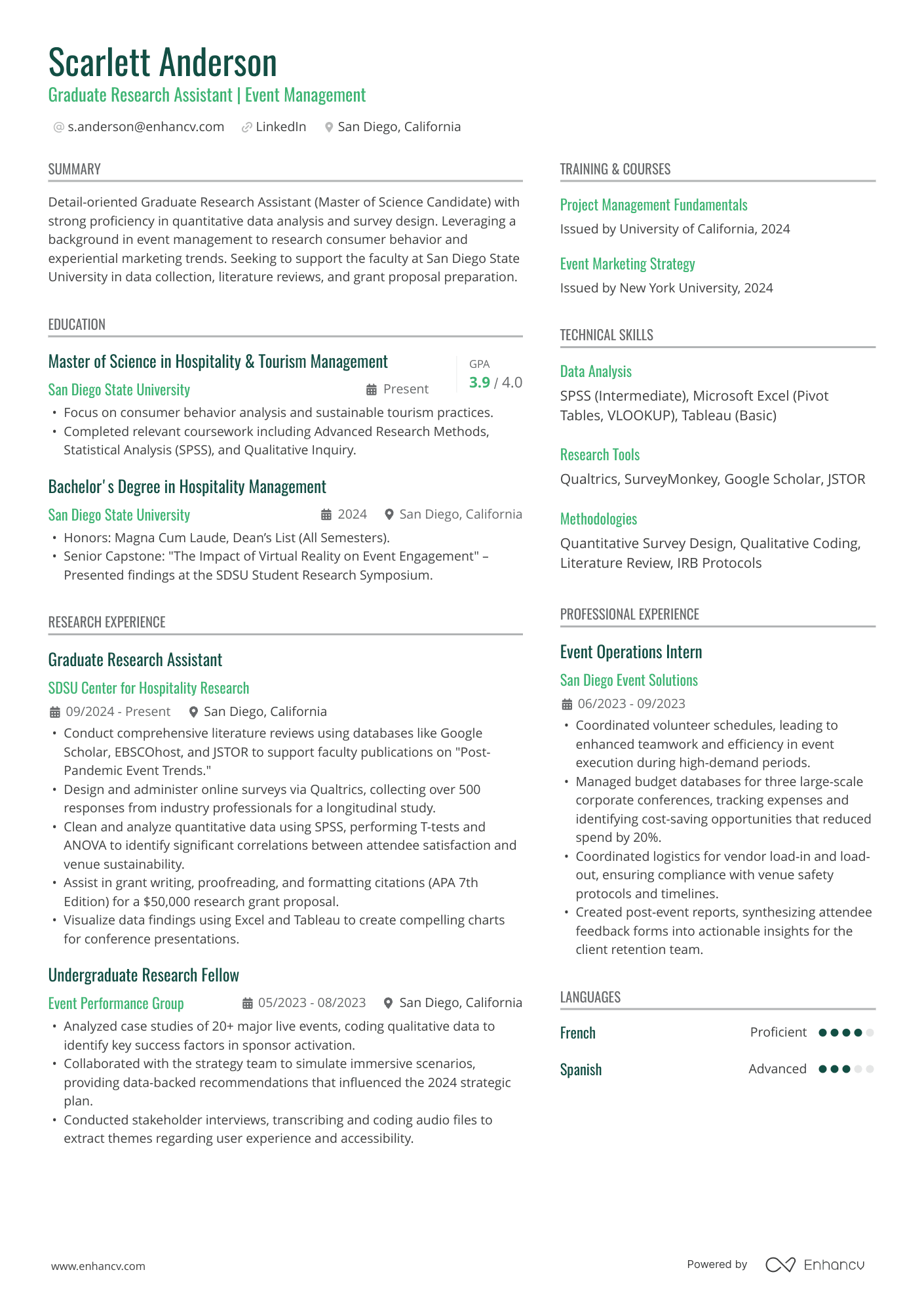
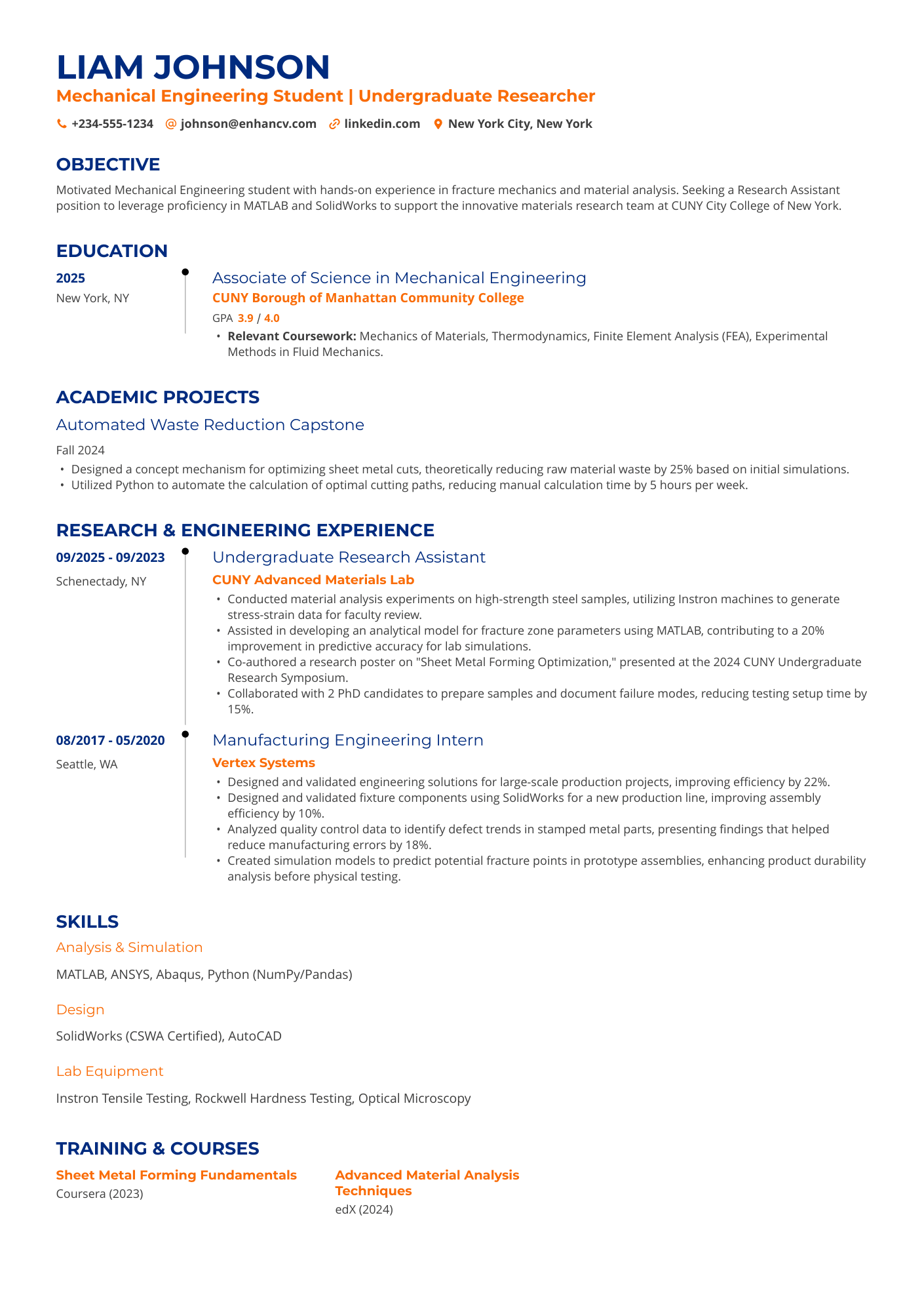
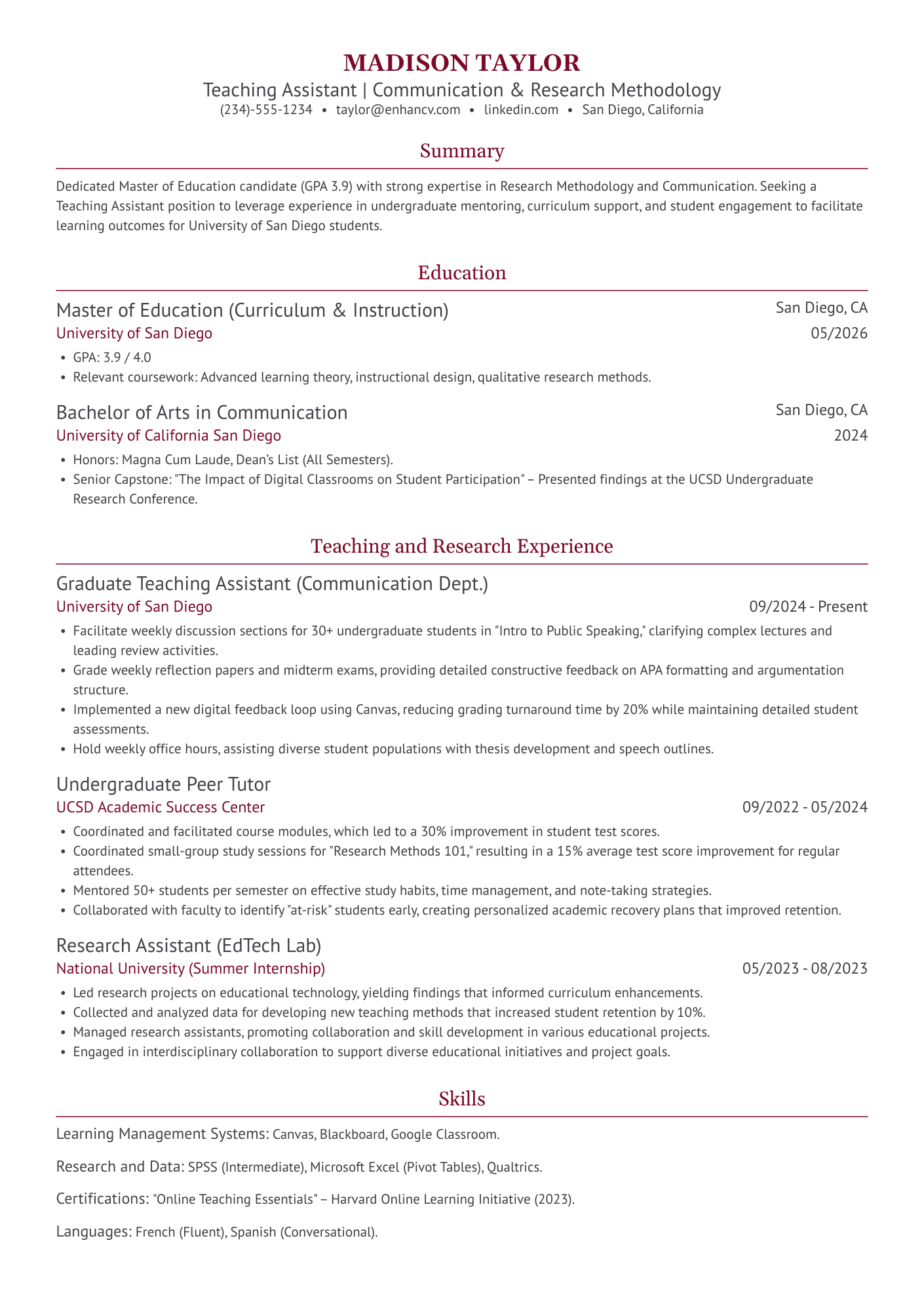
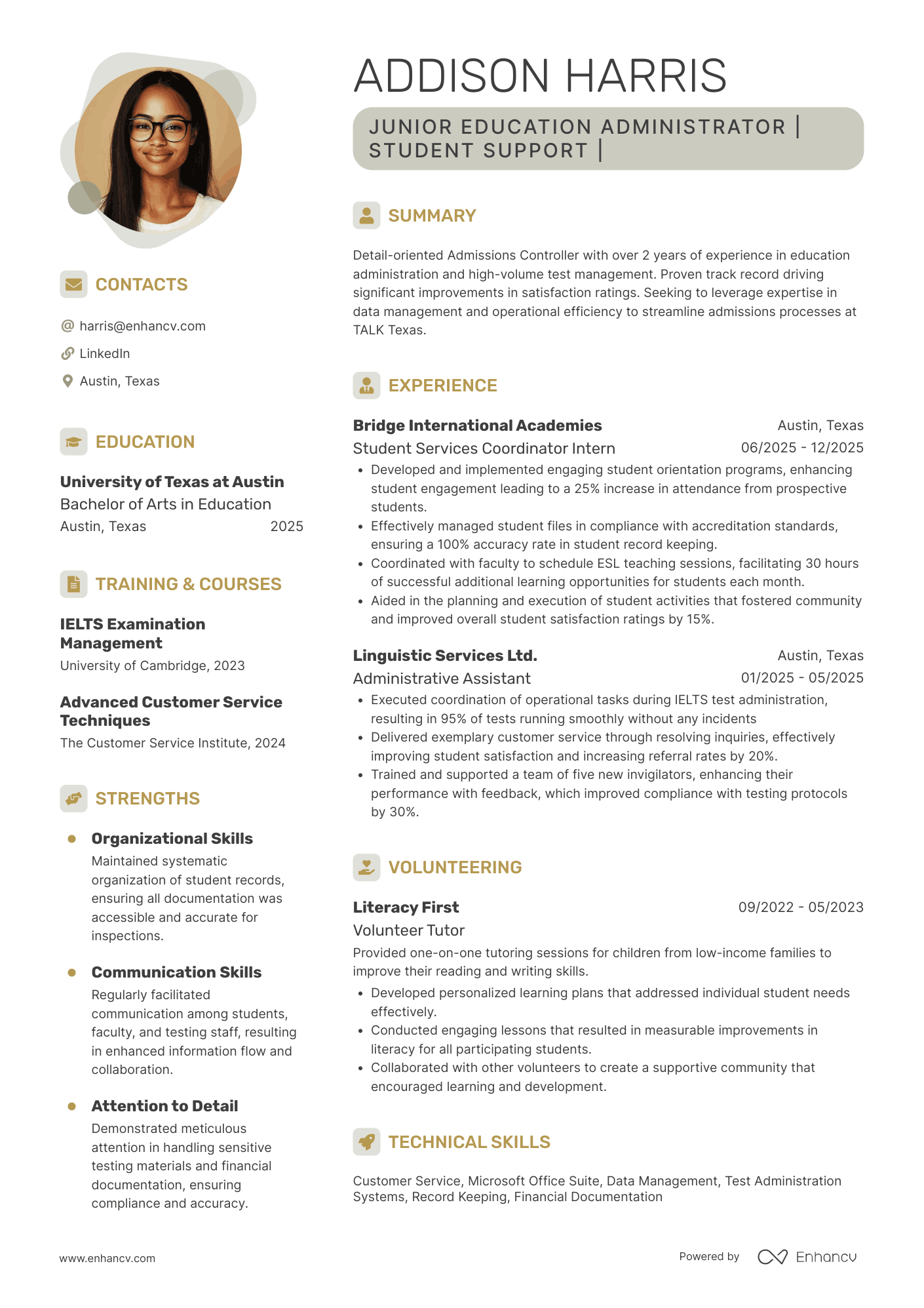
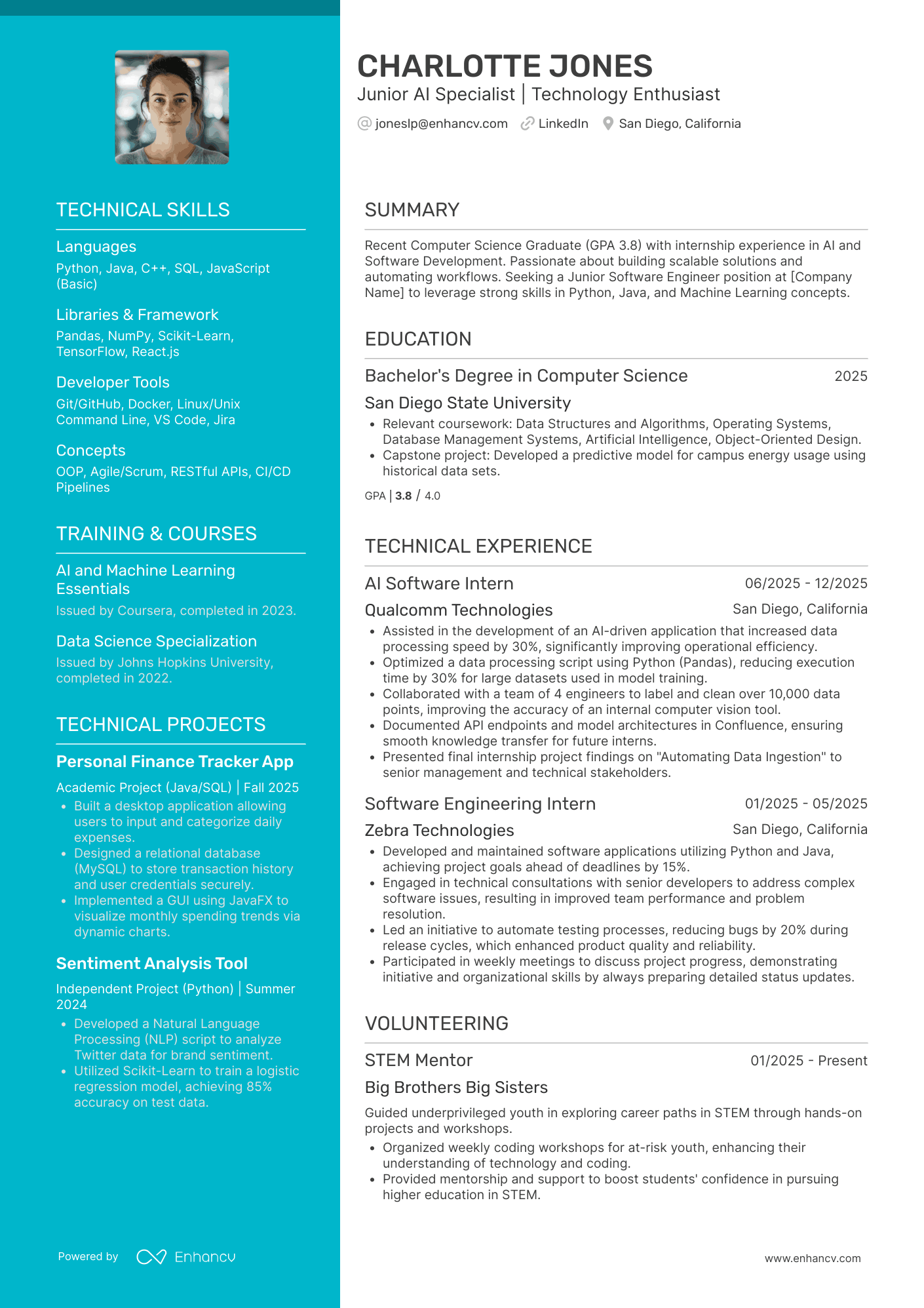
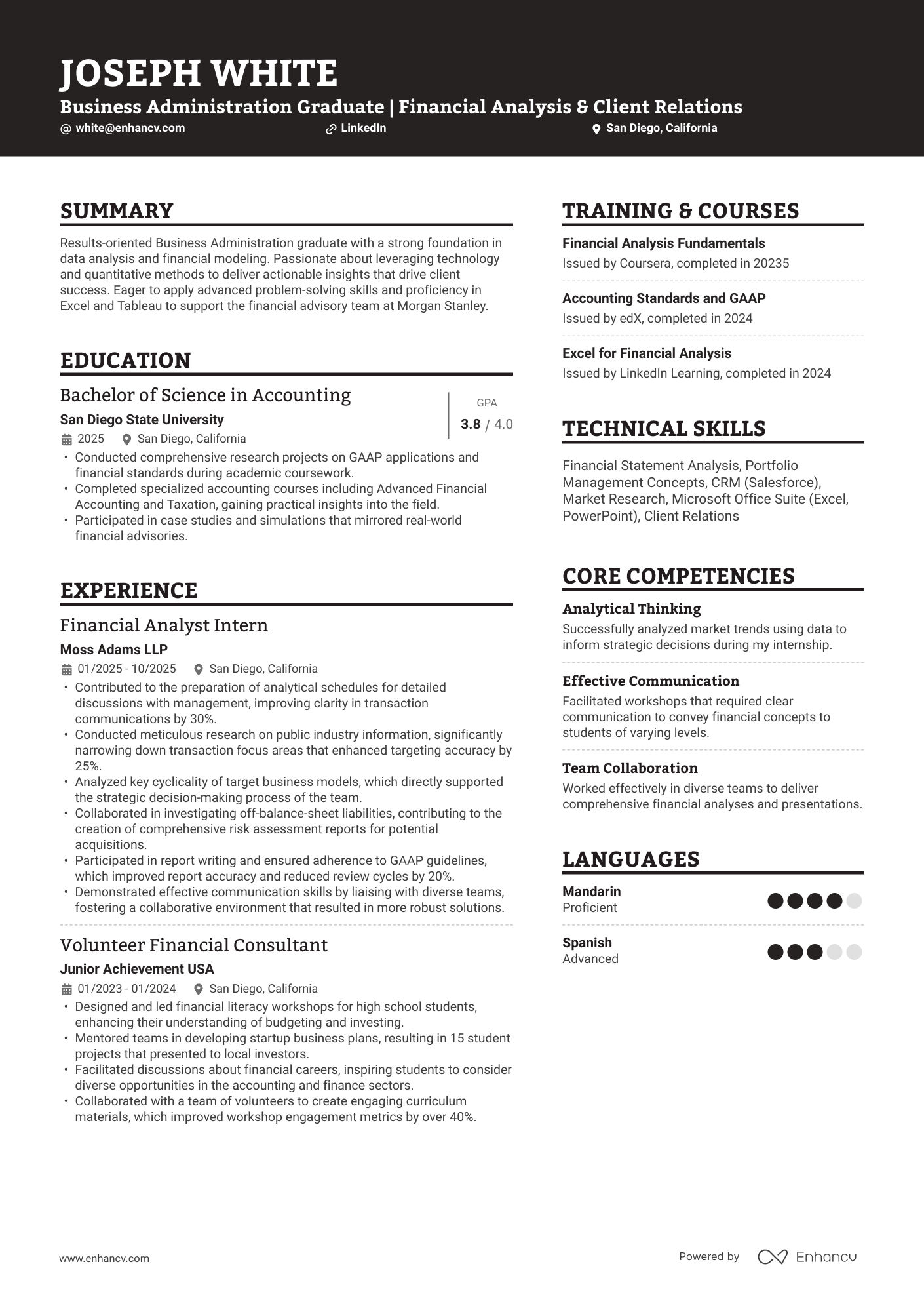
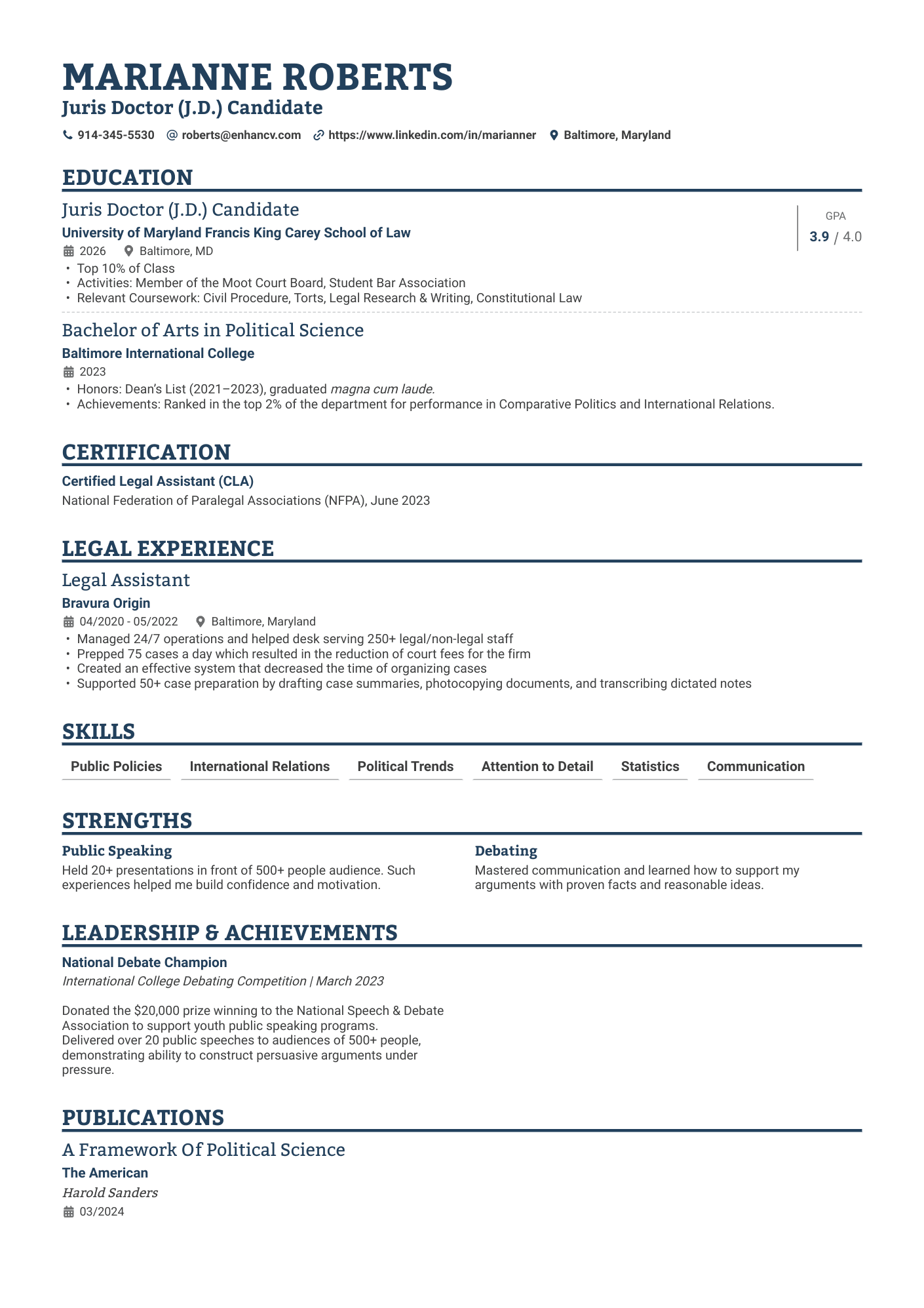
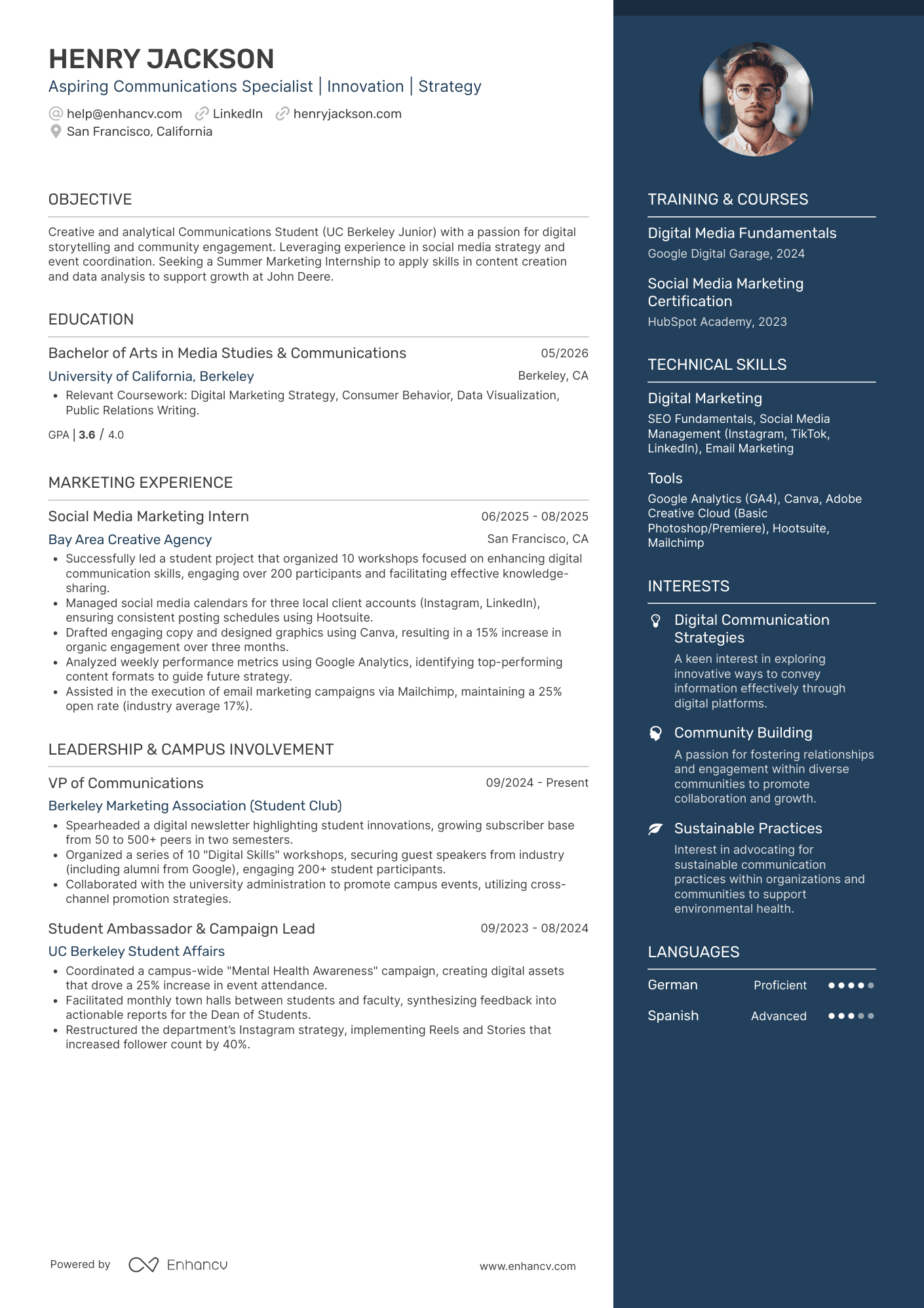
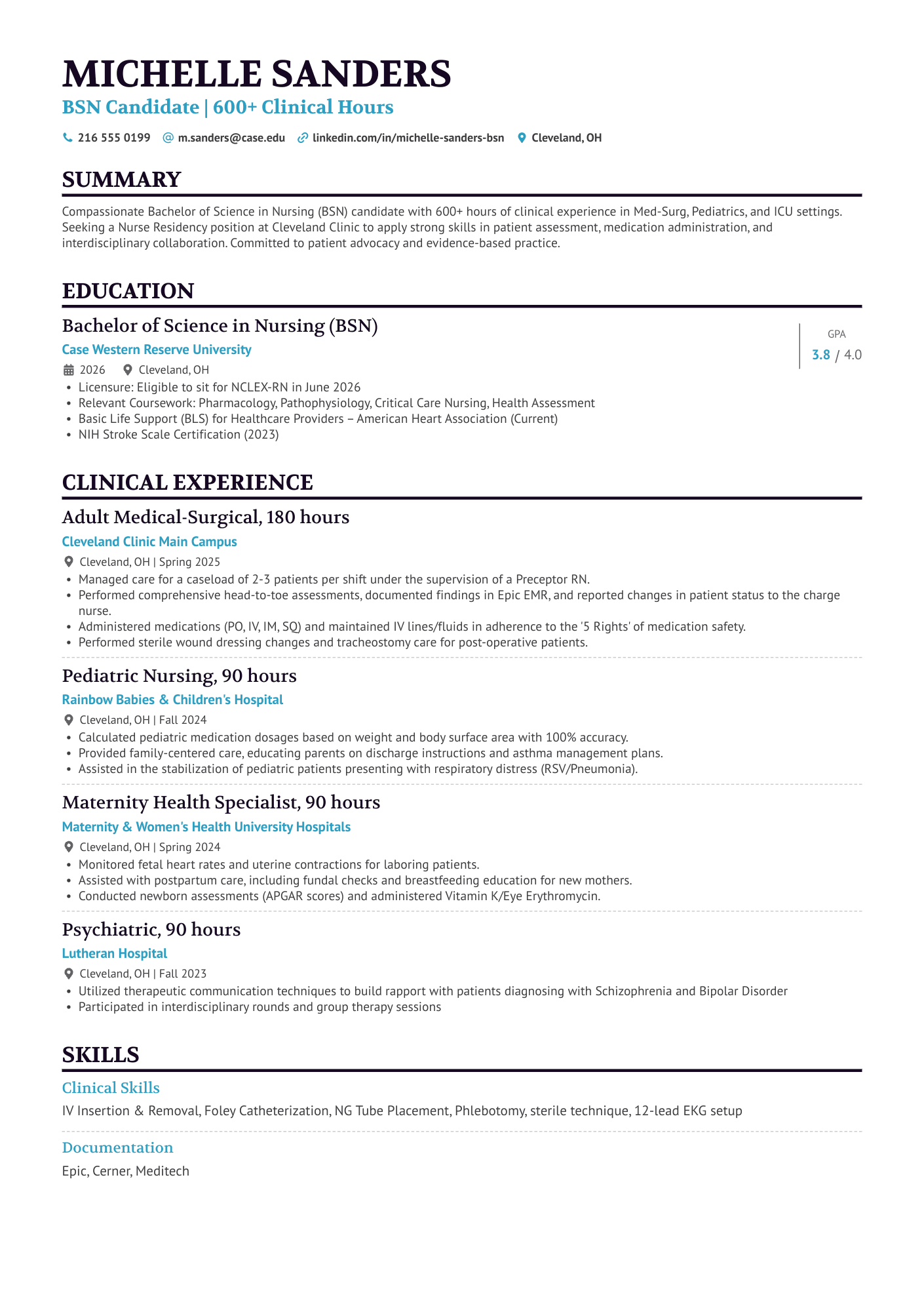
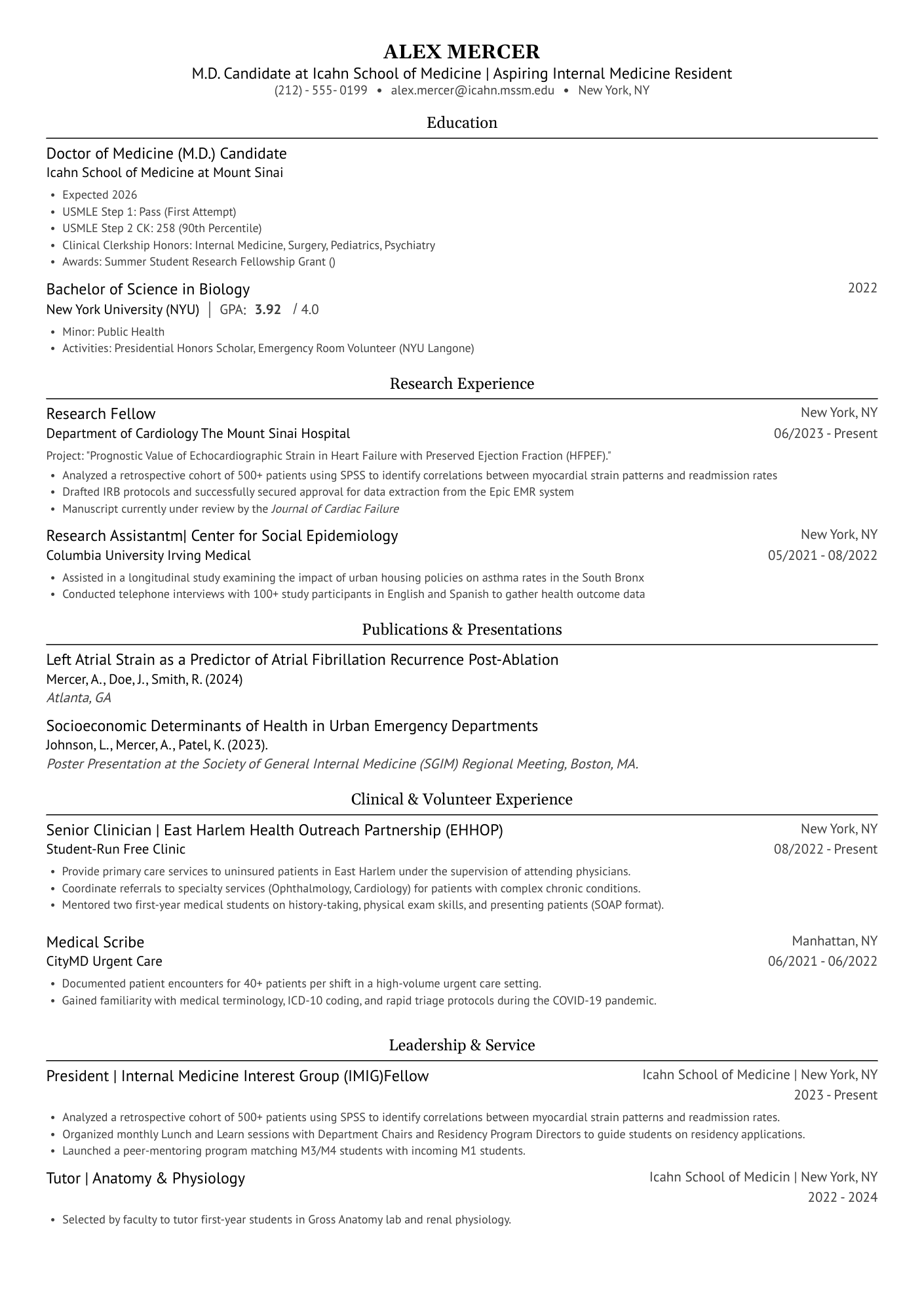
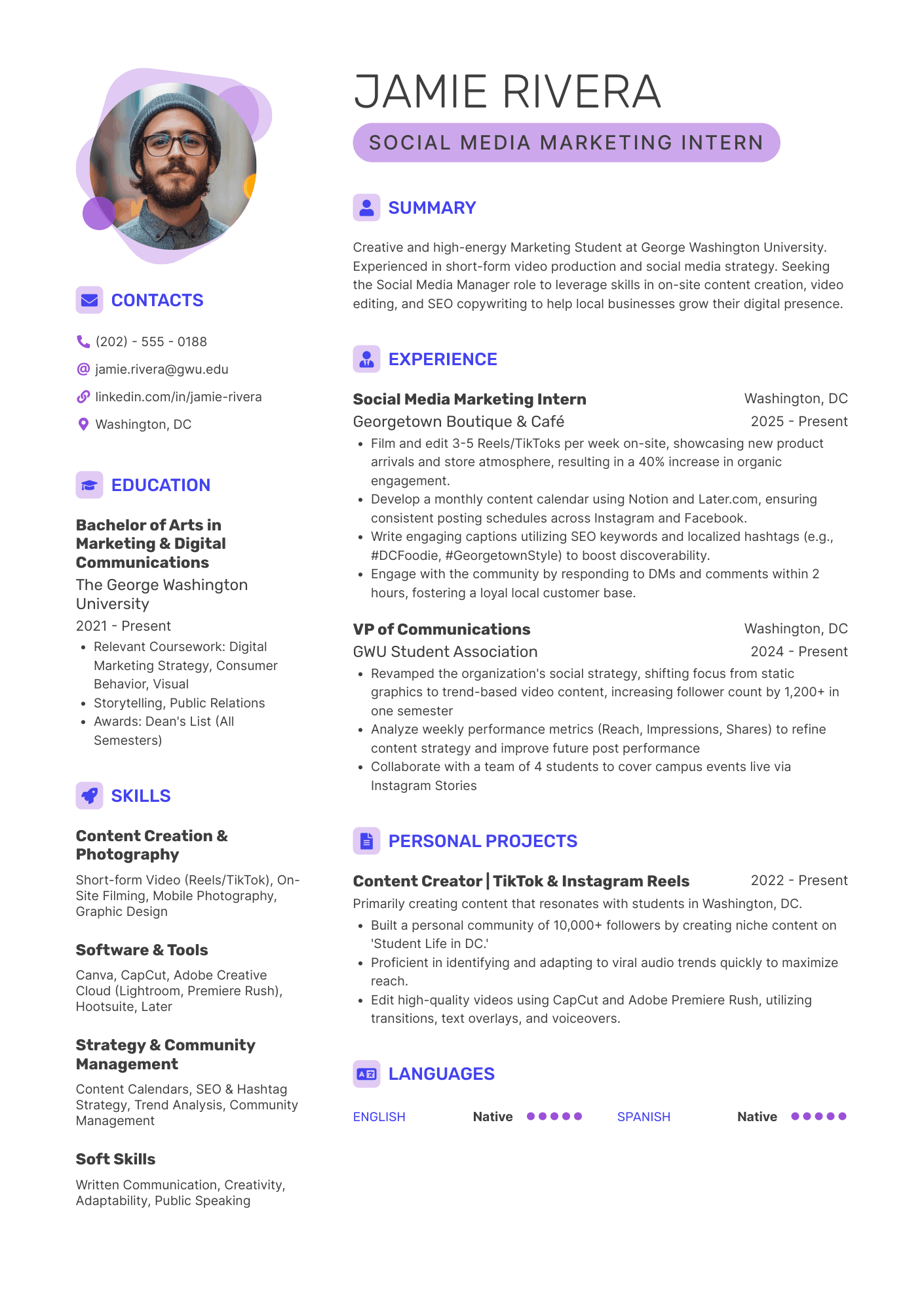
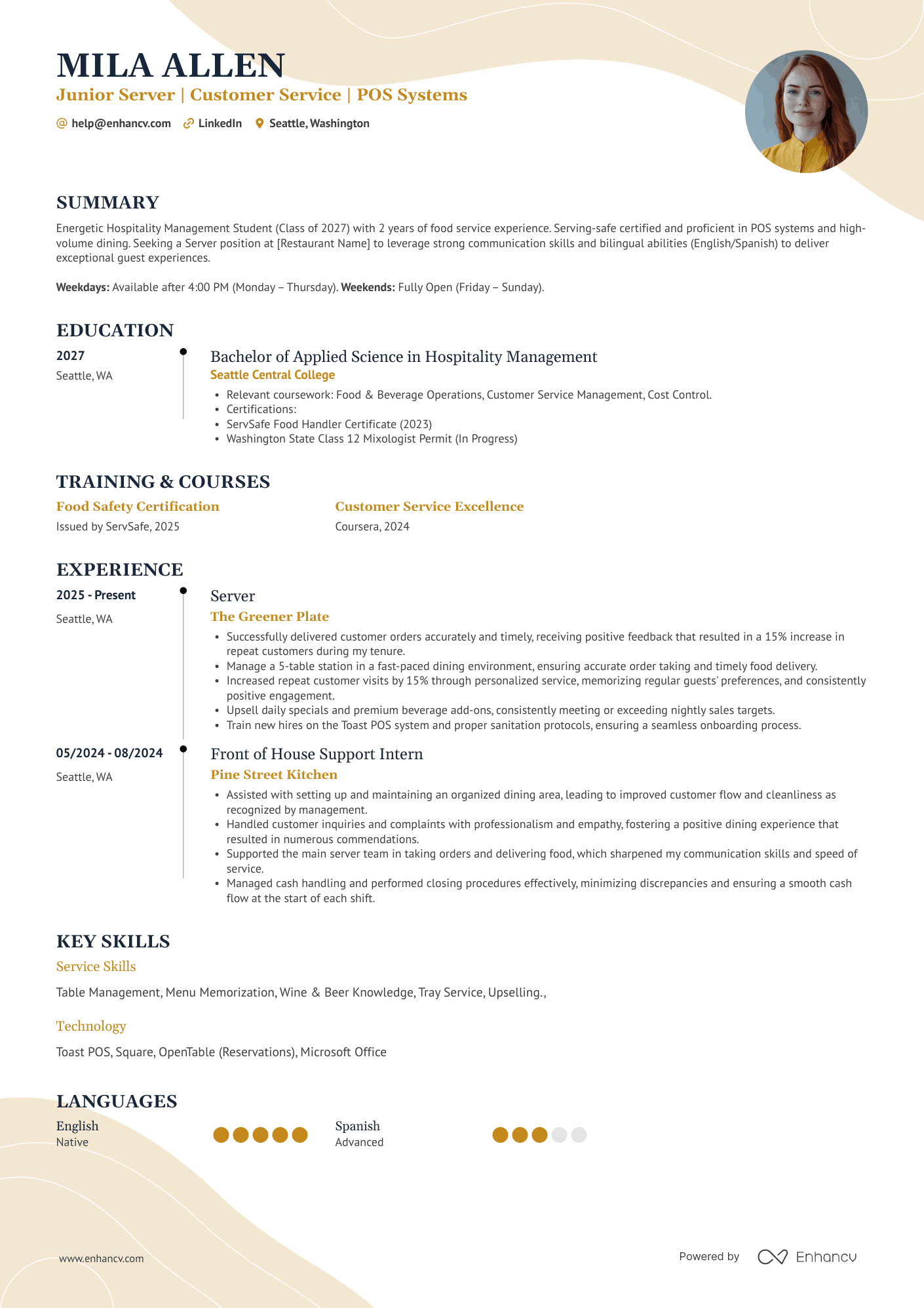
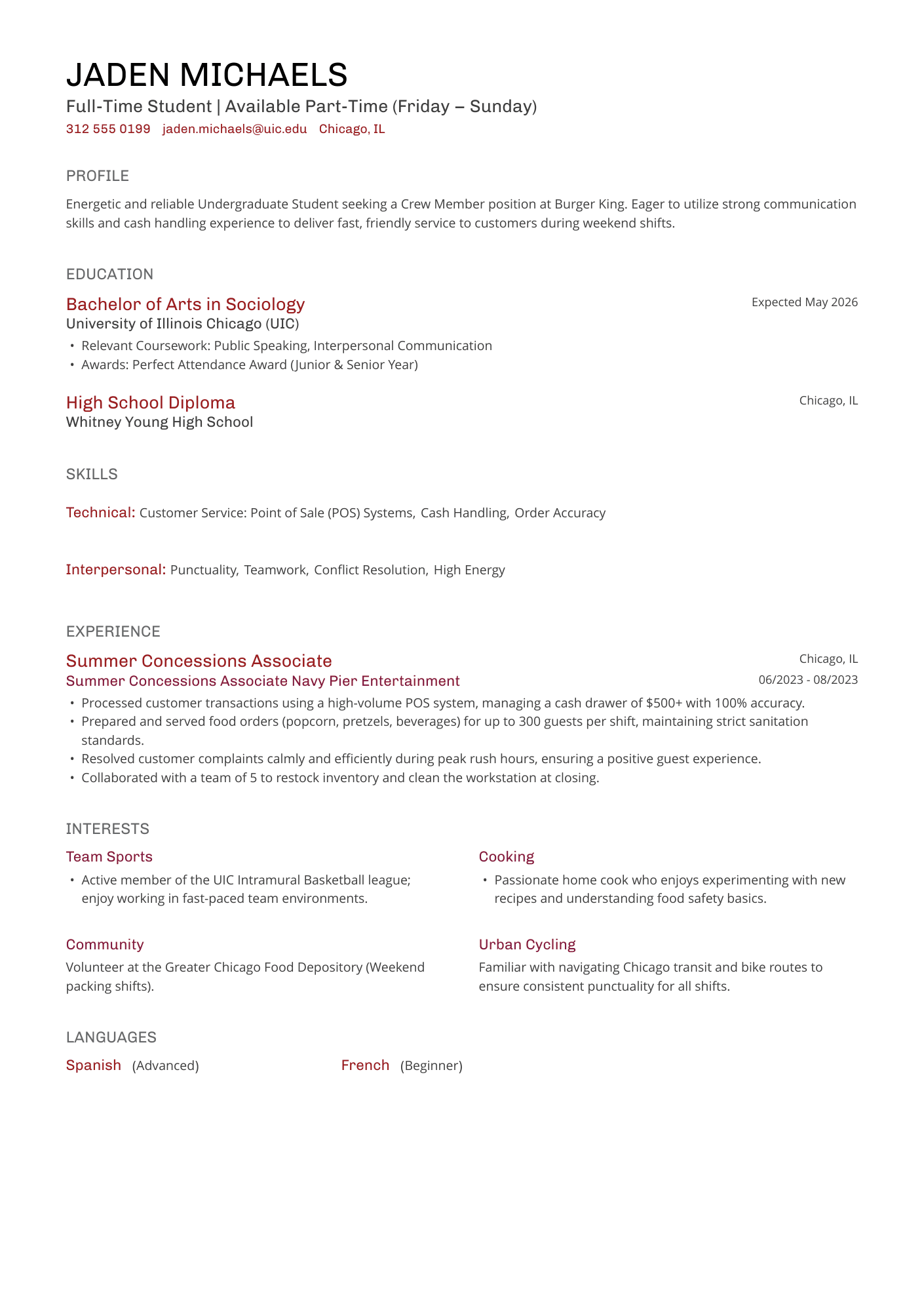
Let’s be honest: taking your life as a student—the coursework, the clubs, the late-night study sessions—and fitting it onto a single sheet of paper is tough. You might feel like you don't have enough "real" work history to fill the page.
However, at Enhancv, we’ve seen countless students go through this process, so we can confirm that recruiters hire for potential, not just the past.
Once the resume is shaped, the application still needs a voice — our college cover letter examples show how to frame potential, coursework, and early projects when you don’t yet have years of work history to lean on.
You don't need a decade of experience to stand out. You just need to know how to frame what you have done. Whether you’re a freshman seeking your first internship or a senior graduating this spring, we’ll show you how to build a college student resume that proves you’re ready.
Grab one of our college resume templates below, and let’s get to work.

Key takeaways
- Lead with your education: Place your degree and relevant coursework at the very top of your resume, as this is currently your strongest asset.
- Focus on transferable skills: Treat club leadership, part-time gigs, and academic projects like professional roles by using the STAR method to describe your contributions.
- Quantify reasonably: Use numbers, percentages, and frequency to turn vague duties into concrete achievements that prove your reliability and impact.
- Tailor for the ATS: Customize your resume for every application by mirroring the hard skills and keywords found specifically in the job description.
- Automate the process: Use Enhancv’s Resume Builder and AI tailoring tools to instantly format your experience and ensure your resume matches the requirements of the job at hand.
Which resume format should a college student use?
For 99% of students, the answer is the reverse-chronological format.
It’s the industry standard that applicant tracking systems (ATS) can read easily, and it’s the layout human recruiters prefer. However, unlike professionals who lead with their work history, you must use the student variation.
Place your education section at the very top, immediately following your header and profile. Your degree is currently your most valuable asset—make sure it’s the first thing they see.
What sections should go on a college student's resume?
Since you might be mixing paid work, internships, and academic achievements, the hierarchy matters.
Here’s the structure that highlights your strengths, prioritized by what recruiters want to see:
- Header (name, phone, email, LinkedIn, and portfolio/GitHub link).
- Resume profile (up to three sentences focusing on your skills and the specific internship/role you want).
- Education (may include academic projects and campus activities)
- Experience (internships, part-time jobs, or summer work).
- Skills (hard skills like Python/Excel, and languages).
Try Enhancv's free Resume Checker. It automatically runs 27 distinct content checks and gives you instant improvement suggestions so you can apply with total confidence.
Is your resume good enough?
Drop your resume here or choose a file. PDF & DOCX only. Max 2MB file size.
How to write your education section—your strongest asset
For professionals, the education section is a footnote. For you, it’s the headline.
Because you’re likely competing against other students with similar "no experience" backgrounds, your academic performance is the main way a recruiter gauges your future success.
This section needs to be more than just the name of your school. It needs to be a list of your intellectual assets.
What to include (in this order):
- Degree and major: Always list this first. e.g., BS in Computer Science.
- University name and location: e.g., University of Texas at Austin.
- Graduation date: If you haven't graduated yet, just write "Expected May 202X."
- GPA: List it only if it’s 3.5 or higher. If it’s lower, leave it off and let your projects do the talking.
- Honors:Dean’s List, magna cum laude, or specific scholarships.
Most students list their classes in a boring comma-separated list. Don't do that. Add your relevant coursework as bullet points directly under your degree. This allows you to treat your classes like job descriptions.
- Don't just list: "Marketing 101"
- Do describe: "Marketing Strategy: Created a comprehensive go-to-market plan for a mock fintech product, utilizing SWOT analysis and competitor research."
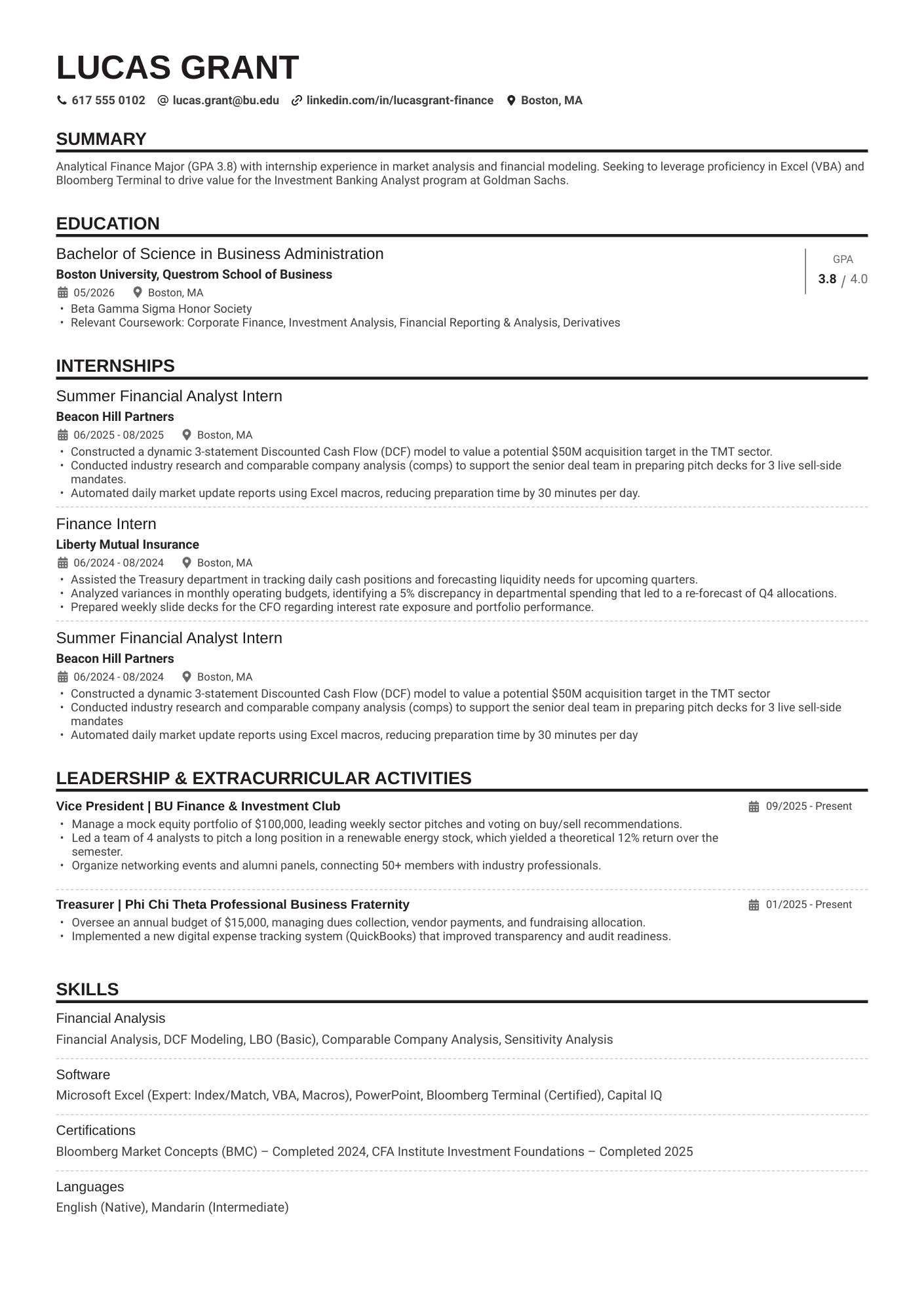
Let’s see how this works on a finance student's resume:
Good example of a college student education section
Bachelor of Science in Business Administration (Finance) | GPA: 3.8
University of Florida, Warrington College of Business
Expected May 2026
- Honors & Awards: Dean’s List (All Semesters), Beta Gamma Sigma Honor Society, 1st Place in 2024 Warrington Case Competition.
- Relevant Coursework (Financial Modeling): Built a dynamic 3-statement Discounted Cash Flow (DCF) model to value a Fortune 500 tech company, utilizing sensitivity analysis to stress-test revenue assumptions.
- Relevant Coursework (Fintech & Data Analysis): Utilized Python (Pandas) to clean and analyze historical stock price data for volatility trends, visualizing results in Tableau.
Notice how the coursework bullets don't just list the class name? They describe the practical skills (DCF modeling, Bloomberg Terminal, Python) that finance recruiters are desperate to see.

Should I include my high school?
If you're a freshman/sophomore—yes. You can include your high school information, especially if you had a high GPA or leadership roles.
If you are a junior/senior: No. Your college achievements should now be strong enough to stand alone.
Your degree proves you have the knowledge, but recruiters also want to see how you apply it.
Whether it was a summer gig or a student club, your background can be formatted just like a professional work history. As long as you know how to translate those activities into relevant work contributions.
What counts as experience on a college resume (and how to write it)
Experience doesn’t necessarily mean "paid corporate work."
To a hiring manager, it’s simply proof of behavior. They want to know if you can show up on time, communicate with adults, handle conflict, and solve problems. Whether you learned those skills in a high-rise office or the campus coffee shop doesn’t matter as much as how you describe them.
If you’re a freshman or have no experience, you can—and should—include:
- Internships: The gold standard, whether paid or unpaid.
- Part-time & summer jobs: Yes, being a lifeguard, server, or camp counselor counts. It proves reliability and customer service skills.
- Campus leadership: Being the treasurer of your sorority isn't just a hobby—it’s financial management. Organizing a hackathon isn't just fun—it’s event operations.
- Academic projects: If you built a marketing plan for a class, that’s market research experience.
How to write bullet points that prove your impact
The biggest mistake students make is listing duties instead of achievements.
- Duties describe what you were supposed to do (e.g., "Responsible for taking orders").
- Achievements describe how well you did it (e.g., "Managed 50+ daily orders with 100% accuracy").
To turn a boring task into a winning bullet point, use the Action + Context + Result formula (also known as the STAR method).
Like so:
- Action: Start with a strong power verb (led, created, analyzed). Never write "helped" or "responsible for."
- Context: Describe the scope. How many people? How much money? What software?
- Result: What was the outcome? Did you save time? Increase membership? Solve a problem?
Now, look at an example experience section on a college resume.
Good example of a college student experience section
Social Media Marketing Intern
TechStart Incubator | Remote
May 2023 – August 2023
- Executed a 3-month content strategy for Instagram and LinkedIn, using Canva and Buffer to schedule 15+ weekly posts.
- Analyzed weekly engagement metrics to optimize posting times, resulting in a 20% increase in organic follower growth over the summer.
- Collaborated with the sales team to turn customer success stories into case study blog posts, increasing website traffic by 12%.
How to tailor your college resume to a job description
Sending the same generic PDF to 50 different internships isn't a strategy—it’s spam. And it rarely works.
Recruiters—and the software they use—are looking for evidence that you fit their specific role. If you’re applying for a data analyst role, they don't care about your customer service skills as a barista. They care about the inventory tracking you did in Excel.
Consider the ATS
Before a human ever sees your resume, it likely passes through an ATS. It scans your resume for specific keywords found in the job description. If the job posting asks for Python and data visualization, and your resume only says “coding” and “charts,” the ATS might reject your application because it doesn’t see the right keywords.
You don't need to rewrite your resume from scratch for every application. Instead, pivot your limited experience to fit the role.
- Mirror the keywords: Scan the job description and identify the top three hard skills they mention. If you’ve done that work, rename the skills on your resume to match their exact terminology.
- Reorder your bullets: Recruiters read top-to-bottom. Don't bury your most relevant achievement at the end of the list. Move the bullet point that relates most to this specific job to the very top.
- Leverage your coursework skills: If you’ve covered any of the preferred skills in your coursework (like a specific software or methodology), don't just hide it in your transcript. You can list those tools or competencies directly under your experience entries (or education bullets) to show you can apply what you learned.
See these resume tailoring steps in action with the examples below:
Resume tailoring examples for college students
| Job description excerpt | Untailored bullet | Tailored bullet |
|---|---|---|
| We specialize in corporate, college, and high school events... | Worked as a server at weddings and birthday parties. | Facilitated large-scale corporate, college, and high school events for 200+ guests. |
| Willing to work in a variety of settings (warehouse and on job sites)... and can lift at least 50 pounds. | Responsible for moving boxes and setting up tables. | Managed equipment logistics between the warehouse and active job sites, safely lifting 50+ lbs of gear to execute 5+ daily setups strictly on schedule. |
| We offer a fun, high-energy atmosphere with an ever-changing scope of work. | Good at multitasking in a busy environment. | Serving 150+ customers daily and rotating between 3 distinct roles per shift to maintain 100% operational coverage. |
Let’s be real—tailoring your resume for every single application is exhausting. This is exactly where AI can be your best friend, provided you use it as an assistant, not a ghostwriter.
If you’re using the Enhancv Resume Builder, we have built this directly into the workflow. You simply paste the job description into our One-Click Tailoring Tool, and the AI analyzes your current bullets against the job requirements. It then suggests specific keyword swaps and phrasing improvements instantly.
If you’re working manually, you can still use AI to tailor your resume. The trick is to give your tool of choice context so it doesn't sound robotic.
Copy and paste this specific prompt:
Act as an expert resume writer.
The context: I am a [Year] [Major] student with previous experience in [List your specialties or past job titles].
The job: I am applying for this role: [Paste job description].
My experience: Here are my current resume bullet points: [Paste your current bullets].
Please rewrite my experience section to align with the job description above.
- Use the STAR method (Situation, Task, Action, Result) for every bullet.
- Highlight gaps for numbers: If a bullet needs quantification, mark it clearly (e.g., "[Insert % increase here]") so I know where to add my real metrics.
- Prioritize the hard skills mentioned in the job ad.
AI is great at matching keywords, but it often strips out your personality. Always read the output out loud. If it uses words you would never say in real life (like "synergized" or "orchestrated"), change them back to plain English. Tailoring is about relevance, not sounding like a thesaurus.
How to quantify your experience on a student resume
Tailoring gets you past the bots, but quantifying your experience is what gets you past the humans.
To instantly upgrade a bullet point, apply this three-part filter:
Three ways to measure your results on a resume
| Questions to ask | Example bullet point |
|---|---|
| How many? (volume)
| Before: "Wrote articles for the student newspaper." After: "Authored 3 weekly articles for the student newspaper, covering campus politics for an audience of 5,000+ students." |
| How much? (money & percentage) Did you handle a budget? Did you save time? Did you increase attendance? | Before: "Organized a charity bake sale." After: "Organized a charity bake sale that raised $1,200 in 4 hours, exceeding the fundraising goal by 25%." |
| How often? (frequency) Consistency proves reliability. | Before: "Attended club meetings." After: "Coordinated weekly agendas for 20+ members, ensuring all semester deadlines were met." |
If you don't know the exact number, it’s perfectly acceptable to use a conservative estimate or a range (e.g., "Served approx. 50-70 customers daily"). Just never lie.
PRO TIP
Struggling to come up with strong, quantified bullet points? Try Enhancv’s Bullet Point Generator. It instantly gives you professional writing suggestions—you only need to plug in your own numbers.
How to list your skills on a college resume
Recruiters and ATS systems are hunting for specific keywords to check a box. Your skills section is where you give them exactly what they’re looking for.
To get this right, you need to treat hard skills and soft skills completely differently.
Hard skills
These are teachable, measurable abilities. If you can take a test on it, it belongs in this section.
- Be specific: Don't just write "Computer Skills" or "Microsoft Office."
- Do write: "Excel (Pivot Tables & VLOOKUP), PowerPoint, Canva, Python, Google Analytics."
- Languages: Only list a language if you can really speak it. Use qualifiers like "Conversational" or "Fluent" so the recruiter knows what to expect.
Only list a skill if you’re comfortable using it in a professional setting. If you can’t answer a basic interview question about it, leave it off.
Here’s a list of high-value hard skills for college students, categorized by industry.
Best hard skills for a college resume
| Category | Skills |
|---|---|
| Universal skills (valuable for any major) |
|
| Marketing, communications & design |
|
| Business, finance & data |
|
| Computer science & technical skills |
|
So, where should the skills section go on a resume?
For CS and engineering majors: Place it at the top, right under your education. Your tech stack (Java, C++, SQL) is your main selling point.
For business & liberal arts majors: Place it at the bottom. Your education and experience tell a stronger story, so the skills section acts as a final checklist.
Soft skills
One big mistake students make is to list words like "Leadership," "Communication," or "Hard Worker." They prove nothing. Anyone can type those words.
Delete these from your skills section and try to demonstrate them in your experience bullets instead.
Below is a list of the top soft skills employers want, paired with the power verbs you should use to prove them in your experience or profile sections.
Best soft skills for a college resume (and how to prove them)
| Category | What to write on a resume |
|---|---|
| Leadership & Initiative | Recruiters want to see that you don't just wait for instructions—you take charge. How to demonstrate it:
|
| Communication (written & verbal) | Can you write professional emails and speak clearly to clients? How to demonstrate it:
|
| Teamwork & collaboration | Hiring managers need to know you aren't a "lone wolf" who’s difficult to work with. How to demonstrate it:
|
| Adaptability & resilience | Essential for students. It proves you can handle the shock of a real workplace. How to demonstrate it: "Thrived in a high-volume retail environment..." "Adapted quickly to new inventory software..." "Resolved urgent customer complaints..." |
| Time management & reliability | Proves you show up on time and hit deadlines. How to demonstrate it: "Balanced a 20-hour work week alongside a full academic course load..." "Prioritized conflicting deadlines for three major projects..." "Maintained a 100% attendance record..." |
It’s best to place your soft skills where they can be backed by evidence. You don’t need to explicitly write the word to show you’re good at it—you just need to put it in context.
While your experience section is the top placement for this, you can also plant the seed right at the top of your resume in your objective statement.
Like so:
Example of showing problem-solving in an objective
"Junior Marketing Major seeking a Social Media Internship. Proven ability to analyze engagement drops and troubleshoot campaign performance to reverse downward trends, as demonstrated during tenure as VP of Student Council."
How to list your certifications on a college student resume
Certifications are a great way to fill gaps in your experience. They show recruiters you’ve gone the extra mile to learn the tools of the trade.

Best certifications to include on a college resume
- Industry-standard certifications: These carry the most weight. (e.g., Google Analytics, AWS Cloud Practitioner, HubSpot Inbound Marketing, CFA Level I Candidate).
- Skill-based courses: If you completed a rigorous course on Coursera, Udemy, or LinkedIn Learning specifically to learn a hard skill for the job (like Python or Excel), list it.
- Safety/compliance: Only list CPR, First Aid, or food handling if the job actually requires it (e.g., lifeguard, camp counselor, server).
Here’s where to put certifications on a resume:
- One or two certifications: Save space by adding them to your skills section under a specific category. Alternatively, you can include them in your profile or headline, especially if they’re relevant to the target role.
- 3+ certifications: Create a dedicated certifications section near the top of your resume to make them stand out.
To format them, keep things simple. You only need three things:
- Name of certification
- Issuing organization
- Date earned. If a certification has an expiration date, list it (e.g., Valid through 2025). If it doesn't expire, just the year is fine.
Look at an example:
Training & Courses section on a resume
- Google Data Analytics Professional Certificate – Coursera (2025)
- Microsoft Office Specialist (Excel Expert) – Microsoft (2025)
- Social Media Marketing Certification – HubSpot Academy (2024)
How to write your college resume profile
For experienced professionals, this section is called a summary. For students, it’s often called an objective.
But here’s the truth—recruiters don't care what you label it. They only care what you say in it.
This small block of text at the top of your resume is prime real estate. You have no more than three lines to demonstrate three specific things:
- Skill: You have the basics down.
- Enthusiasm: You really want this specific job.
- Fast learning: You can catch up quickly without hand-holding.
You may have heard that objective statements are outdated. That’s because most students write them selfishly: "I am looking for a position to learn and grow." Companies don't hire you to teach you. They hire you to help them.
To make this section work, you must flip the script. Don't tell them what you want to get—tell them what you can give.
Here’s how to write your college student summary section.
Keep it to two or three sentences max.
- Who you are: e.g., "Junior Computer Science Student"
- What you have: hard skills + fast learning ability
- What you bring: how you’ll help their specific team
Example summary
"Junior Computer Science Major with a 3.8 GPA and proven ability to rapidly master new technologies (Python, AWS). Seeking to leverage full-stack development skills to support scalable software solutions at [Company name]."
This resume profile highlights the skills, fast learning, and value. If you want to achieve something similar fast, try Enhancv’s Summary Generator.
Optimize your resume summary and objective for ATS
Drop your resume here or choose a file.
PDF & DOCX only. Max 2MB file size.
Bonus: Resume for college applications
Before we get to the templates, a quick clarification. Are you writing this resume to get a job, or are you writing it to get into college (or grad school)?
While 90% of the advice above applies to both, there’s a distinct difference in strategy.
College resumes: admissions vs. jobs
| The job resume (employment) | The admissions resume (common app/grad school): |
|---|---|
|
|
If you’re submitting this to a university, you can afford to list your hobbies, high school sports, and volunteer trips in more detail. If you’re sending this to a hiring manager, cut the fluff and focus on the skills.
Read the specific institution's guidelines and follow them to the letter
This is your first unofficial test. Imagine a program asks for a "1-page blind resume" (no name/contact info) to ensure unbiased review. If you submit a 2-page resume with your headshot, you have failed the test before they even read your qualifications.
- Check the page limit: Some academic CVs can be longer, while some business school resumes must be shorter.
- Check the file name: Do they want LastName_Resume.pdf or ApplicationID_CV.pdf?
- Check the content: Do they specifically ask not to include high school info?
When in doubt, the school's specific rule always trumps general resume advice.
Now that you understand the theory, it is time to put it into practice. You don't need to start from a blank page.
College resume templates
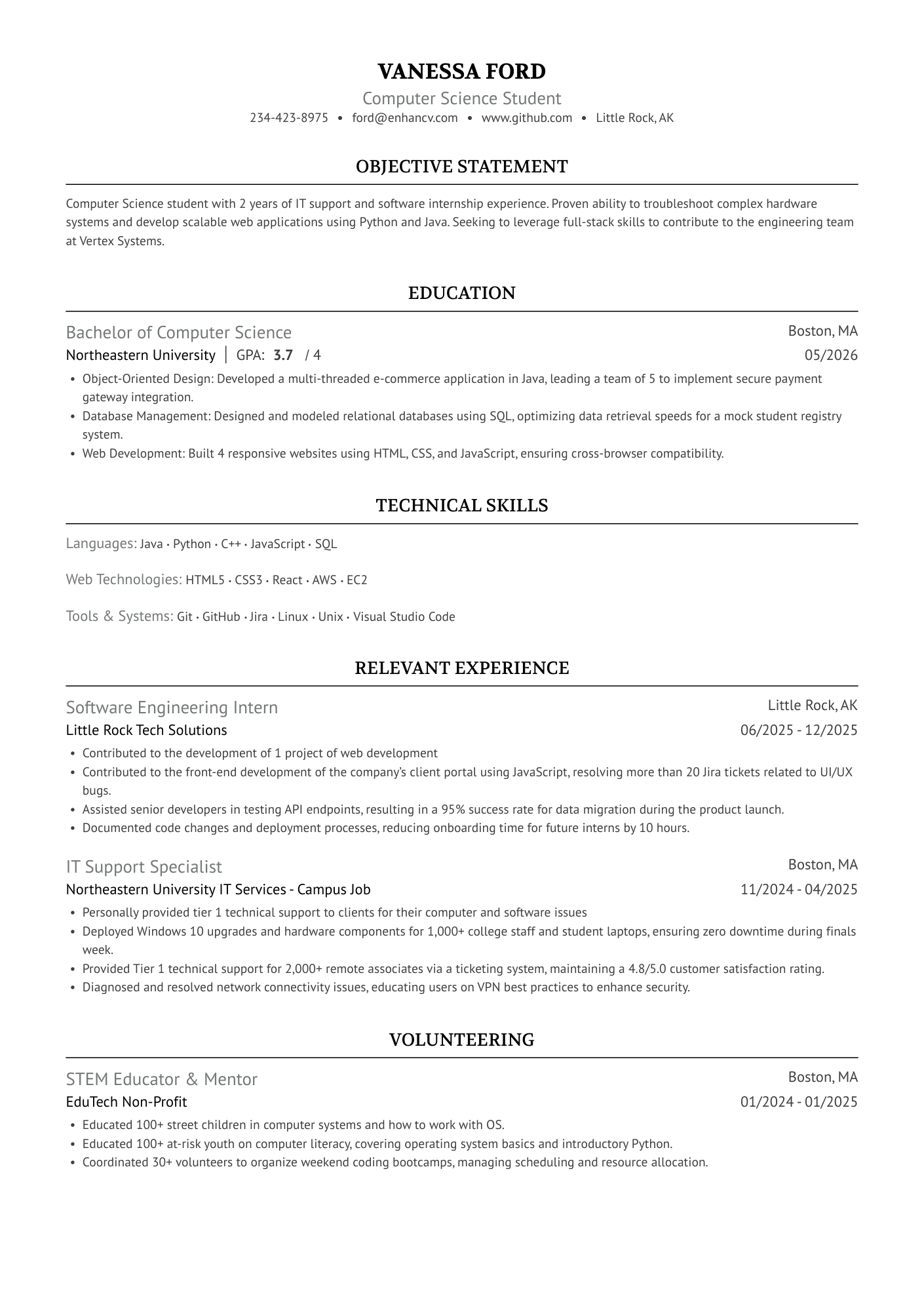
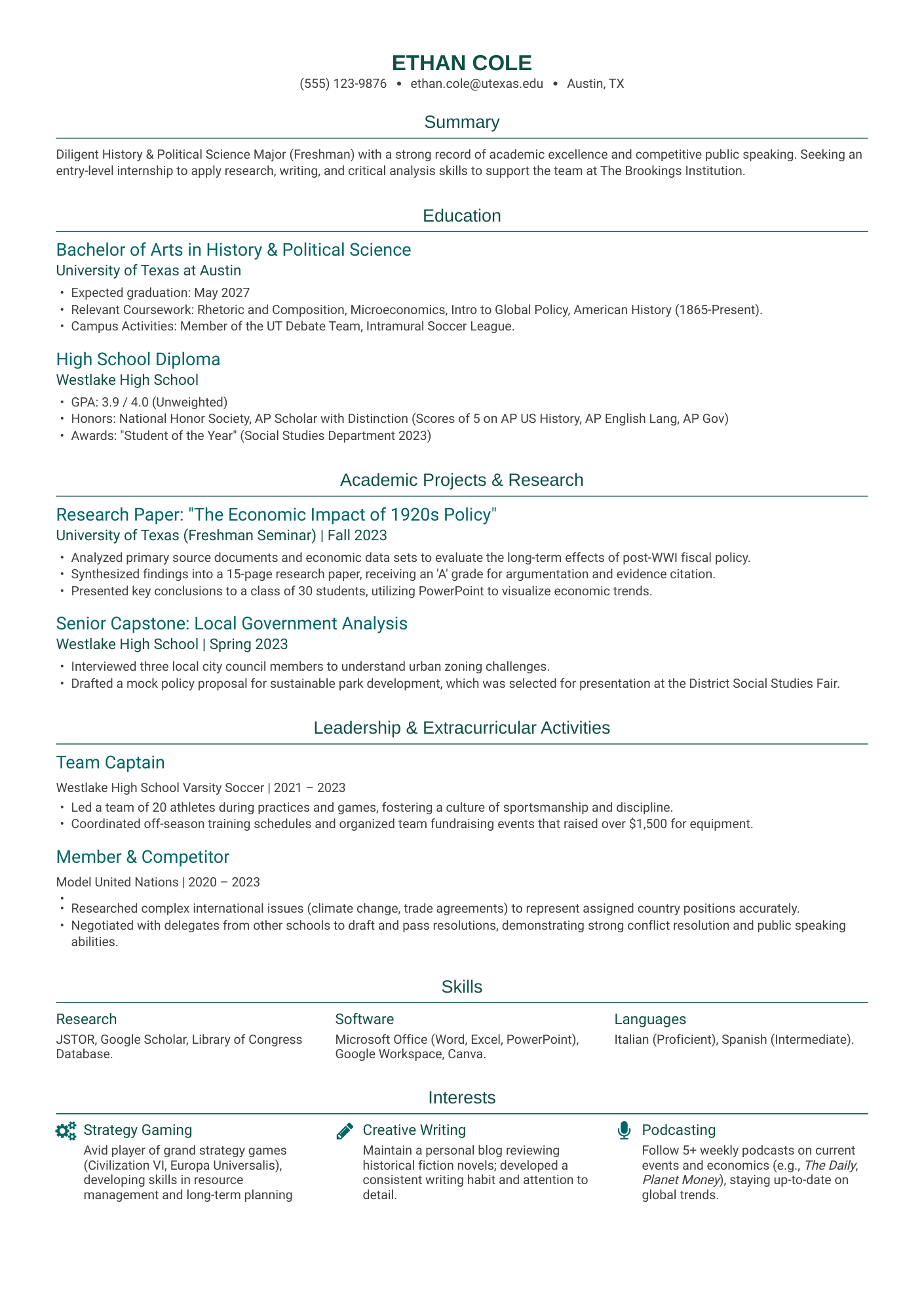
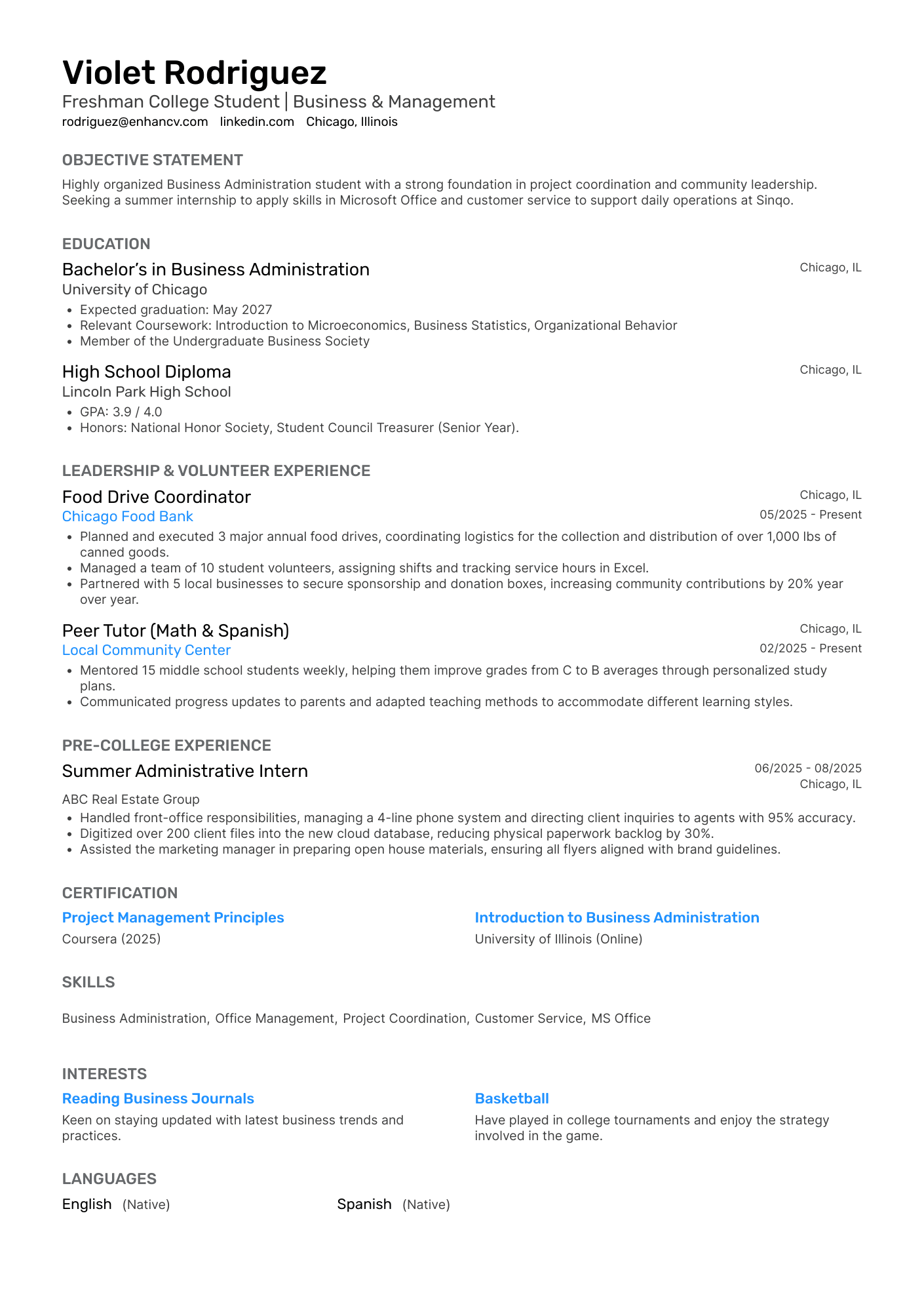
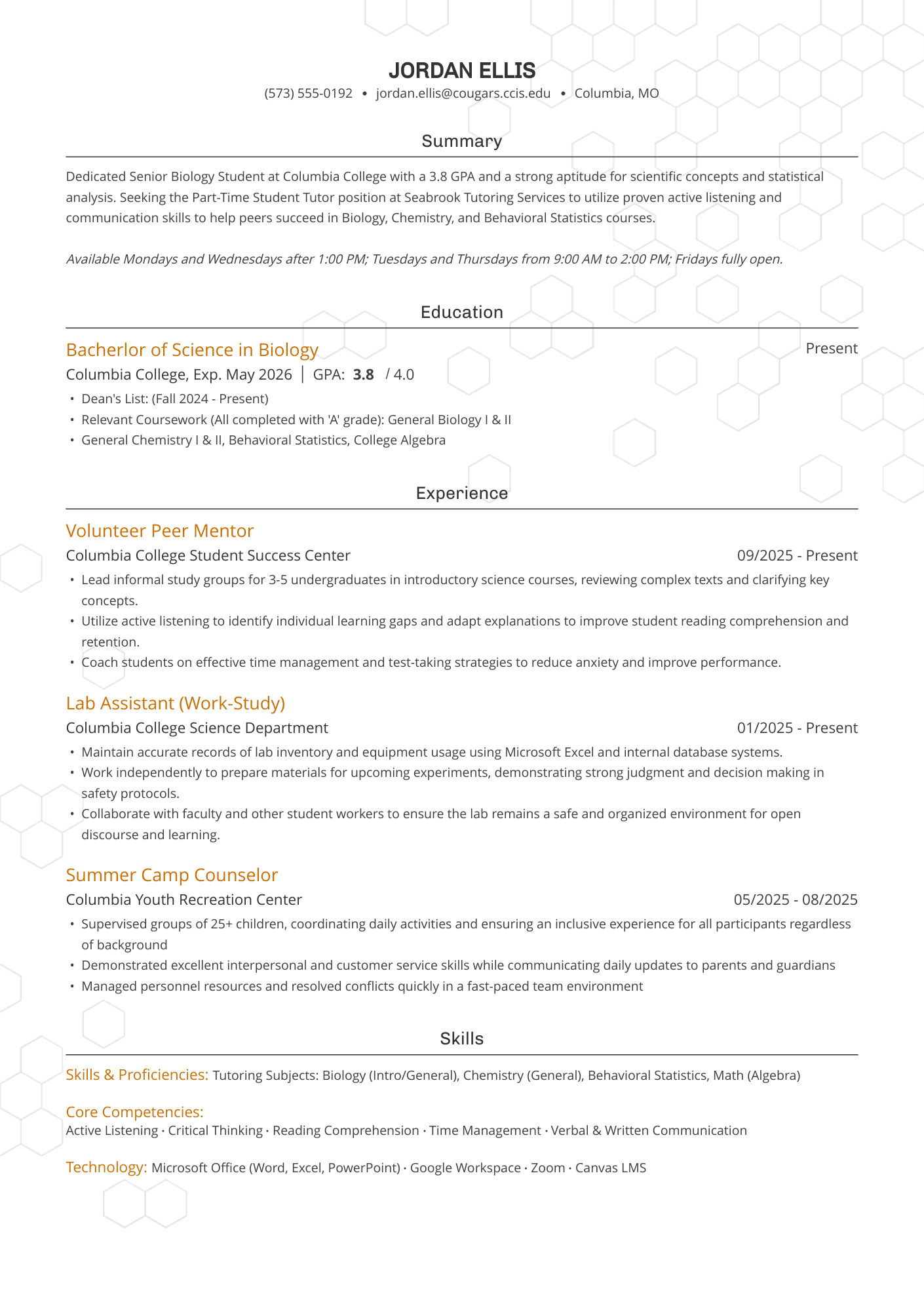
We’ve prepared two distinct templates based on the strategies above. Choose the one that matches your current goal.
College student template: copy and paste
Best for: Students applying to internships, part-time jobs, or entry-level roles.
JORDAN ELLIS
(414) 555-0198 | jordan.ellis@uwm.edu | Portfolio: www.jordanellisdesign.com | LinkedIn:linkedin.com/in/jordanellisdesign
OBJECTIVE
Creative Visual Communication student with a portfolio demonstrating strong branding and digital marketing assets. Seeking to leverage proficiency in Adobe Creative Suite and passion for visual storytelling to create impactful content for Zurn Elkay Water Solutions’ internal and external channels.
EDUCATION
Bachelor of Fine Arts (B.F.A.) in Design and Visual CommunicationUniversity of Wisconsin-Milwaukee (UWM) | Milwaukee, WI Expected May 2026
- GPA: 3.7 (Dean’s List: Fall 2023, Spring 2024)
- Relevant Coursework: Advanced Typography, Digital Branding Strategies, UX/UI Design (Figma), Motion Graphics (After Effects), Marketing Management.
SKILLS
- Design Software: Adobe Creative Suite (Photoshop, Illustrator, InDesign, After Effects, Premiere Pro), Figma.
- Web & Content: WordPress (CMS), Basic HTML/CSS, Social Media Management (Hootsuite).
- Core Competencies: Visual Storytelling, Brand Identity, Print & Digital Layout, Video Editing.
RELEVANT EXPERIENCE
Freelance Graphic DesignerSelf-Employed | Remote May 2023 – August 2024
- Designed a complete branding package (logo, color palette, business cards) for a local startup, delivering all assets 2 weeks ahead of the deadline.
- Communicated directly with clients to refine concepts, demonstrating strong organizational skills and the ability to prioritize feedback from multiple stakeholders.
- Executed a digital ad campaign for a non-profit client, creating 15+ assets in Photoshop optimized for Facebook and Google Display Ads.
ACADEMIC PROJECTS
Brand Re-Imagination Project (Class: Digital Branding)Fall 2024
- Analyzed the visual identity of a legacy manufacturing brand and proposed a modernize logo and style guide.
- Created a mock "Internal Communications" deck to pitch the rebrand to stakeholders, focusing on strategic storytelling and market positioning.
- Utilized Figma to prototype a responsive landing page for the campaign launch.
ADDITIONAL EXPERIENCE
Shift SupervisorColectivo Coffee | Milwaukee, WI June 2022 – Present
- Multitask in a high-volume environment, managing customer orders and inventory restocking during peak morning rushes.
- Trained 5 new baristas on customer service protocols and point-of-sale systems.
This layout prioritizes education and skills at the top, allowing you to highlight coursework and technical abilities before listing your experience. It’s designed to pass ATS scans and catch a recruiter's eye in less than 10 seconds.
Template for college and grad school admissions
Best for: High schoolers applying to college, or undergrads applying to Master’s/PhD programs.
Here’s a standout example for a student applying to Harvard Law School, using a traditional Harvard resume template structure that places heavy emphasis on academic honors and leadership governance.
ALEXANDRA (ALEX) MERCER
New York, NY | (212) 555-0123 | alex.mercer@columbia.edu |
LinkedIn:linkedin.com/in/alexmercer-law
EDUCATION
Bachelor of Arts in Political Science & History
Columbia University | New York, NY
May 2025
- GPA: 3.92
- Honors:summa cum laude, Phi Beta Kappa (Junior Inductee), Dean’s List (all semesters).
- Senior Thesis: "The Constitution in Crisis: Executive Power during the Reconstruction Era." (Advisor: Prof. Eric Foner). Awarded the Charles Beard Prize for best undergraduate thesis in political history.
- Study Abroad: London School of Economics (LSE) – Focus on International Human Rights Law (Spring 2024)
PROFESSIONAL EXPERIENCE
Legal InternAmerican Civil Liberties Union (ACLU) – National Legal Department | New York, NY June 2024 – August 2024
- Conducted legal research on Fourth Amendment surveillance cases, summarizing 50+ federal circuit court decisions for senior staff attorneys.
- Drafted internal memoranda regarding the admissibility of digital evidence, which were utilized in an active amicus brief filing.
- Analyzed discovery documents using Relativity software to identify key evidence for ongoing civil rights litigation.
Research AssistantColumbia University Dept. of Political Science | New York, NY September 2023 – Present
- Assist Professor Jane Doe in compiling data for her upcoming book on Supreme Court voting behavior (1990–2020).
- Code over 500 judicial opinions for specific legal keywords and citations using R and Excel.
- Fact-check and edit footnotes for academic journal submissions to the American Political Science Review.
LEADERSHIP & CAMPUS ACTIVITIES
PresidentColumbia Political Union (CPU)
September 2023 – Present
- Lead the largest non-partisan political group on campus (200+ members).
- Budget Management: Oversee an annual operating budget of $15,000 to organize guest lectures, debates, and voter registration drives.
- Event Execution: Successfully coordinated a keynote address by a former U.S. Senator, handling security logistics, marketing, and press relations for an audience of 500 students.
Editor-in-ChiefColumbia Undergraduate Law Review
September 2022 – May 2024
- Directed a staff of 20 editors to publish a biannual academic journal featuring undergraduate legal scholarship.
- Implemented a new peer-review process that increased submission quality and reduced acceptance rates from 25% to 12%.
- Personally edited and provided feedback on 10+ articles per semester regarding constitutional law and tort reform.
Volunteer Debate CoachNew York Urban Debate League
September 2022 – Present
- Mentor 15 high school students from under-resourced schools in the Bronx on argumentation and public speaking techniques.
- Judge regional weekend tournaments and provide constructive oral feedback to competitors.
SKILLS & INTERESTS
- Languages: Spanish (Fluent/DELE C1 Certified), French (Intermediate Reading).
- Technical: R Studio (Data Analysis), LexisNexis (Legal Research), Microsoft Excel
- Interests: 19th Century American History, Marathon Running (NYC Marathon Finisher 2023), Cello
This format allows for a slightly broader narrative. It focuses on academic achievements, research, and extracurricular depth to prove you’re the well-rounded candidate admissions officers are looking for.
Ready to build yours?
You don't have to fight with margin settings or text boxes. You can load these templates directly into the Enhancv AI Resume Builder and personalize them in seconds.
Frequently asked questions about college resumes and applications
Still have a few doubts?
Here are the quick answers to some other common questions students ask before hitting "submit."
What is the best resume format and design for college students?
Keep it clean, scannable, and professional.
- Format: Use reverse-chronological order (education at the top).
- Fonts: Use serif or sans-serif fonts like Arial, Helvetica, or Volkhov. Keep text size between 10–12pt and headings 14–16pt.
- Margins: Standard1-inch margins on all sides.
- Colors: Stick to black text. You can use a subtle accent color(like navy or dark green) for section headings, but avoid bright neons.
- Templates: Use a single-column layout for traditional fields (finance, law) or a two-column modern layout for creative fields.
How should I name and save my resume file?
Always save your resume as a PDF(unless the application specifically asks for Word). PDFs lock your formatting so it looks the same on every computer.
- Naming convention: “FirstName_LastName_Resume.pdf” or “FirstName_LastName_JobTitle.pdf.”
- Avoid: “Resume.pdf”, “Resume_Final”, or “John_Resume_v3_edited.”
What are common resume mistakes college students make?
- Including high school info: Remove it once you are a Junior/Senior.
- Listing soft skills: They don’t belong in a dedicated section. Instead, put them where they can be contextualized.
- Generic objectives: Avoid "Looking to learn." Focus on "Looking to contribute."
- Inconsistent formatting: Make sure all your dates are aligned and bullet points look the same.
- Unprofessional email address: Using “skaterboi99@hotmail.com” is an instant turn-off. Use your university .edu address or a clean “firstname.lastname@gmail.com.”
- Photo on resume: In the U.S., adding a headshot can actually get your resume rejected due to strict anti-discrimination laws. Unless you’re applying for acting or modeling roles, leave the photo off.
- Forgetting to proofread:Typos are the fastest way to get rejected. They suggest a lack of attention to detail. Always read your resume out loud and/or use a grammar checker.
What extra sections should be included in a college resume?
Since you may lack work experience, use these sections to show value:
- Extracurricular activities: Leadership roles in clubs, sports, or Greek life prove you can manage time and lead others.
- Projects: Capstones, thesis papers, or coding projects.
- Volunteer experience: Shows community involvement and character.
- Certifications: Online courses (Coursera, HubSpot, Google).
- Languages: Only if you’re intermediate or above.
Do college students need a cover letter for internships?
Yes. Unless the job description explicitly says "No Cover Letter," you should write one. For students with light resumes, the cover letter is your chance to explain why you’re passionate and how your coursework translates to the job. It’s often the tie-breaker between two candidates with similar GPAs.
Drop your resume here or choose a file.
PDF & DOCX only. Max 2MB file size.
Best AI prompts to write and improve your student resume
Use these prompts in ChatGPT or Claude to polish your content:
To fix a weak bullet point
"Rewrite this resume bullet point using the STAR method (Situation, Task, Action, Result) to make it sound more professional: '[Insert bullet]'"
To write a summary/objective
"Write a 3-sentence resume objective for a [Major] student with experience in [Skill 1] and [Skill 2], applying for a [Job title] role. Focus on the value I bring to the company."
To tailor your resume to a job
"Act as a recruiter. Compare my resume [Paste resume] to this job description [Paste job ad]. List the top 5 missing keywords I should add to pass the ATS scan."
What are the best jobs for college students to build a resume?
Many students feel pressured to find a job that perfectly aligns with their major, but unrelated jobs are just as valuable if you frame them right.
Jobs during college help students develop essential skills such as time management, effective communication, business etiquette, professional judgment, problem-solving, and analytical thinking. These jobs also demonstrate to graduate schools and employers that you possess the maturity and practical skills to succeed.
Katherine Scannell, Vice Dean of Institutional Success at Washington University in St. Louis School of Law
Top jobs for transferable skills:
- Campus ambassador/tour guide: Proves public speaking and sales skills.
- Administrative assistant: Proves organization and software literacy.
- Social media assistant: Proves digital marketing and content creation.
- Server/barista: Proves ability to work under pressure and handle conflict (highly valued by corporate recruiters).
Final thoughts
Building a standout college resume is about translating your academic and extracurricular achievements into professional value. Prioritize your education, quantify your impact, and tailor your skills to the job description to prove to recruiters that you’re ready to contribute immediately.
Trust in the potential you've built during your studies—your career journey begins with how you frame it on this page.