Social Media Skills for Resume: A Complete Guide in 2026
Turn your social media skills into a highlight reel—creativity, data, and results under one spotlight.
Turn your social media skills into a highlight reel—creativity, data, and results under one spotlight.




Drop your resume here or upload a file to find out if the skills in your resume are readable by an ATS.
In a world where everyone is glued to their phones, social media has become a cornerstone of brand connection. When customers feel connected to a brand, 57% spend more, and 76% choose that brand over competitors. These statistics highlight the demand for skilled social media specialists who can craft authentic engagement and drive business success.
However, many professionals struggle to present these skills effectively on a resume. The good news is that whether you’re a seasoned strategist or just starting out, displaying your ability to create meaningful digital connections can make you a standout candidate.
This guide explores the key social media skills employers crave, how to frame your expertise, and tips to address common concerns about credibility. Let’s ensure your resume tells a story that clicks with hiring managers—just like a viral post.
Social media skills encompass a range of abilities related to effectively using and managing social platforms like Facebook, Instagram, X, and LinkedIn. The broad expertise needed covers content creation, analytics, audience engagement, branding, and trend awareness.
Successful social media professionals understand each platform’s specific algorithms and audiences. It isn’t only about creativity, either, strong organizational and time management skills are key to handling multiple channels and campaigns smoothly.
Social media skills are a must-have for a variety of roles. Whether you’ve boosted engagement, grown follower counts, or led successful campaigns, showing these wins helps potential employers see the impact you can make.
There are a few ways to do this, which we’ll discuss further in this article.
Here are the soft skills you can pair with your social media proficiency on your resume.

And the hard skills:
Include social media skills on your resume when the role directly involves managing social channels, creating content, or engaging online audiences—like in social media management, marketing, or PR roles.
It’s also valuable for jobs that benefit from strong online brand awareness, such as customer service, content creation, or digital strategy positions. Even if social media isn't the core of the job, skills like content planning and analytics can still be relevant for many marketing or communications roles.
Simply listing social media skills without showing how you’ve used them can weaken your resume. Instead, highlight specific achievements, like growing a brand’s online following or increasing engagement rates, to prove their impact.
Putting social media skills on a resume can be done in different ways depending on their relevance to the role. If social media tasks are a core part of your job list them prominently in your experience section.
Here are a few tips:
Dealing with metrics and data is part of managing social media. It allows you to track your pages’ growth and engagement and ultimately gives you information about whether your strategy is working.
This is great because you can quickly show quantifiable achievements on your resume to demonstrate the real impact of your efforts. Adding specific numbers or measurable outcomes makes your skills more credible. Providing concrete evidence of your success conveys not just what you did, but also how well you did it.
Here’s how to quantify social media skills effectively:
Let’s look at Taylor’s social media resume. You can copy the structure and replace the information with your own information, or create a document with the Enhancv resume builder, quickly and easily.
Taylor Anderson
Social Media Specialist | Content Strategist | Community Builder
(512) 555-9876 | t.anderson@enhancv.com | LinkedIn | Austin, TX
Dynamic Social Media Specialist with over five years of experience creating engaging content, managing cross-platform social media strategies, and driving measurable growth in follower engagement and brand visibility. Known for leveraging analytics to tailor content to target audiences, building strong online communities, and achieving 25%+ increases in engagement rates. Seeking to elevate brand stories and engagement strategies at a forward-thinking organization.
Social Media Manager
Creative Brands, Austin, TX
April 2021 – Present
Content Specialist
Media Solutions Co., Austin, TX
January 2018 – March 2021
Bachelor of Arts in CommunicationsUniversity of Texas at Austin
Graduated: 2017
Now that we’ve seen a social media resume sample, let’s break down the sections you can place your relevant skills in.
Where you place your social media skills on your resume depends on your career goals and the role. Highlight these skills in the experience and skills sections to ensure visibility and showcase their relevance and impact.
For particularly noteworthy accomplishments, consider adding an optional Awards and Achievements section to emphasize significant milestones, such as successful campaigns, measurable results, or industry recognition.
Let’s review each placement.
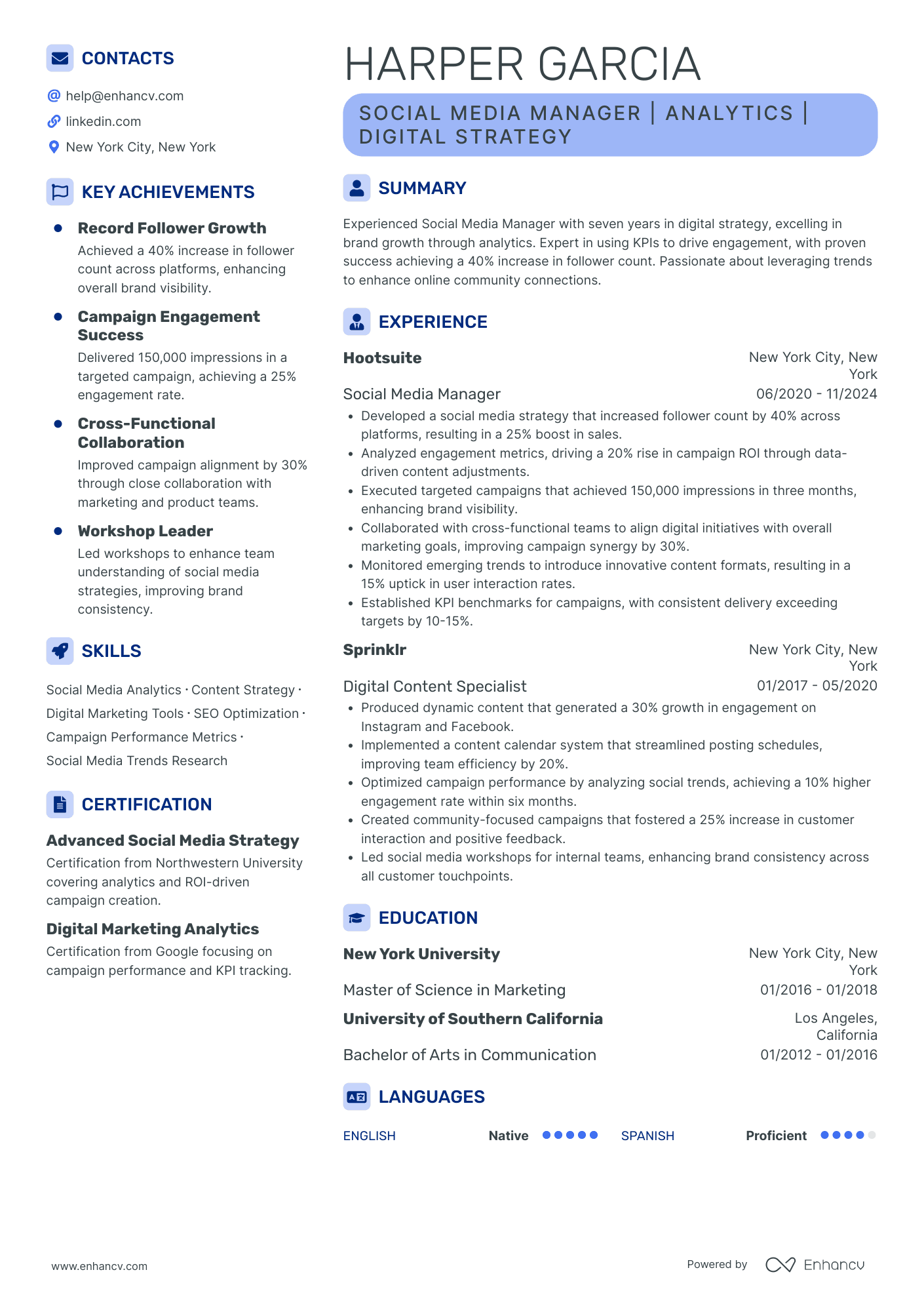
You would include their social media skills in the Experience section when you’ve worked extensively in social media and want to show concrete achievements backed by metrics and examples. This placement is ideal for demonstrating how you’ve applied your skills to drive results, such as increasing engagement, growing followers, or running successful campaigns.
 01/2020 - 11/2023
 08/2017 - 12/2019
Creating a dedicated social media Skills section is a smart way to ensure potential employers can quickly identify your qualifications. This approach works well if social media skills aren’t the top priority for the role you’re applying for but are still valuable. It’s also an effective complement to the more detailed examples provided in your experience section.
Here’s what this section could look like for a content writer with social media skills:
Social media awards can be a valuable addition to your resume, particularly for roles such as social media specialist or advertising specialist, where recognition of your expertise can set you apart. To present these awards effectively, include them in a dedicated Achievements or Awards section.
Here’s how to do it:
Got a resume already? Make sure it doesn’t miss anything important—with our free AI checker.
Drop your resume here or choose a file. PDF & DOCX only. Max 2MB file size.
Understanding how to display social media skills is essential, but knowing which roles prioritize them is equally important.
We use social media every day, and for most of us—especially younger people like students, interns, and juniors—it’s second nature. They already know the basics, like creating content, interacting with others, and spotting trends. This makes it much easier for them to step into professional roles and grow their skills quickly, building on what they already know.
This means that the progression of social media skills isn’t so much about how much experience someone has as much as it’s about their willingness to learn, take courses, and keep up with new trends and tools. Personal motivation and effort play a bigger role in growth than just time spent in the field.
We’ll now give answers to a few more popular questions below.
Adding social media skills is one thing, but should you add your own social media profiles to your resume? Yes, as long as they’re professional and relevant. A well-maintained LinkedIn profile, an Instagram showing your creative work, or a Twitter account highlighting industry insights can act as a dynamic portfolio and help you stand out to employers.
That said, steer clear of including personal or casual accounts that don’t align with your career goals. Don’t put your Facebook or Instagram profile if there’s personal information on there or things you wouldn’t want your employer to see.
To create a strong social media resume, start with a brief summary that underlines your experience and career goals. Include skills like content creation, analytics, and social media strategy, and list tools like Hootsuite or Canva. Write specific measurable achievements to showcase your impact. Finally, customize your resume for each job by aligning your experience with the role’s requirements.
“Proficient” in social media means you have the skills to manage platforms effectively, create engaging content, and analyze performance metrics to improve results. It includes knowledge of platform-specific strategies, such as posting schedules and audience targeting, as well as the ability to use tools like scheduling software and analytics dashboards.
Media literacy skills encompass analyzing the credibility of online content, creating engaging posts or videos, and understanding how algorithms shape what we see online. These skills also involve recognizing bias in media, interpreting performance analytics, and using data to refine content strategies.
It means understanding how platforms work and using them strategically. It involves creating engaging content, staying updated on trends, and managing interactions professionally. Social media-savvy individuals use analytics to measure performance and adjust strategies for better results, combining creativity and data-driven decision-making to achieve goals.