



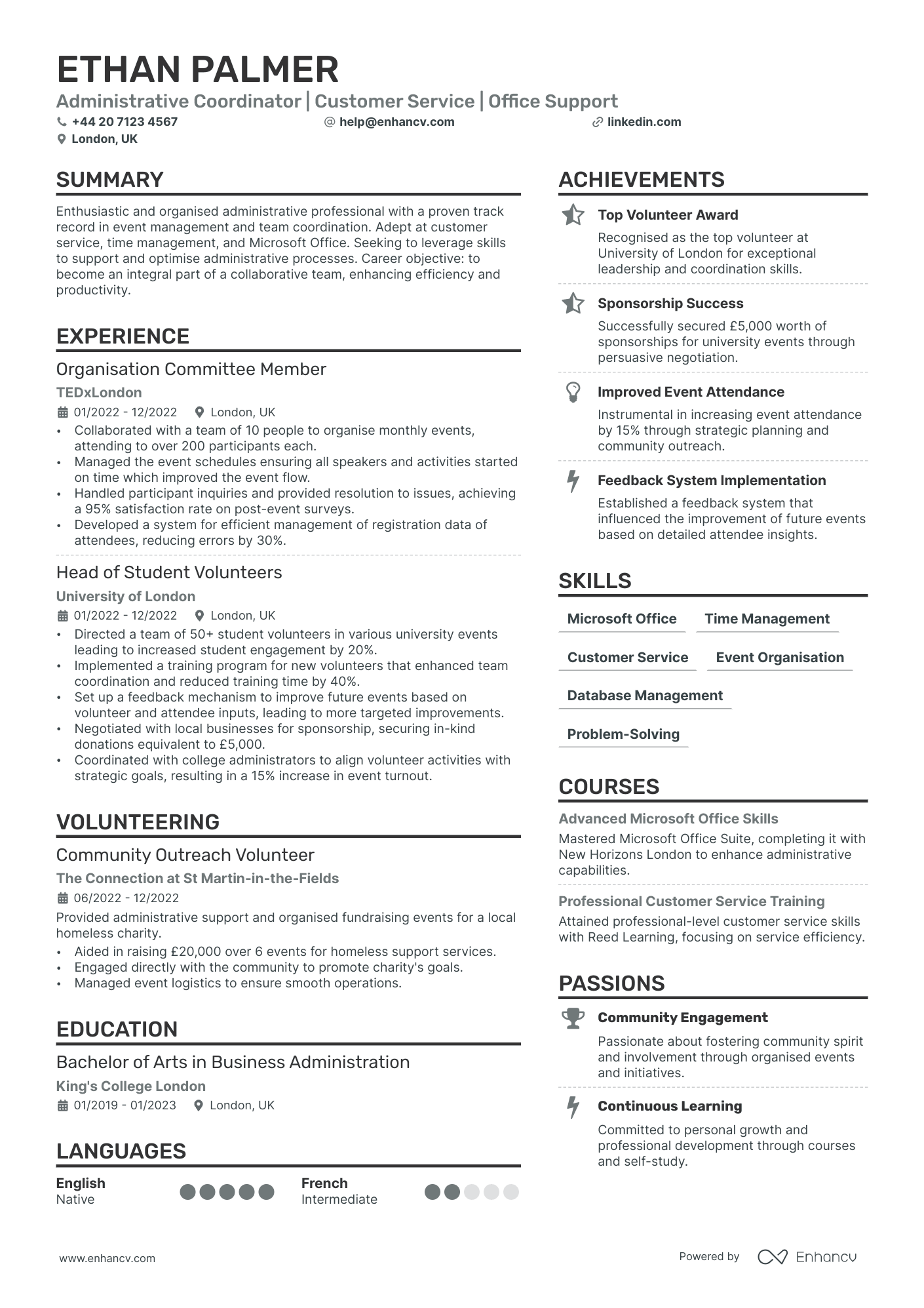
No work experience is the normal starting point for a college CV, not a weakness. Almost every 16, 17, and 18-year-old writes their first one this way, and the employers who hire students already know it.
What separates the CVs that get a reply is simple. They lead with real evidence, a Saturday job, volunteering, a school responsibility, a skill someone can check, instead of a paragraph of adjectives. Get those fundamentals right and a first CV does its job. For the groundwork that applies to any CV, see how to write a CV.

Key takeaways
- No work experience is normal at college age. Lead with school achievements, volunteering, and any part-time or casual work.
- Use a skills-led layout so your strengths sit above a short work history.
- Keep it to one page, most recent first, saved as a PDF unless the advert asks for a Word file.
- Open with a short personal statement built on one or two concrete facts, not adjectives.
- Name only the skills you can actually back up, and prove each one in a bullet.
- Put your predicted or achieved grades and any certificates near the top. They are your track record.
Writing a college CV with no experience
Nobody expects a 16 or 17-year-old to have a CV full of jobs. Employers who advertise for students hire on attitude, reliability, and potential, and they train the rest.
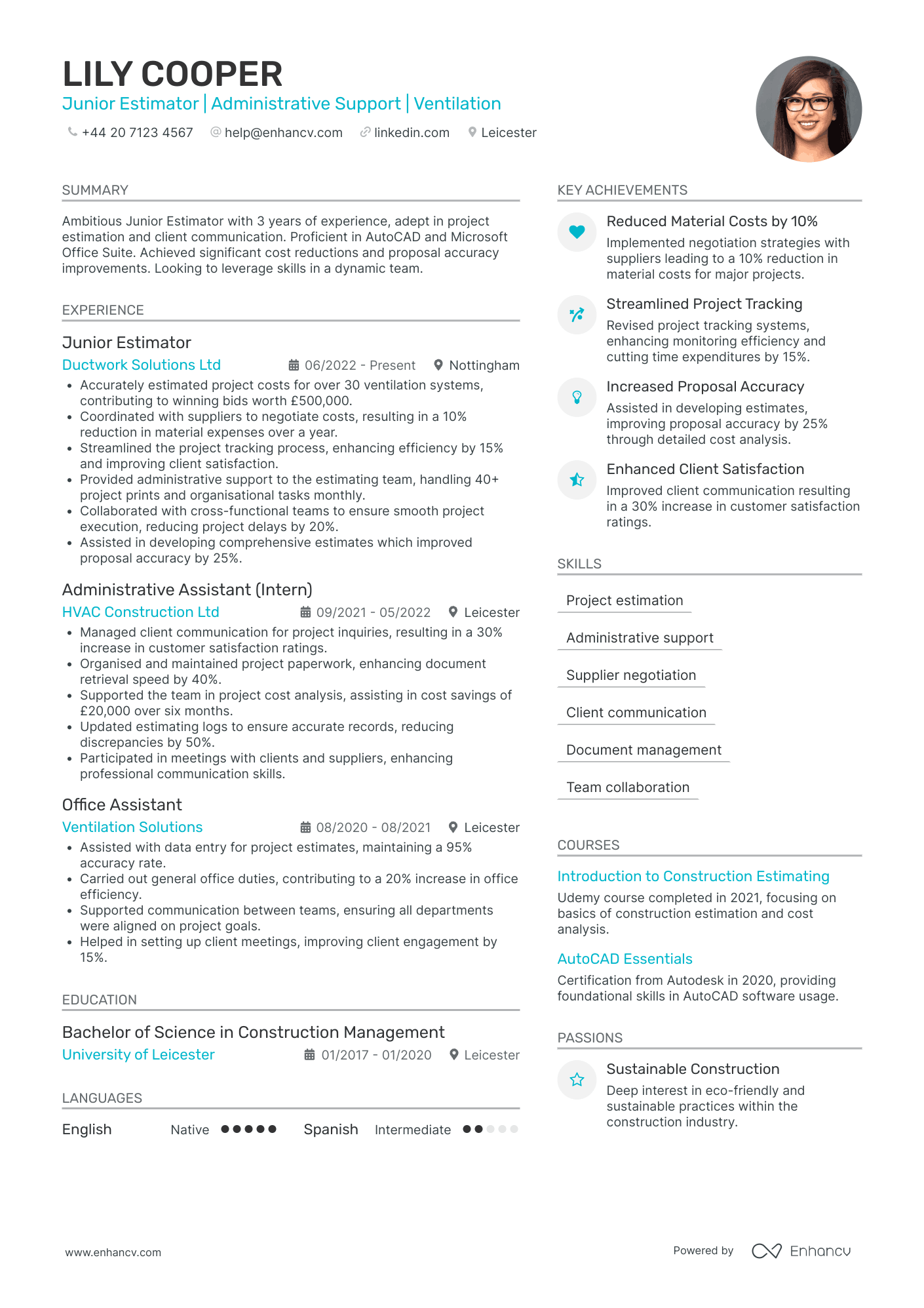
So your first CV carries its weight differently. Use a skills-led structure: personal statement, then skills and achievements, then education, with any work history lower down.
The logic is simple. A recruiter reading a student CV wants to picture you in the role quickly, so the strongest evidence goes highest and a sparse work history sits where it cannot sink the page.
Then mine your life for evidence. It is almost always there:
- School and college: a subject prize, a prefect or peer-mentor role, captaining a team, running an event or the tuck shop rota.
- Volunteering: a charity shop, a community group, a sports club, or helping at a local event.
- Casual and part-time work: babysitting, a paper round, tutoring a younger student, or helping in a family business.
- Personal projects: coding, a YouTube channel, selling on Vinted, fixing bikes, anything you have kept up.
Write those in the language of work. 'Ran the sixth form charity fundraiser and hit the target two weeks early' is an achievement, and it happened at school.
Responsibilities count even when they were not paid. Being trusted to lock up a club, count the takings at a cake sale, or train the new members of a team all show an employer the habits they care about.
Your subjects are evidence too. A science A-level shows you can follow a method and record results, an essay subject shows you can build an argument, and a maths or business course shows you are comfortable with numbers. Say what the study proves, not just its title.
One honest line about a real responsibility beats five vague ones. Pick the two or three things you have genuinely done that a manager would recognise, and give each the space to land.
If you have volunteered, give it a dated entry like a job, with what you did and roughly how many hours. Volunteering on a CV counts as real experience at this stage, not filler.
The same goes for a weekend or holiday job. A CV for a part-time job is often the first one you will write, and a few months on a till tells an employer plenty. If you are stuck on the shape, our CV examples for a first job show what a no-experience CV should look like.
Aim that first CV at the right doors. Local shops, cafes, supermarkets, and seasonal work expect student applicants and are set up to train from scratch, so a clean, honest one-pager is often all it takes to earn a trial shift.

PRO TIP
List your predicted grades if you have not sat the exams yet, and mark them clearly as predicted. Add your GCSEs too, especially English and maths, because plenty of employers screen for a pass in both.
What a college CV should include
A college CV is short by design. On one page a reader should find who you are, what you can do, and what you are studying.
Keep to the standard CV sections, in this order for a first CV:
- Contact details: your name, phone, email, and town. No full address or date of birth needed.
- Personal statement: two or three lines on who you are and what you are looking for.
- Skills: the practical and personal strengths you can prove.
- Education: your school or college, subjects, and grades or predicted grades. For most students this education section carries the most weight.
- Experience: any paid, voluntary, or casual work, most recent first.
- Interests: only where they show something useful. Chosen well, hobbies and interests can hint at commitment or teamwork.
Use a sensible email address, ideally your name rather than a nickname from Year 9. It is one of the first things a recruiter reads, and a tidy one signals you take the application seriously.
You do not need a photo, a date of birth, or a references list on the page. 'References available on request' is enough, if you mention them at all.
Once you know the sections, you can build your CV online and fill each one with guided prompts rather than staring at a blank document.
What the UK college job market looks like
It helps to know the setting you are applying into. Across 48 UK college postings in the last 30 days on Enhancv's internal job feed, two patterns stand out, and both are worth knowing whether you are after a part-time job now or a role at a college later.
| What | UK college roles |
|---|---|
| Sample | 48 UK college postings in the last 30 days (Enhancv's internal job feed) |
| Where the work happens | Almost entirely on-site |
| Skills that recur most | Project management, behavioural support, and curriculum development |
Almost all of that work is on-site, so if you are applying for a role based at a college, a recruiter needs to see you can reliably get there. Put your town near the top and mention your availability around study.
No reliable UK salary benchmark applied to this mix of roles, so treat the advertised rate on each posting as your guide rather than a headline figure.
The skills that recur, project management, behavioural support, and curriculum development, point to the staff side of a college rather than the student one. They are still a useful reminder that even the entry-level roles reward people who can organise their time and work well with others.
Formatting your college CV
For a first CV, a skills-led layout puts your strengths before a thin work history. Once you have a couple of jobs behind you, switch to reverse chronological order.
One page is plenty at this stage. There is proper guidance on how long a CV should be, and for a college leaver the honest answer is rarely more than one.
Keep it to one column, standard headings, and a clear, readable font. A reader should be able to scan the whole thing in seconds.
Stick to a plain font at around 10 to 12 point, with a little white space between sections. Skip the graphics, colour blocks, and photos that make a CV harder to read and slower to parse. Neat and legible wins over decorated at this stage.
For most applications, send it as a PDF so the layout holds on any screen. Keep a Word copy in case an employer or agency asks for one, and if the advert names a file type, follow it.
Rename the file with your name and the role before you send it, so it is easy to find in a full inbox. Tweak it for each application as well, matching a few words to the advert, rather than sending one version everywhere.
Online applications often pass through tracking software first, so keep the layout simple and the headings standard for an ATS-friendly read. Build it from a tested layout rather than a blank page: Enhancv's CV templates export to a clean PDF.
Writing your college CV personal statement
Two or three sentences at the top: who you are, what you are studying, one thing you have done, and what you are looking for. Keep it concrete. There are more personal statement examples if the opening line is hard to start.
Skip the adjective soup that every other student CV uses. 'Hard-working, motivated, and passionate' tells a reader nothing they can check.
Here is the weak version most students send, and the stronger one to aim for:
College CV personal statement to avoid
I am a hard-working, motivated, and passionate individual looking for a role where I can develop my skills and gain experience in a fast-paced environment. I am a great team player with excellent communication skills and a positive attitude.
College CV personal statement example (no experience)
Reliable Year 13 student on track for A-levels in Business, Psychology, and Media, with a Saturday job in retail and two years helping at a local charity shop. Confident with cash handling, stock, and customer questions, and used to juggling coursework with shifts. Looking for a part-time customer service role near Manchester to build on that while I finish my studies.
When a college CV lands with no jobs on it, we are looking for proof you will turn up, follow instructions, and get on with people, not a work history. One real line, like 'ran the tuck shop rota for my sixth form for a year', tells us more than a stack of adjectives. Name the thing you actually did, however small, and let it carry the CV.
the Enhancv team
Skills to put on a college CV
Split your skills into two kinds. Hard skills are the practical, teachable ones: using spreadsheets, handling a till, editing video, a second language. List them in plain terms.
The soft skills that matter at this stage are real and checkable too: communication, teamwork, time management, and reliability. Prove each one in a bullet rather than only naming it.
Evidencing a skill is easier than it sounds. 'Communication' becomes 'explained products to customers and handled returns politely'. 'Teamwork' becomes 'shared jobs and covered shifts with three other volunteers'. The bullet does the convincing, the label just files it.
List only what you can stand behind in an interview. If you picked up a skill through school, a club, or a project, say where. That honesty is what makes the skills section believable on a CV with little paid work.
Top skills for your college CV:
Microsoft Office (Word, Excel, PowerPoint)
Cash handling and till operation
Social media (content and scheduling)
Basic data entry
Touch typing
First aid certificate
A second language
Communication
Teamwork
Time management
Reliability
Customer service
Problem solving
Writing the experience section without a job history
Paid, voluntary, or casual, write every entry the same way: a dated heading, then bullets that show what you did and what came of it. Start each bullet with a verb. For the mechanics, see work experience on a CV.
Even small roles are measurable. Customers served, money handled, events run, a rota you kept, a target you reached. Try to quantify what you did, even with rough numbers.
School work experience placements belong here as well. A week shadowing in an office or a shop is a dated entry with a line or two on what you saw and did, and it shows an initiative that plenty of applicants your age skip.
Order the entries with the most relevant first if one clearly fits the job better, rather than sticking rigidly to dates. A charity shop role sits above a paper round when you are applying to a shop.
- Serve around 40 customers a shift on the till, taking cash and card payments and cashing up at close
- Sort and price donated stock, and built a window display the manager kept for the whole season
- Cover the shop floor on my own during quiet periods, answering questions and keeping the space tidy
- Picked up extra shifts at short notice through the Christmas rush, praised by the manager for reliability
PRO TIP
Read the advert and mirror the words it uses where they are true of you. If it asks for 'customer service' and 'teamwork', put those exact phrases in a bullet you can back up. That is how a first CV lines up with what the employer is scanning for.
Conclusion
Lead with real evidence, name the skills you can prove, and keep the whole thing to a clean single page.
Pair it with a short cover letter that says why you want the role, and a CV with no work history becomes a credible first application. The habits you show now, turning up, following through, writing clearly, are the same ones every later CV will build on.

Author's take - the Enhancv team
When a college CV lands with no jobs on it, we are looking for proof you will turn up, follow instructions, and get on with people, not a work history. One real line, like 'ran the tuck shop rota for my sixth form for a year', tells us more than a stack of adjectives. Name the thing you actually did, however small, and let it carry the CV.