



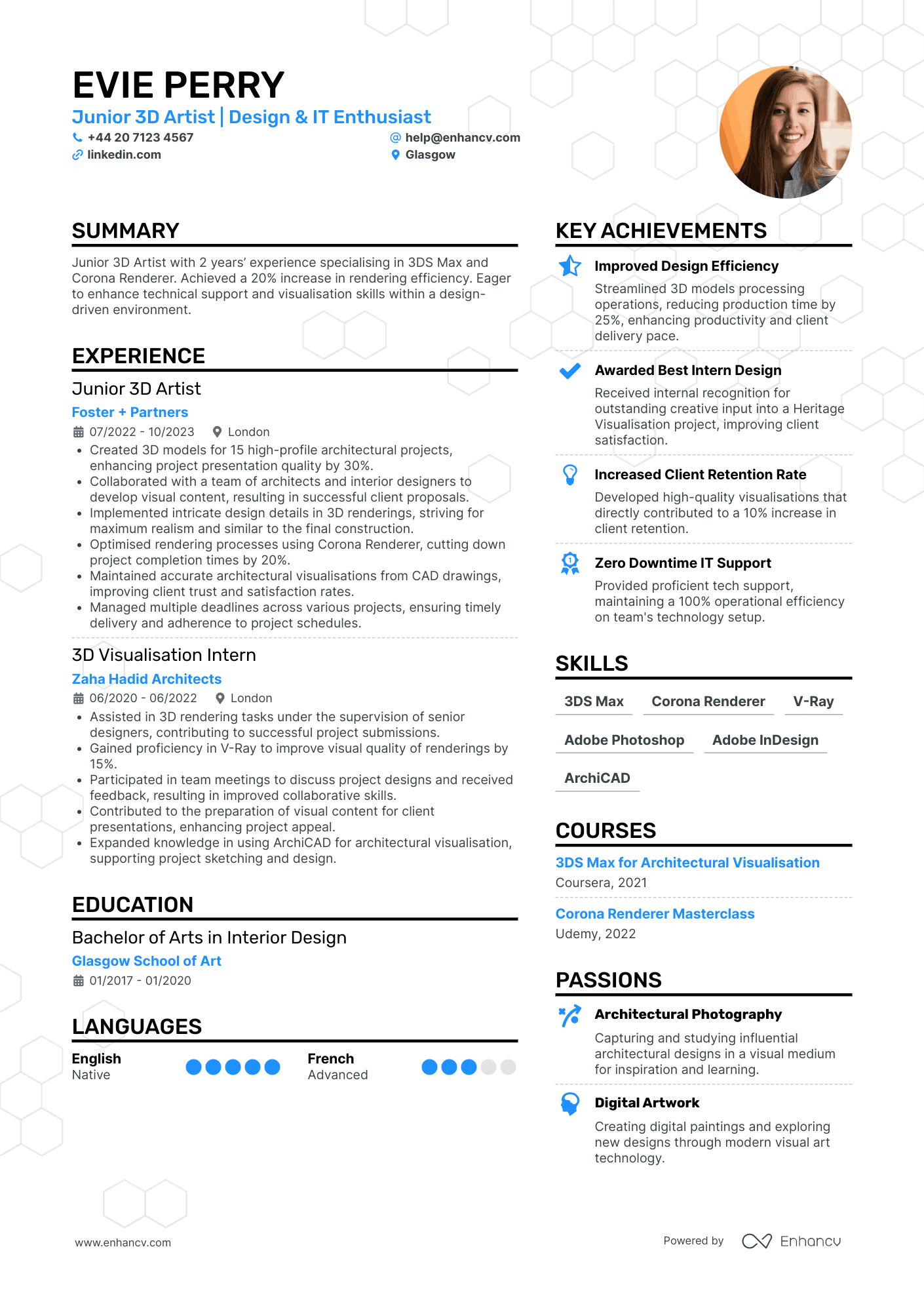
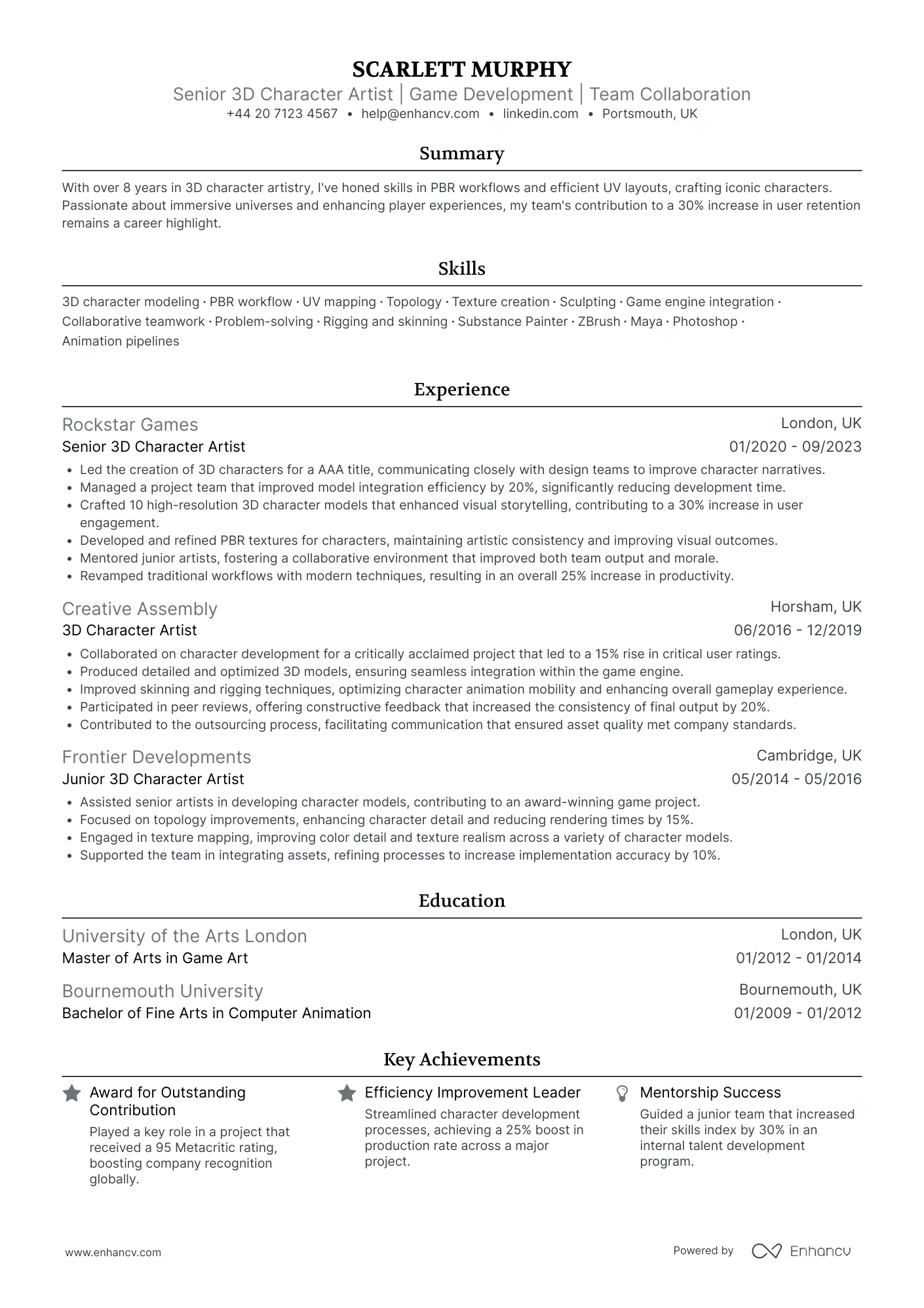
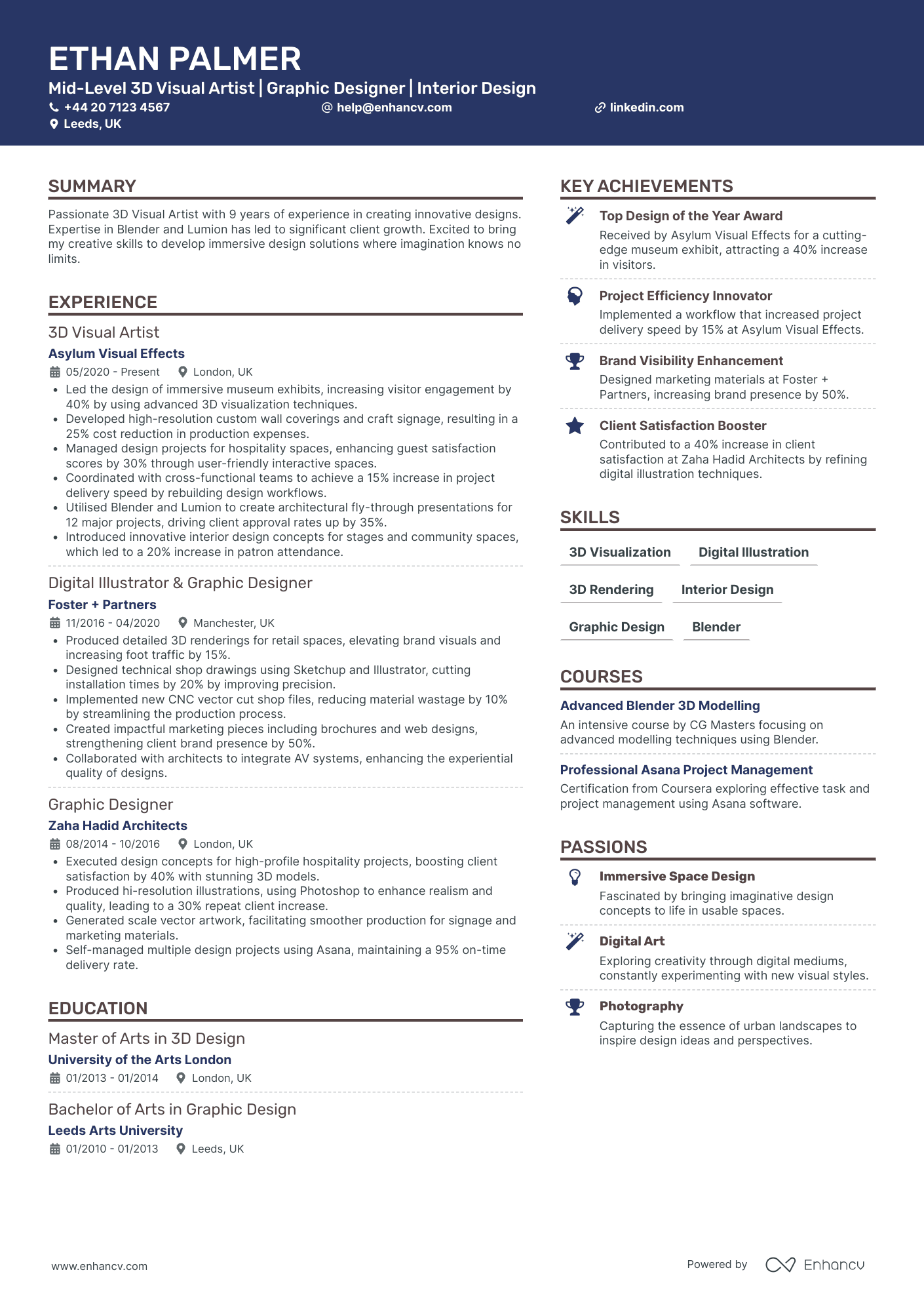
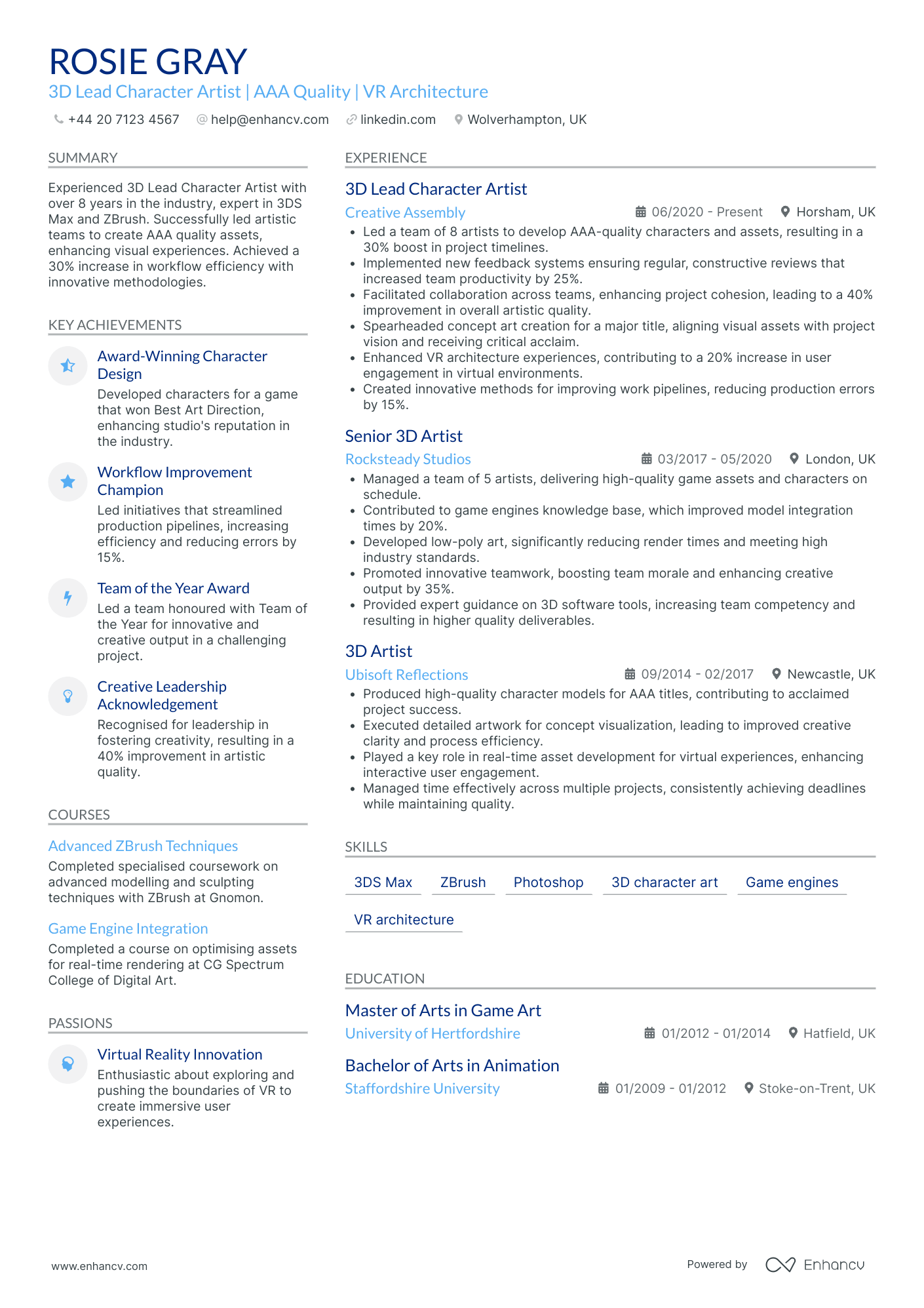
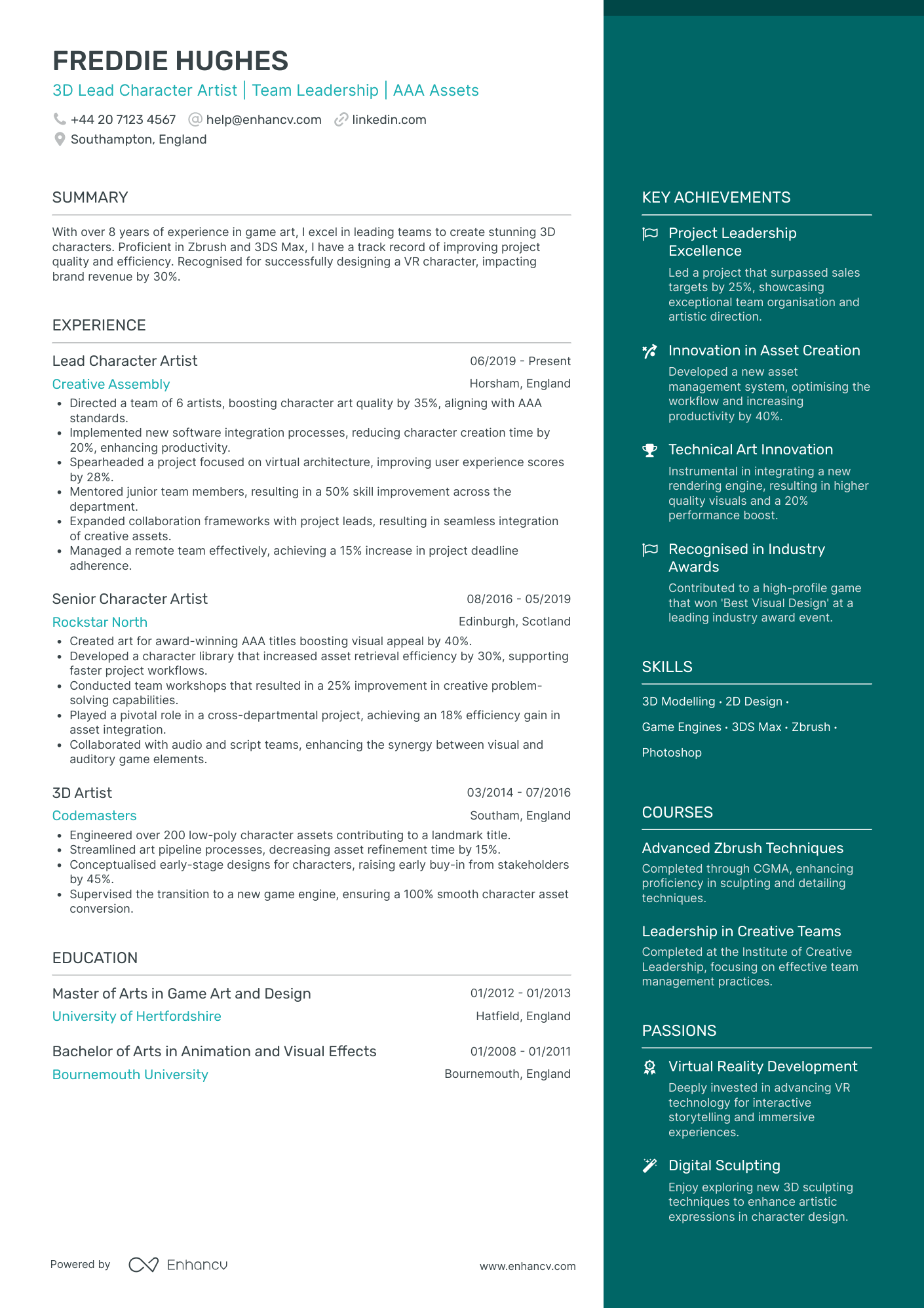
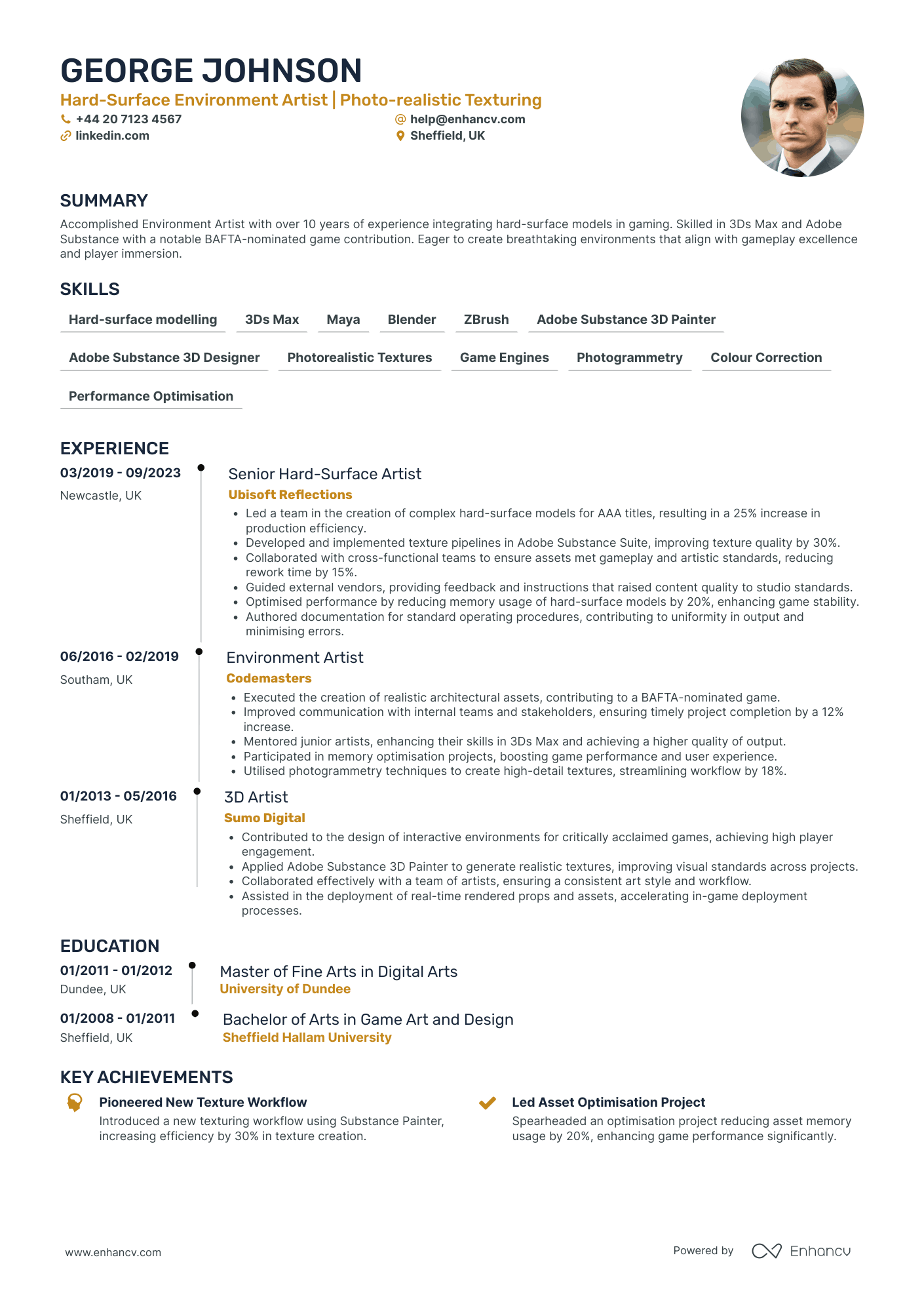
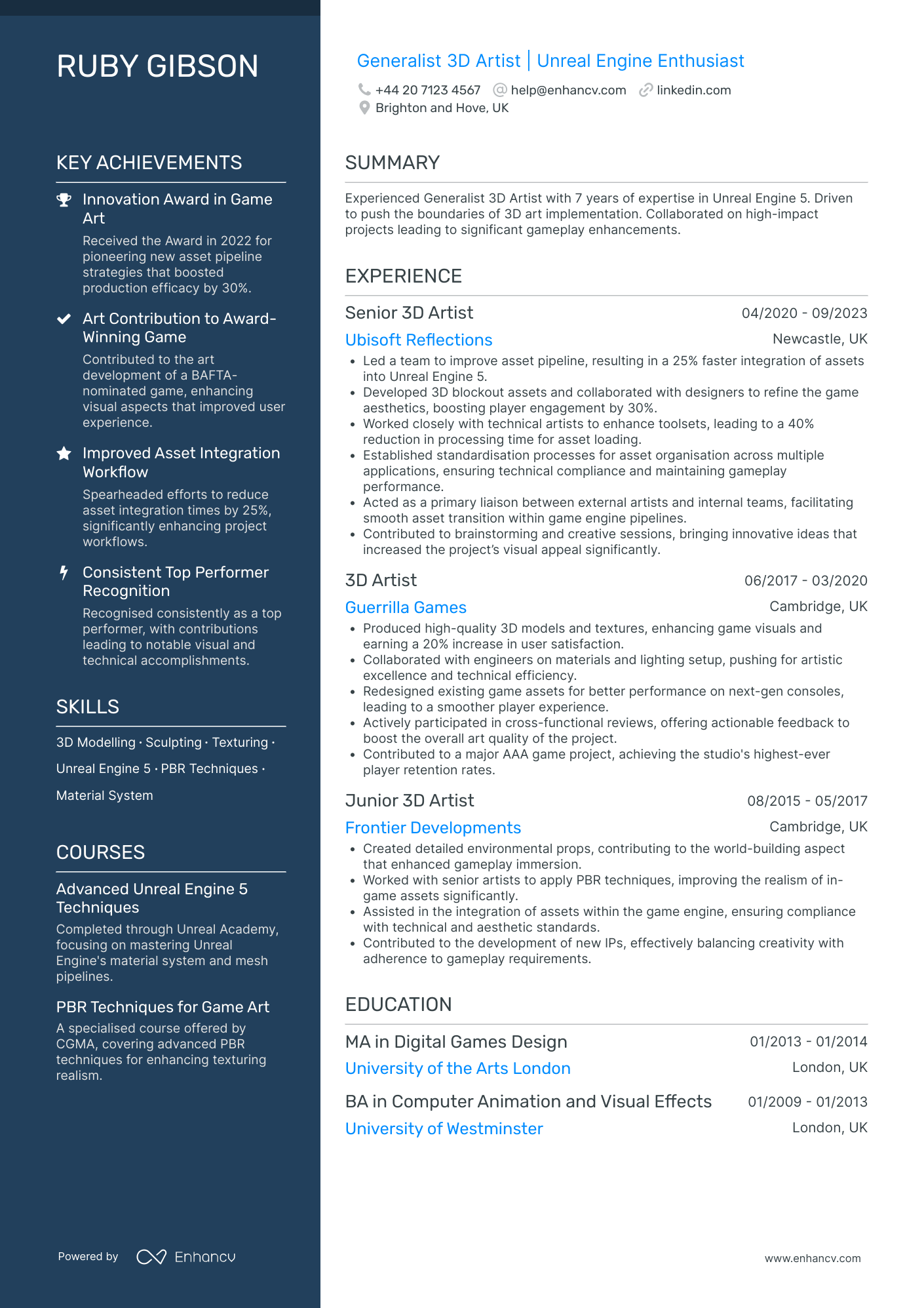
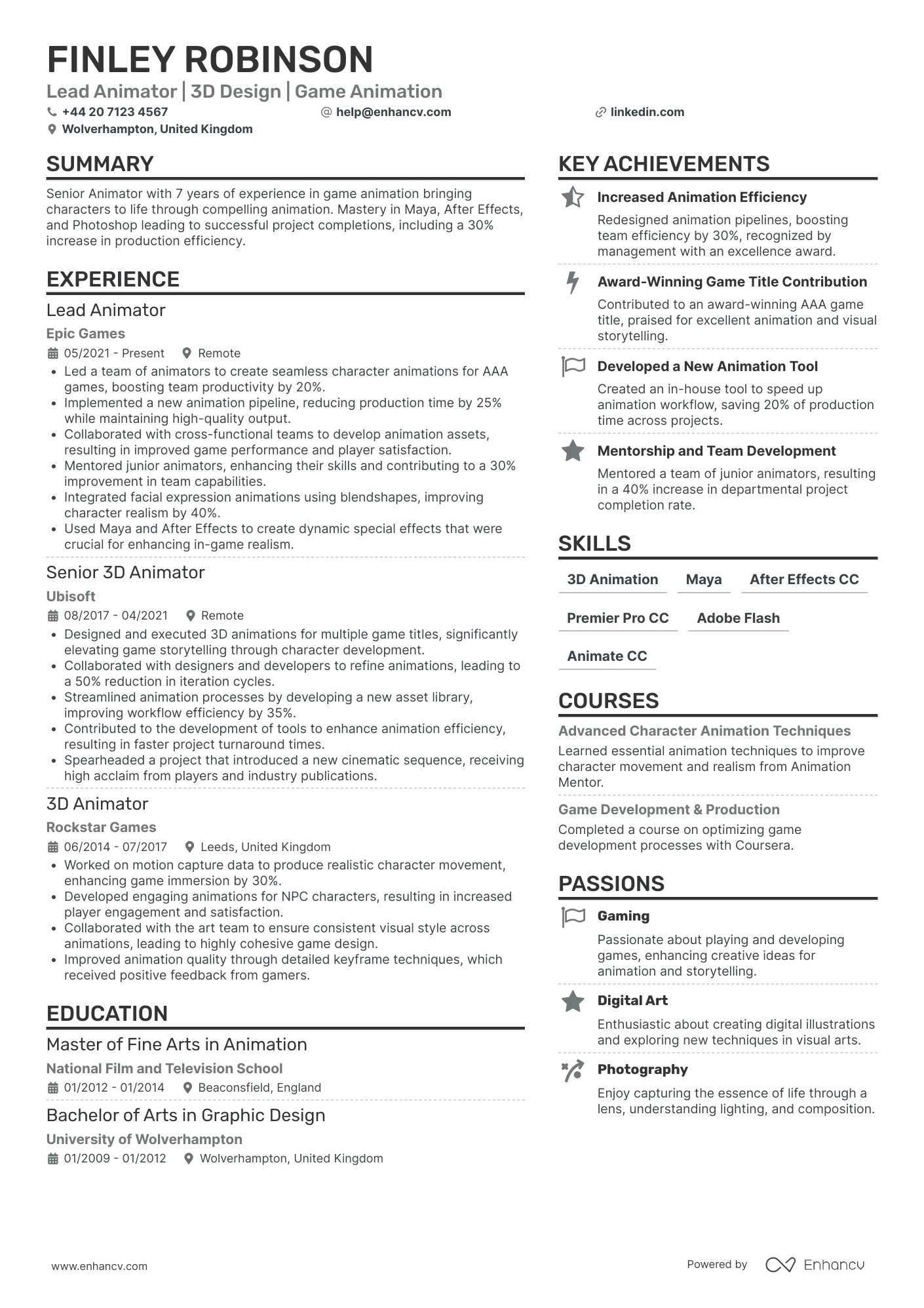
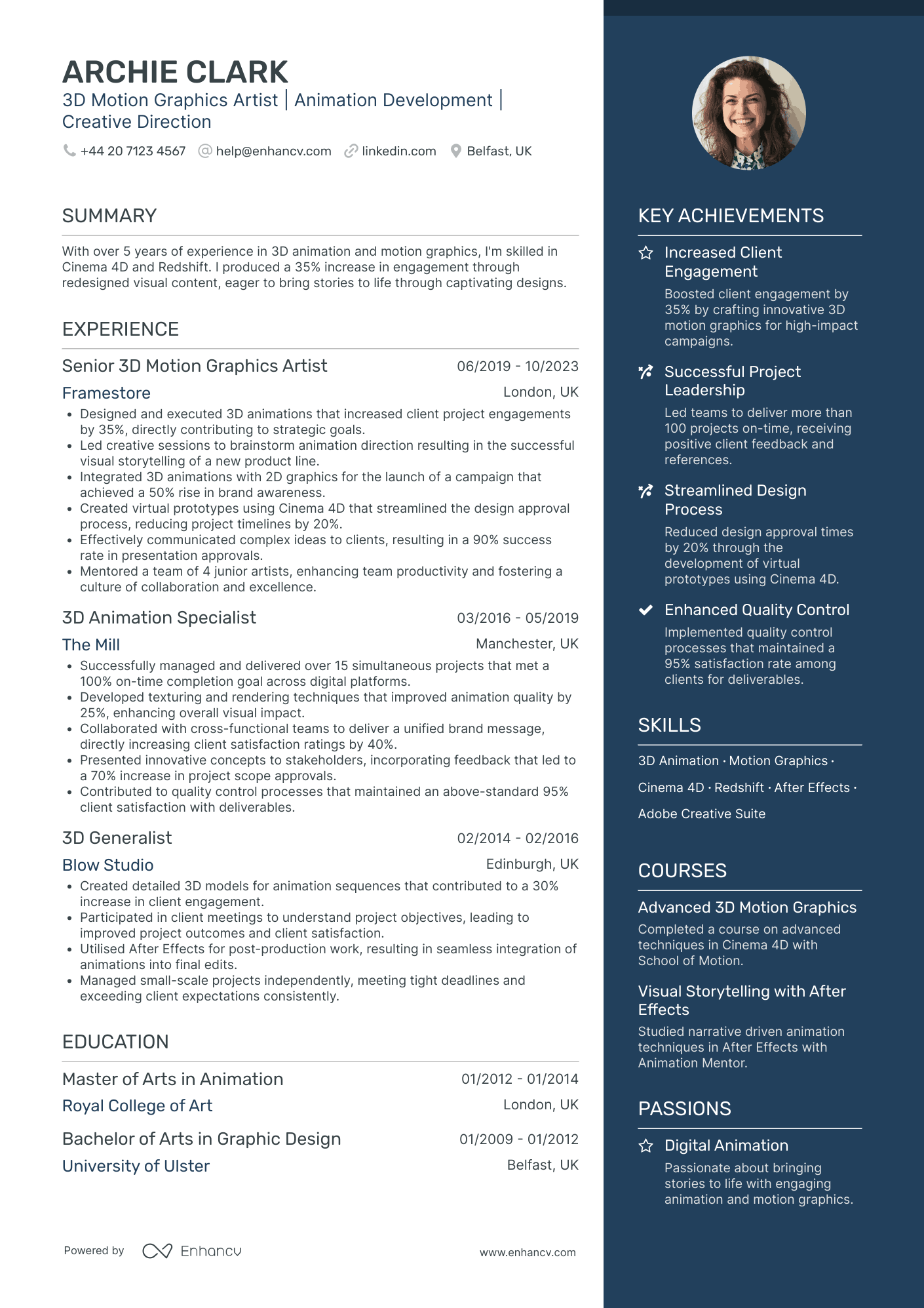
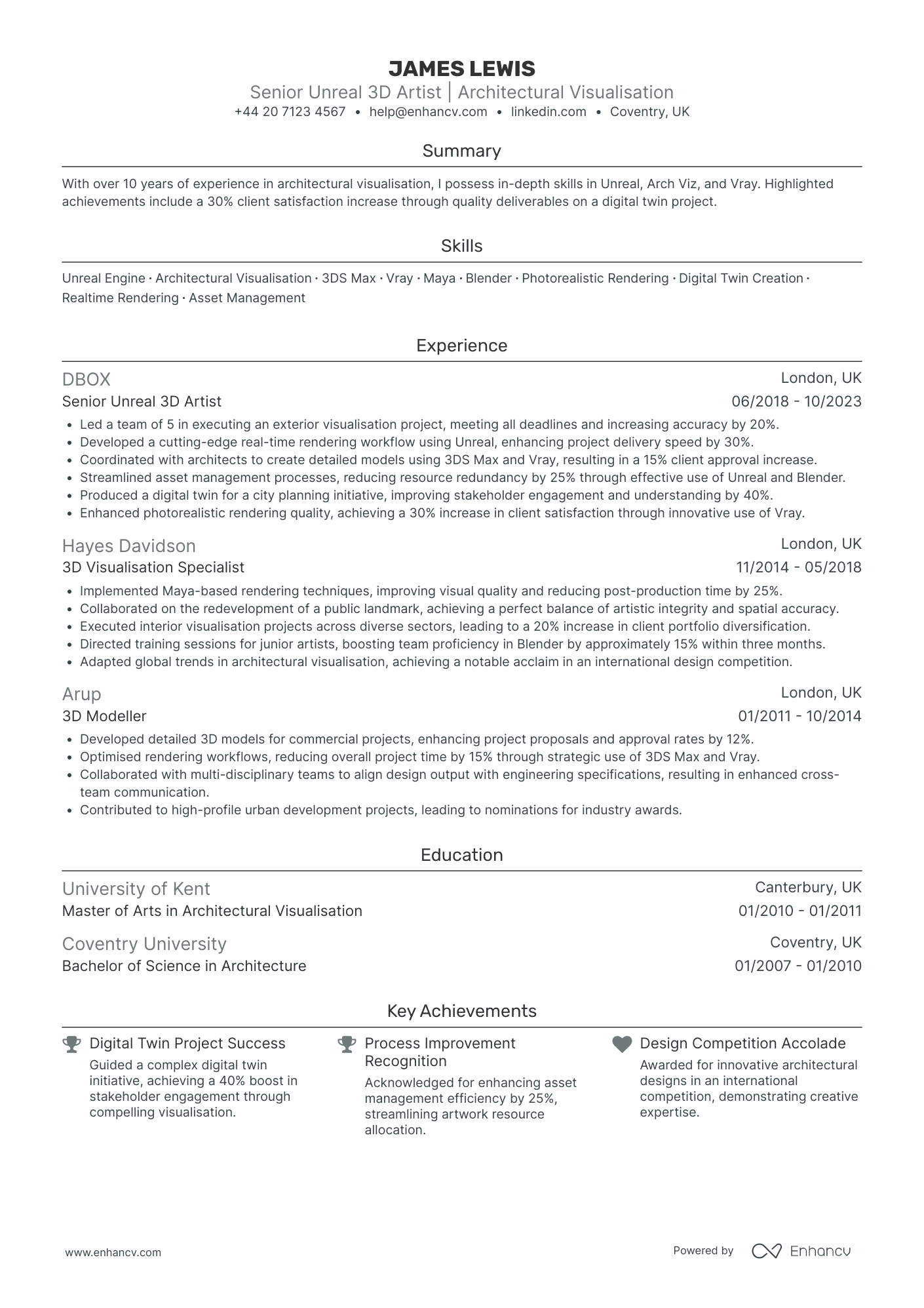
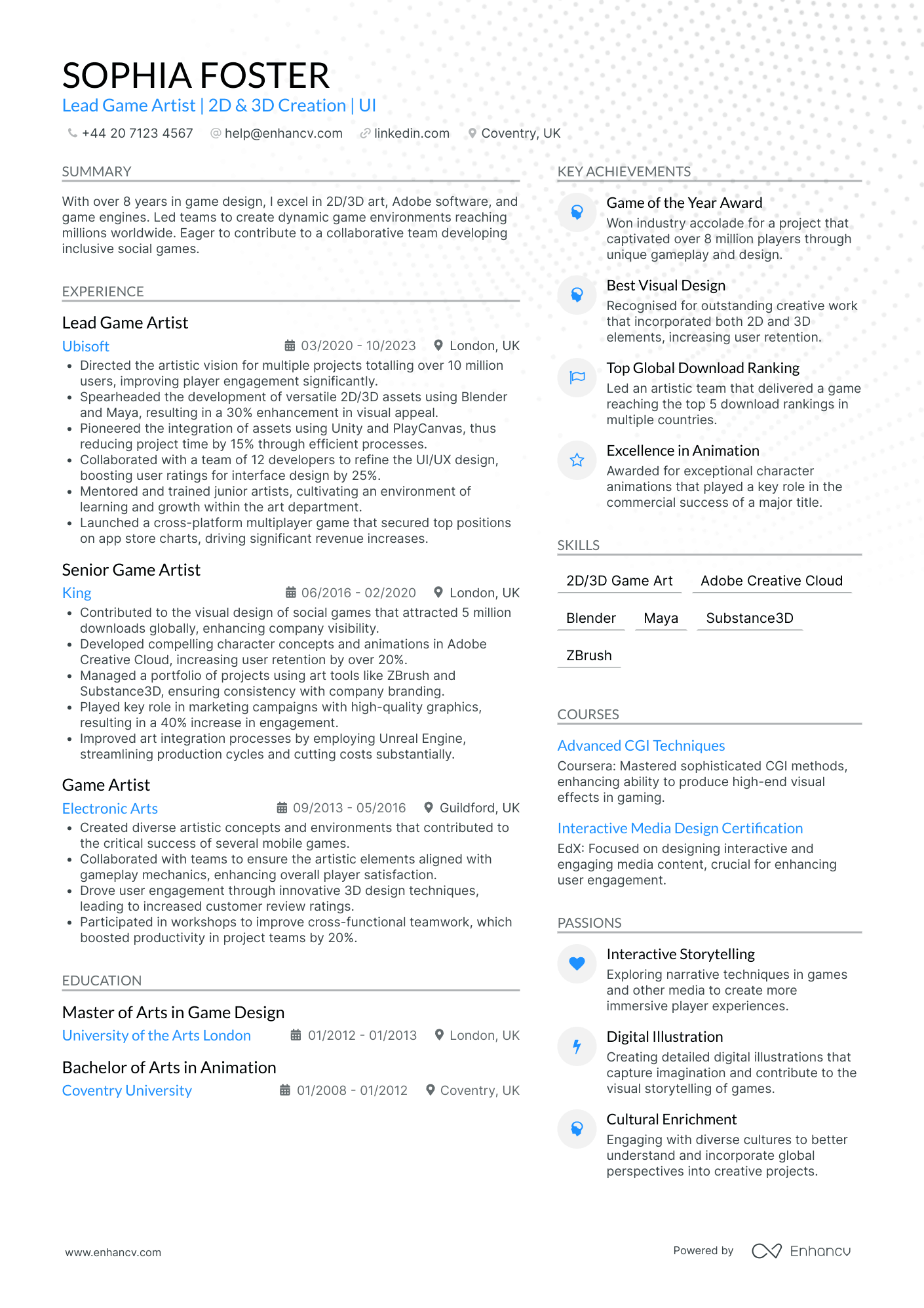
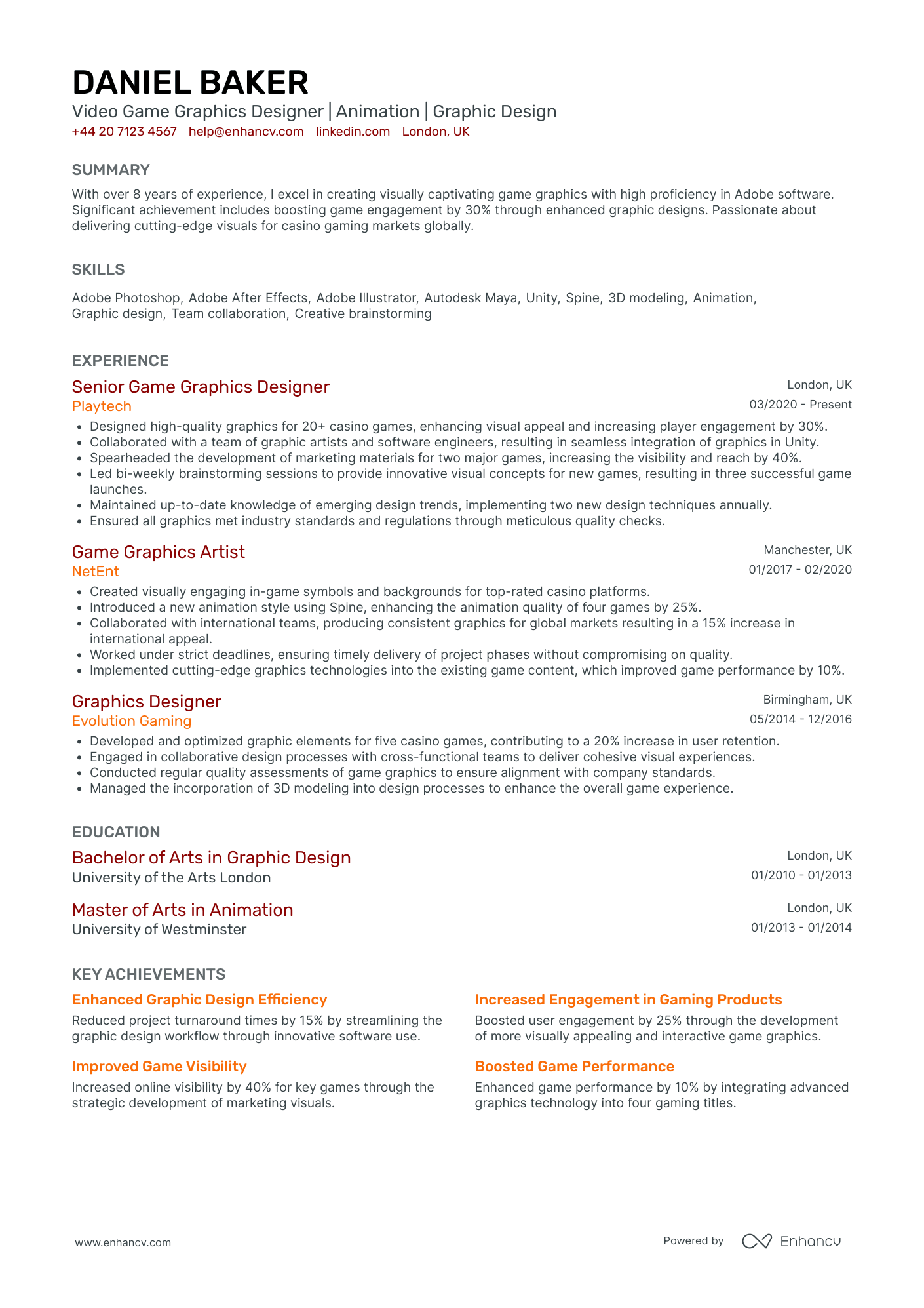
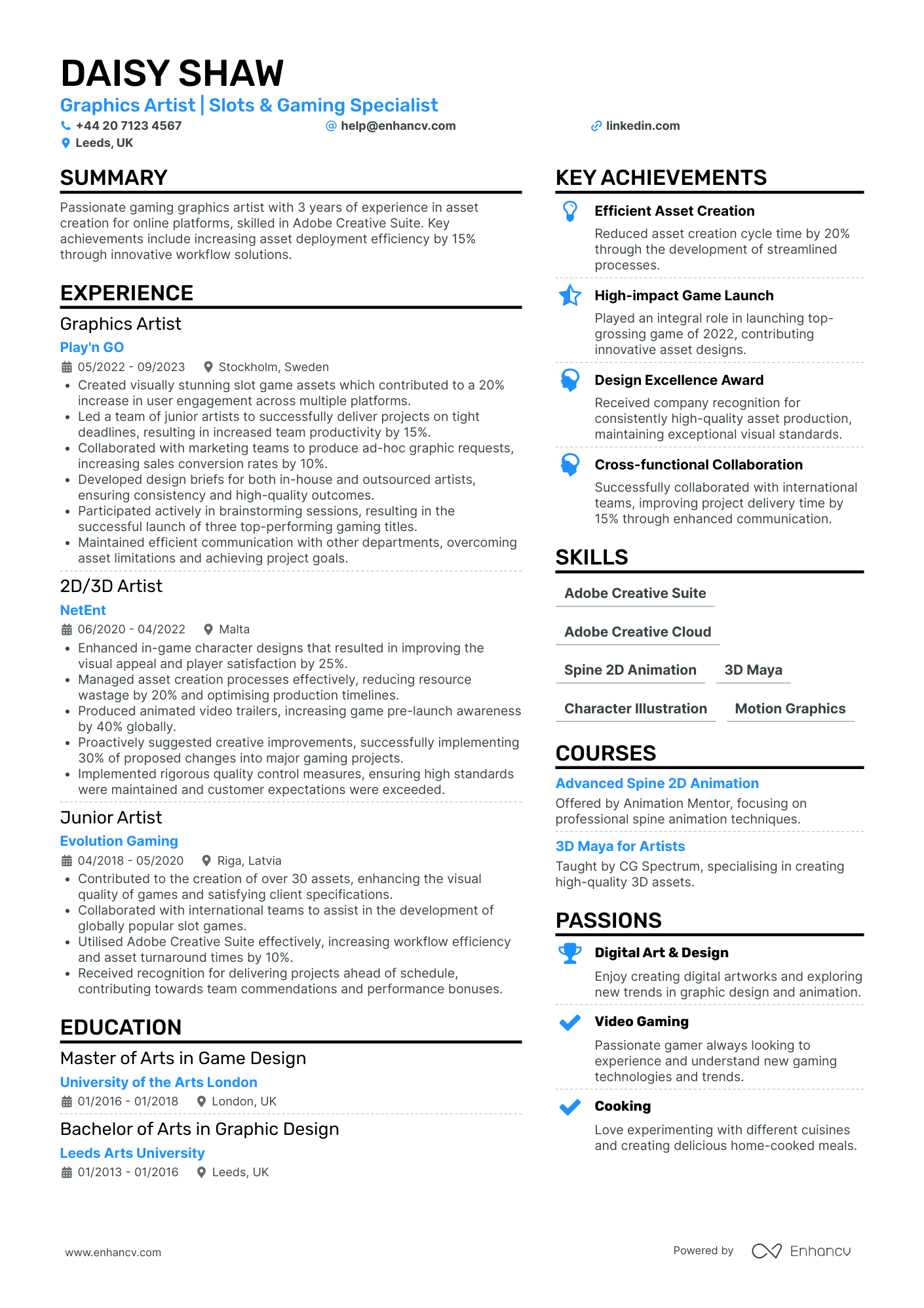
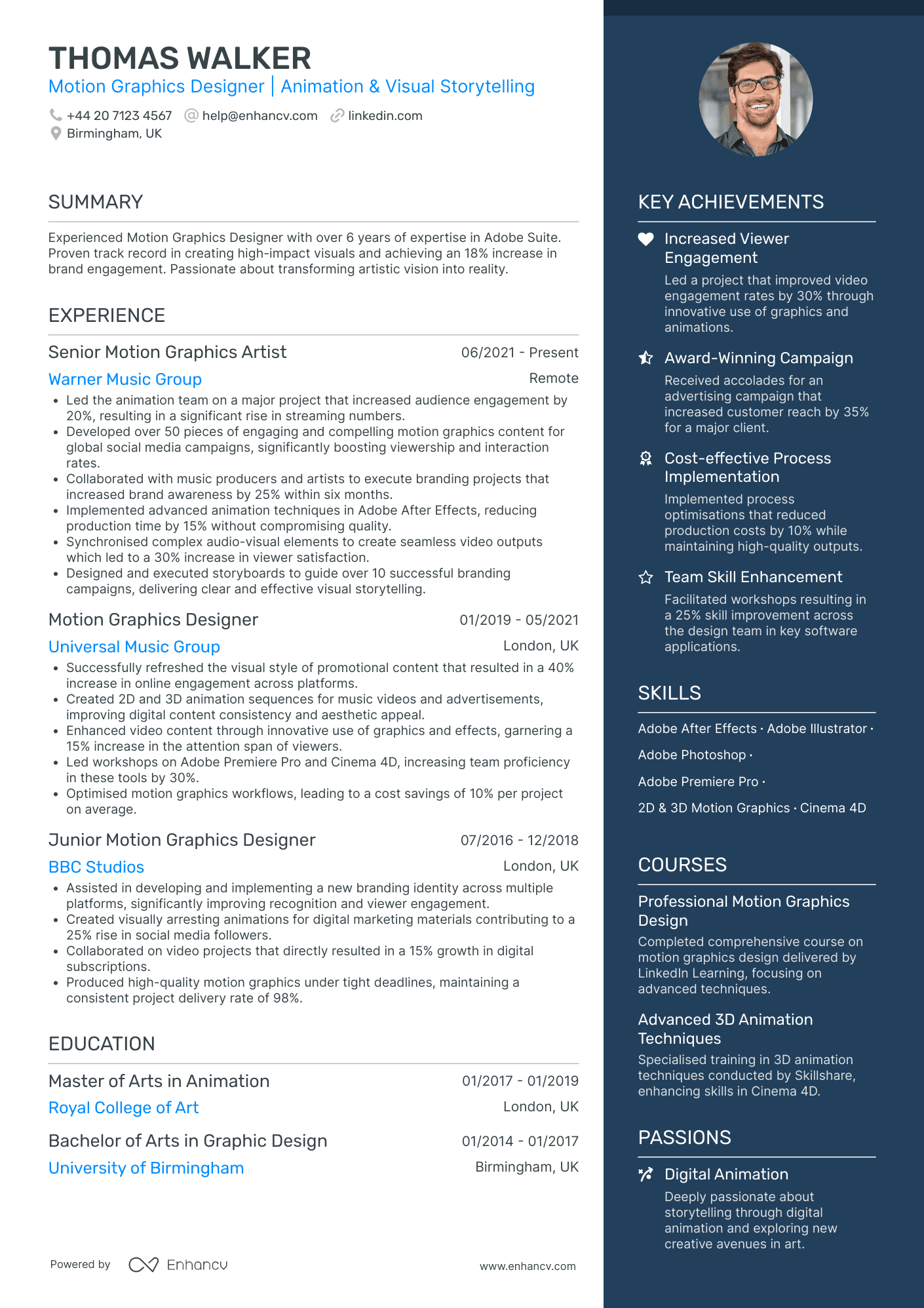
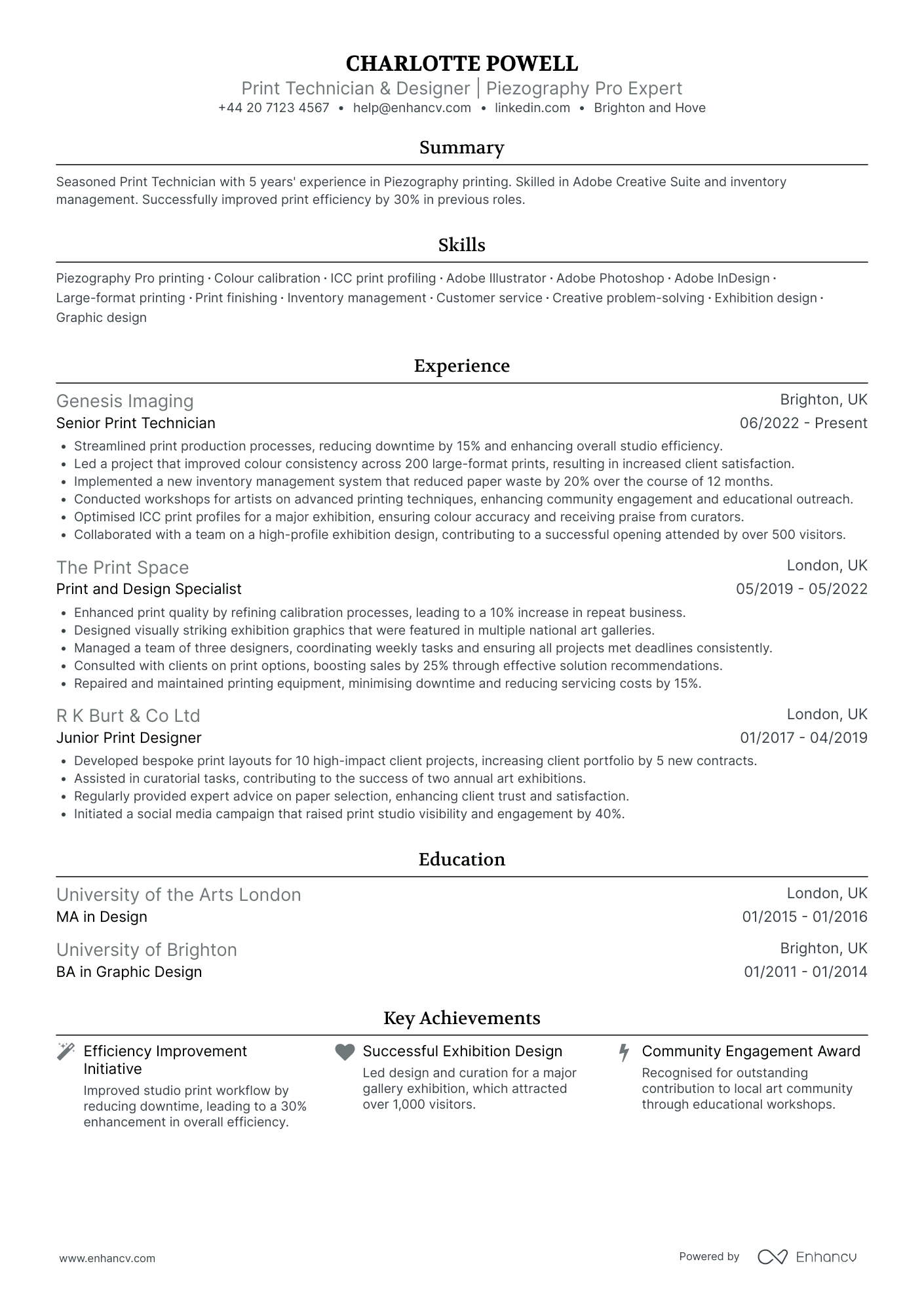
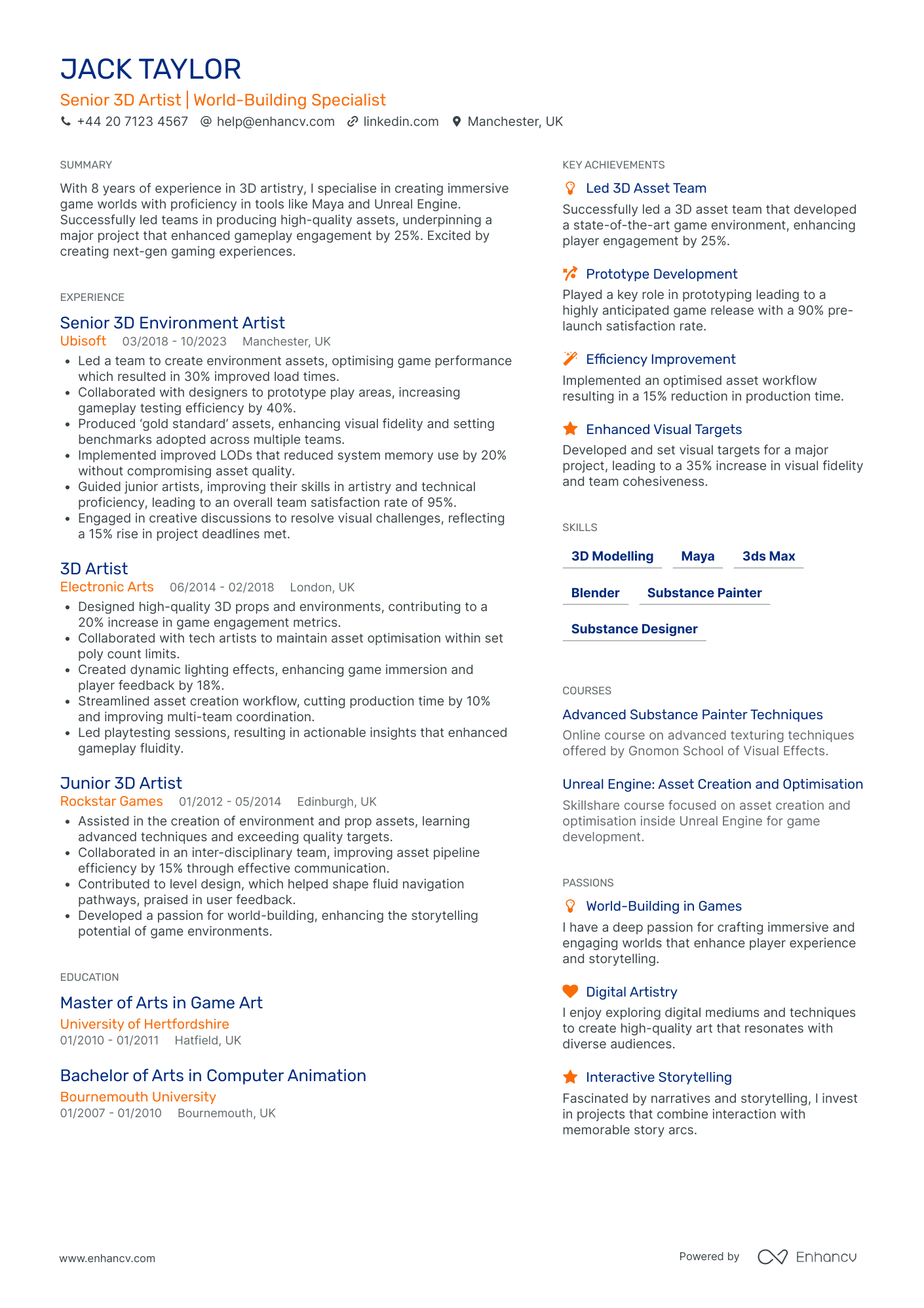
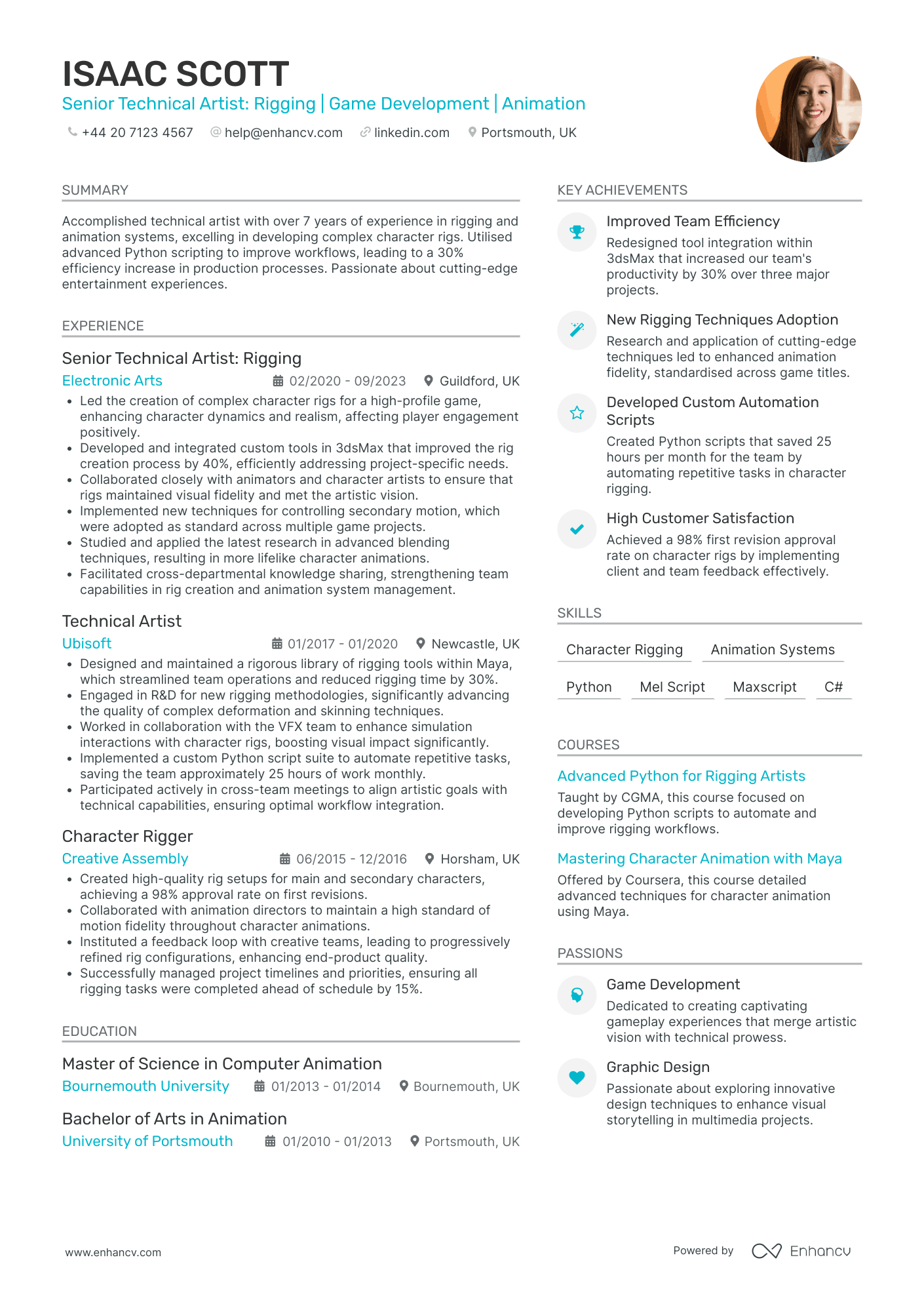
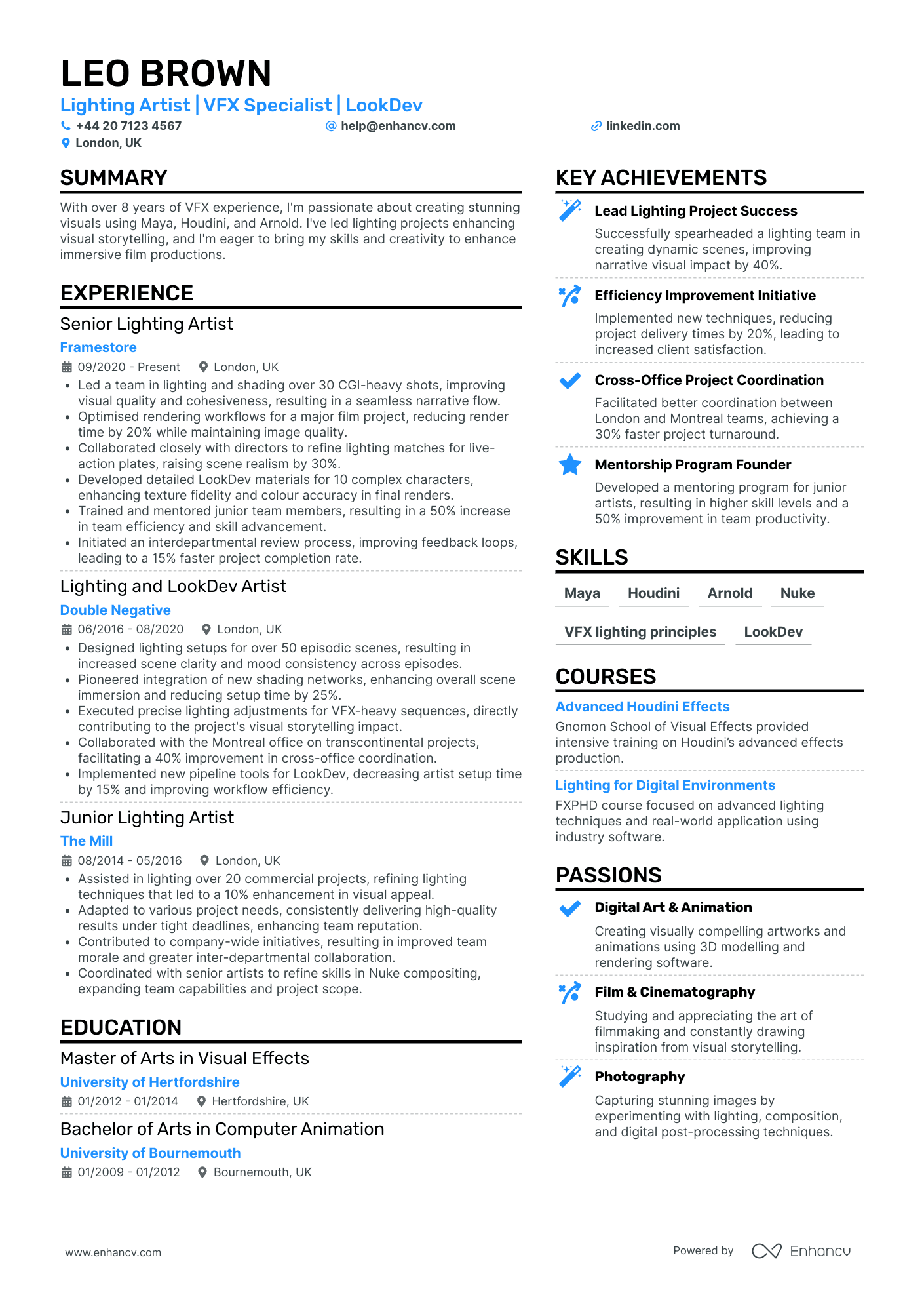
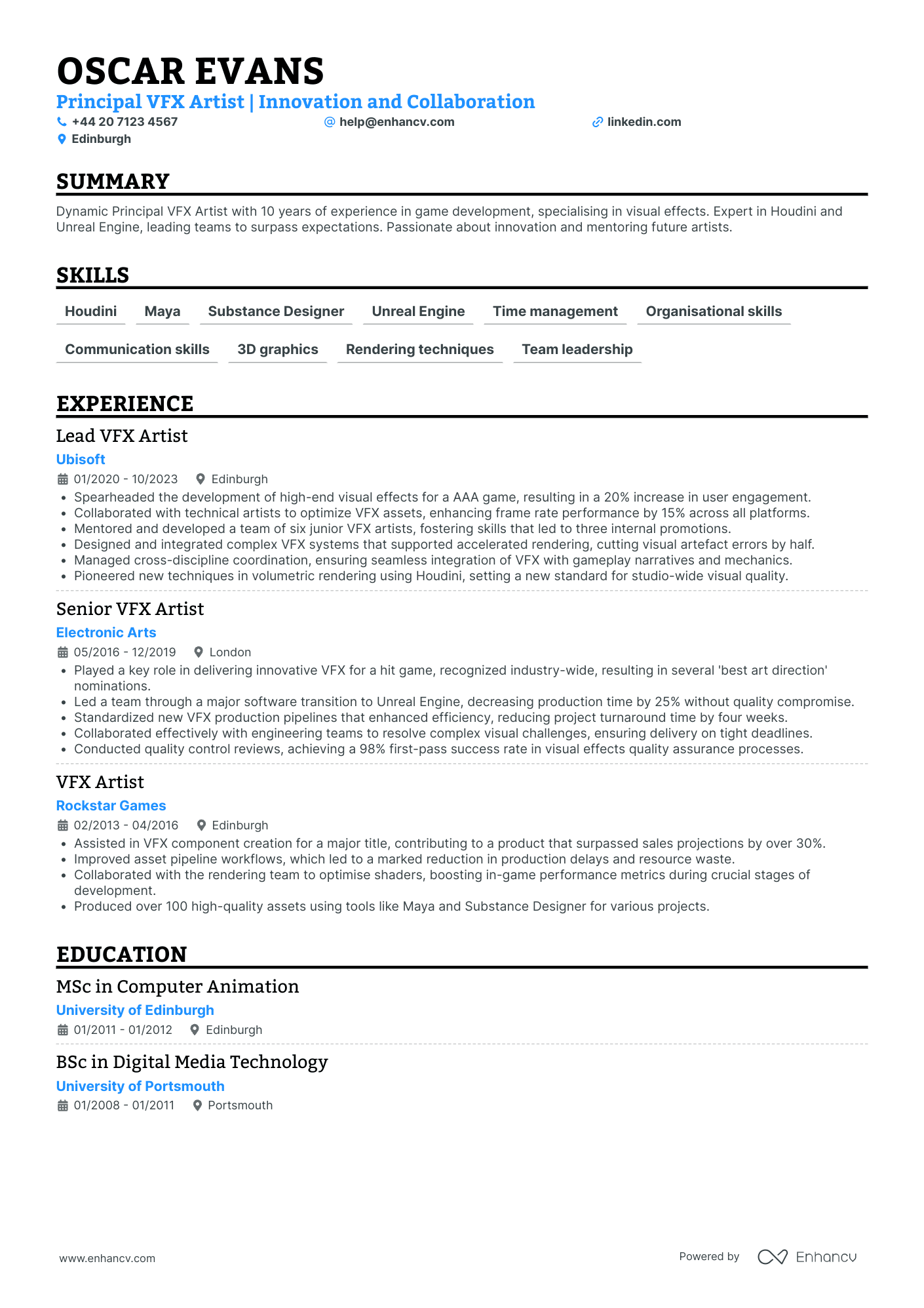
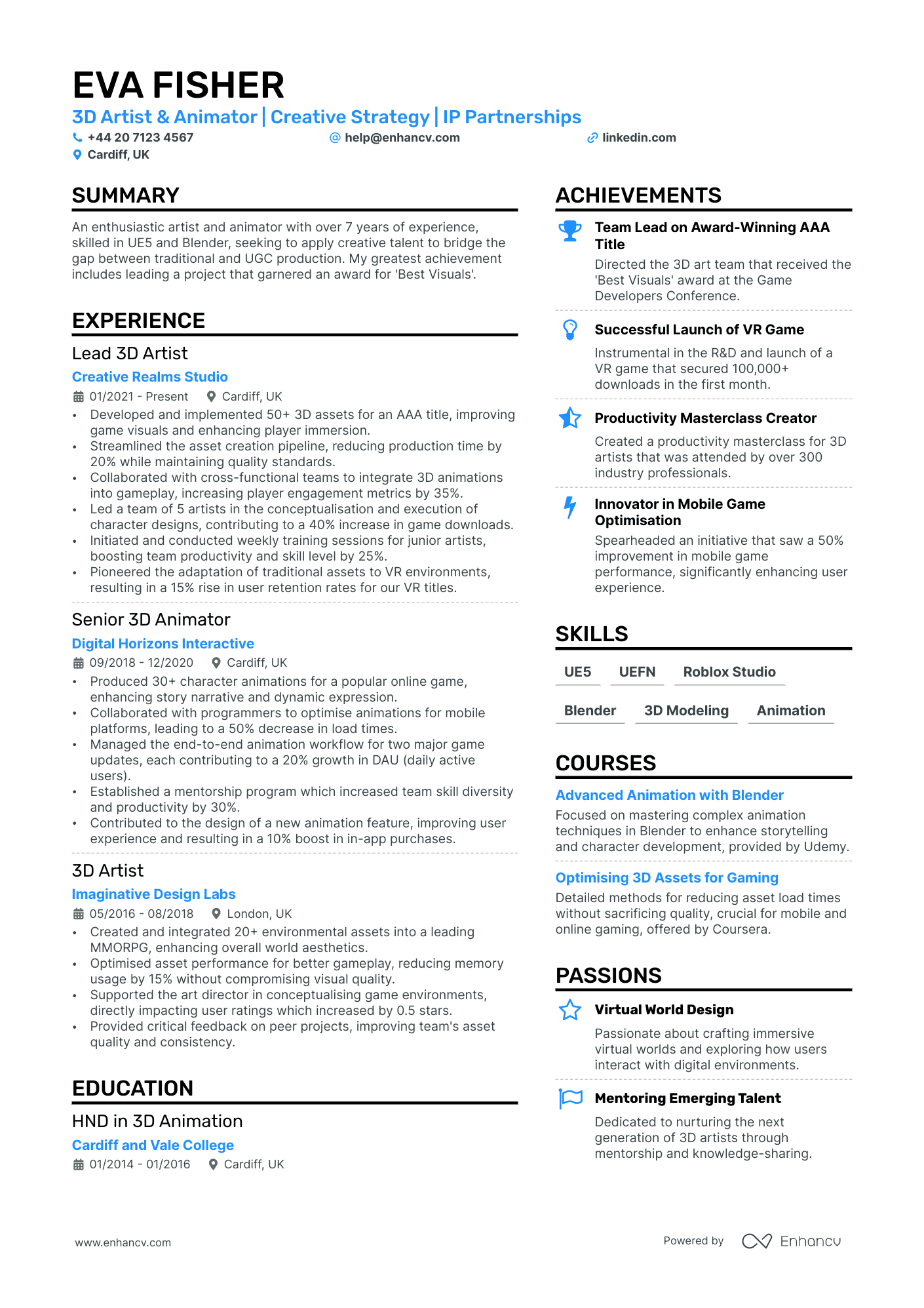
In 3D art, your reel gets you hired, but your CV decides whether anyone opens the reel. It is the thirty-second gate a studio lead skims before they click a single link.
Most junior 3D CVs waste that gate on a wall of software logos and a personal statement about passion. The ones that land an interview point straight to the work, name the pipeline they can slot into, and make the portfolio link impossible to miss.

Key takeaways
- No professional experience is normal for a first 3D role. Lead with your portfolio, your reel, and finished personal projects, not a job history.
- Put your portfolio or ArtStation link in the header, where a lead sees it in the first few seconds.
- Name the specialism you are aiming for, whether that is modelling, texturing, lighting, environment, or character work, so a studio knows where you fit.
- List the software you can actually use to a brief, in the words studios use: Maya, 3ds Max, Blender, ZBrush, Substance Painter, Unreal Engine.
- Treat student briefs, game jams, and personal projects as real experience, with dates, tools, and outcomes.
- Keep it to one or two pages, sent as a PDF, with the reel link live and public.
Writing a 3D artist CV with no experience
3D art is judged on output. A studio cares whether your models are clean, your topology holds, and your textures read at the right resolution. That is good news when you have no paid roles, because a portfolio proves all of it.
So a first 3D CV carries its weight differently. Lead with a skills-led structure: a header with your reel link, a short personal statement, your software and specialism, then projects, with any unrelated jobs lower down. If you want the fundamentals first, see how to write a CV.
Mine your training and your own time for real project evidence. It is almost always there:
- University or college briefs: a modelled environment, a rigged character, a rendered product shot.
- Personal projects: a scene built in Unreal, a character sculpted in ZBrush and textured in Substance Painter.
- Game jams, mod work, or collaborative projects with a clear deliverable and a deadline.
- Freelance or commission work, even small: a logo animation, an asset pack, an architectural visualisation.
Write each of those like a job, not a hobby. 'Modelled and textured a 12-asset medieval prop set in Blender and Substance Painter for a student game project' is an experience bullet, it just happened at university.
Give every project a dated entry with the tools named and the outcome shown: polycount held to budget, delivered on the jam deadline, used in a playable build. These are the first job CV details that turn a hobby into a credit.
Adjacent work belongs on the CV too, framed for its transferable value. A graphic design role that had you living in Photoshop, a video job where you learned After Effects, or a retail job where you hit deadlines under pressure all say something a studio can use. Keep those entries short and let the projects carry the weight.
Be honest about your role on group work. 'Environment lead on a four-person game jam, responsible for all modular assets and set dressing' is far stronger than implying you built a whole game. Studios work in teams, and they trust an applicant who can name exactly what they owned.
One line lifts a no-experience CV: name the pipeline stage you want. 'Junior environment artist, comfortable from blockout to final lighting in Unreal Engine 5' tells a lead exactly where you slot in, which a list of software never does.

PRO TIP
Studios hire for a seat in the pipeline, not a bag of software. Decide whether you are pitching as a modeller, texture artist, lighting artist, or generalist, then make every project on the CV back that one claim.
Building the portfolio your CV points to
For a 3D artist, the CV is the trailer and the portfolio is the film. If a lead cannot reach your work in one click, the CV has failed its main job.
Host the work where studios already look. ArtStation is the default for stills and breakdowns, a Vimeo or YouTube reel for anything animated, and a personal site if you want full control. Put the single most important link in your CV header, not buried at the bottom.
Curate hard. Six strong pieces beat twenty average ones, and a lead will judge you on your weakest shot. Cut anything you would not want to defend in an interview.
Show the process, not only the beauty shot. Wireframes, UV layouts, texture breakdowns, and clay renders prove you understand the craft rather than downloaded a scene. For a reel, lead with your best three seconds.
Label every piece with the software used and your exact role. 'Full asset, modelled and textured by me' reads very differently from 'lighting only on a team scene', and studios respect the honest version.
Order the reel and the gallery to your target. If you want an environment seat, open on your strongest environment, not a character you are proud of but will never be hired to make. The first piece a lead sees sets their expectation for the rest.
Keep the presentation quiet so the work is loud. Neutral backgrounds, consistent lighting on turntables, and a legible caption on every shot let a studio judge the model rather than the mood board around it.
What UK 3D studios look for
Before you format anything, know what a UK studio actually screens a junior on. It is rarely years of experience.
| What studios check | How to show it on your CV |
|---|---|
| Portfolio and reel | A public ArtStation or reel link in the header, curated to your target specialism |
| Software fluency | Maya, 3ds Max, Blender, ZBrush, or Substance Painter named only where you genuinely work in them |
| Pipeline fit | A stated specialism (modelling, texturing, lighting, environment, or character) so a lead sees where you slot |
| Real projects | Student briefs, game jams, and personal work written up with tools, constraints, and outcomes |
| Engine or render knowledge | Unreal Engine, Arnold, or V-Ray where the studio's work needs it |
Notice that none of those require a paid role. A junior who nails the reel, names a specialism, and lists real software is already ahead of most applicants.
The specialism choice matters more than beginners expect. UK studios split the pipeline into narrow seats, and a CV that tries to be modeller, animator, and lighter at once reads as unfocused. Pick the seat your best three pieces support, and pitch for that.
Top skills for your 3D artist CV
The skills section on a 3D CV is where honesty pays off. List the software you can use to a brief, not everything you have opened once.
Split it the way studios read it. Hard skills are your tools and technical craft. Soft skills matter too, but only when a project proves them.
Name tools at the level you actually work at. 'Substance Painter (intermediate)' or 'Unreal Engine 5, blockout to lighting' tells a lead more than a logo wall.
Top skills for your 3D artist CV:
Maya
3ds Max
Blender
ZBrush
Substance Painter
Unreal Engine
Texturing and UV mapping
Lighting and rendering
Retopology
Attention to detail
Working to a brief
Feedback and iteration
Time management
Collaboration
Prove the important ones rather than listing them. A skill only earns its place when a project on the same CV shows it in action, so a line about retopology should have a model behind it that a lead can open.
List only what you can stand behind in an interview. If you are still learning a tool, put it under training in progress rather than claiming it as a core skill. A studio will test the ones you list, and an overclaimed CV falls apart in the first art test.
Formatting your 3D artist CV
For a first 3D role, use a skills-led structure so your reel, software, and projects come before a thin work history. Once you have studio credits, switch to reverse chronological.
Keep it to one page as a junior, two pages at most. A 3D CV is a gateway to the portfolio, not the portfolio itself, so it should be quick to skim.
Put the portfolio and reel links in the header next to your name, as live, public URLs. A lead should never have to hunt for them or request access.
Keep the section order tight: header, personal statement, skills and software, projects, then education. A junior does not need a hobbies block or a references list eating space that a project could use.
Send a PDF so the layout holds and your links stay clickable. Keep the design clean and text-based, because a 3D CV often passes through an ATS-friendly parser before a human sees it.
Build it from a tested layout rather than a blank page. Enhancv's CV templates export to a clean PDF and keep your links intact.
Writing your 3D artist personal statement
Three or four sentences at the top: the specialism you are aiming for, the software you work in, one concrete project, and the kind of studio you want to join. See more CV personal statement examples if the opening line is hard.
Skip the passion paragraph. 'Passionate about all things 3D' sits on every junior CV and tells a lead nothing they can check.
Write it last, once the projects below it exist, then pull the single strongest one up into the opening. The statement should read like a headline for the CV underneath, not a wish list for a career you have not started.
Lead with a project and a tool instead:
3D artist CV personal statement example (no experience)
Junior environment artist and recent games art graduate, comfortable taking a scene from blockout to final lighting in Unreal Engine 5. Built a fully textured medieval courtyard as my final-year project, modelled in Blender and textured in Substance Painter, held within a 60,000 triangle budget. Looking to join a UK games studio as a junior environment or asset artist and grow inside a senior-led pipeline.
What to avoid
Passionate and hard-working 3D enthusiast with a love for all things art and design. Proficient in many industry-standard software packages and eager to bring creativity and dedication to a dynamic team.
The first version names a role, a tool, a project, and the constraint it was built within. The second could describe anyone, which is exactly why it gets skimmed past.
Match the last sentence to the studio. A games applicant should name real-time work and an engine, while a visualisation or film applicant should name render quality and the pipeline they know. One tailored line signals you have actually looked at what the studio makes.
When a junior 3D CV crosses my desk with no studio credits, I look for one thing: a project I can picture. 'Modelled and textured a medieval courtyard in Blender and Substance Painter, held to a 60k triangle budget' tells me more than any list of software. Name the project, the tools, and the constraint you worked within. A clear reel link and one real credit beat a polished CV with nothing behind it.
The Enhancv team
Writing your 3D artist experience section
Whether it is a studio placement, a game jam, freelance, or a university brief, write every entry the same way: a dated heading, the tools used, then bullets that show what you delivered. Lead each bullet with an action verb. For the mechanics, see work experience on a CV.
3D work is measurable even before you are paid for it: polycount, texture resolution, render time, a jam deadline hit, assets shipped into a build. Those specifics are your CV achievements.
- Modelled and textured a 12-asset medieval courtyard in Blender and Substance Painter, held to a 60,000 triangle budget for real-time use
- Built and lit the scene in Unreal Engine 5, delivering a playable walkthrough for the end-of-year showcase
- Produced wireframe and texture breakdowns for the portfolio, documenting the full asset pipeline
- Iterated topology and UVs against weekly tutor feedback until every asset met the brief
- Delivered eight hard-surface props and their PBR textures in a 48-hour jam, all imported and working in the final build
- Kept every asset inside a shared 2K texture budget so the team hit frame rate on a mid-range laptop
- Coordinated naming and scale conventions with the level designer to avoid rework in the last hours
Tailor each application. Pull the software and specialism from the advert and mirror the terms that are genuinely true of you. Enhancv's CV tailoring feature reads the ad and highlights the pipeline terms worth matching, which saves rewriting from scratch each time.
PRO TIP
Studios read numbers, not adjectives. Triangle budgets, texture resolutions, render times, and deadlines hit turn a student project into a credible credit. If you can quantify a constraint you worked within, put it in the bullet.
Education, courses, and showreels
You rarely need a specific degree to work in 3D. A games art, animation, VFX, or design course helps, but studios hire on the reel, so keep education on a CV below your projects once you have them.
List the qualification, the institution, and the dates clearly. If a final-year project is your strongest work, name it here and point to it in the portfolio.
Short courses count when they show real tool depth. A Substance Painter, ZBrush, or Unreal course belongs under certificates on a CV, especially when you can link a finished piece that came out of it.
Name the standout modules if your course had them. A dedicated unit in real-time rendering, character sculpting, or look development tells a studio which part of the pipeline you have already trained toward.
Keep the showreel current. A reel that ends on last year's weakest shot undoes a strong opening, so refresh it as your work improves. A dated line like 'Showreel updated March 2026' next to the link quietly signals the work behind it is recent.
Conclusion
Lead with the portfolio, name the specialism and the software you can genuinely use, and treat student and personal projects as the real credits they are.
Pair the CV with a short cover letter that says which studios you want and why, and a first 3D role stops feeling out of reach.

Author's take - the Enhancv team
When a junior 3D CV crosses my desk with no studio credits, I look for one thing: a project I can picture. 'Modelled and textured a medieval courtyard in Blender and Substance Painter, held to a 60k triangle budget' tells me more than any list of software. Name the project, the tools, and the constraint you worked within. A clear reel link and one real credit beat a polished CV with nothing behind it.