
Surveys of UK employers regularly show soft skills outrank education for many roles. If your CV is lacking this essential element, you’re missing an opportunity to wow the reader.
But how do you write a strong CV and make sure your soft skills stand out? While you can include them in your skills section, that’s not the full story. To make a bigger impact on the hiring manager, you should weave them into your application and offer real context. It’s all about showing the reader what you can do, rather than simply telling them.
If you’re not sure where to start, you’ve come to the right place. In this guide, we’ll be taking a look at the most in-demand soft skills in the UK and how to highlight them on your CV.

Key takeaways
- British hiring managers often value soft skills more than formal qualifications, making them essential for standing out.
- Show, don’t tell—be clear on how you used these skills in the workplace, and the results you got.
- Check the job description for any specific soft skills, which you can then weave into the body of your CV.
- Avoid listing soft skills on their own. Instead, weave them naturally into your personal statement or work experience section, where you can back them up with examples.
- To get the structure on point, use one of Enhancv’s professional CV templates.
Ready for a quick audit? Drop your CV into Enhancv’s free CV Checker to spot gaps and improve your chances.
Is your CV good enough?
Drop your CV here or choose a file. PDF & DOCX only. Max 2MB file size.
First things first, let’s talk about what we mean when we say soft skills.
What are soft skills?
Soft skills are the personal and interpersonal abilities that shape how you work and interact with others. They include qualities like communication, teamwork, adaptability, and problem-solving—skills that aren’t technical or easily measured, but are vital for performing well in almost any role. Unlike hard skills, which show what you can do, soft skills reflect how you do it.
Chances are, you already have a load of in-demand soft skills. For example, you may be a great public speaker, have the gift of the gab, or know how to organise your time well. While many of us take these talents for granted, they are the unsung heroes of our careers. And, since hiring managers value them, they are worth bragging about on your CV.
Let’s take a quick look at how they differ from hard skills:
Soft skills vs. hard skills
| Soft skills | Hard skills |
|---|---|
| Tend to be transferable across multiple positions and fields. | Often apply to one sector or job type. |
| Define how you organise yourself and manage your work. | Measurable through levels or certificates. |
| Can be innate personality traits or learned behaviours. | Most often are learned skills gained via experience or study. |
| May be difficult to quantify, but are usually essential to your role. | Include technical abilities, such as software use or knowledge. |
Choosing the right soft skills for your CV could help you pique the hiring manager’s interest. But why do they place so much emphasis on these traits?
Why are soft skills important on a CV?
Standing out among candidates with similar qualifications and experience as you is far from easy. That’s where soft skills come into play. These talents say more about how you show up as a professional each day than anything else on your CV.
With more than 60% of British professionals working from home some or all of the time, soft skills are more important than ever. These are the traits that allow you to collaborate with others, manage your workload, and communicate. If your job includes things like Zoom calls, chatting on Slack, and using ClickUp, you need to be at the top of your game with soft skills.
Hiring managers are aware of this, which is why they look out for CV soft skills when reviewing applications.
Of course, not all are created equal. Some are more valuable to the modern workplace than others, and identifying which you have could be the key to landing interviews.

Top 10 soft skills in the UK
Michael Page surveyed UK hiring managers to identify the most valued soft skills. Here are the top qualities, ranked by how many respondents mentioned them:
1. Communication
2. Willingness to learn
3. Teamwork
4. Enthusiasm
5. Problem-solving
6. Friendliness
7. Flexibility
8. Respectfulness
9. Self-confidence
10. Sense of humour and sincerity
If you’re looking for a good place to start, check out the list above and see which ones you have. You can then include them in the body of your CV (we’ll talk about where shortly!).

Don’t simply list your soft skills!
One of the biggest mistakes candidates make is listing their soft skills without quantifying them or adding any context.
For example, you might put “good communication” in the skills section of your CV. However, that doesn’t give the reader much to go on.
Instead, include how you communicated with staff while collaborating on projects. Add this detail to your work experience section to provide evidence of your soft skill in action.
While hard skills prove you have the technical abilities to do the job, soft skills show hiring managers your working style. Don’t leave these integral traits off your next CV.
How to write soft skills in a CV: simple steps
Now that you’re clear on why soft skills matter, let’s talk about how to weave them into your application.
Follow the steps we’ve outlined below to get it right.
Step 1: Identify your main soft skills
Firstly, you need to figure out which soft skills are important for the vacancy. You should also be doing this for your hard skills. Enhancv’s latest study shows that while ATS systems don’t reject CVs based on formatting, they can reject them when they have missing skills if pre-set to do that.
Here’s how to identify the right ones:
- Go back to the job description: See which soft skills (if any) are mentioned in the core criteria and highlight the ones you genuinely have. These are the skills that will most likely be scanned for by both the ATS and the recruiter.
- Tailor your CV to the job you’re applying for: Mirror the employer’s language and make sure your chosen soft skills align with what’s needed for the role. It’s not about listing every skill you have—it’s about relevance.
- Draw inspiration from the most popular CV soft skills: If you’re a pro at any we mention in this guide, they may deserve a spot on your application. Think about which ones truly help you excel in your day-to-day work, and find ways to show them in context on your CV.
How many skills should you list on a CV?
According to Enhancv’s 2024 research, the average CV includes around 15 skills. This makes it crucial for job seekers with limited experience to strategically integrate a mix of hard and soft skills into their application—showing not just what they know, but how they work.
Step 2: Showcase top skills in your personal statement
What’s your most impressive interpersonal skill? Lead with that. Your personal statement—also known as objective or summary—is often the first thing a hiring manager reads. If you want them to remember something key about you, put it in this prime position.
Talk about the skill in this freeform section, and mention how it’s helped you to succeed. By including this detail, you’re letting the hiring manager know what they can expect from you.
Here’s how you can add a soft skill to your personal statement:
Personal statement
Account manager with 12+ years’ experience dealing with high-profile clients in the media sector. Known for clear communication with stakeholders and press teams. Strong problem-solver who anticipates client needs and addresses PR concerns before they escalate, leading to 99.9% client satisfaction rating.
Pick out one or two key skills to add to this CV section. Avoid cramming in your personal attributes for the sake of it. Each one you include should bring real value to your application.
Step 3: List them in a dedicated section
If your soft skills are essential to the job, you can create a core competencies section. This is separate to your standard skills section of your CV. With Enhancv’s app, you can quickly and easily add, rename, and restructure sections of your CV to suit your application.
Check out a core competencies section tailored for a tech project manager:
Core competencies
Stakeholder Communication | Relationship Management | Team Leadership | Risk and Issue Management | Cross-Functional Collaboration | Resource Planning and Allocation | Process Improvement | Budget and Timeline Management | Strategic Planning and Execution
Keep things brief and skimmable by using commas or vertical bars. Then, bring your soft skills to life elsewhere on your CV, so they feel authentic, evidenced, and tied to real results. For example, in your work history.
Step 4: Add context in your work experience section
Your work experience section is an excellent place to show off your soft skills. Underneath the basic details of each role—the company name, location, and your title—write long-form bullet points detailing your contributions and achievements.
Since you have more space to work with, you can show off your soft skills in this section. Use the STAR technique to highlight how you used the skill, as follows:
- Situation: Start with the situation you faced.
- Task: Mention the task you had to complete.
- Action: Detail the action you took (and the soft skill you used).
- Result: Show the tangible results of your work.
Here’s how this can look in practice:
Work experience
Senior PR Coordinator
Goose and Duck, Ltd, London | June 2021 – Present
- Led crisis communication during product launch delay, coordinating cross-departmental teams and maintaining transparent client updates, which retained a £250K contract and secured two additional projects.
- Rebuilt team morale following restructure by implementing regular one-to-ones and collaborative workflows, achieving 95% retention while delivering all projects on schedule.
See how skills, like coordinating with cross-departmental teams and collaborative workflows, are mentioned and then contextualised in the example above.
When covering the results, consider adding in some powerful metrics. For example, you could talk about your success rate or how your efforts impacted the bottom line. These are the small details that stick out in hiring managers’ minds.
Top skills to include in your CV (+ examples)
Looking for the top soft skills for your CV? We’ve taken a look at the most impactful skills hiring managers are after.
Here’s 15 you can consider:
1. Communication
Communication skills determine how you share ideas, opinions, and feedback with your coworkers. It’s not merely about being a good speaker—although that is a part of it. Your communication style includes how you listen, read and write, and even your body language.
Types of communication skills:
- Speaking clearly and confidently
- Active listening
- Body language
- Public speaking
- Email etiquette
- Digital communication
- Phone handling
- Giving and receiving feedback
- Empathy in communication
- Negotiation and persuasion
- Conflict resolution
- Presentation skills
- Adapting communication to your audience
Let’s take a look at how you can include these skills on your CV:
“Delivered quarterly presentations to stakeholders, translating complex data into business recommendations and informing budget allocation decisions.”
2. Willingness to learn
The working world is forever changing, what with the rise of AI and new technologies cropping up quickly. If you want to stay ahead of the competition, you’ll need to be willing to learn new things. This soft skill tells hiring managers that you’re adaptable, easy to train, and confident taking on constructive feedback.
Examples of willingness to learn skills:
- Seeking and applying feedback
- Self-directed learning
- Adapting to industry changes
- Taking initiative to upskill
- Curiosity and asking questions
- Learning from mistakes
- Embracing new technologies
- Staying informed about trends and best practices
- Continuous improvement mindset
Take a look at a CV bullet point the implies willingness to learn:
“Swiftly mastered Salesforce CRM within three months through self-directed online courses and peer mentoring, leading to lowering onboarding times by 10%.”
3. Teamwork
Collaboration is the foundation of results. When you have good teamwork skills, you can communicate and work with people easily. That may not sound like a huge deal, but you’d be surprised at how often it’s overlooked. Hiring managers want professionals who can slot right into their workforce so it’s well worth highlighting this trait.
Types of teamwork skills:
- Giving and receiving feedback
- Taking direction from managers
- Supporting team members
- Building team morale
- Sharing knowledge and advice
- Collaborating across departments
- Resolving conflicts constructively
- Contributing to group problem-solving
- Valuing diverse perspectives
- Communicating openly and respectfully
- Flexibility in team roles
- Meeting shared goals and deadlines
Let’s consider how to share these abilities on your CV:
“Collaborated with design, development, and content teams across three time zones to launch a new website, facilitating daily stand-ups and resolving blockers, which delivered the project two weeks ahead of schedule.”
4. Motivation
Nearly 90% of British workers lack enthusiasm for their jobs. So, if you happen to have a positive attitude and boundless enthusiasm, you’re going to be a top candidate.
This soft skill is all about how you approach your everyday duties. You don’t have to fake a sunny demeanour to fall into this category, but you do have to like what you do.
Here’s what motivation involves:
- Maintaining a positive outlook under pressure
- Taking initiative
- Staying motivated through challenges
- Showing enthusiasm for team goals and projects
- Demonstrating commitment to quality and improvement
- Contributing energy and drive to the workplace
Check out an example of how to feature this in your personal statement:
Personal statement
Proactive marketing coordinator with experience developing former company's first TikTok strategy after noticing declining social media engagement, resulting in a 40% increase in reach. Completed a data analytics course outside work hours to better measure campaign performance.
5. Problem-solving
No workplace is free from problems. Whether it’s your email server going down or dealing with a challenging client, these instances always crop up. And it’s how you deal with them that matters. Having the maturity and knowledge to find a suitable workaround goes a long way.
Types of problem-solving skills:
- Analytical thinking
- Critical reasoning
- Curiosity
- Innovative thinking
- Open-mindedness
- Collaboration
- Resilience
- Dealing with ambiguity
- Decision-making
- Creative troubleshooting
- Strategic thinking
- Research and evaluation
- Identifying root causes
- Prioritising solutions
- Implementing and assessing outcomes
Use a real example of your problem-solving feats on your CV:
“Analysed three months of support tickets to identify common product complaints, then collaborated with the technical team to create tutorials that reduced complaints by 65%.”
6. Interpersonal skills
Hiring managers place a high value on people skills—the ability to connect, communicate, and collaborate effectively with others. In practice, this means being approachable, empathetic, and easy to work with. While you wouldn’t list “friendliness” as a standalone skill on your CV, you can use professional equivalents that show how well you interact and build relationships at work.
Types of interpersonal skills:
- Strong interpersonal communication
- Collaborative approach
- Relationship-building
- Team-oriented mindset
- Engaging communication style
- Empathy and understanding
Here’s how you can naturally weave this quality into your CV:
“Built strong professional rapport with clients, resulting in 40% repeat business.”
7. Flexibility
Being flexible means you can learn new skills, take on new challenges, and change according to the business needs. It means you can handle unforeseen problems with ease while keeping cool, calm, and collected. Naturally, this soft skill is always highly in demand.
Types of flexibility skills:
- Adaptability
- Confidence
- Open-mindedness
- Decision-making
- Reliability
- Problem-solving
- Handling change effectively
- Working under pressure
- Managing competing priorities
- Learning new processes quickly
- Adjusting to shifting goals or timelines
- Staying calm in unpredictable situations
Check out how you can slide this into your work experience section:
“Quickly modified lesson plans in response to student feedback, enhancing understanding and participation. This led to a 15% increase in positive student evaluations.”
8. Cultural awareness
Respect is the baseline of all business relationships.Whether you’re working in a corporate office or directly with customers, cultural awareness shows that you value diversity and can adapt your communication style to different people and perspectives. Employers want to know that you can represent the company with understanding, empathy, and professionalism.
Examples of cultural awareness skills:
- Using inclusive language
- Demonstrating respect for different backgrounds and beliefs
- Active listening
- Giving constructive feedback
- Maintaining confidentiality and discretion
- Adapting to diverse workplace cultures
Here’s an example of how you can present this on your CV:
“Resolved customer complaints through active listening and professional courtesy, achieving 95% satisfaction rate.”
9. Confidence
Confidence does more than help you ace interviews—it can also help you land them. The link between confidence and career success is well-documented. People who are comfortable in their own skin excel in fields like sales and customer service. However, whatever industry you happen to be in, you’ll find that this CV soft skill gets you far.
Types of confidence:
- Initiative taking
- Self-assuredness
- Public speaking
- Presenting
- Leadership
- Decisiveness
Let’s take a look at how you can demonstrate this in your personal summary:
Summary
Decisive project leader who thrives in high-pressure environments managing cross-functional teams of 15+ members. Track record of taking ownership of complex initiatives, including a £200,000 software implementation delivered two weeks ahead of schedule.
10. Emotional intelligence (EQ)
Hiring managers want someone who is the right cultural fit for the workplace. It’s not about being the office joker, it’s about being approachable, emotionally aware, and easy to collaborate with. These qualities help you build trust, handle challenges diplomatically, and maintain positive relationships with colleagues.
EQ skills may include:
- Emotional intelligence (EQ)
- Conflict resolution
- Approachability
- Creativity
- Rapport building
- Empathy
- Professional composure
- Diplomacy and tact
- Patience
- Constructive feedback
- Mediation
- Self-awareness
- Respectfulness
- Team empathy (understanding team dynamics)
- Trustworthiness
- Open-mindedness
Look at an example of a CV summary:
Summary
Approachable manager skilled at building rapport and creating collaborative work environments where teams thrive. Reduced interdepartmental challenges by 35% through open-door communication style and conflict resolution skills.
11. Accountability
Accountability is more than just being true to your word. In the working world, it’s about being trustworthy, reliable, and not trying to cut sneaky corners along the way. Recruiters may get an idea of how sincere you are during an interview. However, you want to get on the right footing by blending this trait into the content of your CV.
Types of accountability skills:
- Reliability and consistency
- Ownership of tasks and outcomes
- Time management
- Meeting deadlines
- Attention to detail
- Integrity and honesty
- Transparency in communication
- Following through on commitments
- Self-discipline
- Proactive problem-solving
- Taking responsibility for mistakes
- Setting and managing expectations
- Delivering on team goals
- Dependability under pressure
- Initiative and independent work ethic
Take a look at how you can note this in your work experience section:
“Delivered quarterly reports on schedule for 12 consecutive quarters without requiring extensions.”
12. Conflict resolution
When conflict rears its ugly head in the workplace, how do you handle it? Having the emotional intelligence to smooth over challenges is a huge selling point.
Types of conflict resolution skills:
- Mediation
- De-escalation
- Diplomacy
- Impartiality
- Negotiation
- Empathy
These traits can be woven into your experience section:
“Mediated disputes between sales and operations teams, resolving 15+ conflicts that improved shop floor productivity by 40%.”
13. Creativity
You don’t have to work in the creative industries to have flair. Creativity can help you in all fields, whether it's sales, marketing, teaching, or even administration. It allows you to think outside of the box, come up with innovative ideas, and contribute to all areas of the business.
Types of creative skills:
- Brainstorming and idea generation
- Lateral thinking
- Innovation and experimentation
- Problem-solving
- Curiosity and questioning
- Visual thinking
- Open-mindedness
- Concept development
- Storytelling and narrative thinking
- Design thinking
- Adaptability
- Critical observation
- Pattern recognition
- Improvisation
- Strategic creativity (linking ideas to goals)
- Resourcefulness
- Reframing challenges from new angles
Use this example of how to include creativity in your CV as inspiration:
“Redesigned the existing inventory tracking method that eliminated stockouts and reduced waste by 25% in six months.”
14. Organisation
Your organisational style dictates everything from how you prioritise your tasks to how you manage your time. It takes a level of independence to understand how best to manage yourself and then implement it into your workflow. Some people are naturally organised, while others have to work harder at it. Either way, this is one of the most useful CV soft skills.
Types of organisation skills:
- Project planning
- Prioritisation
- Time management
- Workflow optimisation
- Scheduling
- Task delegation
- Work under pressure
Take a look at our example of how to mention these skills on your CV:
“Balanced competing departmental needs during resource constraints, ensuring high-impact projects stayed on track.”
15. Leadership
Leadership skills are vital if you’re looking to climb the corporate ladder. As you get more established in your career, you’re likely to take on more supervisory roles. That may include training new recruiters, managing a team, or heading up projects. It takes a varied skill set to become a leader, and learn how to motivate your coworkers.
Types of leadership skills:
- Management
- Inspiration
- Motivation
- Decision-making
- Delegation
- Performance management
- Appraisal delivery
- Strategic planning
- Coaching and mentoring
- Conflict resolution
- Team development
- Vision setting
- Accountability and ownership
- Change management
- Influencing and persuasion
- Crisis management
- Empowering others
Here’s how you might show you’re a leader on your CV:
“Developed a digital training program that reduced new hire onboarding time from three months to six weeks.”
Try to integrate a few of these in-demand soft skills into your CV and back them up with real-life examples. Showing how you’ve used these qualities in action is what makes hiring managers stop and take notice—it turns your CV from a list of claims into evidence of how you work.
The most wanted soft skills for your industry
Of course, the right soft skills for your CV will also depend on the industry in which you work. Different fields have different demands, and you need to make sure your application speaks to them.
Next up, we look at the best soft skills for the largest UK industries:
1. Services
The service industry relies firmly on human interaction, and so communication and people skills are in high-demand. Hiring managers will favour candidates who can offer customers an exceptional experience. That means communicating well, understanding the customers’ needs, having empathy for them, and dealing with any conflict like a pro.
Soft skills for service CVs
- Excellent oral and written communication
- Active listening
- Conflict resolution
- Interpersonal skills
- Empathy
- Emotional intelligence
- Diplomacy and tact
- Time management
- Patience under pressure
- Adaptability
- Problem-solving
- Customer focus
- Team collaboration
2. Finance
Professionals working in finance need a keen eye for detail and the ability to work well under pressure. It’s not for the faint-hearted. You may be handling sensitive data, making crucial decisions, and facing tricky ethical conundrums on a daily basis. To excel in this competitive field, you’ll need to have an impressive set of soft skills.
Soft skills for finance CVs
- Analytical thinking
- Attention to detail
- Integrity and accountability
- Critical reasoning
- Problem-solving
- Decision-making
- Time management
- Communication and presentation
- Stakeholder management
- Adaptability
- Teamwork and collaboration
- Negotiation
- Strategic thinking
- Ethical judgement
- Discretion
3. Insurance
Working in insurance means having high-level interpersonal skills, understanding risk, and having the character to build long-term trust. Since this is a fast-moving and regulated field, you’ll also need to be flexible, resilient, and keep up to speed with new developments.
Soft skills for insurance CVs
- Flexibility
- Resiliance
- Relationship management
- Risk awareness
- Analytical thinking
- Integrity
- Empathy and active listening
- Customer focus
- Conflict resolution
- Risk awareness
- Time management
- Negotiation
- Relationship management
- Professional resilience
4. Real estate
Estate agents aren’t just selling people properties—they’re selling people a vision of their life. Many roles in this industry tend to be commission-based. That means the more deals you close, the more money you take home at the end of the month. Armed with the right CV soft skills, you can win people over, make sales, and smash those targets.
Soft skills for estate agent CVs
- Excellent communication
- Negotiation
- Interpersonal skills
- Market knowledge
- Relationship building
- Assertiveness
- Empathy
- Persuasiveness
- Trustworthiness
5. Retail
Similarly, many jobs in the retail sector are customer-facing. Whether you’re on the shop floor, in visual merchandising, or management, you’ll need a whole host of soft skills on your CV. As the pressure ramps up towards the festive season, you will also need to understand how to work in a fast-paced environment, thrive under pressure, and manage those stress levels.
Soft skills for retail CVs
- Customer service
- Communication
- Teamwork
- Organisation
- Stress management
- Positive attitude
- Upselling
- Attention to detail
- Conflict resolution
- Work under pressure
6. Construction
Precision and safeguarding are vital in the world of construction. One wrong move, and it can all come crashing down—sometimes, literally. If you’ve joined this workforce, you’ll need to prove that you have the grit to succeed. That means honing soft skills that allow you to work under pressure, collaborate with the rest of the team, and manage large-scale projects with ease.
Soft skills for construction CVs
- Attention to detail
- Safety awareness
- Stress management
- Time management
- Organisation
- Decision making
- Reliability
- Adaptability
7. Communications
From creative storytelling to brand management, the communications industry is as creative as it is competitive. Your career is likely to be varied. One day, you might find yourself crafting a compelling narrative, the next you could be dabbling in crisis management. It’s fair to say that you’ll need a vast soft skill set on your CV to get the job done.
Soft skills for communications CVs
- Written communication
- Storytelling
- Crisis management
- Stakeholder management
- Creativity
- Flexibility
- Networking
- Emotional intelligence
8. Transportation
Punctuality, safety, logistics—you need to manage it all, and you want to do it with a smile on your face. While there are plenty of opportunities in this sector, it takes a skilled person to excel within it. The day-to-day role could include navigating routes, dealing with harsh weather conditions, and turning things around in tight timeframes.
Soft skills for transportation CVs
- Stress management
- Customer service
- Verbal communication
- Quick thinking
- Decision-making
- Analytical thinking
9. Public sector
The public sector covers a wide selection of roles within local government, healthcare (the NHS), administration, education, or the civil service. Wherever you happen to slot in, you need to learn how to work well within bureaucratic structures. You might find yourself handling sensitive information, managing budgets, and dealing with complex regulatory systems.
Soft skills for public sector CVs
- Analytical thinking
- Impartiality
- Cultural sensitivity
- Communication skills
- Diplomacy
- Stakeholder management
- Integrity
- Patience
Common mistakes to avoid when listing soft skills on your CV
Even if you’ve chosen the right soft skills, it’s easy to lose impact when they’re presented poorly.
Here’s what to steer clear of—and what to do instead:
What NOT to do when writing soft skills on your CV
- Listing soft skills in isolation: Don’t fill your skills section with overused words like teamwork or communication and nothing more. Weave them into your personal statement or work experience with short, results-driven examples.
- Repeating the job advert word-for-word: Copy-pasting keywords shows you can spot them—but not that you own them. Instead, try to use the same ideas in your own language, with proof of how you’ve applied them.
- Using vague words and clichés: Hard-working, motivated, and dynamic have lost their power. Replace them with verbs and context: Delivered, resolved, collaborated, led.
- Overcrowding your skills list: More isn’t always better—a wall of text turns recruiters off. It’s best to focus on 10–15 skills, mixing hard and soft ones that genuinely reflect your experience.
- Ignoring relevance to the role: Not every soft skill belongs on every CV. You should tailor your selection to what the employer values most, as outlined in the job description.
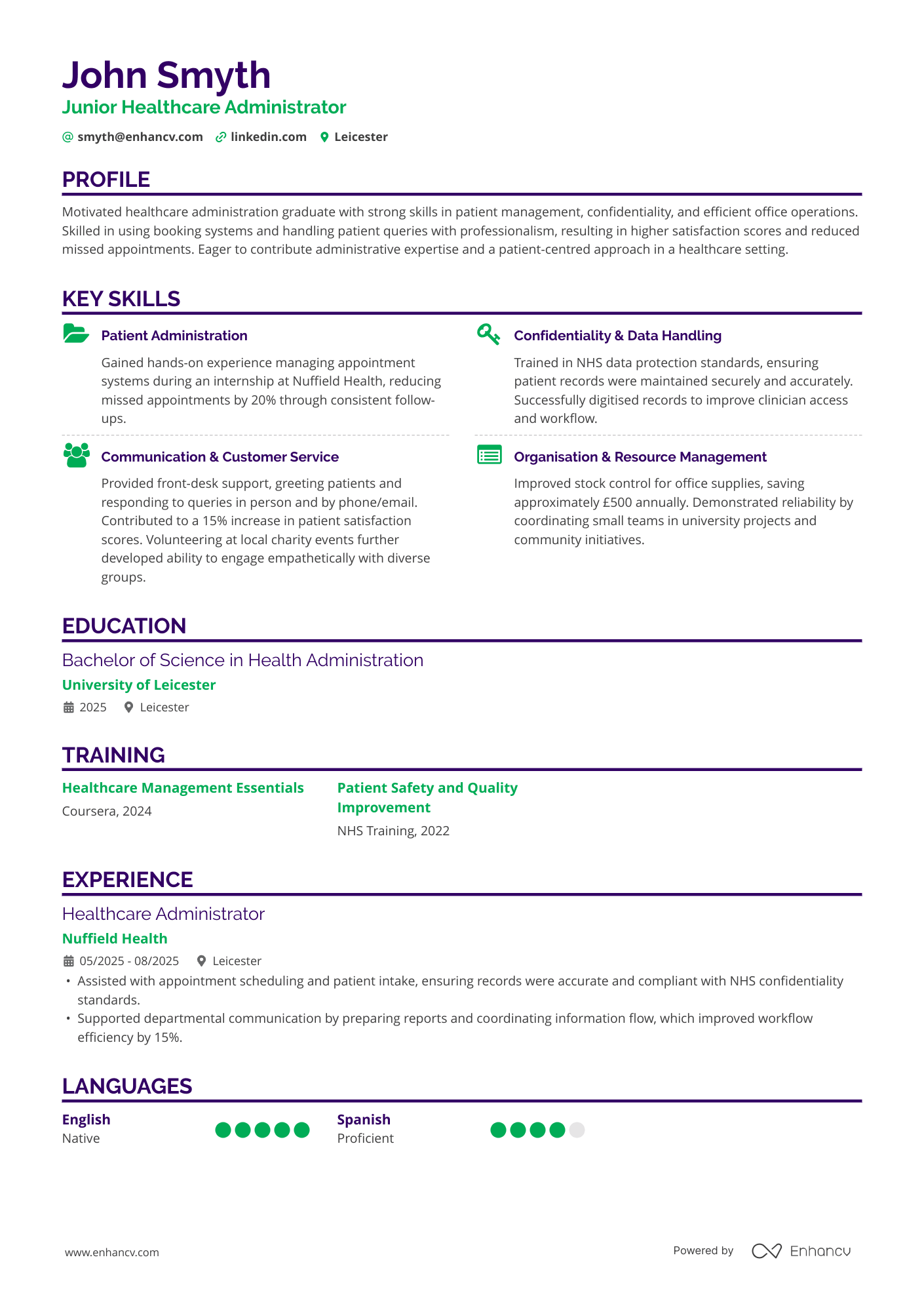
Enhancv’s CV Builder helps you identify weak or generic phrasing and refine it into stronger, evidence-based language that highlights your key competencies.
Take a look at this example CV created in Enhancv—it shows exactly how to present soft skills in a clear, credible way.
Takeaway
Don’t overlook the power of soft skills on your CV. Choosing the right ones to emphasise could help you make the right impression on the hiring manager. Just make sure you describe how you used the skill in the workplace and the results you got. Why not start working on your next application today? With Enhancv’s drag-and-drop CV builder tool, it couldn’t be easier.
