



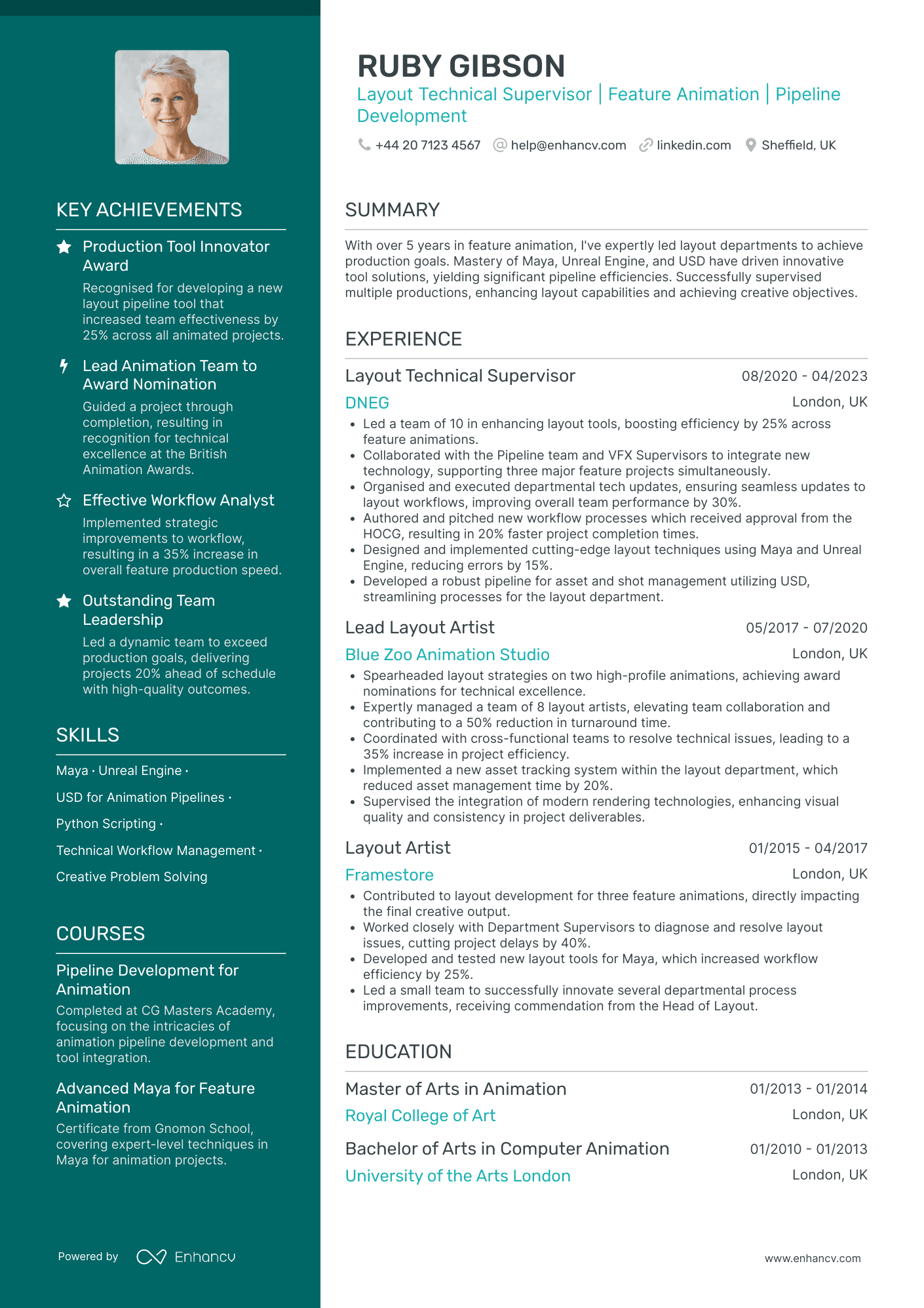
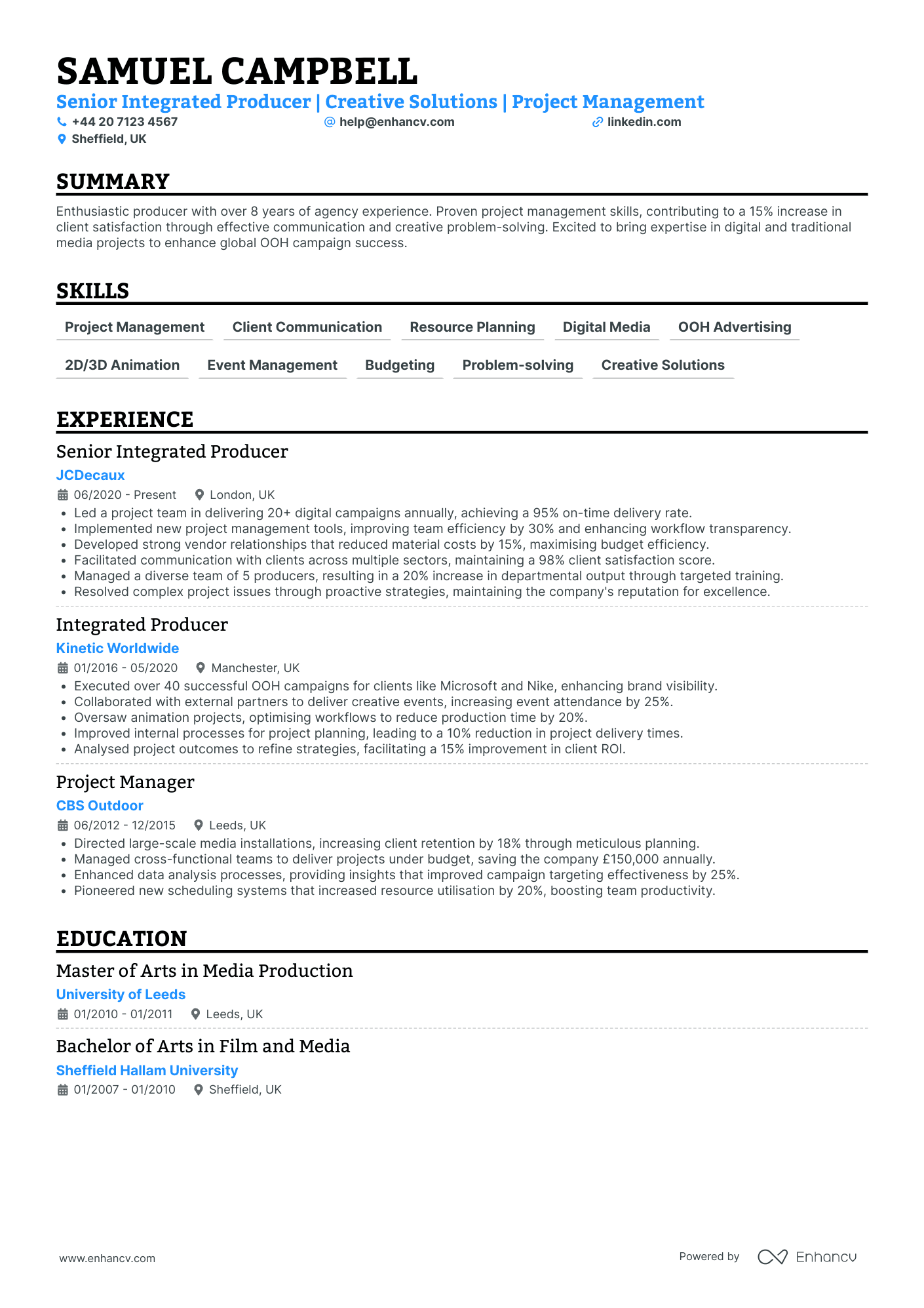
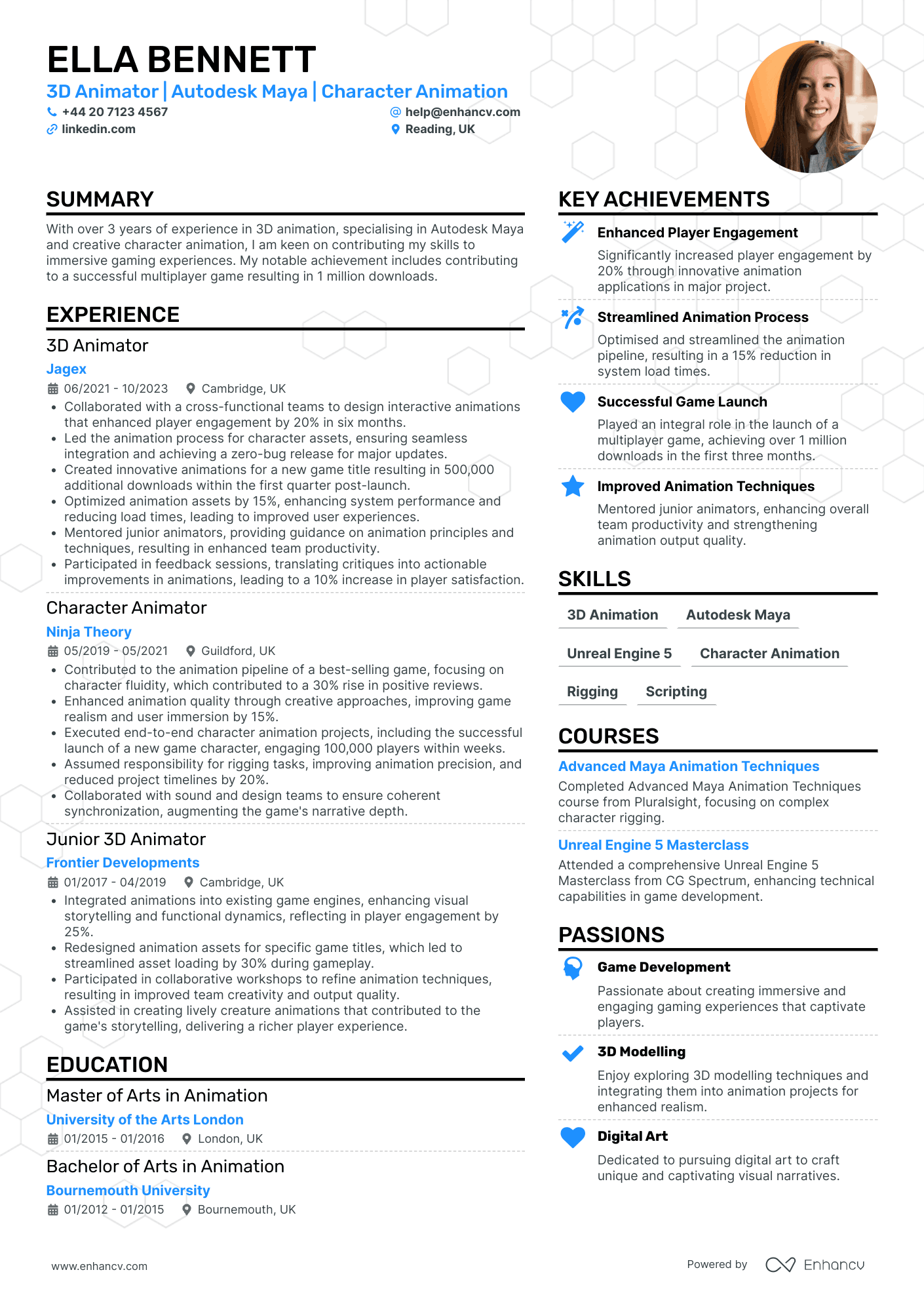
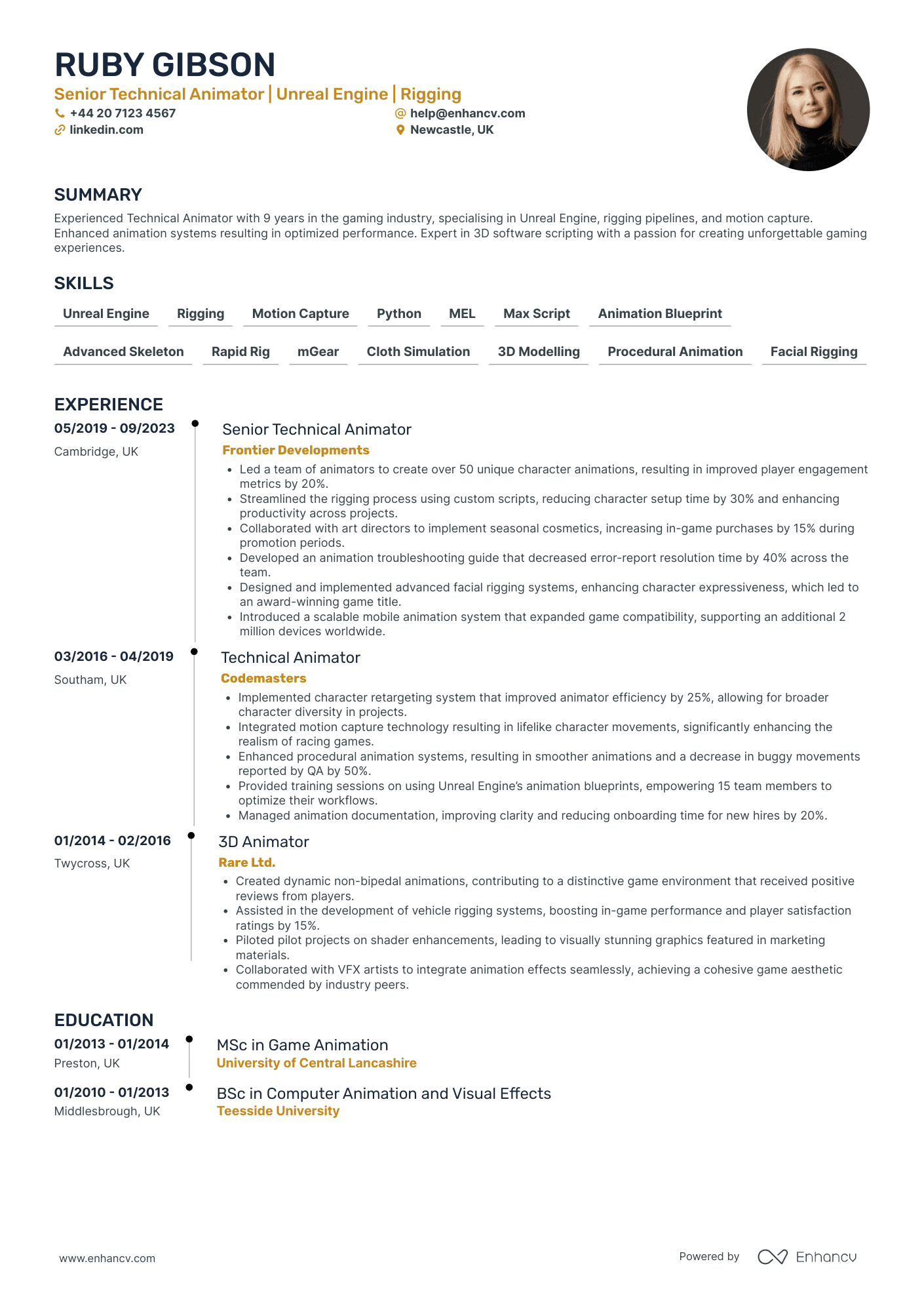
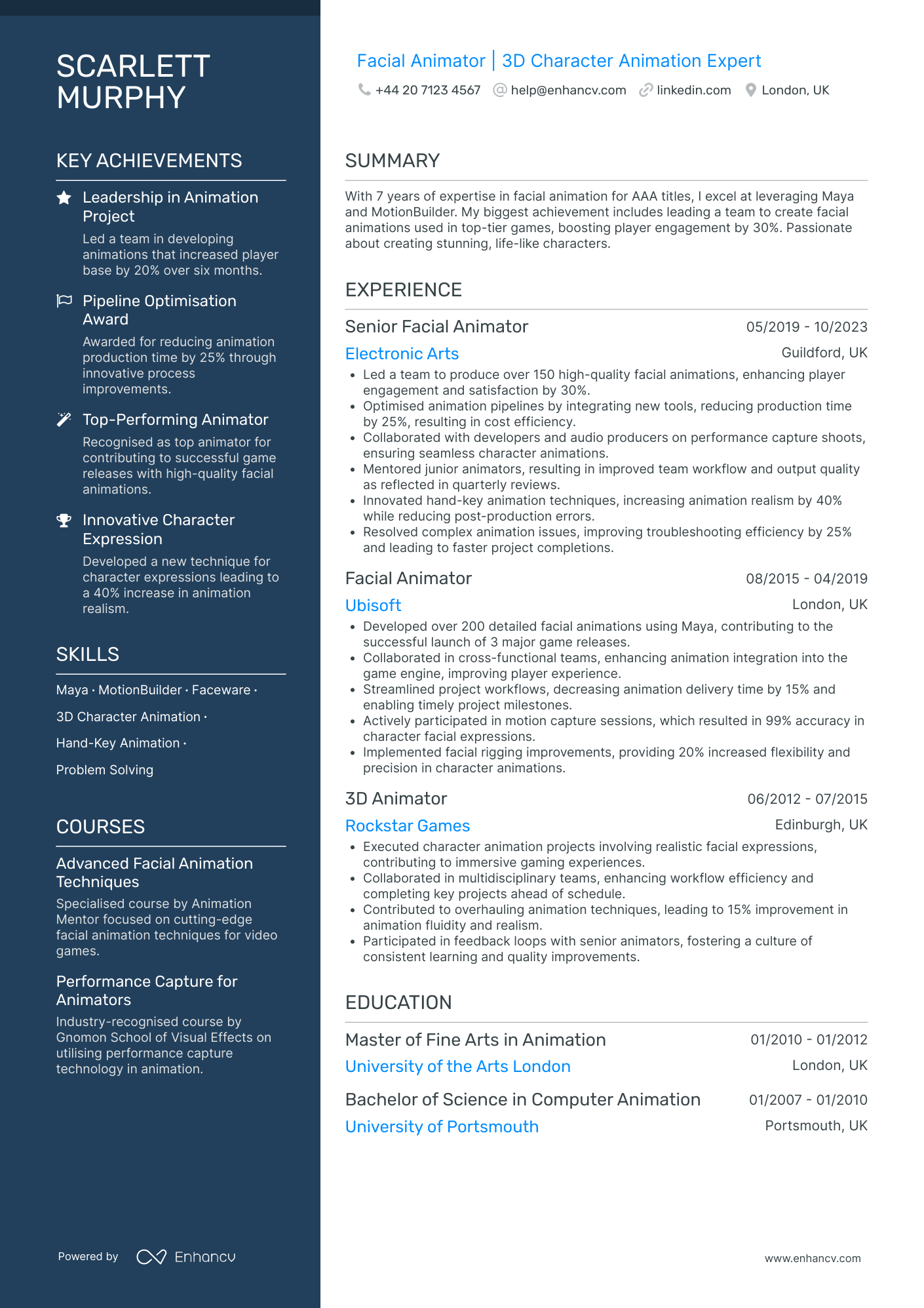
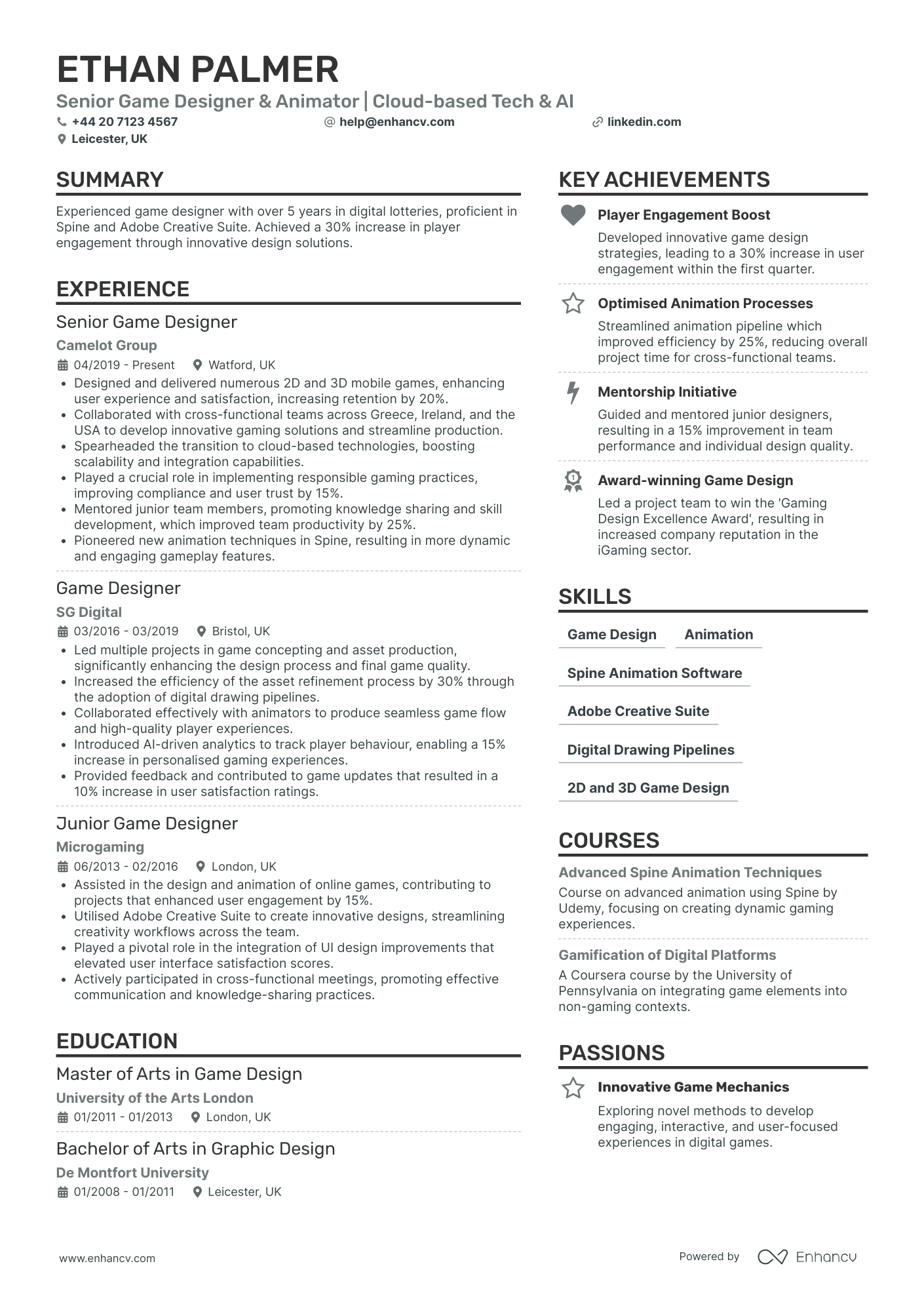
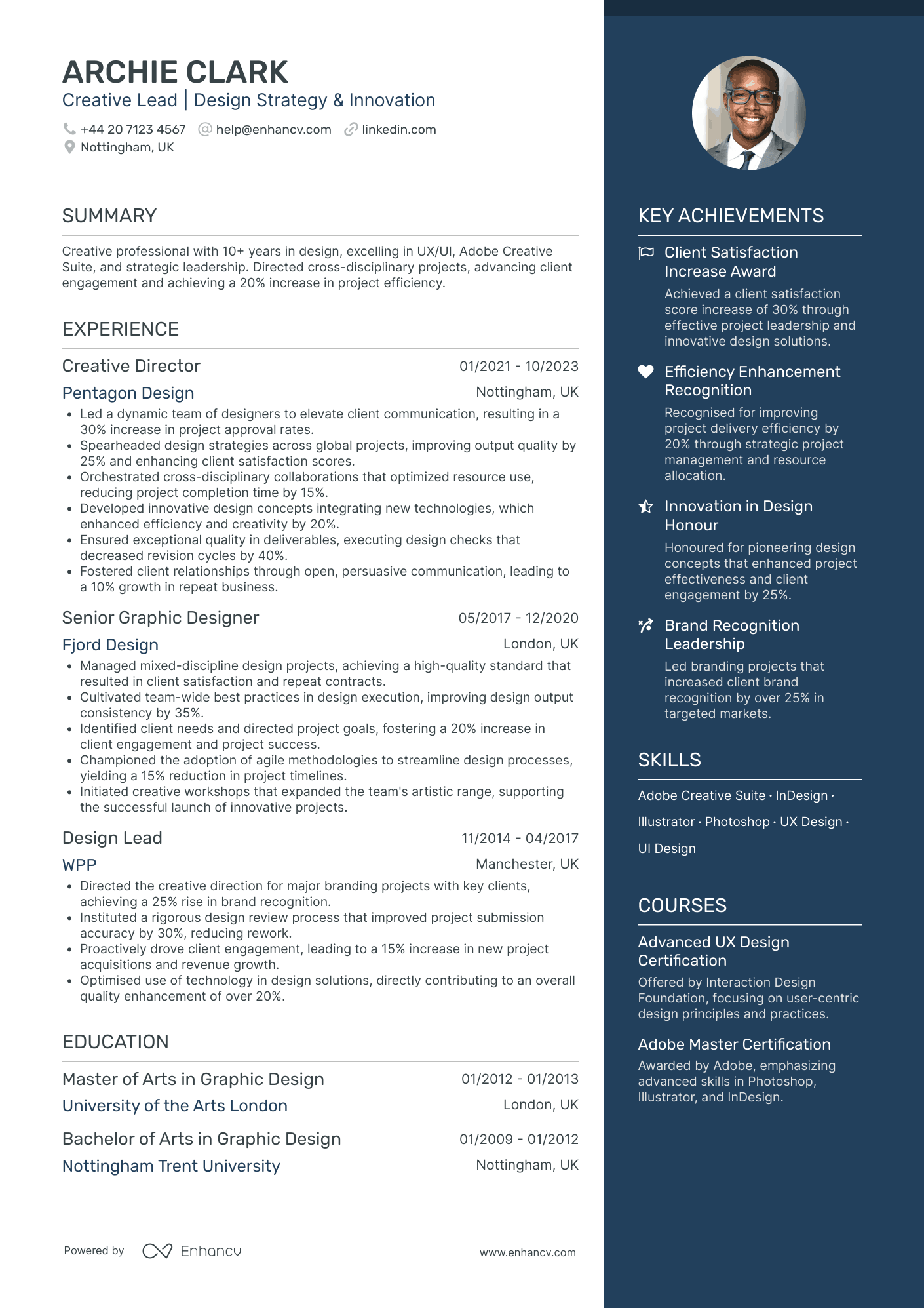
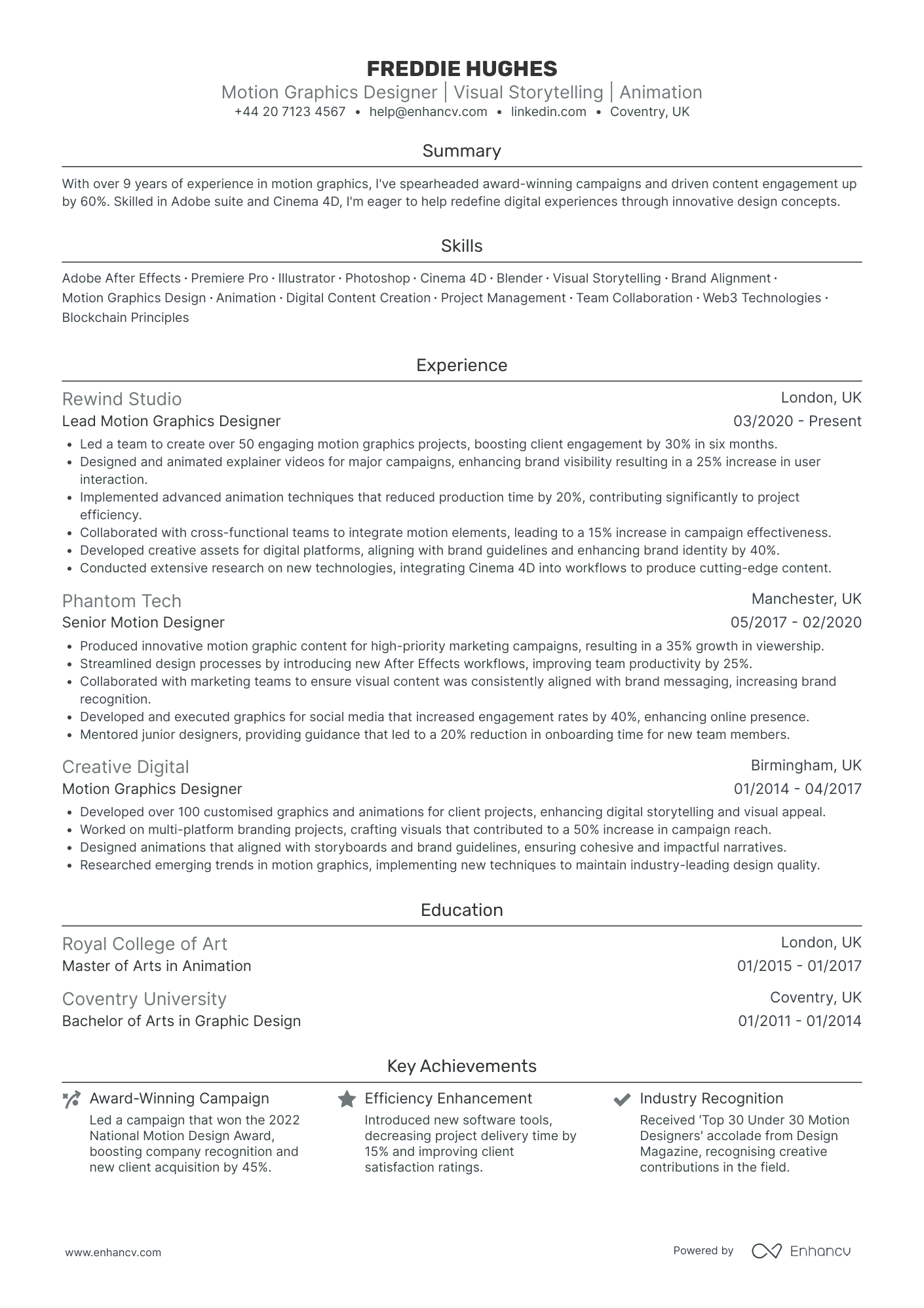
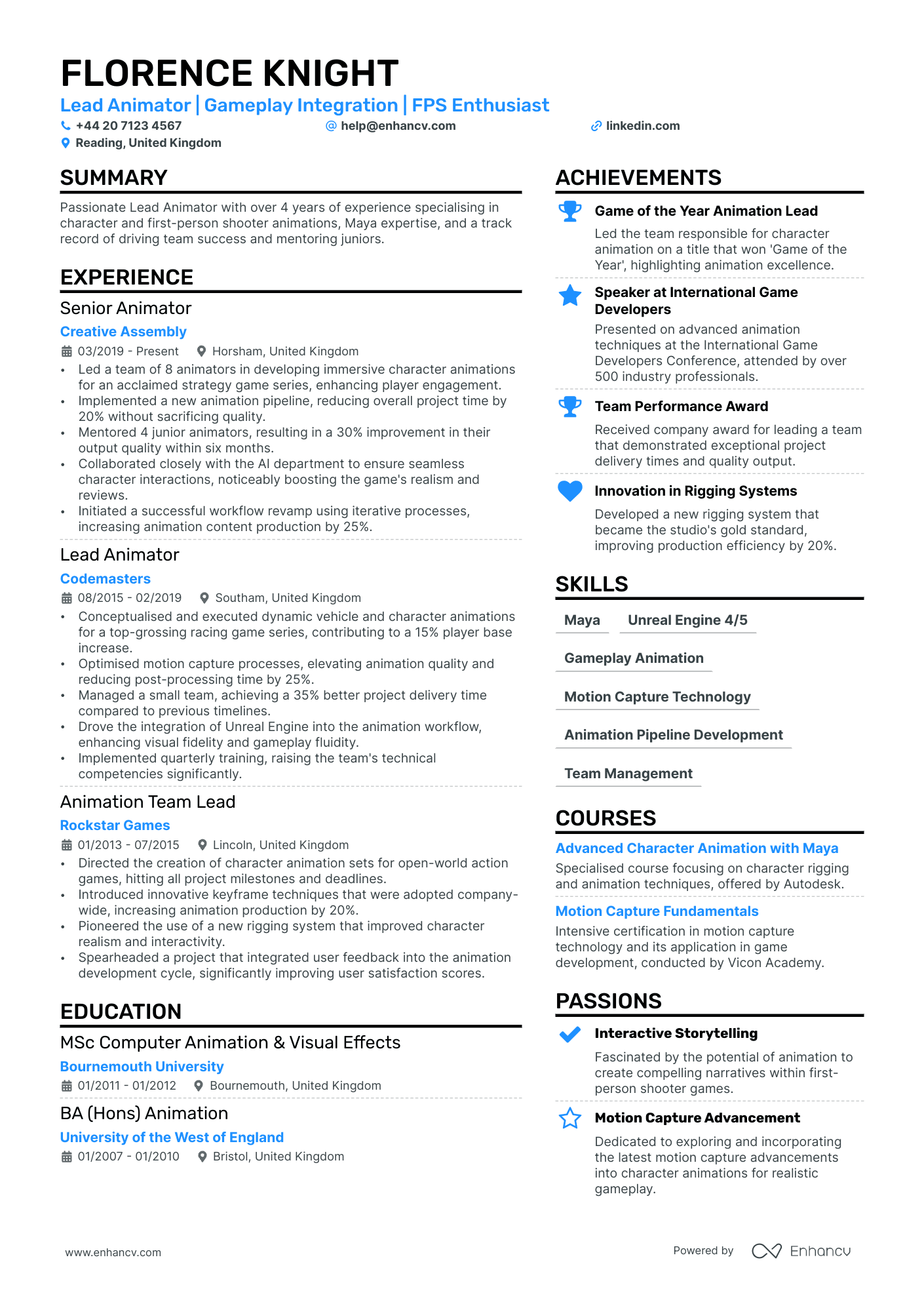
A studio decides whether to open your showreel in the first few seconds of reading your CV. For a first animation job, that CV has one task, to prove the craft is already in your hands even when the studio credits are not.
Most junior animator CVs waste that chance on a generic profile and a wall of software logos. The ones that land interviews lead with a reel, name the technique behind each shot, and treat student and personal projects as real work. If you want the fundamentals first, see how to write a CV.

Key takeaways
- A showreel is your CV's headline. Put a clickable link in the header and reference the exact shots against each project.
- No studio credits is normal for a first animation job. Lead with a skills-led CV built on student, freelance, and personal work.
- Name the software and the technique behind each shot, down to the principle you set out to nail.
- Open with a short personal statement built on your discipline, your strongest project, and the studios or genres you are aiming at.
- One page starting out, two at most, sent as a PDF so your layout and links survive.
- Show you understand the twelve principles of animation by evidencing them in your shots, not by listing them.
Writing an animator CV with no experience
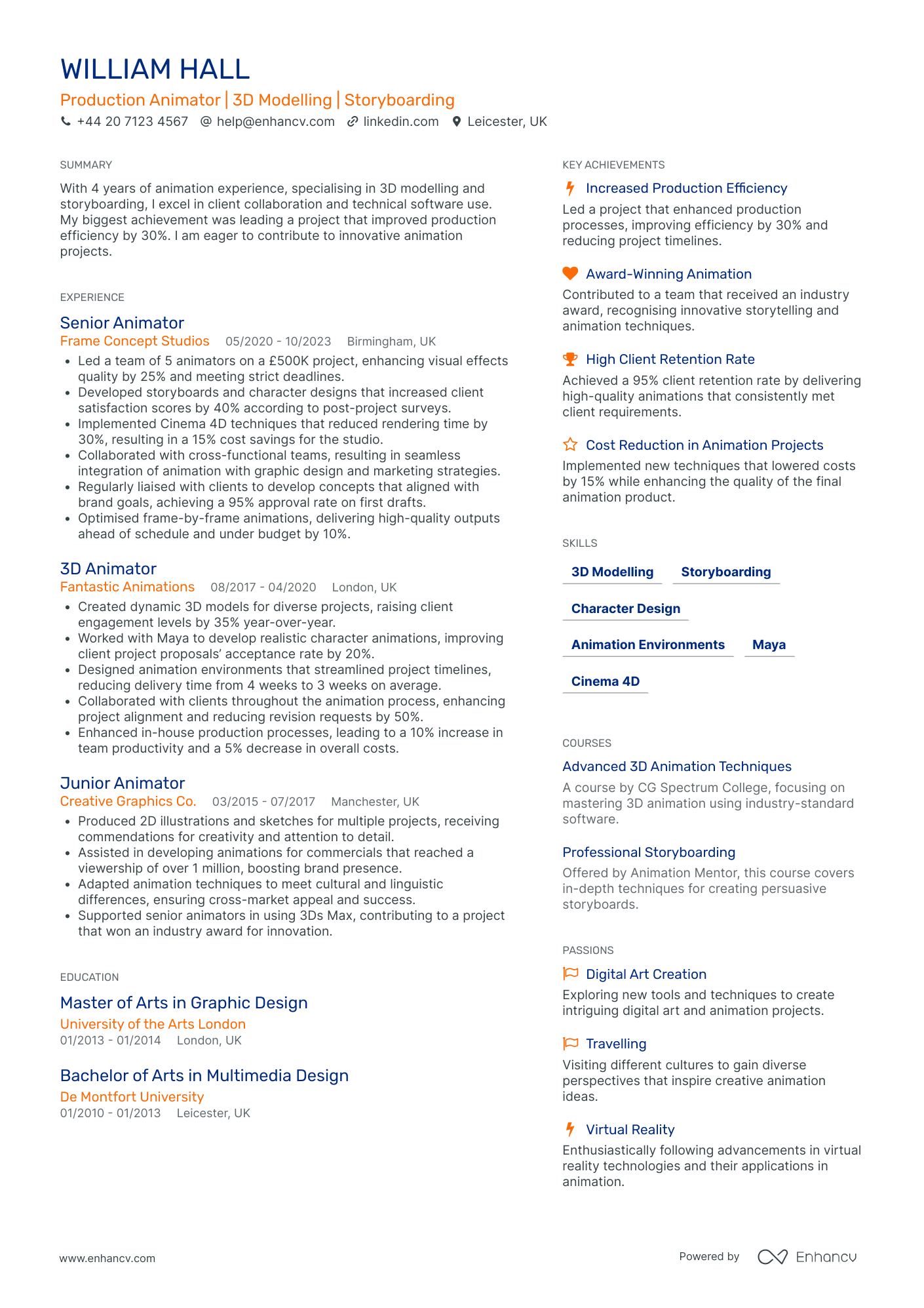
Animation is a portfolio trade before it is a CV trade. Studios hire on what they can watch moving on screen, so a thin work history hurts you far less here than in almost any other field.
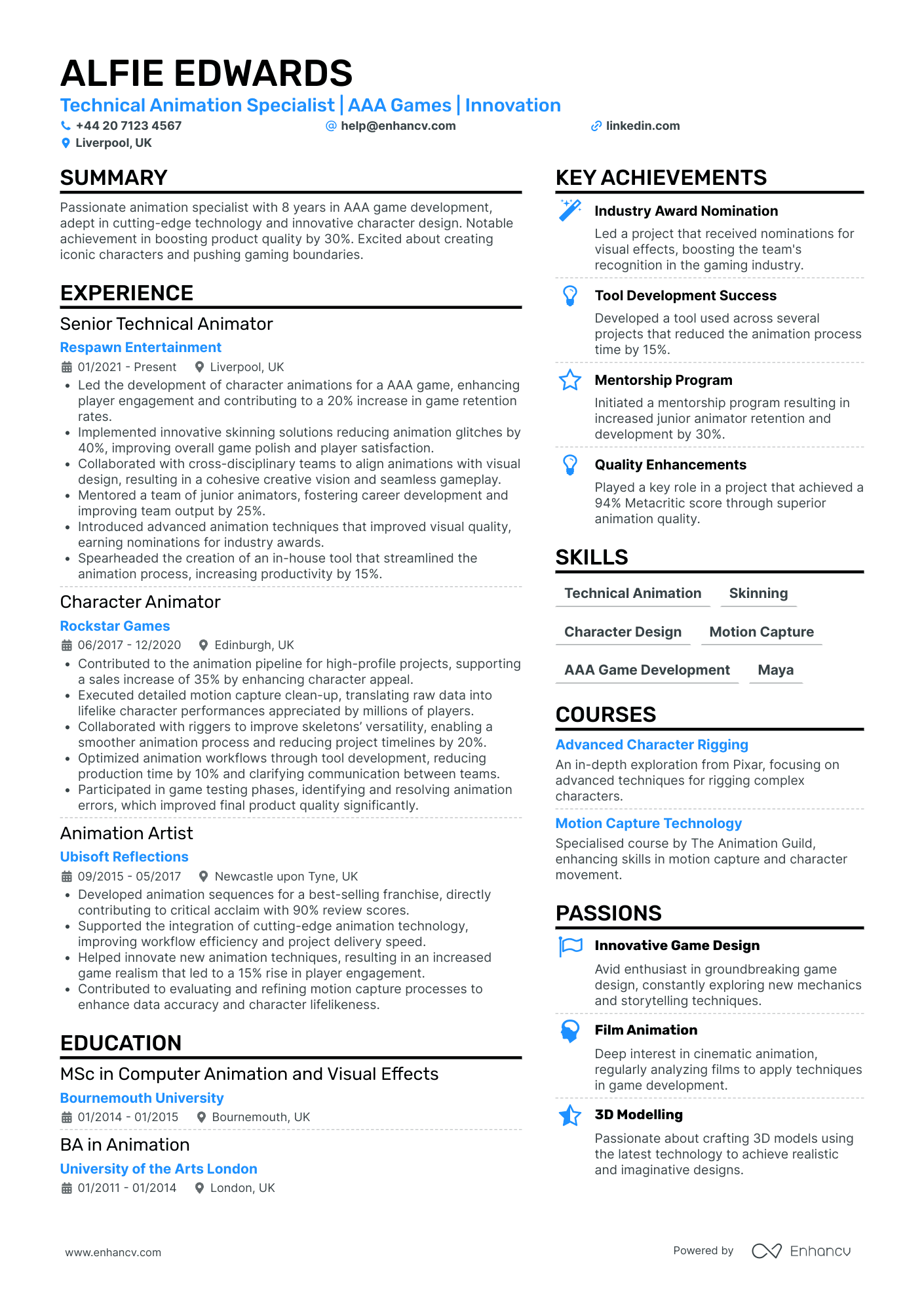
Build the CV around that. Lead with a skills-based CV: personal statement, showreel link, software and techniques, then projects, with any unrelated jobs lower down.
Treat every project as experience, because it is. Mine your own work for it:
- University or college briefs, group films, and your grad film.
- Personal shots and studies: a walk cycle, a lip-sync test, a physics simulation, a short character piece.
- Freelance or commissioned work, even a single paid logo animation or explainer.
- Game jams, animation challenges such as the 11 Second Club, and collaborative online shorts.
- Any volunteering on a CV, like animating for a charity, a student society, or a local business.
Write each one like a job. Give it a dated heading, the tools, your specific role on the shot, and the result. "Rigged and animated a 20-second character walk cycle in Maya for a three-person grad film" beats "good at character animation".
Studio-adjacent work counts too. A stint as a runner, a render wrangler, a QA tester on a game, or a production assistant shows you already understand how a studio runs, which is worth more to a hiring lead than another unrelated retail job.
Straight out of school, the same rule holds. Your college brief work, self-taught projects, and first showreel are your experience section, so present them as CV examples for a first job rather than apologising for the gap.
Aim the whole CV at one discipline. A reel and a personal statement built around 3D character work read very differently from a motion-graphics or a 2D portfolio, and trying to cover all three at once makes you look like a beginner at each.
One question decides a lot of junior interviews, and it is the twelve principles of animation. Do not list them as a skill. Show them.
Point to the squash and stretch in your bouncing-ball test, the anticipation before a jump, the follow-through on a tail. Naming the principle you deliberately used tells a lead animator you already think like one.

PRO TIP
Reviewers scan juniors fast. Lead your CV and your reel with one shot you can defend frame by frame, then let the rest support it. A single 15-second piece you can talk through in detail says more than a mixed reel of half-finished tests.
Building and linking your showreel
Your showreel is the most important thing you submit. The CV exists to get it opened and to explain what the reviewer is watching.
Keep it short. Sixty to ninety seconds, strongest shot first, and cut anything you would feel the need to apologise for. A reviewer stops the moment they lose interest.
Host it where it plays instantly. Use Vimeo or YouTube for the reel and ArtStation or a simple portfolio site for breakdowns, then put the link in your CV header next to your name.
Make the link clickable and also print the plain URL, so it survives a PDF or a printout. If the reel is password protected, put the password right beside it.
Keep the rest of your links tidy in the same block. A portfolio or ArtStation page and a relevant social profile are worth adding, but a reviewer should never have to hunt across three sites to find your best work.
Say what you did on each shot. "Animation and rigging" on one, "layout and blocking" on another, because studios hire for specific stages of the pipeline rather than "animation" in general.
Tailor the reel like you tailor the CV. Applying to a games studio, lead with real-time and gameplay shots. Applying to a feature or advertising studio, lead with acting, weight, and finish. The first ten seconds should look like the job you want.

What a junior showreel should show
Range and control, not volume. A clean body-mechanics shot such as a walk or a jump, one acting or lip-sync piece, and one shot in your target discipline, whether that is 3D character, 2D, or motion graphics. Three strong shots beat ten average ones.
Top skills for your animator CV
Studios read an animator CV for two things: the software you can sit down and use today, and the craft judgment behind your shots.
Your hard skills are the tools and techniques, named the way studios name them in adverts. Autodesk Maya, Blender, ToonBoom Harmony, After Effects, rigging, compositing, and layout. List only the key skills for a CV you can genuinely use on day one.
The soft skills matter more than most juniors expect, because animation is collaborative and deadline-driven. Taking direction, giving and receiving critique, and hitting a deadline without drama all belong here, each proven in a project bullet rather than simply claimed.
Distinguish 2D and 3D honestly. A 2D animator strong in ToonBoom and a 3D character animator strong in Maya are different hires, so lead with your discipline and be specific about the rest.
Evidence the tools rather than stacking logos. "Rigged and animated a full character in Maya" proves more than a row of icons, and a line like "composited a 30-shot sequence in After Effects" turns a piece of software into a genuine skill a reviewer can trust.
Top skills for your animator CV:
Autodesk Maya
Blender
Adobe After Effects
ToonBoom Harmony
Character animation
Rigging
Compositing
Motion graphics
CG production pipeline
Storyboarding and layout
Taking direction
Giving and receiving critique
Collaboration
Meeting deadlines
Attention to timing and detail
Acting and observation
Writing your animator personal statement
Three or four sentences at the top: your discipline, your strongest proof, the software you work in, and the kind of studio or work you are aiming at.
Keep it concrete and skip the adjective soup. "Passionate, creative, hard-working animator" tells a reviewer nothing they can watch, so lead with evidence instead. For more openings, see these personal statement examples.
Name the studio or the kind of work in the last line. A reviewer who sees you have actually looked at what they make, whether that is feature animation, games, or branded motion graphics, reads the rest of the CV with more patience.
Animator personal statement example (junior, no studio experience)
Junior 3D character animator with a grad film selected for two student festivals and a 75-second showreel built in Autodesk Maya. Comfortable blocking, splining, and polishing on a standard pipeline, and rigged three of my own characters for personal shots. Looking to join a feature or games studio as a junior animator and grow under a senior team.
Animator personal statement to avoid
Passionate and creative animator seeking an exciting opportunity to grow within a dynamic studio and contribute to amazing projects.
The weak version names no discipline, no software, and no proof, and every other applicant wrote something close to it. The strong version tells the reviewer what you animate, what you built it in, and what you want next.
Formatting your animator CV
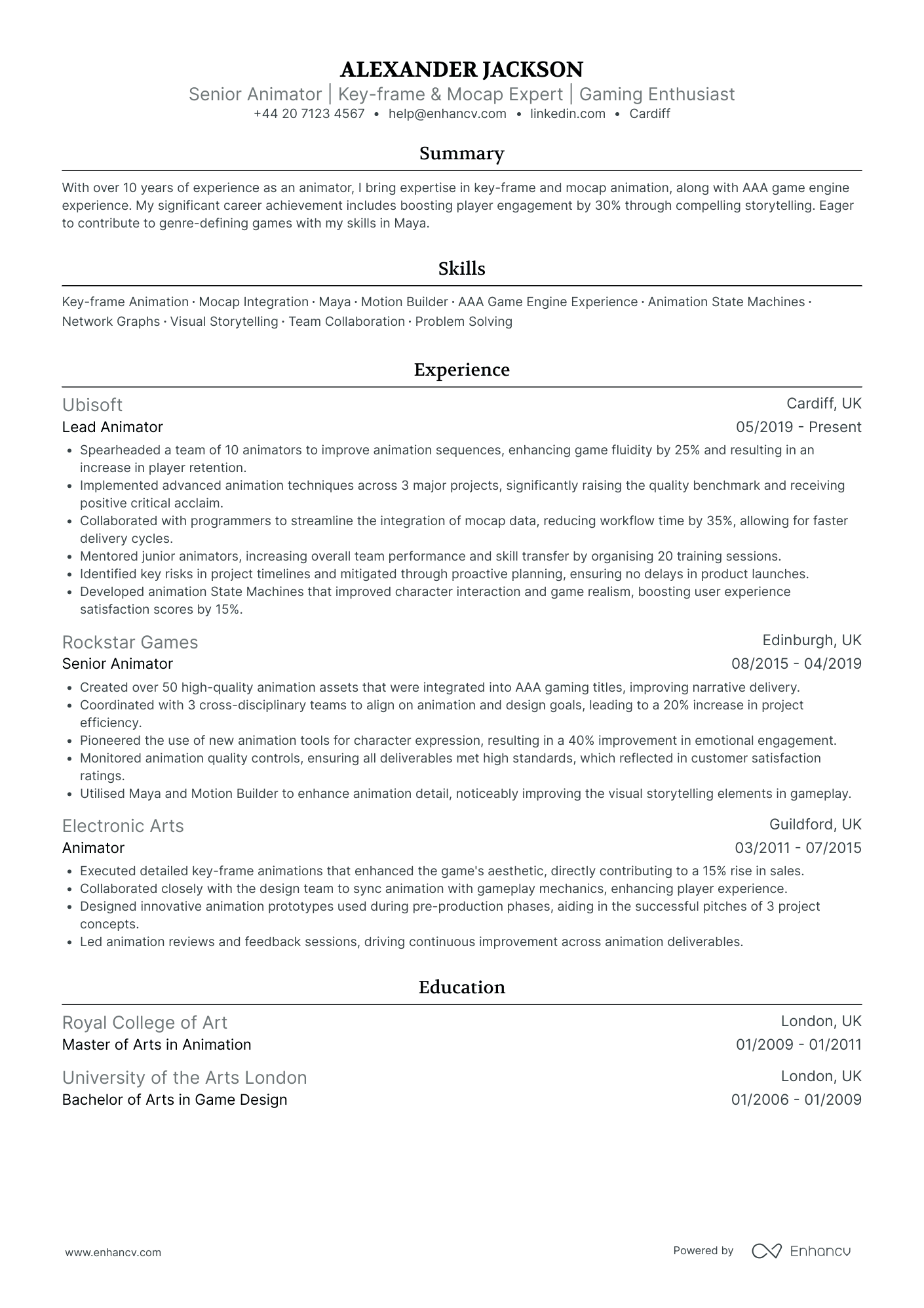
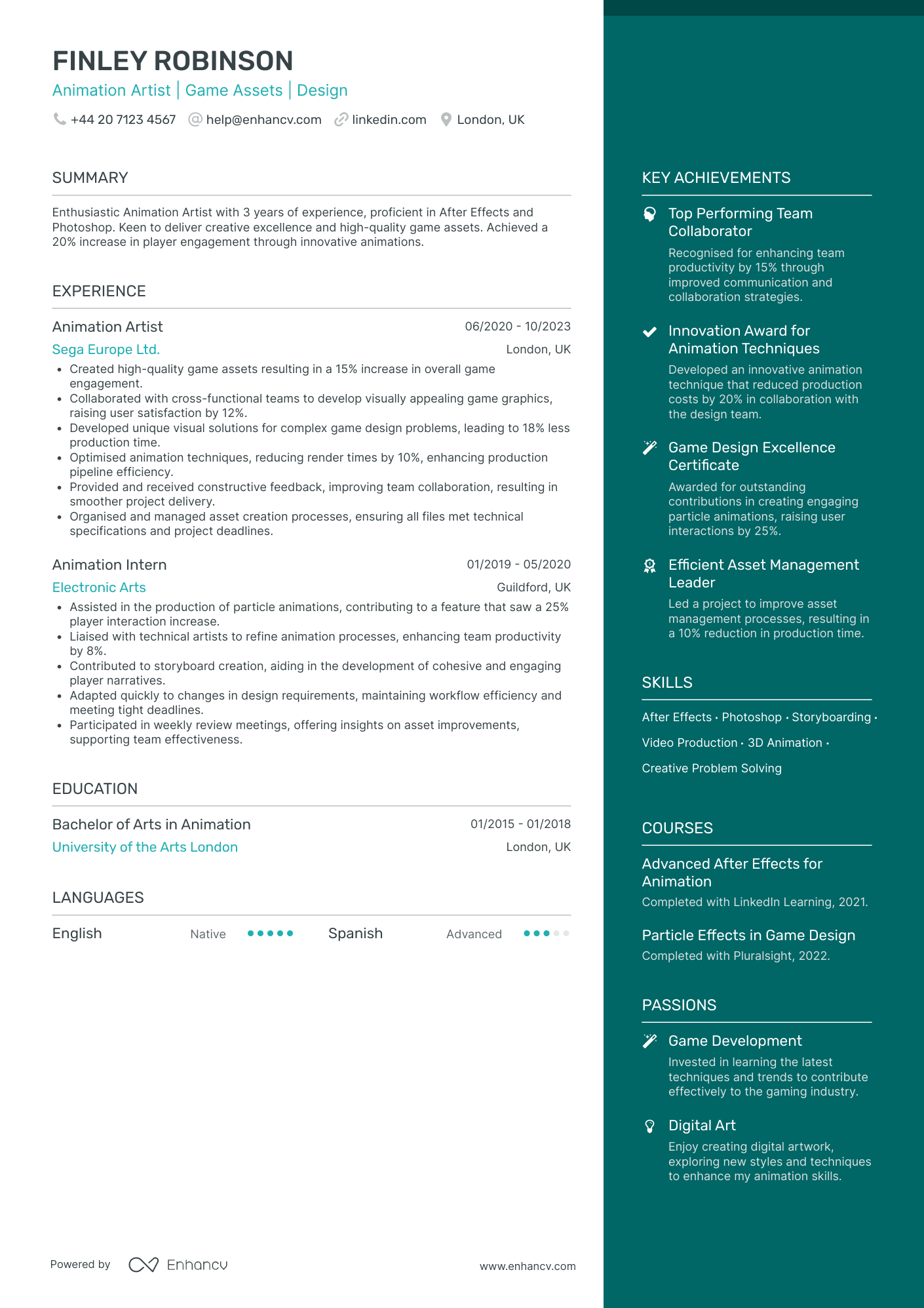
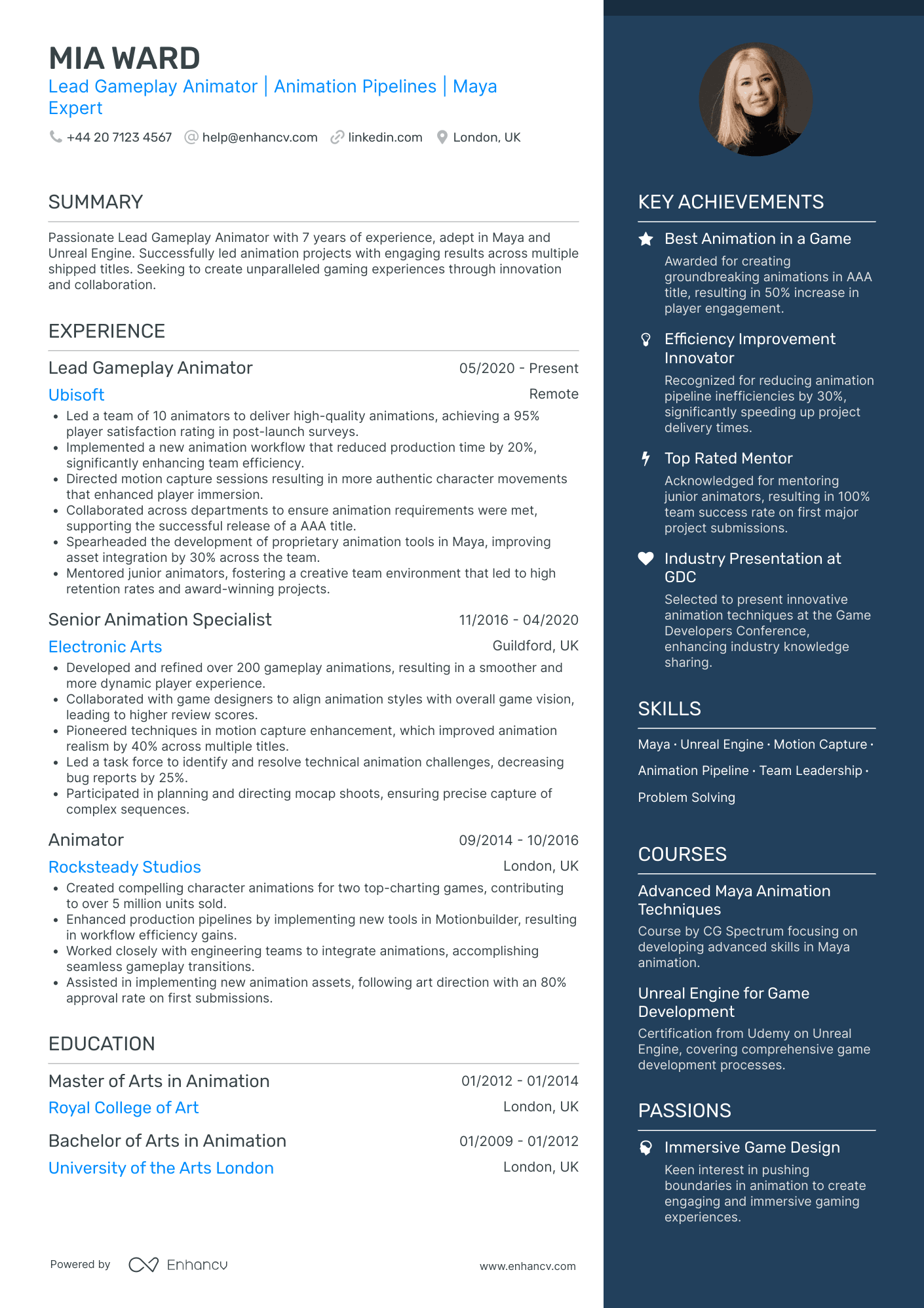
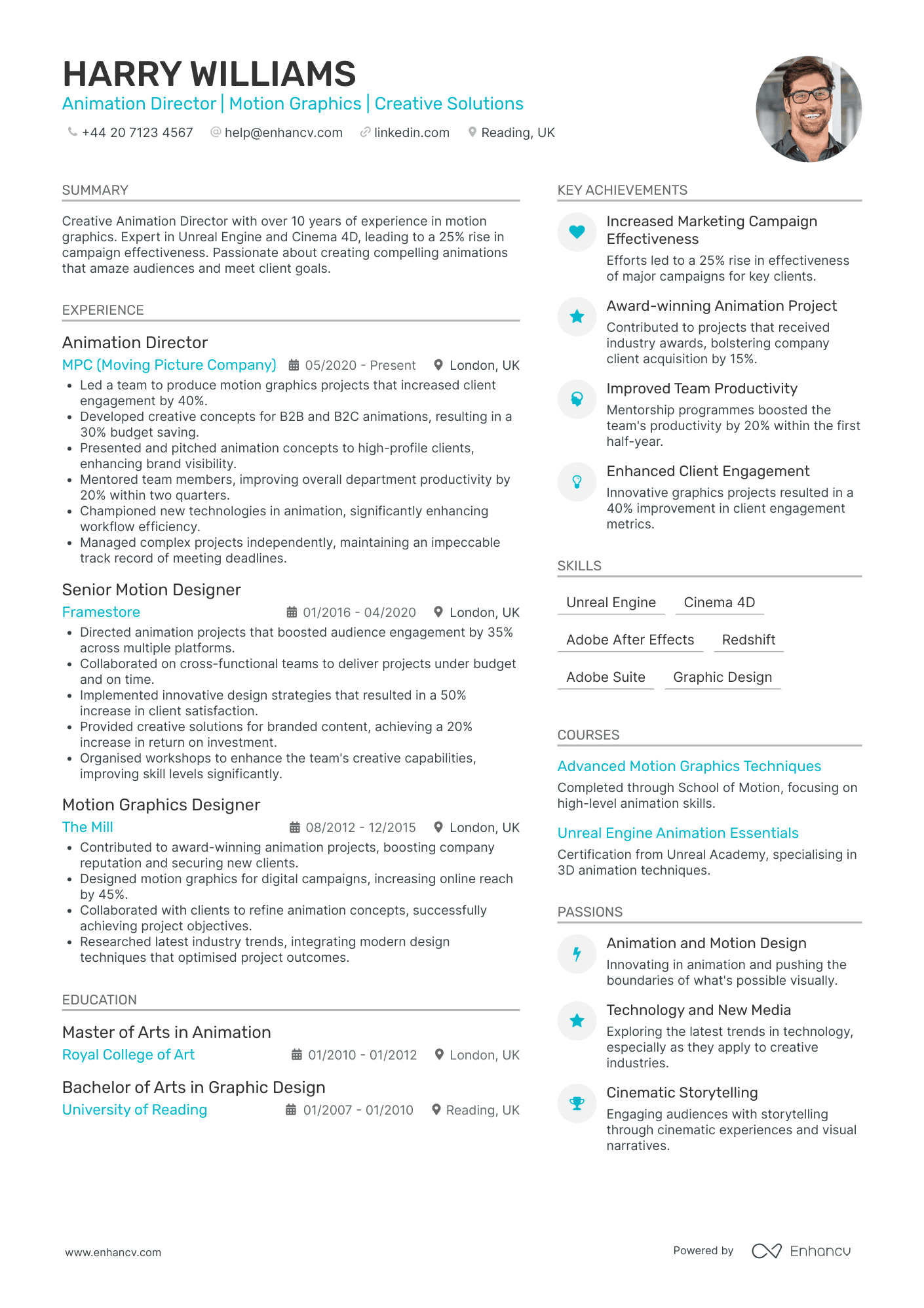
For a first animator CV, use a skills-led structure so your reel and craft come before a short work history. Switch to reverse chronological once you have studio credits.
One page is fine when you are starting out and two is the ceiling. A reviewer wants to reach your reel link quickly, so do not make them read a third page. If you are unsure, see how long a CV should be.
Send a PDF for direct applications so your layout, fonts, and clickable reel link hold. Keep a Word copy for recruiters who ask for one.
Keep the page single-column with standard headings and one readable font, and let the reel carry the visual flair. Studio pipelines and ATS-friendly application systems both prefer plain structure.
Build it from a tested layout rather than a blank page. Enhancv's CV templates export to a clean, single-column PDF that keeps your reel link live.
Writing your animator experience section
Whether it is a grad film, a freelance gig, a game jam, or a personal short, write every entry the same way. Give it a dated heading with the project and your role, the tools, and what you delivered, and lead each bullet with a verb. For the mechanics, see work experience on a CV.
Animation work is measurable even when it feels purely artistic. Seconds of finished animation, shots delivered, characters rigged, review rounds survived, and deadlines met are all CV achievements.
An entry on a junior CV might read:
- Animated 12 shots totalling 90 seconds for a three-minute grad film, from blocking to final polish in Maya.
- Rigged four characters and two props, cutting the team's setup time by roughly a week.
- Delivered every shot across three review rounds on schedule, taking notes from the film's director.
Use strong action verbs such as animated, rigged, blocked, composited, retimed, and storyboarded, and skip the vague ones.
Freelance and self-directed work belong here too. Give the client or the project a name where you can, state the brief, and show the result, such as "produced a 15-second animated explainer for a local charity, delivered in two weeks".
Tailor each application to the studio. Games studios want gameplay and in-engine work, feature studios want acting and polish, and ad studios want motion graphics and speed, so mirror the words the advert uses where they are true of you. Enhancv's CV tailoring feature reads the advert and suggests the matching edits, which saves rewriting from scratch for every studio.
Education and training for an animator CV
You do not need a specific degree to animate, and plenty of working animators are self-taught. What matters is evidence you can do the work.
A named school still helps a first application. UK studios recognise course names such as an animation or VFX BA, an NCCA or Escape Studios course, or a well-regarded games-art programme, so spell yours out in full rather than abbreviating it.
List a relevant degree or diploma if you have one, in animation, film, games art, or VFX, with your classification. Record self-taught study in a courses or training block on your education section.
Name the training that shows real craft, such as an Animation Mentor, iAnimate, or CG Spectrum course, or a ToonBoom certification, and treat any strong qualification as proof rather than decoration.
For a junior, this section can sit high, just under your skills, because it is part of your evidence. Once you have studio credits it moves down, and the certificates on your CV become a short supporting list.
Conclusion
Lead with your reel, prove the craft with named projects and specific techniques, and let student and personal work stand in for studio credits.
Keep the CV clean and the reel link one click away, then pair it with a short cover letter that says why this studio, and a first animation job stops feeling out of reach.
When we look at a junior animator CV with no studio credits, we are really reading it to find the reel and understand what we are about to watch. The CVs that work say, in plain words, which shots are yours and which principle or technique you set out to nail. A 15-second walk cycle you can talk through in detail beats a page of software logos. Name the project, the tool, and the choice you made, then get out of the way and let the reel do the rest.
Author's take - The Enhancv team
When we look at a junior animator CV with no studio credits, we are really reading it to find the reel and understand what we are about to watch. The CVs that work say, in plain words, which shots are yours and which principle or technique you set out to nail. A 15-second walk cycle you can talk through in detail beats a page of software logos. Name the project, the tool, and the choice you made, then get out of the way and let the reel do the rest.