



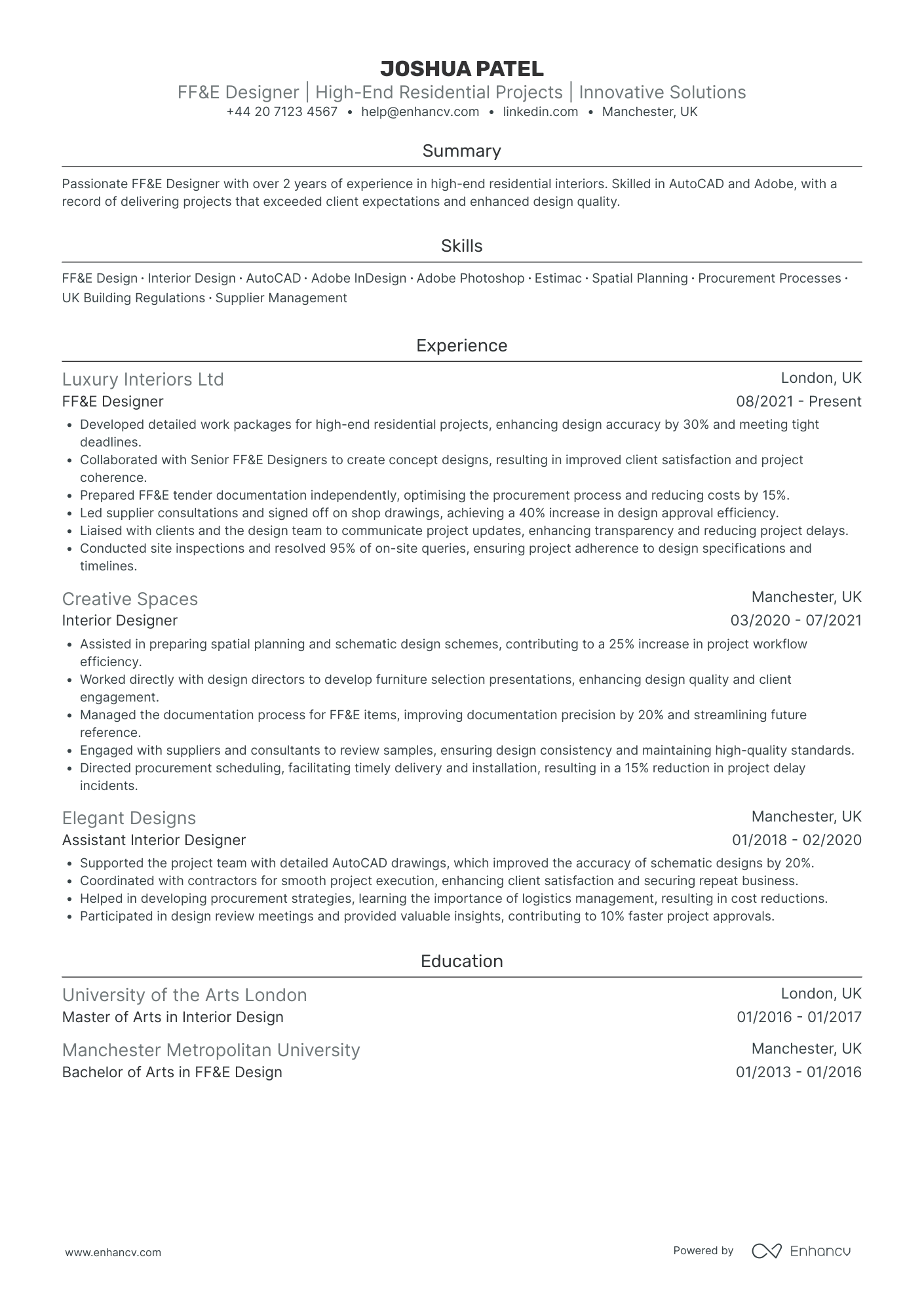
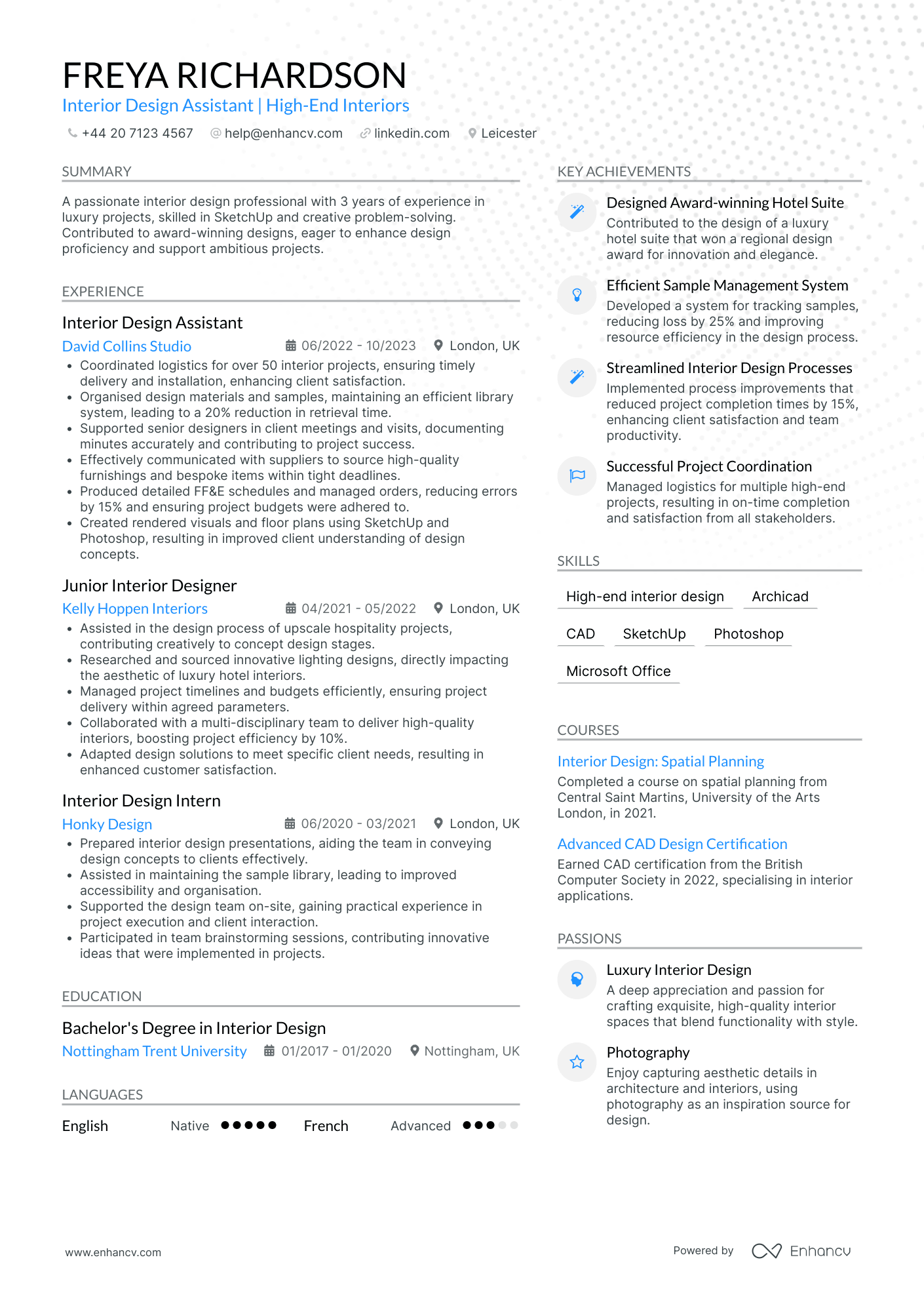
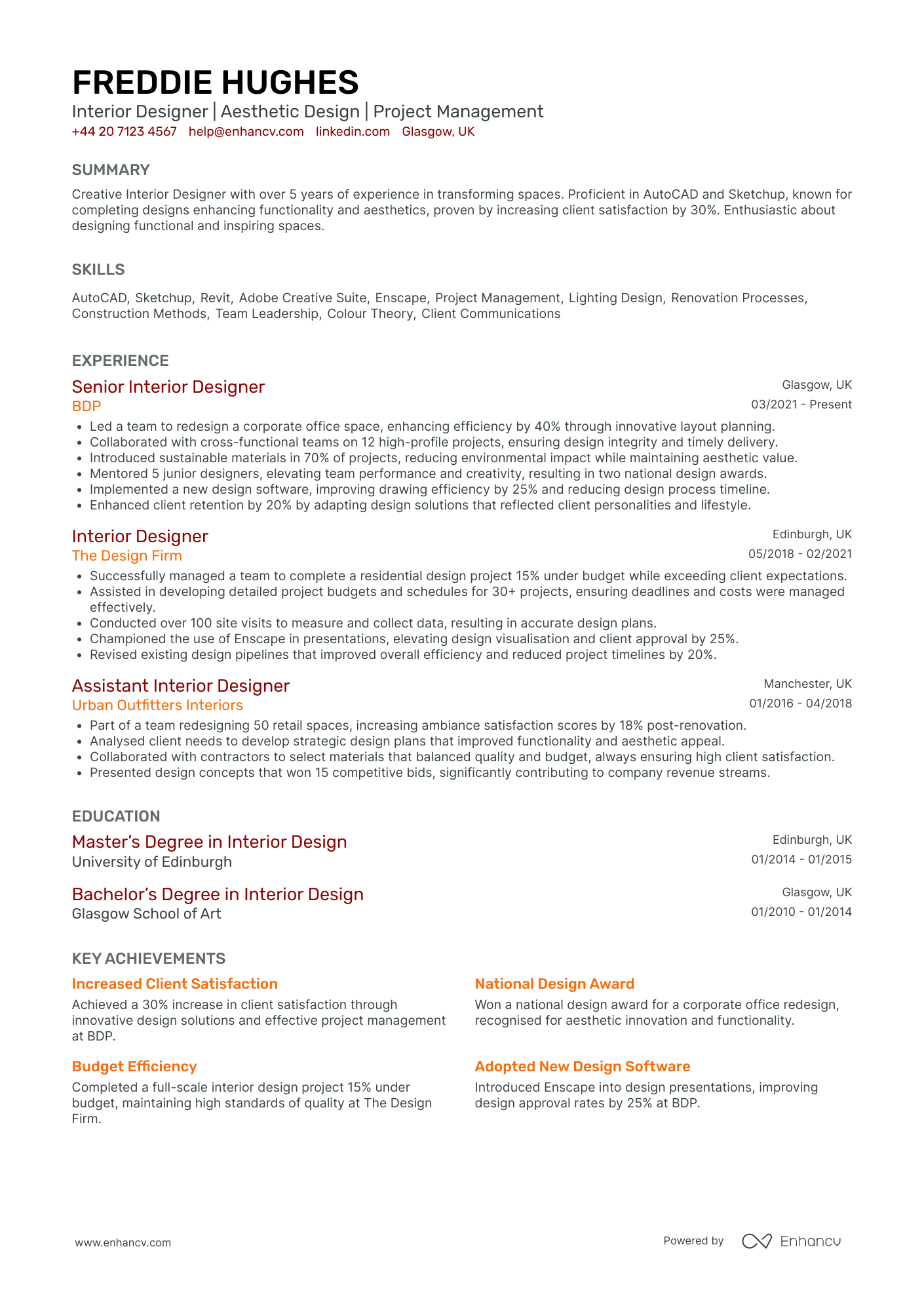
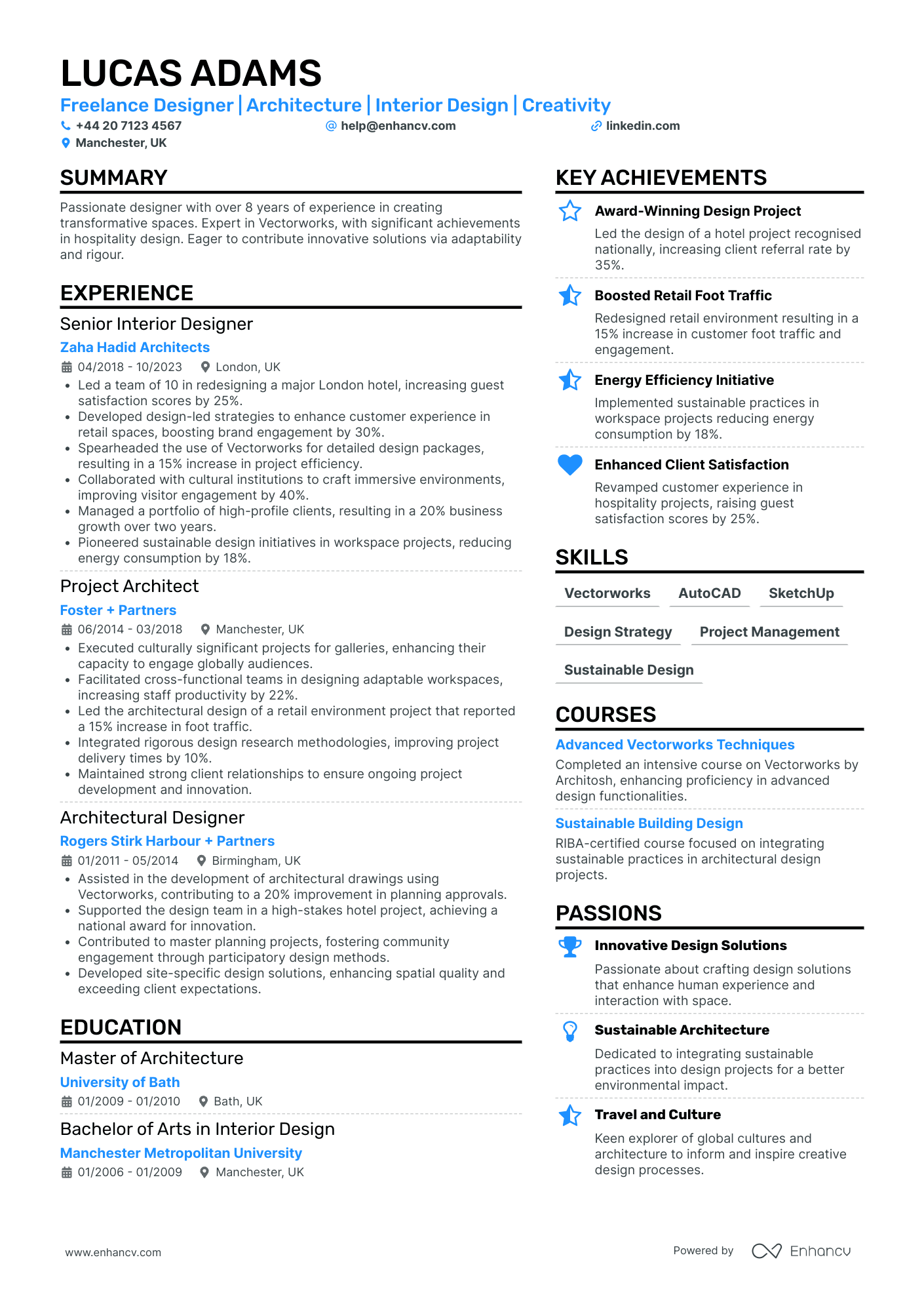
The interior design CVs that get shortlisted do one thing early. They point the reader straight to the work.
A portfolio link near the top, then two or three projects a hiring manager can picture, beats any paragraph about being creative and detail-oriented. Most CVs bury the work under a generic profile and a duty list, so if you want the fundamentals first, see how to write a CV.

Key takeaways
- Lead with a portfolio link. Put a short, working URL in your header so a studio can open your work in one click.
- Show projects, not duties. For each one name the brief, your role, the space, the tools, and the result.
- Name the software studios list: AutoCAD, Revit or ArchiCAD, SketchUp, and Adobe Creative Suite. Keep the ones you actually use in your skills section.
- Open with a short personal statement built on a signature project and a measurable outcome, not adjectives.
- Two pages, reverse chronological, sent as a PDF unless the advert asks for a Word file. Keep the portfolio link live in both.
- Pay swings by studio, specialism, and region, so check the advert and the National Careers Service rather than trusting a single headline figure.
Building and linking your interior design portfolio
Your portfolio is the CV. The written pages exist to get it opened, so treat the link as the most important line on the document.
Put it in your CV header, next to your email and phone, as a short plain-text URL that is also hyperlinked. Do not bury it on page two or hide it behind a QR code a recruiter cannot scan at their desk.
Host it somewhere that loads fast and works on a phone. A personal site, a Behance page, or a tidy PDF all work. Keep the address short enough to type from memory.
If you send a PDF portfolio, name the file so it survives a crowded inbox. "Jane-Okafor-interior-design-portfolio.pdf" beats "portfolio-final-v3.pdf", and it keeps your name on the reviewer's screen while they scroll.
Curate hard. Six to ten projects that show range say more than twenty that repeat the same look. Cover the sectors you want to be hired for, whether that is residential, commercial, hospitality, or retail.
Show the thinking, not only the finished render. Mood boards, sketch plans, material choices, and before-and-after shots prove you can run a scheme, not just style one.
Label every project so a stranger understands it in ten seconds: the type of space, your role, and the brief. If work sits under an NDA, show what you can and note the constraint rather than leaving a gap.
Give each piece a one-line caption in your own words. Renders read the same across a hundred portfolios, so the sentence that explains the constraint you solved is what a reviewer remembers.
Keep the link consistent everywhere it appears. The URL on your CV, your LinkedIn profile, and your email signature should all point to the same tidy page, because a recruiter who loses the link on the CV will look for it on your profile next.

PRO TIP
Reorder your portfolio for each application. If the studio does high-end residential, lead with your strongest residential scheme. The first three projects a hiring manager sees should look like the work they already do.
Presenting your interior design projects on a CV
The CV cannot show the visuals, so the words have to do enough to make the reader open the link.
Write each project like a short case study: the brief, the constraints, what you specifically decided, the tools you used, and how it turned out. Keep the studio's work and your work distinct.
Lead with a verb that claims your contribution honestly. "Designed", "specified", "sourced", "space-planned", and "project-managed" say more than "involved in" or "assisted with". Pull from a list of CV action verbs if you get stuck.
Interior design is measurable even when it feels subjective. Square metres, budget managed, weeks from concept to handover, a repeat commission, or a client sign-off are all CV achievements.
Pick projects that match the job, not just the ones you are proudest of. A CV aimed at a commercial fit-out studio should foreground your commercial work, with the residential piece one line down.
Watch the weak entries that dilute a strong CV. "Assisted the senior designer on various projects" tells a reader nothing, while "Space-planned two floors of a co-working scheme under a senior designer, delivered on programme" shows exactly what you can do.
Three or four projects described this well carry a CV further than a long list of thumbnails. The reader is deciding whether to open the portfolio, and specific, honest detail is what earns that click.
Interior design project entry (experience bullet)
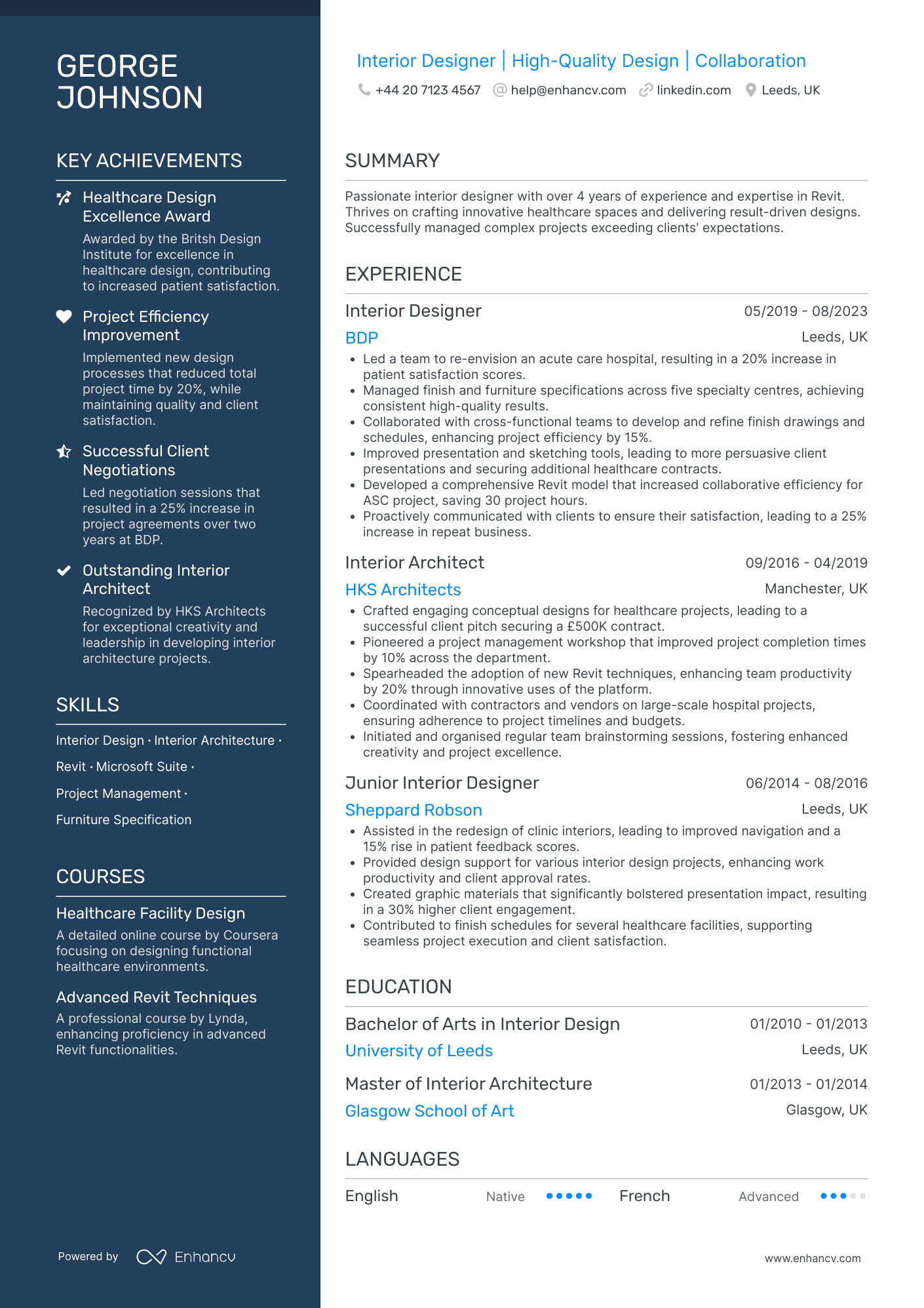
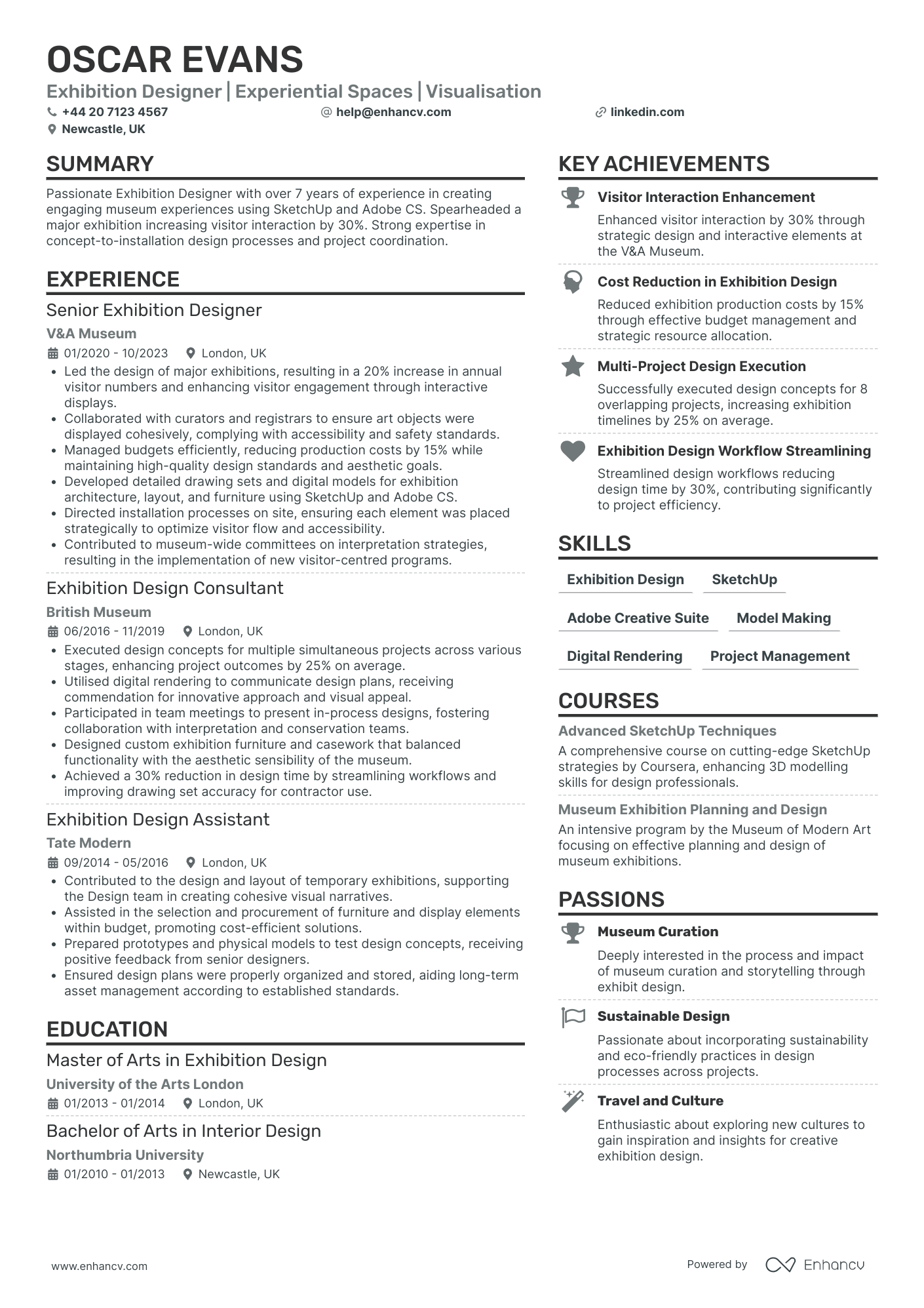
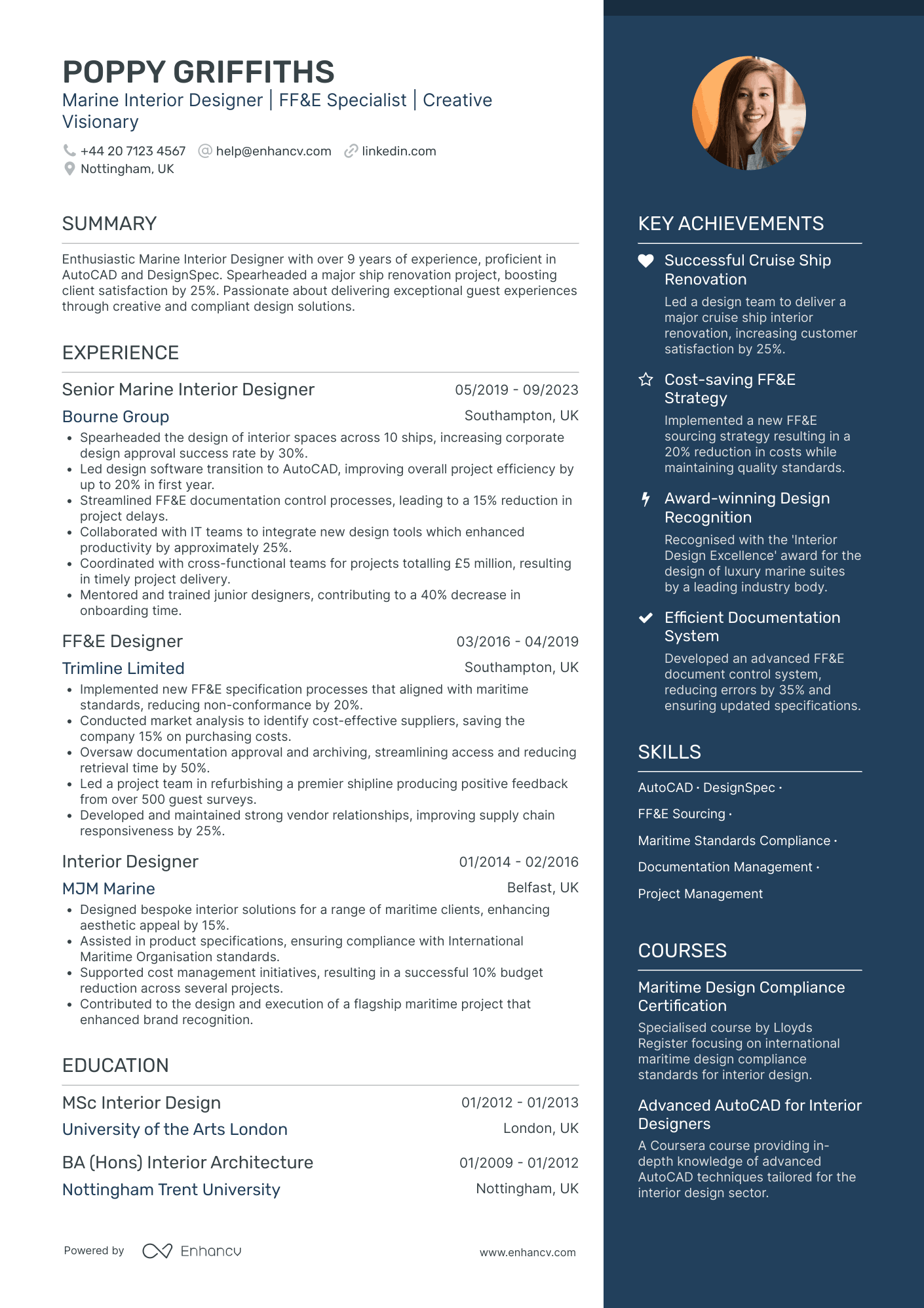
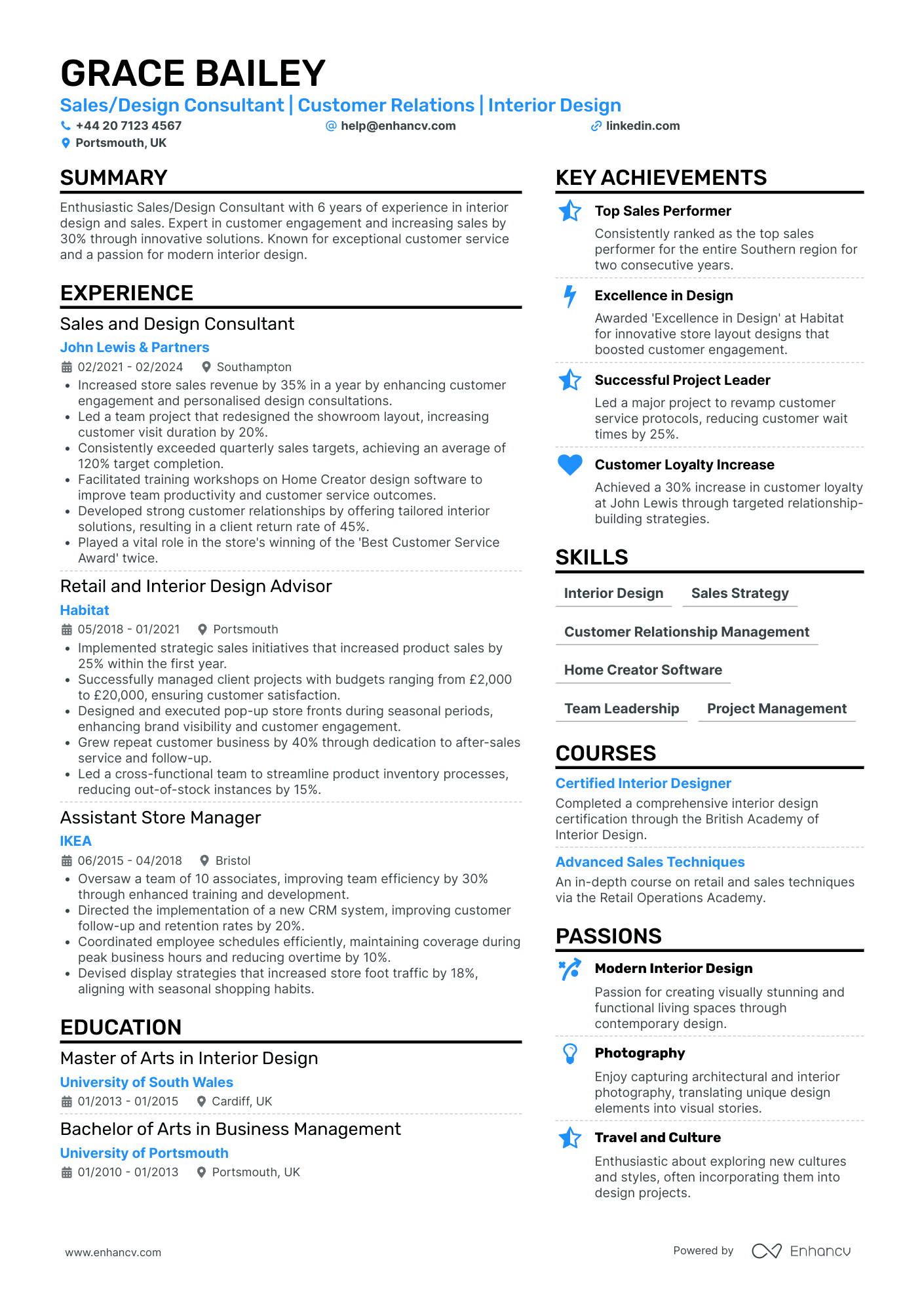
Led the redesign of a 180 sqm boutique hotel lobby in Manchester, managing a £120,000 budget from concept to handover in 14 weeks. Produced the space plan and technical drawings in AutoCAD and Revit, specified FF&E within budget, and coordinated three contractors on site. The refurbished space lifted the client's guest satisfaction scores and led to a second commission for the bedroom floors.
Formatting your interior designer CV
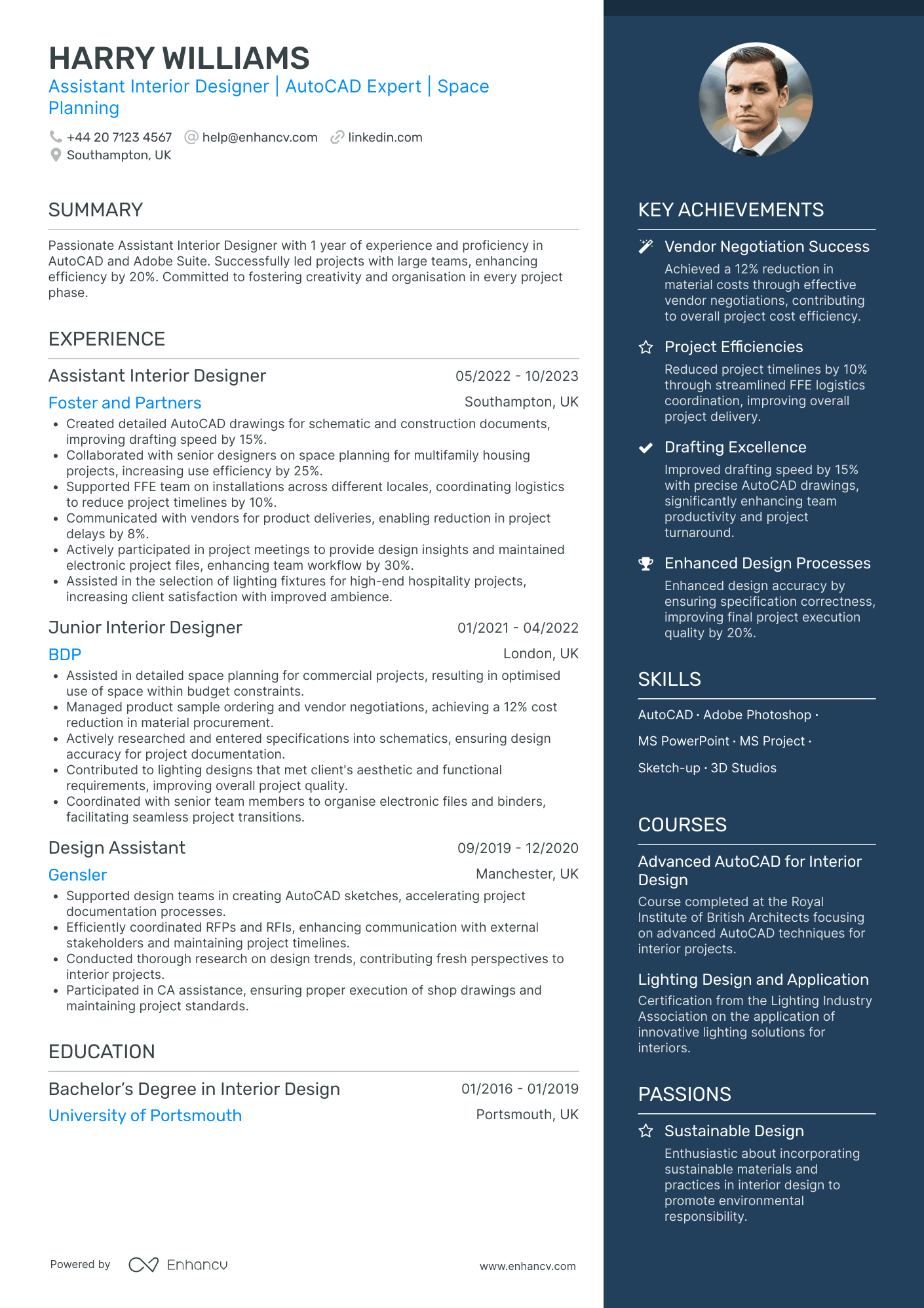
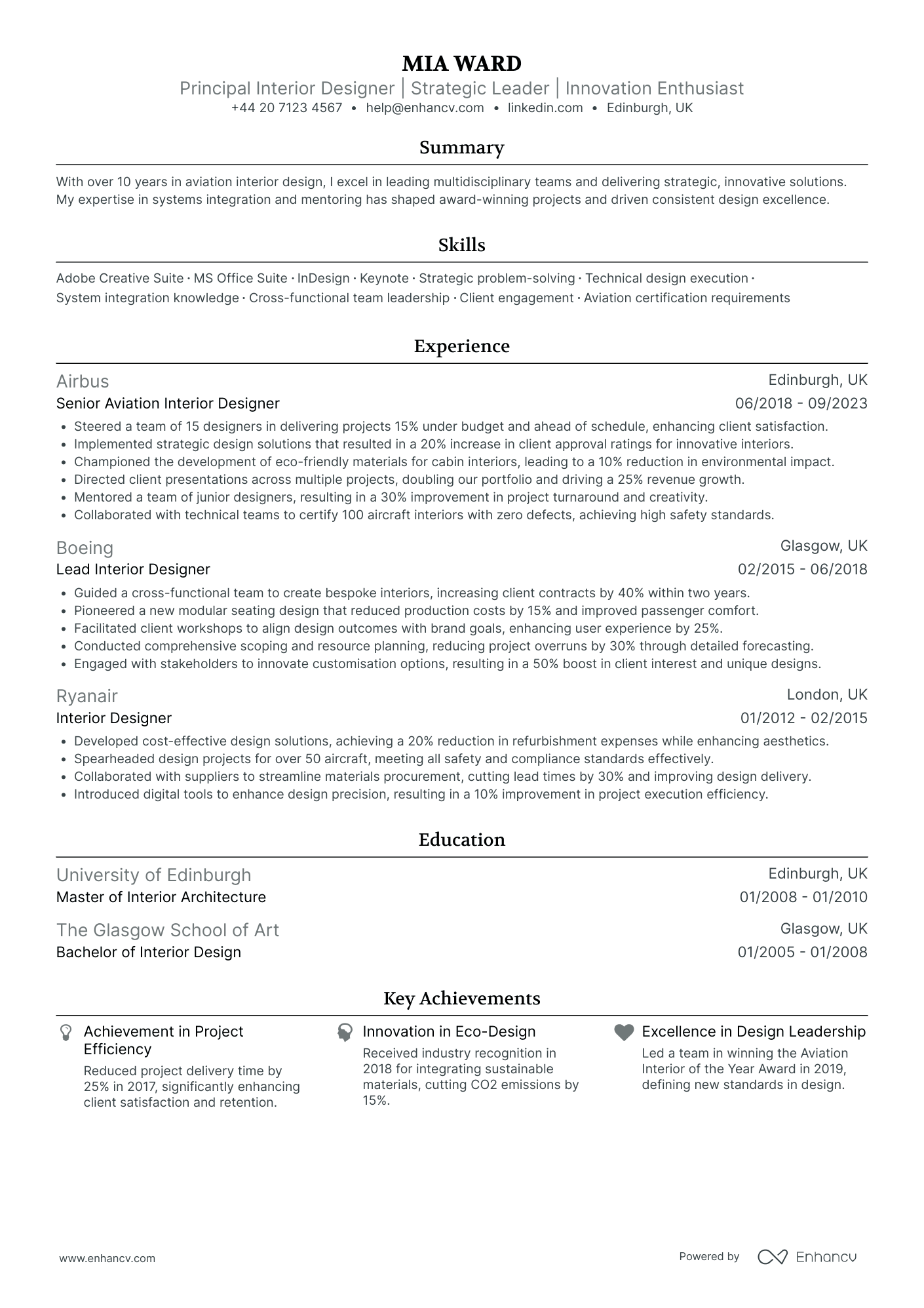
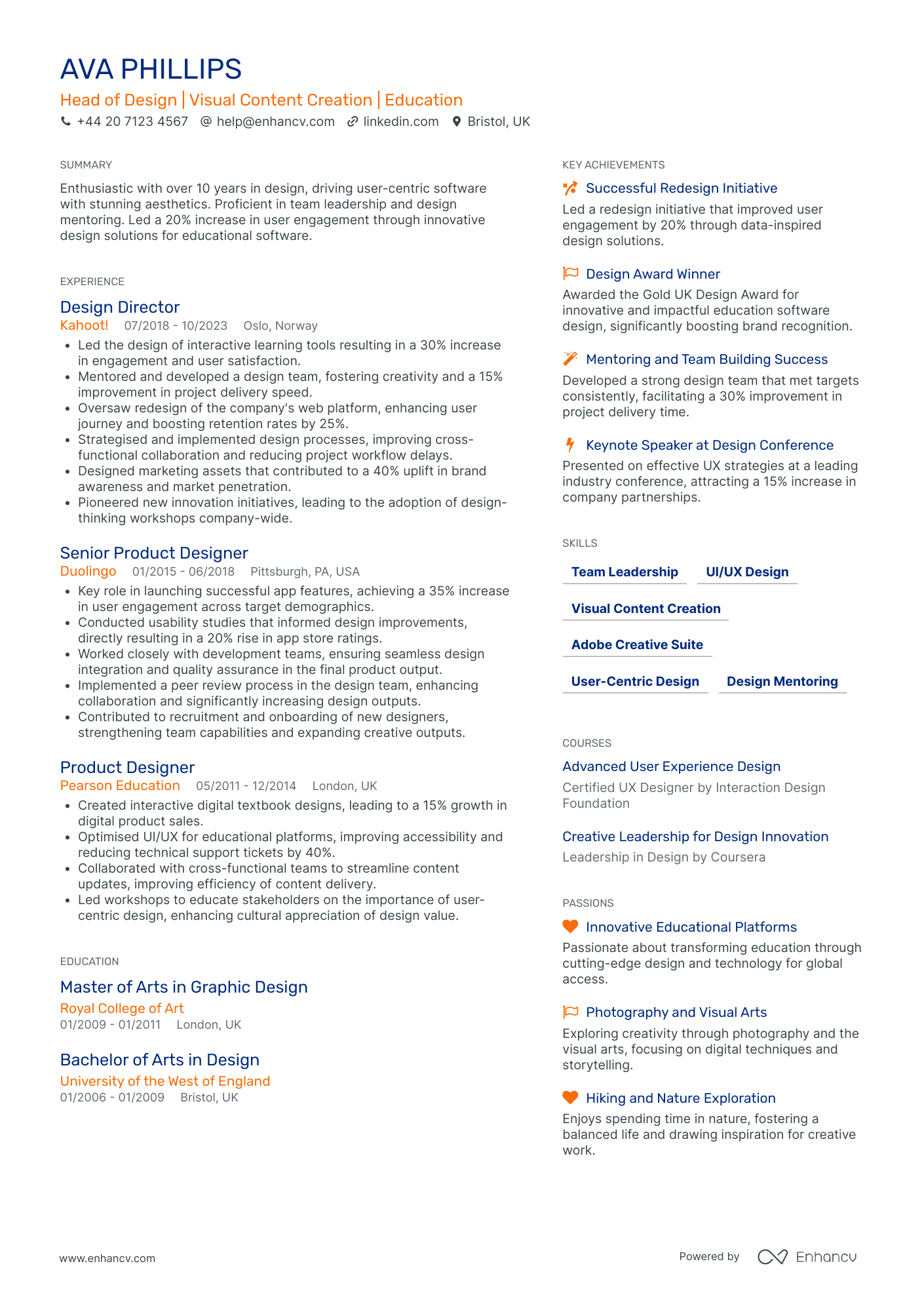
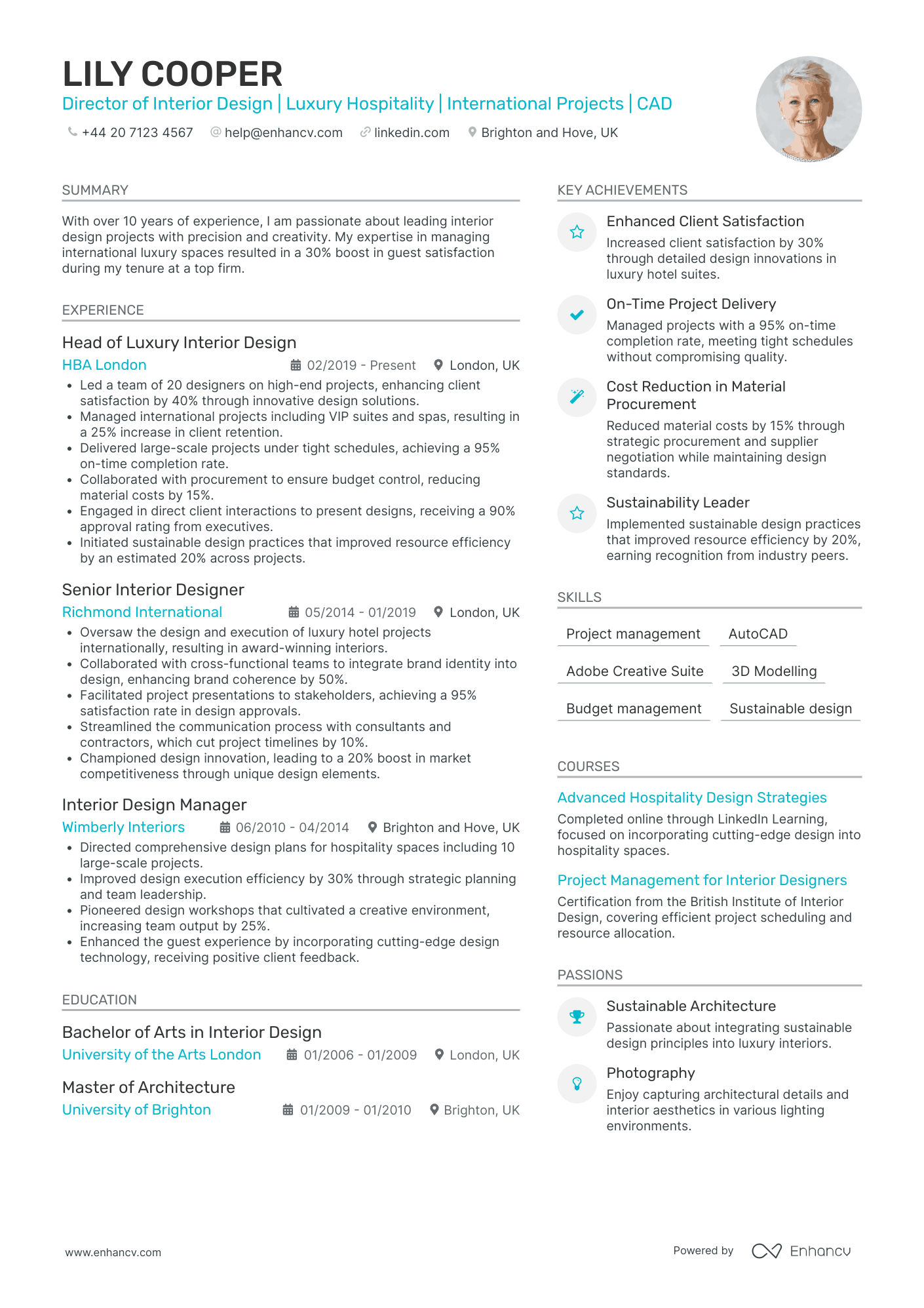
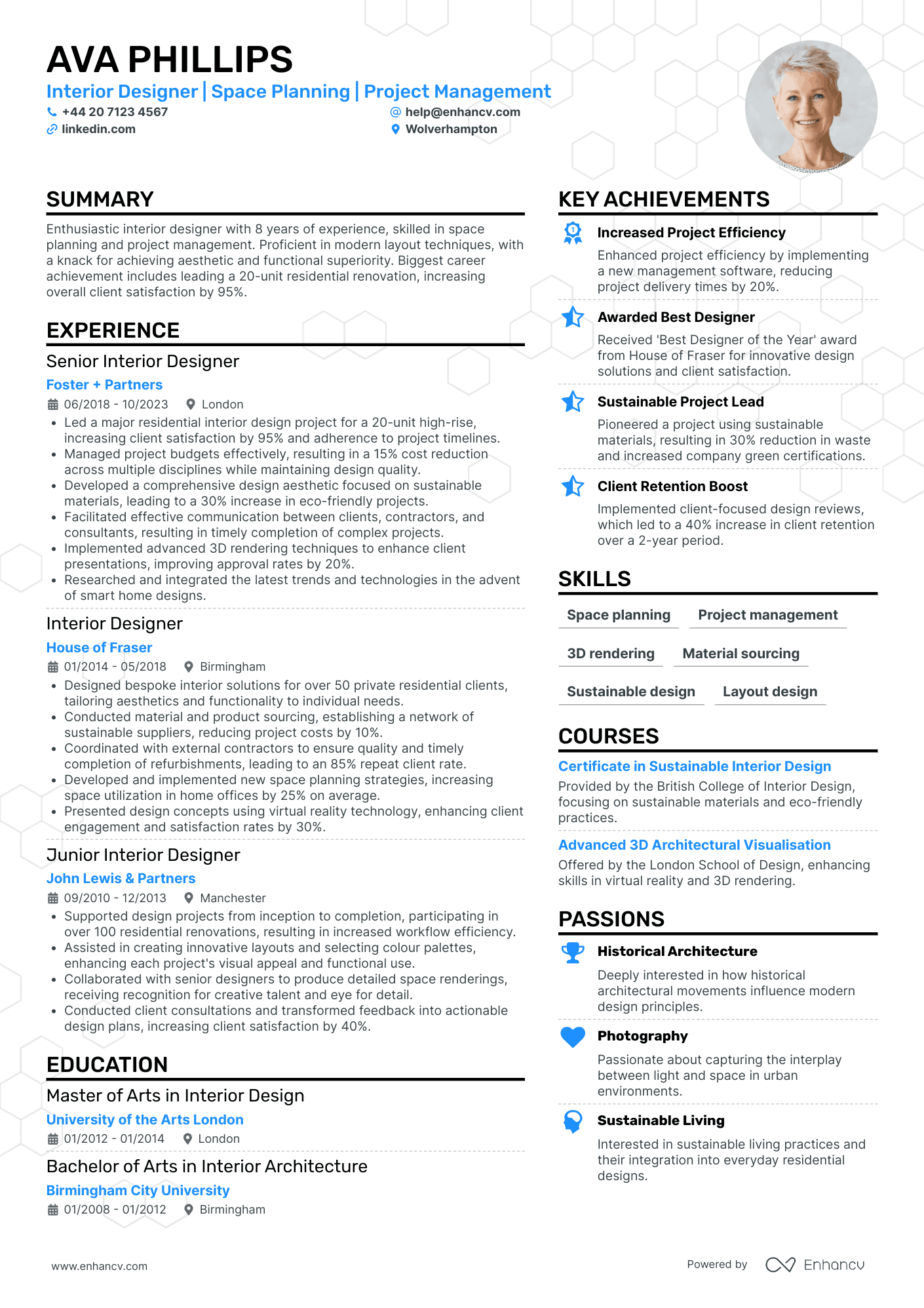
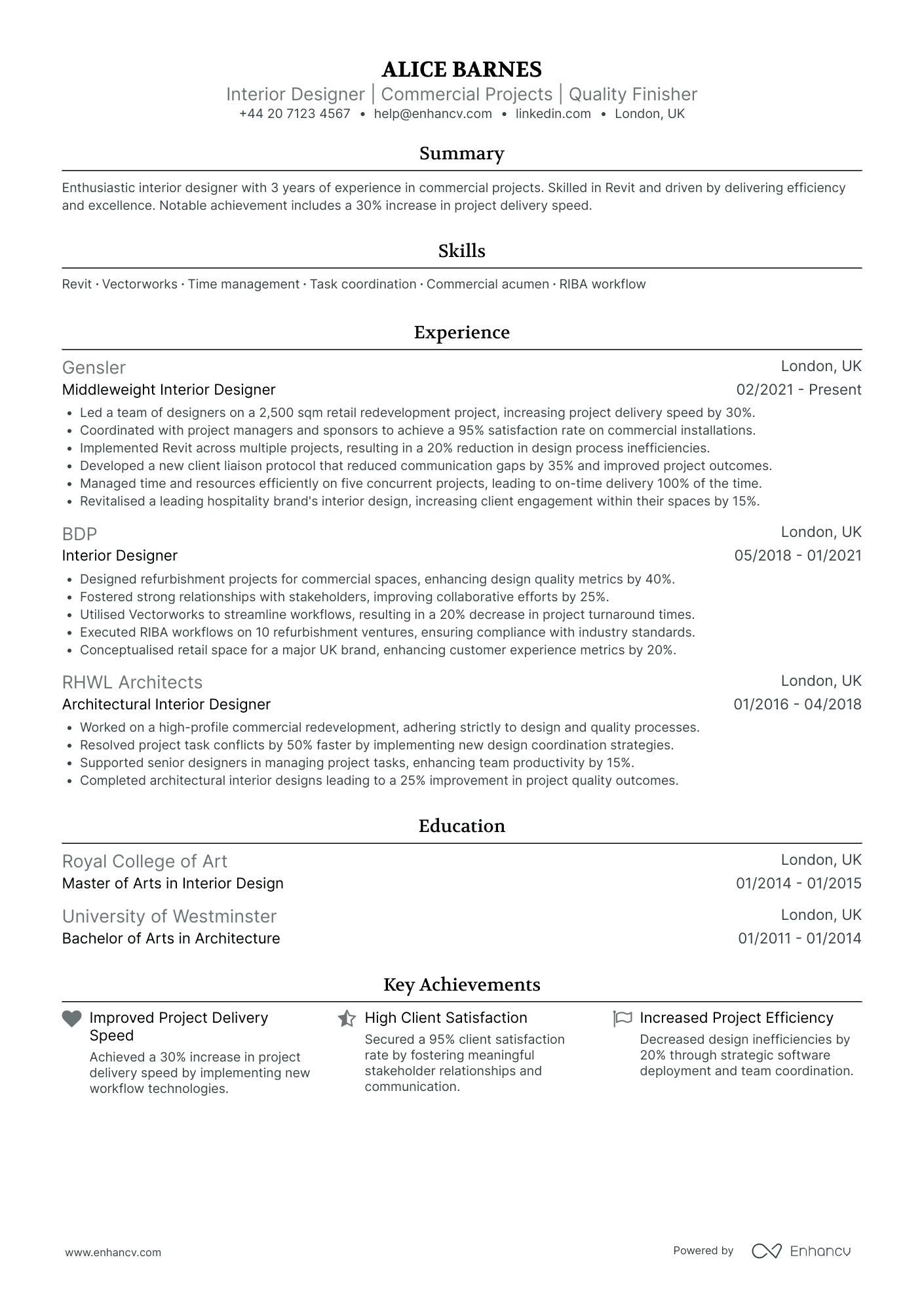
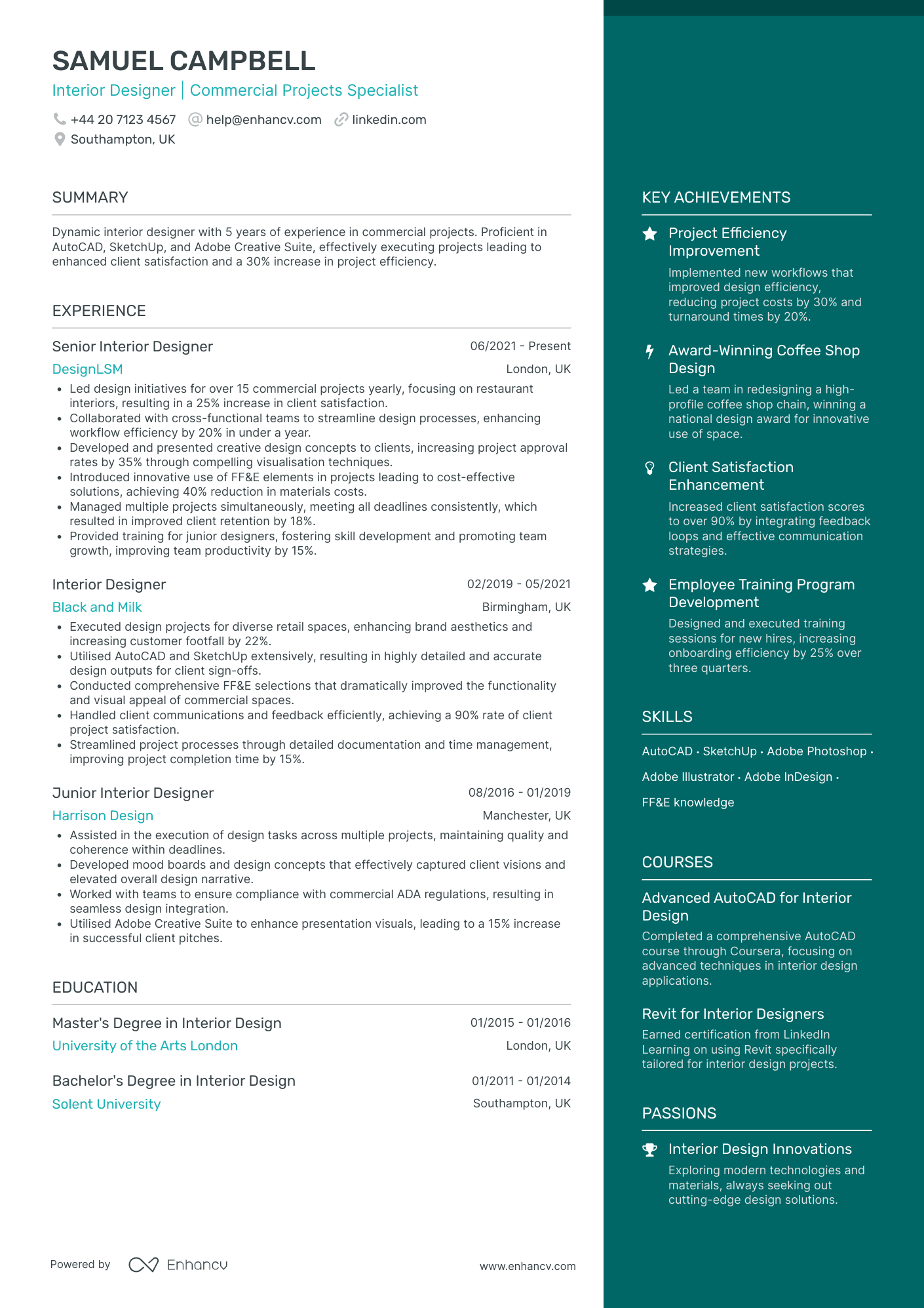
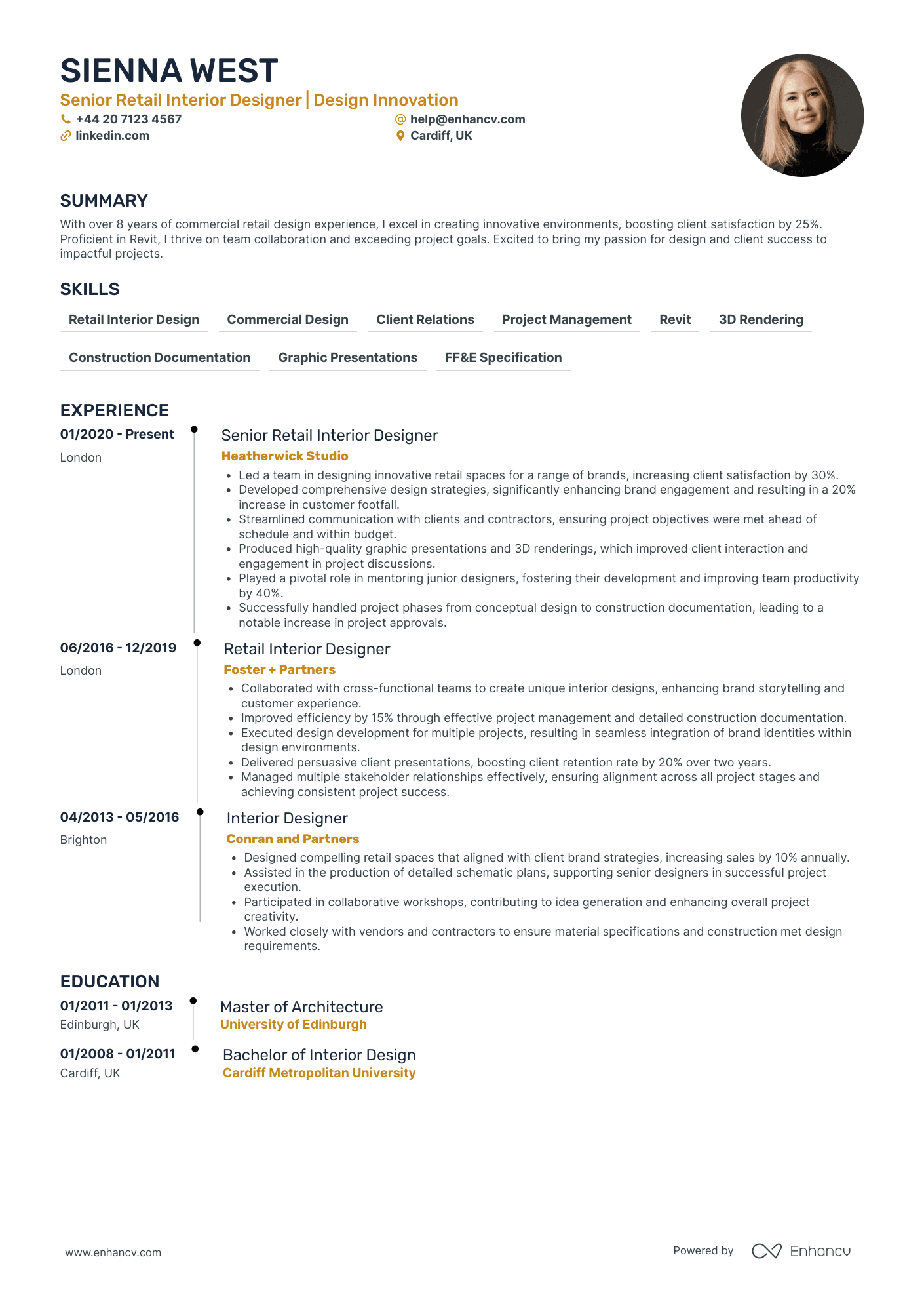
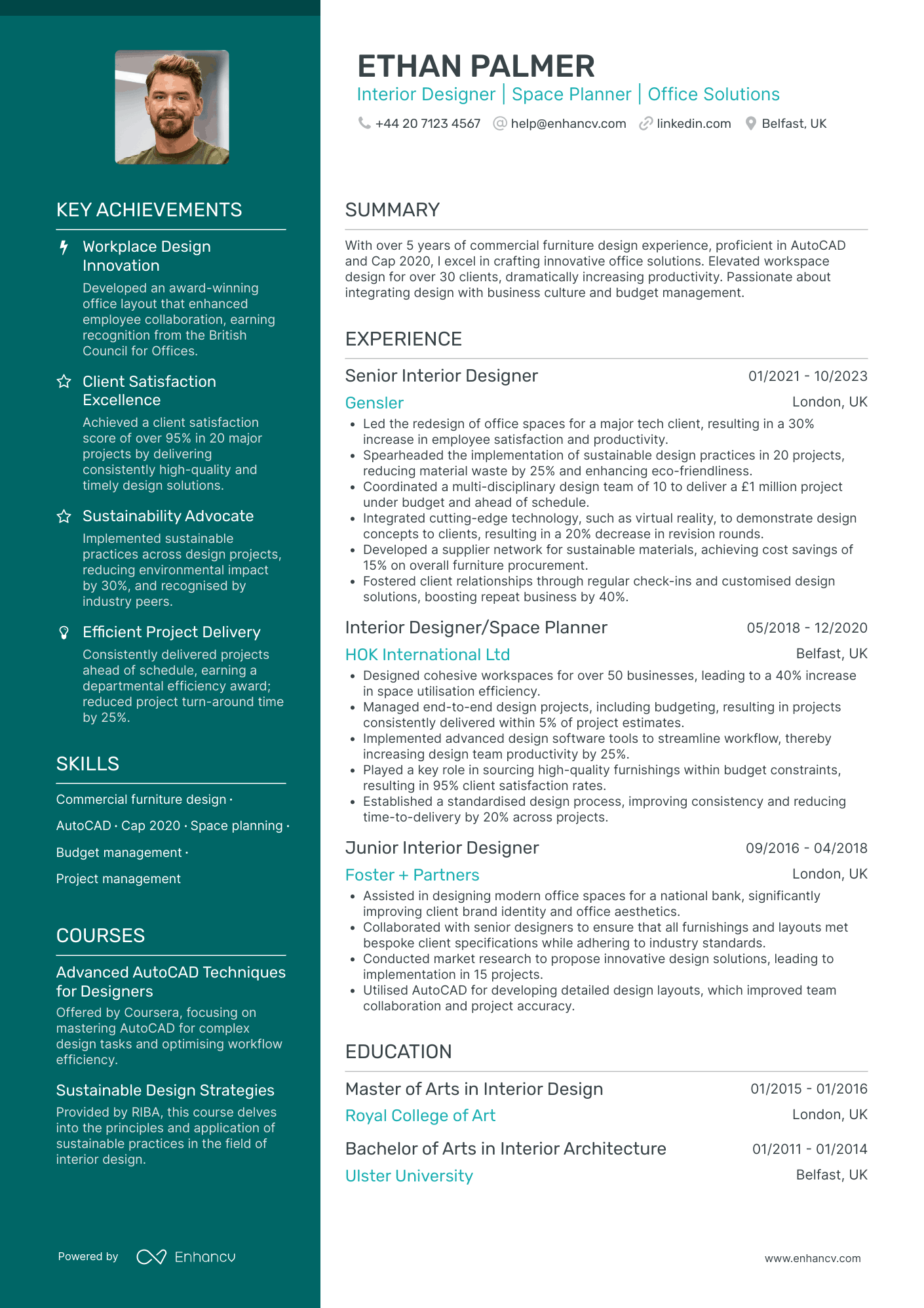
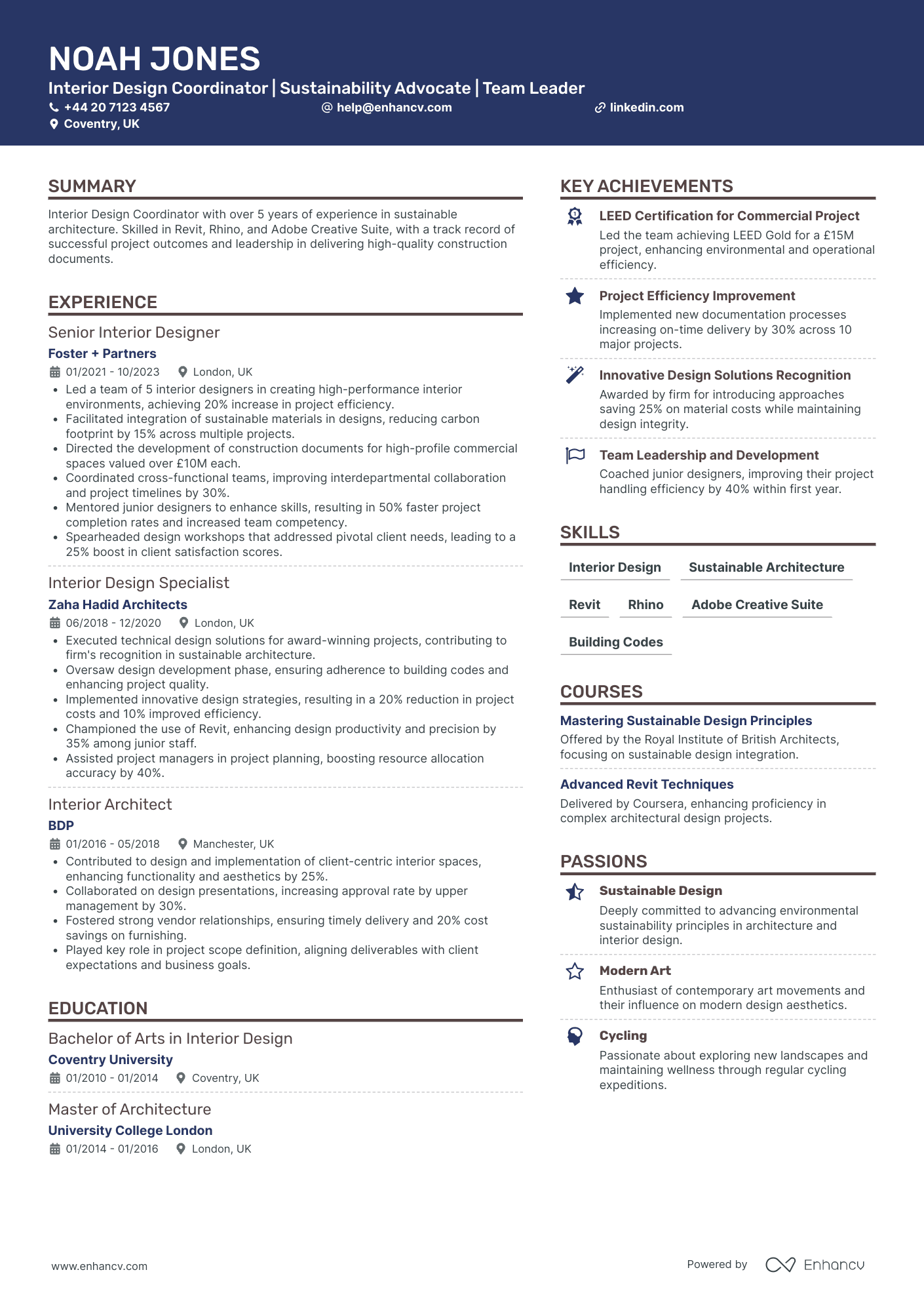
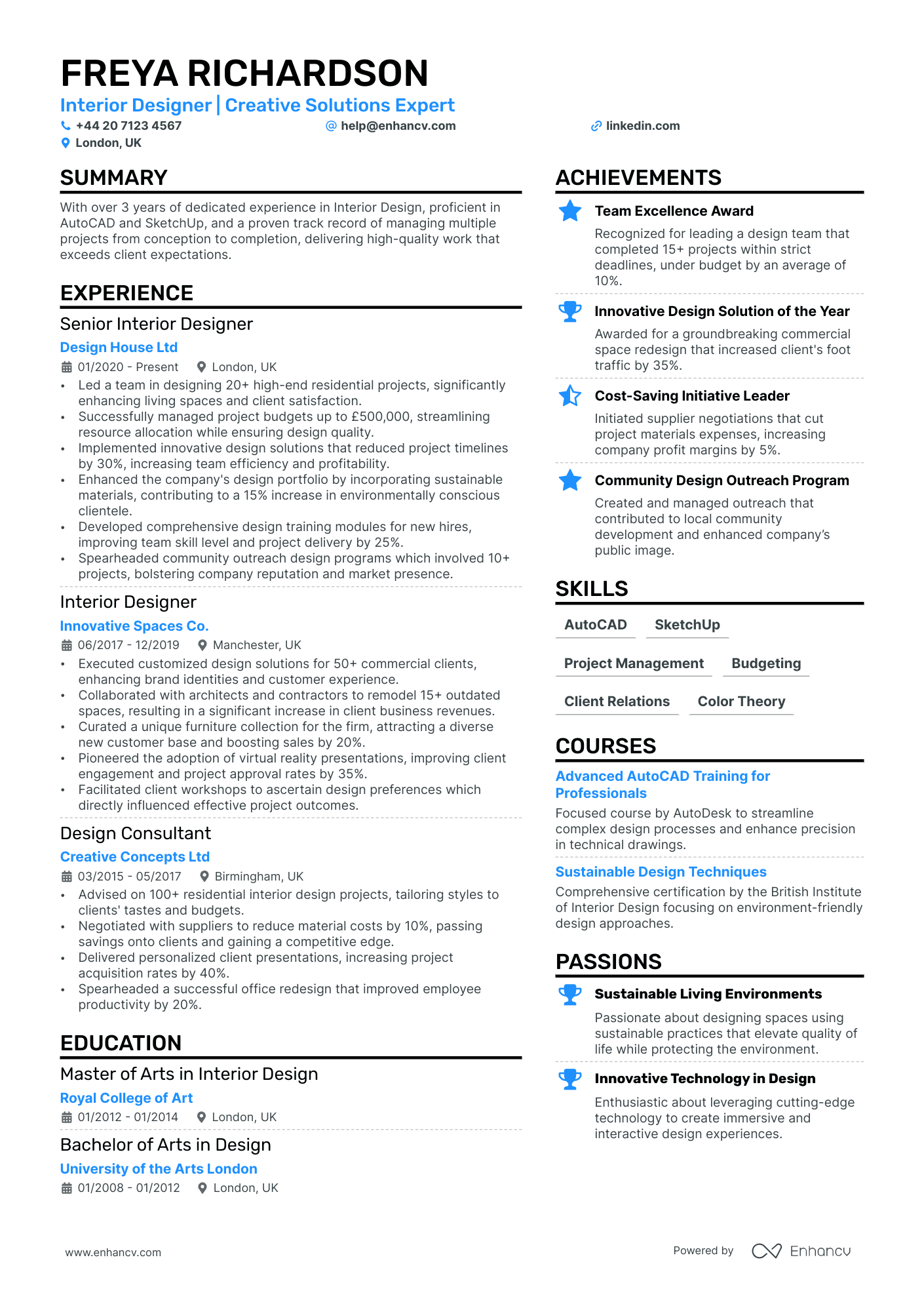
Once you have design roles behind you, use a reverse chronological structure and keep the portfolio link and skills high on page one. Early in your career, a skills-led structure lets the work lead before a thin job history.
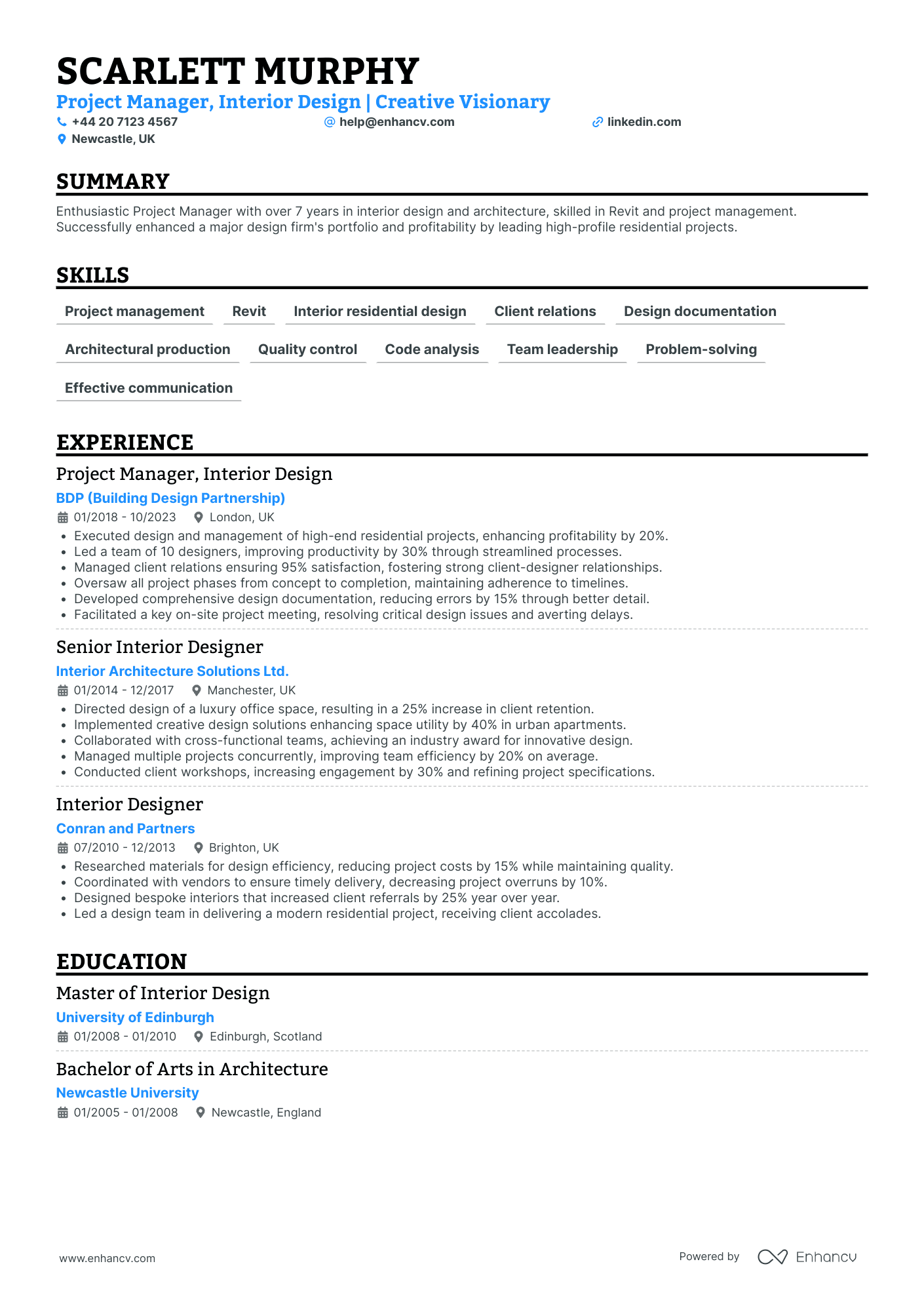
Keep it to two pages, one column, standard headings, and a readable font. A cluttered CV from someone who designs spaces for a living undercuts the pitch, so let the whitespace do some work.
Send a PDF for direct applications so the layout holds and the portfolio link stays clickable. Keep a Word copy for agencies that reformat CVs into their own template. If the advert names a file type, follow it.
Many studios screen through tracking software, so keep the headings standard for an ATS-friendly CV and never tuck the portfolio URL inside an image or the header bar, where a parser can drop it. Build it from a tested layout rather than a blank page, and Enhancv's CV templates export to a clean PDF.
Writing your interior designer personal statement
Three or four sentences at the top: who you are, your specialism, one signature project with a result, and the kind of studio you want to join. See more personal statement examples if the opening line will not come.
Skip the adjective soup every other CV uses. "Creative, passionate, and detail-oriented" tells a studio nothing it can check.
Lead with a project and a number instead:
Interior designer personal statement example
Interior designer with five years in commercial and hospitality fit-outs, from concept boards to on-site handover. Recently led a £250,000 restaurant refurbishment in Leeds, delivered two weeks early and now the client's busiest site. Fluent in AutoCAD, Revit, and SketchUp, and happiest solving a tight-footprint brief. Looking to bring that to a studio doing considered hospitality design.
What to avoid
A passionate and creative interior designer with a keen eye for detail and a love of beautiful spaces. A hard-working team player seeking a challenging role to grow my skills and contribute to exciting projects.
When I open an interior design CV, I look for the portfolio link first, and I want it to work. The strongest ones describe two or three projects the way you would brief a client: the space, the constraint, what you decided, and how it turned out. That shows me how you think, which a list of software never does. Name the studios, name the tools, and let the work carry the rest.
Writing your interior designer experience section
Whether the role was permanent, contract, or a placement, write each entry the same way: a dated heading, then bullets that show what you did and what changed. Lead every bullet with a verb. For the mechanics, see work experience on a CV.
Quantify wherever you honestly can. Budgets managed, square metres delivered, timelines hit, contractors coordinated, and clients retained all turn a duty into evidence.
Show progression across roles rather than repeating the same four bullets. An assistant who moved from drafting in CAD to running client presentations should let the later entry carry the bigger responsibilities.
Tailor each application to the advert, mirroring the sectors and software it names where they are true of you. Enhancv's CV tailoring feature reads the ad and suggests the matching edits, which saves rewriting from scratch each time.
- Design residential and boutique commercial schemes from brief to handover, running three to five live projects at a time
- Produce space plans, elevations, and technical drawings in AutoCAD and Revit, and photorealistic visuals in SketchUp and Photoshop
- Specify and source FF&E to budget, managing schemes between £30,000 and £150,000 and keeping projects on programme
- Present concepts to clients and coordinate contractors on site, holding a repeat-commission rate the studio now uses in its own pitches
PRO TIP
Mirror the software the advert names, exactly as it is written. If a studio asks for Revit and you list only AutoCAD, a parser and a hiring manager both read it as a gap. Name every tool you can genuinely use.
Skills for your interior designer CV
Read a dozen live interior design adverts and the same demands repeat. The hard skills are technical and specific: CAD and BIM software, space planning, technical drawings, FF&E specification, and a working grasp of building regulations.
The soft skills that matter here are the ones clients feel: communication, listening to a brief, managing a budget, and keeping calm when a delivery slips. Prove each in a bullet rather than just claiming it.
List only the software you can open and use under pressure. If you have trained on a tool but never shipped with it, say so rather than implying fluency you cannot back at interview.
Top skills for your interior designer CV:
AutoCAD
Revit
SketchUp
Adobe Creative Suite
Space planning
Technical drawings
FF&E specification
3D visualisation
Building regulations awareness
Client communication
Budget management
Attention to detail
Project coordination
Problem-solving
Education and qualifications for interior designers
There is no single mandatory route into interior design, which is why a strong portfolio can outweigh a specific qualification. Many designers hold a degree or diploma in interior design or architecture, and plenty arrive from adjacent fields.
List your education with the classification if it helps you, then add any professional standing. Registration with the British Institute of Interior Design (BIID) signals that you work to a recognised standard.
Short courses count when they are relevant. A Revit or SketchUp certificate, a CAD course, or CPD in sustainable design all belong under certificates or a dedicated training block, especially early on.
What the UK interior design market looks like
Interior design work is studio and site based more than remote, and it sits across architectural practices, design consultancies, contractors, and retail and hospitality brands with in-house teams.
Employers are consistent about the software they expect, so let the toolset guide what you put on the CV. Pay is the harder number to pin down.
Because the figure moves so much with specialism and location, treat any single average you see online with caution and read the salary band on the actual advert instead. A junior in a regional practice and a senior in a London studio are barely the same job on paper.
| What | UK interior design roles |
|---|---|
| Software adverts list | AutoCAD, Revit or ArchiCAD, SketchUp, and Adobe Creative Suite (Photoshop, InDesign, Illustrator) |
| Where you will work | Studios, architectural practices, design consultancies, and in-house retail or hospitality teams, mostly studio and site based |
| Common routes in | A degree or diploma in interior design or architecture, or a strong portfolio built through junior and assistant roles |
| Pay | Varies widely by specialism, studio size, and region. No single reliable UK figure, so check the advert and the National Careers Service |
Interior designer CV with no experience
Interior design is a portfolio field, so a first CV can carry its weight through projects rather than job titles. Use a skills-led structure and put the work first.
Student and personal projects count. A university brief, a spec redesign of a local cafe, or a room you reworked for family all belong in the portfolio, described the same way you would a paid job: brief, decisions, tools, outcome.
Mine adjacent experience for real evidence. Retail visual merchandising, a design placement, styling work, or CAD drafting for a contractor all show relevant skill. Volunteering and placements get a dated entry like a job.
One live project shifts a first CV from theoretical to credible. Offer to redesign a friend's small business interior or a community space, document the brief and the result, and you have a real case study instead of only coursework.
Name the software you have trained on, even if only through coursework, and keep learning it. A tidy first CV built around three well-described projects beats a polished one with nothing to open.
Conclusion
Lead with the portfolio, describe your projects like case studies, name the software studios ask for, and keep the format to two clean pages.
Pair the CV with a short cover letter that says why this studio, and you give the work the best chance of being opened.

Author's take - the Enhancv team
When I open an interior design CV, I look for the portfolio link first, and I want it to work. The strongest ones describe two or three projects the way you would brief a client: the space, the constraint, what you decided, and how it turned out. That shows me how you think, which a list of software never does. Name the studios, name the tools, and let the work carry the rest.