
Contrary to what you may have heard, hiring managers do value volunteer experience on your CV, especially when it directly aligns with the role at hand. Whether it’s working for a nonprofit, volunteering at a food bank, or helping out at a charity shop, the skills you’ve gained shouldn’t be overlooked. And, you did it all without the incentive of a paycheck at the end of the month.
So, in the right circumstances, adding your volunteer experience to your CV is a smart move. However, you need to know when it will be beneficial, how to format these roles, and the best way to describe them.
In this guide, we cover all of the above, plus some volunteering CV examples.

Key takeaways
- Volunteer experience counts as real work, so long as it pinpoints relevant skills and achievements that align with the role you're applying for.
- Place volunteering strategically based on your situation. Integrate it within your education if you're a student, create a dedicated section if the experience is substantial, or include it under related paid roles if it ties directly in.
- Only include volunteer work that strengthens your overall application. That means skipping one-off events, politically sensitive activities, or unrelated positions that take up valuable CV space without adding real value.
- Use action verbs and quantify your impact wherever possible. Instead of saying "helped with events," write "coordinated monthly fundraising events that raised £10,000 over 12 months."
- Don't undersell your unpaid roles. If you led teams, managed budgets, or achieved results as a volunteer, present these accomplishments with confidence and professionalism.
Is your CV good to go? Find out by using Enhancv’s free CV Checker. Simply upload your CV and get the inside scoop on what’s working and what’s not.
Is your CV good enough?
Drop your CV here or choose a file. PDF & DOCX only. Max 2MB file size.
Let’s get started by defining exactly what we mean by volunteering experience on your CV.
What is volunteering experience on a CV?
Volunteering experience on a CV is any unpaid work or community involvement that develops relevant skills and shows a level of initiative. It covers everything from long-term unpaid work to one-off projects you helped out on. In the context of CVs, it should align with your career path.

Types of volunteer work
- Community projects that you organised or helped out with
- Formal volunteer roles with charities or nonprofits
- Pro bono (unpaid) work that you’ve carried out in your sector
- Board memberships or committee positions
- Fundraising or social awareness campaigns
- Mentoring, coaching, or teaching gigs that were unpaid
When deciding whether a position is worth shouting about, consider your level of responsibility and whether you achieved measurable outcomes. You should also think about whether it showcases in-demand skills that are relevant to the role. If the gig puts you in a positive light and adds value to your CV, it may be worth highlighting.
Why does volunteering matter on your CV?
Having volunteer experience on your CV can be a real pull for hiring managers—but only if you get it right.
This is why it matters and how it could strengthen your next application.
- Demonstrates transferable skills: The right volunteer experience highlights your transferable skills, such as organisation, leadership, and teamwork. For example, if you supervised a team at a charity shop, it proves you have developed your management skills.
- Builds credibility: You might lack formal work experience, but you can make up for it in volunteer experience. If you’ve worked for notable companies in a volunteer capacity, that is likely to pique the hiring manager’s interest. For example, if you volunteered at Oxfam—which is a recognisable brand—that is sure to build a level of credibility.
- Fills in the gaps on your CV: Lacking work experience or new to a sector? Strategically used volunteer work can help you plug any gaps on your CV. If you're a journalism graduate who hasn't landed a paid publication role yet, you might have contributed articles to online magazines without compensation. In that case, including the experience is a savvy move.
- Reflects your commitment to causes: Do you care about social causes? If the answer is yes, volunteering in this sector is an excellent way to prove it. When applying for roles within the nonprofit sector, your commitment to causes could help you land formal employment.
Volunteering counts as experience!
One of the common misconceptions is that volunteer work does not count as real experience. Nothing could be further from the truth. Unpaid work could be entirely relevant to your CV, as long as you developed skills that are relevant to the vacancy you’re applying to.
Should you include volunteering on your CV?
Now, let’s talk about the question on your mind: Should you actually include volunteering on your CV? There isn’t one rigid answer. The truth is that it depends on your experience level, whether the volunteer work is relevant, and, of course, whether you actually have the space on your CV.
Here are some of the times you should definitely consider having a volunteer section on your CV:
Include volunteer experience if…
- You’re a student, graduate, or career changer: In these instances, the volunteer work on your CV fills in any notable gaps. You can show how you’ve been preparing for a career in this sector through these experiences.
- It demonstrates transferable skills: Volunteer work will teach you a range of transferable skills, which will be relevant across multiple roles.
- You’ve had an employment gap: Employment gaps are not uncommon, but they can leave your CV looking sparse. If you volunteered while you were out of formal work, you can add it to your application to cover this period. This stops the hiring manager from having to ask how you spent your time while not working.
- You contributed to long-term projects: Have you been volunteering with an organisation for a long time? That shows commitment and longevity—two traits that will always impress hiring managers. If possible, be clear about how your efforts led to tangible results for the charity or nonprofit.
- You took on a leadership role: Stepping into a managerial position is a big deal, even when you weren’t paid for your work. It means that you were trusted to oversee others and that someone in power saw your leadership talents. Don’t hide them away—talk about them on your CV and impress the reader.
Of course, there are times when adding volunteer work to your CV could do more harm than good. If you’re simply doing this for the sake of it, you might want to think twice.
Next up, we break down the scenarios when it may be better to skip it altogether:
Skip volunteer experience if…
- It’s a one-off event unrelated to your professional goals.: Let’s say you helped out at a soup kitchen once, but you’re applying for a job in marketing. The skills you used in that one-off event are likely not transferable to this field. Equally, since you only did it one time, you may not have gained much know-how from it.
- The work is politically sensitive or controversial: You may be enthusiastic about your membership in a political party and the volunteer work you do for them. However, if your political persuasion could be seen as controversial or not relevant to the role, you might want to leave it out.
- It takes up space from more impactful sections: Every space on your CV is valuable, and you don’t want to waste it. If you already have a ton of relevant work experience, the right skills to match the job criteria, and certificates to boot, chances are there’s no need to include volunteer experience. If this section is only going to take up space and detract from other parts of your CV, skip it.
Consider your circumstances and what you already have to bring to your CV. You should only add volunteer experience if it's of real benefit to your application.

Don’t undersell your volunteer experience
If your volunteer work highlights leadership, mentoring, or community impact, treat it as seriously as paid experience. That means using the same structure and serving up the same level of detail. This gives hiring managers a clear view of the role you played.
Where to put volunteering experience on your CV
Тhe exact placement of volunteering depends on a couple of factors, including how relevant it is and your career stage.
Here are the places you may want to include it on your CV.
Under your work experience
If your volunteer work is relevant to your field—for example, leading a union or Diversity, Equity, and Inclusion (DEI) initiatives at your workplace—you can put it under the job it relates to. You don’t need to create an entirely separate section for this unpaid work, as it ties into a job that you held.
The simplest option is to bullet-point it under the main job details. You’ll be using bullet points to talk about your achievements in the role anyway. Add your volunteer experience in there, but be sure to highlight the fact that it was not a part of your contractual obligations.
Let’s take a look at a volunteer experience example below:
Work experience
Digital Content Creator
Family & Home Magazine | Manchester, UK
June 2020 – August 2023
- Wrote 15+ blog posts and web articles per month covering parenting, home life, and wellness topics
- Optimised existing content for SEO, improving organic traffic by 25% over 12 months
- Managed social media content calendar and engagement across Instagram and Pinterest
- Fact-checked articles and conducted background research to ensure editorial accuracy
- Coordinated the company's annual charity fundraiser, managing logistics and volunteer communications (voluntary role, separate from job duties)
In your education section
If you’re a student or a recent graduate, you may be able to present certain volunteering positions in your education section. However, this only works for experience that you completed while you were studying.
For example, if you ran for union president at your university or held a society role, you can detail it here. List it below the qualification you were completing whilst volunteering.
Here’s an example of how that would look:
Education
Bachelor of Arts in English Literature
University of Leeds | Leeds, UK
September 2015 – June 2018
Grade: 2:1
Volunteering roles during studies:
- Editor-in-Chief, The Leeds Student Magazine (Voluntary position, 2017–2018)
Managed editorial team of 12 student writers, coordinated monthly publication schedule, and increased readership by 30% through digital content strategy
- President, Creative Writing Society (Elected role, 2016–2017)
Organised weekly writing workshops, invited guest speakers from publishing industry, and coordinated annual student anthology fundraiser that raised £800 for charity.
Avoid adding too much detail, especially if you’re short on space on your CV. However, you can include a line or two that explains what you did within your volunteer position.
Never underestimate the power of metrics
When detailing your volunteer experience, add in numbers or statistics wherever possible. Being specific about the impact your efforts had shows the hiring manager that you can get results. That’s precisely the type of gumption they’ll be looking for.
In a dedicated section
Let’s say that your volunteering experience is unrelated to your main job, but still meaningful. It likely helped you hone a whole other skill set, which will help you succeed in your career.
Or, on the other hand, you may have had multiple volunteering roles that are valuable. These are exactly the times when you want to create a dedicated volunteer section for your CV.
You can lay this out like your work history section and position it just below that on the page.
Start by writing the main details about the volunteer experience—your title, the organisation, the dates you volunteered, and where it was—and below that bullet-point your achievements.
Check out how it might look on the page:
Volunteering
Content Creator & Social Media Manager
Hope for Animals Rescue | Manchester, UK |
January 2021 – Present
- Created and scheduled 15+ social media posts weekly across Instagram, Facebook, and Twitter, growing followers from 2,000 to 8,500.
- Wrote monthly newsletter content featuring adoption success stories, fundraising updates, and volunteer spotlights, achieving 35% open rate.
- Developed content calendar aligned with awareness campaigns and adoption events.
- Photographed and profiled rescue animals for website listings, contributing to 40% increase in adoption inquiries.
Workshop Facilitator
Leeds Youth Writing Project | Leeds, UK
September 2019 – June 2021
- Led weekly creative writing workshops for young people aged 13–17, teaching storytelling fundamentals and confidence-building techniques.
- Mentored participants in developing short stories and poetry for annual publication showcase.
- Provided one-to-one feedback on student writing projects outside of workshop hours
- Supported three students in successfully applying to journalism and creative writing degree programmes.
It’s important to label this CV section as Volunteering or Community Involvement so it doesn’t get muddled up with your general work experience. You don’t want to mislead the reader, after all.
In your cover letter
What about if you have some small or even one-off volunteer contributions? Things like a charity fun run or some fundraising you did for a cause that’s close to your heart. If the experience isn’t major, but you still want to mention it, you can talk about it in your cover letter.
However, you should make sure that your unpaid experience says something about you and your ability to do the job. If you’re including it simply because you think it’s interesting, the hiring manager may not agree. Every part of your application package should be tailored to the job at hand.
How to create a volunteer section on your CV
Let’s say you have a few volunteer experiences and you’ve decided to opt for a dedicated section. Creating this part of your CV doesn’t need to be hard. However, there is a right and a wrong way to go about it.
Follow the advice we share below to create a hiring manager-friendly CV section.
Steps to write your volunteering experience
- Mirror the format of your work experience: Your work experience CV section follows the exact same format as a work experience section—only it has a different heading at the top.
- Start with the role title: The first thing you want to include is your exact volunteer role title. It’s best to align the job title with the requirements in the advert. Tweaking it accordingly will help your odds of success.
- Add organisation name and location: Next up, add the name of the organisation (for example, The British Heart Foundation) and the location. If you volunteered at a national charity, put the location where you worked, or simply “remote”.
- Include the dates you volunteered: List the dates that you were actively volunteering for the organisation. Write both the month and the year in each case. For example, “May 2020 - Mar 2023”. Make sure that the date formatting is consistent with the rest of your CV.
- Describe your achievements: When you’ve done that, briefly describe your achievements and responsibilities in that role. You have about two or three bullet points to play with here. Slide in any relevant metrics to illustrate your value to the reader.
- Use the implied first person: That means that all verbs refer to the first person (you), but you drop the “I”. Writing sentences like “I did X” and “I helped out with Y” can sound a little juvenile. You want the tone of your CV to be professional at all times.
- Use action verbs strategically: It’s in these bullet points that you want to be very strategic about your language. Include powerful action verbs, such as “organised,” “led,” “increased,” and “supported” to make the points dynamic and engaging.
- Link skills to the target job: Your volunteer experience section is a great place to tie in some key skills. Go back to the original job advert and take note of the vital skills in the criteria. Look for places you can mention these in the bullet points.
Each of the above is essential to crafting a well-rounded section that will wow the hiring manager. But to really make the point, it may be worth looking at a couple of volunteering CV examples.
Here’s an example of what not to do when writing this section:
Volunteering—bad example
Helper
Charity | 2020-2023
- Helped out at the charity shop whenever I could make it in
- Was responsible for doing various tasks that needed to be done
- Worked alongside other volunteers on different projects and initiatives
- Assisted the manager with organising events and other activities when they asked
- Did social media posts sometimes
- Had a really great experience and learned a lot about working with people
- Was given the opportunity to be involved in fundraising
- Helped with admin tasks like filing and answering phones
- The role taught me valuable skills that I can use in the future
The above section is not likely to impress anyone. It includes the passive voice, vague statements, generic language, and too many bullet points. Additionally, it lacks any specificity and doesn’t have evidence to back up statements.
When you’re sharing your contribution to an organisation, the more specific you can be about it, the more likely it is to have a real impact.
Here’s an example of a great volunteer experience section:
Volunteering—good example
Social Media Manager
Rethink Mental Illness |Remote
February 2021 – Present
- Developed and implemented Instagram content strategy that grew followers from 4,200 to 15,800 within 18 months.
- Created weekly video content featuring mental health tips and personal stories, achieving average reach of 8,000 views per post.
- Managed community engagement by responding to 50+ direct messages weekly with resources and crisis support signposting.
- Collaborated with communications team to launch Mental Health Awareness Week campaign that generated 120,000 impressions.
Reading Mentor
Beanstalk Literacy Charity | Bradford, UK |
September 2019 – July 2021
- Mentored three primary school children weekly in reading comprehension and confidence-building, supporting progression of average 1.5 reading levels per term.
- Designed personalised reading plans based on individual interests and learning styles.
- Communicated progress updates to teachers and parents through monthly written reports.
- Attended safeguarding training and maintained confidential records in accordance with charity protocol.
The above volunteer experience example is far more detailed—featuring metrics, clear outcomes, and specific activities. At a single glance, the recruiter would be able to fully understand the impact the person had.
If you’d like to write equally strong bullet points, try Enhancv’s Bullet Point Generator—it does the hard work for you. All you need to do is make the final tweaks to make it yours.
Volunteering CV examples for different situations
Of course, how you position your volunteer experience will rest upon your career level. That’s why we’ve put together some simple volunteering CV examples below. You can use them to guide your tone, relevance, and placement when structuring your volunteer experience on your CV.
Student or recent graduate CV example
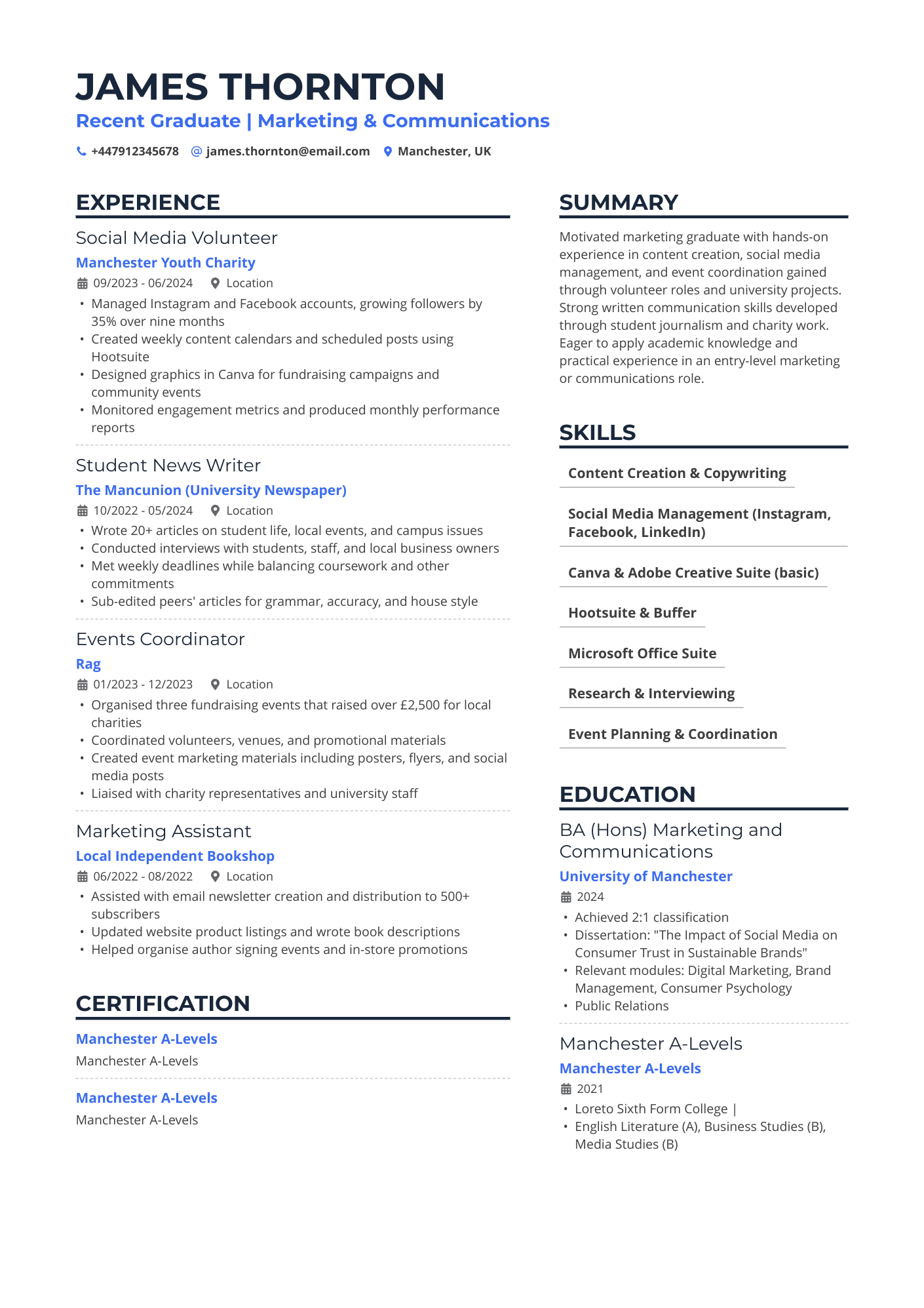
When you’re just embarking on your career, some choice volunteer experience can bridge the gap. You won’t have had the time for full-time employment while studying. However, you may have been able to take on a volunteer position here and there. Make sure that this stands out on your CV.
You have two choices: either list your volunteer experience in your education section (if it aligns with your schooling), or create a dedicated section (if you have a few positions to share!).
Let’s take a peek at an example of how the latter would look:
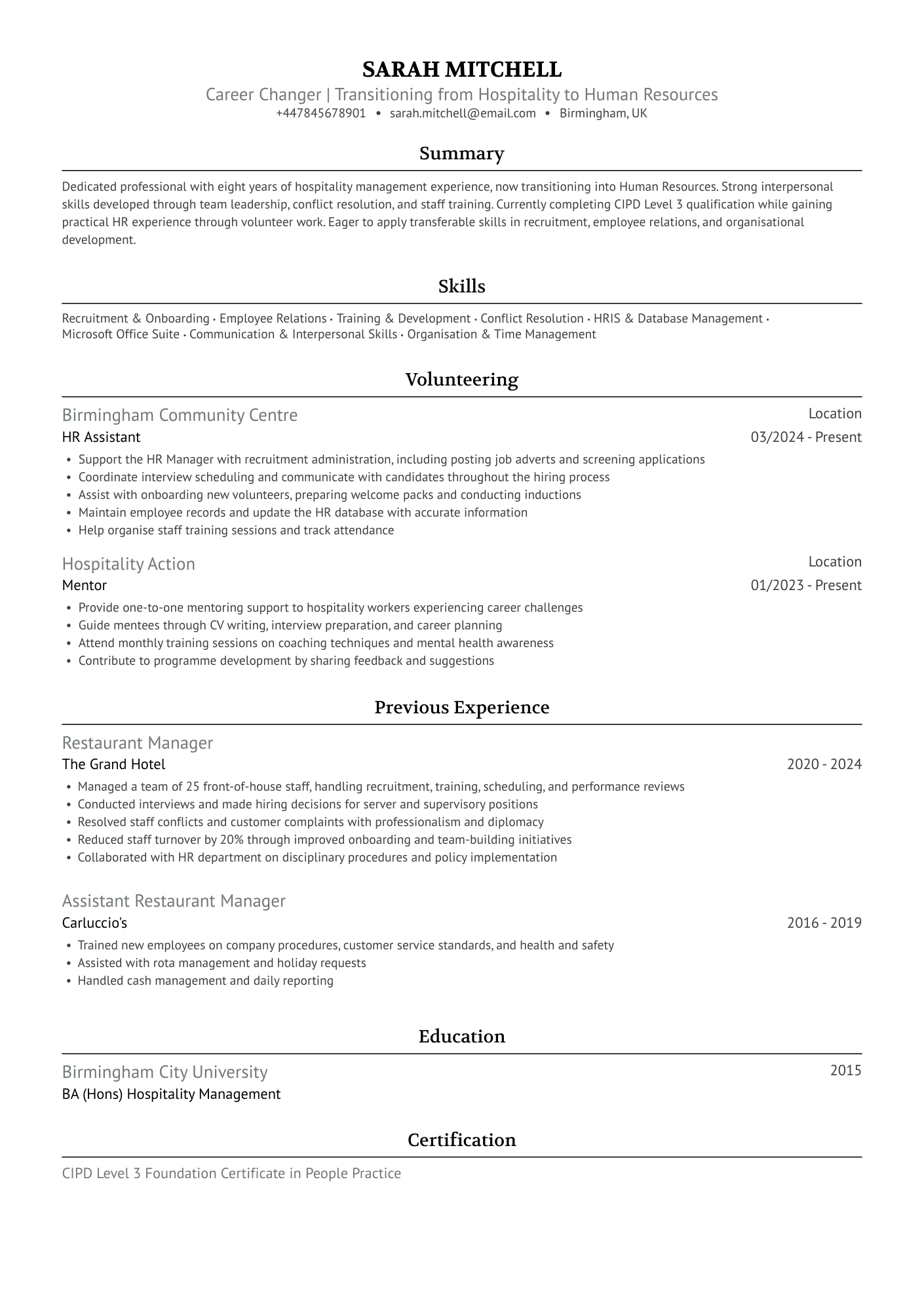
Career changer CV example
One in four Brits are currently dissatisfied with their career. If a change is in order, you may not have work experience in your chosen field. For example, you may be moving from acting into accounting. Those are two extremely different industries. So, how can you prove that you have what it takes?
Volunteer experience may be the answer. You may have undertaken some unpaid work as an intern or helped out at a business. If that is the case, you can either include this in your work experience section—with a clear sentence saying it was unpaid—or create a separate section for it.
Check out how you can share your volunteer experience on your CV:
Experienced professional CV example
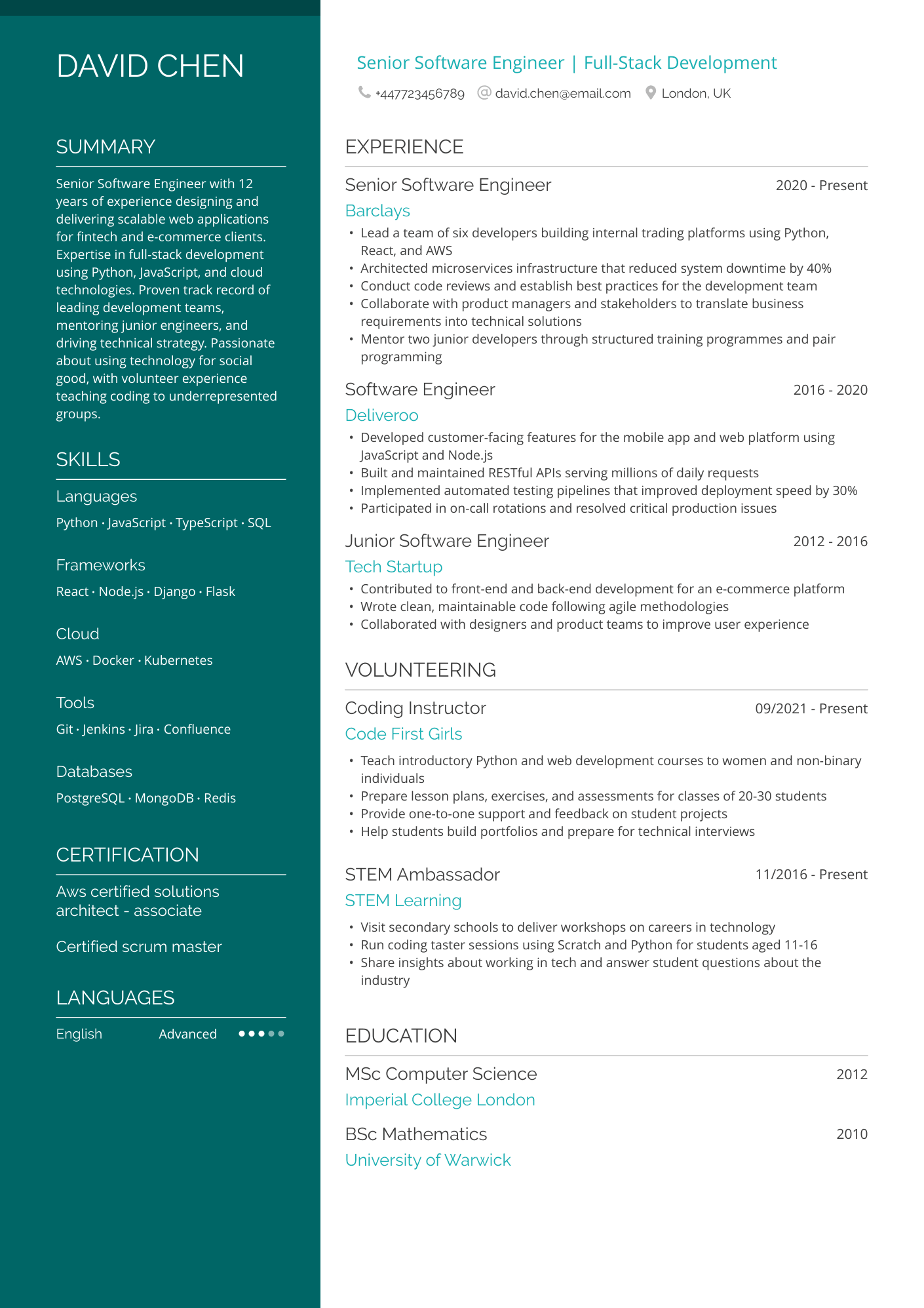
If you’ve been in your job for a matter of years, you don’t need to throw volunteer experience onto your CV. But there are times when you might want to. For instance, if the unpaid experience you have has sharpened skills you don’t use in your everyday work-life, it’s well worth listing on your CV.
However, it needs to complement rather than overshadow your career highlights. For that reason, your best bet is to add a volunteer experience section below your work experience section.
Here’s an example of how that would look on your CV:
Don’t get bogged down in a formatting hole. Enhancv has a selection of tried-and-tested CV templates you can use to get started. Each one is fully customisable, meaning you can add in new sections and move things around.
Bonus: How to talk about volunteering in your personal statement or cover letter
Looking for a way to add a bit more depth to your volunteer experience? Use either your personal statement (i.e. your summary section) or cover letter to do just that. Since these parts of your application have a freeform structure, you have the freedom to talk about your experience.
Personal statement or summary
Believe your volunteering is your Unique Selling Point (USP)? Put it right at the top of your CV in your personal statement or summary section. This works well if you’re a career changer who has volunteered in your chosen sector or have volunteer work that is directly applicable to the role.
Don’t expect the hiring manager to fill in the blank spaces here. Make it obvious how your volunteer experience speaks to the vacancy. You can do this by using the same language you found in the job description, creating an instant link in the reader’s mind.
For some inspiration, take a look at the summary example below:
Summary
Marketing professional with five years of agency experience and a track record of managing multi-channel campaigns for retail brands. Currently serves as Communications Director for Youth Voices Network, a volunteer role involving developing a content strategy that increased community engagement by 150%.
Cover letter example
If you’ve mentioned your volunteer experience on your CV, you can elaborate on it in your cover letter. The golden rule here is making sure that you relate it back to the vacancy.
For example, if you volunteered as a Brown Owl in the Brownies and you’re applying to be a team leader, draw comparisons between the two roles. As a Brown Owl, you know how to lead a group and manage both volunteers and children. Detail that throughout your cover letter.
Whenever you’re describing your volunteer position, tie it back in with the role you’re applying for. Don’t be afraid to spell out exactly why you think that the experience prepared you for the position you’re applying for. Doing this leg-work for the hiring manager will boost your chances.
Let’s take a quick glance at how you would do that:
Cover letter
Dear hiring manager,
I'm writing to apply for the Team Leader position at Riverside Youth Centre. With three years of experience coordinating community programmes and two years as a Brown Owl with 2nd Bradford Brownies, I've developed the leadership and organisational skills needed to manage your after-school team effectively.
As Brown Owl, I lead a unit of 24 girls aged 7–10 and coordinate a team of four volunteer leaders. Each week, I plan and deliver activity sessions that keep children engaged while ensuring their safety and well-being. These are skills that translate directly to managing youth programmes at Riverside. I've learned to adapt quickly when activities don't go as planned, manage conflicting personalities among both children and adult volunteers, and maintain clear communication with parents about expectations and progress.
The parallels between leading a Brownie unit and managing your youth centre team are clear: both require patience, clear communication, the ability to inspire others, and a genuine commitment to young people's development. My volunteer role has given me hands-on experience managing groups, resolving conflicts, and creating inclusive environments where every child feels valued.
I’d welcome the opportunity to further discuss my relevant experience in a formal job interview. Should you have any questions for me regarding my application, please do not hesitate to reach out.
Kind regards,
Jess Smith
You can use the above cover letter as a template when you’re writing yours. It has a very straightforward template: explanation of volunteer work + one standout achievement + how this directly relates to the vacancy. Follow that structure and you’re off to a great start.
Common mistakes when listing volunteering on a CV
- Treating it as filler content: Using generic statements like “Helped out at events” is a waste of your time and CV space. This is not fluffy content—it needs to serve a real purpose of adding value. Be specific about what it is that you did.
- Forgetting dates or measurable outcomes: Things like dates, locations, and measurable outcomes matter more than you might imagine. The hiring manager needs a full picture of your volunteer experience so they can assess it.
- Listing too many unrelated activities: Loads of unrelated volunteer positions can make you look scatty rather than qualified. Only list experience that relates to your role or highlights your transferable skills clearly to the reader.
- Overselling short-term work as a full job: Lying on your CV is never a good idea, and that includes lying by omission. If and when you get caught out, you could end up losing out on potential job opportunities. Leading the reader to believe a short-term gig was a full-time job is untruthful.
- Focusing on tasks instead of achievements: When adding bullet points below your volunteer positions, always highlight your achievements over your tasks. Tasks are what you had to do. Achievements are the impact you made.
- Failing to explain what the organisation does: Don’t presume the hiring manager knows what “Girlguiding” or the “RSPB” does. They may well be out of the loop. Detail the organisation’s purpose either on your CV or in your cover letter.
