



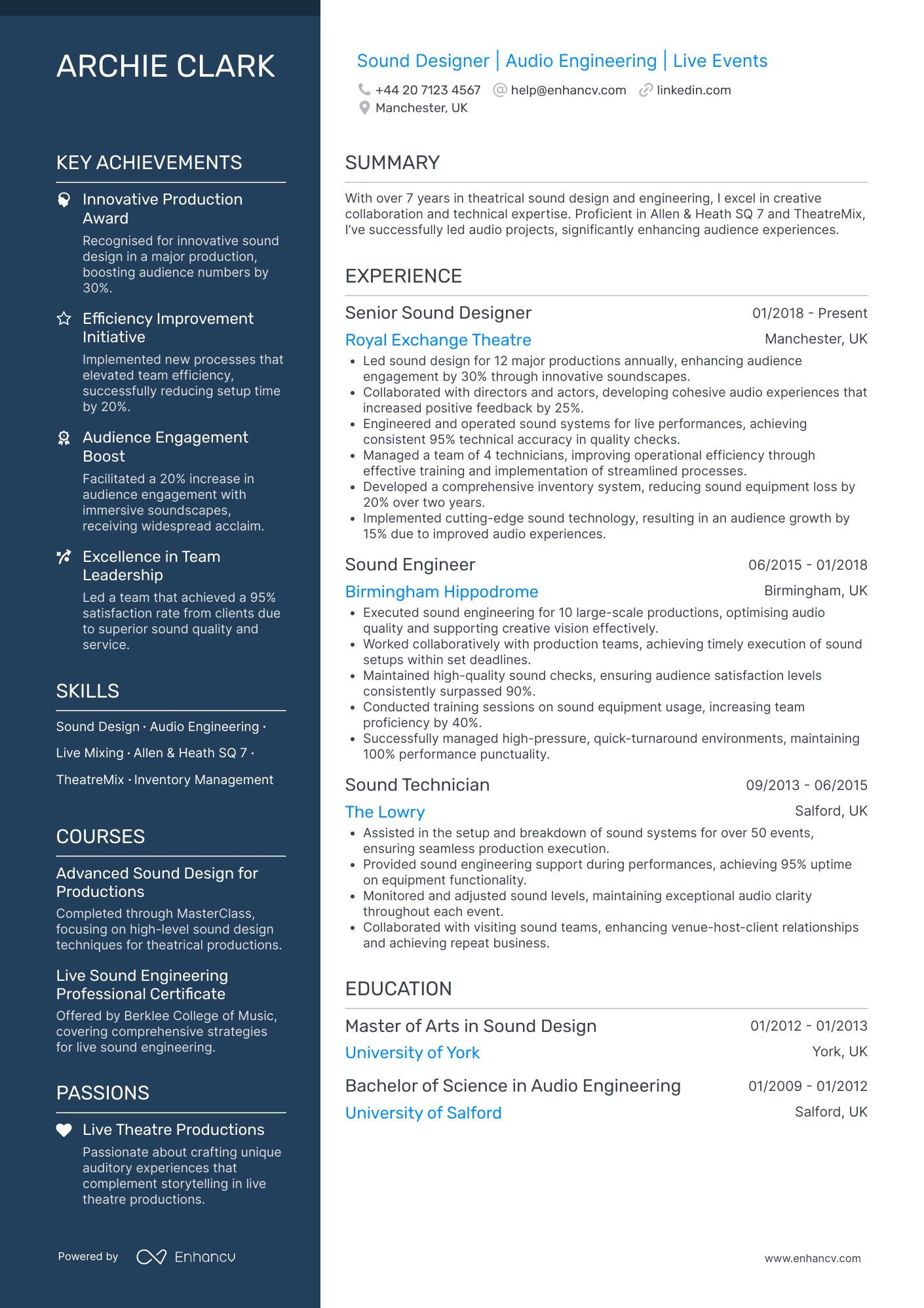
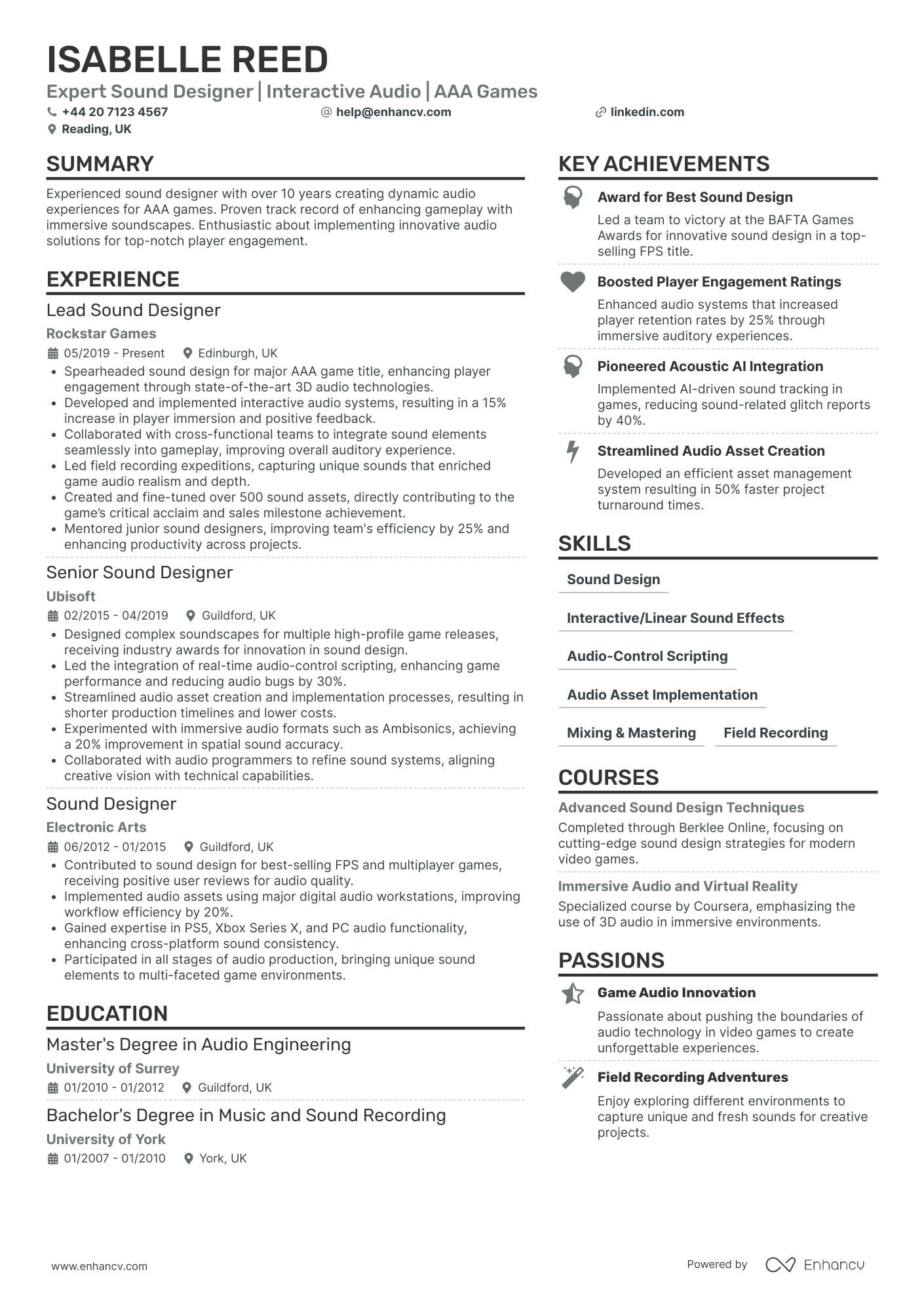
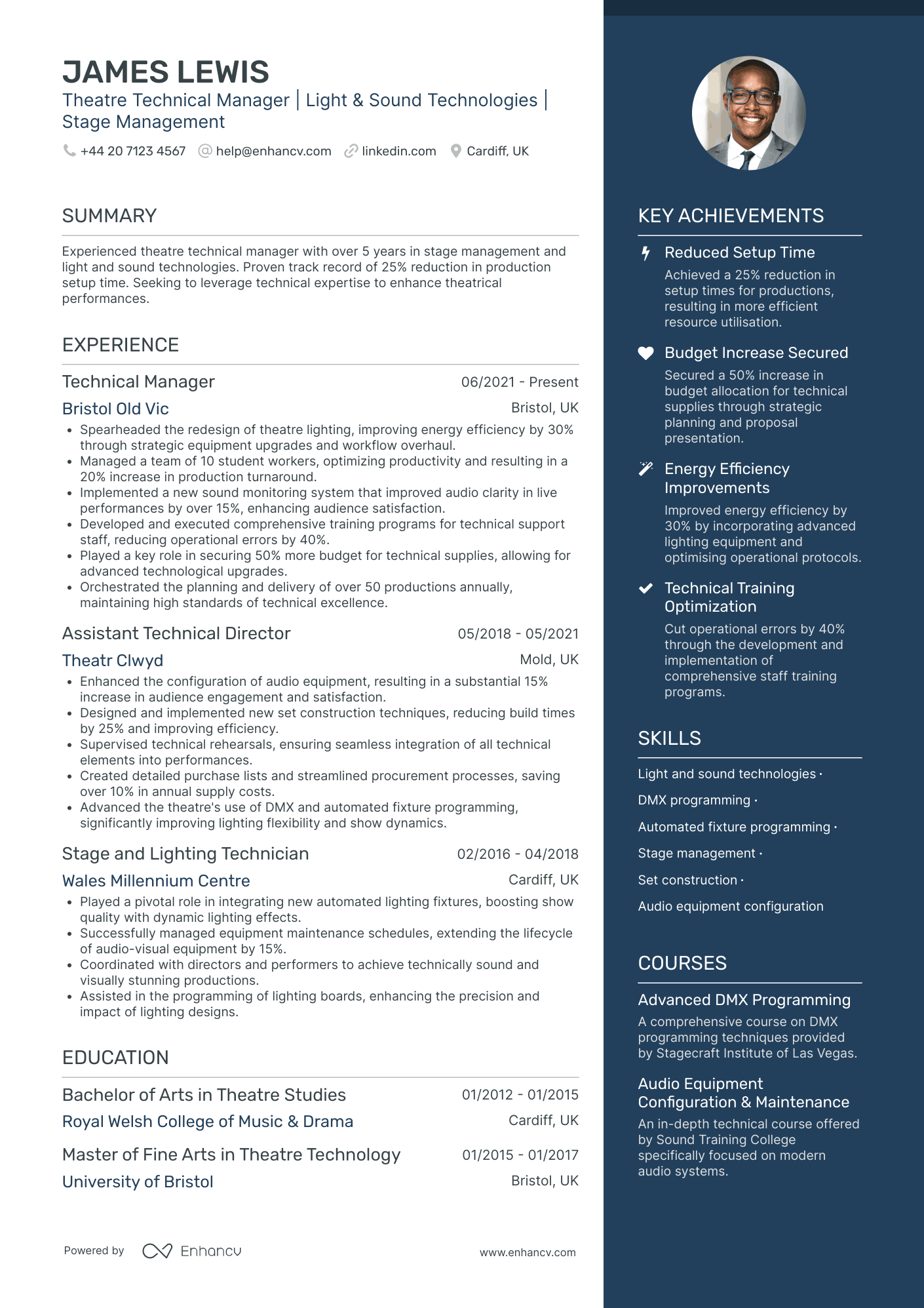
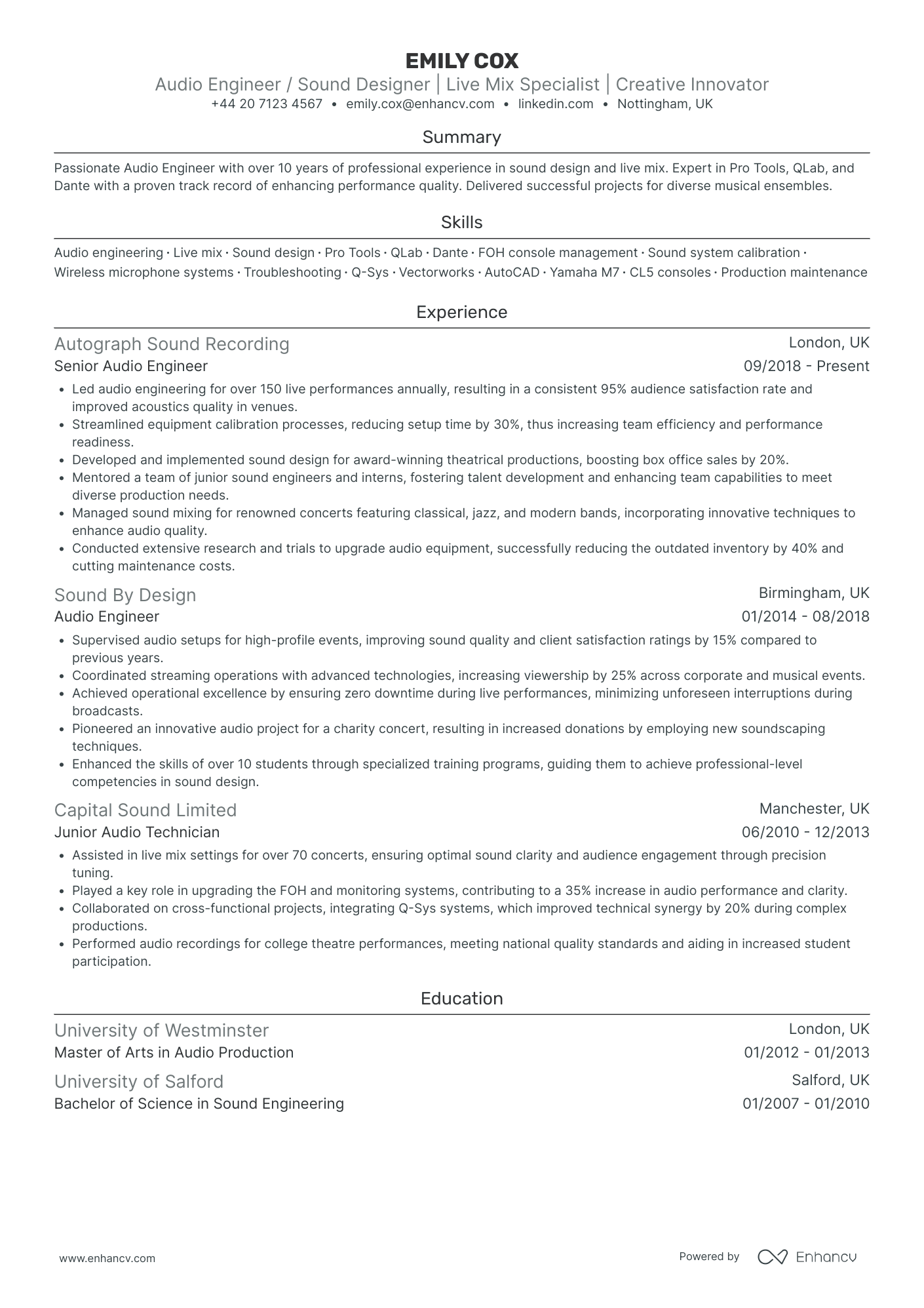
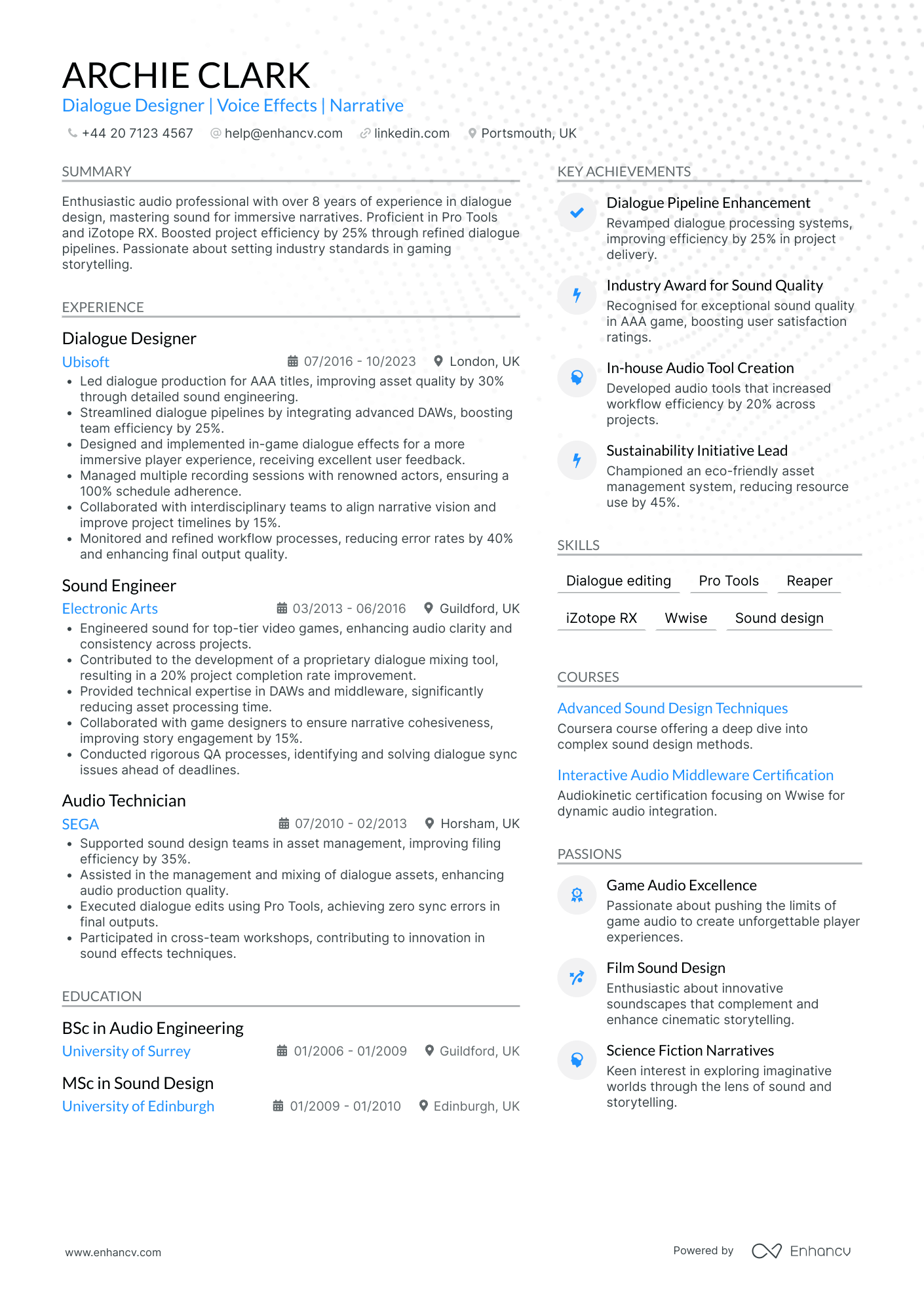
Most sound designer CVs read like a kit list with a name at the top. Rows of microphones, plugins, and a DAW, and not one thing a recruiter can actually hear.
The CVs that earn a callback do two things well. They point straight to a showreel that plays in one click, and they format so the credits, the tools, and that link all survive a ten-second skim and the tracking software behind it. If you want the fundamentals first, see how to write a CV.

Key takeaways
- Put a showreel link in the header. A sound designer CV a recruiter cannot listen to is half a CV.
- Send it as a PDF so the layout and the clickable links hold, and keep a Word copy for agencies.
- Two pages, reverse chronological, one column, standard headings. Credits skim fast.
- Name your DAW and the exact tools in the words the advert uses, from Pro Tools to Wwise.
- Quantify the work: minutes of finished audio, episodes, titles shipped, and turnaround.
- Write each credit like a job, with the production, your role, and the format.
Formatting your sound designer CV
Format is where most sound designer CVs win or lose the callback, so start here rather than with the wording.
Send a PDF for direct applications, so the layout and, more importantly, your clickable showreel link survive intact. Keep a Word copy for agencies and studios that reformat CVs into their own template, and if the advert names a file type, follow it exactly.
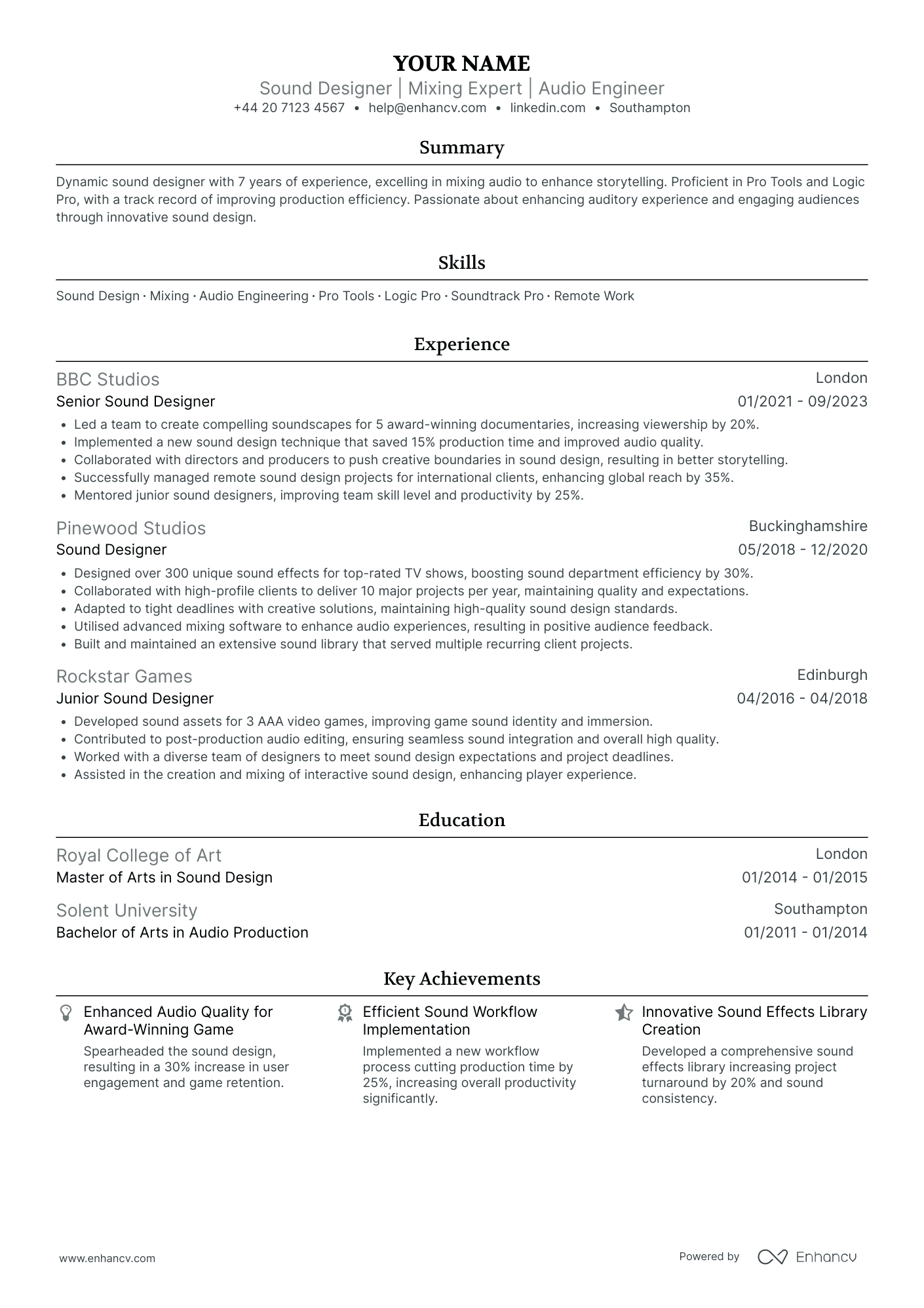
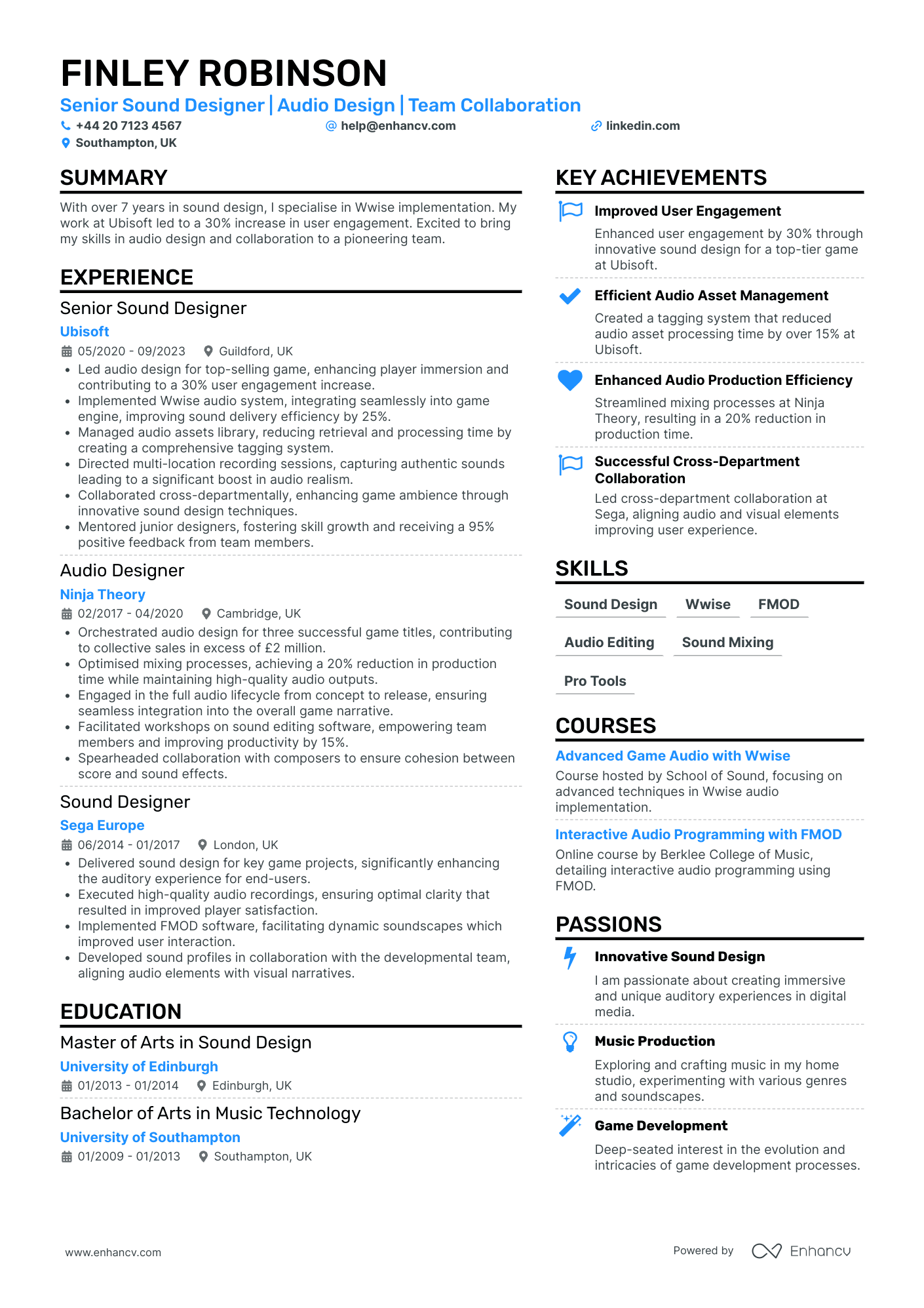
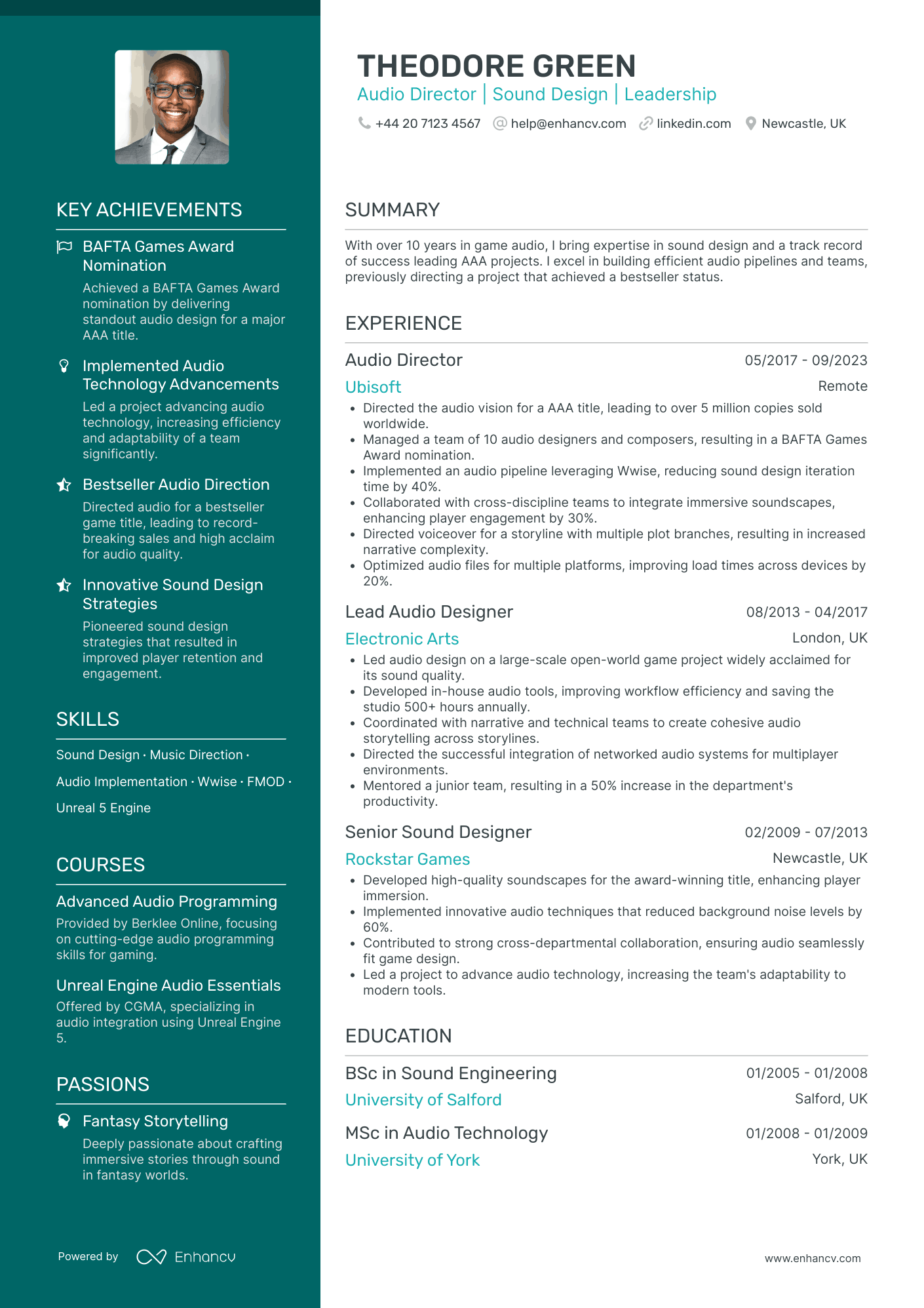
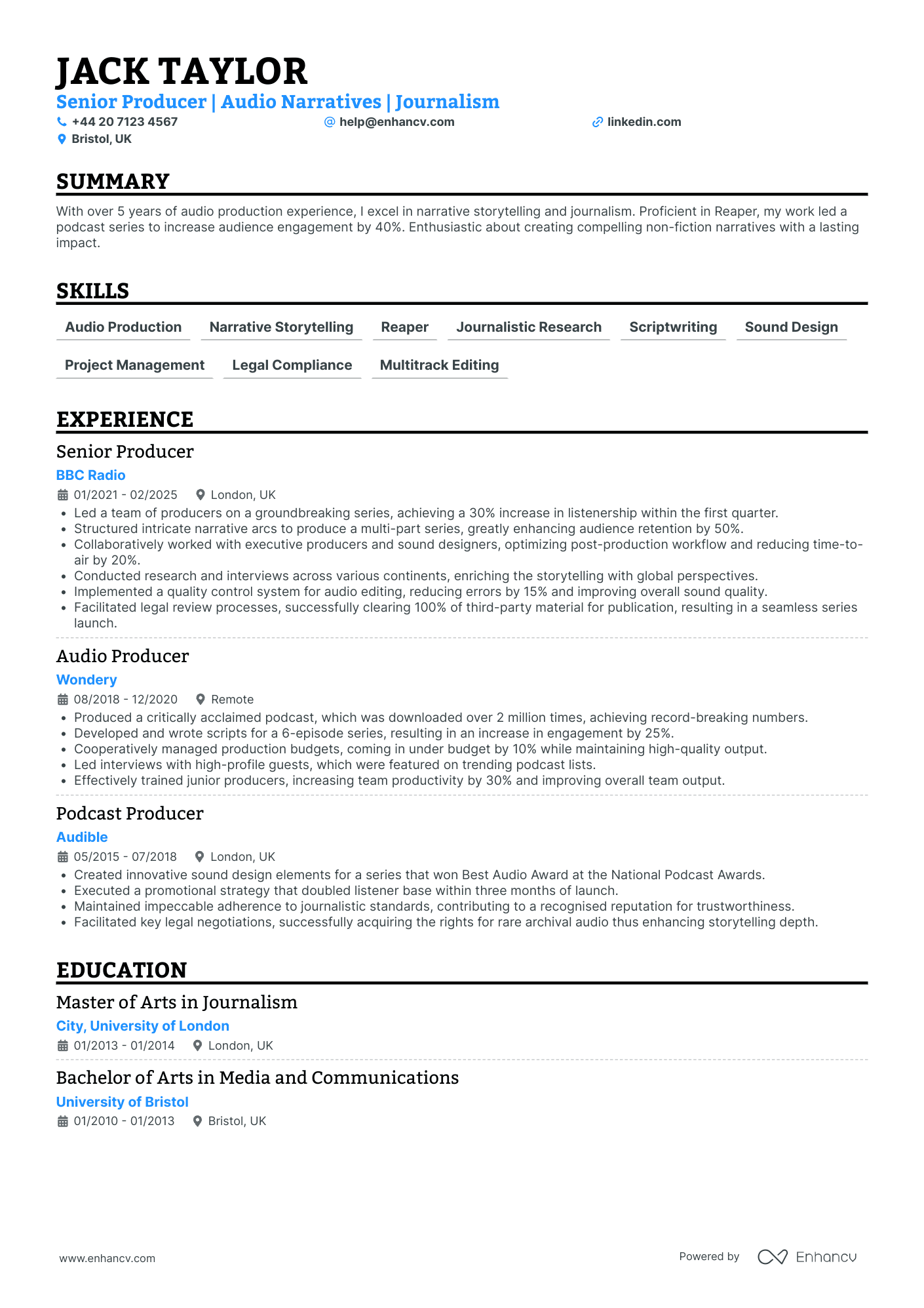
Keep it to two pages, or one if you are early in your career. Reverse chronological suits most sound designers, because recent credits and productions carry the CV, though a skills-led order can help if you are moving between formats.
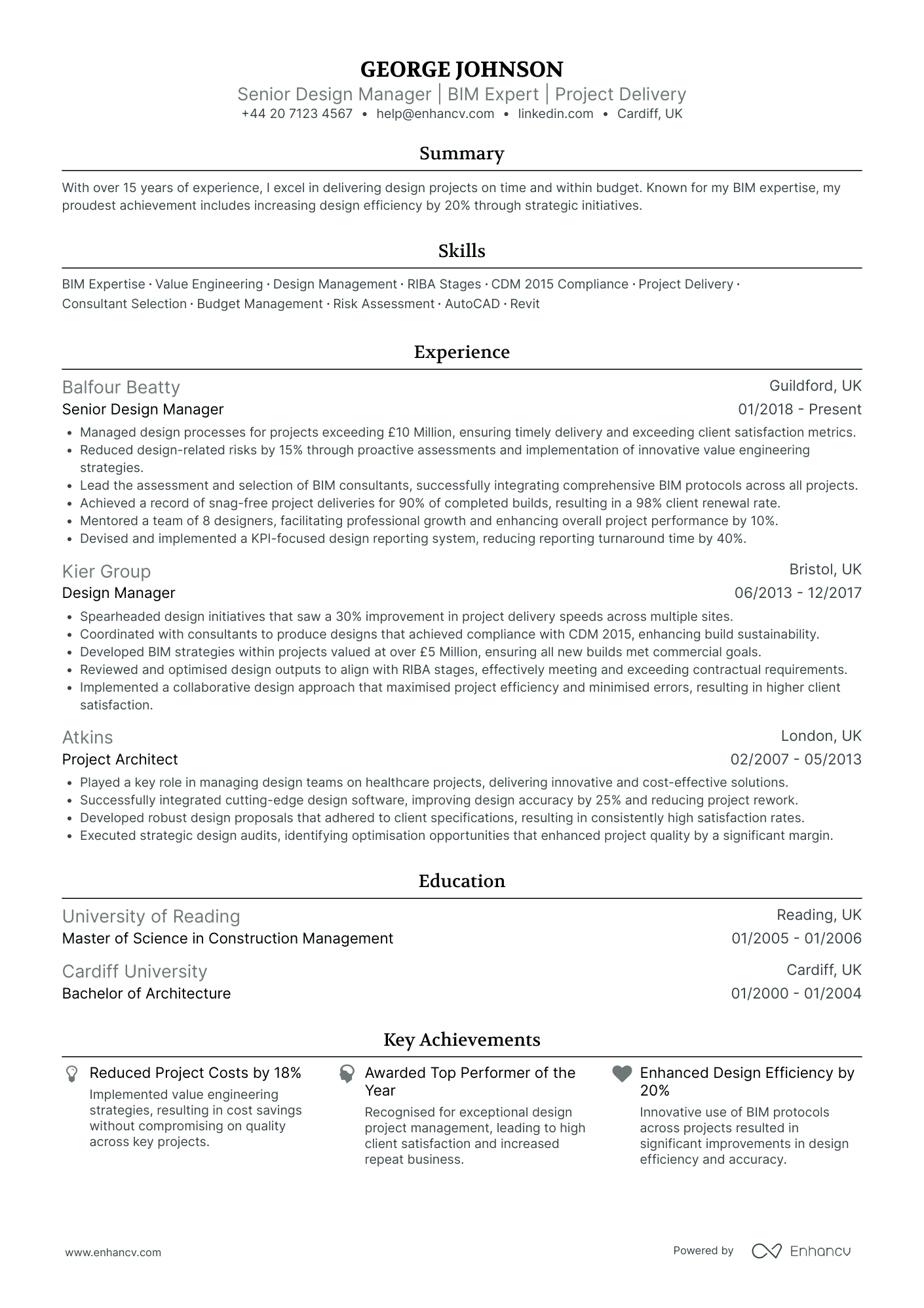
Use one column, standard headings, and a readable font. Studio recruiters and production coordinators skim between deadlines, so the structure needs to be obvious at a glance.
Name the sections in plain terms a recruiter and the tracking software both recognise, such as "Credits", "Experience", "Skills", and "Education". A clever heading like "Sonic journey" costs you a match when a parser is looking for the standard word.
Your header needs your name, the city you are based in or will relocate to, a professional email, and the showreel link. Skip the photo and the full postal address, because a UK CV header needs neither.
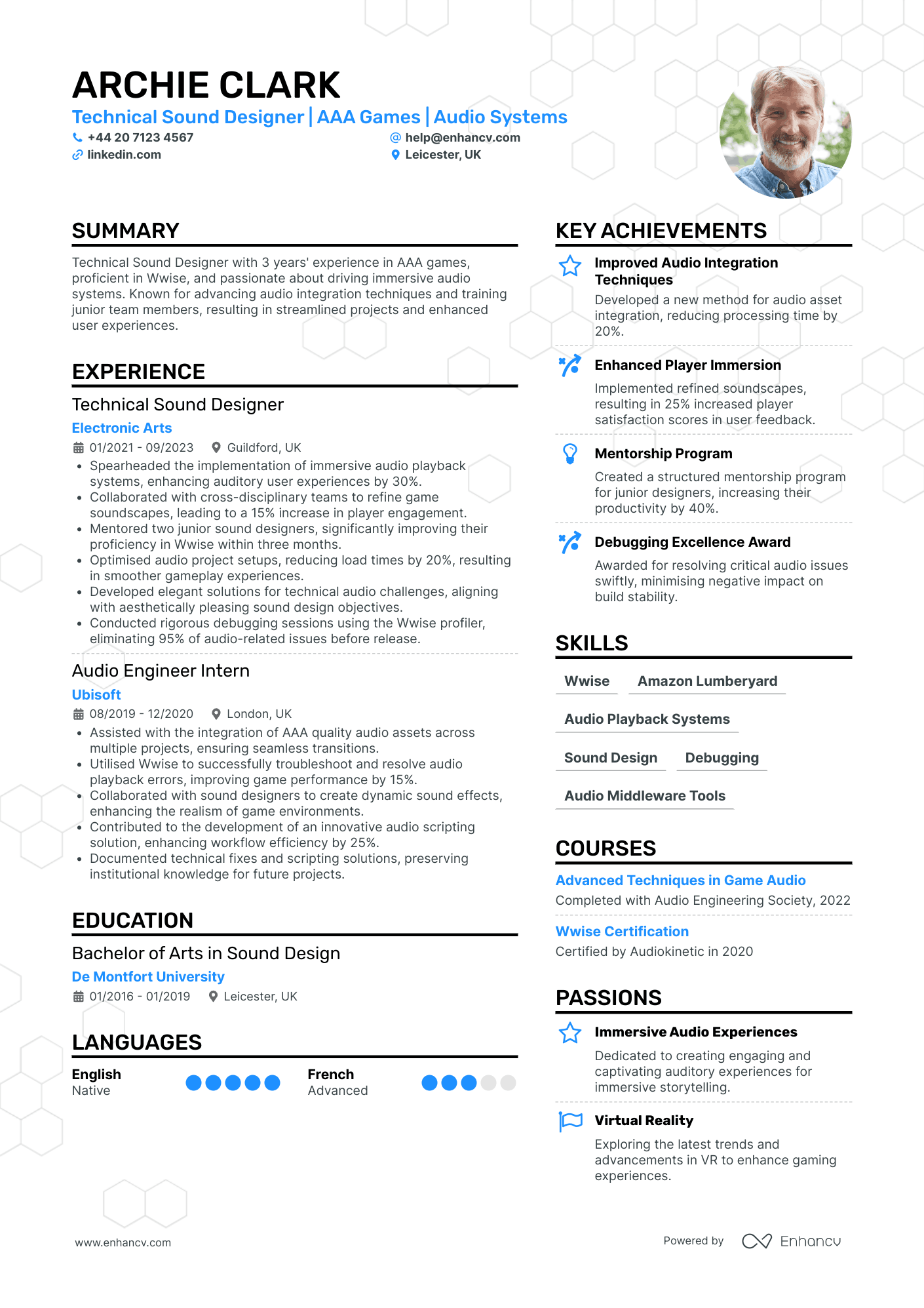
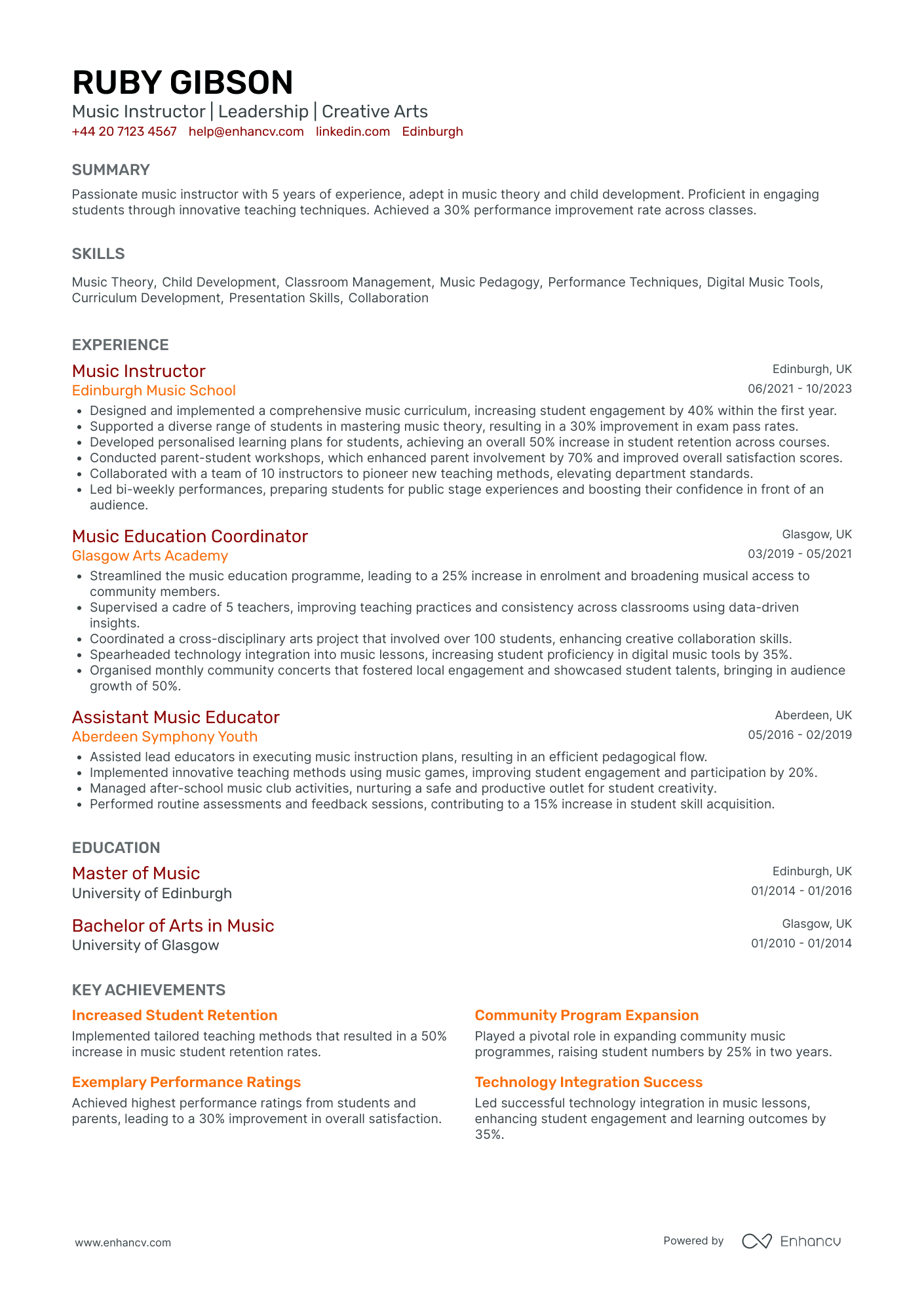
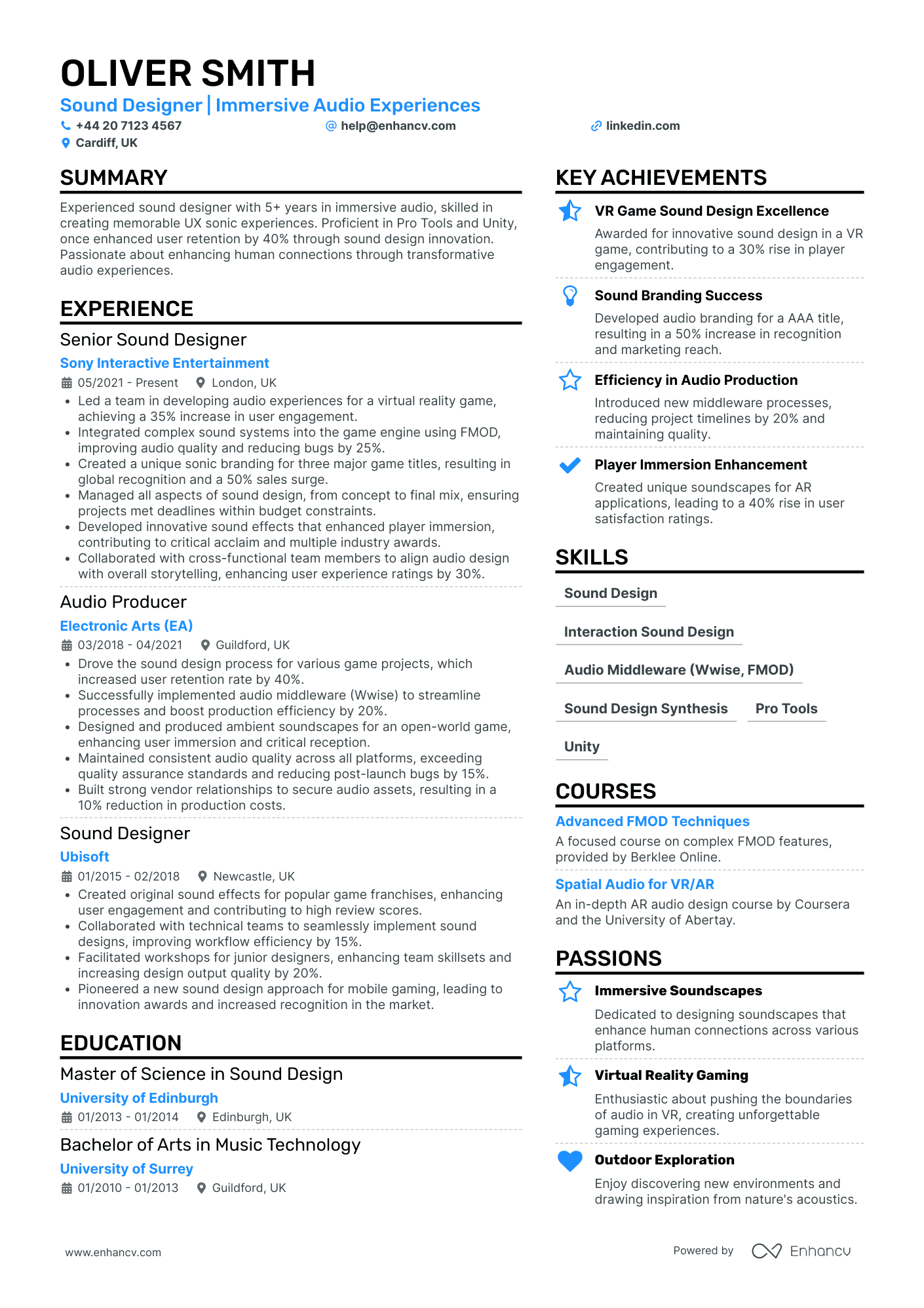
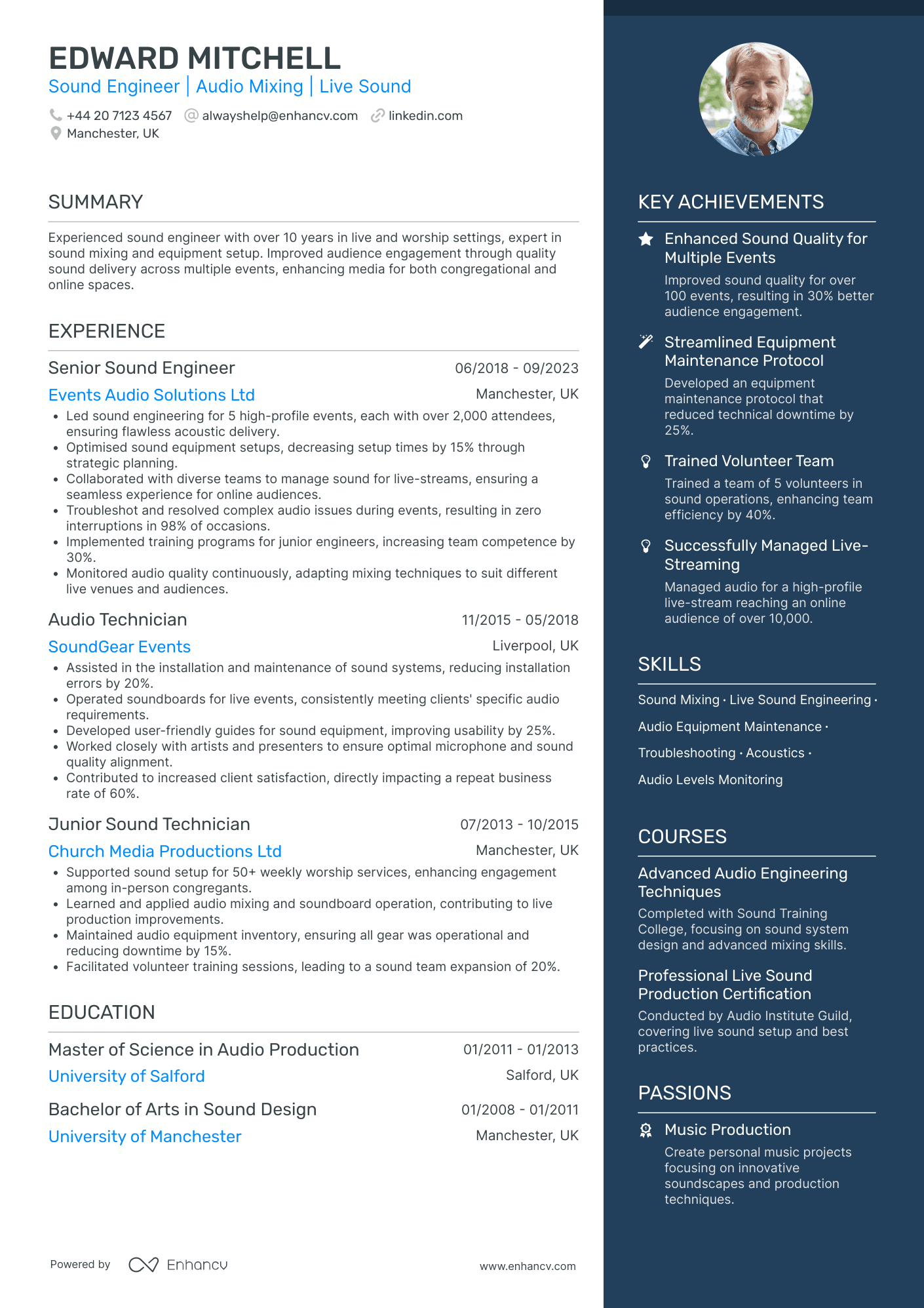
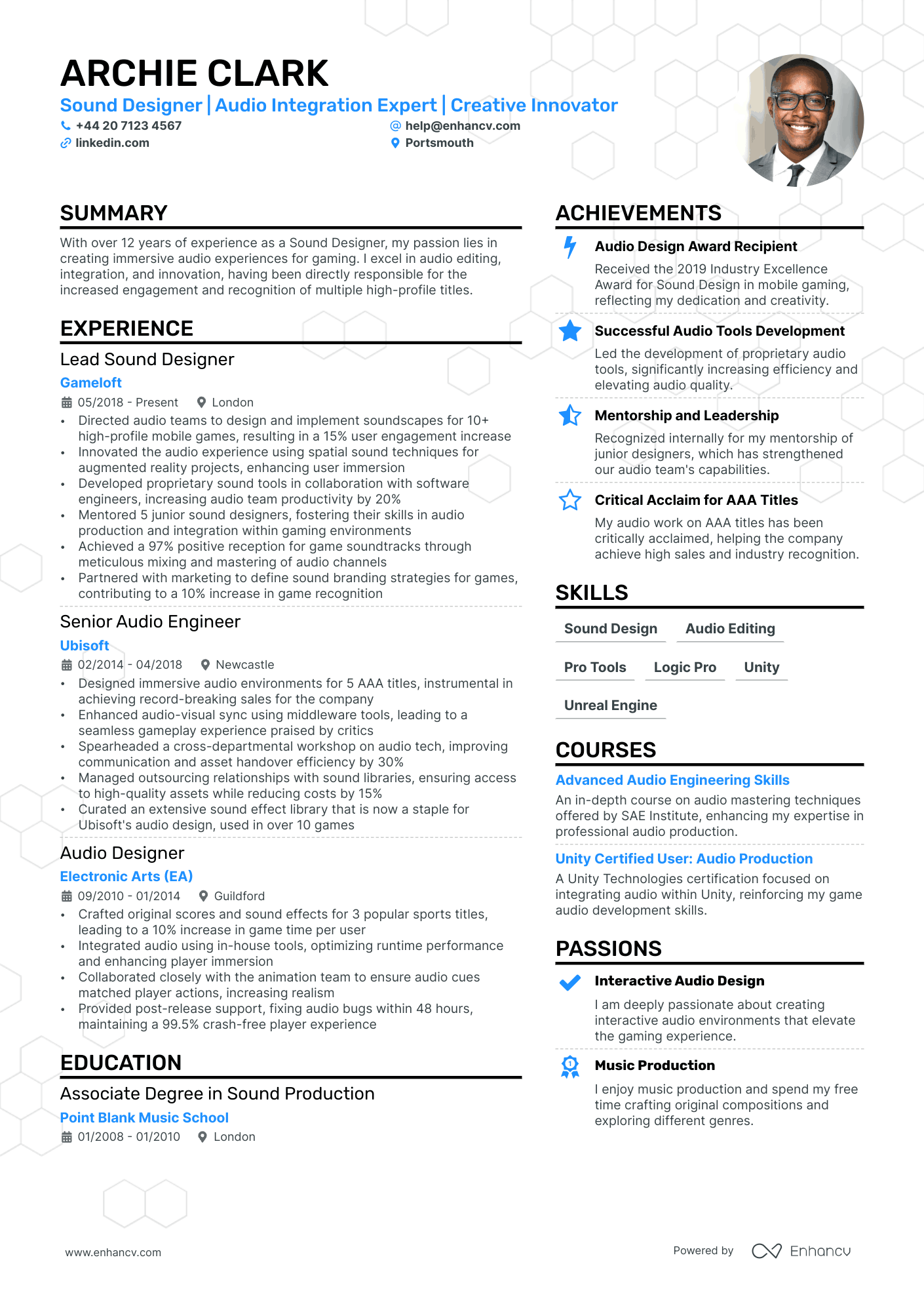
You work in a creative field, so a little visual personality is fine, but readability wins every time. One accent colour, clear headings, and generous white space beat a heavily designed page that a recruiter, or the tracking software, struggles to read.
Put your showreel or portfolio link in that header, not buried at the foot of page two. Make it both a live hyperlink and a plain-text URL, so it still works if someone prints the CV.
Sound design applications often pass through tracking software before a human sees them, so keep the layout clean and the headings standard for an ATS-friendly CV. Build it from a tested layout rather than a blank page. Enhancv's CV templates export to a clean PDF.
Keep one master CV with everything on it, then cut a shorter version for each application. A games studio and a factual production house want to see different credits first, and trimming is faster than starting over.
If you freelance, lead with a short selected-credits block at the top, then a fuller history below. It reads far better than one long run of every contract you have taken.

The running order for a sound designer CV
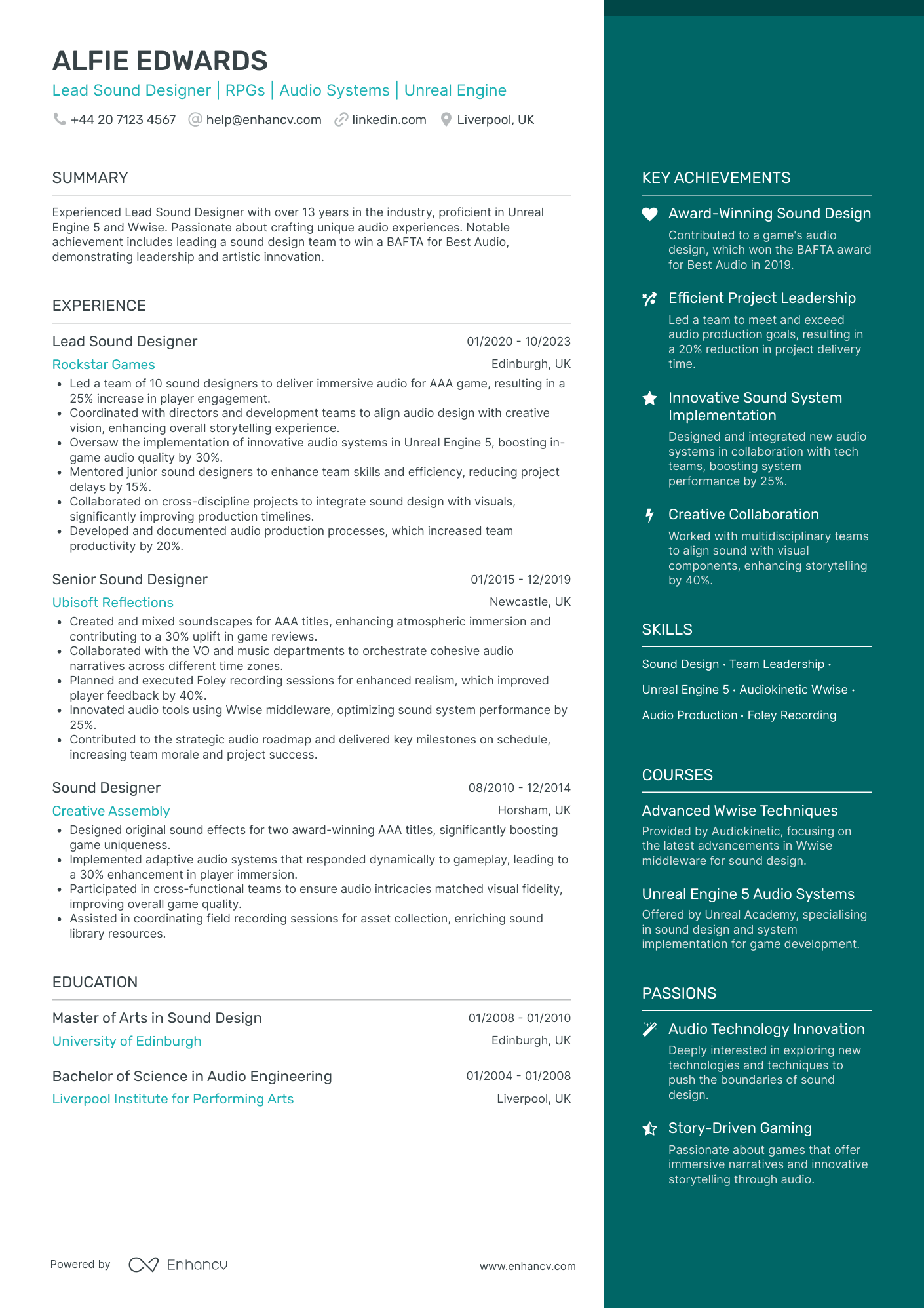
Header with your name, location, and showreel link. Then the personal statement, selected credits or key skills, your experience in reverse chronological order, education and certifications, and a short tools and software block. Keep to that spine, because a recruiter looking for your reel should never have to hunt for it.

PRO TIP
Name the file Firstname-Lastname-Sound-Designer-CV.pdf, and test every link on a phone before you send it. A dead showreel link is the quickest way to lose a callback you had already earned.
Linking your showreel and portfolio
Your showreel is the single most important thing on a sound designer CV. Lead the reader to it in one click, and make pressing play effortless.
Host it where it plays instantly, on a personal site, Vimeo, or SoundCloud. Avoid anything that needs a login or a download before a recruiter can hear a second of your work.
Label each piece with the format, your exact role, the tools, and what you owned, whether that was the dialogue edit, the Foley, or the full mix. A recruiter should know what they are about to hear before they press play.
Keep the reel short and front-load your best sixty seconds. Match it to the job, so lead with game audio for a games studio and with dialogue and Foley for film and factual work.
Back the reel with a simple portfolio or credits page if you have one. A single link that opens onto a clean list of work, each with the format, the studio, and your role, does more than three scattered profiles a recruiter has to piece together.
For audio-only disciplines, a short SoundCloud set works as well as video. What matters is that the recruiter can hear the difference you made, so include before-and-after clips where the brief allows it.
On the CV itself, reference specific pieces next to the relevant credit rather than dumping every link at the bottom. The closer the proof sits to the claim, the harder it lands.
Writing your sound designer personal statement
Three or four sentences at the top: who you are, the formats you work in, your signature tools, and one concrete credit or result. Keep it specific. See more personal statement examples if the opening line is not coming.
Skip the adjective soup. "Passionate, creative sound designer with great attention to detail" tells a recruiter nothing they can check.
Lead with evidence instead:
Sound designer personal statement example (mid-level)
Sound designer with six years across factual TV and indie games, working mainly in Pro Tools and Wwise. Designed and mixed audio for two award-nominated documentaries, and shipped full sound for a Steam title that reached 40,000 players. Comfortable owning a project from location recording to final mix, on deadline. Looking to bring dialogue and Foley craft to a post-production studio in London. Showreel linked above.
What to avoid
Passionate and creative sound designer with excellent attention to detail and a strong work ethic. Skilled in a wide range of audio software and always willing to learn. Seeking a challenging role in a dynamic company where I can grow and develop my skills.
Read those two side by side. The first names tools, formats, credits, and a number, and it points to a reel. The second could belong to any applicant in any field, which is exactly why it gets skimmed past.
Match the statement to the studio in front of you. A games employer wants Wwise and implementation up front, while a factual house wants dialogue, location sound, and turnaround. The same career reads differently depending on which two facts you lead with.
When we read a sound designer CV, the first thing we look for is a link that plays. Tell us the format, your role, and the tools, then let us hear sixty seconds of your best work. A named credit and a working showreel beat any list of adjectives, and they beat a wall of plugin names too. Format the CV so that link is the first thing a recruiter can click, not the last thing they scroll to.
Writing your sound designer experience section
Write each credit like a job: the production or client, your role, the format, and the dates. Lead every bullet with a verb. For the mechanics, see work experience on a CV and these action verbs.
Sound work is measurable even when it feels purely creative. Minutes of finished audio, episodes cut, titles shipped, turnaround, and budget are all CV achievements.
Lead each bullet with what you did and finish with what changed. "Rebuilt the ambient bed for a 40-minute episode, halving the mix notes that came back from the director" tells a recruiter more than "responsible for sound design" ever will.
If a project is under a non-disclosure agreement, describe the scope and the result without naming the title. "Full sound for an unreleased AAA game" still carries weight.
Order credits so the strongest and most recent sit at the top. A freelancer with a long list can split it into a short "Selected credits" block followed by a fuller history, which keeps the first page working hard.
Show the range of the audio chain you can own. One bullet on capture, one on edit or design, and one on the final mix tells a recruiter you can carry a project end to end rather than just one stage of it.
Tailor each application. Pull the tools and formats from the advert and mirror the ones you have genuinely used. Enhancv's CV tailoring feature reads the ad and suggests the matching edits, which saves rewriting the whole thing for every studio, and you can find the manual version in how to tailor your CV.
- Designed, edited, and mixed dialogue, Foley, and effects for 14 short films and two indie games, delivering over 30 hours of finished audio
- Recorded location and studio sound for a six-part factual series, cutting audio pickups on reshoots by a third through cleaner on-set capture
- Built and implemented interactive audio in Wwise for a mobile title that reached 40,000 downloads in its first month
- Ran the full post chain in Pro Tools to broadcast loudness standards, delivering every episode on or before deadline
Skills for your sound designer CV
Name your DAW and the exact tools in the words the advert uses. A recruiter scanning for Pro Tools, Wwise, or FMOD wants to see those words, not "industry-standard software".
Split the technical craft from the way you work. Your hard skills are the tools and disciplines, and your soft skills are collaboration, storytelling, and hitting deadlines under pressure.
Group the hard skills so a recruiter can read them fast: recording, editing, sound design, mixing, and game-audio implementation. It shows the range of the chain you can cover.
Keep a short, separate tools and software block for the specifics, such as Pro Tools, Reaper, Wwise, FMOD, and your plugin suites. That way the skills section stays about what you can do, and the software list answers the recruiter scanning for a named DAW.
List only what you can stand behind and point to in the reel or a credit. A skill a recruiter can hear is worth ten a recruiter has to take on trust.
Top skills for your sound designer CV:
Pro Tools
Field and location recording
Foley
Dialogue editing
Sound effects (SFX) design
Mixing and mastering
Wwise and FMOD (game audio)
Audio post-production
Collaboration
Creative storytelling
Attention to detail
Communication
Working to deadline
Building a sound designer CV with few credits
Nobody starts with a reel that sings. You build one from the work you can do right now, and the CV follows.
Student films, game jams, podcasts, and local theatre all count as credits. Offer to sound-design a friend's short or a drama-society production, and give each one a dated entry like any other job. These first job CV examples show the shape.
Redesign the audio for an existing scene or trailer as a spec piece, and label it clearly as a redesign so no one mistakes it for a shipped credit. It proves the craft without inventing a job.
Say yes to runner, assistant, and studio-junior roles, and log the sessions you sat in on. Time on a real set or in a mix room, even watching, is worth naming while your own credits build.
When paid work is thin, a skills-led structure lets your tools and projects come before a short history. A focused two-minute reel of real work beats an empty CV that lists ten plugins.
Education and training for a sound designer CV
You rarely need a specific degree to work in sound. A recruiter cares far more about the reel than the certificate, so keep this section short.
If you hold a relevant degree or diploma in sound design, music technology, or audio engineering, list it with the classification. See education on a CV for the format.
Name software certifications where you hold them, such as an Avid Pro Tools certification or a Wwise certification. Put shorter workshops and courses in a dedicated training block so they do not crowd the credits that matter more.
Conclusion
Lead with a showreel that plays, format so it survives a skim and the tracking software, and write credits that name the format, the tools, and the result. Everything else on the page exists to get a recruiter to that link.
Pair the CV with a short cover letter that points to one piece of work you are proud of, and you give a studio every reason to press play.
Author's take - the Enhancv team
When we read a sound designer CV, the first thing we look for is a link that plays. Tell us the format, your role, and the tools, then let us hear sixty seconds of your best work. A named credit and a working showreel beat any list of adjectives, and they beat a wall of plugin names too. Format the CV so that link is the first thing a recruiter can click, not the last thing they scroll to.