



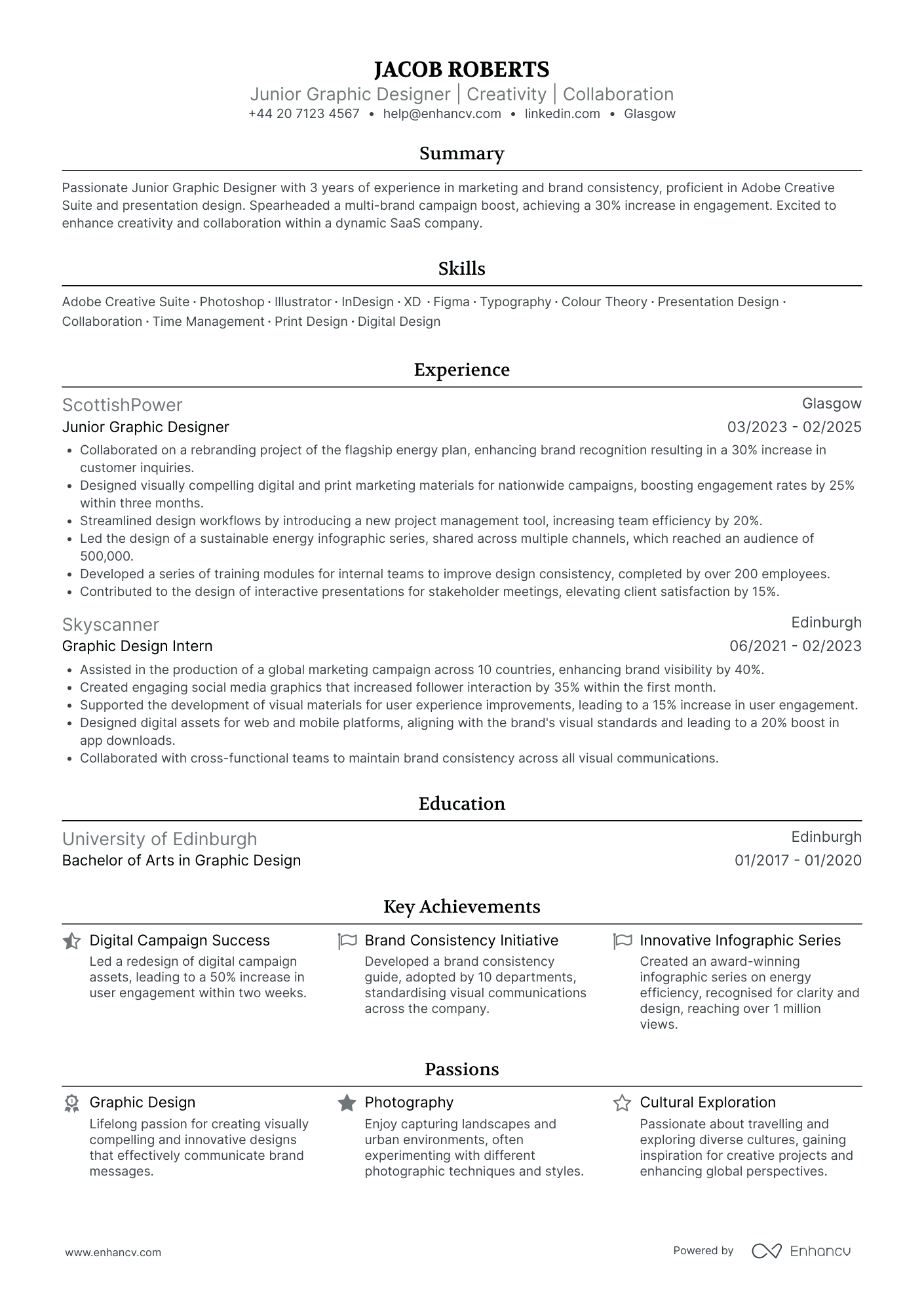
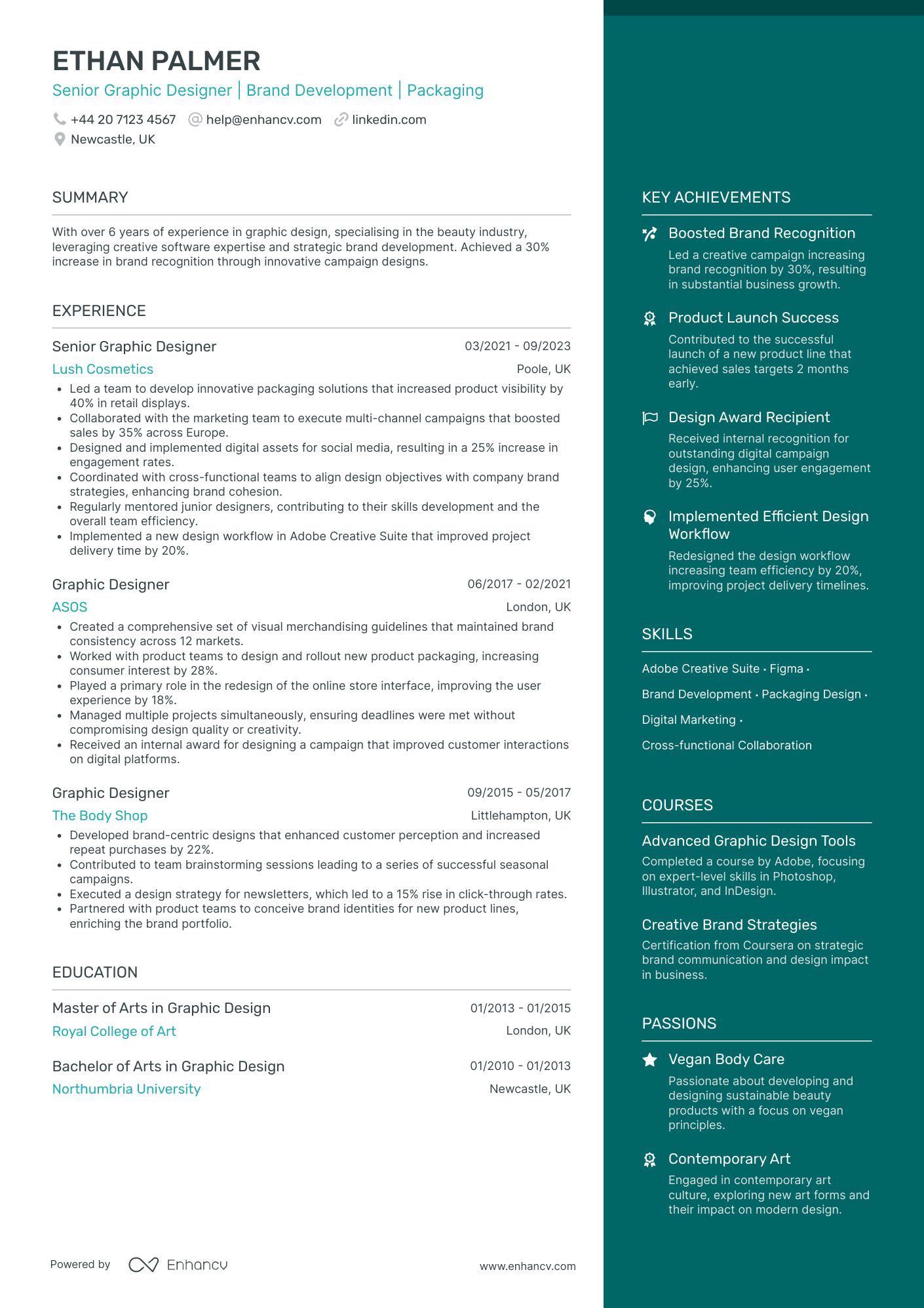
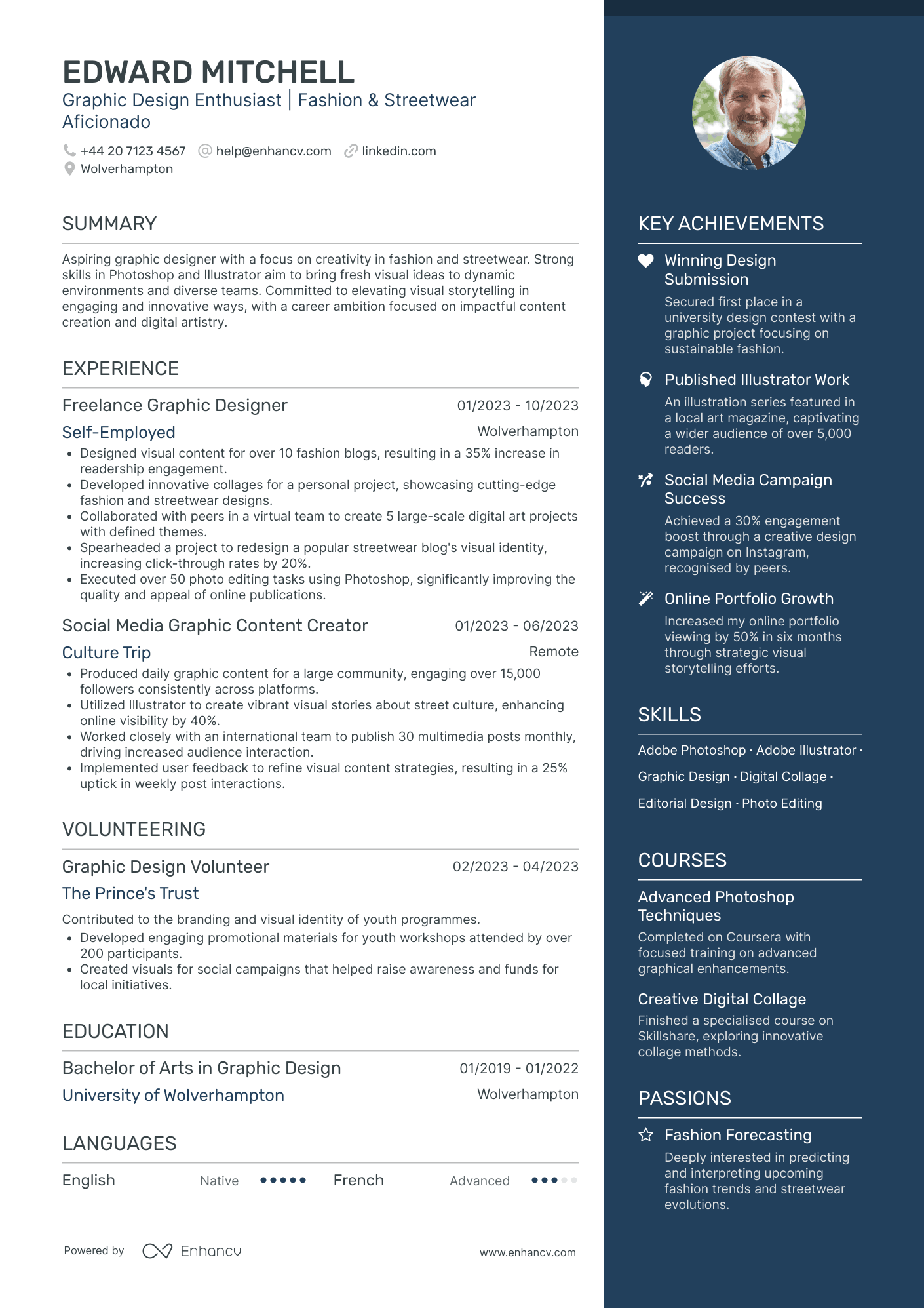
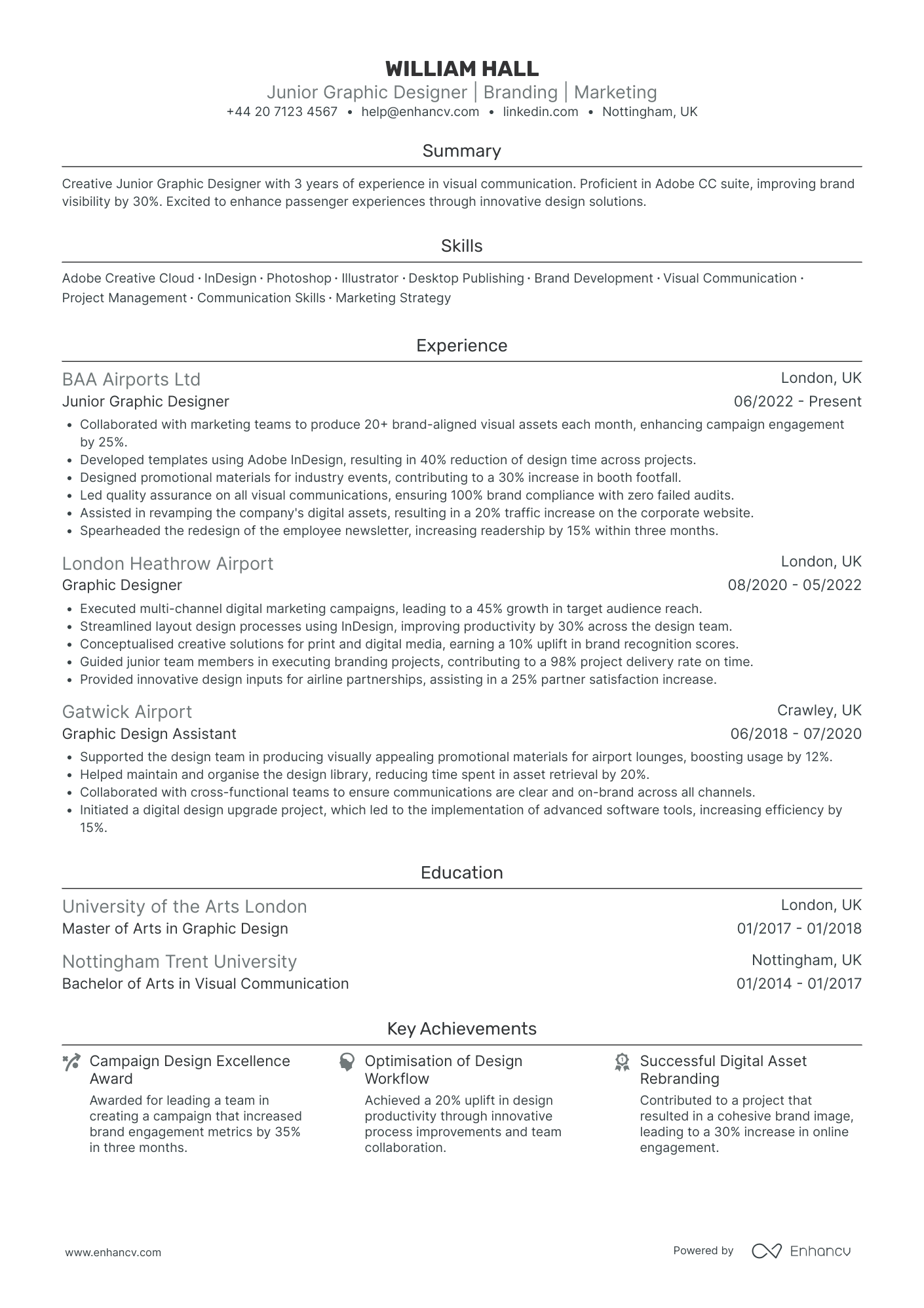
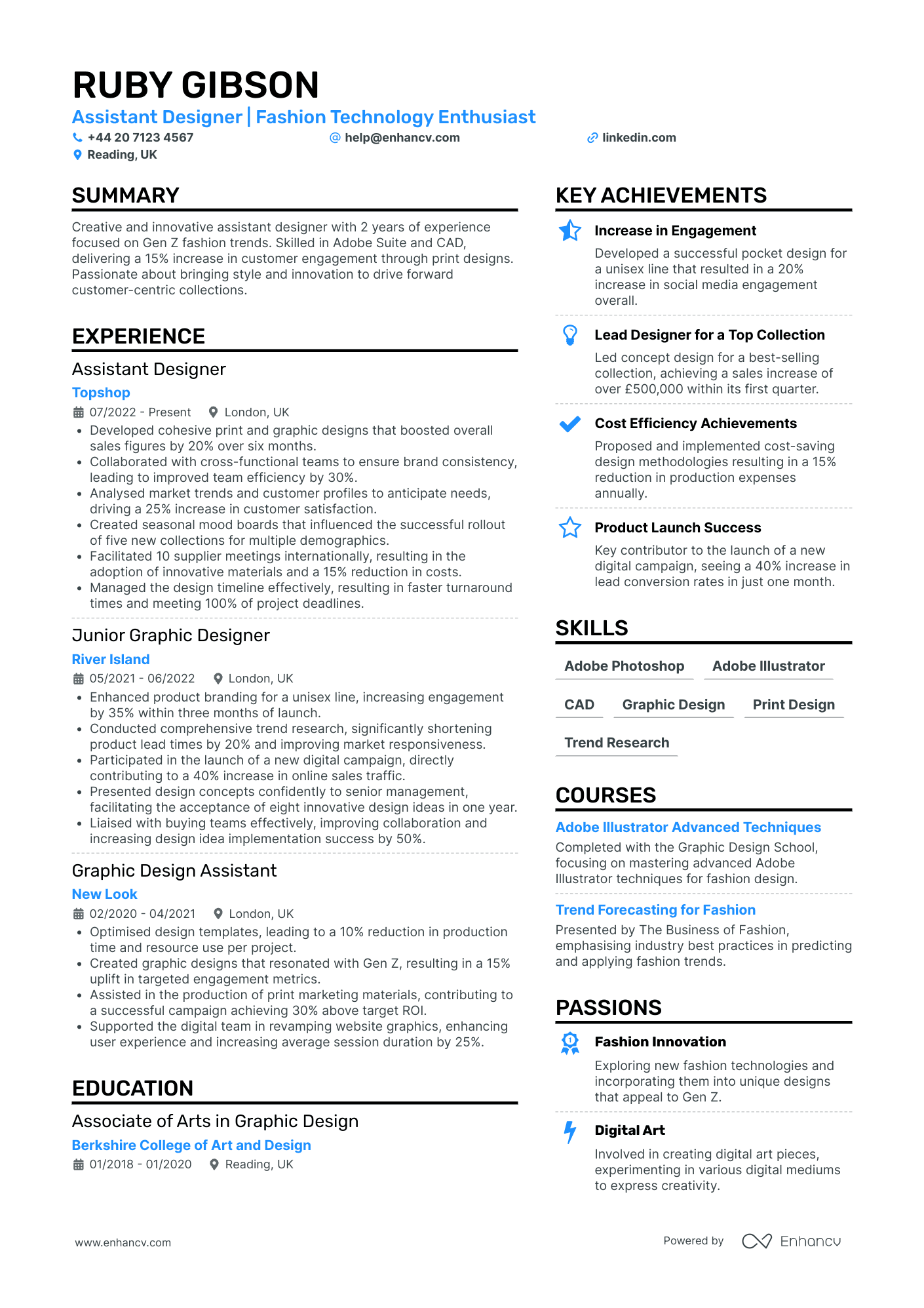
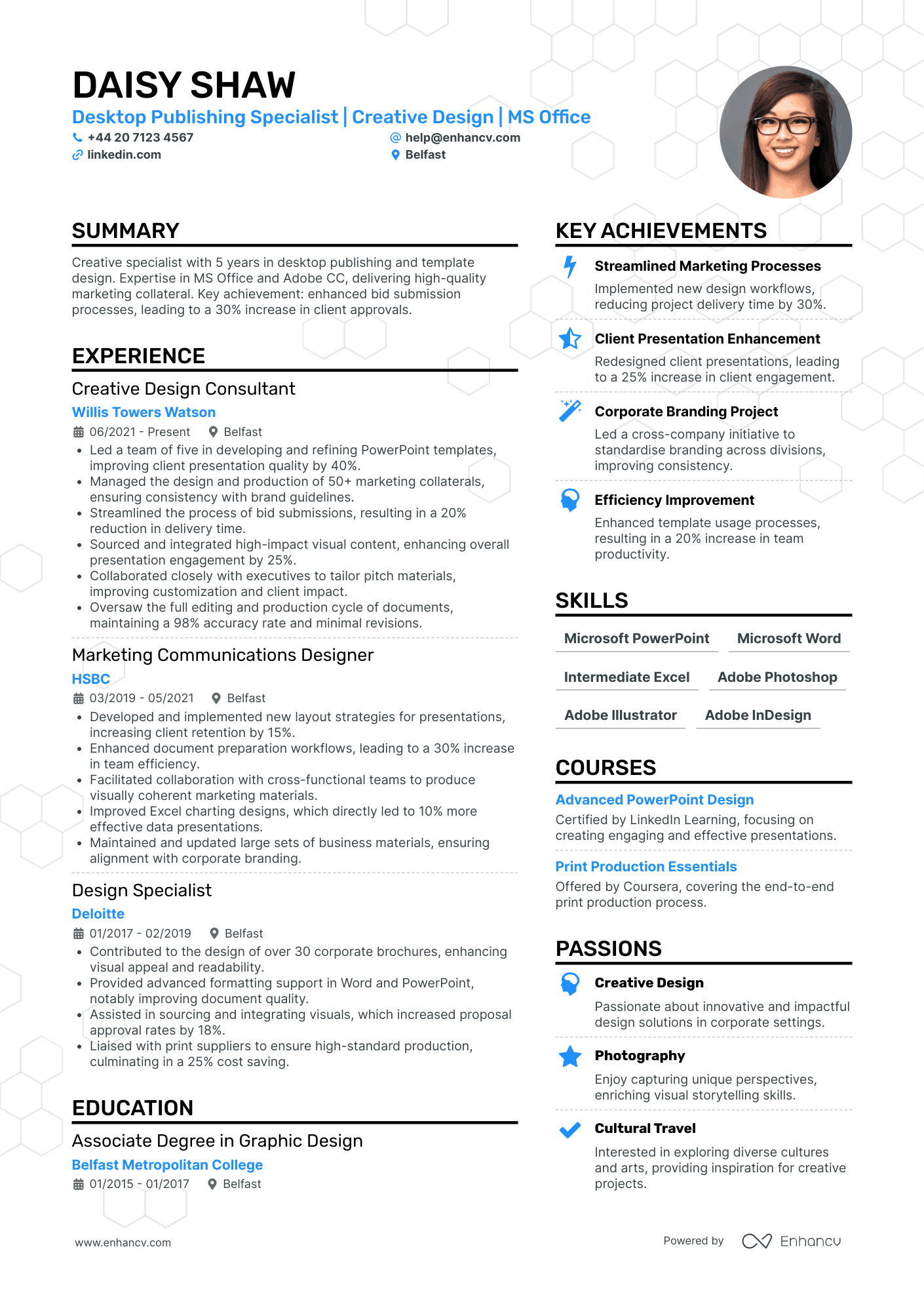
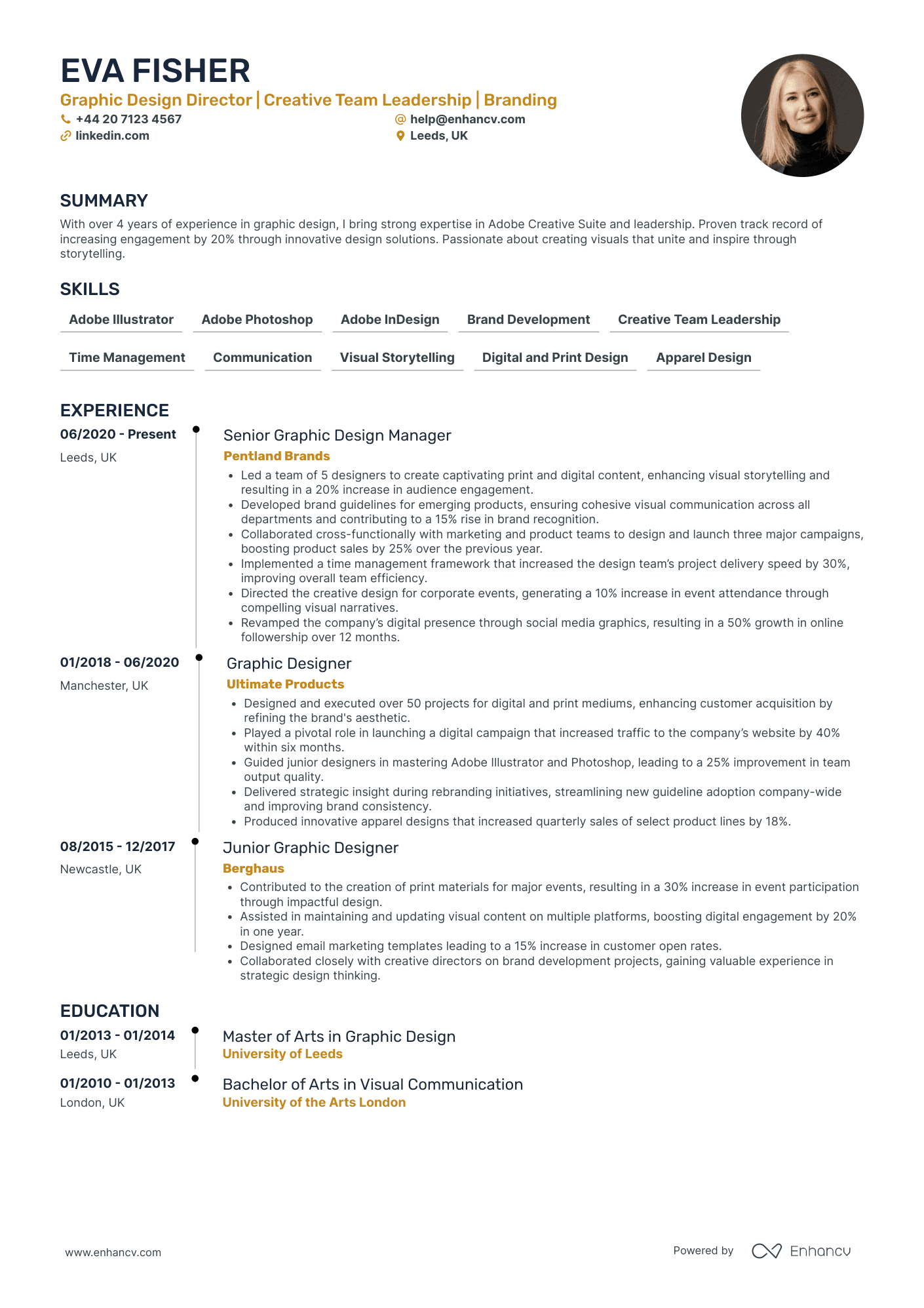
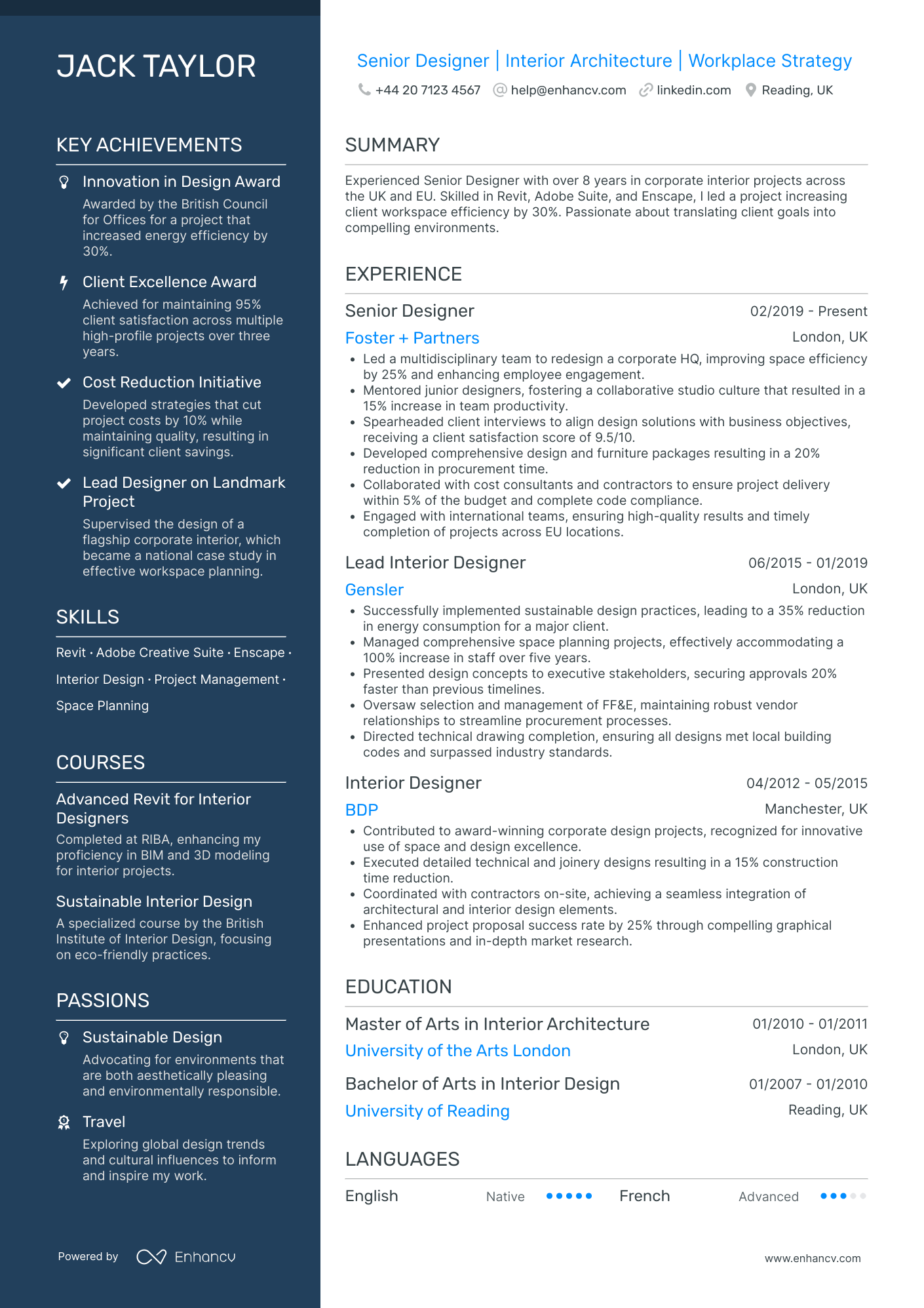
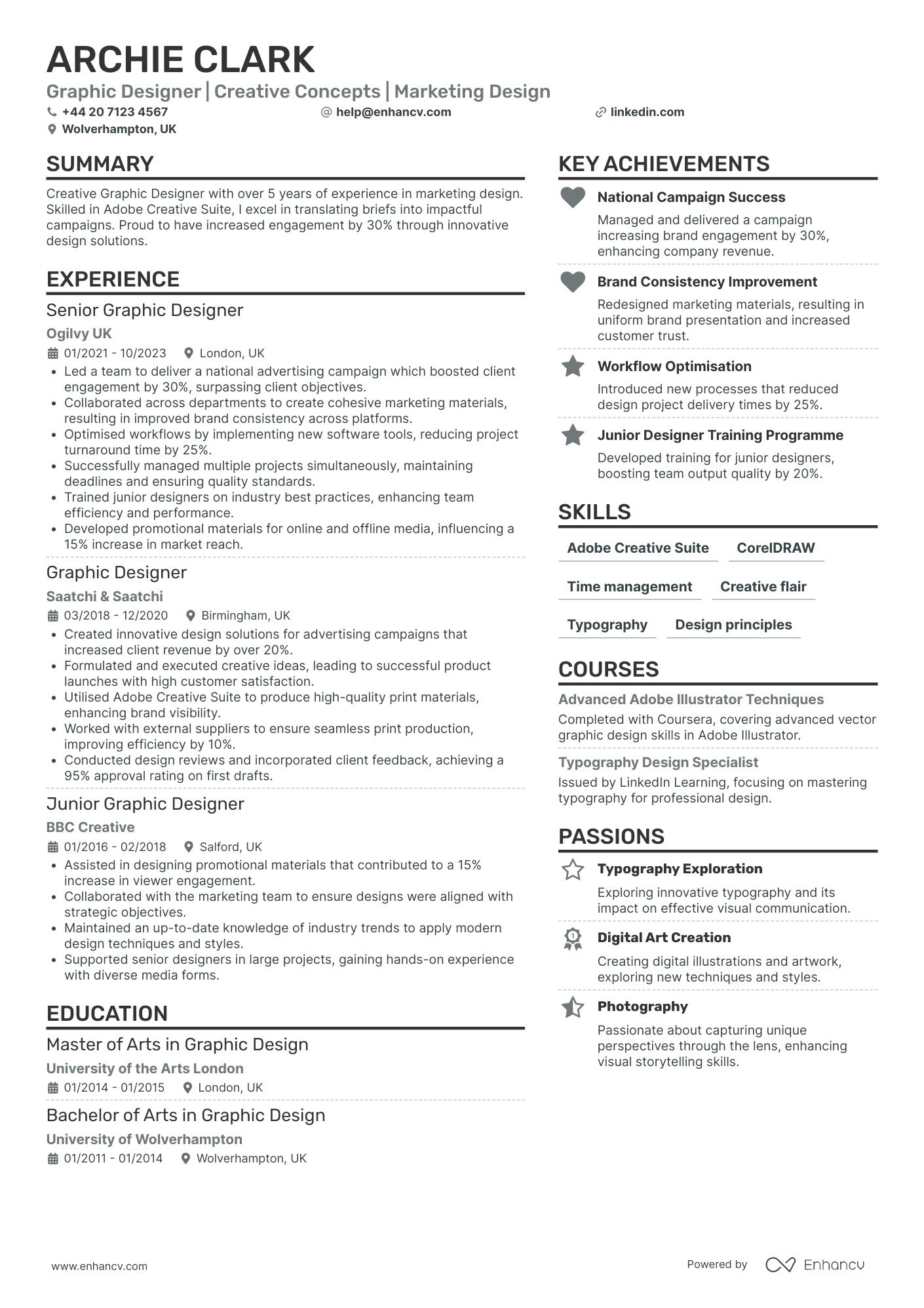
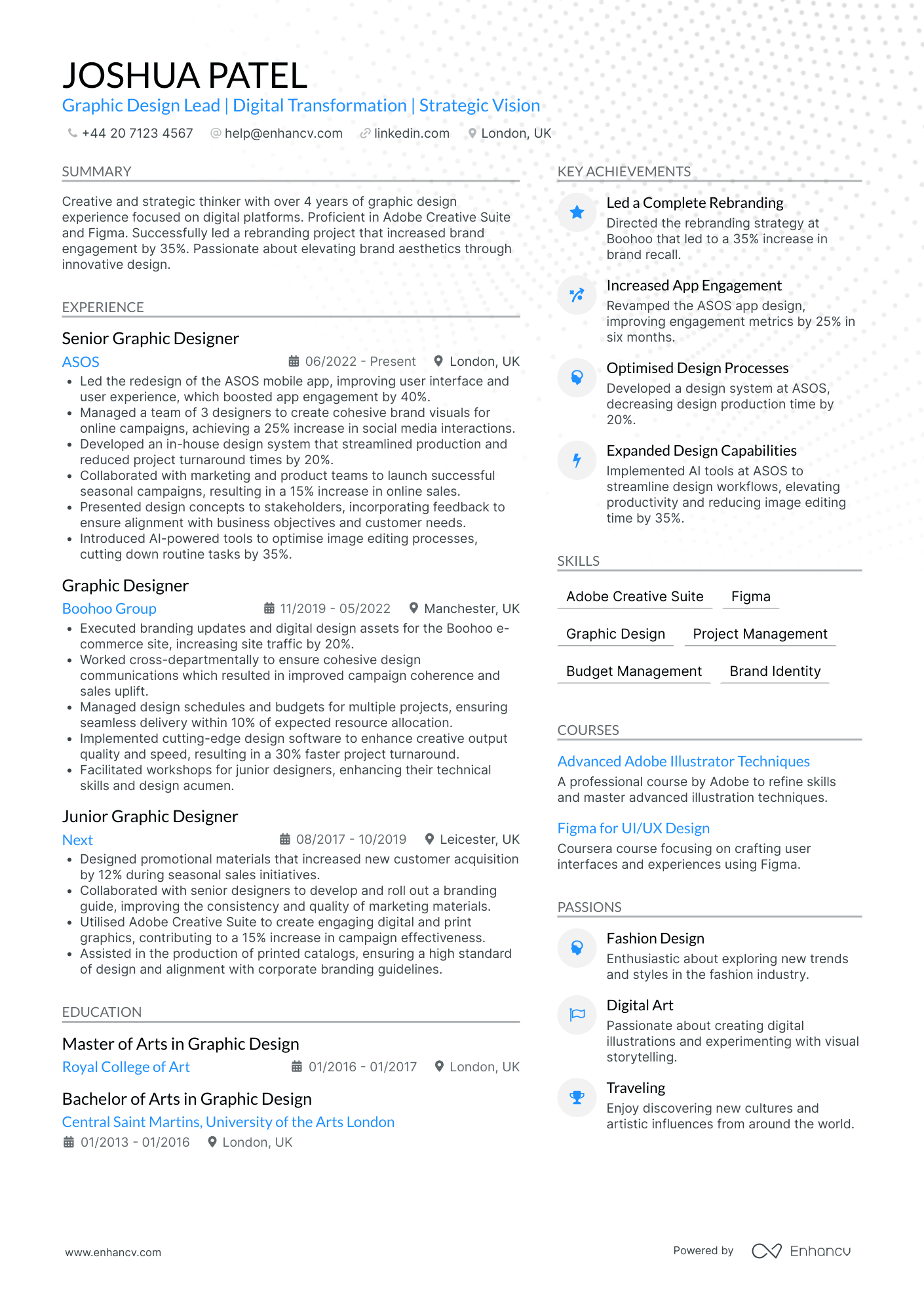
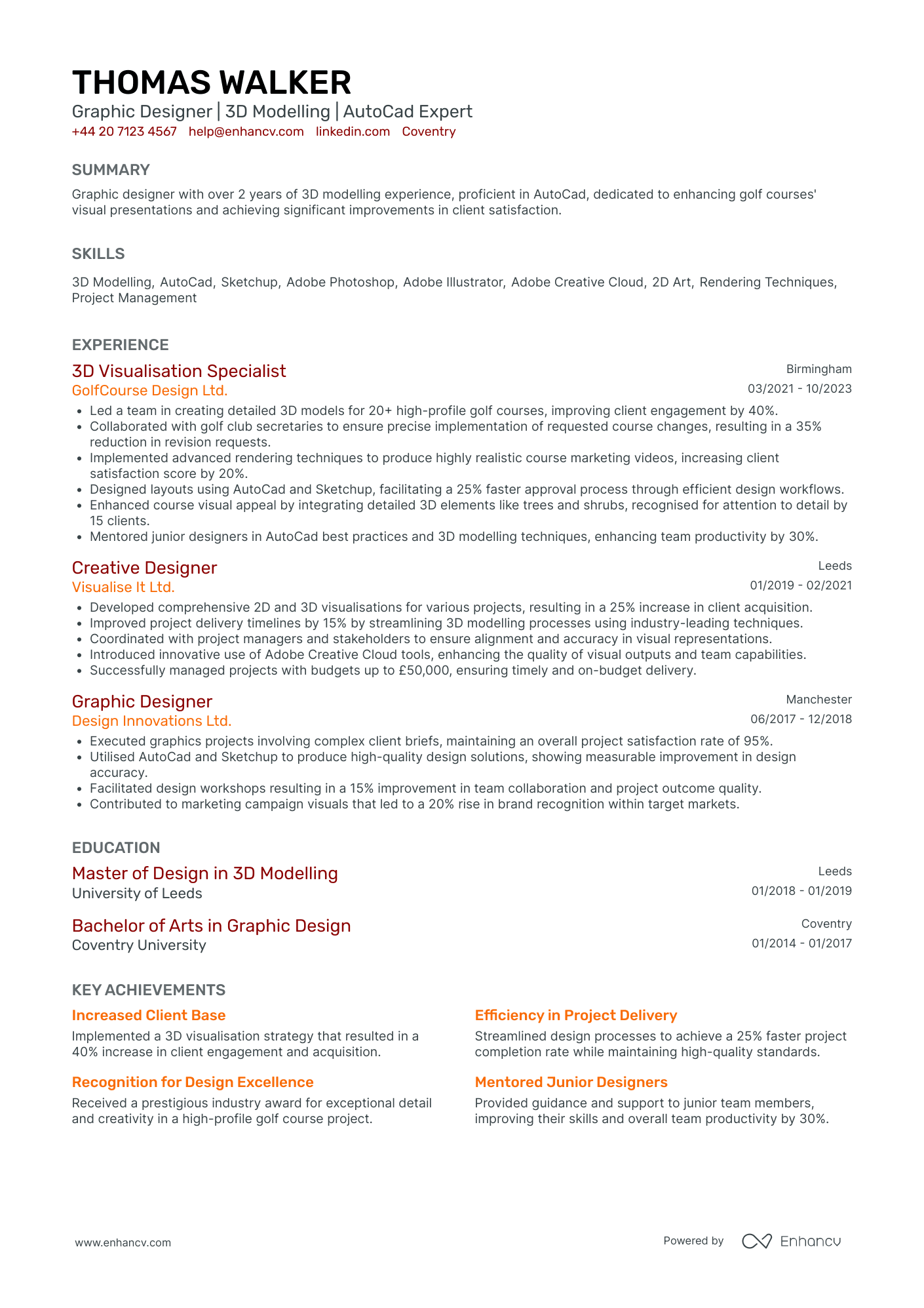
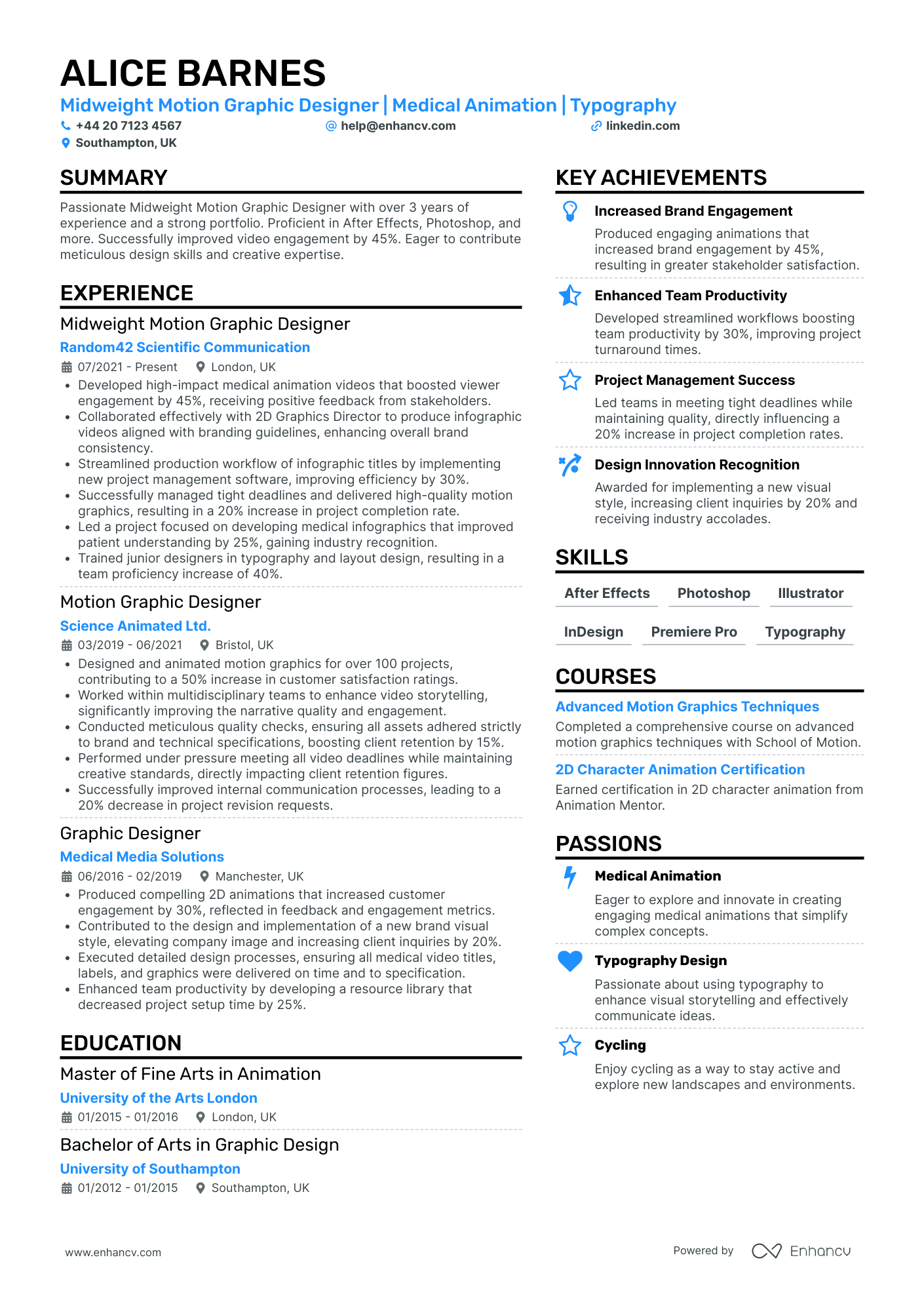
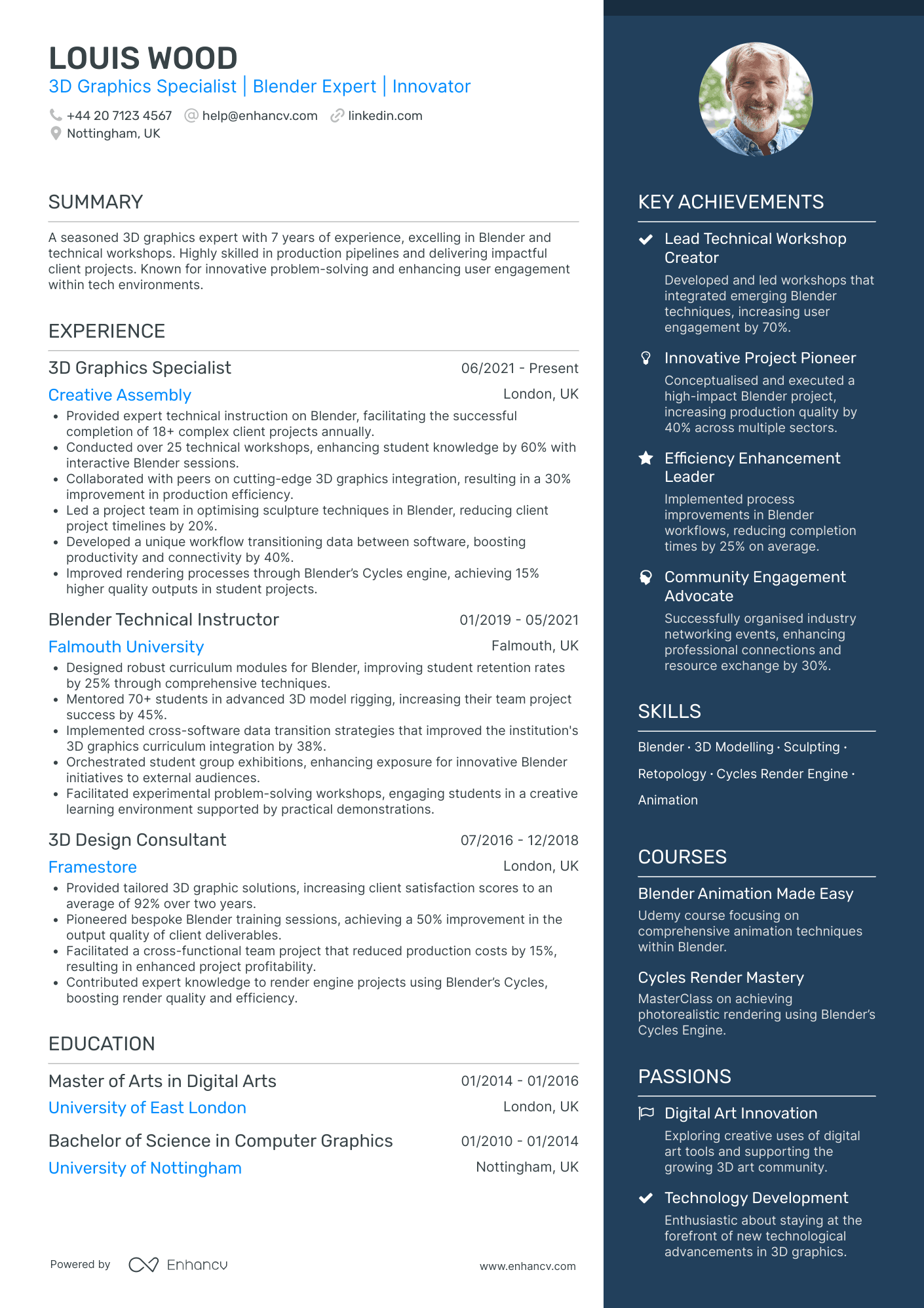
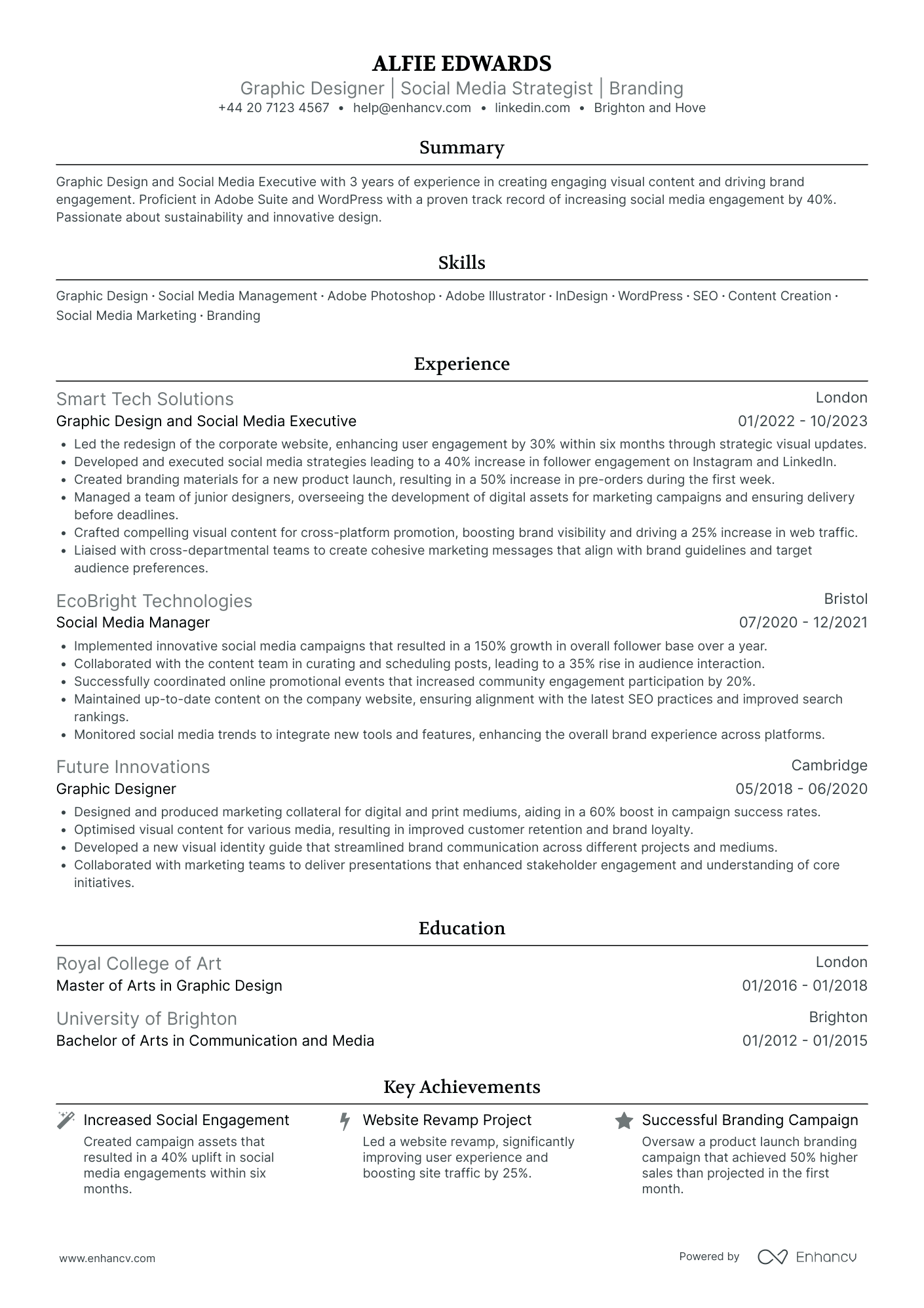
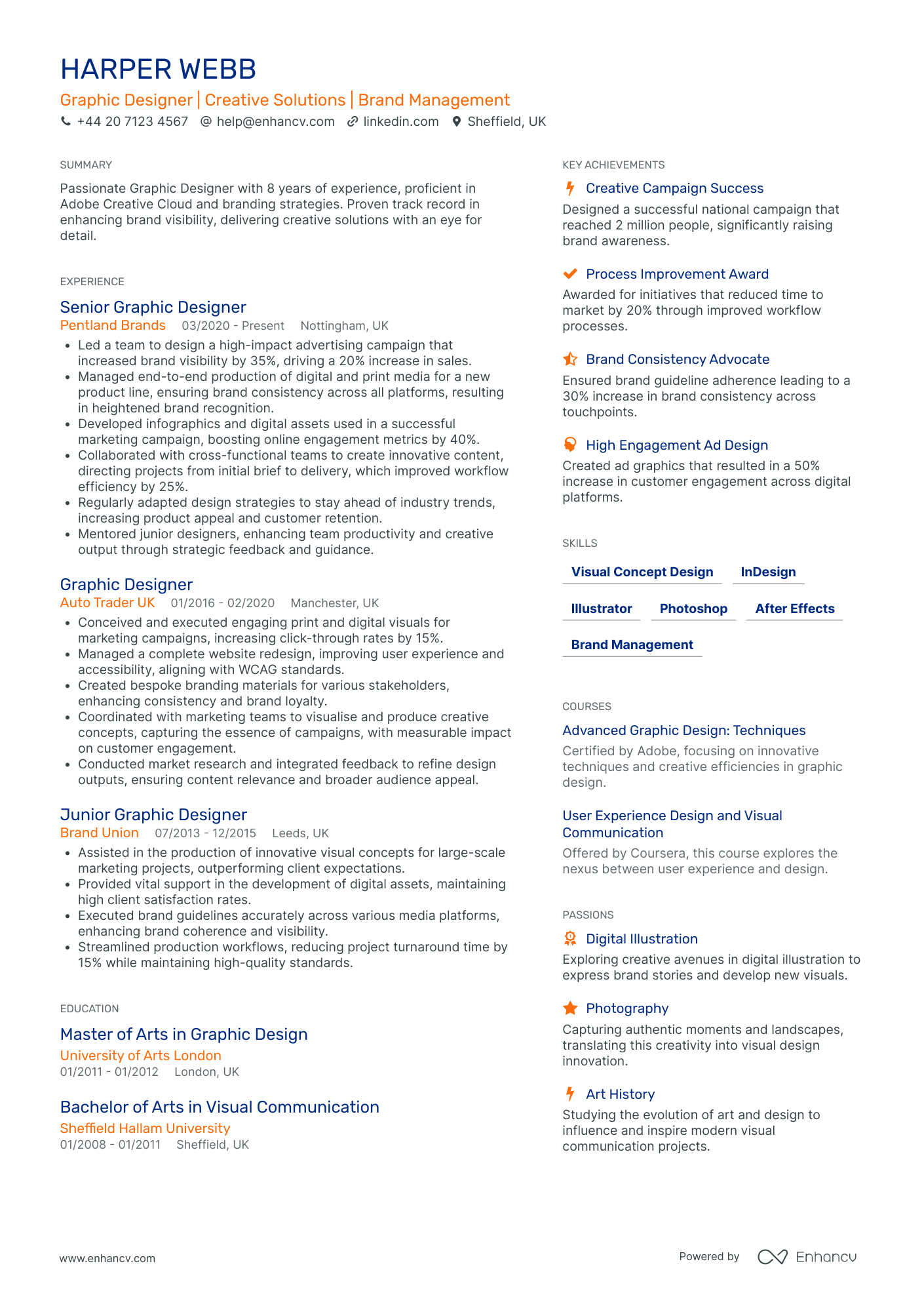
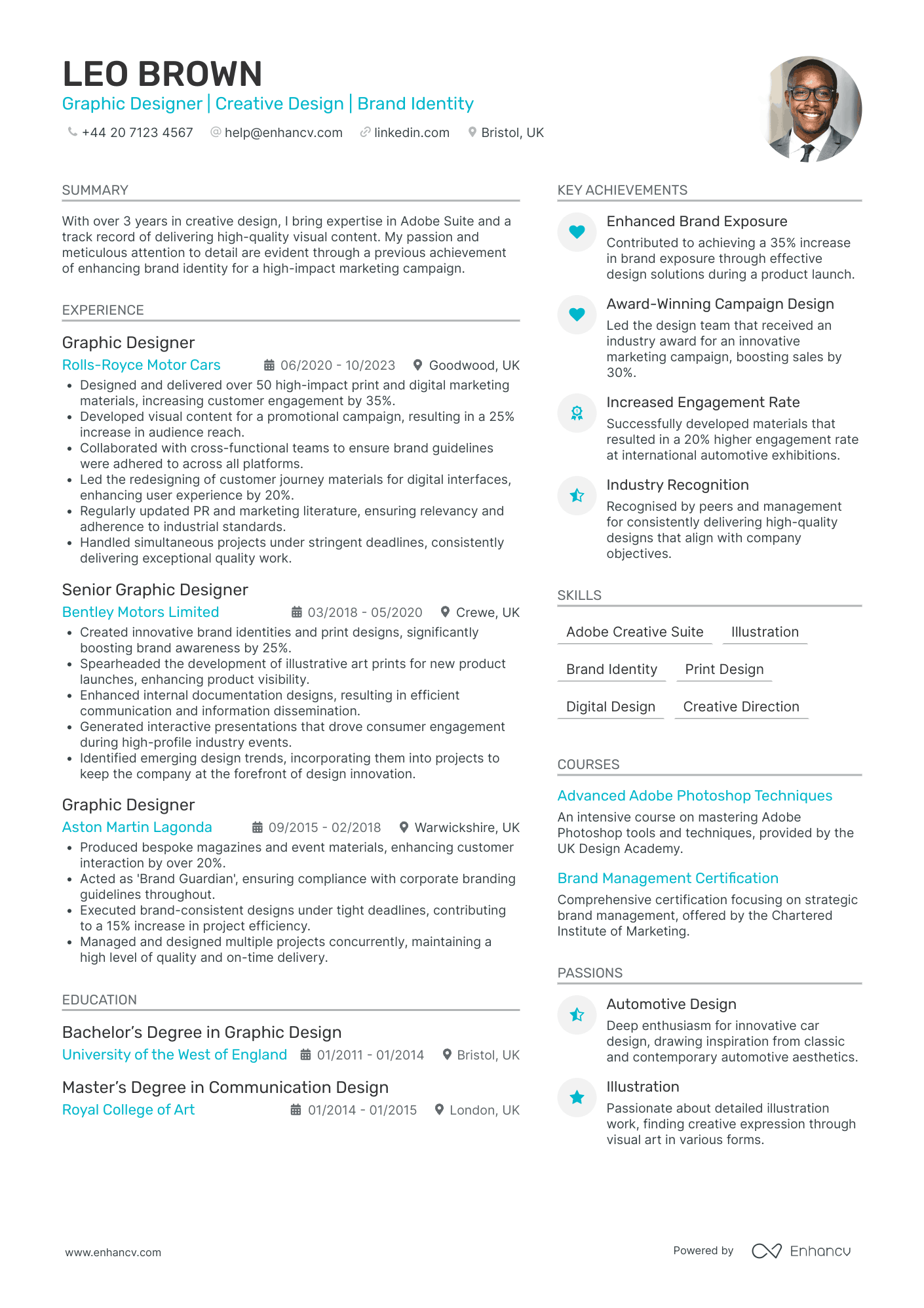
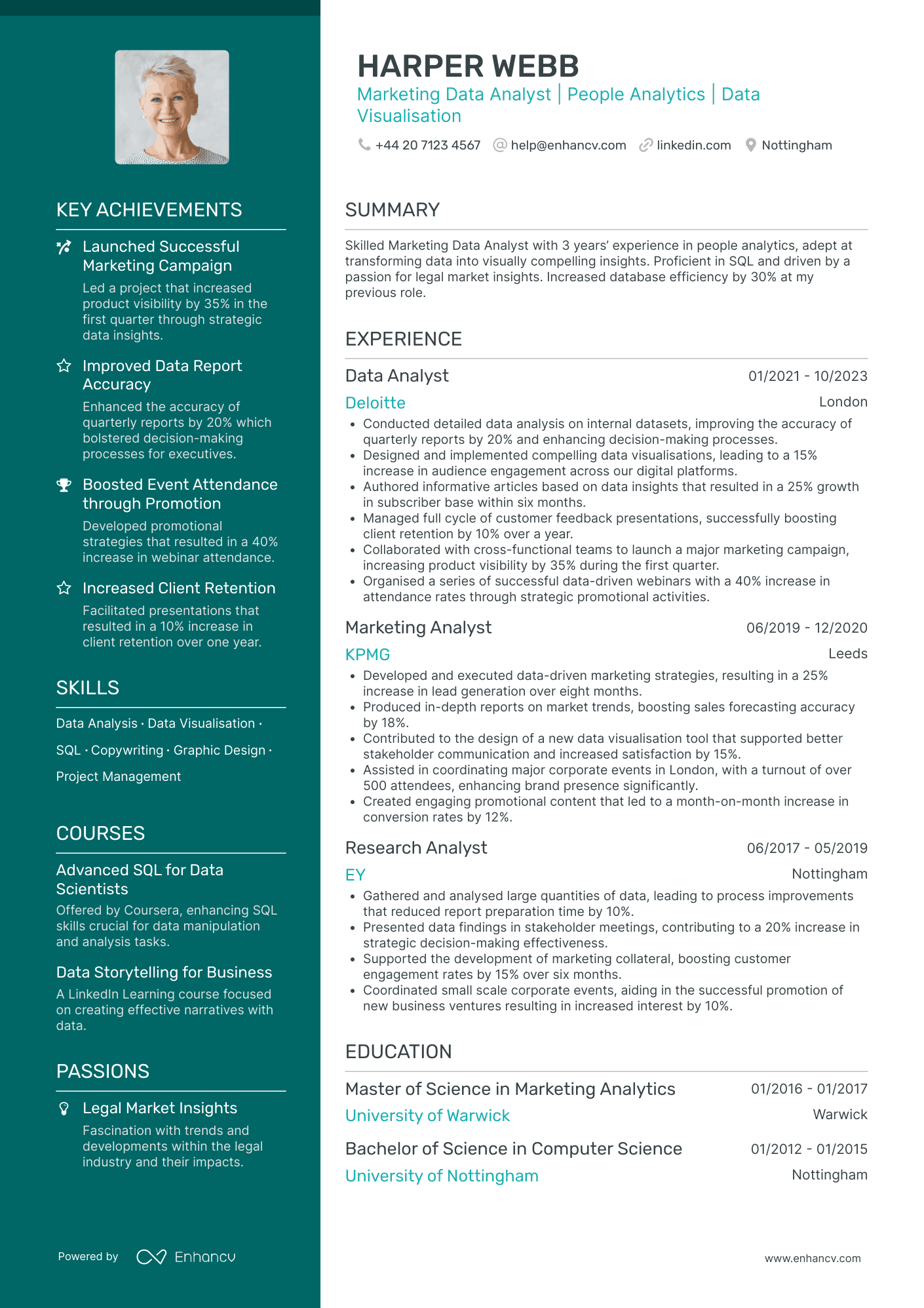
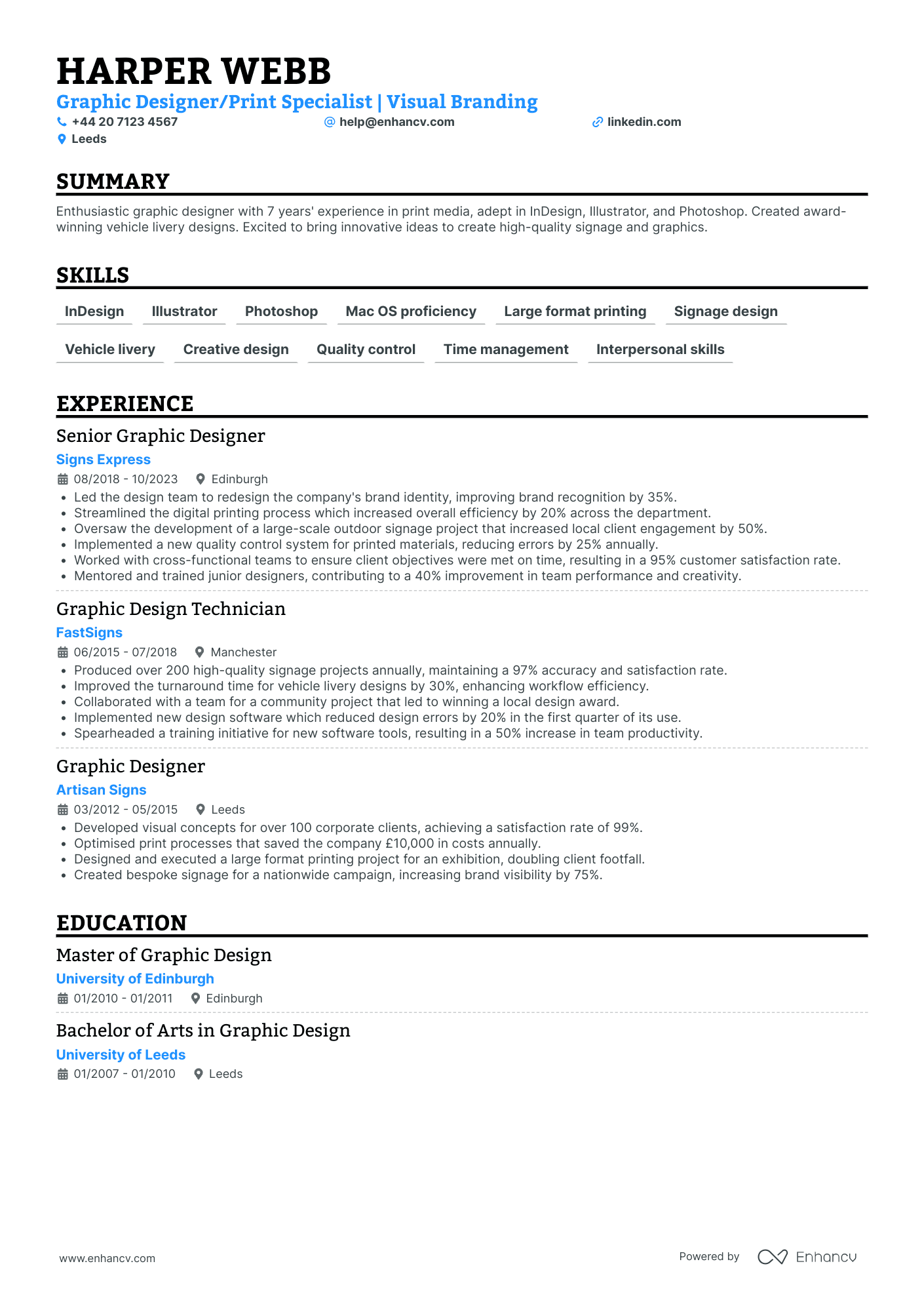
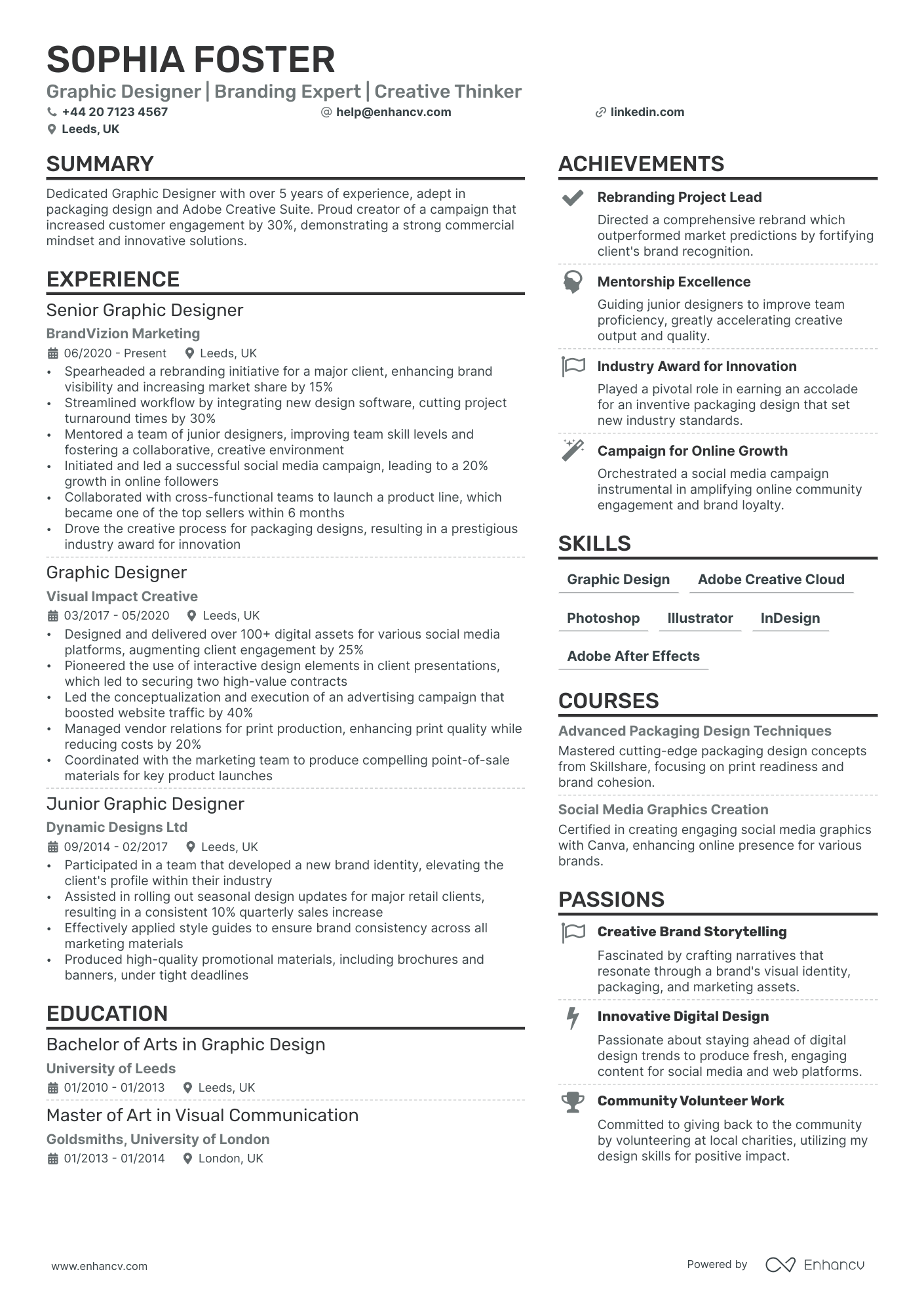
Most graphic design CVs read like a software inventory. Illustrator, Photoshop, and InDesign get listed, then left to speak for themselves.
They rarely do. The CVs that win interviews show what those tools actually produced: the rebrand, the campaign, the number that moved.

Key takeaways
- Lead with the software recruiters name in the advert. Illustrator, Photoshop, and InDesign top UK graphic design listings.
- Your portfolio is half the CV. Put a live, tested link in the header and point to specific projects in your bullets.
- Prove skills with outcomes, not adjectives. Quantify the work by reach, engagement, conversion, turnaround, or revenue, so “lifted social engagement 28%” beats “creative and detail-oriented” every time.
- Keep it to two pages, one clean column, and export a PDF so your type and layout survive the ATS.
- Open with a short personal statement built on your strongest project and the tools you actually own.
- No studio experience yet? Show self-set briefs, competition entries, and coursework as dated entries.
Top skills for your graphic design CV
Most graphic design CVs list twenty tools and prove none of them. The five skills that actually carry a UK graphic design CV are Adobe Illustrator, Adobe Photoshop, Adobe InDesign, typography, and digital design. Name them near the top, and name them the way the advert does.
That is not a guess. Illustrator, Photoshop, and InDesign are the tools that recur most often in UK graphic design postings, with typography and digital design sitting close behind.
Recruiters read the software line first because it is the fastest way to filter a stack of CVs. Earn that filter by being specific.
Never dump the software as a flat wordlist. Listing the tools is the easy part, evidencing them is what separates a shortlisted CV from a filed one. A line like “laid out a 48-page annual report in InDesign” proves more than the word “InDesign” ever will.
Illustrator is where a studio expects vector work: logos, brand marks, icons, and illustration. Tie it to a deliverable, such as “built a 30-icon system in Illustrator for a fintech app”.
Photoshop covers retouching, compositing, and digital artwork. Give it the same concrete treatment, such as “retouched and composited 200-plus product shots for an e-commerce launch”, rather than an icon on a skills bar.
InDesign signals you can handle multi-page layout and print-ready artwork: brochures, editorial spreads, reports, and packaging. It is the tool most junior CVs leave thin, so depth here stands out.
Typography is the one skill your CV can prove by existing. Set your own CV in a considered typeface with a clear hierarchy, and you have demonstrated the skill before a word is read.
Digital design means web, social, and interface assets, usually in Figma alongside the Adobe suite. If you work responsively or hand off to developers, say so.
Adobe Creative Suite is often listed as a single requirement. If you work across the suite, say so plainly, then break out the individual tools underneath so nothing gets missed.
Split the list into hard skills and soft skills, and treat them differently. The hard skills are the tools and techniques above, copied in the exact spelling the advert uses so both the reader and the parser find them.
The soft skills that matter in a studio are checkable: communication with clients, collaboration with marketers and developers, time management across competing briefs, and attention to detail. Prove each one inside an experience bullet rather than parking it in a list.
Keep the skills section of a CV honest. If you have opened a tool twice, it is not a skill. List what you can defend in an interview or a test brief.

PRO TIP
Mirror the advert's exact wording. If it asks for "Adobe Creative Suite" write that, not "Adobe CC". If it says "InDesign" do not shorten it to "ID". Matching the phrasing helps both the recruiter and the ATS tick the box.
Top skills for your graphic design CV:
Adobe Illustrator
Adobe Photoshop
Adobe InDesign
Typography
Digital design
Layout and composition
Adobe Creative Suite
Branding and identity
Print production
Motion graphics
Communication
Collaboration
Creativity
Attention to detail
Time management
Problem-solving
Adaptability
Client relations
What the UK graphic design market looks like
Knowing what UK studios ask for tells you what belongs at the top of the CV.
| What | UK graphic design roles |
|---|---|
| What the role pays | £25,000 to £40,000 a year (National Careers Service) |
| Where the work happens | Split between onsite and hybrid (across the roles in Enhancv's recent UK job feed) |
| Experience level asked for | Mostly mid-level, with a smaller band of entry-level openings |
| Skills that recur most | Illustrator, Photoshop, and InDesign |
The work is split between onsite and hybrid, so a studio needs to see you can reach it. Put your city in the header, and signal a willingness to work in-house if the advert leans that way.
Illustrator, Photoshop, and InDesign recur most across those roles, which is why the skills section leads with them. Most of the openings are pitched at mid-level, with a smaller band of entry-level roles, so a first-time applicant is competing for a real but narrower set of jobs.
If you work across packaging, editorial, and social, make that breadth obvious. Small studios in particular hire generalists who can move between media, so a CV that shows range reads as lower risk.
Formatting your graphic design CV
A designer's CV is a design artefact, and restraint is the skill on show. The candidates who overbuild theirs into a poster tend to lose the recruiter who just wants to find the portfolio link.
Use a reverse chronological CV once you have studio roles behind you, starting with your latest position. If you are moving in from an adjacent field, a skills-based CV lets your tools and projects lead instead of a thin work history.
Keep it to two pages, one clean column, with generous white space and a readable type size. Standard headings help the reader skim.
Use colour with intent. One accent that ties to your personal brand reads as considered, whereas five competing colours read as noise.
Put the portfolio link in the header next to your contact details, never buried on page two. It is the first thing a design lead clicks.
Export a PDF so your typeface, spacing, and colour hold on any screen. Keep a Word copy only if the advert names that format.
Most applications still pass through tracking software, so keep the layout clean and the headings standard for an ATS-friendly CV. Set your contact details as live text, not inside an image the parser cannot read.
Build it from a tested layout rather than a blank canvas. Enhancv's CV templates export to a clean PDF and keep the structure ATS-safe, which frees you to spend your energy on the work itself.
Is your CV good enough?
Drop your CV here or choose a file. PDF & DOCX only. Max 2MB file size.
Building and linking your graphic design portfolio
For a graphic designer, the portfolio is the other half of the application. The CV earns the click. The portfolio wins the interview.
Put a live URL in the header, next to your personal details, and add a QR code if you also print the CV for a meeting.
Curate hard. Eight to twelve of your strongest pieces beat a dump of everything you have ever made. Lead with the work closest to the job you want.
Treat each piece as a short case study, not a gallery image. Name the brief, your role in it, the tools, and what changed because of your work. A design lead reads for thinking, not just finish.
If your best work sits under an NDA or agency confidentiality, describe the brief, your role, and the result without naming the client. Never post work you were told to keep private, but you can still show the thinking behind it.
Reference specific portfolio projects in your experience bullets so the CV and the portfolio point at each other. A recruiter who reads “rebranded a regional retailer” and can click straight to that project trusts the claim.
Keep it current. A portfolio that stops two years ago suggests your best work did too, so retire weak early pieces as stronger ones land.
Host it where it looks considered: a personal domain, a tidy Behance, or a PDF portfolio for roles that ask for one. The CV header is where the link belongs, not a footnote.
PRO TIP
First clicks on a portfolio usually happen on a phone, so open your live link on mobile before every batch of applications. A broken link or a layout that collapses on a small screen ends the application on the spot.
Writing your graphic design personal statement
Your CV headline and personal statement are the two lines doing the heavy lifting at the top of the page. The headline is the label under your name, the statement is the short paragraph beneath it. Get both specific and a design lead keeps reading.
A headline should name your specialism and level, not stop at “Graphic Designer”. Pair the role with the work you want to be hired for.

CV headline examples for graphic designers
Senior Brand Designer, packaging and print, fluent in Illustrator and InDesign. Digital Product Designer specialising in Figma UI and design systems. Junior Graphic Designer, editorial and layout, BA (Hons) with a live portfolio. Each one names a specialism and a proof point instead of stopping at the job title.
The statement itself is three or four sentences: who you are, the tools you own, one project with a result, and the kind of studio you want to join.
Match it to the role. A statement aimed at a packaging studio should not read the same as one aimed at a digital product team, even if the projects behind them overlap.
Skip the adjective soup that opens most design CVs. “Passionate, creative, detail-oriented” is unprovable, and every other applicant has typed it. Lead with something a design lead can picture instead. For more openings that work, see these personal statement examples.
Graphic design personal statement example (mid-weight)
Mid-weight graphic designer with five years across brand and editorial, fluent in Illustrator, Photoshop, and InDesign. Led the rebrand of a regional food retailer, rolling out packaging and in-store artwork across 40 sites and raising shelf-standout preference from 41% to 63% in a 200-shopper test. Portfolio spans identity, print, and social. Looking to bring a print-first eye to a studio role in Manchester.
What to avoid
A passionate and creative graphic designer with a keen eye for detail and a love of all things design. A hard-working team player who thinks outside the box and is dedicated to delivering stunning visuals that wow clients every single time.
The second version names no tool, no project, and no outcome. It could describe any designer at any level, which is exactly why a design lead skims past it.
Give the reader one concrete thing you have made and the result it drove. That single detail does more than a paragraph of adjectives.
Writing your graphic design experience section
List each role with a dated heading, then bullets that open with a verb and close with an outcome. This is where you turn “I can use Illustrator” into proof.
A bullet like “Responsible for a range of design tasks” is a shrug in bullet form. The same job written like it mattered names the work, the tool, and the result: “Designed a 12-page investor brochure in InDesign that the sales team still leads with”. Same role, one version disappears and the other gets read.
Design work is more measurable than it feels. Engagement lifted, downloads gained, turnaround cut, print costs saved, sites rolled out, awards won. Those are your CV achievements, and they belong in the bullet, not the appraisal.
Open each line with a strong action verb: designed, rebranded, art-directed, produced, shipped. Then attach the skill and the result. See the mechanics of a strong work experience section if you are starting from scratch.
Tailor every application to the advert, mirroring the tools and deliverables it names where they are true of you. Enhancv's CV tailoring feature reads the advert and suggests the matching edits, which saves rewriting each version from a blank page.
- Led the rebrand of a regional food retailer, designing packaging and in-store artwork rolled out across 40 sites and raising shelf-standout preference from 41% to 63% in a 200-shopper test
- Produced over 60 digital campaign assets a quarter in Photoshop and Illustrator, improving average social engagement by 28% year on year
- Rebuilt the studio's InDesign template library, cutting brochure turnaround from five days to two without dropping quality
- Designed print and digital collateral for 20-plus SME clients, working to brand guidelines and tight deadlines
- Set editorial layouts in InDesign for a quarterly membership magazine reaching 12,000 readers
- Created a 30-icon system in Illustrator for a fintech client, later adopted across their app and marketing site
PRO TIP
One strong, quantified project beats five vague bullets. No hard number to hand? Scope is evidence too: name the scale, such as a 64-page catalogue or a 40-store rollout. A bullet with no tool, deliverable, or scale is a job title, not your work.
Education and certifications for a graphic design CV
A degree helps, but the portfolio outweighs it. Plenty of working designers hold a BA in graphic design or visual communication, and plenty came in through foundation courses and self-teaching.
If you have a relevant degree, list it in full with the classification, the institution, and the dates in your education section. A model entry reads: BA (Hons) Graphic Design, 2:1, Manchester Metropolitan University, 2017 to 2020. If your qualifications are lighter, keep the section short and let the work carry more weight.
Certifications signal you keep your tools sharp. Name the specific one: an Adobe Certified Professional exam in Photoshop, Illustrator, or InDesign, a recognised typography course, or a motion-design short course all read well when they match the job. List certificates on a CV near your education, and skip the ones that do not relate to the role.
On a portfolio-led layout, this section shrinks. Once you have studio roles and a strong body of work, cut education to a single line so the page stays focused on what you have shipped. Foundation and self-taught applicants can drop the classification and simply name the training that is relevant.
Graphic design CV with no experience
Most first design jobs are won on the portfolio, not the work history, so a thin experience section is not the barrier it feels like.
Build evidence the same way a paid designer would. Self-set briefs, redesigns of brands you admire, competition entries, freelance work for a local business or a friend's band, and university projects all count. Give each one a dated entry with your role, the tools, and the outcome, exactly like the entry below.
First-project entry that reads like real experience
Self-initiated, 2024. Redesigned the identity and match-day posters for a local five-a-side football league. Built the logo and a set of poster templates in Illustrator and InDesign, then rolled them out across the league's social channels and printed signage, giving eight teams a consistent look for the season.
Unpaid and volunteer work on a CV counts as real experience, because it is. A charity poster that ran, or a society's identity you built, shows a brief taken from start to finish.
Then lead with a skills-led layout, a strong education section, and a live portfolio link. See more CV examples for a first job if you are staring at a blank page.
The market leans mid-level, so a sharp entry-level CV has to work harder. Tailor the three or four portfolio pieces you show to the job in front of you, because relevance beats volume when you are starting out.
Conclusion
Lead with the tools employers name, prove each skill with an outcome, and let a live, curated portfolio carry the rest. That is the whole job of a graphic design CV.
Get the fundamentals right the way any strong CV starts, by studying how to write a CV, then pair it with a short cover letter that says why this studio. Do that and you turn a stack of nice visuals into interviews.
Author's take - Gabriela Manova, Certified Professional Resume Writer at Enhancv
Half the graphic design CVs I open tell me they are creative and passionate, then arrive as a Word file from 2009. The ones I remember do the opposite: they say very little about themselves and point me straight at the work. I click that portfolio link within about ten seconds, so it had better lead somewhere considered, three strong projects, not thirty average ones. Show me you can decide what to leave out, and I already believe you can design.