



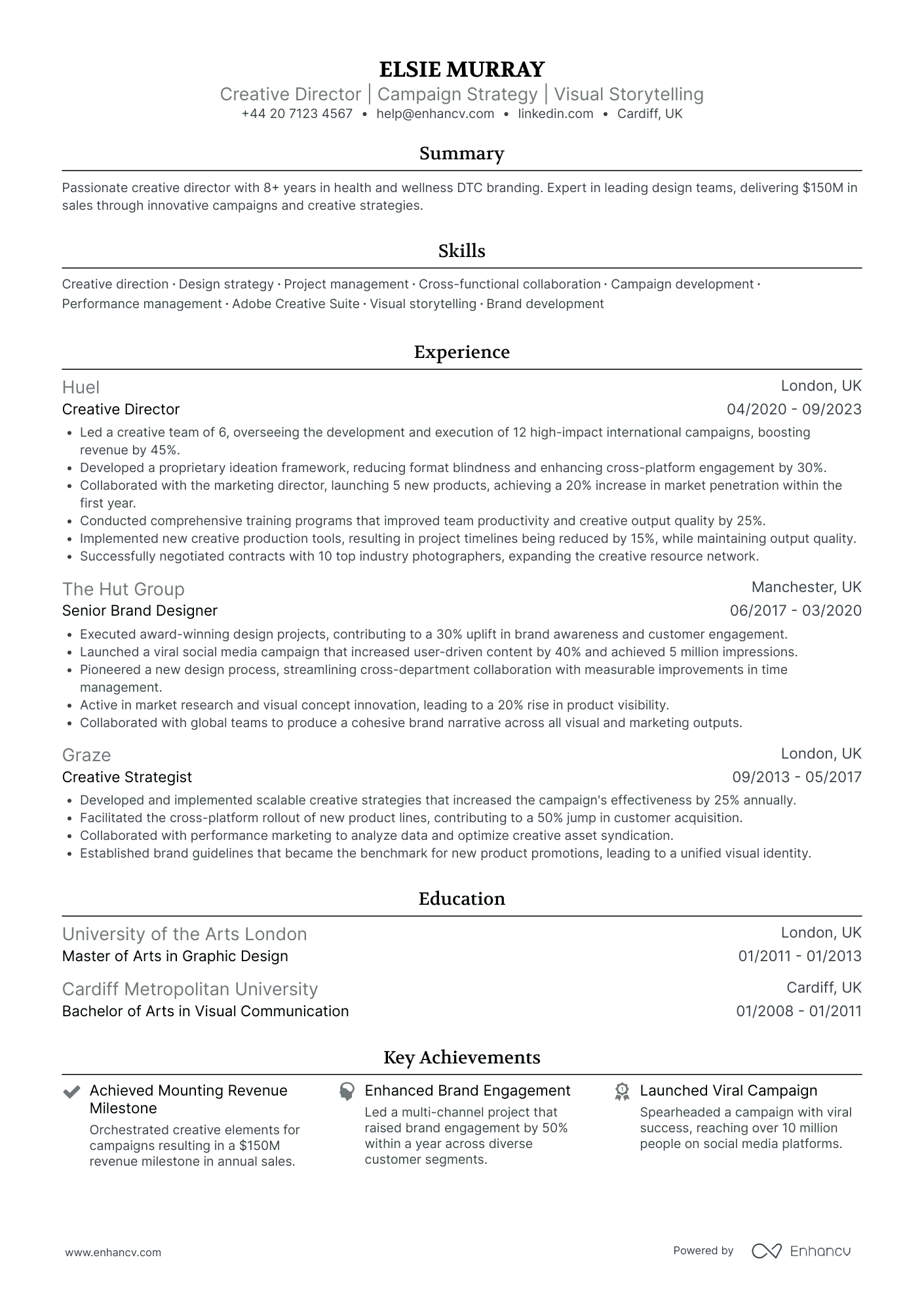
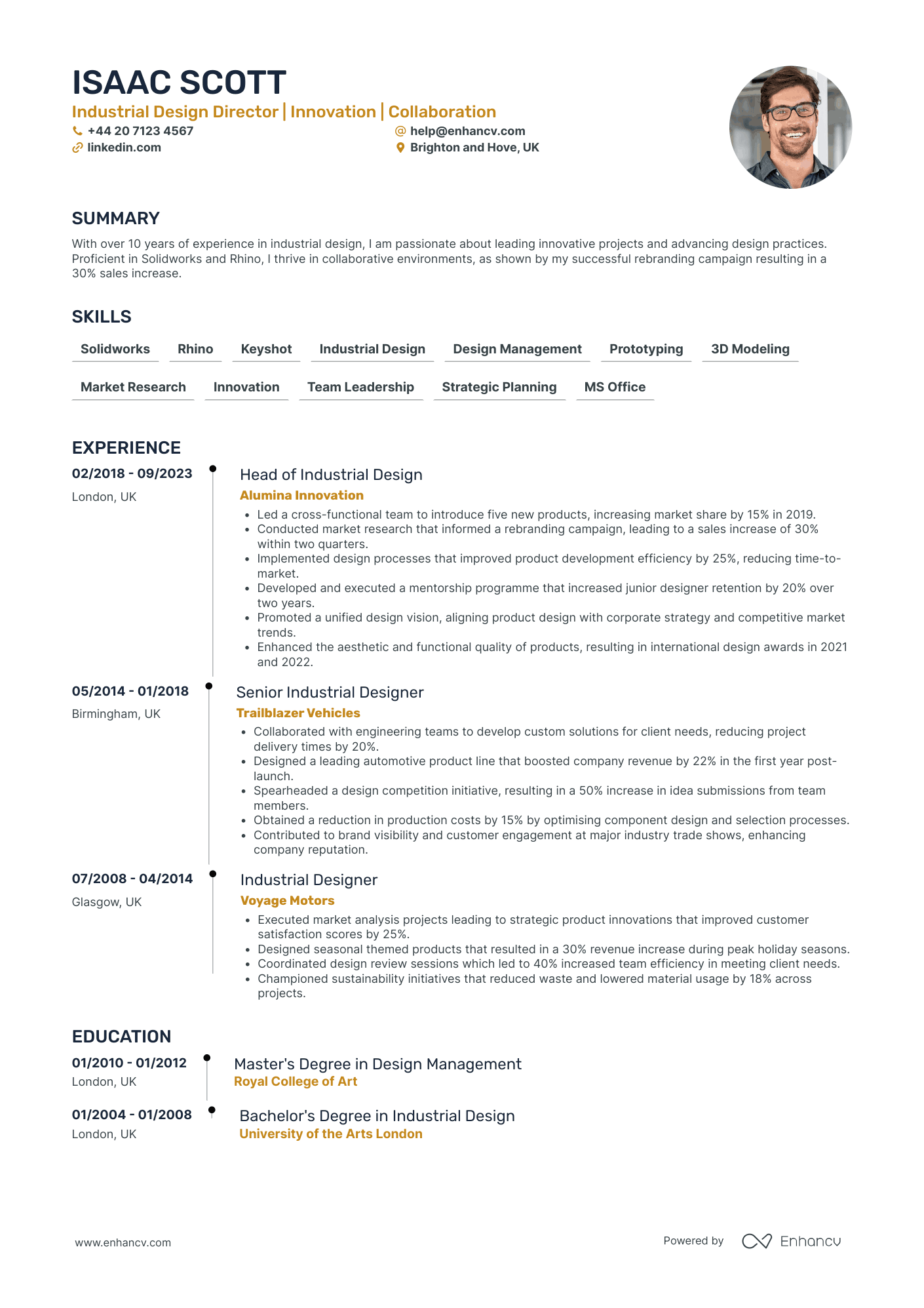
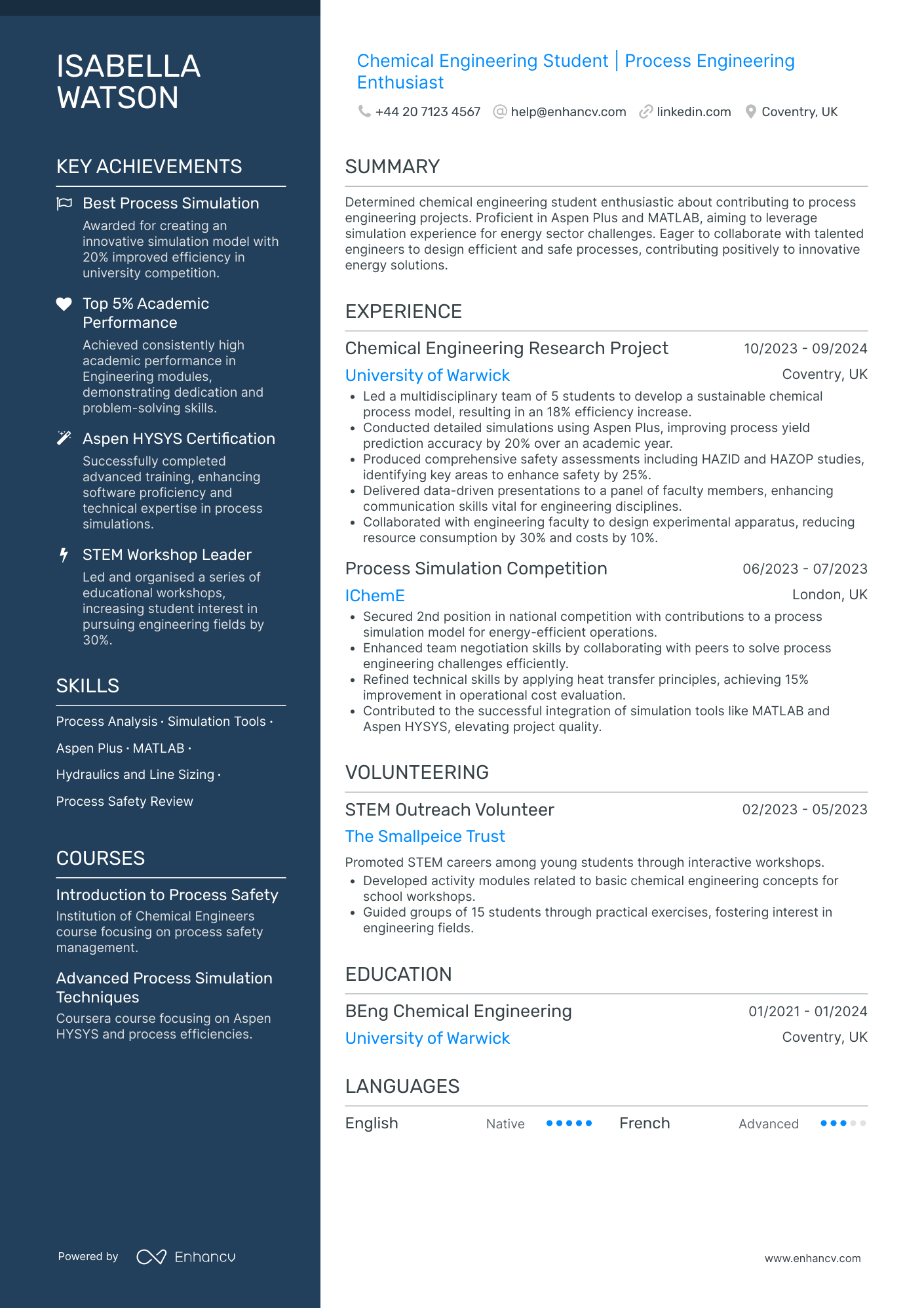
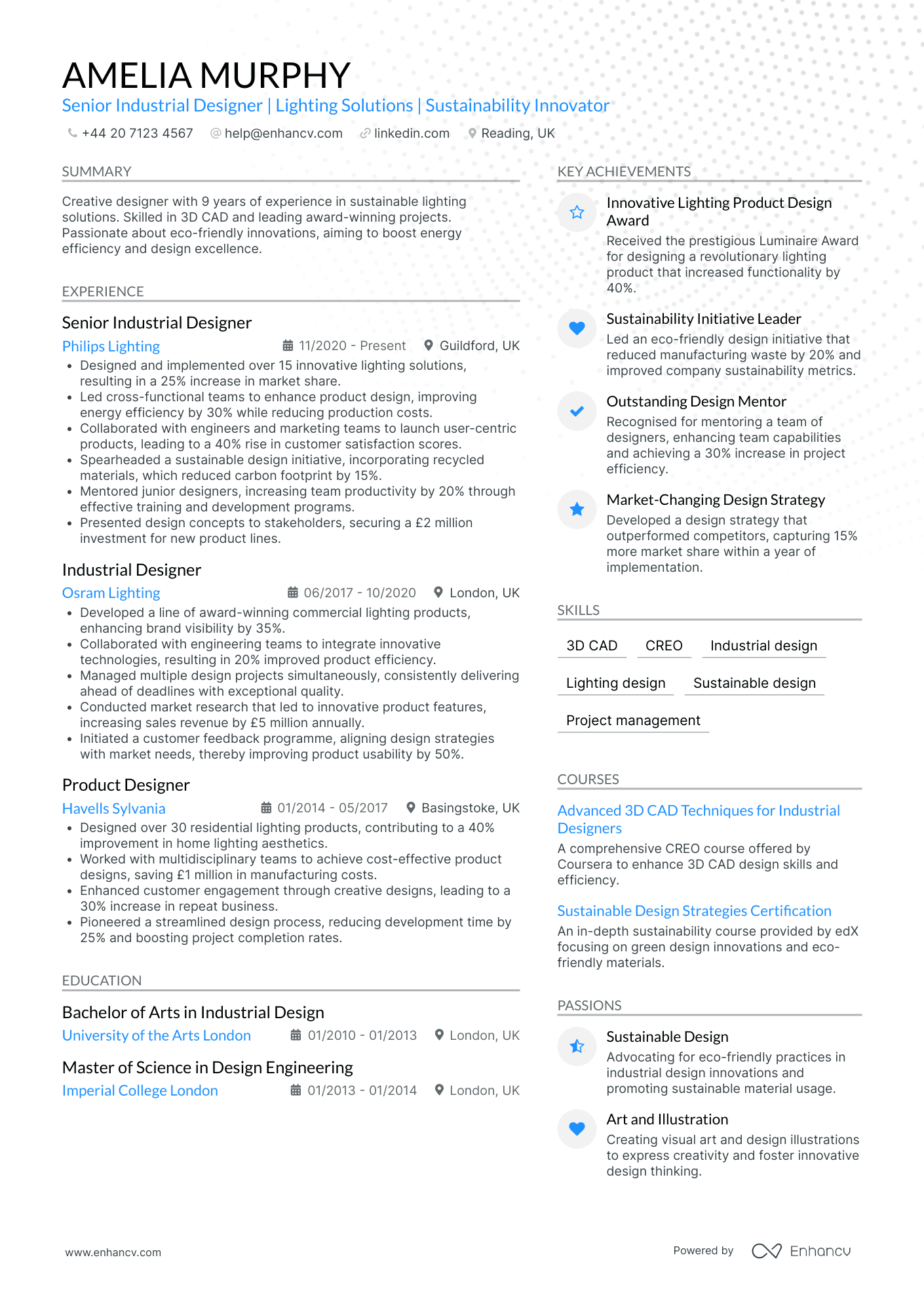
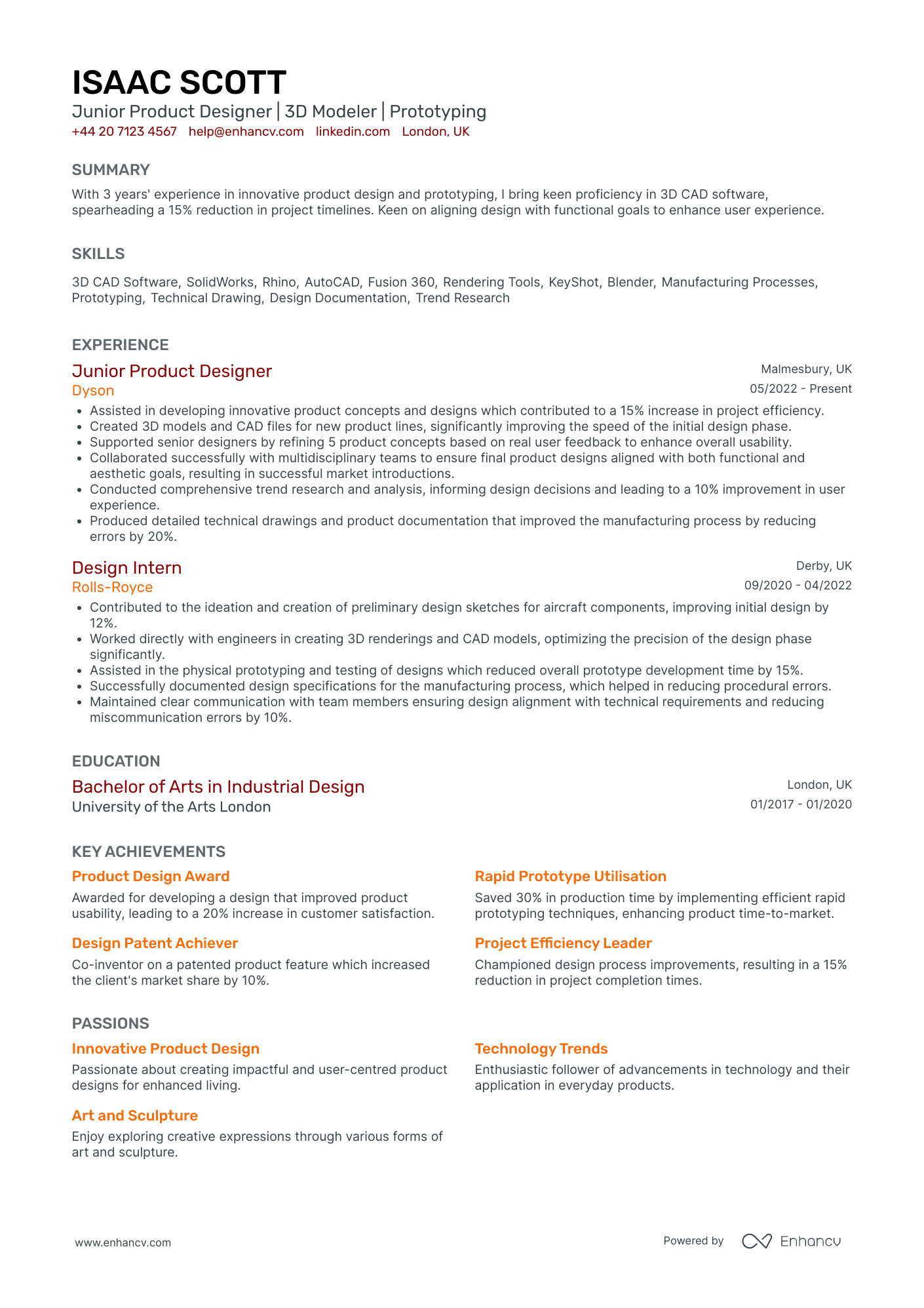
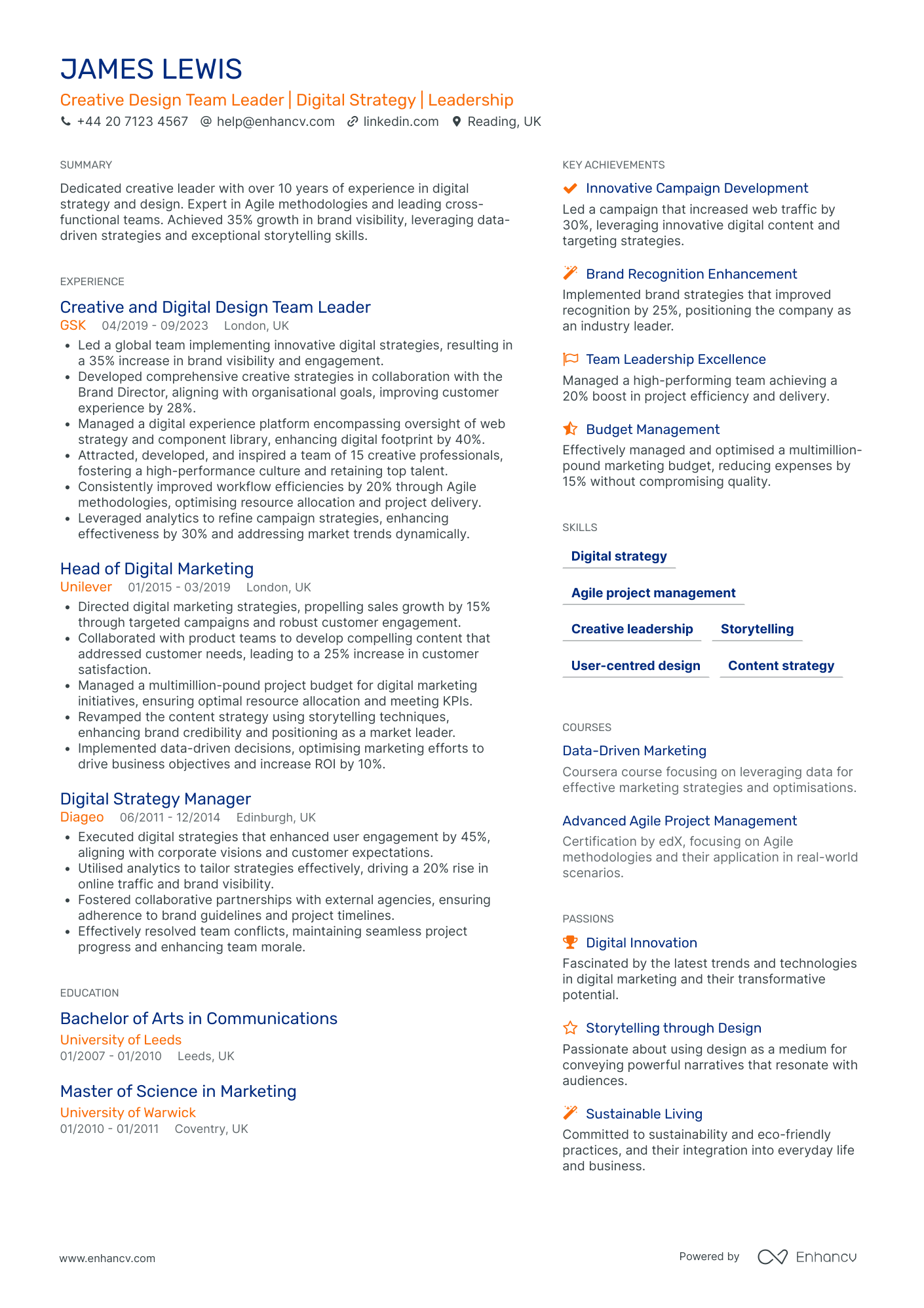
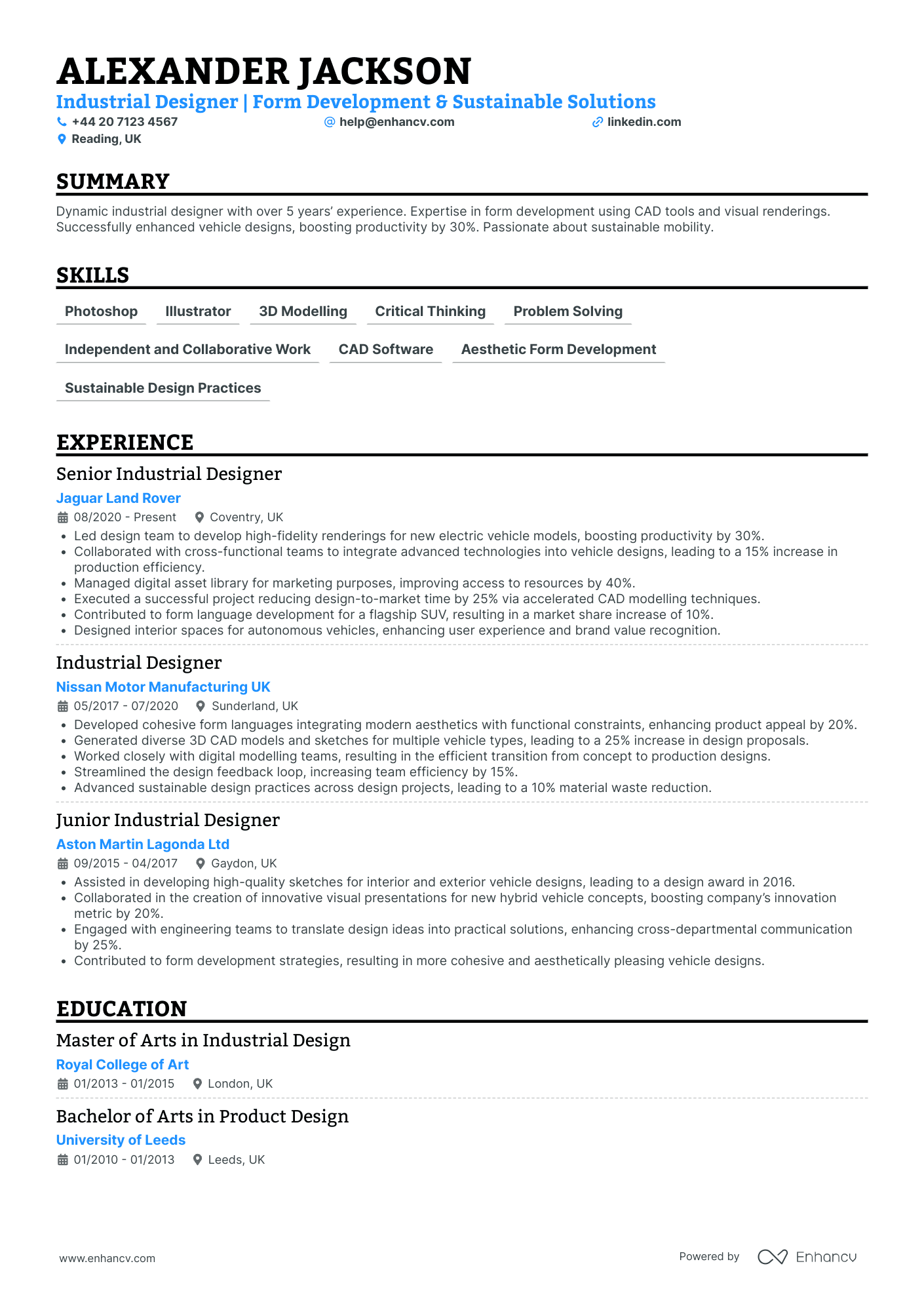
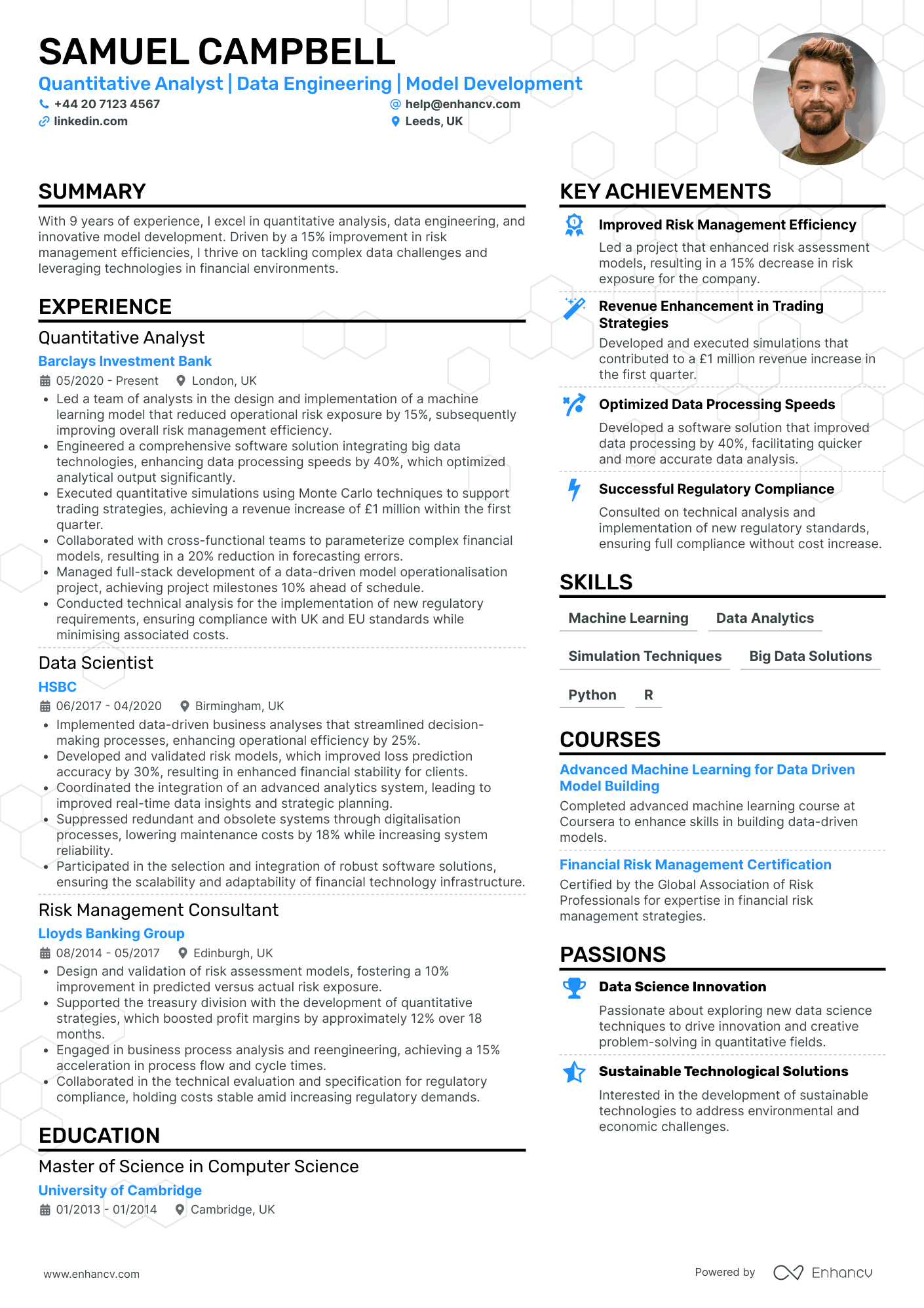
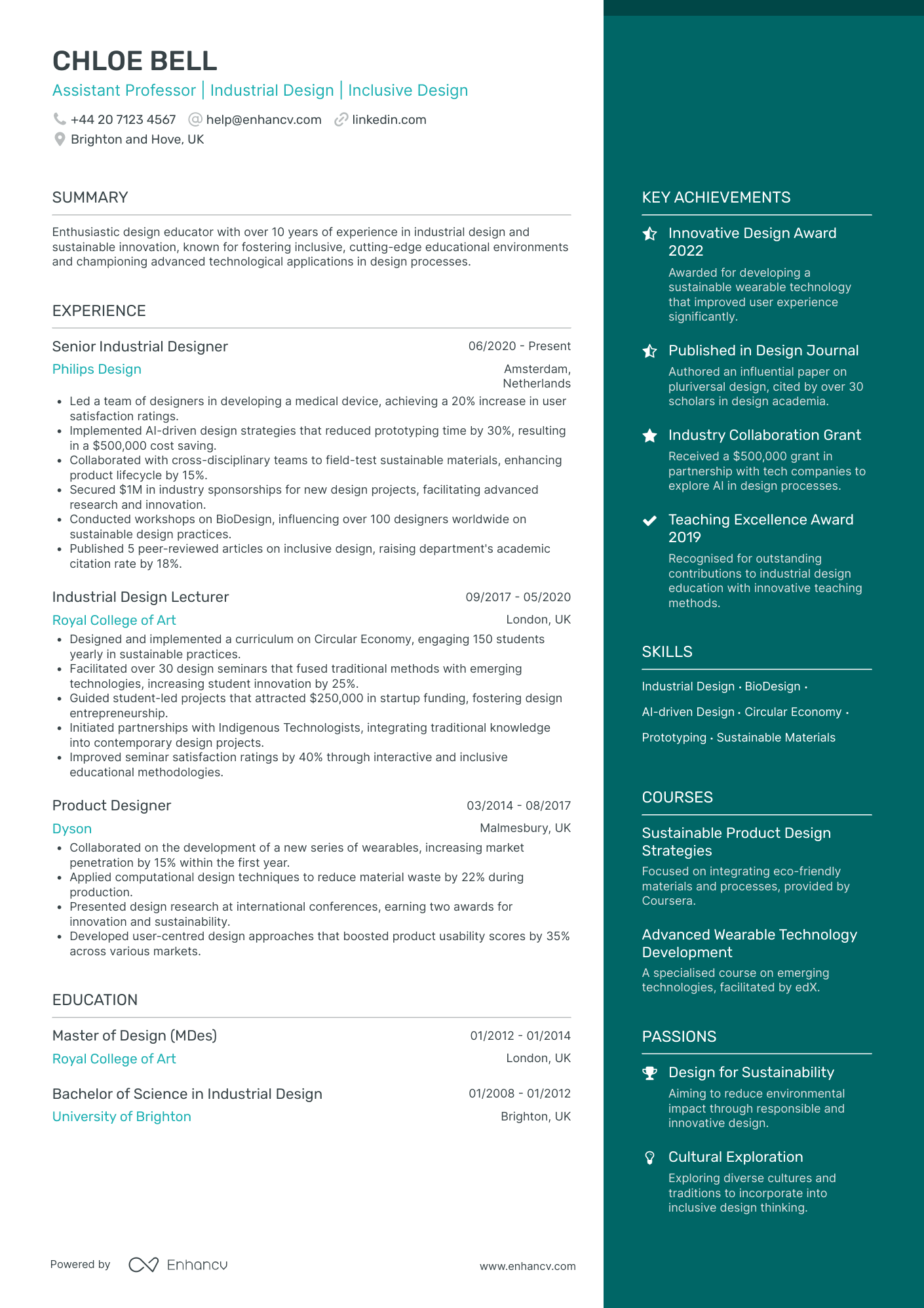
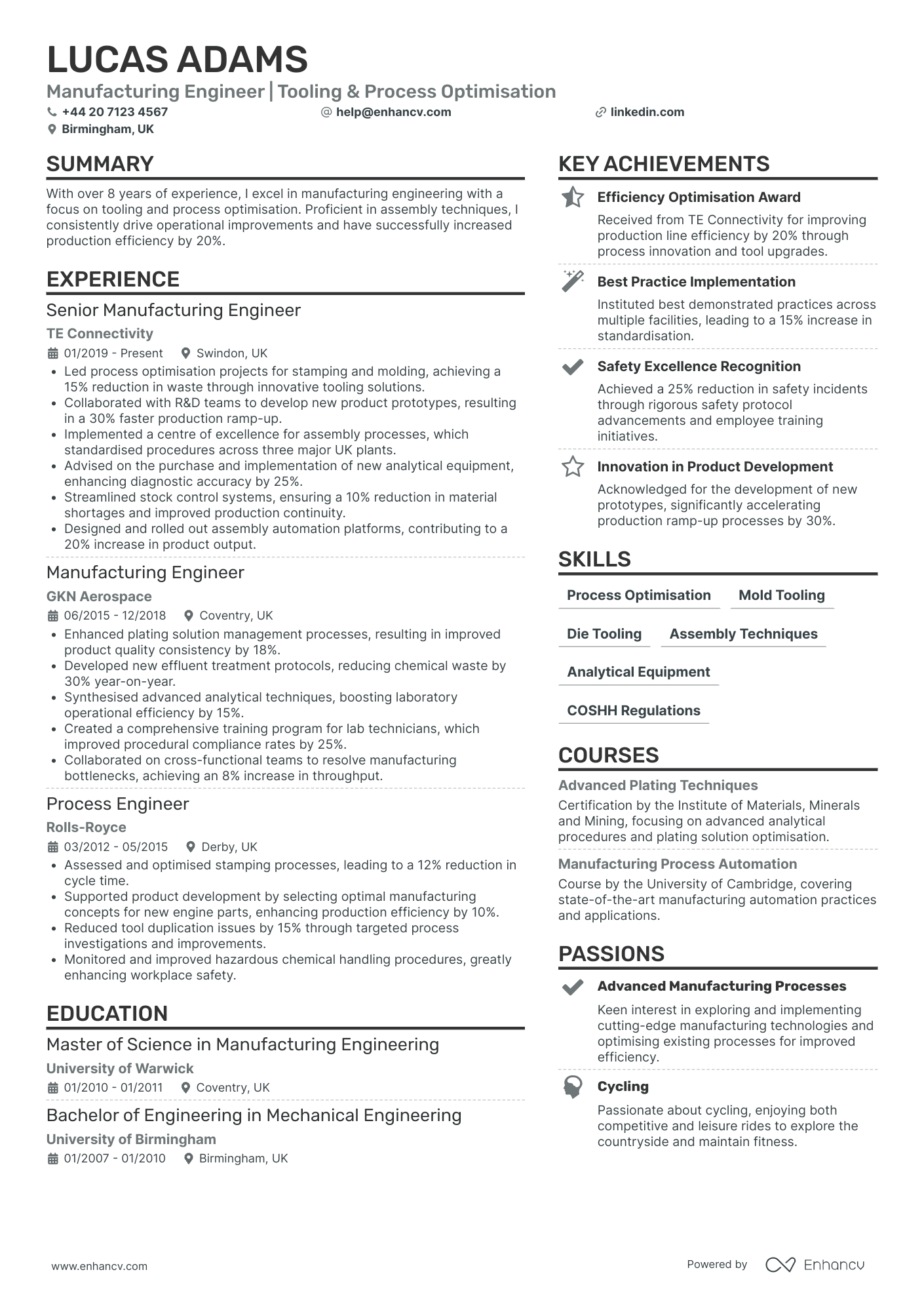
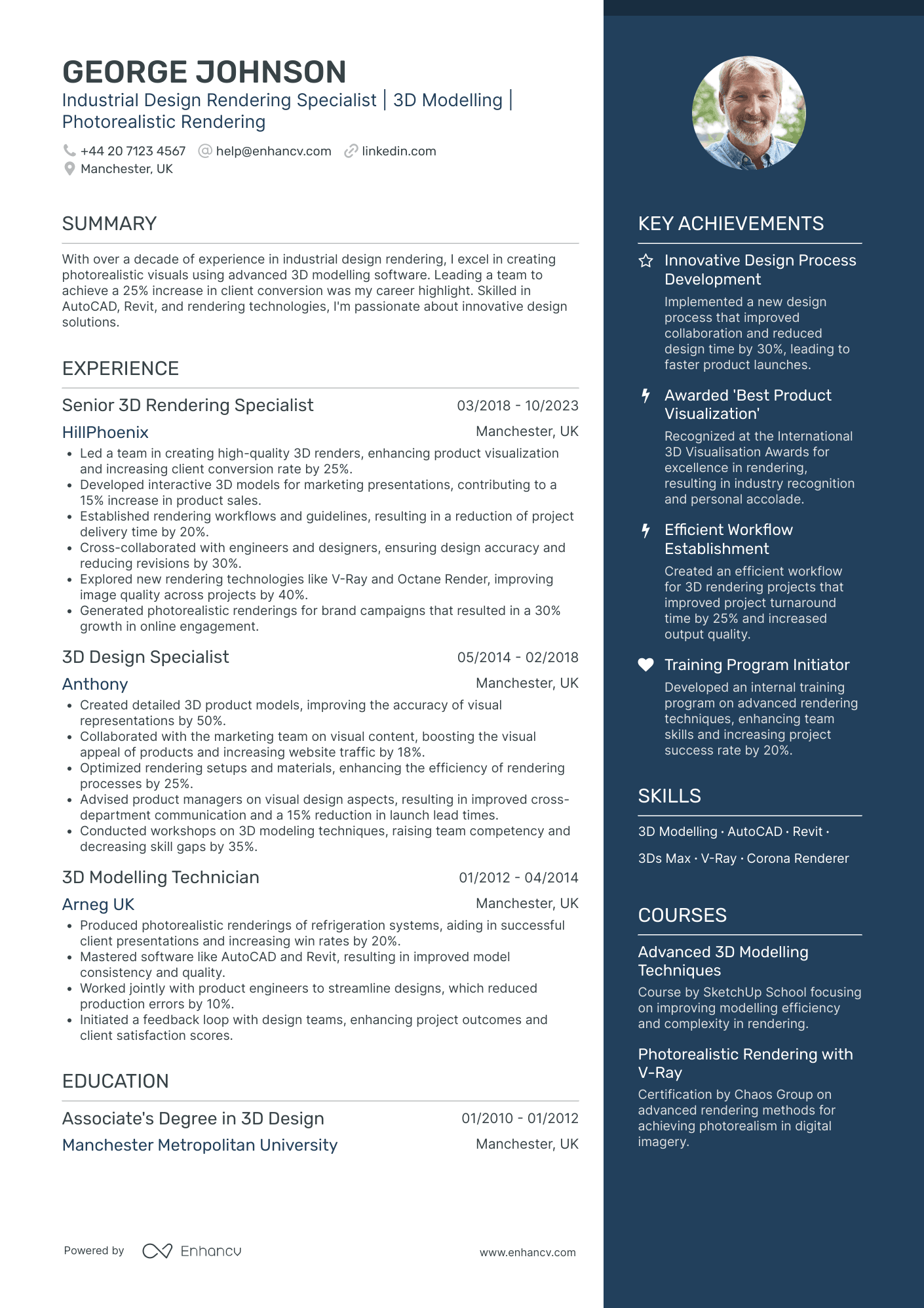
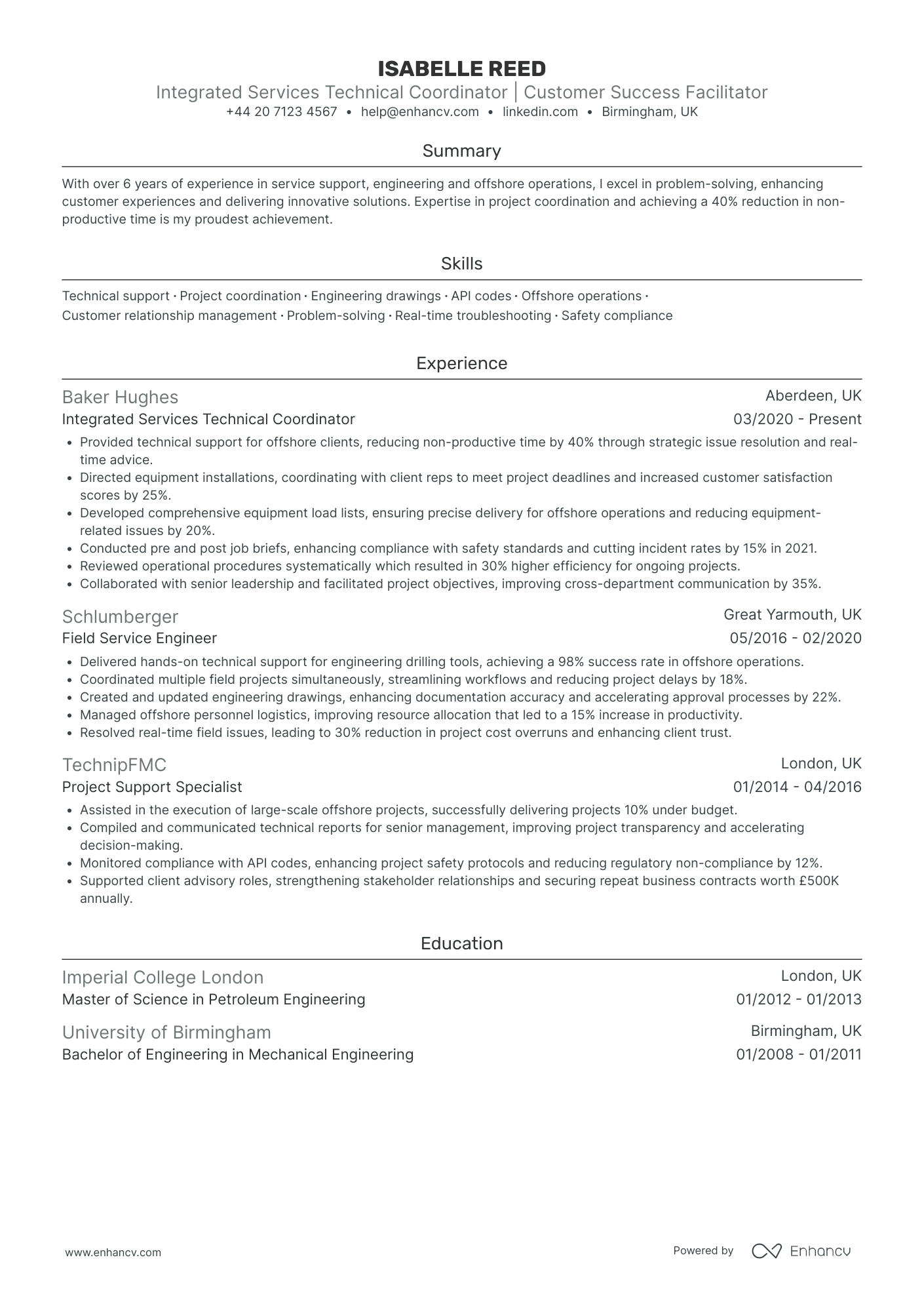
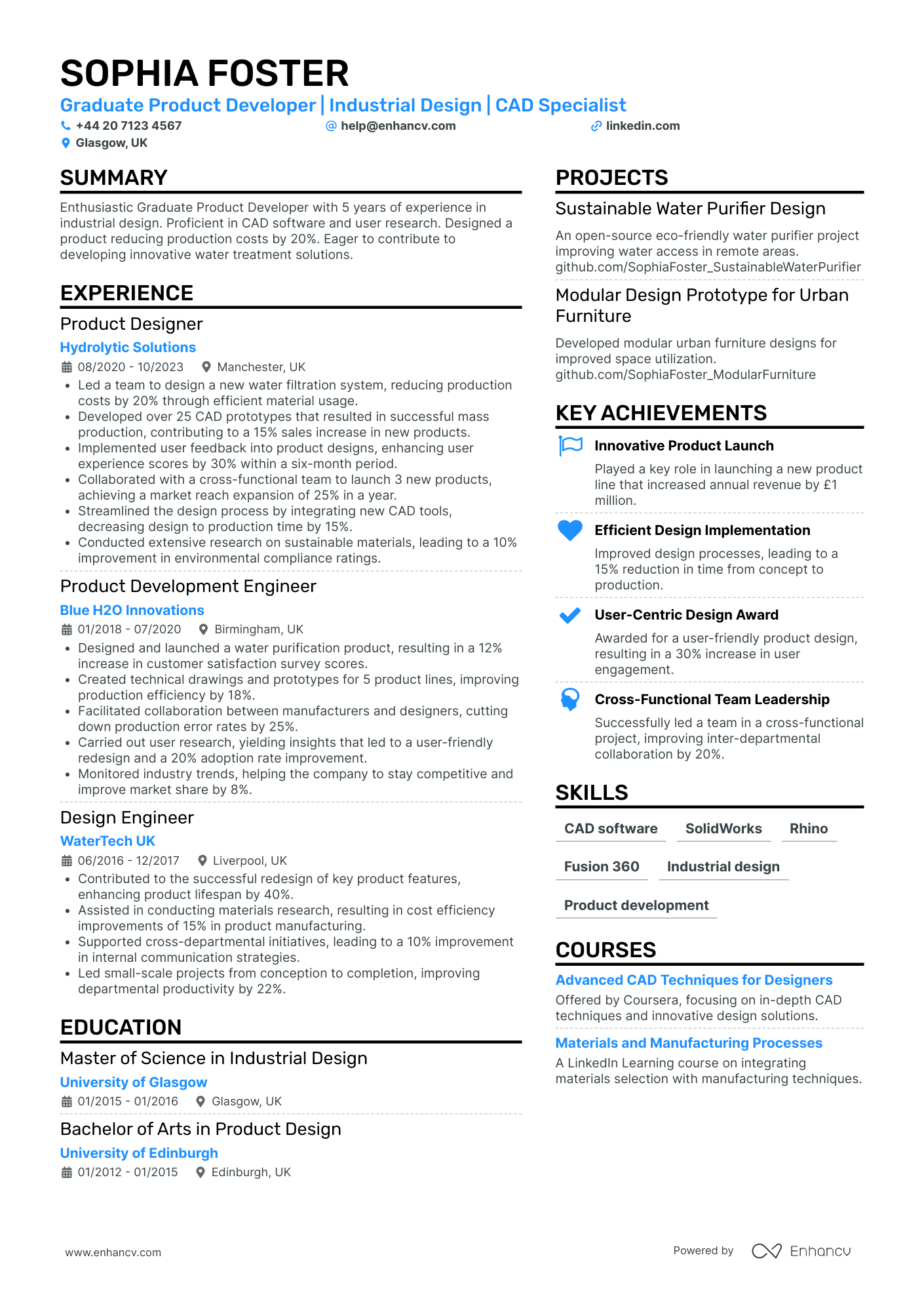
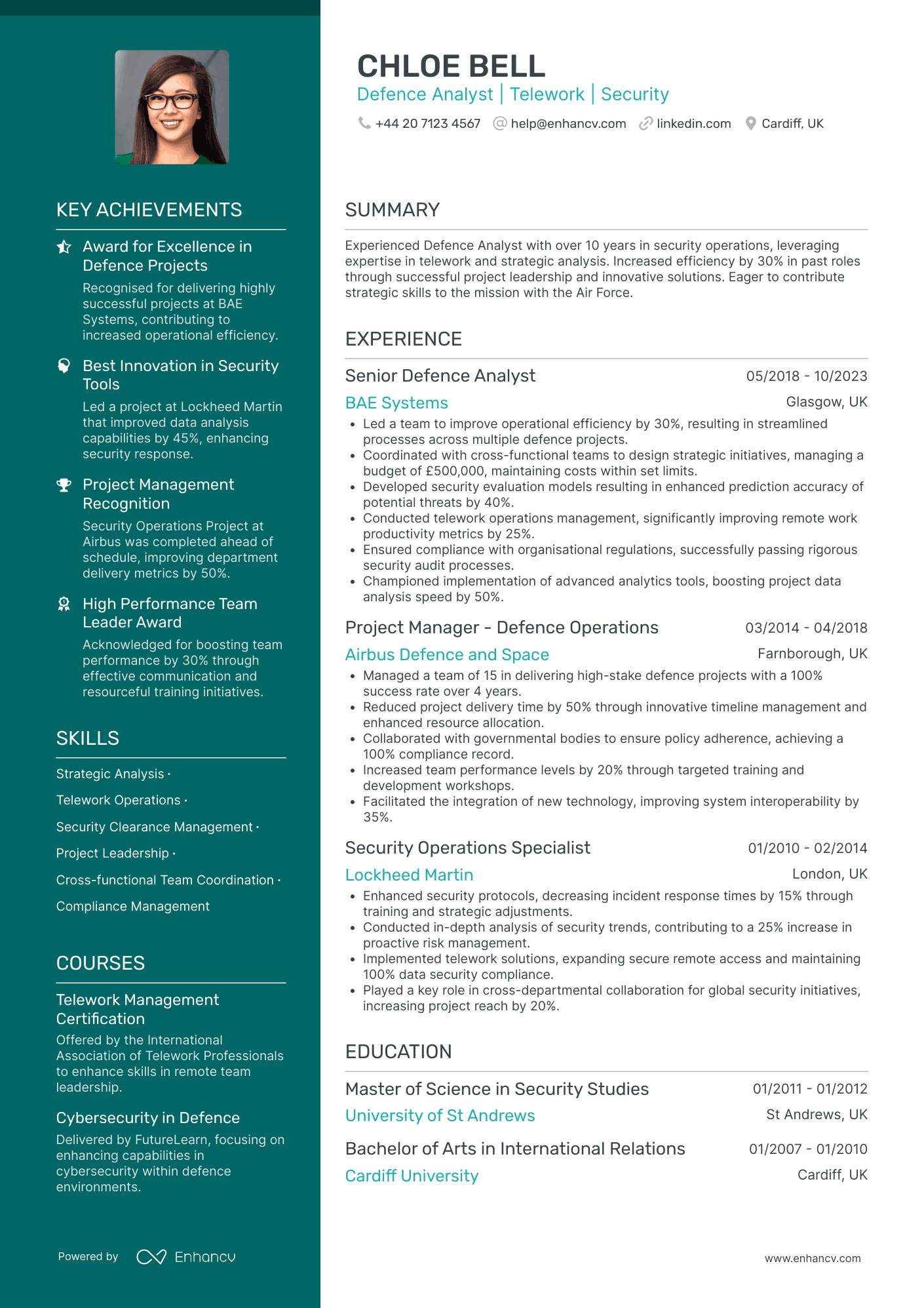
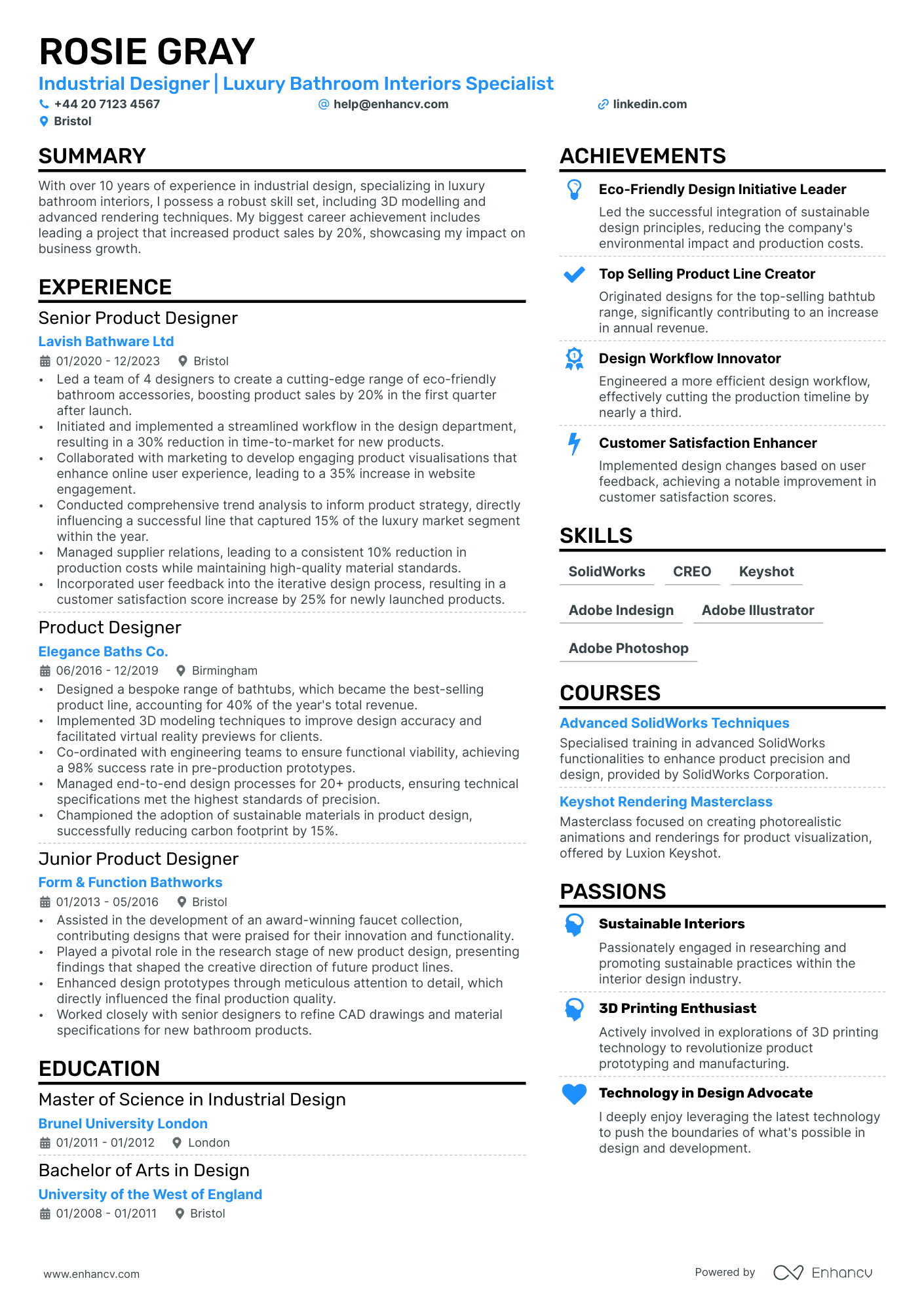
A student industrial design CV rarely wins on years of experience. It wins on the work: the products you have sketched, modelled in CAD, prototyped, and can talk a recruiter through in an interview.
Most graduate CVs bury that work under a skills grid and a line about being passionate about design. The strong ones lead with a portfolio link and two or three projects written up like real jobs, so the first thing a recruiter sees is proof you can design.

Key takeaways
- No professional experience is normal for a first industrial design CV. Lead with projects, a portfolio link, and the tools you actually use.
- Put your portfolio URL in the header. Recruiters click it before they finish reading.
- Write coursework, competitions, and placements like jobs: a dated heading, your role, and the outcome.
- Name the exact software you have used, SolidWorks, Rhino, Blender, or Cinema 4D, not just "CAD".
- One page as a graduate, sent as a PDF unless the advert asks for Word.
- Show process, not only final renders. Sketches, CAD, and prototypes prove how you think.
Writing an industrial design CV with no experience
Industrial design is one of the most portfolio-led fields there is. Employers hire on the work you can show rather than the years you have served, which is why a graduate CV can compete with a mid-weight one.
So your first CV carries its weight differently. Use a skills-based structure: personal statement, portfolio link, projects, then education, with any part-time or retail work lower down.
Mine your degree for real design evidence. It is already there:
- Live briefs set by real companies, with the constraints and the client named.
- Your final-year or major project, written up with the problem, your process, and the result.
- Design competitions and awards, even a shortlisting.
- Self-initiated products you sketched, modelled, and prototyped for yourself.
- A placement year or internship, workshop and model-making work, or hackathons.
Write each one in the language of the job. "Designed and prototyped a flat-pack stool to a live brief from a local manufacturer, tested with eight users" is an industrial design bullet that happened at university.
Structure a project entry the way a studio thinks: the problem you were solving, the process you ran, the tools you reached for, and the outcome you can point to. Skip the coursework framing ("Module 3B assignment") and lead with the design instead, because a recruiter reads the work, not the syllabus.
If you did a placement, give it a dated entry like a job, with responsibilities and the tools you used. A year in a studio counts as experience, not filler.
Part-time and unrelated work still earns a place, lower down and kept short. A bar or retail job that ran to a deadline, handled a till, or trained a new starter shows reliability, which a studio taking a chance on a graduate wants to see.
One line moves a graduate CV up the pile: a named live client brief, a design award, or a competition shortlisting. It signals your work has already been judged outside the studio.

PRO TIP
Recruiters skim for software they recognise. Write the exact packages you have used, SolidWorks, Rhino, Fusion 360, KeyShot, Blender, rather than a vague "3D CAD". If a job advert names a tool you know, mirror it word for word.
Building the portfolio your CV points to
Your CV is the trailer. The portfolio is the film, and an industrial design recruiter clicks the link before they reach your third bullet.
Put one portfolio URL in your header, next to your email, not buried at the bottom. A Behance page, a personal site, or a well-built PDF all work, as long as it loads fast on a phone.
Curate four to six projects and show the process behind each: research, sketches, CAD, CMF choices, prototypes, then the final renders. Process is what separates a designer from a stylist.
Be ruthless about what you cut. Three strong projects that show your range beat eight that repeat the same skill, and a weak project drags the average down rather than padding it out.
Match the projects you list on the CV to the ones in the portfolio, in the same order, so a recruiter can jump straight from a bullet to the full write-up. Add a one-line caption under each project in the portfolio: the brief, your role, and the tools, so the work reads even when nobody is there to talk it through.
What UK industrial design employers look for
Before you format anything, know what a studio scans an industrial design CV for. Five things come up again and again, and each one belongs on your CV in a form a recruiter can check. Treat the table below as a checklist: for every row, there should be a bullet or a portfolio project that backs it up.
| What employers look for | How to show it on your CV |
|---|---|
| CAD and 3D fluency | Name the exact packages you have used, such as SolidWorks, Rhino, Fusion 360, Blender, or Cinema 4D, and link a project that uses them. |
| Physical prototyping | Show model-making, workshop, and 3D-printing work, with photos of the prototypes in your portfolio. |
| Materials and CMF thinking | Describe the colour, material, and finish decisions you made on a project and why you made them. |
| User and consumer research | Point to a project where you tested with real users and changed the design as a result. |
| A live portfolio | One clean URL in the header, curated to four to six process-led projects. |
Formatting your industrial design CV
As a graduate, keep it to one page and use a projects-led structure so your work leads. Once you have a placement and a role or two behind you, switch to reverse chronological across two pages.
Your portfolio link belongs in the header, next to your email and location, where a recruiter will find it in the first two seconds. Type the full URL out rather than hiding it behind a word, because a printed or forwarded CV loses the hyperlink.
Keep the layout calm. A single column, one accent colour, and clear section headings let the work carry the page. Save the visual flair for the portfolio, where it belongs, and let the CV stay easy to skim.
Send a PDF unless the advert asks for Word, so your layout and any embedded images hold. Many studios screen through an ATS, so keep the CV text clean and let the portfolio do the visual persuading.
Build it from a tested layout rather than a blank page. Enhancv's CV templates export to a clean PDF that keeps your portfolio link clickable.
Writing your industrial design personal statement
Three or four sentences at the top: who you are, the kind of products you design, the tools you work in, one concrete project, and the studio you want to join. See more personal statement examples if the opening line will not come.
This is the one place a recruiter reads in full before they decide whether to open the portfolio, so make it work. Keep it in your own voice, cut anything that could sit on another graduate's CV unchanged, and end on the kind of role you are after so the reader knows where you are heading.
Skip the adjective soup that opens most graduate CVs. "Passionate and creative industrial designer" tells a recruiter nothing they can picture or check, and every other applicant has written the same line.
Anchor the statement to a specific strand of the field instead. Consumer electronics, furniture, medical devices, and packaging are different worlds, and naming yours tells a studio you know where you fit.
Lead with evidence instead. Here is the difference:
Industrial design personal statement (too vague)
Passionate and creative industrial design graduate with a keen eye for detail and a love of solving problems. Skilled in CAD and prototyping, I am a team player looking for an exciting opportunity to grow and make an impact in a forward-thinking studio.
Industrial design personal statement (graduate, evidence-first)
Industrial design graduate (2:1, Loughborough) focused on consumer products and furniture. Comfortable in SolidWorks, Rhino, and KeyShot, with a final-year project that took a flat-pack stool from sketches to a user-tested prototype for a live brief. Looking to bring hands-on prototyping and a research-led process to a product design studio in the Midlands.
When we read a graduate industrial design CV, we are looking for one thing: proof you can take a product from a problem to a prototype. A line like "tested a flat-pack stool with eight users and cut the part count from nine to five" tells us more than any list of adjectives. Name the brief, your process, and the outcome, then link the portfolio page that shows the work. A concrete project beats a polished CV with nothing behind it every time.
Writing your industrial design experience section
Whether it is a placement, a live brief, or a self-initiated project, write every entry the same way: a dated heading, then verb-led bullets that show what you did and what happened. For the mechanics, see work experience on a CV.
Design work is measurable even when it does not feel like it: users tested, iterations run, part count reduced, a prototype delivered, a grade, a competition rank. Those are your CV achievements.
A self-initiated project earns a dated entry just like a placement. Give it a title, the months you worked on it, and the same verb-led bullets, and it reads as work rather than a hobby. Recruiters care that you can run a brief end to end, not who set it.
Rewrite every duty as a result. "Worked on a product concept" says nothing, while "Took a kitchen-tool concept from 30 sketches to a 3D-printed prototype, then cut the moulded parts from six to three for manufacture" shows judgement, process, and an outcome in one line. The second version is the same project, written like a designer rather than a student.
Tailor each application by pulling the software and methods from the advert and mirroring the ones you genuinely have. Enhancv's CV tailoring feature reads the ad and suggests the matching edits, which saves rewriting from scratch for every studio.
- Supported two senior designers across three consumer-electronics briefs, from sketch concepts to CAD-ready models in SolidWorks
- Built and tested 12 foam and 3D-printed prototypes, feeding user feedback back into the design and cutting one product's part count from nine to five
- Produced CMF boards and KeyShot renders used in a client pitch that won the studio a follow-on project
- Ran two rounds of user testing with eight participants each and logged the findings for the project lead
PRO TIP
One quantified project beats five lines of duties. If you tested with users, count them. If you cut cost, weight, or part count, put the number in. Recruiters remember the CV that says "reduced the part count from nine to five", not the one that says "worked on prototypes".
Skills to put on an industrial design CV
Read a batch of UK industrial design adverts and the same demands repeat: CAD fluency, prototyping, materials, and research. List those as hard skills in the exact software names the adverts use.
The soft skills that matter here are the ones a studio can see in your work: communication, collaboration, and the patience to iterate. Prove each one in a project bullet rather than just claiming it.
Group the list so a recruiter can scan it: software in one line, making and prototyping in another, research and process in a third. A wall of 20 keywords reads as noise, while three tight groups read as a designer who knows their own toolkit.
List only what you can stand behind. If you have used a tool on a real project, name it. If you are still learning it, put it under a "learning" line rather than your core skills.
Top skills for your industrial design CV:
Product design
3D CAD (SolidWorks, Rhino)
Fusion 360
Blender
Cinema 4D
Prototyping and model-making
CMF (colour, material, finish)
Rendering (KeyShot)
Consumer research
Design for manufacture
Communication
Collaboration
Problem-solving
Attention to detail
Presentation
Education and certifications for an industrial design CV
For a graduate, education sits high on the CV, because your degree and its projects are your main evidence. Give your course, university, and classification (a First or a 2:1), then two or three lines on the projects that matter.
List relevant modules only where they add something a recruiter wants, such as design for manufacture, human factors, or a specific CAD or rendering course. Add any certificates that prove software, like a SolidWorks certification.
A short, dated qualifications or training line for workshops, a placement induction, or an online CAD course rounds out a thin first CV without padding it.
Leave off A-levels and GCSEs in full once your degree is on the page. A single line stating you have them is plenty, and the space is better spent on a project write-up or a certification that proves a tool a studio actually uses.
Conclusion
Lead with the work, link a portfolio you have curated, and write your projects and placements like the jobs they prepared you for.
Pair the CV with a short cover letter that says why this studio, and a graduate application with no formal experience turns into a credible one.

Author's take - the Enhancv team
When we read a graduate industrial design CV, we are looking for one thing: proof you can take a product from a problem to a prototype. A line like "tested a flat-pack stool with eight users and cut the part count from nine to five" tells us more than any list of adjectives. Name the brief, your process, and the outcome, then link the portfolio page that shows the work. A concrete project beats a polished CV with nothing behind it every time.