



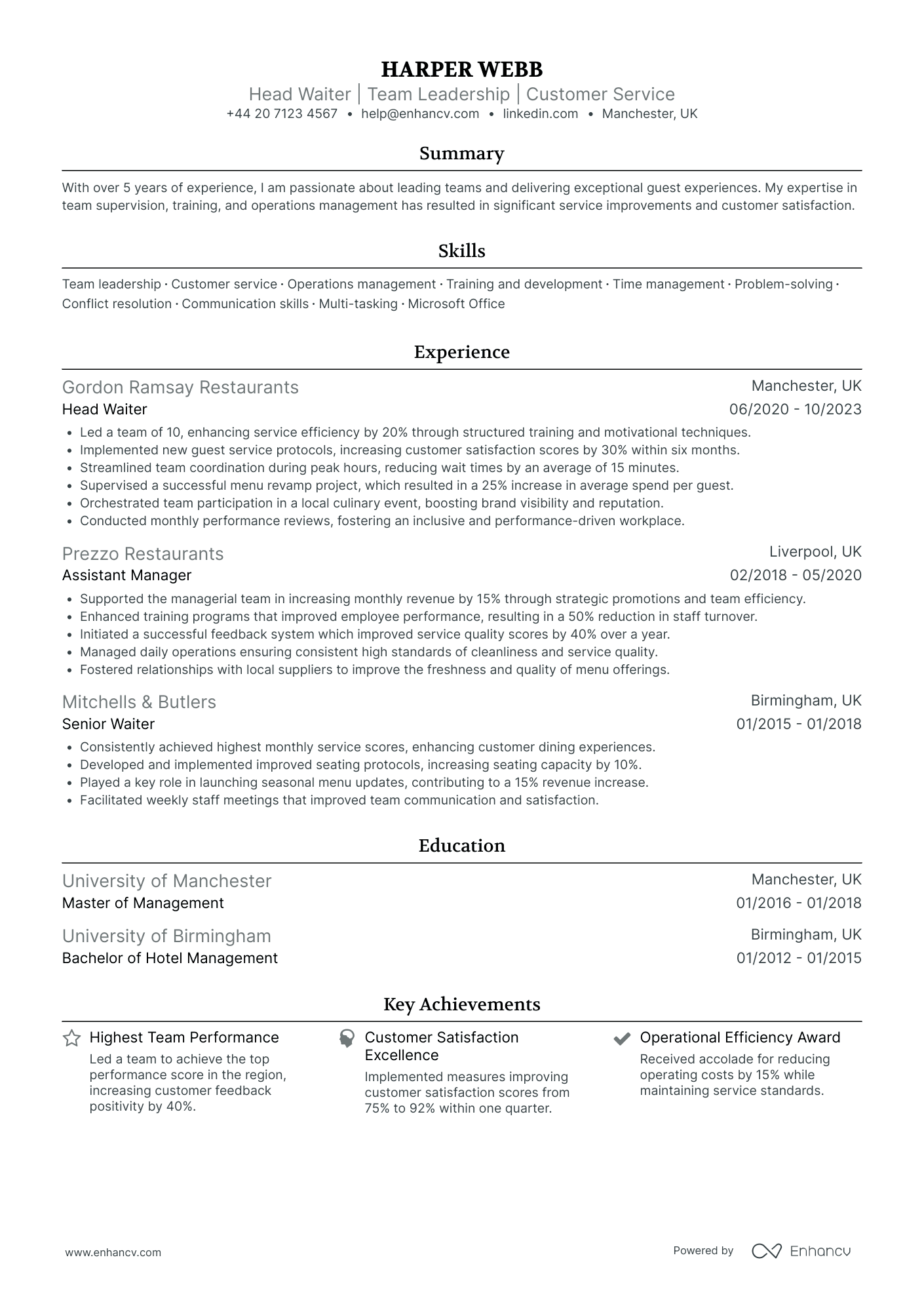
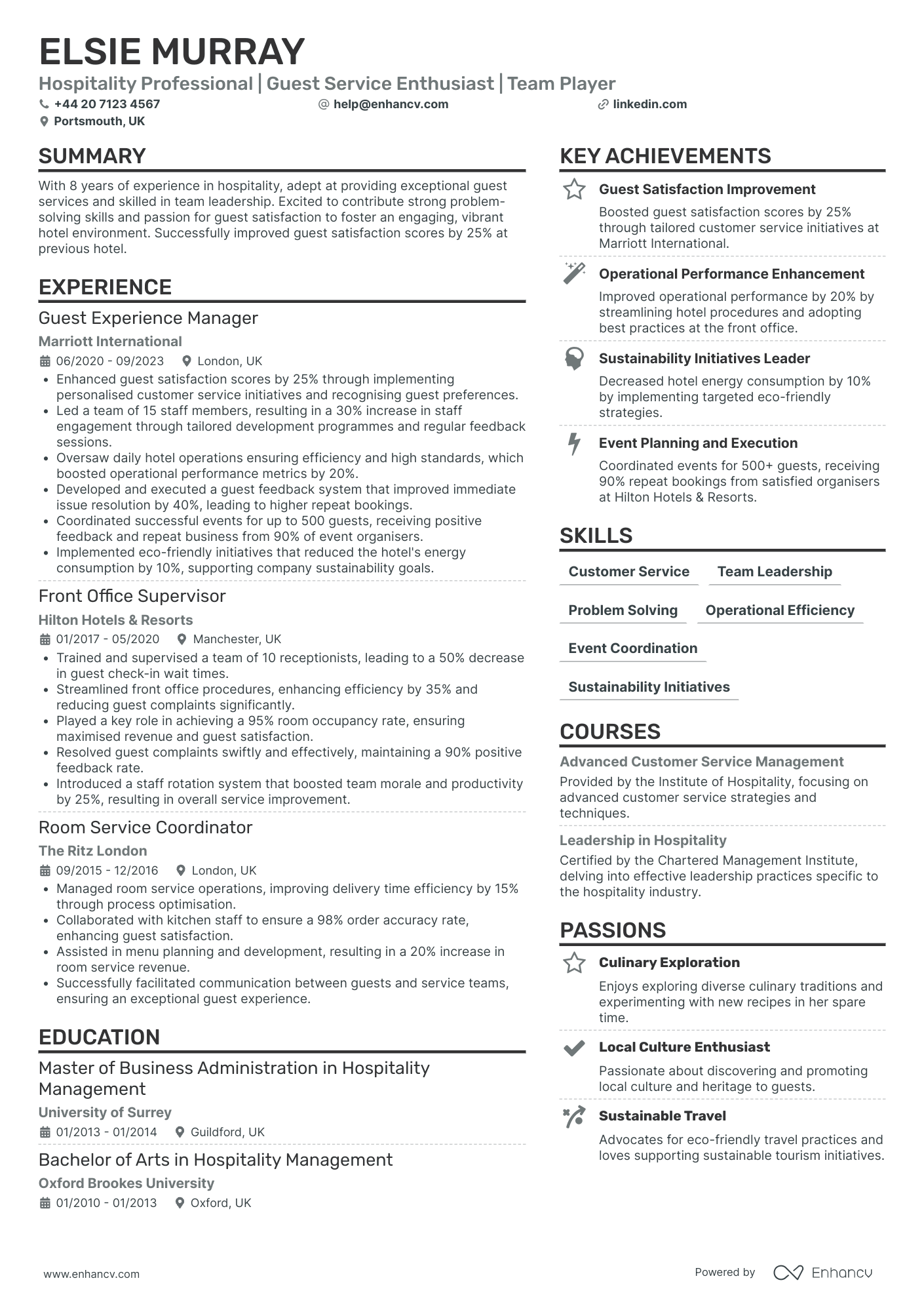
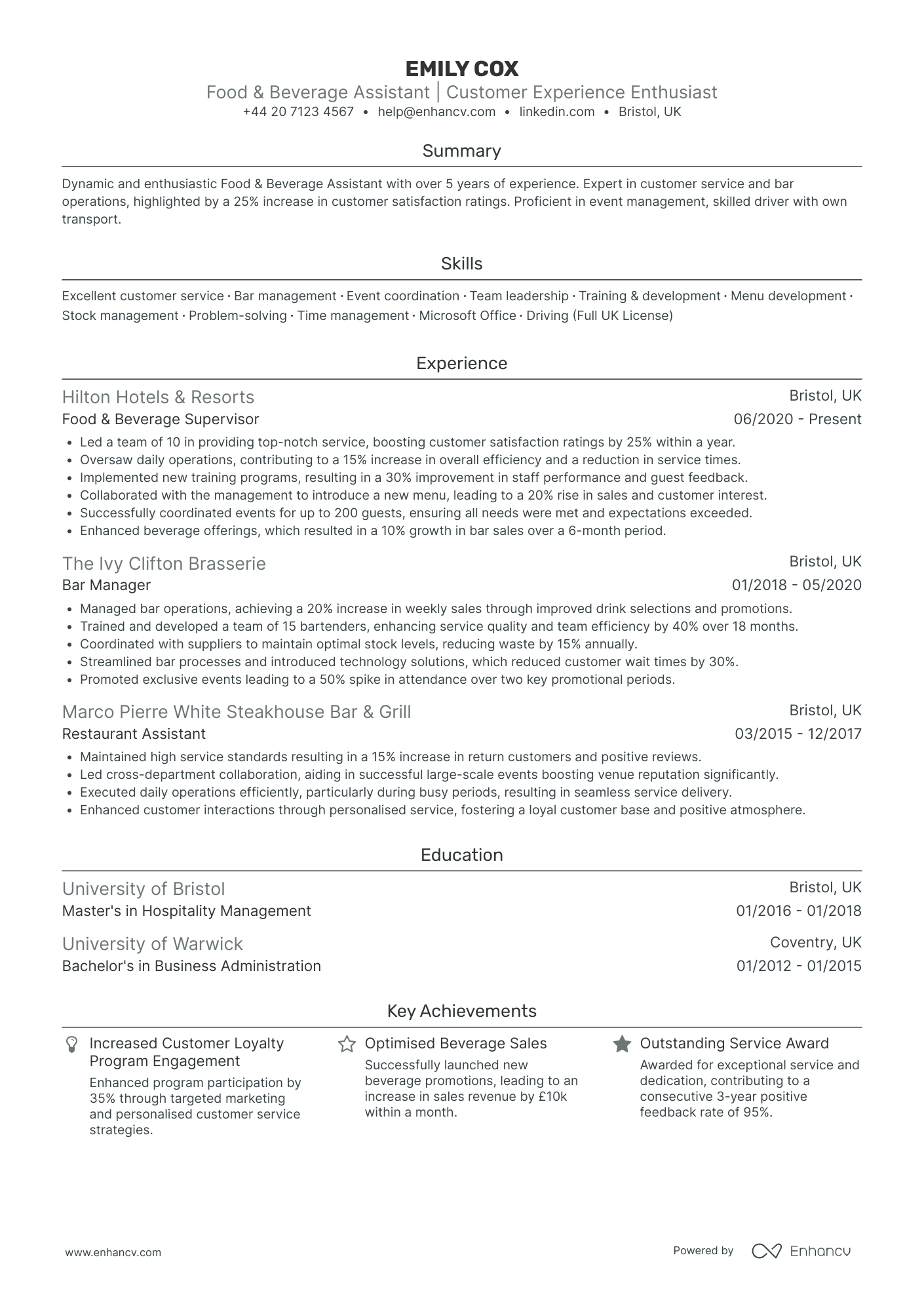
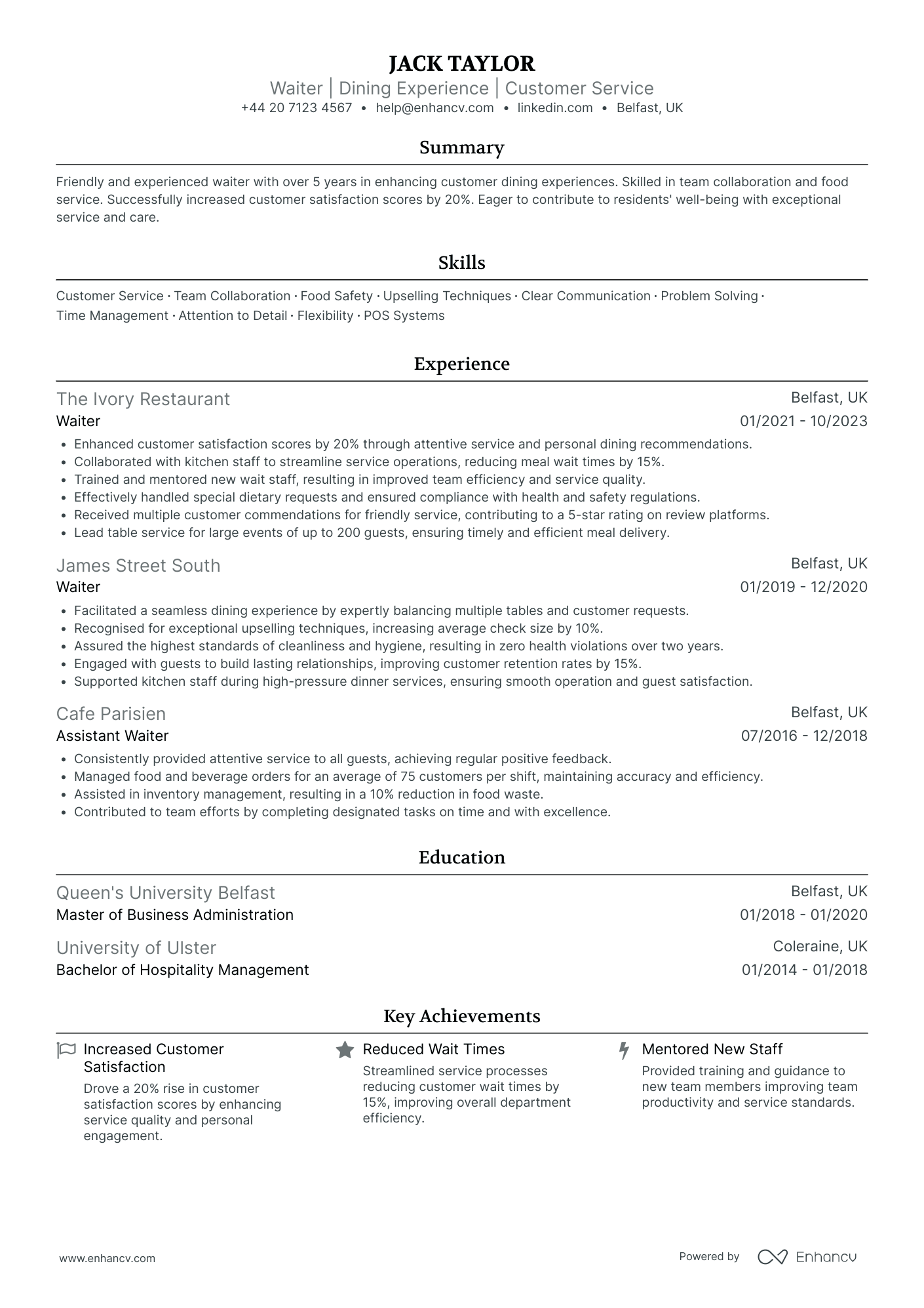
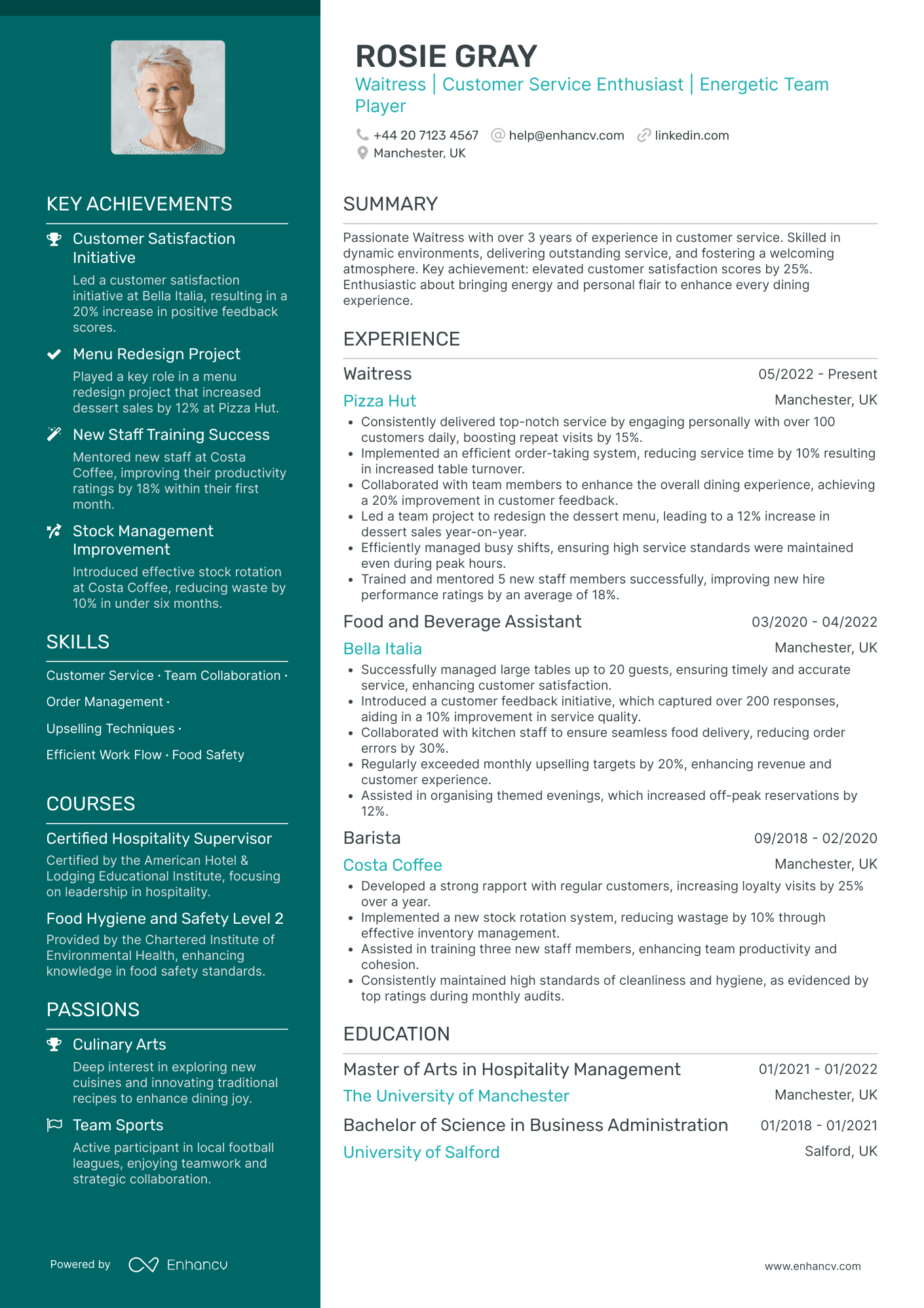
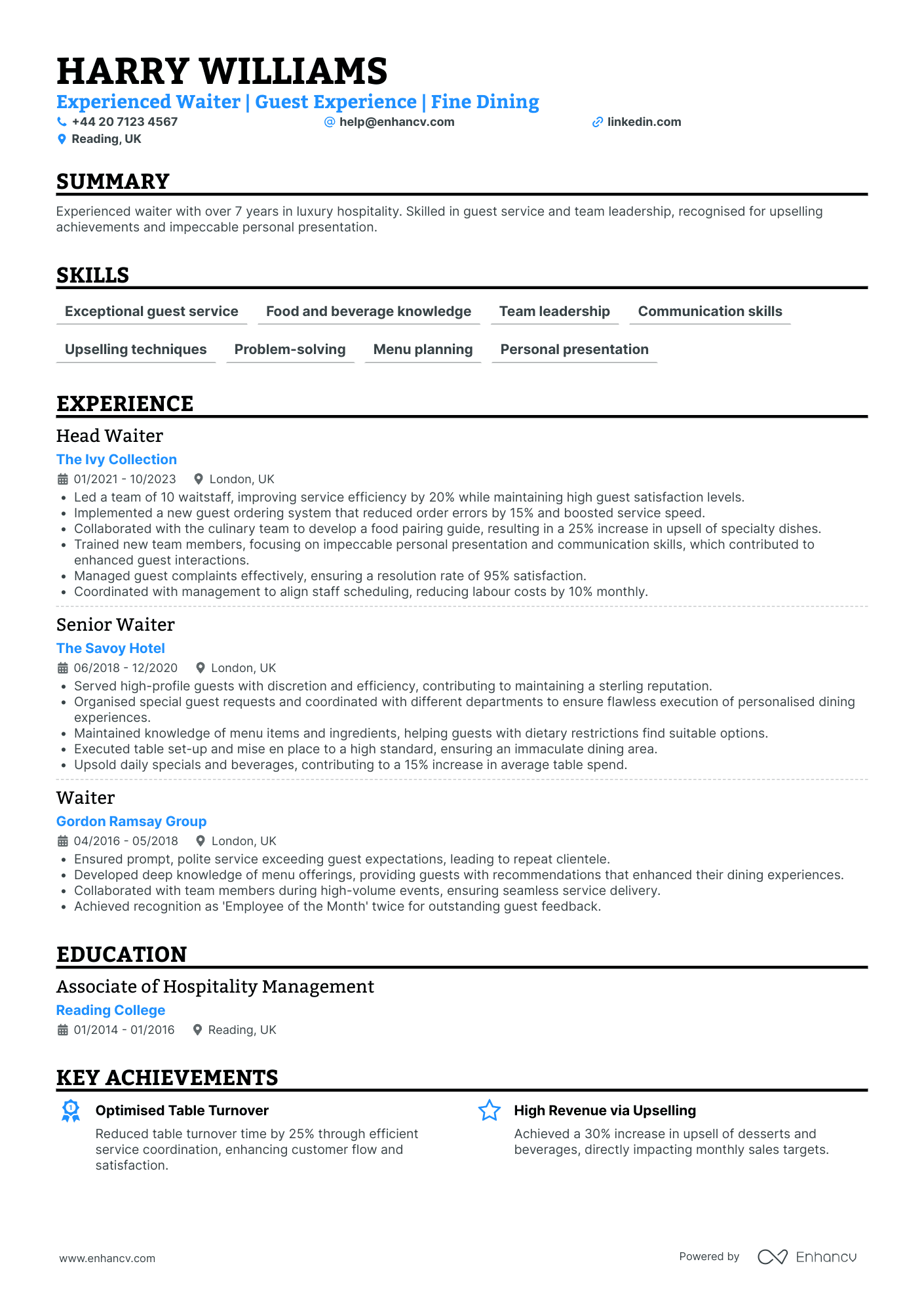
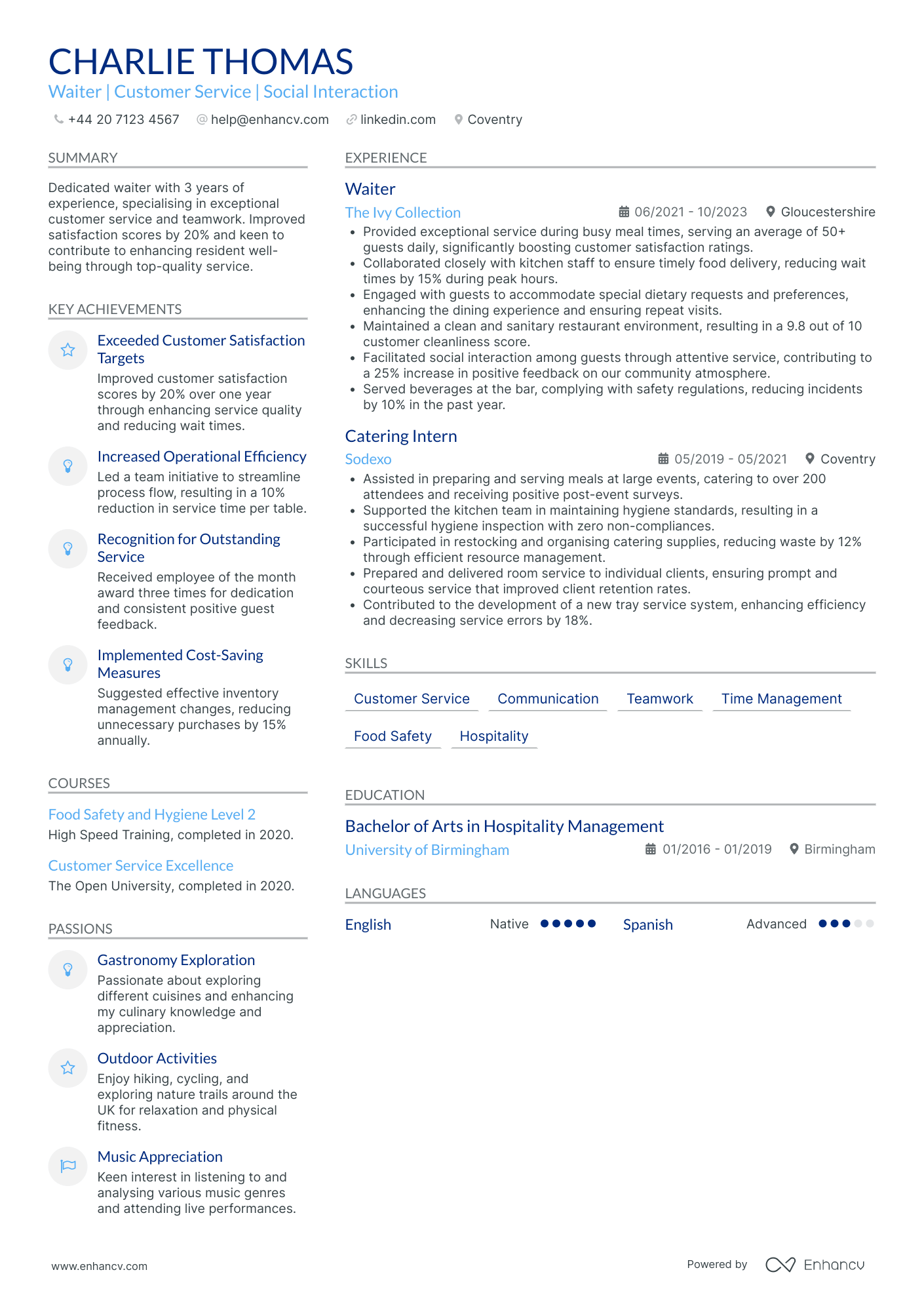
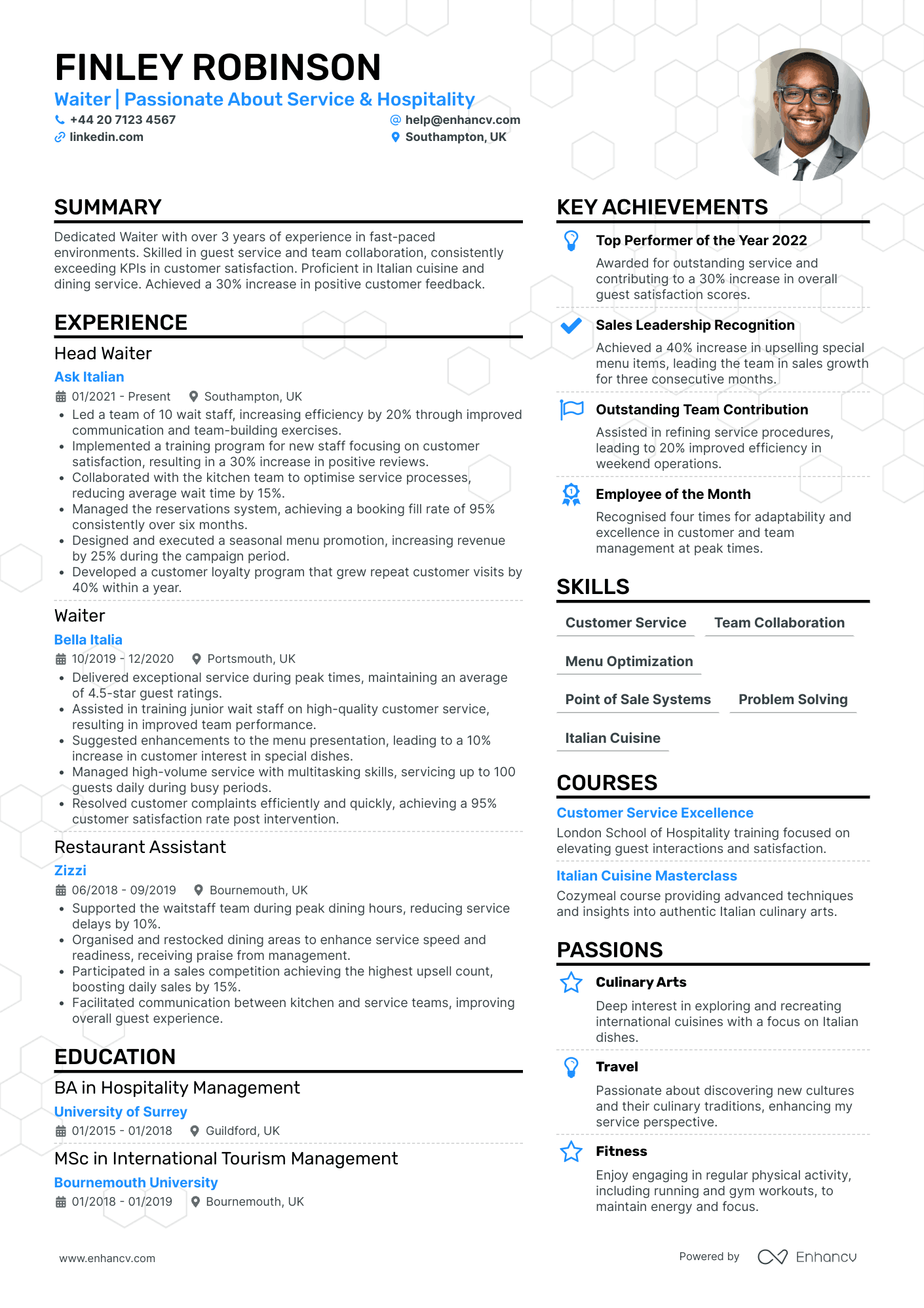
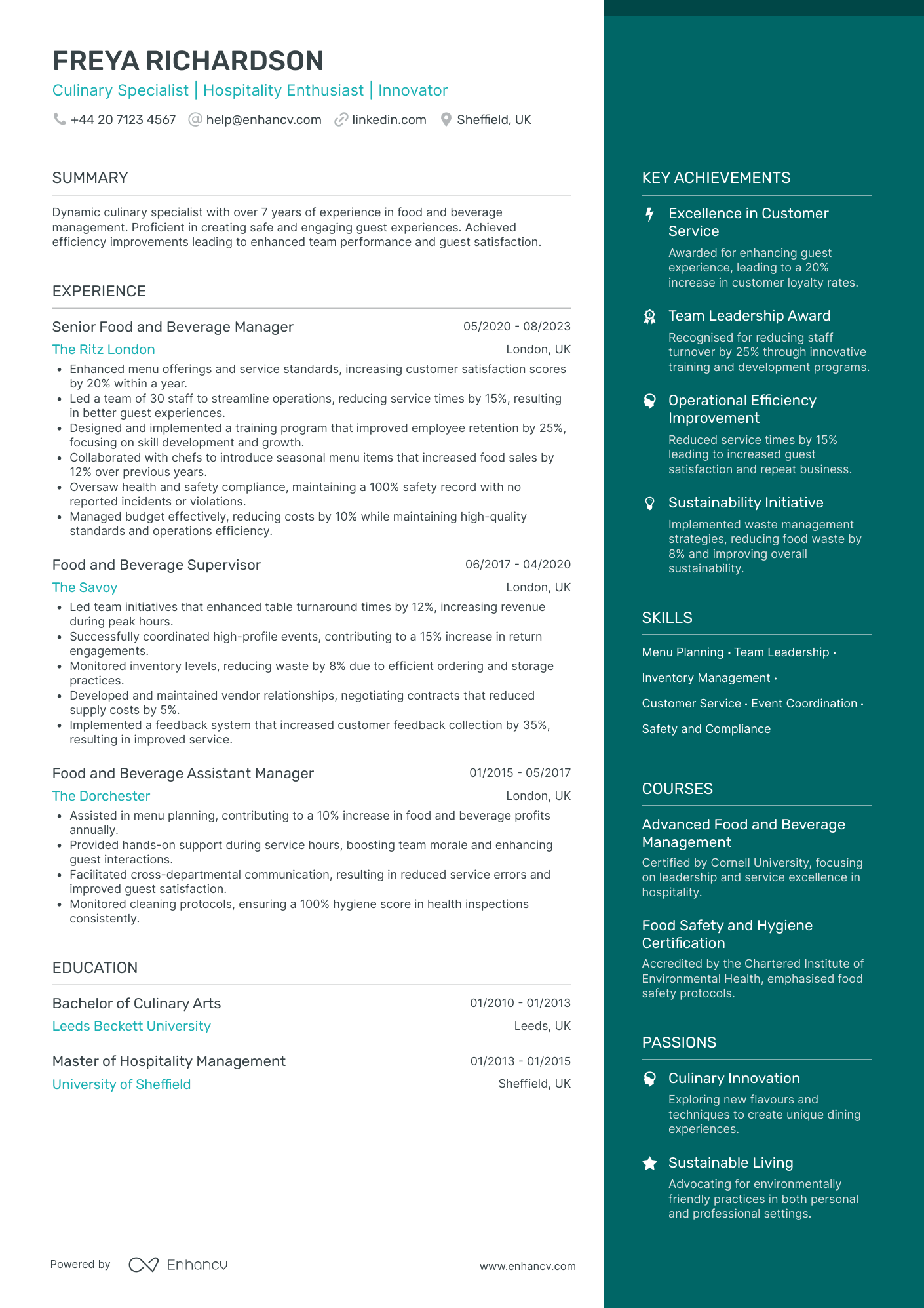
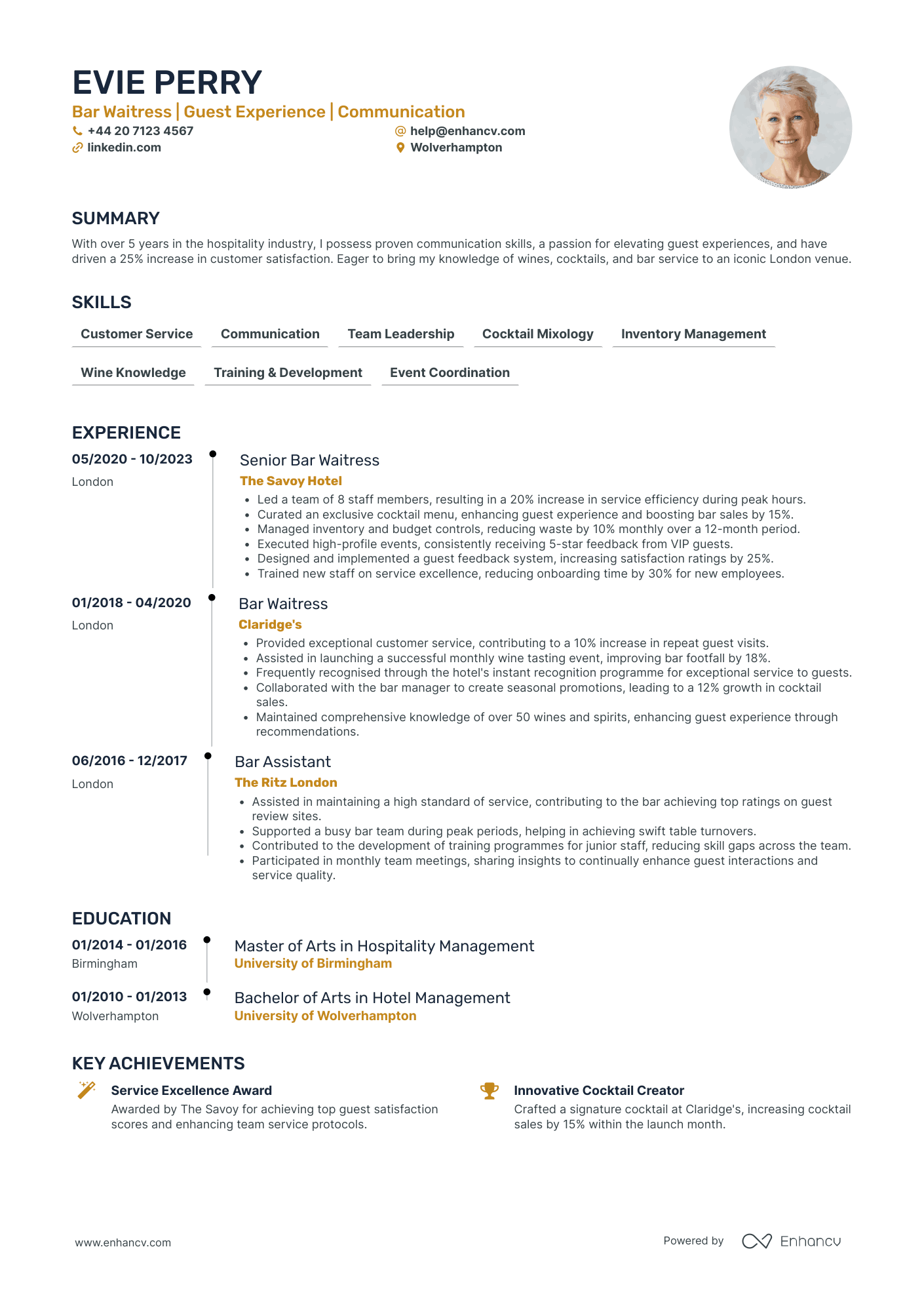
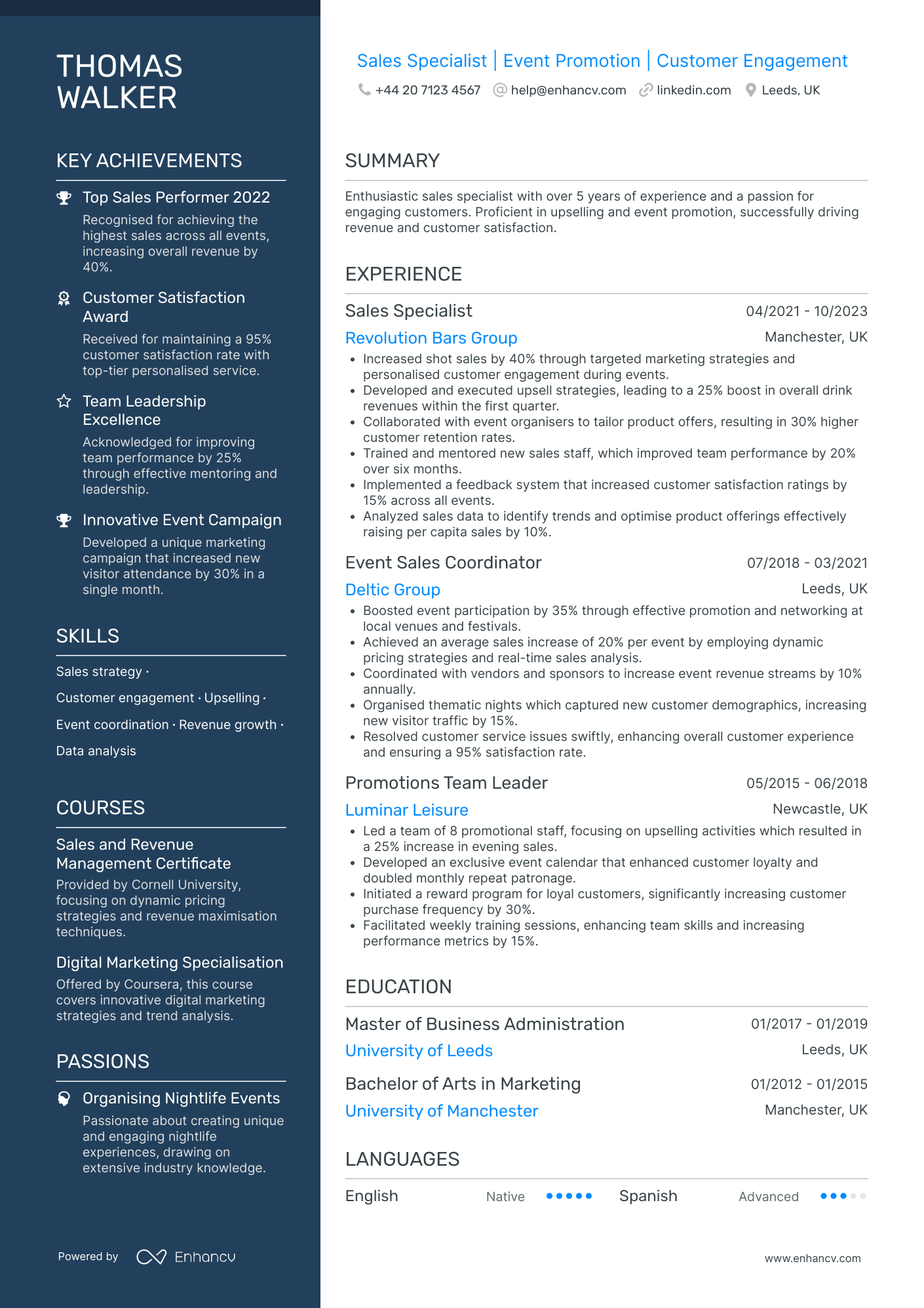
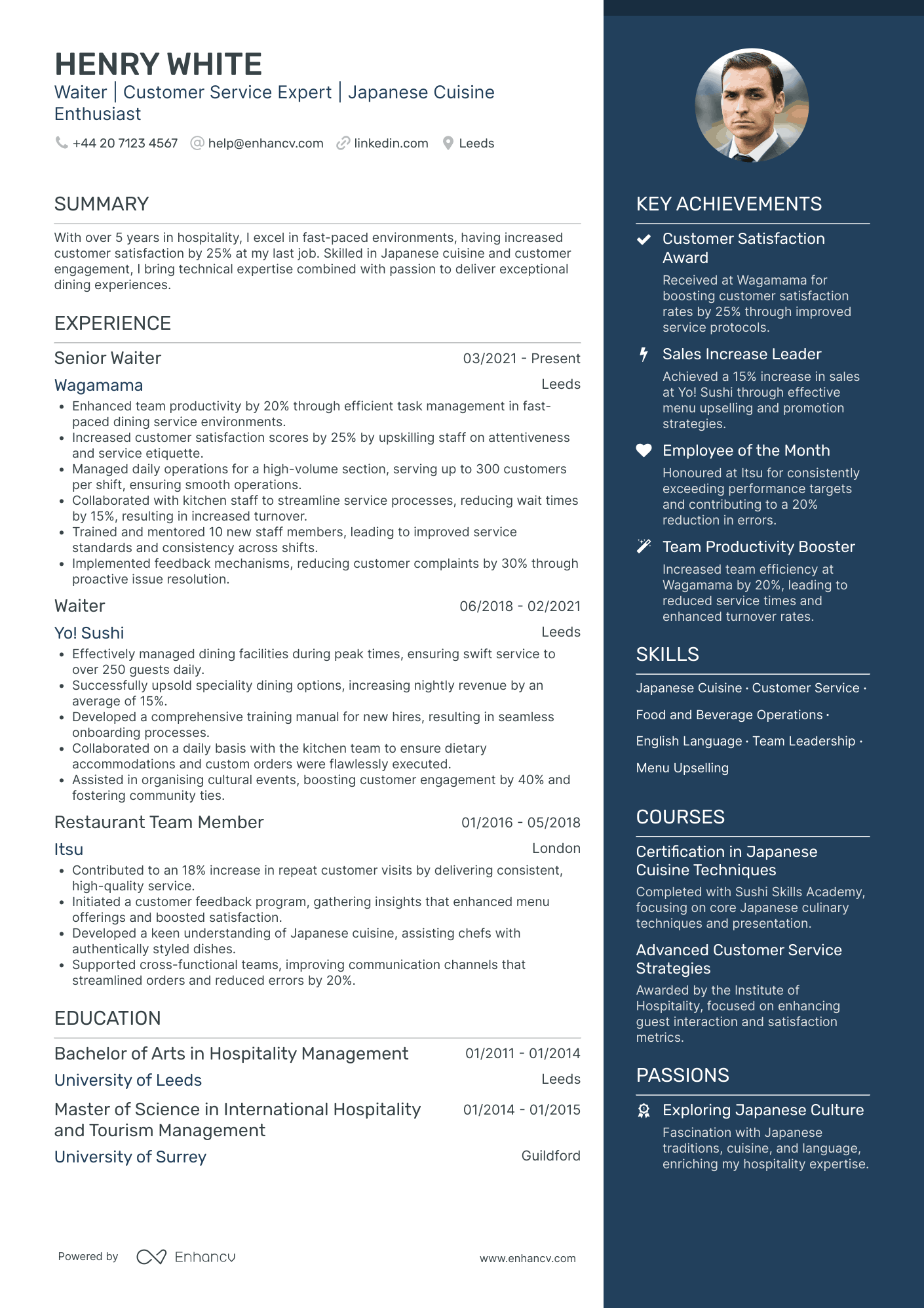
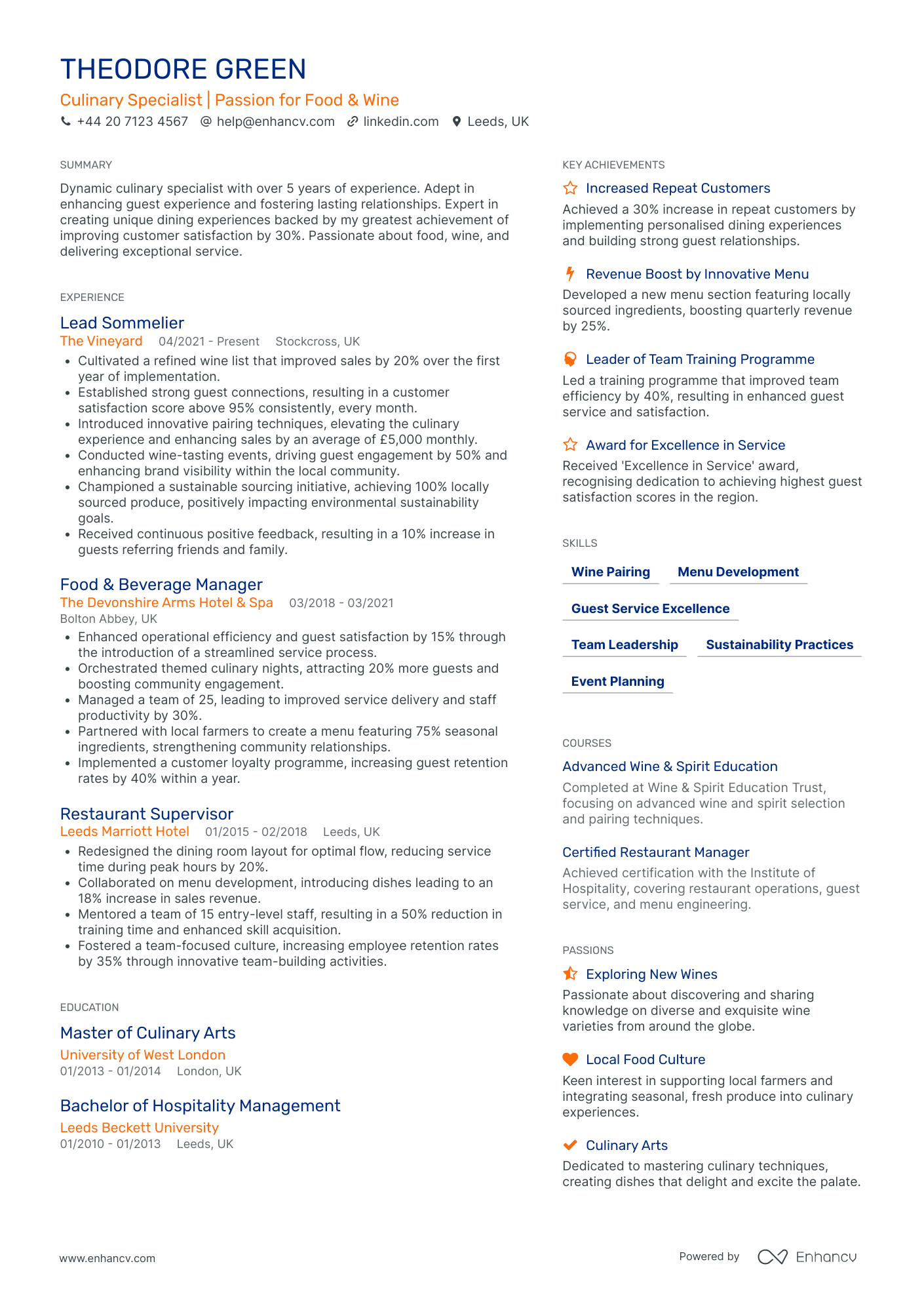
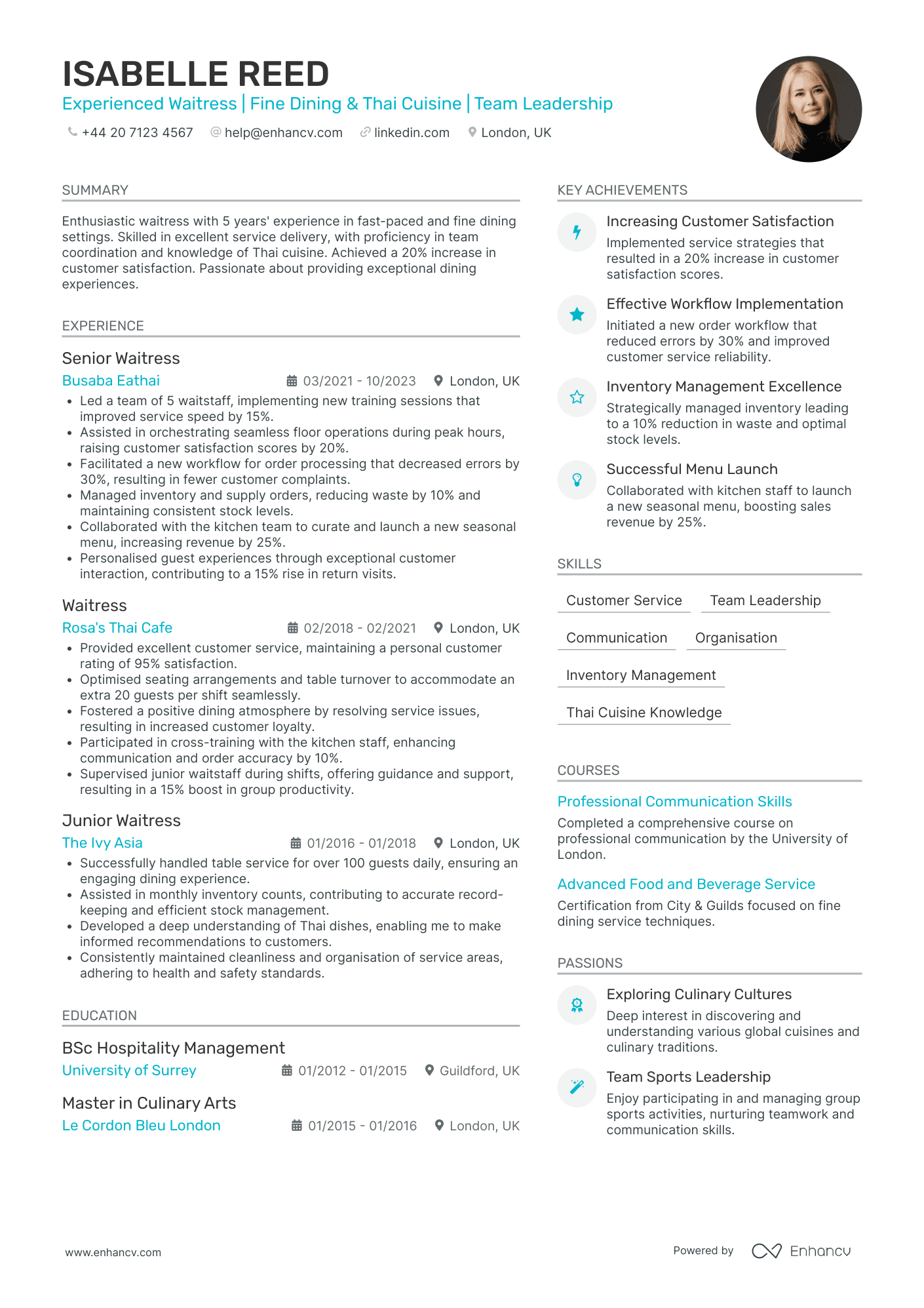
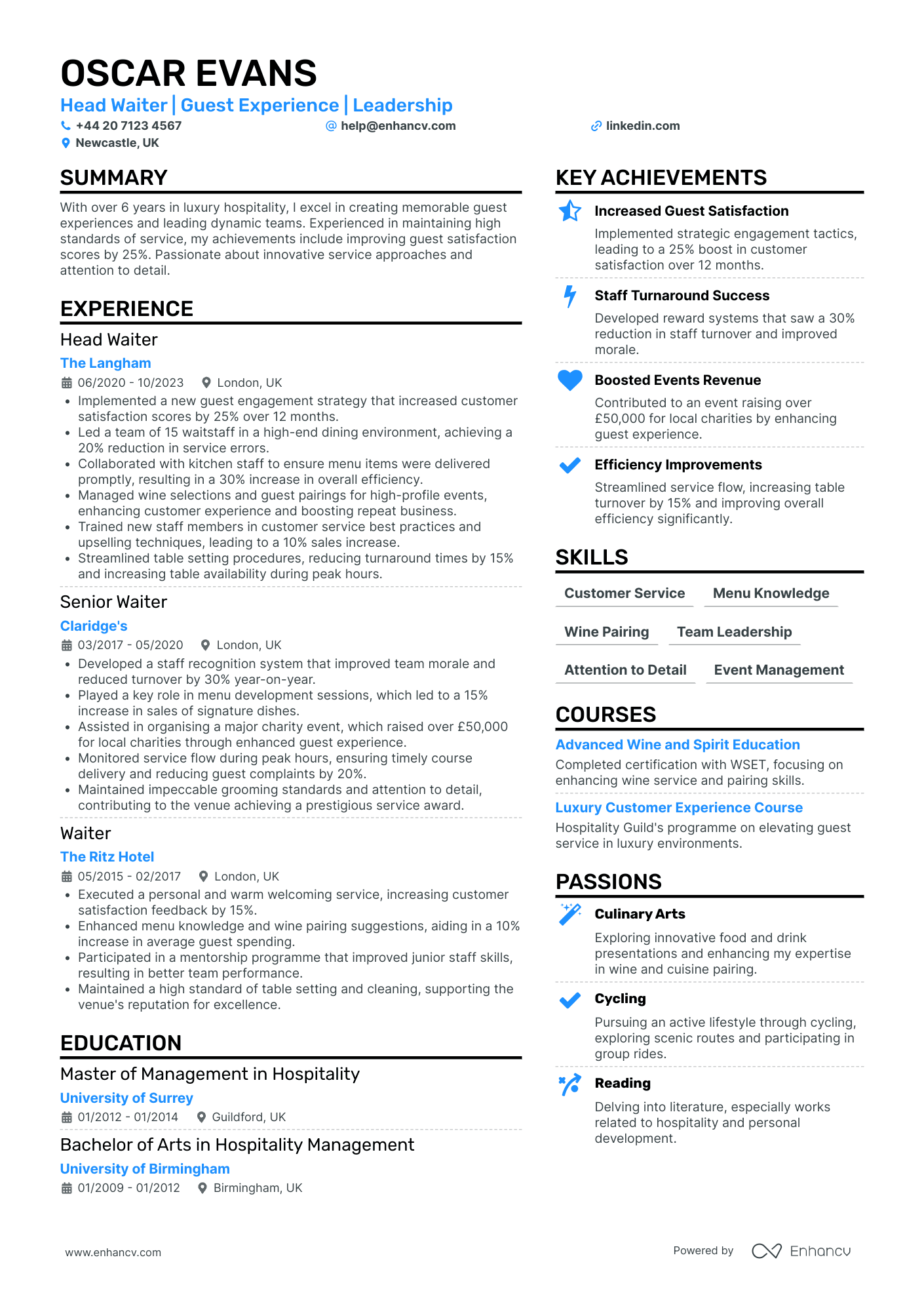
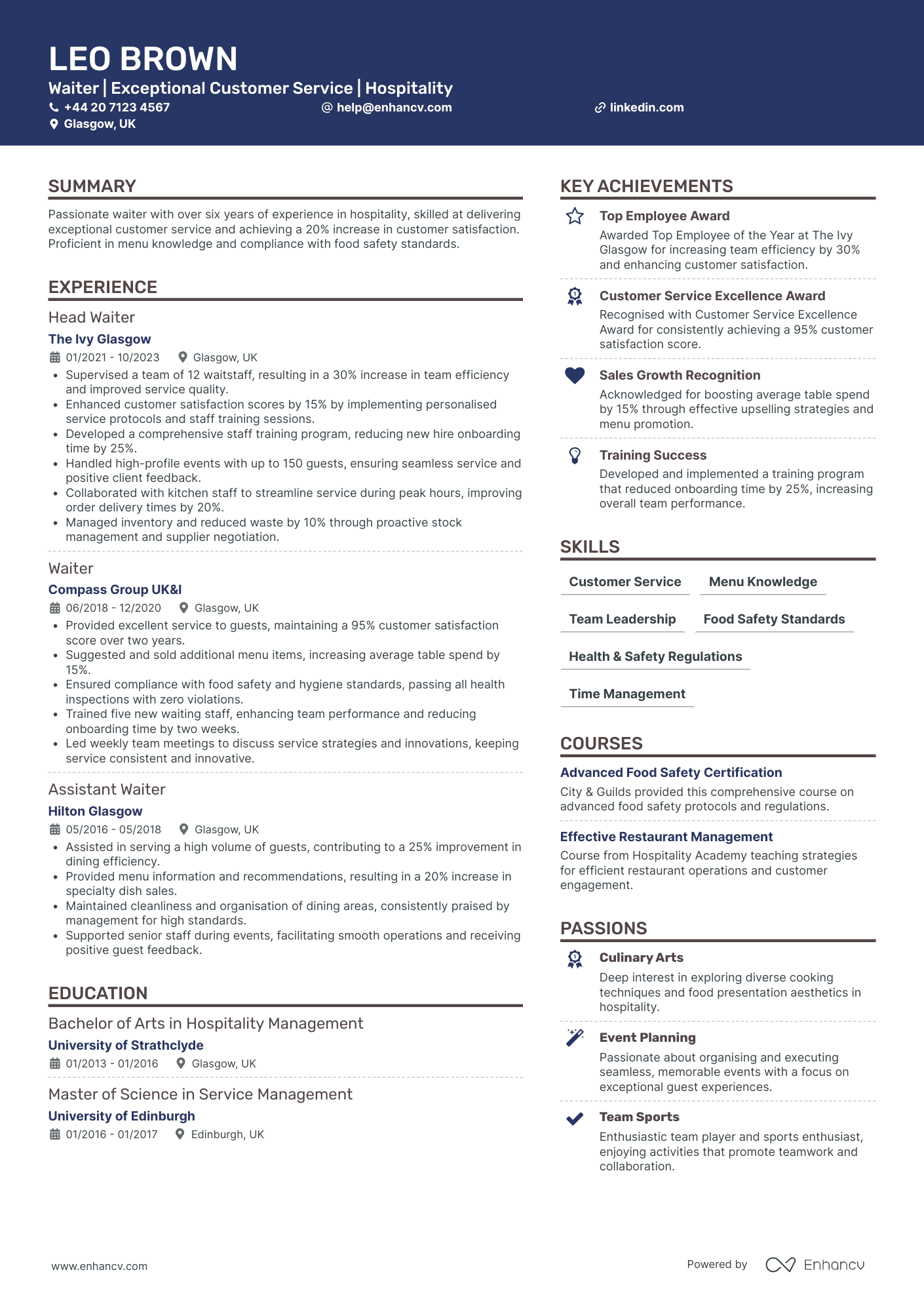
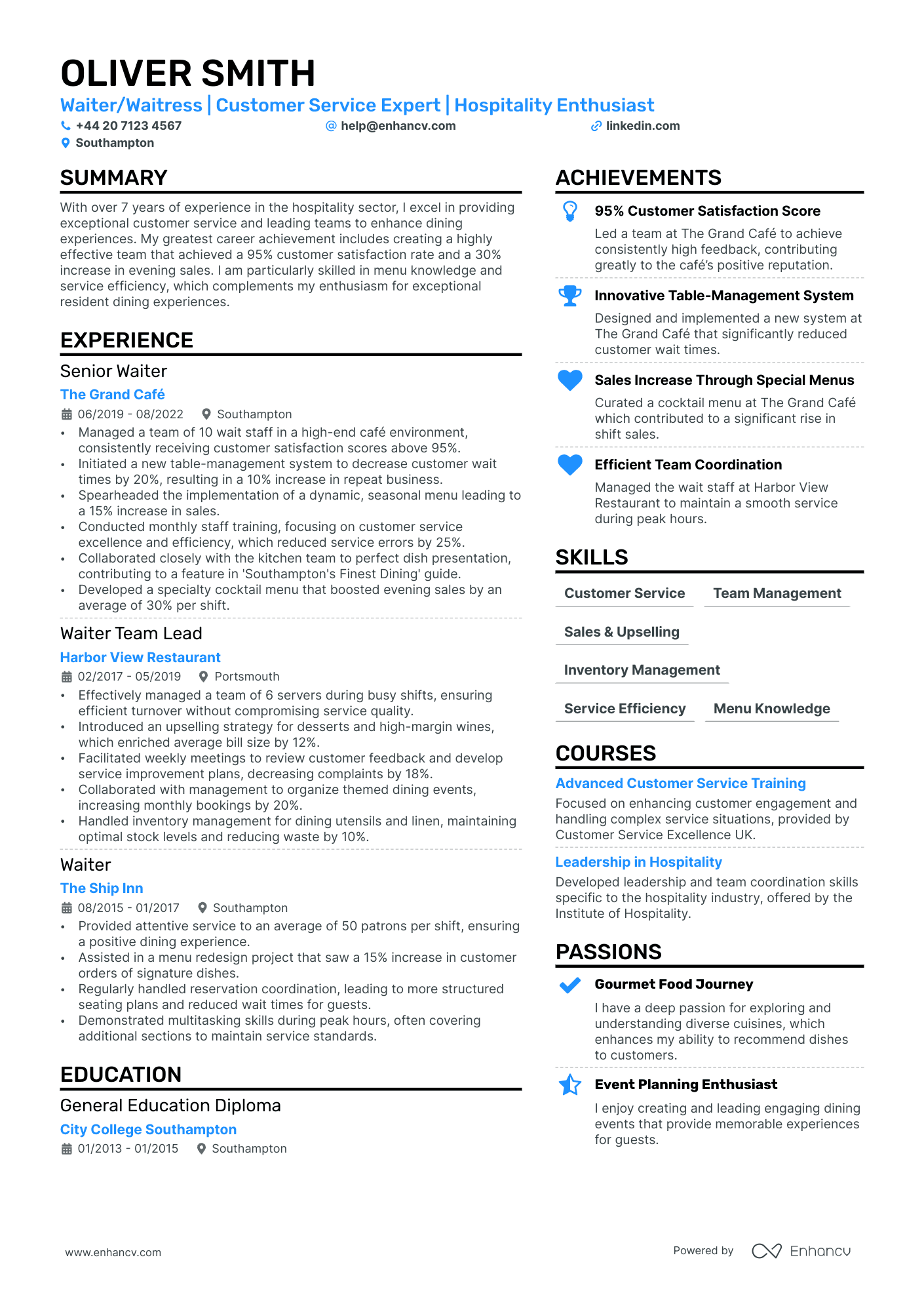
Most waitress CVs list the same handful of duties and stop there: took orders, carried plates, worked the till. A hiring manager has read that CV a hundred times, and it tells them nothing about whether you will hold up on a full Friday night.
The ones that win a trial shift prove something instead. They show you can move fast, stay calm, and keep customers happy, even when the applicant has never had a paid waitressing job. That is where this starts, because most people writing a waitress CV are writing their first one. If you want the fundamentals first, see how to write a CV.

Key takeaways
- No experience is normal for waitressing. Lead with transferable service, speed, and reliability, not an empty work history.
- Hospitality is on-site, so put your location, how you travel, and your availability for evenings and weekends near the top.
- Name the real duties employers list: order taking, food and beverage service, cash handling, table turnover, and food hygiene.
- Open with a short personal statement built on service attitude, one concrete example, and the shifts you can cover.
- Keep it to one page while your experience is thin, reverse chronological, and sent as a PDF unless the advert asks for a Word file.
- Mirror the skills that recur most in the adverts: attention to detail, customer service, and interpersonal skills.
Writing a waitress CV with no experience
Hospitality is one of the easiest sectors in the UK to break into. Restaurants, pubs, and cafes hire for attitude and train the rest on the floor, so nobody expects a first-time waitress to arrive with years of service behind her.
That changes what your first CV has to do. Lead with a skills-led structure: personal statement, then skills and any customer-facing experience, then education, with paid jobs lower down or left off entirely. This first job CV carries its weight differently from a mid-career one.
Mine your life for real service evidence. It is almost always there:
- A Saturday job in retail: handling cash, serving a queue, and staying polite when it is heaving.
- Volunteering at a community cafe, church hall, school fete, or charity event.
- Helping at family or catering events: carrying plates, clearing tables, and keeping guests topped up.
- Any role with the public: reception, stewarding, care, childcare, or a paper round that proves you turn up.
Write those in hospitality language. "Served a steady queue of customers and handled cash accurately during Saturday rushes" is a waitressing bullet that happened in a shop.
The trick is to translate, not to inflate. A shift stacking shelves becomes "kept a busy shop floor stocked and tidy between serving customers". Looking after younger siblings becomes "stayed calm and responsible while caring for others for long stretches". You are not inventing hospitality experience, you are naming the parts of your life that already look like it.
If you have volunteered, give it a dated entry like a job, with the venue, your duties, and rough hours. Volunteering on a CV counts as experience for this role, not filler. A term of Saturdays at a community cafe reads as service experience, because that is exactly what it is.
This is also where you answer the question every applicant asks, which is how to make waitressing sound good on a CV. You do it with specifics, not adjectives: covers served, tables handled at once, a busy service you got through without a dropped order.
Recruiters in hospitality move fast, so the top third of the page does most of the work. A manager who is three staff down before a Saturday service scans for two answers, which are can this person cover my shifts, and will they be pleasant to customers. Answer both before they scroll.
One line lifts a no-experience CV above the rest. State that you are available for evenings, weekends, and bank holidays, and that you can get to the venue reliably. Managers screen hard for availability, because a gap in the rota is their real problem, and a candidate who solves it is worth training.
What sinks a first CV is the opposite move: a long, generic profile followed by a wall of duties copied off the advert. Cut it. A short, specific CV that names real service moments beats a padded one every time.
What the UK waitress market looks like
Knowing what employers actually ask for tells you what to put near the top of the CV.
| What | UK waitress roles |
|---|---|
| Where the work happens | On-site (125 of 126 UK postings in the last ~30 days, Enhancv's internal job feed) |
| Experience level asked for | Entry 94% · mid 3% · lead 2% · senior 1% |
| Skills employers list most | Attention to detail, customer service, interpersonal skills, communication, and food and beverage service |
Two things there should shape your CV.
Across 126 UK waitress postings in the last ~30 days on Enhancv's internal job feed, almost all were on-site and about 94% were pitched at entry level. That is why the no-experience route above is realistic rather than wishful.
So a manager needs to see two things fast: that you can reliably get to the venue, and that you can cover the shifts they are short on. Put your area, how you travel, and your availability for evenings, weekends, and bank holidays in the header.
On pay, rates swing too much by venue, tips, and hours to quote one reliable figure here, so check the specific advert and the going rate in your area rather than trusting a headline number.
Formatting your waitress CV
While your experience is thin, keep the CV to one page and use a skills-led order so your service attitude and availability come before a short work history. Once you have a season or two of shifts behind you, switch to reverse chronological.
One column, standard headings, and a clean readable font. A busy manager skims CVs between services, often on a phone.
On length, one page is right while your work history is short, and there is no prize for stretching it to two. There is guidance on how long a CV should be, but a manager filling a shift wants the essentials, not a life story.
Put your name, phone number, email, and general area at the very top, with a line on availability right beside them. A recruiter should not have to dig to find out whether you can work Friday and Saturday nights.
Send it as a PDF so the layout holds on whatever device opens it. Keep a Word copy for agencies that place hospitality staff and reformat CVs into their own template. If the advert names a format, follow it.
Applications through the big pub and restaurant chains often pass through tracking software, so keep the layout simple and the headings standard for an ATS-friendly CV. Build it from a tested layout rather than a blank page: Enhancv's CV templates export to a clean PDF.
Writing your waitress personal statement
Three or four sentences at the top: who you are, the service attitude you bring, any customer-facing experience, and the shifts you can cover. Keep it concrete. There are more personal statement examples if you get stuck on the opening line.
This is also the answer to how you describe yourself as a waitress. Skip the adjective soup every other CV opens with. "Friendly, hard-working, and a great team player" tells a manager nothing they can check.
Lead with evidence instead:
Waitress CV personal statement example (no experience)
Reliable and friendly college leaver with two years of Saturday retail experience serving busy queues and handling cash accurately. Calm under pressure, quick to learn a menu, and used to keeping customers happy when the shop is full. Available evenings, weekends, and bank holidays, and looking for a waitressing role in a busy Leeds restaurant to build a career in hospitality.
What to avoid
Hard-working and passionate individual seeking a waitressing position. I am a great team player with excellent communication skills and a positive attitude who is always willing to go the extra mile. I work well under pressure and am looking for an opportunity to grow.
The weak version could belong to anyone applying for any job. It names no real experience, no availability, and nothing a manager could check. The strong one is specific about what the applicant has done and when she can work, which is what earns a trial shift.
When a waitress CV lands with no paid hospitality on it, we are not hunting for experience the person does not have. We are looking for proof they can handle a full room. One concrete line, like serving a Saturday queue in a shop or running food at a family event, tells us more than a paragraph of adjectives. Add the shifts you can cover and a food hygiene certificate if you hold one, and a first-timer jumps straight to the top of the pile.
The Enhancv team
Writing your waitress experience section
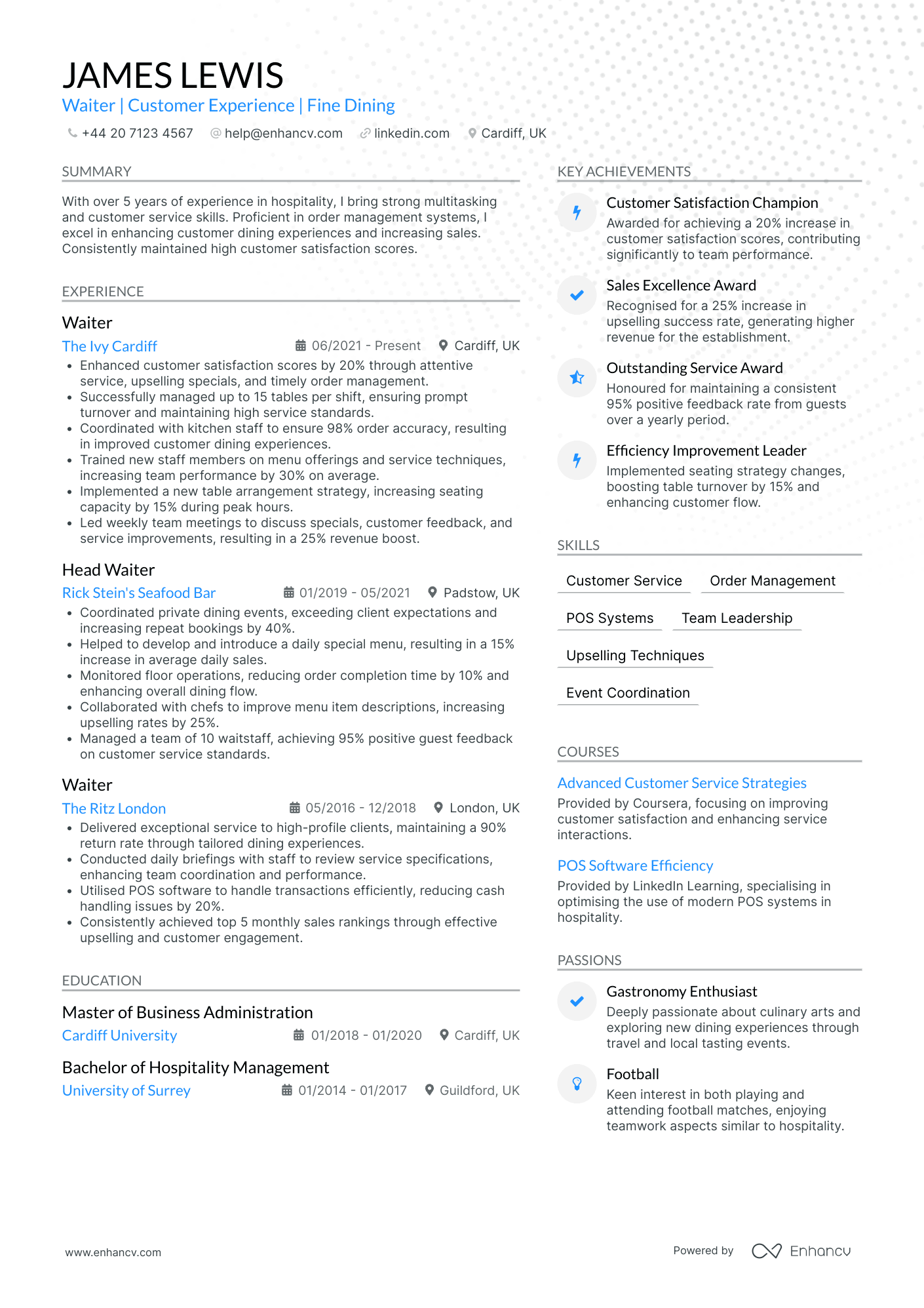
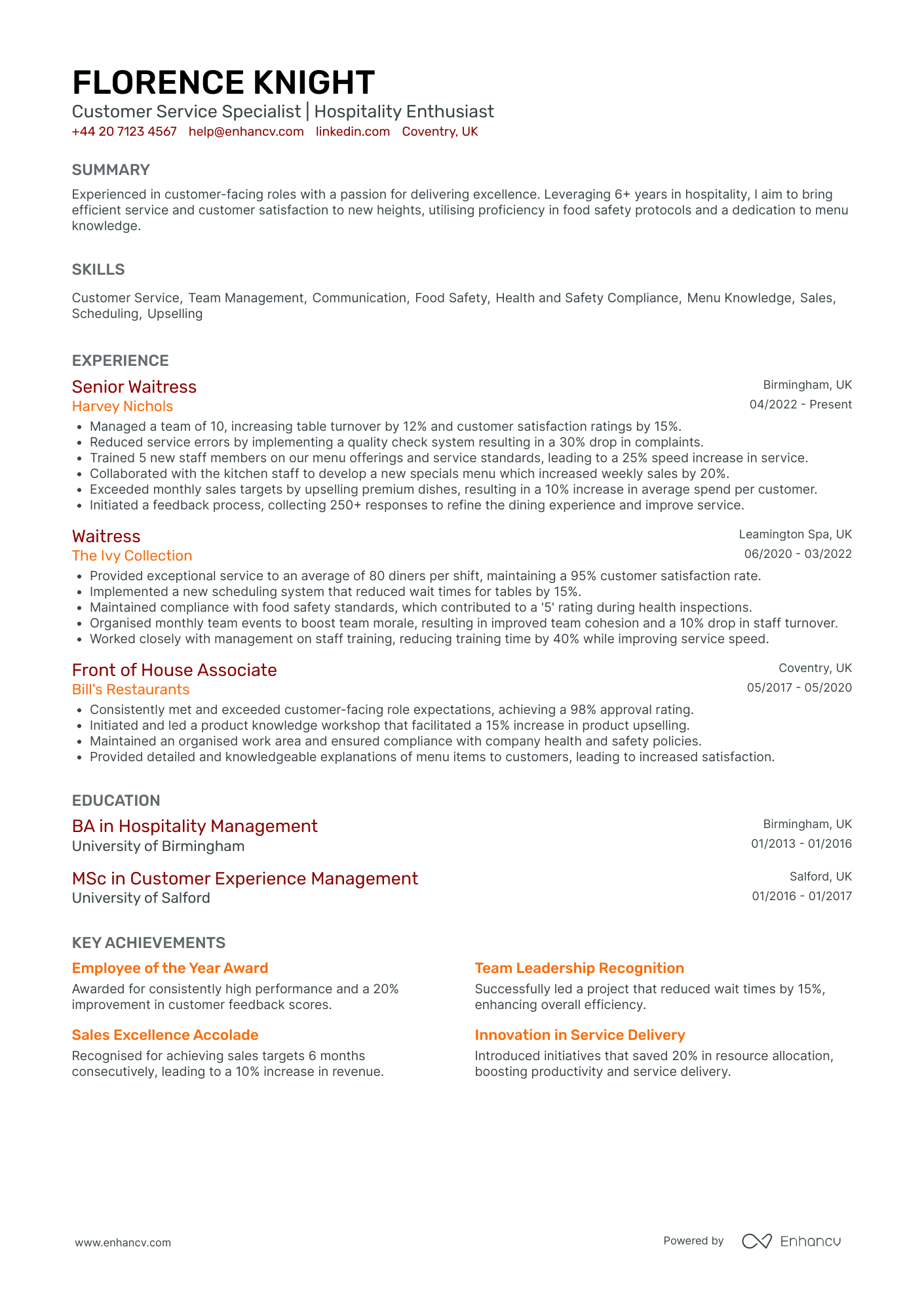
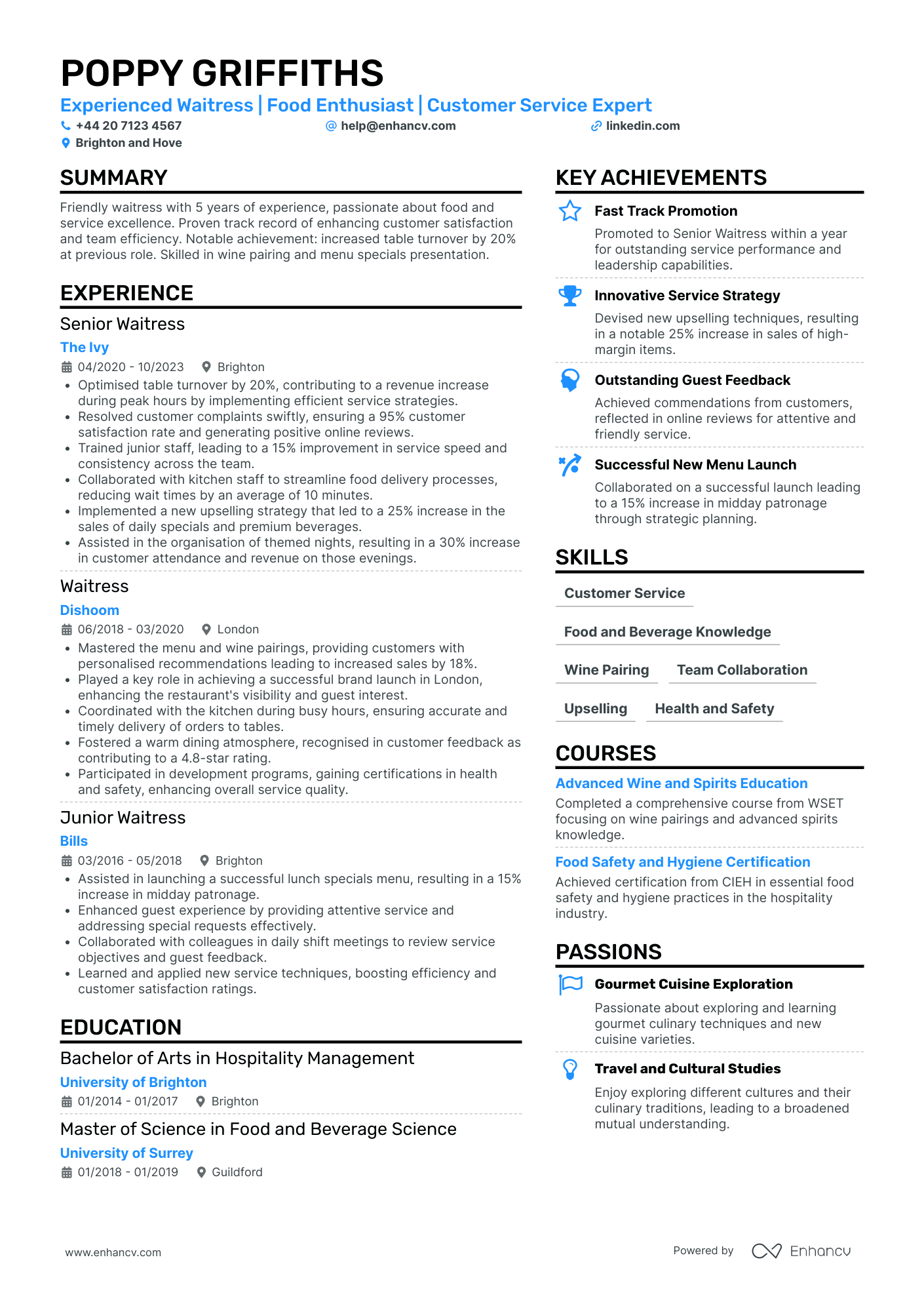
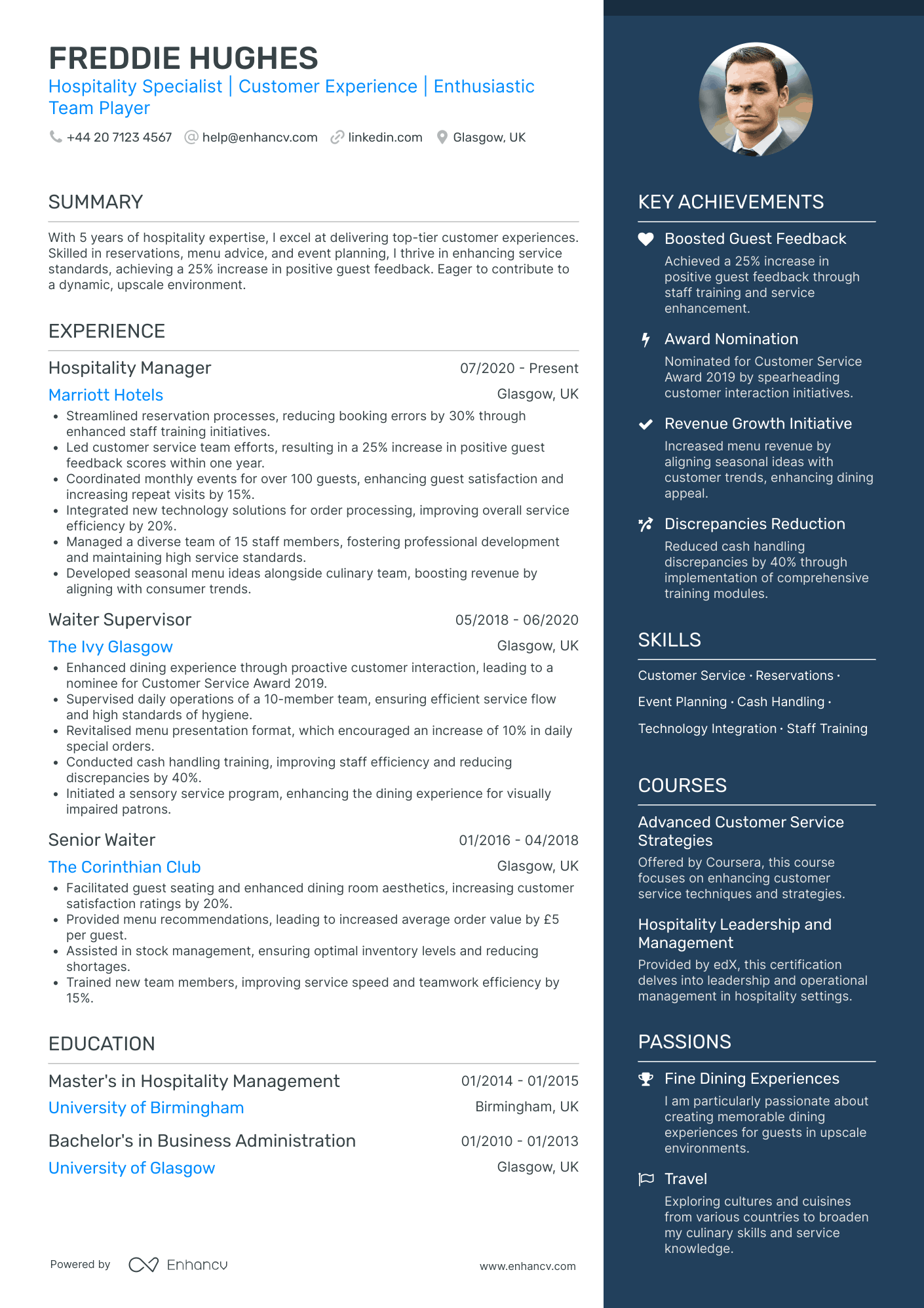
Paid, casual, or voluntary, write every entry the same way: a dated heading with the venue, then bullets that show what you did and what came of it. Start each bullet with a verb. For the mechanics, see work experience on a CV.
Waitressing is more measurable than it feels. Covers served, tables handled at once, an average spend you upsold, a shift you closed single-handed, a regular who asked for your section. Those are your CV achievements.
Compare two versions of the same duty. "Responsible for taking orders and serving food" is a line lifted straight off the job advert. "Took orders and served up to 50 covers a shift with a near-zero error rate on a fast bar menu" is a bullet a manager can trust. The second one carries a number, a pace, and a result.
Tailor every application. Pull the duties and the wording from the advert and mirror the ones that are true of you. Enhancv's CV tailoring feature reads the advert and suggests the matching edits, which saves rewriting from scratch for every pub and restaurant.
- Serve 40 to 60 covers each Saturday, taking orders, running food, and clearing tables through the lunch rush
- Handle cash and card payments at the till and reconcile the float at the end of every shift
- Learned the full menu and allergen list in two weeks and now brief new volunteers on it
- Praised by the cafe manager for staying calm and friendly when every table filled at once

PRO TIP
Waitressing adverts name real duties, not buzzwords. Mirror the ones you can back: order taking, food and beverage service, cash handling, table turnover, and food hygiene. If you hold a Level 2 Food Hygiene certificate, say so, because it saves the employer a training slot.
Skills to put on a waitress CV
Read a stack of live waitress adverts and the same requirements repeat. Attention to detail, customer service, and interpersonal skills are the ones that recur most often in UK waitress postings (Enhancv's internal job feed, last ~30 days), alongside clear communication and food and beverage service. Those are the key skills for a CV in this role, listed in the words the adverts use.
Split them the way a manager reads them. The practical, teachable ones are your hard skills: till and payment handling, table service, food hygiene, and allergen awareness.
The soft skills that matter here are checkable on the floor: customer service, teamwork, patience, and staying calm under pressure. Prove each one in a bullet rather than just claiming it.
Evidence beats a list. "Attention to detail" means little on its own, but "double-checked every order against allergen notes before it left the pass" proves it. Pick your three strongest and back each one in an experience bullet.
List only what you can stand behind. If you have been trained on a till or an allergen matrix, name it. If you have not yet, leave it off rather than padding the section.
Top skills for your waitress CV:
Food and beverage service
Order taking (POS/till systems)
Cash and card handling
Table setting and turnover
Food hygiene (Level 2)
Menu and allergen knowledge
Upselling
Health and safety
Customer service
Attention to detail
Interpersonal skills
Communication
Teamwork
Working under pressure
Education and training for a waitress CV
You rarely need qualifications to start waitressing, which is why the no-experience route works. What helps is anything that shows you are safe and trainable on the floor.
List your school or college with dates and grades if you are a recent leaver, then any hospitality-relevant training in your education section: a Level 2 Food Hygiene certificate, an allergen awareness course, or a personal licence if you will serve alcohol.
If you are still at school or college, lead with that. Recent grades, a part-time job, and a food hygiene certificate together make a stronger case than an empty experience section ever could.
None of this is mandatory to apply. Naming the certificates on a CV you already hold, though, saves the employer a question and a training cost, which is exactly the kind of detail that moves a first application up the pile.
Conclusion
Lead with service attitude and real customer-facing evidence, name the duties and the food hygiene training employers screen for, and keep the format clean and quick to skim.
Pair the CV with a short cover letter that says why you want the shift and when you can start, and a first waitressing application starts to look like a safe hire.

Author's take - the Enhancv team
When a waitress CV lands with no paid hospitality on it, we are not hunting for experience the person does not have. We are looking for proof they can handle a full room. One concrete line, like serving a Saturday queue in a shop or running food at a family event, tells us more than a paragraph of adjectives. Add the shifts you can cover and a food hygiene certificate if you hold one, and a first-timer jumps straight to the top of the pile.