



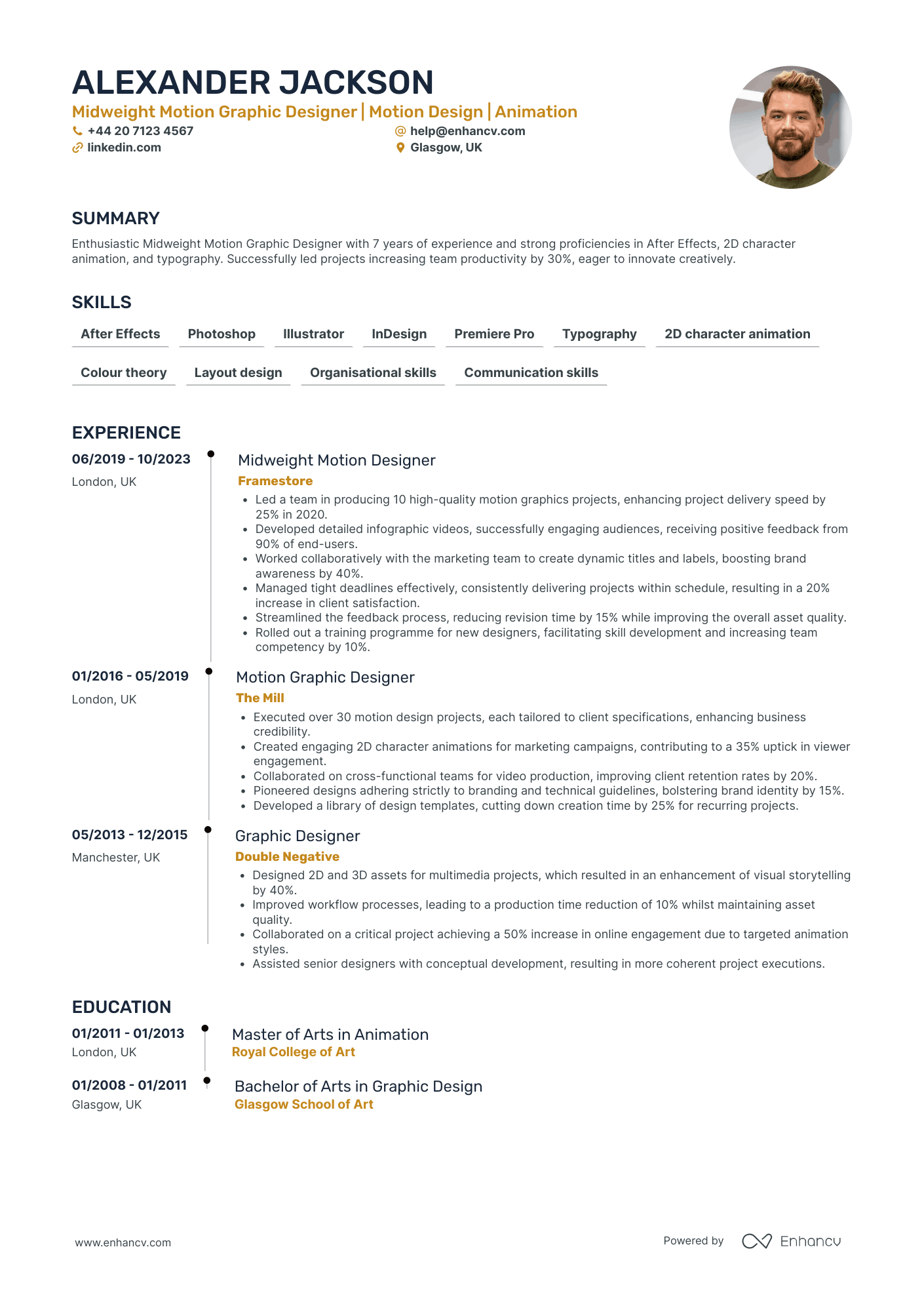
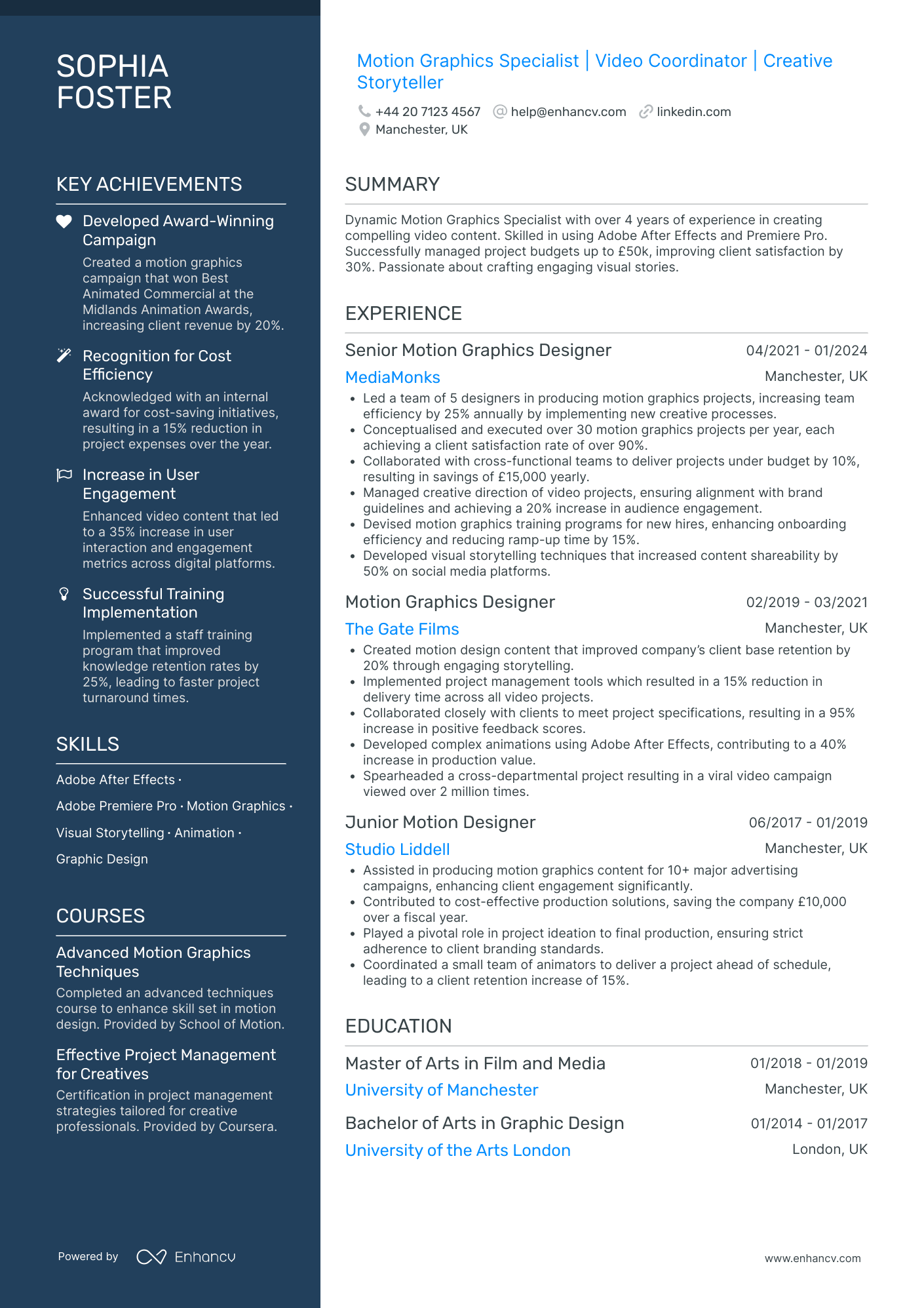
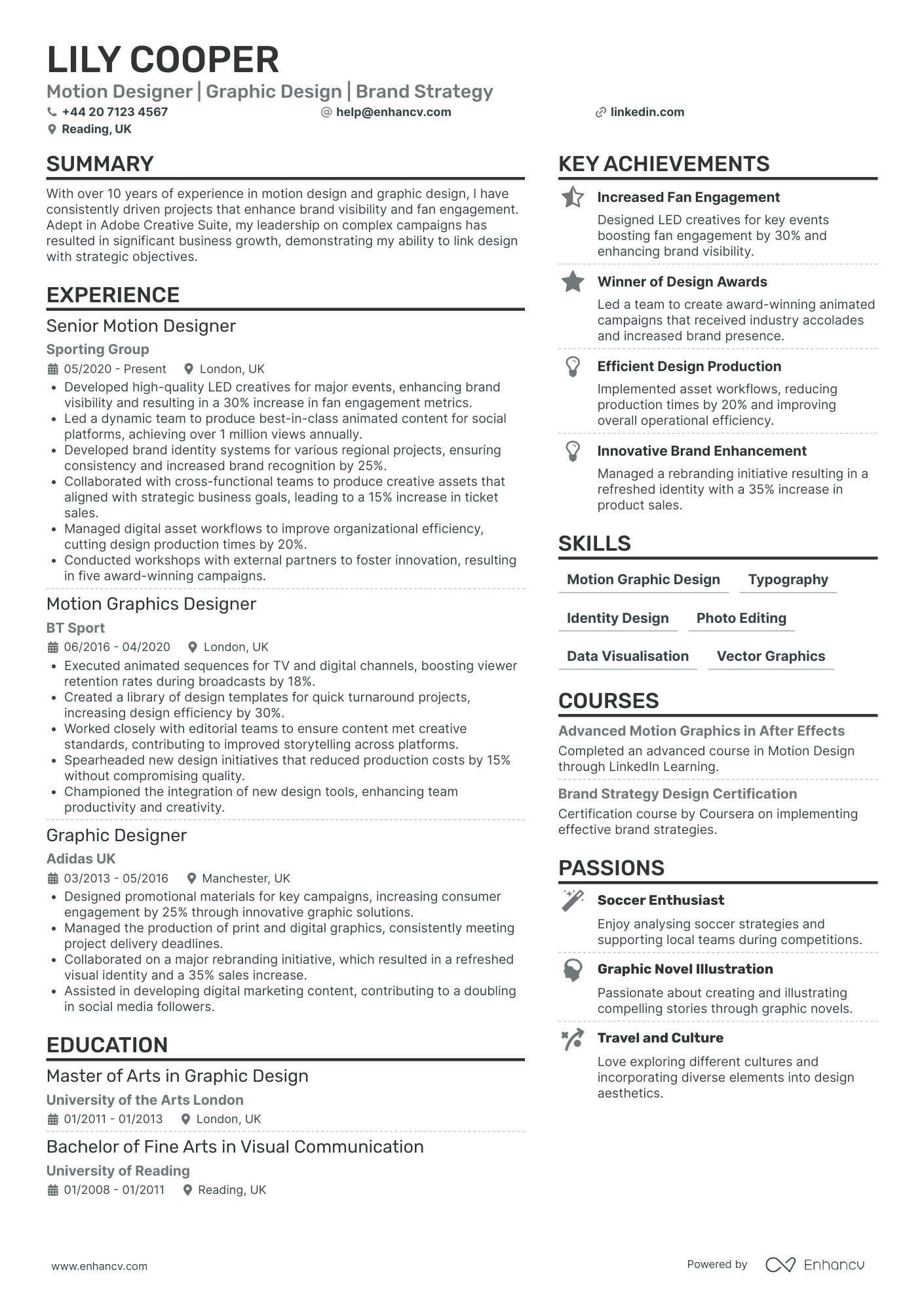
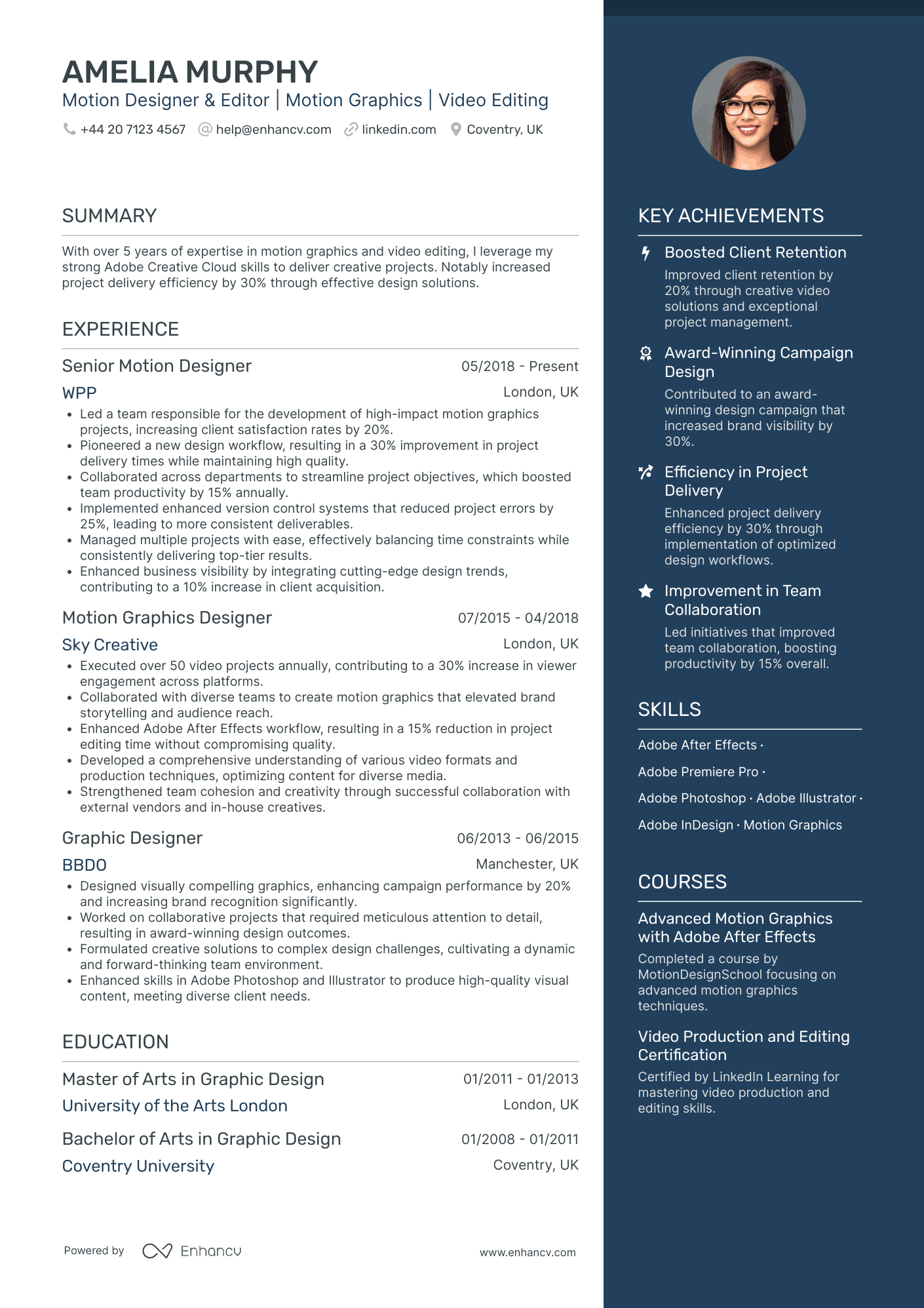
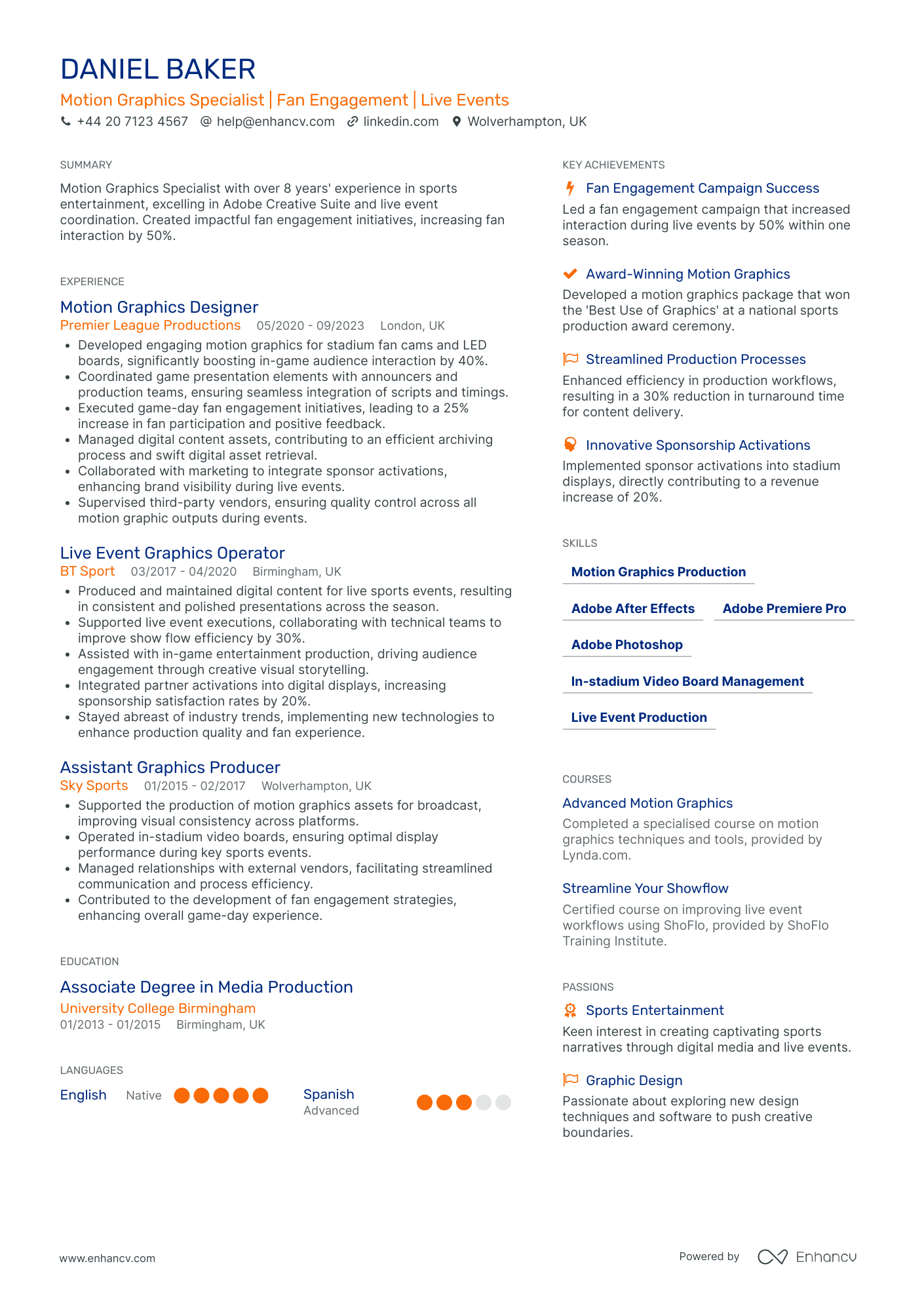
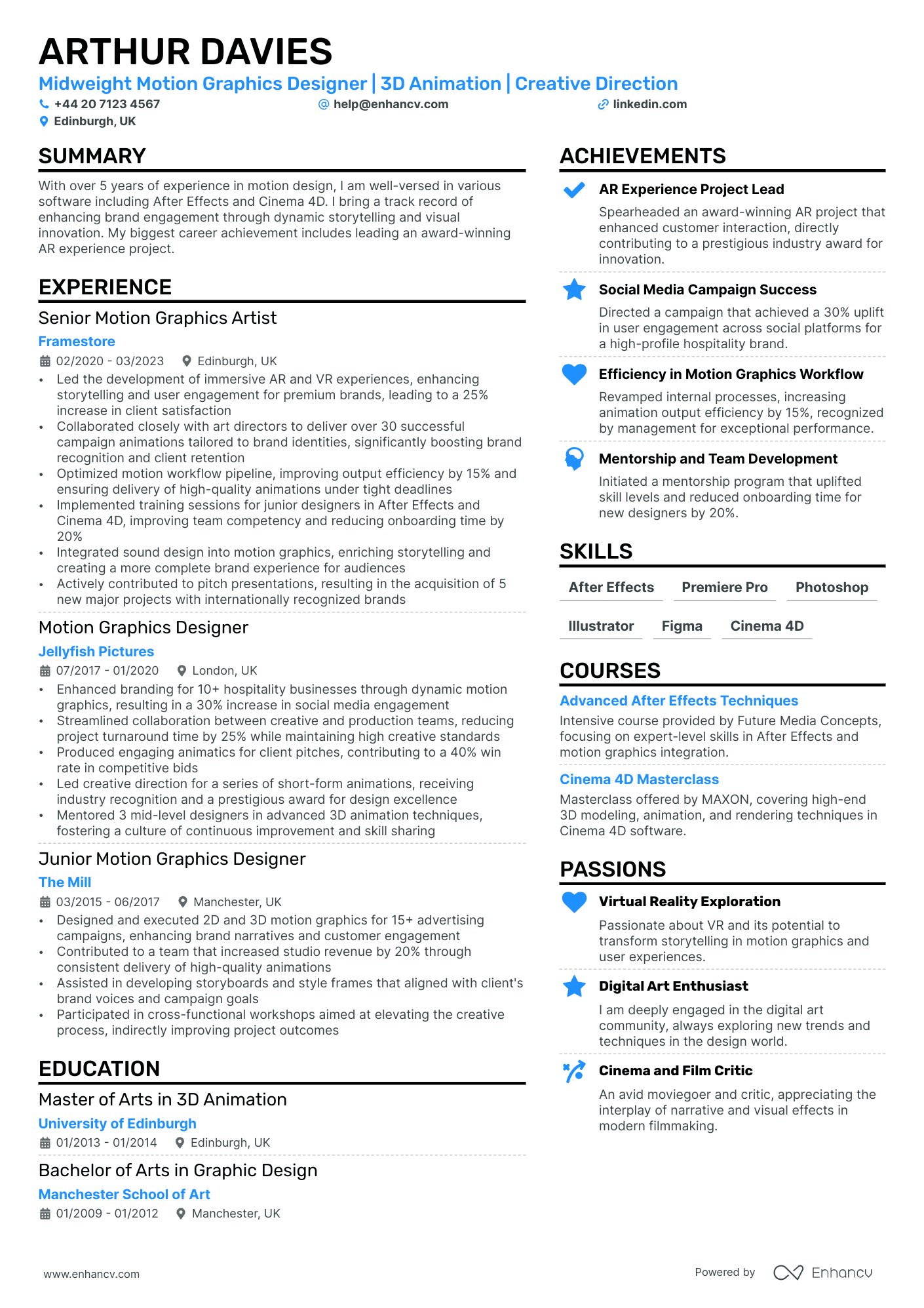
The best motion graphics CV I opened this year led with a 40-second reel and one line telling me what to watch for. Everything else on the page existed to back up the work, not to stand in for it.
Most motion designers do the reverse. They crowd the top of the page with adjectives and leave the showreel link buried near the footer, so a recruiter closes the tab before a single frame ever plays. If you want the fundamentals first, read how to write a CV.

Key takeaways
- Your showreel is the CV. Put a live, clickable link in the header and open on your strongest shot.
- Host the reel where it plays in one click, on Vimeo, your own site, or a portfolio page, never as a heavy attachment.
- Reels are collaborative, so caption your exact role on each shot: design, animation, cel, 3D, or compositing.
- Name your stack in the words studios use: After Effects, Illustrator, Photoshop, and Premiere Pro.
- Turn each project into a result, with views, watch-through, turnaround, or a client win.
- Keep it to one or two pages, reverse chronological, and send a PDF so the layout and the links survive.
Leading with your motion graphics reel
Your showreel is the CV. A creative director clicks the link before reading a word, and usually decides inside the first ten seconds whether to keep watching.
So put a live, clickable reel link in the header, right next to your name and title. Not in the footer, not "portfolio available on request". Make it the single easiest thing on the page to find.
Then earn those first ten seconds. Open on your strongest shot, not a slow logo sting or a title card with your name on it. A recruiter scrubbing through forty reels in an afternoon will not wait for your best work to arrive at 1:40.
Keep the whole thing short and ruthless. Thirty to ninety seconds, five to eight pieces, and nothing you would not want to be hired to make again. A tight 45-second reel beats a rambling three-minute one every time.
Curation is the skill on display here as much as the animation. A reel padded with student exercises and half-finished ideas reads as a designer who cannot tell their good work from their filler.
Reels are almost always collaborative, so make your own contribution unambiguous. Add a short breakdown, on the CV or linked beside the reel, that names your role on each shot: design, animation, cel, 3D, compositing, or the full end-to-end.
Leads care about this more than anything else on the page. "Full design and animation" against a hero shot is worth more than a paragraph of adjectives, and claiming a shot you only comped will unravel in the first interview.
Host the reel where it plays instantly. Vimeo, your own site, or a portfolio page open in one click. A heavy file attached to an email does not, and it may never reach the recruiter if it trips a size limit or a spam filter.
Tailor the reel to the role. Broadcast idents, social-first vertical cutdowns, and product UI motion are different crafts, and the studio wants the one it hires for near the top, not three scrolls down.
Two quick kills before you send it. Drop the copyrighted chart track that gets the video muted, and remove anything still carrying another studio's watermark or a trial-version stamp. Both tell a lead you did not sweat the final ten per cent.
Sound design carries a reel further than most designers expect. A clean mix with animation cut to the beat feels finished, while strong work laid over a random track feels like a rough draft. If audio is not your strength, license a simple piece and cut to it deliberately.
Keep it current. A hiring lead can date a shot from its style alone, and an old reel hints that you have not shipped anything worth adding since. Refresh it every few months, lead with this year's work, and quietly retire the pieces you have outgrown.

PRO TIP
Caption every shot on your reel with the tools and your exact contribution. "Full design and animation, After Effects and Cinema 4D" tells a lead more in six words than a paragraph of personal-statement adjectives ever will.
Formatting your motion graphics CV
One page early in your career, two once you have several roles behind you. Reverse chronological, standard headings, and a font a tired recruiter can read at a glance.
Resist the urge to design the CV itself into a poster. The reel is where your visual craft belongs. A CV overloaded with gradients and hand-set type is harder to scan and often harder for software to read.
Your header does more work on a creative CV than on most. Name, title, location, and your rate or availability if you freelance, then the reel, portfolio, and contact details. A lead should be able to reach you and see your work without scrolling.
Send a PDF for direct applications so the layout holds and every link stays clickable. Keep a Word copy for agencies that reformat CVs into their own template. If the advert names a file type, follow it.
Put your reel, portfolio, and LinkedIn as live links in the header. A creative CV that makes someone copy and paste a URL has already burned a little goodwill.
Even studio applications often pass through tracking software, so keep the structure clean and the headings standard for an ATS-friendly CV. Text baked into a graphic does not get parsed, and a link hidden inside an image does not get clicked.
Build it from a tested layout rather than a blank artboard. Enhancv's CV templates export to a clean PDF with your links intact, so your time goes on the reel instead of on margins.
Is your CV good enough?
Drop your CV here or choose a file. PDF & DOCX only. Max 2MB file size.
Writing your motion graphics personal statement
Three or four sentences at the top: who you are, your specialism, the tools you live in, one concrete result, and a nod to the reel. Keep it specific. See more personal statement examples if the opening line will not come.
Its job is small and precise. It tells the lead what to expect from the reel and why they should watch yours over the next one in the pile.
Skip the adjective soup every other CV opens with. "Creative, passionate and detail-oriented motion designer" tells a lead nothing they can check.
Name a specialism instead. "2D character animation and kinetic type for social" is a hook. "Motion graphics generalist" is white noise.
Lead with evidence:
Motion graphics CV personal statement example (experienced)
Motion designer with five years across broadcast and social, specialising in kinetic typography and 2D character animation in After Effects and Cinema 4D. Recent work includes a launch campaign that reached 2.1 million views and a title sequence for a commissioned drama series. Reel and shot breakdown linked above. Looking to bring fast, on-brief animation to a London studio.
Junior, or still building your first reel? Point at the craft and the trajectory rather than the years you do not have yet:
Motion graphics CV personal statement example (junior)
Motion design graduate specialising in kinetic typography and 2D animation in After Effects. Reel features three spec pieces, including a rebrand animation for a local festival and a 20-second explainer built end to end. Comfortable taking direction and turning briefs around fast. Looking for a junior motion role in a studio that mentors.
And here is the version to avoid, the one a lead reads on autopilot and forgets instantly:
Personal statement to avoid
Passionate and creative motion graphics artist with a keen eye for detail and a love of storytelling. Highly motivated team player looking for an exciting opportunity to grow and showcase my skills in a dynamic studio environment.
When we read a motion graphics personal statement, we skim it in a couple of seconds and then click the reel. The statement's only job is to tell us what to expect and why you, so name your specialism, your core tools, and one result we can picture. The reel proves the rest. A statement built on adjectives just delays the click and signals you had nothing concrete to lead with.
the Enhancv team
Writing your motion graphics experience section
Each role gets a dated heading, then verb-led bullets that show the brief, what you animated, and what it delivered. For the mechanics, see work experience on a CV.
Motion work is measurable even when it feels subjective. Views, watch-through rate, turnaround time, assets shipped, formats delivered, and a client renewed are all CV achievements.
Name the deliverable and the tool in the same breath. "Animated a 30-second explainer in After Effects" beats "responsible for animation" because a lead can picture the exact work.
Open every bullet with a strong verb: designed, animated, directed, built, delivered. Weak stems like "responsible for" and "helped with" waste the most valuable space on the page. A quick pass through CV action verbs sharpens a tired list fast.
Tailor each application to the advert, mirroring the software and formats it lists where they are true of you. Enhancv's CV tailoring feature reads the ad and flags the terms worth matching, which saves rewriting from scratch for every studio.
- Designed and animated 60+ social-first cutdowns a quarter in After Effects and Premiere Pro, lifting average watch-through by 34% across the client's channels
- Led the motion for a product launch that reached 2.1 million views in its first month and was picked up by two industry newsletters
- Built a reusable template and lower-third toolkit that cut turnaround on recurring campaigns from three days to one
- Directed a junior designer and a freelance 3D artist on a broadcast ident, delivering on brief and two days early
Freelance and agency work counts fully, so list it. Group short contracts under one heading if there are many, name the studios or clients where your agreements allow, and lead with the campaigns that landed rather than the logistics of the booking.
No hard metrics from a role? Reach for scale and craft instead: the number of assets, the formats, the tools, and the team you worked alongside. "Delivered 200+ animated assets across six campaigns" still shows range.
PRO TIP
One quantified result outweighs five lines of software logos. Open with what changed, a lift in views, a faster turnaround, a renewed client, then name the tools that made it happen.
Top skills for your motion graphics CV
The core toolkit is consistent, and studios list it by name. After Effects, Illustrator, Photoshop, and Premiere Pro appear again and again, usually alongside Cinema 4D or another 3D package. Those are your hard skills, written in the words the adverts use.
Underneath the software sit the craft skills that actually separate reels: animation principles, timing and spacing, kinetic typography, compositing, and storyboarding. Name these too, because anyone can install the software.
Be honest about depth. "Expert in After Effects, working knowledge of Cinema 4D" is more useful, and more credible, than a flat wall of logos that suggests you are fluent in everything.
The soft skills that matter here are checkable on the job: taking direction, hitting deadlines, and collaborating with editors, designers, and clients. Prove each in a bullet rather than claiming it.
List only what you can defend in a live test brief. If you are still learning a package, put it under "developing" rather than beside the tools you know cold.
Placement matters as much as content. On a reel-led CV the skills block sits high, just under the personal statement, so a lead sees your stack before they scroll. A dense, scannable list beats a row of rated bars that says nothing about real depth.
Top skills for your motion graphics CV:
After Effects
Illustrator
Photoshop
Premiere Pro
Cinema 4D (3D)
Kinetic typography
Compositing
Storyboarding
Animation principles
Collaboration
Taking direction
Time management
Attention to detail
Communication
Motion graphics CV with no experience
No studio roles yet does not sink a motion graphics CV. The reel decides, and a reel can be built from spec work in a weekend.
Animate something real. Redesign a title sequence, bring a brand's logo to life, or build a 20-second kinetic-type piece from a song lyric or a manifesto. Three strong spec pieces beat an empty CV waiting on a first client.
Give freelance gigs, university briefs, and personal projects dated entries like jobs, with the tools used and the outcome. A first job CV in this field is judged on craft, not job titles.
Recreate a piece of work you admire, then say so. "Study: re-animated the opening titles of a favourite film to practise pacing" is honest and shows exactly what you were training.
List your training where it adds weight: a degree in animation, graphic design, or motion design, and any focused online courses. Put them in your education section and keep any certificates you hold nearby.
Then link the reel at the top exactly as an experienced designer would. In this field the work is the argument, and the work is something you can make this week.
Conclusion
Lead with the reel, caption your role on every shot, and turn each project into a result a recruiter can picture.
Keep the CV clean and the links live, and pair it with a short cover letter that says why this studio. The animation earns the interview.

Author's take - the Enhancv team
When we read a motion graphics personal statement, we skim it in a couple of seconds and then click the reel. The statement's only job is to tell us what to expect and why you, so name your specialism, your core tools, and one result we can picture. The reel proves the rest. A statement built on adjectives just delays the click and signals you had nothing concrete to lead with.