



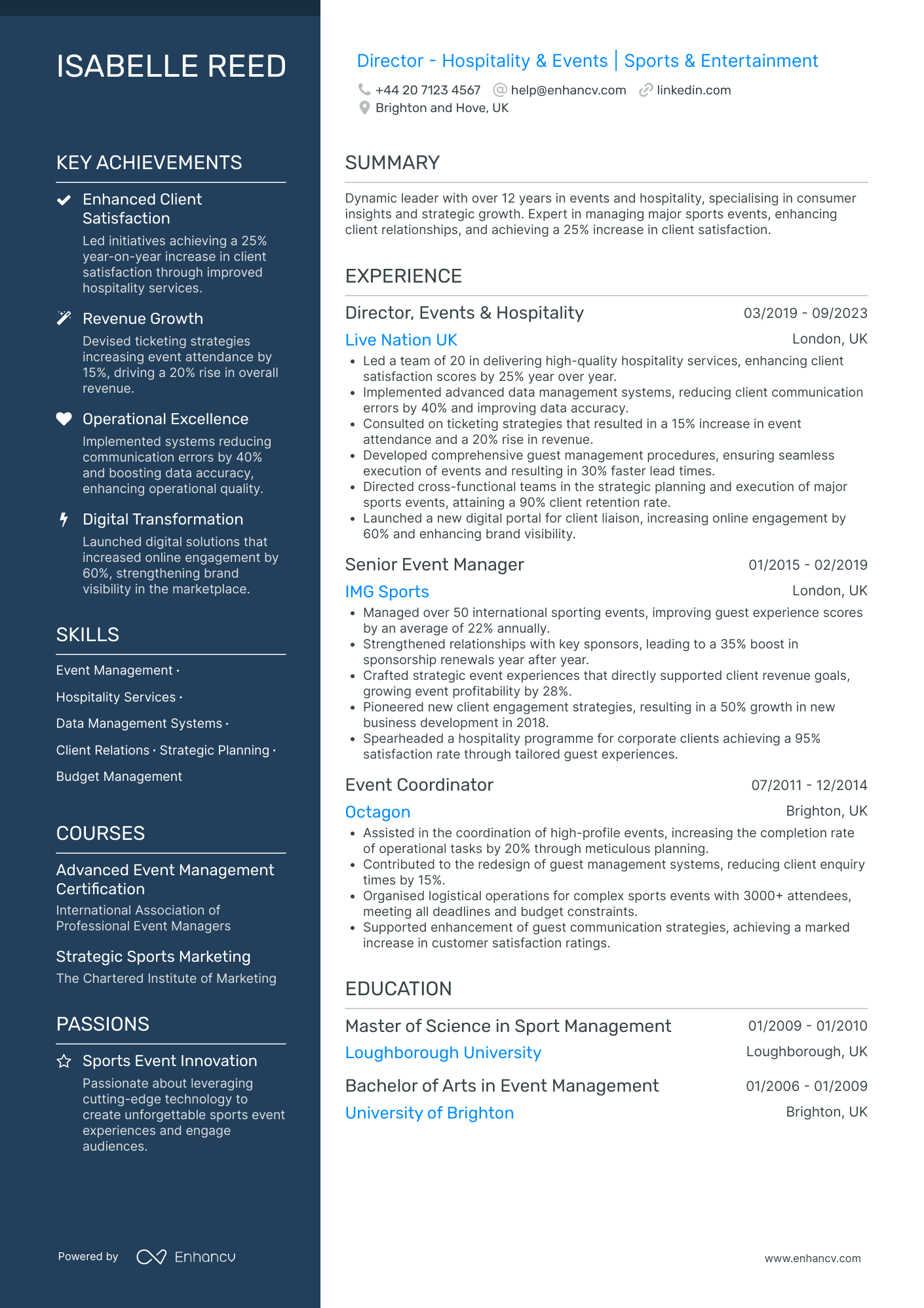
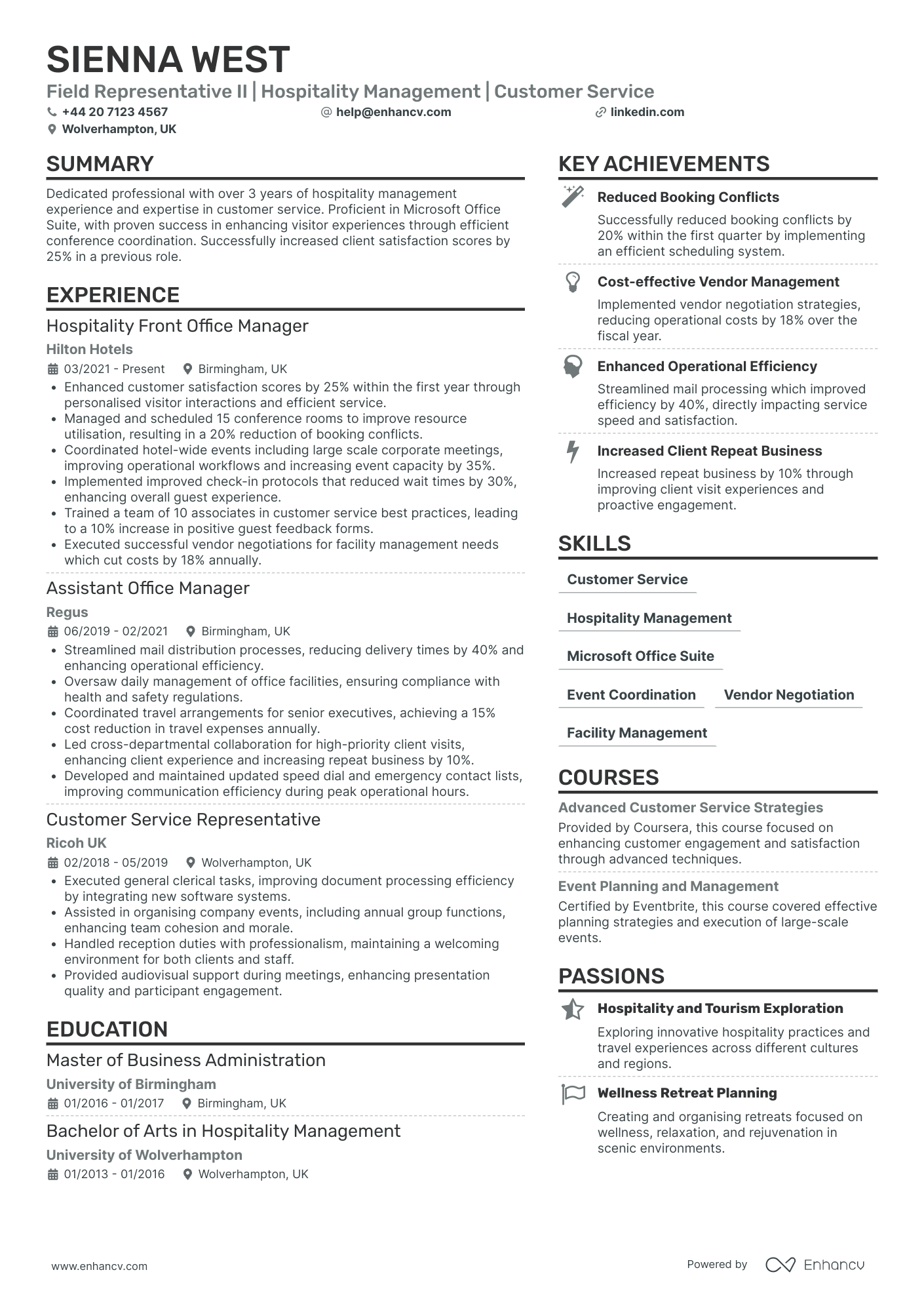
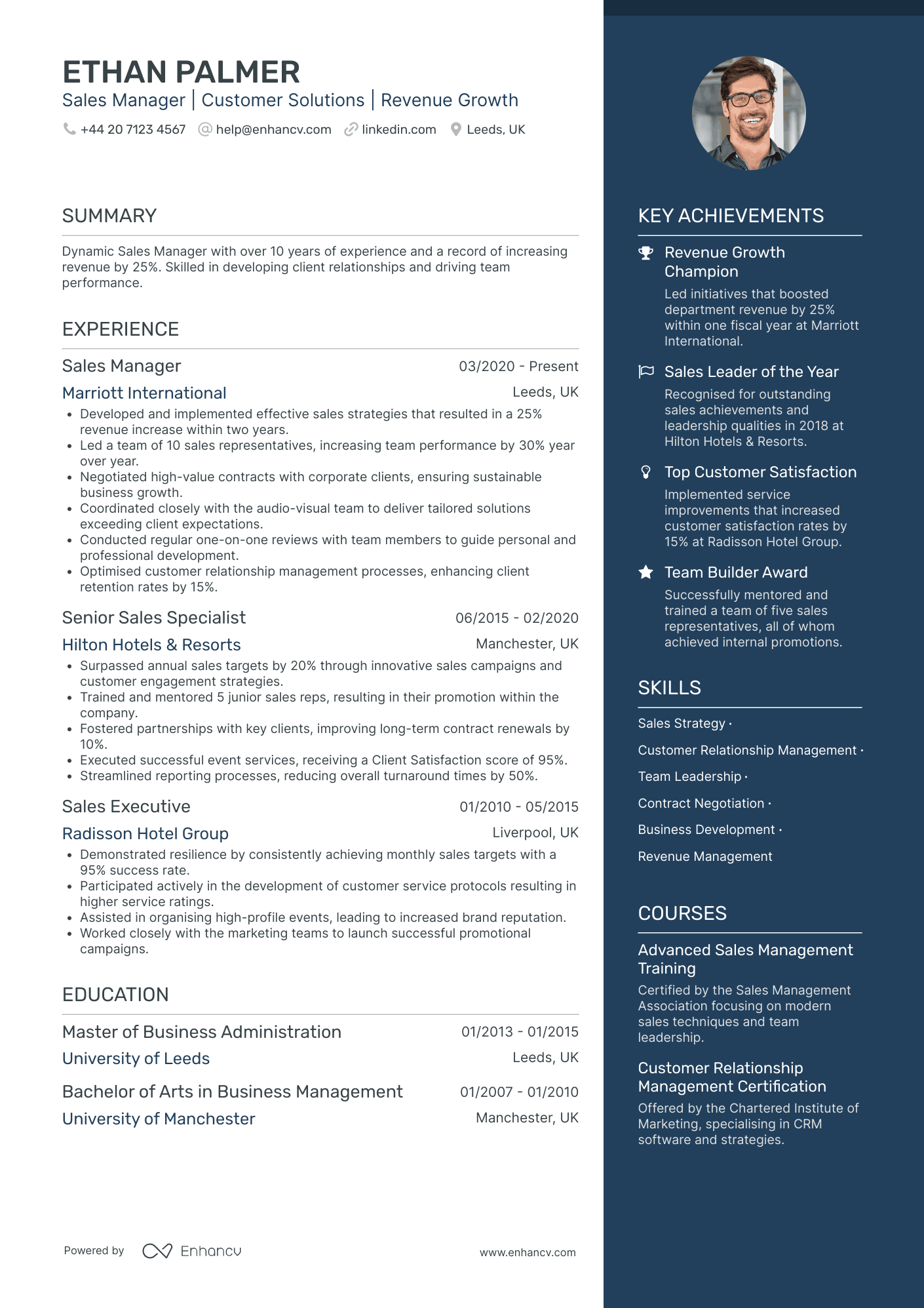
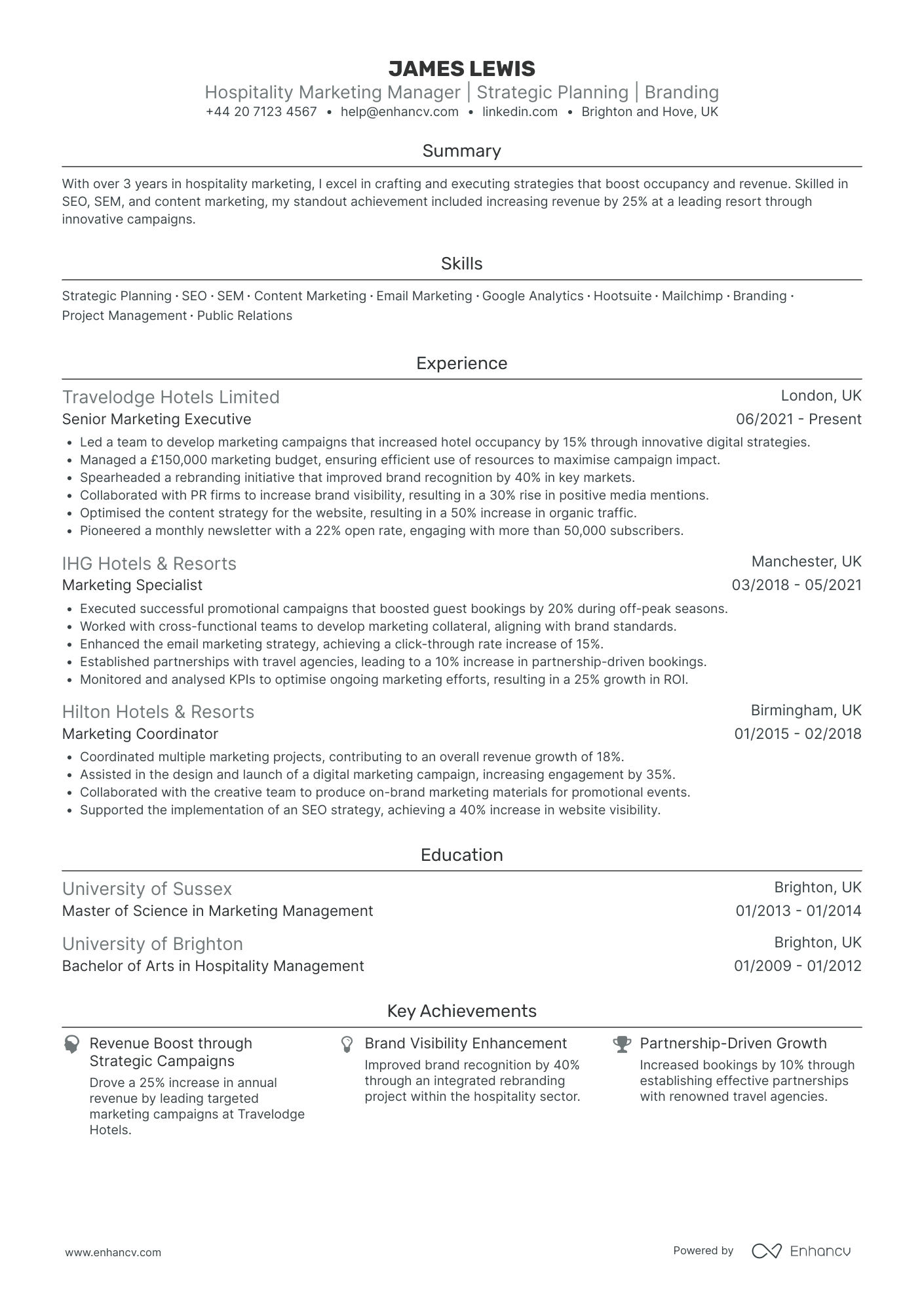
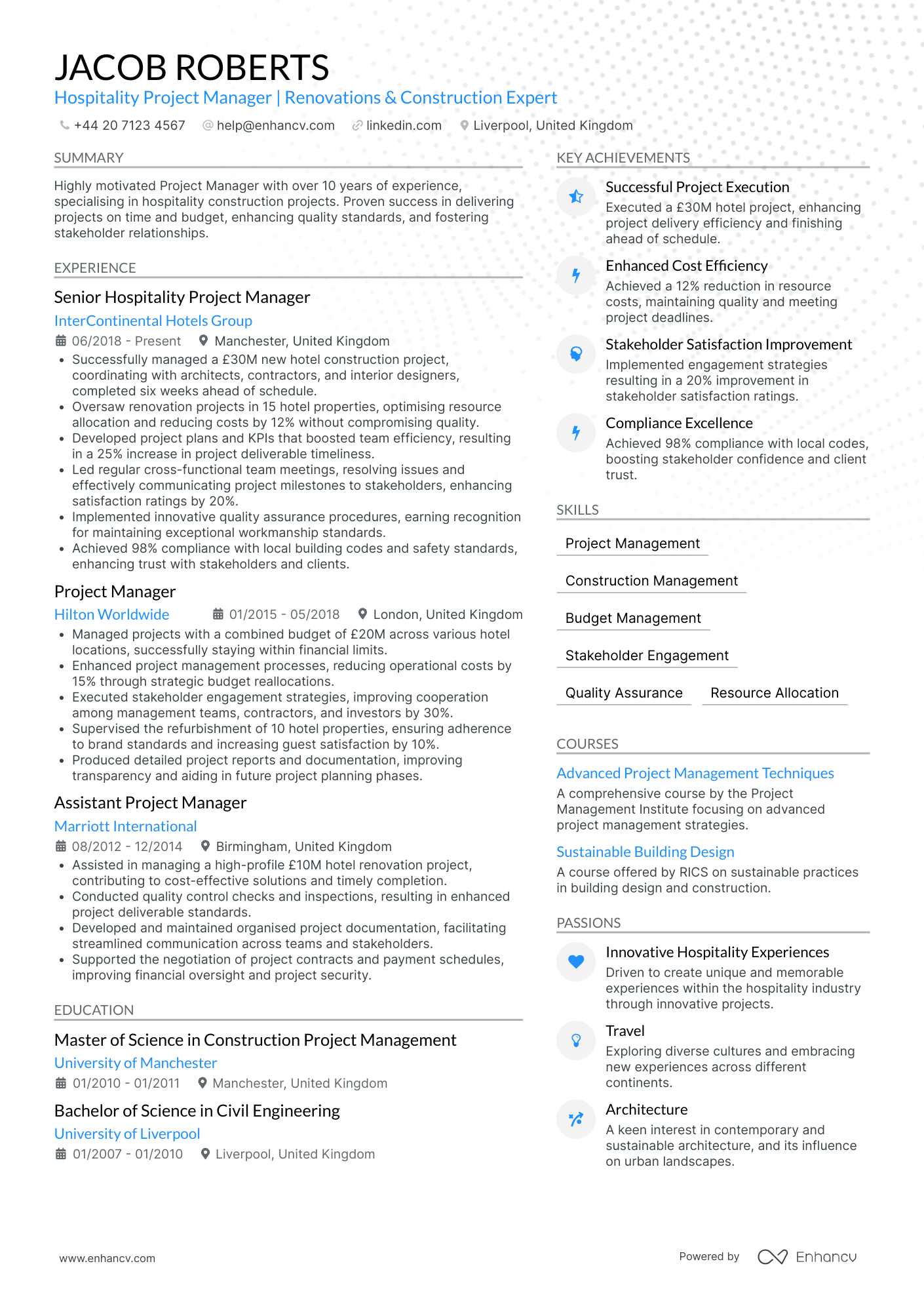
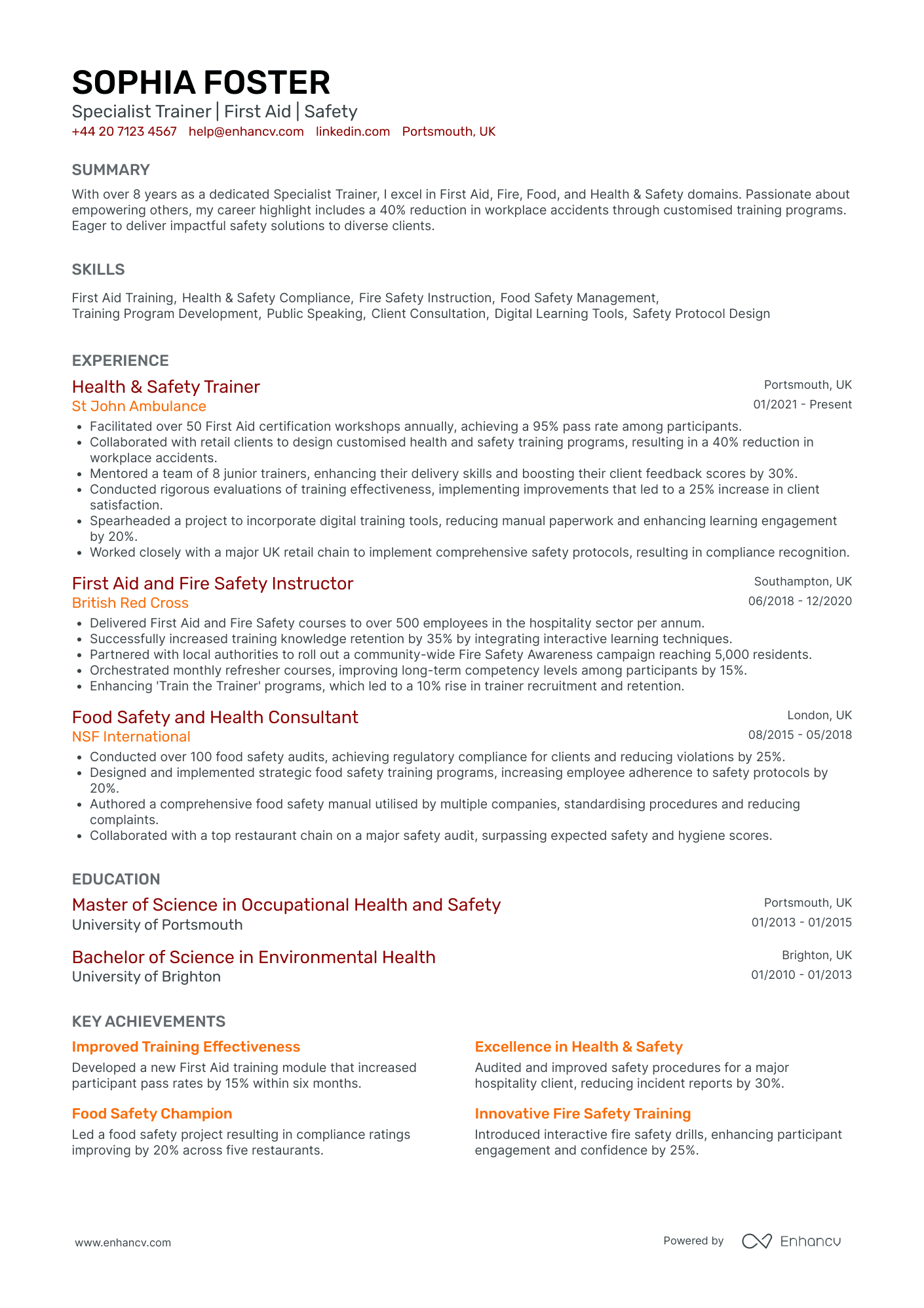
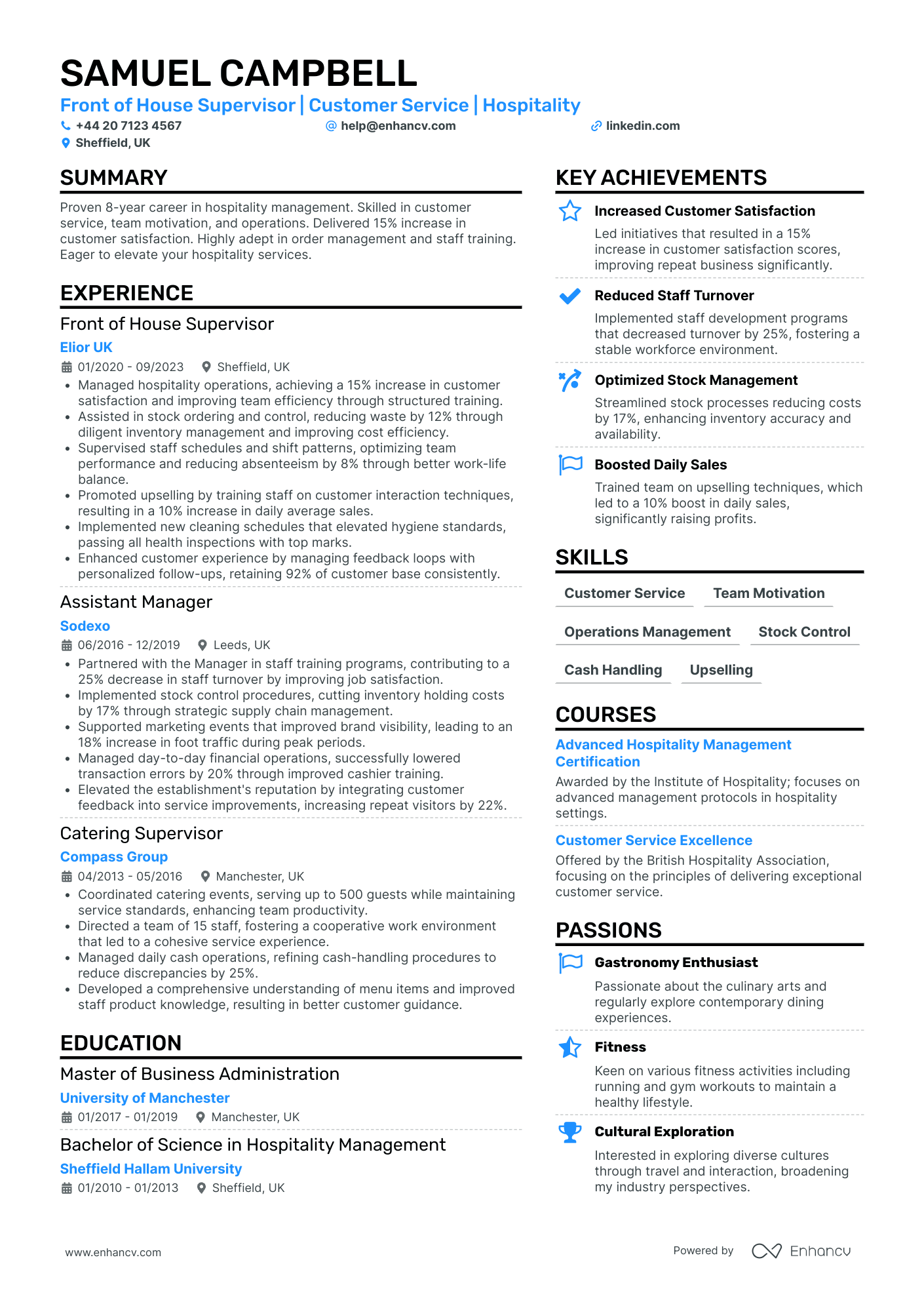
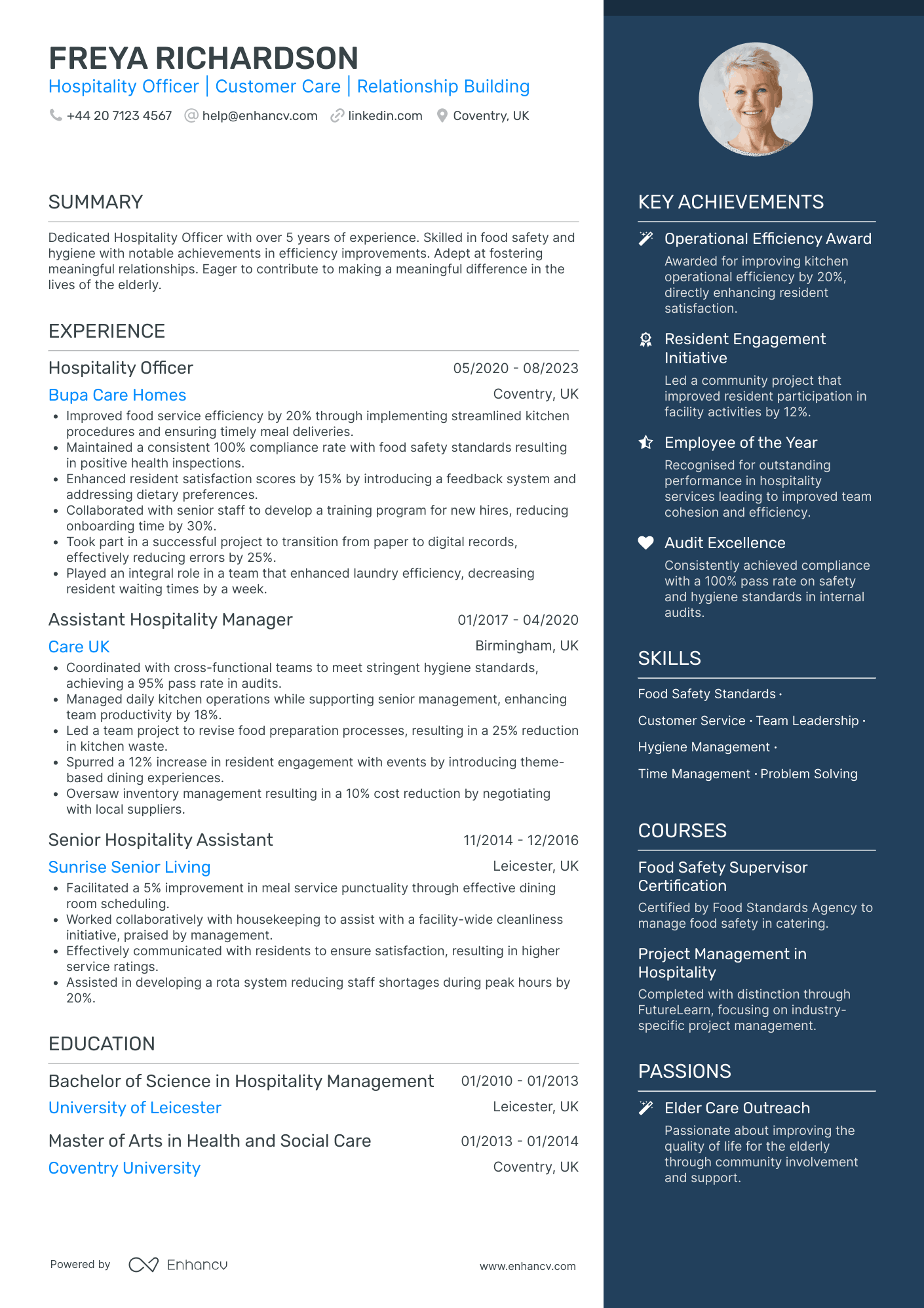
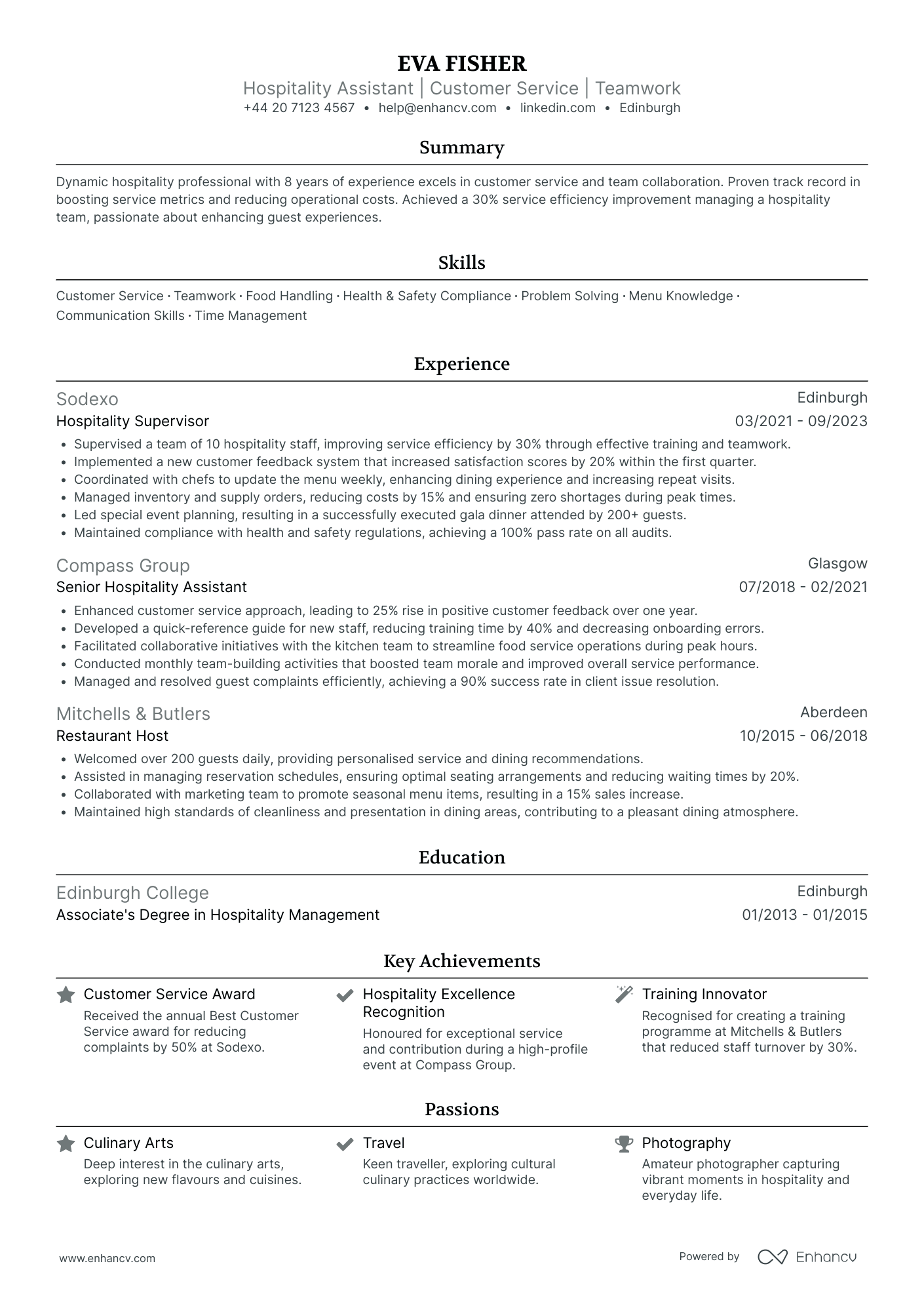
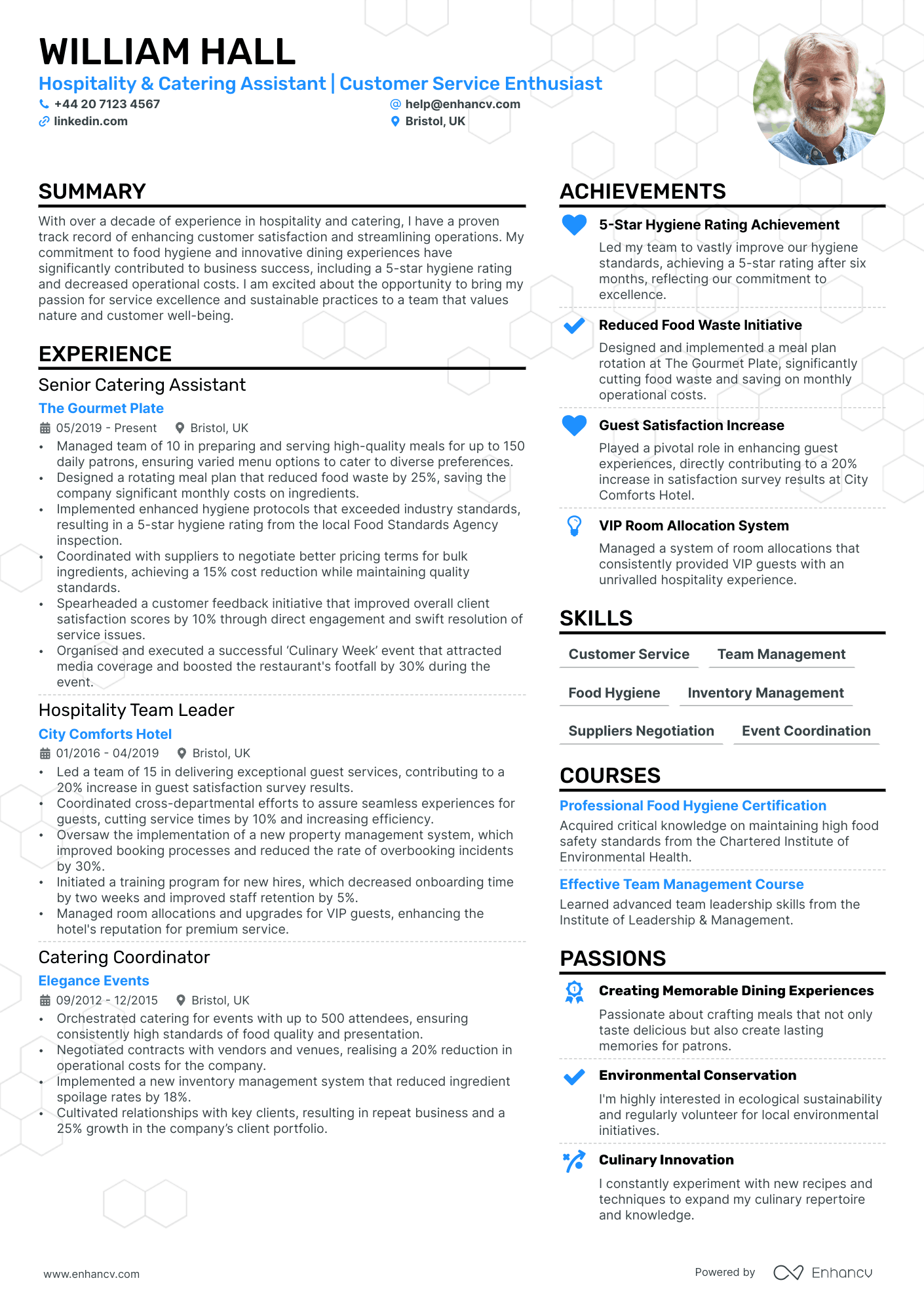
Most hospitality CVs read like a shift rota, a wall of duties nobody asked to read. The ones that get called back prove two things fast: you look after customers when the room is full, and you can be trusted with food safety and a till.
Hospitality hires on evidence, not adjectives. A manager skimming applications between services wants the venues you have worked, the skills the advert named, and one number that shows you kept your head when it got busy. Get those on the page and the interview follows. If you want the fundamentals first, see how to write a CV.

Key takeaways
- Lead with the skills employers screen for: customer service, food safety, and communication.
- Hospitality work is almost entirely on-site, so put your location and availability near the top.
- Prove each skill with a number: covers served, complaints resolved, or a shift you ran on your own.
- Open with a short personal statement built on evidence, not "hard-working and passionate".
- Two pages, reverse chronological, sent as a PDF unless the advert asks for a Word file.
- Name your food hygiene and health and safety training, even if it is still in progress.
Top skills for your hospitality CV
Hospitality is a skills-led hire. Employers screen for what you can do on the floor before they read your work history, so lead with the skills and back each one with proof.
Across 162 UK hospitality postings in the last ~30 days on Enhancv's internal job feed, three skills recur more than any other: customer service, food safety, and communication. Those belong near the top of your CV, listed in the words the adverts use.
The trade talks about the five C's of service: commitment, communication, courtesy, cooperation, and consistency. They make a useful checklist, but a manager cannot verify a C. Turn each into something concrete, such as a shift you closed on your own, a regular who asked for you by name, or a complaint you defused before it reached the duty manager.
Your hard skills are the checkable, trainable ones: food safety and hygiene, health and safety, manual handling, stock management, cash handling and EPOS or till operation, and allergen awareness. Name the level where you hold it, such as Level 2 Food Hygiene.
Your soft skills are real and testable in this trade: customer service, communication, teamwork, and staying calm under pressure. Prove each in a bullet rather than claiming it.
Customer service is the skill every hospitality advert wants and the hardest to fake on paper. Do not write "excellent customer service". Show it: the review score you protected, the complaint you turned into a returning table, the regulars who followed you between venues.
Food safety is the one employers cannot compromise on. If you hold a Level 2 certificate, put it in both your skills and your training section. If you have taken a section through an environmental health inspection, say so plainly.
Communication and teamwork read as filler until you attach them to a moment. Anchor them to the pass, the point where the kitchen and the floor either move as one team or fall apart. "Called orders cleanly through a 200-cover Saturday service" proves both in a single line.
Match the skills to the role you want. A bar role leans on speed, cocktail knowledge, and cash handling. A hotel front desk leans on booking systems, upselling, and handling complaints. Kitchen work leans on prep, food safety, and holding standards when the tickets pile up.
Top skills for your hospitality CV:
Food safety and hygiene (Level 2)
Health and safety compliance
Manual handling
Stock management and ordering
Cash handling and EPOS or till operation
Allergen awareness
Food and beverage service
Licensing and age verification
Customer service
Communication
Teamwork
Team leadership
Working under pressure
Adaptability
List only what you can stand behind. If you have been trained on a till system or a booking platform, name it. If a skill is still in progress, put it under training rather than claiming it outright.

PRO TIP
Hospitality adverts name specifics, not soft-skill clouds. Mirror the ones you can back: "Level 2 Food Hygiene", "allergen awareness", "cellar management", "EPOS", and "cash reconciliation". If you have been trained in it, name it exactly as the advert does.
What the UK hospitality market looks like
Knowing what employers ask for shapes what goes on the page. Here is what UK hospitality postings look like right now.
| What | UK hospitality roles |
|---|---|
| Where the work happens | On-site (151 of 162 UK postings, 93%, in the last ~30 days on Enhancv's internal job feed) |
| Experience level asked for | Entry 43% · mid 39% · lead 18% |
| Most-listed skills | Customer service, food safety, communication, and health and safety |
| Also frequently named | Team leadership, manual handling, stock management, and food hygiene |
Two numbers should shape your CV.
Hospitality is overwhelmingly on-site, so a manager needs to see you can reliably get to the venue for the shifts on offer. Put your location and your availability, including evenings and weekends, near the top.
Most postings sit at entry or mid level, which is why a first hospitality CV is realistic rather than wishful. Pay varies widely by role, venue, and region, and tips or a service charge can form part of it, so treat the advertised rate as your anchor.
The skills the adverts list are the skills to feature, in that order. Customer service, food safety, communication, and health and safety come up again and again, with team leadership, manual handling, stock management, and food hygiene close behind. If your CV names those in the same words, an ATS and a manager both see the match at a glance.
Formatting your hospitality CV
For a first or early hospitality CV, use a skills-led structure so your skills and training come before a thin work history. Once you have a few venues behind you, switch to reverse chronological.
Keep it to two pages, one column, standard headings, and a readable font. Managers skim CVs between shifts, often on a phone.
Put the sections in the order a hospitality manager reads them: personal statement, then skills and training, then experience, then education. When your work history is the strongest thing you have, move it up. When it is thin, let skills and training carry the top of the page.
Your header does more work in hospitality than in most sectors. Alongside your name and contact details, add your location, your availability, and a line confirming your right to work in the UK. Managers filter on those before anything else.
Send a PDF for direct applications so the layout holds. Keep a Word copy for agencies, which place a large share of hospitality shifts and reformat CVs into their own template. If the advert names a file type, follow it.
Applications often pass through tracking software, so keep the layout clean and the headings standard for an ATS-friendly CV. Build it from a tested layout rather than a blank page: Enhancv's CV templates export to a clean PDF.
Writing your hospitality personal statement
Three or four sentences at the top: who you are, the service strengths you bring, where you have worked, and why this venue. Keep it concrete. See more personal statement examples if the opening line stalls.
Skip the adjective soup. "Hard-working, passionate, and a great team player" tells a manager nothing they can check.
Name the venue type and size, because a 200-cover gastropub and a boutique hotel bar are different jobs. A recruiter reads scale as a proxy for how much pressure you can take.
Tie the last line to the venue you are applying to. A statement that says "looking to bring fast, friendly service to a high-volume city-centre bar" reads as written for them, not blasted to fifty places. That small edit is often what separates a callback from the pile.
Lead with evidence instead:
Hospitality CV personal statement example (front of house)
Reliable front-of-house team member with three years across a busy 90-cover restaurant and two city-centre bars. Level 2 Food Hygiene certified, confident on EPOS and cash reconciliation, and used to running the floor on weekend evening services. Looking to bring calm, fast service to a supervisor role in a high-volume venue in Manchester.
What to avoid
Hard-working and passionate hospitality professional with excellent communication skills and a bubbly personality. A real team player who always goes the extra mile and thrives in fast-paced environments.
When we read a hospitality CV, we are looking for evidence you can hold a busy service together. "Handled 120 covers on a Saturday night with a runner off sick" tells us more than any run of adjectives. Name the size of the venue, the shifts you ran, and one moment you stopped a bad situation getting worse. Managers hire for that and train the rest.
Writing your hospitality experience section
Whether it is paid, seasonal, or casual shifts, write each entry the same way: a dated heading, then bullets that show what you did and the result. Lead each bullet with a verb. For the mechanics, see work experience on a CV.
Hospitality is measurable even when it does not feel like it: covers served, average spend, upsell figures, complaints resolved, or a rota you managed. Those details are your CV achievements.
Tailor each application by pulling the duties and terms from the advert and mirroring them where they are true of you. Enhancv's CV tailoring feature reads the advert and suggests the matching edits, which saves rewriting from scratch. For the manual version, see how to tailor your CV.
Strong verbs carry a hospitality bullet: served, upsold, trained, reconciled, resolved. Weak ones bury it: responsible for, helped with, duties included. Swap them for stronger action verbs.
- Serve 100 to 140 covers a service across a 90-seat restaurant, rated in the venue's top three for upselling desserts and drinks
- Trained six new starters on EPOS, allergen procedure, and table service during a summer intake
- Resolve customer complaints on the floor before they reach the manager, protecting a 4.6-star review average
- Run cash reconciliation and end-of-night till reports, with zero discrepancies logged in the last year
- Served a summer holiday crowd of up to 200 covers a day across bar and outdoor terrace
- Handled cash and card payments during peak weekend trade with no till shortfalls
- Restocked the cellar and rotated kegs and stock to cut waste over the busy season
Two entries, both quantified, and the seasonal role earns its place because it shows volume and cash handling. Casual and seasonal shifts count as experience in this trade, so give them dated headings and treat them like any other job.
PRO TIP
One strong number beats five vague duties. "Upsold desserts on 3 in 10 tables" or "trained six new starters" lands harder than "provided excellent service to all customers". Pick the shifts you are proud of and quantify them.
Education and training for a hospitality CV
You rarely need a degree to work in hospitality. What employers do check is your food safety and health and safety training, so list it clearly.
Name the ones you hold, even "in progress": Level 2 Food Safety and Hygiene, allergen awareness, health and safety, first aid, and a personal licence if you serve alcohol. Put them in your education section or a dedicated training block.
Extra certificates, such as a barista qualification or a wine and spirits award, are worth listing where the role calls for them. They save the employer a question and show you take the craft seriously.
If you studied hospitality, catering, or event management, list the qualification and the venue placements that came with it. If you did not, do not worry about it. A GCSE line and the right training block are enough for most floor and bar roles, and experience carries far more weight here than a certificate on its own.
Writing a hospitality CV with no experience
Hospitality is one of the most entry-friendly sectors in the UK, and most postings sit at entry or mid level. Employers hire on attitude and train the skills once you start.
Mine your life for transferable evidence. It is almost always there:
- Retail or any customer-facing job: handling queues, complaints, and cash under pressure.
- Volunteering at events, festivals, or a community café: service, teamwork, and long shifts on your feet.
- Sport, clubs, or a Saturday job: reliability, teamwork, and turning up on time.
- School or college catering, or helping out in a family business.
Write those in hospitality language. "Handled cash and served a lunchtime rush of 60 covers at a charity café" is a hospitality bullet that happened while volunteering.
One line moves a no-experience CV up the pile: "Level 2 Food Hygiene in progress" or "available evenings and weekends". See more first job CV examples if you are starting from scratch, and give any volunteering a dated entry like a job.
Reliability is the quiet skill that lands entry hospitality jobs. Shifts fall apart when people do not show up, so a manager will take a punctual, willing beginner over a flashy CV with gaps in the story. Say you can start soon, cover short notice, and work the shifts nobody else wants.
Keep the personal statement short and honest. Name what you bring, the training you are doing, and your availability, then let a clean, one-page CV do the rest. Nobody expects a decade of covers from a first application.
Conclusion
Lead with the skills employers screen for, prove each one with a number, and keep the format clean and on-site-friendly.
Pair the CV with a short cover letter that says why this venue, and a thin work history turns into a credible application.

Author's take - the Enhancv team
When we read a hospitality CV, we are looking for evidence you can hold a busy service together. "Handled 120 covers on a Saturday night with a runner off sick" tells us more than any run of adjectives. Name the size of the venue, the shifts you ran, and one moment you stopped a bad situation getting worse. Managers hire for that and train the rest.