



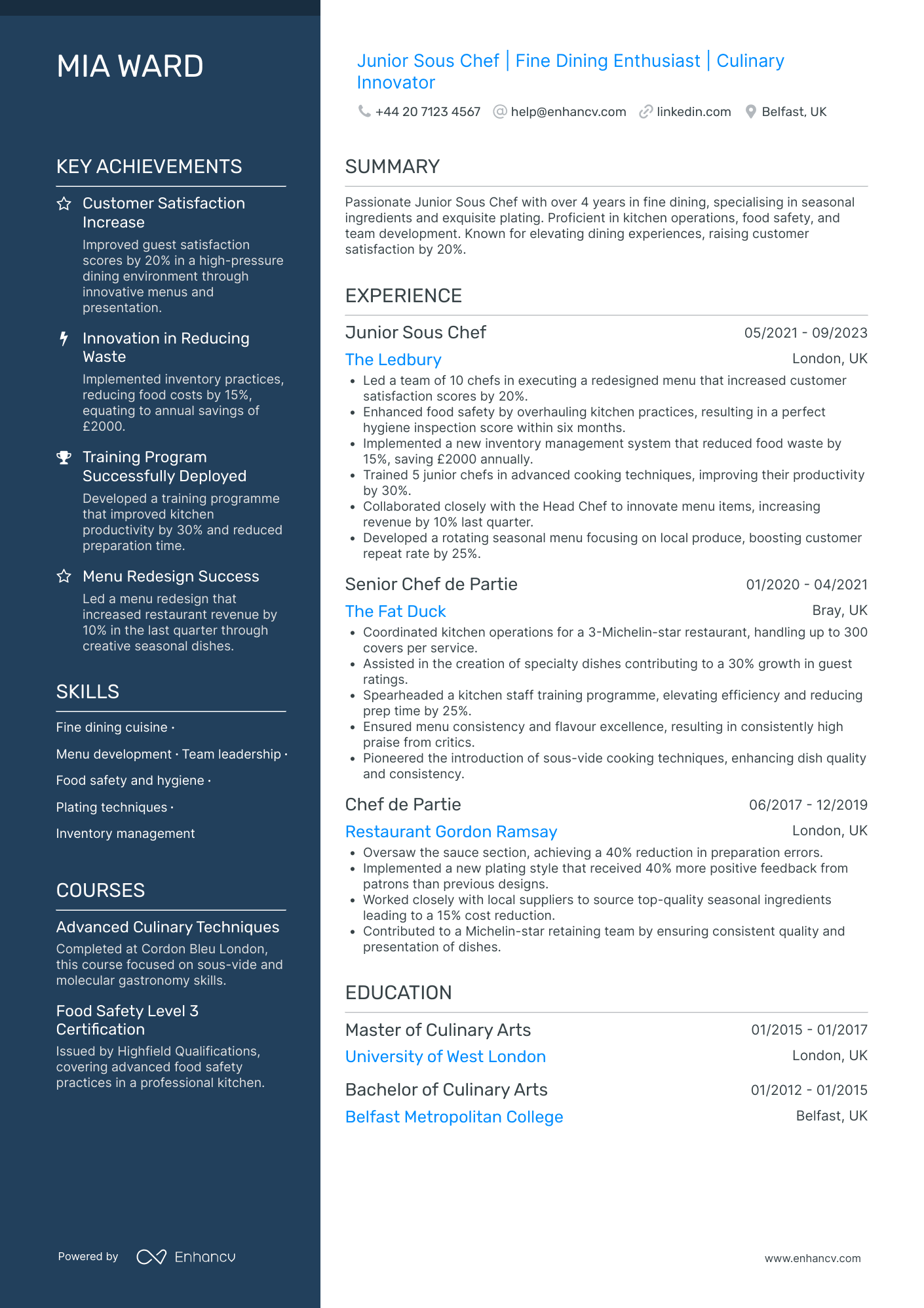
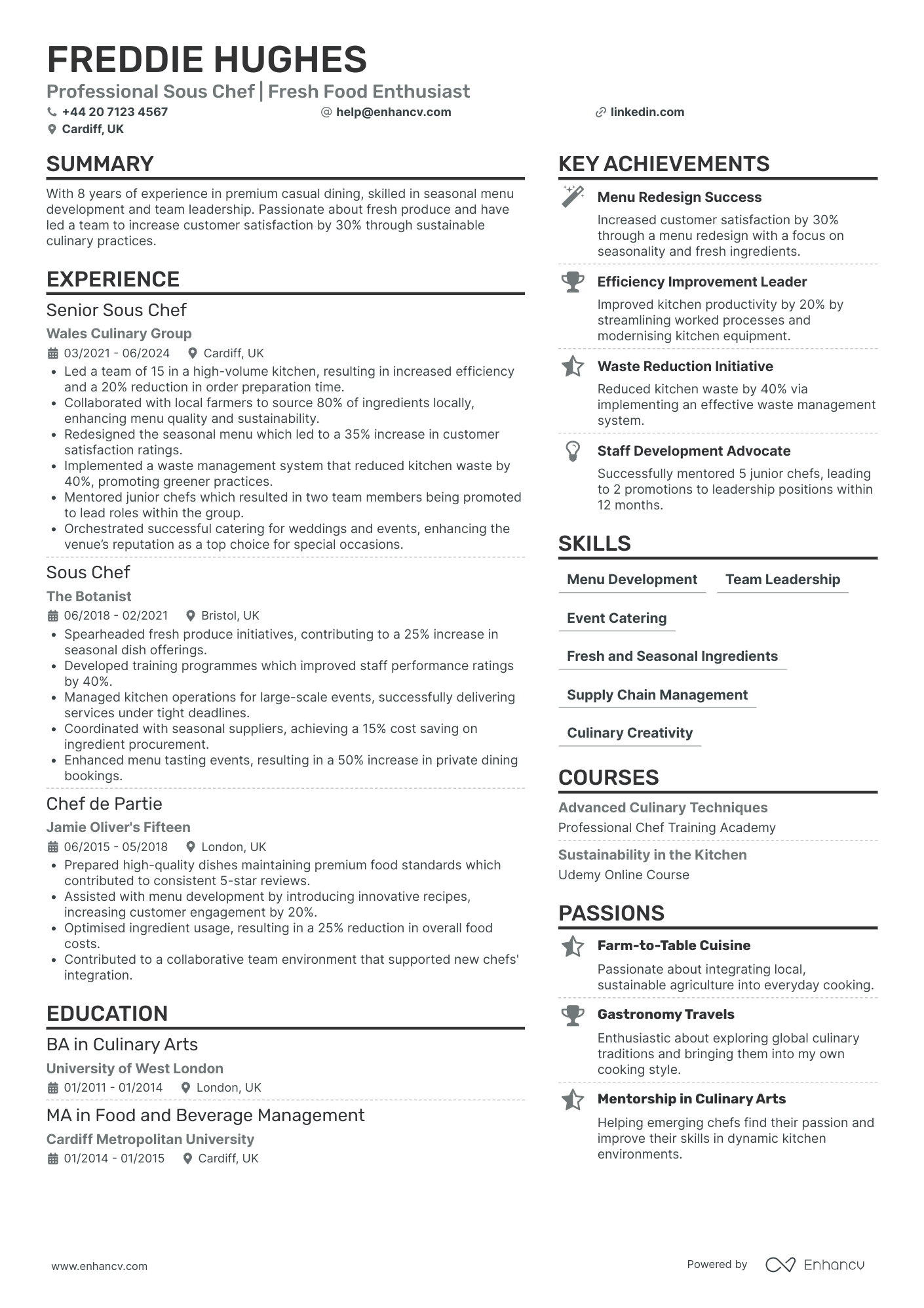
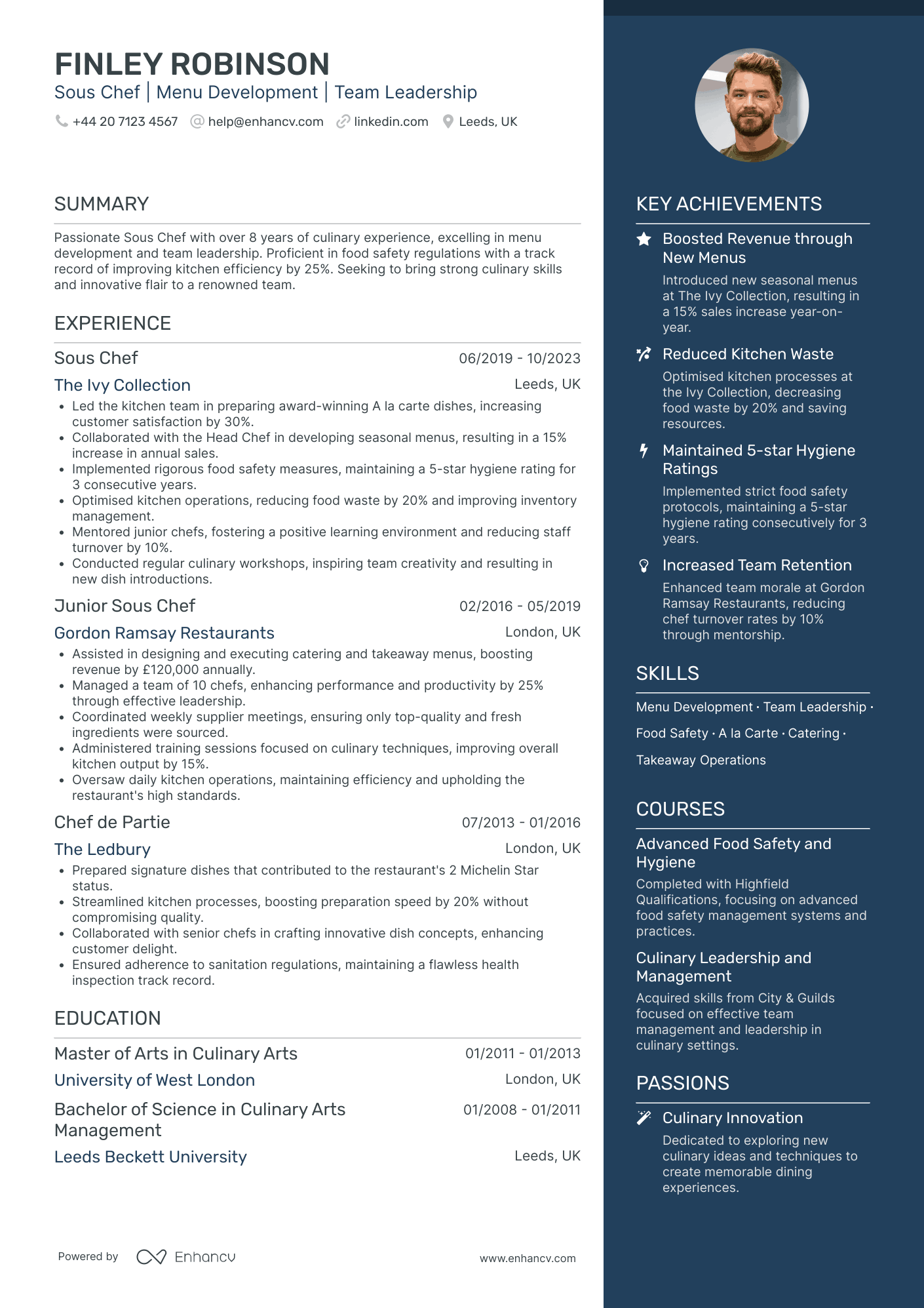
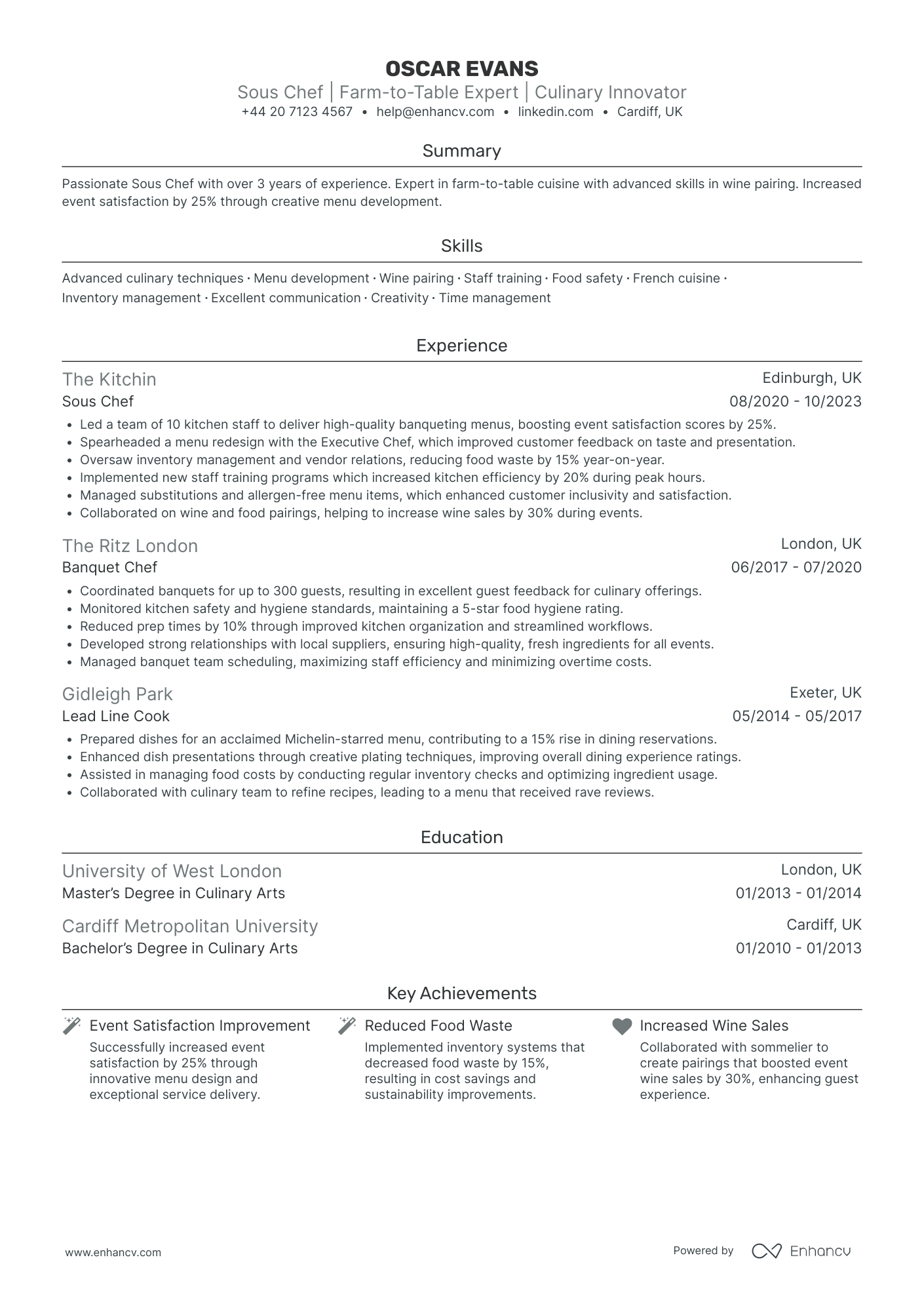
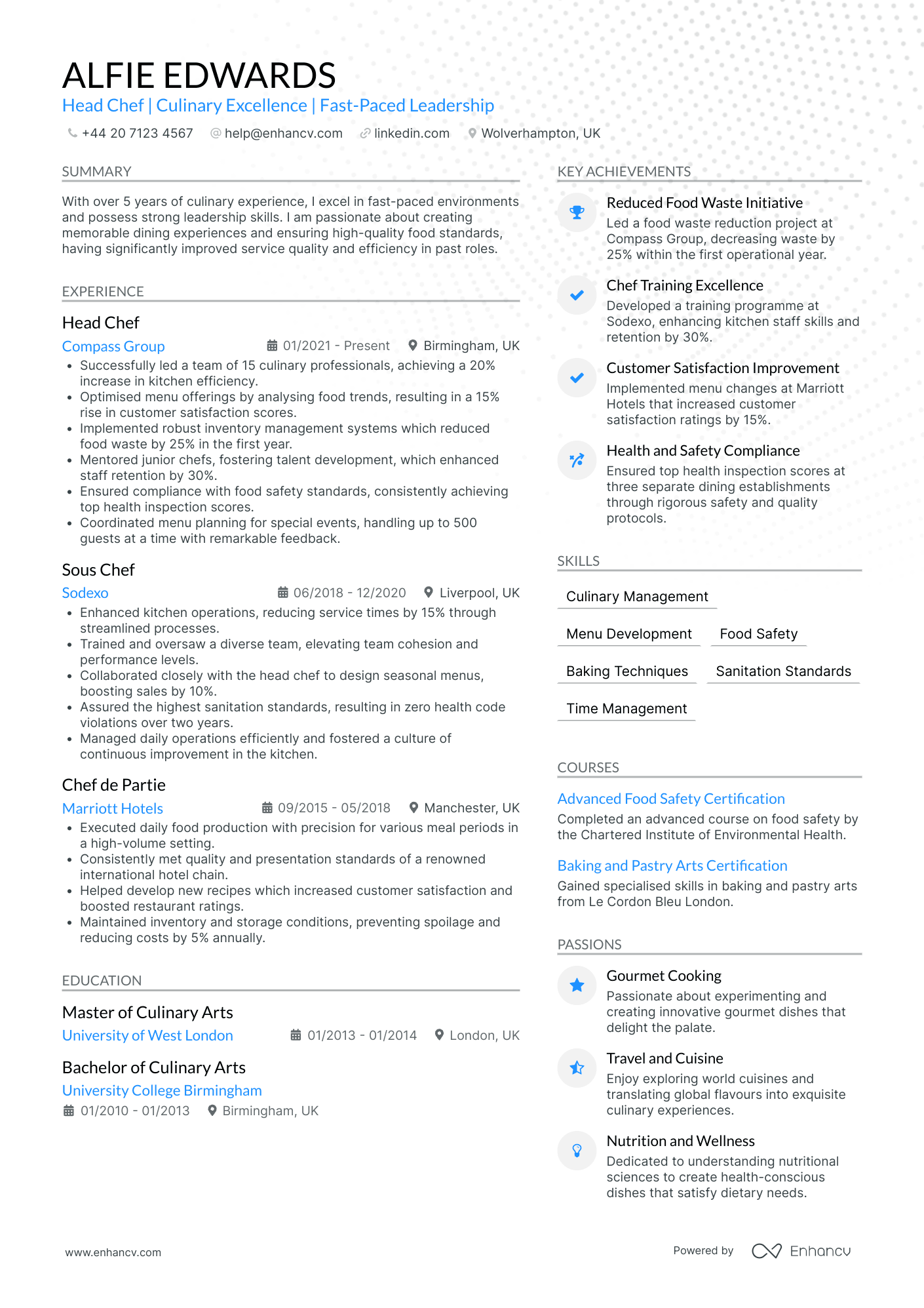
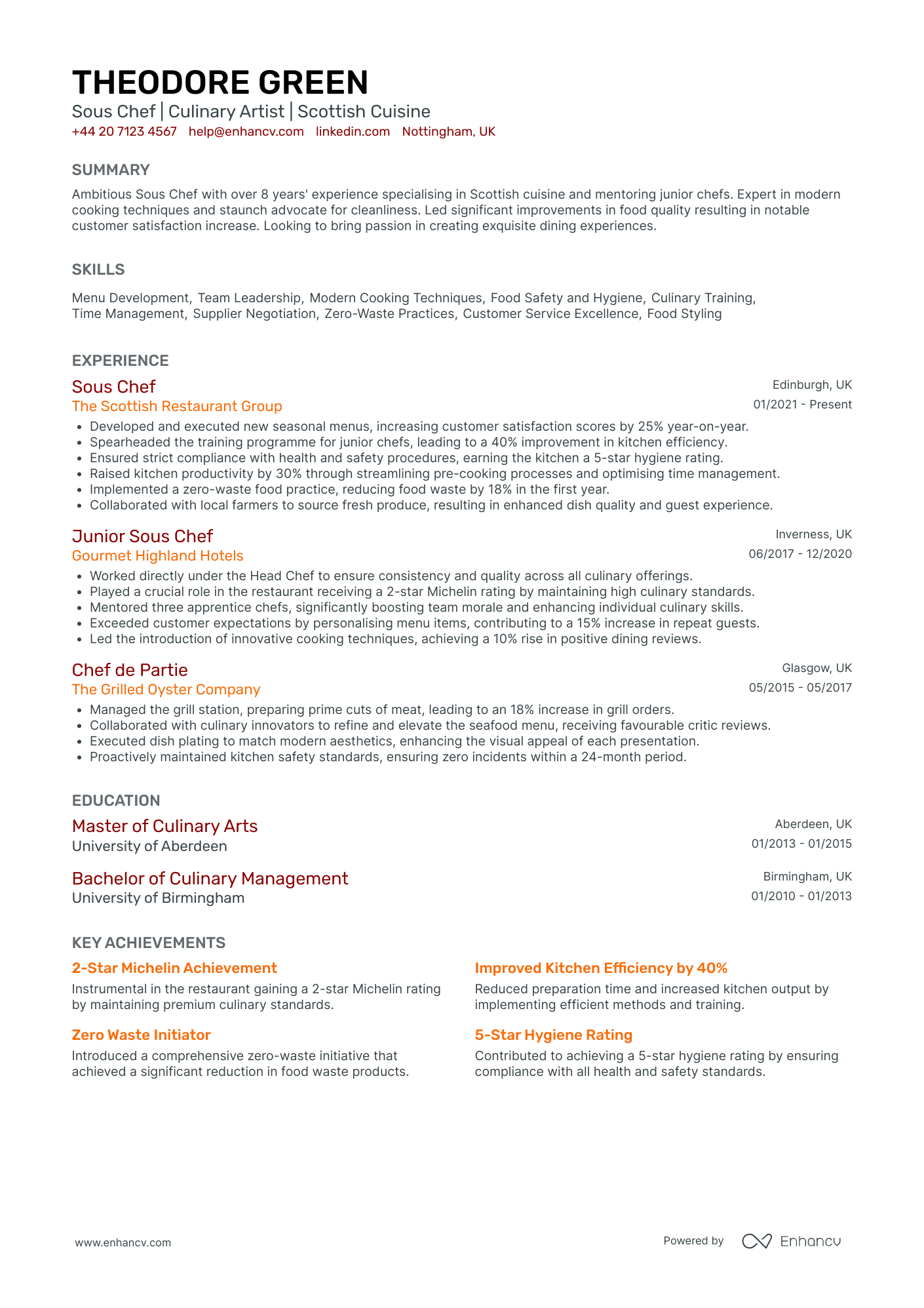
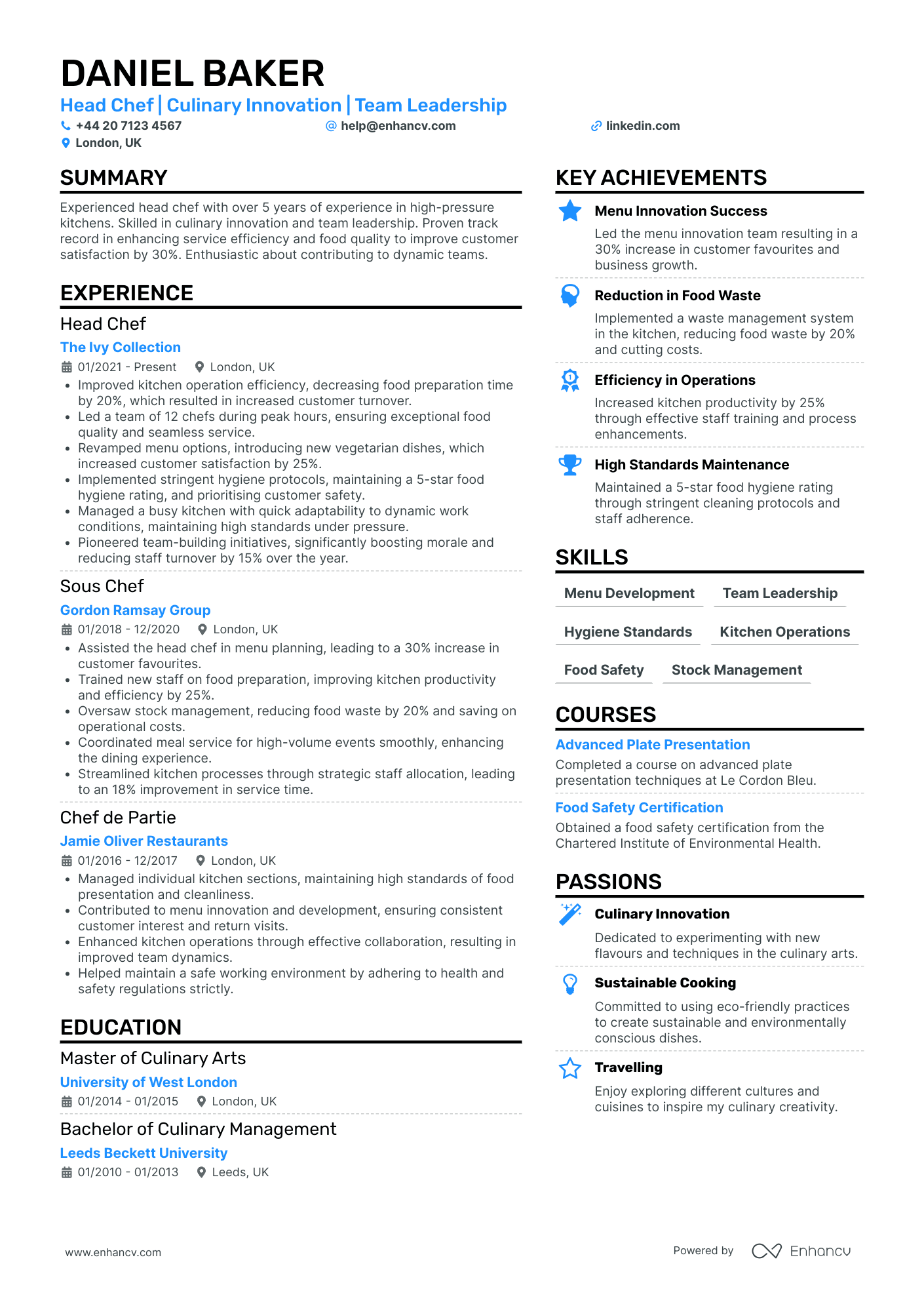
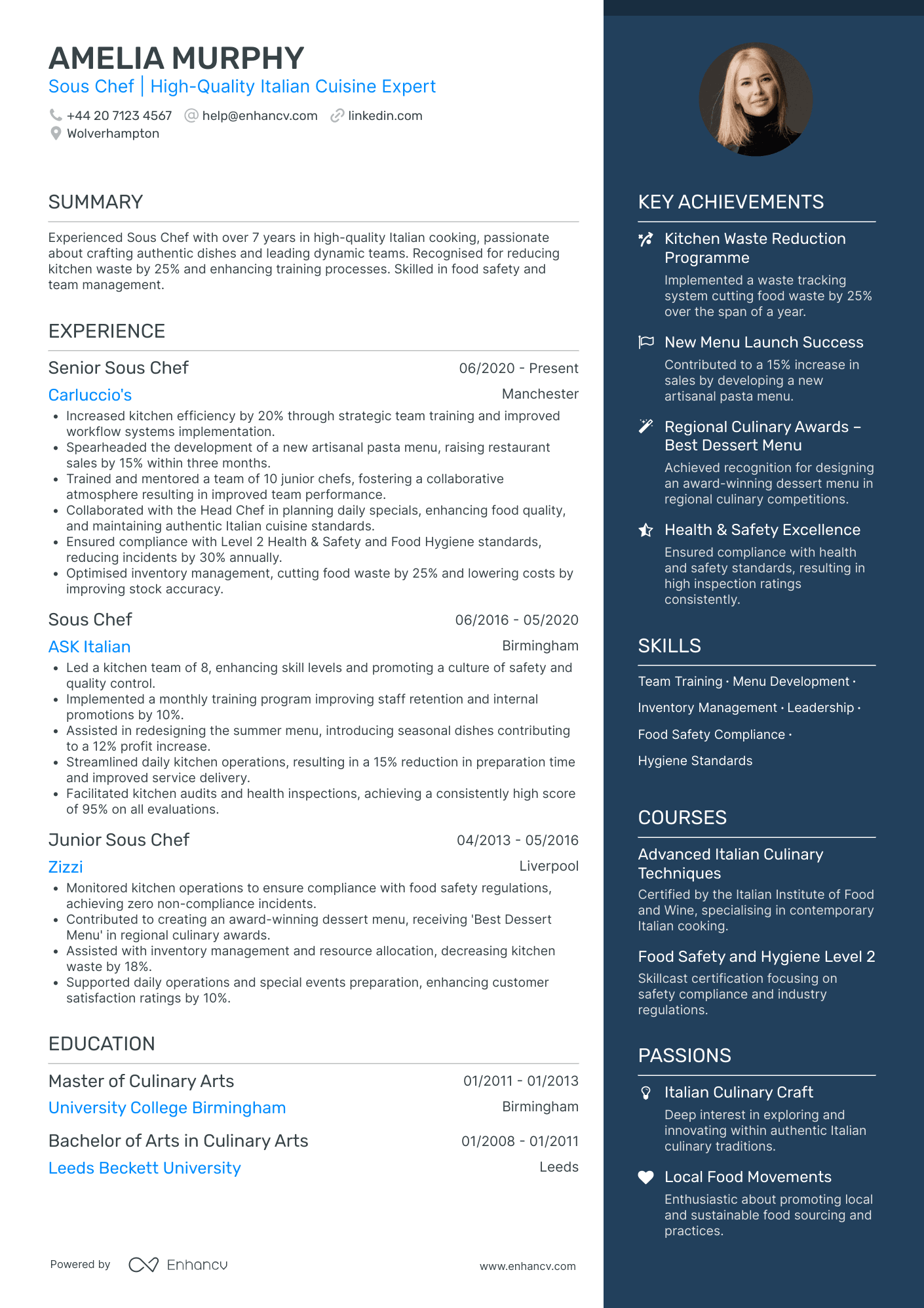
Most sous chef CVs read like the head chef's job advert pasted into bullet form, a stack of duties with nothing that proves you can hold a section together on a Saturday night.
The ones that get the call do the opposite. They lead with covers per service, the sections you have run, the hygiene rating you held, and the shifts you took charge of when the head chef was off. If you want the groundwork first, see how to write a CV.

Key takeaways
- Lead with format. Two pages, reverse-chronological, and sent as a PDF unless the advert asks for a Word file.
- Sous chef work is on-site, so put your location and how far you will travel near the top.
- Prove volume. Covers per service, section size, and the rota you ran say more than a list of duties.
- Put your food hygiene certificate and allergen training high on the page. Kitchens screen for them.
- Name the skills adverts actually list: food safety, kitchen organisation, and stock control.
- Open with a short personal statement built on evidence, not a run of adjectives.
Formatting your sous chef CV
A sous chef CV is read fast, often by a head chef between services who has thirty seconds and flour on their hands. Structure it so the things that matter surface first.
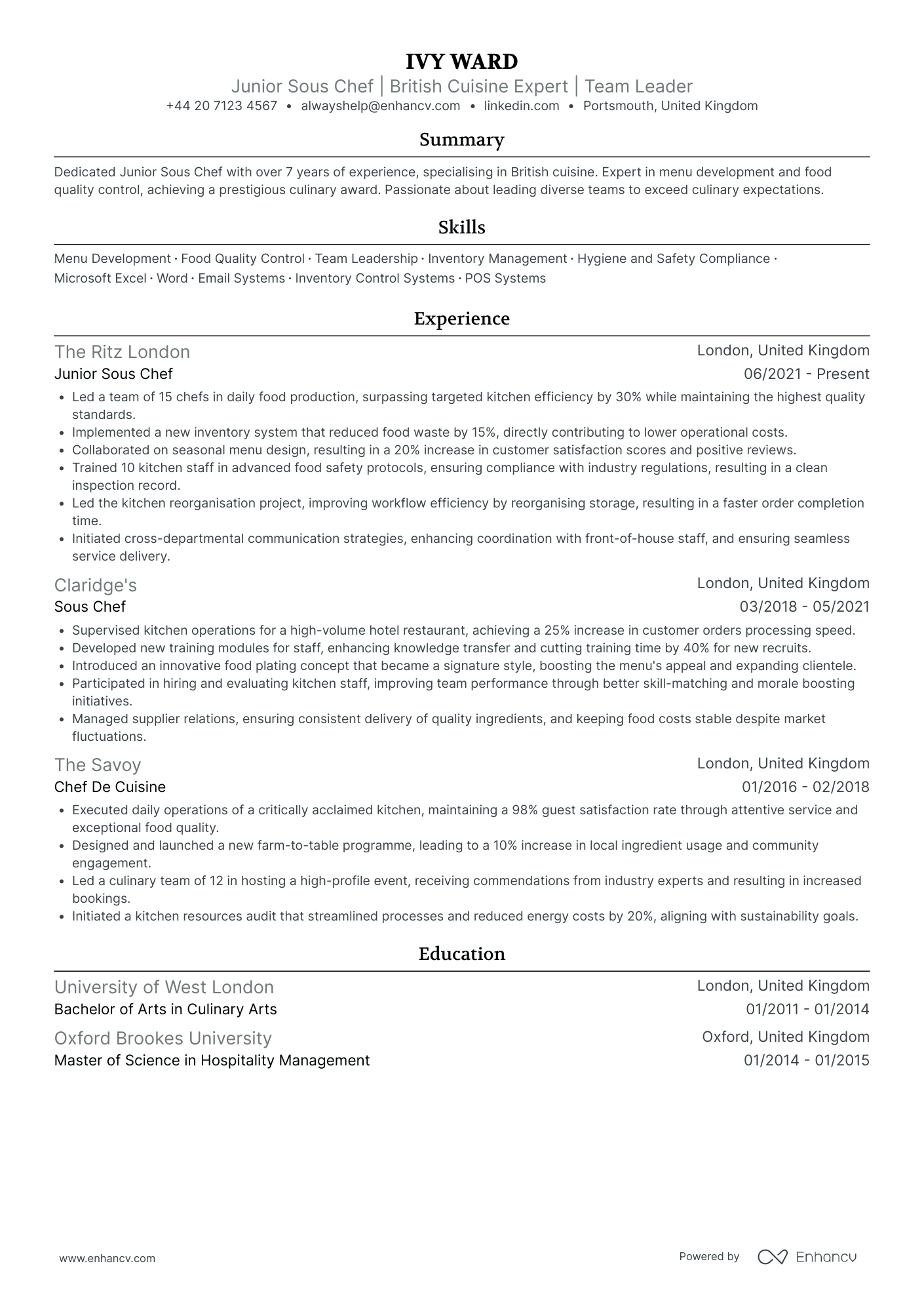
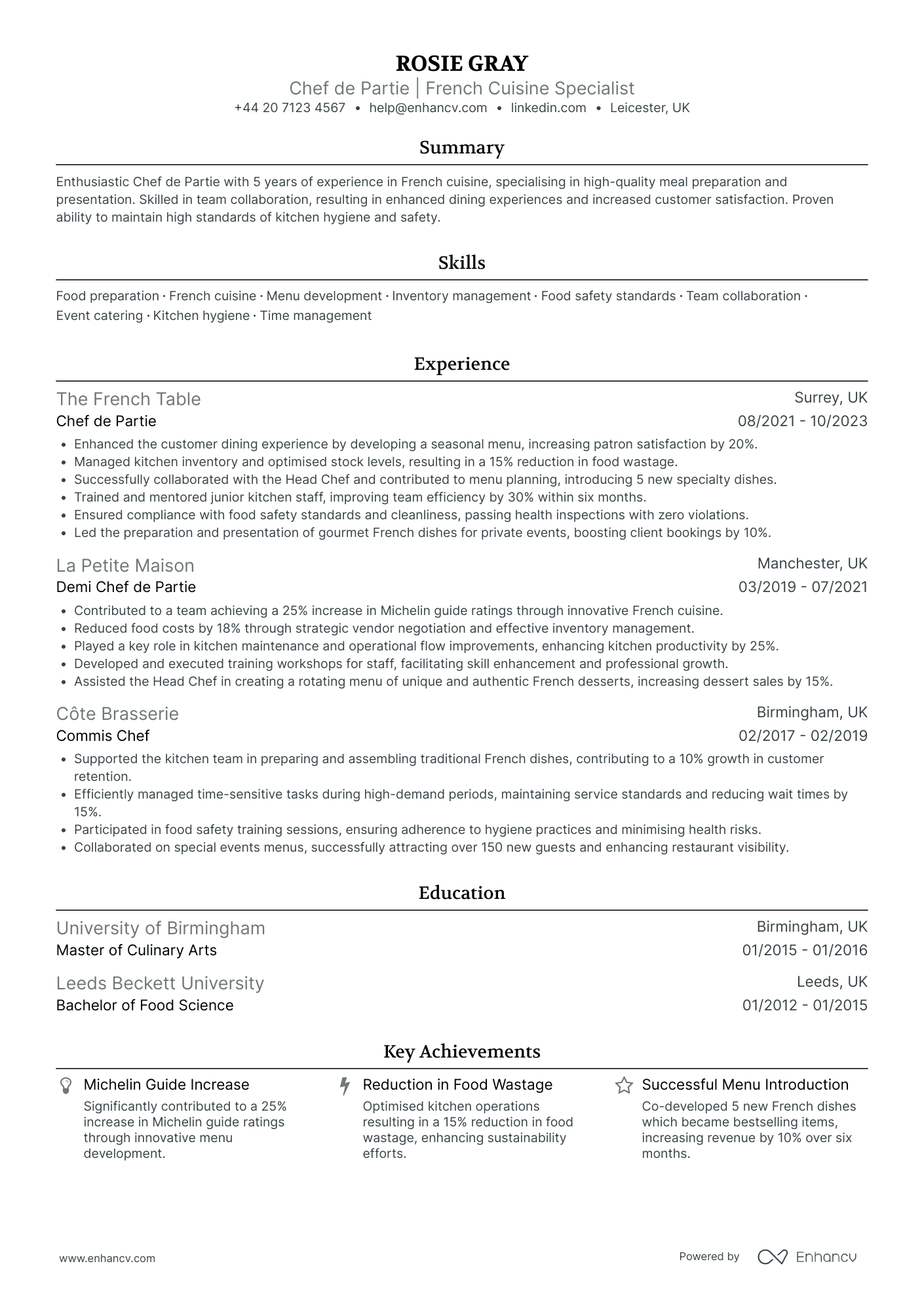
Use reverse chronological order: your current or most recent kitchen at the top, working back. It is the order UK employers expect, and it is the one an ATS reads cleanly when an agency or a large group puts your CV through one.
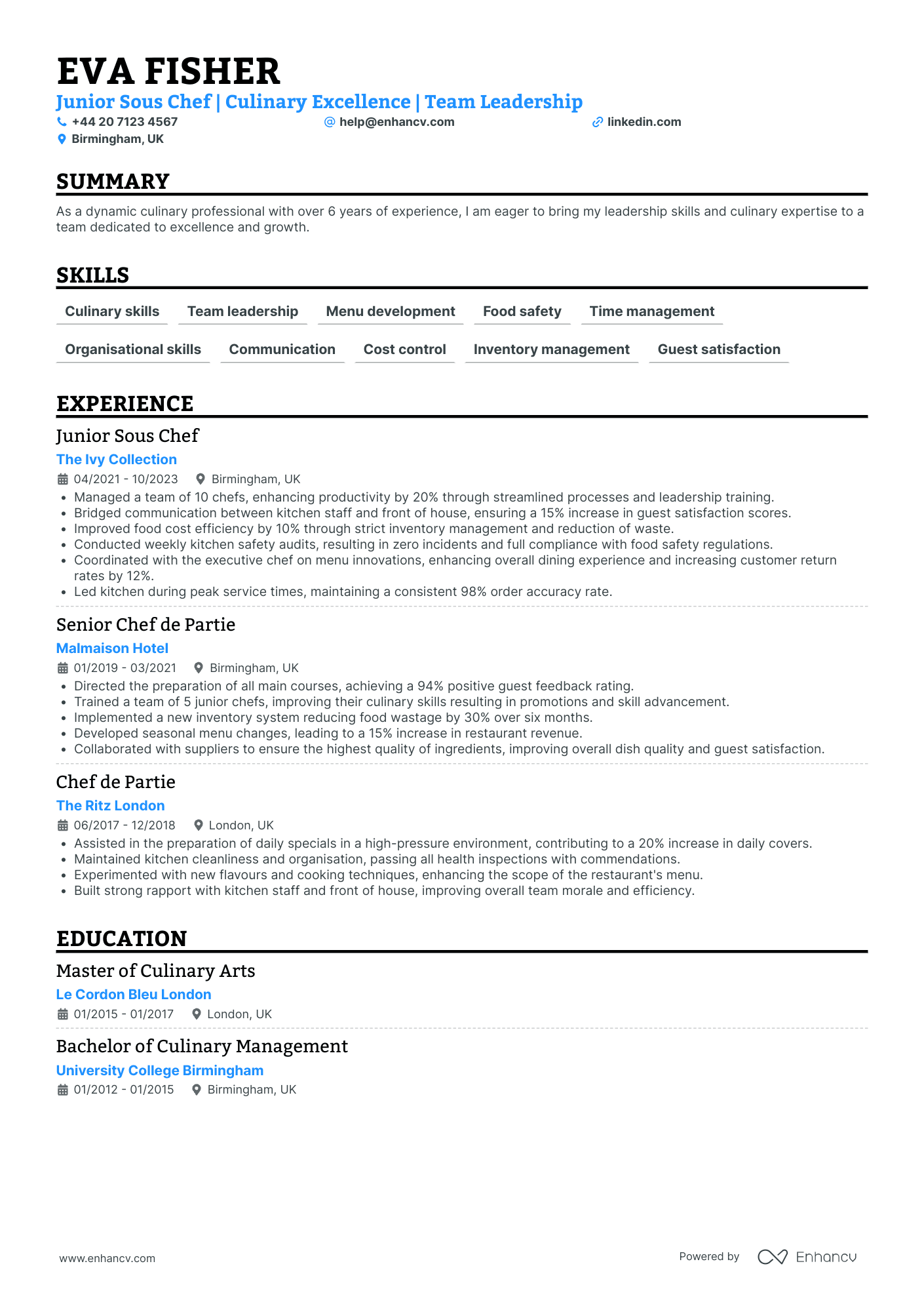
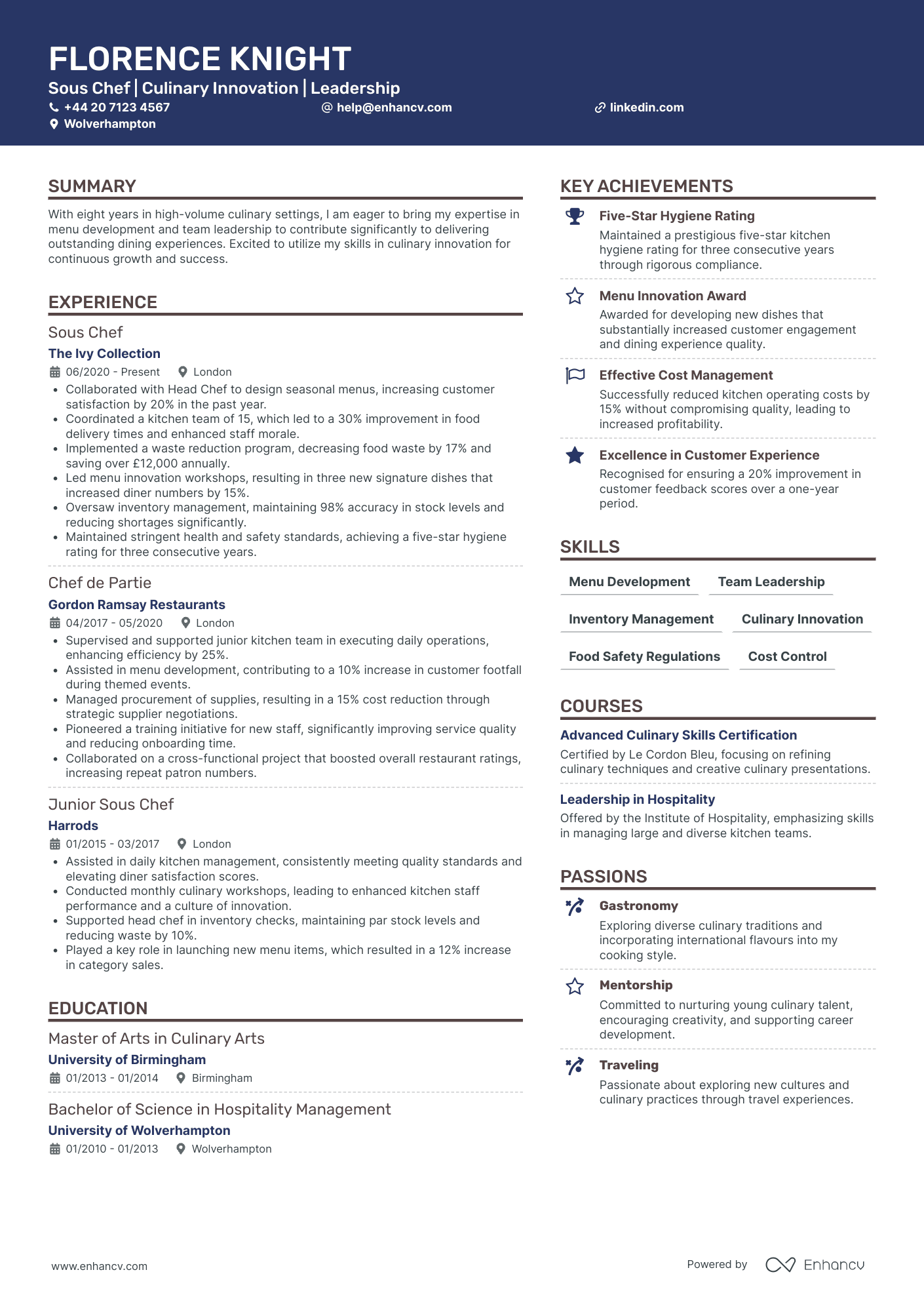
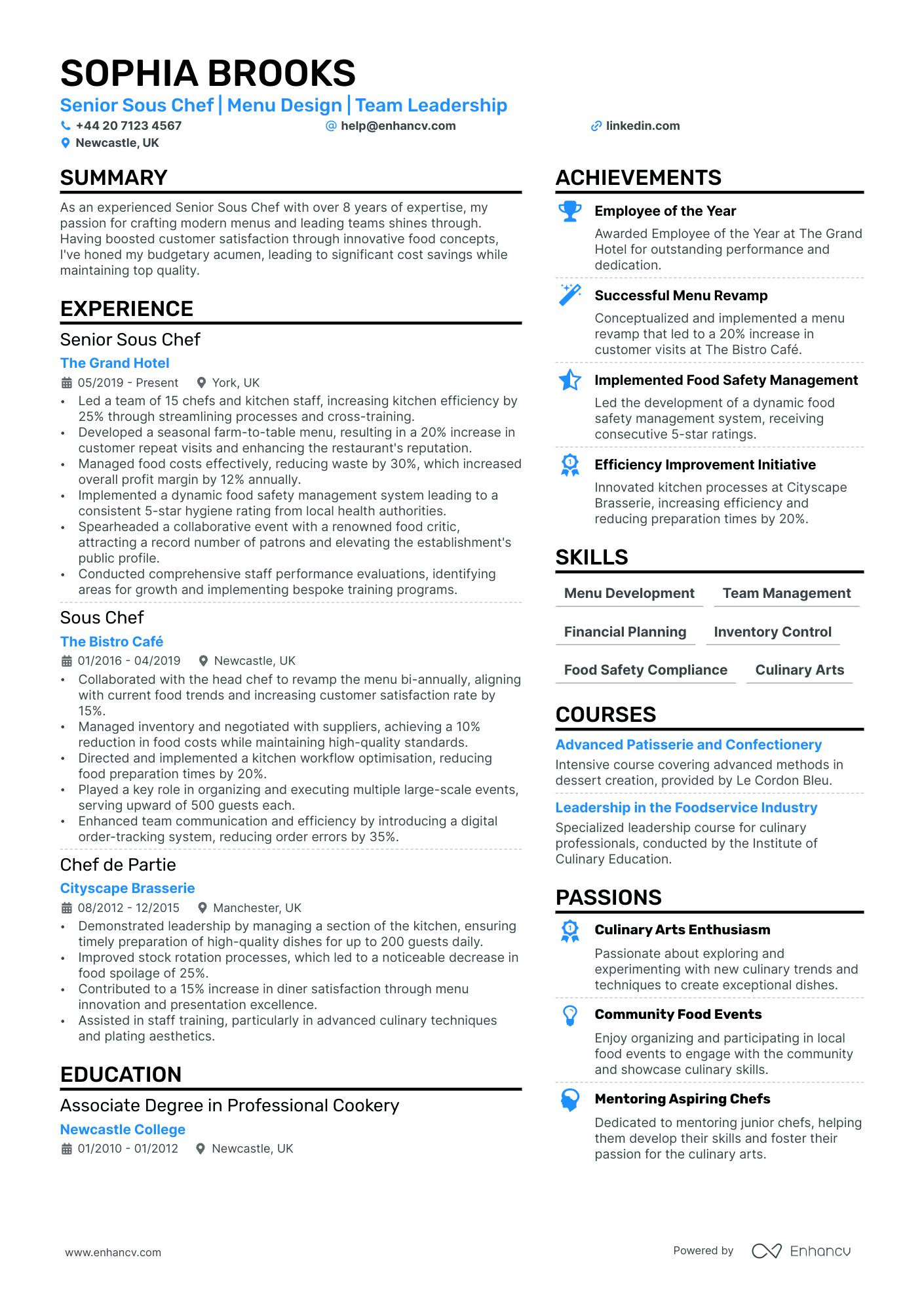
Keep it to two pages, one column, standard headings, and a plain, readable font. A third page of prep lists nobody asked for works against you.
Order the sections to match how a kitchen hires: header, a short personal statement, key skills, then experience, then your food safety and hygiene certificates, then education. Put the certificates where a head chef finds them in a glance rather than at the foot of page two. For the full running order, see the sections a CV needs.
Send a PDF for direct applications so the layout holds on any screen. Keep a Word copy for recruitment agencies, which place a large share of chef roles and reformat CVs into their own template. If the advert names a file type, follow it.
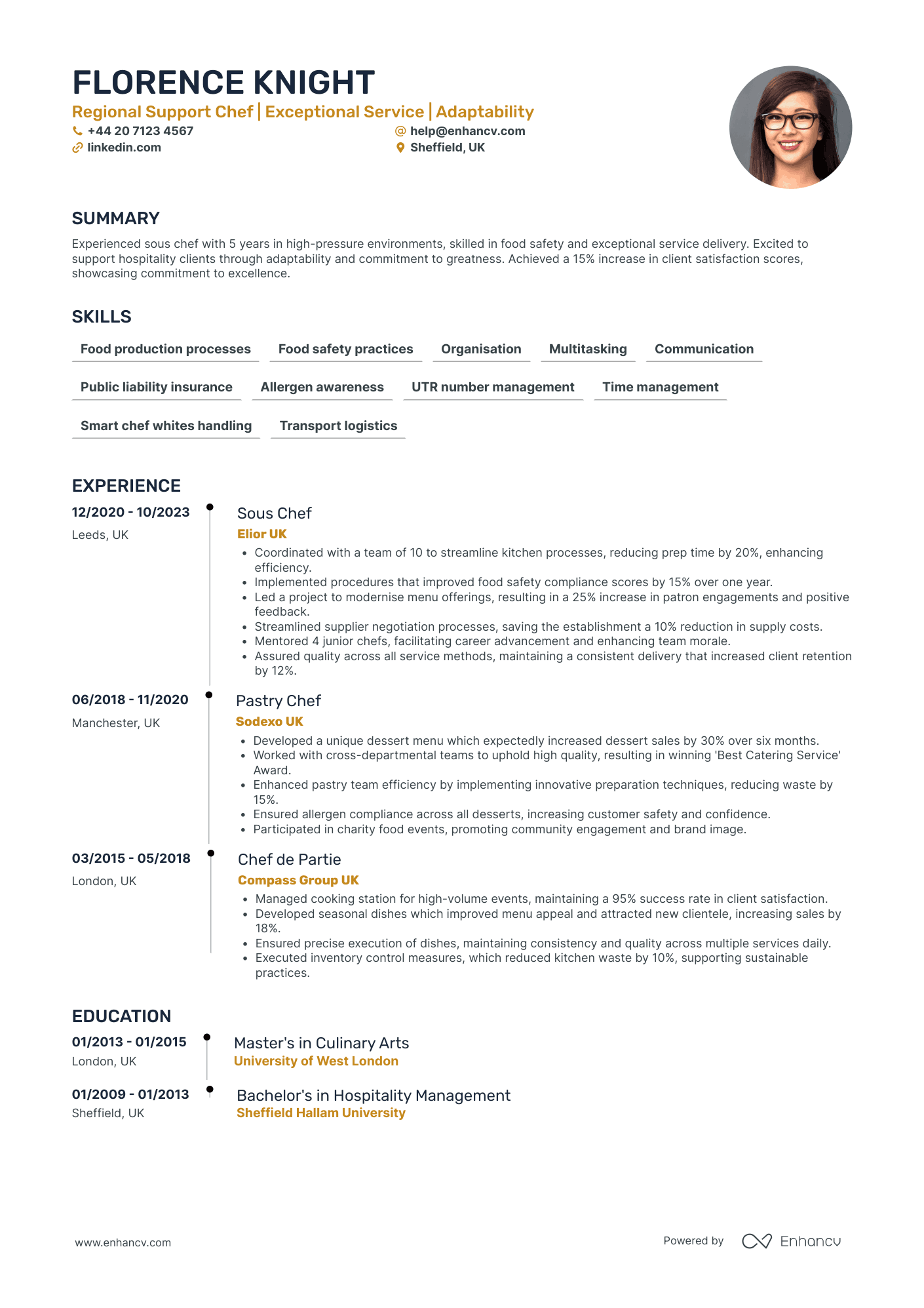
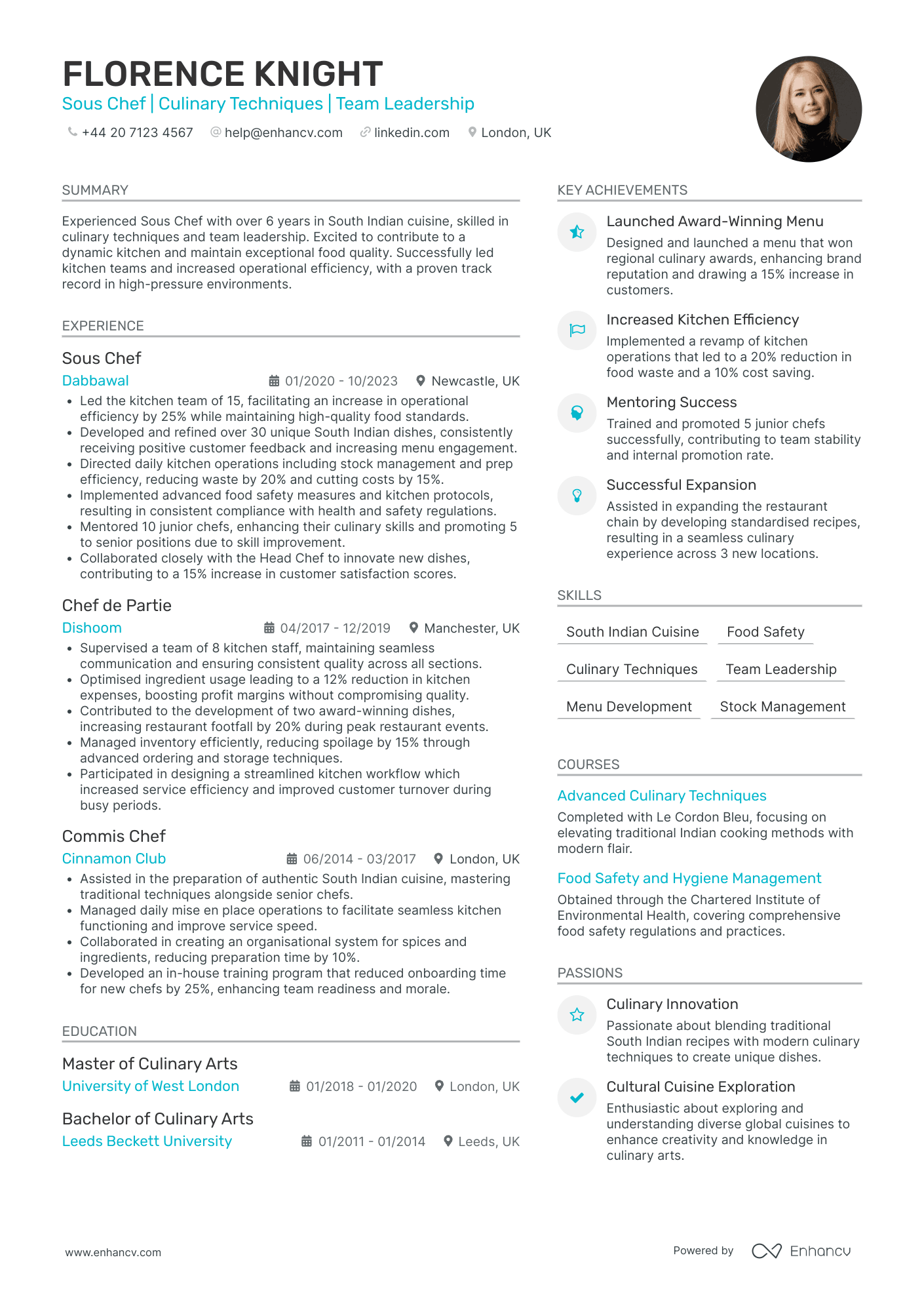
Your header does a lot of quiet work on a chef CV. Name, phone, email, and town are the basics. Add your general availability, whether you drive, and your notice period, because a kitchen short a section wants to know how fast you can start. Leave off your full address, your date of birth, and a photo. None of them help you, and a photo can trip an ATS.
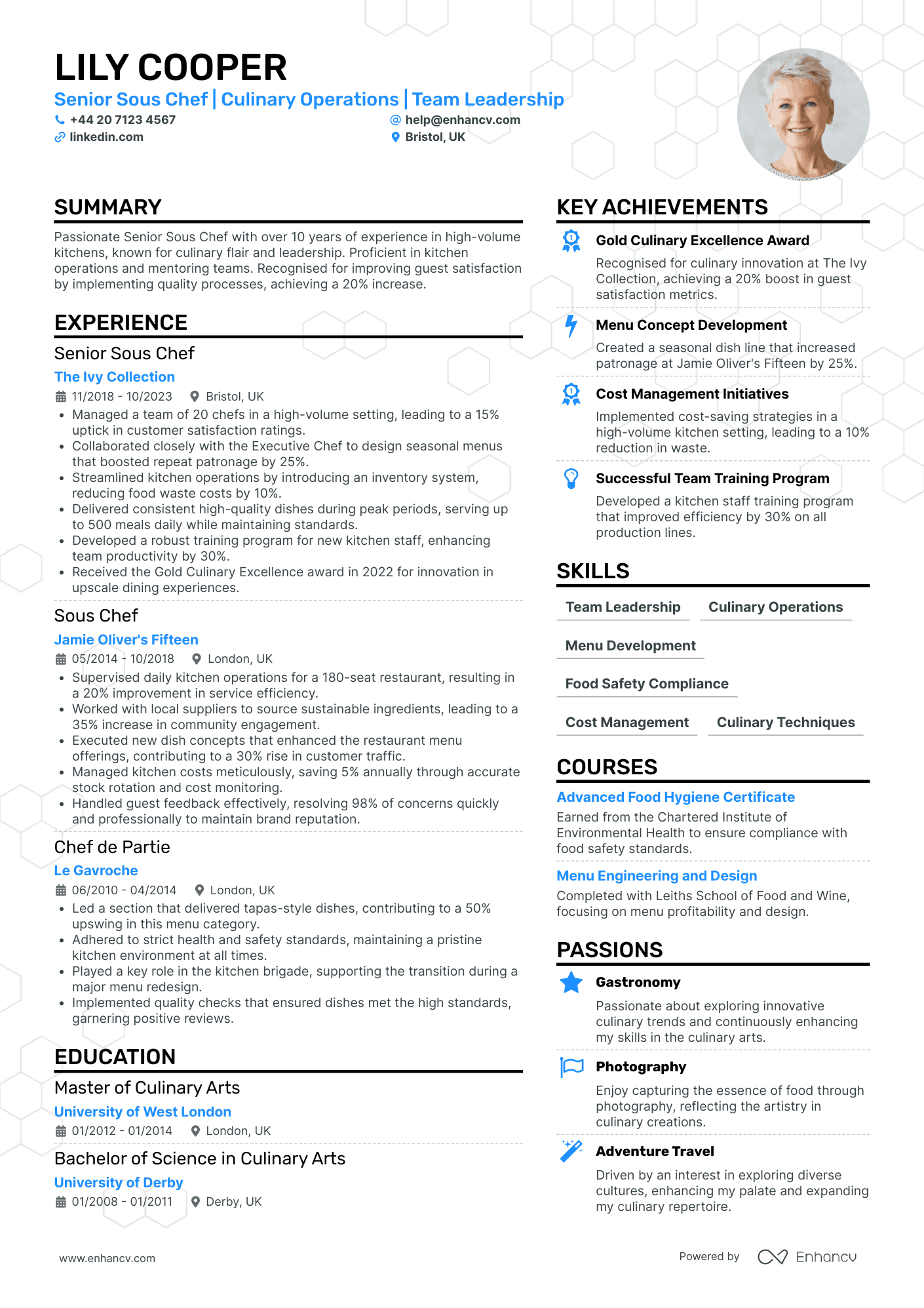
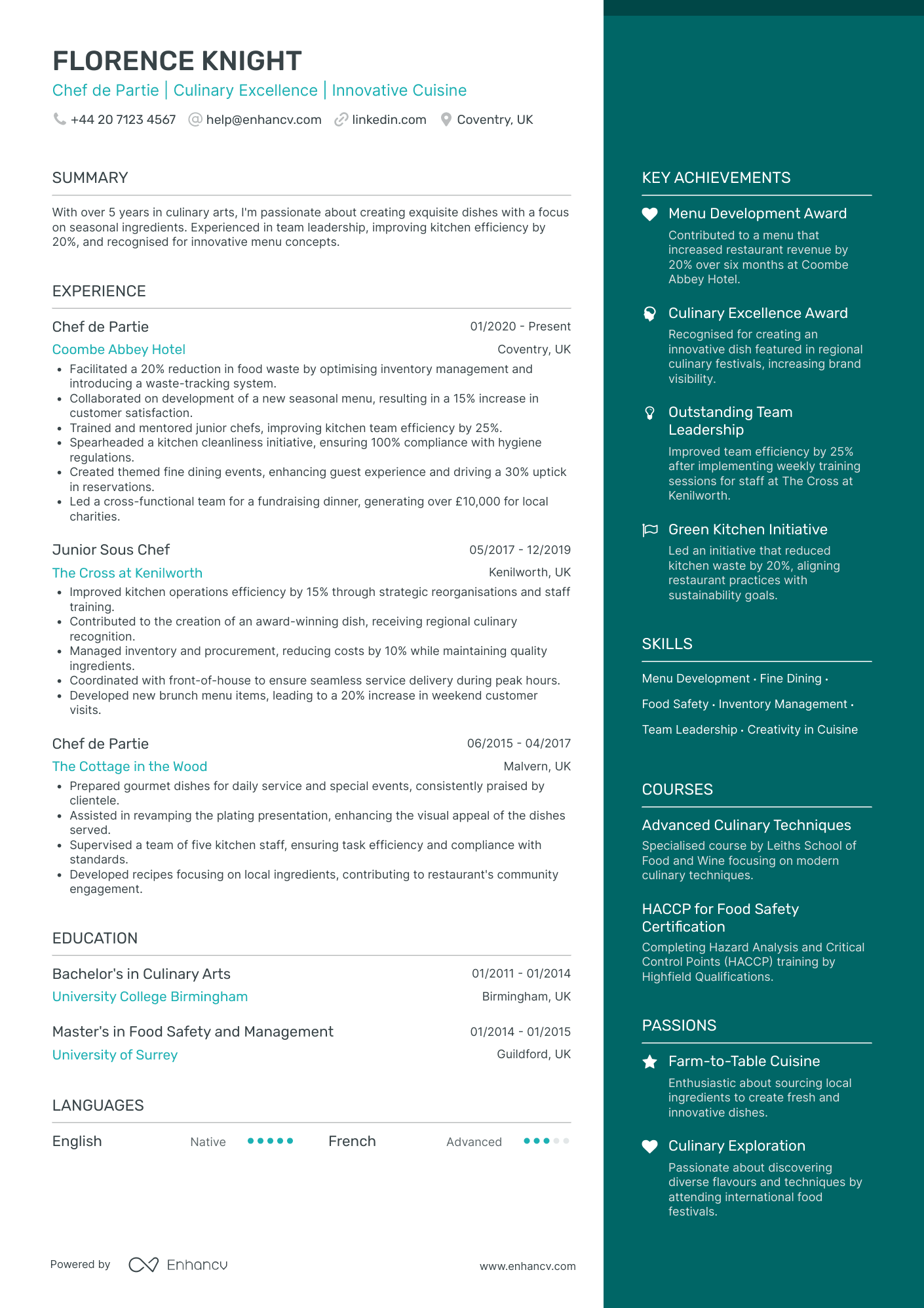
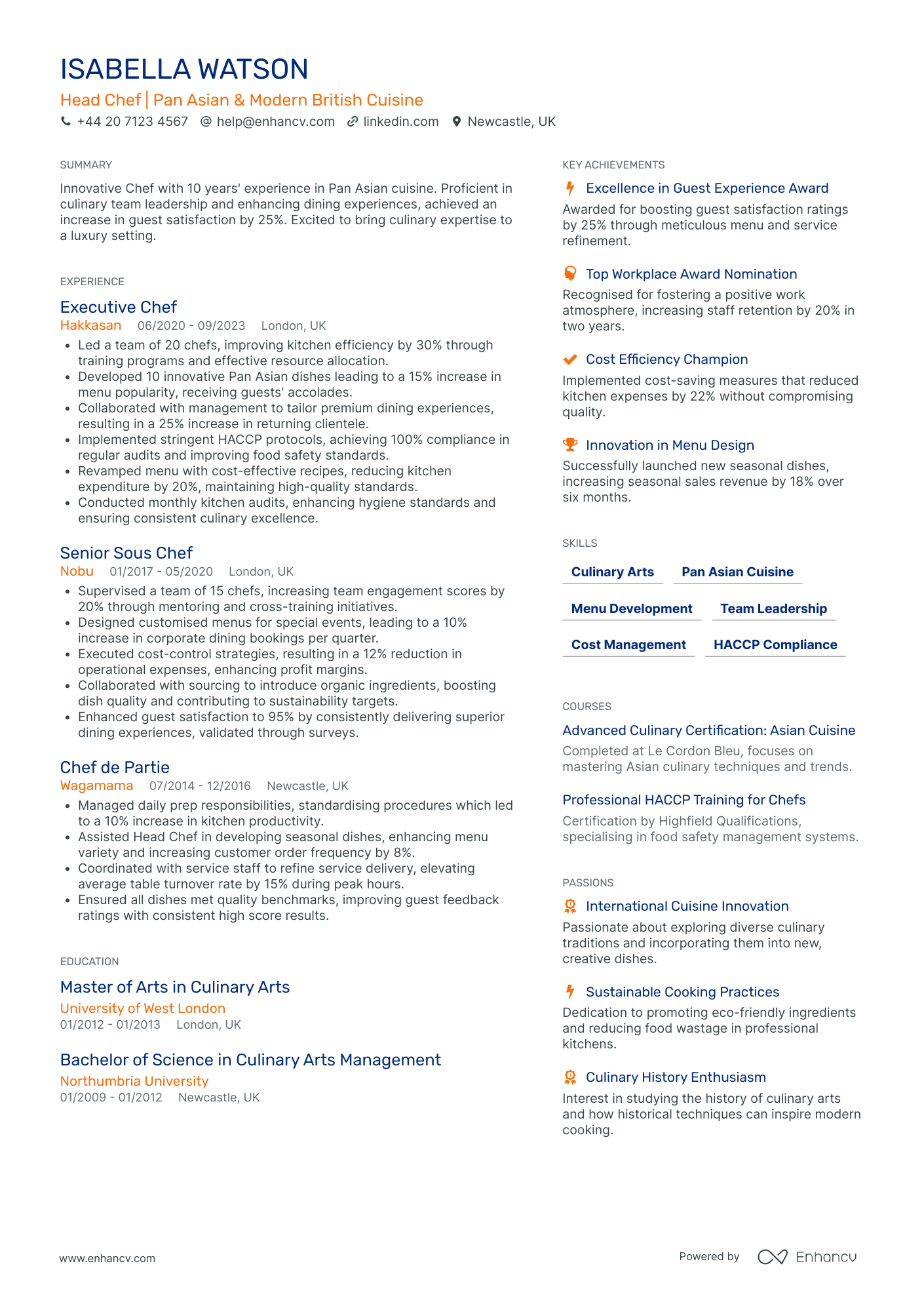
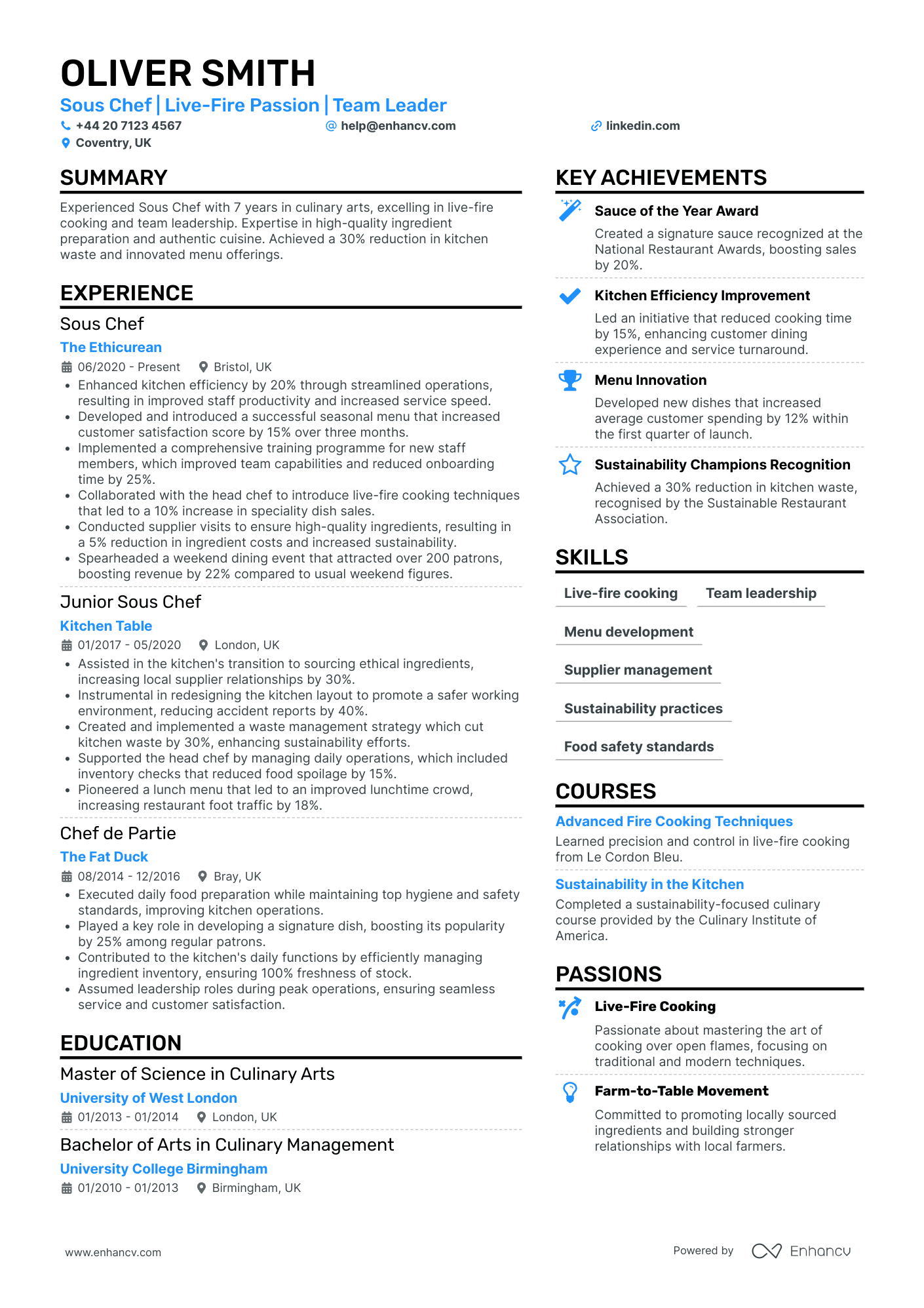
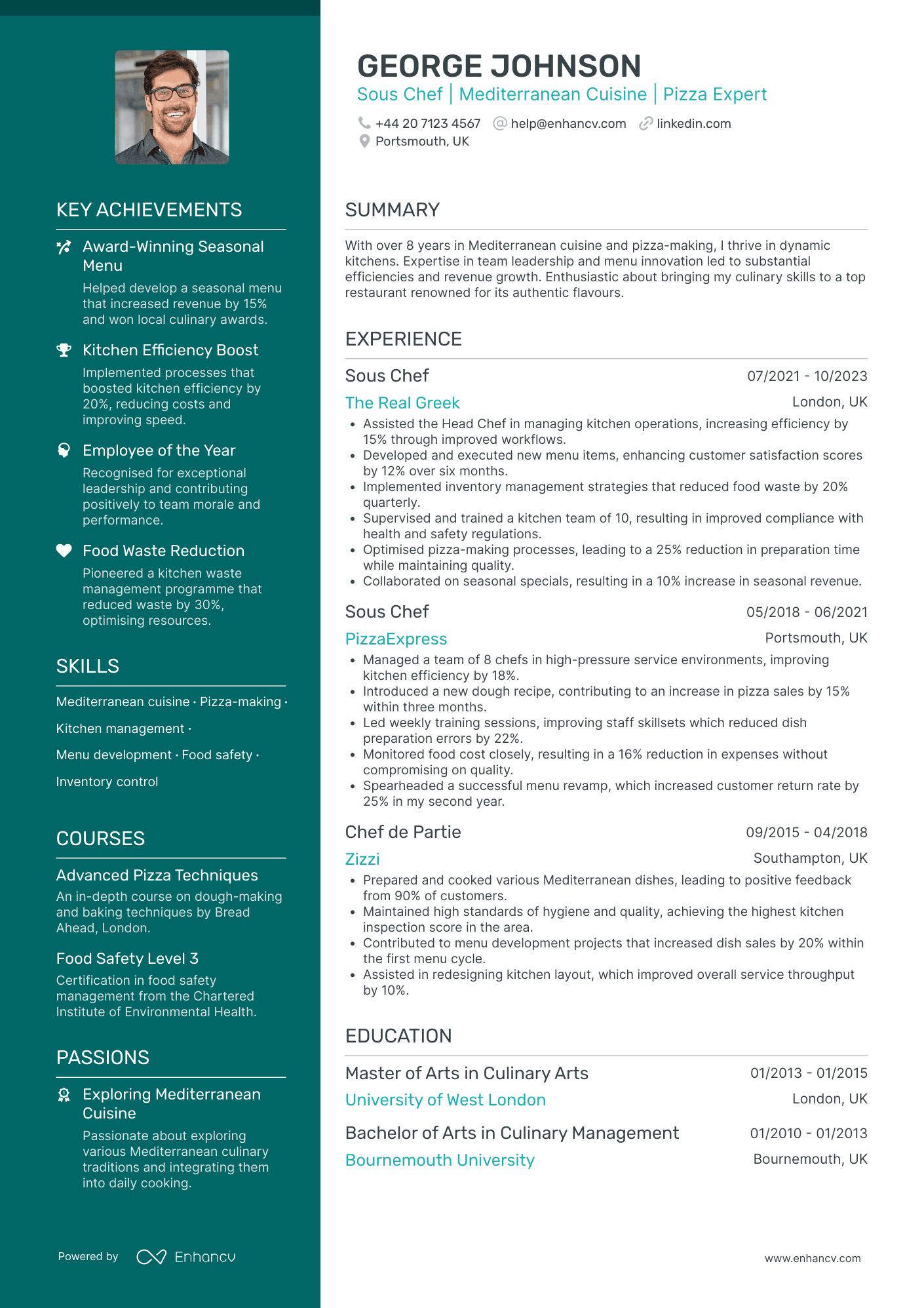
Two formatting mistakes sink otherwise strong chef CVs. The first is a dense wall of duties with no white space, which a head chef skims and abandons. The second is a creative template with columns, icons, and a skills chart that an ATS cannot read. A plain, single-column layout with clear headings beats a fancy one on the only screen that counts, the recruiter's.
Build it from a tested layout rather than a blank page. Enhancv's CV templates export to a clean PDF that keeps its formatting on the way through an ATS.

The order that suits a sous chef CV
Header with your location and contact details, a three-line personal statement, key skills, experience in reverse-chronological order, food safety and hygiene certificates, then education. Certificates sit above education because a head chef checks them first.

PRO TIP
Applying through a hospitality agency? Send both files. The agency wants an editable Word version for its own branded template, and the venue wants the PDF you designed. Name them clearly, as in "Firstname-Lastname-Sous-Chef-CV", and you save a reformatting round and a lost attachment.
What the UK sous chef market looks like
Knowing what kitchens ask for shapes what your CV leads with. Here is what the current UK postings show.
| What | UK sous chef roles |
|---|---|
| Where the work happens | On-site (all 665 UK sous chef postings in the last ~30 days, Enhancv's internal job feed) |
| Experience level asked for | Mid 57% · entry 25% · lead 14% · senior 4% (of 665 postings, last ~30 days) |
| Most-listed skills | Food safety, kitchen organisation, stock control, shift management, and hygiene standards |
Two numbers should shape your CV. Sous chef work is on-site everywhere, so a recruiter needs to see you can reliably get to the kitchen. Put your town and how far you will travel in the header, and mention a driving licence and late-shift availability if you have them.
Most postings sit at mid level, with a strong entry tier feeding in from commis roles, so name the covers and sections you have run to show which rung you belong on. Pay swings widely by venue, covers, and city, so leave salary off the CV and raise it at interview.
The skills row is the useful one for wording. When the same demands appear across most adverts, a recruiter is scanning for those exact phrases, so a CV that says "food safety", "stock control", and "kitchen organisation" in its own words matches faster than one that dresses them up. Mirror the advert's language where it is honestly true of you.
Skills to put on a sous chef CV
The same demands repeat across UK sous chef adverts, and they are practical, not fluffy. Hard skills like food safety, kitchen organisation, and stock control come up again and again, so list them in the words the adverts use.
Under those sit the soft skills that actually run a kitchen: leading a brigade through a rush, coaching commis, and staying calm when three tables order at once. The generic "seven soft skills" lists you see online miss most of these, so prove yours in a bullet rather than claiming them in a row.
Evidence beats a list every time, so tie each skill to a moment. Food safety becomes "held a 5-star Food Hygiene Rating across two inspections". Stock control becomes "cut wastage by a fifth by rewriting the rotation system". Kitchen organisation becomes "reset the prep schedule so service ran without a single hold". A skill a recruiter can picture is worth ten they have to take on trust.
List only what you can stand behind. If you have run a section, say which one. If you have covered head chef days off, that is a leadership skill worth its own line.
Top skills for your sous chef CV:
Food safety (HACCP)
Kitchen organisation
Stock control and ordering
Shift management
Hygiene standards
Menu and prep planning
Portion and cost control
Shift handovers
Team leadership
Coaching junior chefs
Communication under pressure
Calmness
Time management
Teamwork
Writing your sous chef personal statement
Three or four sentences at the top: who you are, the kitchens you have worked, the volume you are used to, and what you want next. Keep it concrete. See more personal statement examples if the opening line will not come.
Skip the adjective soup. "Passionate, hard-working team player" is on half the CVs in the pile and tells a head chef nothing they can check.
Match the statement to the kitchen. A fine-dining role wants to hear about precision, consistency, and section discipline. A high-volume gastropub or hotel wants speed, calm, and the covers you can turn. Read the advert, then lead with the version of yourself it is hiring for.
Lead with evidence instead:
Sous chef CV personal statement example
Sous chef with six years in high-volume gastropub and hotel kitchens, running the larder and grill sections through services of up to 180 covers. Hold a Level 3 Food Hygiene certificate and lead a brigade of four commis, covering head chef days off for the last two years. Looking to bring tight section control and a calm pass to a senior kitchen in central Bristol.
Compare that with "Enthusiastic and reliable sous chef seeking a challenging role in a dynamic kitchen." It could belong to anyone in the pile, and it gives a head chef no reason to read the next line.
When I read a sous chef CV, I skip past the adjectives and look for two things: the covers you have run and the sections you have owned. "Ran the grill through 200-cover services" tells me you can handle my Saturday night. "Passionate about food" tells me nothing. Name the volume, name the sections, and name the times you stepped up when the head chef was off. That is the CV that earns a trial shift.
The Enhancv team
Writing your sous chef experience section
This section wins or loses the trial shift, so give it the most room. Write each role as a dated heading, then bullets that lead with a verb and land on a result. For the mechanics, see work experience on a CV.
A sous chef's job is measurable even when it does not feel like it: covers per service, section size, food cost percentage, wastage, hygiene scores, and the number of commis you trained. Those numbers are your achievements, and they beat a list of duties every time.
Give one line of context per role, then let the bullets do the selling. A head chef already knows what a sous chef broadly does, so do not spend five bullets restating the job. Spend them on what you changed: a cost you cut, a section you turned around, a rating you protected, a chef you developed.
Show progression across roles. An earlier chef de partie or commis entry does not need five bullets, but it should show the rung below and the moment you started leading. Two or three lines that name the section you ran and the responsibility you took on are enough to tell the story.
Tailor each application. Pull the sections, cuisine, and cover volume from the advert and mirror them where they are true of you. Enhancv's CV tailoring feature reads the advert and suggests the matching edits, so you are not rewriting from scratch for every kitchen.
- Run the grill and larder sections through services of up to 180 covers, six days a week, leading a brigade of four commis
- Cut food cost from 34% to 29% in eight months by tightening ordering, portion control, and supplier negotiation
- Held the kitchen's 5-star Food Hygiene Rating across two consecutive Environmental Health inspections
- Trained and signed off six commis chefs, three of whom progressed to chef de partie
- Cover head chef duties on days off, including rota planning, ordering, and daily prep lists for a team of nine
- Ran the sauce section for a 120-cover restaurant and a busy function suite, working doubles across weekends
- Stepped up to sous chef cover during a six-month vacancy, planning prep and briefing the section each service
- Standardised recipe cards for the section, cutting plate inconsistencies and speeding up new-starter training
PRO TIP
List a duty once, as context, then spend your bullets on outcomes. "Responsible for stock control" is a duty. "Rewrote the prep and rotation system and cut wastage by a fifth" is the same duty turned into a reason to hire you.
Education and certifications for a sous chef CV
Kitchens hire on the pass, not the classroom, so this section is short. What earns its place are the certificates a head chef and an Environmental Health Officer expect to see.
List these where you hold them: Level 2 or Level 3 Food Safety and Hygiene, allergen awareness, and any first aid. Add an NVQ or Diploma in Professional Cookery if you have one, and put in-progress certificates on too. A Level 3 Food Hygiene certificate in particular signals you are ready to be responsible for a section.
Catering college matters most early in a career. Once you have years on the pass, a single line for your qualifications is enough, and the experience section carries the weight.
Writing a junior sous chef CV
Stepping up from chef de partie or commis, your CV has to argue that you are ready to lead a section, not just work one. Lead with the moments you already have.
UK brigades run in a clear order: commis chef (often numbered commis 1, 2, and 3, where commis 1 is the most senior junior), then chef de partie, then sous chef, then head chef. If you have covered a chef de partie on holiday, run a section solo on a quiet service, or trained a new starter, those are the lines that move you up.
No formal sous chef title yet? Use a skills-led structure and put a strong personal statement, your sections, and your food safety certificates before a thinner work history. Name the covers you have worked and the responsibilities you have taken on, even the informal ones.
Junior CVs win on trajectory. A head chef reading a chef de partie who wants the step up is asking one question: is this person ready to be trusted with a section and a couple of commis? Answer it with evidence. The time you ran service when the sous was off, the new starter you trained, the order you took charge of, the busy Saturday you held together. Those moments are the argument, so give them the space a generic duties list would waste.
Conclusion
Lead with format, prove volume with real numbers, and put your food safety certificates where a head chef sees them in a glance.
Pair the CV with a short cover letter that says why this kitchen, and you turn a stack of duties into a reason to offer you a trial shift.
Author's take - The Enhancv team
When I read a sous chef CV, I skip past the adjectives and look for two things: the covers you have run and the sections you have owned. "Ran the grill through 200-cover services" tells me you can handle my Saturday night. "Passionate about food" tells me nothing. Name the volume, name the sections, and name the times you stepped up when the head chef was off. That is the CV that earns a trial shift.