



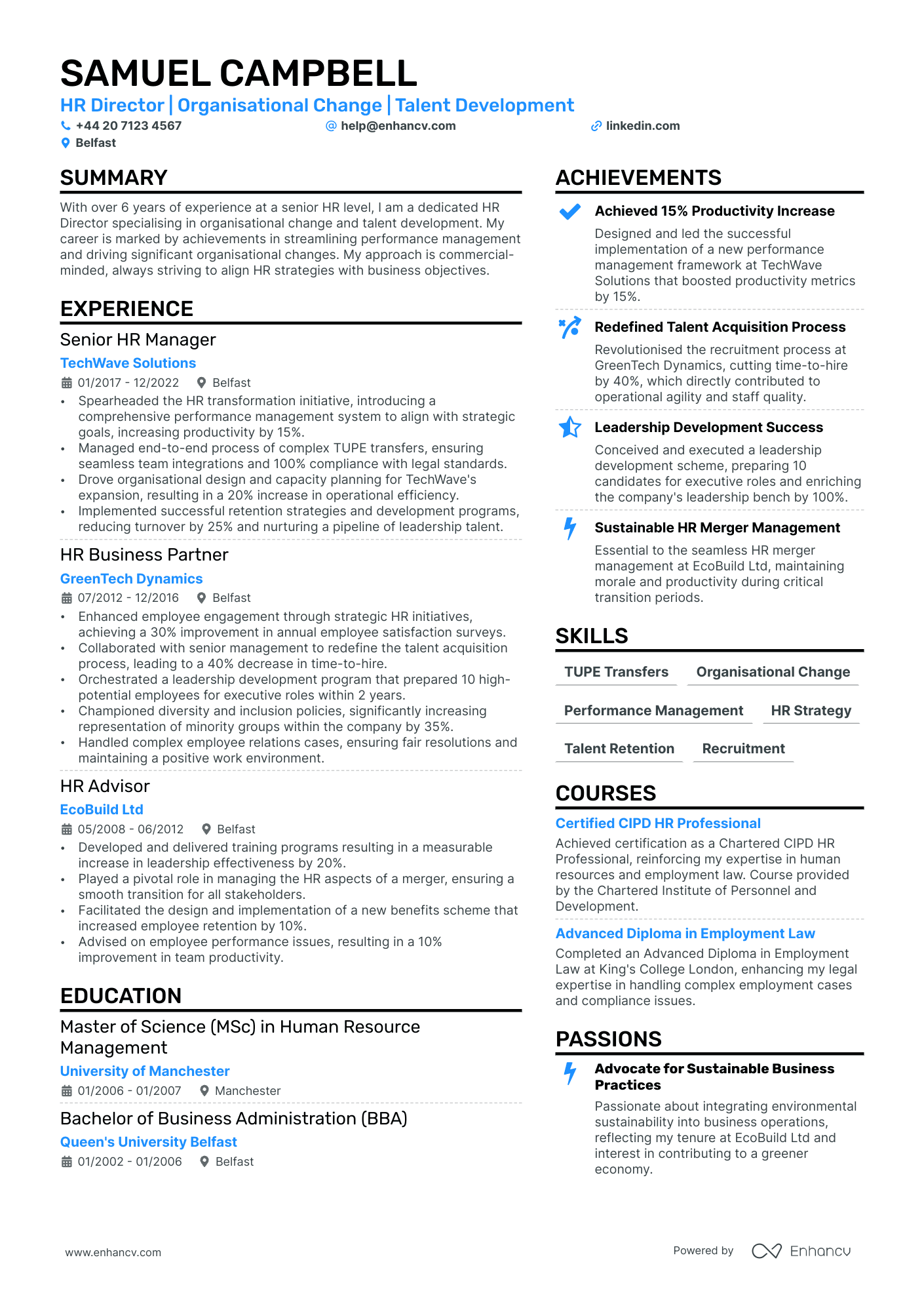
Most HR director CVs read like a job description with the pronouns swapped. Responsible for this, oversight of that, and not a single number a board would recognise.
At director level the CV has one job: to prove you can run HR as a function, tie people decisions to commercial outcomes, and hold your own in the room where the budget gets set. Get the format and framing right first, because that is where most strong candidates quietly lose the interview. If you want the fundamentals before the senior polish, start with how to write a CV.

Key takeaways
- Lead with function-level scope: headcount, sites, and the budget you were accountable for, stated as figures in the top third.
- Prove commercial impact, not activity. Tie people decisions to attrition saved, cost per hire, engagement, and money managed.
- Put your chartered CIPD standing near the top. At director level it is expected rather than a bonus.
- Two pages, reverse chronological, sent as a PDF for direct applications and a Word copy for the search firms that place director roles.
- Open with a personal statement that names your scale and one measurable result, then stops.
- Show the boardroom work: restructures, TUPE, transformation, reward, and workforce planning against a business plan.
Formatting your HR director CV
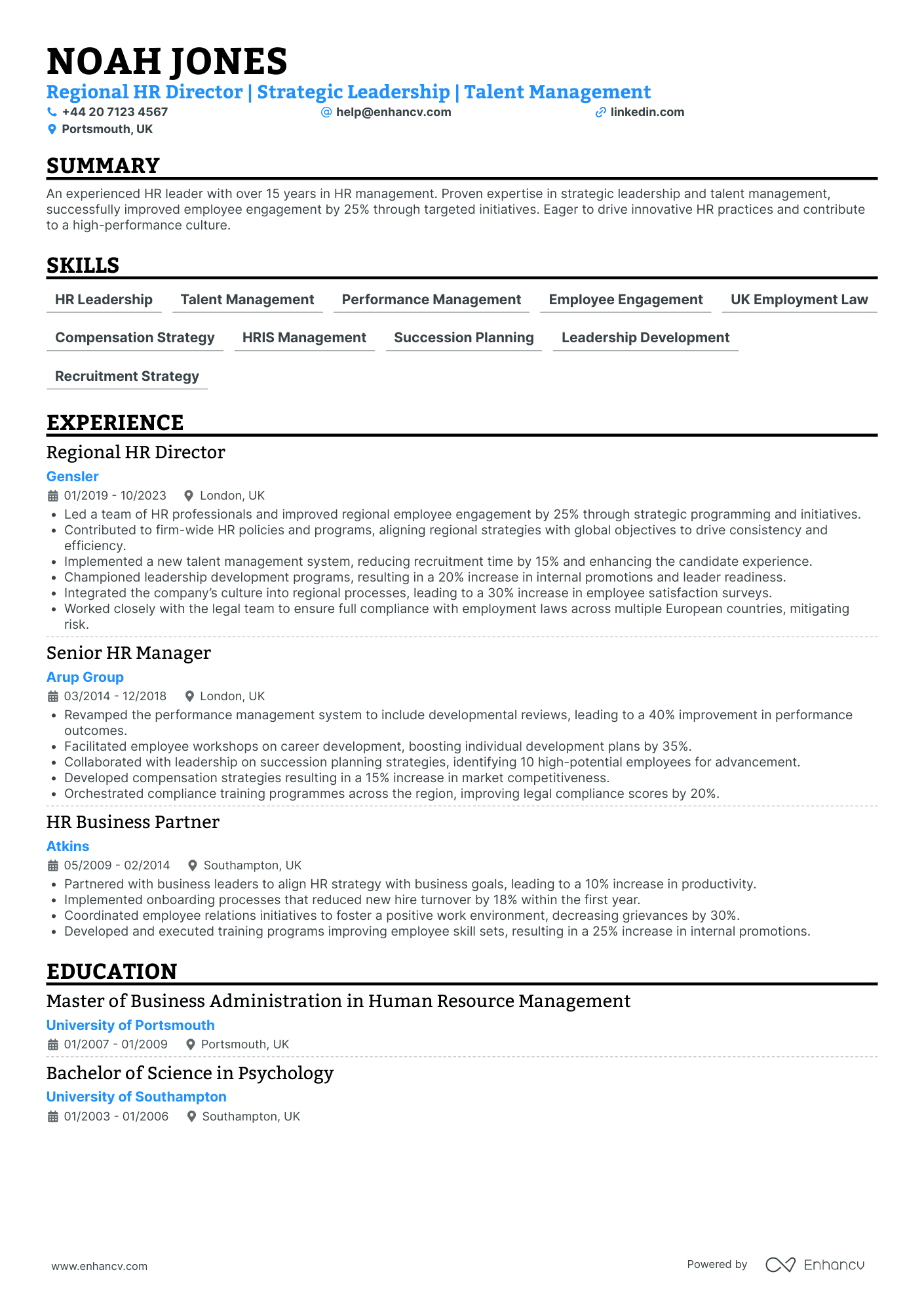
Use a reverse chronological structure. At director level your track record is the argument, so the most recent and most senior role sits first and carries the most detail.
Keep it to two pages, even after a long career. A director who cannot edit their own story down to two pages invites a quiet question about judgement.
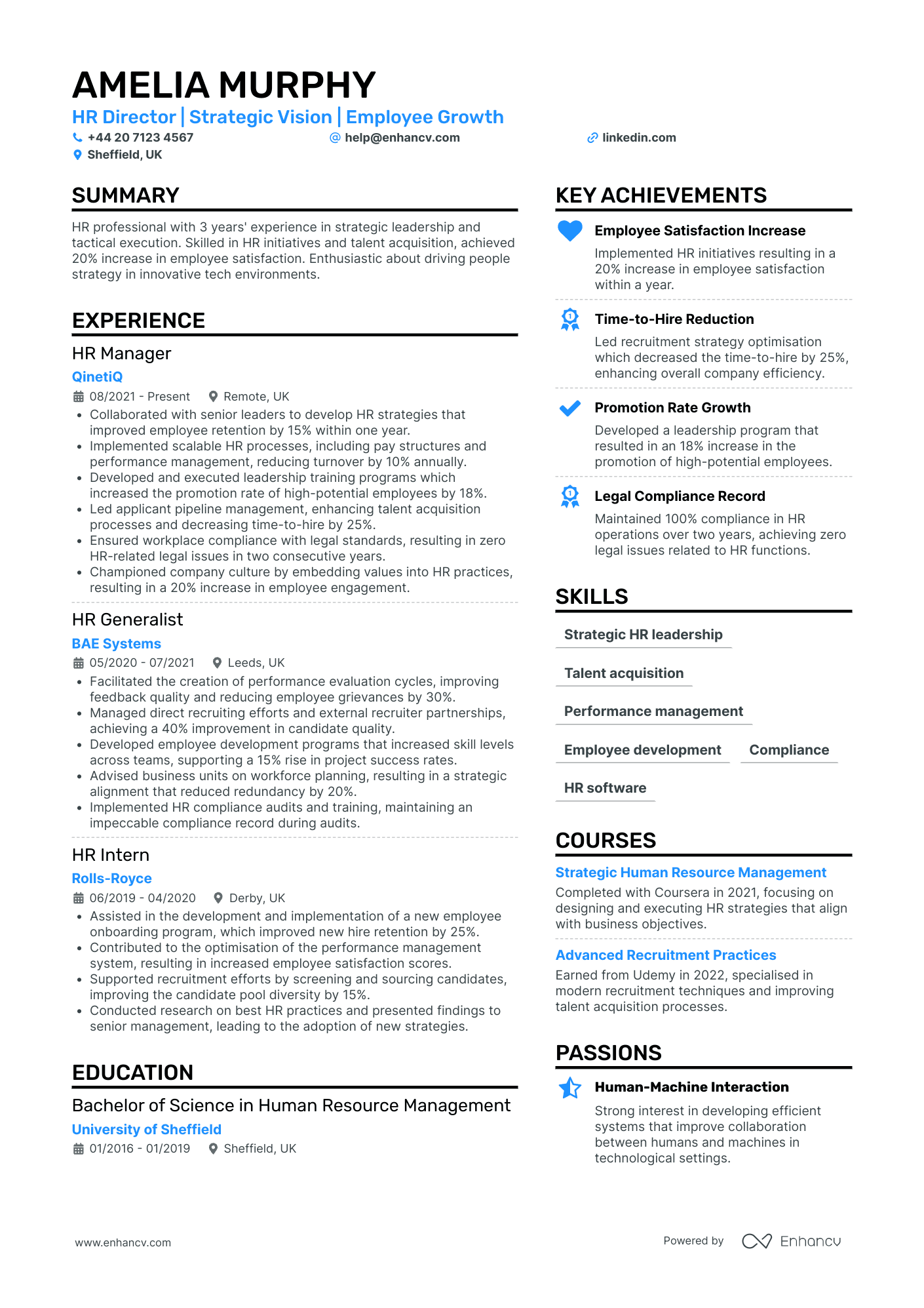
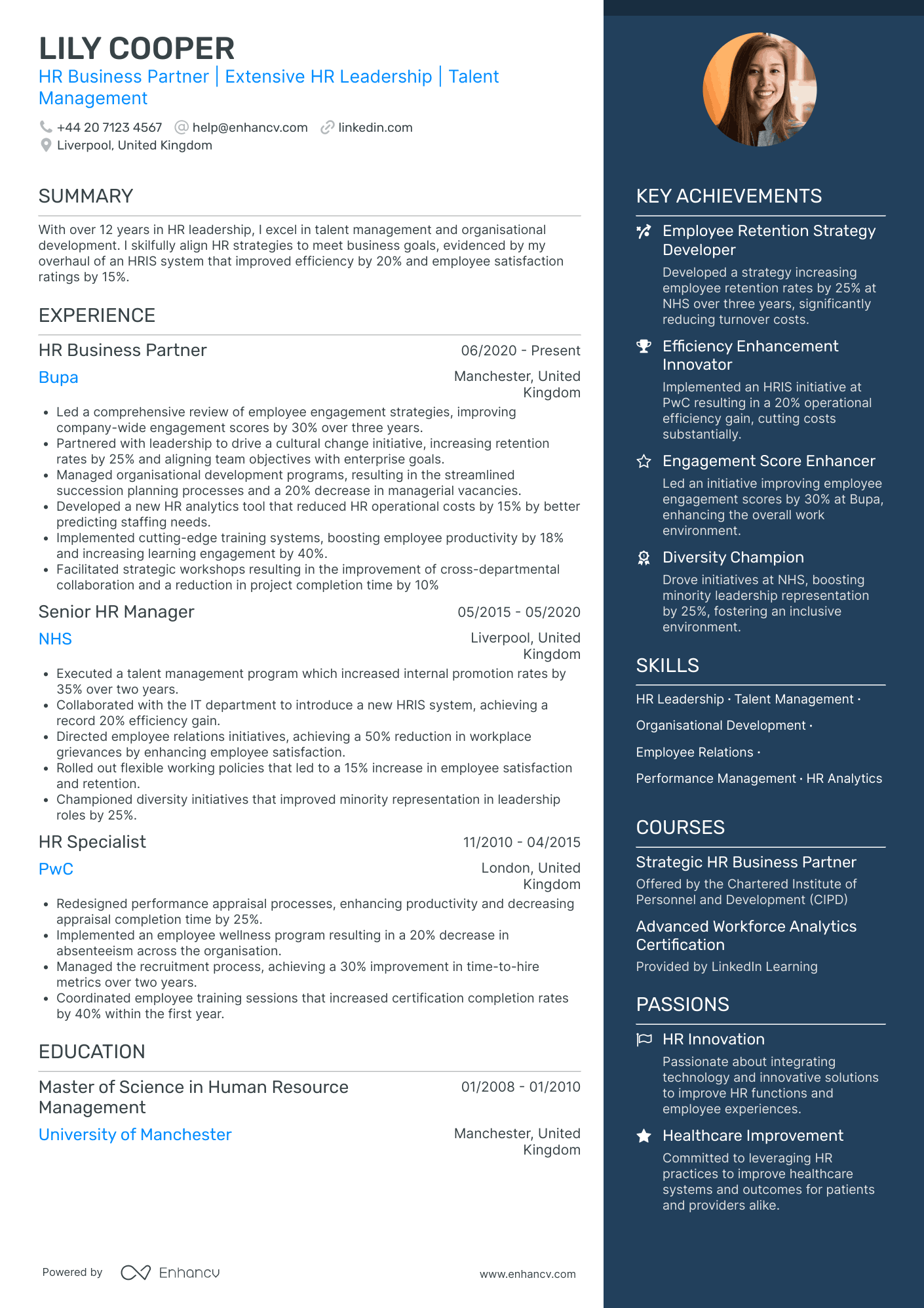
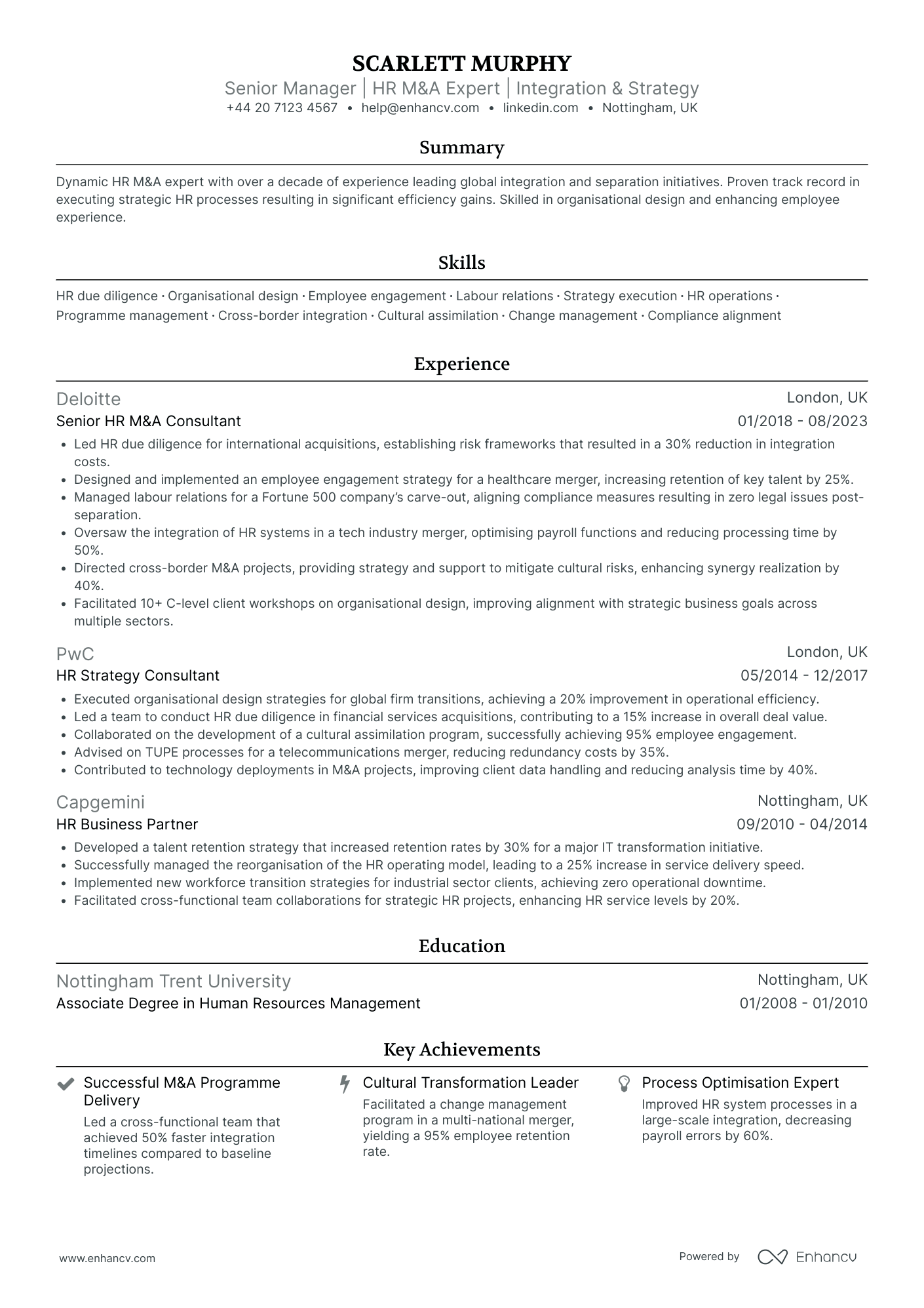
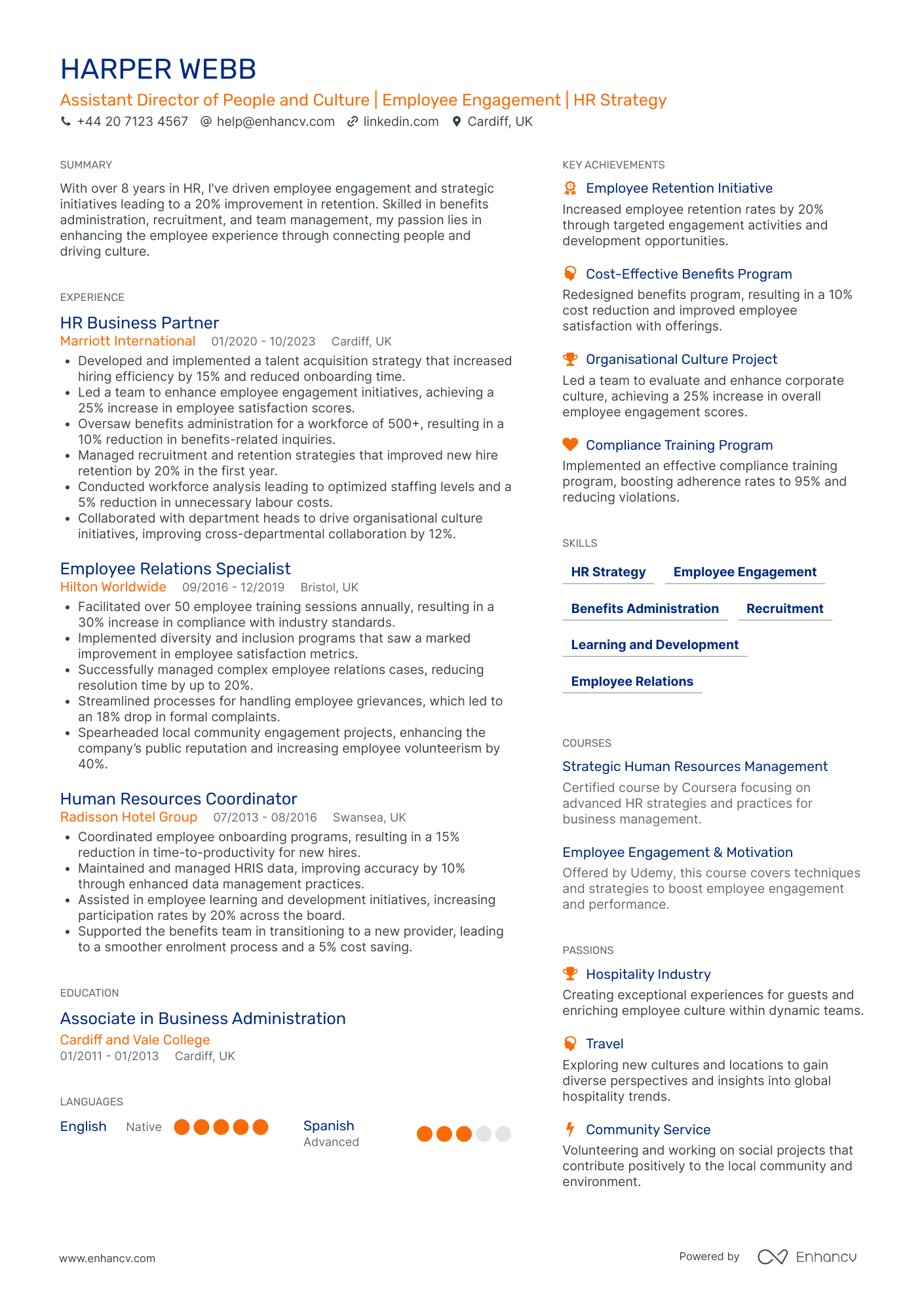
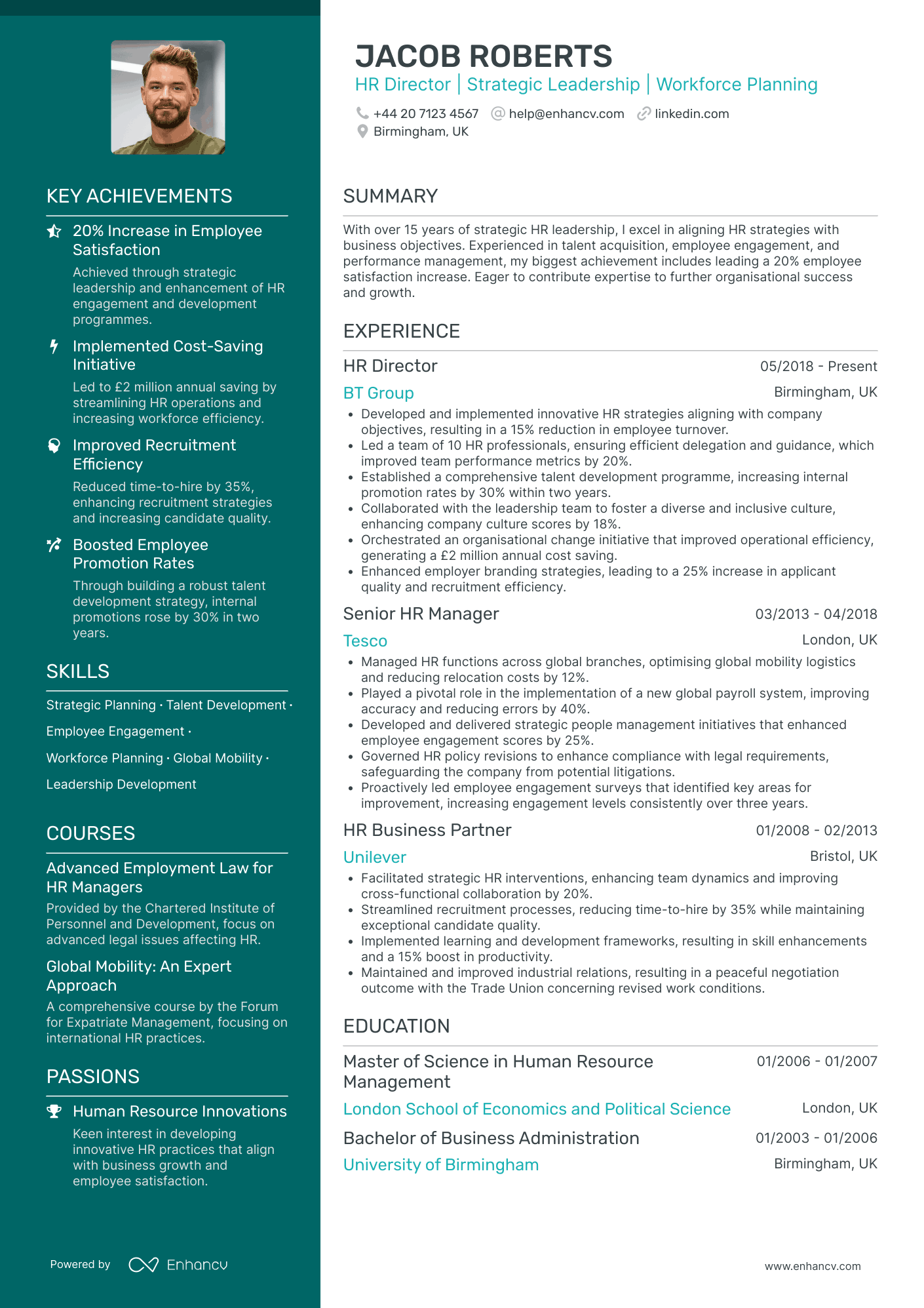
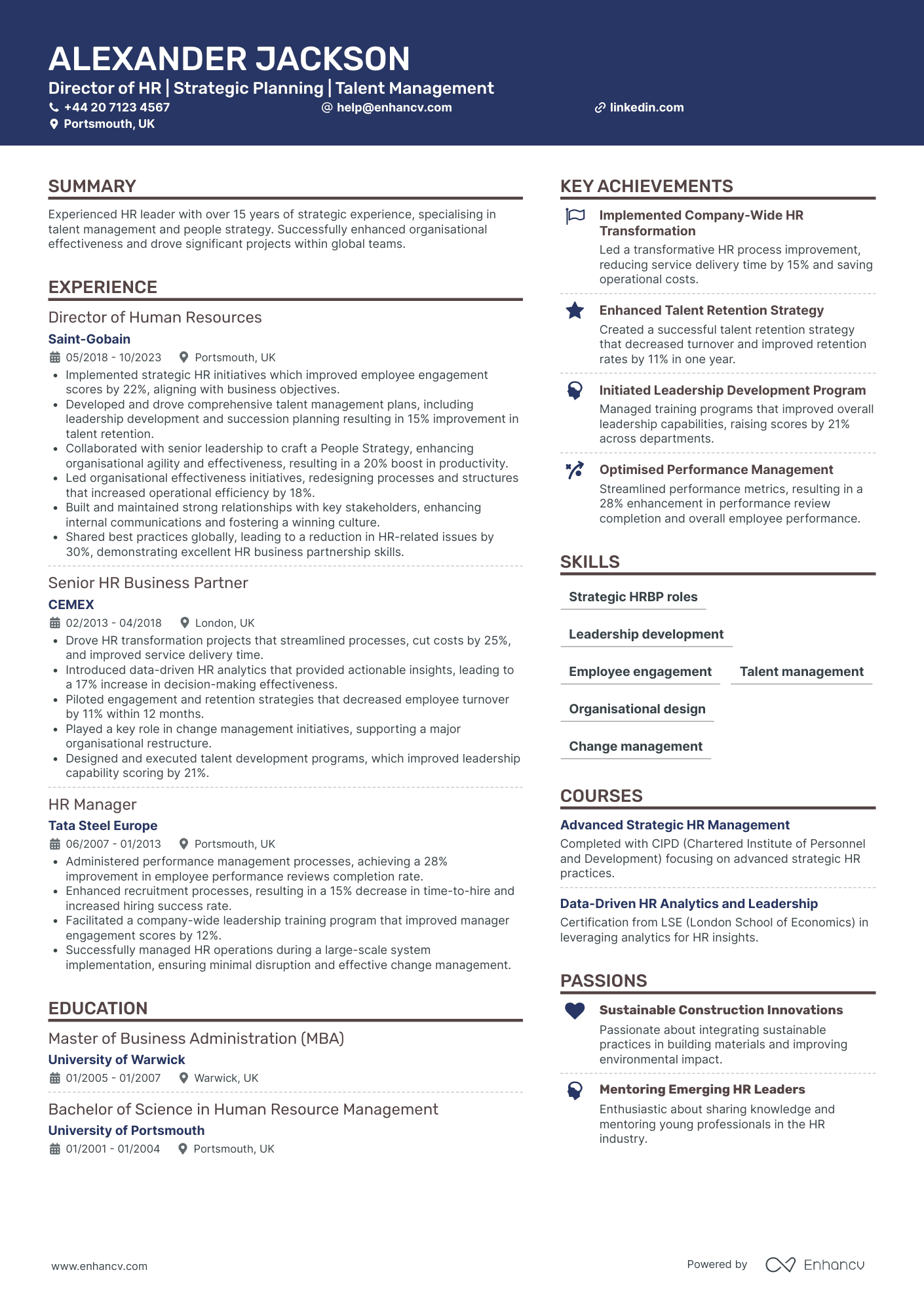
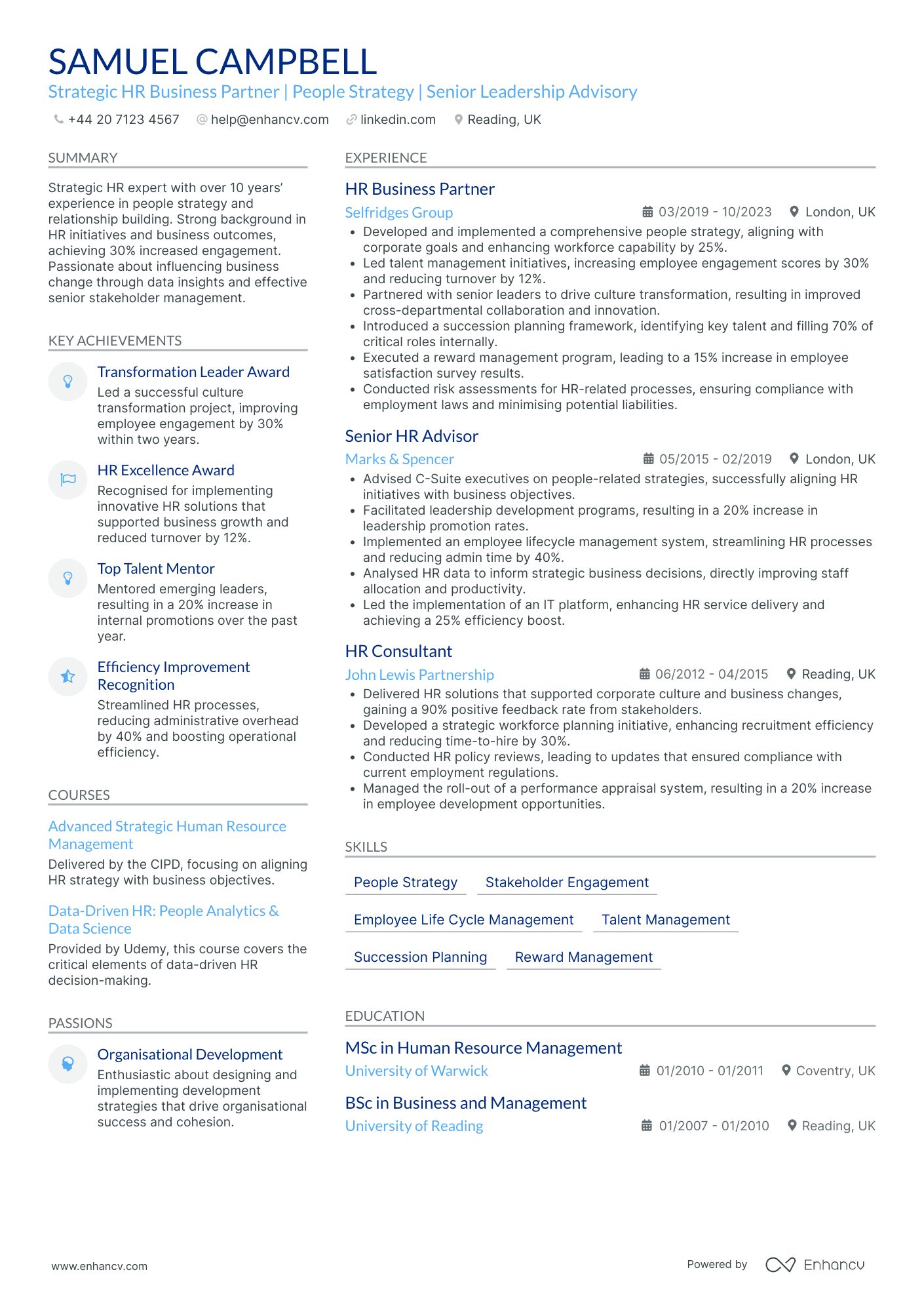
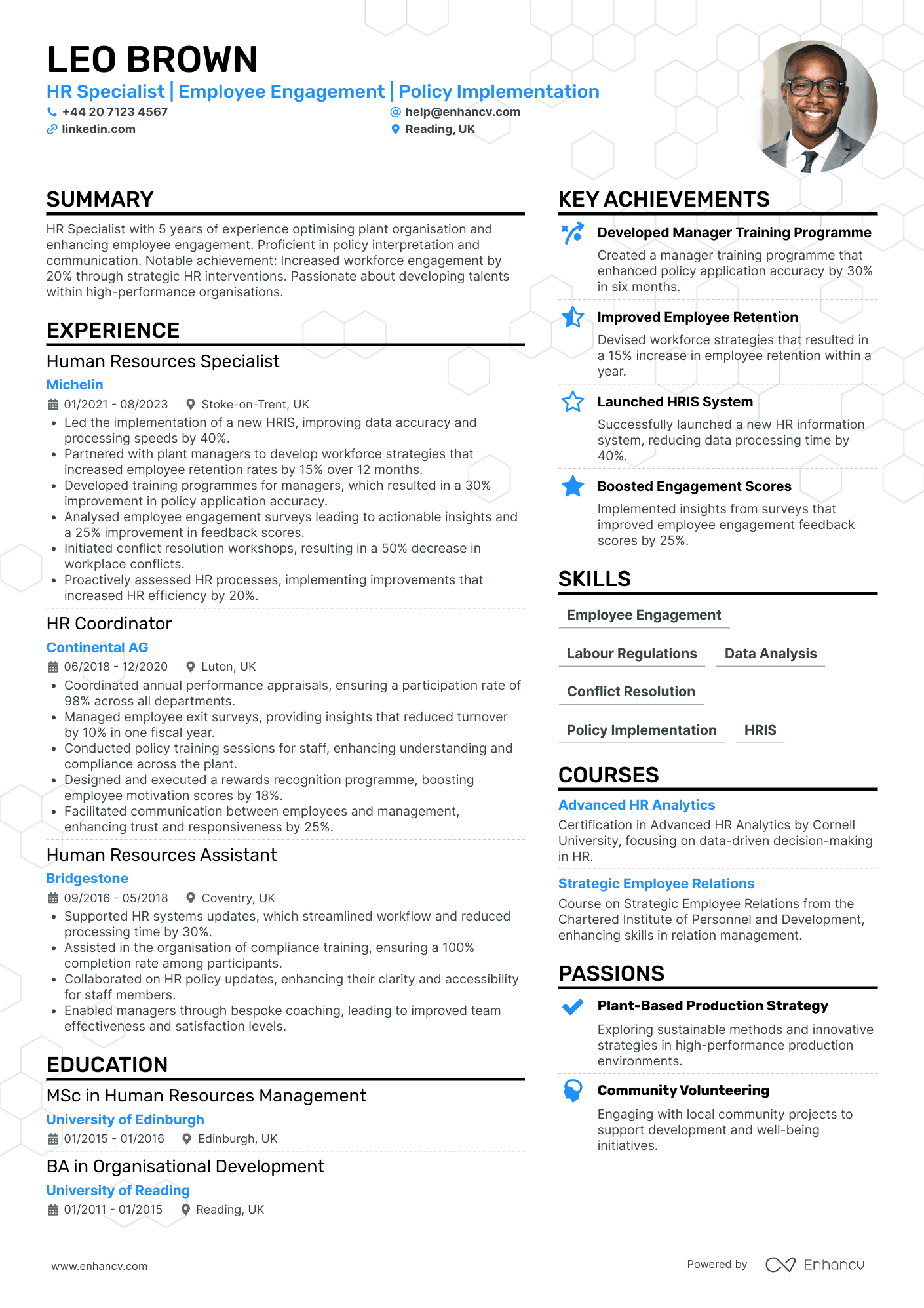
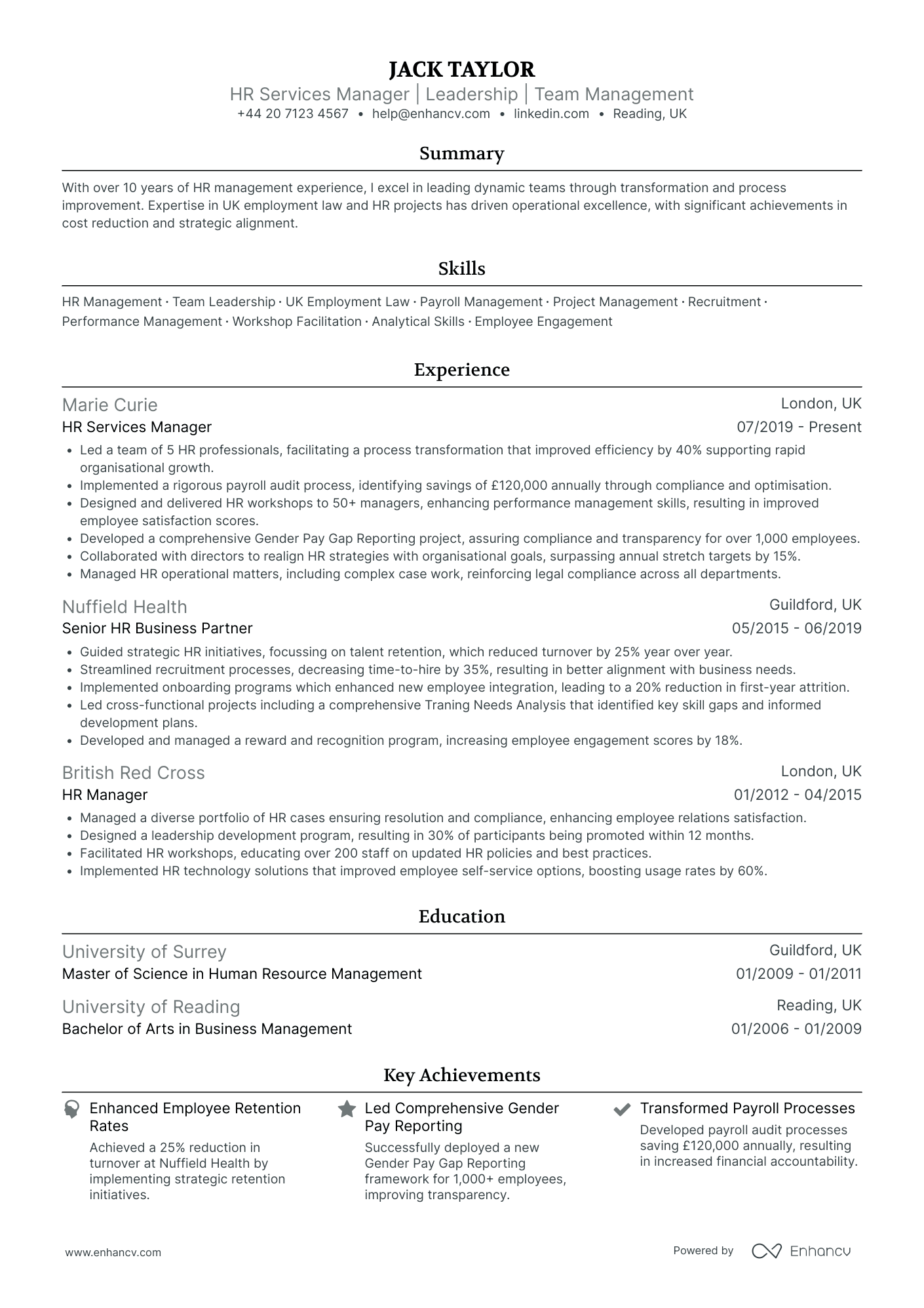
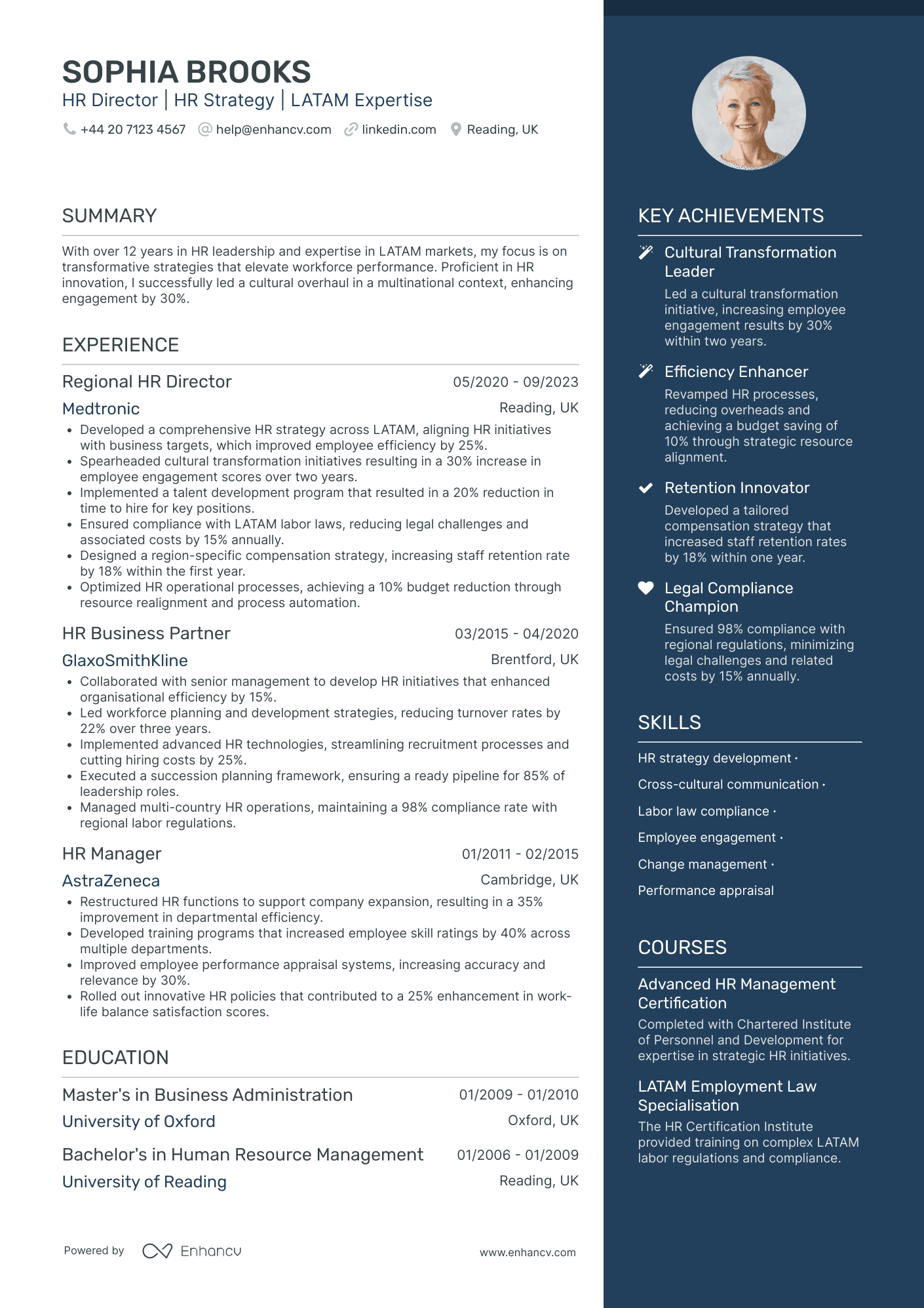
Order the CV the way a board reads it. A short header with your name, the title HR Director, and your chartered CIPD post-nominals, then a personal statement, then a selected achievements band, then the role-by-role history, with education and board roles below. Skip the photo and keep personal details to location, phone, email, and a LinkedIn URL.
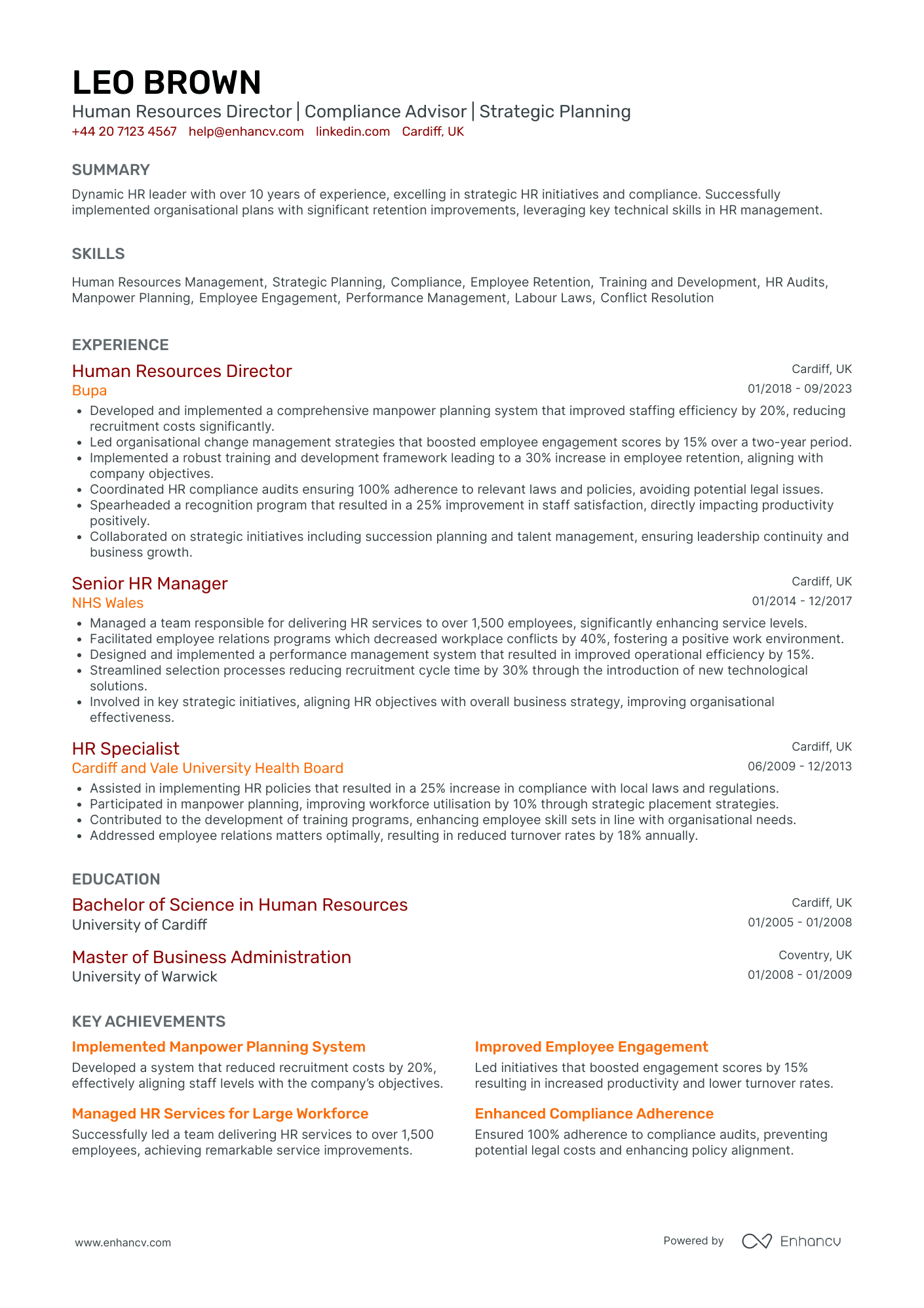
That selected achievements band earns its space at this level. Three or four lines pulling your biggest numbers, a transformation delivered, an attrition figure, a budget owned, out of the buried bullets and up to where a time-poor reader looks first.
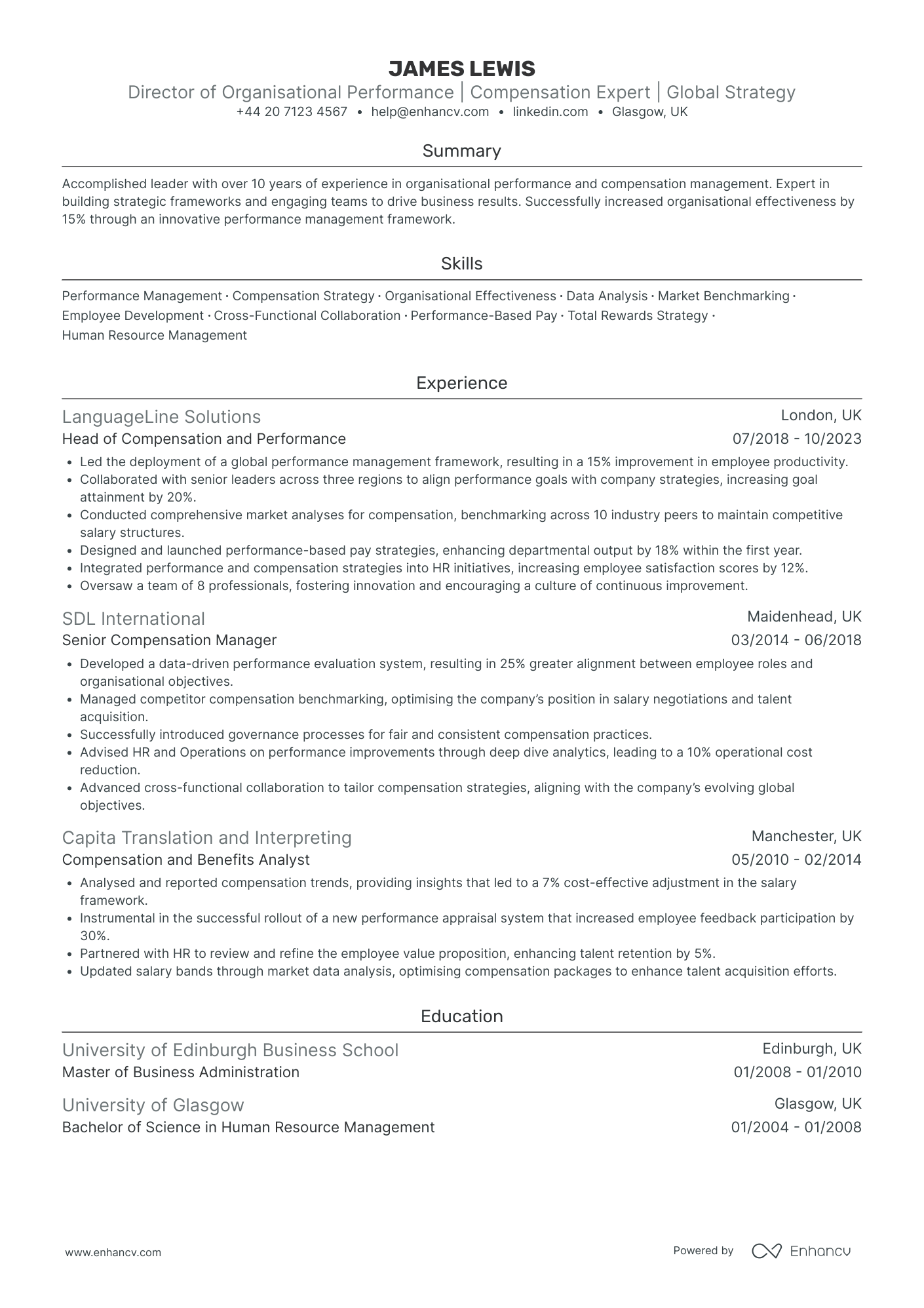
One column, standard headings, and a clean professional font. Boards and executive search consultants skim in seconds, so make the scan easy. Give two pages room to breathe, because sensible margins and white space read as seniority while ten-line roles crammed edge to edge read as someone who cannot prioritise.
Put the target title in the header and echo the advert's language through the CV. If the role is called Group HR Director or People Director, mirror that wording, and weave the priorities it lists, transformation, employee relations, reward, into your bullets where they are genuinely yours.
Send a PDF for direct applications and board submissions so the layout holds exactly as you built it. Keep a Word copy for the executive search firms and recruiters that place most director roles, since they reformat CVs into their own house template. If the advert names a file type, follow it.
Large employers still route senior applications through tracking software, so keep the headings standard and the layout clean for an ATS-friendly CV. Build from a tested layout rather than a blank page, since Enhancv's CV templates export to a clean, ATS-parsable PDF.

PRO TIP
Most director roles are filled through executive search, not job boards. Keep a Word version of your CV ready, because consultants will strip your formatting into their own template before the client ever sees it. A CV that survives that reformatting cleanly, with plain headings and no text boxes, protects your first impression.
What an HR director CV needs to prove
A recruiter reading a director CV is scanning for evidence you have run a function, not managed a caseload. Four things carry that message.
The reader is usually a search consultant, a chair, or a CEO, and each of them decides in the first half of page one whether you are operating at their level. So the top of the CV has to answer the question a board asks about any senior hire: can this person be trusted with the whole thing.
| What a board is checking | How to evidence it on your CV |
|---|---|
| Scale and scope | Headcount, number of sites, and the budget you were accountable for, stated as figures in the top third of the CV. |
| Commercial impact | People outcomes tied to money: regretted attrition reduced, cost per hire, reward spend managed, productivity gained. |
| Change and transformation | Named programmes such as restructures, TUPE transfers, acquisitions integrated, and operating-model redesign. |
| Board credibility | Where you presented, to whom, and the decisions your advice shaped, from remuneration committees to the executive team. |
Scale and commercial impact do most of the persuading. A finance director reading your CV wants to see that you can connect HR to the numbers, so lead every senior role with the result before the responsibility.
None of the four works alone. Scale without impact reads as a caretaker, and impact without scale reads as a manager who had one good year. The CV that wins interviews carries all four, briefly, in the top half of page one.
Writing your HR director personal statement
Three or four sentences at the very top: the scale you operate at, the kind of business you know, and one result a board would care about. See more personal statement examples if the opening line will not come.
Tailor the statement to the business you are writing to. A private-equity-backed scale-up wants pace and commercial edge, a public-sector body wants governance and fairness, and a charity wants values alongside rigour. Same record, different emphasis.
Keep it to the statement, and resist the urge to restate the job you are applying for. The board already knows what an HR director does, so every sentence should be about what you specifically have delivered.
Skip the adjective soup that opens most senior CVs. Lead with evidence instead:
HR director personal statement example (experienced)
Chartered HR director with 15 years leading people strategy across multi-site retail, most recently for a 4,200-person business with a £6m pay and reward budget. Cut regretted attrition from 18% to 11% in two years, led a TUPE transfer of 600 staff with zero tribunal claims, and sit on the executive committee shaping workforce planning against a three-year growth plan. Now looking to bring commercial, board-level HR leadership to a scaling, private-equity-backed group.
Now the version that lands in most director inboxes:
What to avoid
Passionate and results-driven HR professional with extensive experience across all aspects of human resources. A strategic thinker, strong leader, and team player with excellent communication skills, seeking a challenging HR director position to utilise my expertise and take my career to the next level.
The second one could belong to anyone at any level. No headcount, no budget, no board, and not one number a CFO could check. Words like passionate, strategic, and utilise fill the space where evidence should sit.
When I read an HR director personal statement, I skip the adjectives and hunt for scope. How many people, how large a budget, and what changed because you were in the room. "Led a restructure of 600 roles with no tribunal claims" tells me more than a paragraph about being strategic and passionate. Name the scale you operate at, attach one number a finance director would recognise, and you have already cleared most of the shortlist.
Writing your HR director experience section
Write each role the same way: a dated heading, then bullets that move from decision to action to result. Lead every bullet with a strong verb and close it with a number. For the mechanics, see work experience on a CV.
Director-level impact is measurable even when it feels like judgement and influence. Attrition, engagement, cost per hire, tribunal outcomes, and reward spend are your CV achievements, so put the figure in the bullet.
Tailor each application to the brief. Pull the priorities and language from the advert and mirror them where they are true of you, using strong action verbs to open each line. Enhancv's CV tailoring feature reads the advert and suggests the matching edits, which saves rewriting each version from scratch.
When you do not have a precise figure, use an honest estimate and say so. "Reduced agency spend by roughly a third" is defensible and specific, while inventing a false decimal is the fastest way to unravel in the interview. Reach for the number you can stand behind under questioning.
For roles more than ten or twelve years back, compress them into a short earlier-career summary. A board cares about what you have done recently and at scale, so protect that space rather than spending it on your first HR adviser job.
- Own people strategy for a 4,200-employee, 60-site group, leading a team of 18 across HR, reward, talent, and employee relations
- Cut regretted attrition from 18% to 11% in two years, saving an estimated £1.4m in replacement and lost-productivity costs
- Led the HR workstream on a £40m acquisition, integrating 600 staff through TUPE with zero tribunal claims and full retention of the leadership team
- Rebuilt the pay and grading framework, narrowing the gender pay gap from 9% to 3% and lifting engagement scores by 14 points
- Present quarterly to the board on workforce planning, succession, and organisational design against a three-year growth plan

The director bullet formula
Decision plus action plus number. "Chose to insource recruitment (decision), stood up an in-house talent team (action), and cut agency spend by £900k a year (number)." If a bullet has no number in it, it is a duty rather than an achievement, so either find the figure or move the line down the page.
PRO TIP
Director adverts talk in outcomes, not tasks. Mirror the ones you can back with a figure: reduced attrition, led a TUPE transfer, managed a £Xm reward budget, chaired the joint consultative committee. If the number lives in a system you can still access, pull the real figure before you write the bullet.
Skills to put on an HR director CV
At this level your skills section is a fast index of the function you can run, not a list of software. Name the areas a board expects an HR director to own.
Your hard skills are the disciplines: talent management, workforce planning, employee relations, reward, organisational design, and the employment law behind restructures and TUPE. List them in the language the adverts use.
The soft skills that matter here are senior and checkable: commercial judgement, influencing at board level, and leadership of a whole function. Prove each one in an experience bullet rather than only claiming it.
Data is the skill increasingly separating director candidates. Reading attrition, engagement, and cost trends, and arguing a people case from the numbers, is what earns and keeps the seat at the table, so evidence it with a decision the data actually drove.
List only what you can defend in an interview. If you have led it, name it. If you have been close to it without owning it, keep it in context in your experience rather than claiming it flat as a skill.
Top skills for your HR director CV:
Talent management
Workforce planning
Employee relations
Leadership development
Organisational design
Business transformation
Reward and benefits
TUPE and employment law
HR analytics and data
Commercial acumen
Board-level influencing
Leadership
Communication
Stakeholder management
Stepping up to HR director without the title yet
Plenty of first-time director CVs come from HR managers and heads of HR who already do the work without the title. The CV has to close that gap on the page.
Frame your current scope in director language. If you have owned employee-relations strategy, led a restructure, or carried a function's budget, say so in those terms rather than describing day-to-day management.
Show the trajectory. A clear line of progression from adviser to manager to head of function tells a board you are ready for the next step, so make the promotions visible rather than hiding them inside one long entry.
Lean on deputising and board exposure. Chairing a project, presenting to the executive team, or covering for the director are the moments that prove you can operate a level up, so give each one a bullet with a result attached.
Education, CIPD, and credentials for an HR director CV
Chartered CIPD standing is close to non-negotiable at this level. List Chartered Member (MCIPD) or Chartered Fellow (FCIPD) in the header and again in your education section, since a governance-level reader checks for it early.
A relevant degree in business, psychology, or human resources belongs here, along with senior development such as an MBA or an executive coaching accreditation. Keep older qualifications brief and let the recent, senior ones carry the weight.
Ongoing professional development counts too. CIPD CPD, board-readiness or non-executive director programmes, and reward or employment-law updates show you keep current in a field where the law moves every year.
List non-executive, trustee, or board-adviser roles too, and any board-level certificates you hold. They signal that you already operate at the level the job is hiring for.
Conclusion
Lead with scope and commercial results, prove your CIPD standing, and keep the format senior, clean, and two pages.
Pair the CV with a short cover letter that connects your people strategy to this business's plan, and you turn a strong record into a shortlist of interviews.
Author's take - the Enhancv team
When I read an HR director personal statement, I skip the adjectives and hunt for scope. How many people, how large a budget, and what changed because you were in the room. "Led a restructure of 600 roles with no tribunal claims" tells me more than a paragraph about being strategic and passionate. Name the scale you operate at, attach one number a finance director would recognise, and you have already cleared most of the shortlist.