



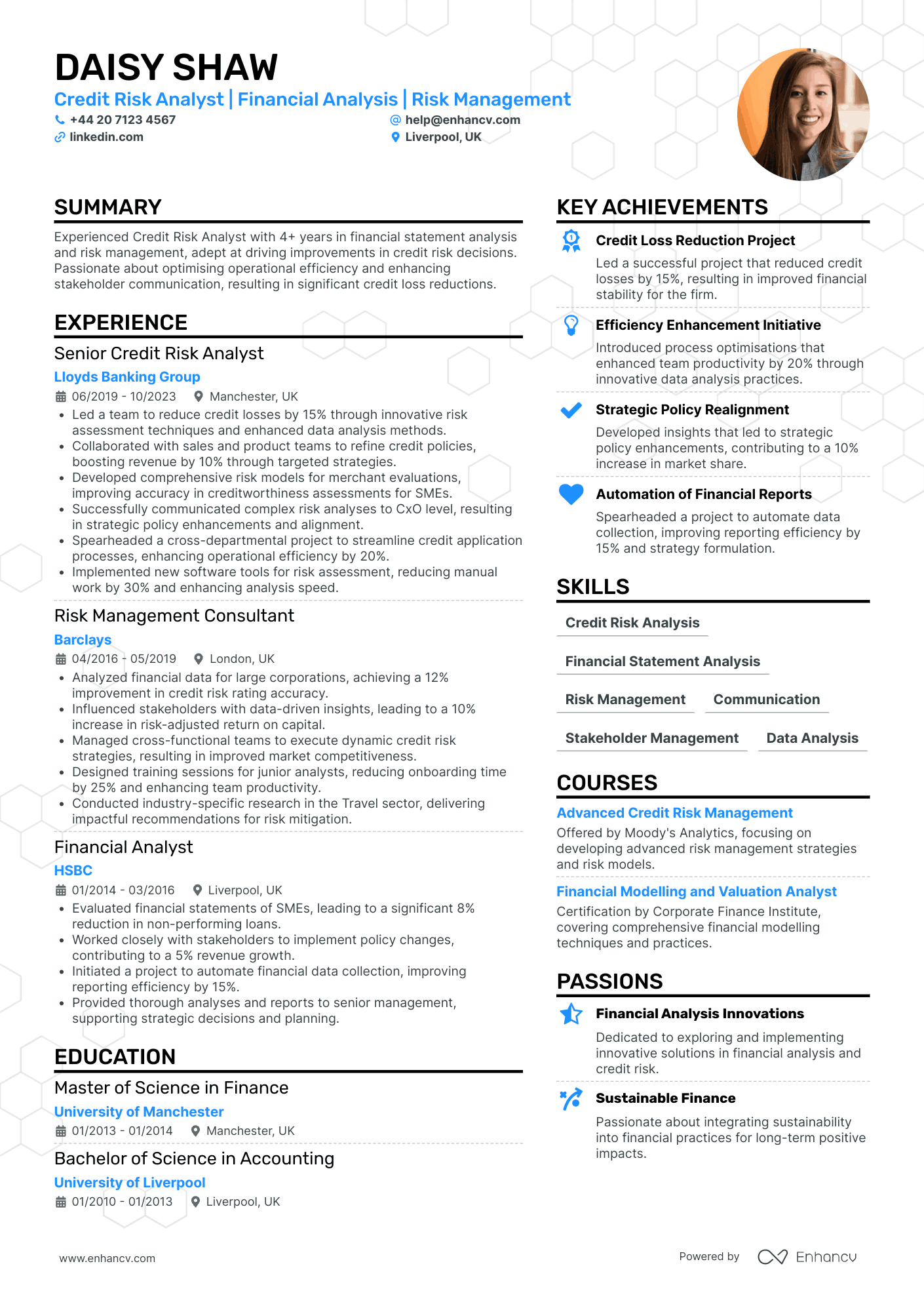
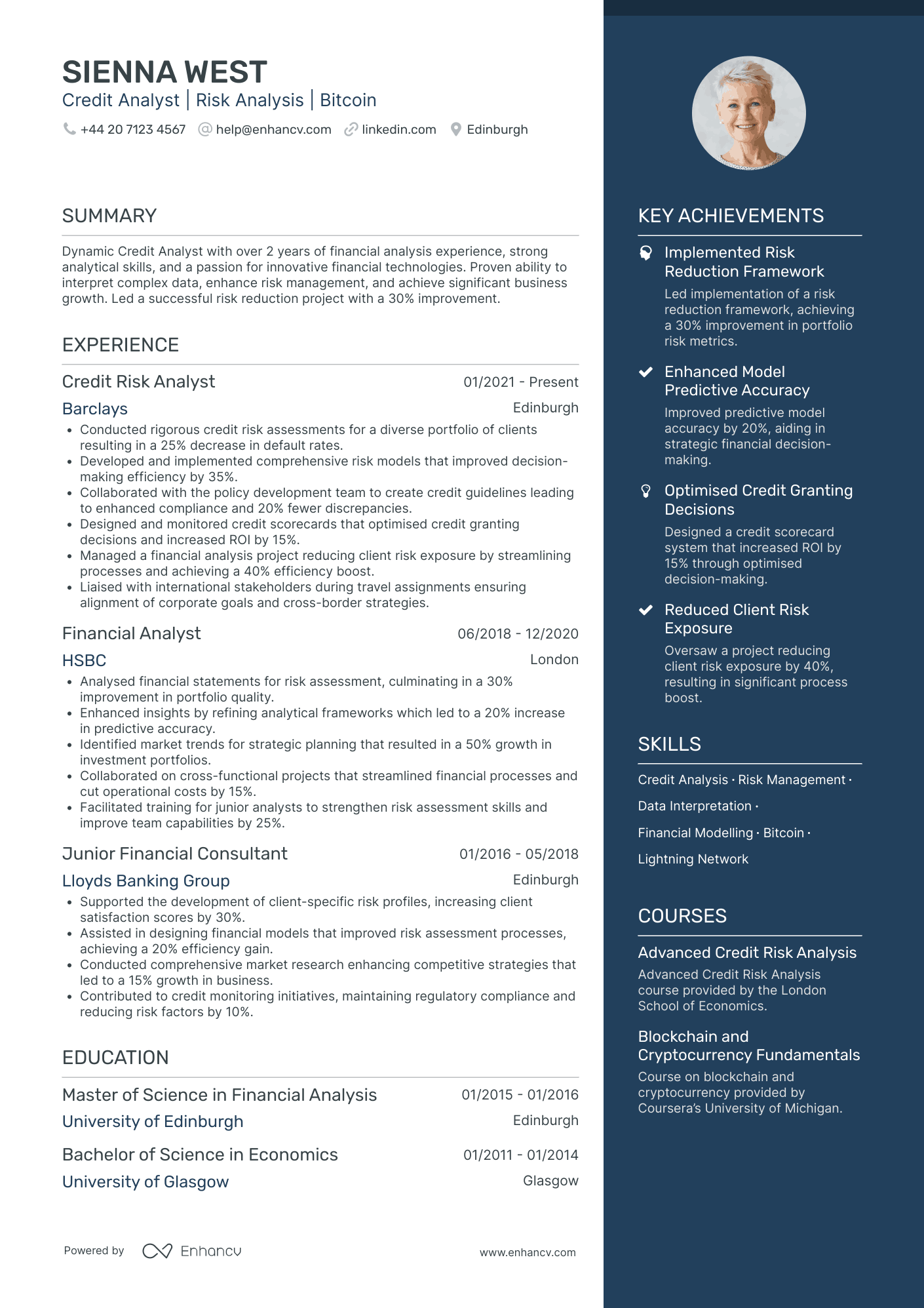
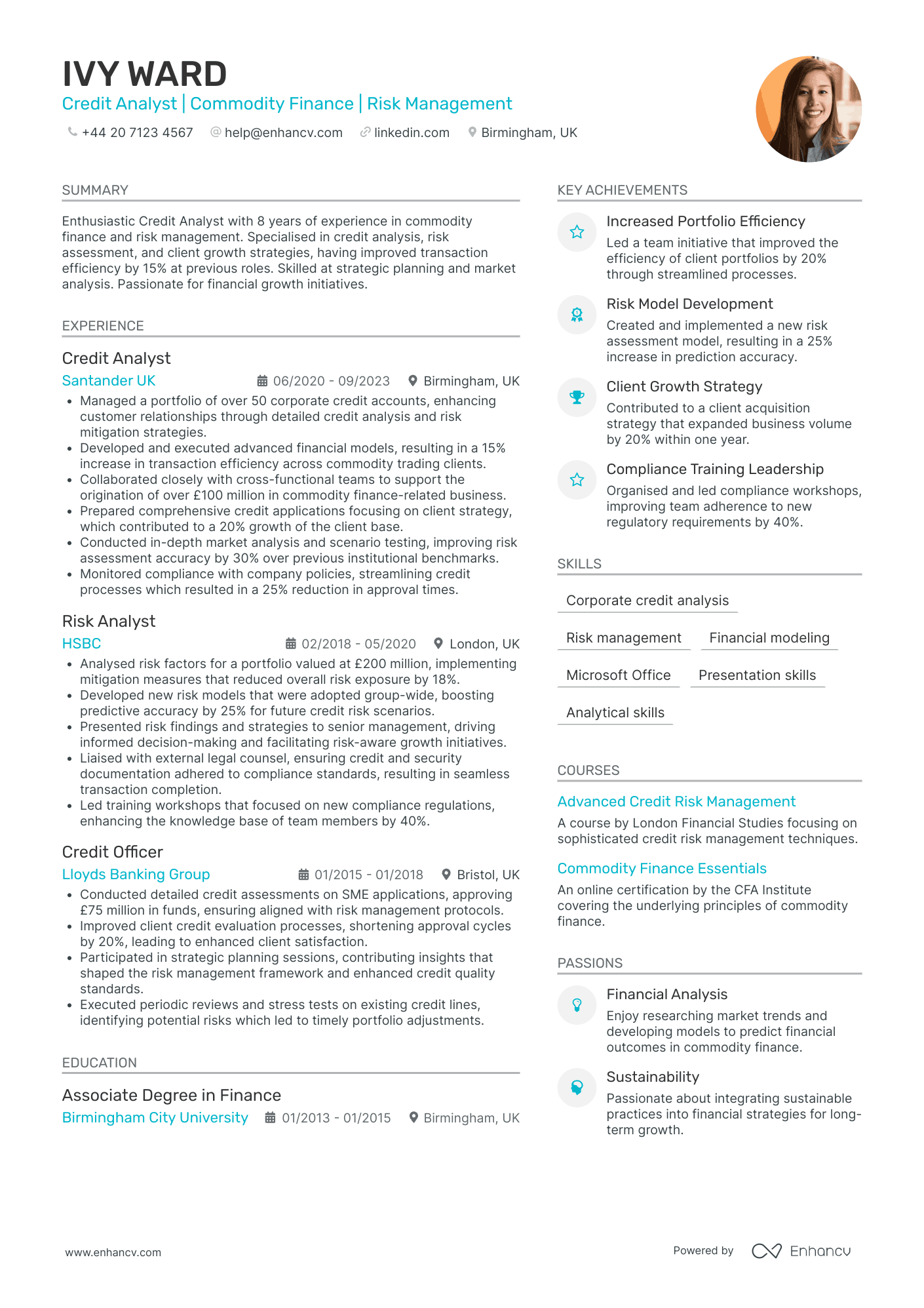
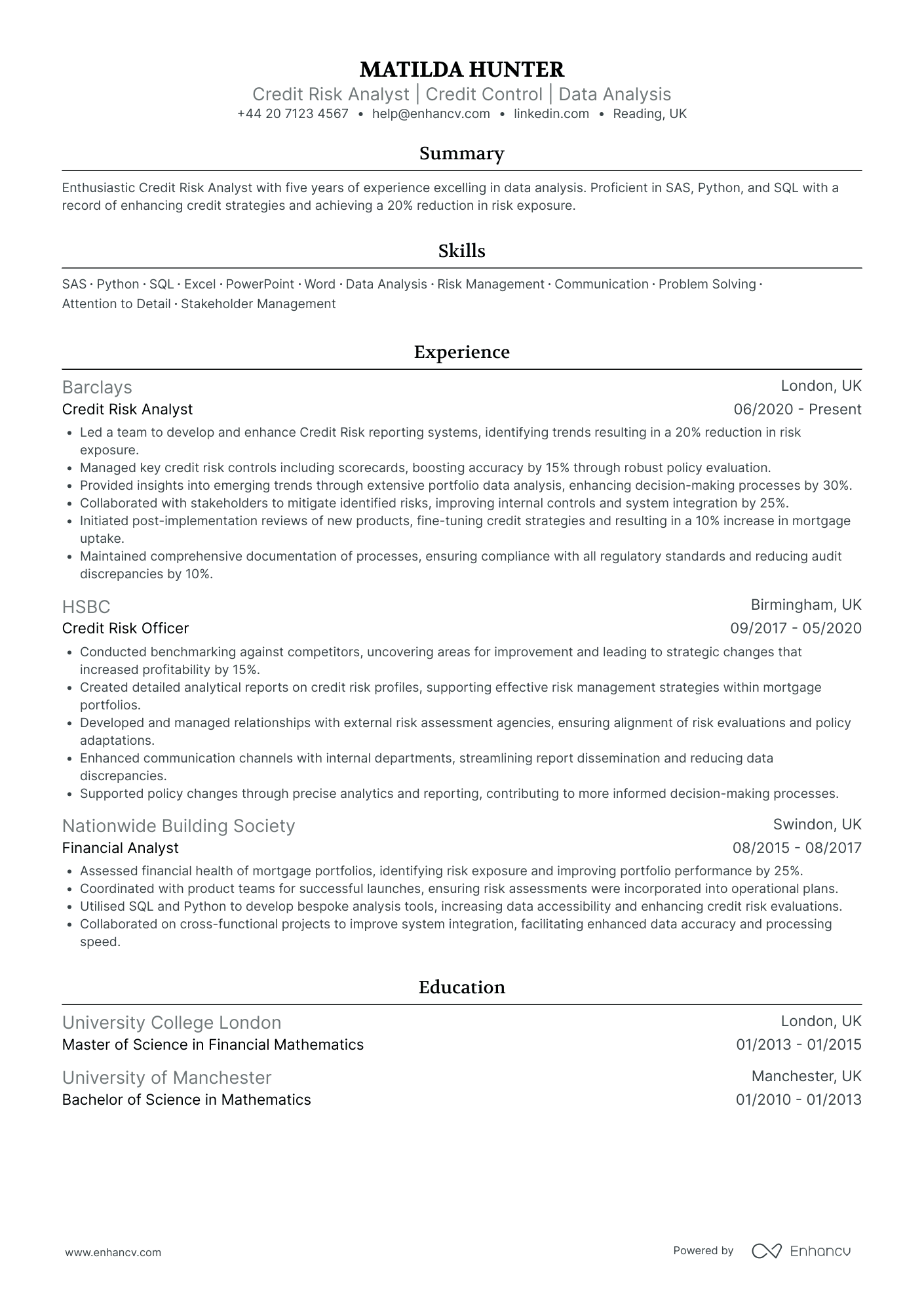
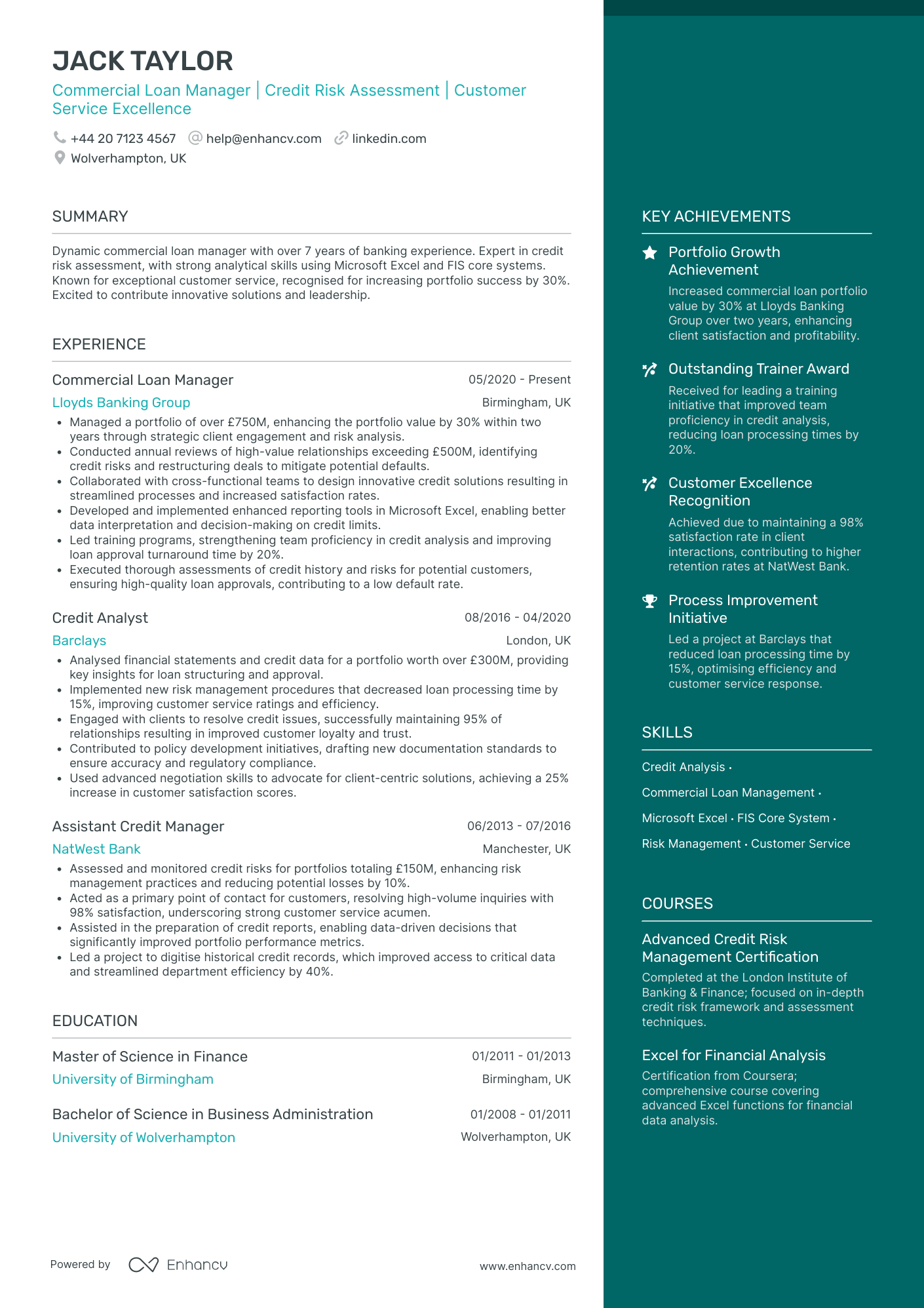
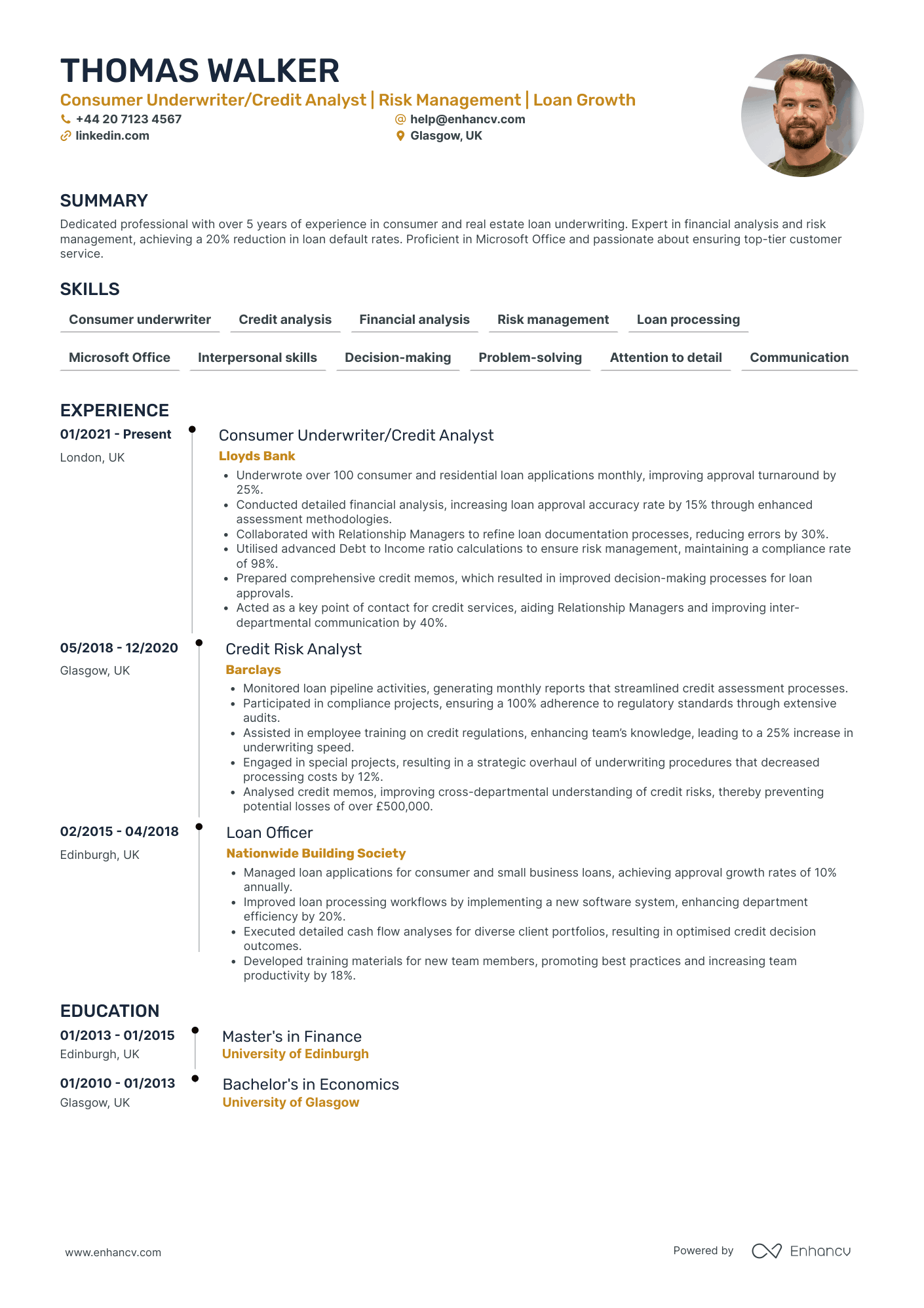
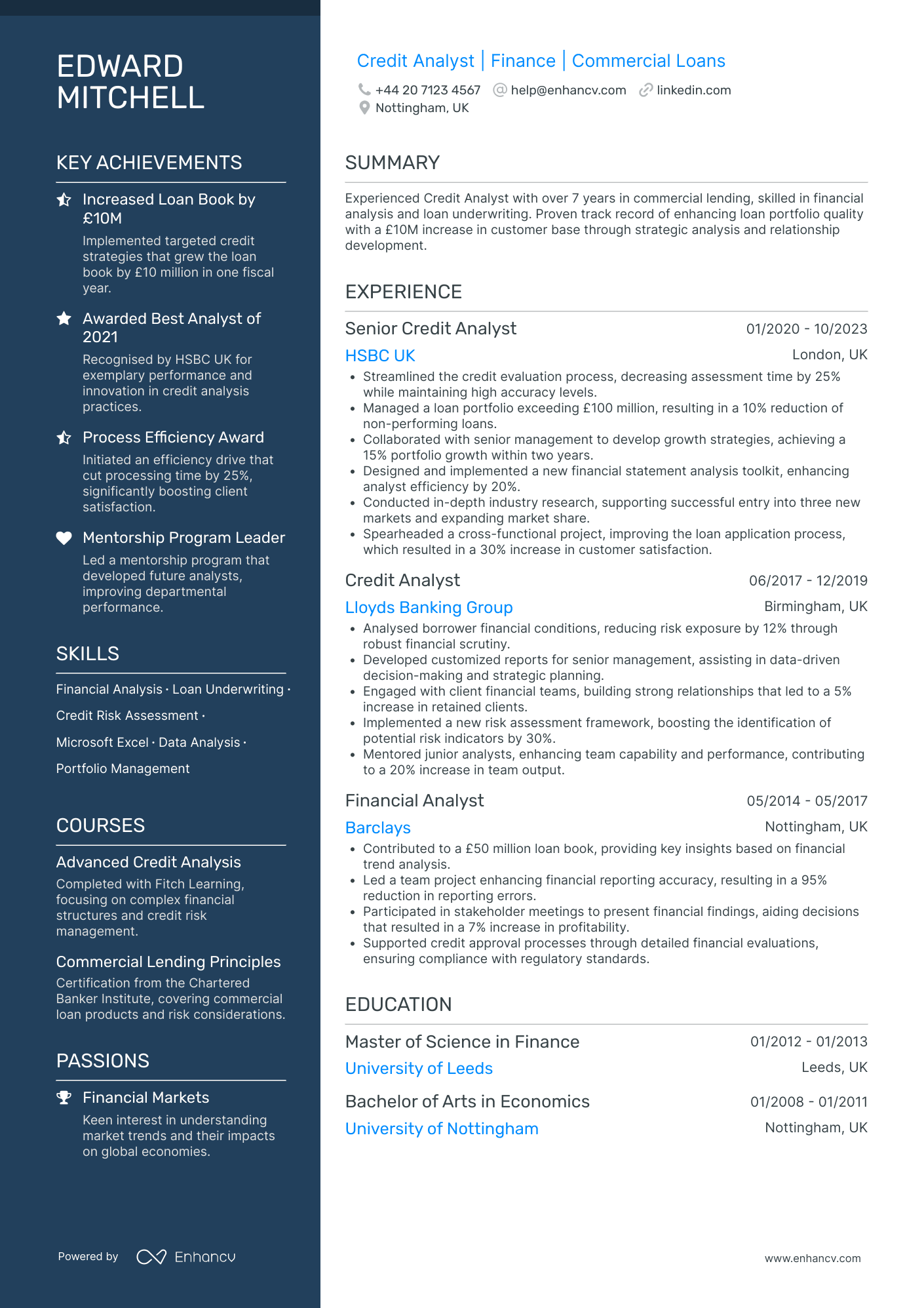
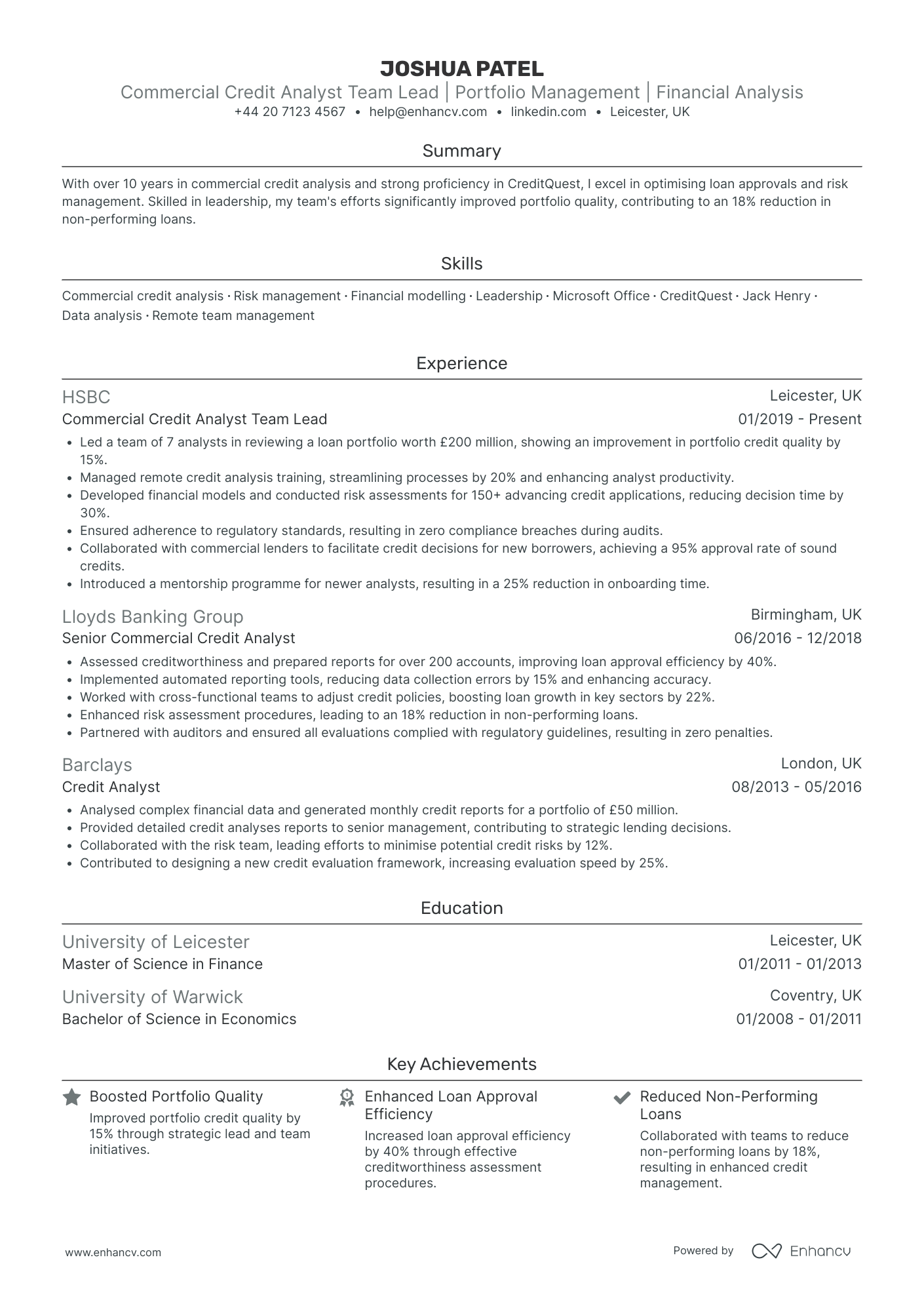
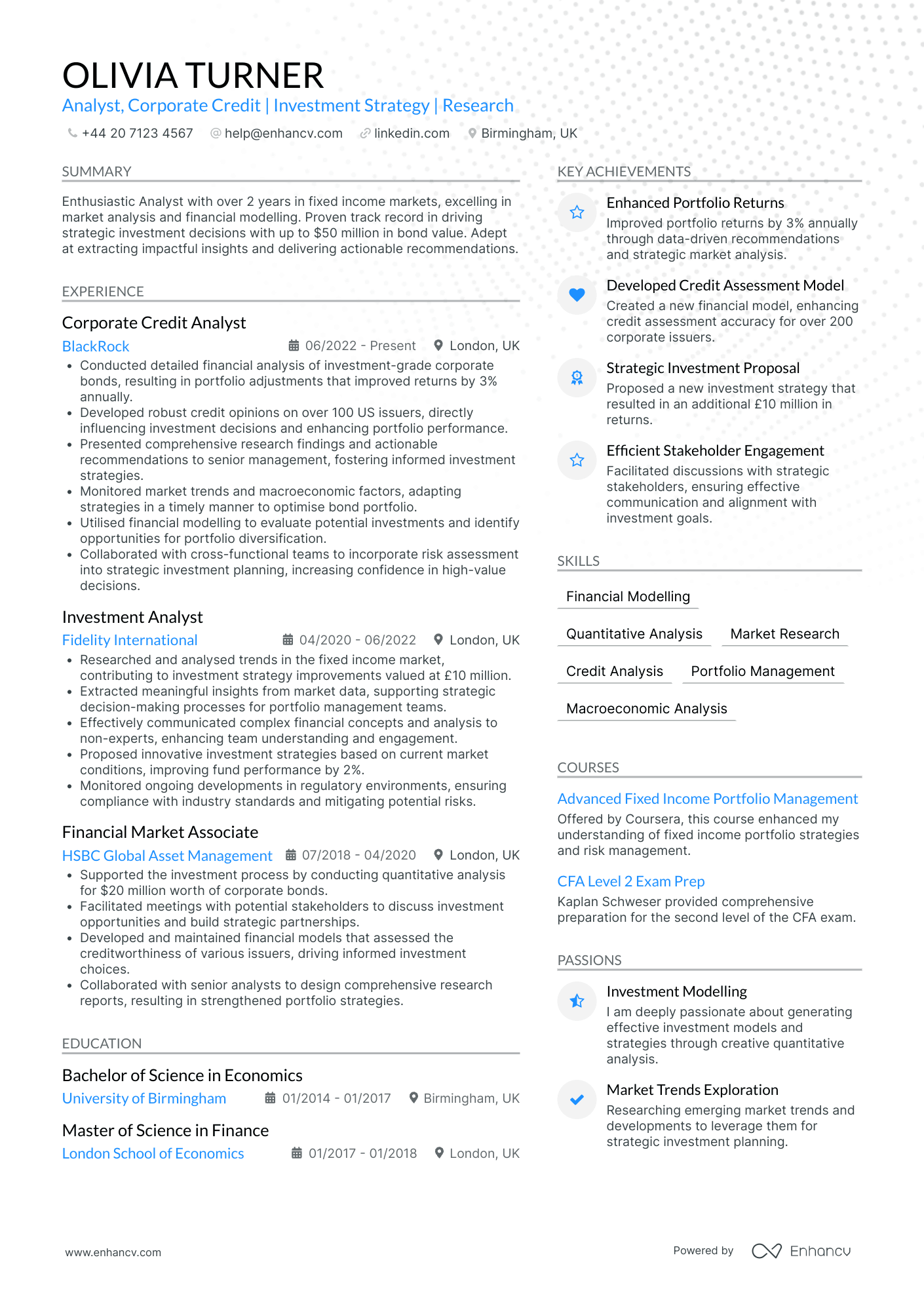
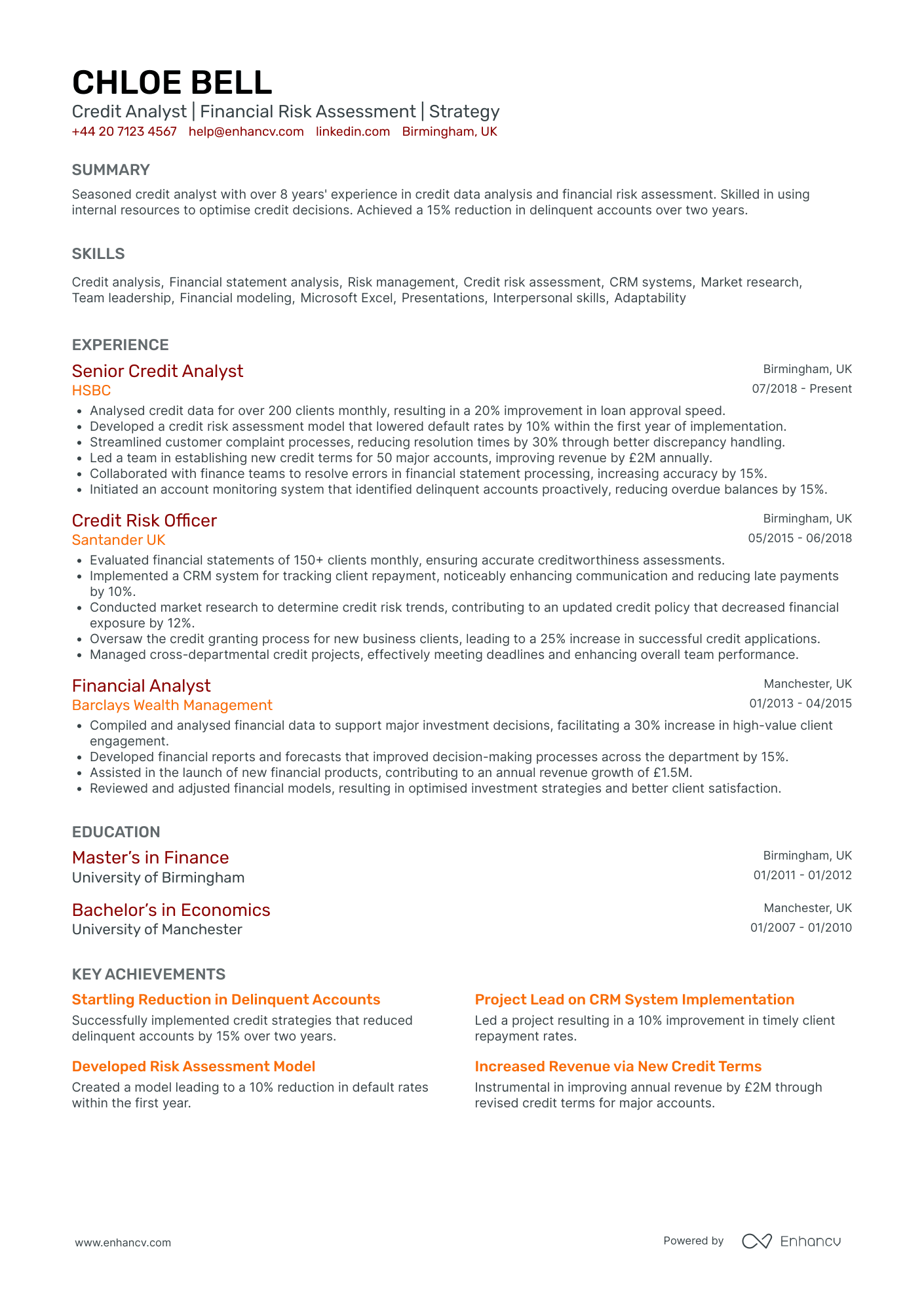
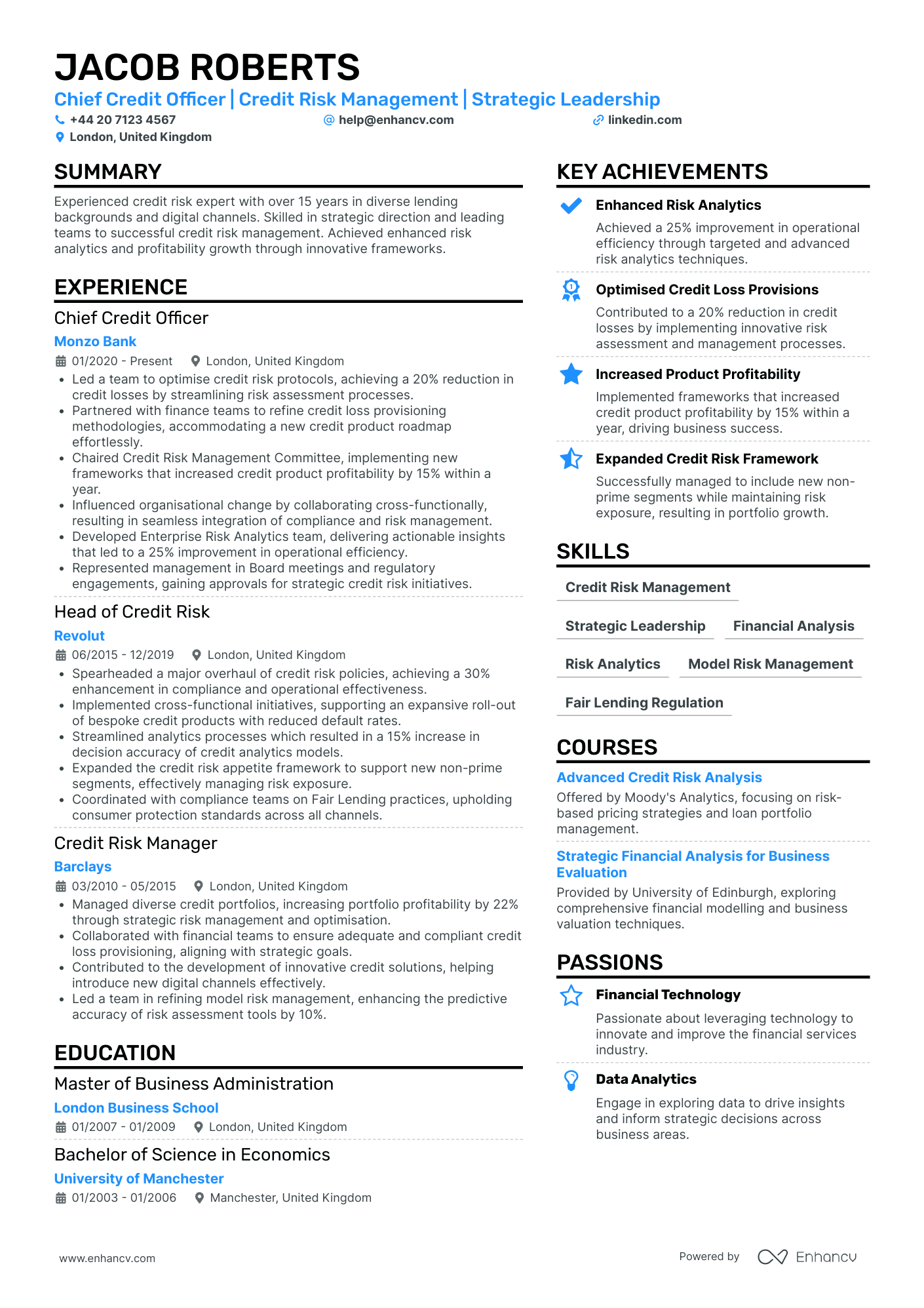
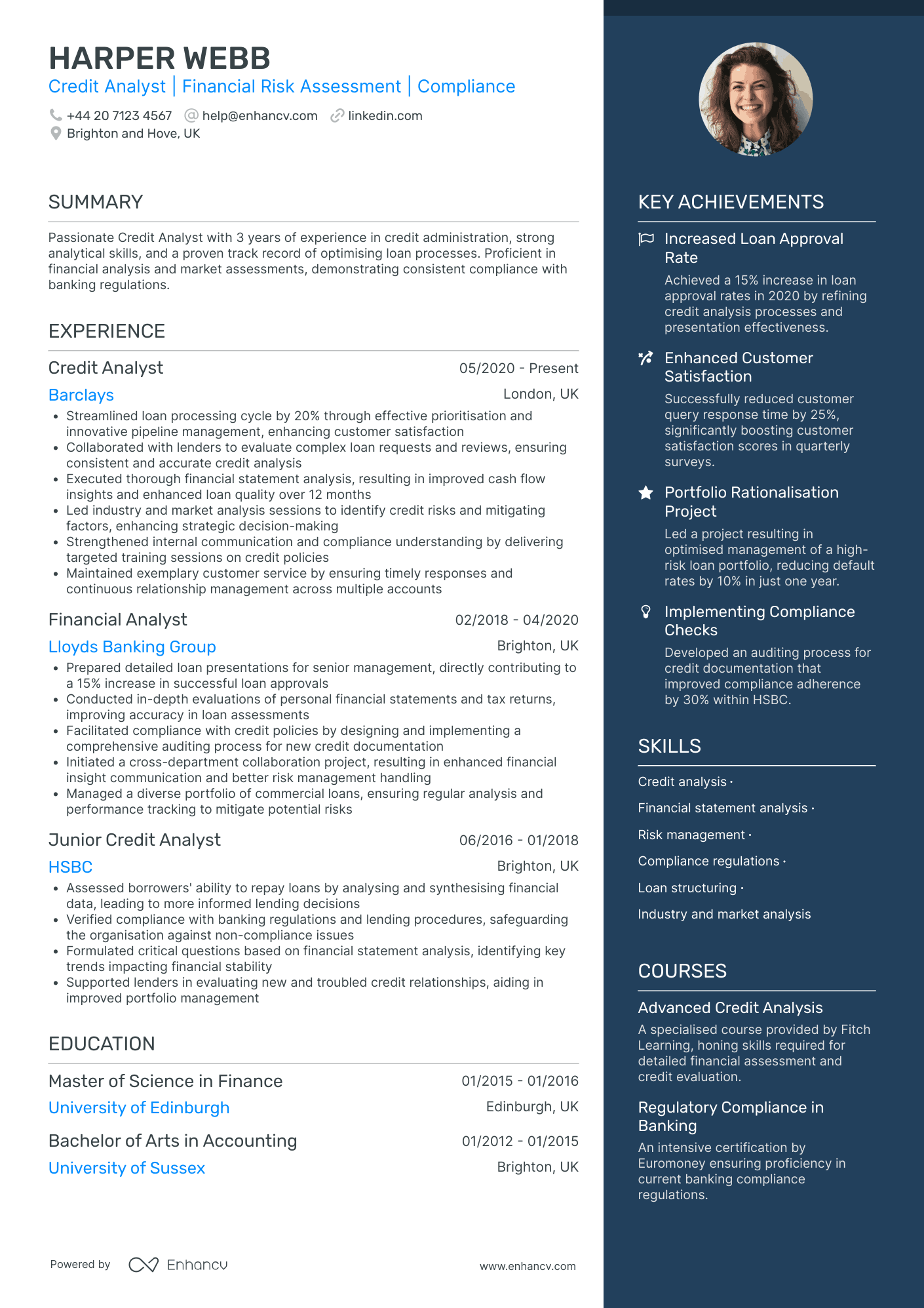
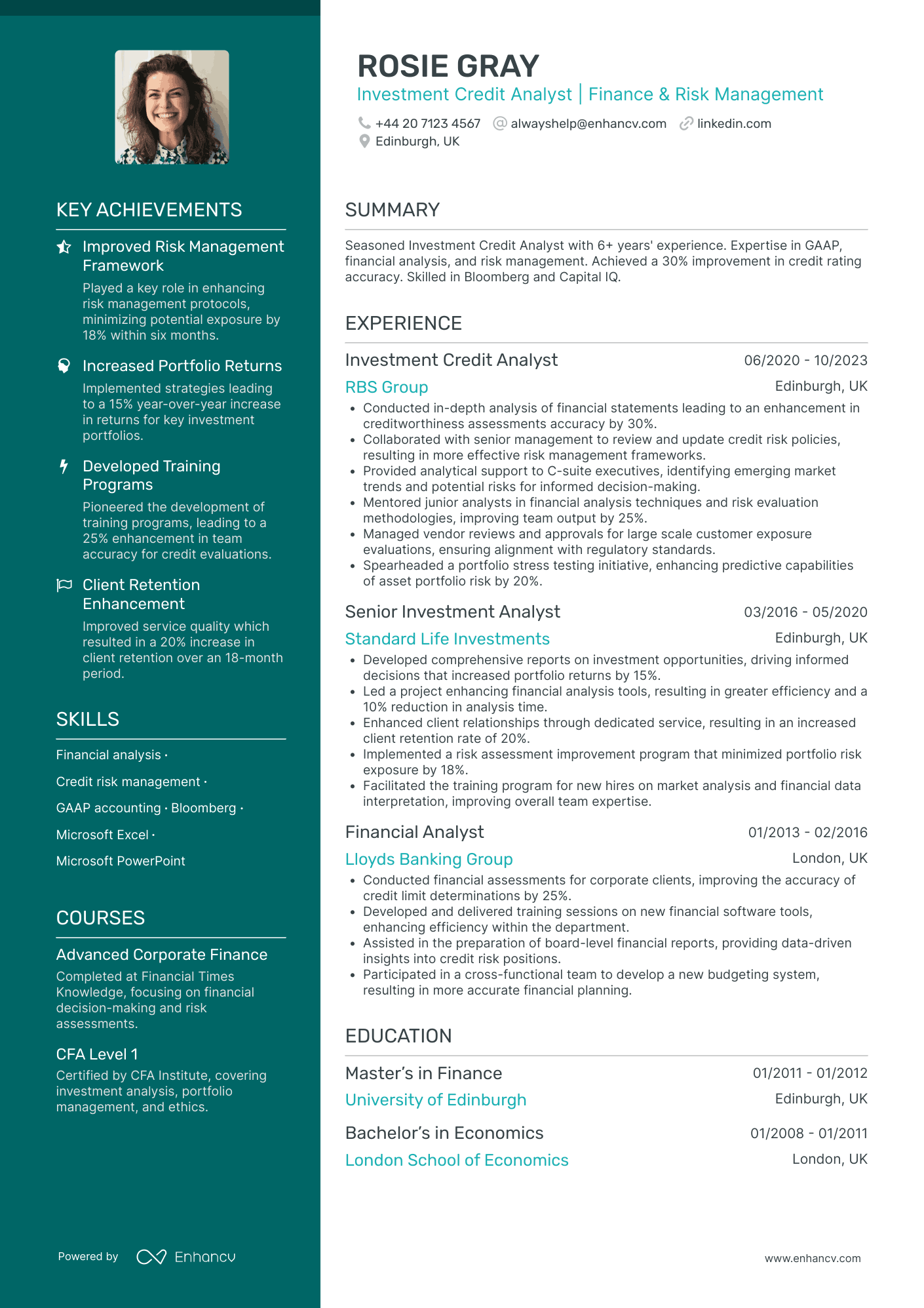
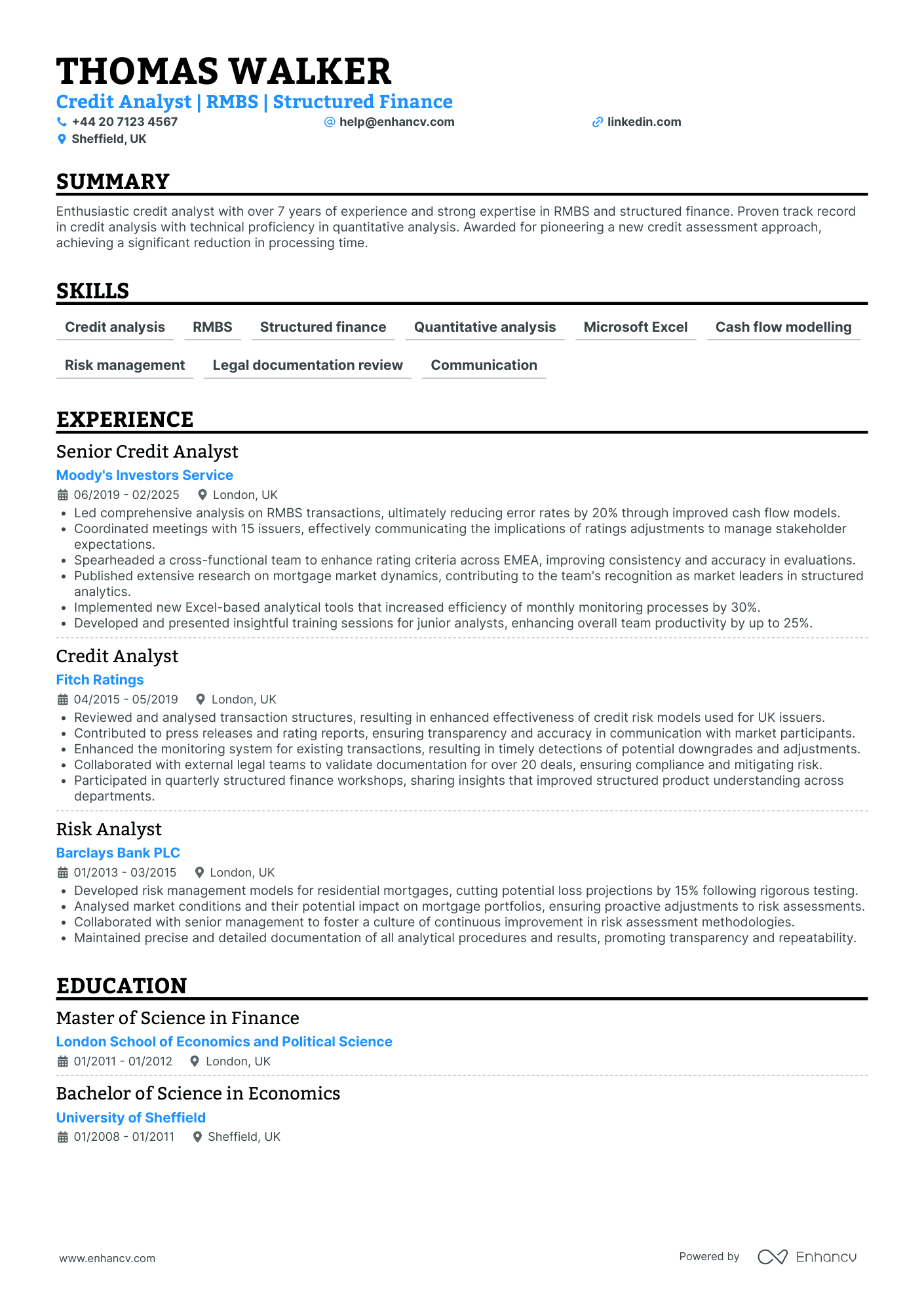
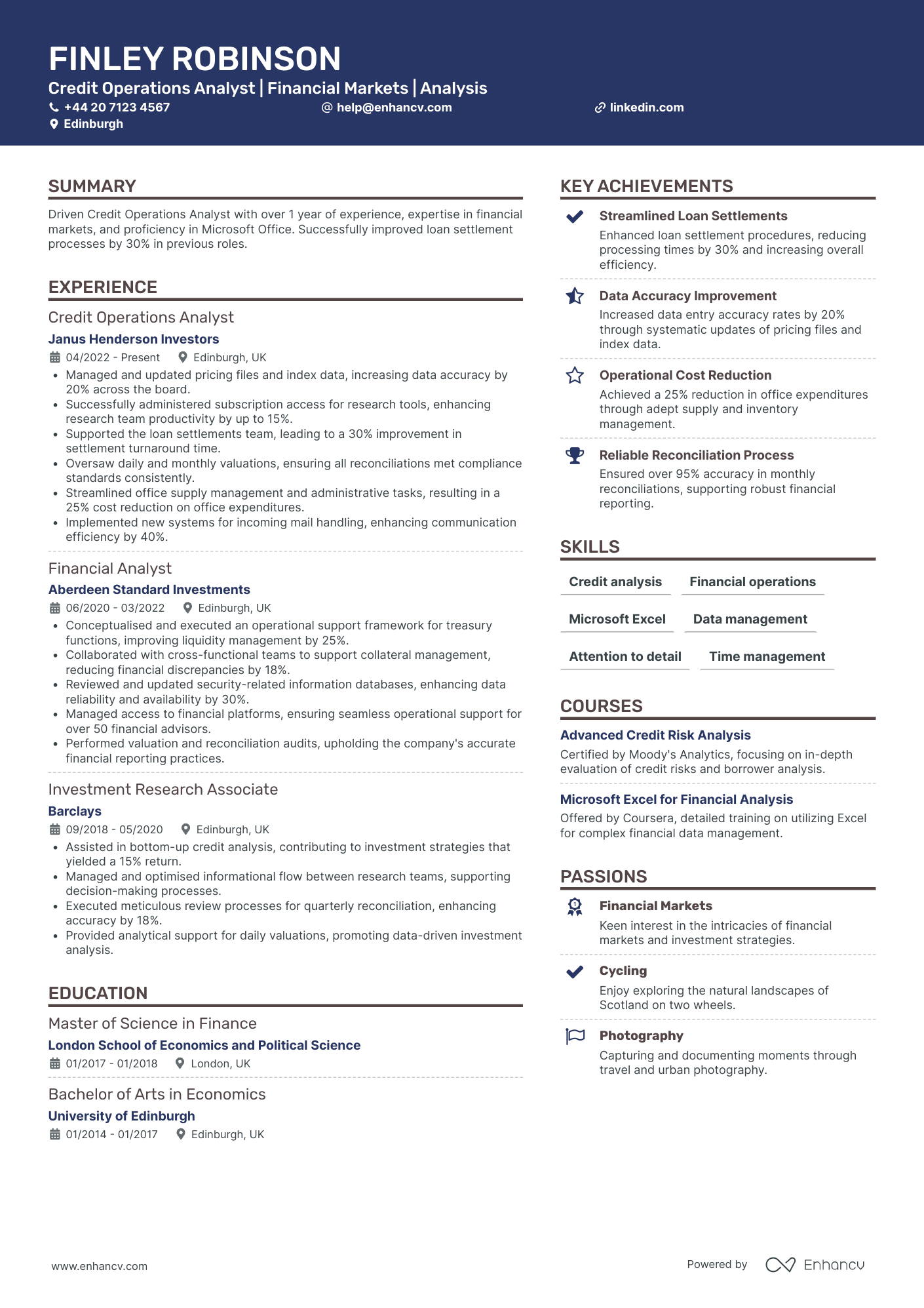
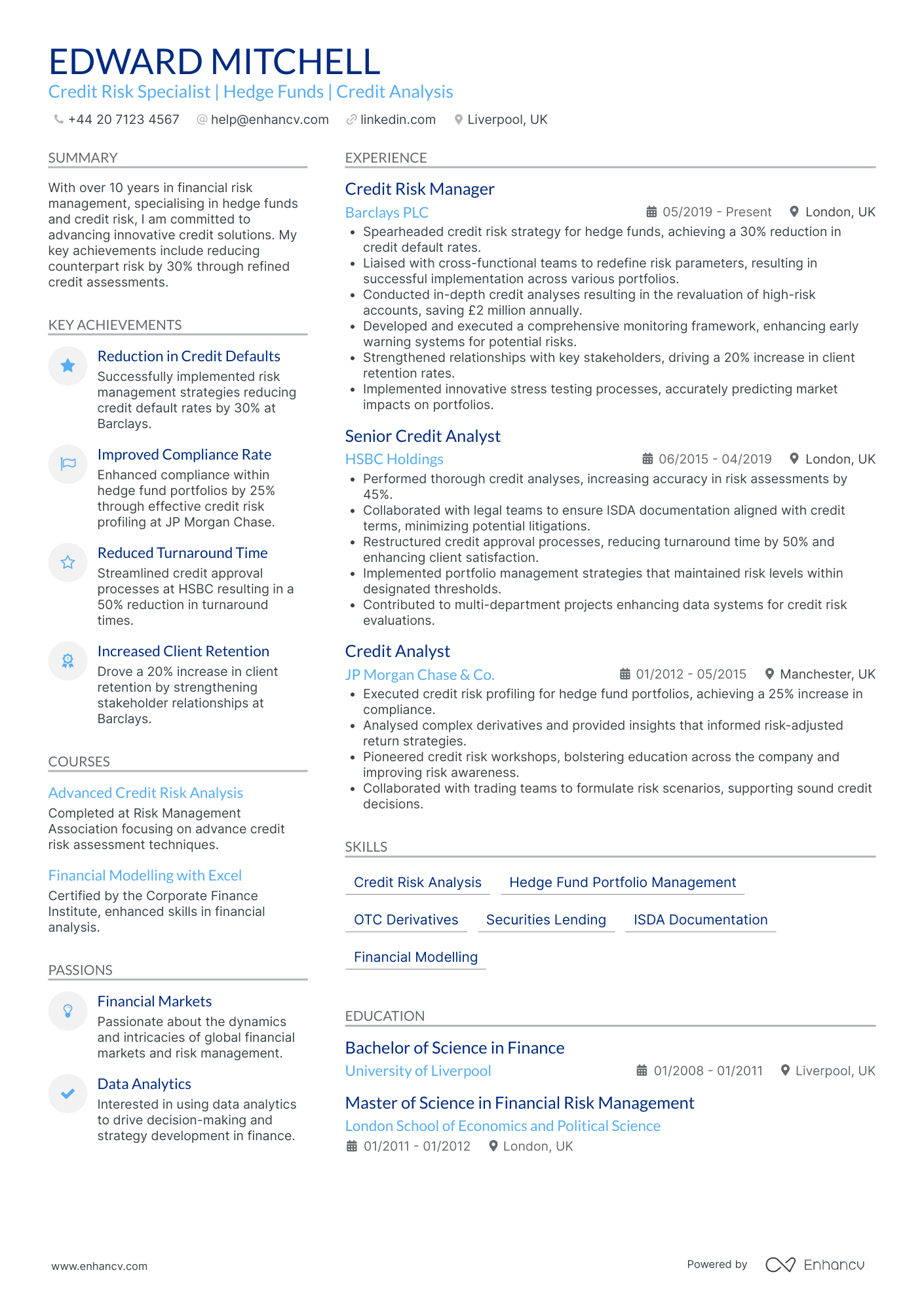
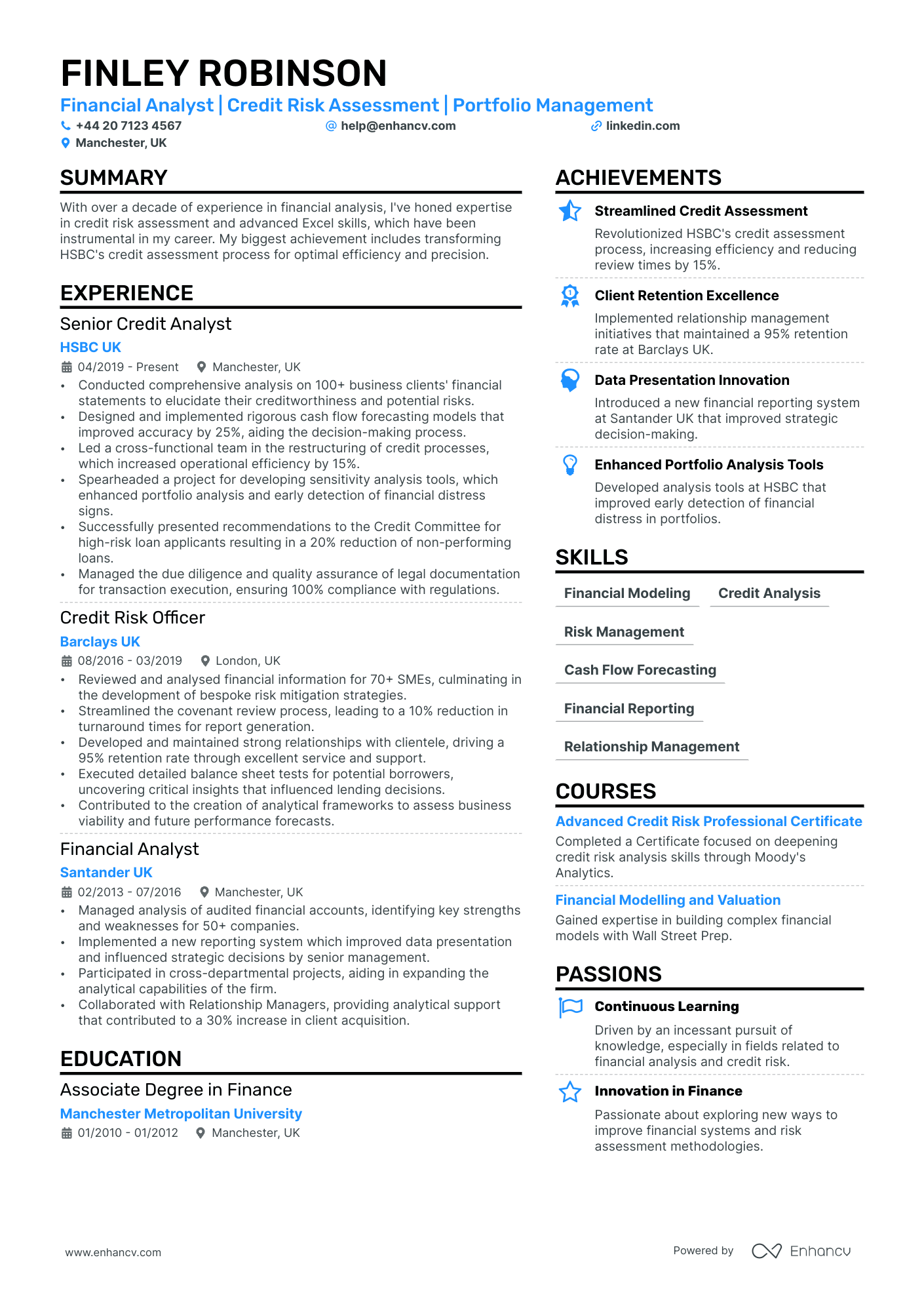
The strongest credit analyst CV I read this year opened with a number, not a personal statement full of adjectives. It said the applicant had cut a portfolio's arrears rate and named the figure. That is exactly what a lending team screens for.
Most credit analyst CVs do the opposite. They list every model and system the applicant has touched, then bury the decisions and the money behind a wall of duties. The ones that get interviews lead with judgement, quantify it, and speak the language of risk. If you want the fundamentals first, read how to write a CV, then come back for the role-specific moves.

Key takeaways
- Lead with the skills a lending team screens for: financial analysis, credit risk, Excel modelling, and SAS.
- Show that you work the 5 C's. Prove character, capacity, capital, collateral, and conditions through real decisions.
- Quantify everything: book size, default and arrears rates, provision movements, approval turnaround, and rating accuracy.
- Most UK roles are hybrid and pitched at senior level, so target your CV to the seniority in the advert.
- Two pages, reverse chronological, sent as a PDF unless the advert asks for a Word file.
- Name your qualifications: a numerate degree, plus CFA, ACCA, or Chartered Banker progress where you have it.
Top skills for your credit analyst CV
Recruiters for this role scan for one thing first: can you turn financial data into a defensible lending decision. The skills section carries more weight than almost anywhere else on the page, which is why it leads here.
Across 20 UK credit analyst postings in the last ~30 days on Enhancv's internal job feed, Excel, SAS, and data analysis recur most often, followed by wider Microsoft Office, PowerPoint reporting, coding, and credit risk itself. Those are the hard skills to put first, in the words the adverts use.
List the hard skills you can defend in an interview, not every tool you have opened once. Financial statement analysis, credit risk assessment, and Excel financial modelling belong at the top for almost every applicant.
The soft skills that matter here are the checkable kind: analytical judgement, attention to detail, and clear written communication for credit papers. Prove each one in a bullet rather than listing it as an adjective.
Group the list so a skimming recruiter sees the shape fast: analysis and modelling first, then tools and systems, then domain and regulation. Coding is increasingly expected, so if you work in SAS, SQL, Python, or R, say so plainly and point to where you have used it.
Top skills for your credit analyst CV:
Financial statement analysis
Credit risk assessment
Excel financial modelling
SAS
Data analysis
Ratio and cash-flow analysis
Credit scoring and rating models
PowerPoint reporting
SQL and coding
Regulatory knowledge (IFRS 9, Basel)
Analytical judgement
Attention to detail
Written communication
Commercial reasoning
Stakeholder management
A skills section works hardest when every line maps to something a lender needs. Analytical technique is the spine of the job, so back your analytical skills with a decision you made and what it saved, not with the word "analytical" on its own.
The 5 C's of credit analysis and how to prove them on a CV
Every UK credit interview circles back to the same framework: the 5 C's of credit analysis, which are character, capacity, capital, collateral, and conditions. Your CV should show that you assess all five, not only that you crunch numbers.
This is the mental model a credit committee uses, so an interviewer will often walk you through a live case against it. A CV that already reflects the framework signals you will fit straight into that conversation.
Map each one to a bullet a hiring manager can picture:
- Character: the borrower's track record and willingness to repay. "Reviewed credit histories and management accounts for 40 plus SME applicants a month."
- Capacity: the ability to service the debt. "Built cash-flow and debt-service-cover models to test repayment under stress scenarios."
- Capital: the borrower's own stake. "Assessed gearing and net-worth positions across a £30m lending book."
- Collateral: the security behind the facility. "Valued and monitored asset security on secured lending up to £5m."
- Conditions: the wider economic and sector picture. "Factored sector risk and interest-rate movements into every rating decision."
You do not need to name the framework on the CV. Show that you work it. A lending team reading those bullets sees an analyst who already thinks in the terms it uses every day.
What the UK credit analyst market looks like
Knowing what employers actually ask for shapes what you lead with. Two signals from the current market should shape your CV.
| What | UK credit analyst roles |
|---|---|
| Where the work happens | Mostly hybrid (15 of 20 UK postings in the last ~30 days, Enhancv's internal job feed) |
| Seniority most asked for | Senior-weighted (11 of the 20 postings senior, only 2 pitched at entry level) |
| Skills that recur most | Excel, SAS, and data analysis, then Microsoft Office, PowerPoint, and credit risk |
Credit analyst work is mostly hybrid, so name your base location and make it clear you are comfortable with a hybrid pattern.
The roles also skew senior, which means an advert often expects a track record of independent lending decisions rather than support work alone. Match the level of your CV to the seniority in the posting, and lead with the decisions you owned rather than the team you sat in.
On pay, benchmarks vary widely by seniority, sector, and location, and we did not find a verified UK figure worth quoting here. Treat any single number you see with caution and check the live advert for the band.
Formatting your credit analyst CV
For an experienced analyst, use a reverse chronological structure so your most recent lending decisions sit at the top where a hiring manager looks first.
Keep it to two pages, one column, standard headings, and a readable font. Credit and risk managers skim fast between deals.
Send a PDF for direct applications so your tables and alignment hold. Keep a Word copy for agencies that reformat CVs into their own template. If the advert names a file type, follow it.
Give your systems and technical skills their own short block near the top rather than scattering them through the roles. A credit manager wants to see Excel, SAS, and your rating tools at a glance.
One page is fine only if you are early in the career. Established analysts should use the full two pages and spend them on decisions, not duties.
Applications for these roles often pass through tracking software, so keep the layout clean and the headings standard for an ATS-friendly CV. Build it from a tested layout rather than a blank page: Enhancv's CV templates export to a clean PDF.
Writing your credit analyst personal statement
Three or four sentences at the top: who you are, your strongest risk credential, the size of book or portfolio you have handled, and what you want next. Keep it concrete. See more personal statement examples if the opening line is hard.
Anchor it to the role you want. A senior commercial application and a graduate scheme need different opening lines, so write the statement last, once the rest of the CV has shown you what your strongest evidence is.
Avoid the version every other CV uses. Adjective soup tells a lender nothing it can check.
Credit analyst personal statement to avoid
Hard-working and detail-oriented finance professional, passionate about credit and risk, seeking a challenging role to utilise my skills in a dynamic organisation.
Credit analyst personal statement example
Credit analyst with five years assessing SME and mid-corporate lending across a £120m book. Cut the portfolio's bad-debt provision by building a sharper cash-flow stress model, and hold a 2:1 in Economics with CFA Level II passed. Looking to move into a senior commercial credit role in a hybrid London team.
When we read a credit analyst CV, we look for one thing before anything else: evidence you have made a lending call and owned the outcome. A line like "cut portfolio arrears from 4.1% to 2.6%" tells us more than a page of systems and frameworks. Name the decision, the number, and the book it sat in. An analyst who quantifies risk on the page is the one we trust to quantify it on the job.
Writing your credit analyst experience section
Write each role as a dated heading, then bullets that show the decision and the outcome. Lead each bullet with a verb. For the mechanics, see work experience on a CV.
Credit work is measurable by design: book size, default and arrears rates, provision movements, approval turnaround, and rating accuracy. Those numbers are your CV achievements.
Resist the urge to describe the process. "Responsible for analysing credit applications" is a duty. "Approved £40m of new lending at a 2.6% arrears rate" is a result. Every bullet should survive the question a lender will ask, which is so what happened.
Pull the risk terms and systems from the advert and mirror the ones that are true of you. Naming the right keywords matters here. Enhancv's CV tailoring feature reads the ad and suggests the matching edits, which saves rewriting from scratch each time.
- Assess £2m to £15m lending applications for SME and mid-corporate clients, presenting rated credit papers to the monthly credit committee
- Cut the portfolio arrears rate from 4.1% to 2.6% by tightening the cash-flow stress test applied to new facilities
- Built an Excel and SAS scoring model that reduced average decision turnaround from six days to two
- Monitor a £180m book for covenant breaches and early-warning signals, escalating high-risk exposures to the head of credit
- Analysed 30 to 40 asset-finance applications a week, checking affordability, gearing, and repayment history against lending policy
- Prepared credit papers and cash-flow schedules for the underwriting team, cutting rework by writing to the committee's template
- Identified three fraudulent applications through inconsistencies in bank statements and filings, preventing an estimated £250k of losses

PRO TIP
Credit adverts name their tools and frameworks. If the ad says SAS, IFRS 9, or Moody's RiskCalc and you have used it, name it exactly the way the advert does. A recruiter often searches the CV pile for those precise terms.
Tailoring your CV for commercial, consumer, and credit risk roles
Credit analyst is a broad title, and the same CV rarely fits every advert. Read the posting and shift your emphasis.
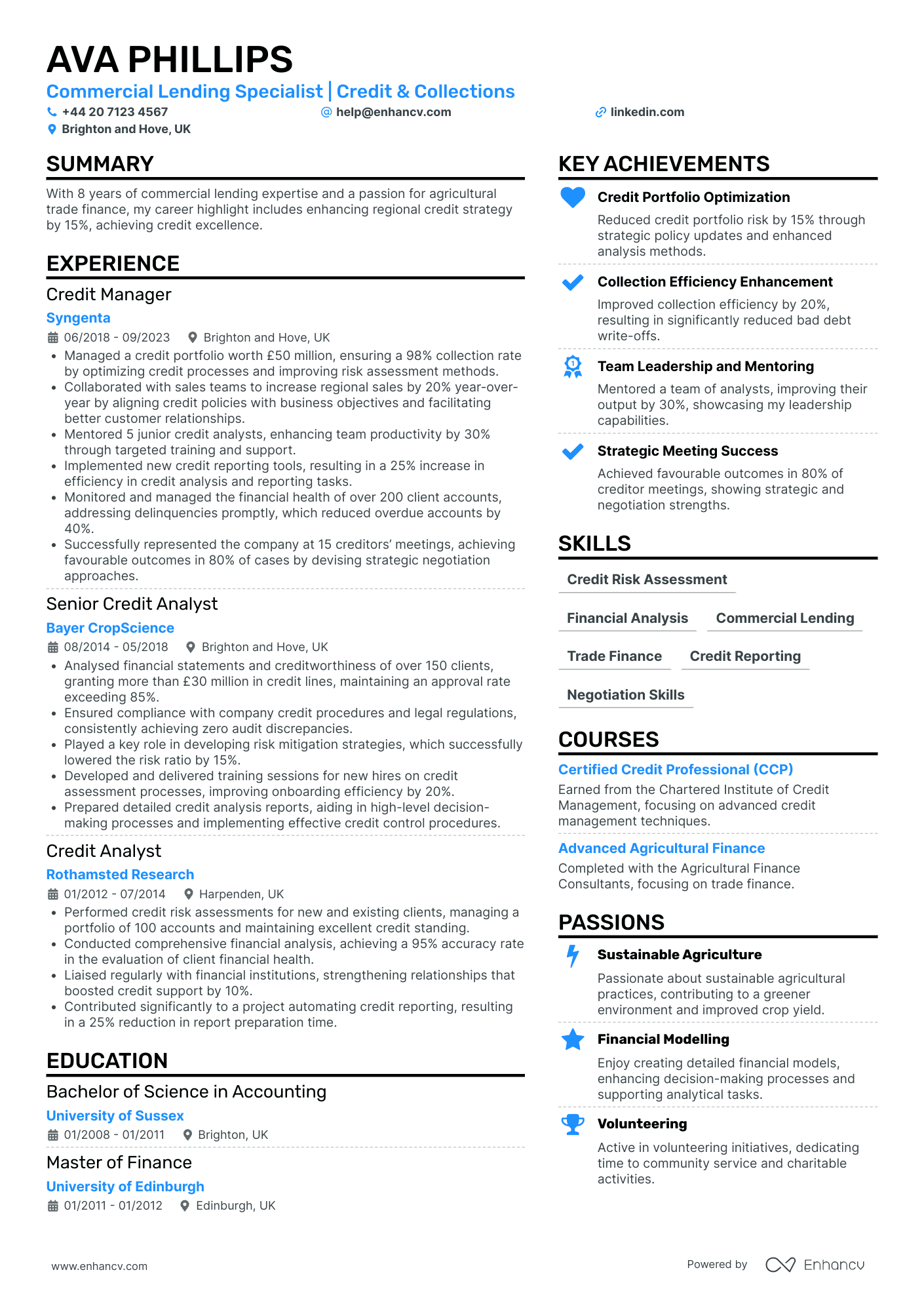
For a commercial or corporate credit role, foreground financial statement analysis, covenant setting, and larger secured facilities. Name the book size and the sectors you have lent into.
For a consumer or retail credit role, lead with scorecard work, portfolio analytics, and the modelling tools behind automated decisions, SAS and SQL among them.
For a dedicated credit risk analyst role, weight regulation and measurement: IFRS 9 provisioning, Basel capital, stress testing, and model validation.
The core skills stay the same across all three. What changes is the order and the language, so tailor your CV to the specific advert every time.
Education and certifications for a credit analyst CV
Most UK credit analyst roles want a numerate degree, usually a 2:1 or above in economics, finance, accounting, mathematics, or a related subject. List your degree and classification plainly.
Certifications carry real weight in this field. Name the ones you hold or are working towards: CFA, ACCA, ACA, or the Chartered Banker qualification. Put "in progress" where it applies, because it signals you are on a recognised path.
If you are moving up, a completed professional qualification can matter more than another year of the same duties. Keep this section short and let the experience section carry the weight.
The entry-level and junior credit analyst CV
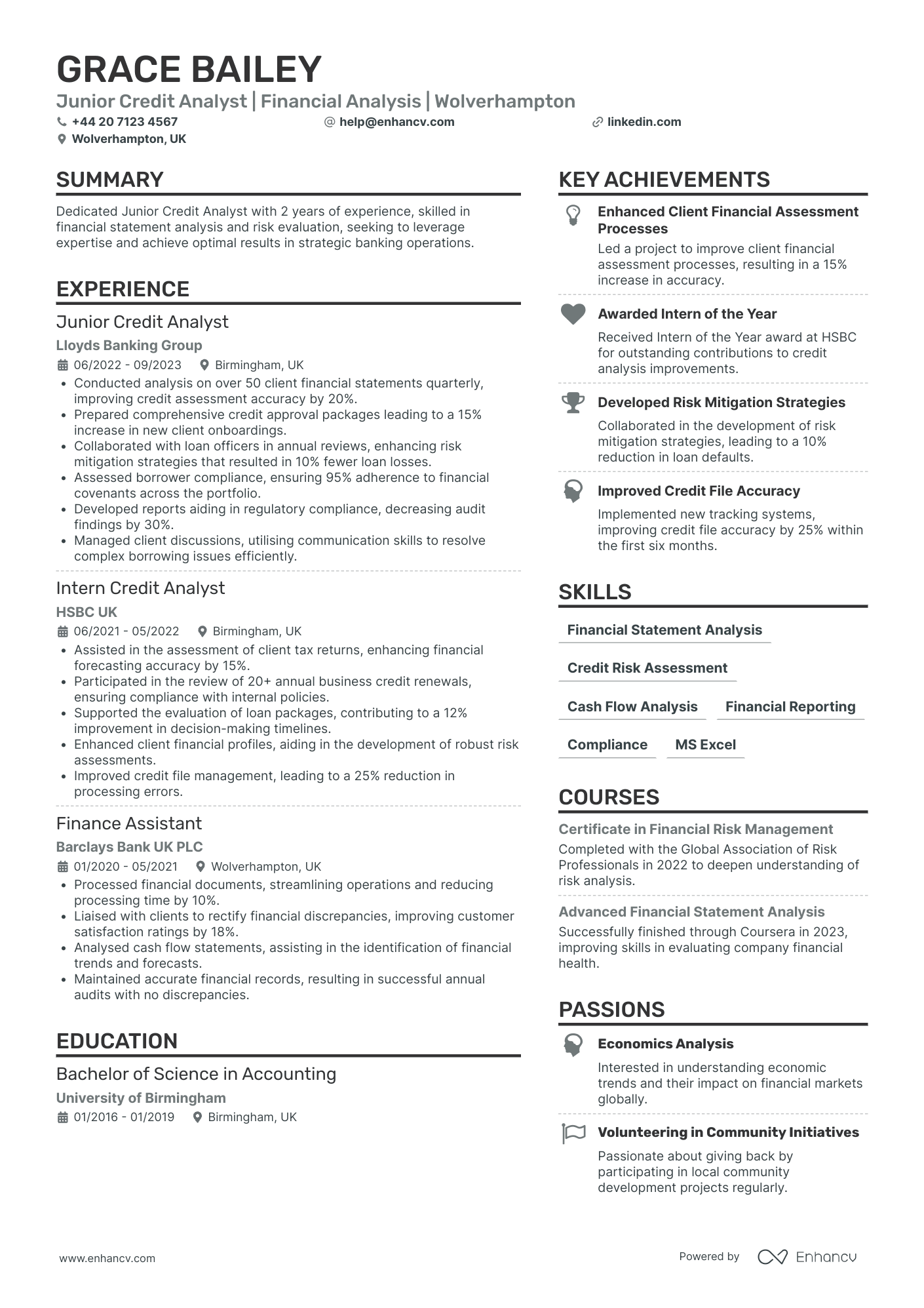
Only 2 of the 20 recent UK postings on Enhancv's internal job feed were pitched at entry level, so a first credit role is competitive. Your CV has to work harder.
Lead with a skills-led structure and the numerate proof you do have: a strong degree, a dissertation or module in credit, financial modelling, or econometrics, and any internship in banking, audit, or risk.
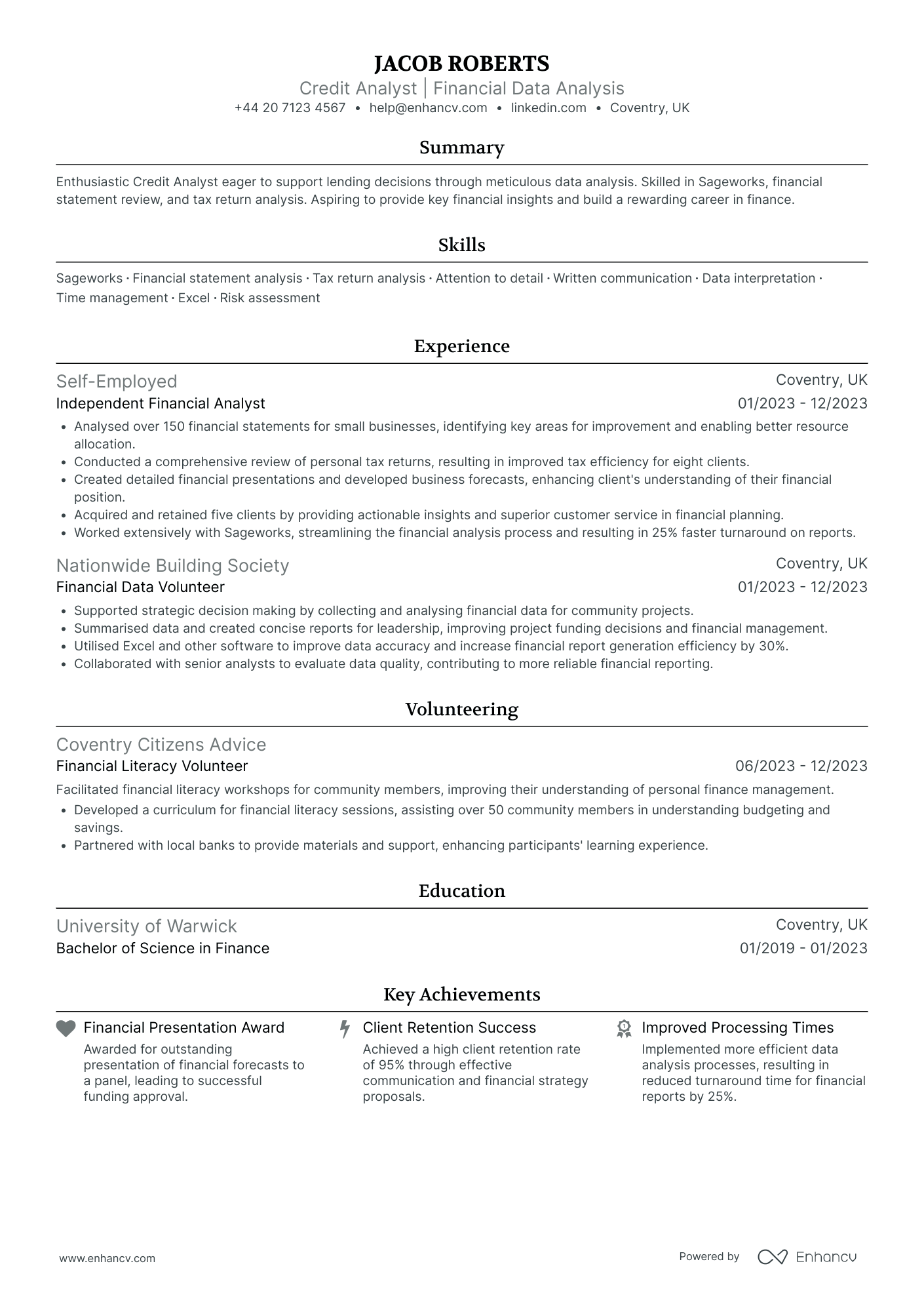
Mine coursework and projects for real analysis. A university project modelling default probability, a placement reconciling ledgers, or a part-time role handling cash all show the raw skills a lender can build on. See how to build a first-job CV when the work history is thin.
One line lifts a junior CV: a certification in progress. "CFA Level I candidate" or "studying towards ACCA" tells a lender you are committed to the profession before your first full role.
Treat a rejection from a graduate scheme as data, not a verdict. Ask what was missing, add the modelling or the certification step, and apply again the next cycle. This field rewards persistence and a clean, quantified CV over a perfect first attempt.
Conclusion
Lead with the risk skills a lending team screens for, show that you work the 5 C's, and quantify every decision you have made.
Keep every claim checkable, mirror the risk terms the advert uses, and let one real number carry more weight than a paragraph of duties.
Pair the CV with a short cover letter that names the sector you want to lend into, and you turn a strong CV into an interview.

Author's take - the Enhancv team
When we read a credit analyst CV, we look for one thing before anything else: evidence you have made a lending call and owned the outcome. A line like "cut portfolio arrears from 4.1% to 2.6%" tells us more than a page of systems and frameworks. Name the decision, the number, and the book it sat in. An analyst who quantifies risk on the page is the one we trust to quantify it on the job.