



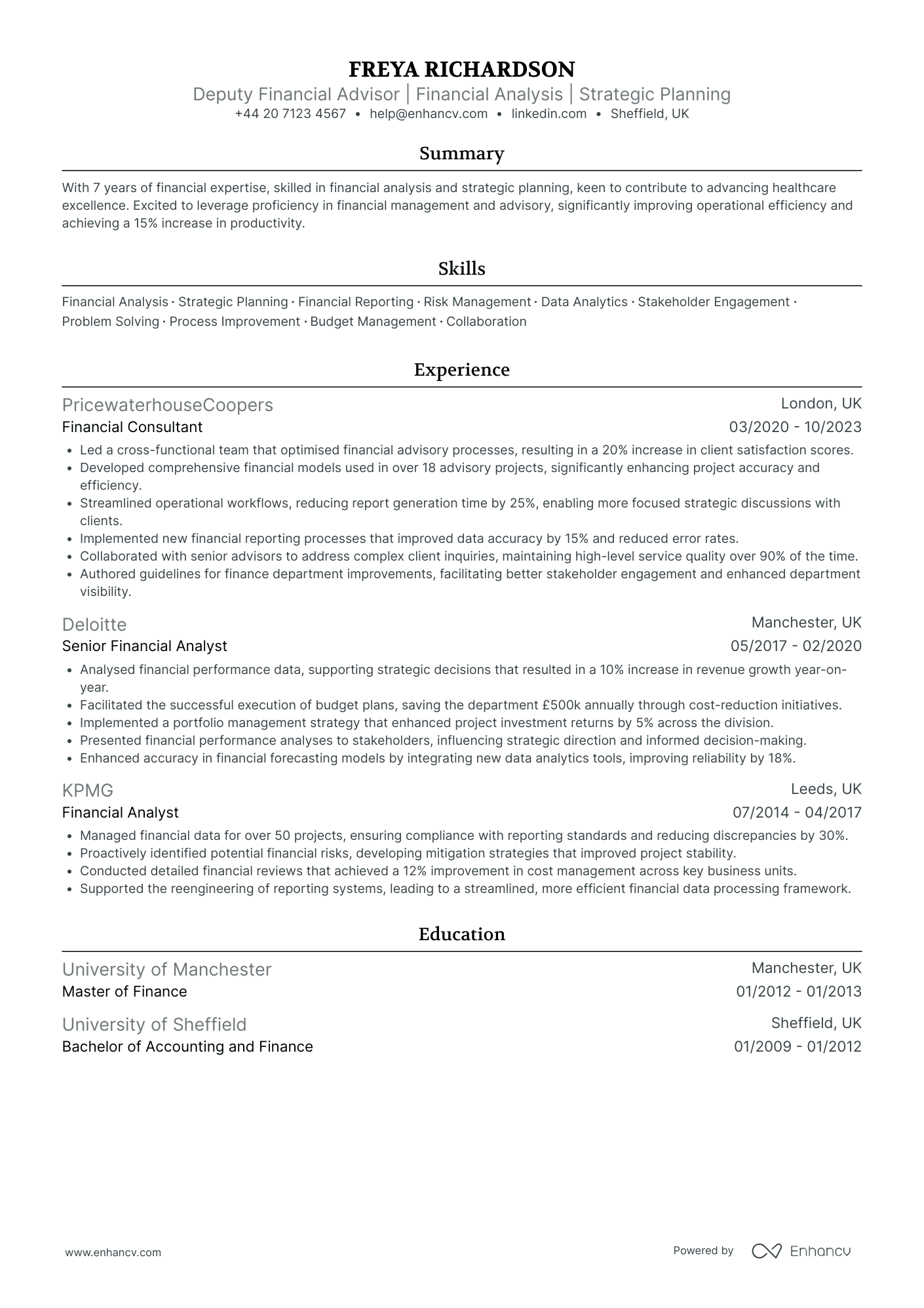
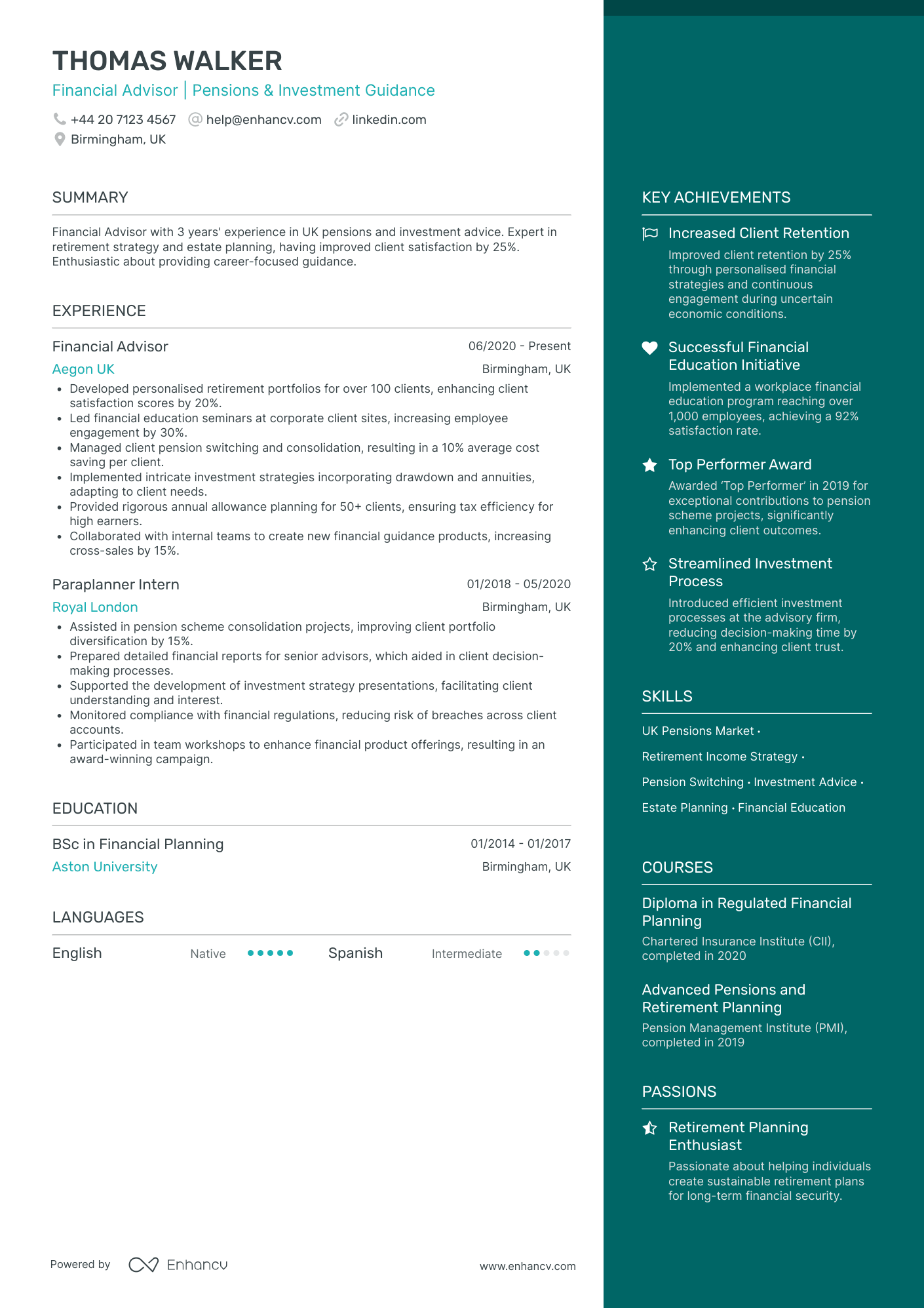
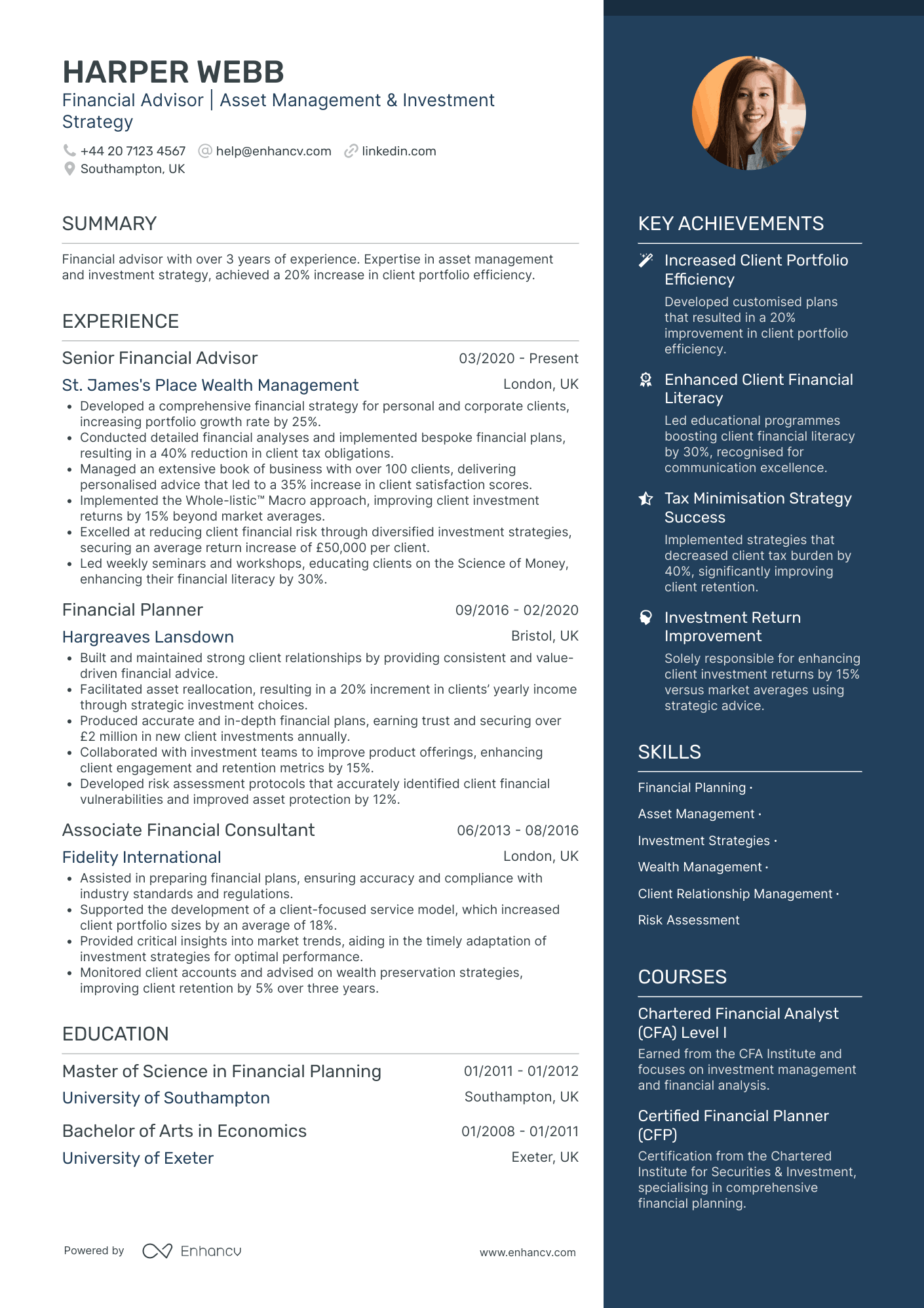
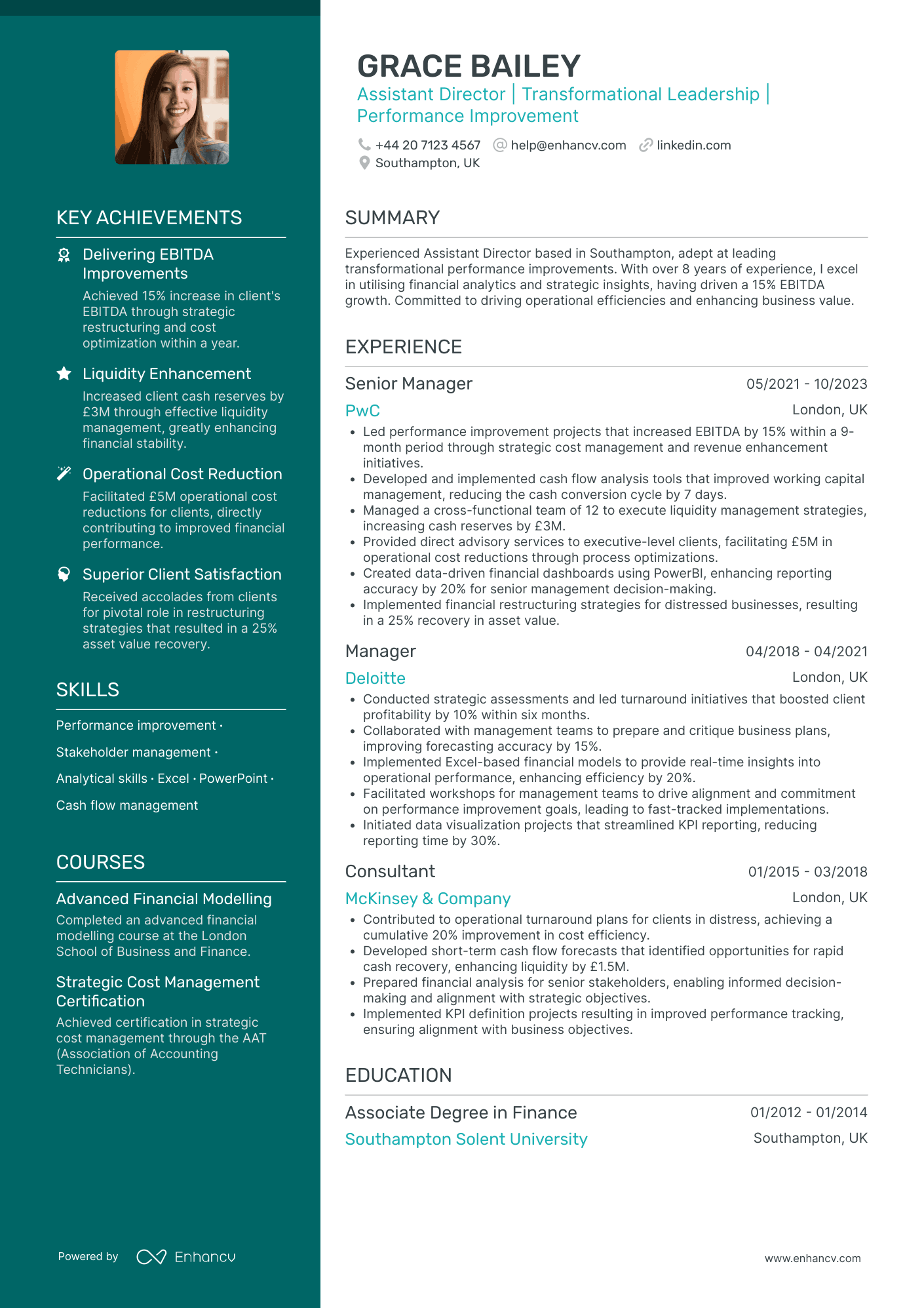
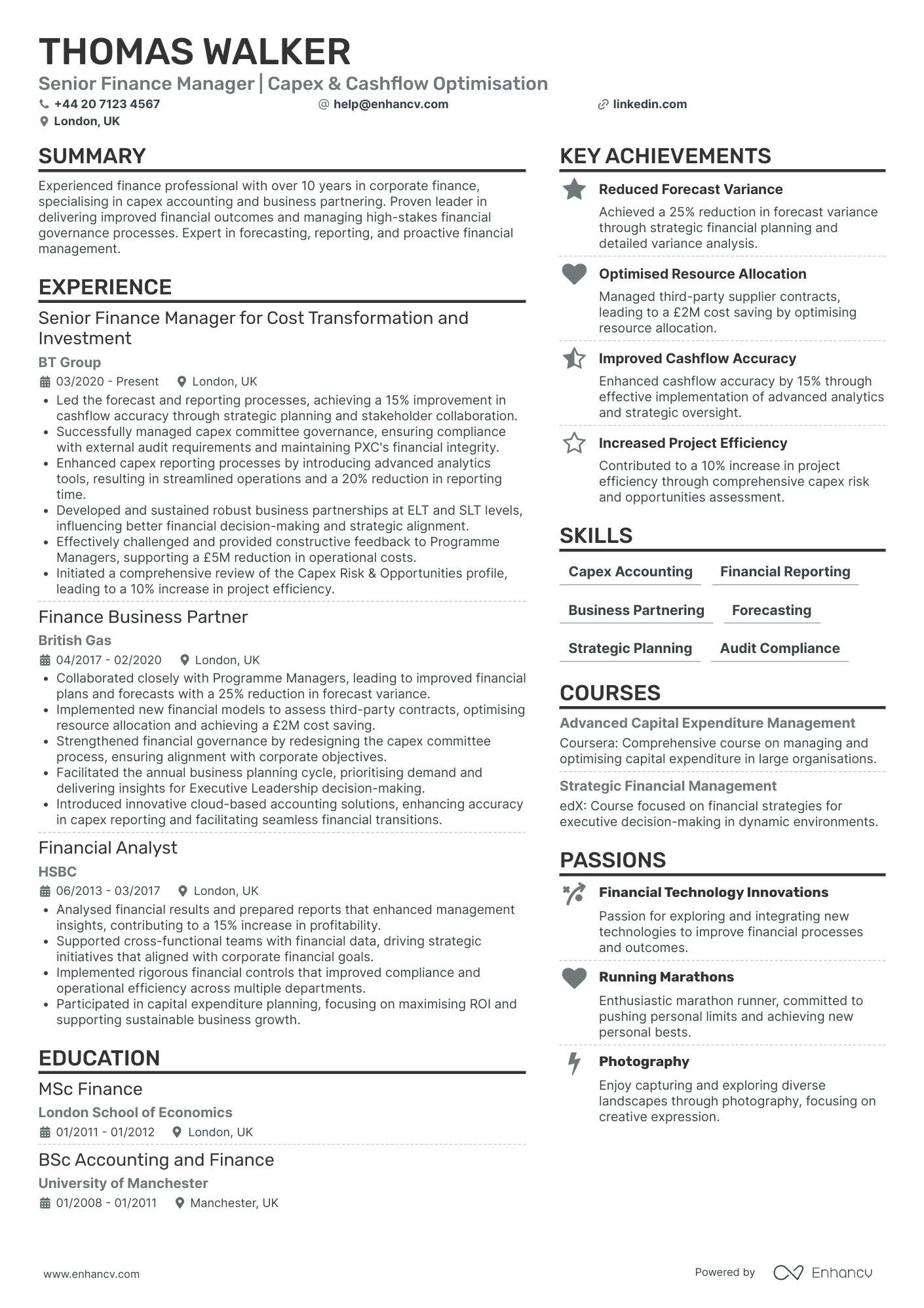
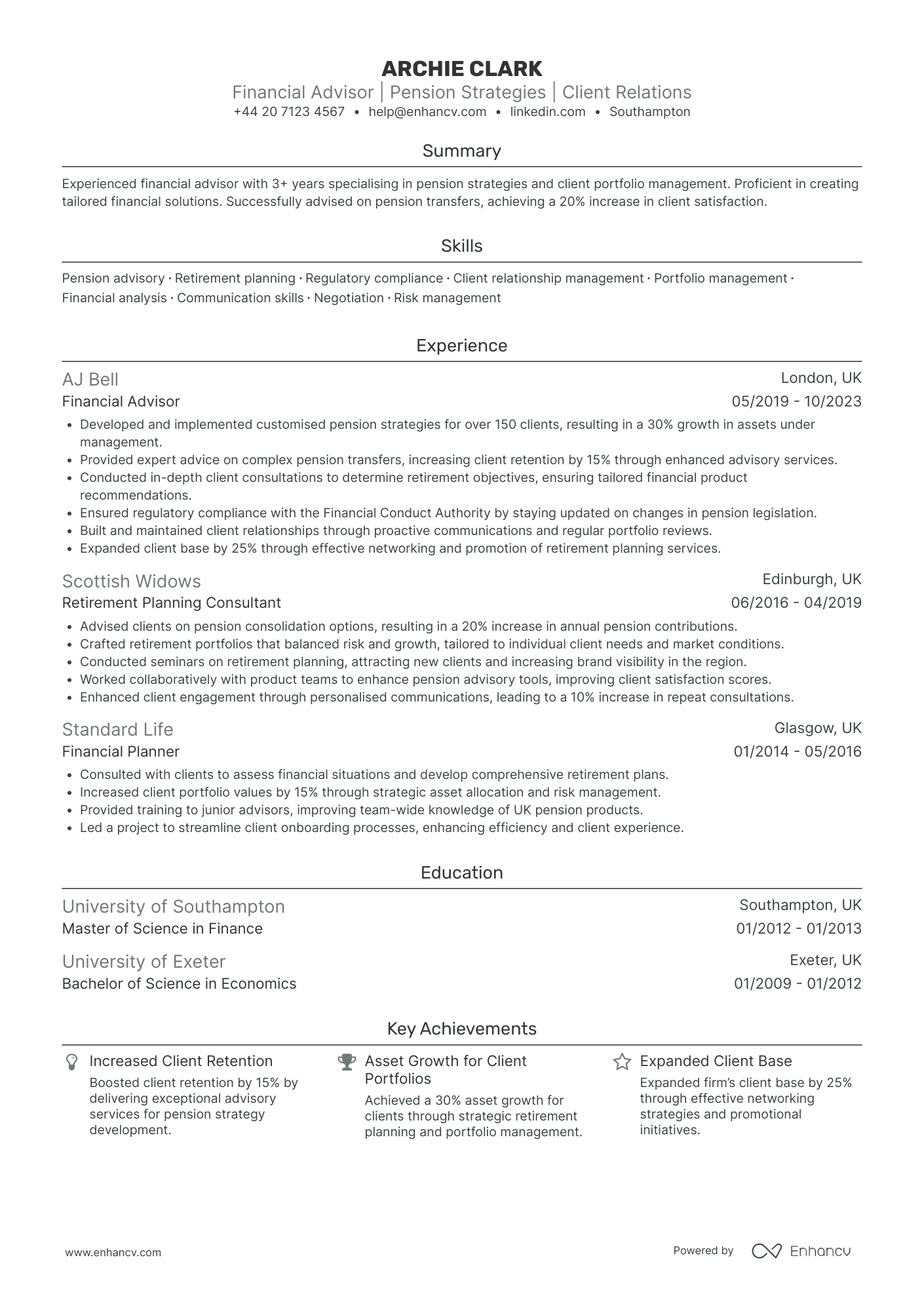
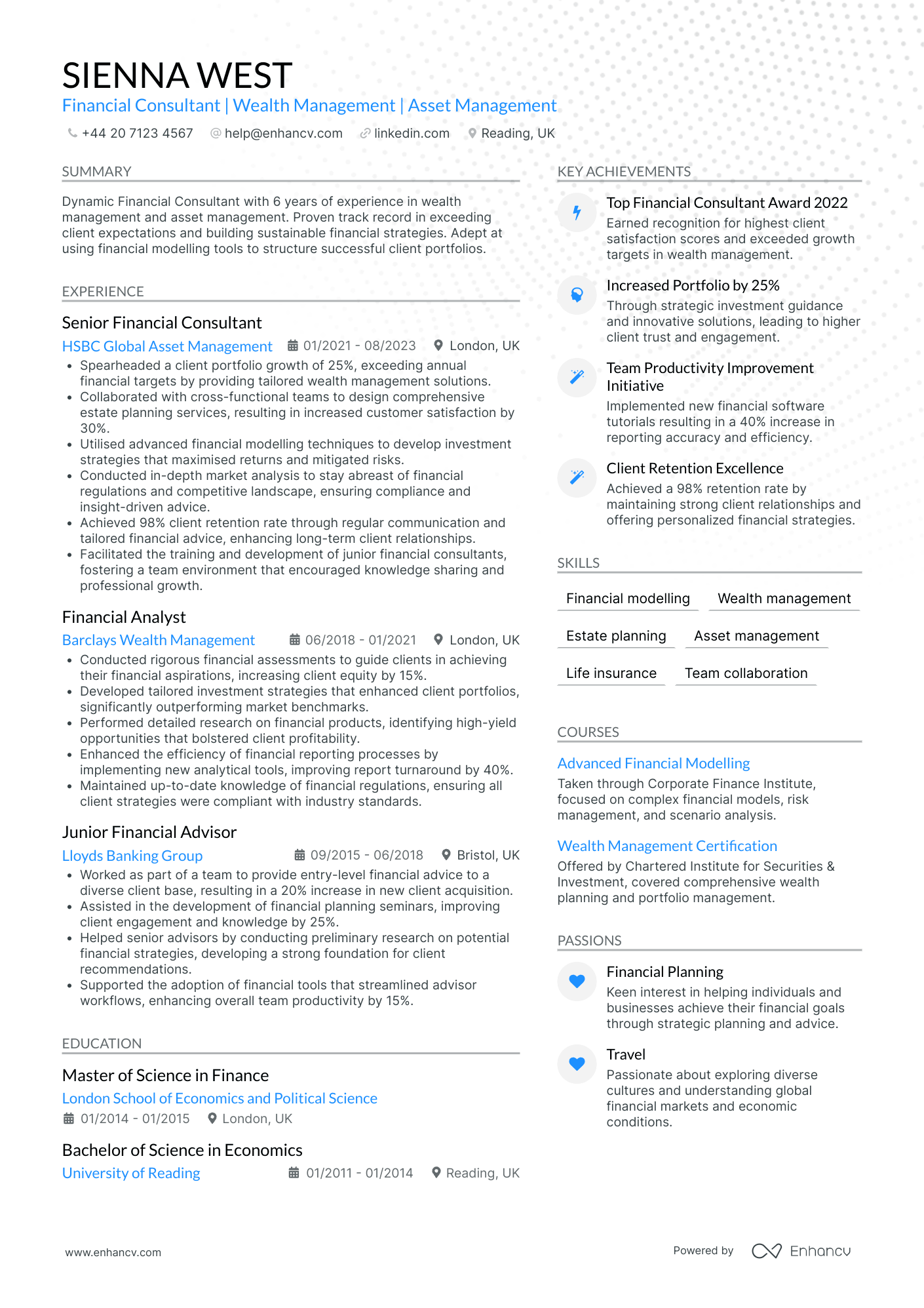
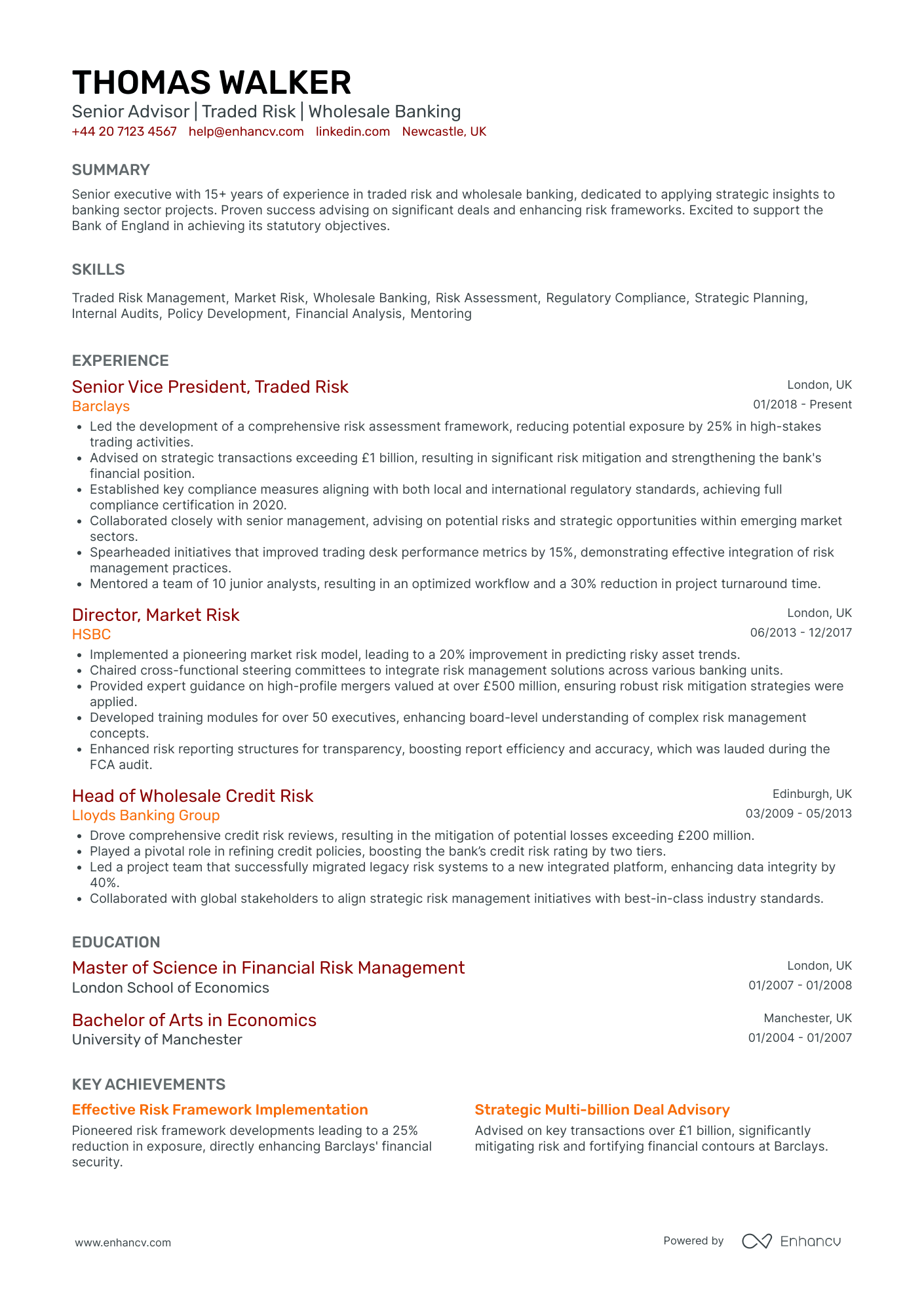
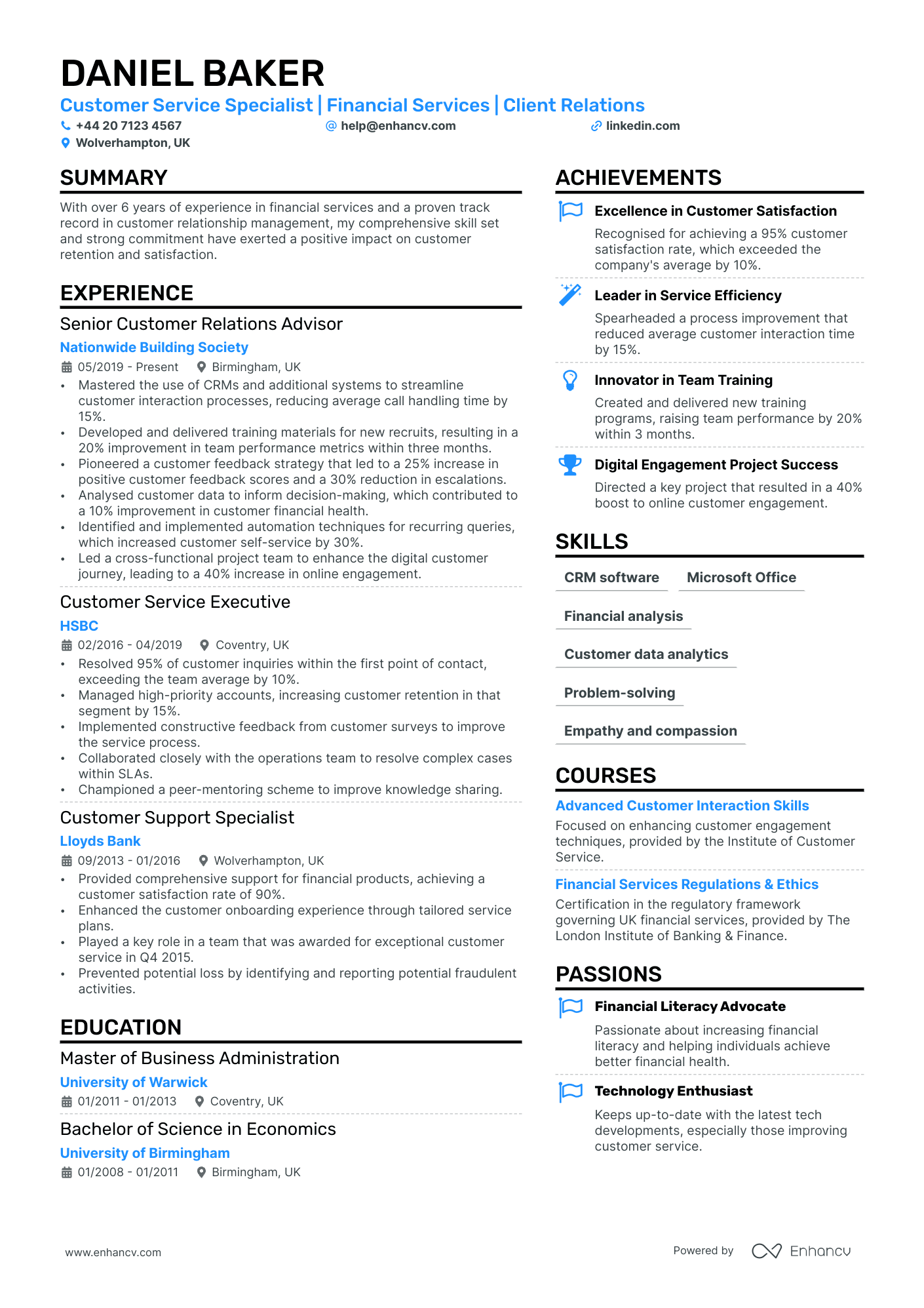
Most financial advisor CVs read like a compliance file. A wall of duties, a list of products sold, and not a single client outcome a hiring manager can actually trust.
The ones that win interviews prove regulated competence and real client results in the first third of page one, which is exactly where a recruiter decides whether to keep reading. Get the fundamentals right first with a clear guide on how to write a CV, then build outward from your qualifications and your numbers.

Key takeaways
- Lead with regulated competence. Name your Level 4 Diploma, your Statement of Professional Standing, and the FCA-authorised advice you are qualified to give.
- Prove client outcomes with numbers: funds under advice, client retention, review completion, and a clean compliance record.
- Put your qualifications and authorisation status near the top. This is a regulated role, so employers screen for them before anything else.
- Open with a short personal statement built on your specialism, your qualifications, and one measurable result.
- Two pages, reverse chronological, sent as a PDF unless the advert asks for a Word file.
- Mirror the exact terms in the advert: pensions, protection, investments, suitability, whole-of-market or restricted.
Top skills for your financial advisor CV
A financial advisor CV lives or dies on two things a recruiter checks first: are you authorised to give the advice, and can you show the results of giving it. The skills section is where you answer both, in the language the advert uses.
Keep the list tight. Eight to ten hard skills and five or six soft skills is plenty, and every one should be defensible. A sprawling list of thirty generic competencies reads as filler and hides the two or three that would have won you the interview.
Split them the way employers read them. Hard skills are the regulated, technical competencies you can evidence, so list your hard skills in the exact words the job description uses: financial planning, pension and investment advice, suitability report writing, risk profiling, and FCA compliance.
Soft skills carry more weight in advice than in almost any other finance role, because clients commit to trust before they commit to a plan. The soft skills that count here are checkable ones: client relationship management, active listening, and the ability to explain complex options in plain English.
Match the emphasis to your specialism. A pension adviser leads with retirement and drawdown planning, a mortgage adviser with CeMAP and protection, and a wealth adviser with portfolio construction and cash flow modelling. The advert tells you which words to promote to the top of the list.
Top skills for your financial advisor CV:
Regulated financial advice
Financial planning and cash flow modelling
Pension and retirement advice
Investment and portfolio advice
Suitability report writing
Risk profiling and attitude to risk
FCA compliance and record keeping
Client fact-finding and product research
Client relationship management
Active listening
Clear communication
Trust and rapport building
Attention to detail
Commercial judgement
Do not stop at listing them. A skills section only works when the experience below it backs every claim you have made above it.
Take risk profiling. "Skilled in risk profiling" proves nothing. "Assessed attitude to risk for 120 clients a year and matched portfolios to capacity for loss, with zero upheld suitability complaints" proves all of it.
Do the same for compliance, planning, and product research. Name the tool, name the client volume, and name the outcome. One backed claim outweighs a column of unproven adjectives.
Recruiters at advice firms read skills against the file they will have to defend to compliance. If you claim defined benefit transfer experience, they expect to see the permission, the volume, and a clean advice record beneath it. List only what you can stand behind under an audit, and move anything aspirational into a training-in-progress line instead.
Where you can, put the skill in context of a client rather than a system. "Explained a phased drawdown strategy to a nervous retiree and secured sign-off in one meeting" shows communication, technical knowledge, and outcome in a single line. That is the standard every skill on the page should aim for.

PRO TIP
Advice adverts name the permission, not a soft-skill cloud. Mirror the exact terms you can back: "whole-of-market", "restricted", "defined benefit transfers", "drawdown", "protection", "auto-enrolment". Name the wrap platforms, CRMs, and cash flow tools you actually use, so a hiring manager can picture you doing the job from day one.
Qualifications UK financial advice employers check
Financial advice is a regulated profession, so a UK employer checks your qualifications and authorisation before your achievements. Get these onto page one.
The baseline to give regulated advice is the Level 4 Diploma in Regulated Financial Planning, or an equivalent RQF Level 4 qualification, plus a current Statement of Professional Standing from an accredited body. Name both, with the awarding body and the year.
| What employers check | How to show it on your CV |
|---|---|
| Qualification | Level 4 Diploma in Regulated Financial Planning (CII) or an equivalent RQF Level 4 qualification, listed with the awarding body and year |
| Authorisation | Your FCA authorisation status and a current Statement of Professional Standing (SPS) from an accredited body |
| Specialism | The advice you are permitted to give: pensions, investments, protection, or mortgages (CeMAP), and whether you are whole-of-market or restricted |
| Professional standing | Chartered or Certified status (PFS, CISI) and up-to-date continuing professional development |
| Proof it works | Client outcomes near the top: funds under advice, client retention, review completion, and a clean compliance record |
If you are working towards a qualification, say so. "Level 4 Diploma, four of six units passed" tells an employer you are on the path and worth training.
Chartered or Certified status is the differentiator once you are qualified. It signals depth, and it is the term senior advice roles screen for. List any certifications and your CPD in a dedicated block, and keep your qualifications on your CV near the top rather than buried at the bottom.
Match the qualification to the advice. Mortgage and protection roles want CeMAP, pension transfer work wants the relevant pension specialism, and holistic planning roles favour the full Diploma with an eye on chartered progression. Spell out the exact route you have taken, because "qualified" on its own leaves a recruiter guessing what you are permitted to do.
Do not hide your authorisation history either. A short note that you have held statement of professional standing renewals for several years, with no disclosures, quietly answers the question every compliance manager asks before an interview.
Writing your financial advisor personal statement
Three or four sentences at the top: your specialism, your qualification and authorisation status, the clients you serve, and one measurable result. Keep it concrete. For more openings, see these personal statement examples.
Skip the adjective soup. "Driven, client-focused and results-oriented" sits on half the CVs in the pile and tells a recruiter nothing they can check.
Pitch the statement to the level you are applying for. A newly qualified adviser leads with the Diploma and the client-facing experience that got them there, while an experienced adviser leads with funds under advice, retention, and specialism. Both close with the kind of firm they want to join.
Lead with evidence instead.
Financial advisor CV personal statement example
Diploma-qualified financial adviser (CII Level 4) with a current SPS and six years advising retail clients on pensions and investments. Manage £48m of funds under advice across 140 households, with 96% client retention and a clean compliance record. Whole-of-market and looking to bring holistic planning to a chartered advice firm in the North West.
What to avoid
Hardworking and motivated financial advisor with a passion for helping people reach their financial goals. Excellent communication skills and a proven track record of success in a fast-paced environment. Seeking a challenging new role to develop my career and add value to a forward-thinking company.
When we read a financial advisor CV, the first thing we look for is proof you can be trusted with someone's money and signed off by a compliance team. That means your qualification, your authorisation status, and one clean, specific outcome, all before the fold. A line like "managed £48m of funds under advice with 96% retention and no upheld complaints" tells us more than a paragraph of adjectives. A real qualification plus a real number beats a polished summary with nothing behind it every time.
Writing your financial advisor experience section
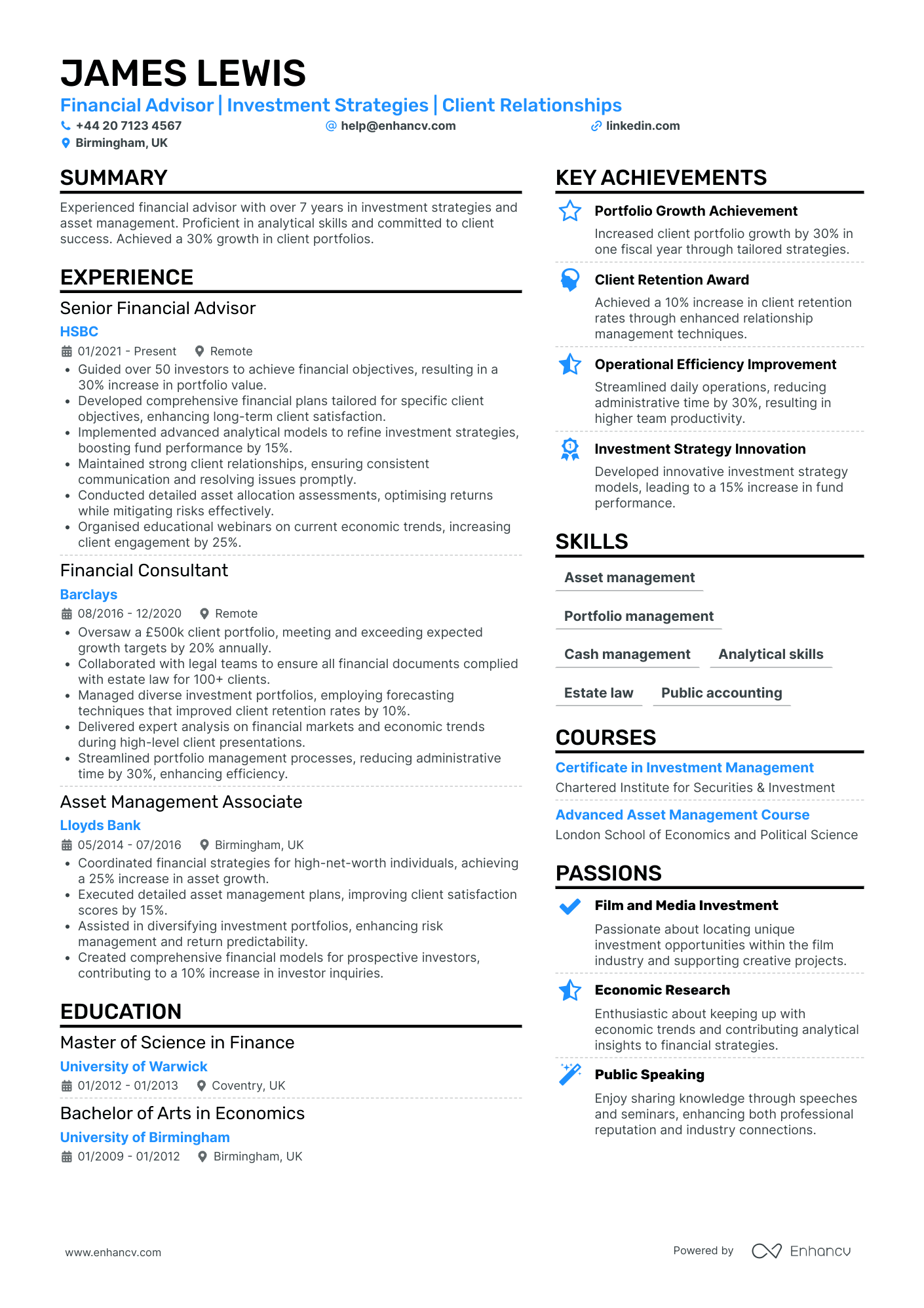
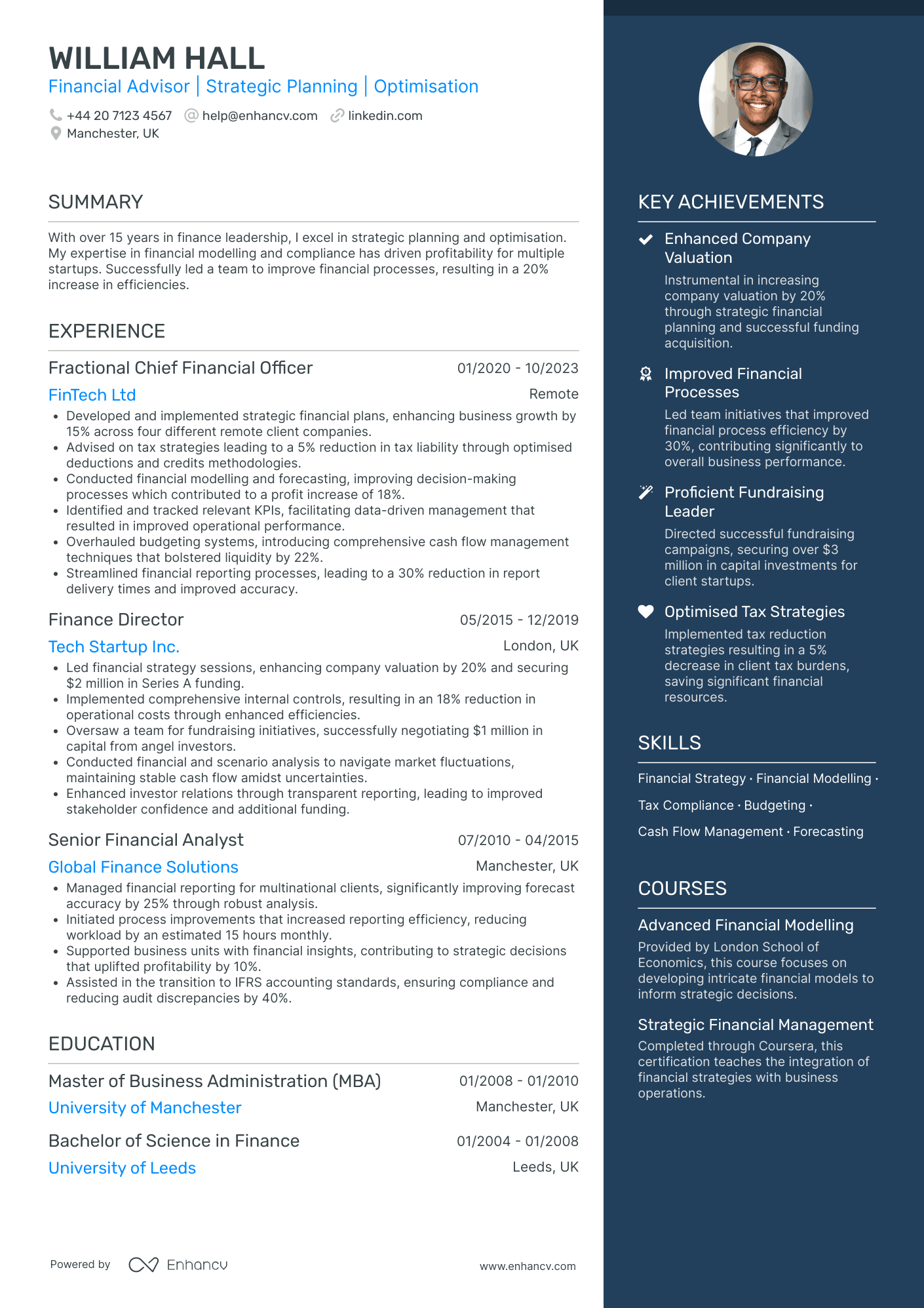
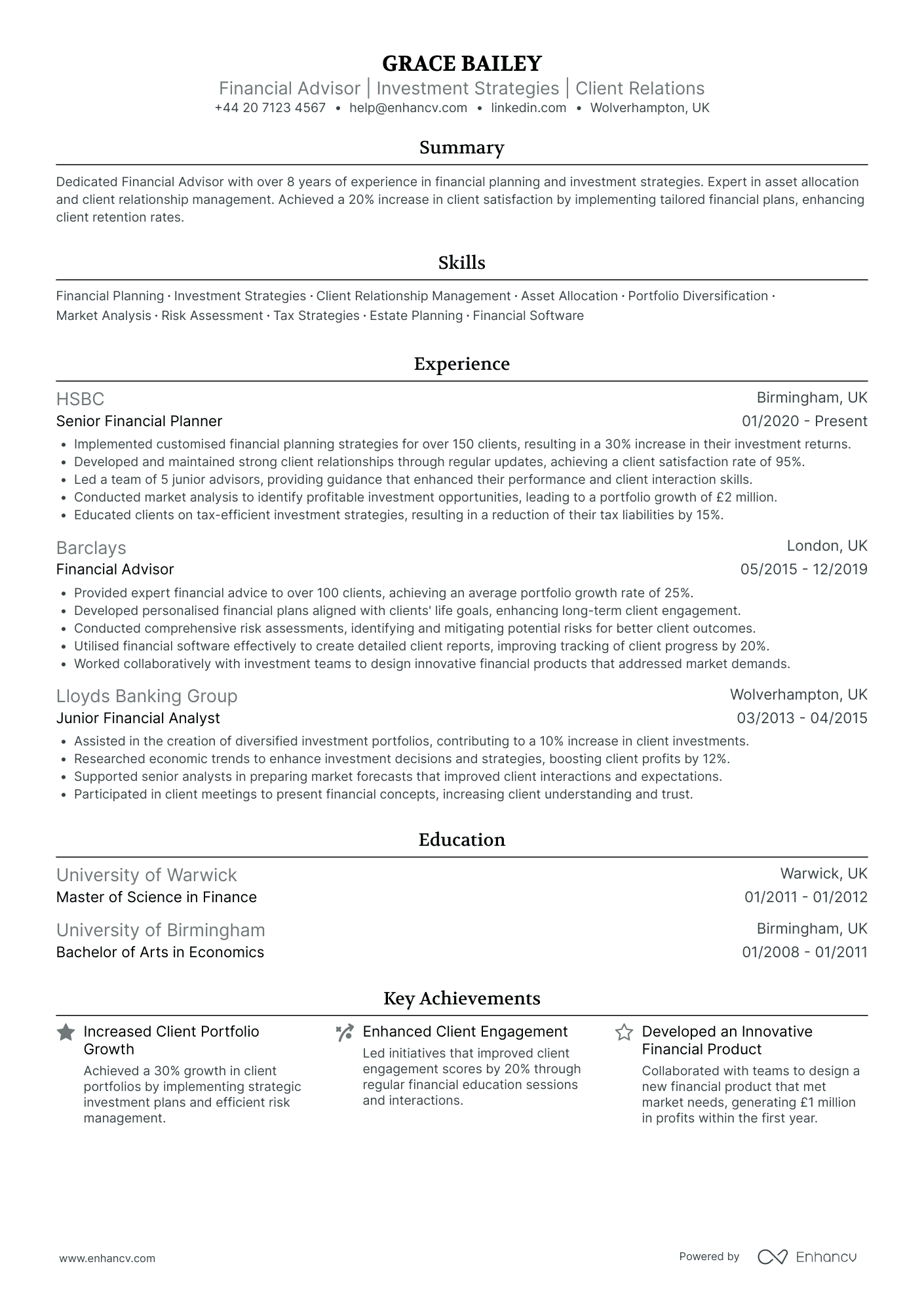
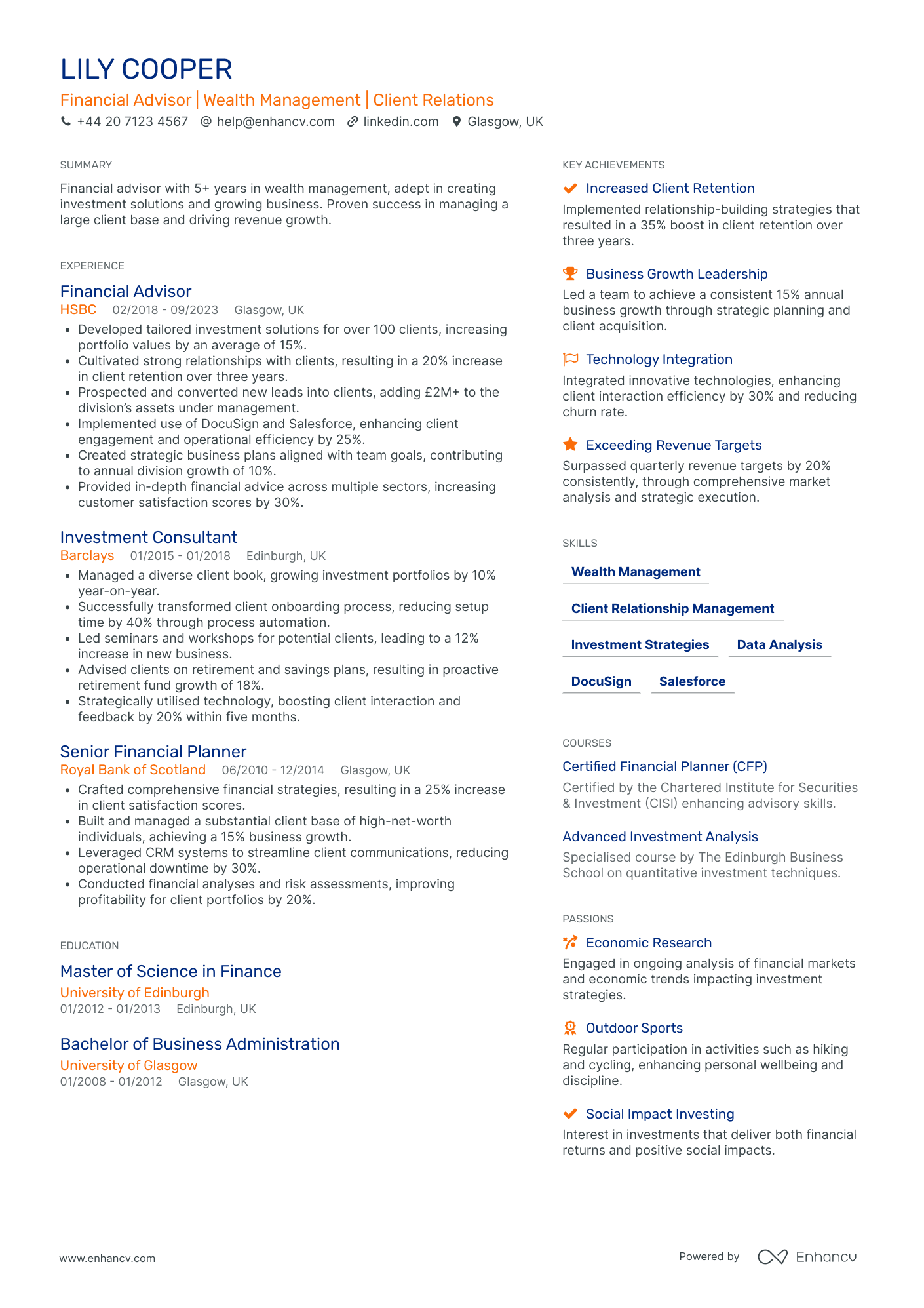
Write every role the same way: a dated heading, then bullets that lead with a verb and land on a result. For the mechanics, see work experience on a CV.
Advice work is measurable even when it feels like relationship work. Funds under advice, client numbers, retention, review completion, referrals earned, and a clean compliance record are all CV achievements a hiring manager can weigh.
Show progression as well as results. Moving from paraplanner to adviser, or from bank-based to independent, tells a hiring manager you have grown into more responsibility and more complex advice. Order your roles so that story reads top to bottom.
Tailor each application. Pull the specialism and the regulatory keywords from the advert and mirror them where they are true of you. Enhancv's CV tailoring feature reads the advert and suggests the matching edits, which saves rewriting from scratch each time.
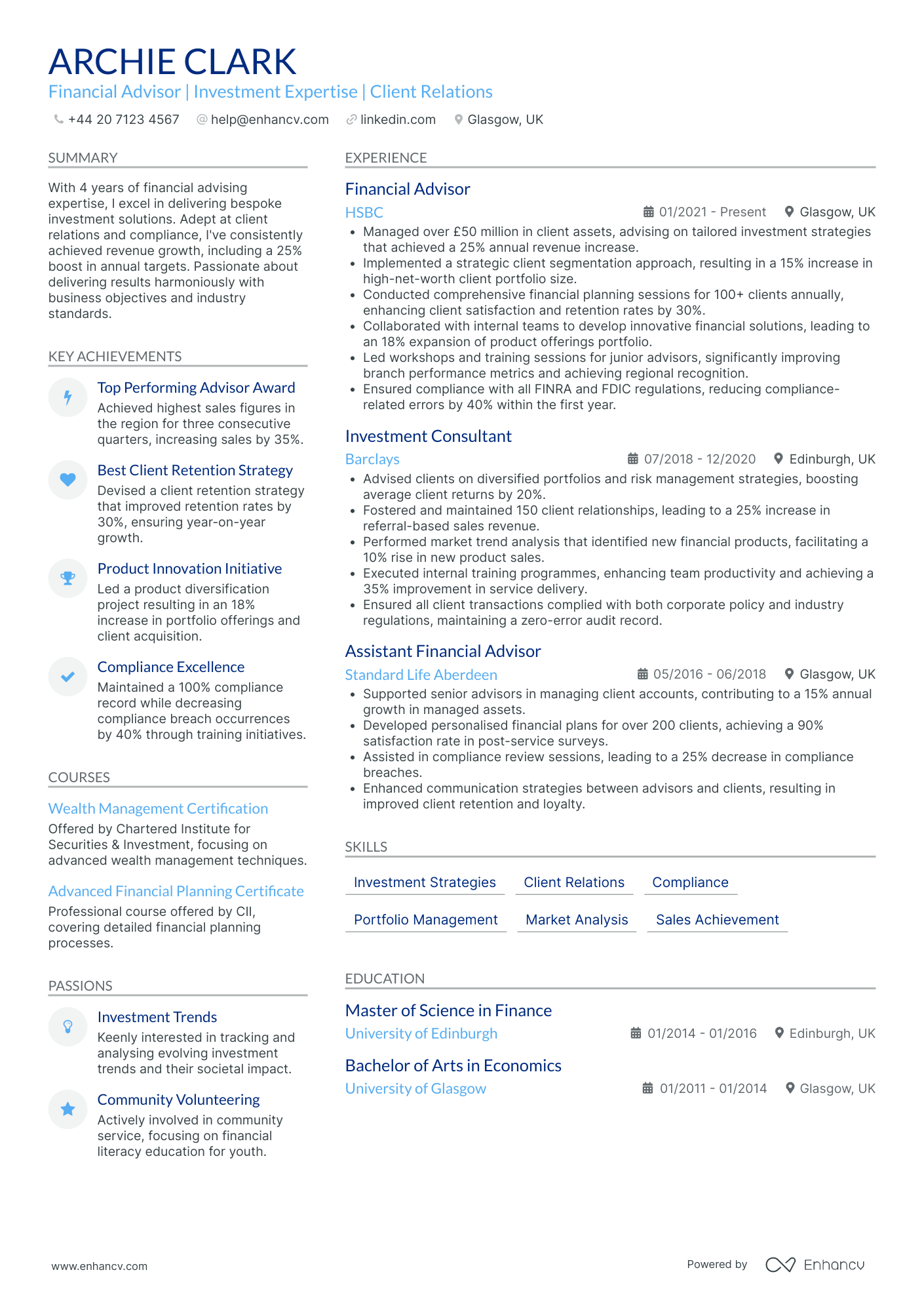
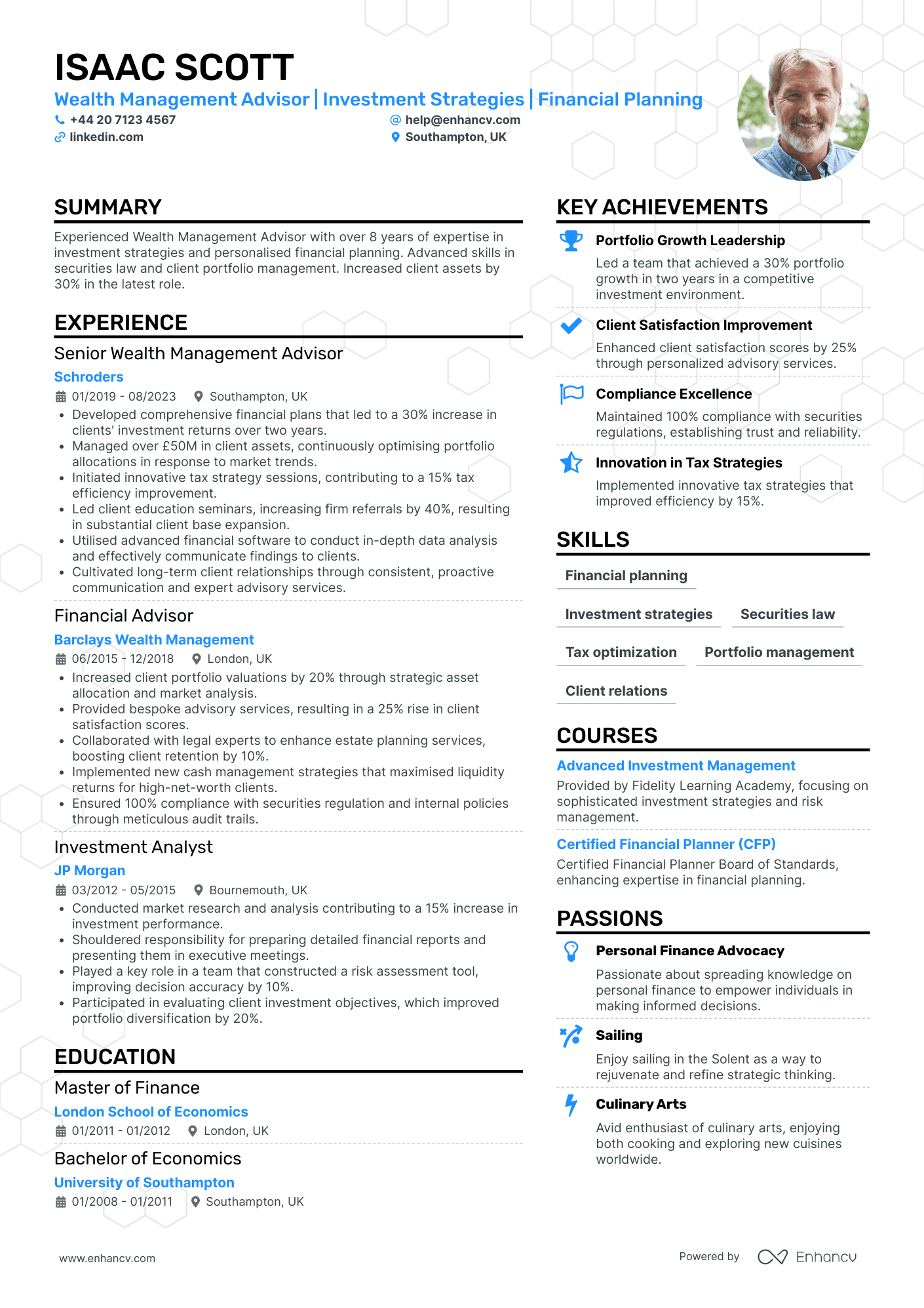
- Advise 140 retail and high-net-worth households on pensions, investments, and protection, managing £48m of funds under advice
- Grew the client book by 28% in two years through a structured referral process and disciplined annual reviews
- Produce compliant suitability reports and held a clean file-check record across three internal audits
- Introduced cash flow modelling to every review, lifting annual review completion from 71% to 94%
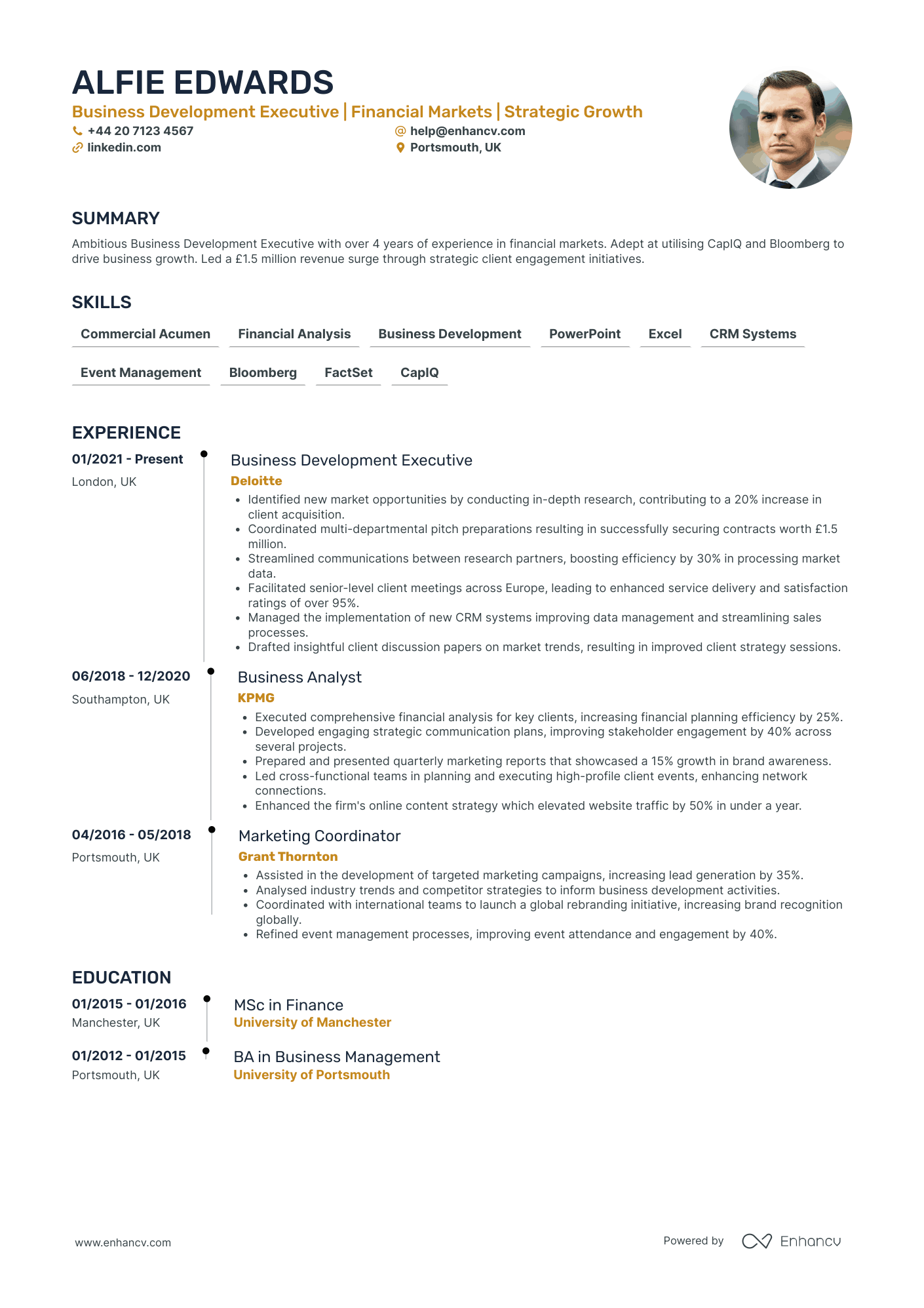
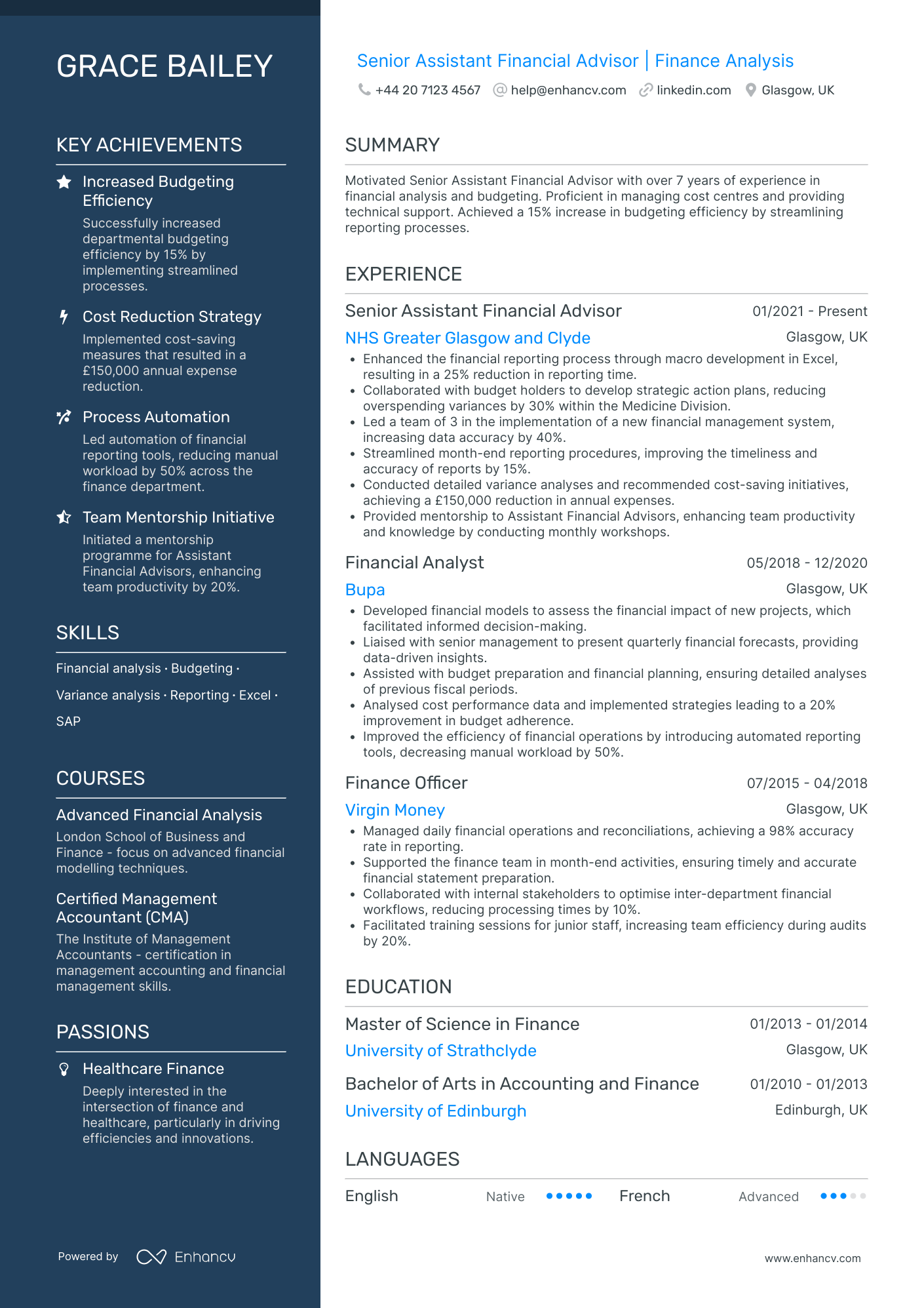
- Prepared 25 to 30 suitability reports a month for three advisers, covering pensions, ISAs, and protection
- Ran research and cash flow modelling that supported £30m of new investment recommendations
- Cut report turnaround from five days to two by building a compliant template library
- Passed four of six Level 4 Diploma units while working full time, moving into an advising role in 2021
PRO TIP
Every bullet should answer "so what?". "Reviewed client portfolios" is a duty. "Reviewed 140 portfolios a year and retained 96% of clients through market volatility" is an outcome. If a bullet has no number, no client volume, and no result, either add one or cut it.
Formatting your financial advisor CV
Use a reverse chronological structure once you have advice roles behind you, so your current permissions and results sit at the top. Lead with a skills-led layout only if you are moving into advice for the first time.
Keep it to two pages, one column, standard headings, and a readable font. Hiring managers at advice firms skim fast, and compliance-heavy CVs bloat quickly.
Send a PDF for direct applications so the layout holds, and keep a Word copy for recruitment agencies that reformat CVs into their own template. If the advert names a file type, follow it.
Applications often pass through tracking software, so keep the layout clean and the headings standard for an ATS-friendly CV. Build from a tested layout rather than a blank page, and Enhancv's CV templates export to a clean PDF.
Keep the CV header simple and professional: name, town, phone, and email. You do not need a photo for a UK advice role, and a clear header leaves more of page one for the qualifications and results that actually move a decision.
Financial advisor CV with no experience
Most people move into advice from paraplanning, banking, or another regulated role rather than straight from university, so a thin advice history is normal. Structure the CV to carry your weight differently.
Use a skills-led structure: personal statement, then qualifications and transferable skills, then experience. Your Level 4 progress and any regulated experience do the heavy lifting.
Mine adjacent roles for real evidence. Paraplanning, mortgage advice, bank-based reviews, compliance, and client service all build the fact-find, suitability, and relationship skills advice demands. Write them in advice language rather than as generic admin.
Numbers still matter, even without a client book of your own. Reports prepared, research completed, clients supported, and turnaround times are all measurable, and they show a hiring manager how you will perform once you are authorised in your own right.
One line moves an entry-level CV up the pile: "Level 4 Diploma in progress, four of six units passed". It signals you are already on the path. If your advice experience is light, borrow structure from CV examples for a first job and let your qualifications lead.
Conclusion
Lead with regulated competence, prove client outcomes with real numbers, and put your qualification and authorisation status where a recruiter sees them first.
Pair the CV with a short cover letter that says why this firm and this specialism, and you turn a compliant CV into a compelling one.
Read it back once from the recruiter's chair. If the qualification, the authorisation, and one strong number are all visible without scrolling, the CV is doing its job. If they are not, move them up before you send it.

Author's take - The Enhancv team
When we read a financial advisor CV, the first thing we look for is proof you can be trusted with someone's money and signed off by a compliance team. That means your qualification, your authorisation status, and one clean, specific outcome, all before the fold. A line like "managed £48m of funds under advice with 96% retention and no upheld complaints" tells us more than a paragraph of adjectives. A real qualification plus a real number beats a polished summary with nothing behind it every time.