



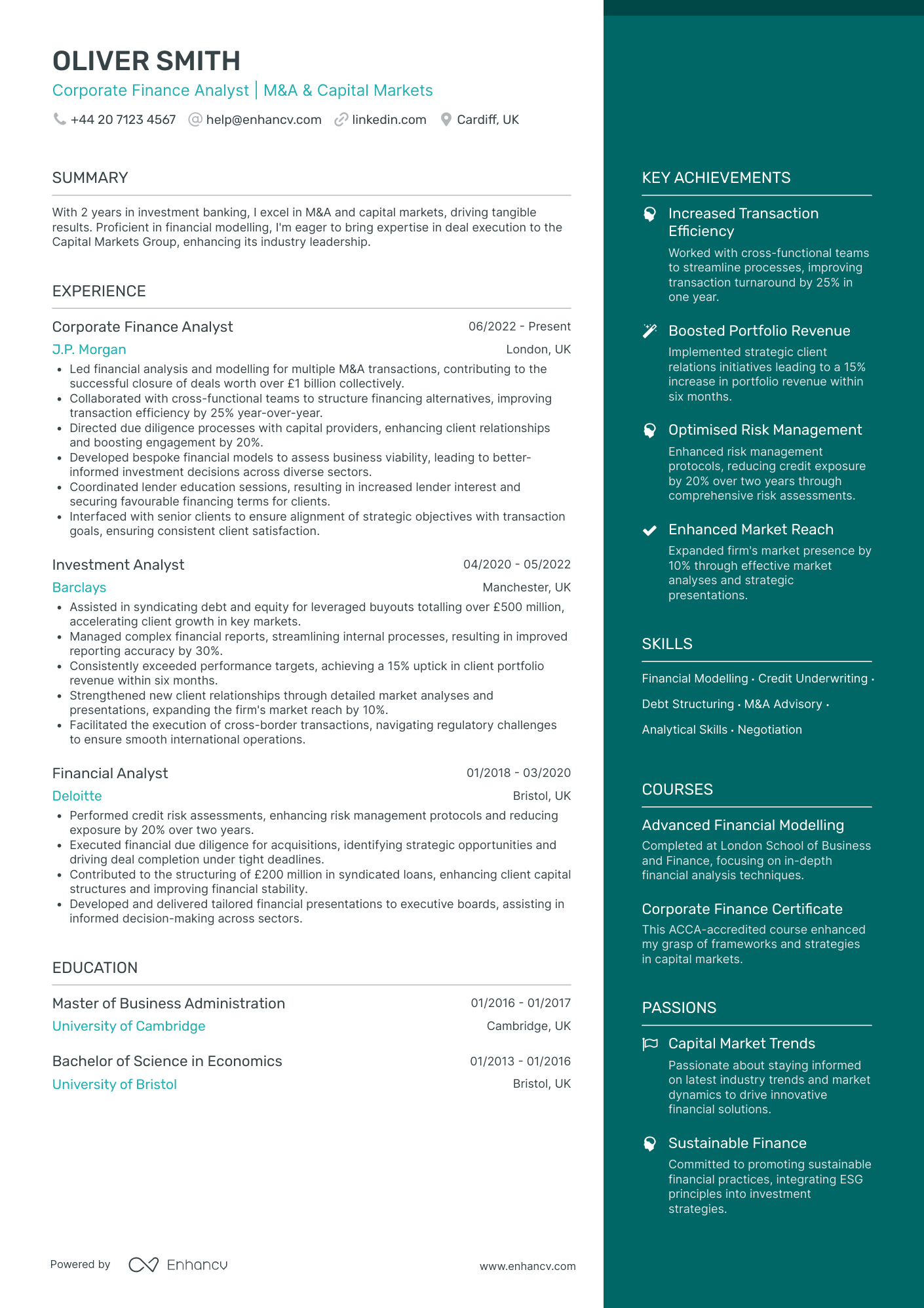
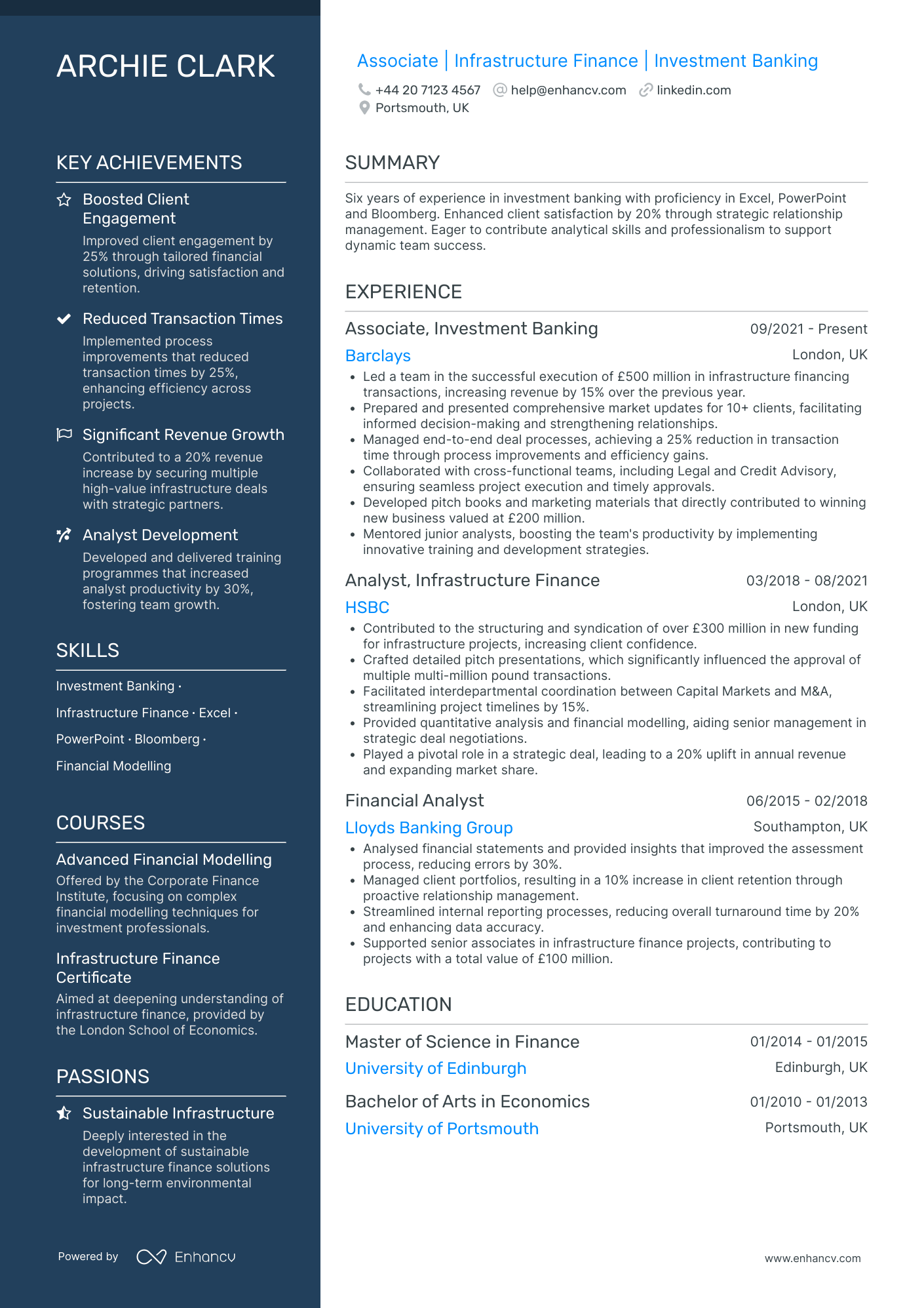
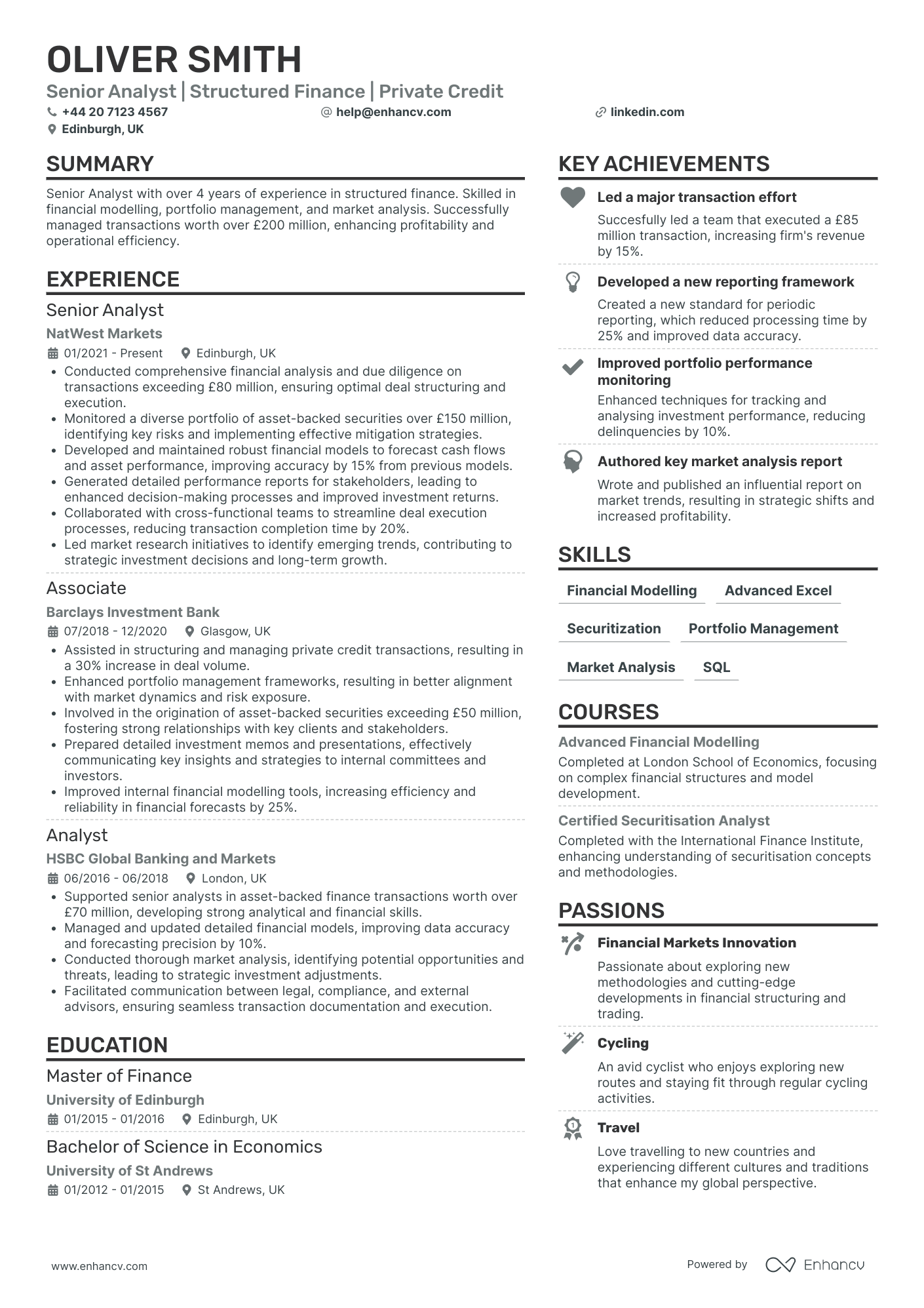
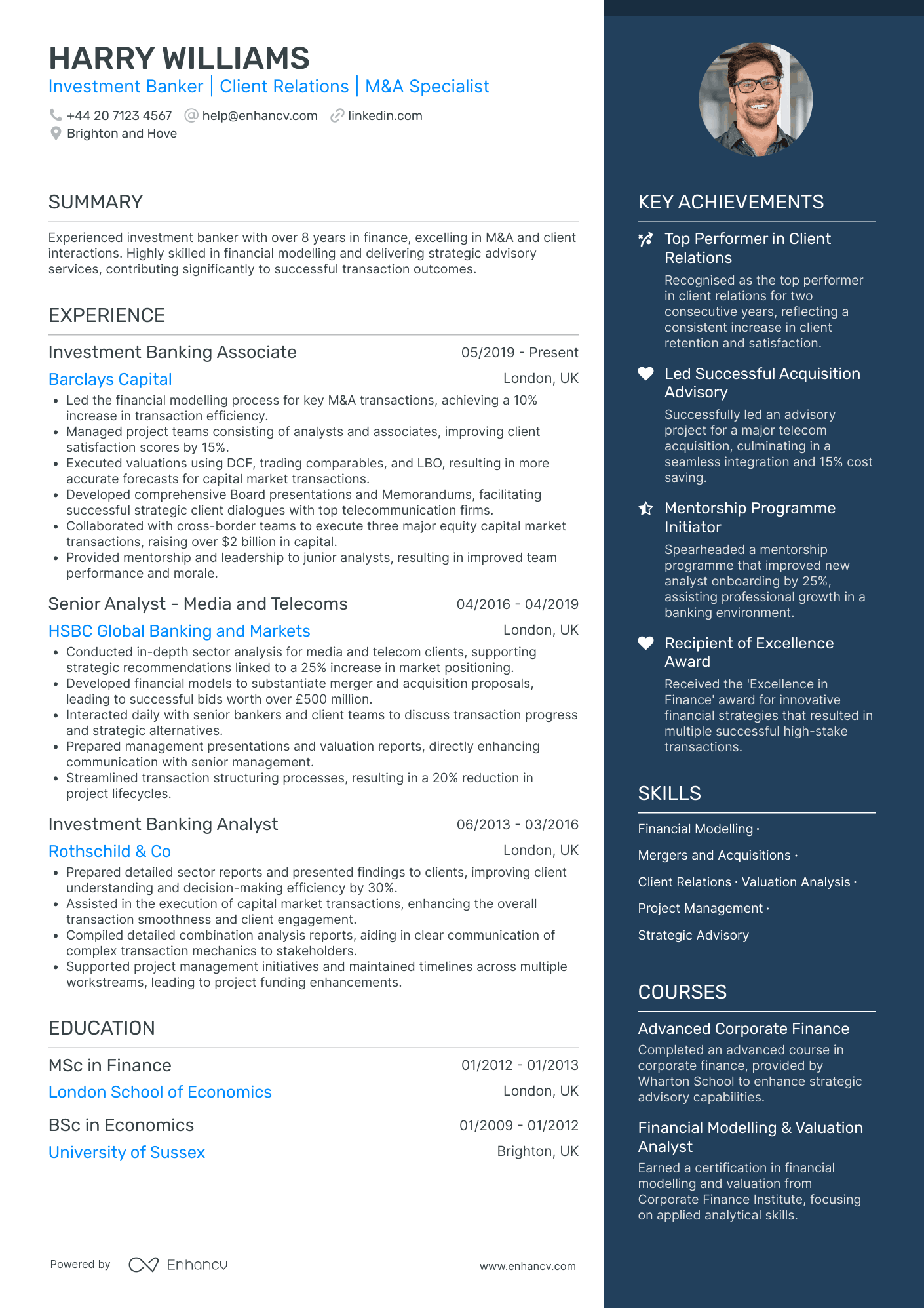
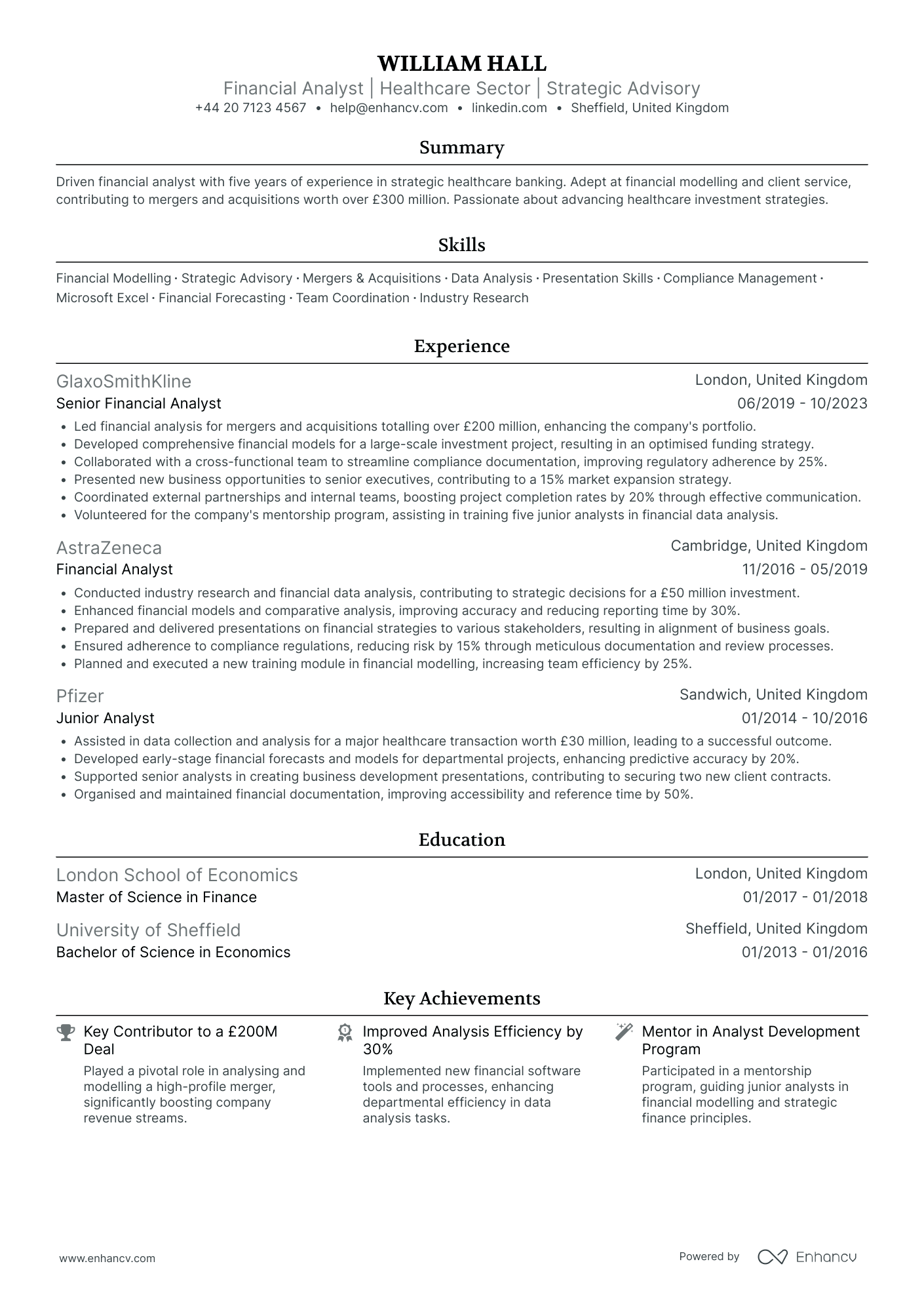
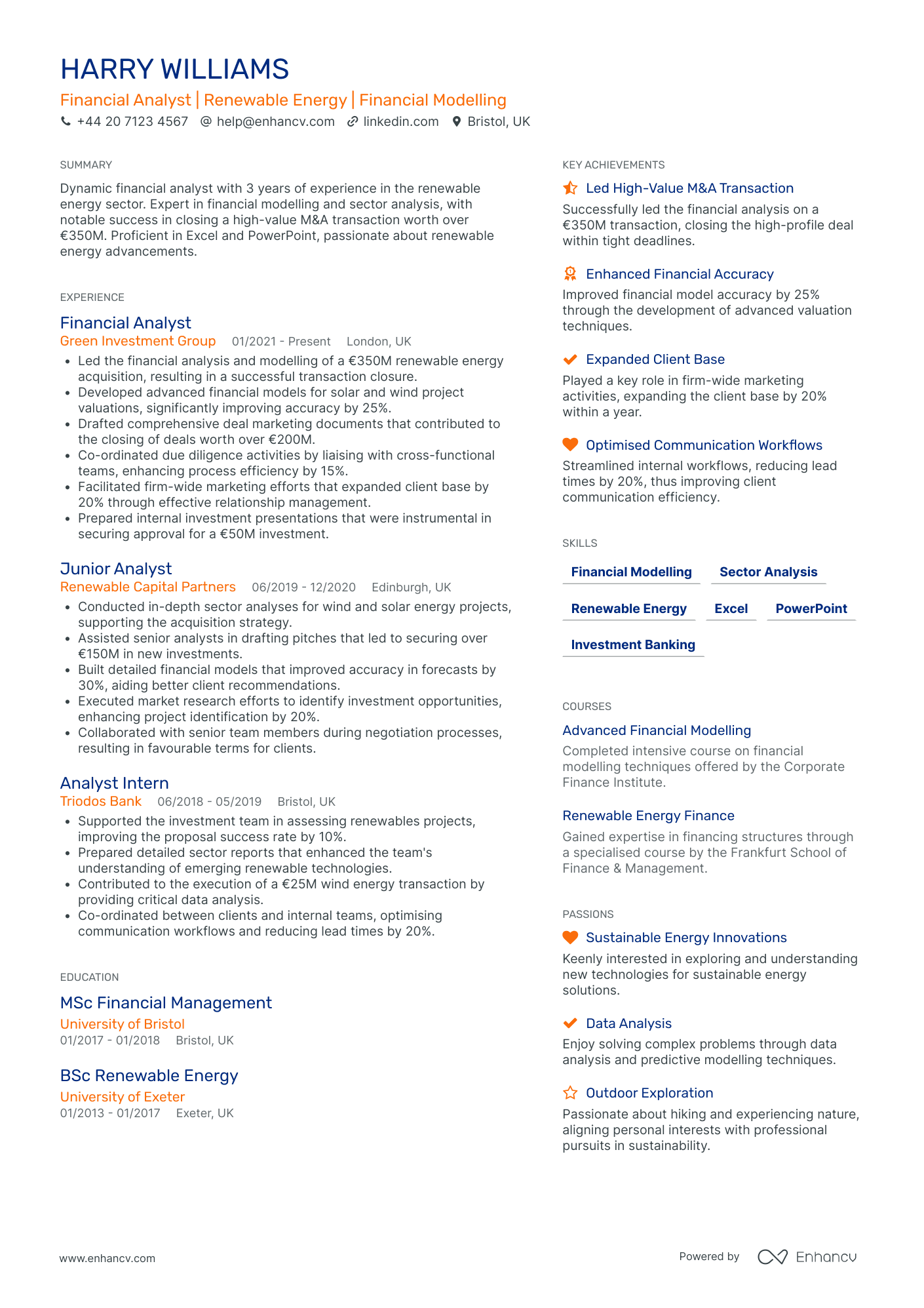
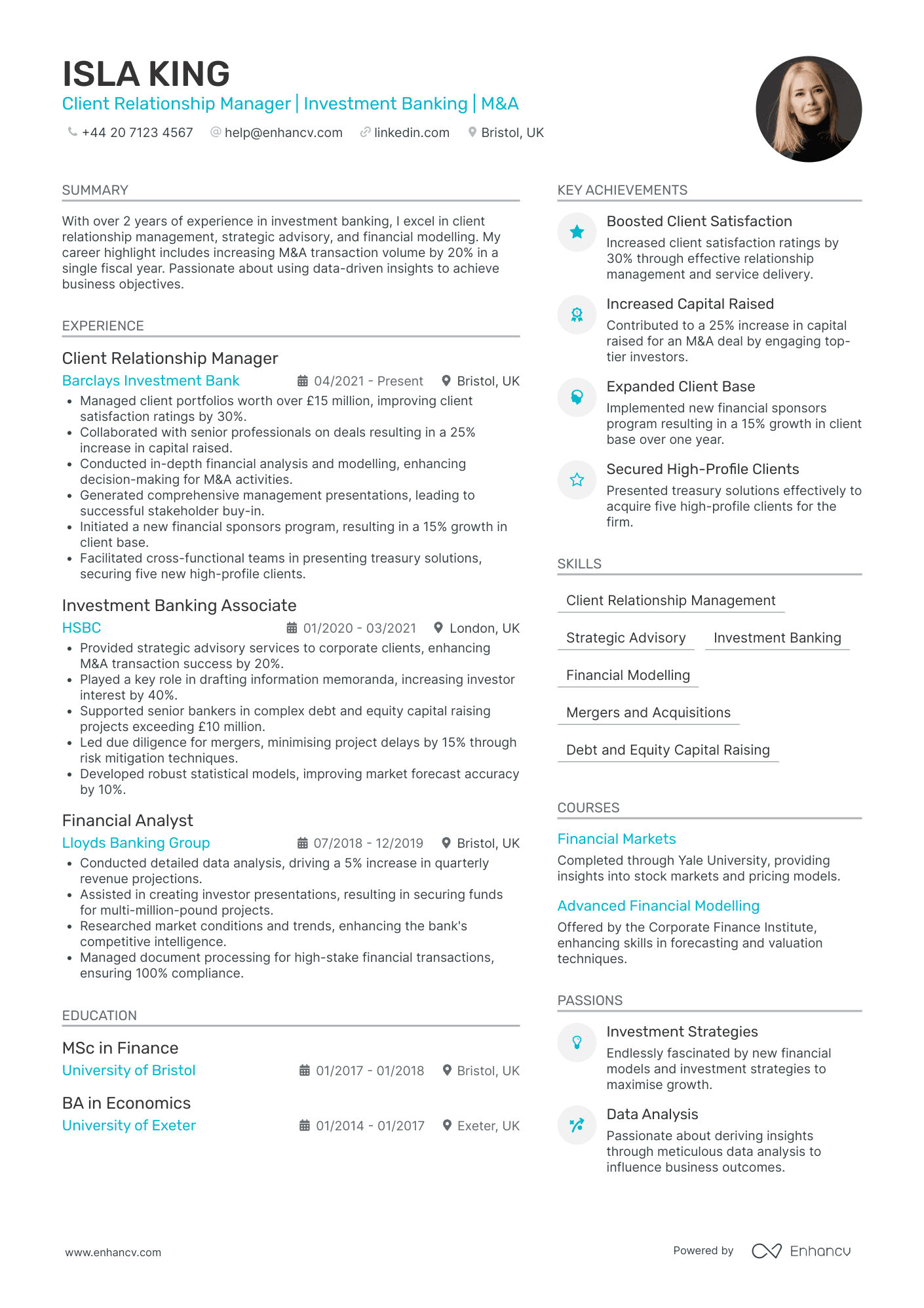
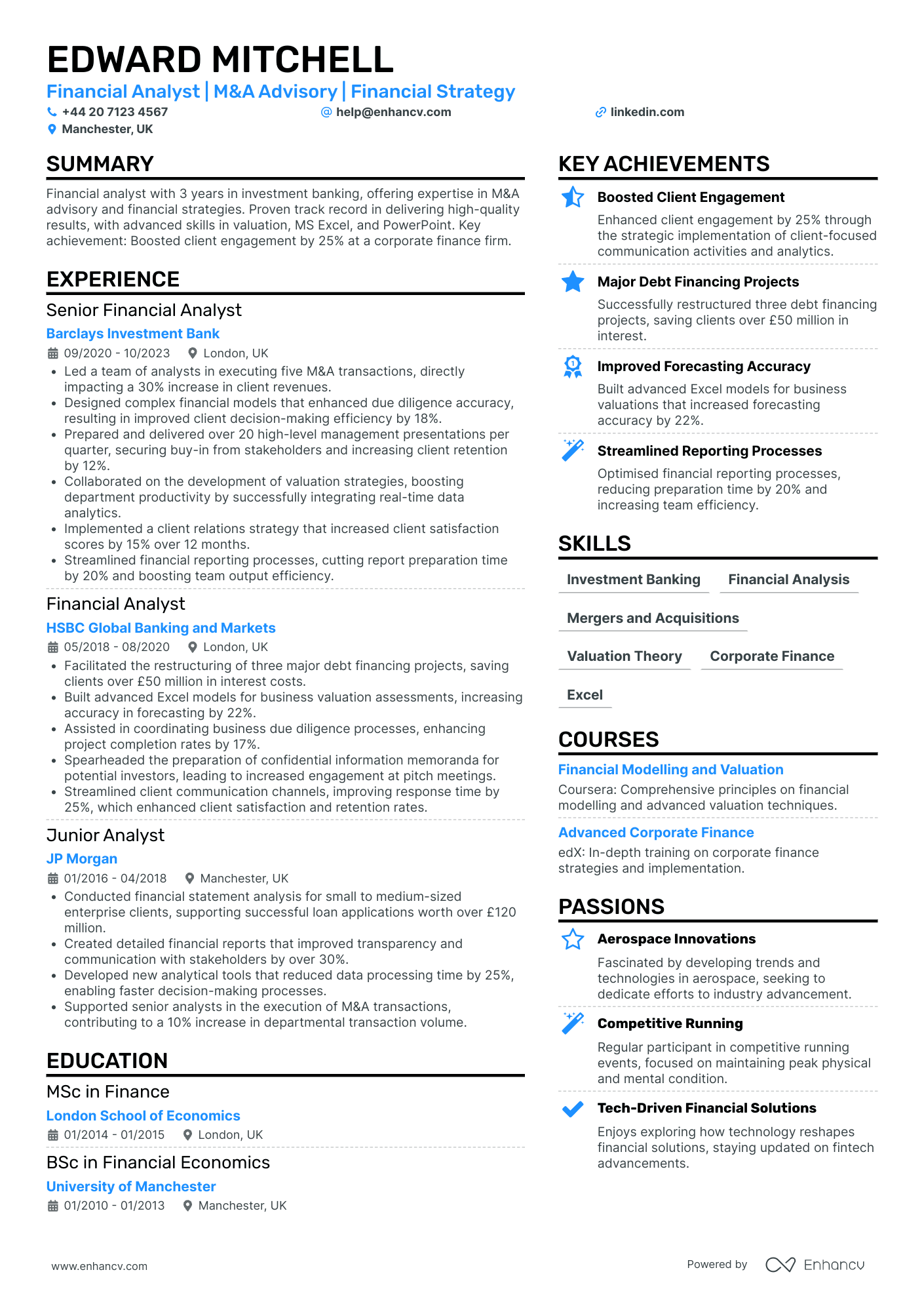
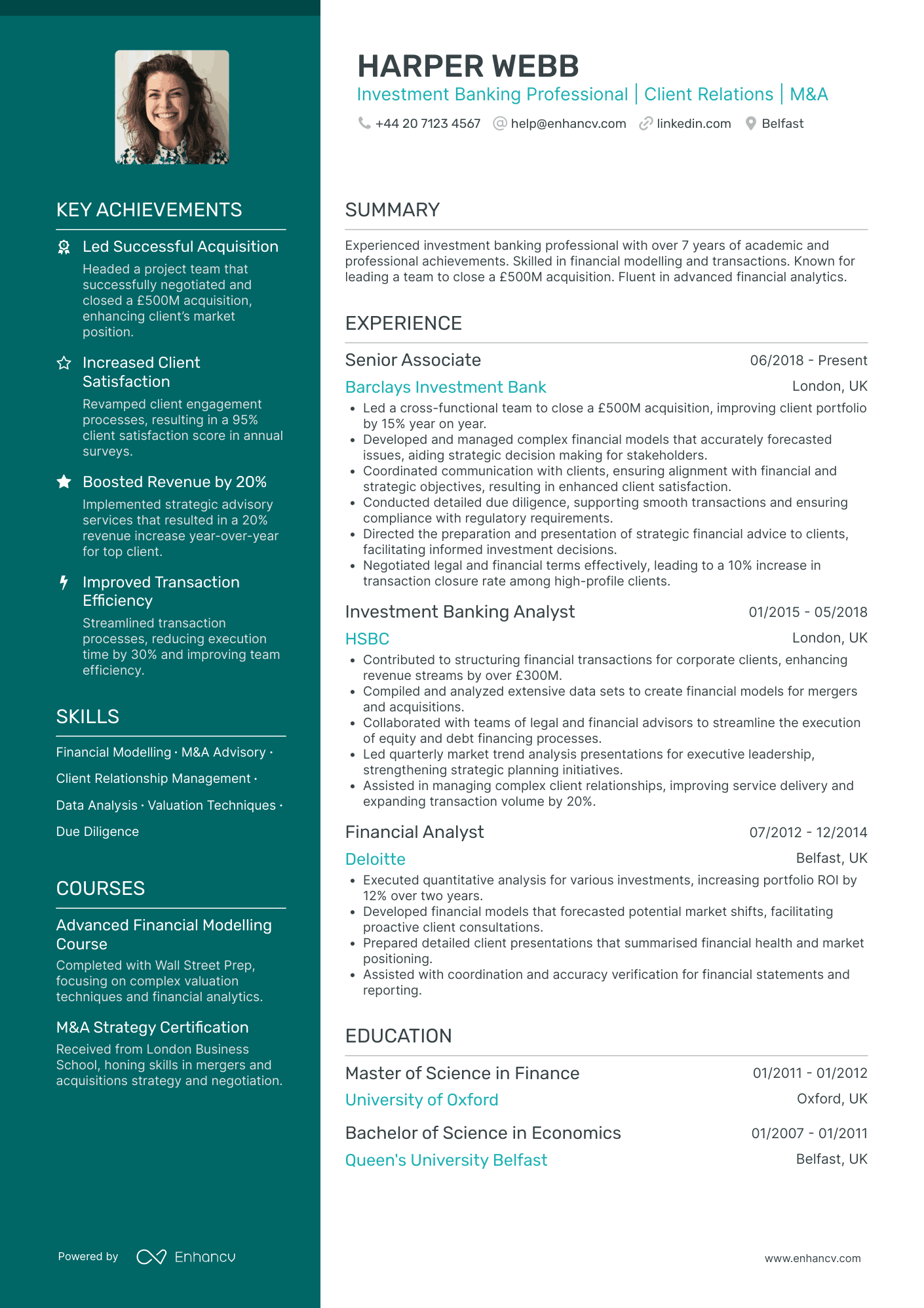
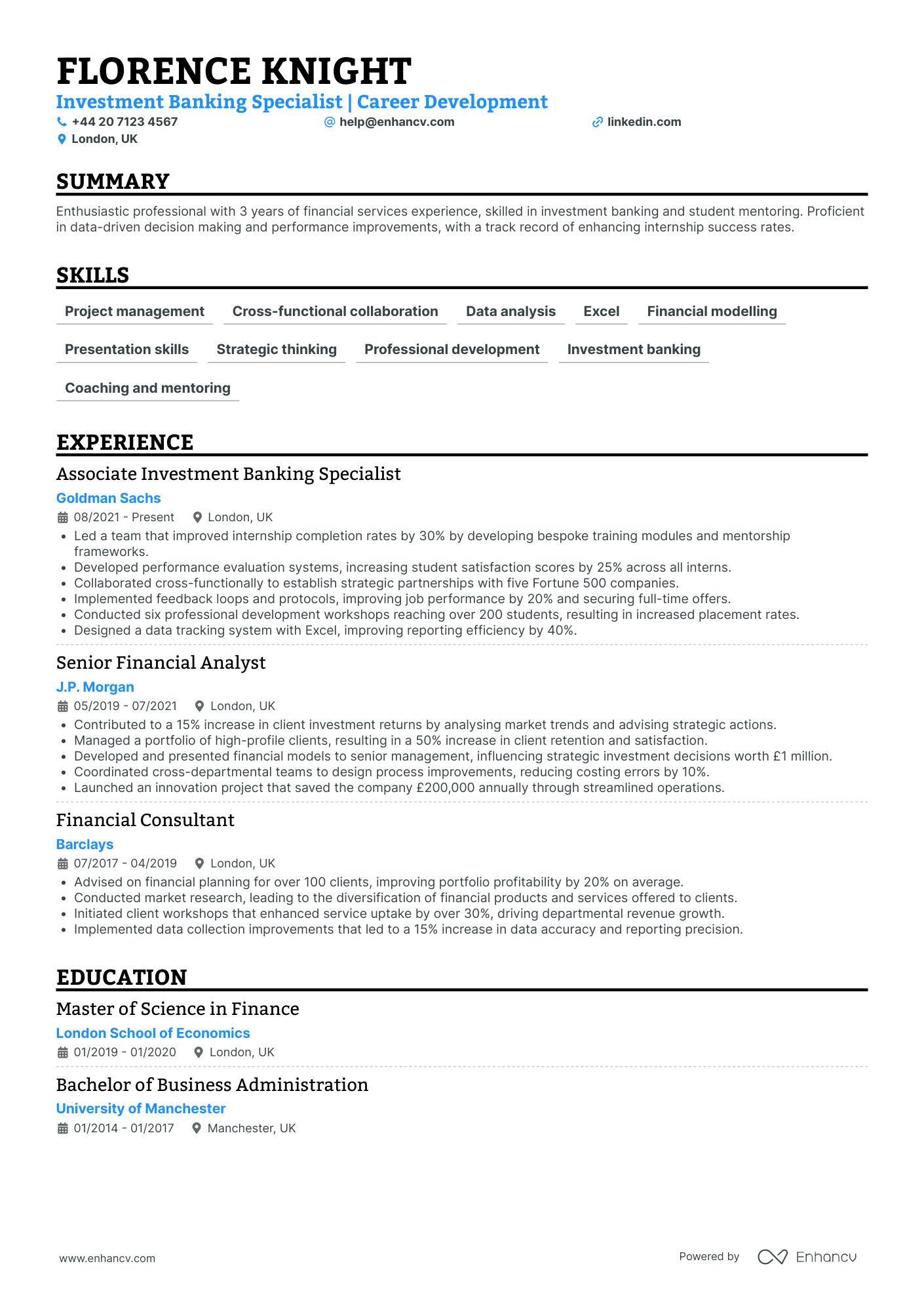
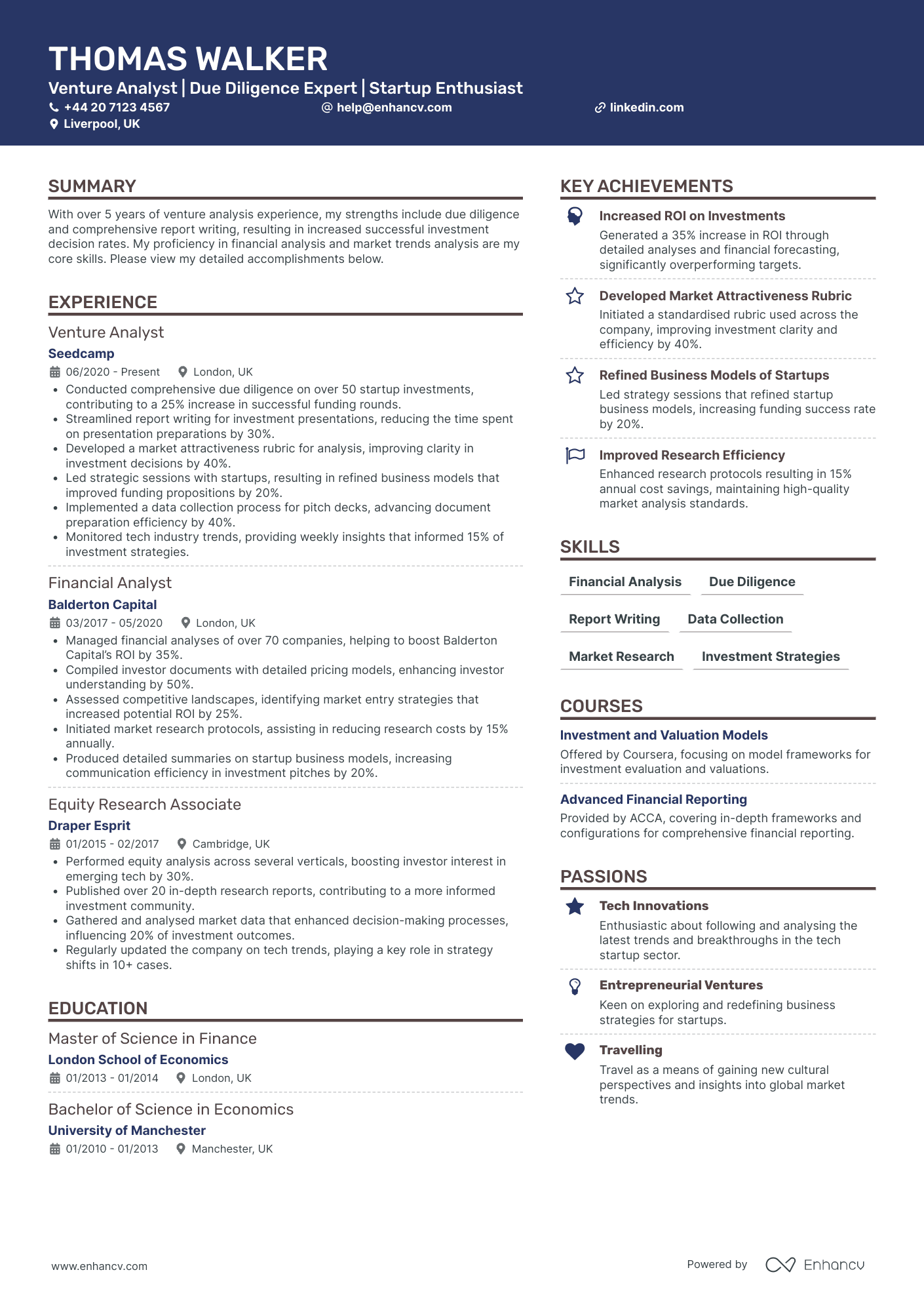
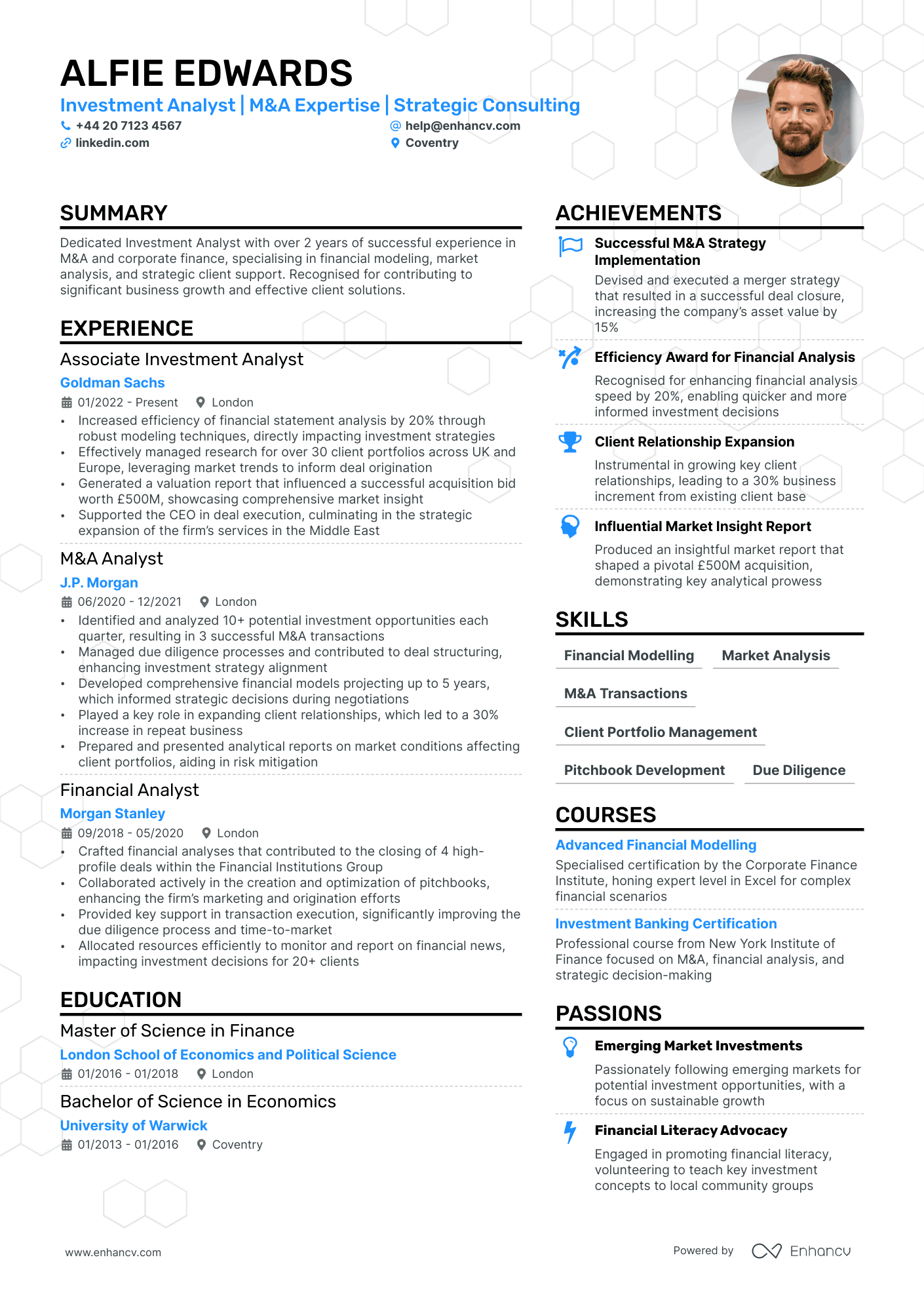
The two-page CV that works across most of the UK job market will get you cut from an investment bank. Analyst screens move fast, and the unwritten rule on the desk is one page, no exceptions.
An analyst CV earns its interview on two things: a clean, scannable format and a deal list a banker can read in fifteen seconds. Get those right and the rest of the page has room to breathe. If you want the fundamentals first, start with how to write a CV, then come back for the banking specifics.

Key takeaways
- One page, reverse chronological, sent as a PDF. Banking recruiters expect an analyst to fit everything onto a single page.
- Lead with deal experience. Name each transaction by type, sector, and size, and state exactly what you owned.
- Put a strong education line high on the page. Degree classification, university, and strong A-levels still count early in a banking career.
- List the technical stack recruiters scan for: financial modelling, valuation, Excel, and PowerPoint.
- Keep the personal statement to three or four lines, evidence first, with no adjective soup.
- Tailor every version to the bank and the group, whether that is M&A, ECM, DCM, or leveraged finance.
Formatting your investment banking analyst CV
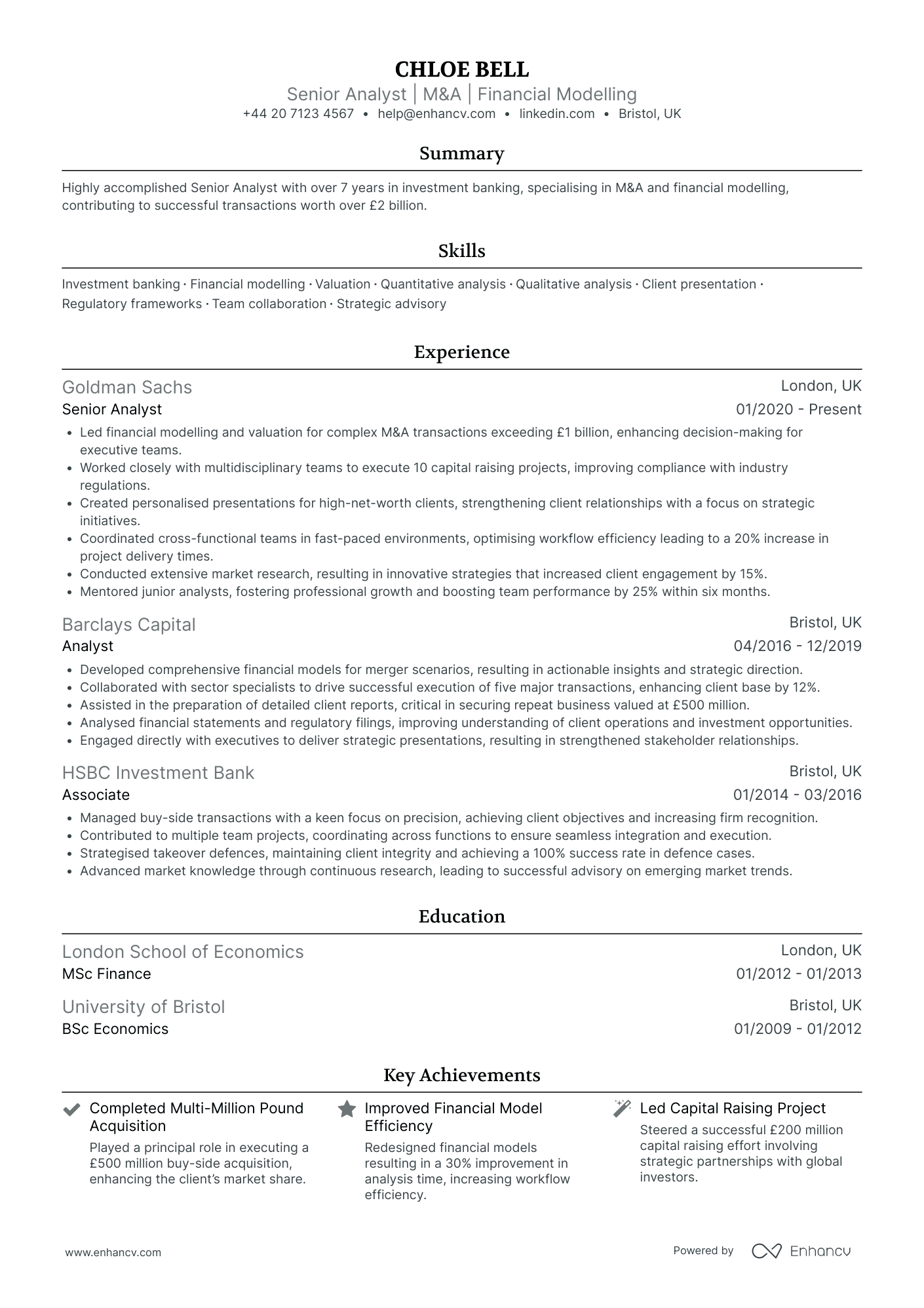
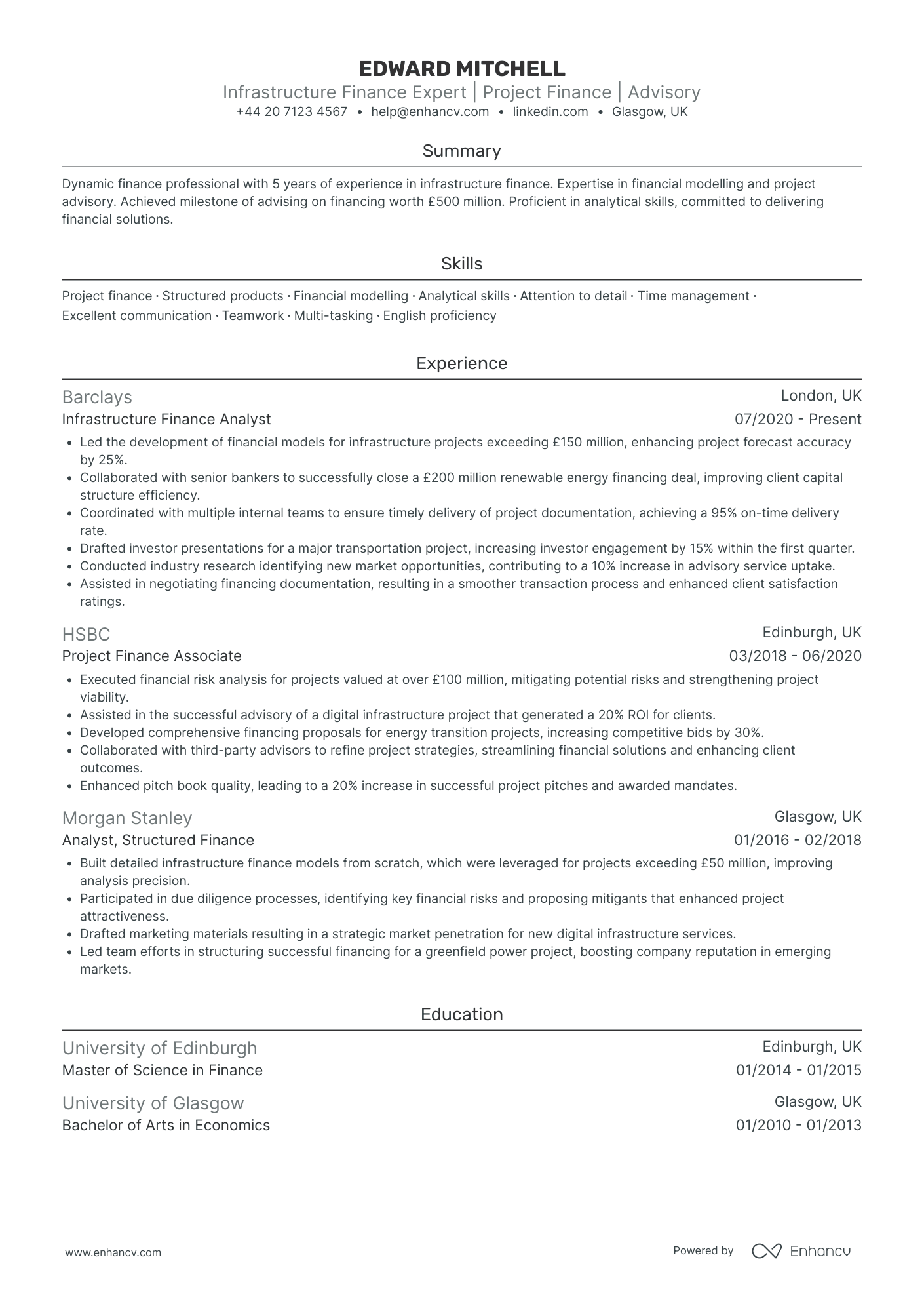
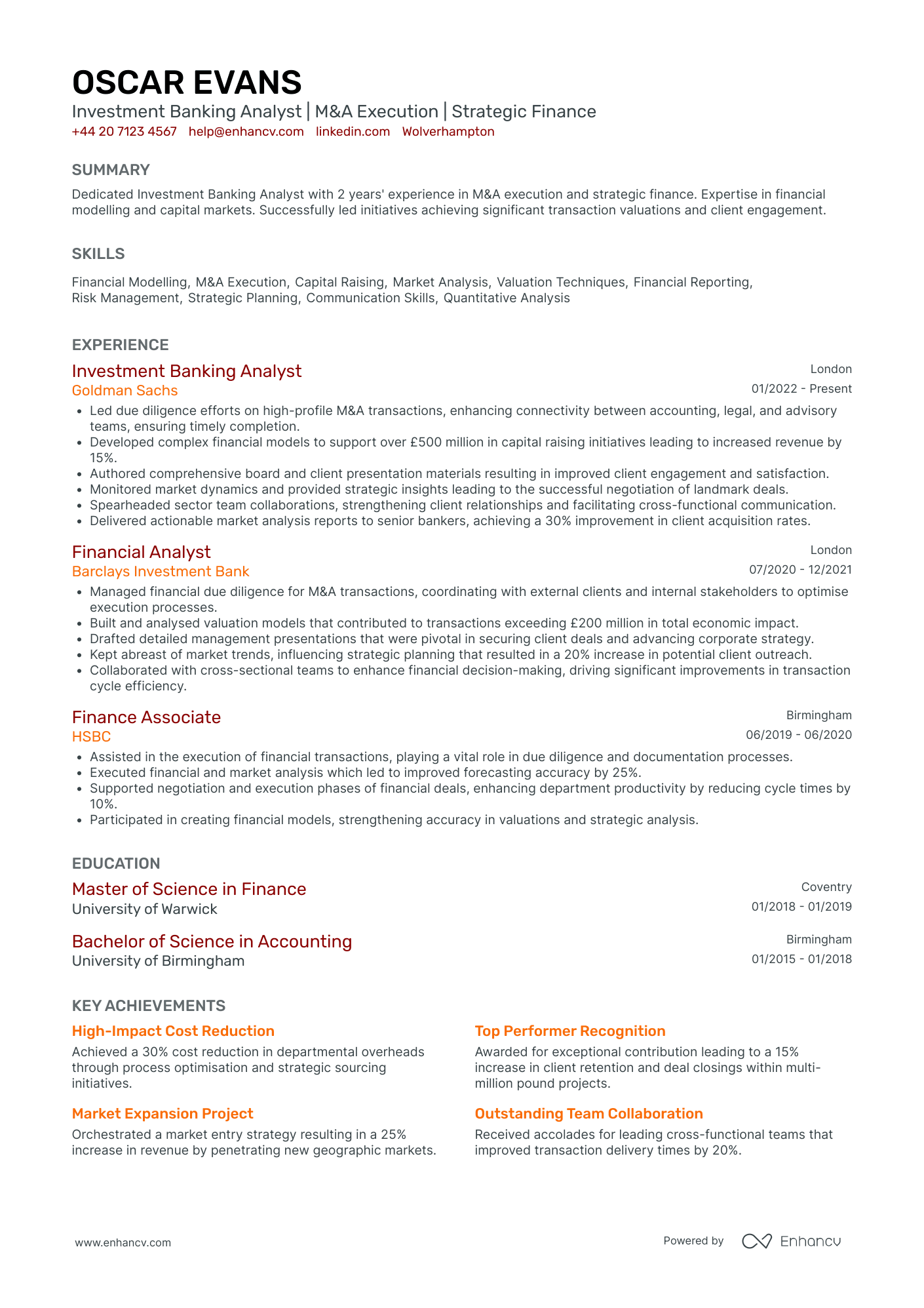
Start with the constraint that shapes everything else: one page. Recruiters at investment banks read hundreds of analyst CVs a cycle and spend seconds on each, so a second page reads as a candidate who cannot prioritise.
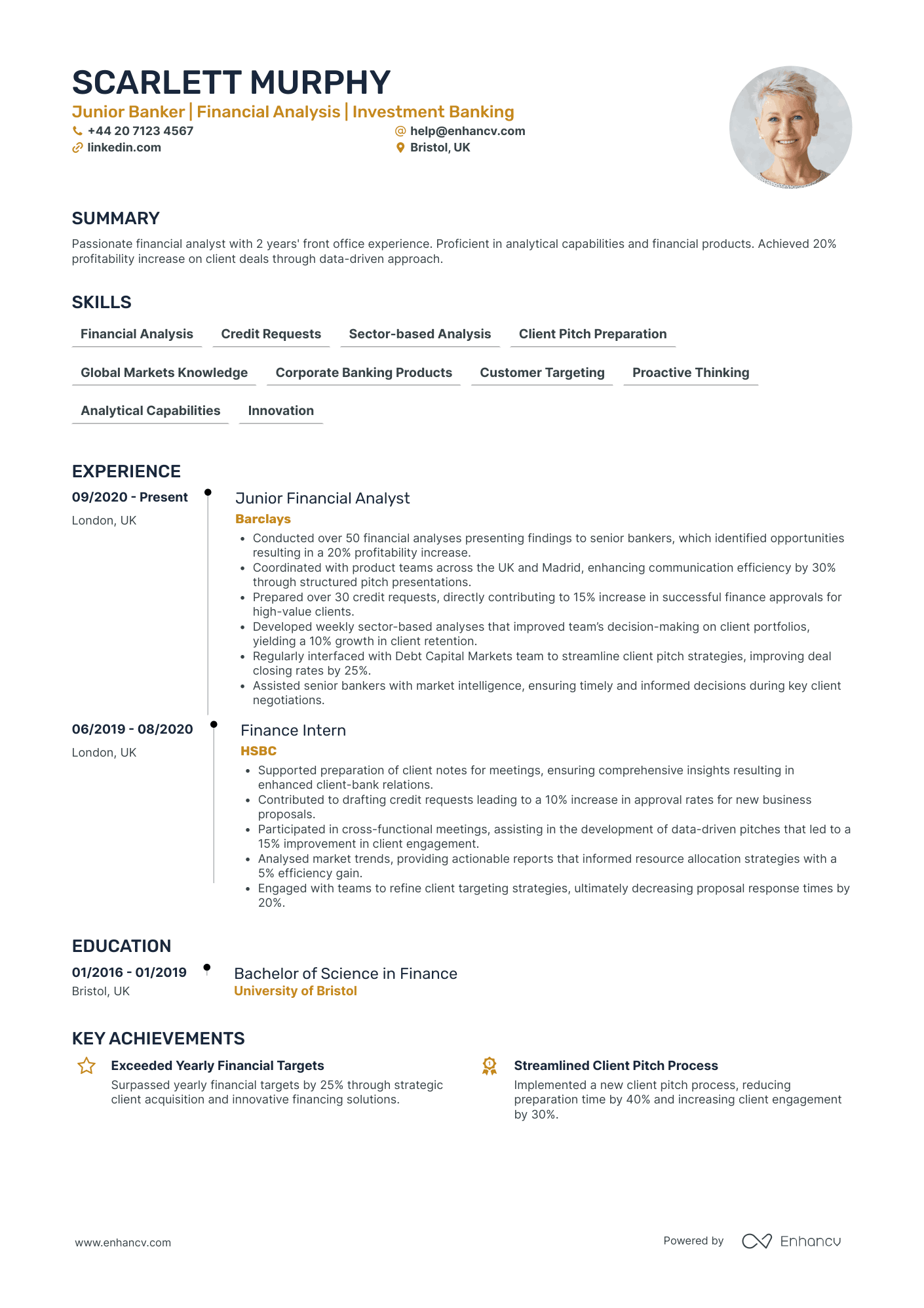
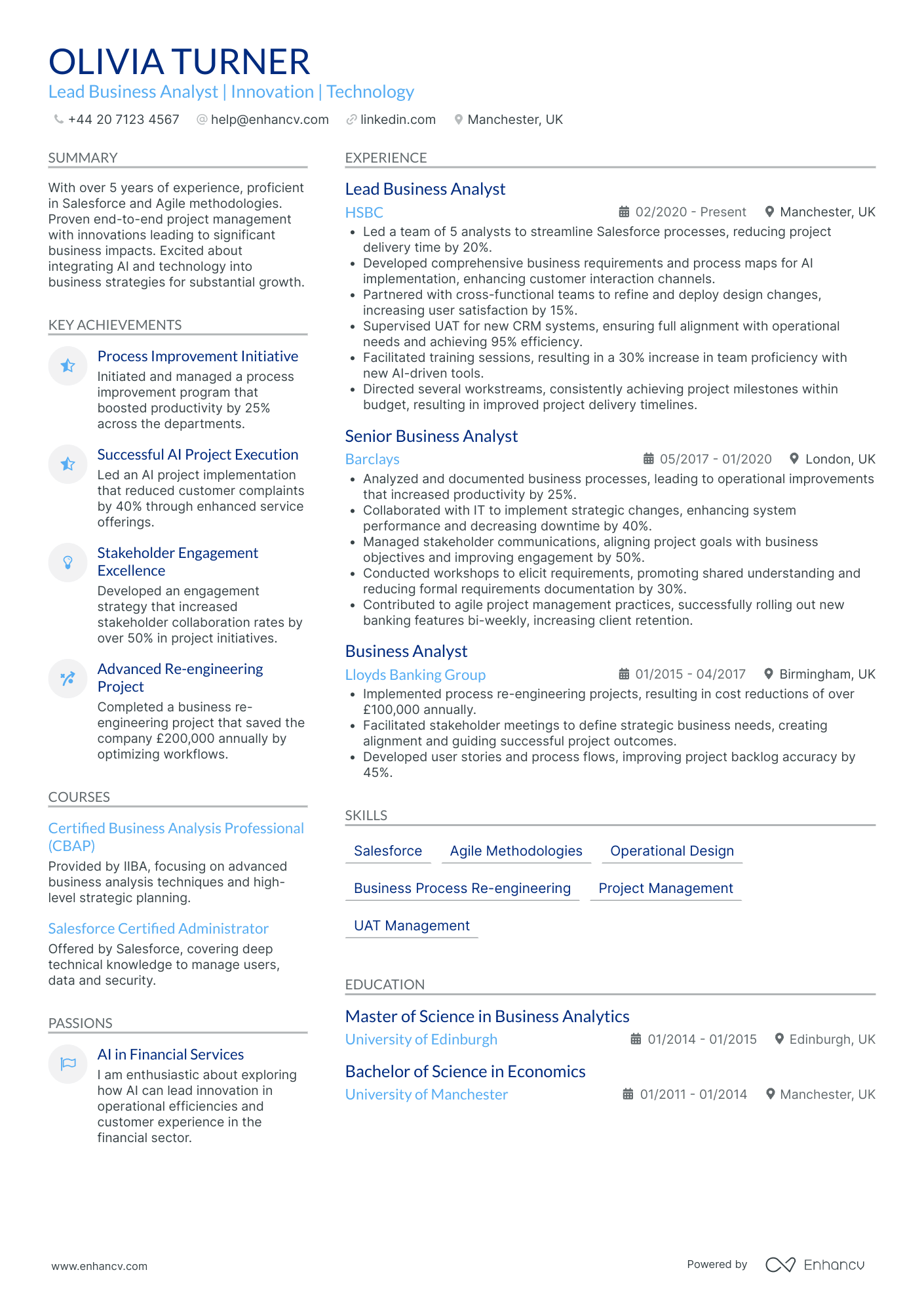
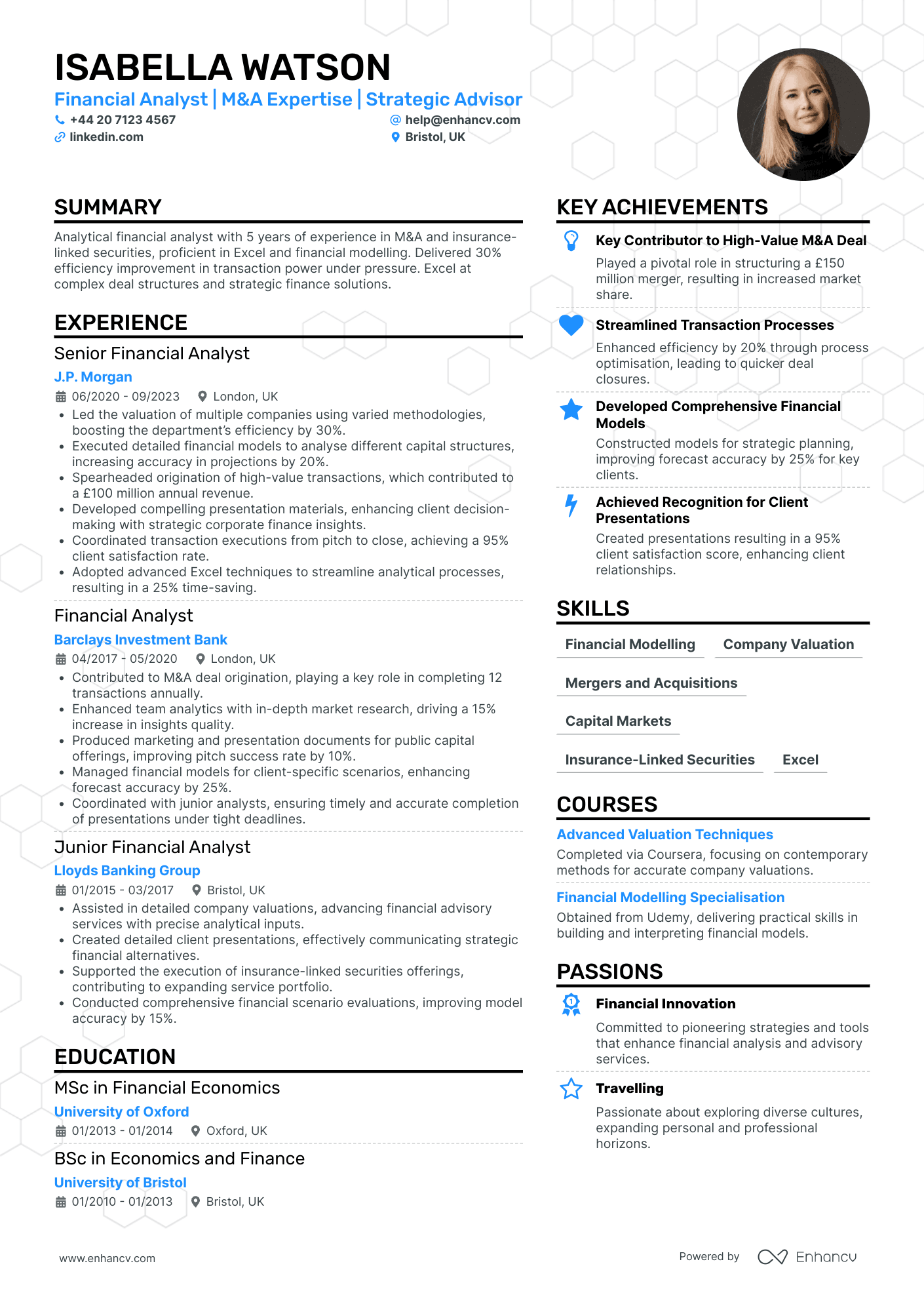
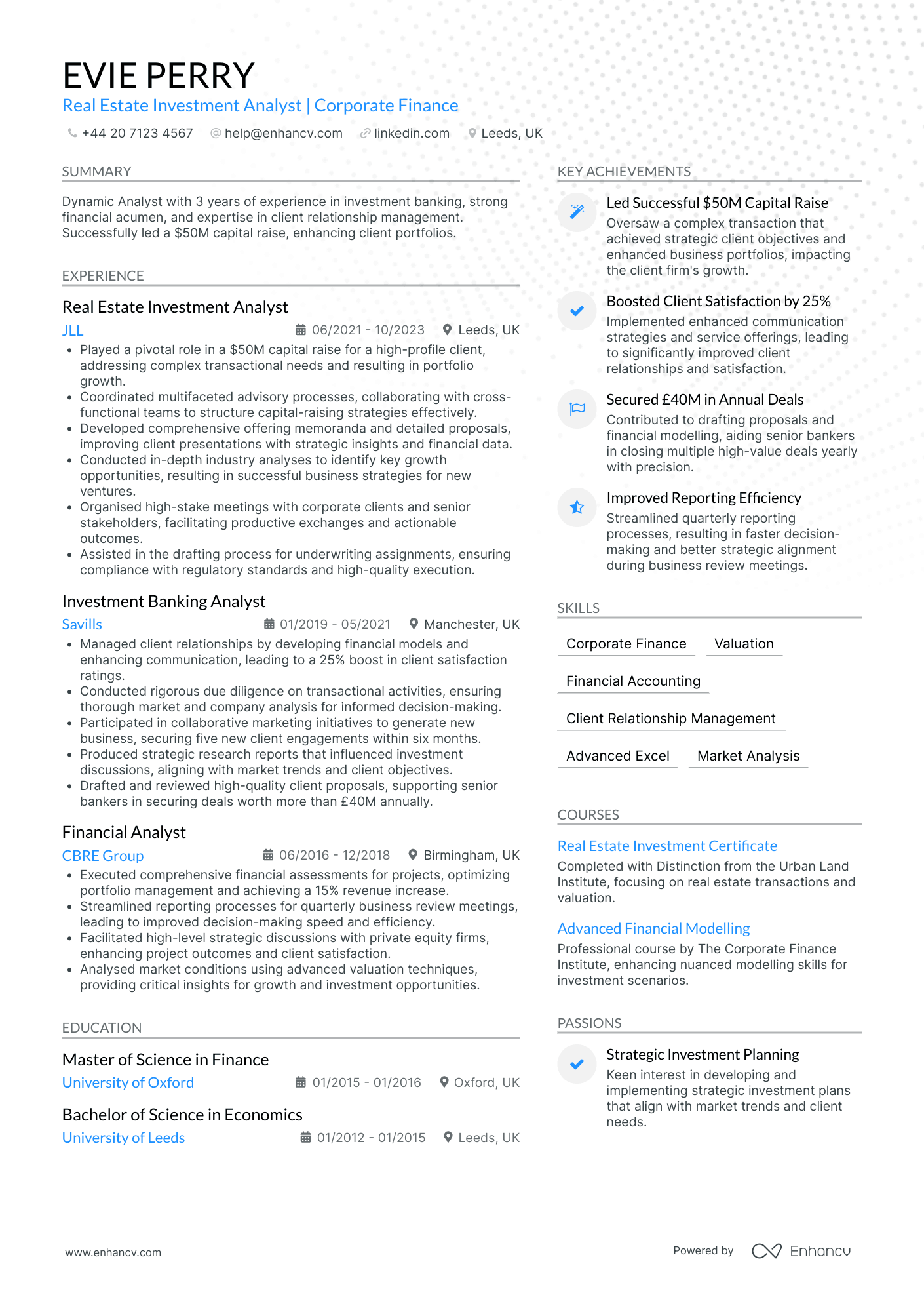
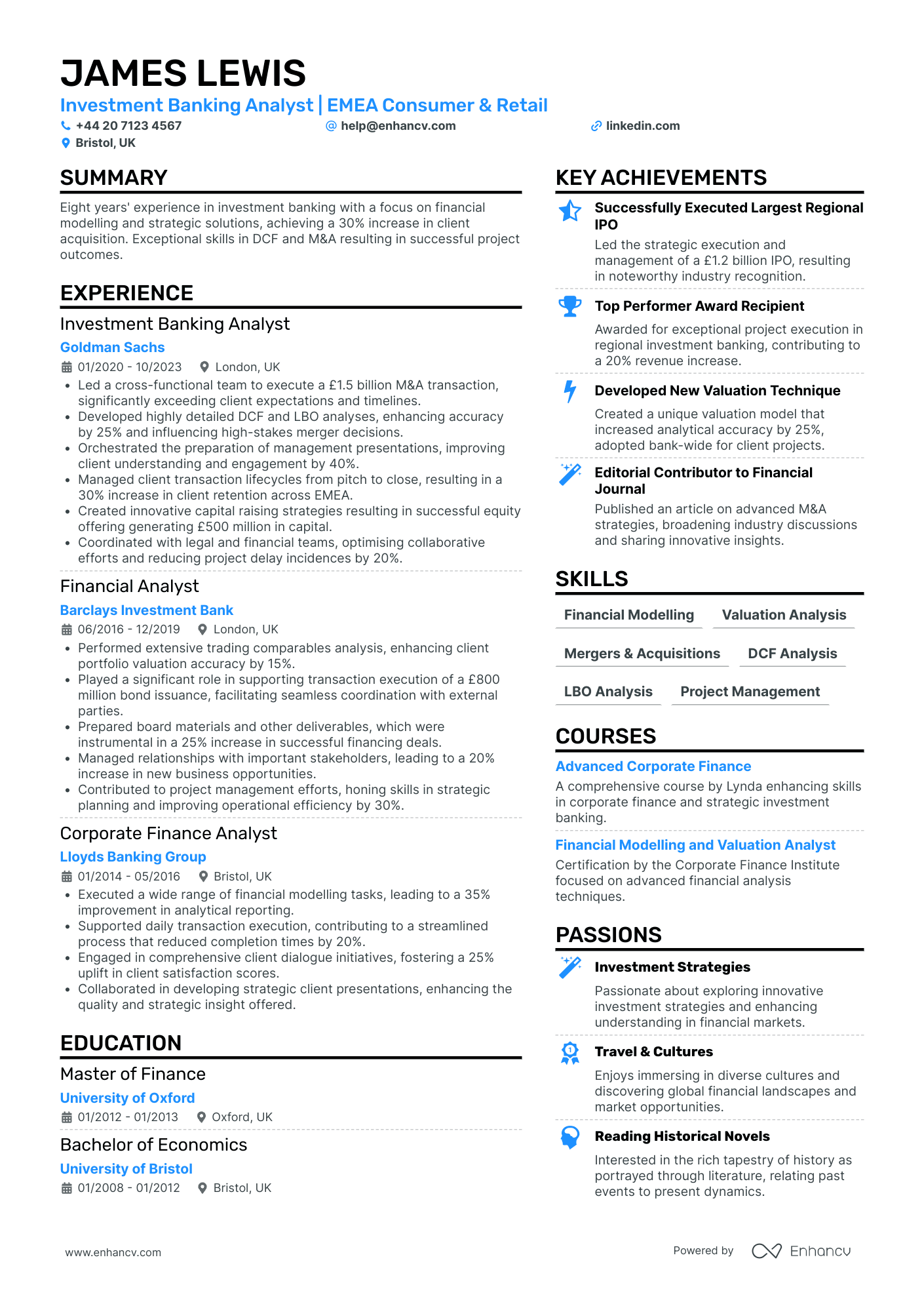
Use a reverse chronological CV, one column, standard headings, and a readable font. Save the design flourishes for another industry. Banking wants clean, dense, and easy to scan.
This is where investment banking breaks from standard UK advice. The two-page CV is normal for an experienced professional in most sectors, yet the desk treats brevity as a proxy for judgement. Fitting a strong candidate onto one page is the first test you pass.
| Element | What works on an investment banking analyst CV |
|---|---|
| Length | One page. Analysts are expected to fit their whole story onto a single page. |
| Format | Reverse chronological, one column, standard headings. |
| File type | PDF for direct applications so the layout holds. Keep a Word copy for agencies that reformat. |
| Order | Header, education, experience and deal list, technical skills, then a short extras line. |
| Font and margins | A clean serif or sans-serif at 10 to 11 point, margins around two centimetres, no graphics. |
| Deal detail | Every transaction named with type, sector, size, and your specific contribution. |
Two of those choices do the heavy lifting.
Keep the whole document to a single page and lead the layout with education, then experience and deals. For a junior analyst, a strong education line still carries weight, so it sits near the top rather than at the foot of the page.
Your header is your name, phone number, a professional email, and a LinkedIn URL. Skip the photo, the date of birth, and the full postal address. A city and a line on relocation is enough. On the details, a sensible CV font such as Calibri, Arial, or Georgia keeps a dense page readable.
Everything on the page competes for space, so cut ruthlessly. Older or unrelated jobs shrink to a single line, hobbies come off unless they are genuinely distinctive, and a references line is not needed. The one extras line worth keeping names languages, a spring week at a named bank, or a society you actually led.
Export as a PDF for direct applications so the spacing and alignment hold on any screen. Keep a Word copy for the recruitment agencies that place a large share of banking roles and reformat CVs into their own template. If the advert names a file type, follow it.
Banking applications almost always pass through tracking software before a human sees them, so keep the layout clean and the headings standard for an ATS-friendly CV. Build it from a tested layout rather than a blank page, and keep the one-page discipline that CV length guidance for banking demands. Enhancv's CV templates export to a clean, one-page PDF that parses correctly.
Structuring your deal experience
Deal experience is what separates one analyst CV from the next, and it is the section a banker reads first.
Give live and closed transactions their own block, whether that sits inside the relevant job entry or in a short standalone deal list. For each deal, name four things: the transaction type, the sector, the size, and what you personally owned.
'Supported various M&A processes' is invisible. 'Built the operating model for a £480m cross-border food sale' is a hire. The specifics are the whole point.
Investment banking analyst deal experience example
Analyst, Consumer & Retail M&A, London (2023 to present)
- Built the operating model and three-statement forecast used in management presentations for the £480m cross-border sale of a UK food manufacturer.
- Ran comparable company and precedent transaction analysis across 14 European targets for a live buy-side mandate.
- Drafted sections of the information memorandum and managed the data room for a mid-market private equity exit.
Lead each line with an action verb and quantify the achievement wherever you can: deal size, number of comparables screened, pages of the information memorandum you drafted, hours saved by a model you rebuilt. The action verbs that land here show ownership, like built, ran, drafted, and coordinated.
Three to five deals is plenty. A recruiter wants depth on the ones you know cold, not a scroll of tombstones you barely touched. If your transactions sit across two employers, an embedded list under each role reads more naturally than a separate block, and a standalone deal list works best when one internship or desk holds almost all of your exposure.
Order the list by relevance to the role, not strictly by date. If you are targeting a healthcare M&A team, the healthcare deal goes first even if it is not the most recent one you worked on.
Respect confidentiality. If a deal has not been announced, describe it generically, for example 'a £300m acquisition of a UK logistics business', rather than naming the parties. Bankers reading your CV understand exactly why, and breaking an NDA on a CV ends interviews before they start.

PRO TIP
Investment banks screen by group, and an M&A CV is not the same document as a DCM one. Name the product area you want, whether that is M&A, ECM, DCM, leveraged finance, or restructuring, and mirror the language of that desk rather than generic 'finance' phrasing.
Writing your investment banking analyst experience section
Outside the deal list, your work experience proves you can carry an analyst's workload: modelling, materials, and process management under real deadlines.
Write each role as a dated heading followed by bullets that pair an action with an outcome. Internships count, and for many junior analysts the summer analyst programme is the strongest entry on the page.
Show the outcome, not the task. 'Formatted slides' is a duty. 'Turned a partner's rough logic into a 40-page pitch book delivered overnight' is an analyst who can be trusted with a client deadline. Every bullet should answer the question a banker is silently asking, which is what this actually changed.
Non-finance work still earns its place when you frame it in the language of the desk. A retail or hospitality job becomes evidence of composure under pressure and long hours. A dissertation or a student investment fund becomes evidence of research and valuation. Strip the generic duties and keep the parts an analyst needs.
- Built and maintained LBO, DCF, and trading comparable models for eight live M&A and financing mandates across UK and European industrials
- Prepared pitch books and client presentations that supported £1.5bn of announced deal value in 2024
- Coordinated due diligence and data room management for a £320m carve-out, liaising with legal, accounting, and management teams
- Trained two summer interns on the modelling standards and formatting conventions used across the group
Tailor every application to the bank and the group. Pull the language from the job ad and mirror it where it is true of you, whether that is keywords like leveraged finance and sector coverage or specific modelling techniques. Enhancv's CV tailoring feature reads the ad and suggests the matching edits, which saves rewriting each version from scratch. If you would rather work through it by hand, this guide on how to tailor your CV covers the steps.
Writing your investment banking analyst personal statement
Three or four lines at the top: who you are, the transactions and technical skills you bring, your degree, and the desk you want. Keep it concrete. For more openers, see these personal statement examples.
Lead with evidence, not adjectives. A banker can verify a deal count and a degree classification. Nobody can verify 'hard-working and passionate'.
Stay consistent in first or third person, and never open with 'I am a'. Front-load the strongest fact you have, whether that is a deal count, a marquee client, or a first-class degree from a target course.
Investment banking analyst personal statement example
Investment banking analyst with two years in consumer and retail M&A, having supported six announced transactions worth a combined £2.1bn. Strong financial modelling and valuation skills, with a record of building models that reach management and client committees. First-class economics degree from LSE. Looking to move to a bulge-bracket M&A team covering larger cross-border mandates.
Compare that with the version most applicants send:
Weak personal statement to avoid
Hard-working and passionate finance professional seeking a challenging investment banking role in a dynamic, fast-paced environment where I can utilise my skills and grow. A strong team player with excellent communication skills and a proven work ethic.
The weak version could belong to anyone applying for any job. The strong one could only belong to an analyst who has done the work. If you are early and short on deals, name the group you want and the technical skills you hold, and let the education line carry more of the weight.
When we look at an analyst CV, the deal list is the first thing we read. Not the personal statement, not the skills box, the deals. Name the transaction type, the sector, the size, and exactly what you owned, whether that was the model, the comps, or the data room. 'Supported live M&A processes' tells us nothing. 'Built the operating model for a £480m cross-border sale' tells us you can do the job. One specific deal beats a paragraph of adjectives.
The Enhancv team
Skills for an investment banking analyst CV
The technical stack recruiters look for is narrow and specific. Financial modelling, valuation across DCF, LBO, and comparable methods, and fluent Excel and PowerPoint are the baseline, listed as hard skills in the words the desk uses.
Company and industry analysis, data analysis, and support on capital raises and client coverage round out the list. Put your strongest technical skills near the top of the page where a recruiter scanning for a modelling background will find them, and keep your skills section tight.
Modelling is the skill every screen tests, so make it visible beyond the skills box. A bullet that reads 'rebuilt a three-statement model that cut the monthly update from a day to an hour' proves it in a way a one-word entry never will. Name the tools you use daily, from Excel and PowerPoint to Capital IQ, FactSet, or Bloomberg, only where you can back them.
The soft skills that matter here are the ones the hours demand: attention to detail, composure under pressure, and clear communication with senior bankers and clients. Prove each in a bullet rather than listing it as a claim.
Top skills for your investment banking analyst CV:
Financial modelling
Valuation (DCF, LBO, comparables)
Excel
PowerPoint
Company and industry analysis
Data analysis
Deal execution support
Pitch and CIM preparation
Attention to detail
Composure under pressure
Communication
Teamwork
Time management
Education and certifications for an investment banking analyst CV
Banking still weighs education heavily, especially early in a career. List your degree classification, university, and course, and keep strong A-level or equivalent results if you are within a few years of graduating.
Add the qualifications that signal technical intent: a CFA level passed or in progress, an ACA or ACCA if you have moved across from audit, and any financial modelling or valuation courses. Naming a certificate in progress shows the trajectory recruiters want.
If you did not attend a target university, do not hide it. Let a strong classification, a relevant modelling course, and real deal exposure carry the page. Recruiters increasingly read the whole CV, and a non-target candidate with two named transactions outranks a target candidate with none.
Keep this section short. On a one-page CV, education earns its place through classification and institution, not a list of modules.
Conclusion
Keep it to one page, lead with a deal list a banker can scan in seconds, and back every line with a number or a named transaction.
Pair the CV with a short cover letter that names the bank and the group, and you turn a strong page into an interview.

Author's take - The Enhancv team
When we look at an analyst CV, the deal list is the first thing we read. Not the personal statement, not the skills box, the deals. Name the transaction type, the sector, the size, and exactly what you owned, whether that was the model, the comps, or the data room. 'Supported live M&A processes' tells us nothing. 'Built the operating model for a £480m cross-border sale' tells us you can do the job. One specific deal beats a paragraph of adjectives.