



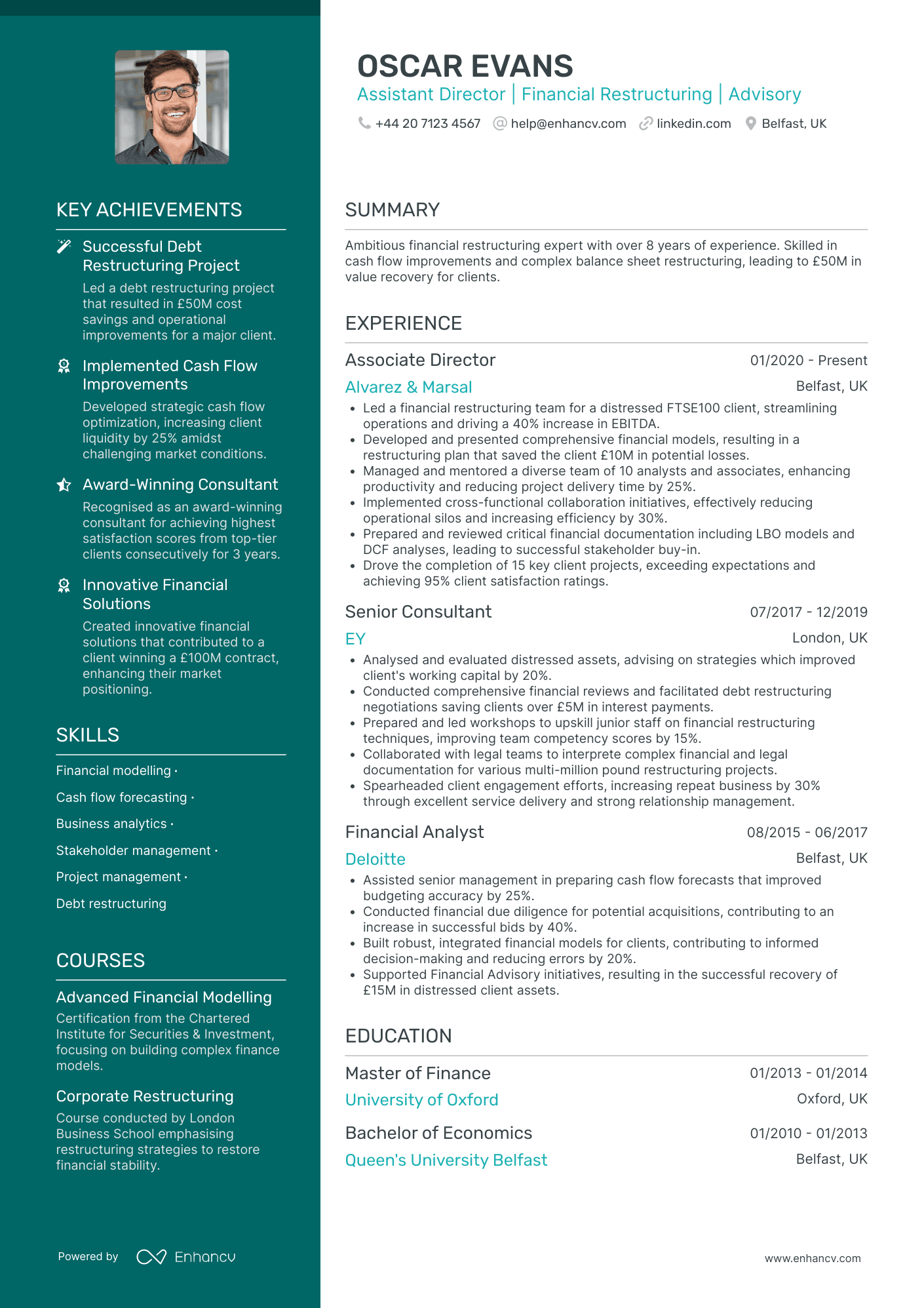
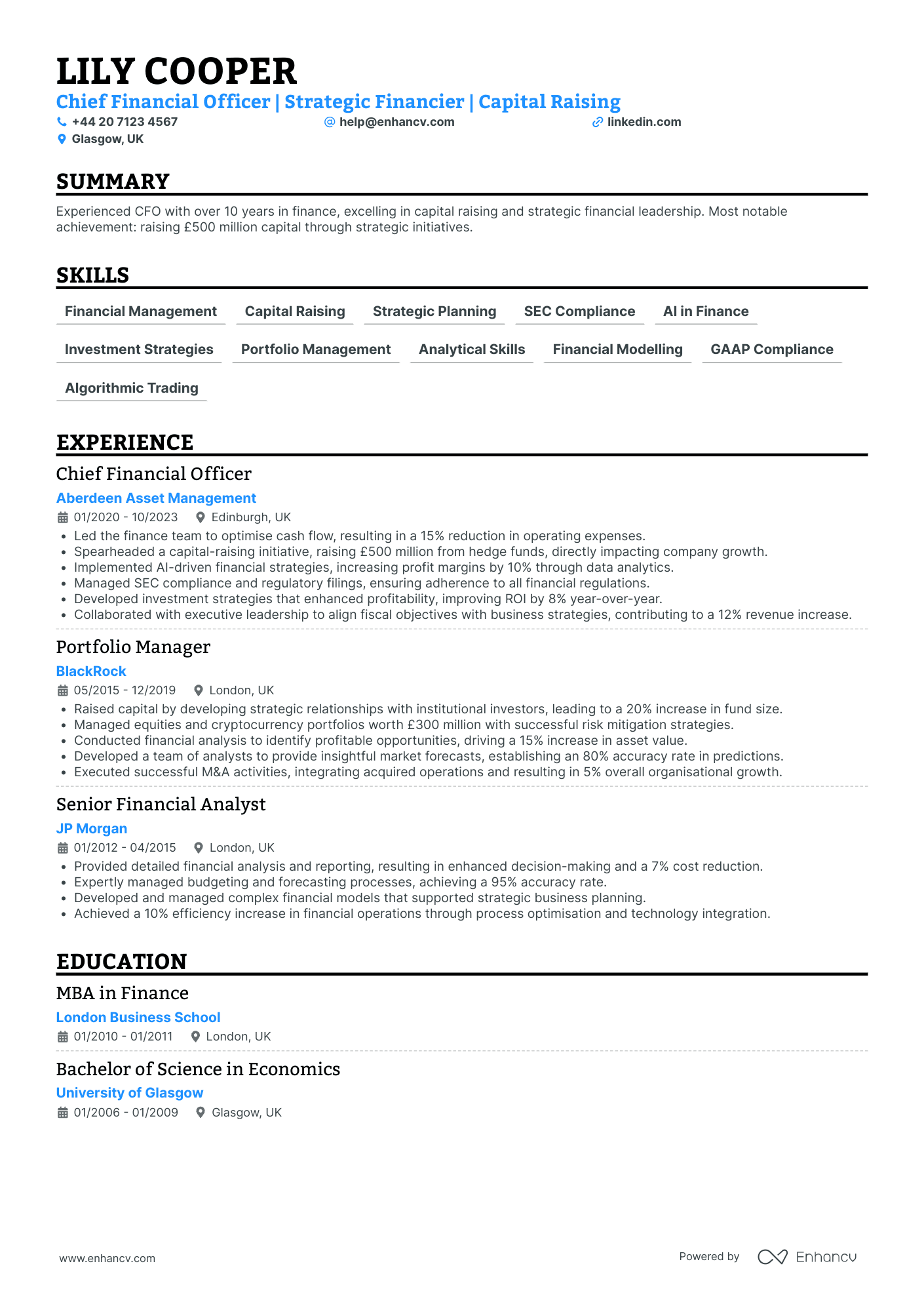
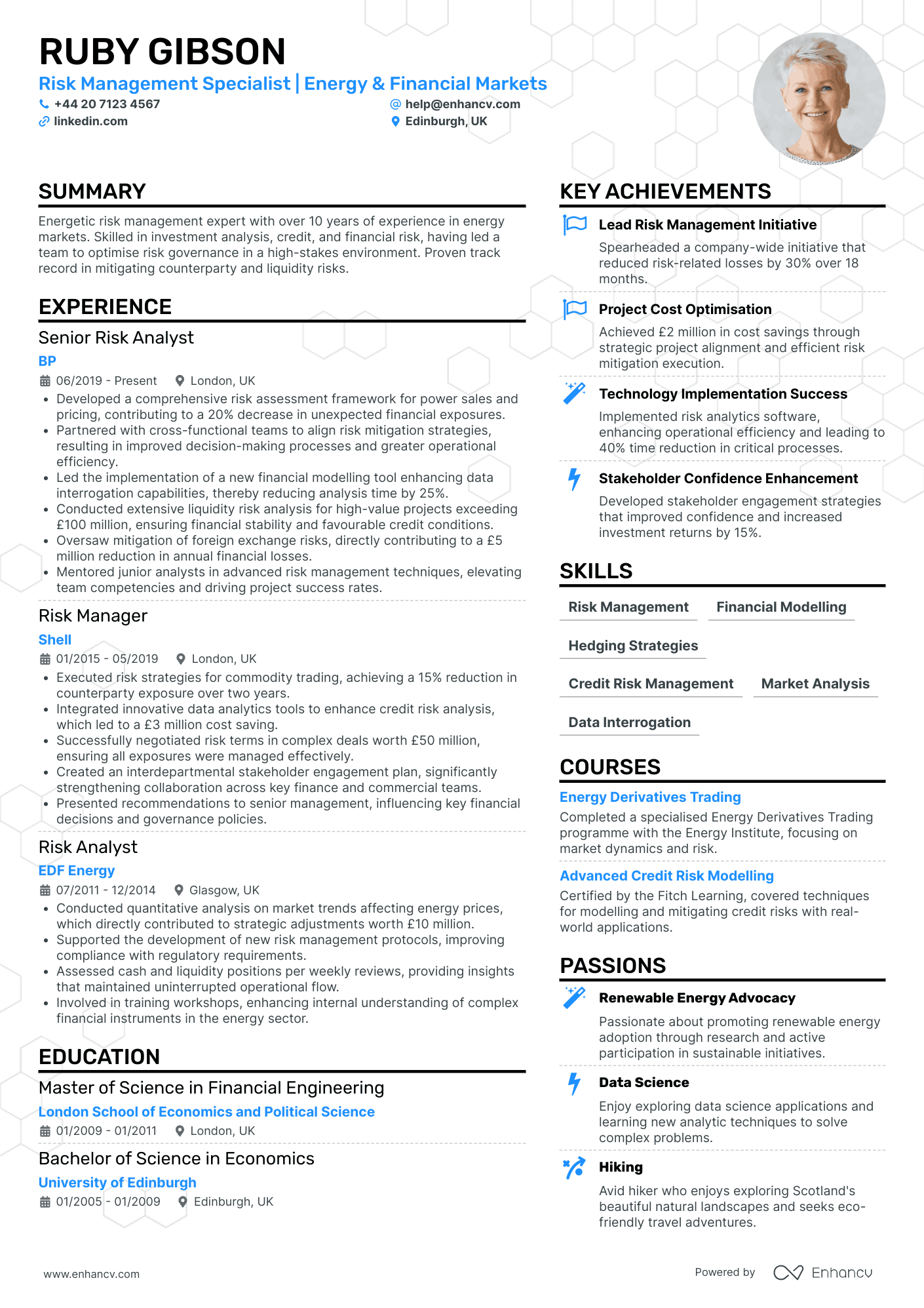
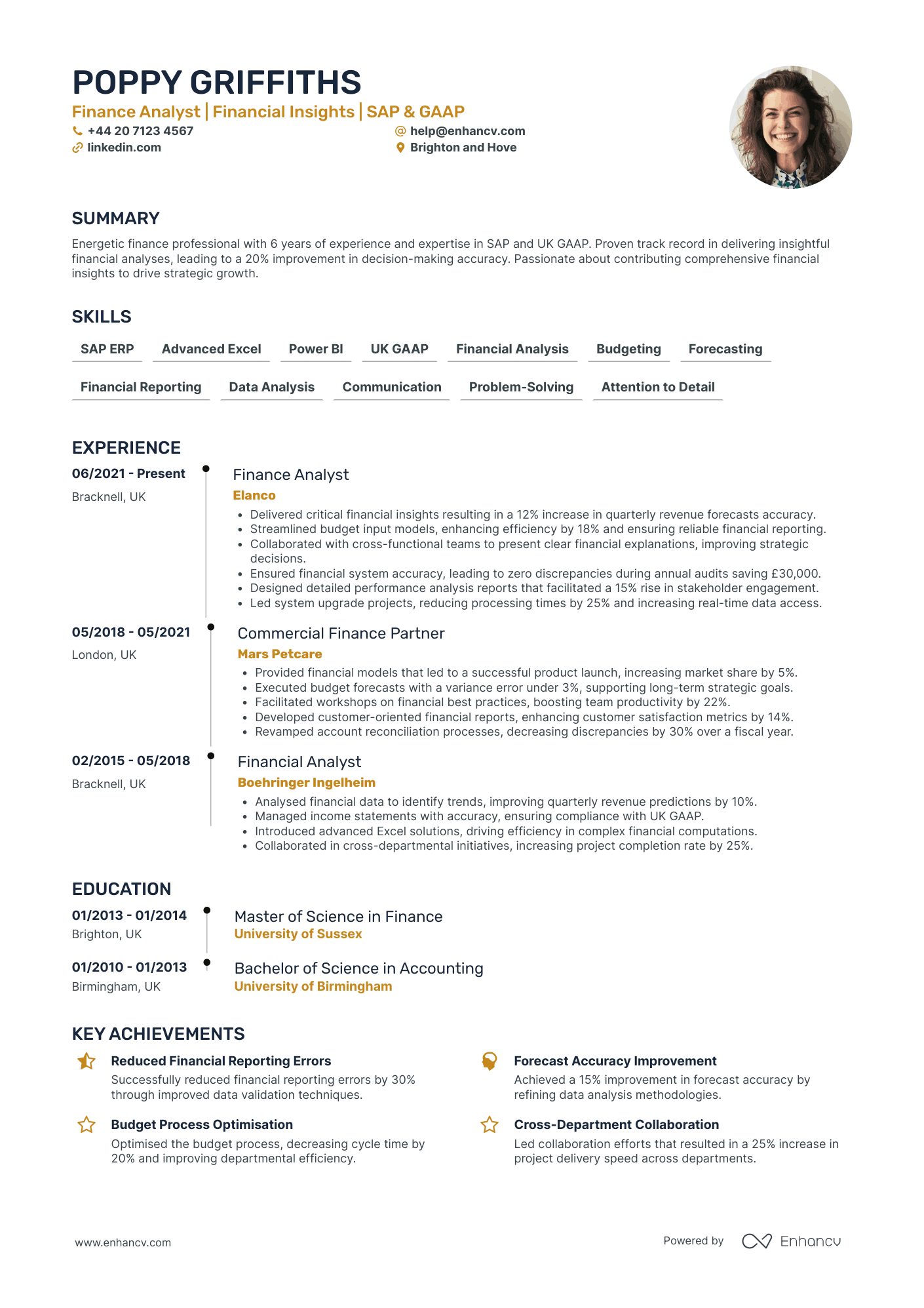
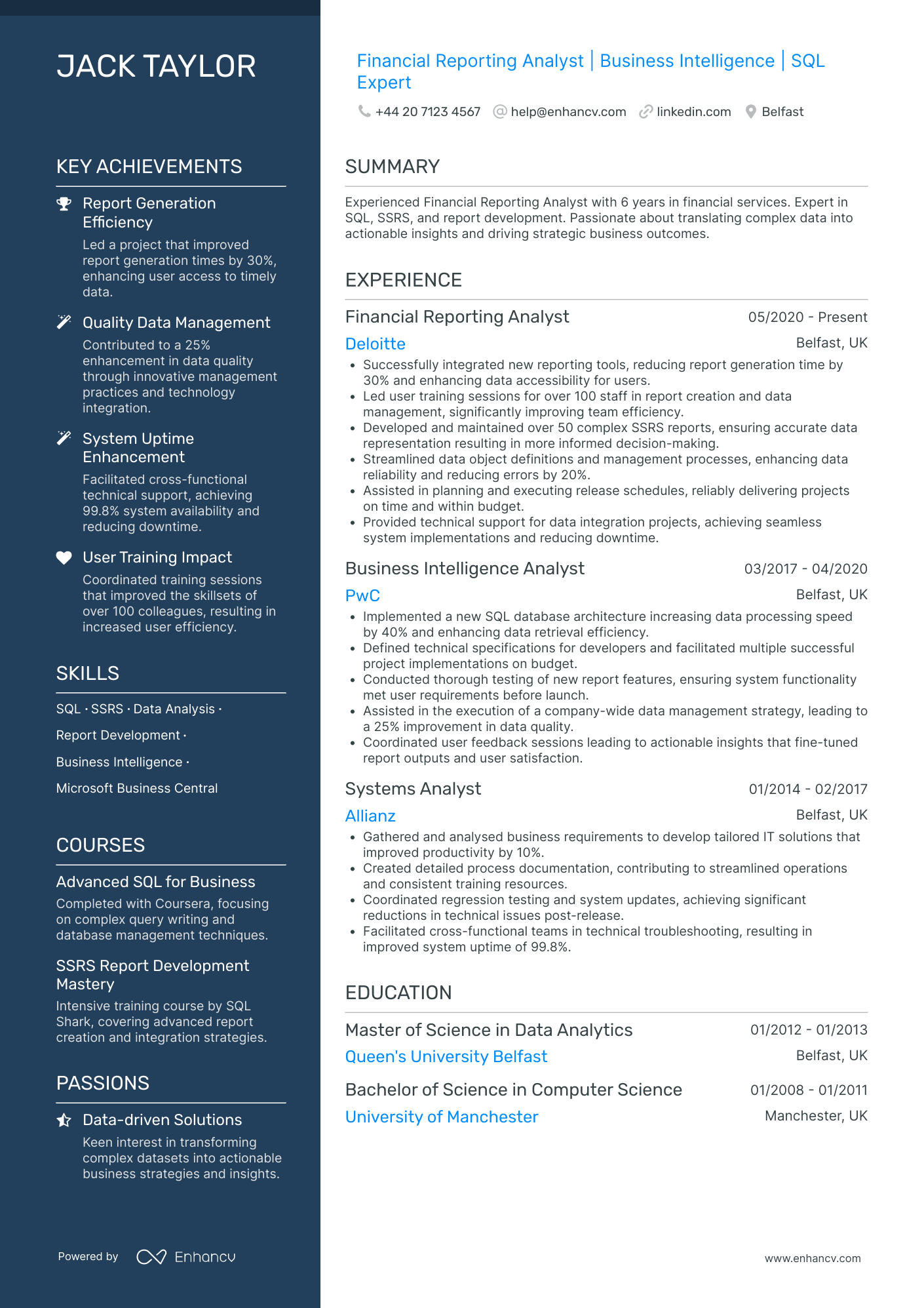
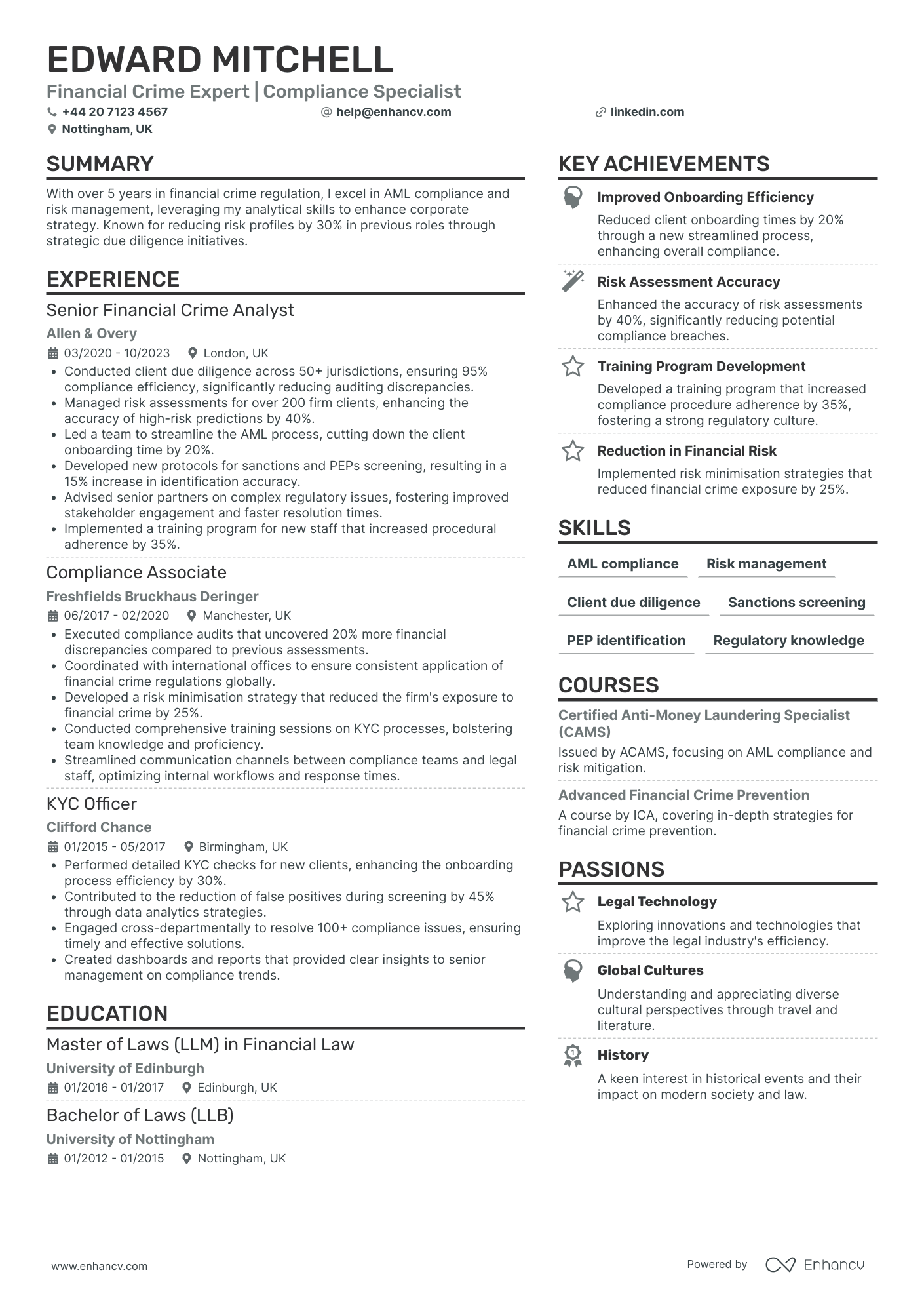
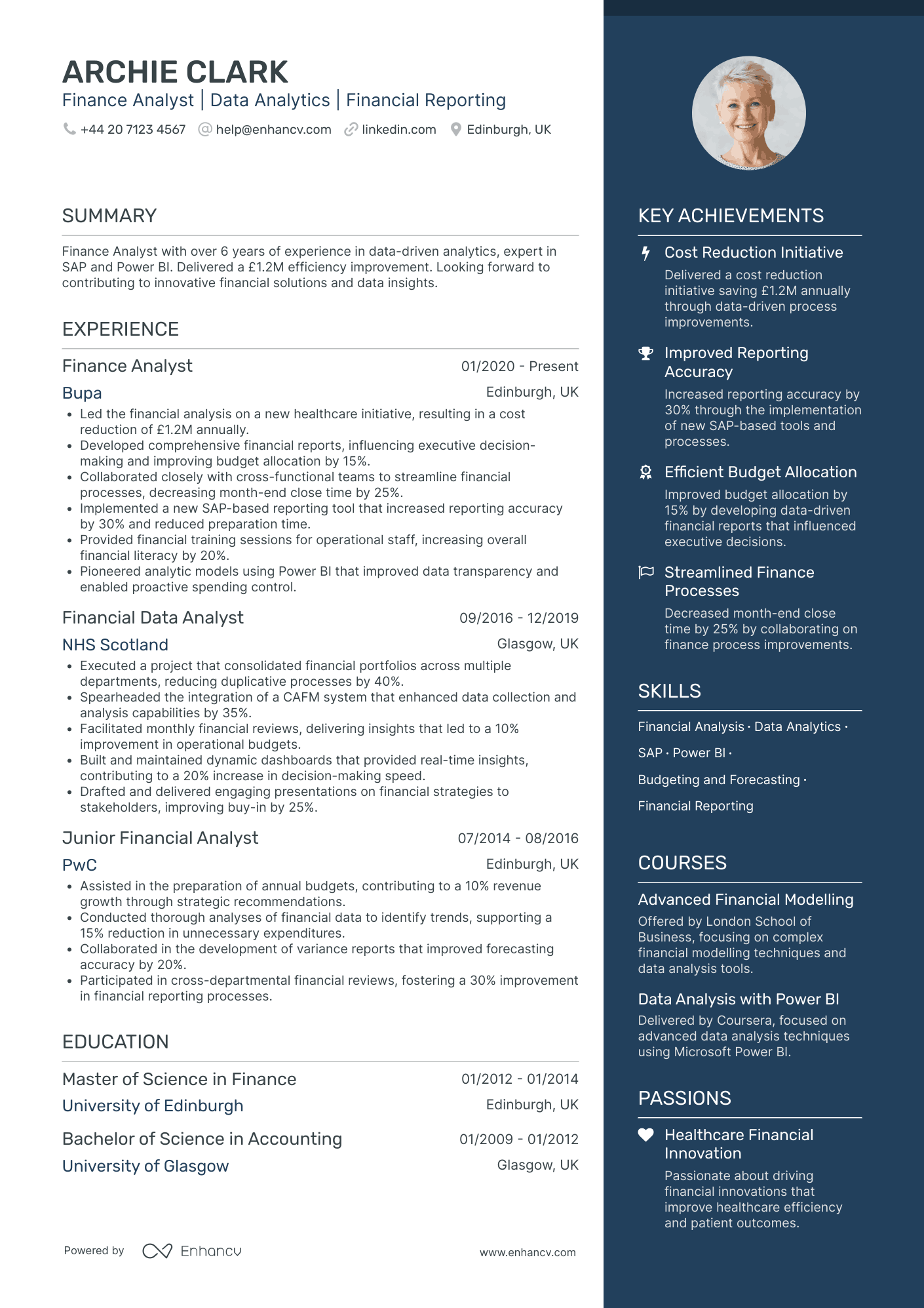
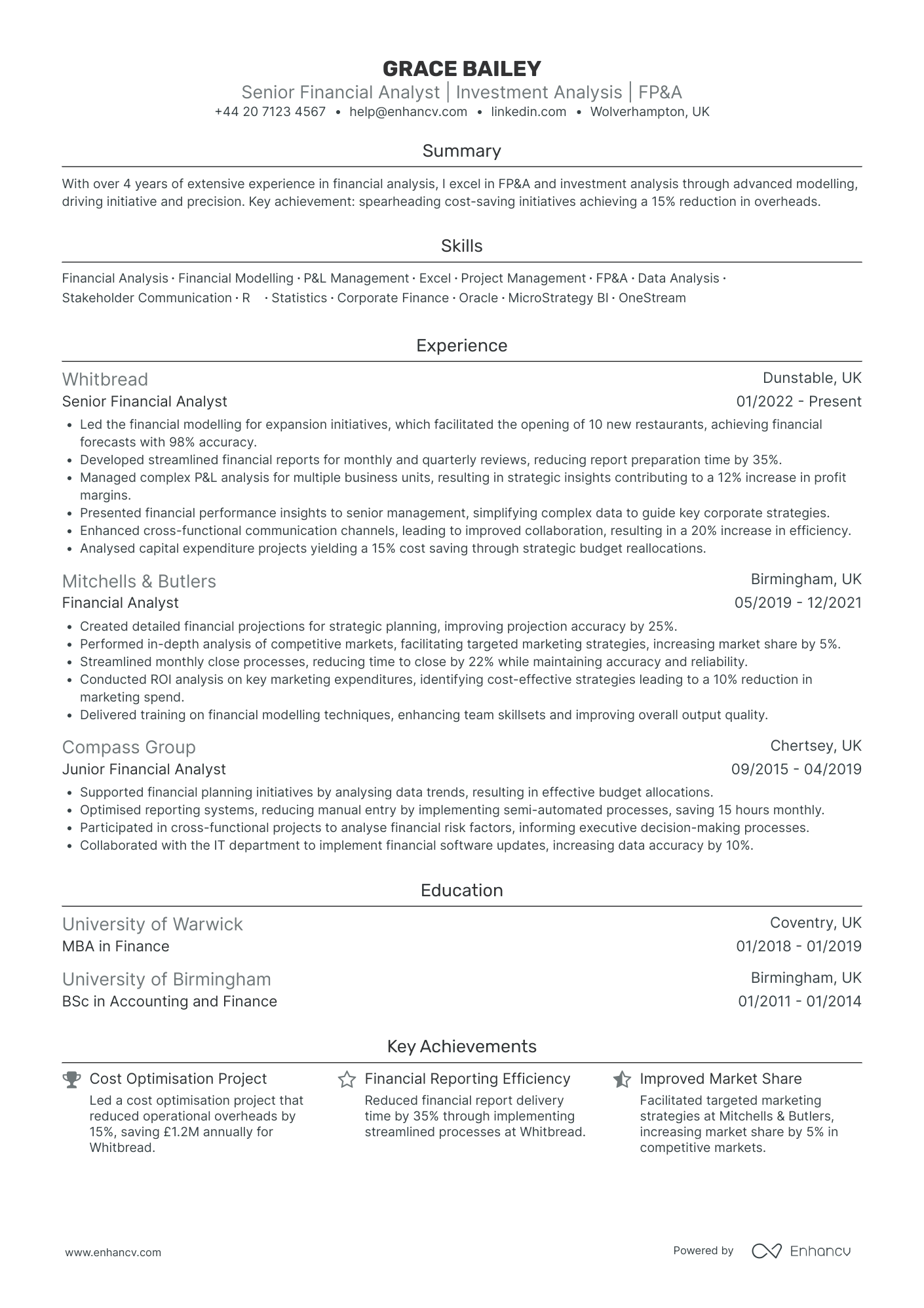
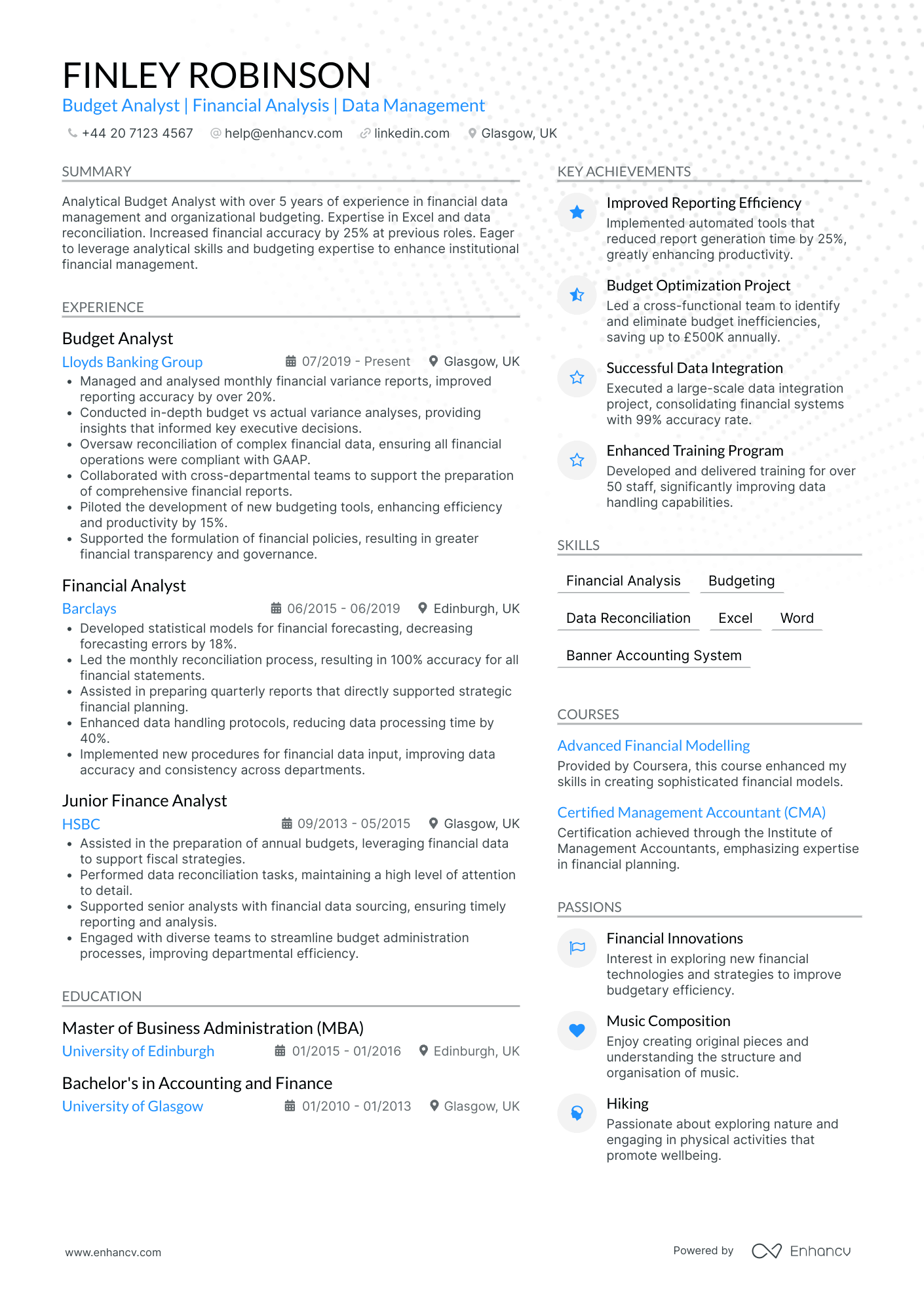
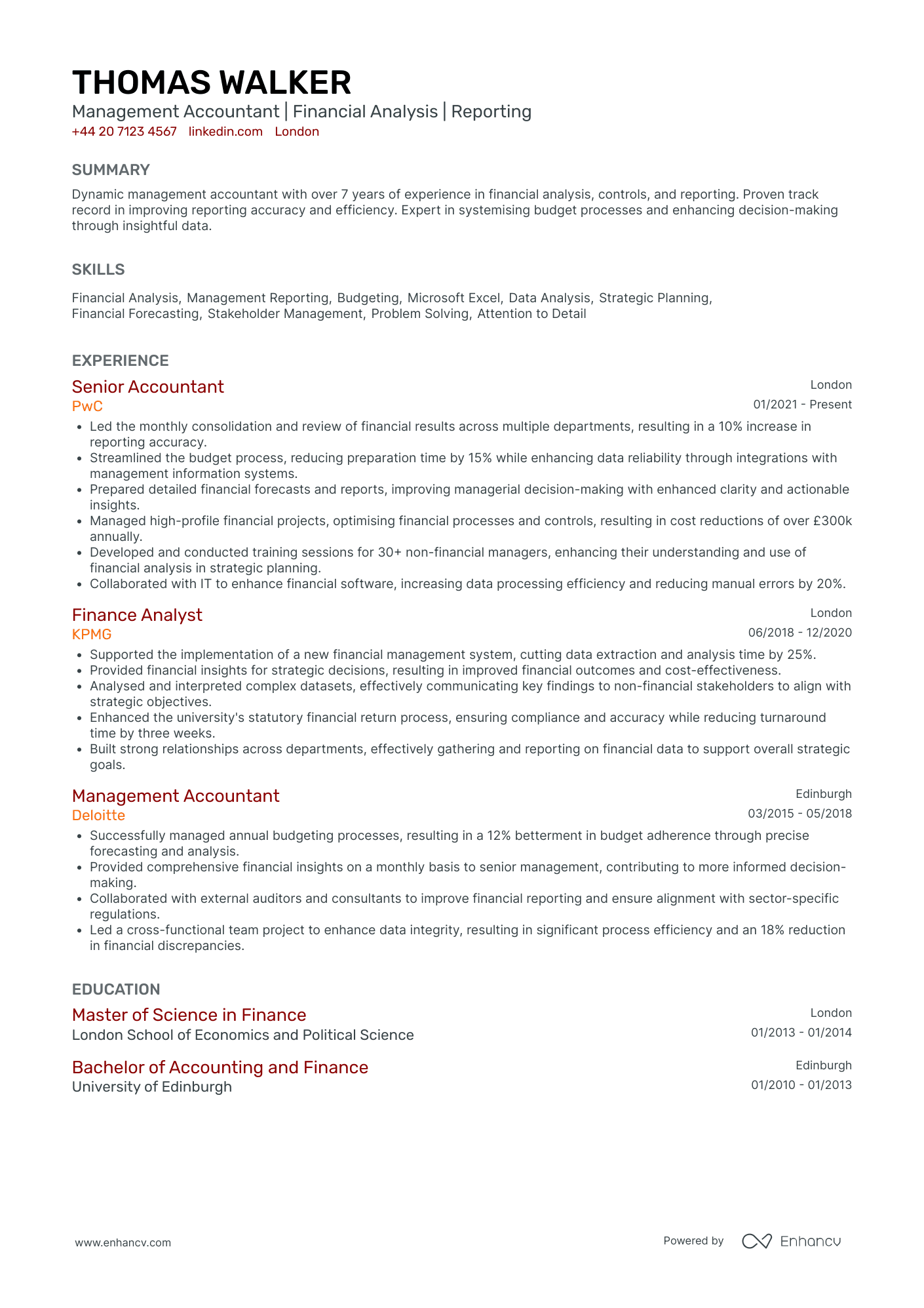
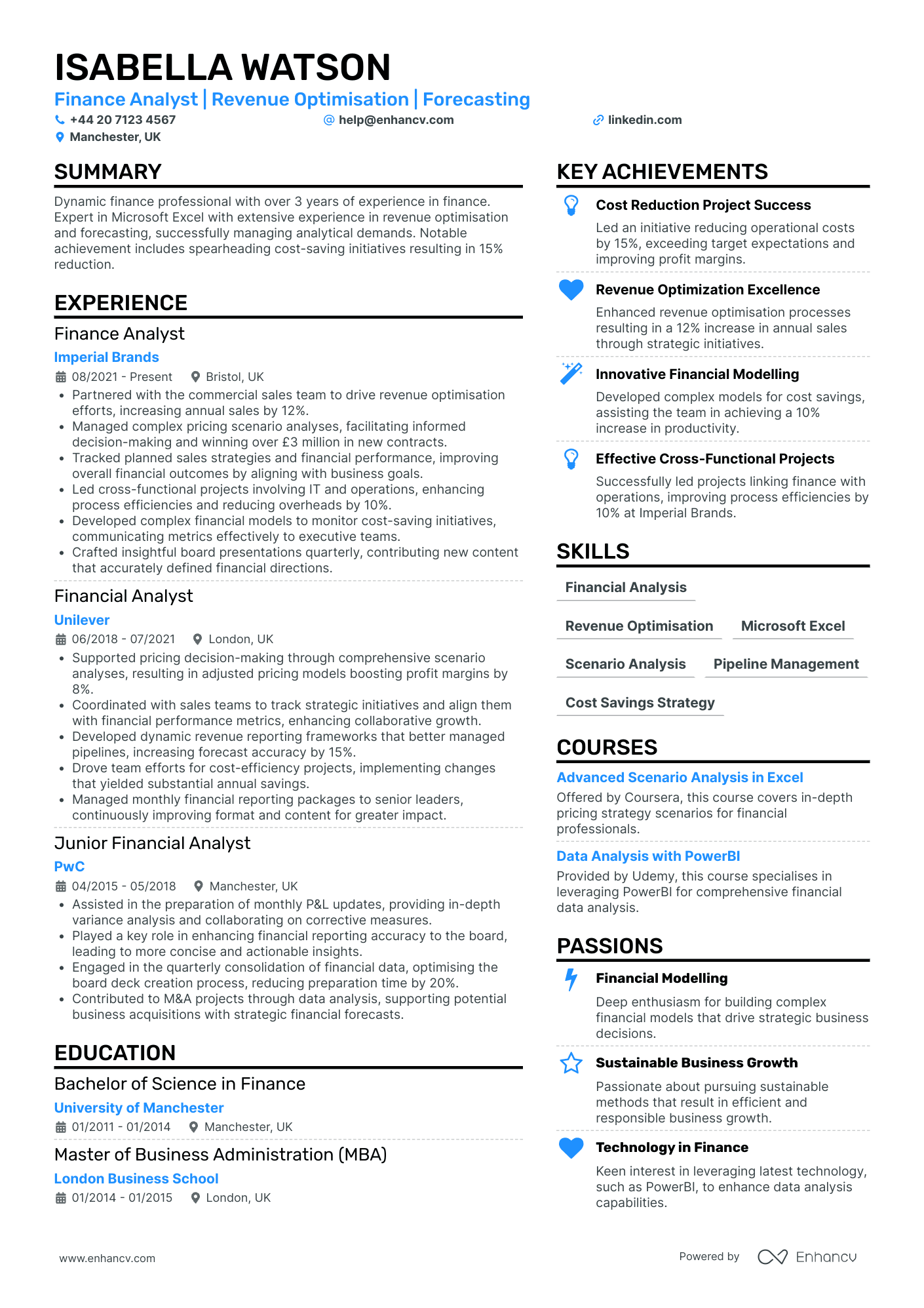
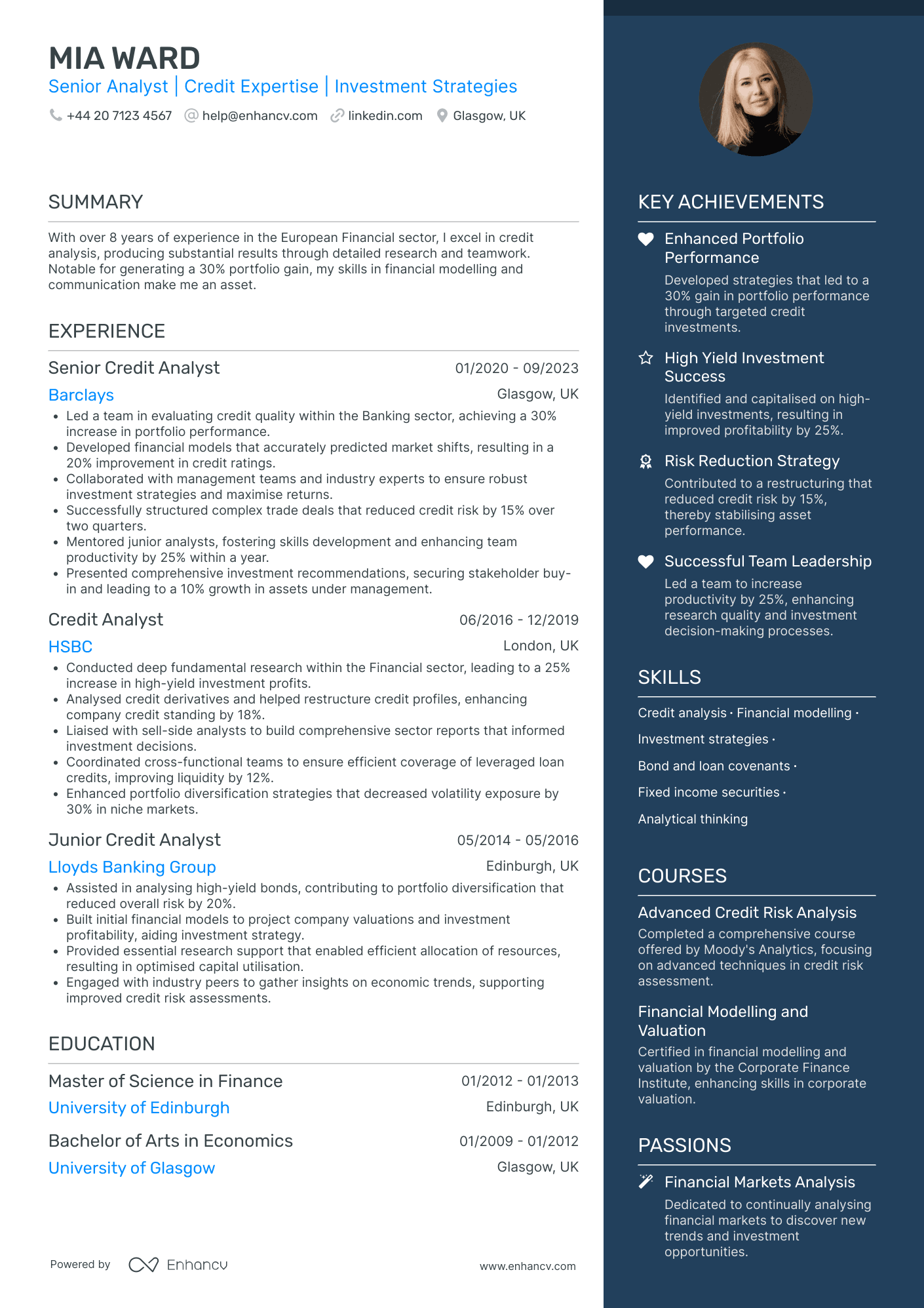
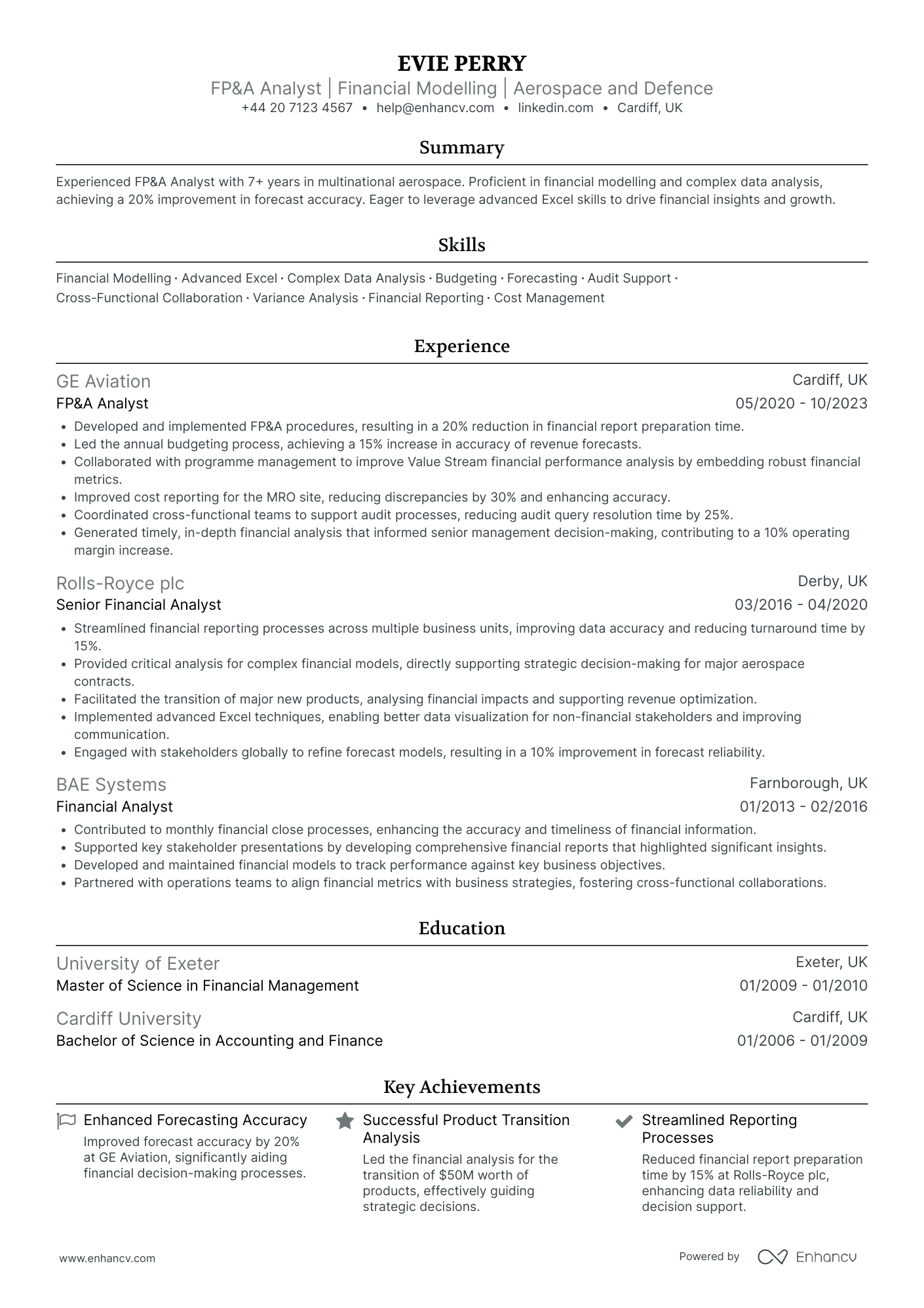
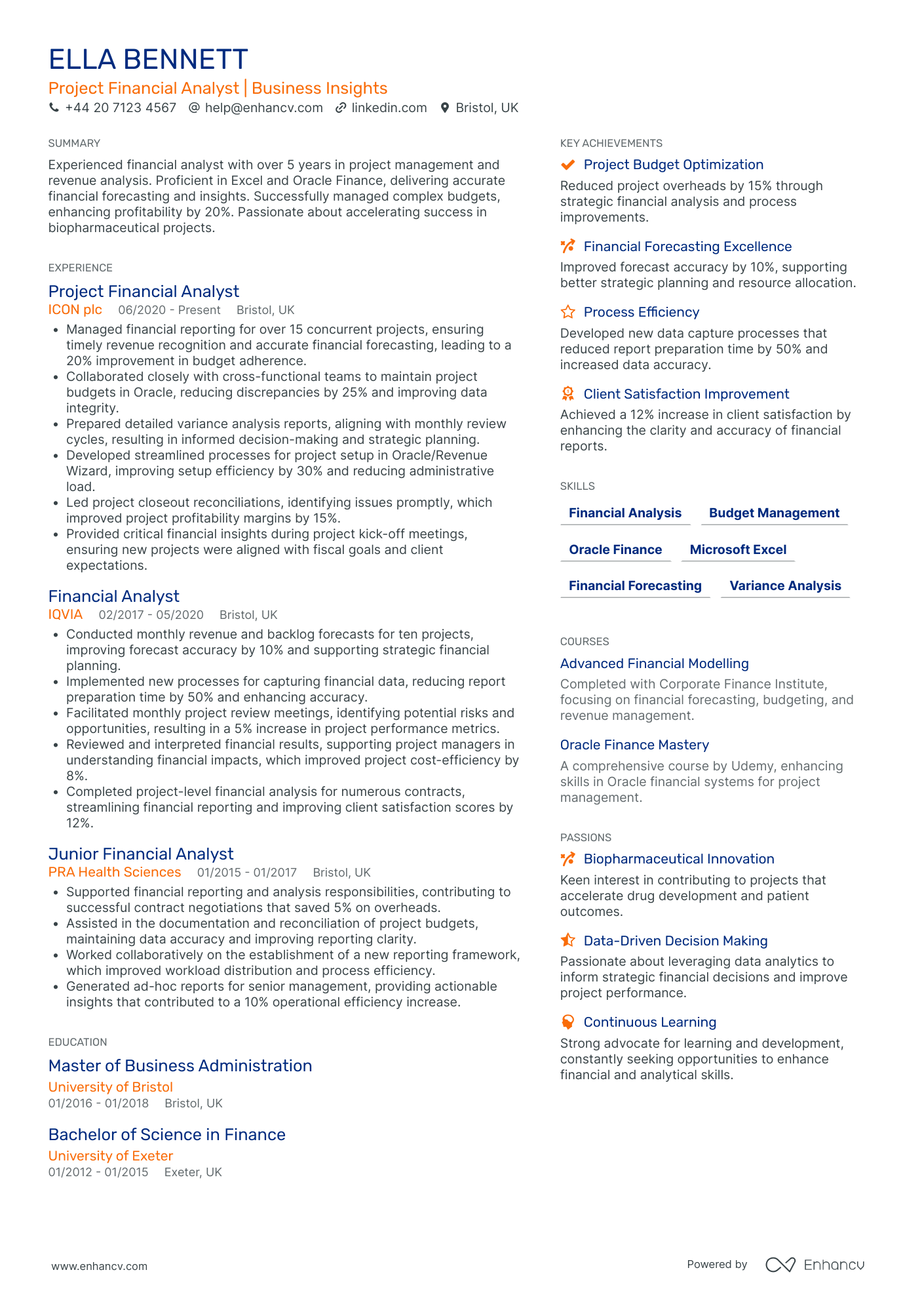
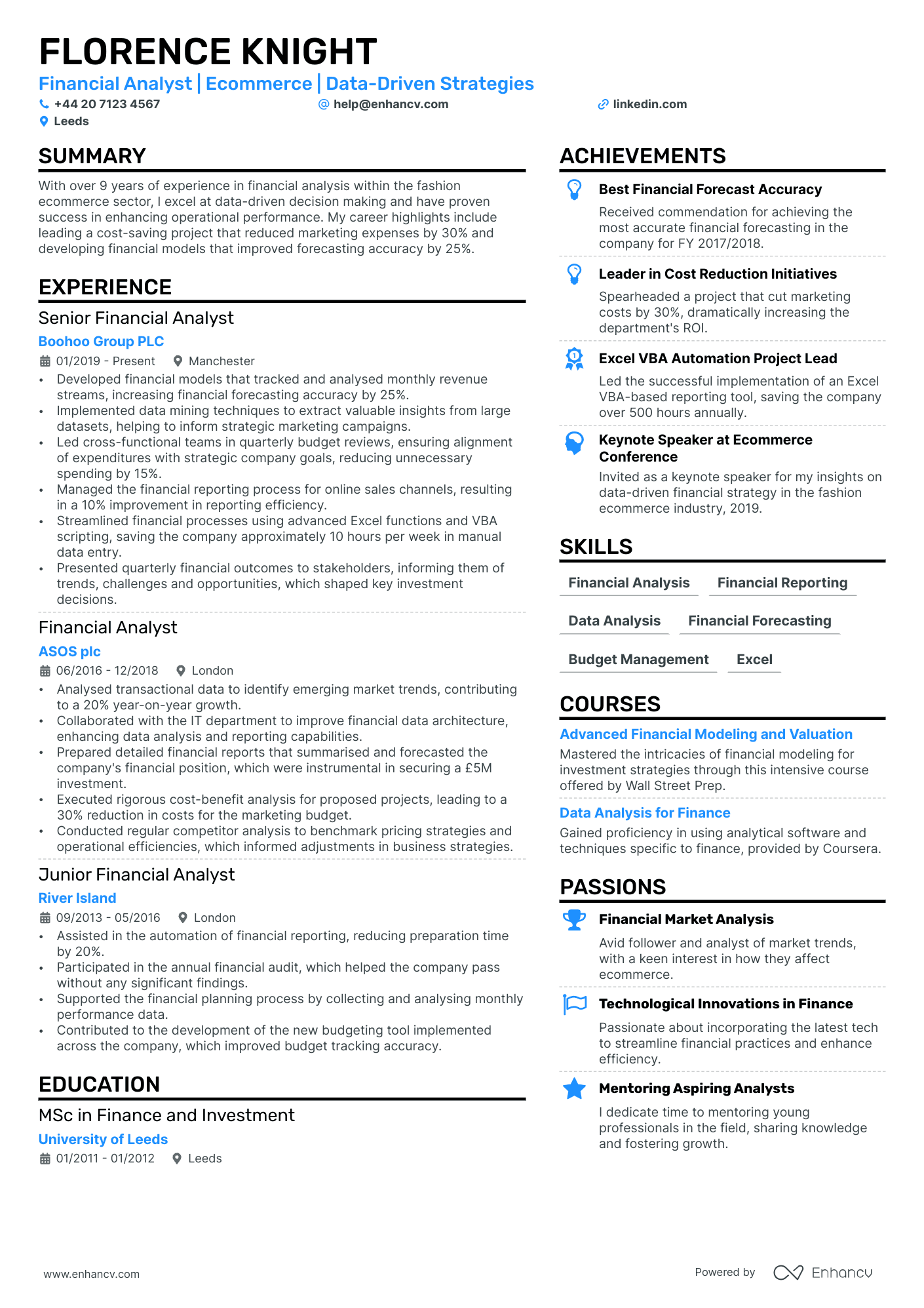
Most financial analyst CVs read like the job description handed back to the employer, a wall of duties with every number stripped out. The ones that win interviews do the opposite and lead with the decisions your analysis actually changed.
The quickest win is not a longer skills list. It is a clean, ATS-ready format that puts your strongest quantified work where a hiring manager looks first, and the fundamentals of how to write a CV sit underneath that.

Key takeaways
- Lead with a clean, reverse-chronological format. Analysts are judged on clarity before content.
- Two pages, one column, standard headings, sent as a PDF unless the advert asks for Word.
- Put two or three quantified results in the top third: money saved, variance closed, hours automated.
- Name the tools employers list most, Excel, financial modelling, and SQL.
- Most UK roles are on-site or hybrid, so make your location easy to find in the header.
- Back a CFA, ACCA, or CIMA with your progress, even when you are only part-qualified.
Formatting your financial analyst CV
Analysts are judged on precision, so a messy CV reads as messy work. Format is the first competence test, before anyone reads a single bullet.
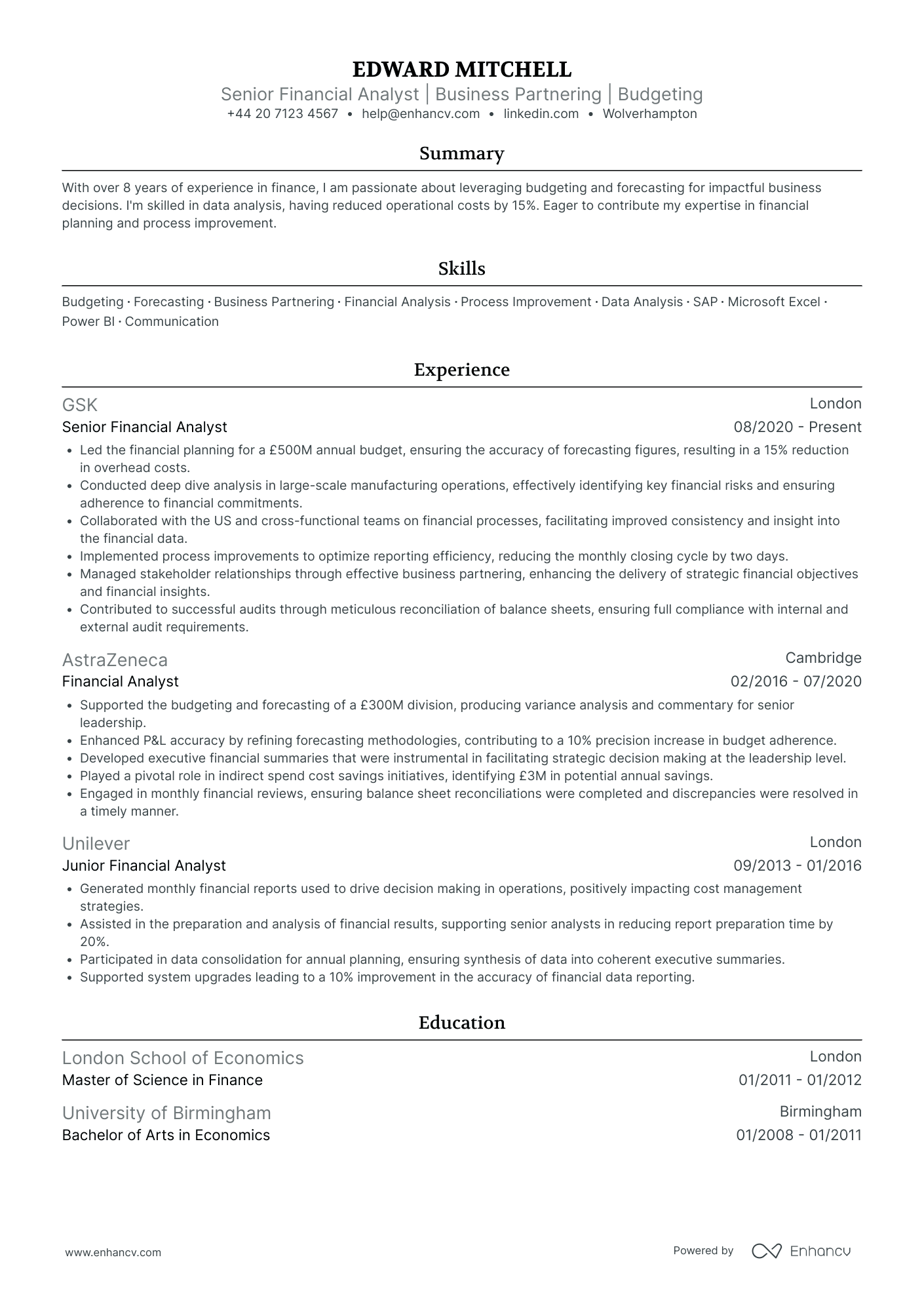
Use a reverse-chronological format. It is what UK recruiters expect, and it puts your most recent and most senior analysis at the top where it earns attention.
Keep it to two pages. One page is fine early in your career, but an experienced analyst with real numbers to show should use the space rather than cramming.
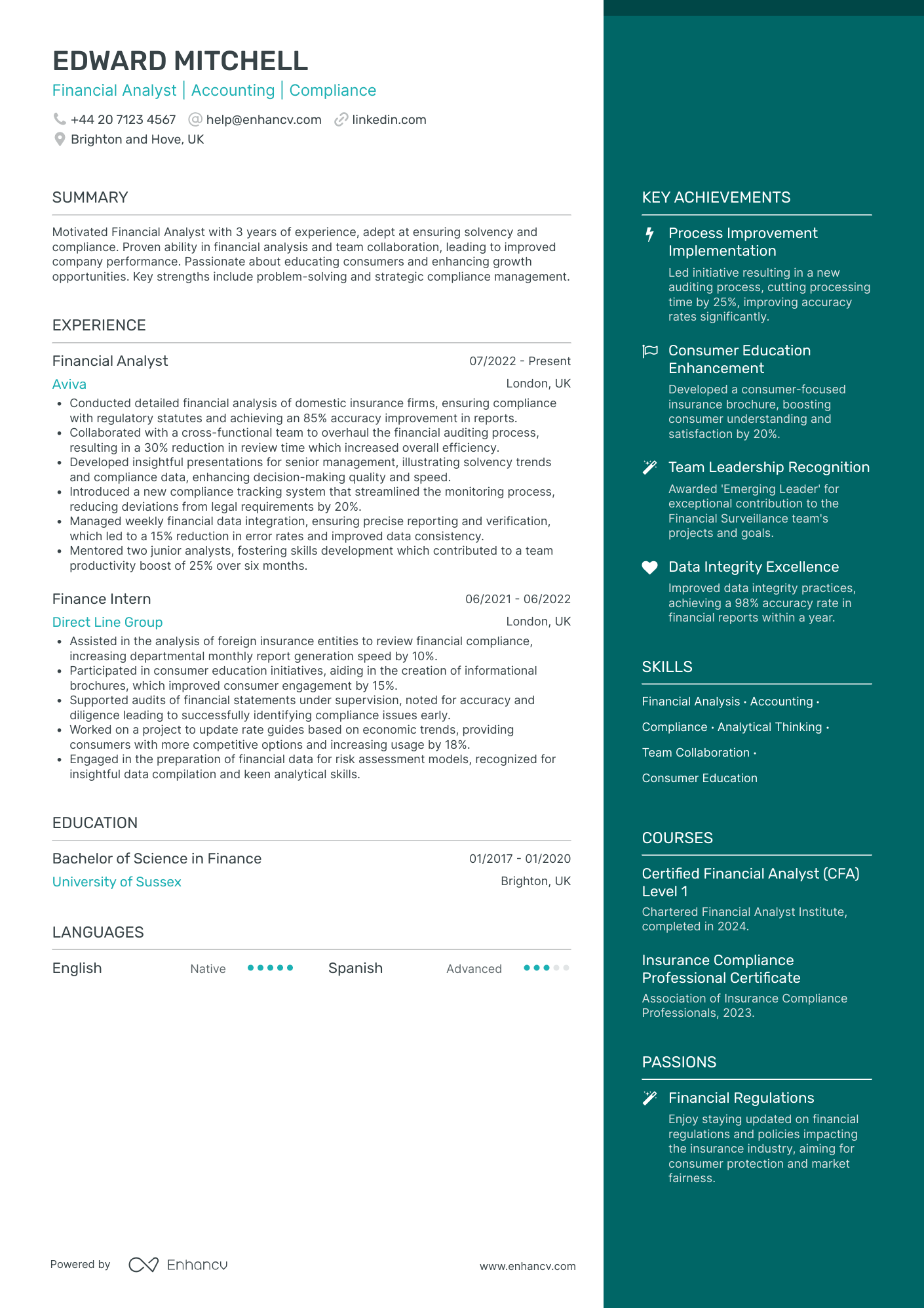
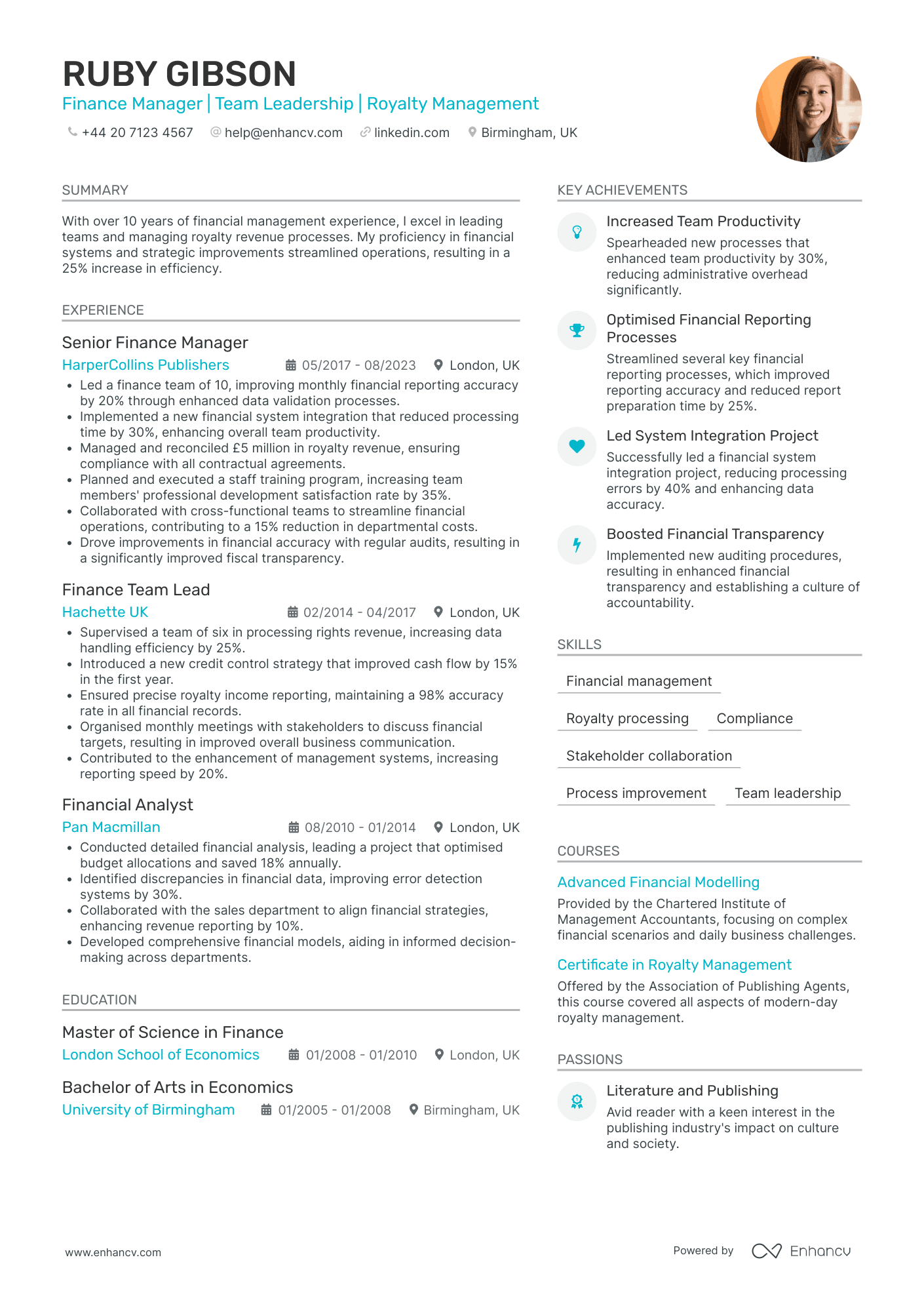
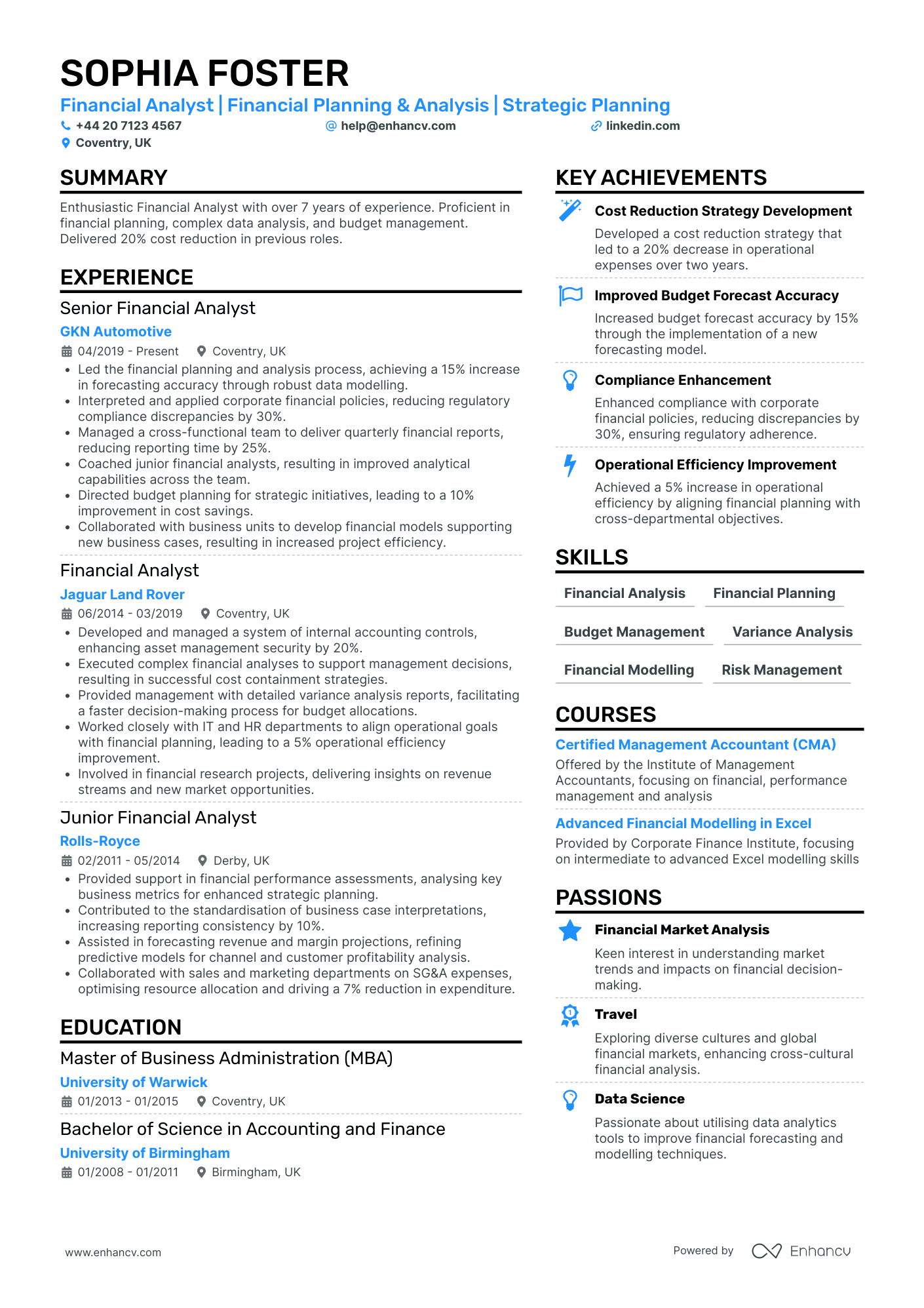
Stick to one column. A single clean column survives a fast skim and parses cleanly, whereas a two-column CV layout scatters the eye and confuses some tracking software. Save the design flourishes for a field that rewards them.
Choose a plain, readable font and consistent spacing. Standard headings, "Experience", "Skills", "Education", beat clever labels a recruiter has to decode.
Get the header right. Your name, city, phone, email, and a LinkedIn URL are enough. Because most UK roles are on-site or hybrid, your location matters, so put your city where it is easy to find and skip your full address in the personal details on your CV.
Send a PDF for direct applications so your tables, alignment, and number formatting hold on any screen. Keep a Word or PDF copy ready for recruitment agencies, which place a large share of finance roles and often reformat CVs into their own template. If the advert names a file type, follow it.
Financial analyst applications almost always pass through an applicant tracking system first, so keep the layout clean, avoid text boxes and images, and label sections in plain terms an ATS-friendly CV can parse. Name the file with your name and the role, not "CV final v3".
A template that starts you from a tested structure beats a blank page. Enhancv's CV templates export to a clean PDF and hold the columns and headings a tracking system reads without tripping.

A section order that works for analysts
When in doubt, run the sections in this order:
- Personal statement, three or four lines built around one quantified result.
- Key skills, led by Excel, financial modelling, and SQL.
- Experience, reverse-chronological, every bullet ending on a number.
- Education and certifications, with the CFA, ACCA, or CIMA called out.

PRO TIP
Recruiters open finance CVs looking for numbers, so treat number formatting as part of the layout. Right-align figures, keep date formats consistent, and never let a currency symbol wander. Sloppy formatting on a CV about handling numbers is the fastest way to get filtered out.
What the UK financial analyst market looks like
Reading the market before you write tells you what to put near the top. Here is what UK employers asked for most across 44 financial analyst postings in the last ~30 days on Enhancv's internal job feed.
| What | UK financial analyst roles |
|---|---|
| Where the work happens | On-site leads (30 of 44 postings), hybrid next (13), fully remote rare (1) |
| Experience level asked for | Weighted to senior and mid roles (senior 18, mid 16), with fewer entry (7) and lead (3) openings |
| Skills listed most often | Excel first, then financial modelling and SQL, with budgeting and forecasting close behind |
Two things in that table should shape your CV.
On-site and hybrid roles dominate, so a recruiter needs to see where you are based. Put your city in the header and do not bury it in the footer.
Demand skews senior and mid-level, which means entry-level applicants are competing against experienced analysts. If that is you, the no-experience section below shows how to close the gap with projects and coursework.
On pay, treat any single figure with caution. We did not find a verified UK salary benchmark for this exact title that we would stand behind, so check the live salary range on each advert rather than trusting a round number, and let the seniority mix above set your expectations.
Top skills for your financial analyst CV
The job feed is blunt about what matters. Excel appears more than any other skill, and financial modelling and SQL are the next most common, so those three belong in your skills section and proven in your bullets.
List them in the words the adverts use: financial modelling, forecasting, budgeting, variance analysis, and data analysis. These are your hard skills, and each one should trace to a result somewhere in your experience.
Show, do not tell, on the big three. For Excel, name what you built, dynamic dashboards or pivot-driven reforecasts, not "proficient in Excel". For modelling, name the model type, three-statement, DCF, or LBO. For SQL, say what you queried and why it mattered.
The soft skills that carry weight in finance are the checkable ones: attention to detail, clear communication with non-finance stakeholders, and commercial judgement. Prove each in a bullet rather than asserting it, since "detail-oriented" means nothing a recruiter can verify.
List only what you can defend in an interview. If you have written SQL to pull your own data, say so. If you have only watched someone else do it, leave it off or mark it as learning.
Top skills for your financial analyst CV:
Advanced Excel
Financial modelling
SQL
Forecasting
Budgeting
Variance analysis
Data analysis
Financial reporting
Attention to detail
Communication
Commercial judgement
Problem solving
Stakeholder management
Writing your financial analyst personal statement
Three or four sentences at the top: who you are, the kind of analysis you do, one quantified result, and the sector you want next. Keep it concrete and skip the adjectives. For more openers, see these personal statement examples.
The weak version lists traits. The strong version leads with a number a hiring manager can picture. Compare these two.
Financial analyst personal statement example (mid-level)
Financial analyst with five years in FP&A across retail and SaaS, building three-statement models and monthly variance reporting for budgets up to £40m. Automated a manual reforecast in SQL and Excel that cut the monthly close by two days. Looking to bring forecasting and commercial partnering to a senior analyst role in a growth business.
What to avoid
Hard-working and detail-oriented financial analyst passionate about numbers and delivering results in a fast-paced environment. A strong team player with excellent communication skills, seeking a challenging role to grow my career and add value to a dynamic organisation.
When we review a financial analyst CV, the first thing we look for is a number that survived contact with a decision. Anyone can write "responsible for forecasting". Far fewer can write "cut forecast error from 12% to 4% and freed up £600k in working capital". Lead with the second kind of line, because in finance the evidence is the personality. The candidates who get interviews are the ones who show the analysis mattered, not just that they ran it.
Writing your financial analyst experience section
Each entry gets a dated heading, then bullets that lead with a verb and land on a result. For the mechanics, see how to write work experience on a CV.
Finance work is measurable by nature, so use that. Money saved, variance closed, models built, reports automated, days cut from the close. A bullet without a number is a duty, and duties are forgettable.
Frame each bullet around the outcome, not the task. "Rebuilt the cash-flow model, cutting reforecast time by a day" beats "responsible for the cash-flow model", and it lets you quantify your achievements in a way a hiring manager remembers.
Tailor every application. Pull the tools and terms from the advert and mirror the ones that are true of you. Enhancv's CV tailoring feature reads the advert and suggests the matching edits, which saves rewriting from scratch each time.
- Built and maintained three-statement models for a £40m product division, improving forecast accuracy quarter on quarter
- Automated the monthly management pack in SQL and Excel, cutting reporting time from three days to one
- Ran variance analysis that flagged a £250k marketing overspend and fed the corrective budget review
- Partnered with non-finance department heads to turn budget data into plain-English decisions on spend
PRO TIP
Mirror the advert's language exactly. If it says "financial modelling" do not write "building models", and if it lists "SQL" then name SQL. The right CV keywords get you past the filter and signal to the human reader that you actually read the brief.
Education and certifications for a financial analyst CV
A numerate degree helps, but certifications carry real weight in finance, so give them their own space. List your degree with its classification, then your professional qualifications underneath in the education section.
Name the ones UK employers recognise: the CFA, ACCA, CIMA, or an AAT for earlier-career roles. Put these qualifications on your CV and show progress even when you are part-qualified, with lines like "CFA Level II candidate" or "ACCA, 9 of 13 papers passed".
Listing the certificates you hold, and the ones in progress, answers a question the employer would otherwise have to ask. It also signals that you are still investing in the craft.
Writing a junior financial analyst CV with no experience
Entry-level applicants face the senior-weighted market from the table above, so a first CV has to work harder to prove capability without a track record.
Lead with a skills-led structure: personal statement, then skills, projects, and education, with any work history lower down. The goal is to show you can already do the analysis.
Projects are your strongest evidence. A modelling exercise, a dissertation built on real data, a public-dataset analysis, or a finance-society case competition all count. Write each like a job entry, with the tools used and the result reached.
- Build a three-statement model of a listed company from its annual report and summarise the investment case.
- Clean and analyse a public dataset in SQL or Python and present the finding in a dashboard.
- Run a valuation or budgeting exercise from a university module and quantify the outcome.
Add an internship, a part-time finance role, or relevant coursework, and name the certifications you are working towards. A part-qualified CFA or ACCA line signals you are already on the path.
Conclusion
Lead with a clean, ATS-ready format, put two or three quantified results in the top third, and name the tools the adverts ask for. That is what separates a financial analyst CV that gets read from one that gets filtered.
Pair it with a short cover letter that connects your analysis to the employer's decisions, and you turn a strong CV into a strong application.
Author's take - The Enhancv team
When we review a financial analyst CV, the first thing we look for is a number that survived contact with a decision. Anyone can write "responsible for forecasting". Far fewer can write "cut forecast error from 12% to 4% and freed up £600k in working capital". Lead with the second kind of line, because in finance the evidence is the personality.