



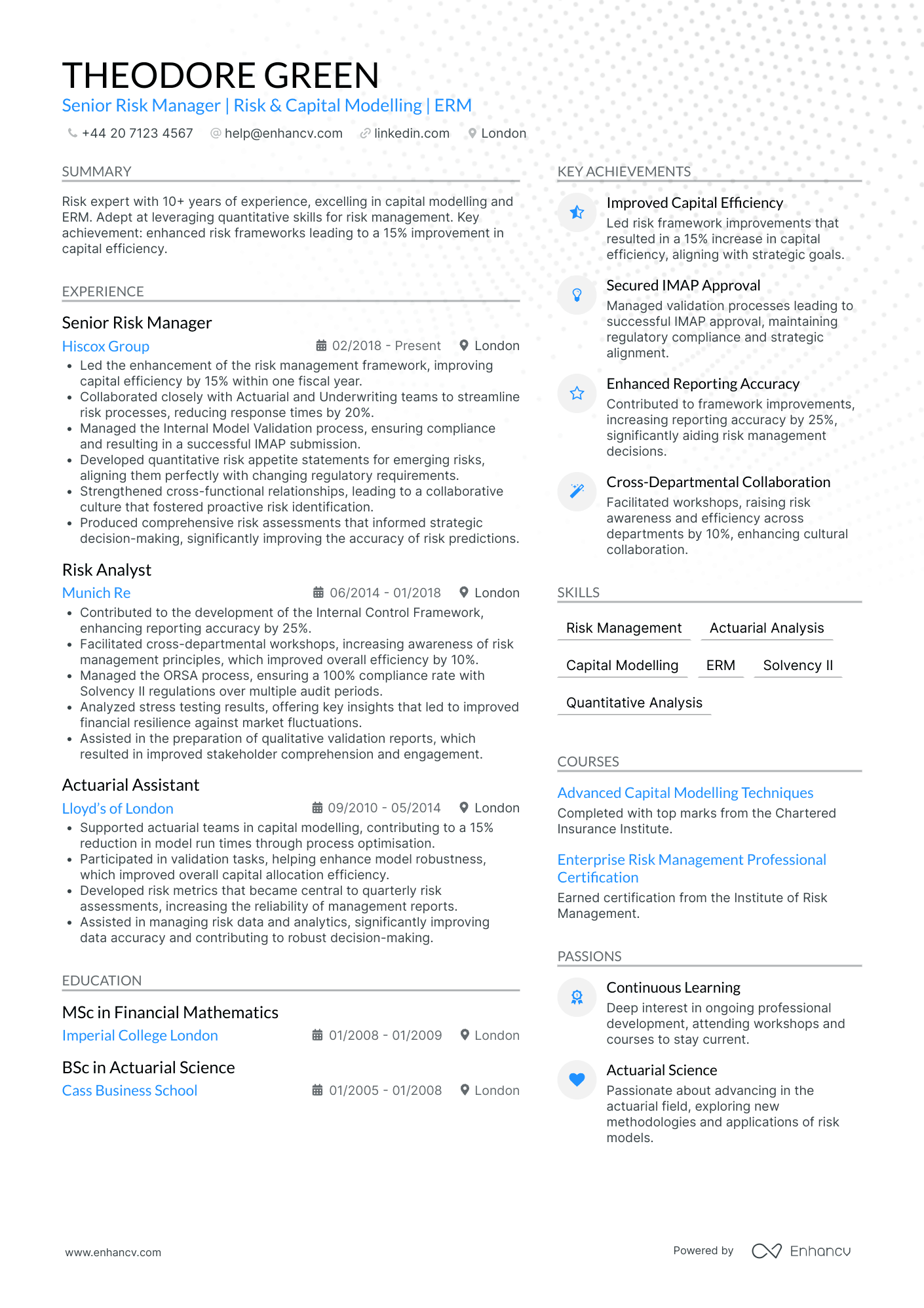
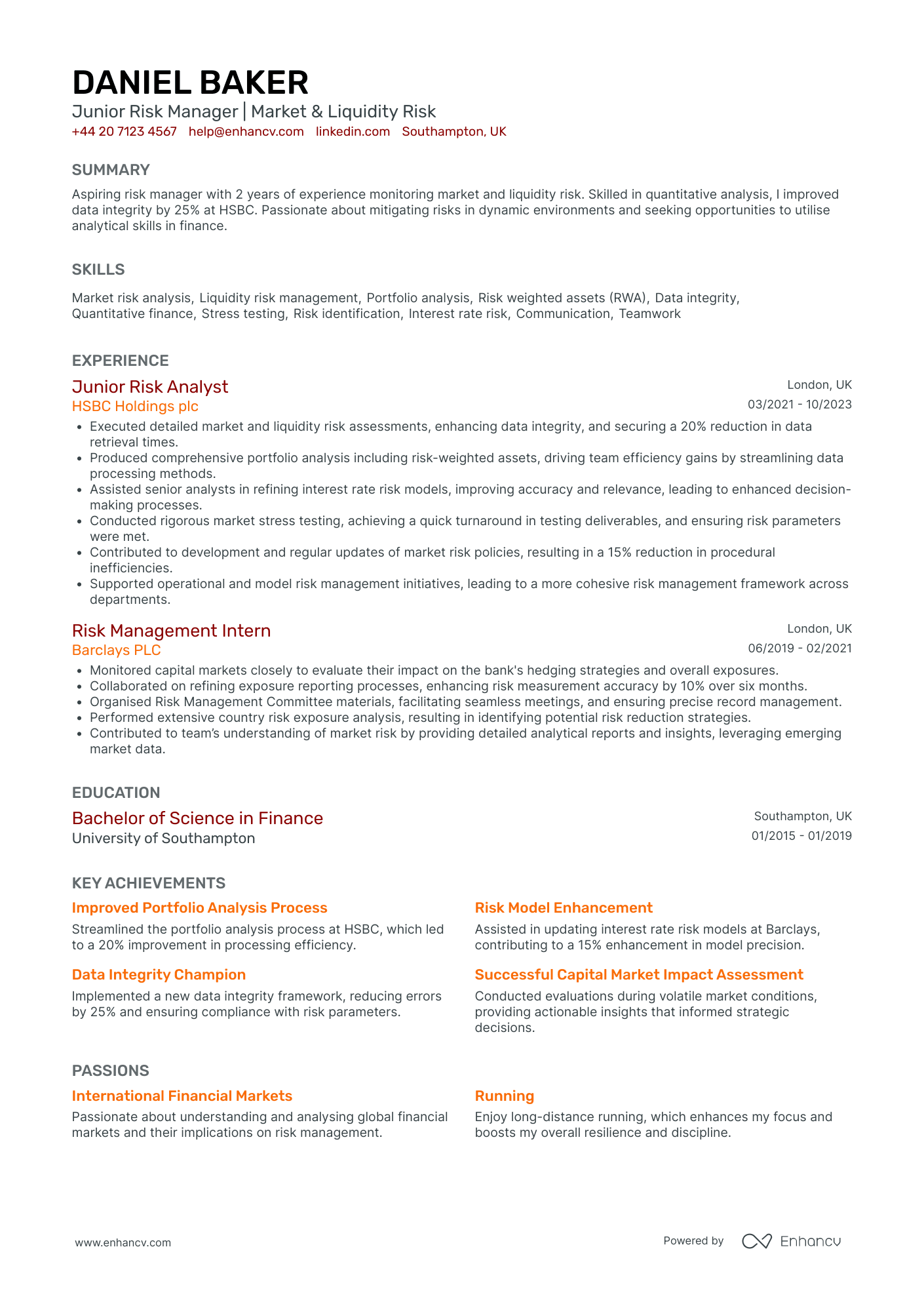
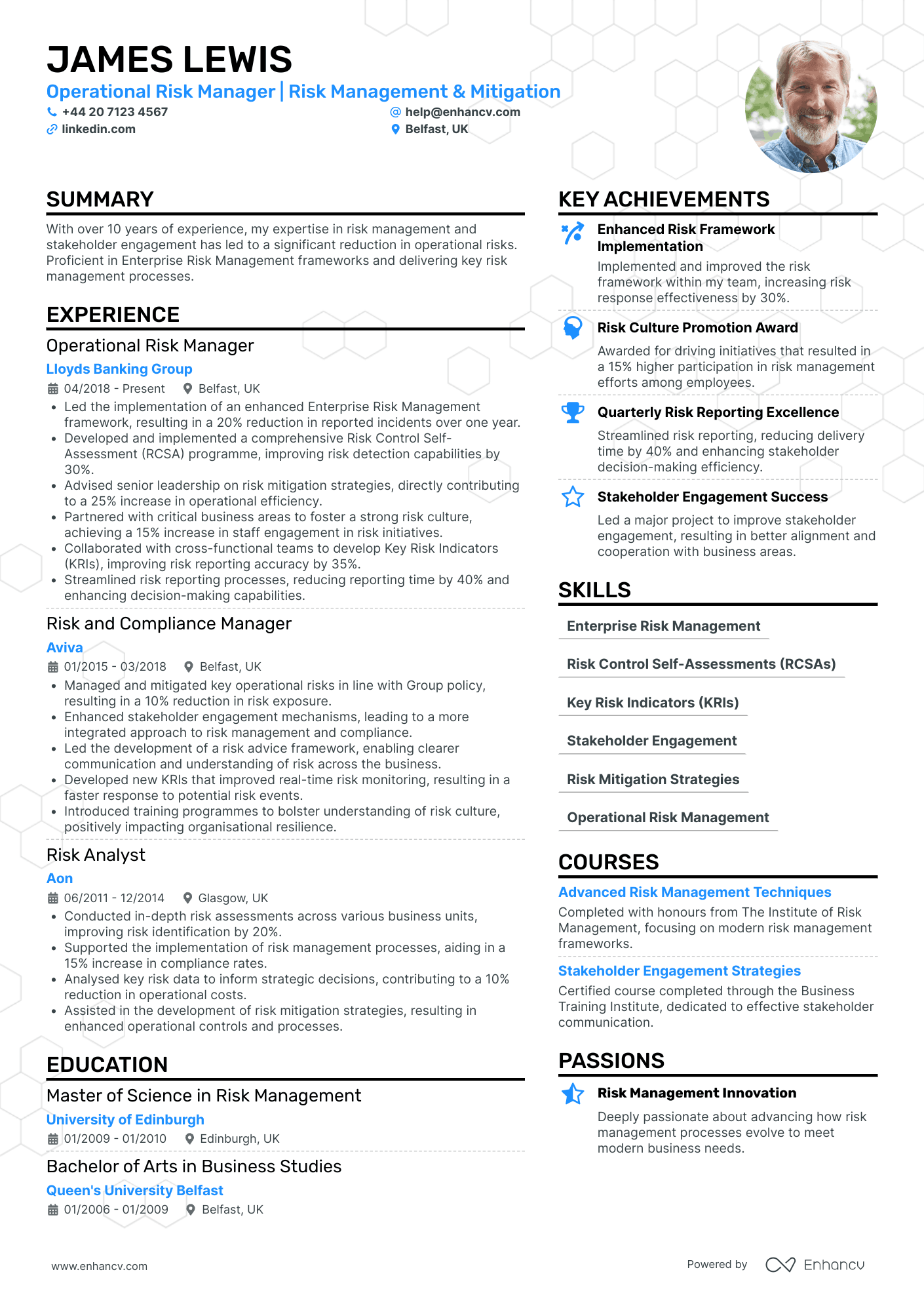
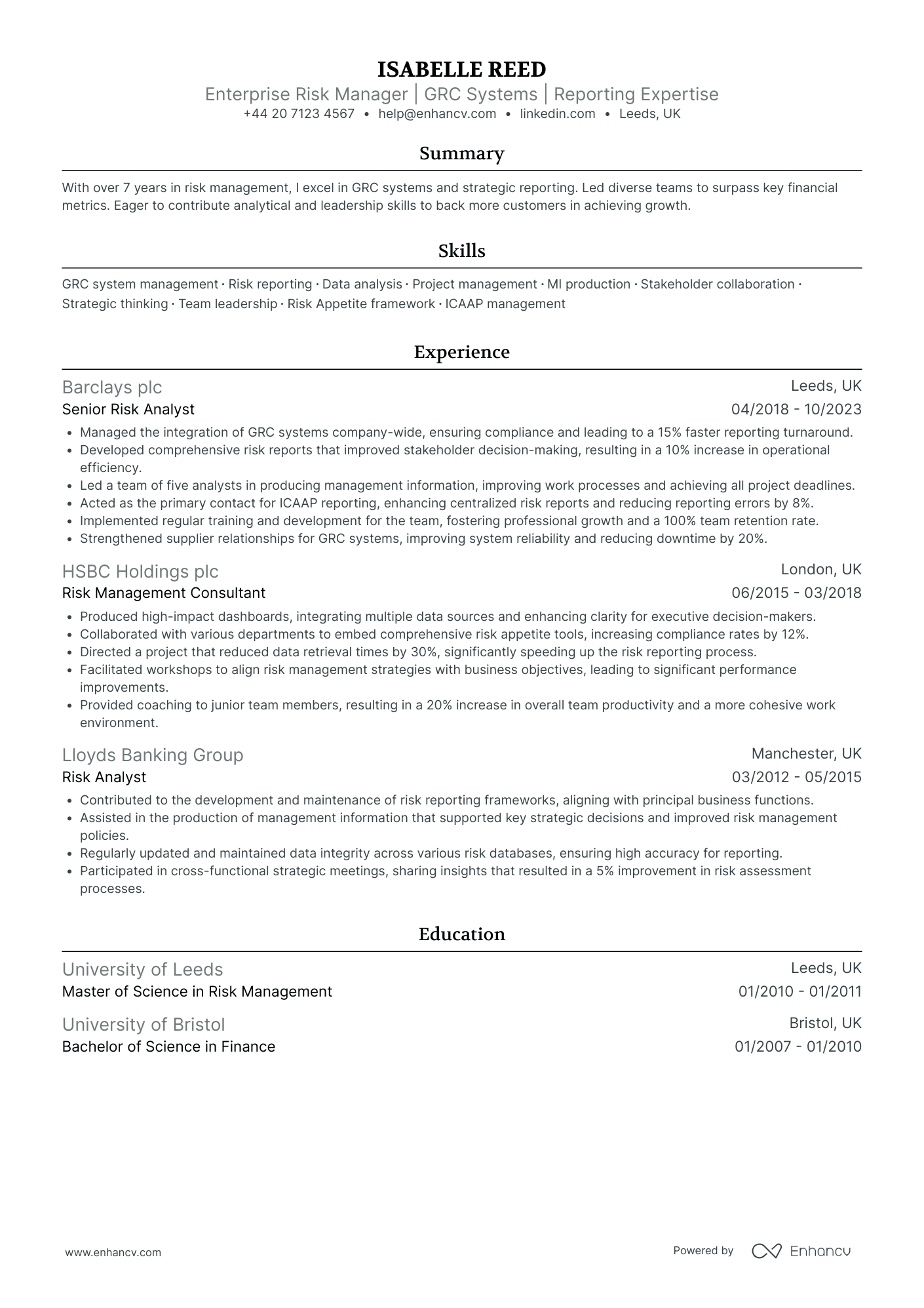
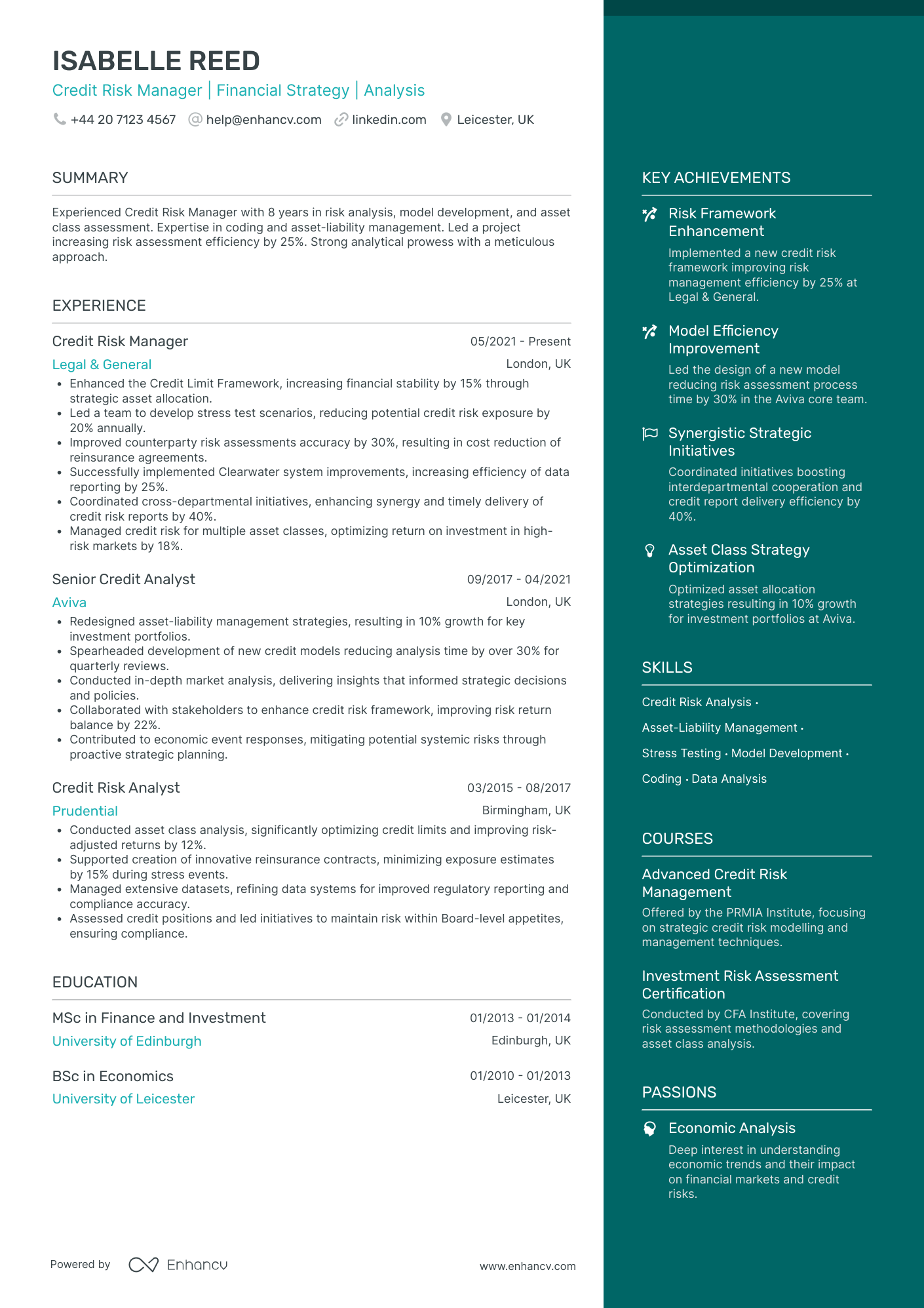
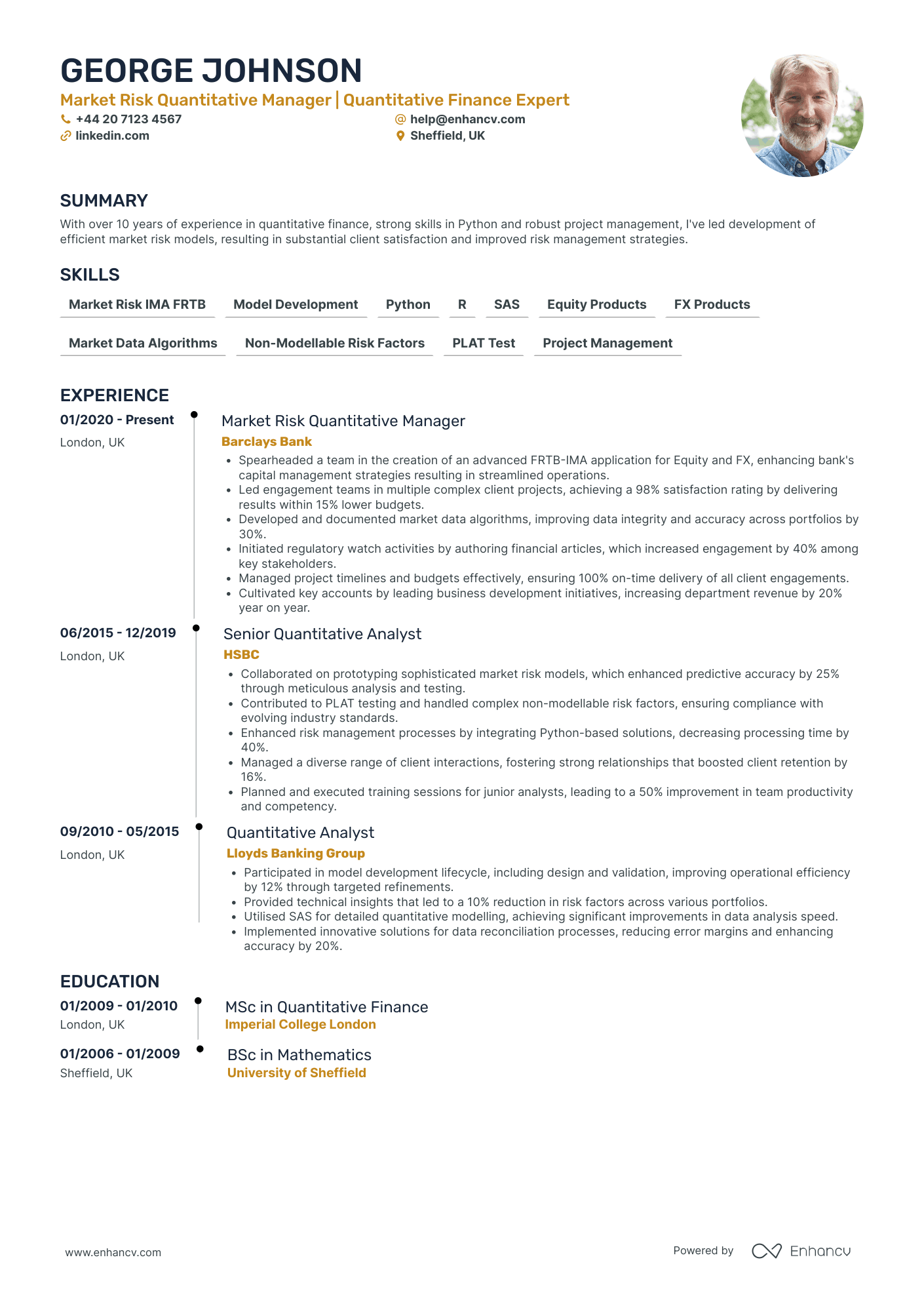
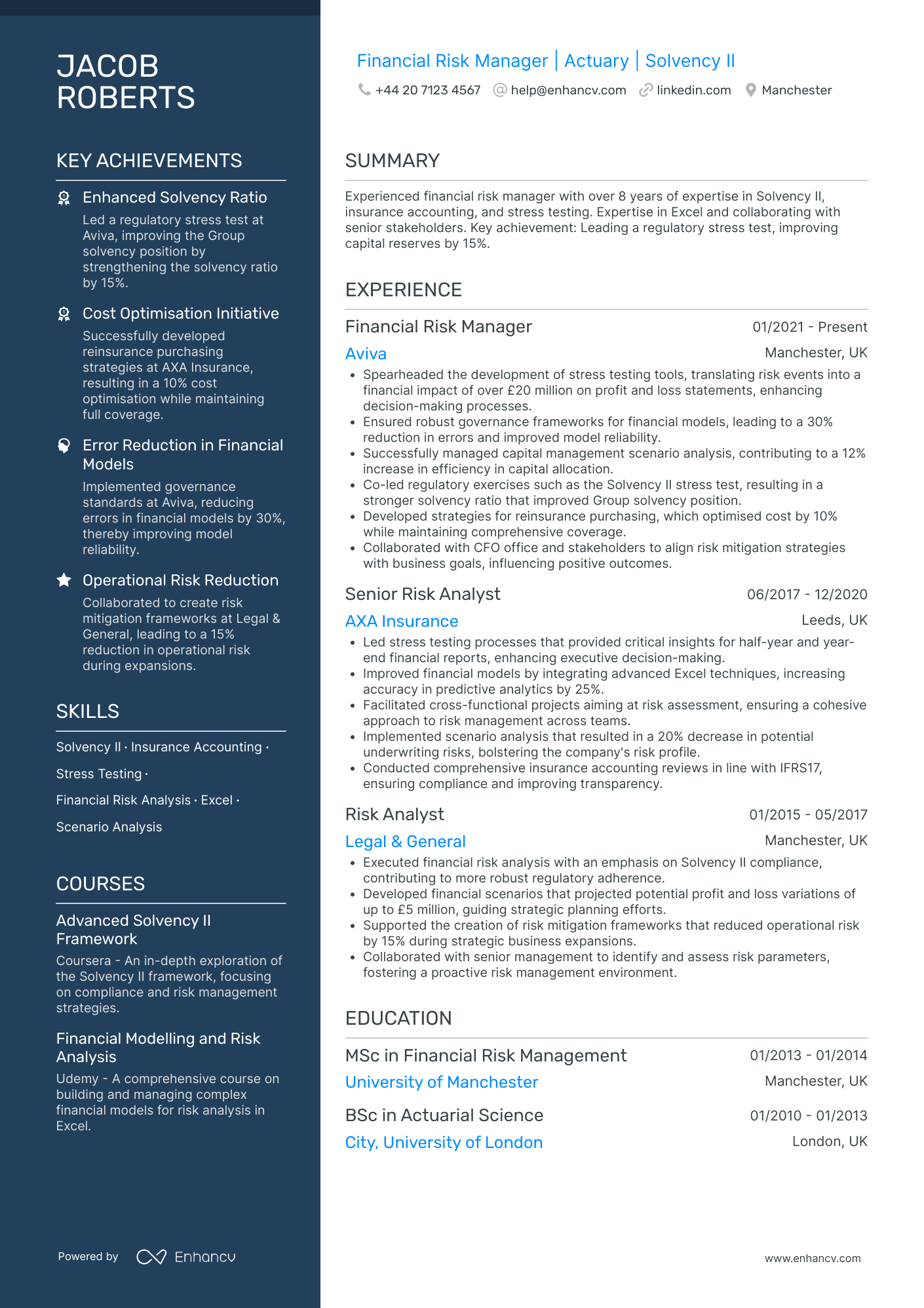
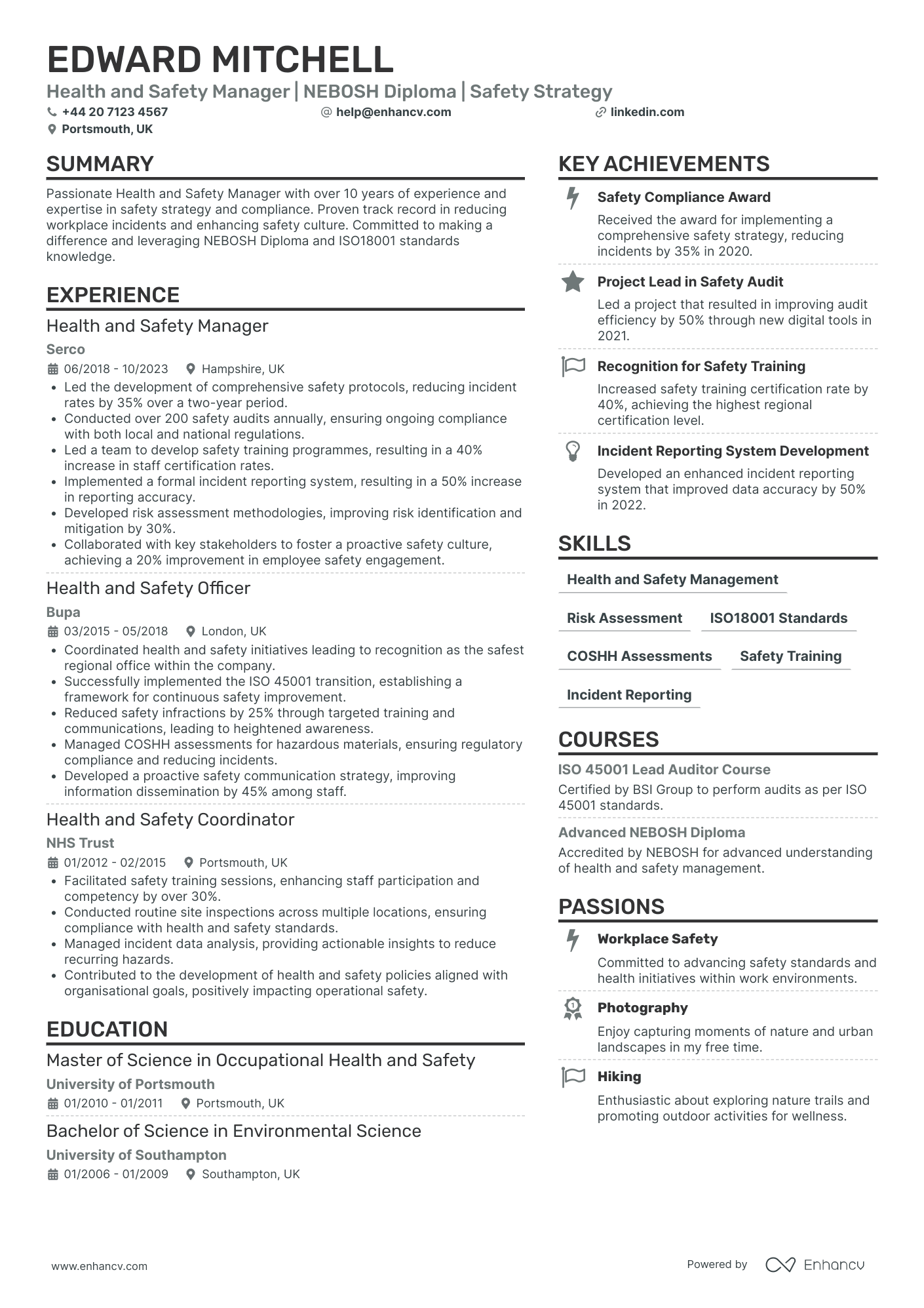
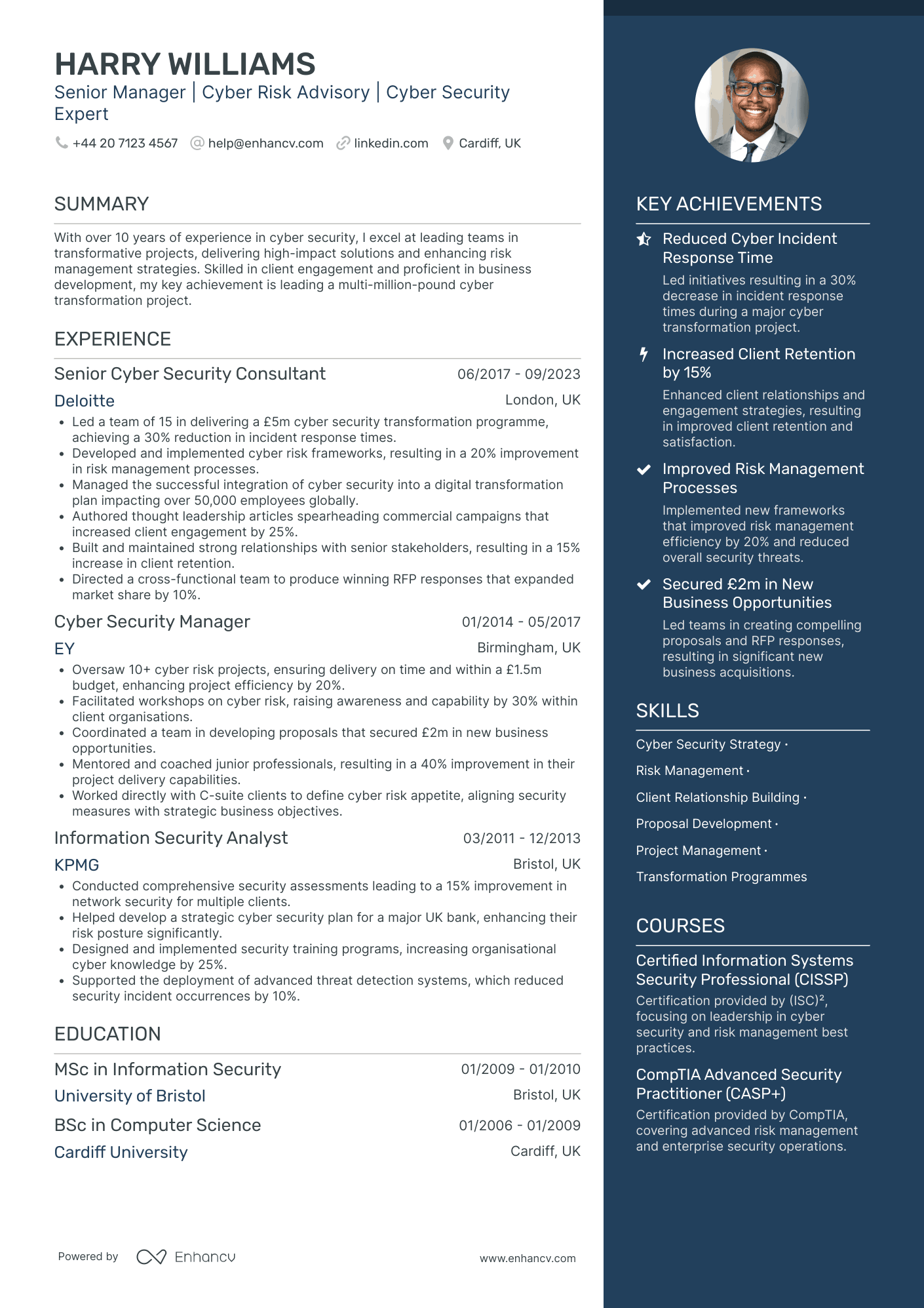
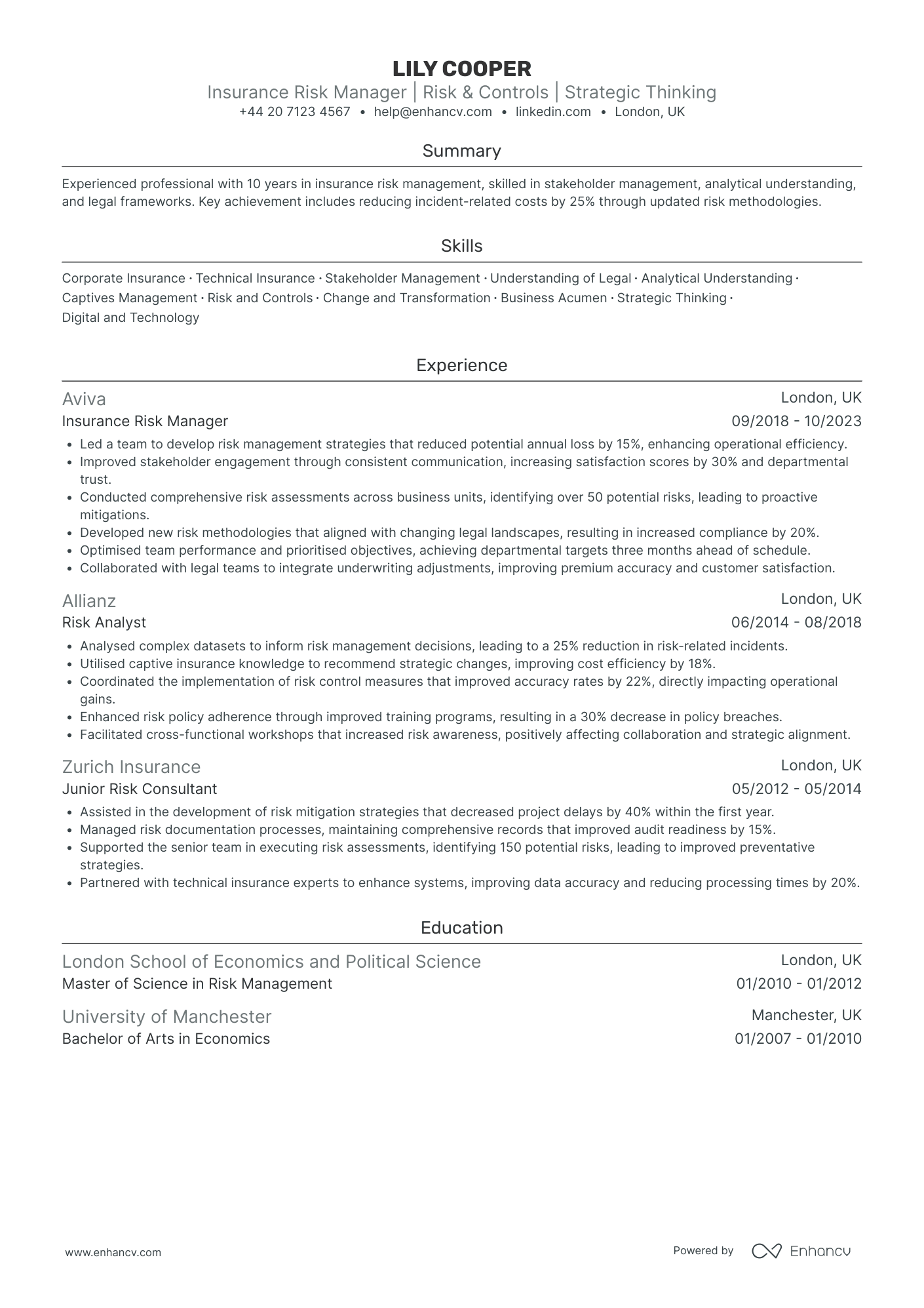
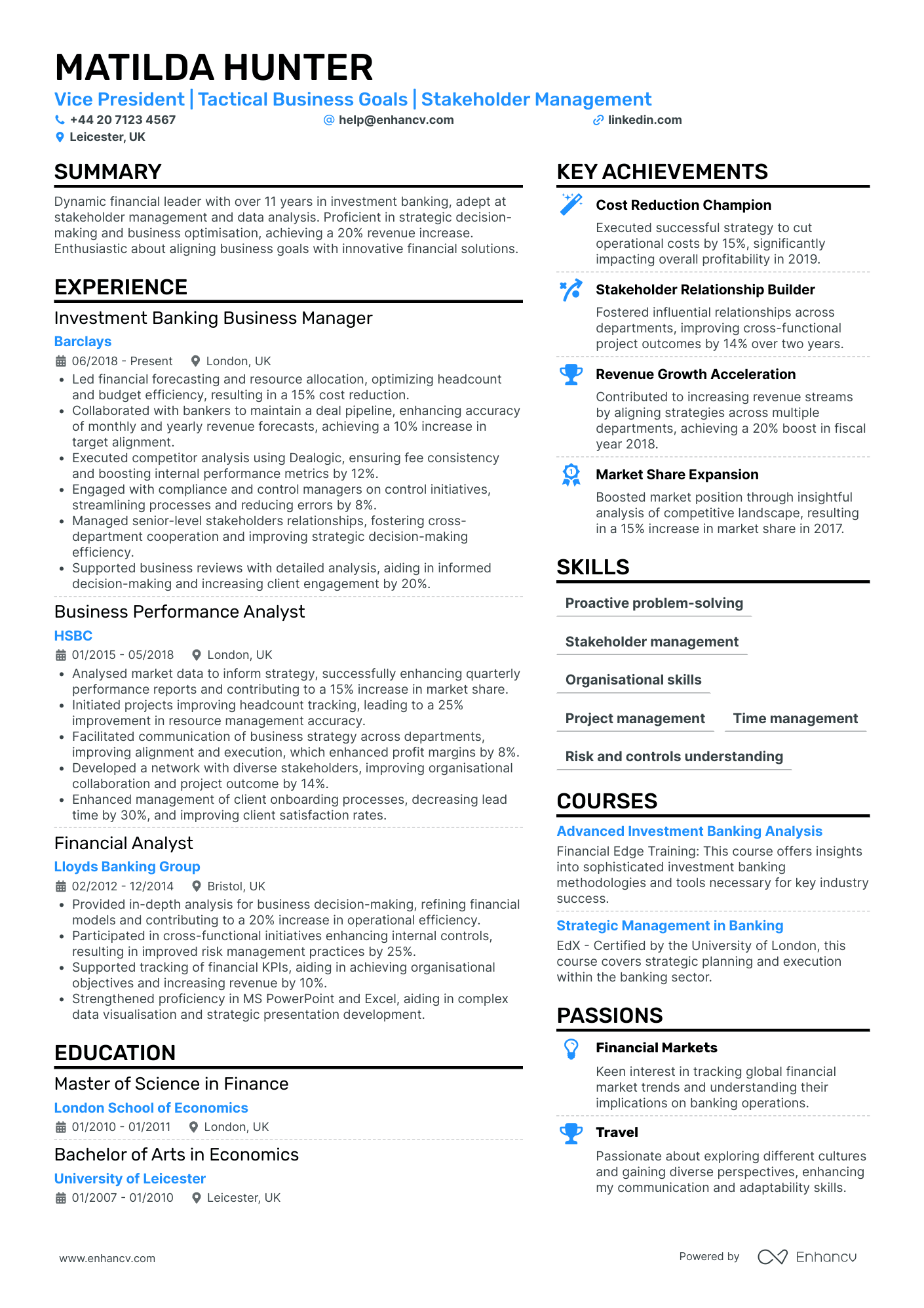
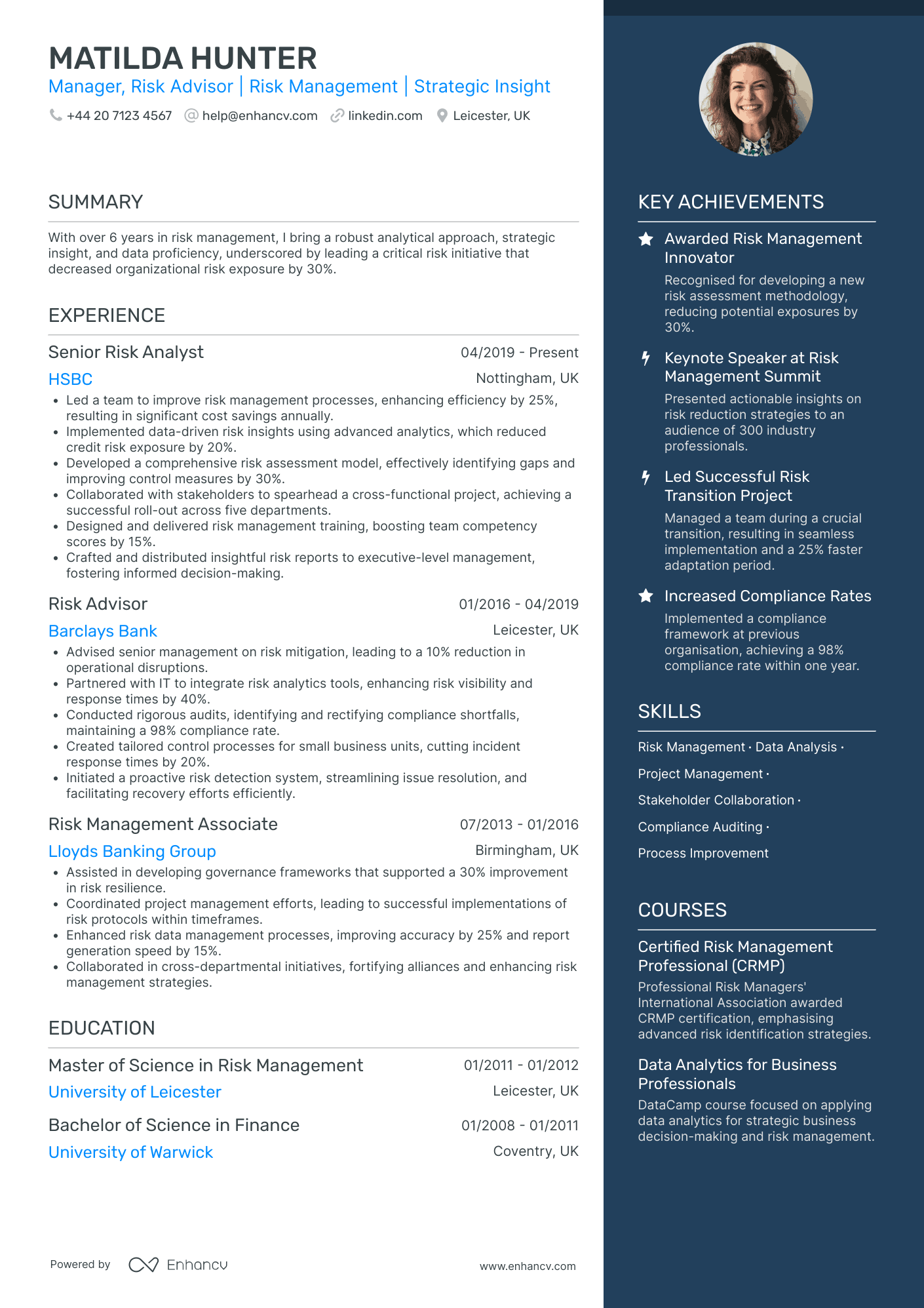
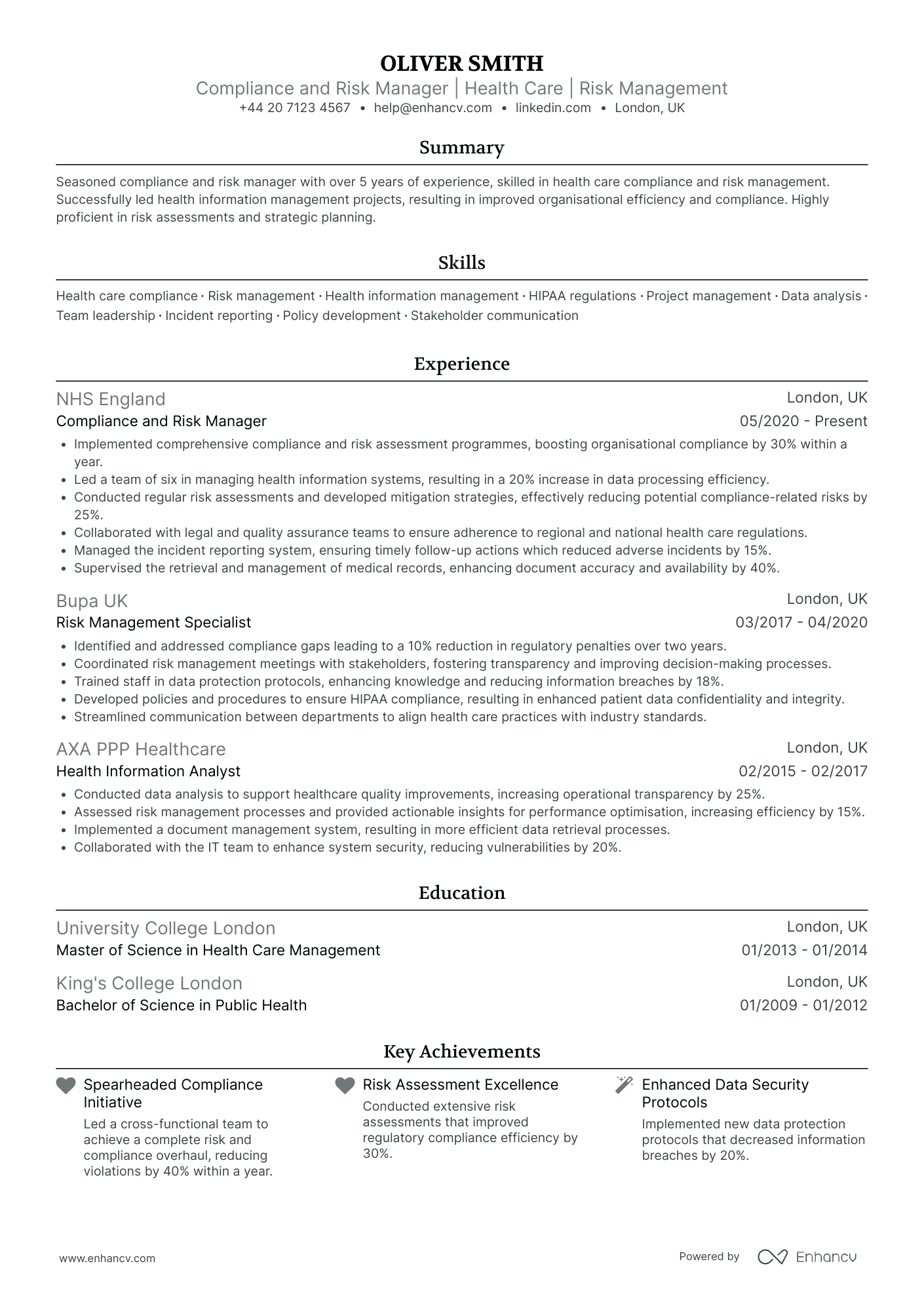
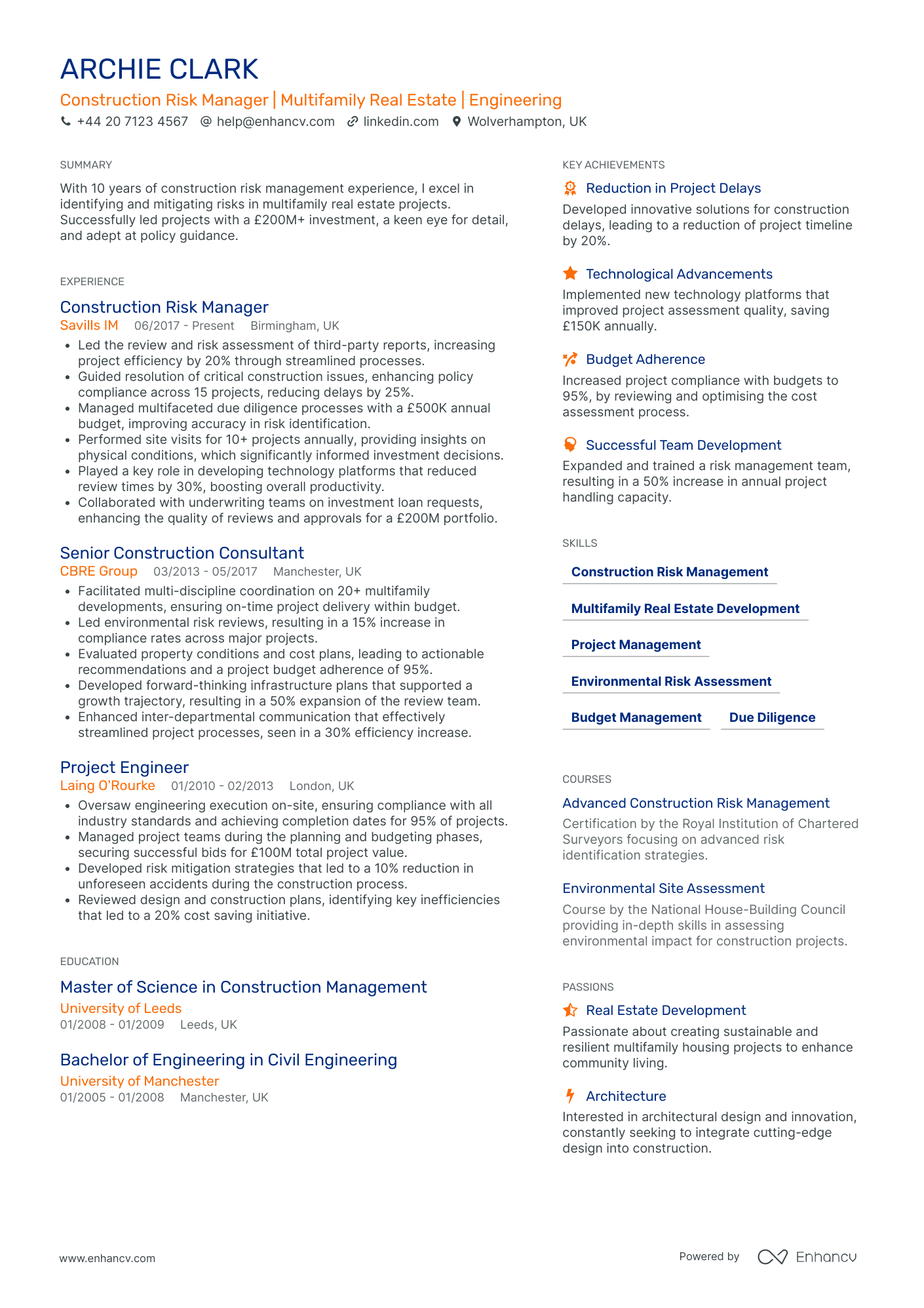
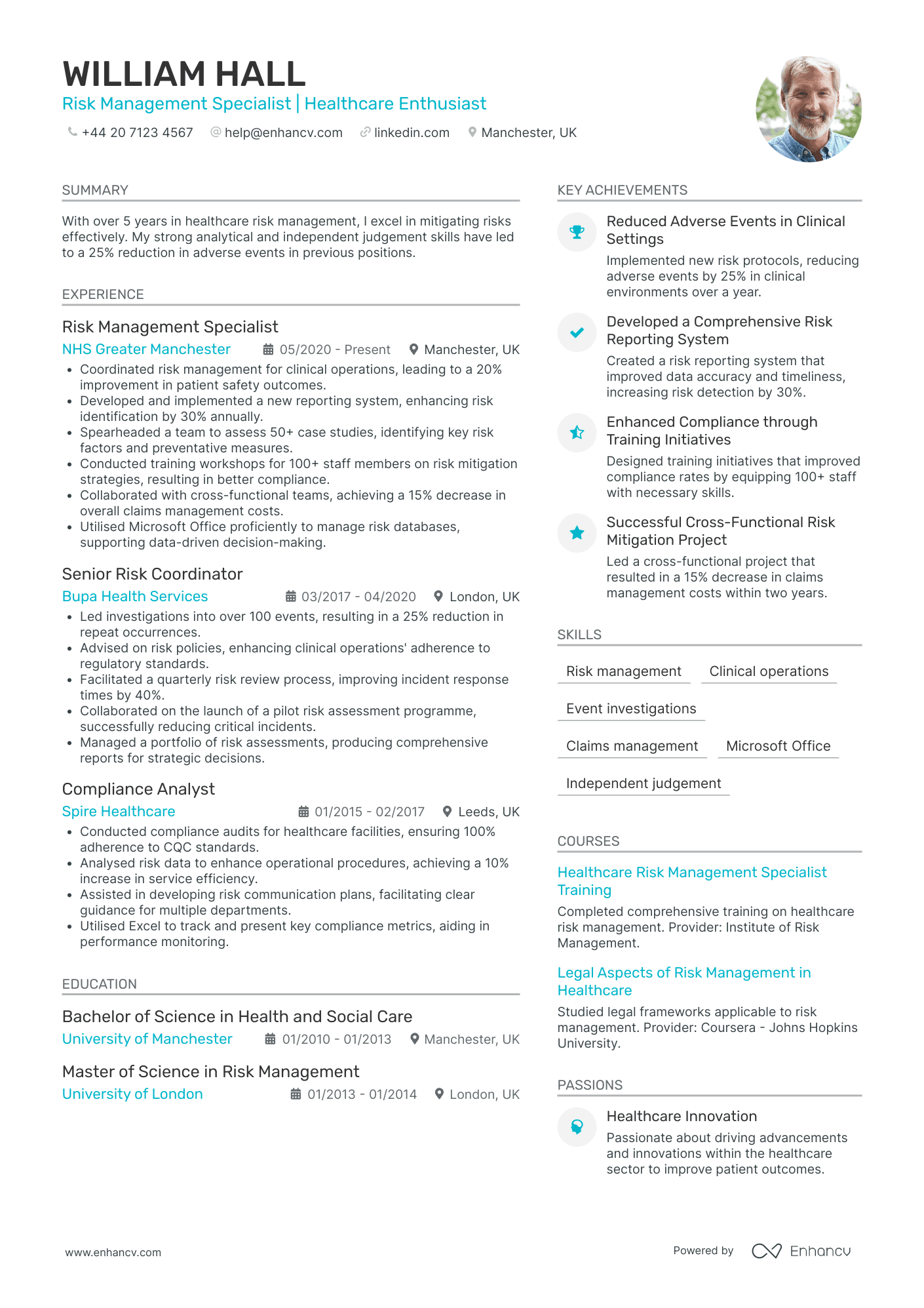
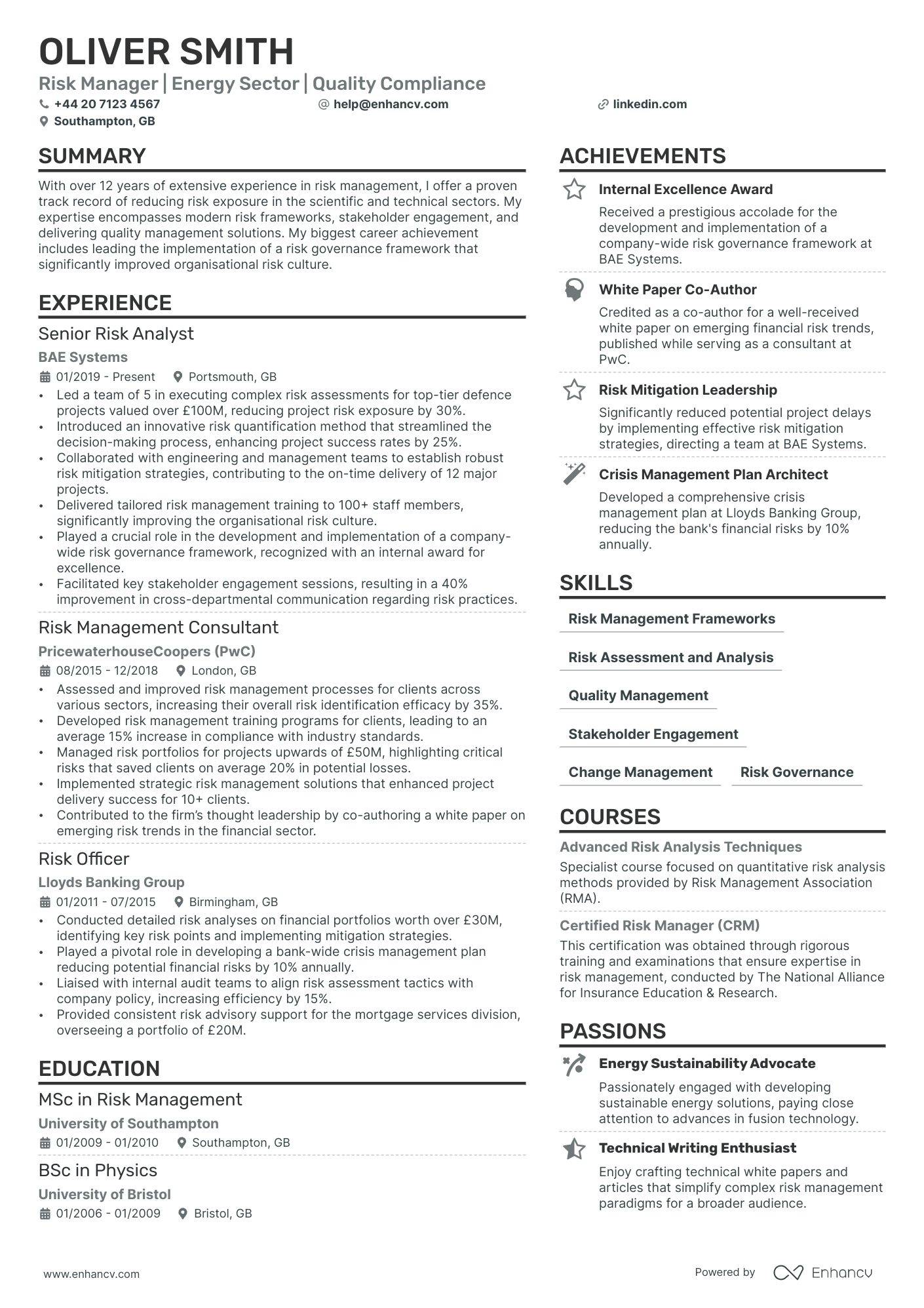
Most risk manager CVs read like the risk register itself: exhaustive, cautious, and impossible to skim. A hiring manager wants proof of one thing, and fast, that you can spot exposure before it costs money and get the business to act on it.
The CVs that get interviews lead with the competencies a risk function screens for and pin a number to each one. Get the fundamentals in our guide on how to write a CV, then focus on the risk-specific parts that decide the shortlist.

Key takeaways
- Lead with the skills a risk function screens for: risk management, risk reporting, and data analysis top live UK adverts.
- Quantify everything. Exposure reduced, losses avoided, audit findings closed, and controls tested all belong in numbers.
- Name the framework you work to, such as ISO 31000, COSO ERM, or the three lines of defence, rather than a memorised acronym.
- The UK market splits between hybrid and on-site roles, so put your location and working preference near the top.
- Nearly half of postings are pitched at lead level, so signal the seniority you are targeting in your personal statement.
- Two pages, reverse chronological, sent as a PDF unless the advert asks for a Word file.
Top skills for your risk manager CV
The question behind this page is which skills to put front and centre. Read a stack of live UK risk adverts and the same competencies repeat, and they are specific, not generic.
Risk management, risk reporting, and data analysis lead almost every posting. Close behind sit risk assessment, project management, and stakeholder management, with regulatory awareness and a working command of Excel assumed rather than asked for. Those are your hard skills, listed in the words the adverts use.
The pattern tells you something a generic careers article will not. Risk is now half analysis and half persuasion. The reporting and data skills prove you can quantify an exposure, and the stakeholder skills prove you can get someone to do something about it.
The soft skills that matter here are the ones that get a finding actioned: influencing without authority, clear written reporting, sound judgement under pressure, and managing stakeholders across the business. Prove each in a bullet rather than claiming it.
A skills list on its own convinces no one. Recruiters read the top box for keywords, then look to your experience for the proof. So treat the list as a promise and make sure every item reappears, evidenced, further down the page.
Top skills for your risk manager CV:
Risk management
Risk reporting
Data analysis
Risk assessment
Regulatory compliance
Internal controls
Key risk indicators (KRIs)
Excel and data visualisation
Risk frameworks (ISO 31000, COSO ERM)
Stakeholder management
Influencing
Written communication
Judgement under pressure
Attention to detail
List only what you can stand behind. If you have run a control self-assessment or built a risk register in a named tool, name the tool and the outcome. If you have only studied a framework, keep it under qualifications rather than skills.
Two skills separate a shortlisted risk CV from the pile. Data analysis, because risk is quantitative and boards want numbers, and stakeholder management, because a risk that no one acts on is a risk you failed to manage. Give each its own evidenced bullet.
Here is what evidenced looks like. For data analysis, do not write strong analytical skills. Write built a KRI dashboard that flagged a breach two quarters early. For stakeholder management, do not write excellent communicator. Write persuaded three business heads to fund a control that closed a £3m gap.
The same rule applies to regulatory knowledge. Naming the regimes you have worked under, whether that is Solvency II, Basel, the SMCR, or GDPR, is far stronger than a generic line about compliance, because it tells a recruiter exactly which desk you can sit at on day one.
One newer signal is worth acting on. AI now appears in the skill tags of a sizeable share of UK risk postings, so if you have used models for scenario analysis, fraud detection, or automating a reporting pack, name the tool and the time or accuracy it bought you. It is a fast way to look current on a desk that is changing.

PRO TIP
Mirror the advert's exact risk vocabulary. If it says operational risk, ICAAP, ORSA, KRIs, or three lines of defence, use those terms where they are true of you. A CV that says managed risks where the advert says owned the operational risk framework reads as junior.
What the UK risk manager market looks like
Two things about the market should shape the CV before you write a word.
| What | UK risk manager roles |
|---|---|
| Where the work happens | Hybrid 51% and on-site 47%, with remote barely featuring (68 and 63 of 134 UK risk manager postings in the last ~30 days, Enhancv's internal job feed) |
| Seniority asked for | Lead 48% · mid 37% · senior 15% (of 134 UK postings, last ~30 days, Enhancv's internal job feed) |
| Skills that recur most | Risk management (66 of the 134 postings), risk reporting, and data analysis lead, then risk assessment, project management, and stakeholder management (Enhancv's internal job feed, last ~30 days) |
| An emerging signal | AI shows up in the skill tags of a growing share of postings (26 of 134, Enhancv's internal job feed, last ~30 days) |
Hybrid and on-site roles split almost evenly, and remote work barely features, so a recruiter needs to see where you are based and how you prefer to work. Put your location and working preference in the header.
Nearly half of the postings are pitched at lead level. If you are targeting one of those, your personal statement has to show you own risk outcomes, not just support them.
Pay for risk managers varies widely by sector and seniority, from financial services to the public sector, so treat any single headline figure with caution and research the bands for your specific niche.
Choosing a risk management framework for your CV
The popular acronym lists, the five P's, the four A's, the seven elements, circulate widely, but interviewers rarely test them and the wording changes from source to source.
What a hiring manager checks is whether you can apply a recognised framework to real exposure. Three are worth naming on a UK CV:
- ISO 31000, the international standard, gives you the process language: context, identify, assess, treat, monitor, and review.
- COSO ERM, common in financial services and internal audit, links risk to strategy and controls.
- The three lines of defence, which shows you understand where your role sits between the business, the risk function, and internal audit.
The three lines of defence deserves a special mention, because UK financial services adverts lean on it heavily. If you have sat in the first line owning risk in the business, the second line challenging it, or the third line auditing it, say which, because employers hire for a specific line and read that language fast.
Name the one you actually work to and show it in an achievement, for example rebuilt the operational risk register to ISO 31000 and cut overdue actions by 40%. That beats reciting an acronym every time, and it is the fastest way to tailor your CV to the advert in front of you.
On a risk CV, we look for one thing above the framework name: evidence the person changed a decision. Anyone can list ISO 31000. The candidates who get interviews write the exposure they found, the number attached to it, and what the business did differently because they raised it. A risk that got actioned is worth more than any qualification on the page.
Formatting your risk manager CV
Use a reverse chronological format. Risk is a career where progression and sector matter, and recruiters read your last three roles first.
Keep it to two pages, one column, standard headings, and a readable font. A risk lead skimming twenty CVs will not hunt for your best work, so choose a clean CV format that puts it up top.
Send a PDF for direct applications so the layout holds, and keep a Word copy for agencies that reformat risk roles into their own template. If the advert names a file type, follow it.
Order the sections to match how this market reads a CV. Personal statement, then key skills, then experience, then qualifications, so the framework knowledge and the numbers land before the reader scrolls. A separate certifications block near the top earns its place when your qualifications are the headline.
Risk applications in banking and insurance often pass through tracking software, so keep the layout clean and the headings standard for an ATS-friendly CV. Build from a tested layout rather than a blank page. Enhancv's CV templates export to a clean PDF.
Is your resume good enough?
Drop your CV here or choose a file. PDF & DOCX only. Max 2MB file size.
Writing your risk manager personal statement
Three or four sentences at the top: who you are, the risk domains you own, the framework you work to, and the level you are targeting. Keep it concrete. See more personal statement examples if the opening line is not landing.
Match the statement to the seniority you are chasing. A lead role wants ownership language, so open with the frameworks and books of business you have run. A first risk role wants transferable proof, so open with the analysis, audit, or compliance work that already looks like risk.
Skip the adjective soup. Detail-oriented, proactive risk professional tells a recruiter nothing they can check.
Lead with evidence instead:
Risk manager personal statement example
Risk manager with eight years in financial services and a track record of turning risk data into board decisions. Rebuilt an operational risk framework to ISO 31000, cut overdue control actions by 40%, and cleared two consecutive internal audits with no major findings. IRM Level 5 qualified, targeting a lead risk role in insurance or banking.
What to avoid
A passionate and detail-oriented risk management professional with excellent communication skills, seeking a challenging role in a dynamic organisation where I can utilise my abilities and grow.
The second version could describe anyone in any function. The first names a framework, a number, and a target, which is what a risk lead reads for.
Moving into risk from an analyst, audit, or compliance role uses the same trick. Lead with the parts of your current job that already are risk work, such as building reporting, testing controls, or flagging exposures, and translate them into risk language. You have more relevant evidence than the job title on your last payslip suggests.
Writing your risk manager experience section
Write each role the same way: a dated heading, then bullets that lead with a verb and end with a number. For the mechanics, see work experience on a CV.
Risk work is measurable even when it feels like governance. Exposure reduced, losses avoided, findings closed, capital freed, controls tested, and reporting cycles shortened are all achievements you can quantify. Lead each bullet with a strong action verb.
Structure each bullet as exposure, action, and outcome. Name the risk you were dealing with, what you did about it, and the number that changed. That order reads the way a risk committee thinks, and it stops your bullets sounding like a list of duties.
If you have moved through first, second, and third line roles, or across sectors, let the progression show. A recruiter reading your last three roles first should see growing ownership, from supporting a framework to owning it to setting the appetite.
Tailor every application. Pull the risk domains and framework names from the advert and mirror them where they are true of you. Enhancv's CV tailoring feature reads the advert and suggests the matching edits, which saves rewriting from scratch each time.
- Own the operational risk framework for a £2bn general insurance book, reporting quarterly to the board risk committee
- Cut overdue control actions by 40% in 12 months by rebuilding the risk register to ISO 31000 and chasing owners weekly
- Led the ORSA process across three business lines and cleared the PRA review with no major findings
- Built a KRI dashboard in Power BI that flagged a £1.2m fraud exposure two quarters before it crystallised
PRO TIP
Every risk bullet needs a number and a consequence. Identified a control gap is a task. Identified a control gap that would have exposed £3m and closed it within 30 days is an achievement. If you cannot attach a number, attach an outcome.
Education and certifications for a risk manager CV
A degree helps but rarely decides a risk hire. Professional qualifications and the frameworks you have applied carry more weight, so give them room in your education section.
Numerate degrees such as economics, finance, mathematics, or engineering read well for a risk role, but they are not a barrier if yours is elsewhere. What a hiring manager wants to see is that you can handle data and structured judgement, and a qualification plus a quantified achievement proves that faster than the subject on your degree.
List the ones you hold or are working towards: the Institute of Risk Management (IRM) qualifications, the FRM or PRM for financial risk, and PRINCE2 or an agile certificate where the role touches project risk. Put them in a dedicated certifications block if the list is long, and mark anything in progress honestly.
Name any framework training too. A line such as ISO 31000 and COSO ERM applied in practice does more than a list of course titles, and naming the certificates you hold saves the employer a question.
Conclusion
Lead with the skills a risk function screens for, name the framework you work to, and attach a number to every claim.
Pair the CV with a short cover letter that connects your risk record to this employer's exposure, and you turn a cautious CV into a confident application.

Author's take - the Enhancv team
On a risk CV, we look for one thing above the framework name: evidence the person changed a decision. Anyone can list ISO 31000. The candidates who get interviews write the exposure they found, the number attached to it, and what the business did differently because they raised it. A risk that got actioned is worth more than any qualification on the page.