



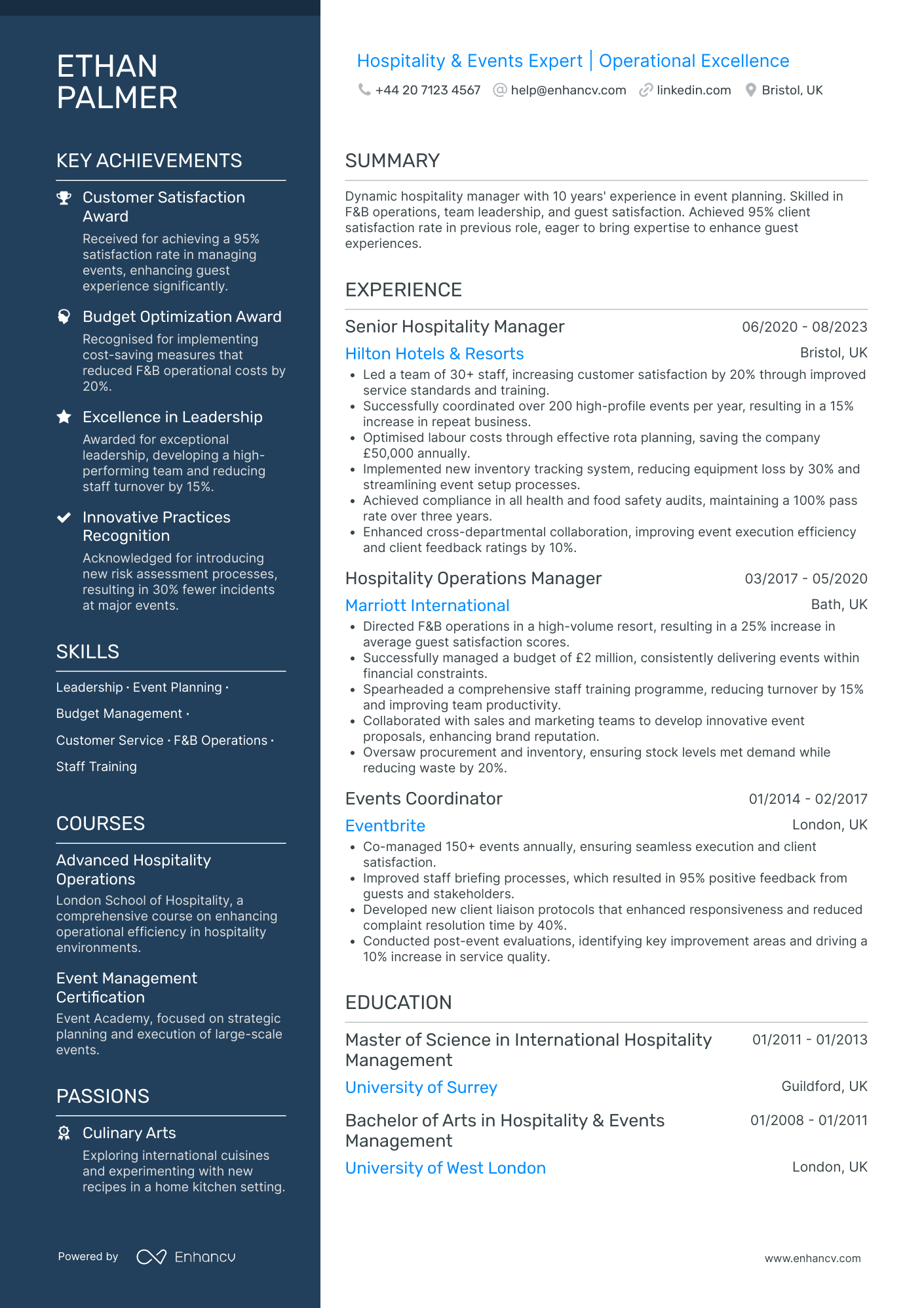
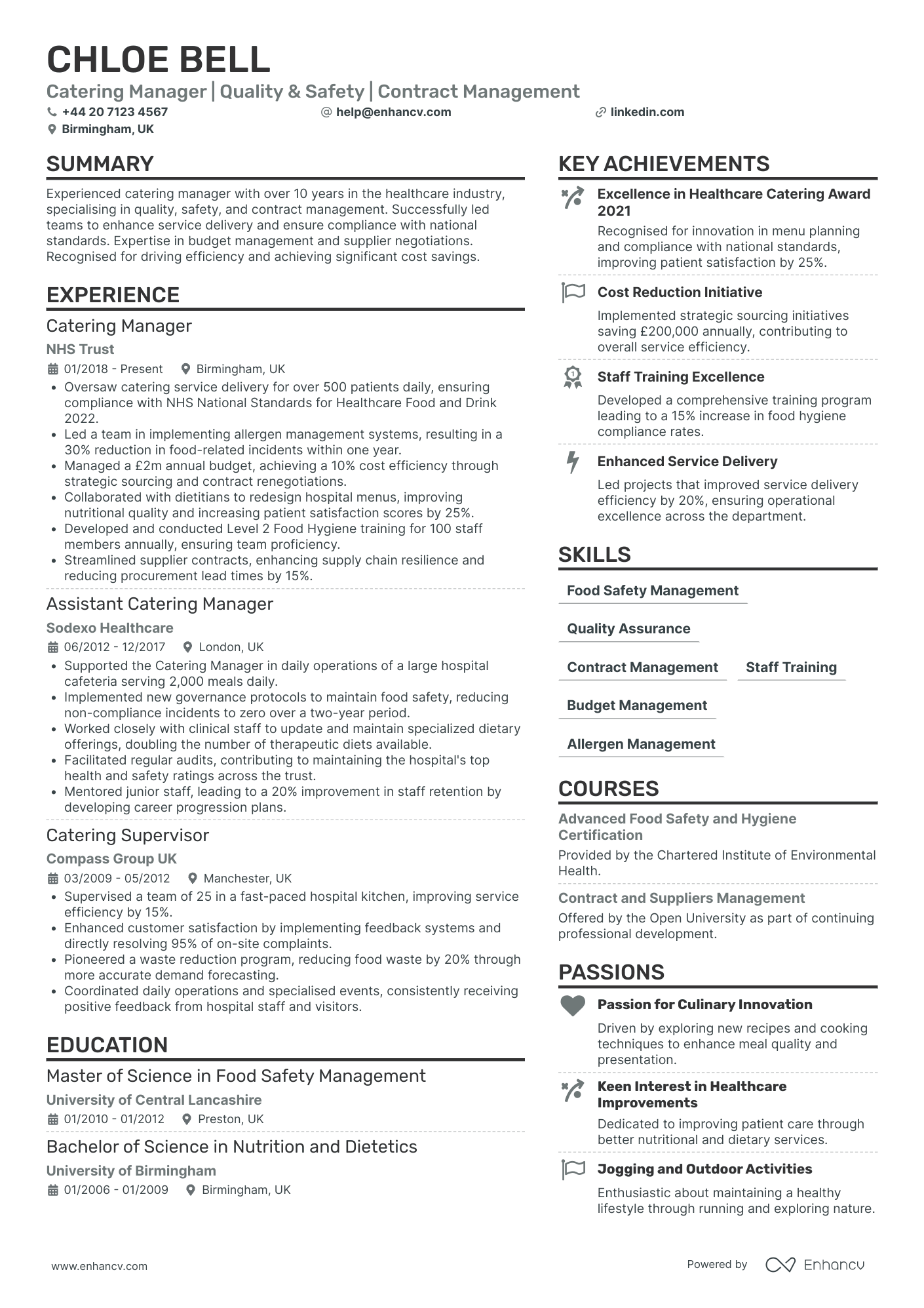
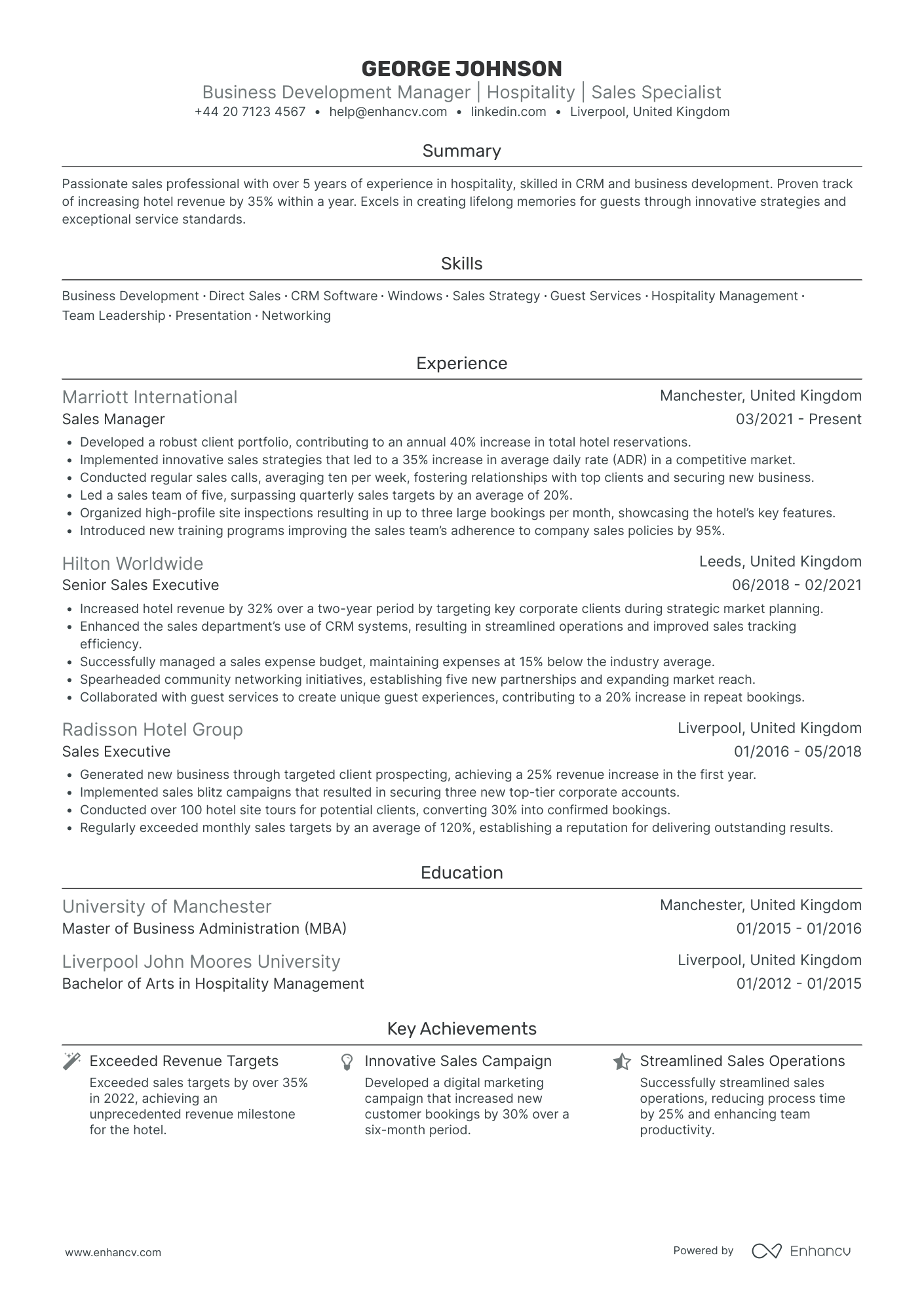
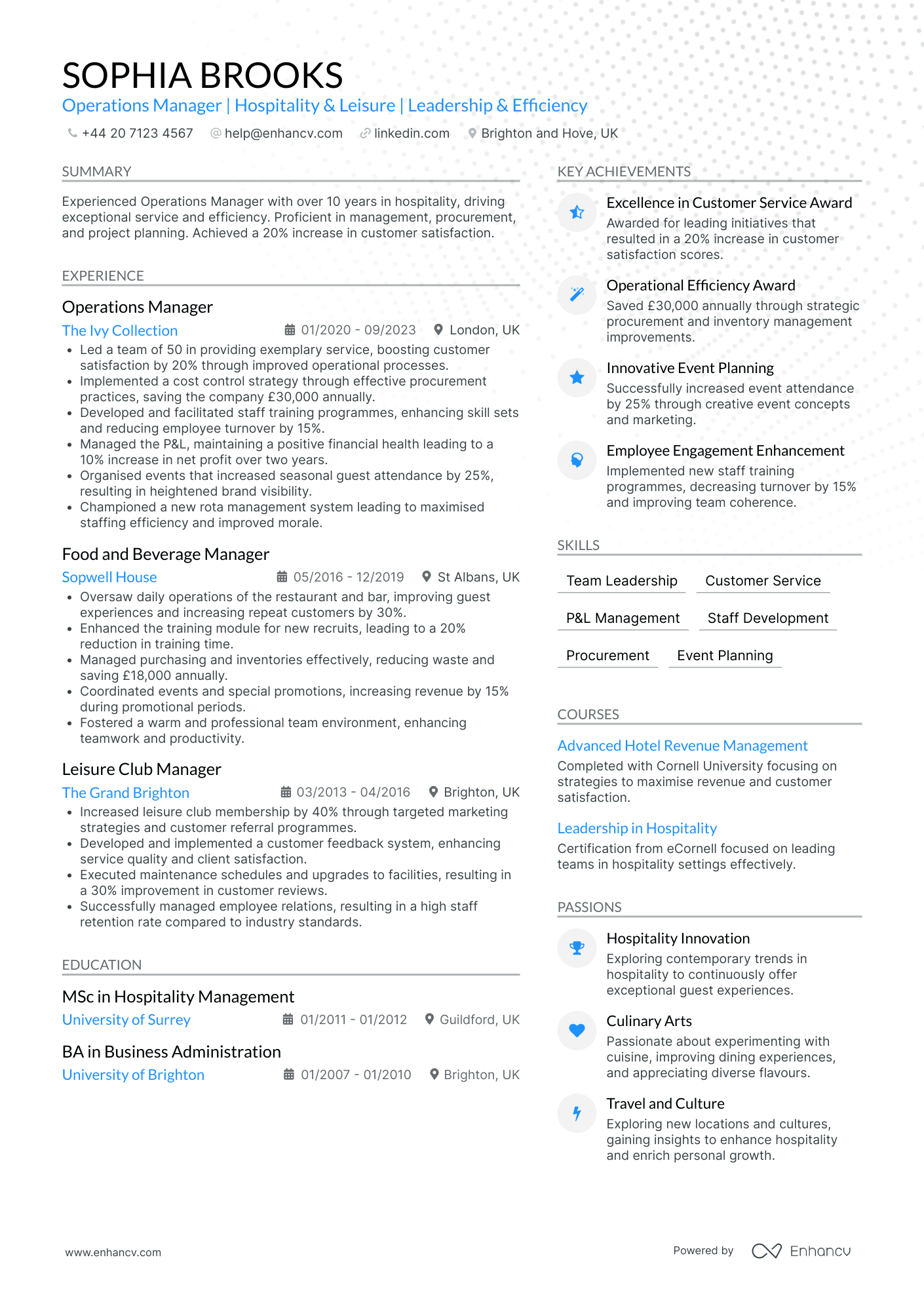
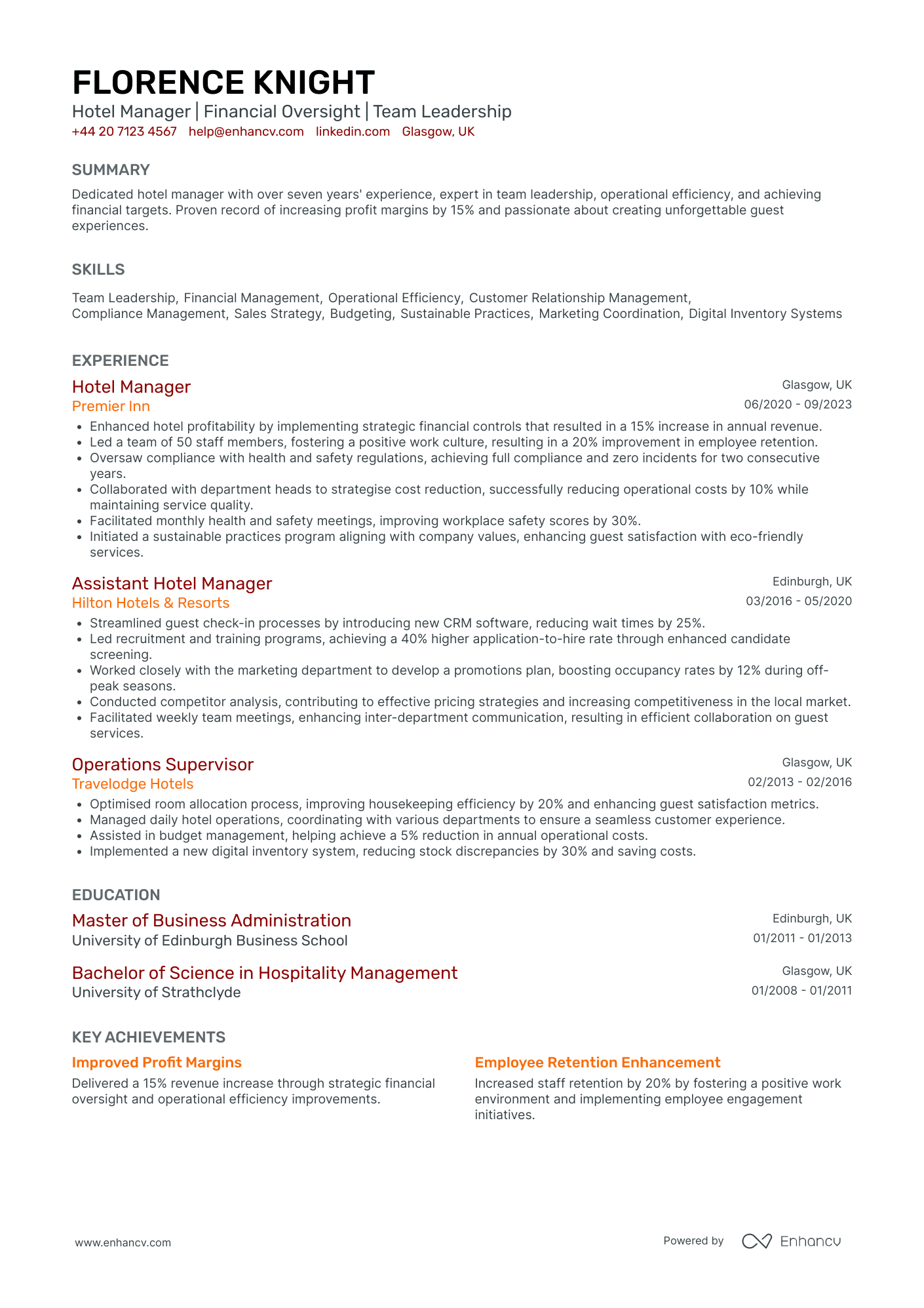
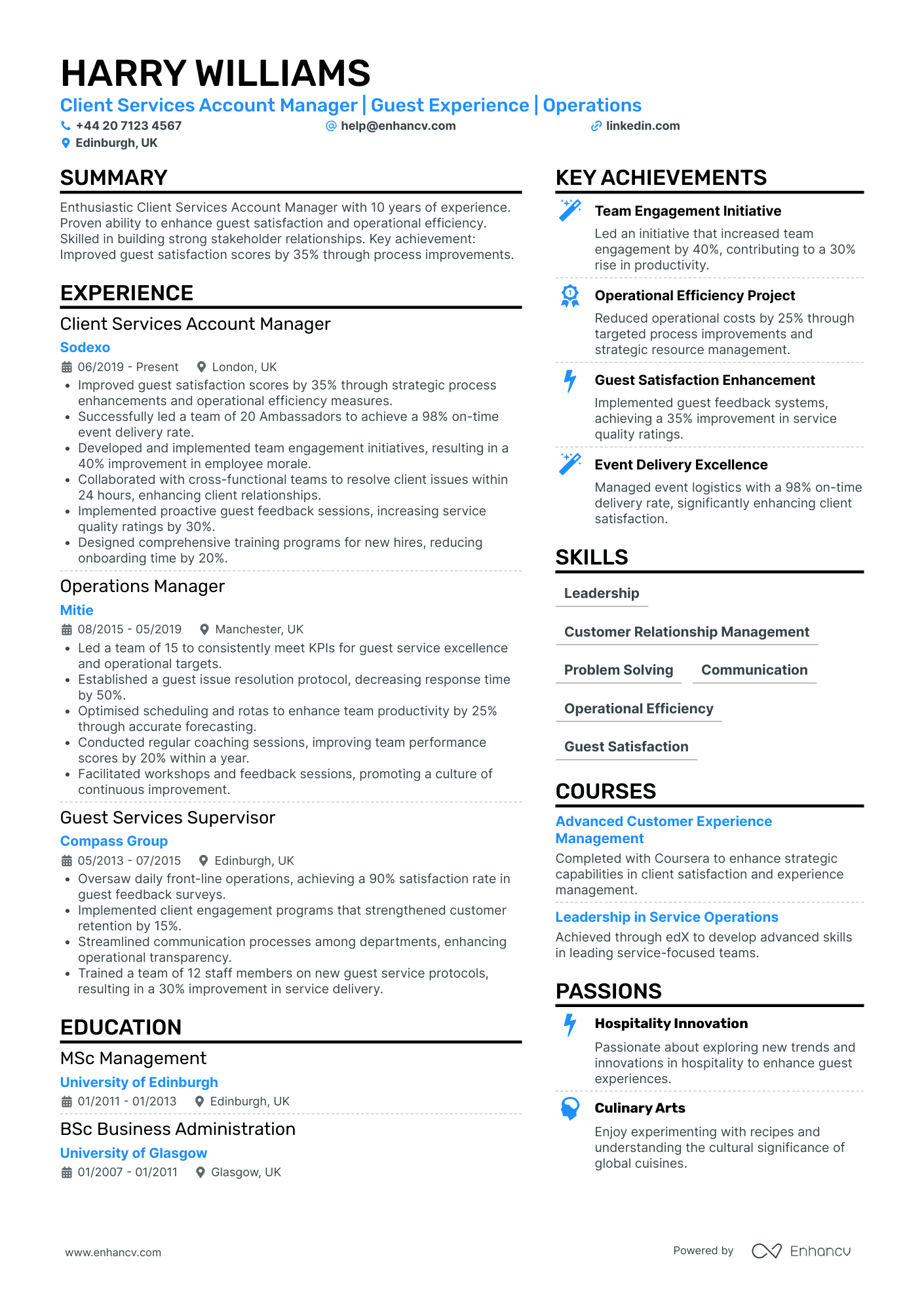
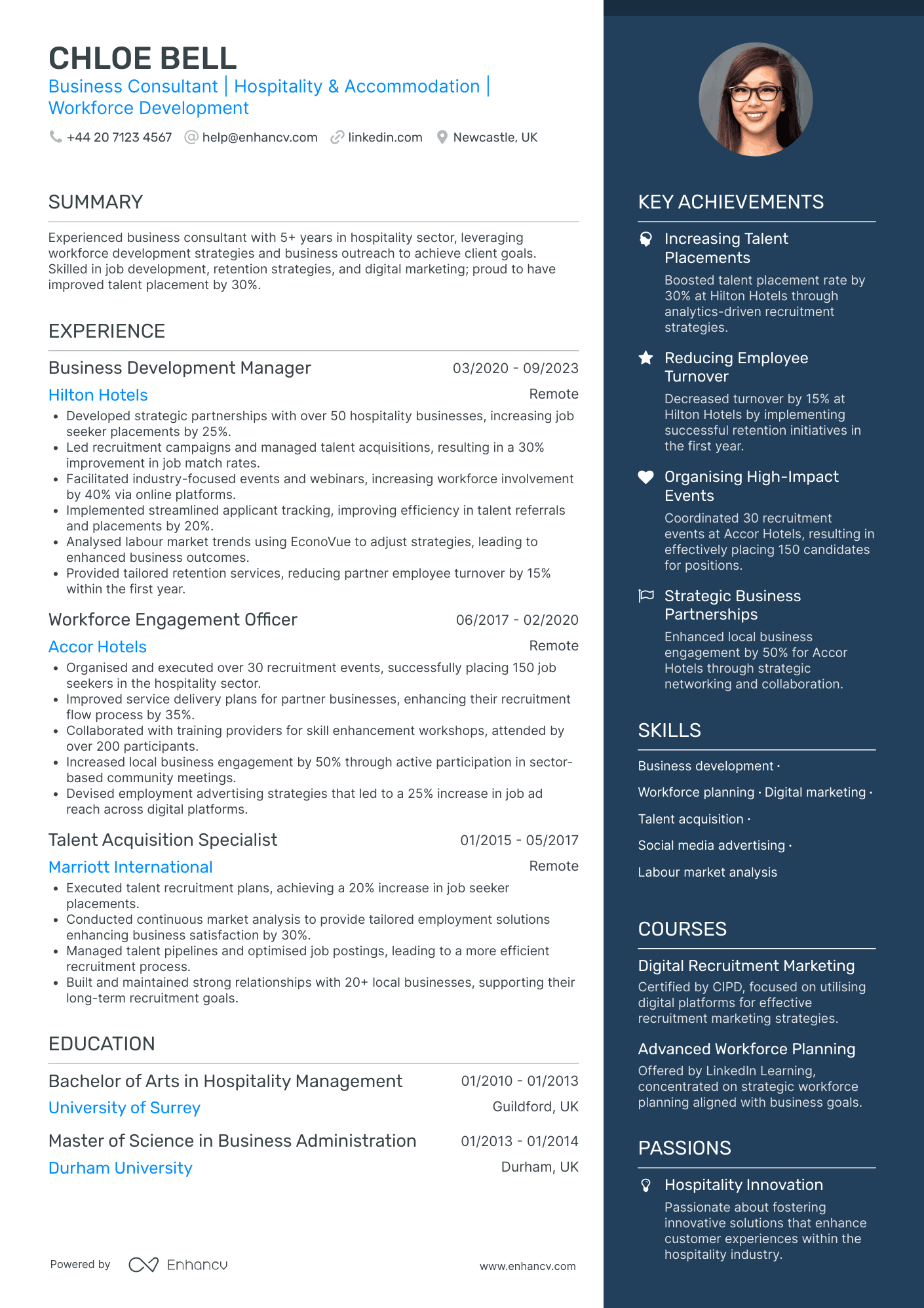
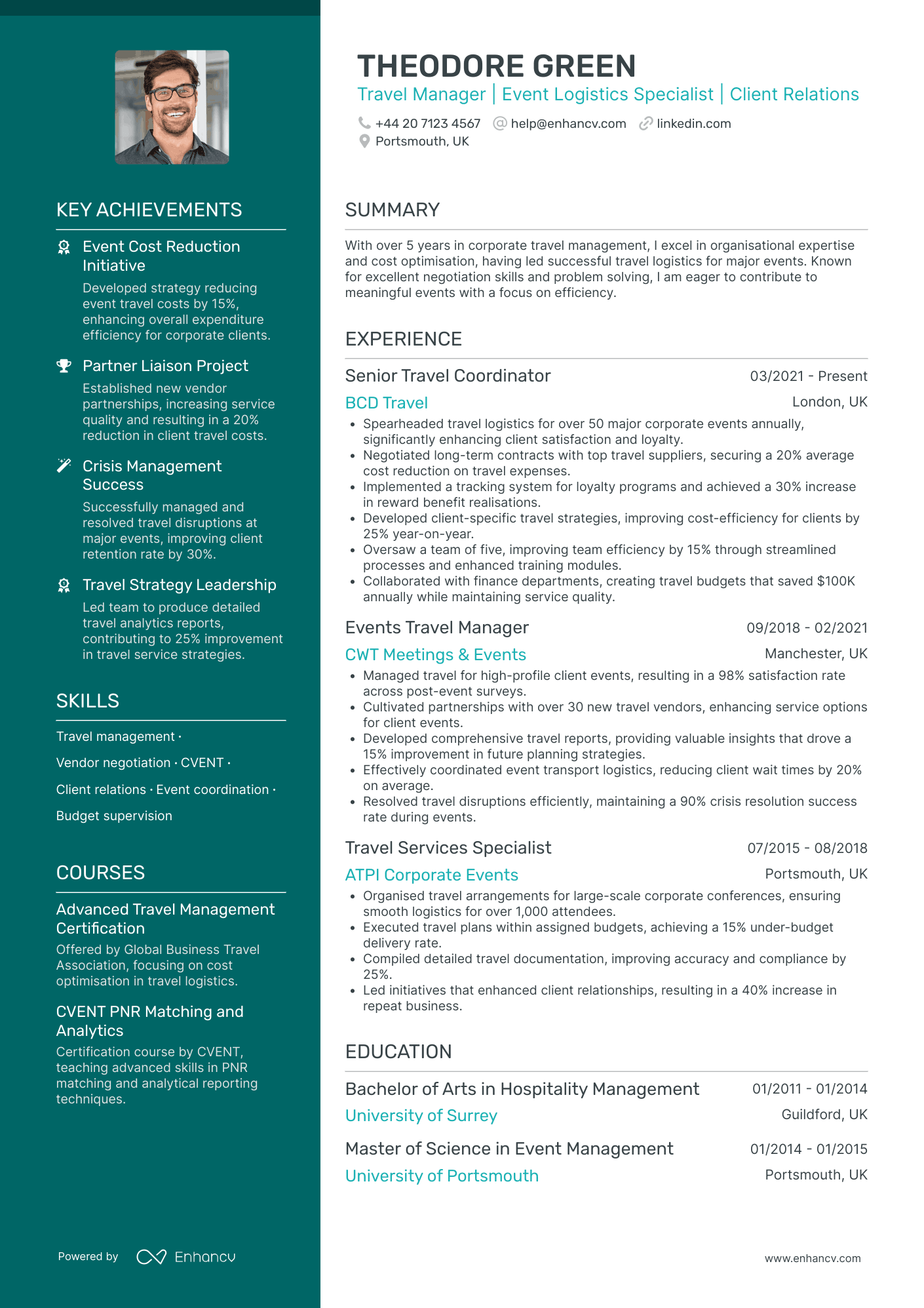
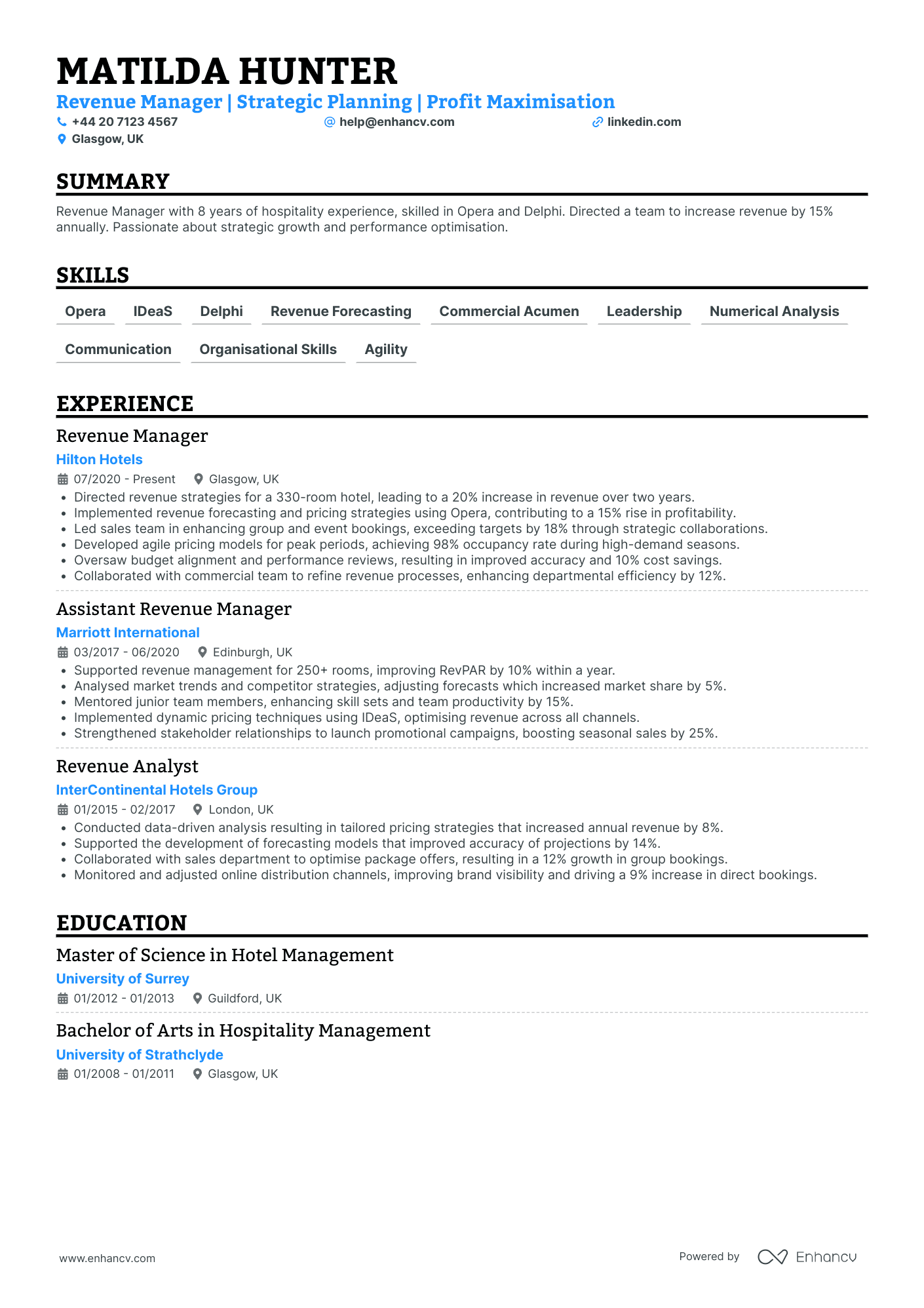
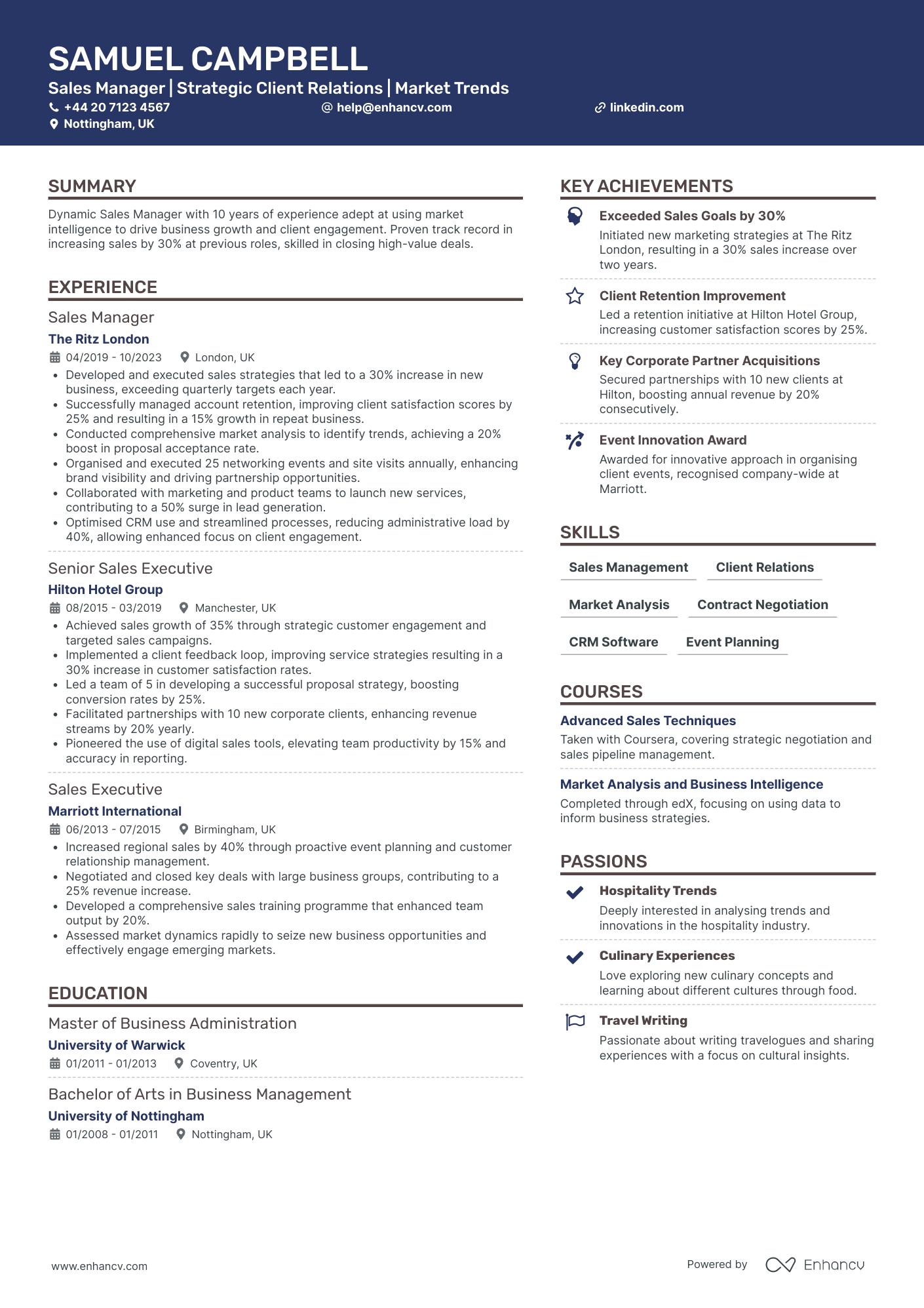
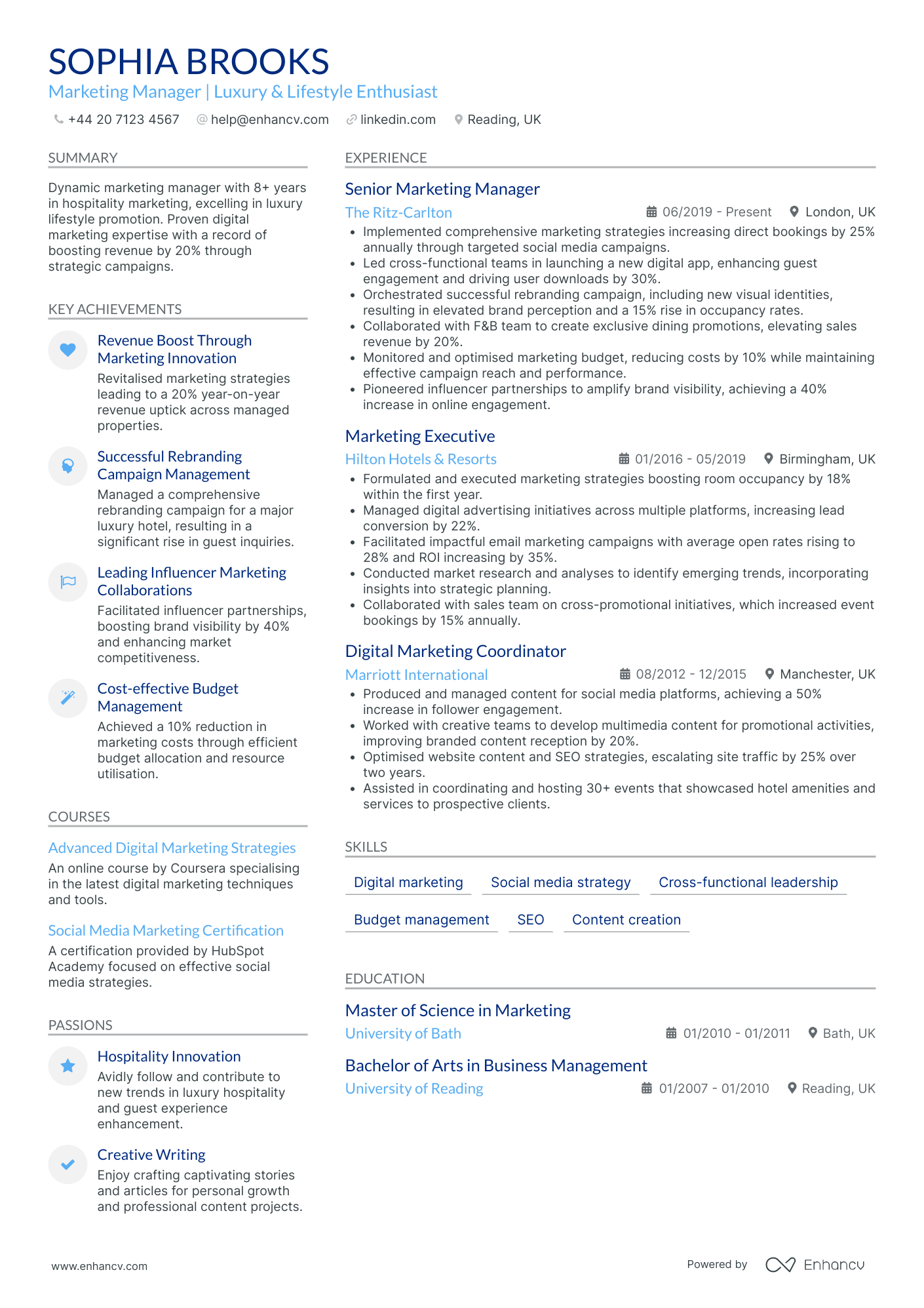
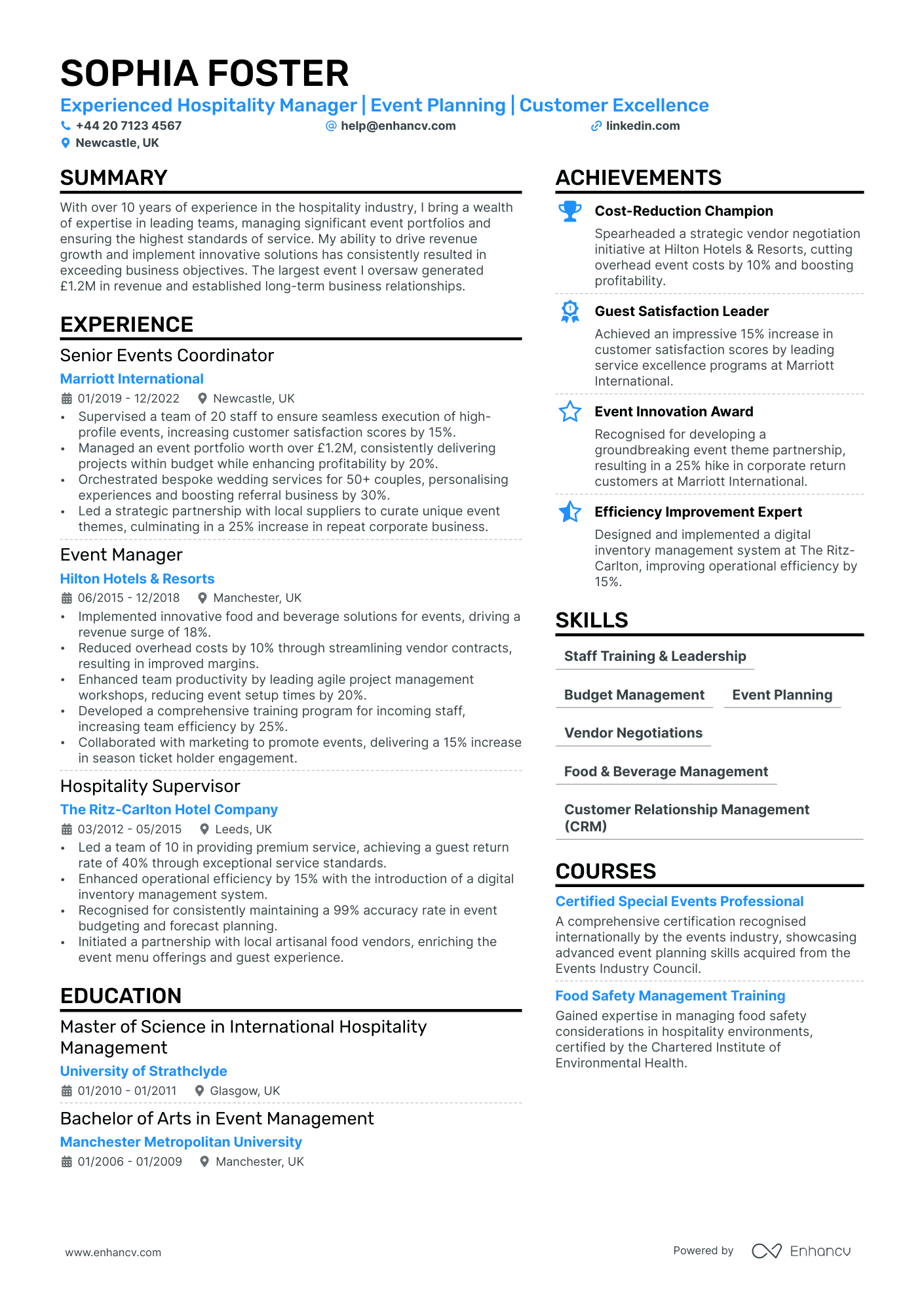
Most hospitality manager CVs read like a shift handover. A wall of duties, and not one line that proves a single service ran better because you were on the floor.
The CVs that get interviews do the opposite. They lead with covers managed, teams led, and costs kept under control, then back each claim with a number a recruiter can picture. If you want the fundamentals first, start with how to write a CV.

Key takeaways
- No management title yet is normal. Lead with the supervisory moments you already own: covering shifts, key-holding, training starters, and running a section under pressure.
- Hospitality is on-site and floor-based, so put your location, availability, and any driving licence near the top.
- Name the compliance employers screen for: food safety, health and safety, licensing, and stock or cellar control.
- Quantify everything. Covers served, team size, labour and stock costs, guest scores, and complaints resolved are your achievements.
- Two pages, reverse chronological once you have management roles, sent as a PDF unless the advert asks for a Word file.
- List your certificates even in progress: Level 2 Food Safety, a Personal Licence, first aid, and any hospitality qualification.
Writing a hospitality manager CV with no experience
Almost nobody starts with a manager's title. Most hospitality managers step up from supervisor, team leader, or duty shifts, or they move across from retail, events, or another service role. Your first management CV has to prove readiness, not tenure.
That is good news, because hospitality promotes on proof of responsibility more readily than on years served. A recruiter reading a step-up CV wants to see that you have already carried the weight of a shift, even once, and that you know what goes wrong when nobody does.
So lead with a skills-led structure: personal statement, then the leadership and compliance skills you can evidence, then experience written to show responsibility, with dates and job titles lower down.
Mine every shift for real management evidence. It is almost always there:
- Covering as duty manager or keyholder when the manager was off: opening or closing the venue, cashing up, and handling the float.
- Running a section or a full service on your own: the covers served, the team you directed, and the problems you fixed on the night.
- Training and onboarding new starters, writing or rebuilding a rota, ordering stock, or cutting waste.
- Handling complaints, refunds, and difficult guests at the table without escalating them.
- Standing in during an inspection, a stocktake, or a supplier delivery that went sideways.
Write those in management language. "Ran the floor as duty manager two nights a week for a 90-cover restaurant" is a management bullet, even if "manager" was never on your contract.
Adjacent experience carries across too. Retail keyholding, shift leadership, or event coordination all count, and volunteering on a CV that involved organising people or running an event is evidence, not filler.
Line up a reference who can vouch for the responsibility, ideally a current or former manager who saw you cover shifts. In hospitality a quick word from a known operator carries real weight, so name a referee or note that references are available.
One line lifts a step-up CV to the top of the pile: "Level 2 Food Safety certificate held, Personal Licence in progress". It tells an employer you already understand what running a venue demands. For structure, browse a few first job CV examples and adapt them upward.

Turn covered shifts into management evidence
The single most useful move on a step-up CV is to name the shifts you ran without the title. Give each one a date, a venue size, and a result: "Duty manager cover, 120-cover gastropub, Fridays and Saturdays, closed the site and cashed up nightly for six months." That reads as management. "Assisted the manager" does not.
What UK hospitality employers look for
Read a stack of live UK hospitality manager adverts and the same priorities repeat. Get them onto the CV and you are already ahead of most applicants who send the same generic document to every venue.
| What | UK hospitality manager roles |
|---|---|
| Where the work happens | On-site and floor-based. Managers are expected in the venue during service, so make your location, availability, and any driving licence easy to find. |
| Typical settings | Hotels, restaurants, bars, pubs, and event or contract catering, from a single site to a small group of venues. |
| What employers screen for | Food safety and health and safety compliance, team leadership, budget and stock control, and customer service, listed in the words the advert uses. |
| Pay | Varies widely by venue type, size, and region, so research the specific employer rather than relying on a single headline figure. |
Two of those shape the CV most.
The work is on-site, so a recruiter needs to see you can reliably be there for service. Put your town, your availability, and a driving licence if you have one in the CV header.
And the compliance line matters more here than in most roles. Food safety and health and safety are not optional extras in a venue, so name the training you hold and treat it as a headline rather than an afterthought.
Cost control is the quiet differentiator. Two candidates can both say they ran a busy floor, but the one who shows a labour percentage held to target, wastage kept low, or a stock variance closed is the one who reads as ready for a profit and loss line. Put a number against it wherever the truth allows.
Formatting your hospitality manager CV
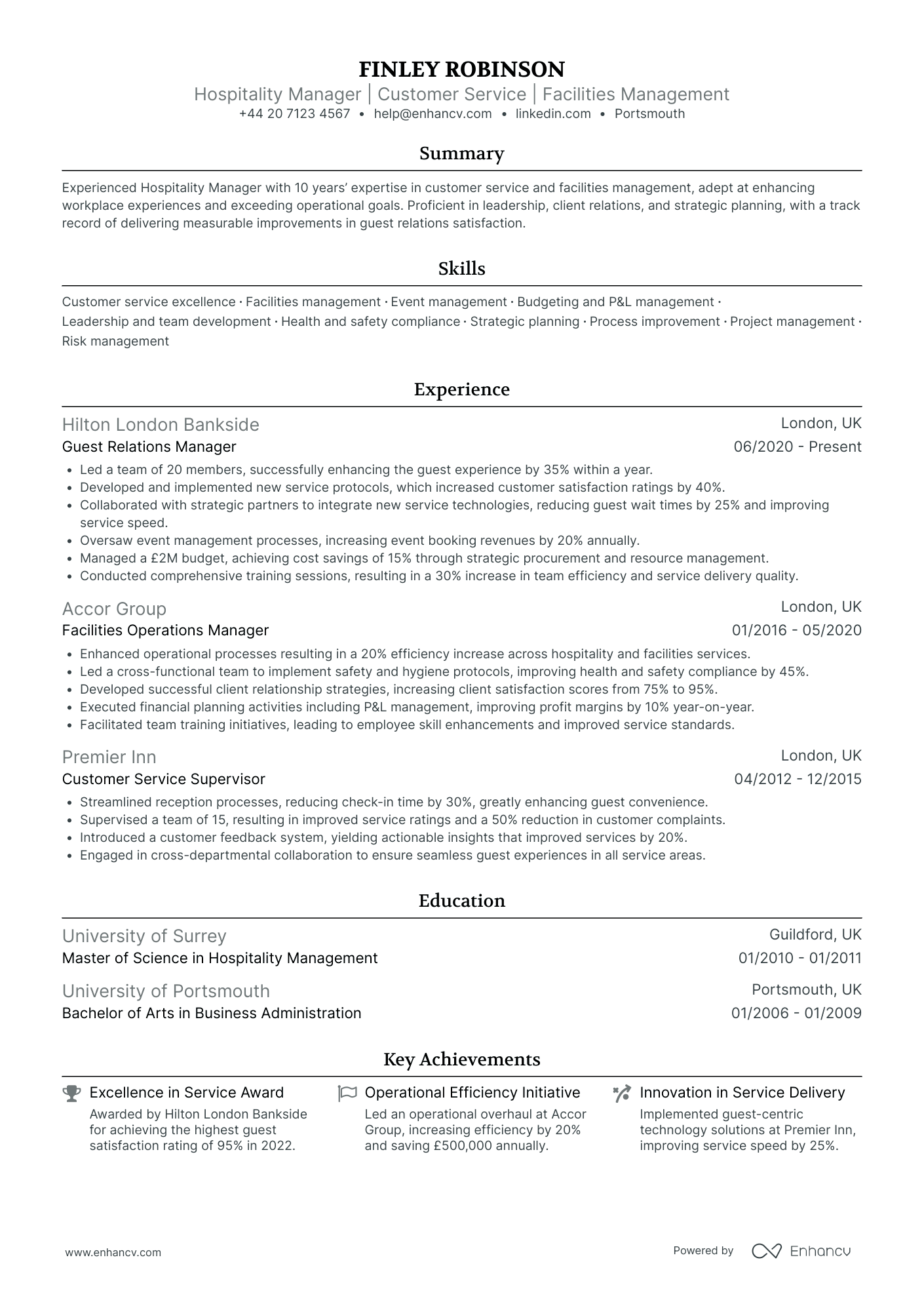
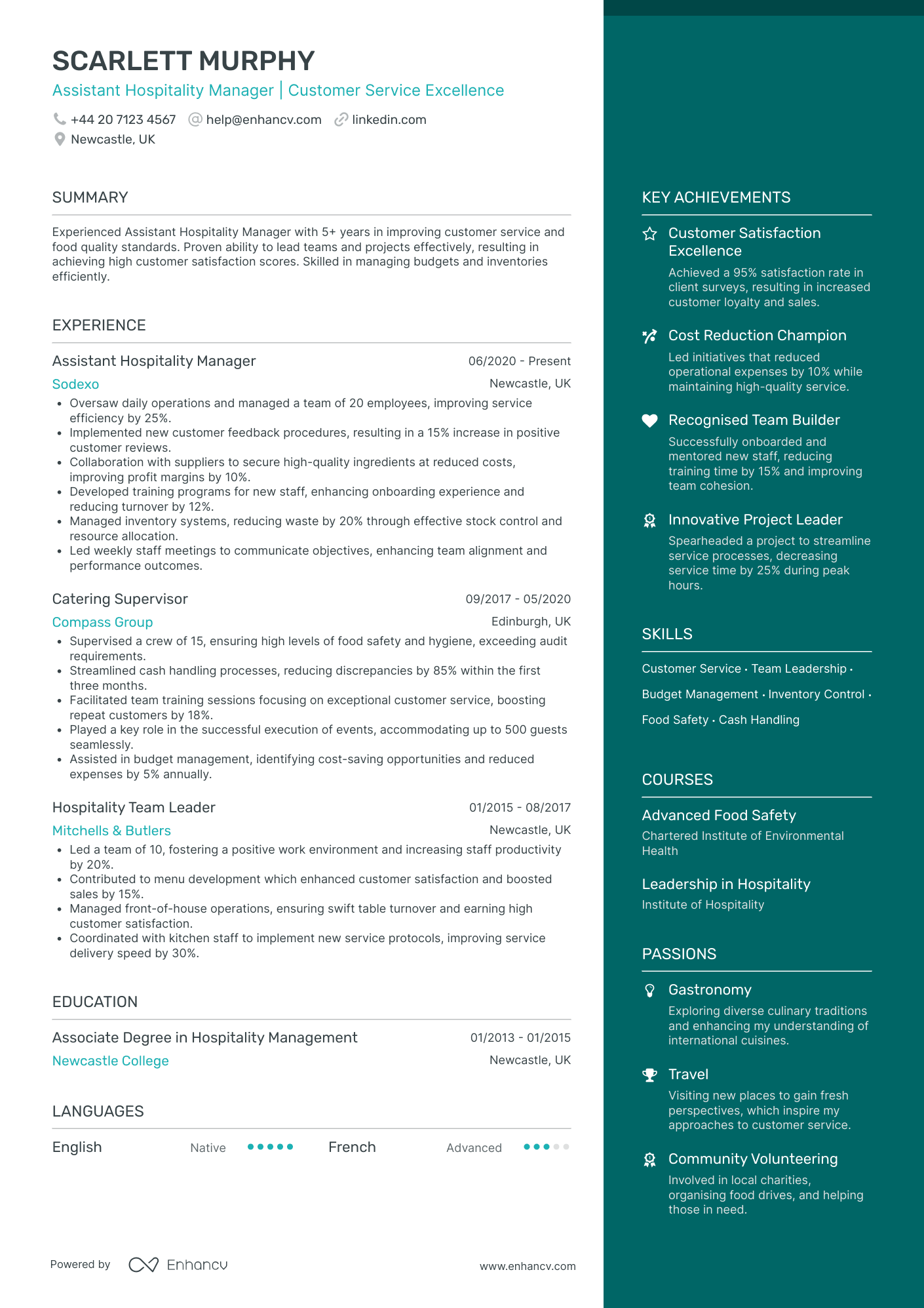
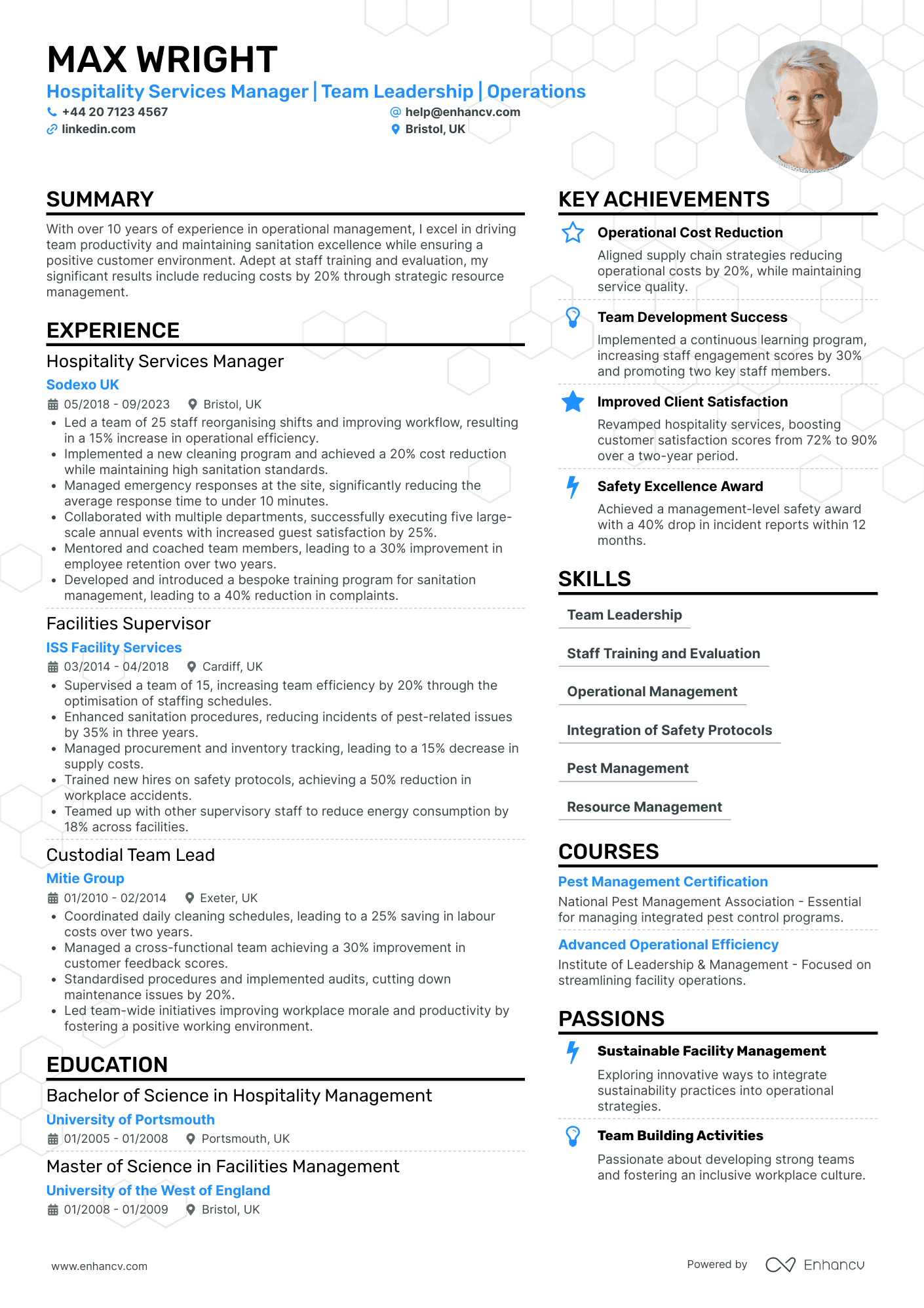
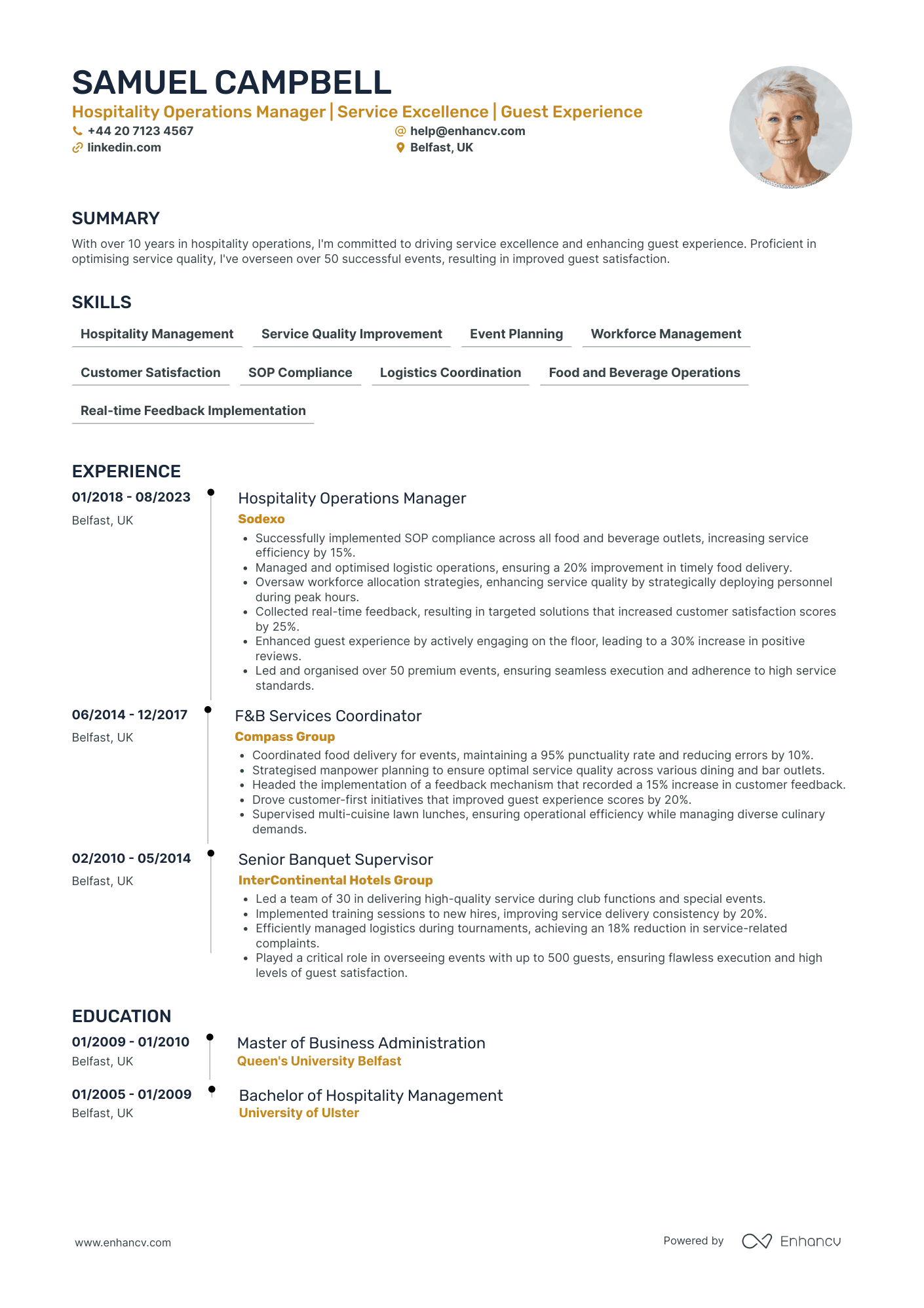
Pick the CV format that flatters your experience. If you are stepping up, lead with skills and achievements. Once you have management roles behind you, switch to reverse chronological and let the job titles carry the weight.
Keep it to two pages, one column, standard headings, and a font a tired area manager can skim at 11pm. Hospitality hiring moves fast, often between services.
Order the sections to your advantage. Header, then a tight personal statement, then skills and compliance, then experience, then training. A step-up candidate wants the readiness up top, while an experienced manager can lead with the roles and let the venues and covers speak first.
Send a PDF for direct applications so the layout holds on any device, including the phone a lot of managers screen on. Keep a Word copy for agencies, which place a large share of hospitality roles. If the advert names a file type, follow it.
Applications often pass through tracking software before a human sees them, so keep the structure clean and the headings standard for an ATS-friendly CV. Build it from a tested layout rather than a blank page. Enhancv's CV templates export to a clean PDF that holds its formatting.
Is your resume good enough?
Drop your CV here or choose a file. PDF & DOCX only. Max 2MB file size.
Writing your hospitality manager personal statement
Four sentences at the top: who you are, the scale you have run, the compliance you hold, and the role you want. Keep it concrete. If the opening line is where you stall, see more personal statement examples.
Skip the adjective soup on every other CV. "Passionate, hard-working people person" tells a recruiter nothing they can check.
The fix is one specific, checkable fact per sentence. Trade "excellent communicator" for the size of the team you briefed before service, and "customer focused" for the review score you protected through a difficult month. Detail is what separates a manager's statement from a member of staff's.
Lead with evidence instead:
Hospitality manager personal statement example (stepping up)
Floor supervisor with three years in a busy 90-cover restaurant, stepping up to duty manager two shifts a week. Rebuilt rotas around forecast covers, led the team to a 5-star food hygiene rating, and hold a Level 2 Food Safety certificate with a Personal Licence in progress. Looking to bring calm, cost-aware leadership to a first assistant manager role in a Bristol hotel or restaurant group.
When someone applies for their first hospitality management role, we are not looking for a manager's title on the page. We are looking for the night you ran the floor when the supervisor called in sick, the rota you rebuilt around a bank holiday, the complaint you turned around at the table before it reached a review. Name those moments with a date and a number, then add the Level 2 Food Safety or Personal Licence you are working towards. A clear step up beats a borrowed job title every time.
Writing your hospitality manager experience section
Whether the responsibility was formal or covered, write each entry the same way: a dated heading, then bullets that show what you ran and what changed because of it. Lead each bullet with a strong verb.
Cut the duty-list bullets that describe the job rather than your impact. "Responsible for the bar" is a job description, while "Held bar wastage below 3% across a year" is a reason to interview you. Three sharp, quantified bullets beat eight vague ones.
Hospitality is one of the easiest fields to quantify, and most people forget to. Covers served, team size, labour percentage, stock variance, guest scores, complaints resolved, and audit ratings are all achievements a recruiter understands instantly. For the mechanics of the section, see work experience on a CV.
Tailor every application. Pull the duties and compliance terms from the advert and mirror the ones that are true of you. Enhancv's CV tailoring feature reads the advert and suggests the wording to match, which saves rewriting from scratch each time.
- Ran the floor as duty manager two evenings a week, directing a team of 8 across a 90-cover service when the general manager was off
- Rebuilt the weekly rota around forecast covers, cutting agency and overtime spend by around 12% across a quarter
- Led the team to a 5-star food hygiene rating at the last two Environmental Health inspections
- Resolved guest complaints at the table and kept the venue's online review score above 4.5 through a two-month refit
- Trained 6 new starters on till, service, and allergen procedures, cutting time to a solo shift from three weeks to two
- Led a section of 4 through peak weekend trade of up to 300 covers, keeping ticket times under 12 minutes
- Managed stock counts and weekly ordering for the bar, holding wastage below 3% across the year
- Held the cellar to line-cleaning and temperature schedules, passing every brewery audit with no actions
- Handled cash reconciliation and the nightly float on closing shifts as the trusted keyholder

PRO TIP
Hospitality adverts name specific compliance, not vague soft skills. Mirror the ones you can back: "Level 2 Food Safety", "HACCP", "Personal Licence", "COSHH", "manual handling", "cellar management". If you have been trained in it, name it exactly as the advert does.
Skills that get a hospitality manager CV noticed
The demands that repeat across hospitality manager adverts are operational, not generic. Food safety, health and safety, team leadership, budget and stock control, rota planning, and customer service come up again and again. Those are your hard skills, listed in the words the adverts use.
The soft skills that matter are the ones a busy service tests: leadership, communication, and staying calm when the kitchen is 20 minutes behind. Prove each in a bullet rather than claiming it.
Evidence each one where you can, because a skills list on its own reads as a wish list. "Budget and cost control" means little until a bullet shows you held labour to a target percentage or cut wastage across a quarter. "Team leadership" lands when it sits next to a team size and a rota you owned.
List only what you can stand behind. Build the skills section from tasks you have actually done, and put anything you are still training in under a training heading instead.
Top skills for your hospitality manager CV:
Food safety (Level 2)
Health and safety compliance
Team leadership
Rota and labour planning
Budget and cost control
Stock control and ordering
Licensing and cellar management
Customer service and complaint handling
Leadership
Communication
Composure under pressure
Problem solving
Teamwork
Education and training for a hospitality manager CV
You rarely need a degree to manage a venue, which is why the step-up route works. What employers do check is the training that keeps a site legal and safe.
List these where you have them, even in progress: a Level 2 or 3 Food Safety certificate, a Personal Licence, first aid, allergen and health and safety training, and any NVQ, diploma, or qualification in hospitality management. Put them in your education section or a dedicated training block.
The Personal Licence is worth calling out on its own if the role serves alcohol, since it lets you be the designated premises supervisor and saves the employer arranging cover. Note the date you gained it, as some operators check it is current.
Short courses count when they are relevant, and naming the certificates you hold saves an employer a question and a screening call. If you belong to a body such as the Institute of Hospitality, add it under professional memberships to signal you take the career seriously.
Conclusion
Lead with the responsibility you have already carried, quantify what changed on your watch, and name the compliance employers screen for.
Pair the CV with a short cover letter that says why this venue, and a step up reads as the obvious next move rather than a stretch.
Author's take - The Enhancv team
When someone applies for their first hospitality management role, we are not looking for a manager's title on the page. We are looking for the night you ran the floor when the supervisor called in sick, the rota you rebuilt around a bank holiday, the complaint you turned around at the table before it reached a review. Name those moments with a date and a number, then add the Level 2 Food Safety or Personal Licence you are working towards. A clear step up beats a borrowed job title every time.