


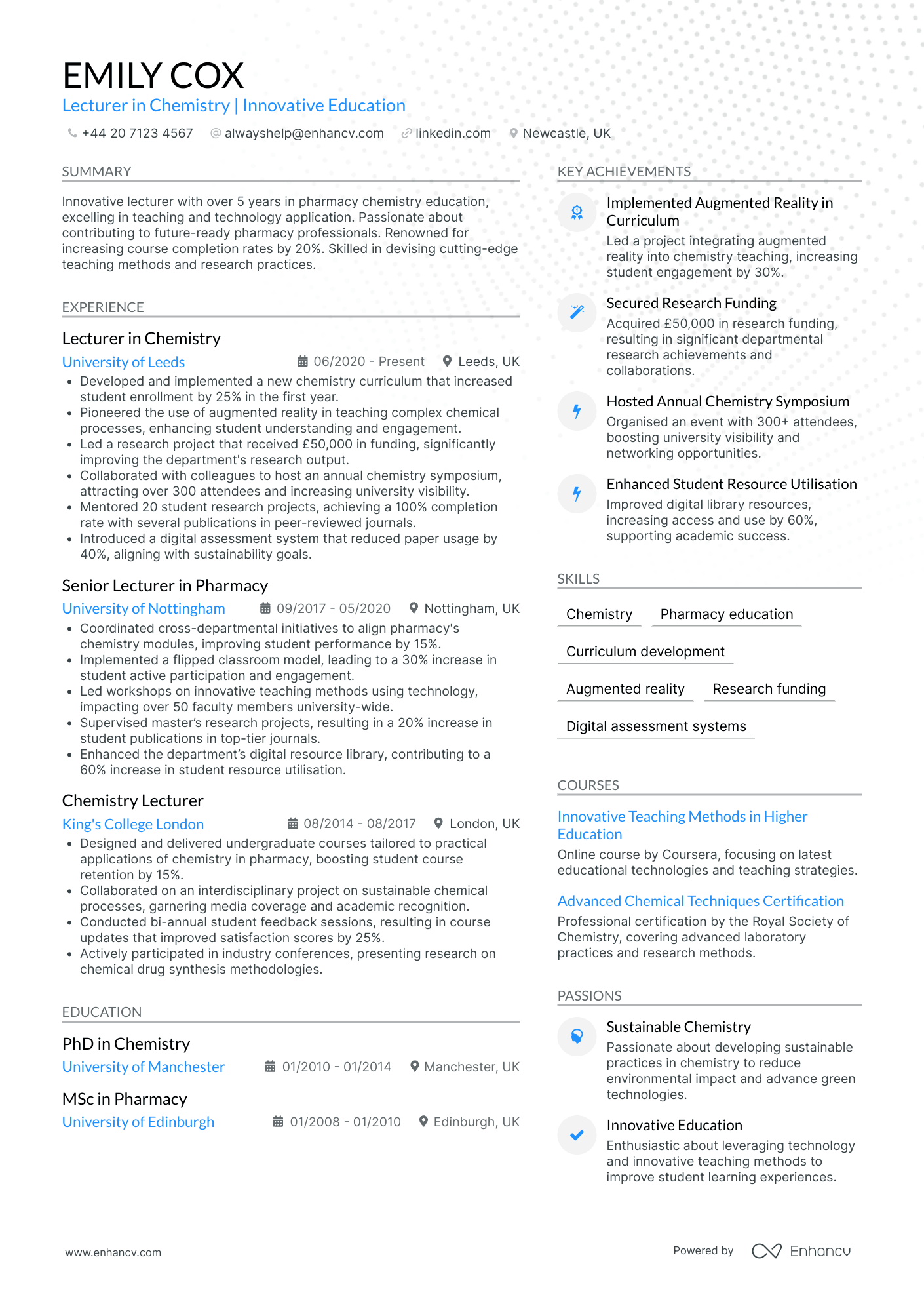
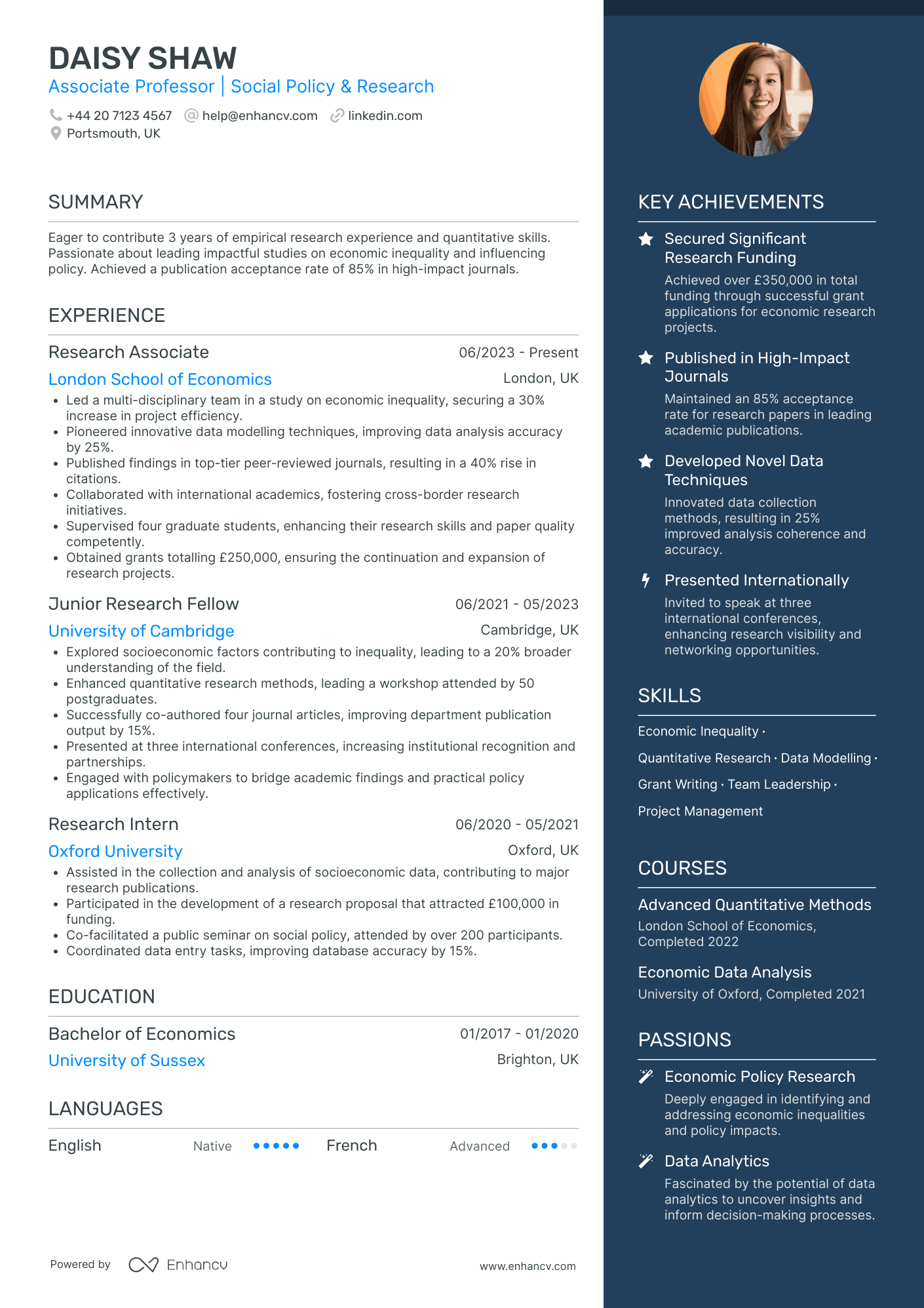
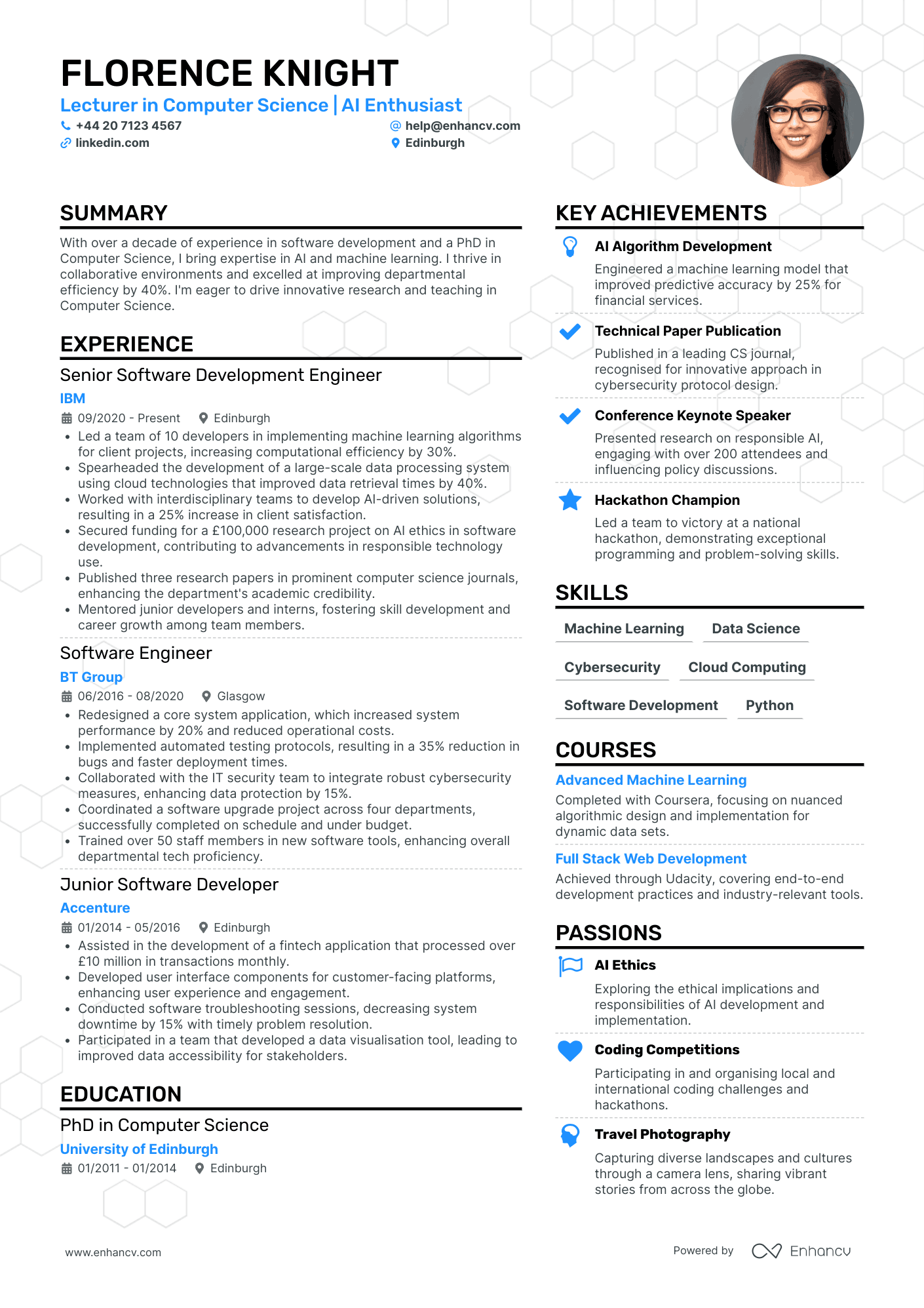
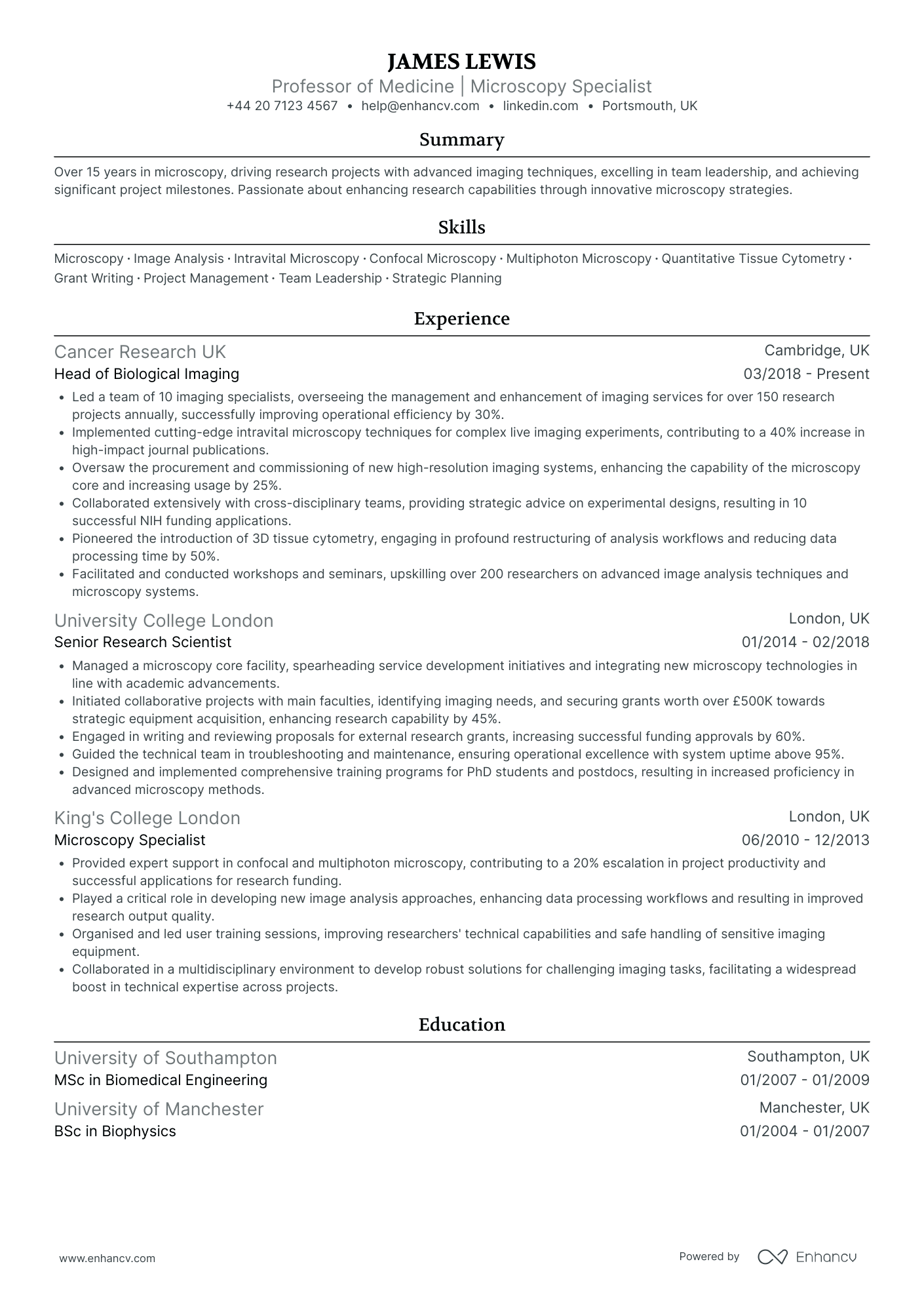
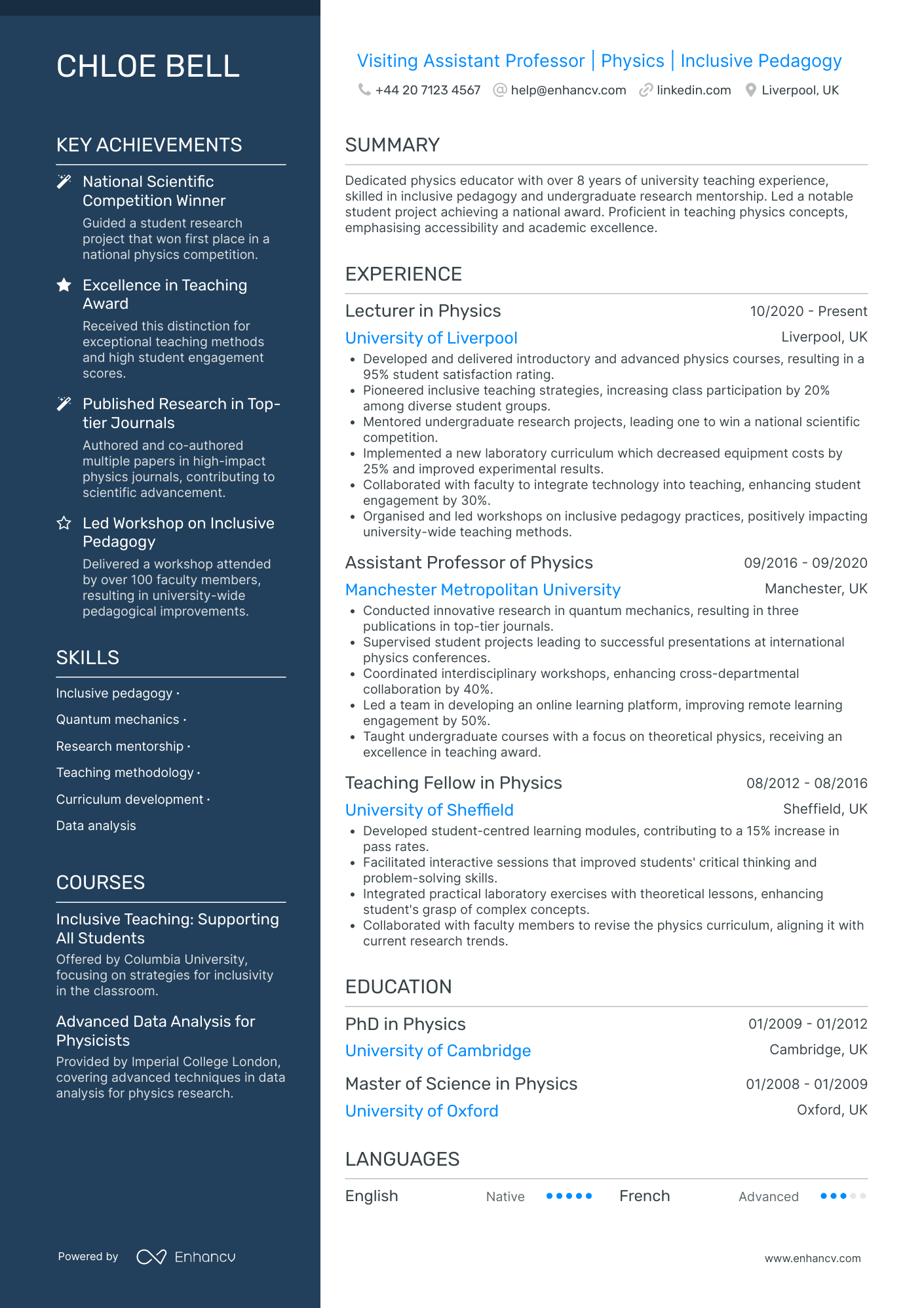
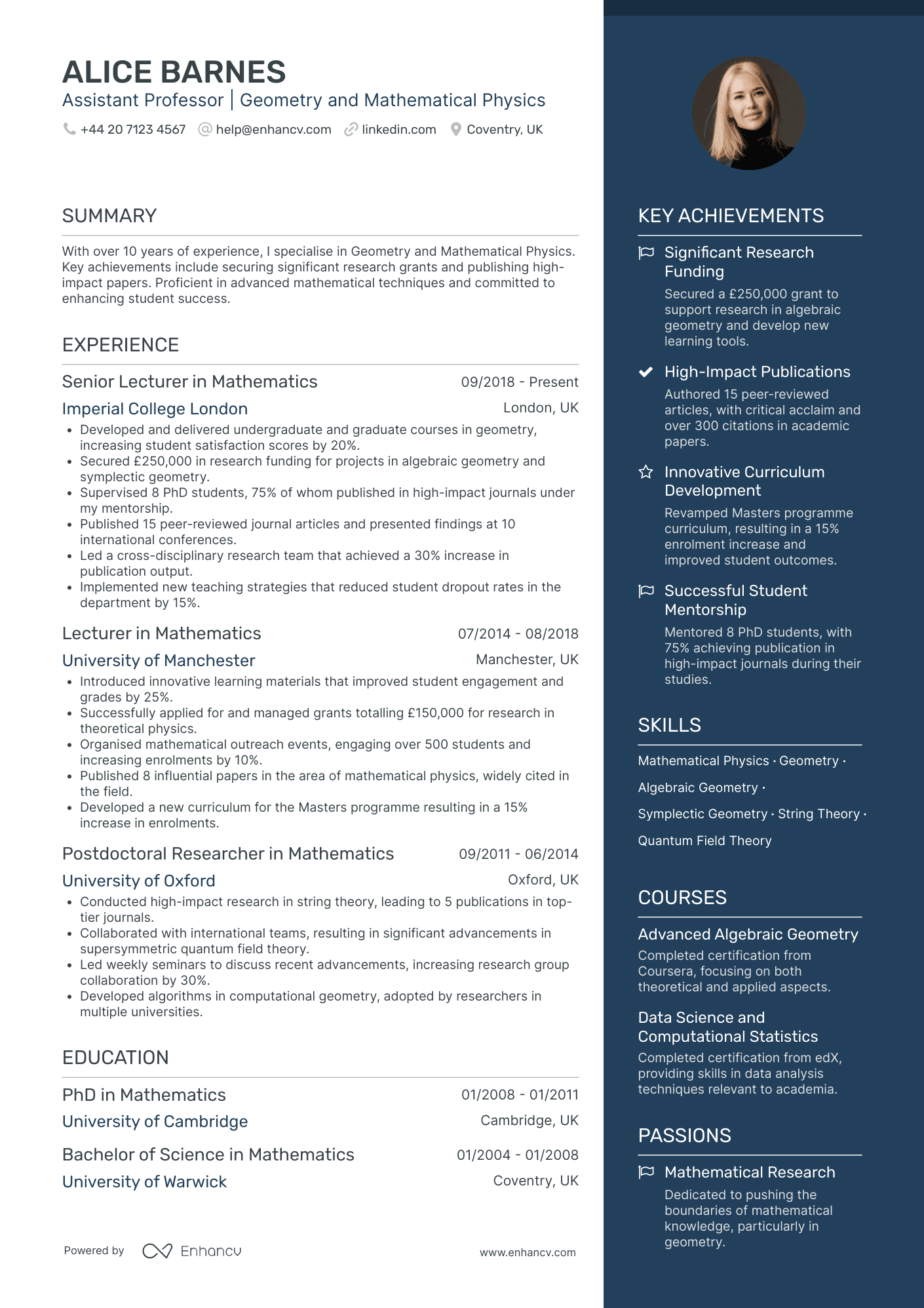
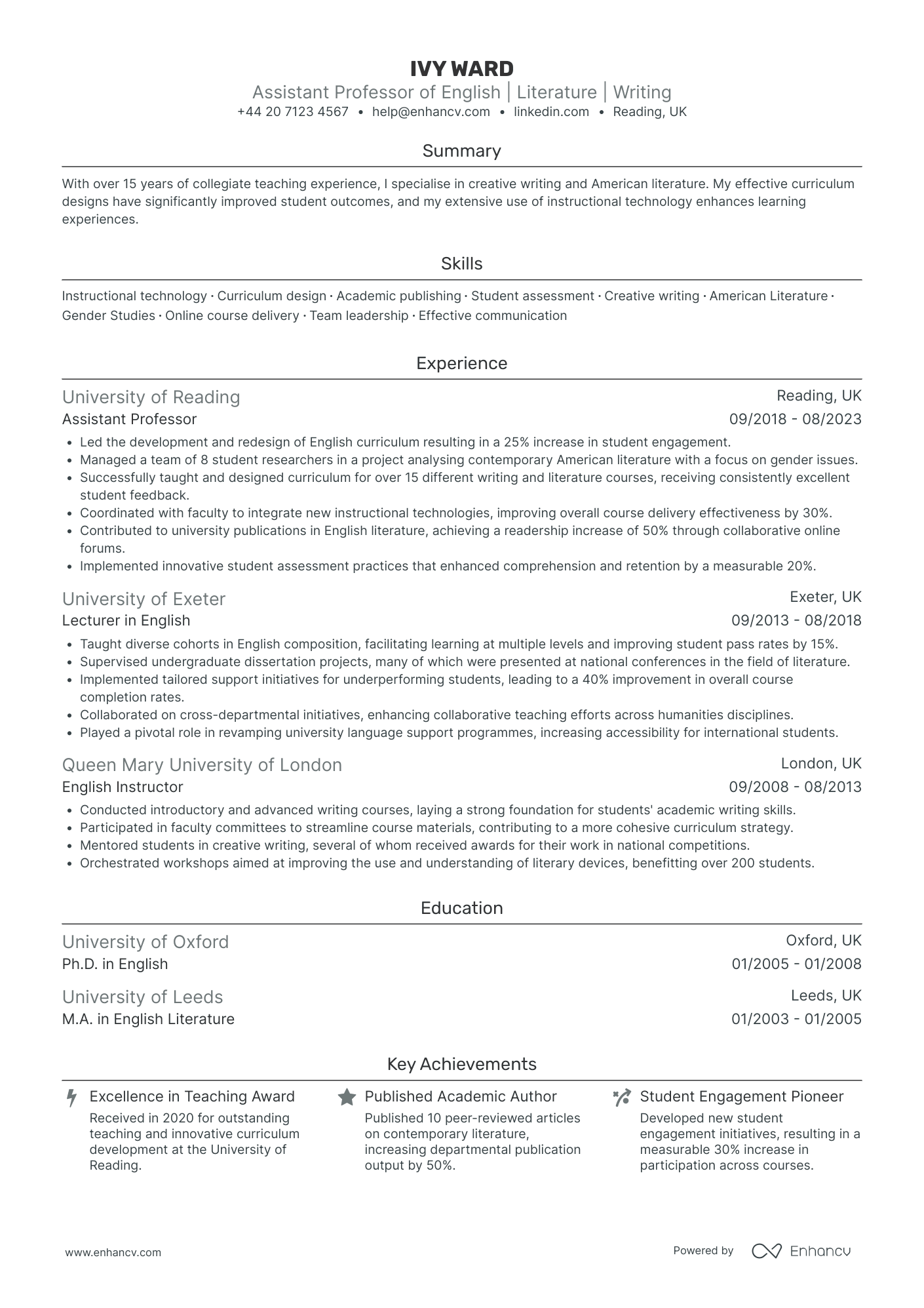
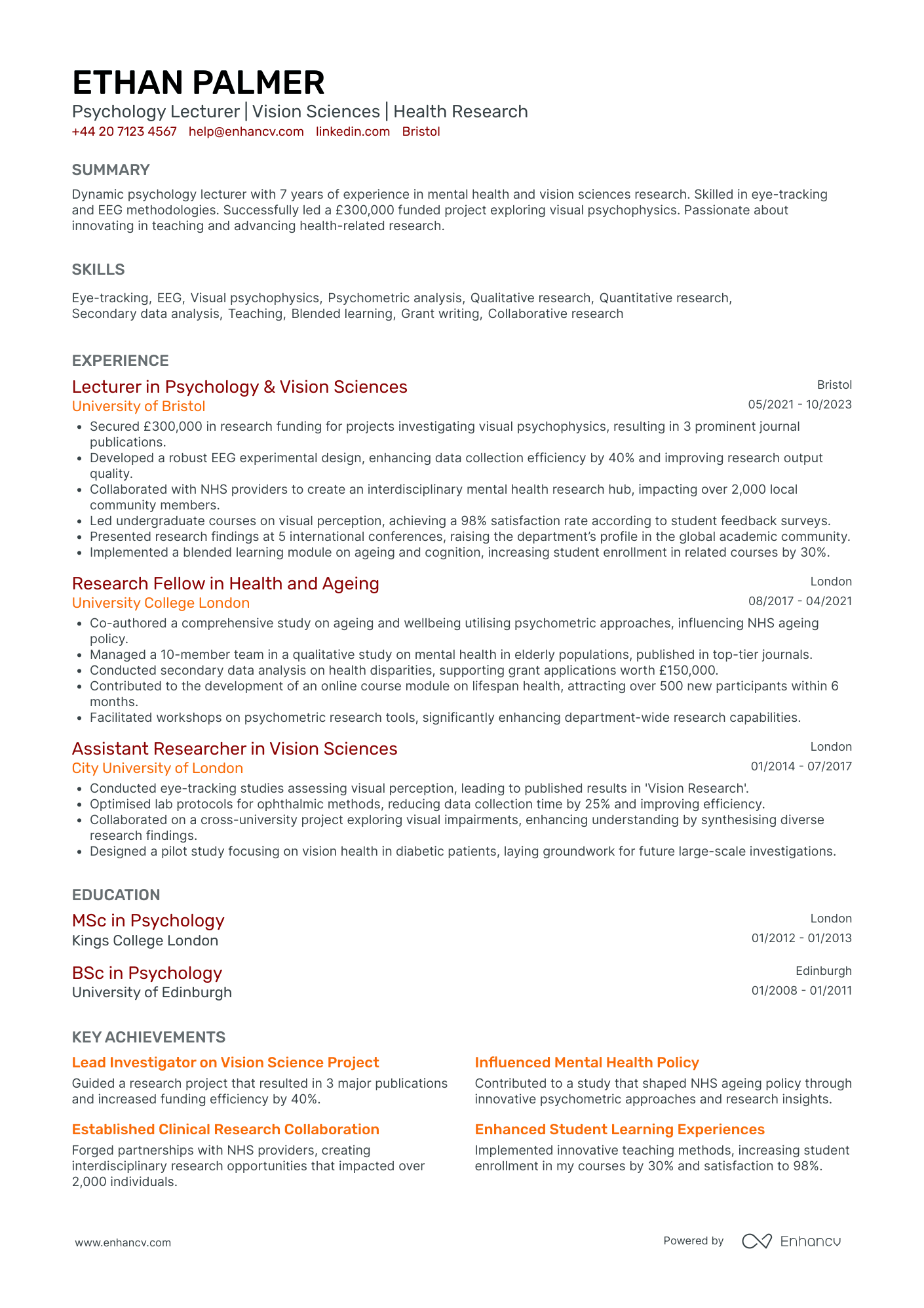
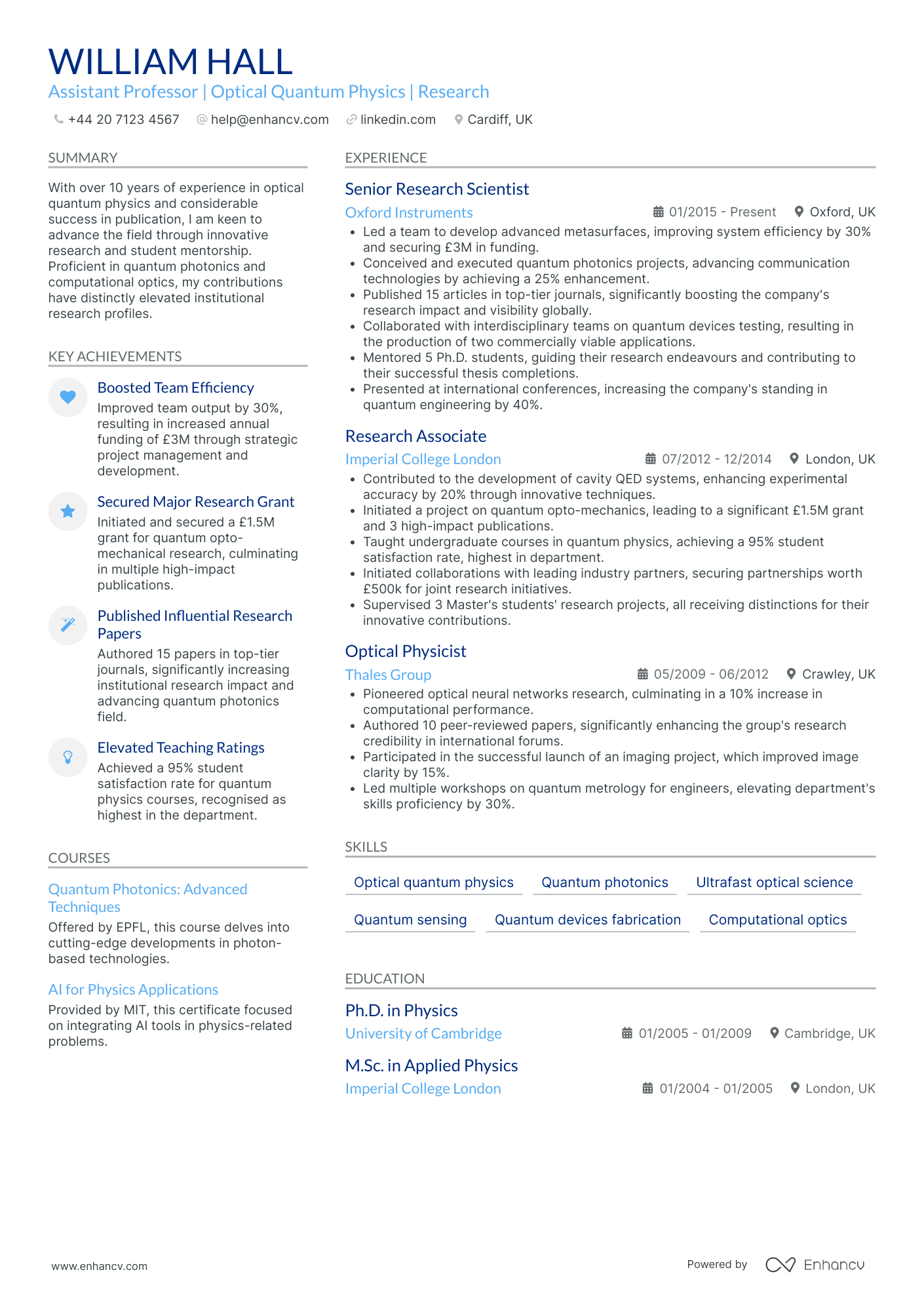
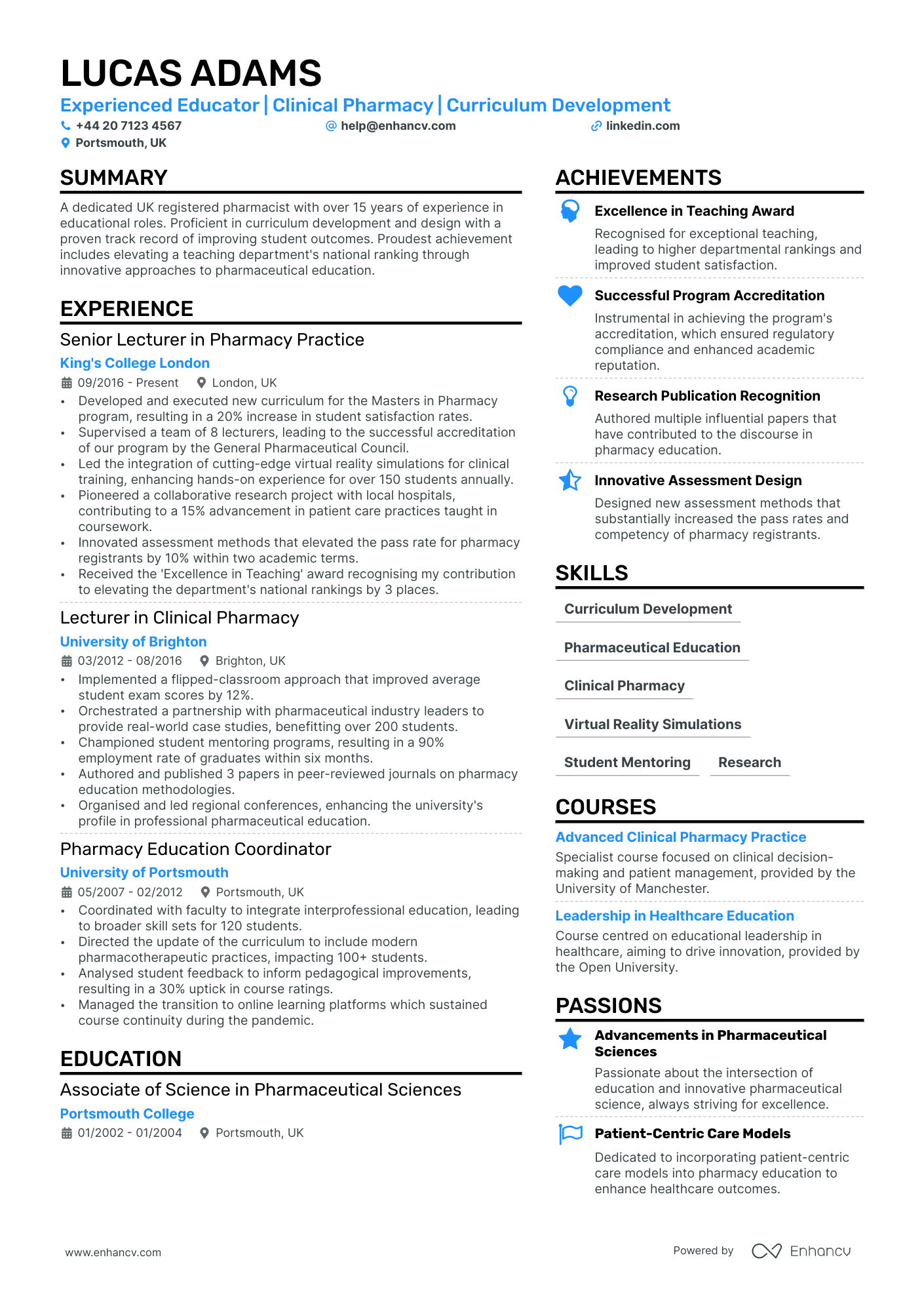
An academic CV plays by its own rules. The one-page and two-page limits every careers guide repeats do not apply to a professor, and following them will make you look junior.
A professor CV is a complete record of your research, teaching, publications, and funding, and it can run to six pages or more. Get the structure right and a hiring panel can find your grant income, your best papers, and your teaching load in seconds. If you want the fundamentals first, see how to write a CV.

Key takeaways
- An academic CV has no page limit. Lead with research and publications, and let the length follow your record.
- Send a PDF so pagination and special characters hold, and keep a Word version for portals that demand one.
- Order the sections around the post: research-led for a research chair, teaching-led for a teaching professorship.
- Give your publication list a recognised referencing style and put your own name in bold in every citation.
- Name your funding, the amounts, and the bodies that awarded it. Panels read this closely.
- Open with a short research profile built on evidence, not a generic personal statement full of adjectives.
Formatting your academic CV
Forget the two-page rule. An academic CV is meant to be long, because it documents everything: publications, funding, teaching, supervision, and service. A mid-career professor CV of six to ten pages is normal and expected.
Use reverse chronological order within each section, most recent first. Standard headings, one column, a readable font, and generous margins. Panels skim dozens of these, so keep your CV layout easy to navigate.
Stick to one clean typeface at 11 or 12 point, with clear section headings and a little white space between entries. A readable CV font matters more than a decorative one when a document runs past six pages. Avoid two-column layouts for the body, because a long publication list wraps badly across columns and confuses the reading order.
Number your pages and put your name in a header or footer on every page, so nothing gets lost if the printout is separated. Name the file clearly, along the lines of Surname-CV-2026, rather than leaving it as a string of numbers.
Send it as a PDF for direct applications and email, so your pagination, tables, and any special characters hold on every machine. Keep a Word copy for university application portals and recruitment systems that insist on one. If the advert names a file type, follow it.
Length follows substance, never padding. Early in your career, three or four honest pages beat ten padded ones. See how long a CV should be for the general rule, then set the cap aside once your publication list earns the space.
Keep the layout clean and the headings standard so it stays ATS-friendly when it passes through a university recruitment system. Build it from a tested layout rather than a blank page, and Enhancv's CV templates export to a clean PDF that holds its structure across every page.
| Element | Academic CV | Standard UK CV |
|---|---|---|
| Length | Runs as long as your record needs, often six pages or more | Two pages for most experienced professionals |
| What leads | Research profile, publications, and funding | Personal statement and work experience |
| Publications | A full, referenced list is expected | Rarely included |
| Detail level | Comprehensive, down to grants, talks, and supervision | Selective, highlights only |
| File format | PDF for applications, Word only where a portal demands it | PDF unless the advert asks for Word |

PRO TIP
Pick one referencing style for your publication list, Harvard or Vancouver or your field's standard, and use it consistently throughout. Put your own name in bold in every citation so a panel can spot your contribution at a glance.
The academic CV structure, section by section
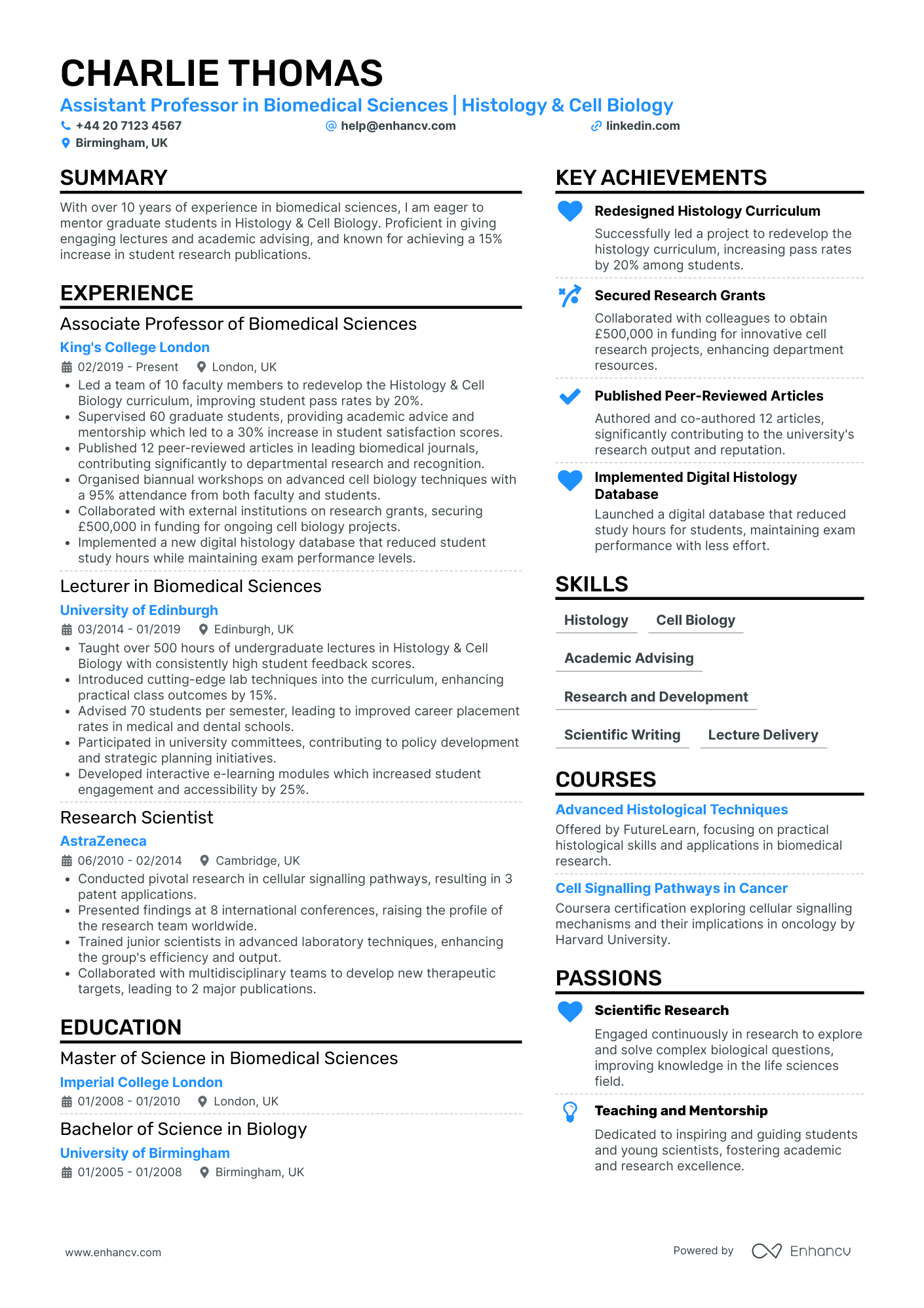
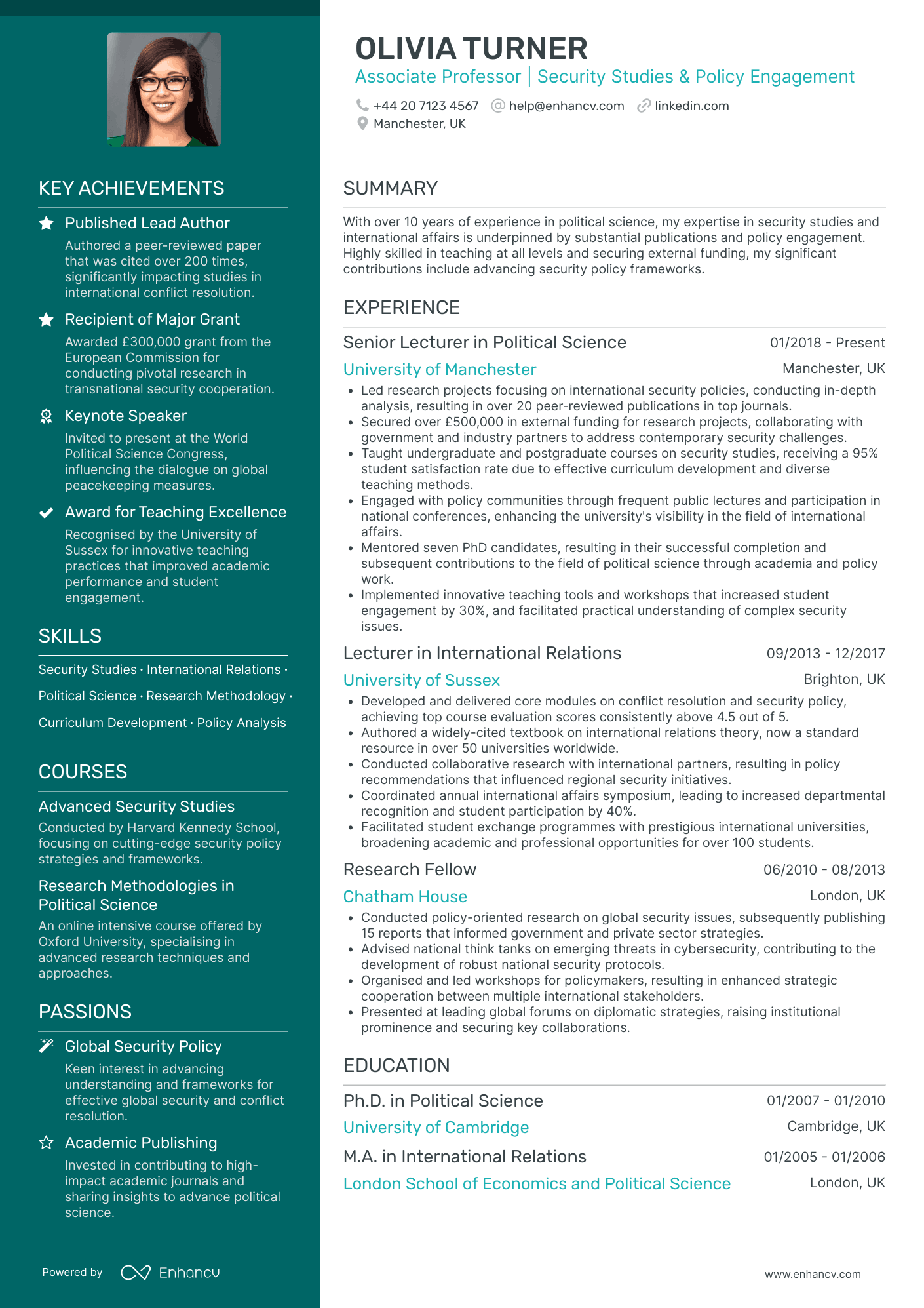
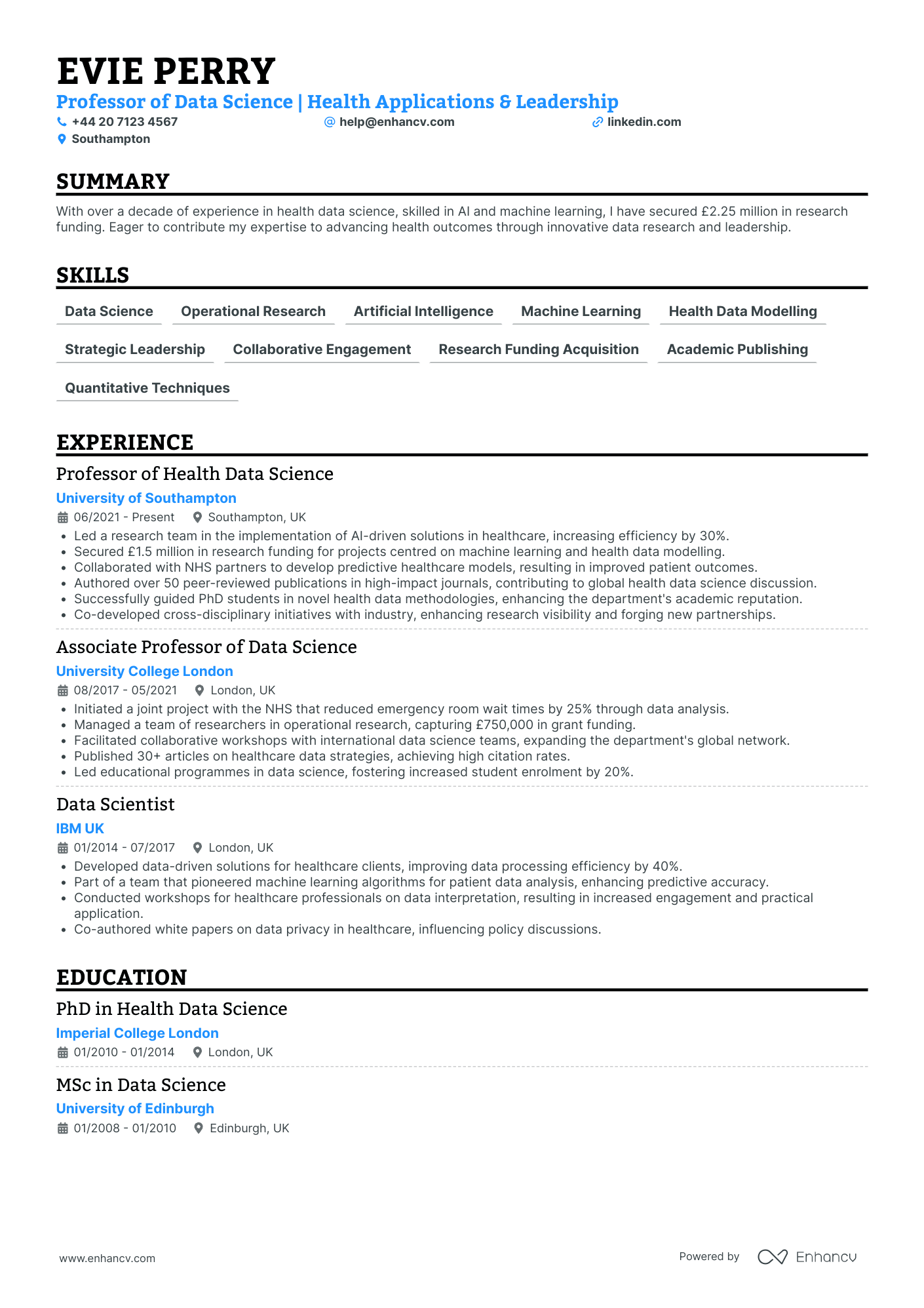
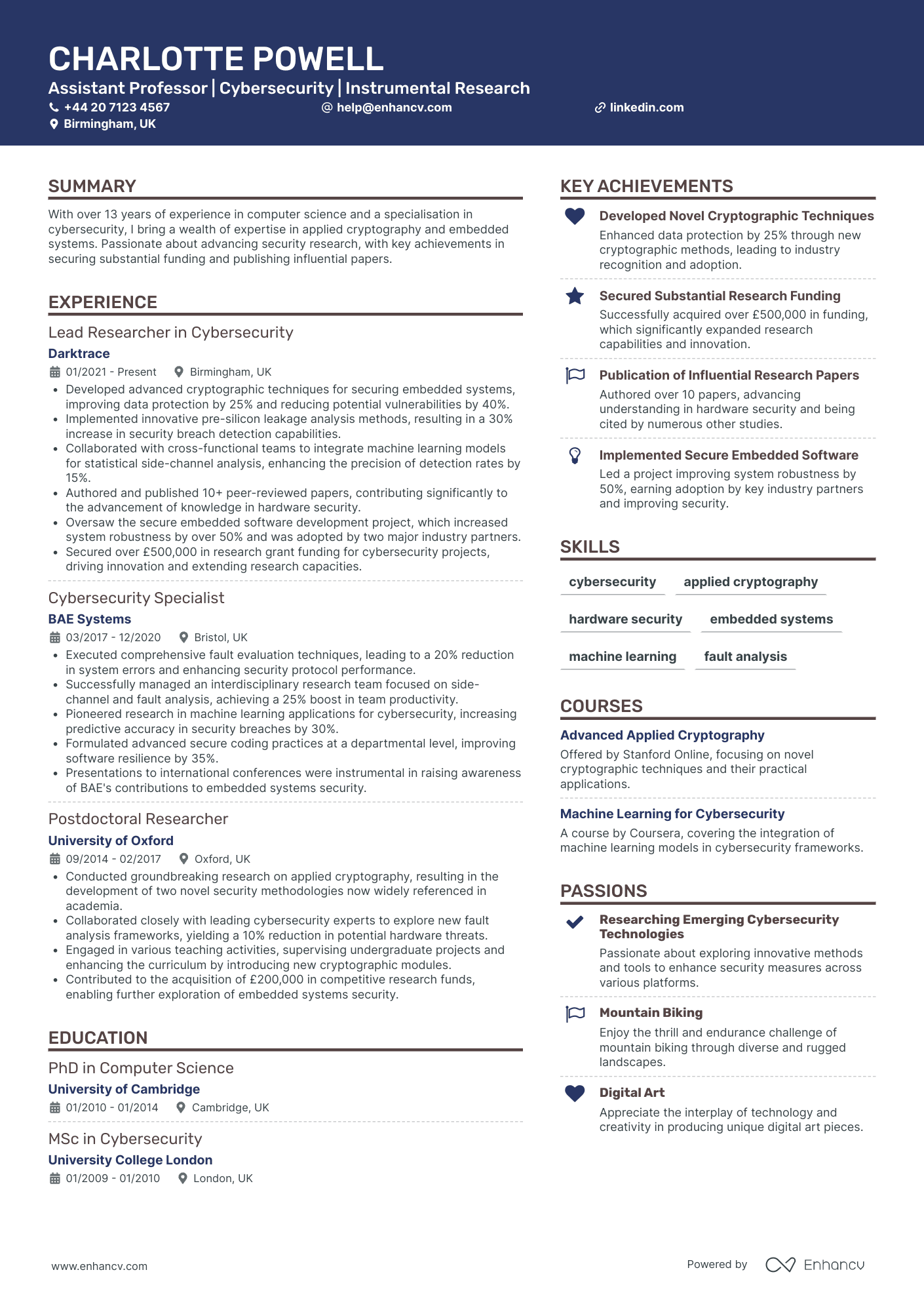
Order your sections around the post. For a research chair, research and publications come straight after your profile. For a teaching-focused professorship, teaching and curriculum development lead.
Whichever way round, keep the CV structure predictable so a panel never has to hunt for the section they care about.
Keep your personal details at the top short: name, academic title, institutional and personal email, and a link to your ORCID or departmental profile. A photo is not expected on a UK academic CV, so leave it off unless the advert specifically asks.
List named referees at the end, usually two or three senior academics who know your work, with their titles, institutions, and contact details. Check with them before you submit, and match them to the post, so a research chair sees research referees and a teaching role sees someone who has seen you teach.
If you are moving into academia from industry, resist the urge to send your two-page commercial CV. The panel expects the academic format, so translate your work into publications, patents, and applied research, and lead with the outputs a university can assess rather than a list of job duties.

A typical professor CV runs in this order:
- Contact details and academic title
- Research profile or personal statement
- Education, including your PhD and postdoctoral training
- Academic appointments
- Publications, grouped by type
- Grants, funding, and awards
- Teaching and doctoral supervision
- Conference presentations and invited talks
- Professional service, peer review, and memberships
- Referees
Writing your professor personal statement
At the top, four or five sentences that state your field, your research contribution, and what you are looking for. Academics often call this a research profile, and it should read like evidence rather than a mission statement. See more personal statement examples if you are stuck on the opening line.
Lead with what you have actually done: your area, your standing, your funding, your teaching. Skip the adjective soup that every other applicant reaches for.
Rewrite the profile for each post. A research chair wants to see your agenda and your funding trajectory, while a teaching chair wants your pedagogy and your impact on students. The body of the CV stays largely the same, but these opening lines should point straight at the role you are applying for.
Professor CV personal statement example
Professor of Molecular Biology with 15 years of research and teaching across two Russell Group universities. Author of 60 peer-reviewed papers, principal investigator on £2.3m of UKRI funding, and supervisor of 12 completed PhDs. Seeking a research chair to build an interdisciplinary group in RNA therapeutics and lead the department's early-career mentoring.
What to avoid
A passionate and dedicated academic with excellent communication skills and a proven track record, seeking a challenging professorship at a leading institution to further my career and contribute to the wider field.
The weak version names no field, no funding, and no output. It could belong to any applicant in any discipline, which is exactly why a panel skims past it. The strong version tells them what you study, how much you have raised, and how many researchers you have trained, all before they reach the first citation.
When I read a professor CV, I go straight to funding and publications, not the profile. Grant income tells me whether you can run a group, and a strong, well-referenced publication list tells me you will keep producing. The candidates who get shortlisted make both easy to find on the first page and let the rest of the CV back them up. Panels expect a long CV here. What they will not forgive is a disorganised one.
The Enhancv team
Writing your research and teaching experience
Your academic appointments are the backbone. Give each post a dated heading, then bullets that show what you built, led, and measured. Lead each bullet with a strong action verb, and treat this like work experience on a CV anywhere else.
Numbers make research legible to a panel: grant income won, papers published, students supervised, citations, teaching scores. Those are your achievements, so quantify them wherever you honestly can.
Separate research and teaching so a panel can weigh each on its own terms. Under research, show the grants you led, the group you built, and the collaborations you drove. Under teaching, show the modules you designed, the cohorts you took, and what your feedback scores did over time.
Do not let esteem indicators disappear into a footnote. Editorial boards, keynote invitations, prizes, and external examining all signal standing, and a panel looks for them. Give them their own short section if you have several.
If teaching is central to the post, treat it as more than a job title. Name the modules you own, the level you teach at, the students you have supervised through to completion, and the curriculum you have designed or reformed. Where you hold a teaching portfolio or strong student evaluations, reference them so the panel knows the evidence exists.
Mirror the language of the further particulars where it is true of you. Enhancv's CV tailoring feature reads the advert and suggests the matching edits, which saves rewriting each application from scratch and helps you land more interviews.
- Secured £2.3m in UKRI and Wellcome funding across four grants as principal investigator, growing the group from three to eleven researchers
- Published 34 peer-reviewed papers since appointment, four of them in journals with an impact factor above 15
- Supervised 12 PhD students to completion, with every candidate submitting within four years
- Redesigned the MSc in Molecular Medicine, lifting student satisfaction scores from 78% to 94% over three years
Listing publications, funding, and grants
For a professor, this section often matters more than anything else on the CV. Give it room and structure it well.
Group publications by type: journal articles, books and chapters, conference papers, and other outputs. Within each group, list them reverse chronologically, in a consistent referencing style, with your own name in bold.
Make your own contribution visible. On multi-author papers, a panel wants to know where you sat in the author order and whether you were the corresponding or senior author, so mark that clearly rather than leaving them to guess.
If the list is long, lead with a short selected-publications block of your strongest five or six, then follow with the full list. Note the metrics your field respects, such as an h-index or a paper's citation count, only where they help you.
Handle preprints and work in progress honestly. Label a preprint as a preprint, and mark anything as under review, in press, or forthcoming rather than blurring it into the published record. A specialist panel will spot an overclaim immediately.
Count outputs beyond the journal article too. Datasets, software, patents, edited collections, and public engagement all belong here, especially where your field or the post rewards research impact. If a body of work fed into policy or practice, say so in a line rather than hoping the panel infers it.
Funding is evidence of independence. List each grant with the awarding body, your role, the amount, and the dates. A panel reads grant income as a proxy for whether you can run a group and win more.
PRO TIP
Keep a master CV with every publication, grant, and talk, then cut it down for each application. Rebuilding the list from memory each time is how gaps and errors creep in, and a missing paper is the first thing a specialist panel will notice.
Education and academic qualifications
This section is lighter than you might expect, because your record now speaks louder than your degrees. List your PhD, your postdoctoral positions, and your degrees in reverse chronological order, with the institution, dates, and thesis title. Treat it like the education section of any CV, only fuller at the doctoral end.
Include fellowships and teaching qualifications, such as an Advance HE Fellowship, and any professional qualifications your field requires for the post. Name your PhD supervisor and examiners only where that carries weight in your discipline, and keep the entry to a few clean lines.
Do not pad this section with school-level results. Once you hold a doctorate and a research record, your GCSEs and A levels add nothing, so the space is better spent on the sections a panel actually reads.
Skills to put on a professor CV
A professor CV carries fewer standalone skills than a commercial one, because most of your expertise is already evidenced in your publications and grants. Keep the skills section short and specific.
List the research methods, techniques, and tools you genuinely use, in the words your field uses. Those are your hard skills, and a specialist reader will recognise them at once.
Prove the soft skills in a bullet rather than just claiming them. Mentoring shows up as students supervised to completion, leadership as a group you built, collaboration as a cross-institution grant you helped land.
Top skills for your professor CV:
Research methodology
Academic publishing
Grant writing and funding
Research supervision
Statistical analysis
Curriculum design
Peer review
Lecturing and public speaking
Mentoring
Collaboration
Strategic planning
Written communication
Leadership
Conclusion
Let your record lead. Structure the CV around research, publications, and funding, format it as a clean PDF, and let the length follow your career rather than an arbitrary page limit.
Pair it with a cover letter that connects your research agenda to the department's, and you give the panel an easy yes.
Author's take - the Enhancv team
When I read a professor CV, I go straight to funding and publications, not the profile. Grant income tells me whether you can run a group, and a strong, well-referenced publication list tells me you will keep producing. The candidates who get shortlisted make both easy to find on the first page and let the rest of the CV back them up. Panels expect a long CV here. What they will not forgive is a disorganised one.