



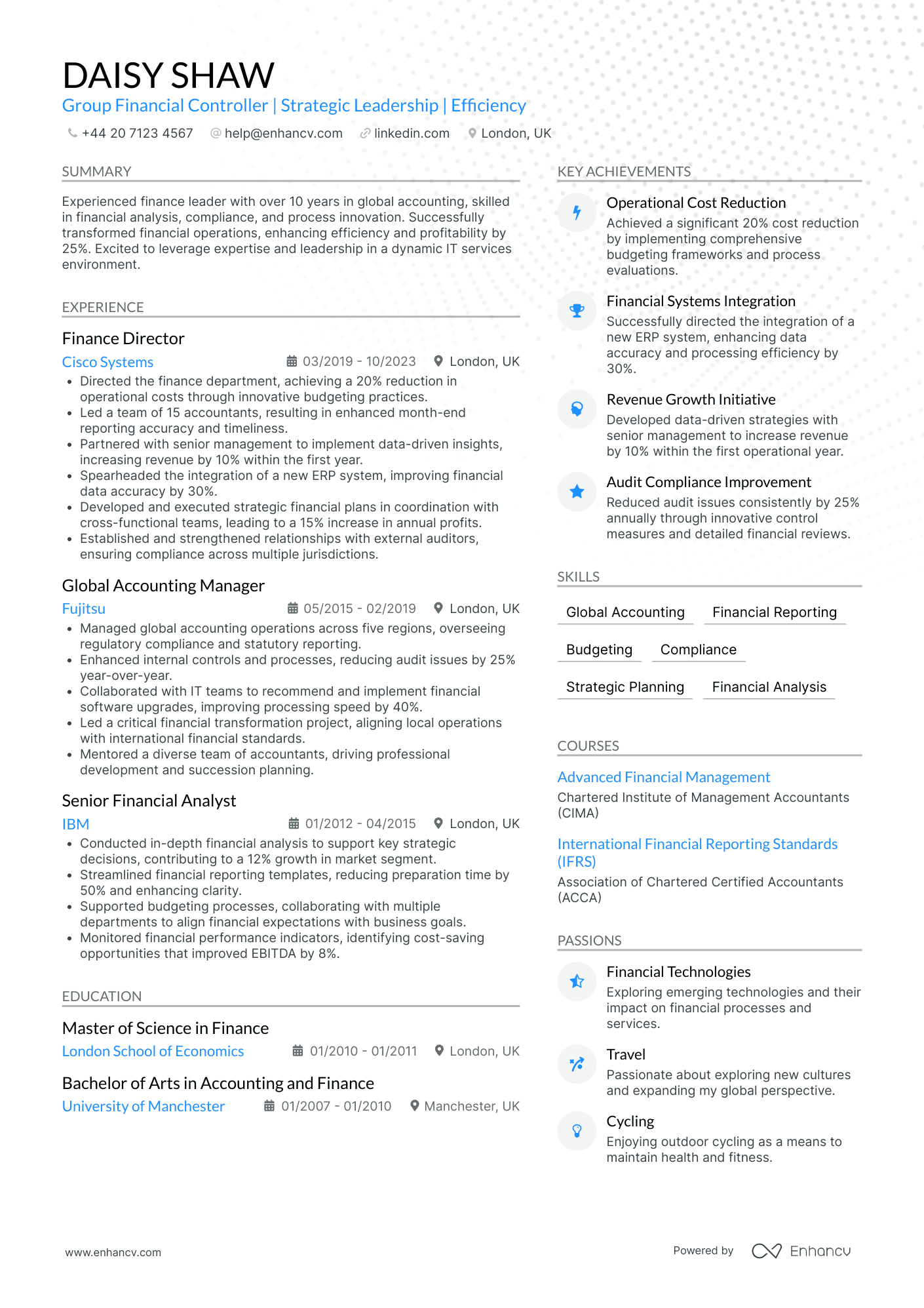
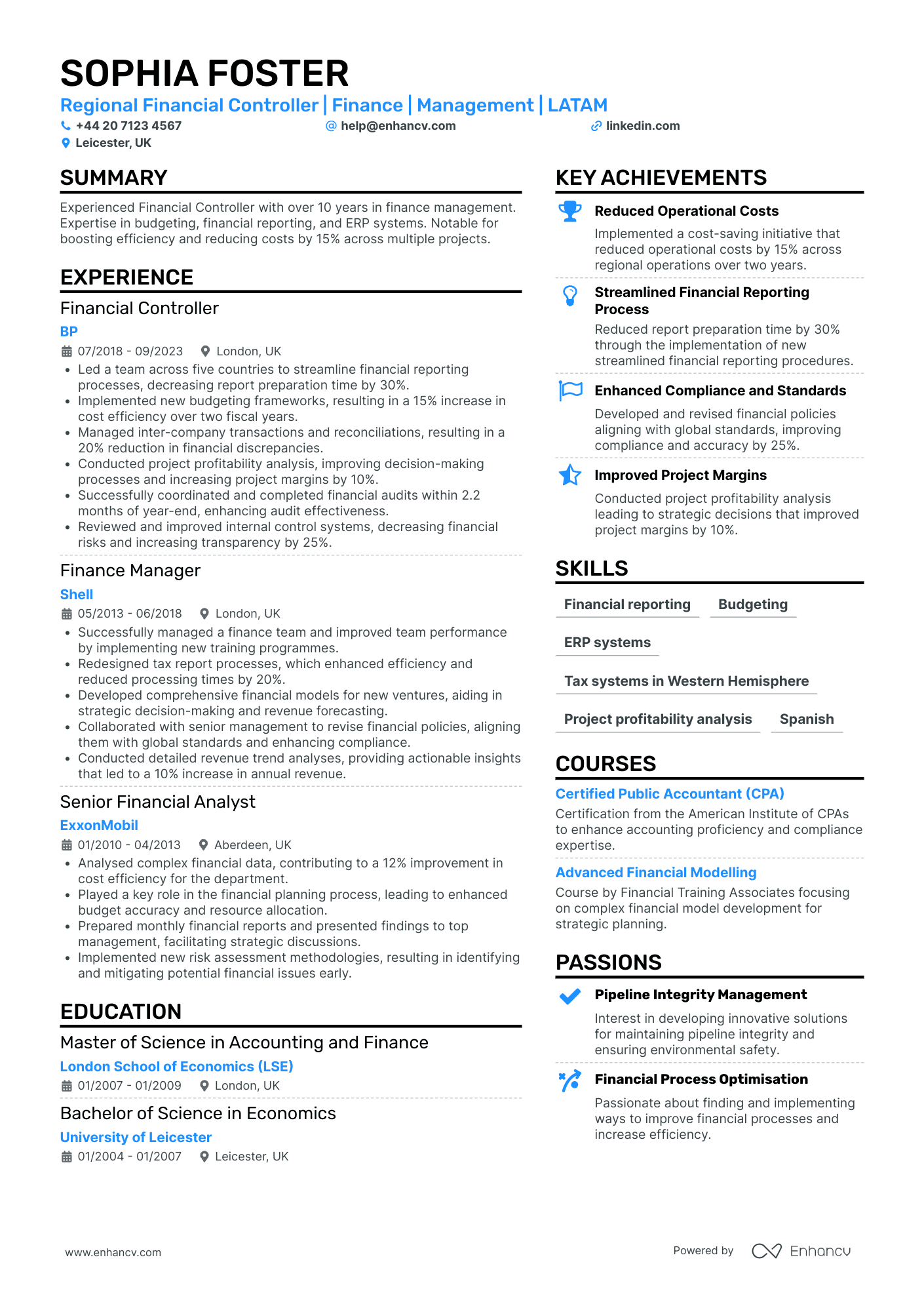
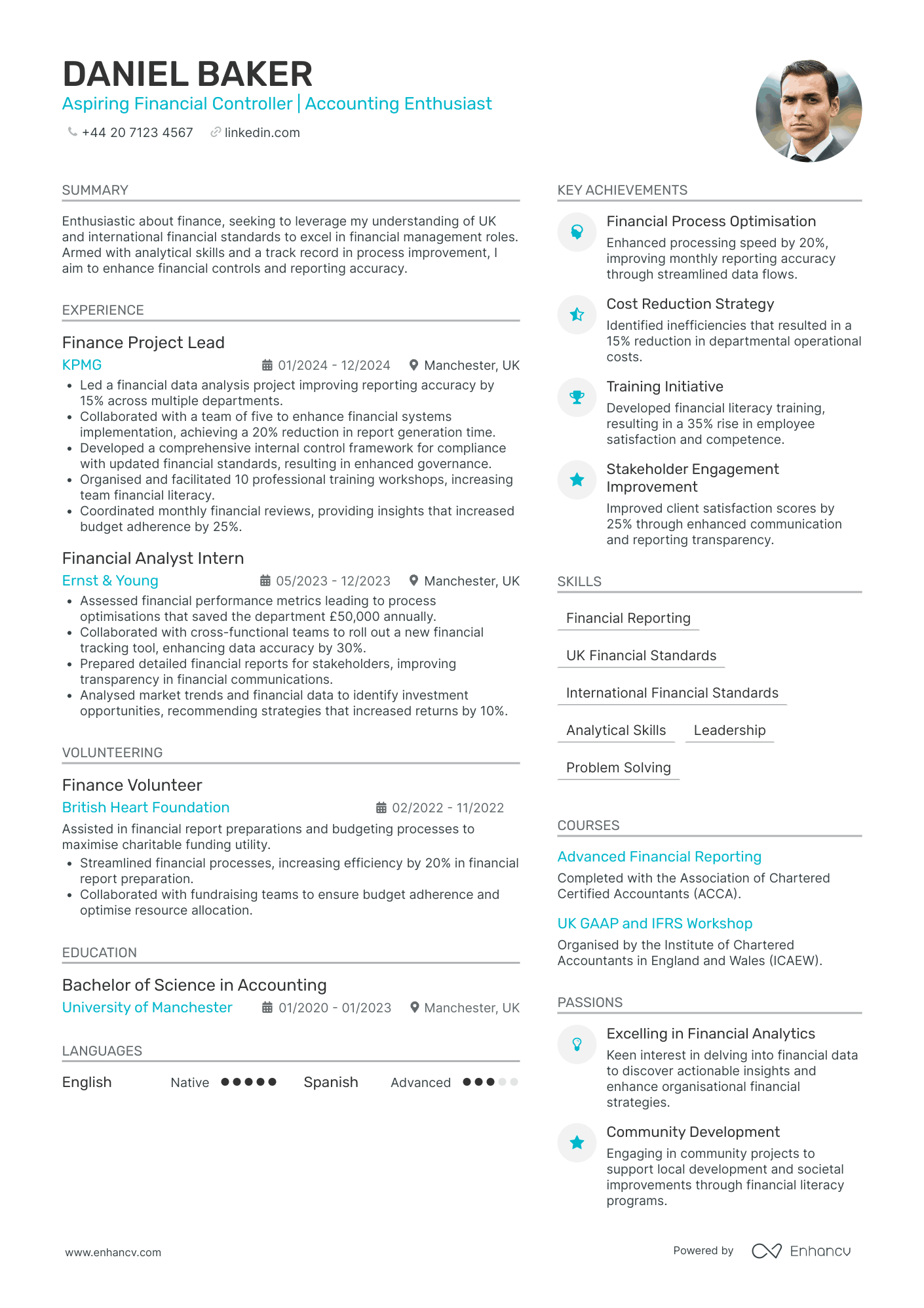
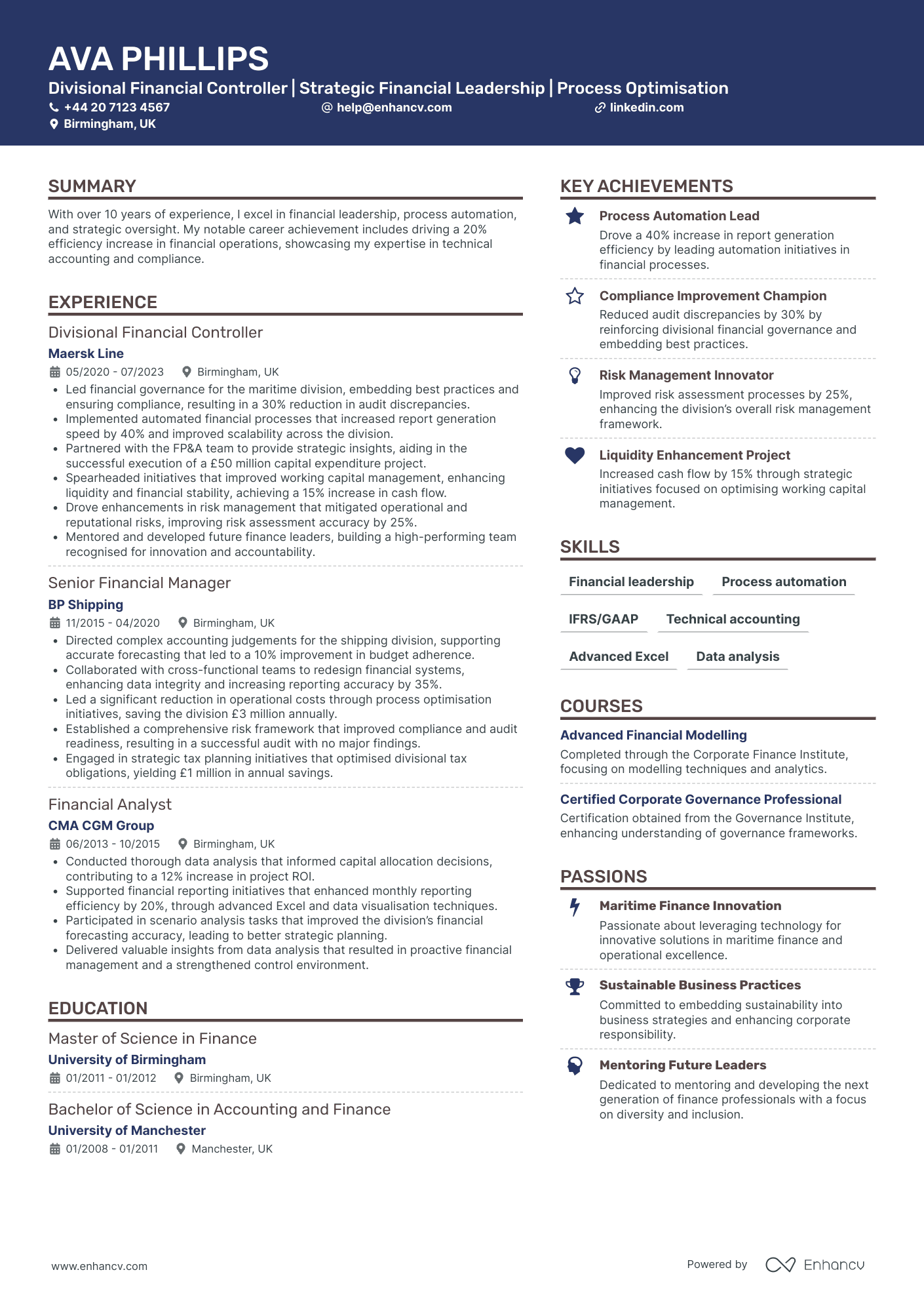
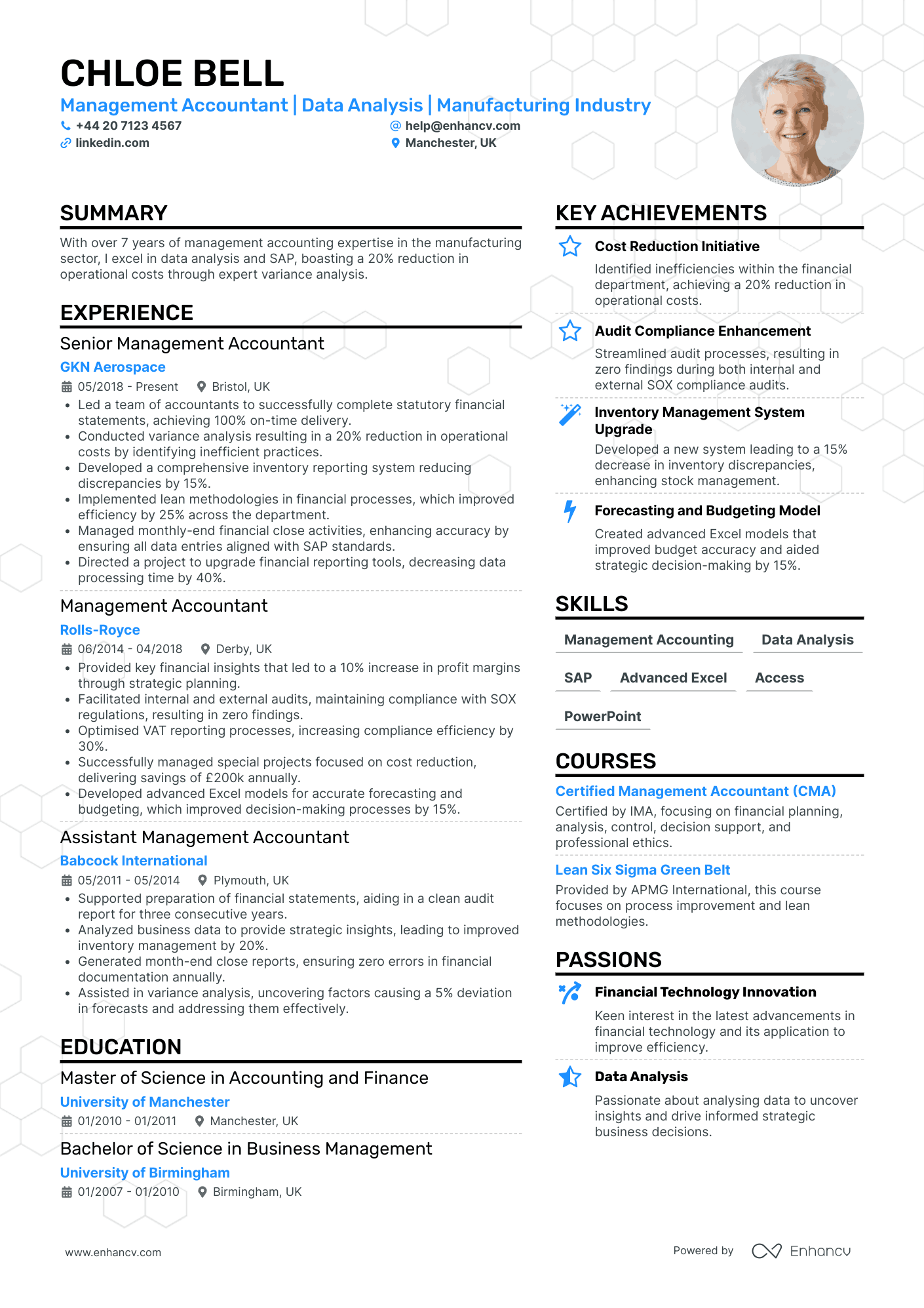
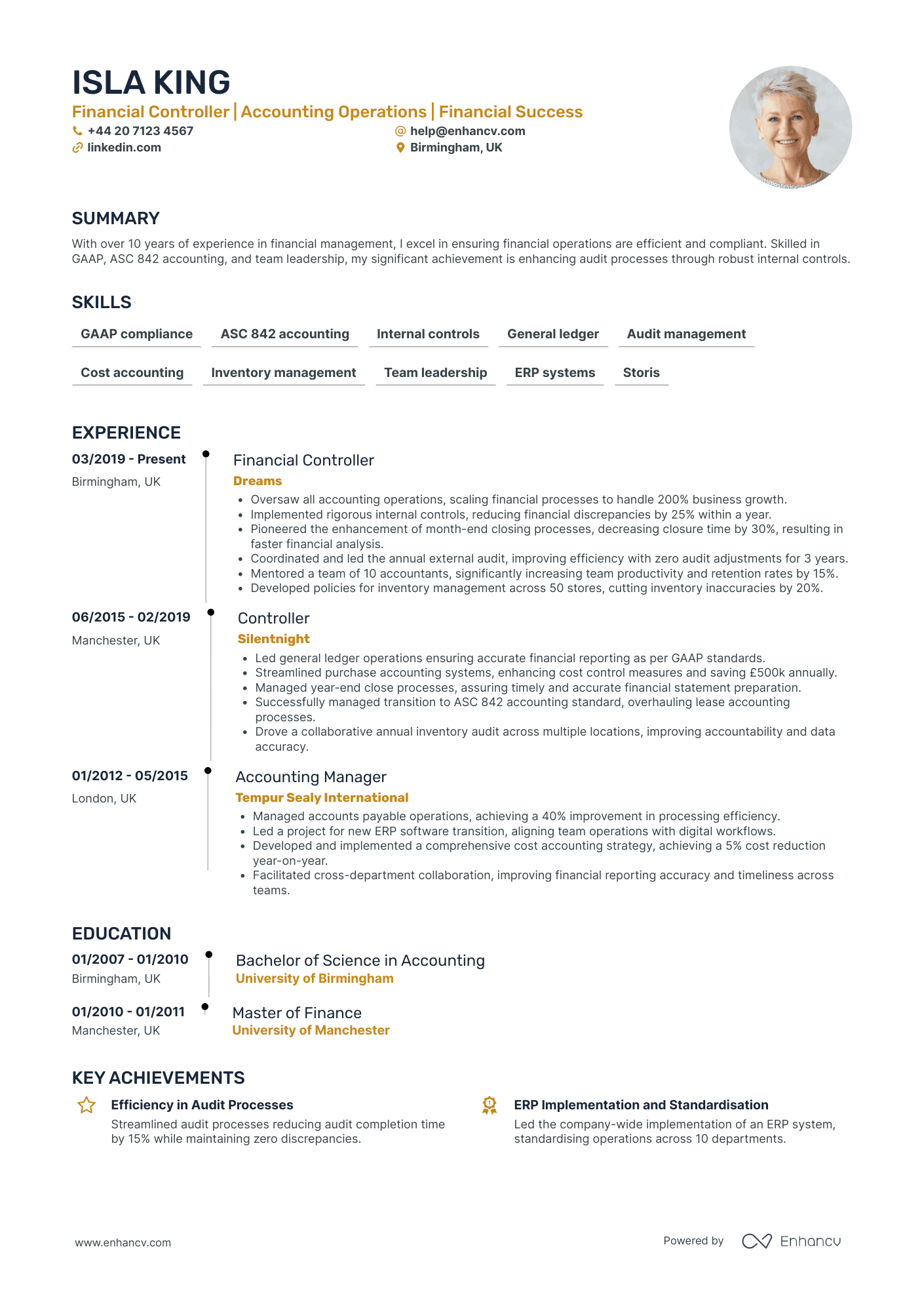
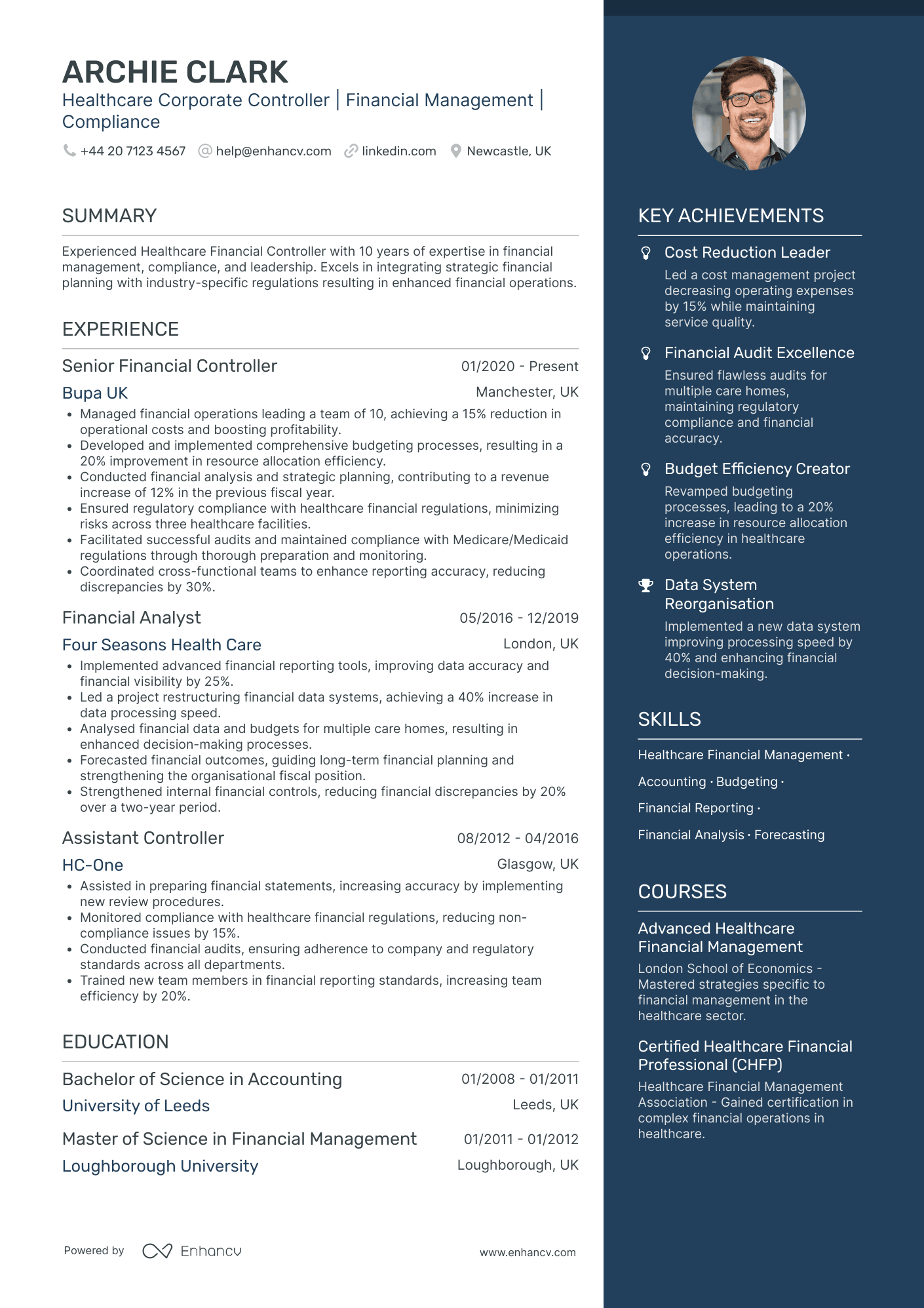
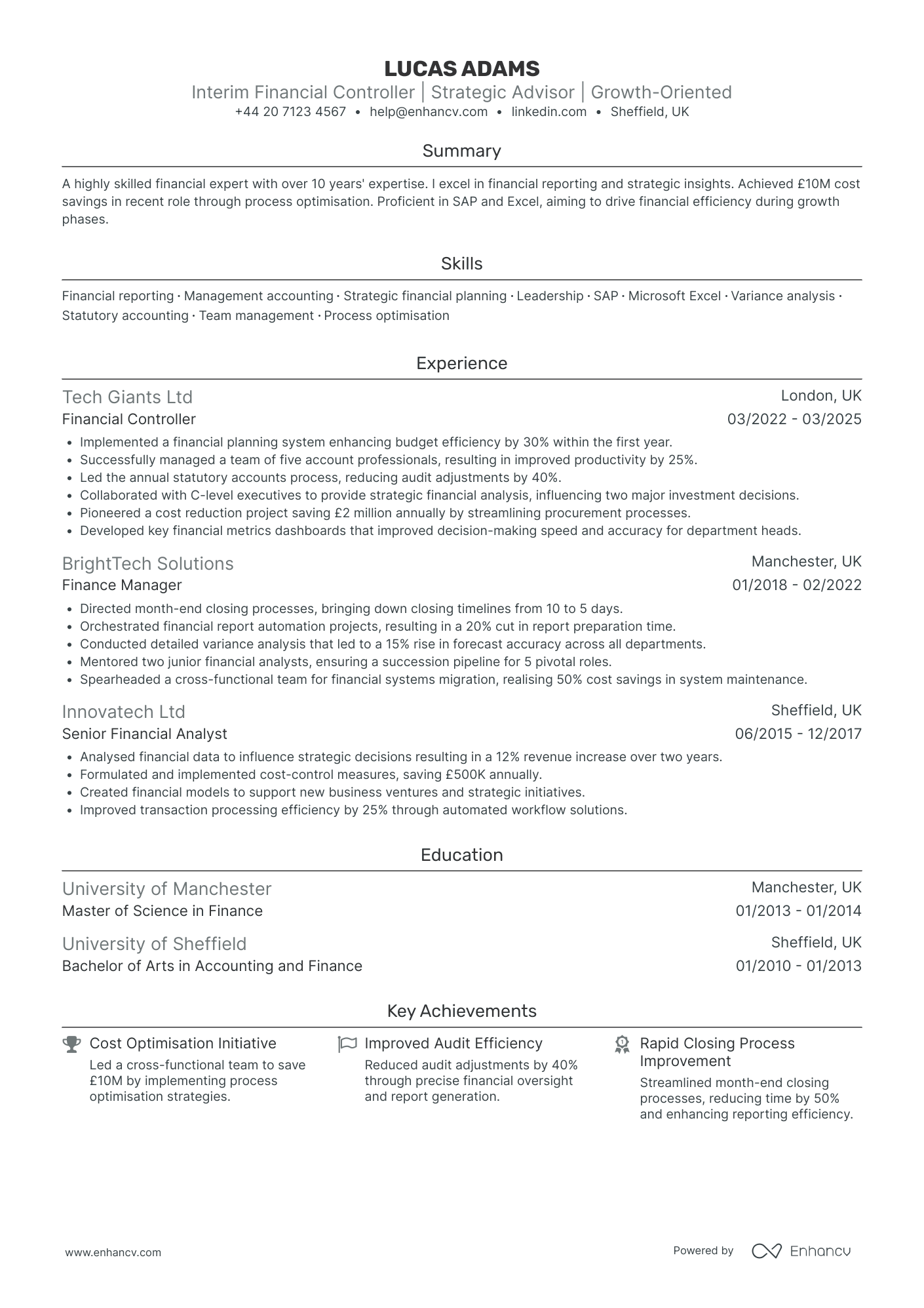
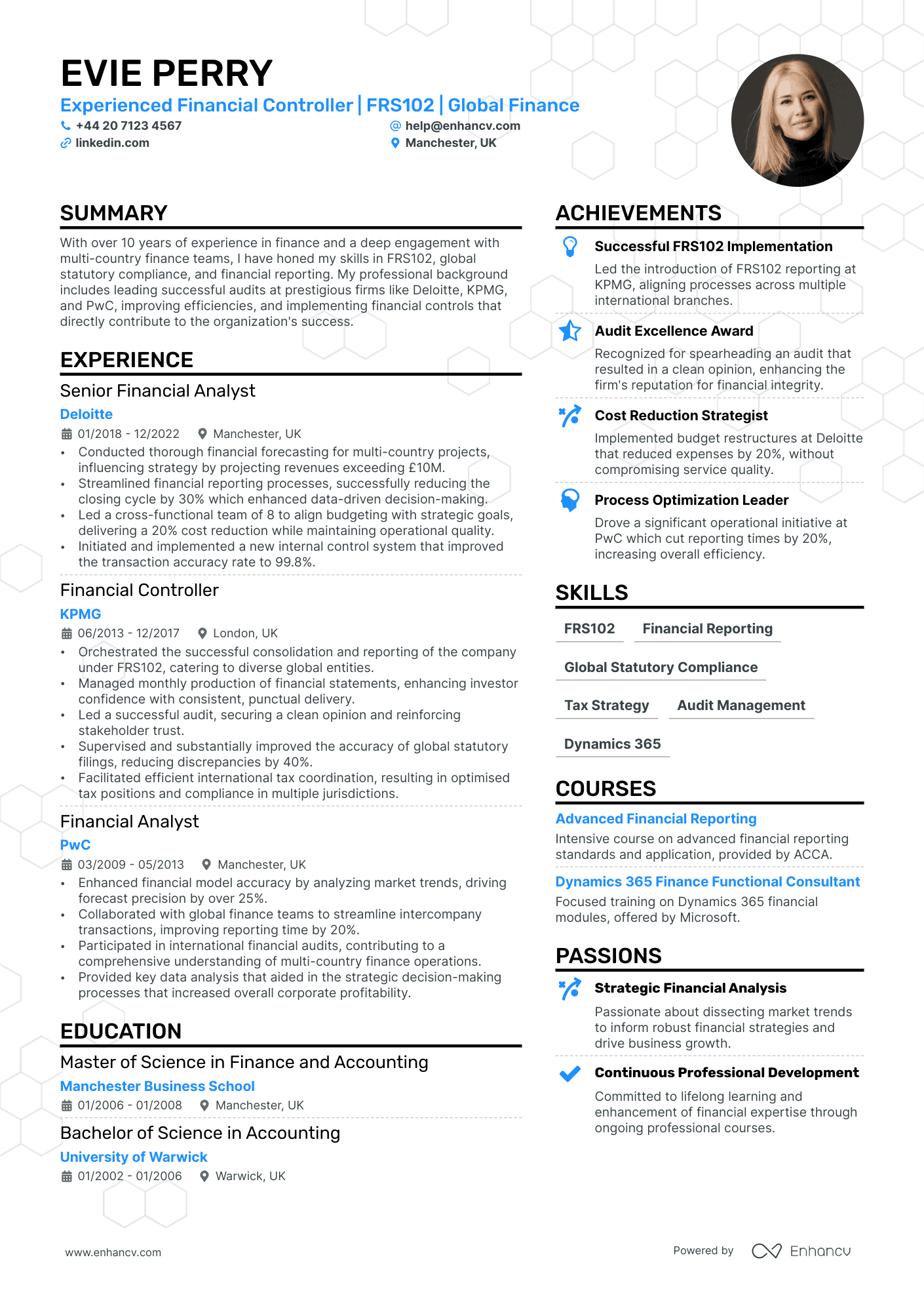
A financial controller CV lives or dies on one thing: proof you can own the numbers a board actually relies on. Most read like the job description for the role, not evidence that the person behind it did the work.
Senior finance candidates lose the reader on structure first. Get the layout wrong and a strong track record reads as a wall of duties, which is why formatting is where this starts. If you want the fundamentals first, see how to write a CV.

Key takeaways
- Lead with format: two pages, reverse chronological, a PDF for direct applications and a Word copy for recruiters.
- Financial controller roles are senior. Show ownership of month-end, statutory reporting, and a team, not a list of tasks.
- Name the skills adverts repeat: financial reporting, budgeting, financial controls, forecasting, and strong Excel.
- Quantify everything: budgets managed, close timelines cut, audits passed clean, headcount led.
- The work is mostly on-site, so keep your location visible near the top of page one.
- Chartered status (ACA, ACCA, or CIMA) belongs high on the page, not buried in education.
Formatting your financial controller CV
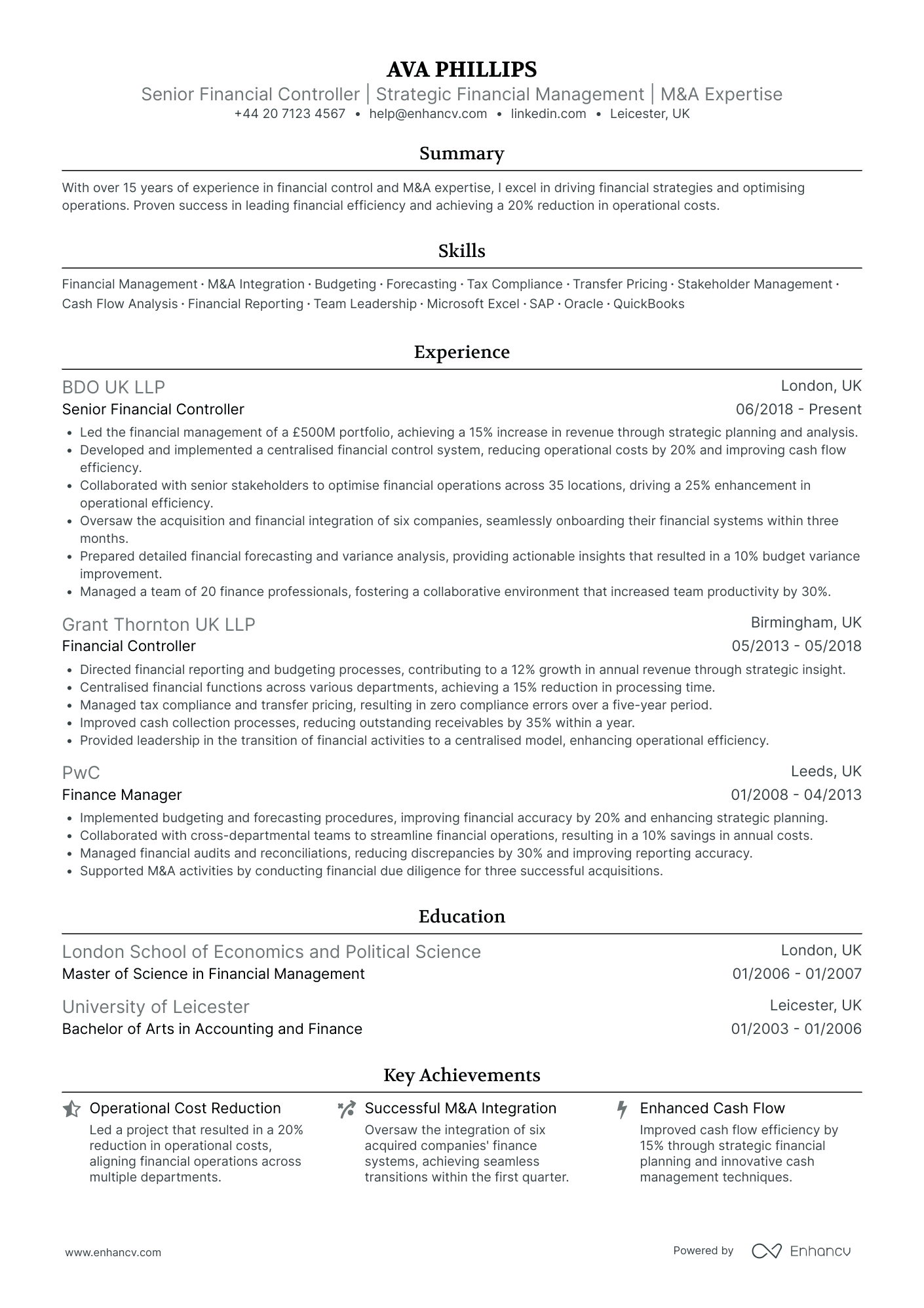
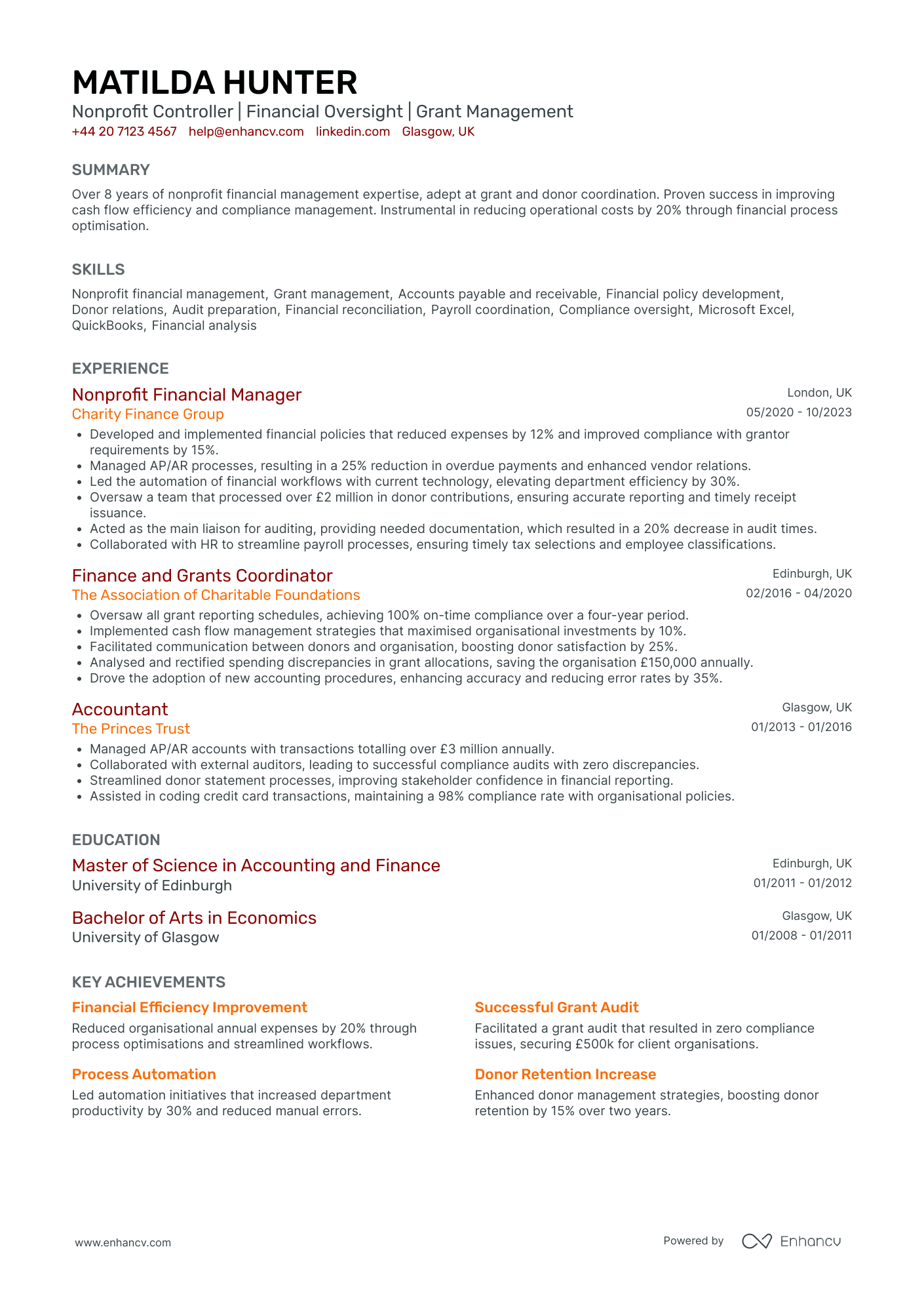
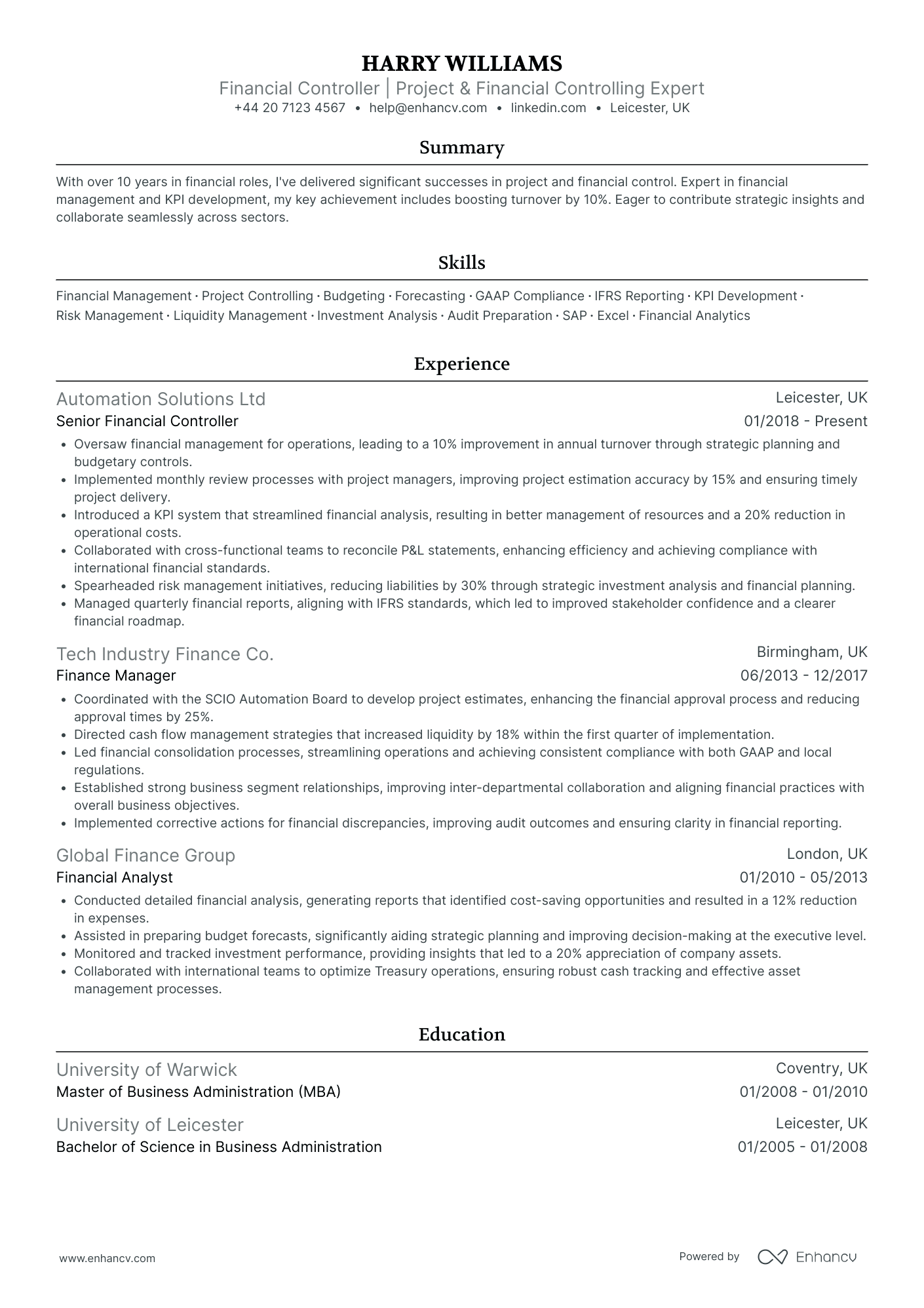
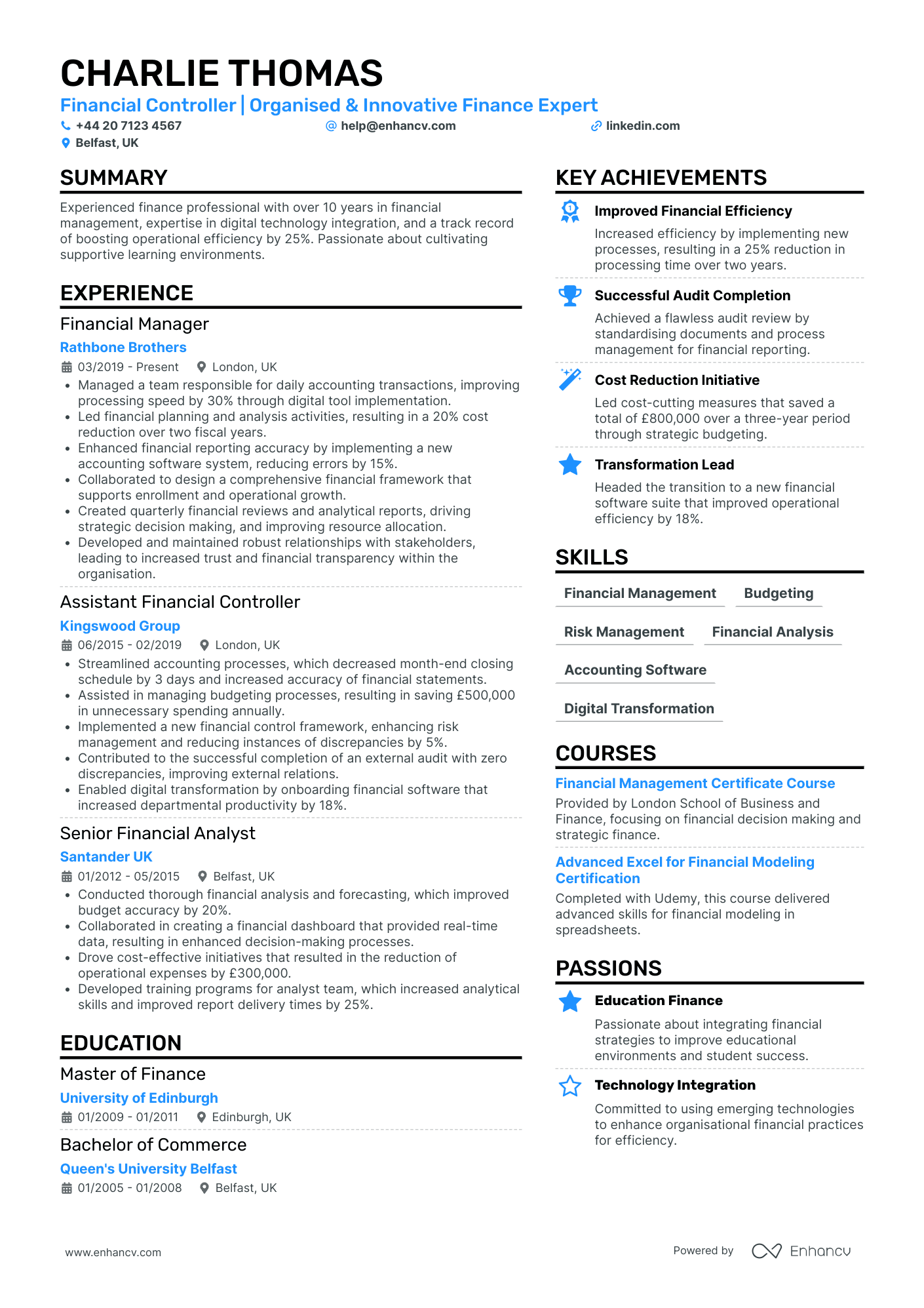
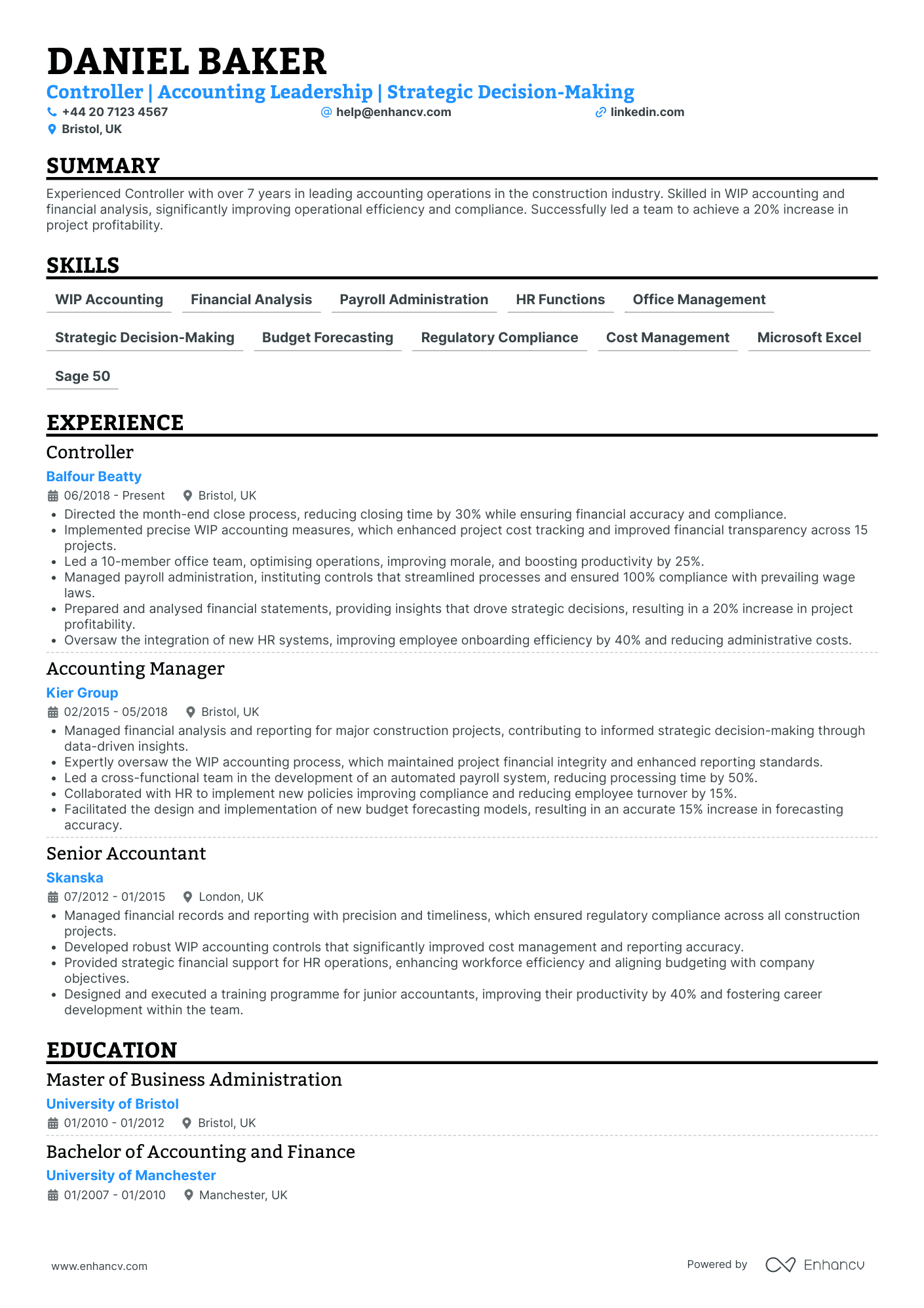
Use a reverse chronological structure. At controller level your recent roles are the evidence, so lead with them and let older jobs shrink to a line or two.
Keep it to two pages. A finance director skims a controller CV in under a minute, so one column, standard headings, and a readable font beat anything decorative.
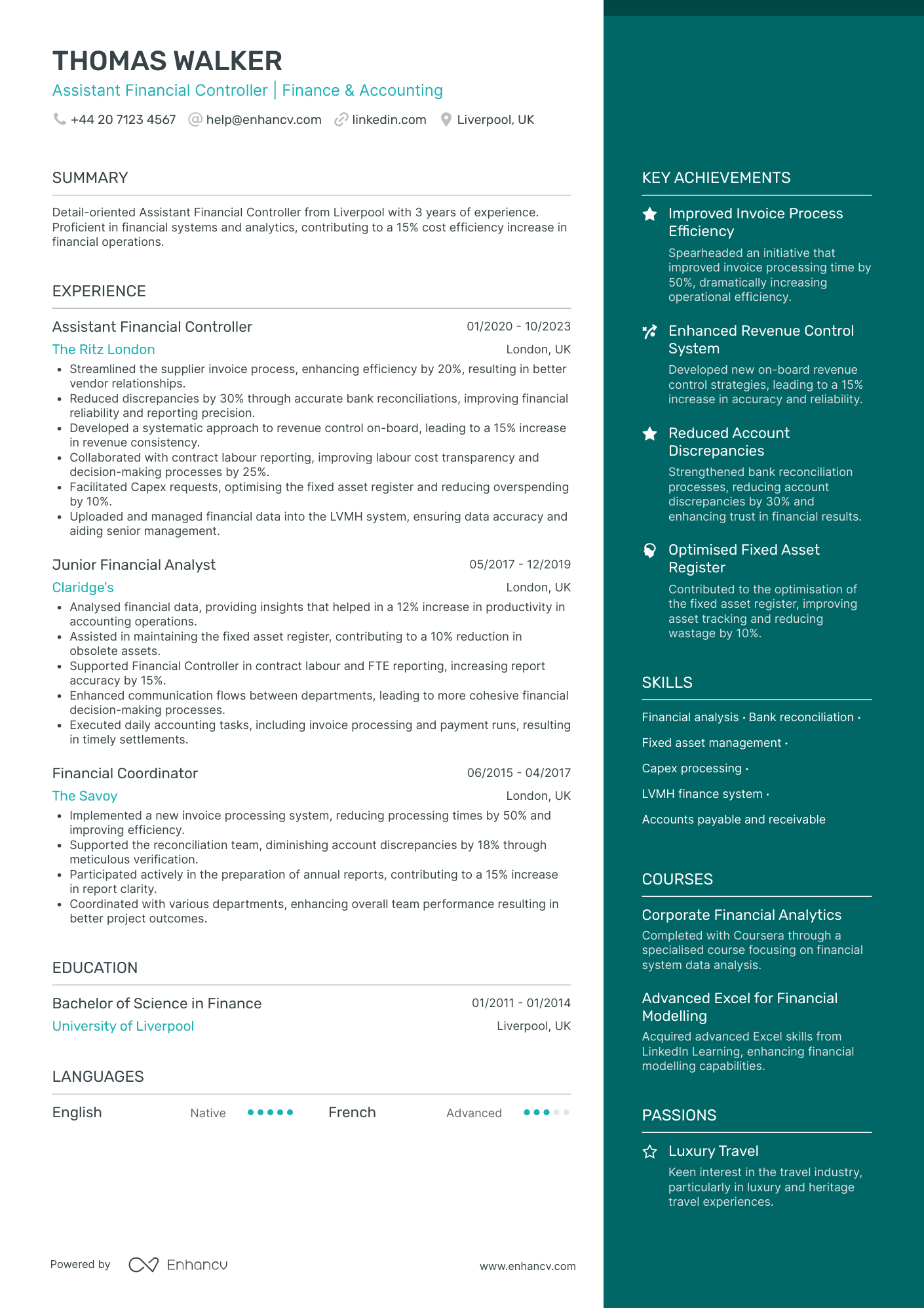
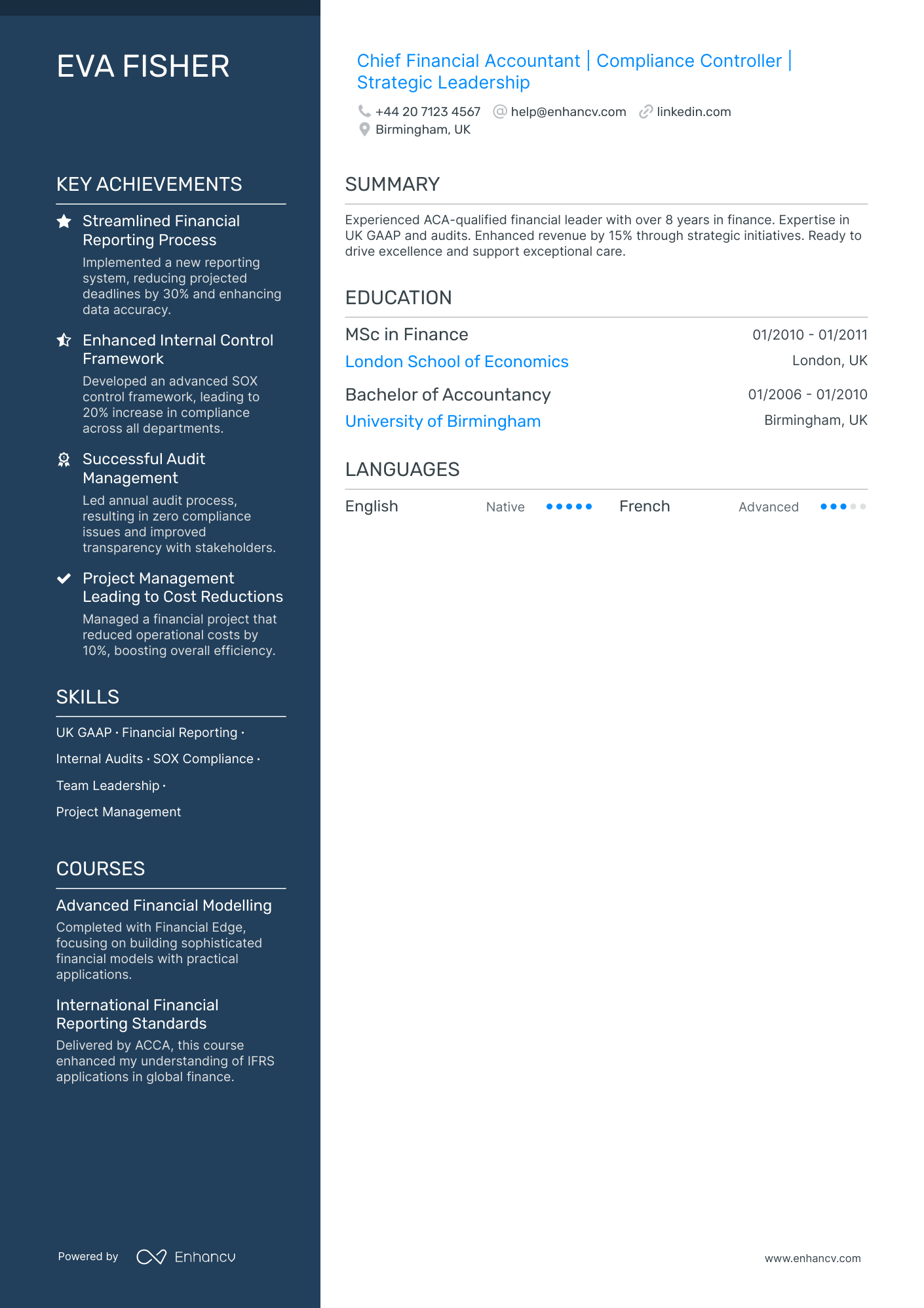
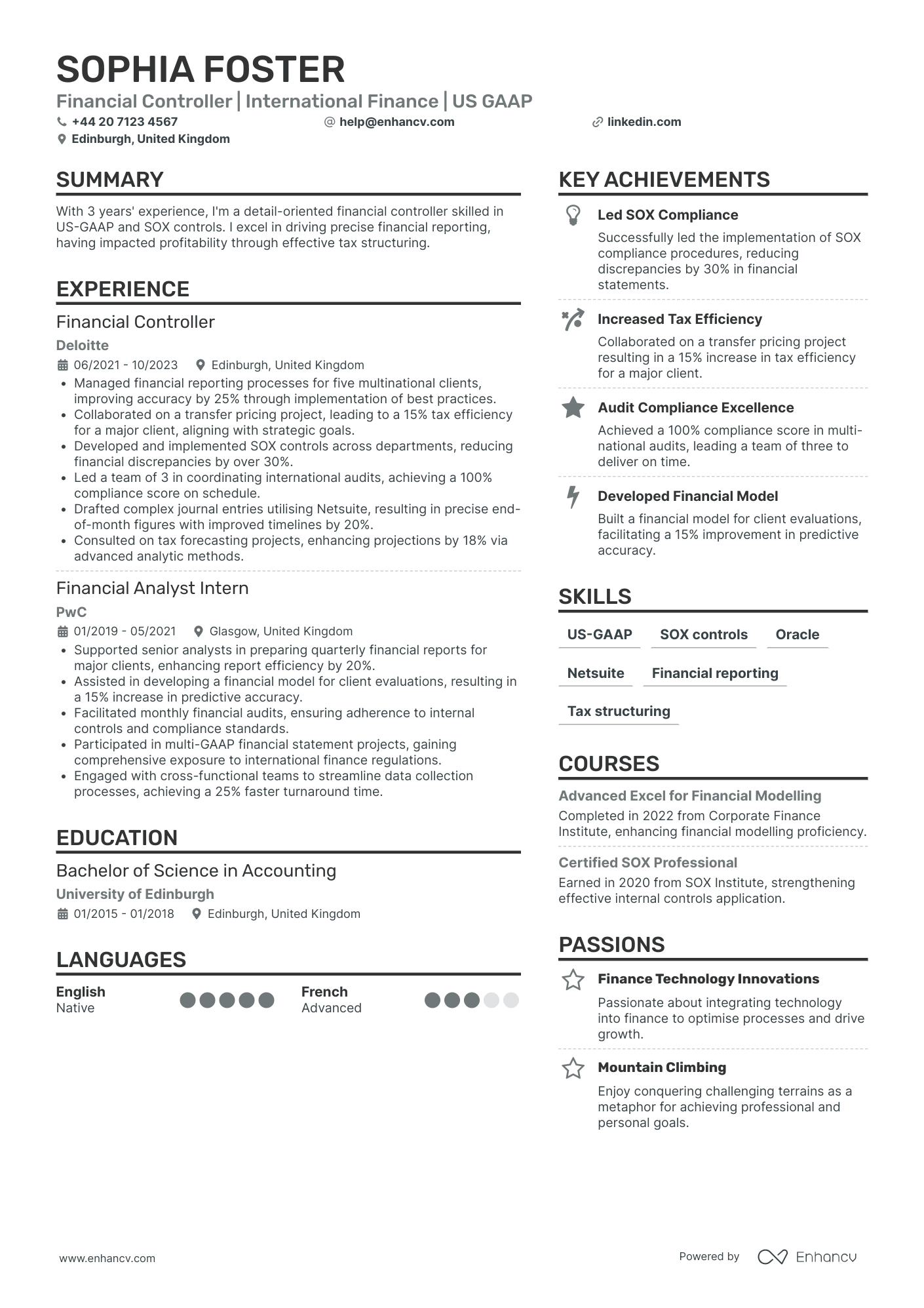
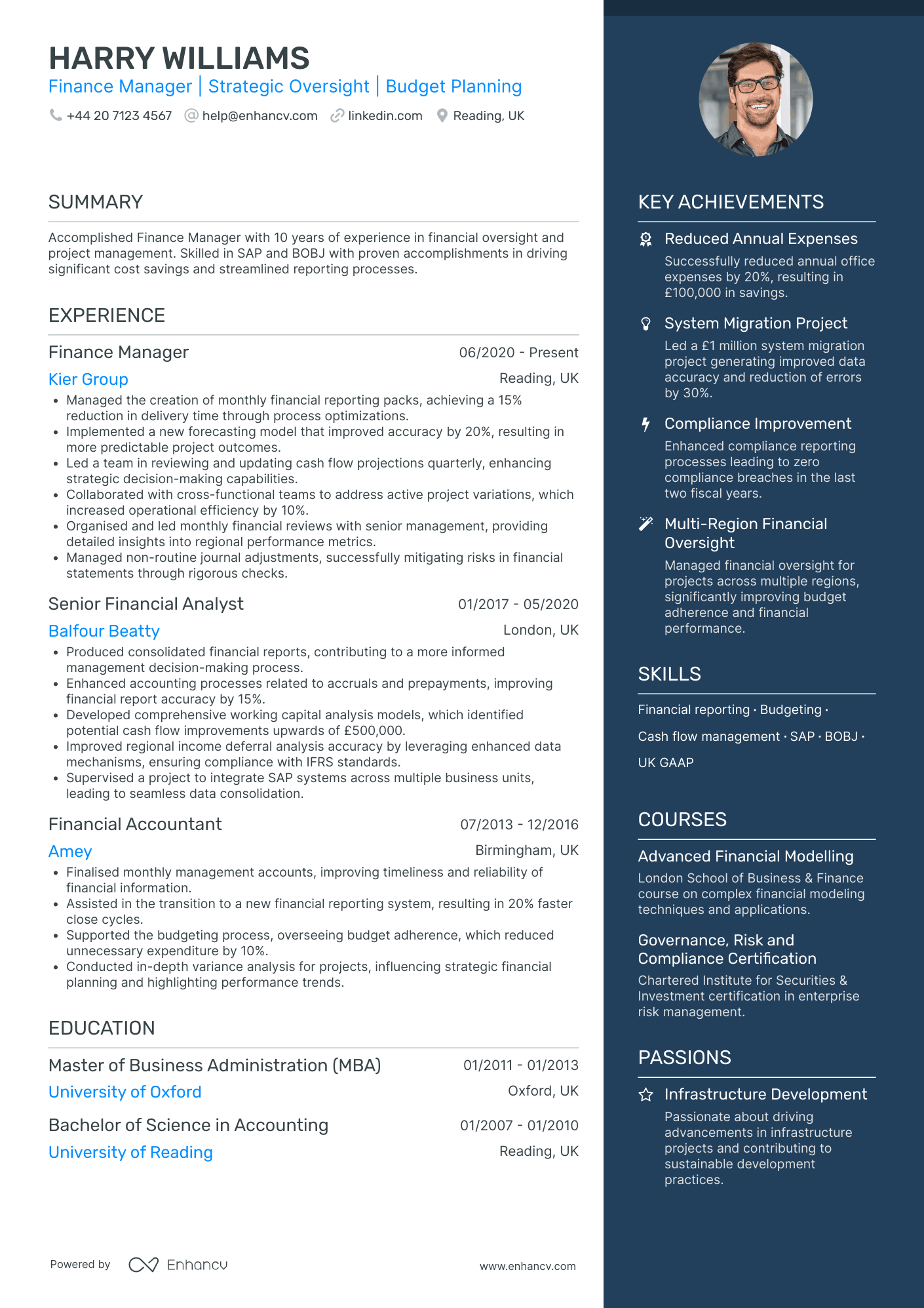
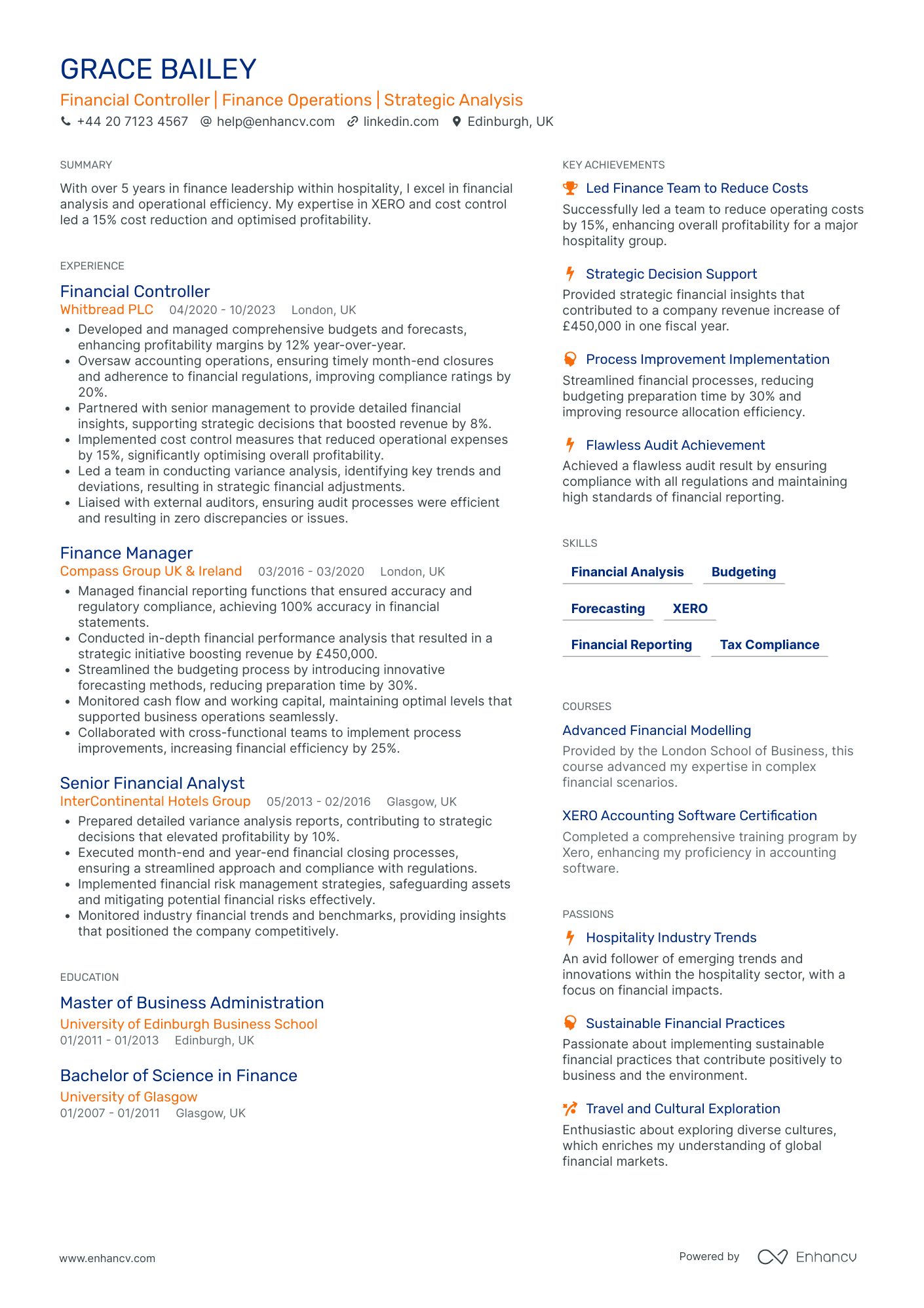
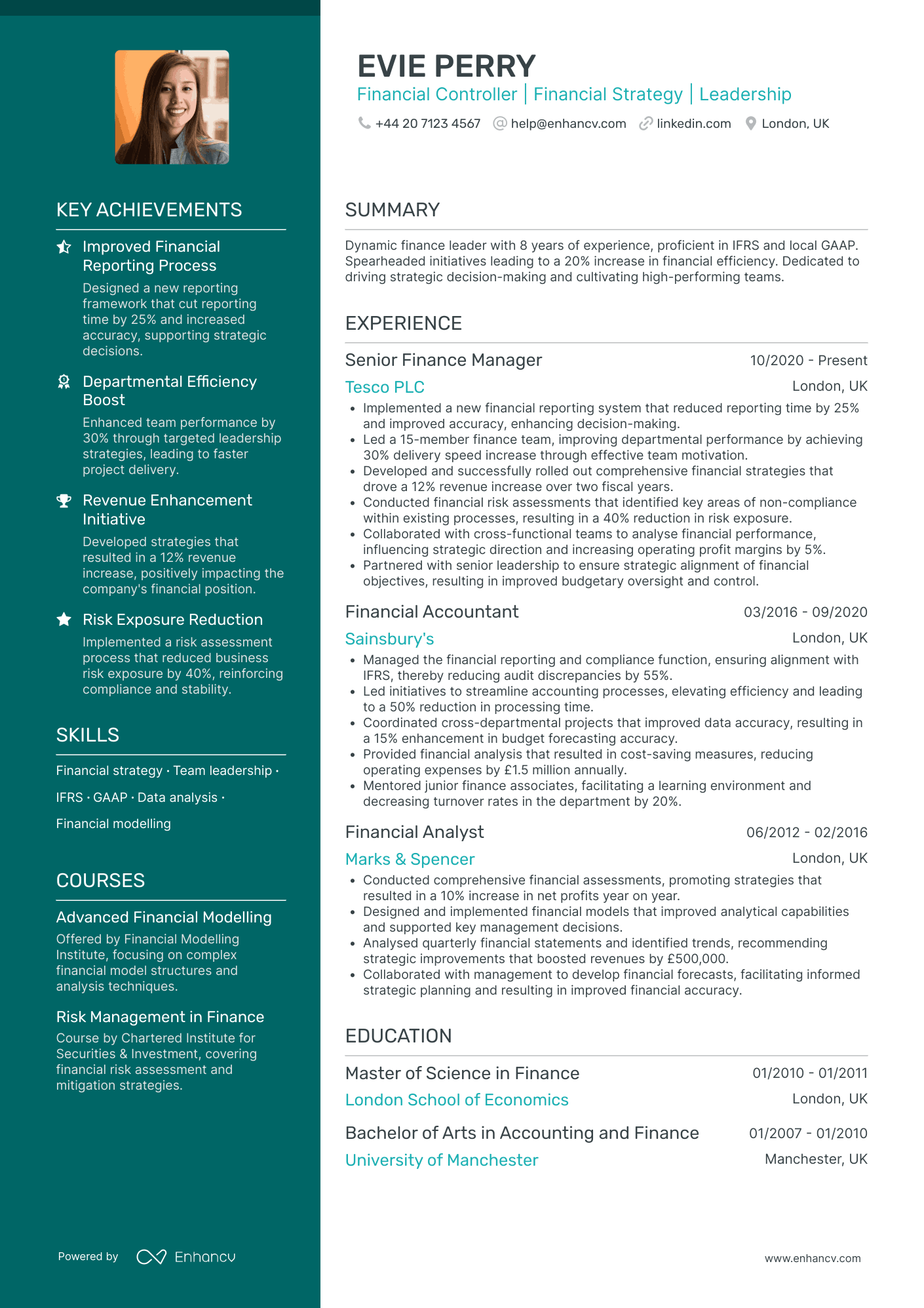
Resist the two-column, graphic-heavy templates built for creative roles. They can confuse tracking software, and they signal the wrong thing for a finance job where clean and precise beats designed.
Your header earns its space, so keep it lean. Name, chartered status, location, phone, and email are enough. Skip the full postal address and the date of birth, and add a LinkedIn URL only if the profile is current.
Put your qualifications where they get seen. Chartered status (ACA, ACCA, or CIMA) belongs near the top, next to your name or inside the personal statement, not at the foot of page two.
Name your systems, because controllers are hired partly on the tools they run. A short technical line for the ERP and reporting stack you know, whether that is SAP, Oracle, NetSuite, Sage, or Xero, plus any consolidation tools, saves the reader a question.
Send a PDF for direct applications so the layout holds on any screen. Keep a Word copy for recruitment agencies, which place a large share of finance roles and reformat CVs into their own template. If the advert names a file type, follow it.
Finance applications almost always pass through tracking software, so keep the layout clean and the headings standard for an ATS-friendly CV. Build from a tested CV format rather than a blank page, and Enhancv's CV templates export to a clean PDF.
Be consistent with your own numbers. Format every currency figure, date, and heading the same way down the page. A controller CV that is careless with its own presentation undercuts the one thing the role is about.

PRO TIP
Order the page for a senior finance reader. Name and chartered status first, then a tight personal statement, then experience, then skills and qualifications. A finance director wants ownership and the letters after your name up top, not a skills grid before they know what you have run.
What the UK financial controller market looks like
Knowing what employers ask for shapes what you put near the top. Here is what the current postings show.
| What | UK financial controller roles |
|---|---|
| Where the work happens | Mostly on-site (17 of 27 UK postings in the last ~30 days on Enhancv's internal job feed), with 9 hybrid and 1 remote |
| Seniority asked for | Pitched senior: 23 of the 27 postings ask for a lead or fully qualified controller, only a handful at mid level |
| Most-listed skills | Financial reporting, budgeting, and financial controls lead, followed by financial analysis and forecasting |
| Tools and standards named | Strong Excel throughout, plus IFRS and statutory reporting knowledge |
Two signals should change your CV. The work is mostly on-site, so a hiring manager needs to see you can be in the office, which means your location belongs near the top and not in the footer.
And these roles are pitched senior. Most postings ask for a lead or fully qualified controller rather than a mid-level accountant, so evidence of ownership and a team beats a longer task list.
The skills line up too. Financial reporting, budgeting, and financial controls are the demands that recur most, with financial analysis and forecasting close behind, so mirror those words where they are true of you rather than inventing a fresh vocabulary for them.
Remote controller roles are the exception rather than the rule, so a CV built around a remote pitch works against the market. Show that you can be on-site, and treat any hybrid arrangement as a bonus you raise at interview rather than a headline demand.
Writing your financial controller personal statement
Three or four sentences at the top: who you are, your qualification, the size of what you have run, and one hard result. See more personal statement examples if the opening line is not landing.
Keep it to the top of page one and leave the detail for the sections below. The personal statement is a headline, not a second copy of the whole CV.
Skip the adjective soup. The opener below uses a lot of words and says nothing a finance director can check:
Financial controller personal statement to avoid
A hard-working and detail-oriented finance professional with excellent communication skills and a proven track record, seeking a challenging and rewarding financial controller position in a dynamic organisation.
Lead with numbers and scope instead. Name the qualification, the size of the business, the team, and one result that moved:
Financial controller CV personal statement example
Qualified financial controller (ACCA) with eight years in manufacturing finance, leading a team of six and owning month-end close, statutory reporting, and budgeting for a group turning over £60m. Cut the close from nine days to five and delivered three consecutive clean audits. Looking to bring tighter financial controls and clearer board reporting to a controller role in the West Midlands.
If you are part-qualified and stepping up, the same rules apply with one addition. State where you are in your studies, then let the ownership and the numbers carry the rest of the pitch.
When we read a financial controller CV, the first thing we look for is ownership. A line like "cut month-end close from nine days to five and delivered three clean audits" tells us more than a paragraph of responsibilities. Name the size of what you ran, the team you led, and the number that moved. At this level the letters after your name get you shortlisted, but the results get you the interview.
Building your financial controller experience section
Write each role as a dated heading followed by bullets that show what you owned and what changed. Lead every bullet with a strong action verb, and see work experience on a CV for the mechanics.
Controller work is measurable by design. Budgets managed, close timelines cut, audits passed clean, variances caught, and headcount led are your CV achievements, not the fact that you "prepared management accounts".
Watch the difference a number makes. "Responsible for month-end reporting" describes a duty anyone in the role holds. "Owned month-end close for a £60m group and cut it from nine days to five" describes the person who did it well.
Order the bullets by weight, not chronology. Put the result that would matter most to your next employer first, and let the routine tasks sit lower or drop off entirely.
Tailor each application to the advert. Pull the finance terms it uses, IFRS, statutory reporting, and consolidation, then mirror them where they are true of you. Enhancv's CV tailoring feature reads the advert and suggests the matching edits, which saves rewriting from scratch each time.
- Own the month-end close for a business turning over £60m, cutting the timeline from nine to five working days across two reporting cycles
- Lead a team of six across management accounts, budgeting, and statutory reporting under IFRS
- Delivered the annual audit with no material adjustments for three consecutive years, working directly with external auditors
- Rebuilt the forecasting model in Excel, improving cash-flow visibility and flagging a £250k budget variance before quarter-end
- Tightened purchase-approval controls, which reduced maverick spend and cleared two long-standing balance-sheet reconciliations
- Produced monthly management accounts and variance analysis for three business units, presenting the pack to department heads
- Ran the annual budgeting cycle alongside the finance manager, consolidating input from eight cost-centre owners
- Automated a manual reconciliation in Excel, saving roughly two days of work each month-end
- Studied for ACCA alongside the role and qualified in 2020

From duty to result
Weak: "Responsible for preparing management accounts and assisting with the audit." Strong: "Produced monthly management accounts for a £60m group and led the audit to a clean sign-off with no adjustments." It is the same task, but the second version names the scale and the outcome, which is what a finance director is reading for.
PRO TIP
Finance adverts name specifics, not slogans. Mirror the ones you can back: "IFRS", "statutory reporting", "consolidation", "month-end close", "budgeting and forecasting". Match the standard or system exactly as the advert writes it, and only where it is genuinely yours.
Showing leadership on a financial controller CV
Controller is a leadership role, so the CV has to show more than technical accuracy. A finance director is buying a safe pair of hands who can run a team and a reporting cycle without supervision.
Make progression visible. If you moved from management accountant to controller, or took on more of the group as it grew, let the job titles and dates tell that story as the reader travels down the page.
Quantify the leadership itself. The size of the team you manage, the trainees you have taken through their exams, and the reporting lines you own all count as evidence, not soft padding.
Name the people you answer to and work with. Board packs, audit committees, external auditors, and non-finance department heads all signal that you operate well above pure bookkeeping.
Show how you handle the pressure points. Steering a first clean audit, standing up a new control after a finding, or holding the reporting together through a system migration are the moments that separate a controller from an accountant.
Skills for your financial controller CV
Read a run of live controller adverts and the same demands repeat. Financial reporting, budgeting, and financial controls come up most often, followed by financial analysis, forecasting, and strong Excel. Those are your hard skills, listed in the words the adverts use.
Back the technical list with the knowledge employers name directly: IFRS and statutory reporting. List them only where you can stand behind them under questioning.
Be specific about Excel. "Advanced Excel" means more when a bullet nearby shows a model you built or a reconciliation you automated, so let the experience section carry the proof.
The soft skills that matter at this level are the ones a controller leads with: communication with non-finance stakeholders, attention to detail, and the judgement to hold a control when holding it is inconvenient. Prove each in a bullet rather than claiming it.
Do not over-list. A wall of twenty skills reads as filler, so keep the section to the eight or so that both the adverts and your own experience genuinely support.
Top skills for your financial controller CV:
Financial reporting
Budgeting
Financial controls
Financial analysis
Forecasting
Advanced Excel
IFRS
Statutory reporting
Stakeholder communication
Attention to detail
Leadership
Judgement
Deadline management
Education and qualifications for a financial controller CV
For a controller role the chartered qualification does more work than the degree. Name your body clearly, ACA, ACCA, or CIMA, and say whether you are fully qualified or part-qualified with papers still to sit.
List your qualifications and certificates with the awarding body and year, and put your education below them. A 2:1 in accounting or finance is worth a line, but a qualified ACCA outranks it here.
If you are part-qualified, say so plainly and add your study progress. Employers hiring at controller level expect the letters, so make them easy to find rather than making the reader hunt.
Keep any continuing professional development relevant. A recent course in a reporting standard or an ERP system belongs on the page, whereas an unrelated certificate from a decade ago rarely earns its space.
Where you trained matters less than that you finished. A CIMA passed through part-time study while working full-time is a selling point in itself, so do not hide the effort behind a single flat line.
Conclusion
Lead with a clean two-page format, put your chartered status and location where they get seen, and turn every duty into an owned result with a number attached.
Pair the CV with a short cover letter that explains the move, and a senior finance application starts to read like the controller the board wants.
Author's take - The Enhancv team
When we read a financial controller CV, the first thing we look for is ownership. A line like "cut month-end close from nine days to five and delivered three clean audits" tells us more than a paragraph of responsibilities. Name the size of what you ran, the team you led, and the number that moved. At this level the letters after your name get you shortlisted, but the results get you the interview.