



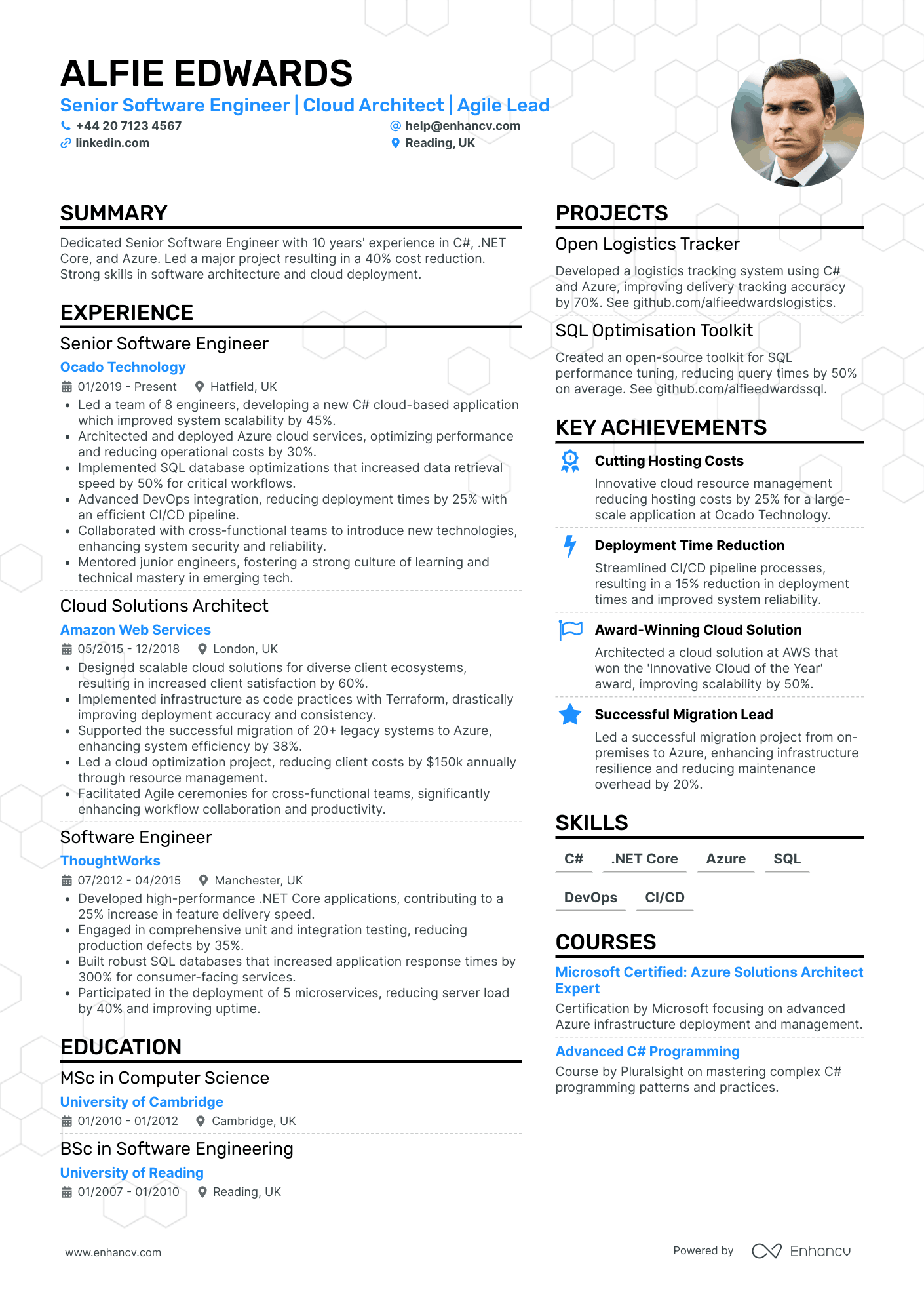
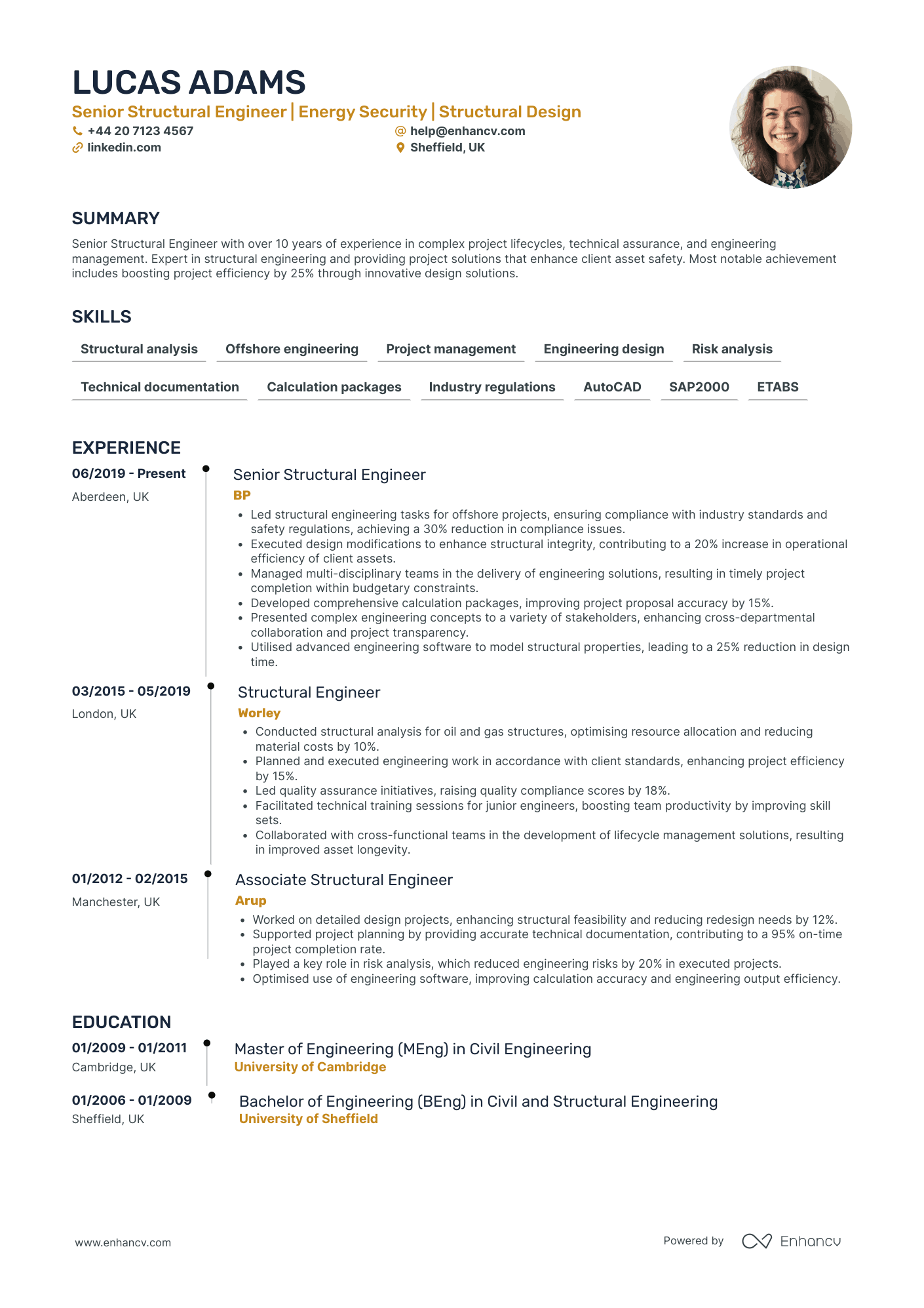
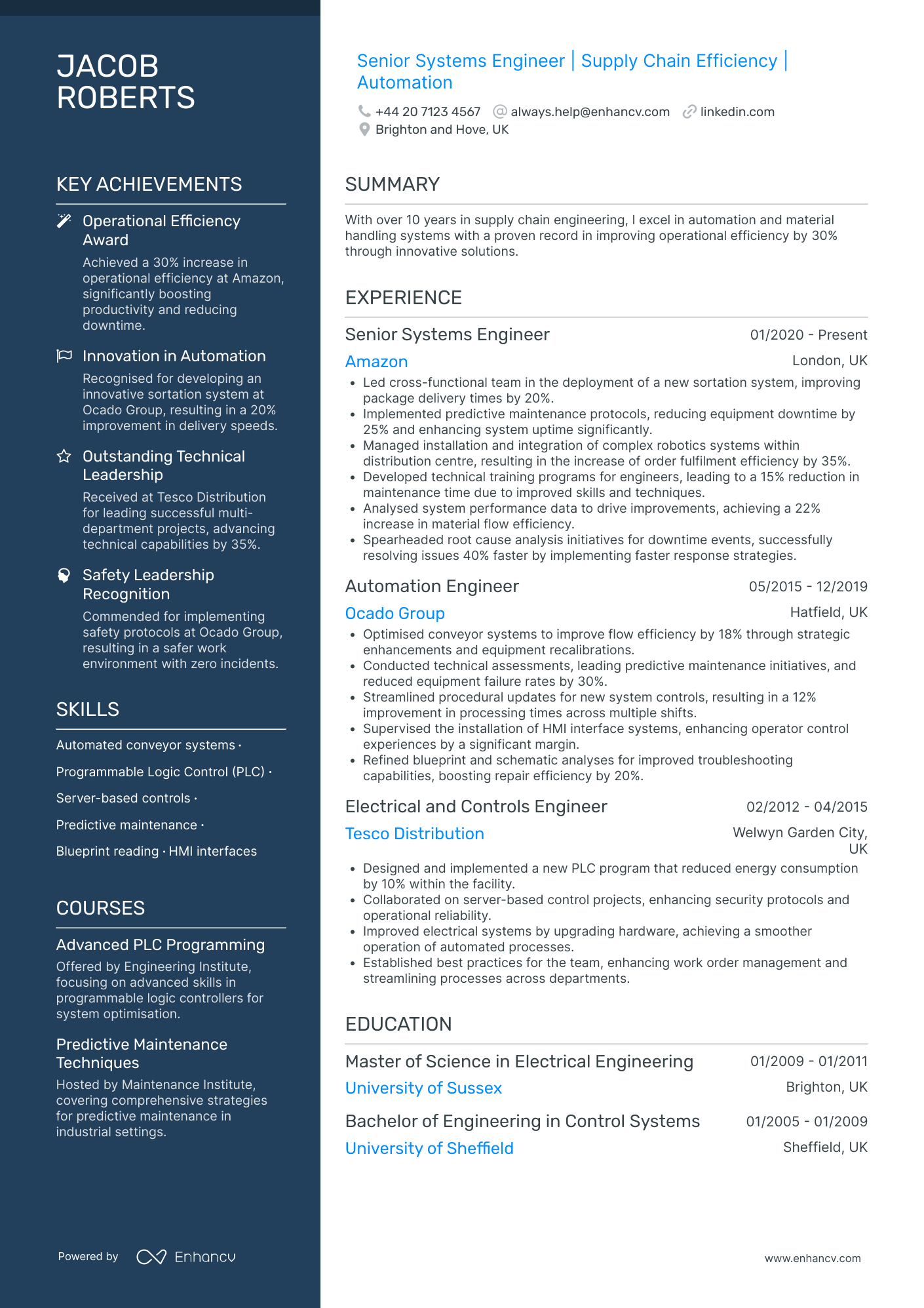
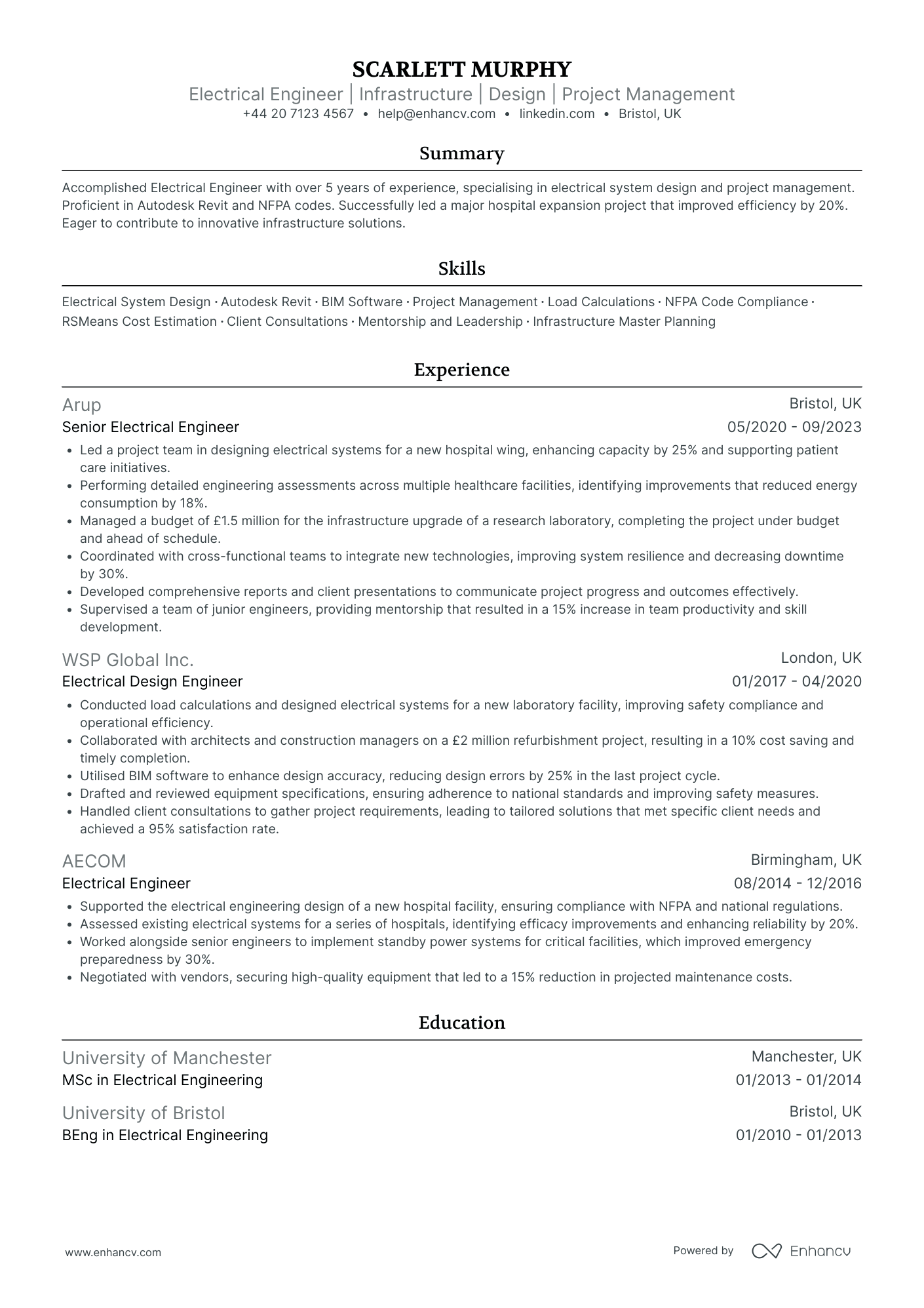
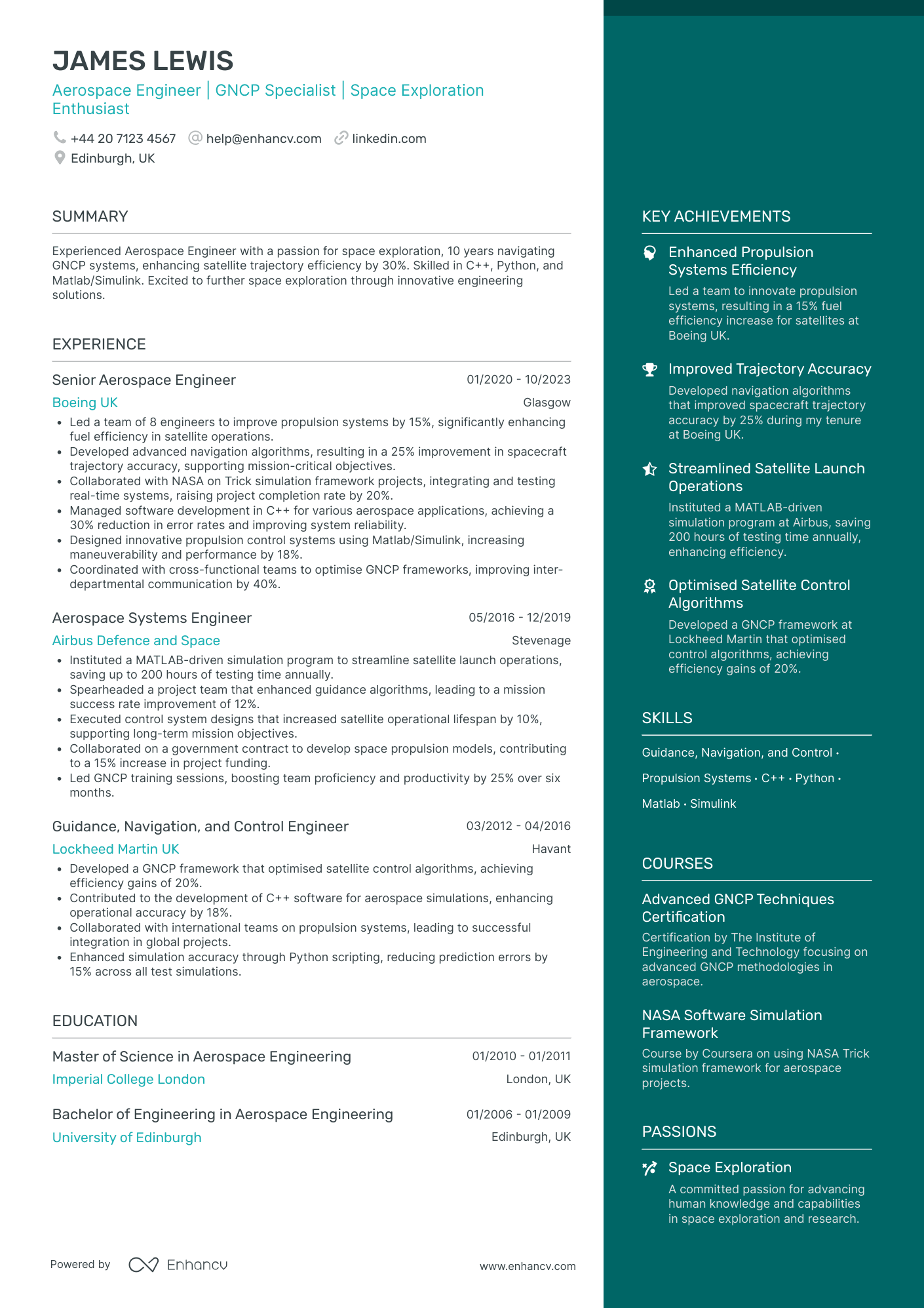
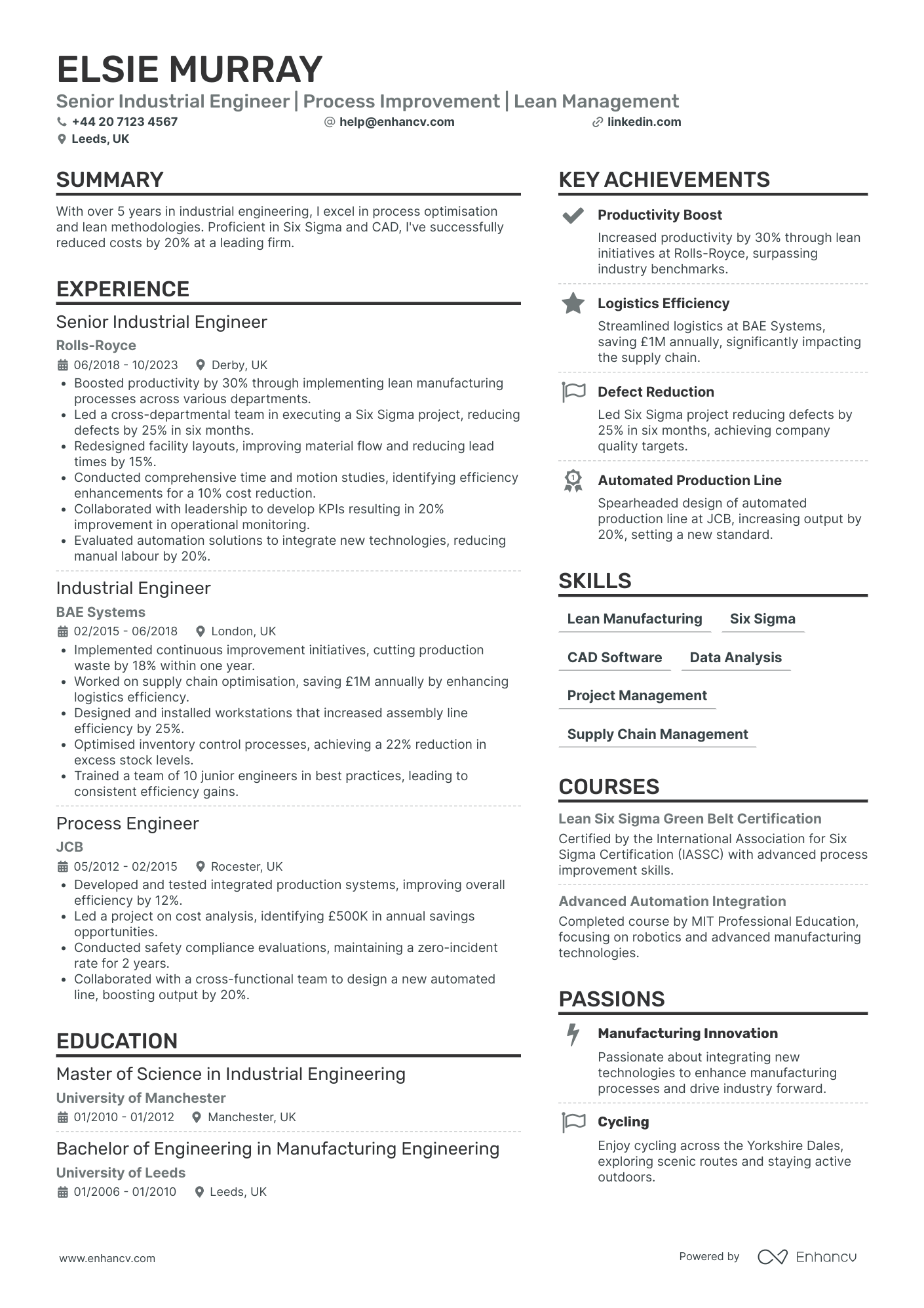
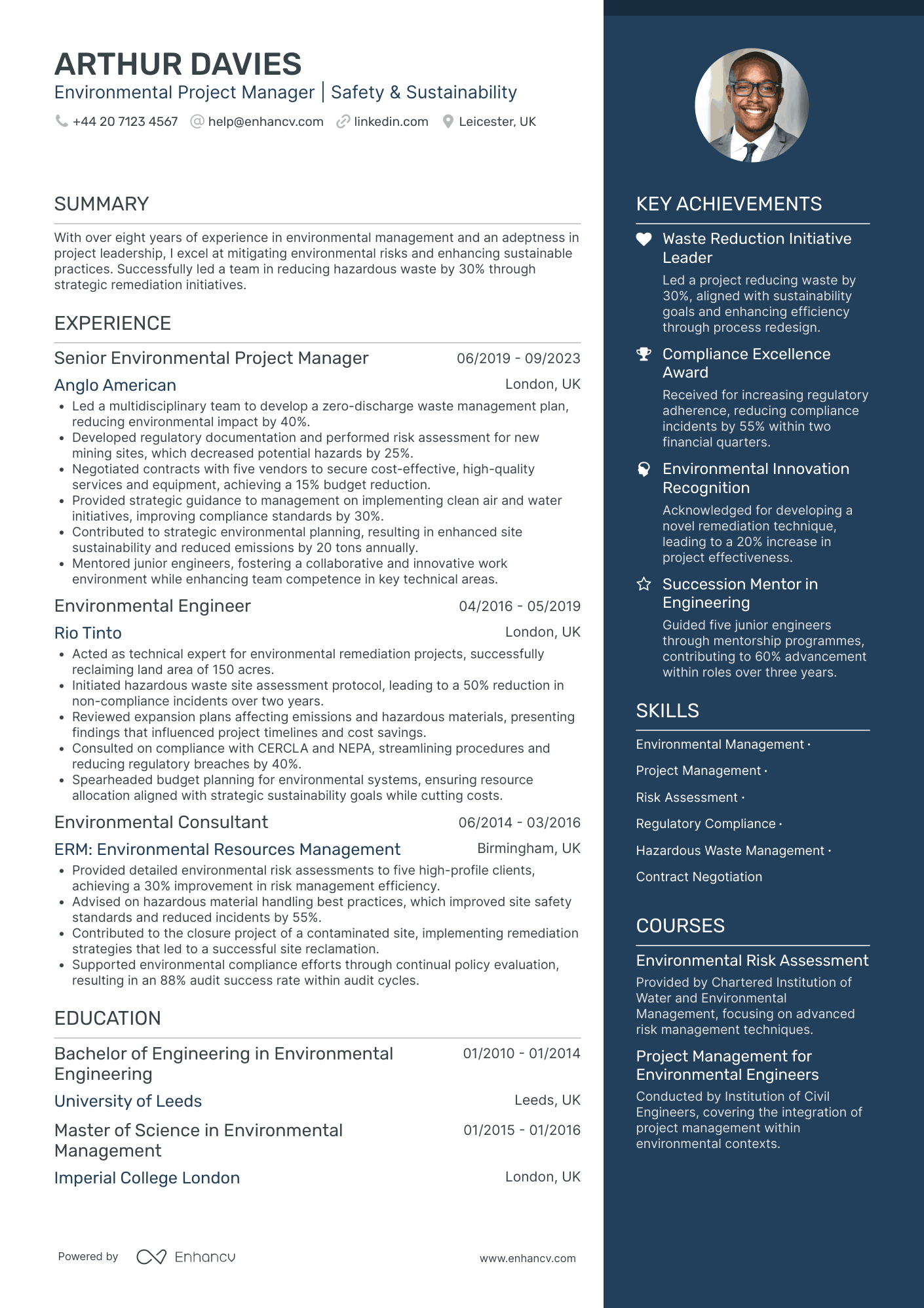
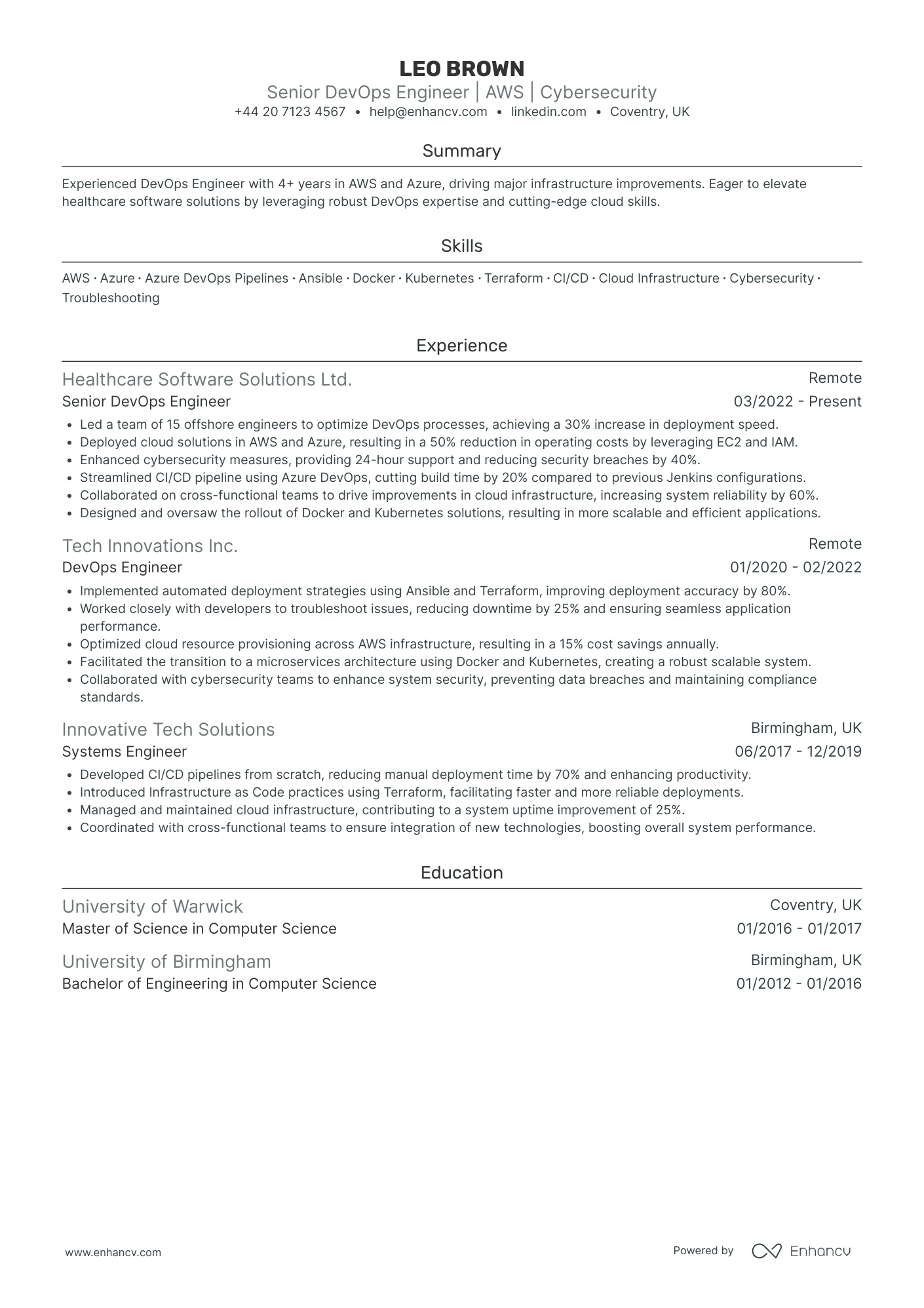
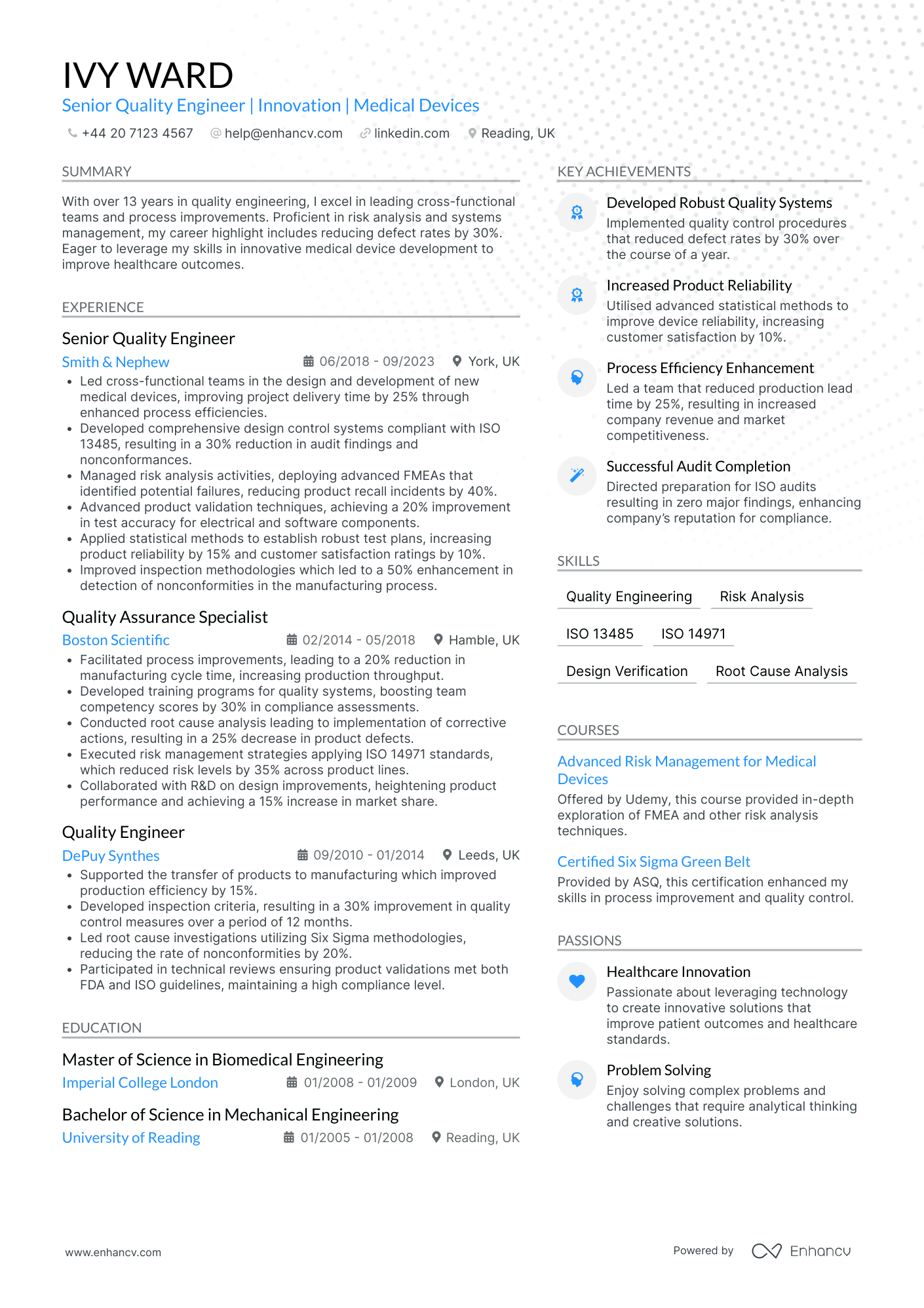
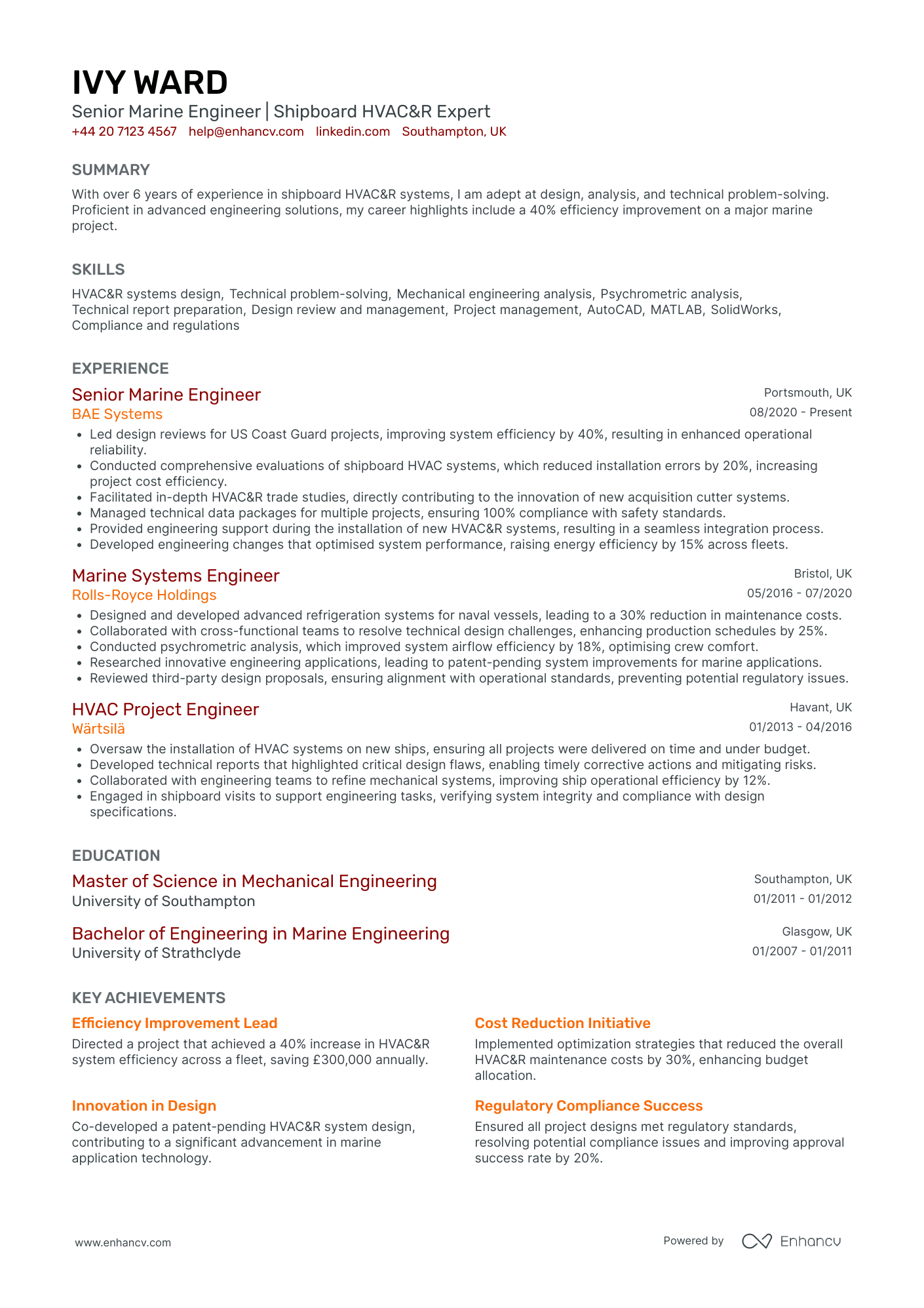
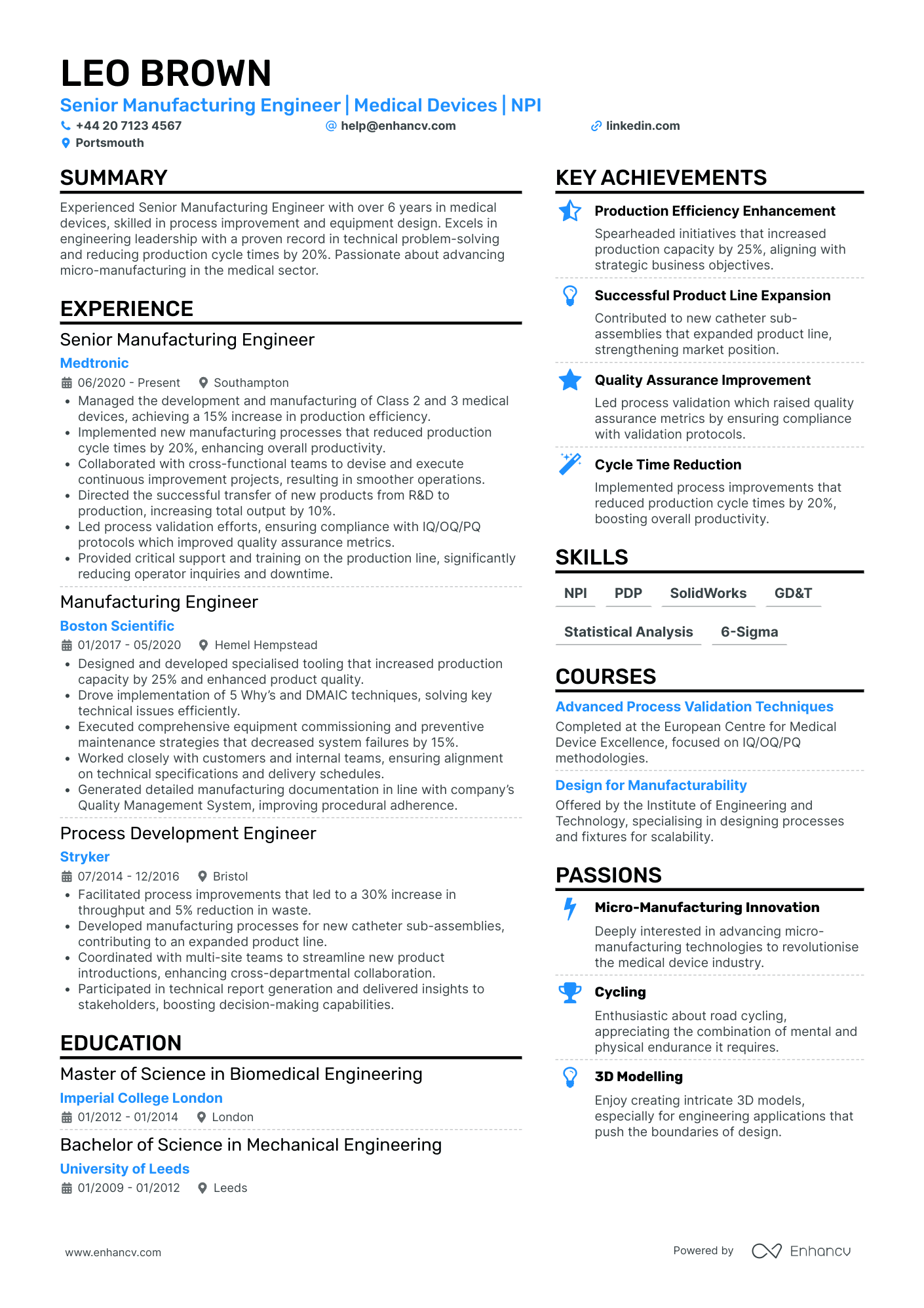
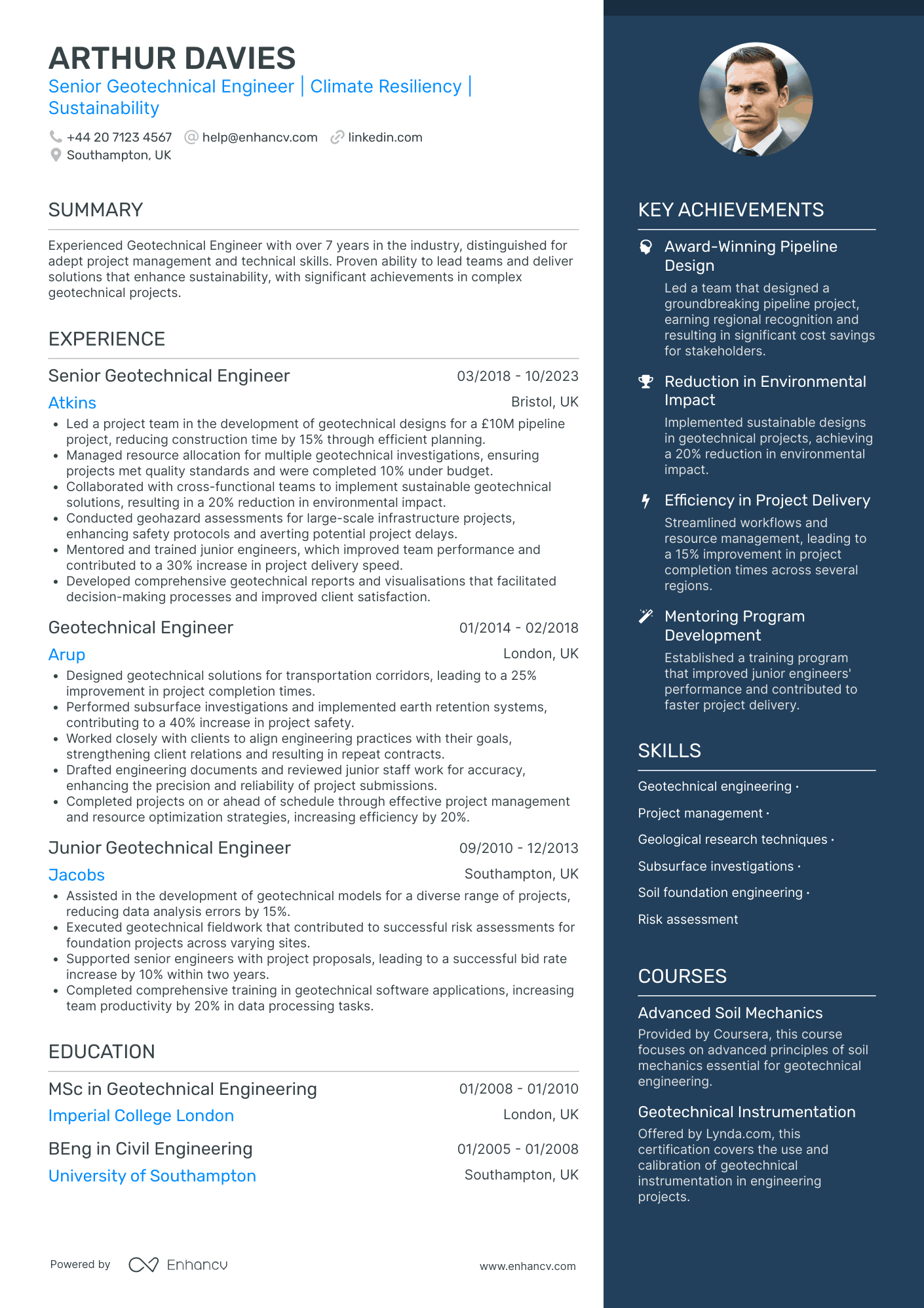
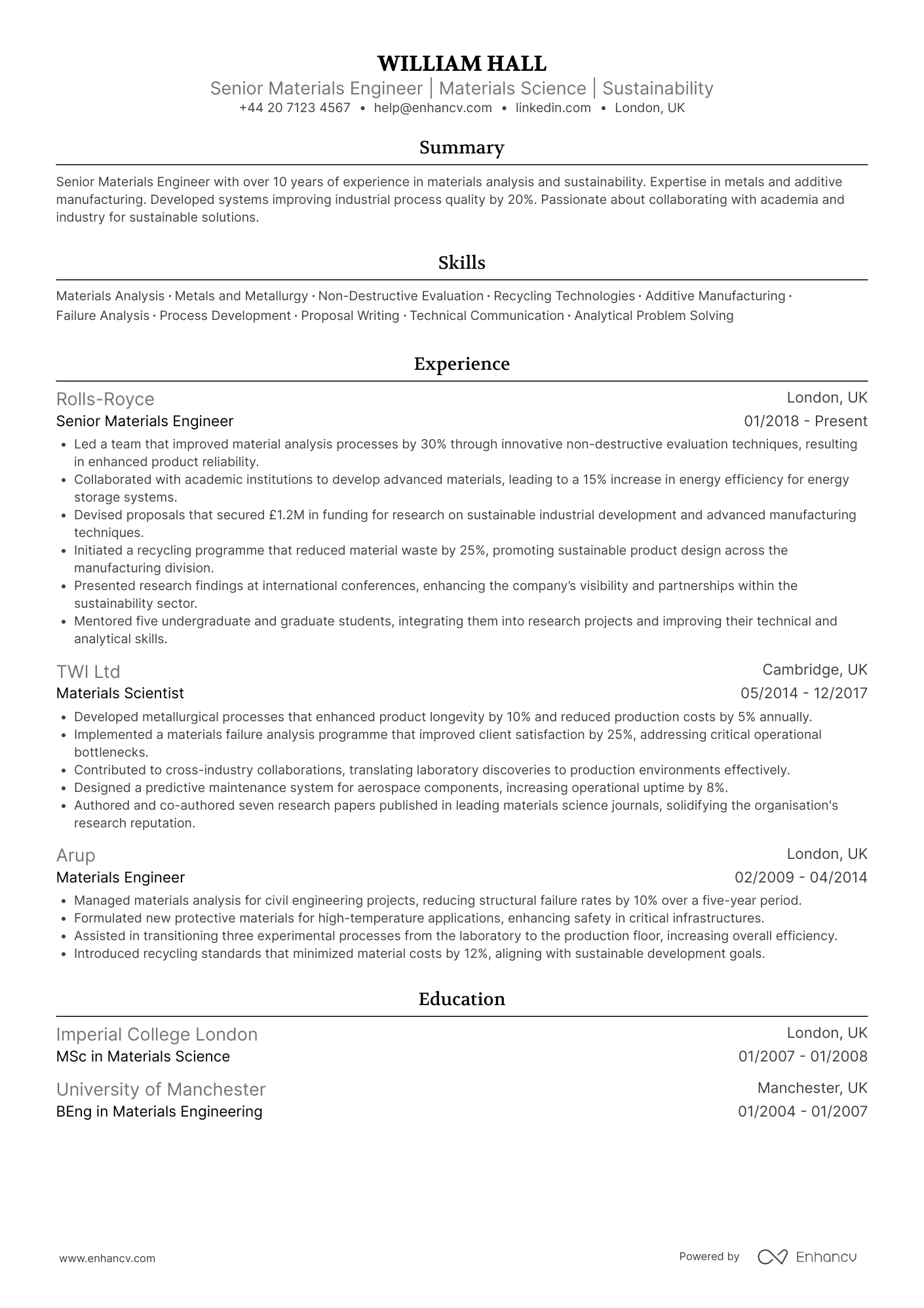
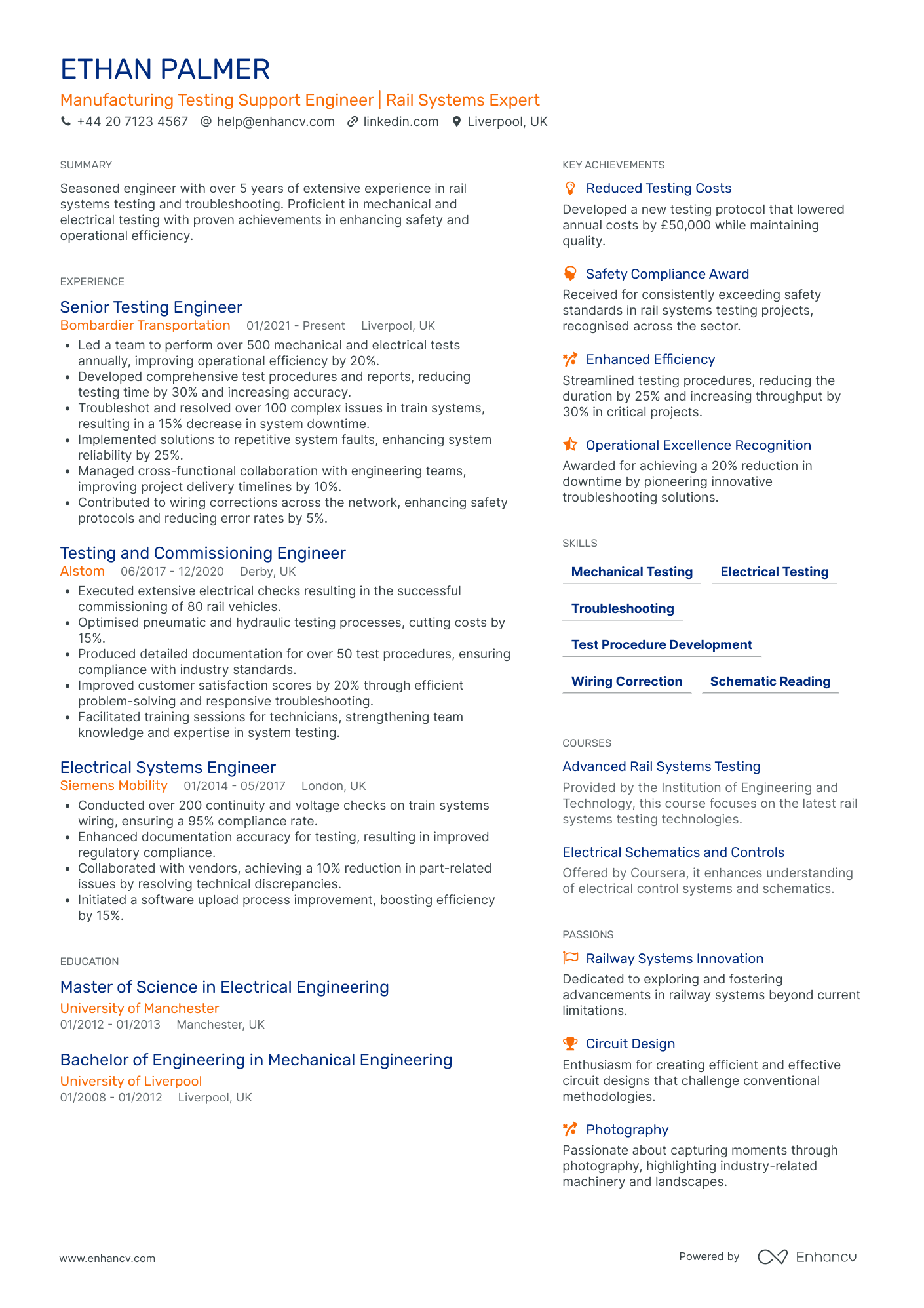
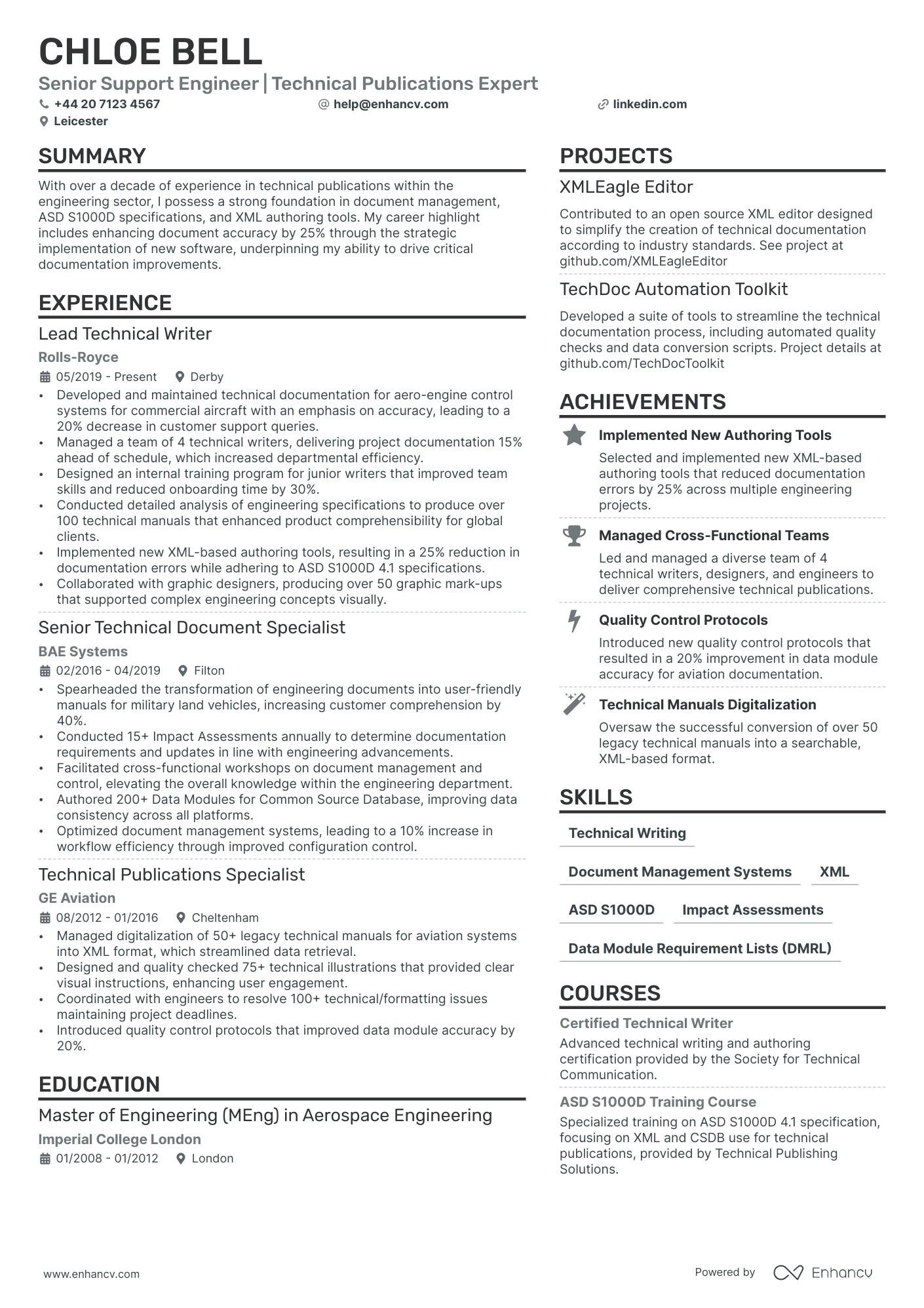
Most senior engineer CVs read like a mid-level CV with a few more years bolted on. The same task-level bullets, the same neat list of tools, and no sign of the scope or judgement the title is meant to signal.
A senior CV has to prove seniority on the page, not just claim it in the job title. That means impact a business actually felt, decisions you owned, and engineers who got better because you were there. If you want the fundamentals first, see how to write a CV.

Key takeaways
- Seniority shows in scope, not years. Lead with the size of the problems you owned, not a longer list of tasks.
- Quantify outcomes a business cares about: latency, cloud cost, revenue, uptime, and team throughput.
- Name the leadership signals employers screen for: technical direction, mentoring, code review, and cross-team delivery.
- UK senior engineer roles are mostly onsite or hybrid, so put your location and working preference near the top.
- Two pages, reverse chronological, sent as a PDF unless the advert asks for a Word file.
- Link a GitHub, portfolio, or technical blog only when it is current and shows senior-level work.
What makes a senior engineer CV read as senior
The gap between a mid and a senior engineer is scope and autonomy, not the number of years on the page. Your CV has to show that gap in the first third of the first page.
A mid-level bullet describes a task that was handed to you. A senior bullet describes a problem you owned from an ambiguous start to a measured finish, and the call you made in the middle.
Three signals separate the two, and a strong senior CV carries all three.
- Scope. The size of what you were trusted with: systems, services, budgets, or the number of engineers affected by a decision.
- Technical direction. The architecture you chose, the tradeoff you weighed, and why. "Migrated the database" is a task. "Chose Postgres over DynamoDB after load-testing both, and cut read latency by 40%" is a senior decision.
- Multiplier effect. The ways you made other engineers better: mentoring, code review, setting standards, or unblocking a stuck team.
Watch what happens to a single line when you rewrite it for seniority. "Responsible for maintaining the checkout service and fixing bugs" is a job description. "Owned the checkout service through Black Friday peak, held it at 99.98% uptime under 4x traffic, and cut the on-call incident rate in half" is the same job, written by someone who understands that a senior is trusted with the risk, not just the code.
The tell is ownership. Mid-level CVs are full of "assisted with", "contributed to", and "worked on". Senior CVs say "owned", "decided", "set", and "led", because at this level you are hired to carry the parts of the system nobody else wants to be woken up for.
Show progression too. A promotion inside one company is the clearest proof that someone already trusted you with more, so make promotion on a CV obvious with stacked, dated titles under the same employer.
Lead every entry with the outcome, not the activity. One measured result outranks five lines of responsibilities, and quantified CV achievements are what a hiring manager remembers after the tenth CV of the day.

Match the level named in the advert
UK employers split the top of the ladder into senior, lead, staff, and principal, and they mean different things. Senior owns features and mentors. Lead owns a team's delivery. Staff and principal own technical direction across teams. Read the advert, work out which rung it describes, and mirror that language in your personal statement and titles. Across 135 UK senior engineer postings in the last ~30 days on Enhancv's internal job feed, 71% were pitched at senior level and 28% at lead level, so most adverts want the individual-contributor-plus-mentoring profile rather than pure management.
What the UK senior engineer market looks like
What UK employers ask for should shape what you put at the top of the page. Here is what the current postings show.
| What | UK senior engineer roles |
|---|---|
| Where the work happens | Onsite 50% and hybrid 47%, remote rare at 3% (67, 64, and 4 of 135 UK postings in the last ~30 days, Enhancv's internal job feed) |
| Seniority level asked for | Senior 71% · lead 28% · mid 1% |
| Most-listed skills | Project management, CI/CD, Agile, Python, and AWS |
| Also recurring | Civil engineering, risk management, and quality assurance |
Two things here should shape your CV.
First, senior engineer work is overwhelmingly onsite or hybrid, so a hiring manager needs to see you can be in the building. Put your town and your working preference in the header, not buried on page two.
Second, the title spans disciplines. Project management, CI/CD, and Agile top the list ahead of any single language, which tells you delivery and collaboration read as seniority just as much as the stack does. Name them where they are true of you.
That spread also matters when you read "senior engineer" in an advert. The same words cover backend and platform roles, and civil and infrastructure engineering, so a CV that leans entirely on one stack can miss a role that was really asking for delivery ownership and risk management. Tailor to the discipline the advert describes rather than the one your last job had.
Formatting your senior engineer CV
Use a reverse chronological layout. At senior level your recent roles are the argument, so they belong first and biggest.
Keep it to two pages. A senior engineer with a page and a half looks light, and a four-page CV signals you cannot prioritise, which is the one thing a senior is paid to do.
Send a PDF for direct applications so the layout holds, and keep a Word copy for agencies that reformat into their own template. If the advert names a file type, follow it.
Most senior applications pass through tracking software before a human sees them, so keep the headings standard and the columns simple for an ATS-friendly CV. Build it from a tested layout rather than a blank page: Enhancv's CV templates export to a clean PDF that parses.
Keep the header tight. Name, target title, location, phone, email, and one link. A senior engineer does not need a photo, a full address, or a date of birth, and a wall of contact detail pushes your first strong bullet further down the page.
Put one link in the header, not five. A current GitHub, a portfolio, or a technical blog earns its place only if the top of it shows senior-level work. A dead repository from 2019 works against you. A tidy LinkedIn profile that matches the CV is worth linking, an abandoned one is not.
Is your resume good enough?
Drop your CV here or choose a file. PDF & DOCX only. Max 2MB file size.
Writing your senior engineer personal statement
Three or four sentences at the top: your level, your domain, the scale you operate at, and one result a business felt. See more personal statement examples if the opening line will not come.
Skip the adjective soup. "Highly motivated, results-driven engineer passionate about clean code" tells a hiring manager nothing they can check, and it is the exact opening on half the CVs in the pile.
Anchor the statement to one system, one number, and one direction of travel. If a reader could copy your statement onto a different candidate's CV without changing a word, it is too generic to earn the interview.
Lead with evidence and scale instead.
Senior engineer personal statement example
Senior backend engineer with eight years building payment systems at scale, currently owning a service that processes £40m a month for 2 million users. Cut checkout latency by 45% and led the team's move to CI/CD, taking releases from fortnightly to daily. Mentors three mid-level engineers and reviews architecture across two squads. Looking for a staff-track role in a hybrid London fintech.
What to avoid
Highly motivated and passionate senior software engineer with over 8 years of experience in a fast-paced environment. A team player with excellent communication skills and a proven track record of delivering high-quality solutions. Seeking a challenging role to leverage my skills and grow with a dynamic company.
When I read a senior engineer CV, I skip the skills list and go straight to the bullets. A mid-level engineer tells me what they were assigned. A senior engineer tells me what they decided, what it cost or saved, and who got better because they were on the team. Name the system, the number, and the call you made. That is the difference between a CV that lists ten years and one that proves them.
Writing your senior engineer experience section
Write each role as a dated heading followed by bullets that lead with a strong action verb and land on a result. For the mechanics, see work experience on a CV.
Senior work is more measurable than it feels. Latency, cost, uptime, incident count, release frequency, and engineers mentored are all numbers you can stand behind.
Build each bullet the same way: a verb, the thing you owned, and the result with a number on it. "Led", "owned", "redesigned", and "reduced" open a senior bullet far better than "was responsible for". Two or three strong bullets per role beat eight thin ones, so cut anything that only proves you turned up.
Show the shape of a career, not just the current job. Two or three roles with real depth, then earlier positions compressed to a line each, tells a clearer story than five roles all given equal weight. The example below pairs a current senior role with a compressed earlier one to make the progression obvious.
Tailor every application. Pull the systems and delivery terms from the advert and mirror the ones that are true of you. Enhancv's CV tailoring feature reads the ad and suggests the matching edits, which saves rewriting from scratch each time.
- Own the payments service handling £40m a month, and cut checkout latency by 45% by redesigning the retry and caching layer
- Led the team's migration to CI/CD, taking releases from fortnightly to daily and reducing failed deployments by 60%
- Set the code review standard adopted across two squads, and mentor three mid-level engineers through architecture decisions
- Reduced AWS spend by £180k a year by right-sizing services and moving batch jobs to spot instances
- Built and shipped the refund service used by 30 internal teams, cutting manual refund handling time by 70%
- Introduced automated integration tests that dropped production regressions by a third across two release cycles

PRO TIP
Recruiters shortlist senior CVs on the first two bullets of your current role. Put the biggest number and the widest scope there. Save the routine duties for lower down, or cut them, because at senior level everyone assumes you can do the day job.
Skills for your senior engineer CV
List the skills the adverts actually repeat, in the words they use. Across the UK postings, project management, CI/CD, and Agile come up more often than any single language, alongside Python and AWS. Those are your hard skills, and they should read as delivery, not just tooling.
Group them so a reader can scan fast. Languages and frameworks in one line, cloud and infrastructure in another, and delivery practices such as CI/CD and Agile in a third. A single undifferentiated wall of thirty keywords reads as junior, because a senior knows what actually matters for the role.
The soft skills that matter at senior level are the multiplier ones: technical leadership, mentoring, and stakeholder communication. Prove each in a bullet rather than claiming it in a list. "Mentored three engineers to their first production release" beats "strong communicator" every time, because one can be checked and the other cannot.
Your technical skills still need context to land, so let the experience bullets carry the proof and keep the skills block as the quick reference.
List only what you can defend in a technical interview. A skill on a senior CV is an invitation to be questioned on it, so put your strongest key skills where they will be seen and leave the ones you last touched years ago off.
Top skills for your senior engineer CV:
Project management
CI/CD
Agile
Python
AWS
System design and architecture
Cloud infrastructure
Quality assurance
Technical leadership
Mentoring
Stakeholder communication
Decision-making
Cross-team collaboration
Education and certifications for a senior engineer CV
At senior level your education moves down the page. A degree still belongs there, but it sits under your experience, listed in one or two lines with the classification and year.
Certifications carry more weight when they are current and relevant. An AWS or Azure certification, a Certified Kubernetes Administrator, or chartered status such as CEng for civil and infrastructure engineers all signal a verified standard that a hiring manager does not have to take on trust.
You do not need to list every course you have ever taken. At senior level the work is the credential, so include the two or three certifications that map to the role and let the rest go.
List certificates with the awarding body and the year, and drop anything expired. A lapsed certification dated 2016 raises a question you do not want asked.
Conclusion
Prove seniority on the page. Lead with scope and owned outcomes, quantify the impact a business felt, and name the ways you made a team better.
The strongest senior CVs read like a short case for why the important problems were safe in your hands. Every bullet should support that case, and anything that does not can go.
Match the level in the advert, keep the format clean and ATS-ready, and pair the CV with a short cover letter that says why this role and this company.
Author's take - the Enhancv team
When I read a senior engineer CV, I skip the skills list and go straight to the bullets. A mid-level engineer tells me what they were assigned. A senior engineer tells me what they decided, what it cost or saved, and who got better because they were on the team. Name the system, the number, and the call you made. That is the difference between a CV that lists ten years and one that proves them.