



Most IT support CVs read like a closed-ticket log. Every system touched, every tool listed, and no sign of what actually got fixed or how quickly.
The ones that get interviews match a format a busy manager can scan in seconds, then name the exact systems from the advert, from Active Directory to ServiceNow. Nail the layout first, because on a technical CV a clean, ordered page is the first competence test you pass. If you want the groundwork first, start with how to write a CV.

Key takeaways
- Lead with format. A one or two page, single-column CV in a standard font beats a decorated template for a technical role.
- Send a PDF unless the advert asks for Word, so your layout holds in every inbox and tracking system.
- Mirror the systems named in the advert. Windows, troubleshooting, ITIL, Active Directory, and Microsoft 365 recur across UK postings.
- Most IT support work is on-site, so put your location and any driving licence near the top.
- Quantify the work: tickets resolved, first-response times, systems migrated, and users supported.
- List the certifications employers scan for, even in progress, such as CompTIA A+, ITIL Foundation, and Microsoft 365.
Formatting your IT support CV
Lead with format, because it is the first thing a hiring manager judges and the easiest thing to get wrong. IT support is a role where a messy CV reads as a messy engineer.
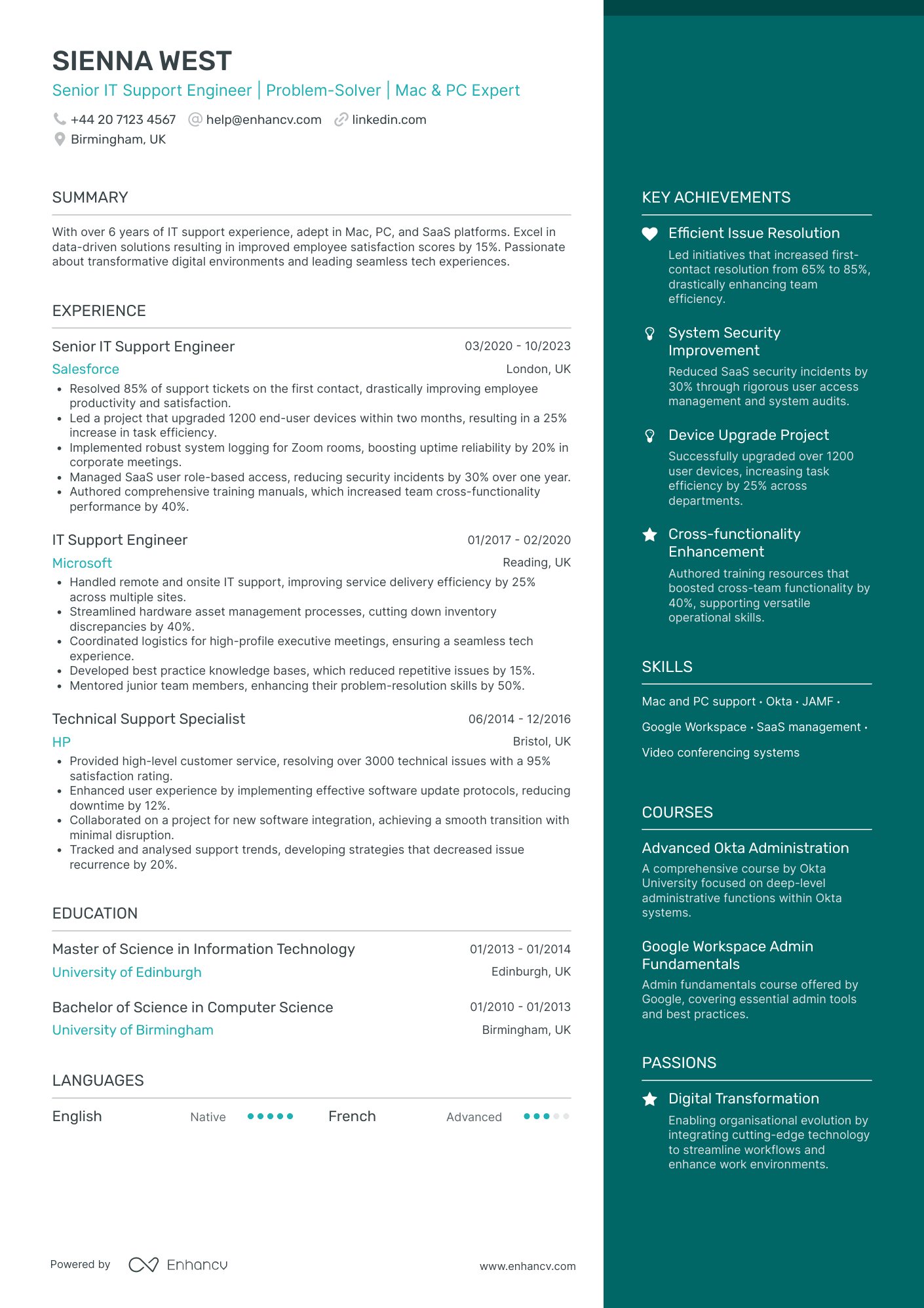
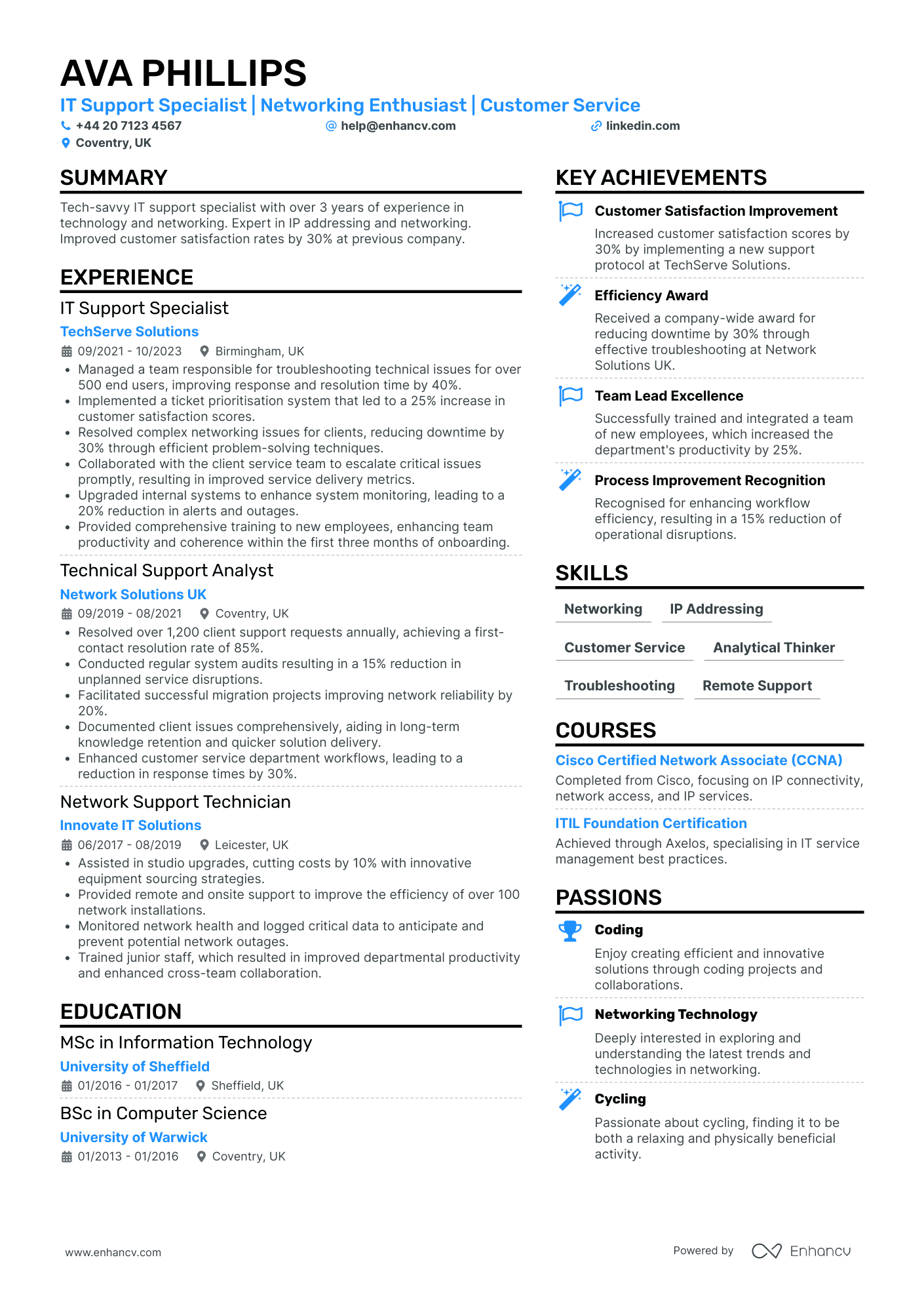
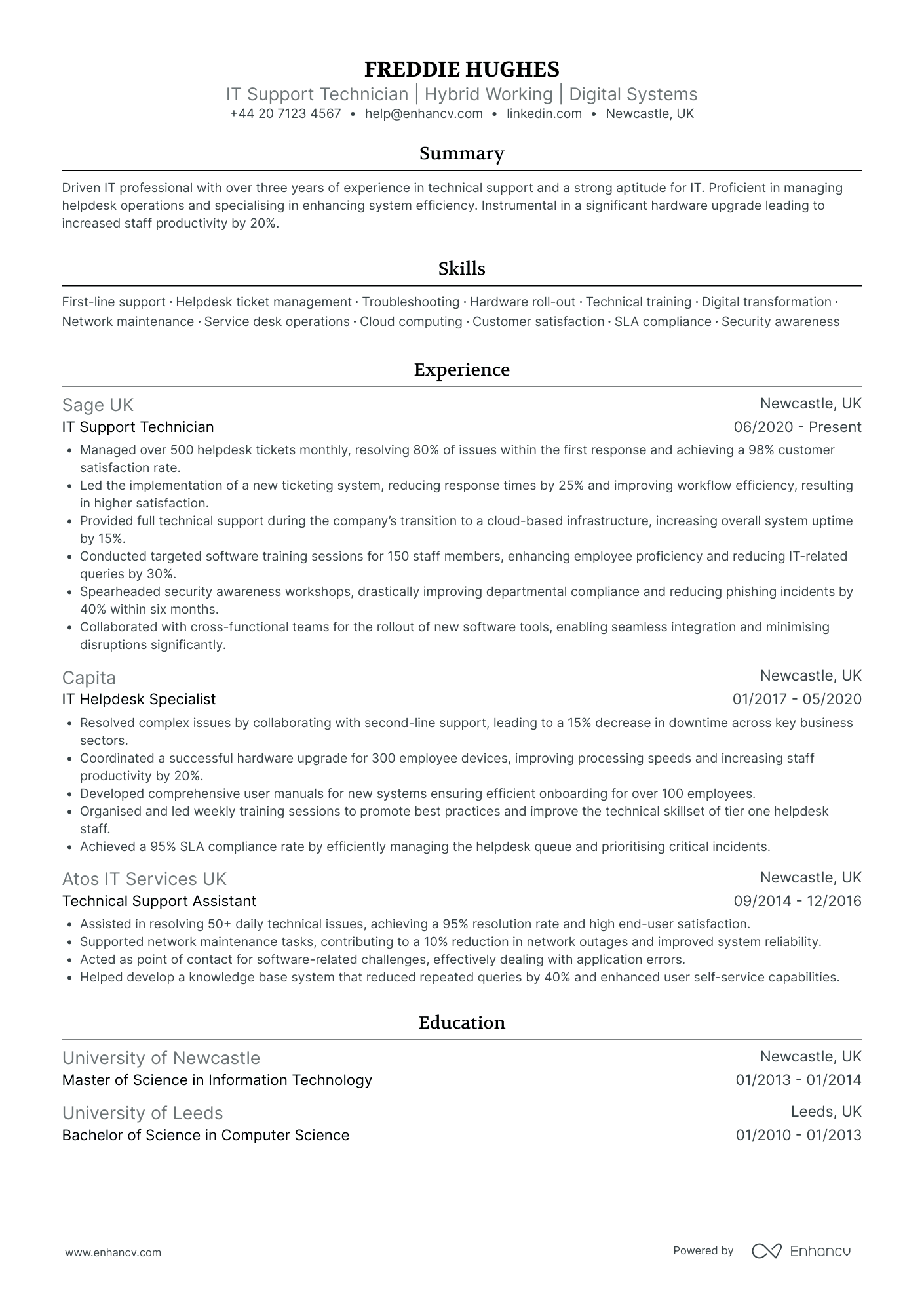
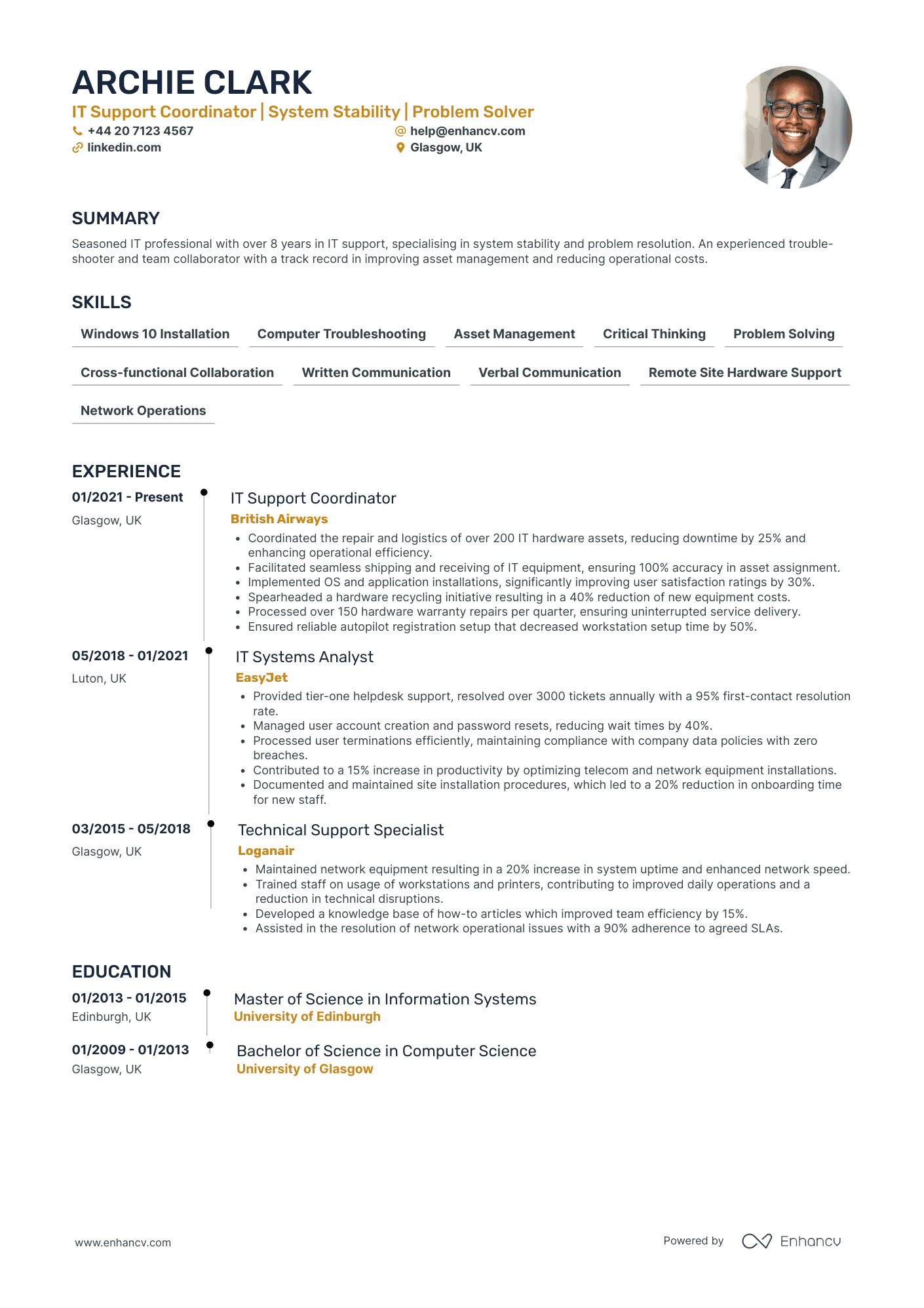
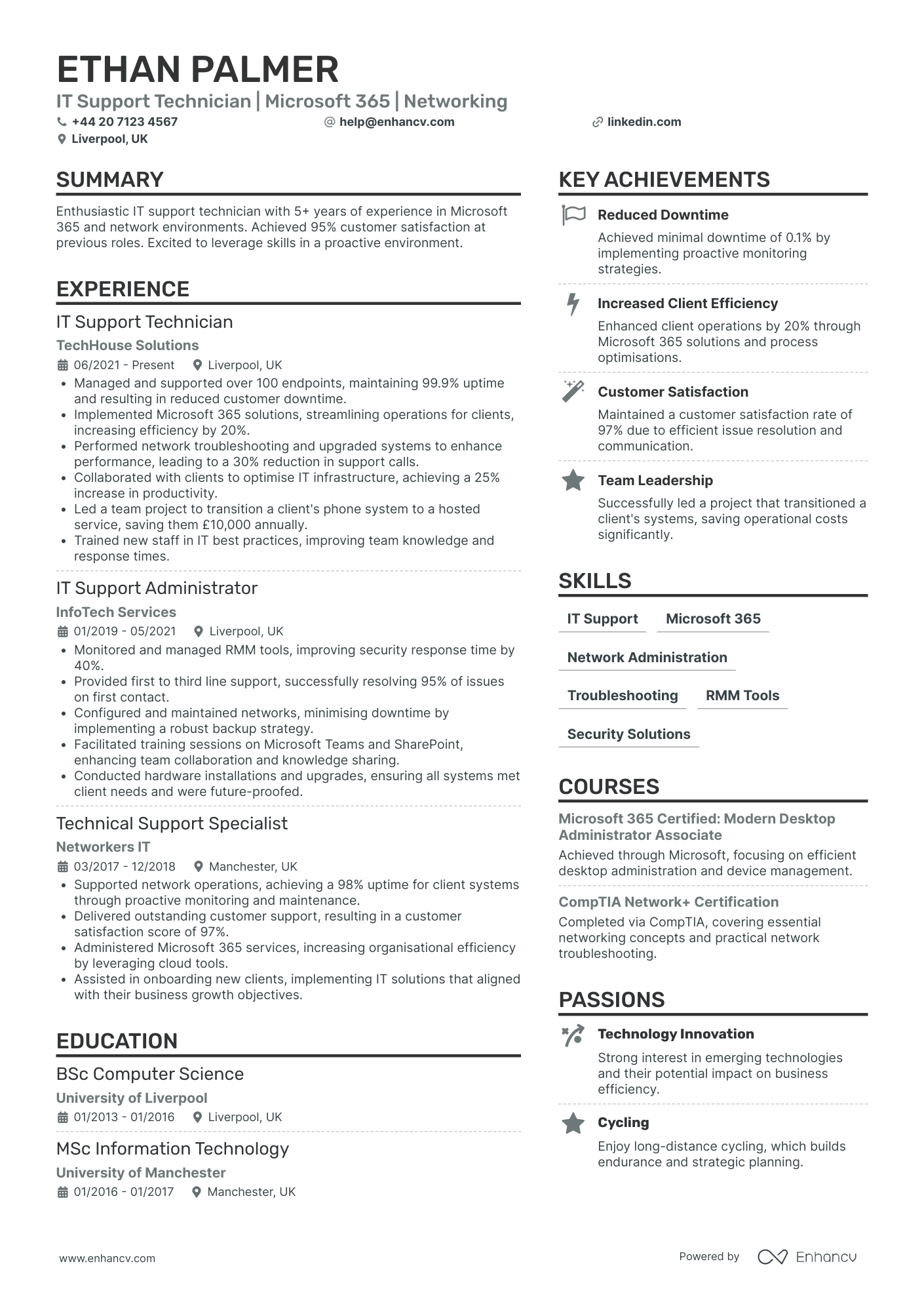
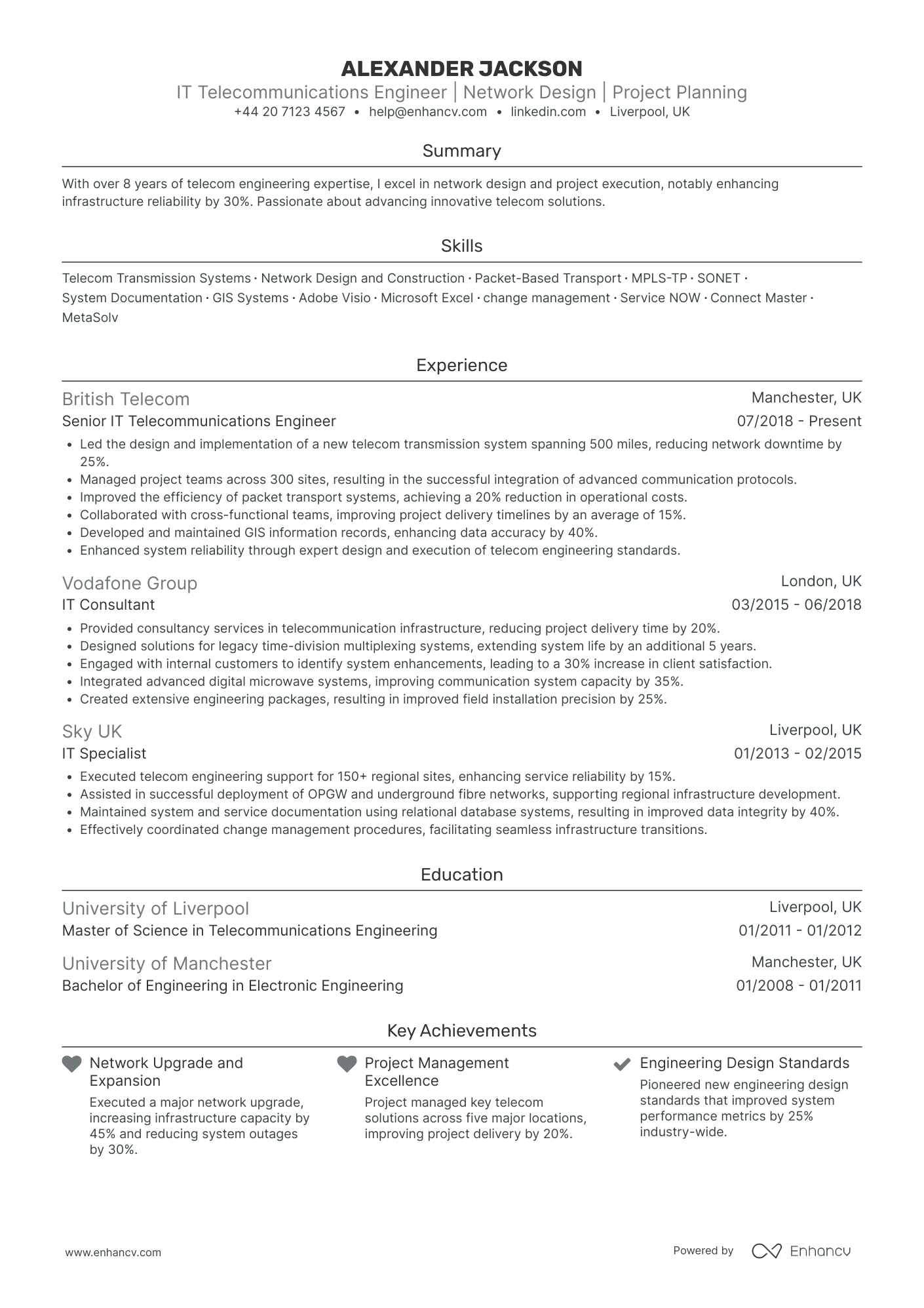
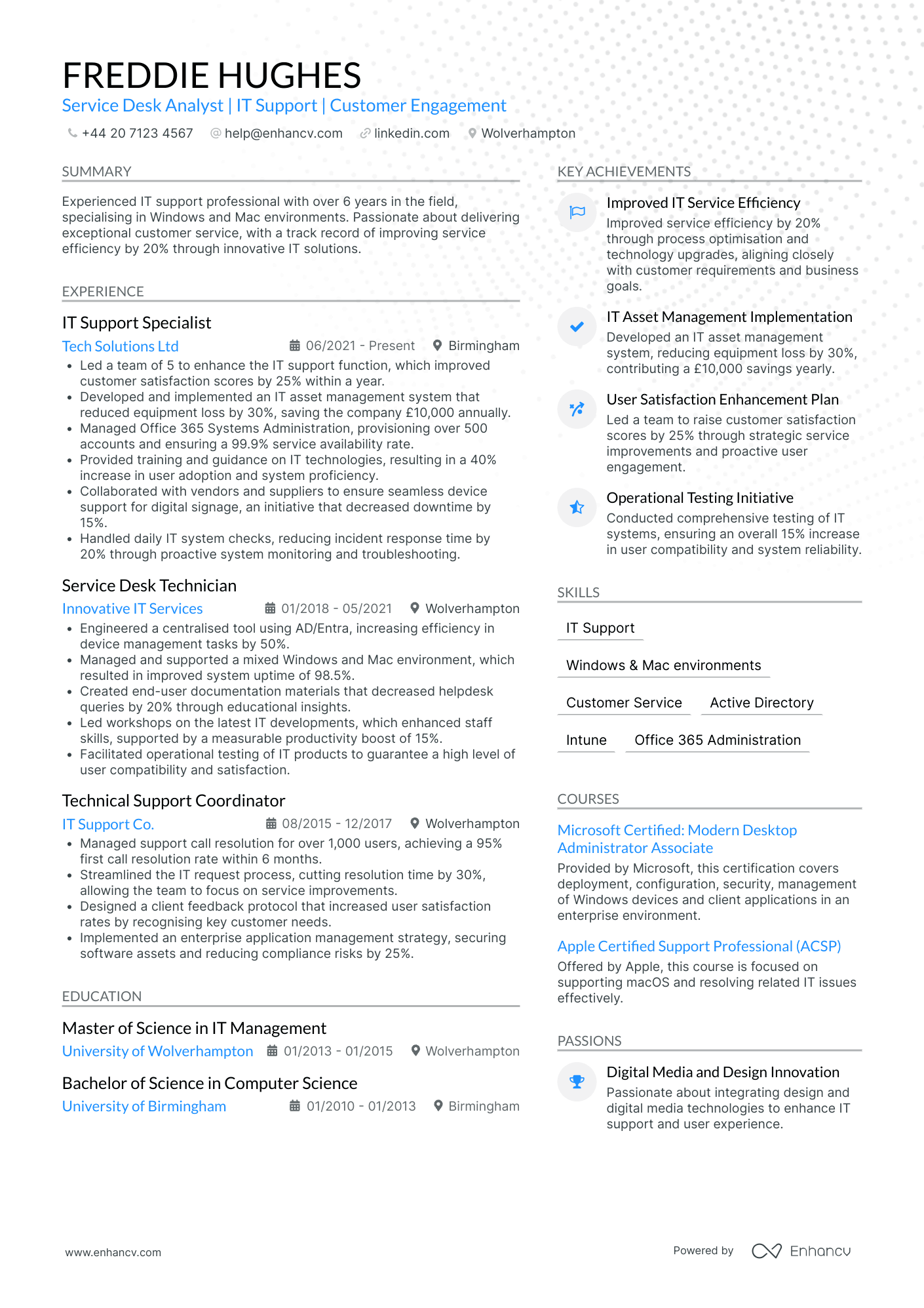
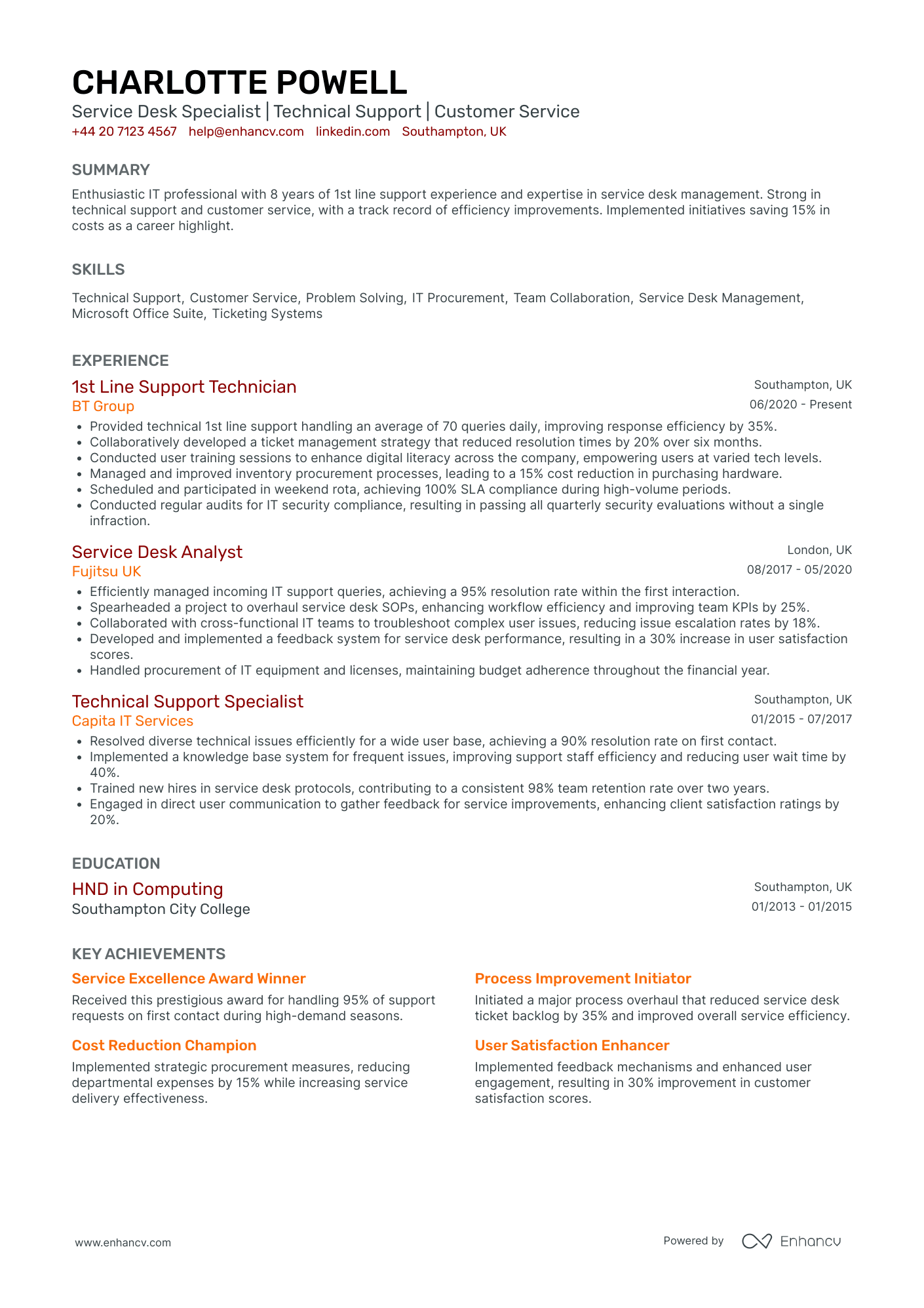
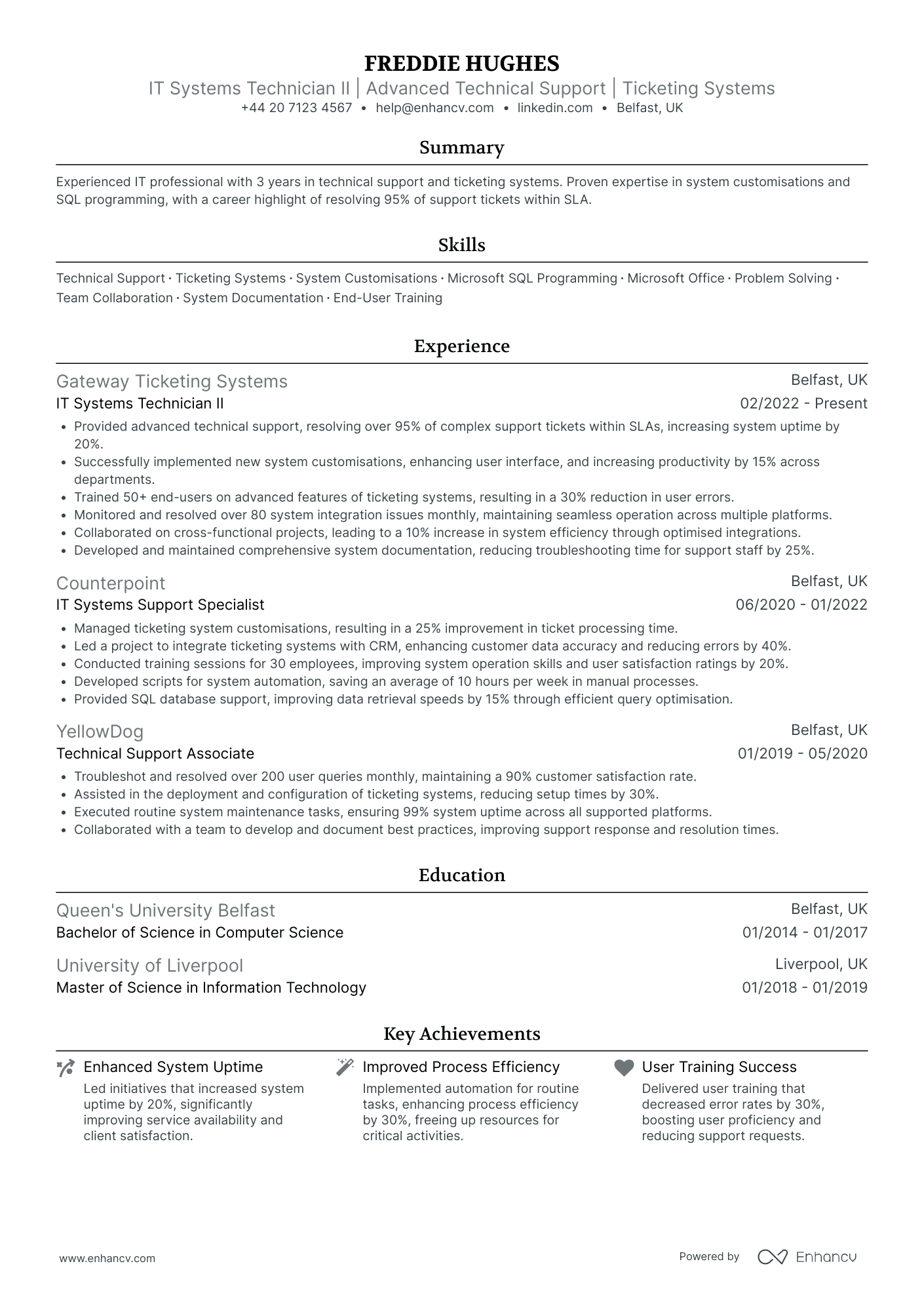
Use a reverse chronological structure once you have support roles behind you, with your most recent job first. Keep it to two pages, one column, standard headings, and a readable font, so a recruiter can find your systems, your tickets, and your certifications without hunting.
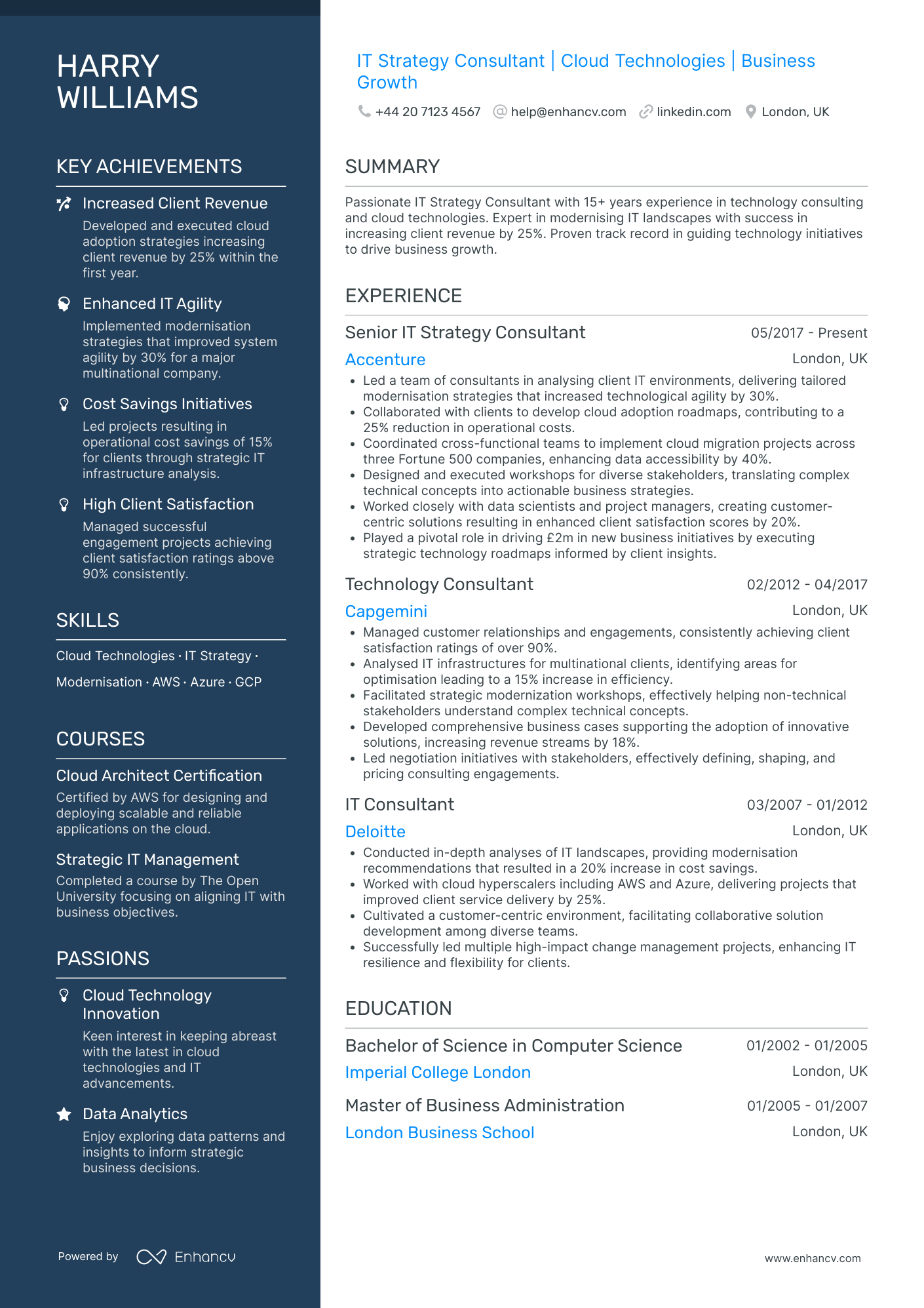
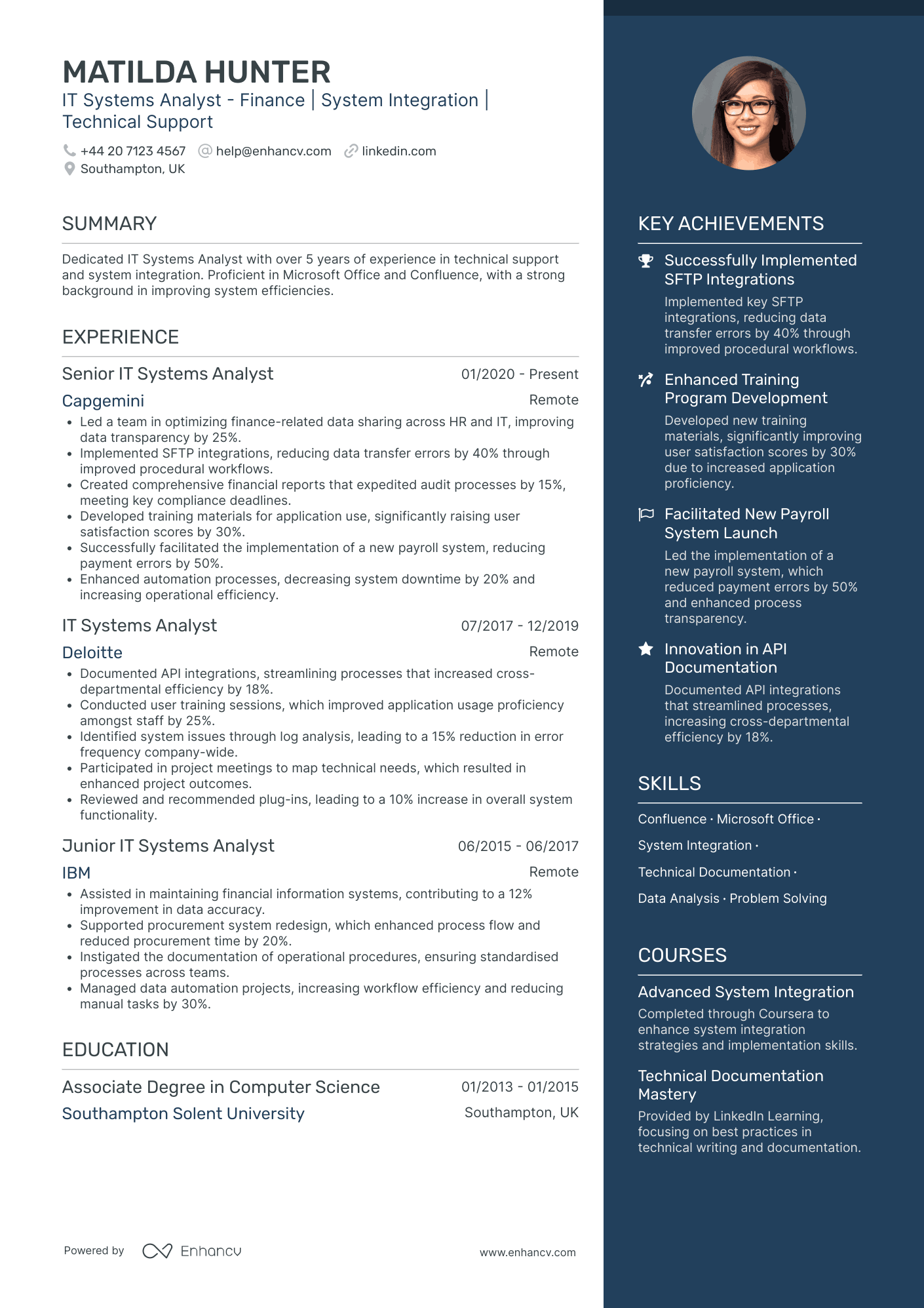
Order the sections of a CV for a technical reader: header, a short personal statement, a technical skills block, experience, then certifications and education. The skills block sits high on purpose, because it is where a manager checks for the systems in the advert.
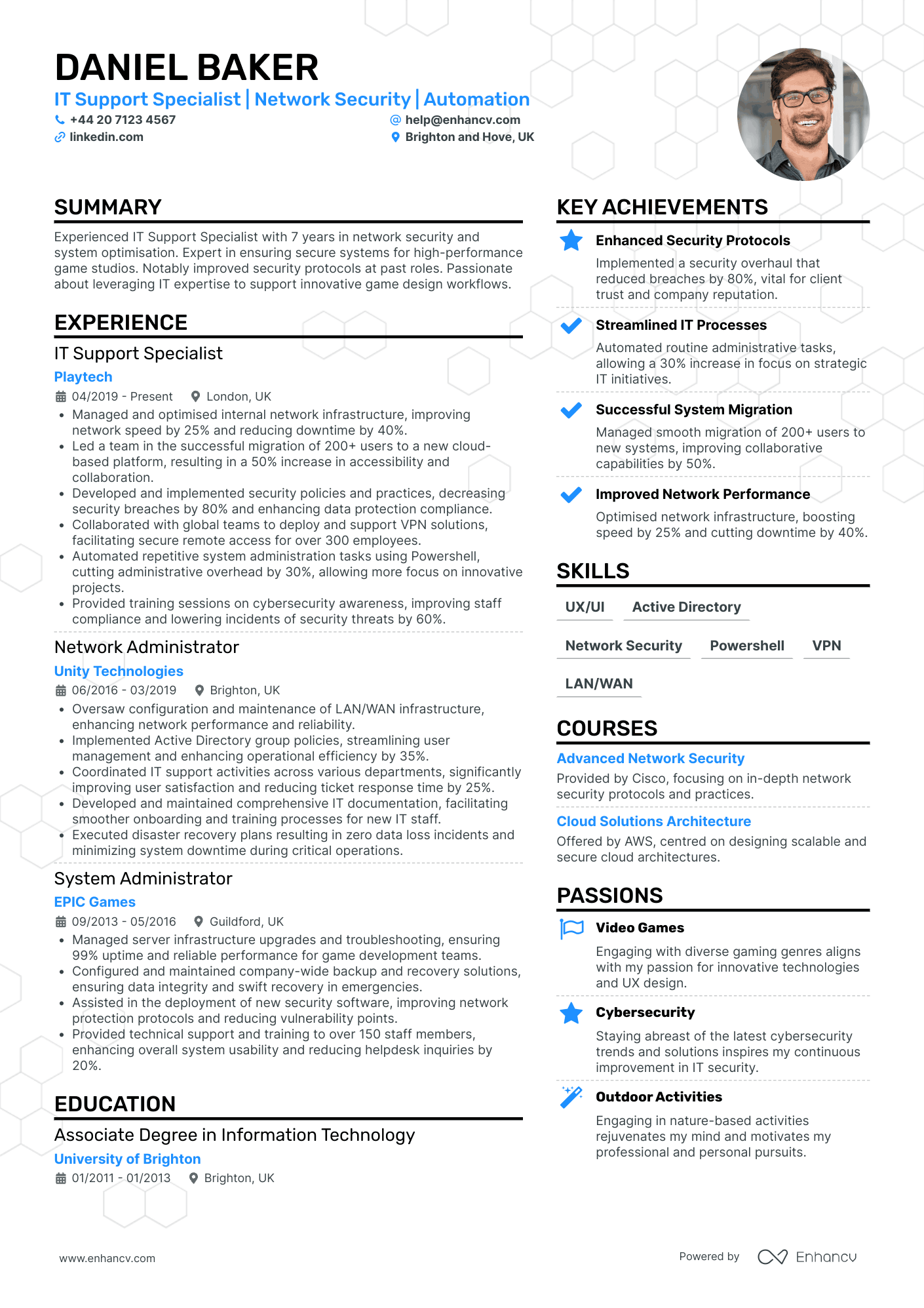
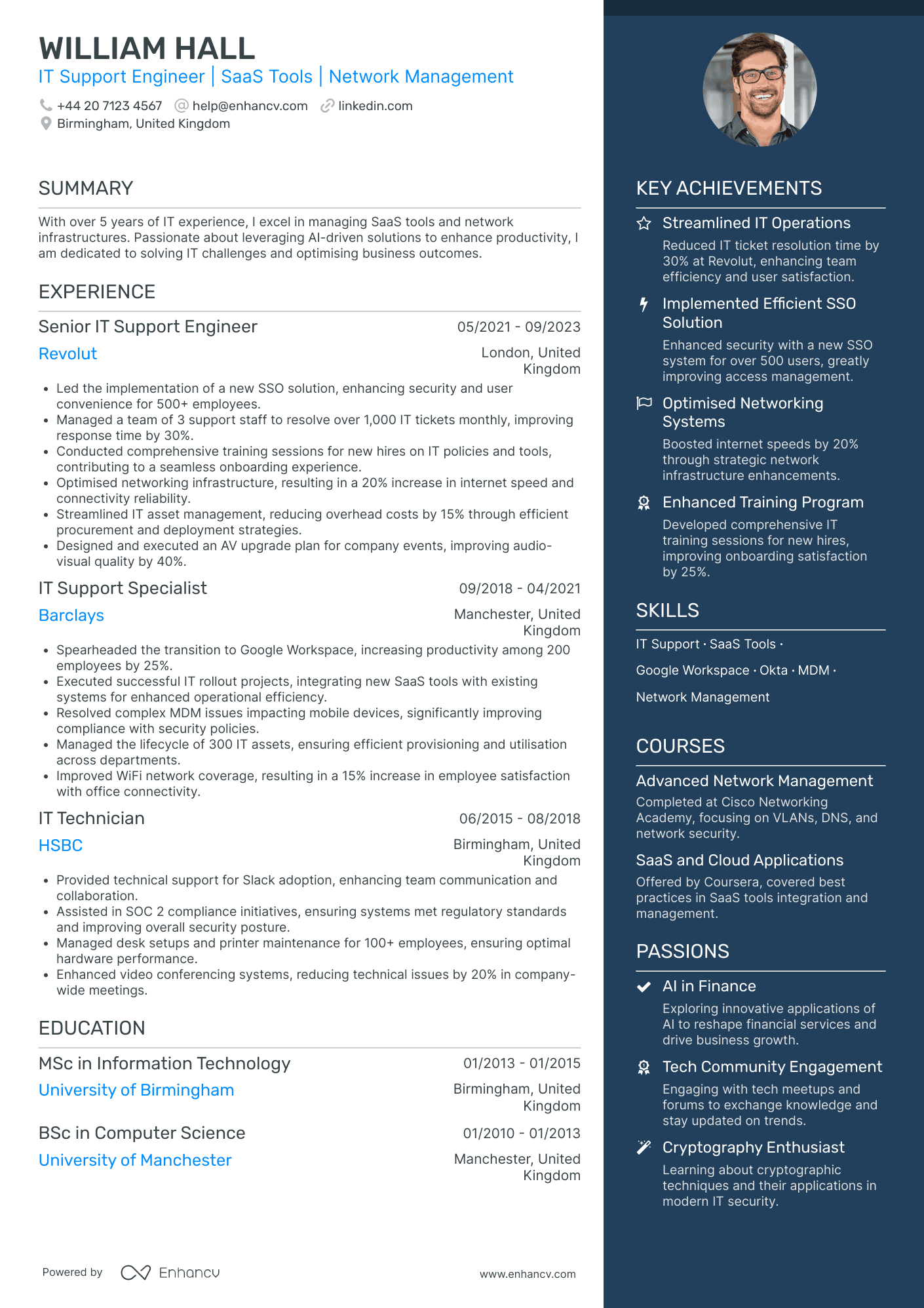
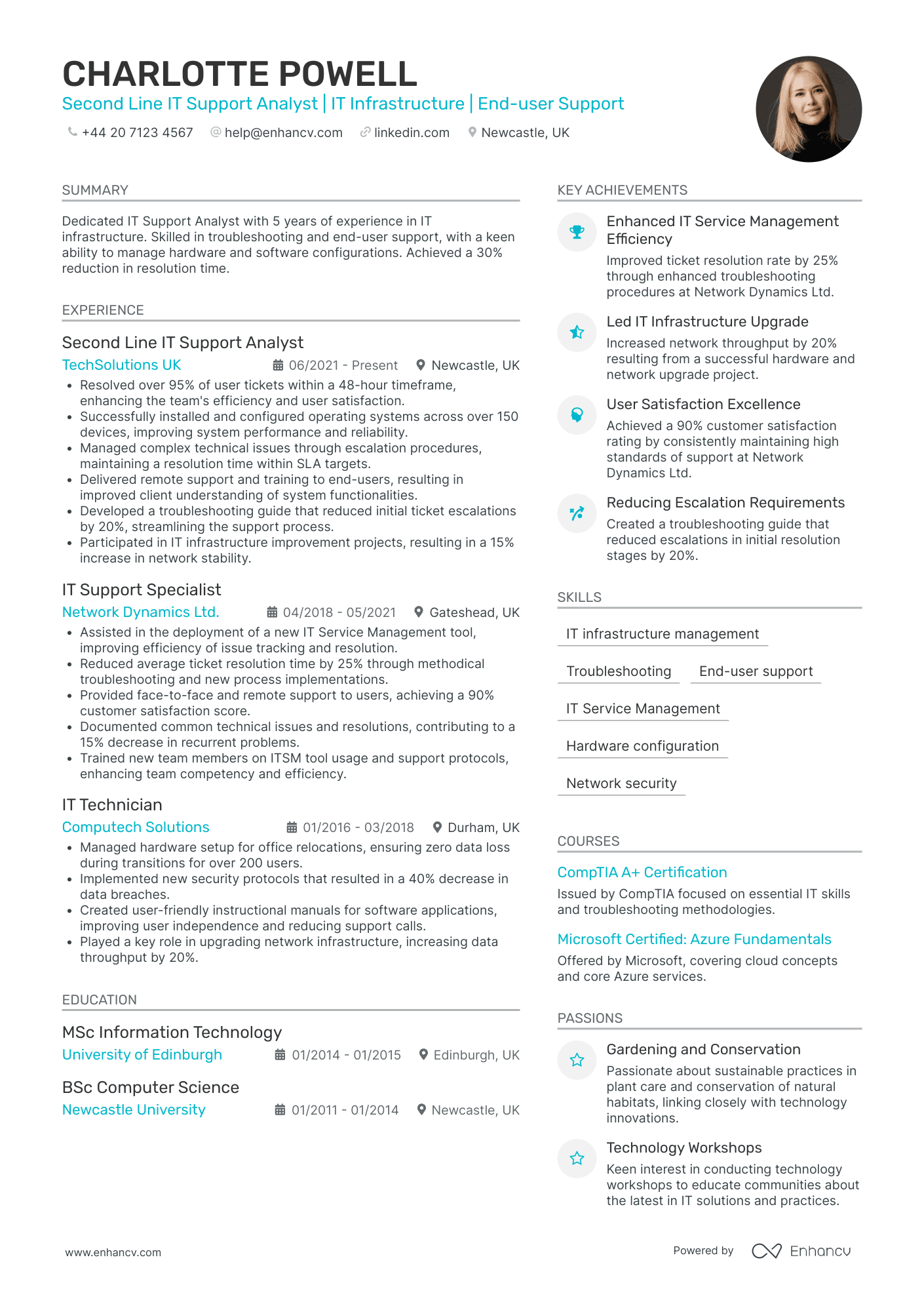
Keep the header simple and factual: your name, phone number, a professional email, your town, and a link to a LinkedIn or GitHub profile if it shows relevant work. Skip the photo, the full postal address, and the date of birth, none of which a UK employer needs.
Choose one clean font at 10 or 11 point, set sensible margins, and keep the spacing consistent. White space is not wasted space on a technical CV, it is what lets a manager scan your tools and tickets at speed.
Send a PDF for direct applications so the layout holds everywhere. Keep a Word copy for recruitment agencies, which place a large share of IT support roles and paste CVs into their own template. If the advert names a file type, follow it.
IT support applications almost always pass through tracking software, so keep the layout clean, the headings standard, and the job titles literal. "IT Support Technician" parses cleanly, "Desktop Ninja" does not, and that is what makes an ATS-friendly CV.
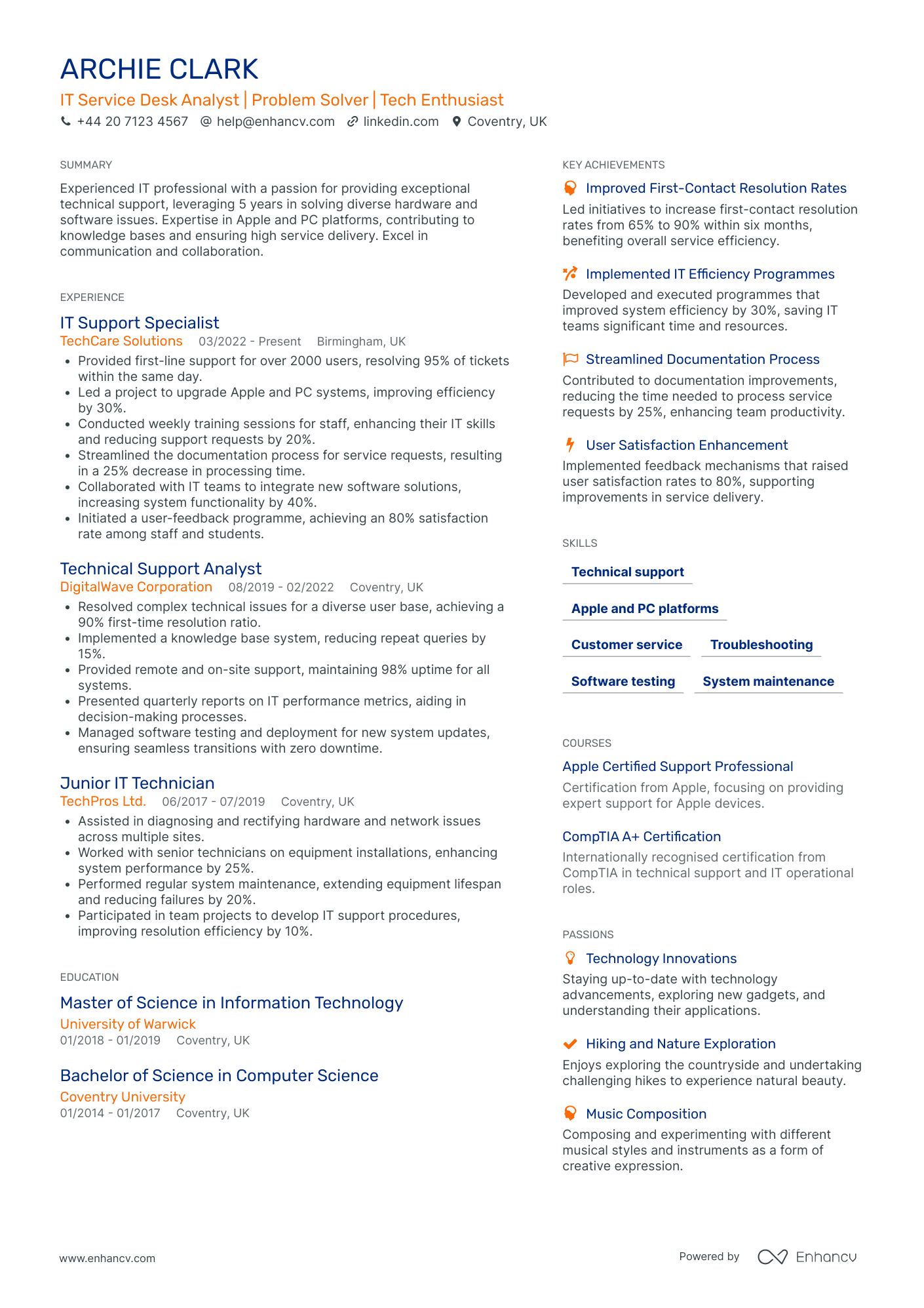
Stick to one column for the same reason. Two-column templates look tidy on screen, but tracking software often reads them out of order, so your carefully placed skills block can arrive scrambled. A single column reads top to bottom for both a human and a parser.
Name the file so a recruiter can find it later. "Jordan-Smith-IT-Support-CV.pdf" beats "cv-final-v3.pdf", and it is the small kind of detail that signals you are organised before anyone reads a line.
You do not need a heavily designed template for this role. A plain, well-structured layout does the job, and a free CV template only helps if it holds one column and clean headings. Some free downloads bury your content in tables and text boxes that a parser cannot read, which undoes the point of using one. Build from a tested layout rather than a blank page, and Enhancv's CV templates export to a clean PDF.

PRO TIP
Recruiters skim IT support CVs for tiers and tools. Put "first-line" or "second-line" in your job titles where it is accurate, and list your systems in the exact words the advert uses, such as "Active Directory", "Microsoft 365", and "ServiceNow", not vague labels like "ticketing tools" or "the cloud".
What the UK IT support market looks like
Knowing what employers actually ask for decides what belongs near the top of your CV. Here is what recent UK postings show.
| What | UK IT support roles |
|---|---|
| Where the work happens | Mostly on-site (32 of 45 UK postings, the rest hybrid) on Enhancv's internal job feed over the last ~30 days |
| Experience level employers ask for | Weighted to mid and entry level (20 and 17 of those 45 postings), with a handful of senior and lead roles |
| Skills that recur most | Windows, troubleshooting, and ITIL lead, followed by macOS, ServiceNow, Active Directory, Microsoft 365, and Linux |
Two patterns should shape your CV.
IT support is mostly on-site work, since you are often walking to a desk or a server room, so a recruiter needs to see you can reliably get there. Put your town, and a driving licence if you have one, in the header.
Windows, troubleshooting, and ITIL recur most across those postings, so they belong high on the page and proven in your bullets rather than only listed.
Pay varies widely by tier, sector, and region, from first-line helpdesk to infrastructure support. No single verified UK figure applied cleanly across the role, so check current listings for your tier and area rather than trusting a headline number.
That spread is why the tier on your CV does so much work. A recruiter reading "second-line, 300 users, two-hour SLA" can place you and your likely salary band in a glance, where a bare "IT support" leaves them guessing. Be specific, and let the detail set the expectation for you.
Writing your IT support personal statement
Three or four sentences at the top: your support tier, the systems you know, one measurable result, and the kind of team you want next. Keep it concrete, and see more personal statement examples if the opening line will not come.
Skip the adjective soup. "Hard-working, passionate IT professional" tells a hiring manager nothing they can check.
Lead with evidence instead:
IT support CV personal statement example
First-line support technician with three years on a busy service desk, resolving around 40 tickets a day across Windows, Microsoft 365, and Active Directory to a 95% SLA. ITIL Foundation certified and CompTIA A+ qualified, now looking to move into a second-line infrastructure role in a Manchester-based team.
Set that against the version most CVs open with:
What to avoid
Hard-working and passionate IT professional with excellent communication skills and a keen eye for detail, seeking a challenging role in a dynamic company where I can grow and make the most of my abilities.
When I read an IT support CV, I look for two things in the first ten seconds: the tier you work at and the systems you actually touch. "Provided IT support to end users" could be anyone. "Second-line support for 300 staff across Windows and Microsoft 365, resolving escalations to a two-hour SLA" tells me exactly where you fit and what you can walk in and do. Name your tools the way the advert names them, and put one real number behind them.
Skills for your IT support CV
Read a dozen live IT support adverts and the same systems repeat. Windows, troubleshooting, ITIL, macOS, ServiceNow, Active Directory, and Microsoft 365 come up again and again, and those are your hard skills, listed in the words the adverts use.
Group your IT skills so a reader can scan them: operating systems, directory and identity, ticketing and ITSM, networking, and hardware. List only what you can talk through in an interview.
Be specific with versions and scope. "Windows Server 2019" and "Microsoft 365 administration" carry more weight than a bare "Windows" or "Office", because they tell a manager the depth you worked at.
The soft skills that matter are the ones a helpdesk lives or dies by: clear communication with non-technical users, patience, and staying calm with a full ticket queue. Prove each one in a bullet rather than claiming it.
Put the whole set in a dedicated skills section near the top, where a technical reader expects to find it.
Top skills for your IT support CV:
Windows 10 and 11
Troubleshooting
Active Directory
Microsoft 365
ServiceNow
ITIL and ITSM
macOS
Networking (TCP/IP, DNS, DHCP)
Linux
Remote desktop support
Communication
Patience
Problem-solving
Time management
Teamwork
Writing your IT support experience section
Whether it is first-line, second-line, or a mixed helpdesk role, write each entry the same way: a dated heading, then bullets that show what you fixed and the result. Lead every bullet with a strong action verb, and see work experience on a CV for the mechanics.
Support work is measurable even when it feels routine. Tickets resolved, first-response times, SLA rates, systems migrated, users onboarded, and repeat issues designed out are all CV achievements.
A level 1, or first-line, role is the front desk of IT: logging tickets, resetting passwords, basic troubleshooting, and escalating what you cannot resolve. Say that plainly, then show the volume you handled and the standard you held.
If you have moved up to second or third line, make the jump obvious. Second-line handles the escalations first-line passes on, from software faults to account and access problems. Third-line sits closest to infrastructure, servers, and networks. Naming your tier tells a hiring manager which queue you can walk into without training.
Where you can, show the trajectory rather than a flat list of duties. A first-line role followed by a second-line one, with growing ticket volumes and tighter SLAs, reads as someone who earns responsibility. That story matters more than any single bullet.
- Resolved around 45 service desk tickets a day across Windows 10 and 11, Microsoft 365, and Active Directory, holding a 96% first-response SLA
- Built and imaged laptops for 200 new starters a year, standardising the image and cutting onboarding time by a third
- Escalated network and server faults to second-line with clear diagnostics, reducing reopened tickets by 20%
- Wrote 15 short self-help guides for common issues, noticeably cutting repeat password and VPN tickets
- Logged and triaged around 60 inbound tickets a day, routing complex faults to senior technicians with clear notes
- Supported 350 store and head-office users on Windows, Microsoft 365, and shared network drives
- Reimaged and deployed 120 devices during a company-wide Windows 11 rollout, hitting the project deadline

Turn a duty into an achievement
Weak: "Responsible for resolving IT tickets and supporting users." Strong: "Resolved around 45 tickets a day to a 96% first-response SLA, and cut repeat VPN issues by writing a short self-help guide." The second names the volume, the standard, and the result. The first could sit on anyone's CV.
Tailor every application. Pull the systems and the support tier straight from the advert and mirror them wherever they are true of you. Enhancv's CV tailoring feature reads the advert and suggests the matching edits, which saves rewriting the whole CV from scratch each time.
Certifications and education for an IT support CV
IT support is one of the more certification-led routes in tech, and a hiring manager scans for them before a degree.
List these where you have them, even in progress: CompTIA A+ and Network+, ITIL Foundation, a Microsoft Certified fundamentals qualification, and the Google IT Support Certificate. Group your certificates in a dedicated block near your skills so they are easy to spot.
A degree matters less here than proof you can do the work, so keep your education below your certifications and brief. Name the qualification, the institution, and the dates, and leave it there.
Put a certification in progress on the CV with a target date, such as "CompTIA Network+ (exam booked for March)". It shows momentum, and a manager would rather see the path you are on than a gap where the qualification should be.
If you have built anything worth showing, a home lab, a script that automated a routine task, or a documented network setup, add a short line and a link. In IT support, proof you tinker on your own time reads as genuine interest, not filler.
Breaking into IT support with no experience
Entry-level roles are well represented in UK IT support postings on Enhancv's internal job feed, so a first technical job is realistic rather than wishful.
Lead with a skills-led structure: personal statement, technical skills, certifications, then any related experience lower down. It puts your strongest evidence where a technical reader looks first.
Mine real evidence, because it is almost always there. Fixing family and friends' machines, running a home lab, a help desk volunteer stint, or a retail job where you handled stock systems and frustrated customers all count. Write them in support language and give them dated entries like any first job on a CV.
Any customer-facing job is worth more than it looks. A helpdesk is half technical and half service, so a stint in retail or hospitality where you calmed a frustrated customer and worked to a process is real evidence of the softer half of the role.
One line moves a no-experience CV up the pile: "CompTIA A+ in progress" or "completed the Google IT Support Certificate". It signals you are already on the path.
Conclusion
Get the format right first, name the systems from the advert, and put one real number behind every claim.
Pair the CV with a short cover letter that says why this team, and a clean, scannable IT support CV turns a pile of similar applications into a shortlist.
Author's take - the Enhancv team
When I read an IT support CV, I look for two things in the first ten seconds: the tier you work at and the systems you actually touch. "Provided IT support to end users" could be anyone. "Second-line support for 300 staff across Windows and Microsoft 365, resolving escalations to a two-hour SLA" tells me exactly where you fit and what you can walk in and do. Name your tools the way the advert names them, and put one real number behind them.