



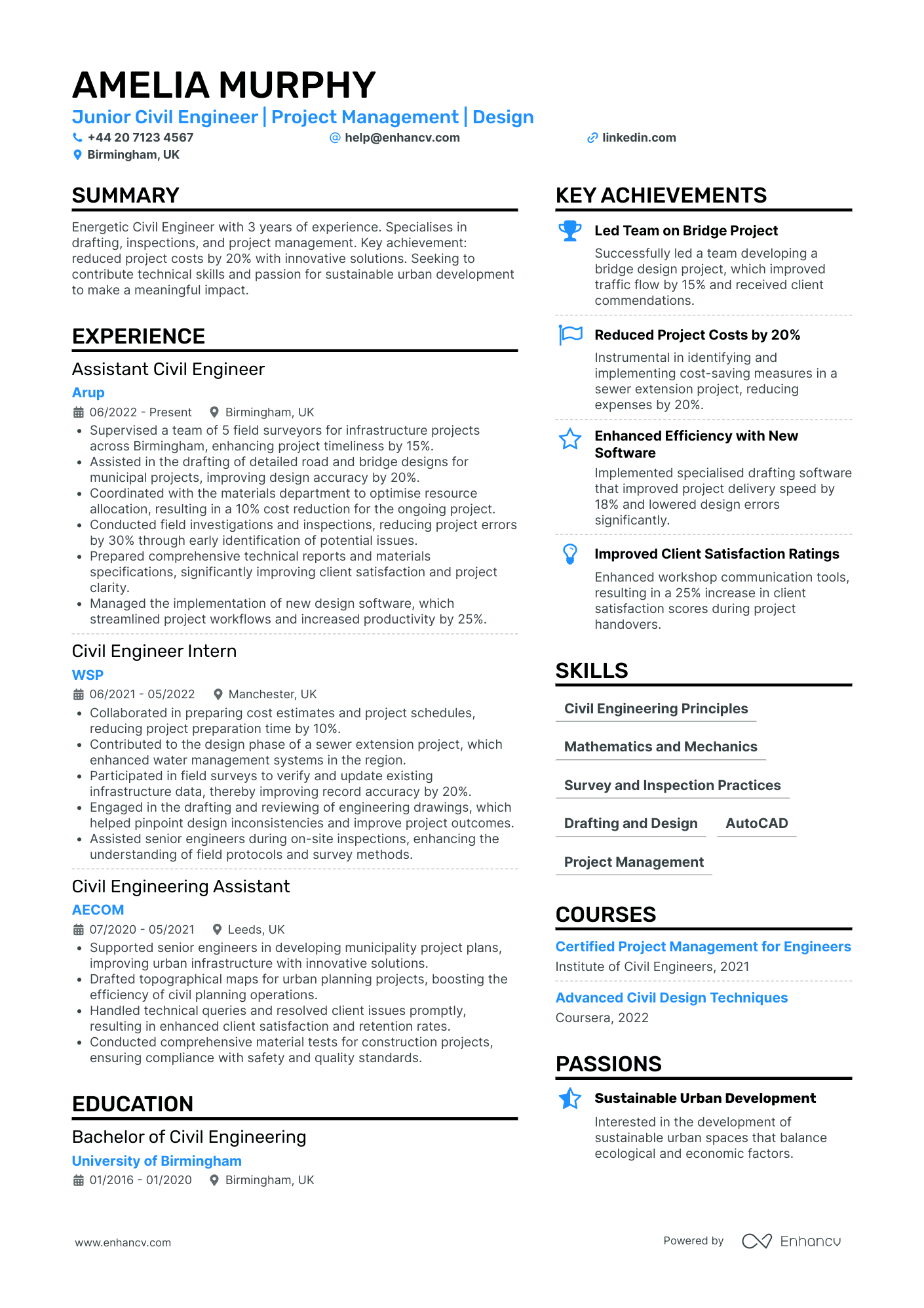
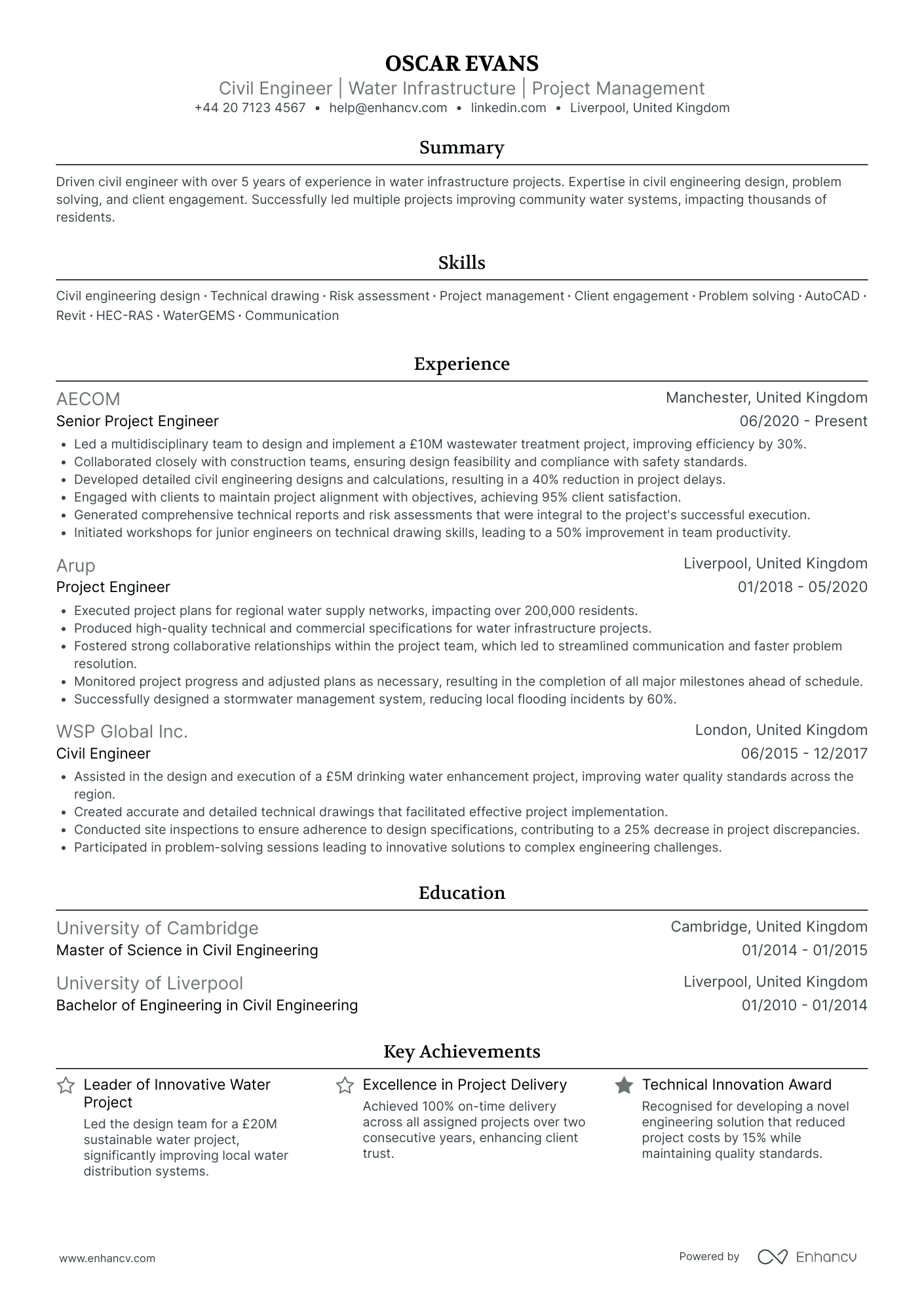
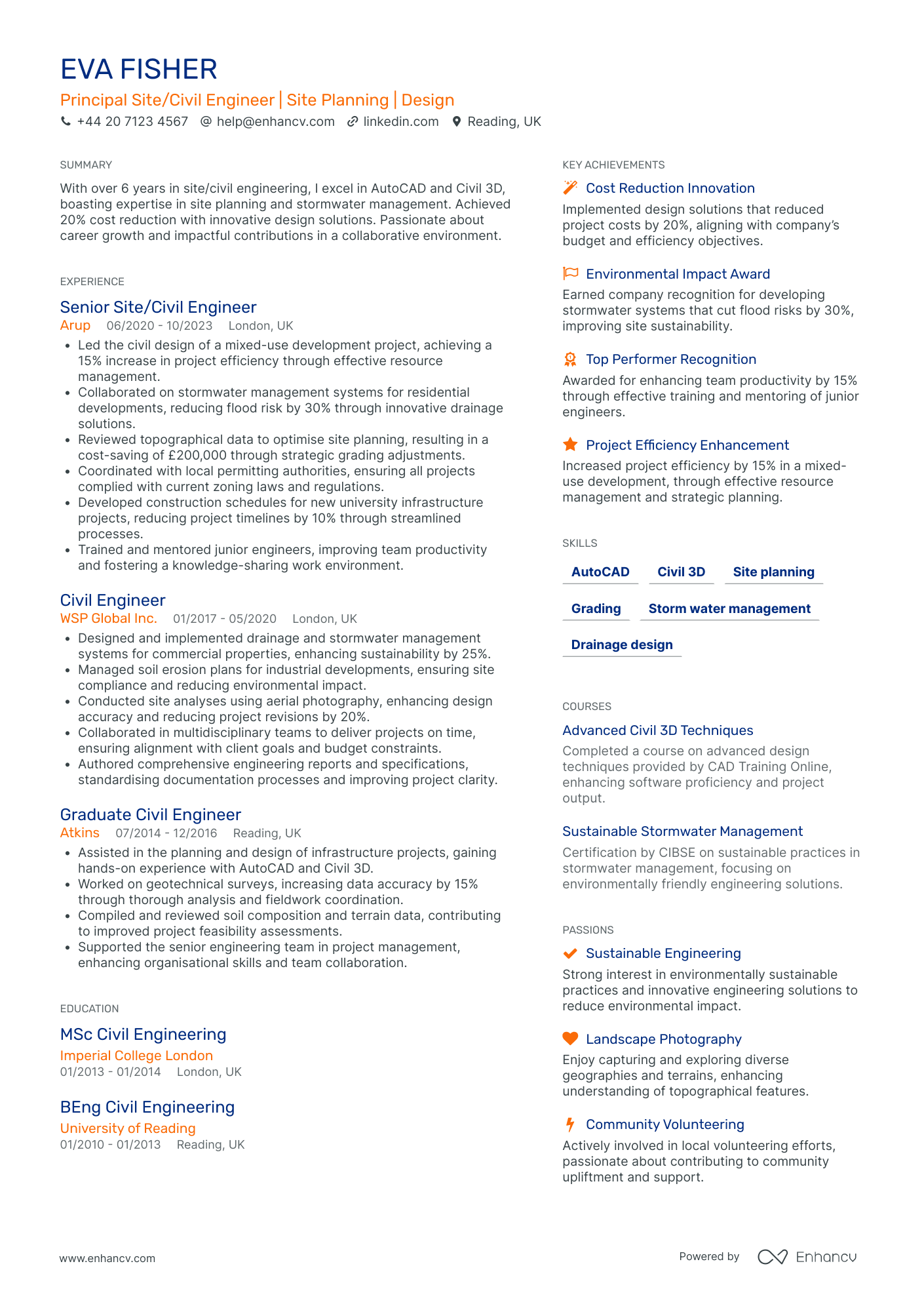
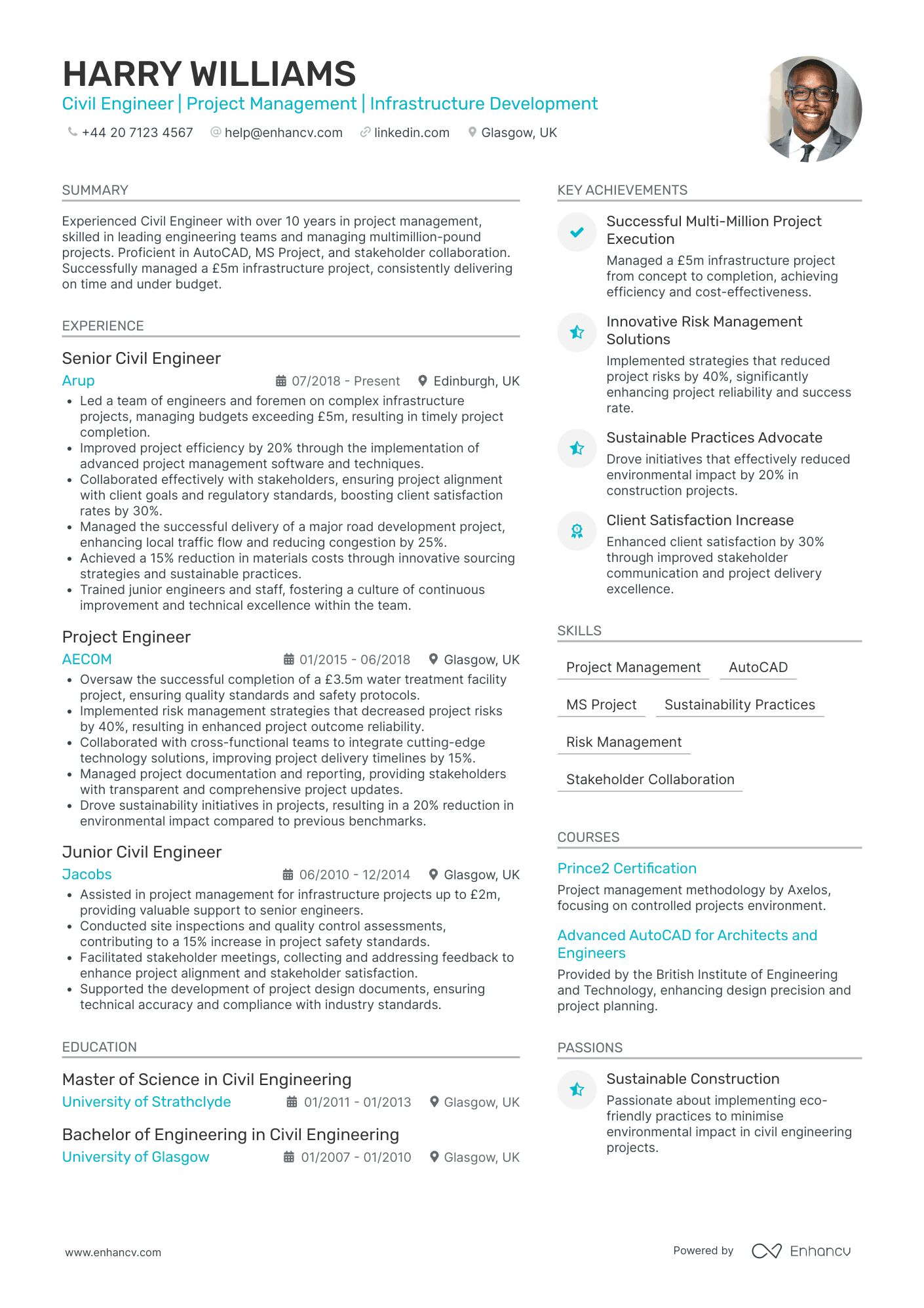
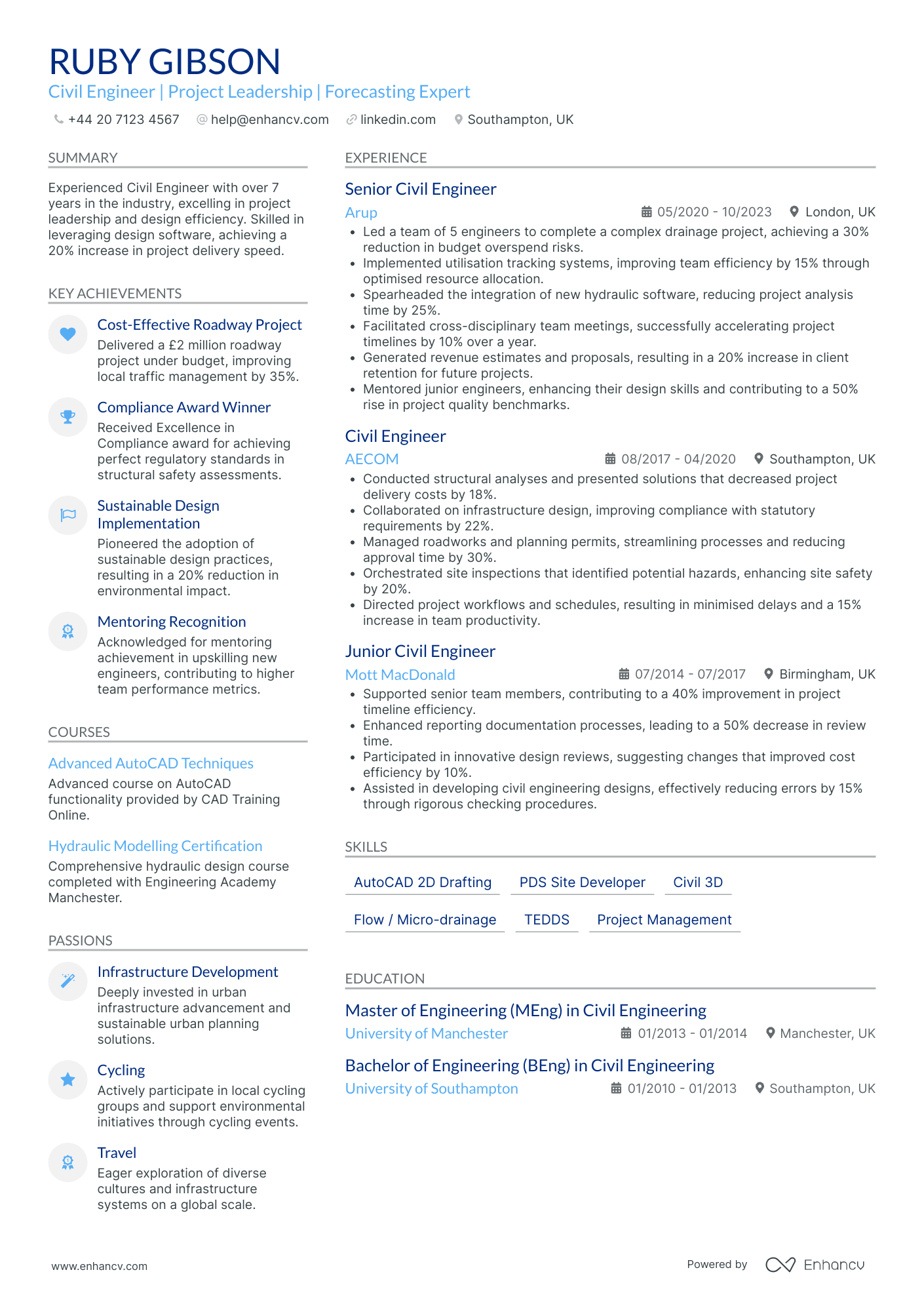
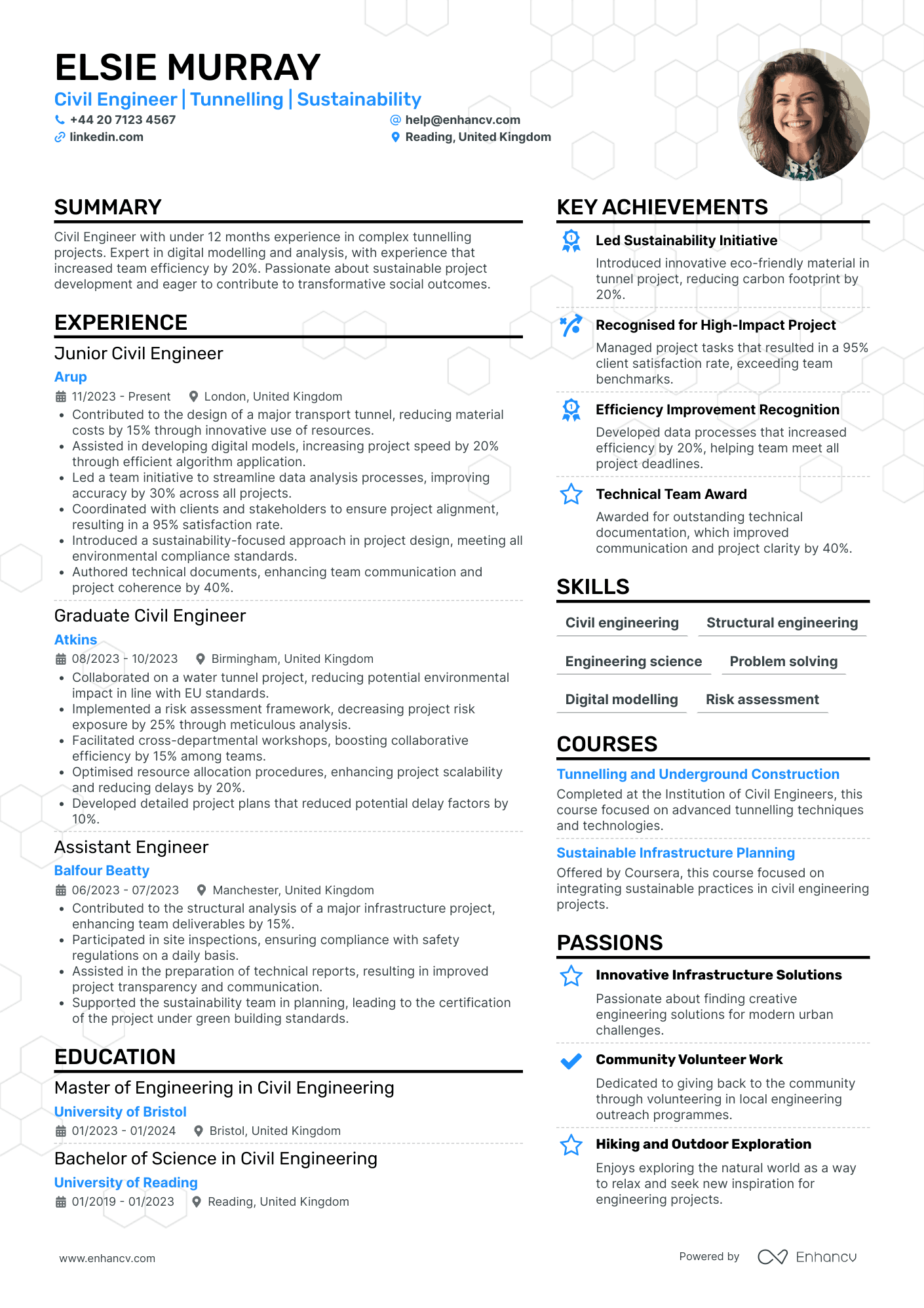
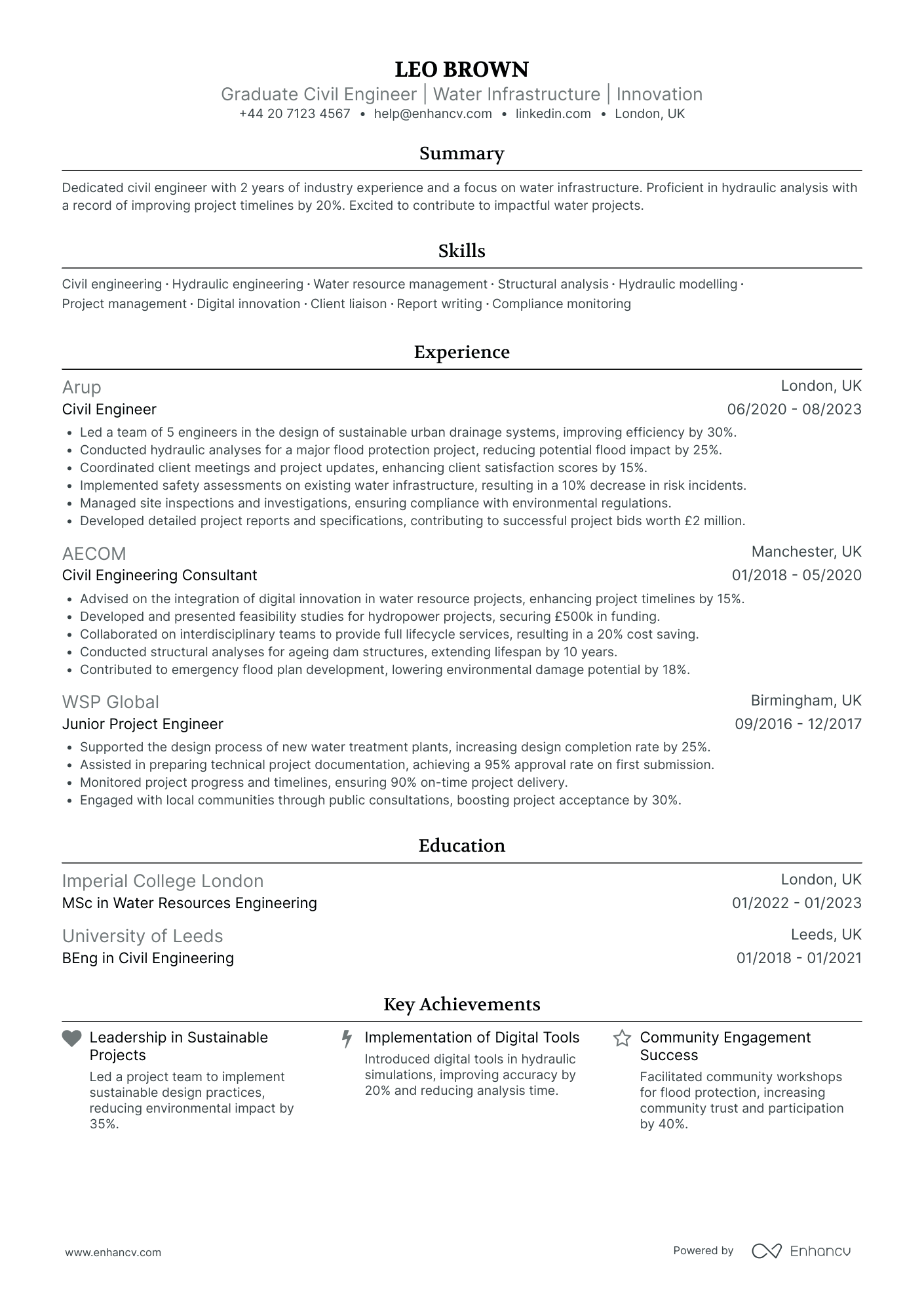
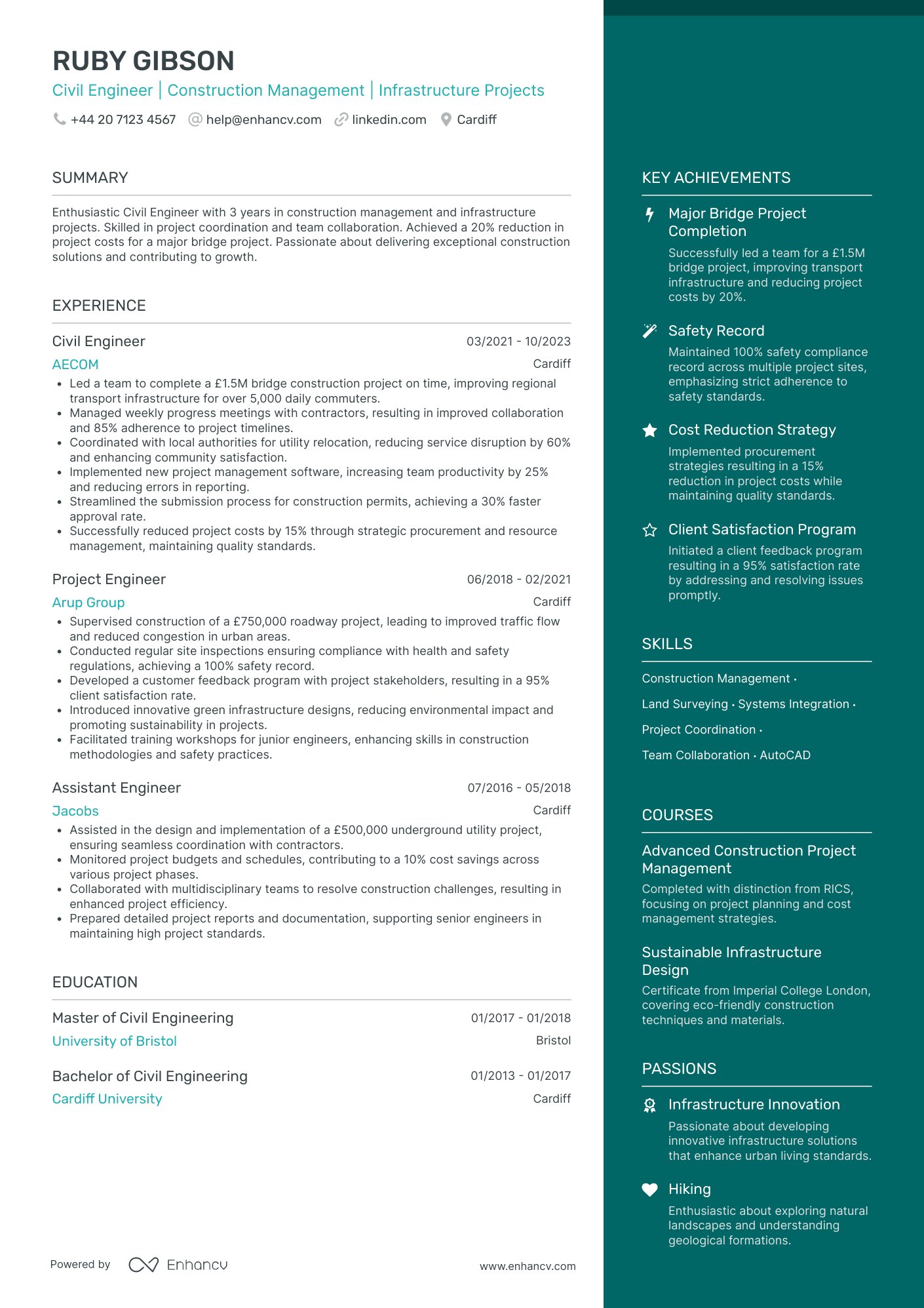
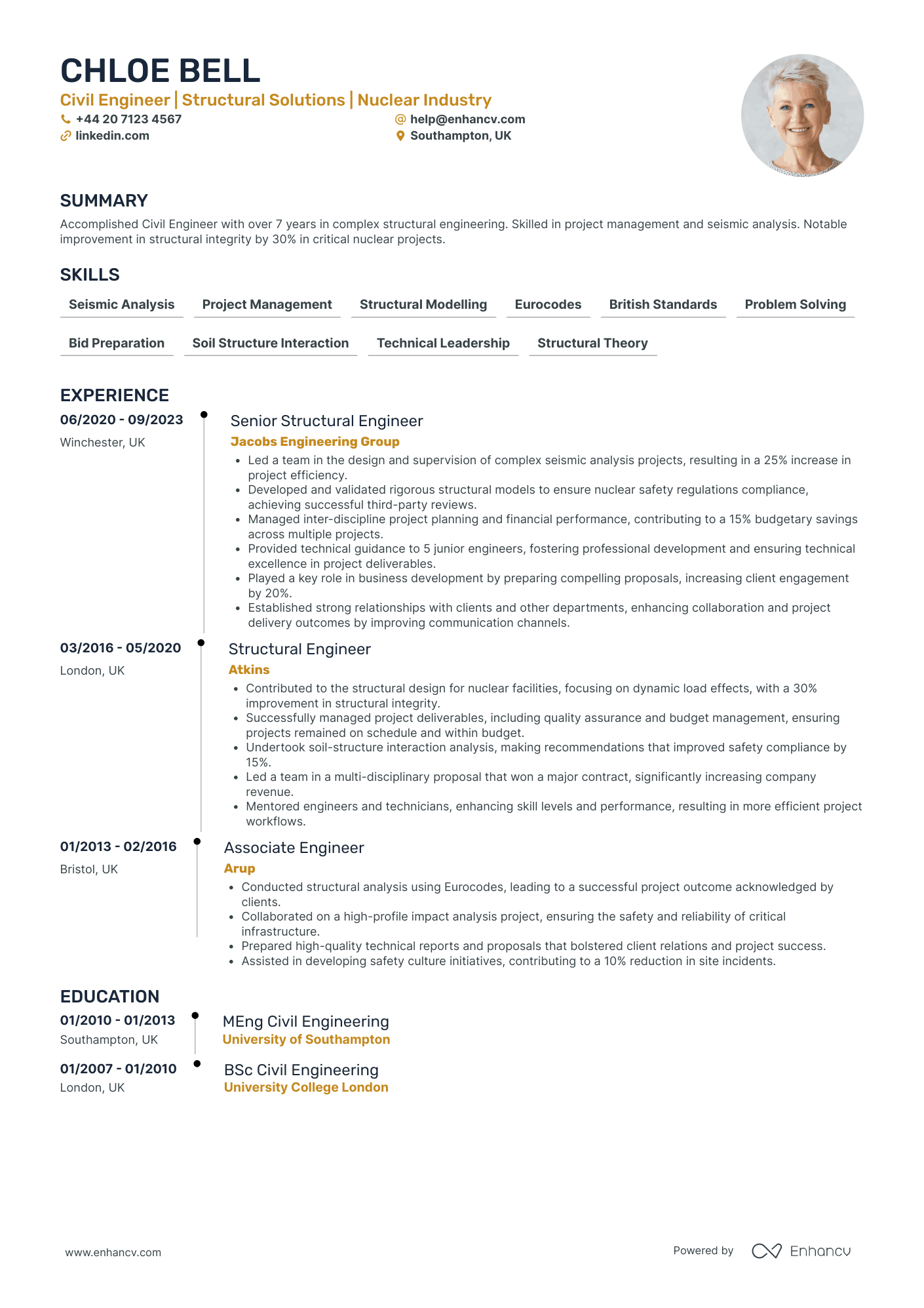
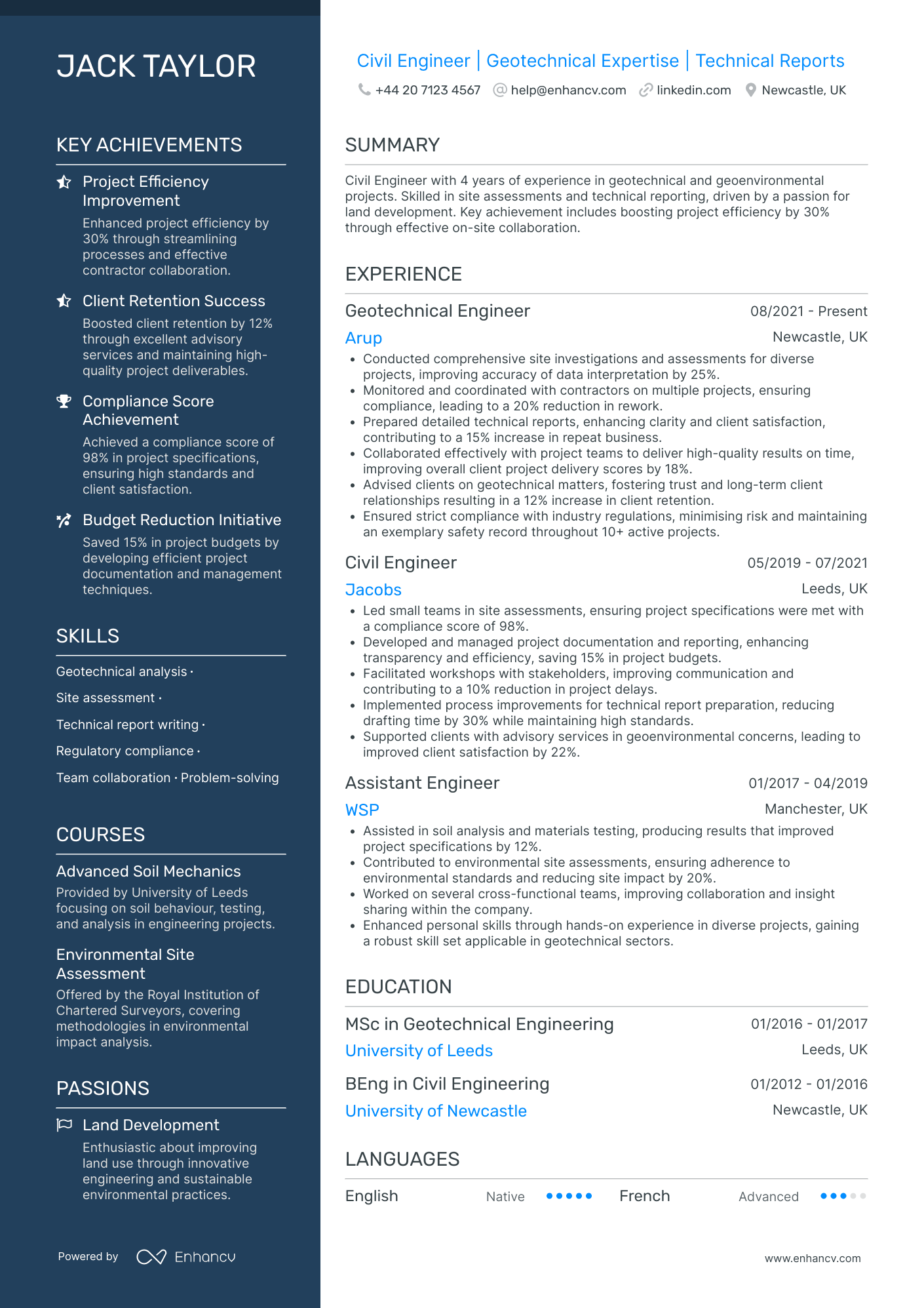
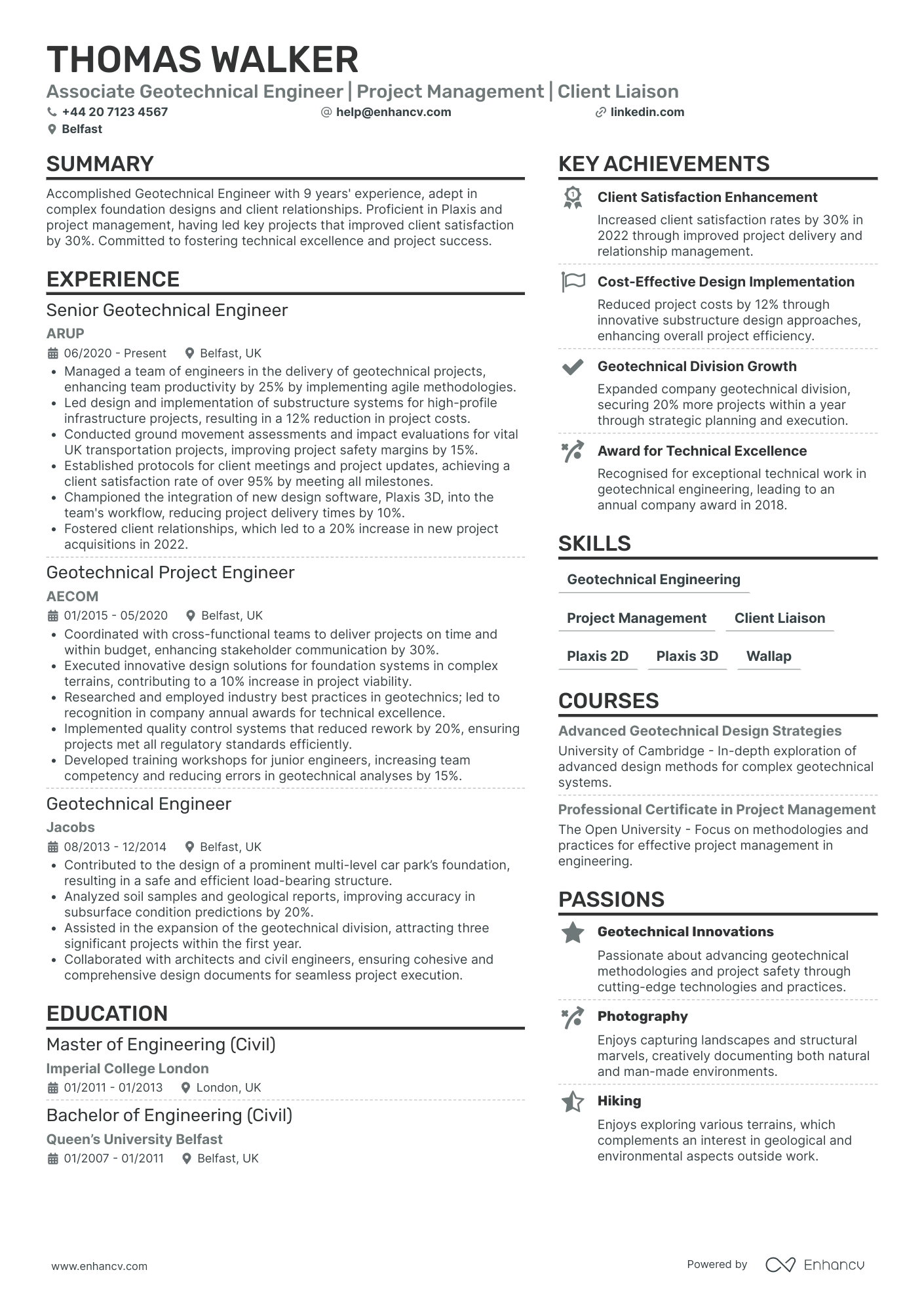
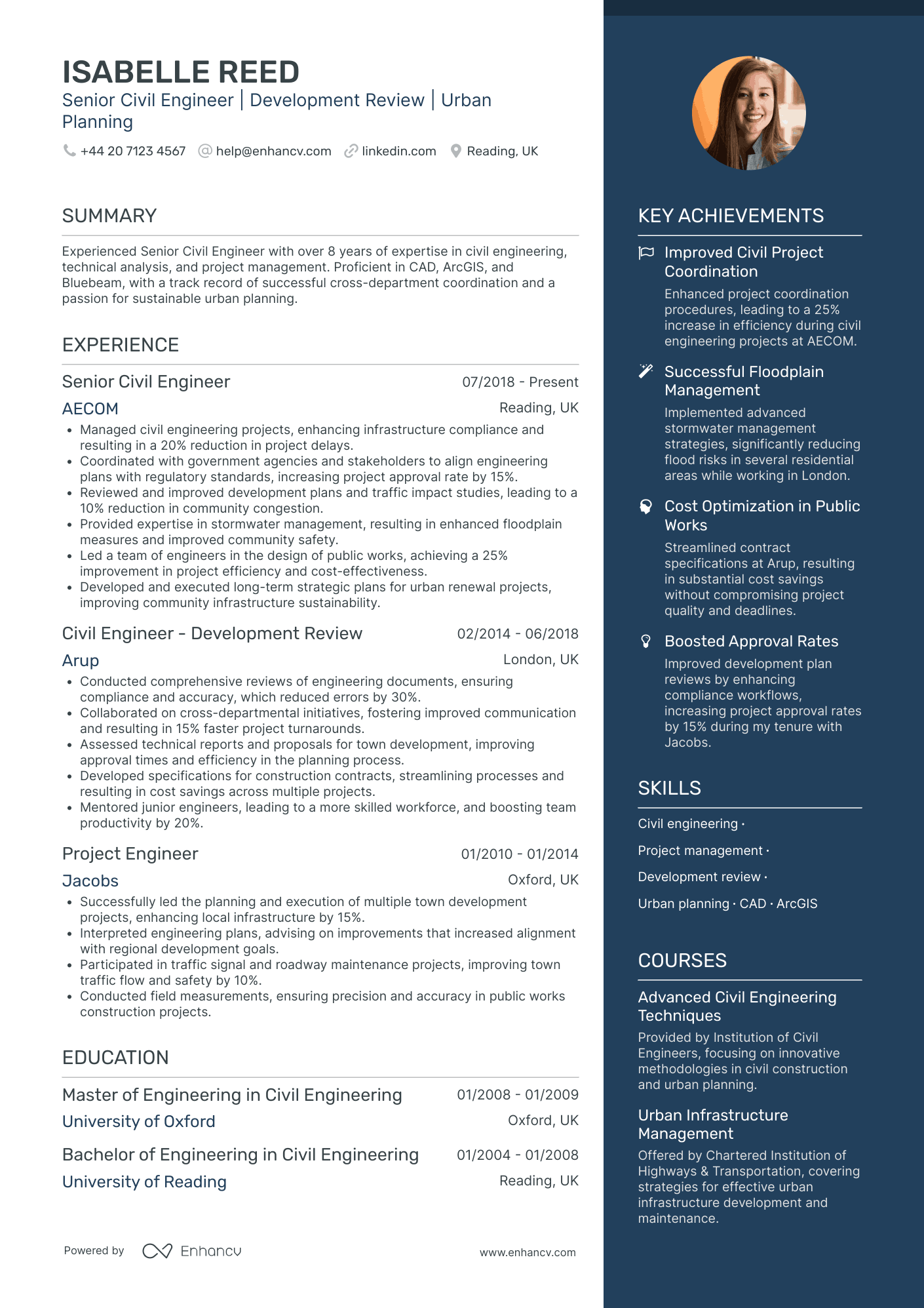
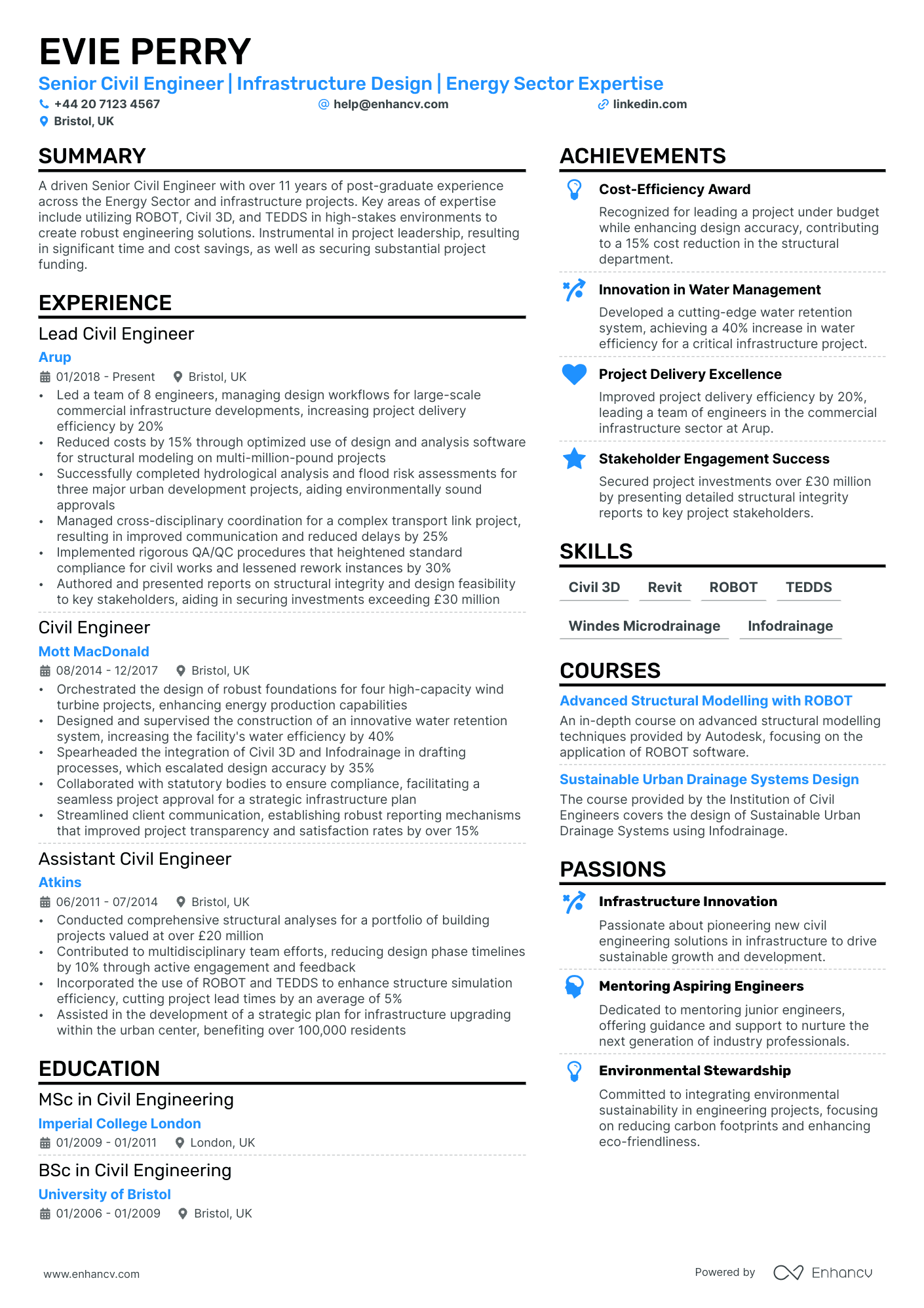
Most civil engineer CVs read like a project list with the engineering taken out. Scheme names, software logos, and a wall of duties, but nothing that tells a hiring manager what you actually delivered.
The CVs that get shortlisted do two things. They lead with a format an engineering manager can skim in one pass, and they back every claim with a number: a budget, a programme saved, a design signed off. Get the CV fundamentals right and the format does half the work for you.

Key takeaways
- Lead with format: two pages, reverse chronological, one clean column, sent as a PDF unless the advert asks for a Word file.
- UK civil engineer roles are mostly on-site (52% of postings), so put your base location and willingness to travel near the top.
- Name your chartership status early: CEng, IEng, or working towards it with the ICE.
- Mirror the skills the adverts repeat: civil engineering design, project management, feasibility studies, and Civil 3D.
- Quantify every project with budget, programme, tonnage, or the standard you designed to.
- Keep a Word copy for recruitment agencies, which place a large share of civil engineering roles.
Formatting your civil engineer CV
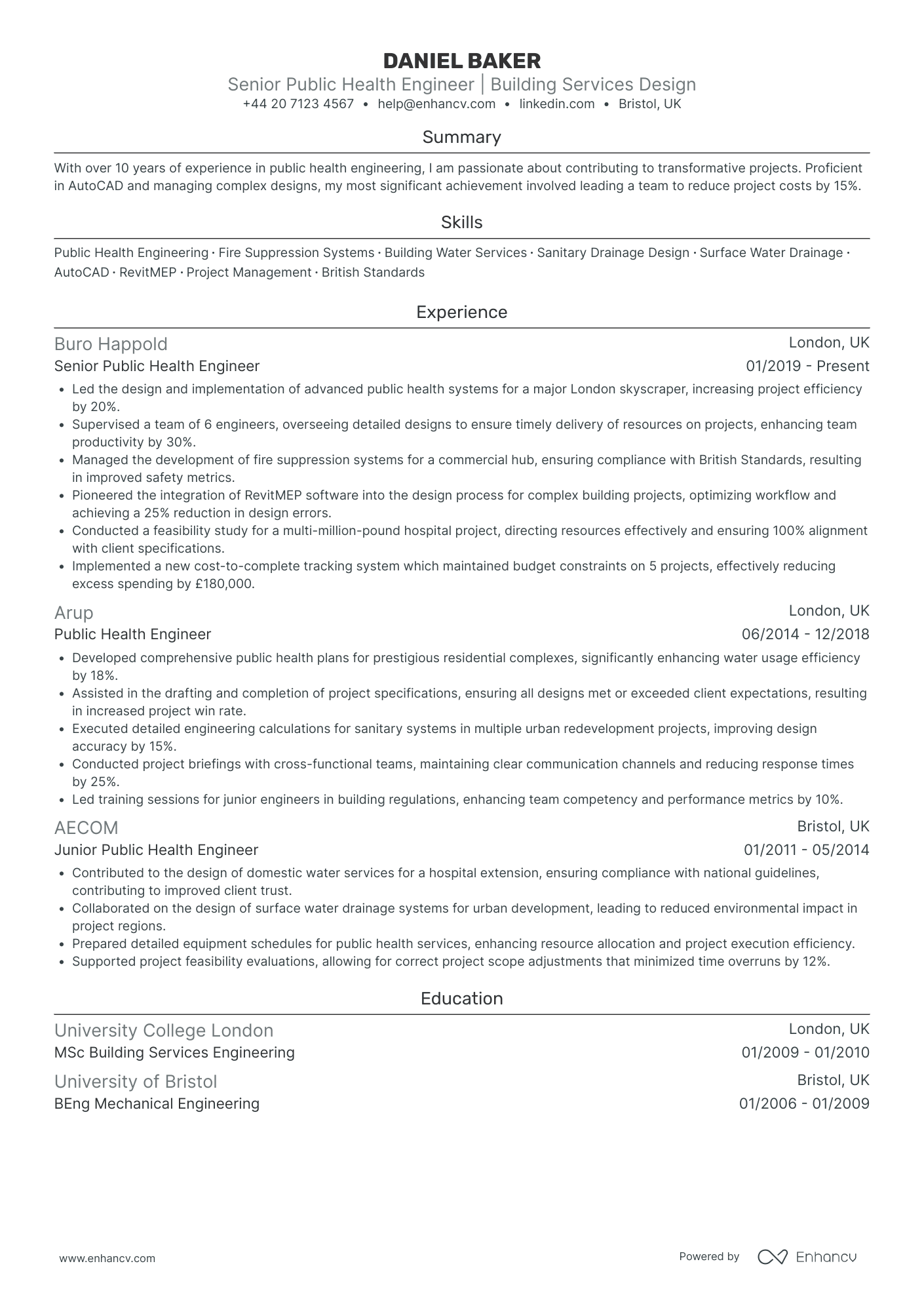
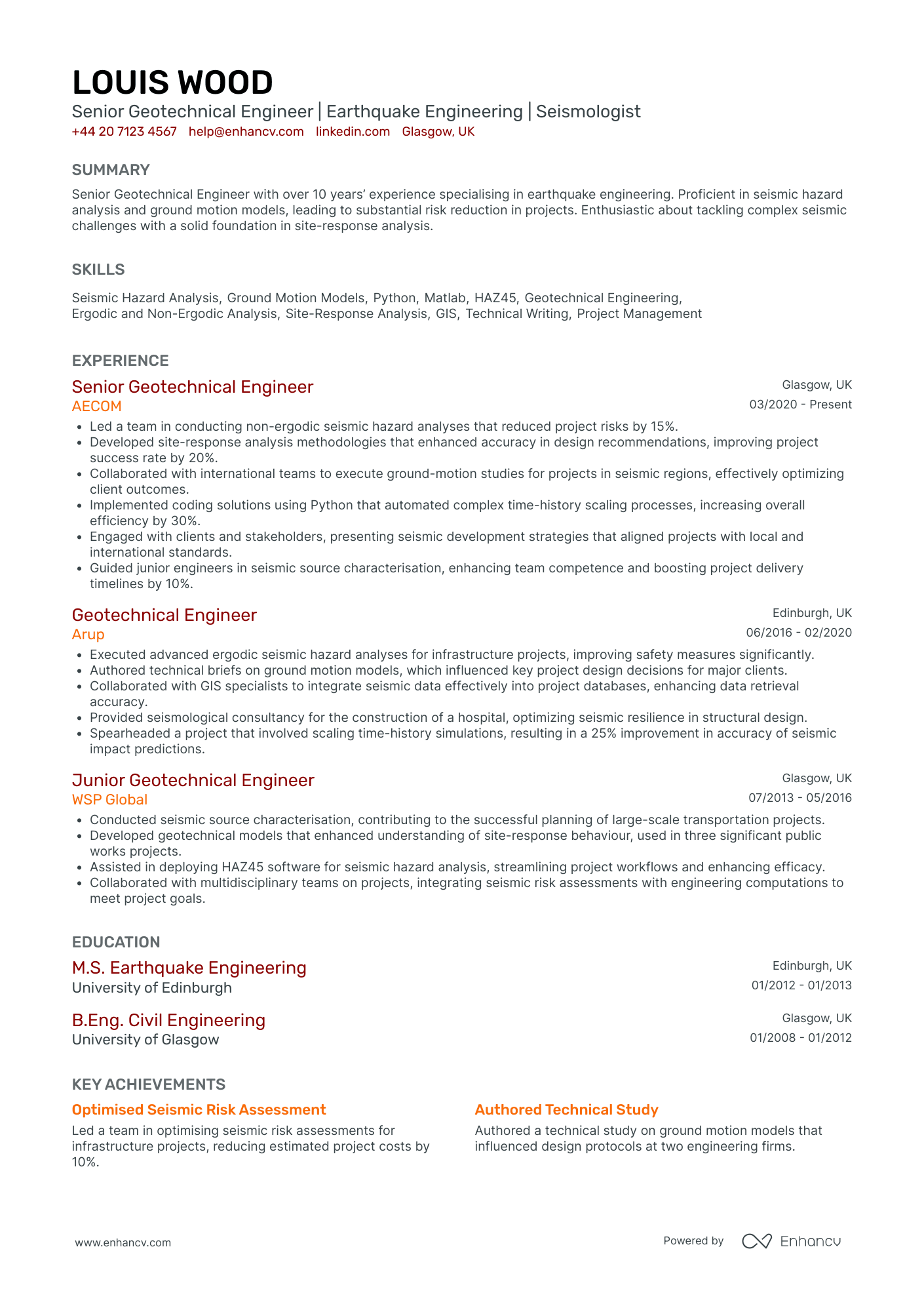
Lead with the format, because an engineering manager decides whether to keep reading in seconds. A clean, predictable CV format buys you that read, and on a technical CV it is doing more work than most applicants realise.
Use reverse chronological order so your most recent project sits at the top, where it carries the most weight. Only switch to a skills-led structure if you are early-career or changing disciplines.
Keep it to two pages. Civil engineering careers generate a long project list, and the temptation is to include everything, but a focused two-page CV beats a four-page catalogue every time. Choose the four or five schemes that best match the advert and give the rest a single grouped line.
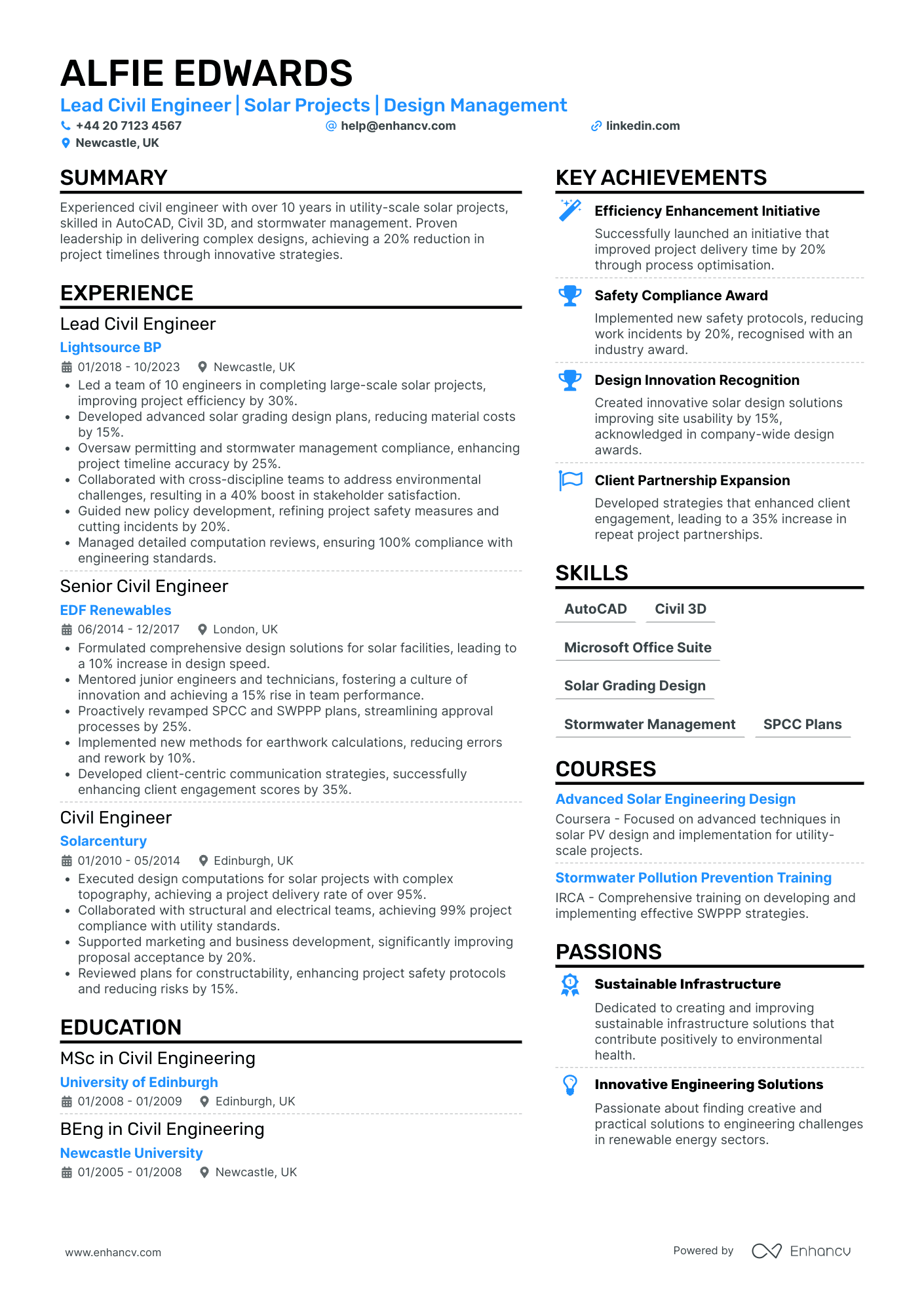
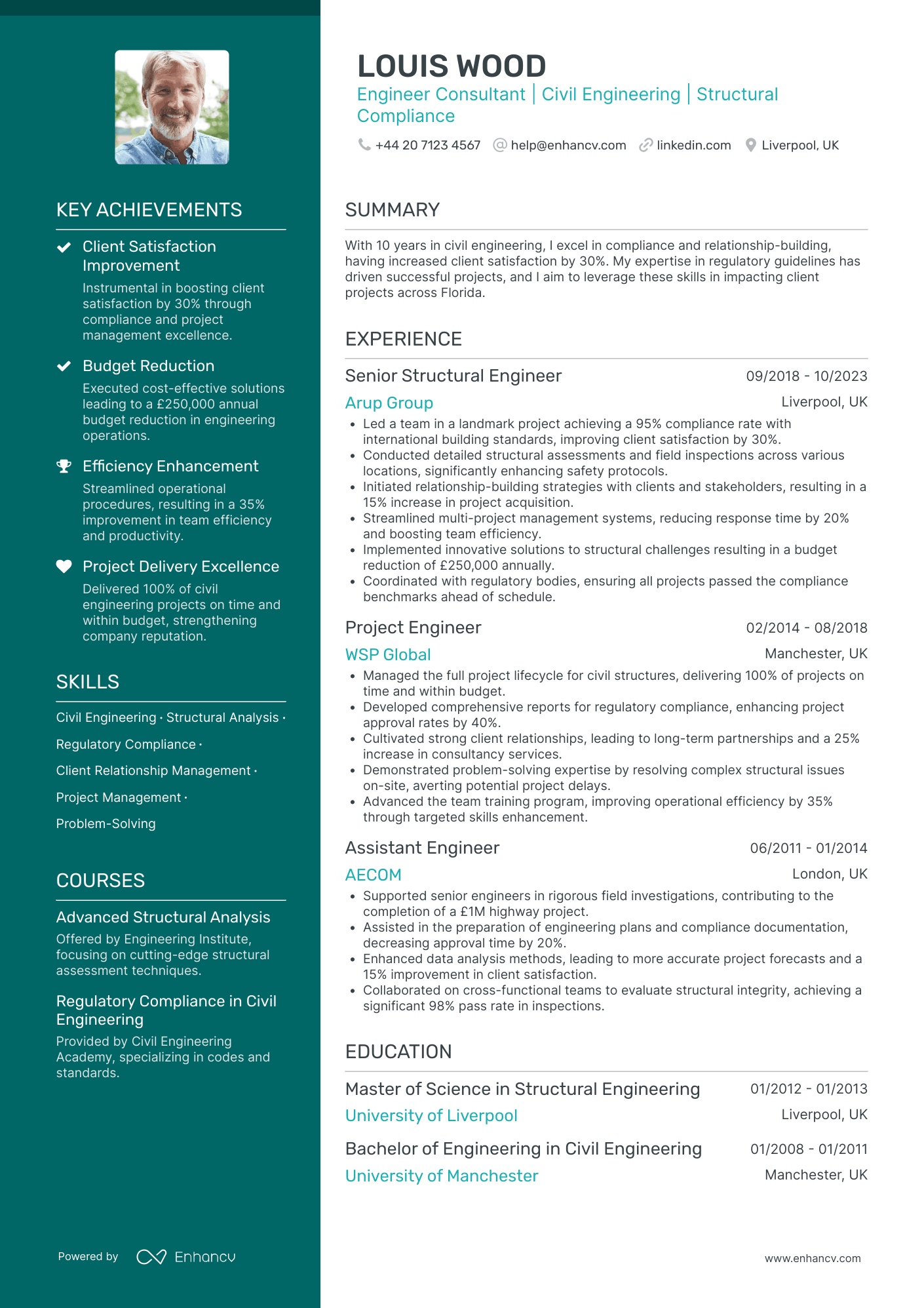
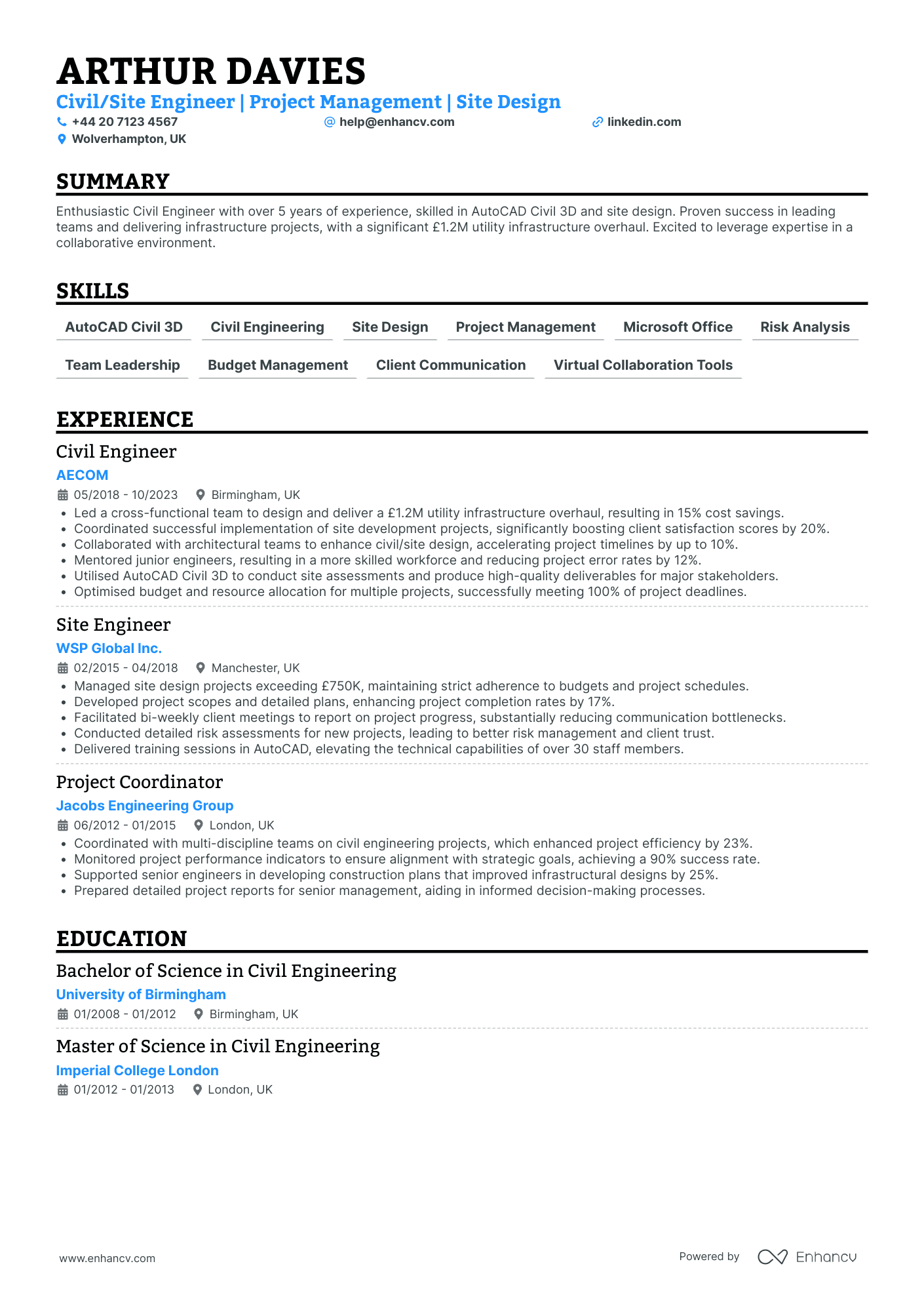
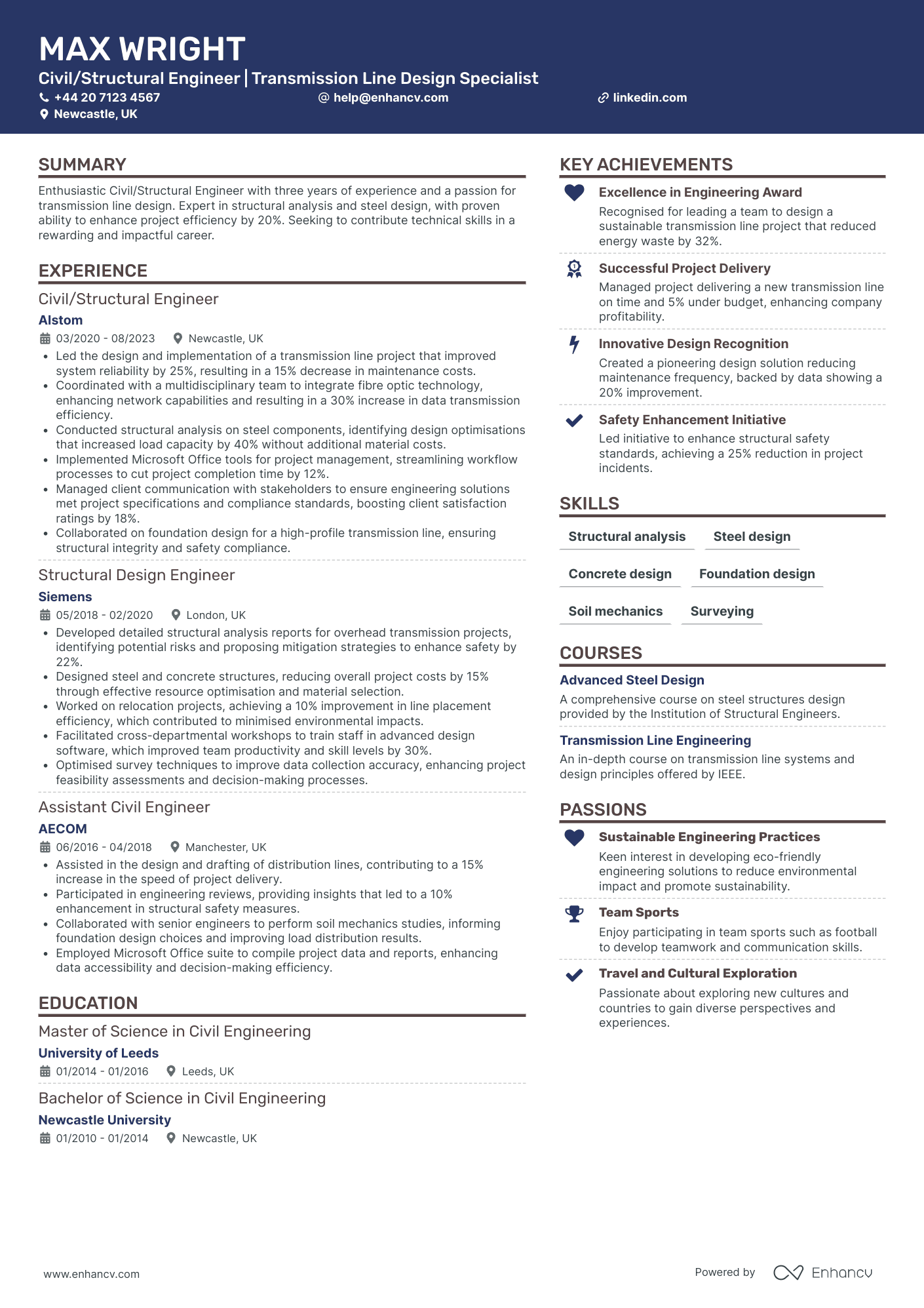
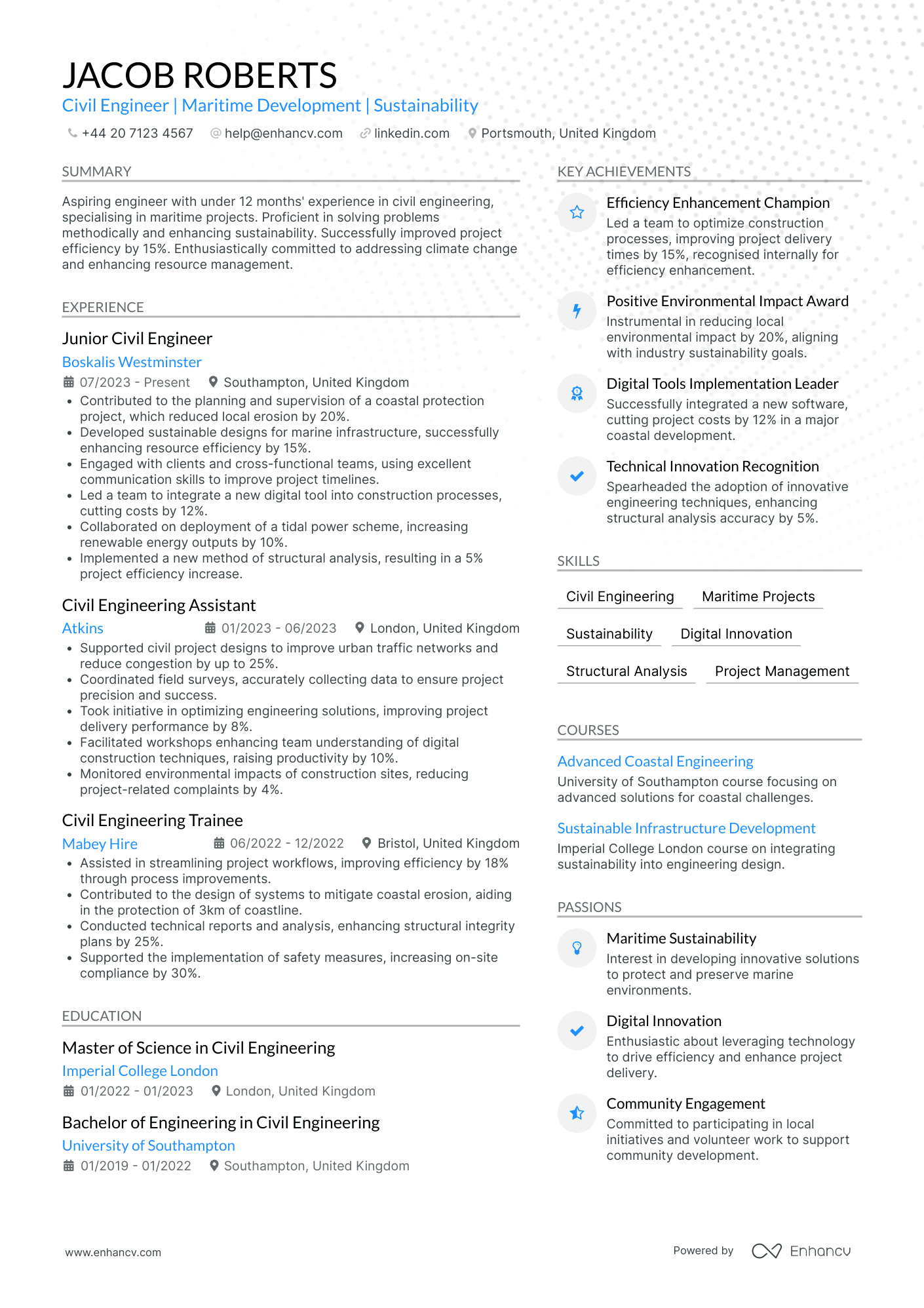
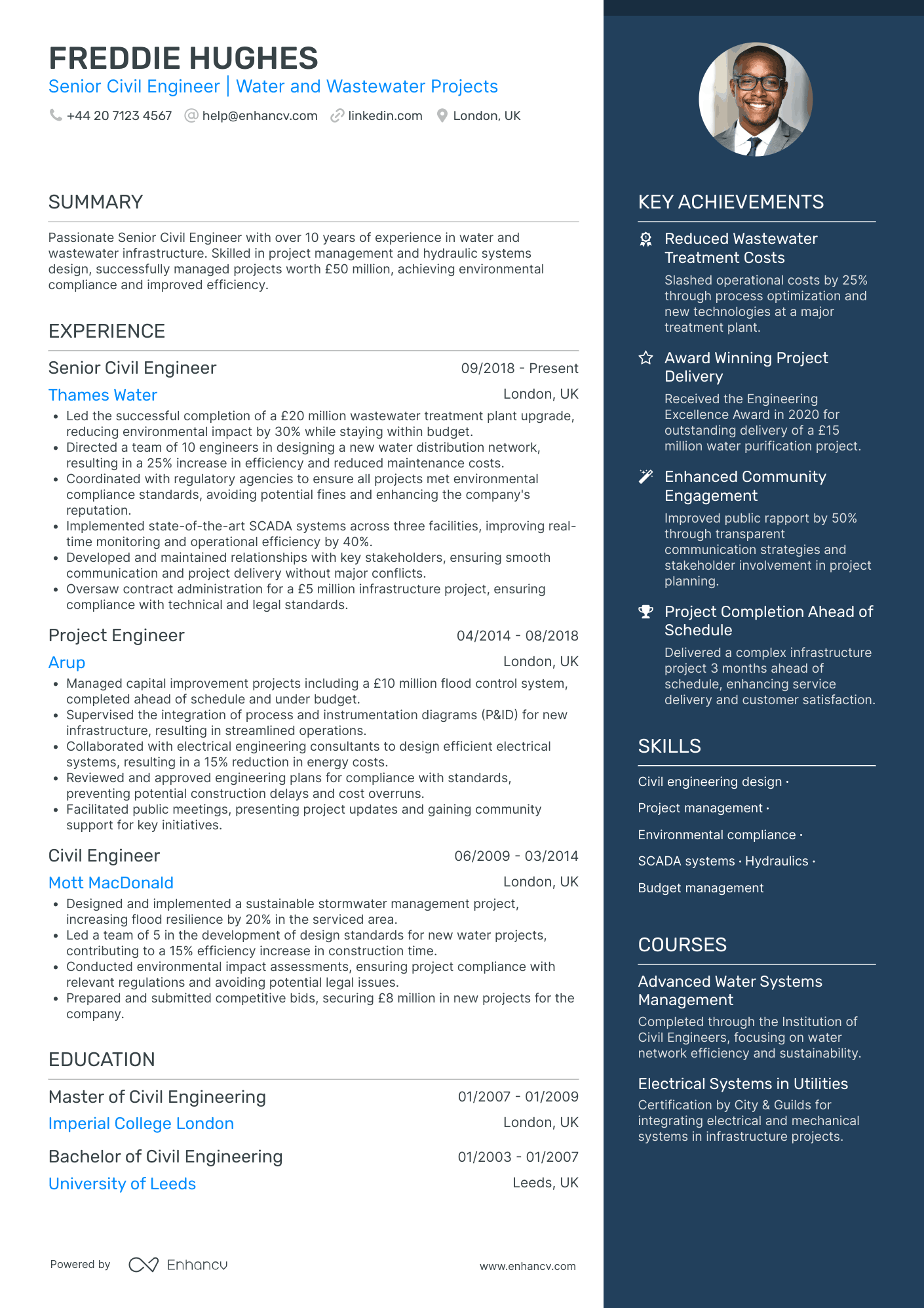
One column, standard headings, and a readable font at 10 to 11 point. Skip the timeline graphics, headshots, and skill-percentage bars. They rarely survive an applicant tracking system and they waste space a project could fill. Two columns can look sharp, but a parser reads left to right and often scrambles a split layout, so keep the structure simple where you can.
Order the sections the way an engineering manager reads: header, personal statement, key skills, chartership, experience, then education. On a civil CV your chartership and project delivery earn the space a generic profile usually wastes.
The header is small but it does real work. Put your name, your chartership postnominals if you have them, a base location, a phone number, a professional email, and a LinkedIn URL. Leave off a date of birth, a full address, and a photo, none of which a UK engineering employer expects.
Send a PDF for direct applications so your layout holds in PDF on any screen. Keep a Word version for recruitment agencies, which place a large share of civil engineering roles and reformat CVs into their own template. When a recruiter asks for a Word format CV, it is usually so they can add a header before sending you to the client, so give them one rather than fighting it. If the advert names a file type, follow it.
A good UK civil engineer CV template does the structural work for you. It fixes the margins, keeps a consistent CV layout, and stops a long project list from spilling onto a third page. A free blank template saves time, but check it parses cleanly before you rely on it, because many pretty designs read as gibberish to an ATS.
Build it from a tested structure rather than a blank document. Enhancv's CV templates export to a clean, ATS-parsable PDF, so the formatting decisions above are handled before you type a word.

PRO TIP
Civil engineering adverts name the standards and software they use: Eurocodes, DMRB, BS 5400, Civil 3D, AutoCAD, MicroStation. Mirror the exact terms you have genuinely worked with, in the words the advert uses. An ATS matches on wording, and a hiring engineer trusts specifics.
What the UK civil engineer market looks like
Knowing what UK employers ask for tells you what to put near the top of the CV. Here is what the role pays and what the adverts repeat.
| What | UK civil engineer roles |
|---|---|
| Typical pay | £29,000 to £63,000 a year (National Careers Service, gov.uk) |
| Where the work happens | On-site 52%, hybrid 48% (204 and 185 of 389 UK postings in the last ~30 days, Enhancv's internal job feed) |
| Experience level asked for | Lead 42% · mid 30% · senior 15% · entry 13% |
| Most-listed skills | Civil engineering, project management, feasibility studies, detailed design, Civil 3D, AutoCAD |
Two things in that table should shape your CV.
The work is mostly on-site, so a recruiter needs to see you can reliably get to a site. Put your base location and willingness to travel in the header, and mention a driving licence if you hold one.
The market skews experienced, with 42% of postings pitched at lead level and only 13% at entry. If you are early in your career, lean on placements, a year in industry, and your degree project to close that gap.
Skills for your civil engineer CV
Read a stack of live civil engineer adverts and the same demands repeat. Civil engineering design and project management appear in most UK postings, with feasibility studies close behind, according to Enhancv's internal job feed over the last ~30 days.
Those are your hard skills, listed in the words the adverts use. Pair each with the software and standards you have applied: Civil 3D, AutoCAD, Revit, Eurocodes.
Be specific about discipline, because civil is a wide field. Highways, drainage, structures, geotechnics, water, and rail each carry their own tools and standards, and a recruiter shortlisting for a drainage role wants to see MicroDrainage or InfoDrainage, not a generic list. Name the sub-discipline you work in and the software that goes with it.
The soft skills that matter here are checkable, not decorative: communication with contractors and clients, stakeholder management, and the judgement to flag a design risk early. Prove each one in an experience bullet rather than listing it cold. "Chaired the design risk workshop that caught a clash before it reached site" beats "excellent communicator" every time.
List only what you can defend in a technical interview. A good rule for the skills section of a CV is that every line should map to something you have designed, delivered, or signed off. If you have used a tool once on a placement, it belongs in a bullet with context, not in a headline skills band that implies fluency.
Top skills for your civil engineer CV:
Civil engineering design
Project management
Feasibility studies
Detailed design
AutoCAD Civil 3D
Project lifecycle management
Project delivery
Eurocodes and BS standards
BIM and Revit
Communication
Stakeholder management
Problem solving
Attention to detail
Teamwork
Writing your civil engineer personal statement
Three or four sentences at the top: who you are, your chartership status, the sectors you have worked in, and one delivery you are known for. Keep it concrete.
Skip the adjective soup. "Hard-working and detail-oriented civil engineer passionate about the built environment" tells a hiring manager nothing they can check.
Lead with evidence instead, and see more personal statement examples if the opening line is not coming.
Retune it for every application. A design consultancy wants to see technical depth and the standards you work to, while a contractor wants site experience and delivery under programme pressure. Same career, different opening line.
Below is the difference between a statement that earns a read and one that a recruiter has seen a thousand times.
Civil engineer CV personal statement example
Chartered civil engineer (CEng MICE) with eight years in highways and drainage design across the UK. Led the detailed design of a £12m junction improvement, delivered three weeks ahead of programme, with Civil 3D models signed off to Eurocode and DMRB standards. Looking to bring structural design and contractor coordination to a principal engineer role in the North West.
Personal statement to avoid
Hard-working and passionate civil engineer with excellent communication skills and a keen eye for detail. A team player who thrives under pressure and is looking for a challenging new opportunity to grow and develop within a forward-thinking company.
Writing your civil engineer experience section
Write each role as a dated heading, then bullets that show the project, your scope, and the outcome. Lead every bullet with a verb and anchor it with a number.
Name the scheme where you can. "Detailed design engineer on the £40m Riverside flood alleviation scheme" places you instantly, and it tells the reader the scale and sector you are comfortable in. Add your role on it, the stage you took it through, and what changed because you were on the job.
Civil engineering is one of the easiest fields to quantify, so use that. Budget, programme, tonnage, span, percentage saved, drawings issued: the numbers are already in your project records.
For the mechanics, see how to write strong work experience on a CV, and treat each figure as one of your CV achievements rather than a duty. "Responsible for drainage design" is a job description. "Designed the surface water drainage for a 220-plot residential site, adopted by the water authority first time" is an achievement.
Tailor every application. Pull the keywords for a CV straight from the advert, the standards, software, and scheme types, and mirror them where they are true of you. Enhancv's CV tailoring feature reads the job ad and suggests the matching edits, which saves rewriting from scratch for each role.
- Led detailed design for a £12m A-road junction upgrade, coordinating drainage, earthworks, and structures across a six-person team
- Produced and checked Civil 3D models and issued 80+ drawings to Eurocode, DMRB, and BS standards with zero design-stage rejections
- Cut the outline design programme by three weeks by reworking the drainage strategy, saving the client an estimated £45k
- Ran fortnightly design reviews with the contractor and client, resolving buildability issues before they reached site
PRO TIP
Recruiters and framework clients search CVs for scheme types and standards. If you have worked to DMRB, Eurocodes, CDM 2015, or a specific water company's design manual, name it. Those exact phrases are what a keyword search picks up.
Education, chartership, and CPD on a civil engineer CV
Civil engineering is a chartered profession, so this section pulls more weight than on most technical CVs. Employers read it to place you against CEng, IEng, and EngTech.
List your degree with its classification and whether it is accredited by the Joint Board of Moderators: a BEng or MEng (Hons) in Civil Engineering, 2:1 or above where you have it. Keep your education section tight and name the accrediting institution. An accredited MEng is the cleanest academic route to CEng, so if yours is accredited, say so.
State your chartership status plainly, even in progress: "Chartered (CEng MICE)", "Incorporated (IEng)", or "working towards CEng, ICE Professional Review 2026". Put it in the header and again here. If you are on a structured training scheme with an ICE-approved employer, name it, because it tells an assessor you are being signed off against the attributes.
Back it with the qualifications and short courses that matter: CSCS card, NEC contract training, temporary works coordinator, CDM awareness, first aid. Group your certificates so an assessor can find them, and keep the expiry dates current.
Keep a line for continuing professional development. The ICE expects CPD, and showing a recent example, a course, a technical talk, or a standard you got up to speed on, signals you take chartership seriously.
Writing a graduate civil engineer CV
Only about 13% of UK civil engineer postings on Enhancv's internal job feed are pitched at entry level, so a graduate CV has to work harder to be seen. The format flips to give your strengths room.
Lead with education and a skills-led structure, then your degree project, placements, and any year in industry, with part-time work lower down. A final-year design project is real engineering, so write it up like a job: the brief, the tools, the standards, and the outcome.
Name the software you used in your degree, the site visits and surveying you have done, and any exposure to Civil 3D, AutoCAD, or Revit from coursework. One line that you are working towards IEng or CEng through a graduate scheme moves you up the pile, because it signals you already know the path.
A placement counts as experience for this role, not filler. Give it a dated entry with the discipline, the scheme, and what you contributed, the same way you would a permanent post.
Conclusion
Get the format right first: two pages, reverse chronological, one clean column, and a PDF that survives an ATS. That is what earns your projects a read.
Then let the numbers and your chartership do the talking. Pair the CV with a short cover letter that names the scheme you most want to work on, and you turn a project list into a shortlist-worthy application.

Author's take - the Enhancv team
The civil engineer CVs that get shortlisted are never the longest. They are the ones where every project line carries a number and the chartership status is impossible to miss. When we review these CVs, a single quantified outcome, a £12m scheme delivered ahead of programme, tells us more than a full page of responsibilities. Lead with the format, prove the delivery, and name your CEng or IEng status early.