



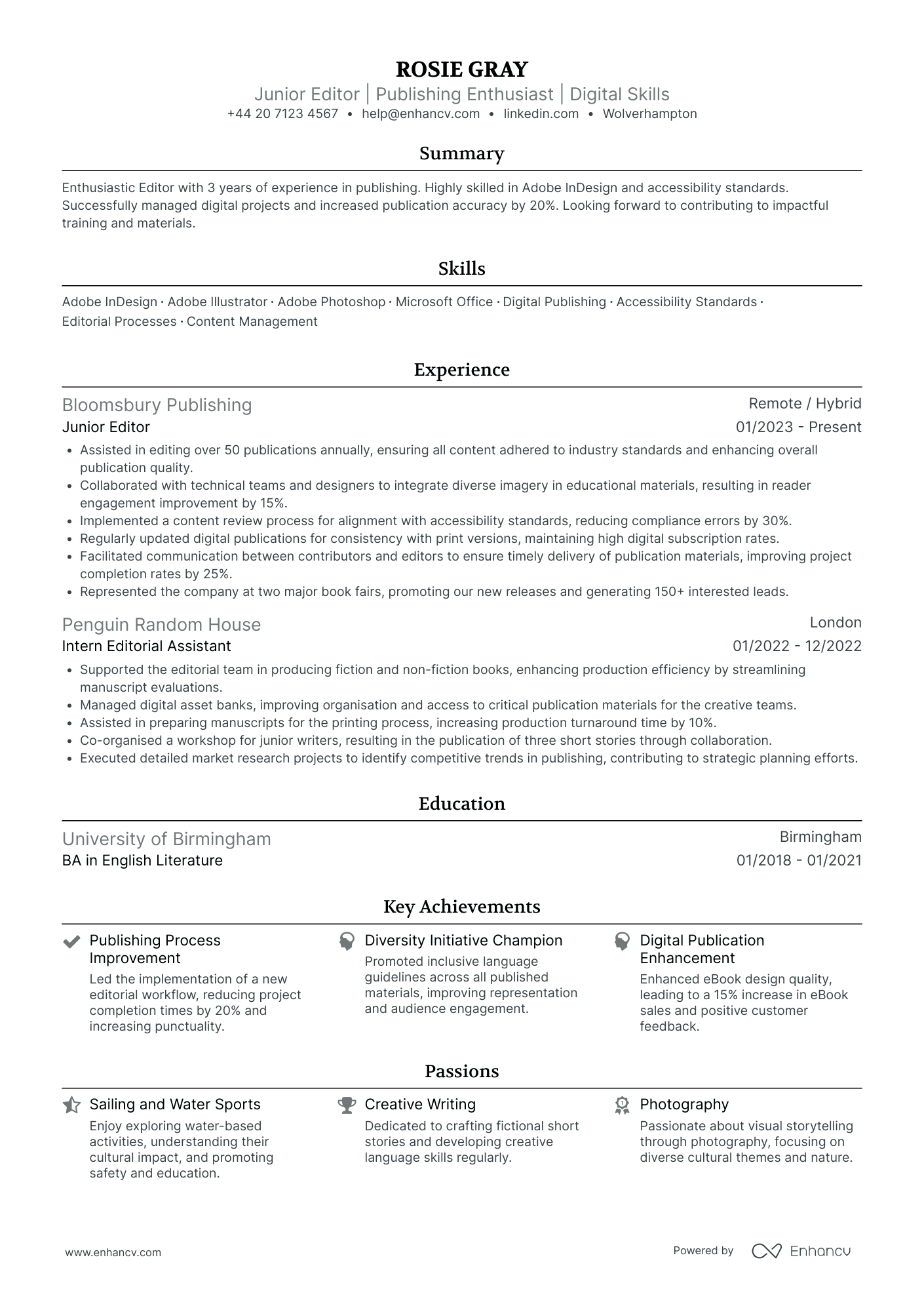
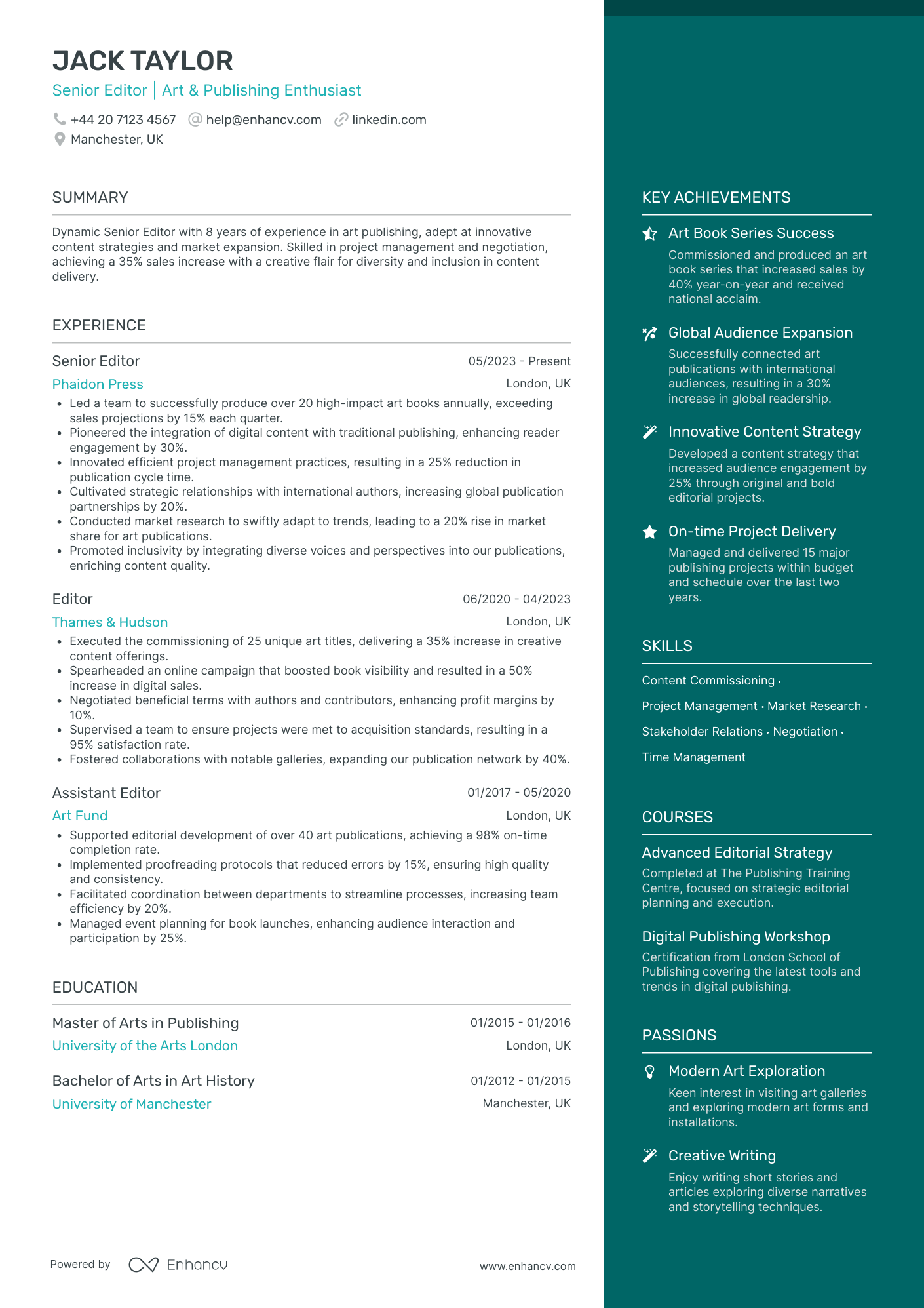
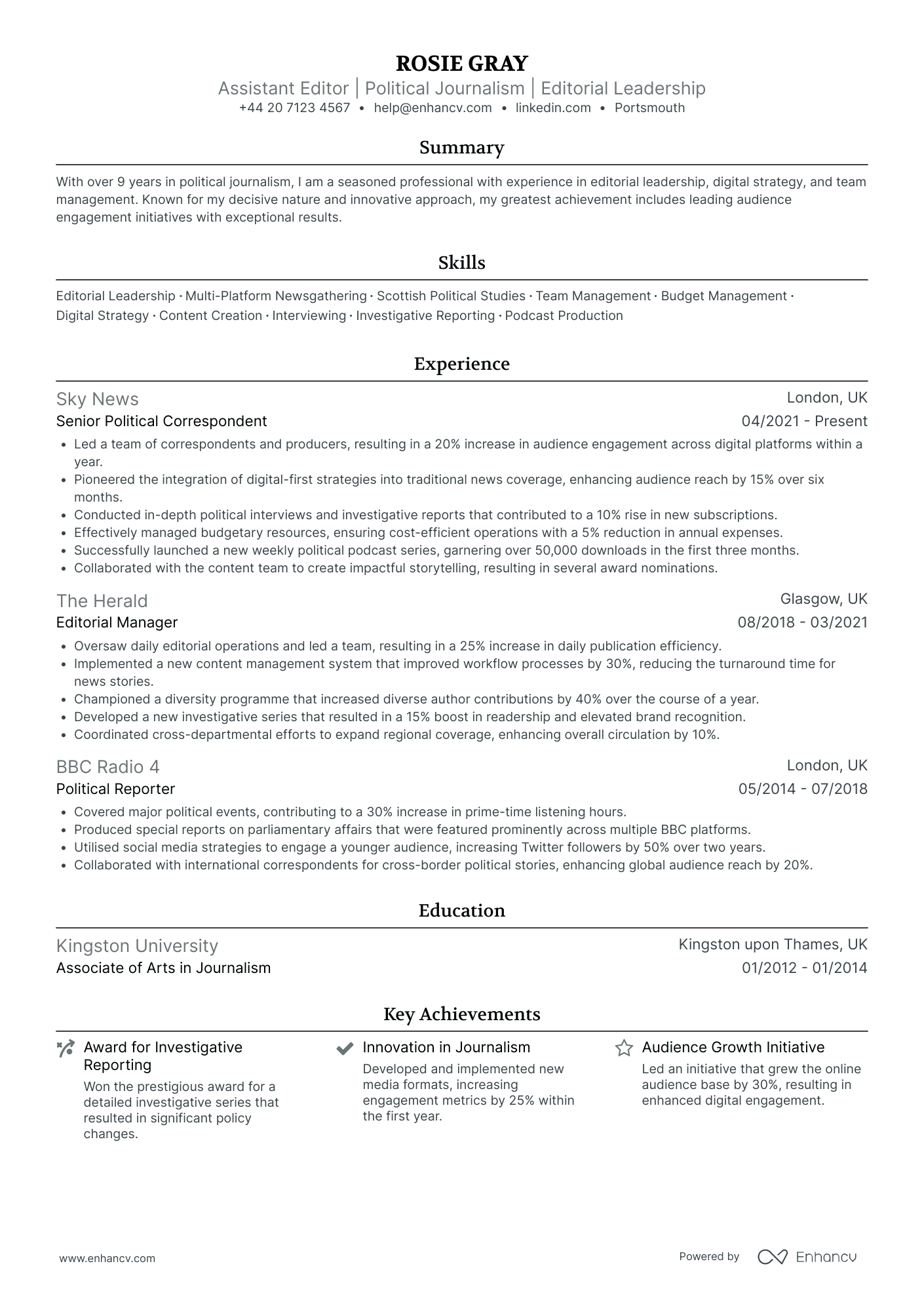
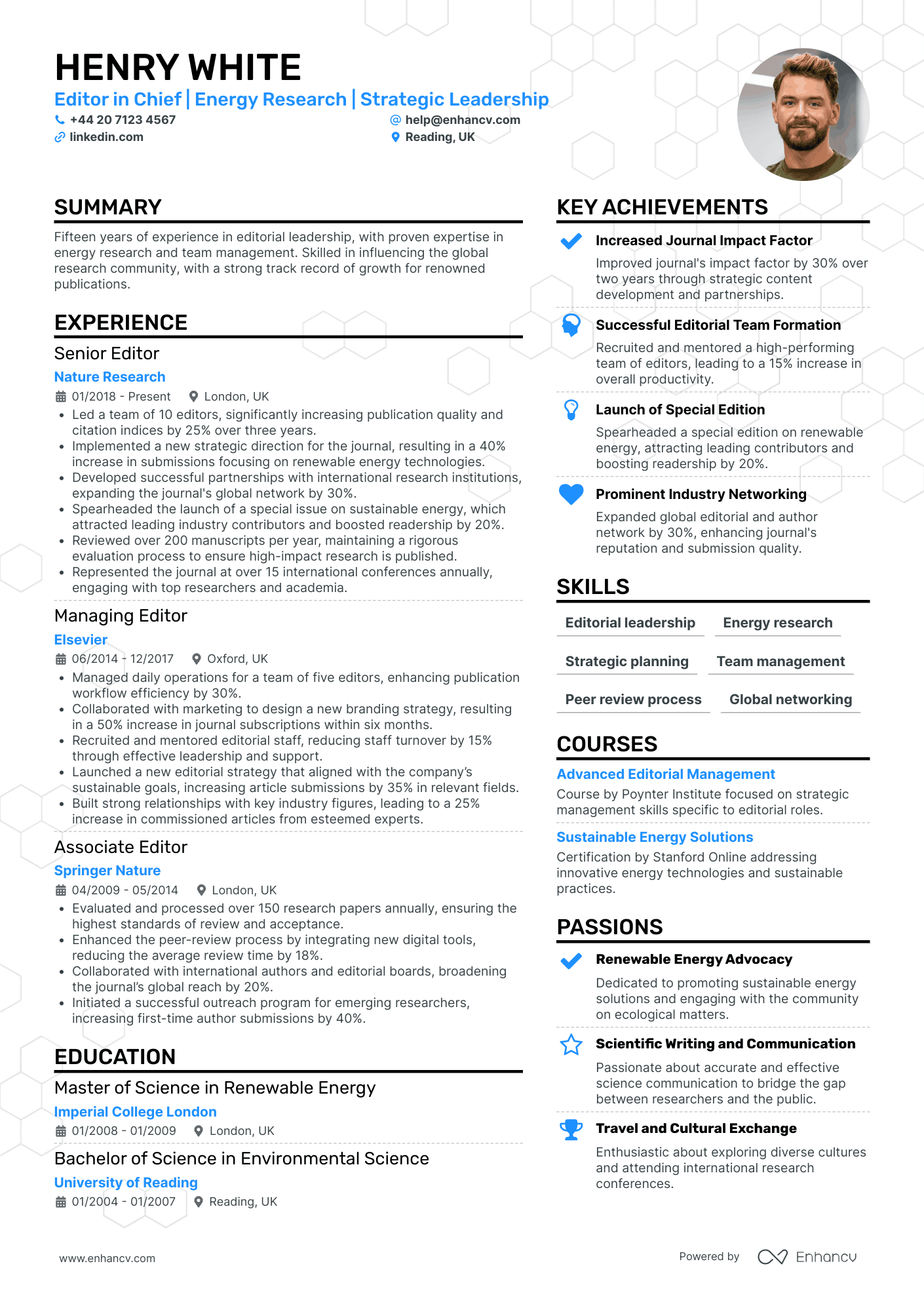
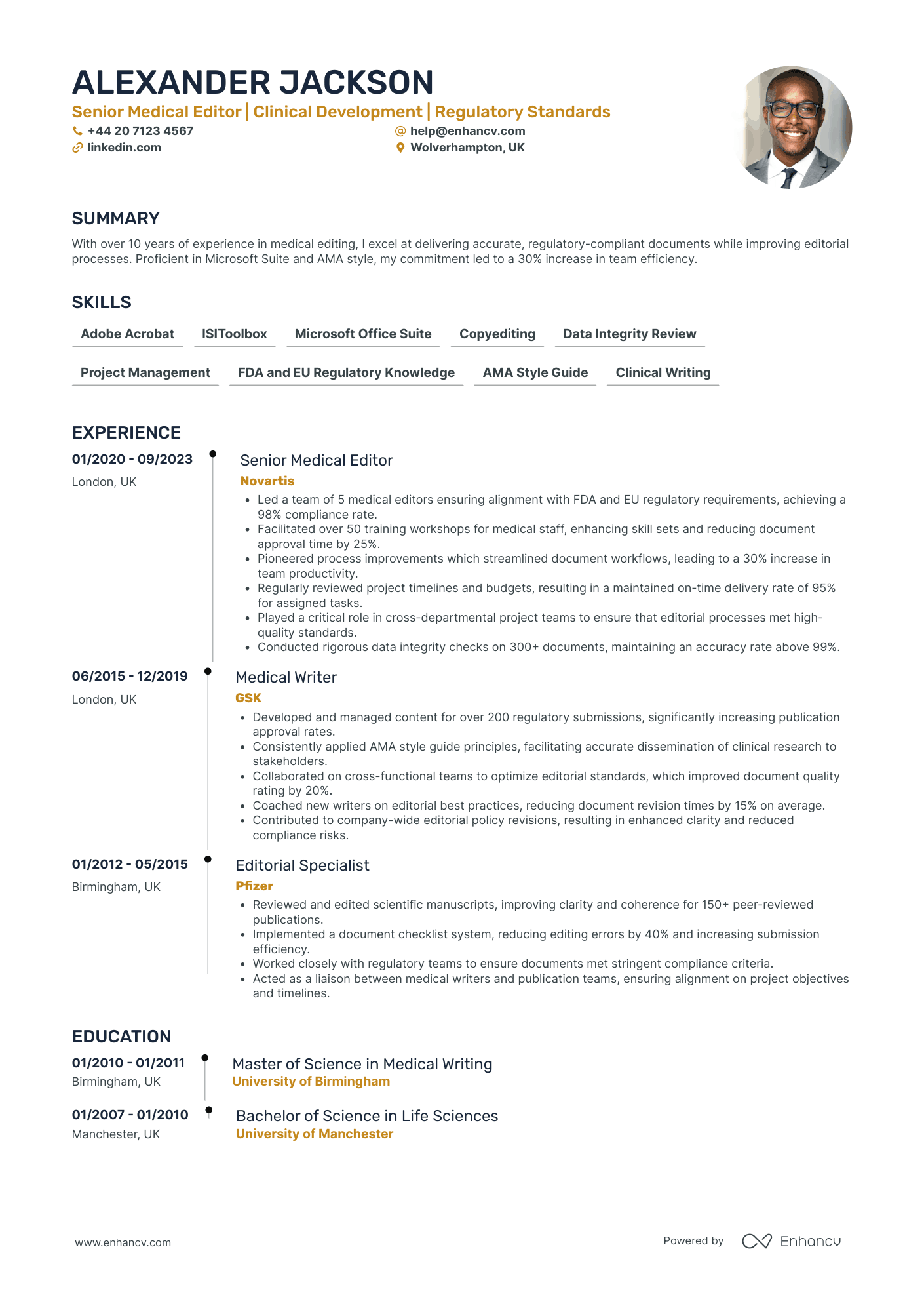
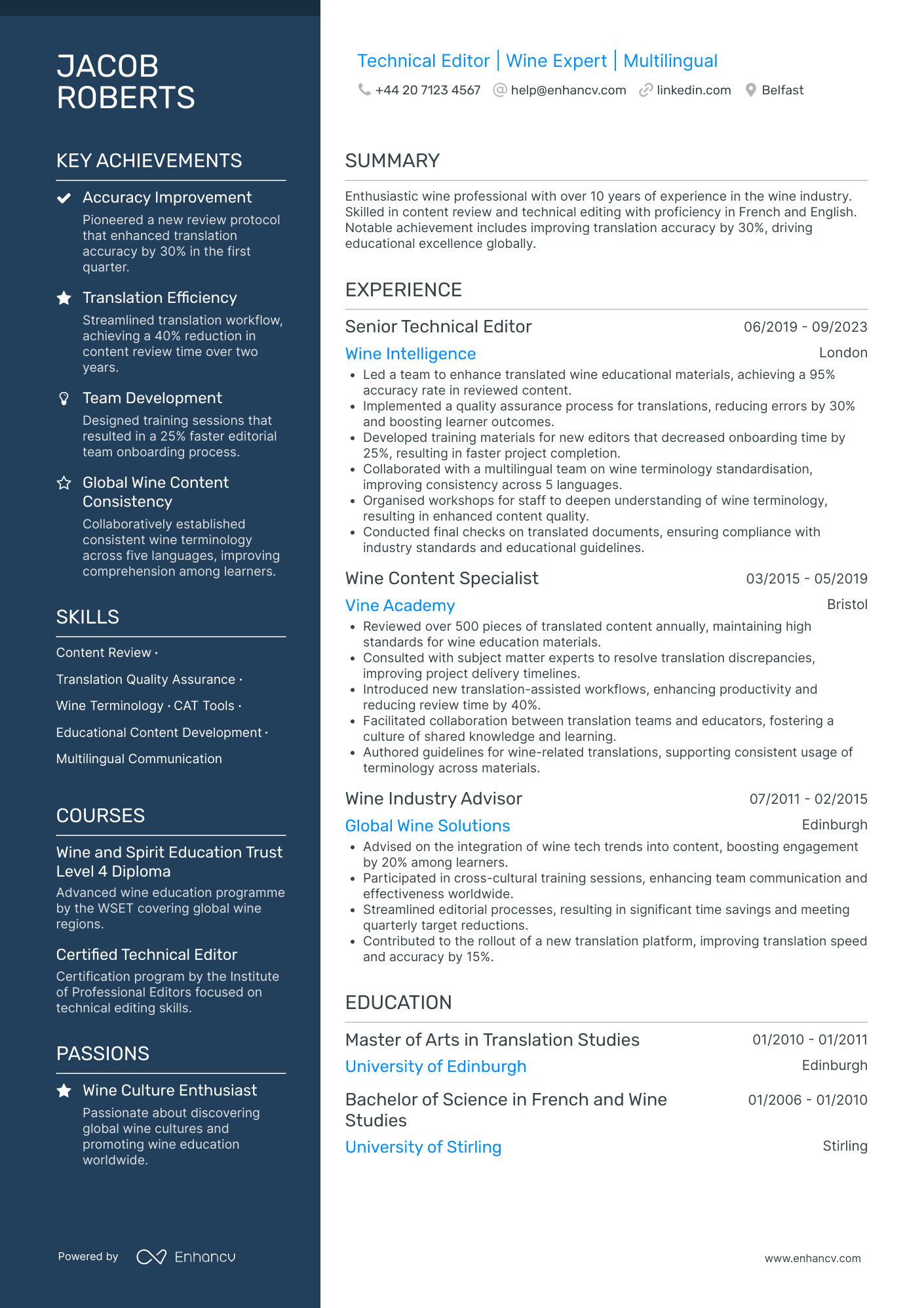
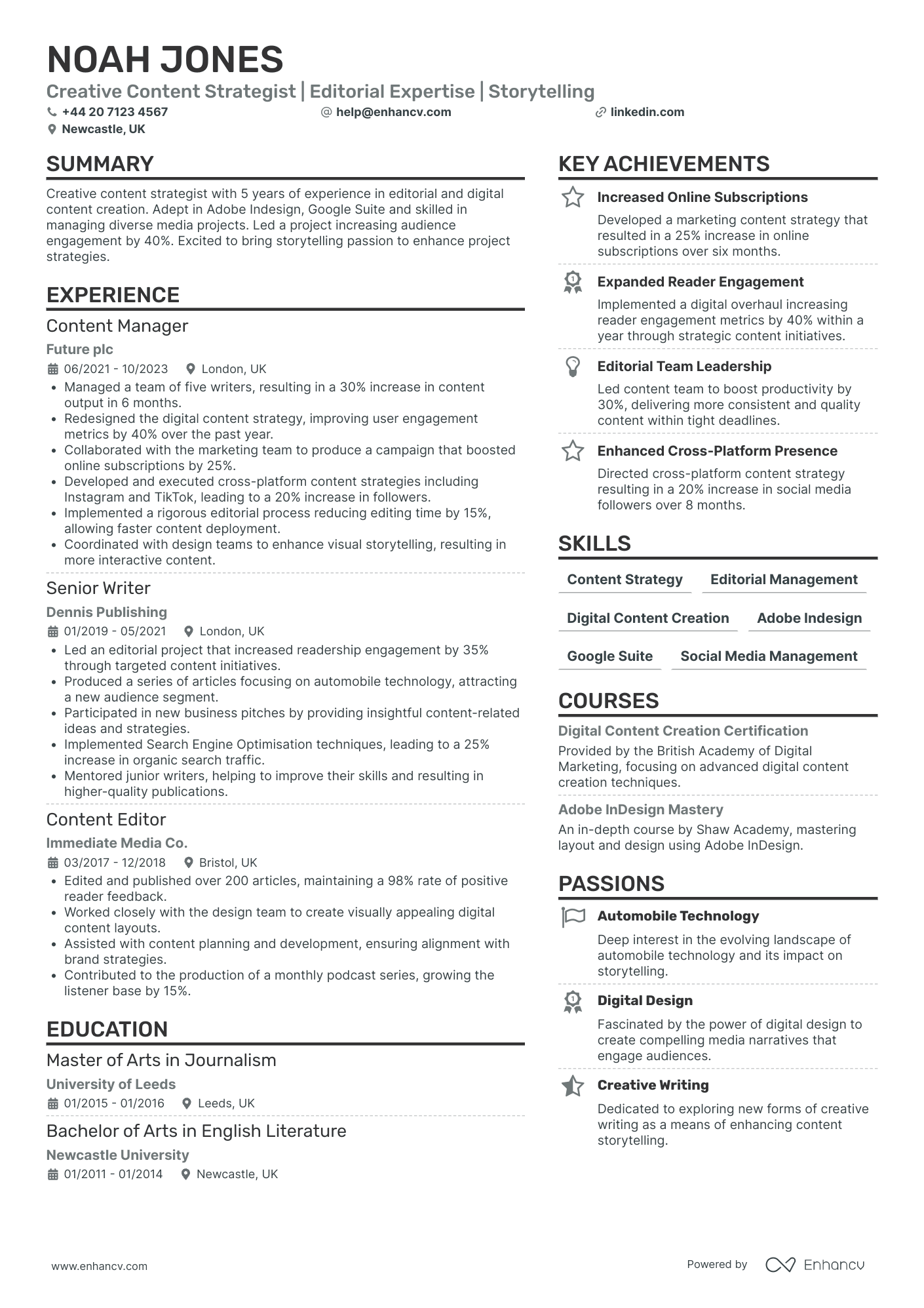
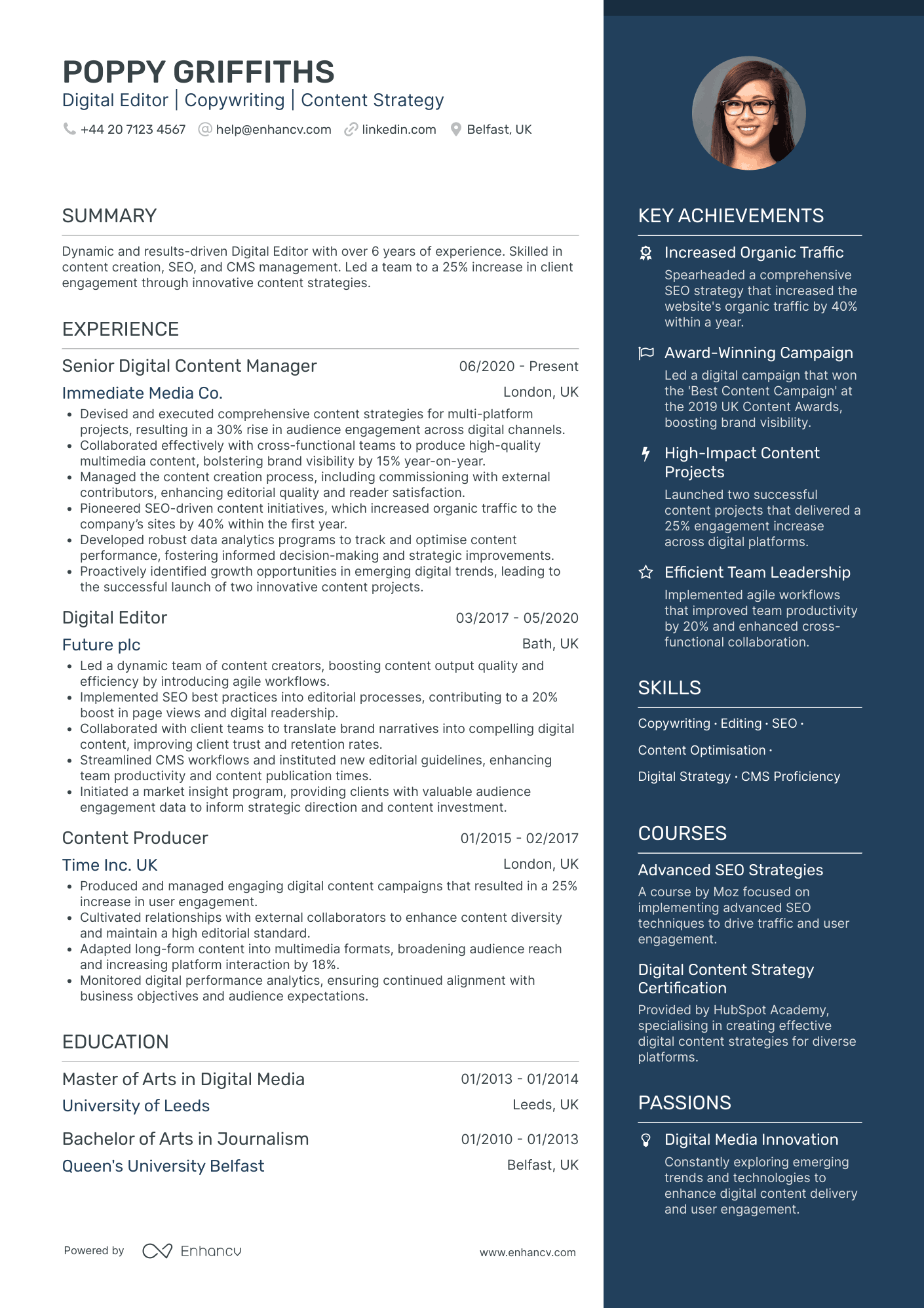
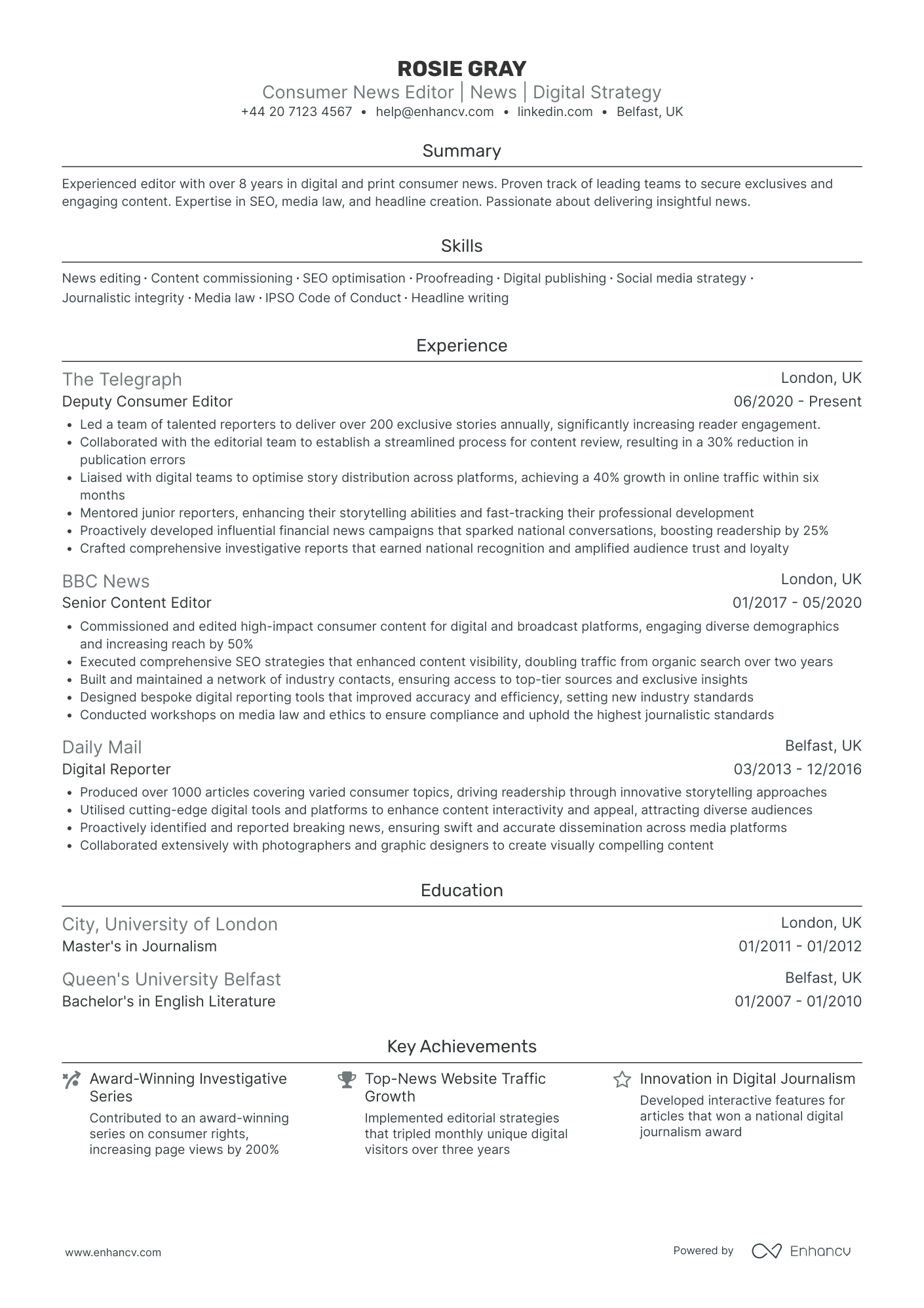
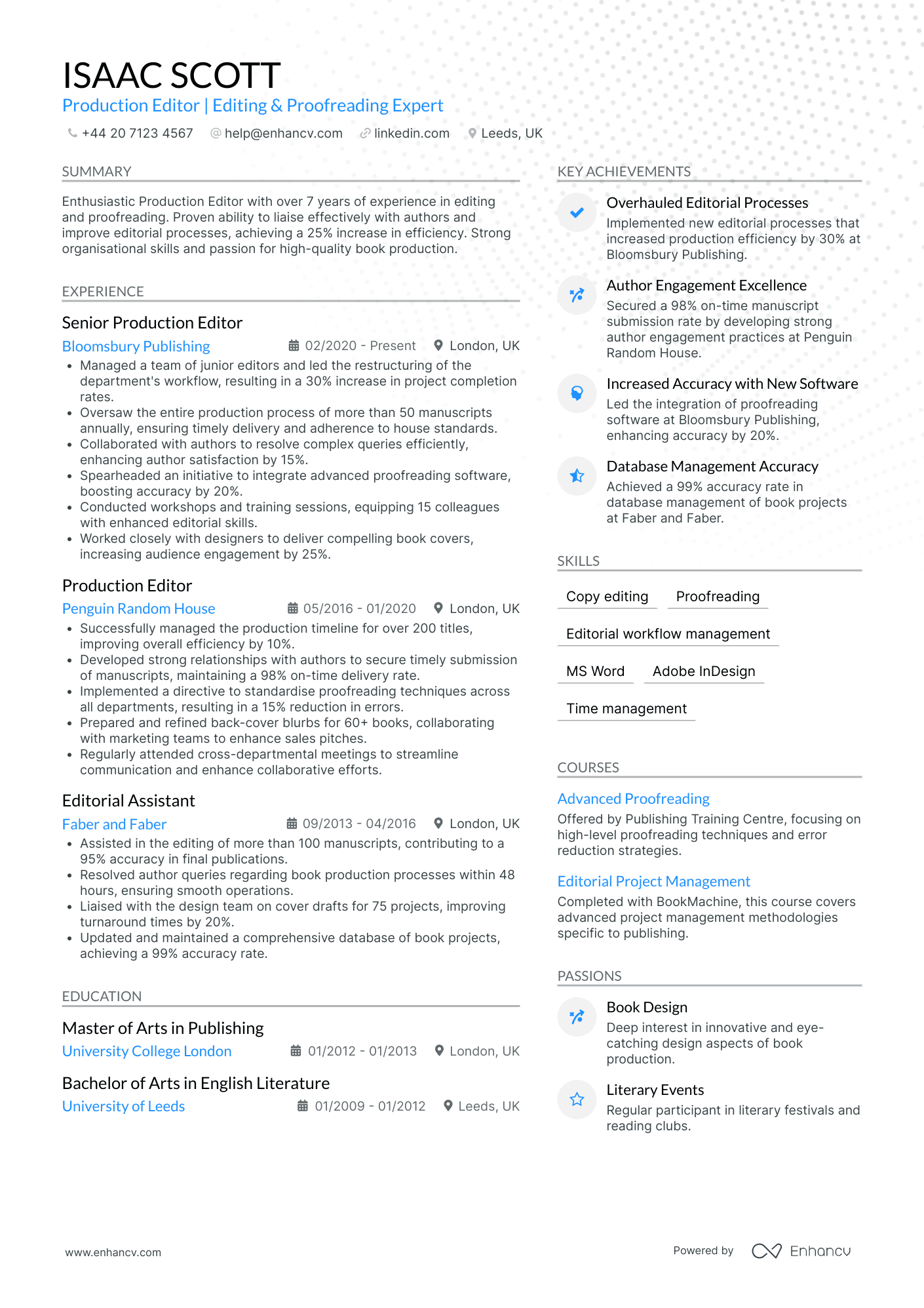
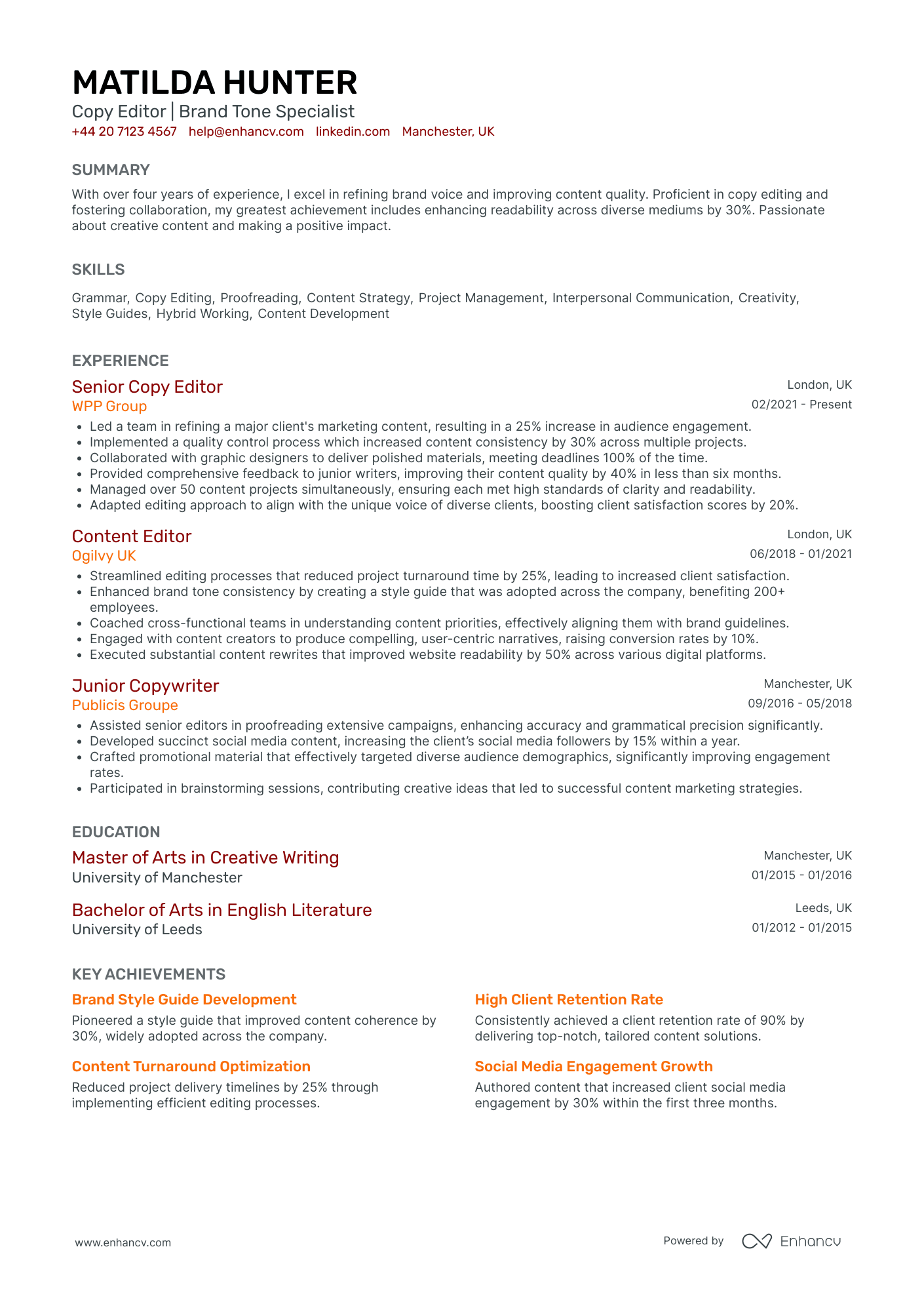
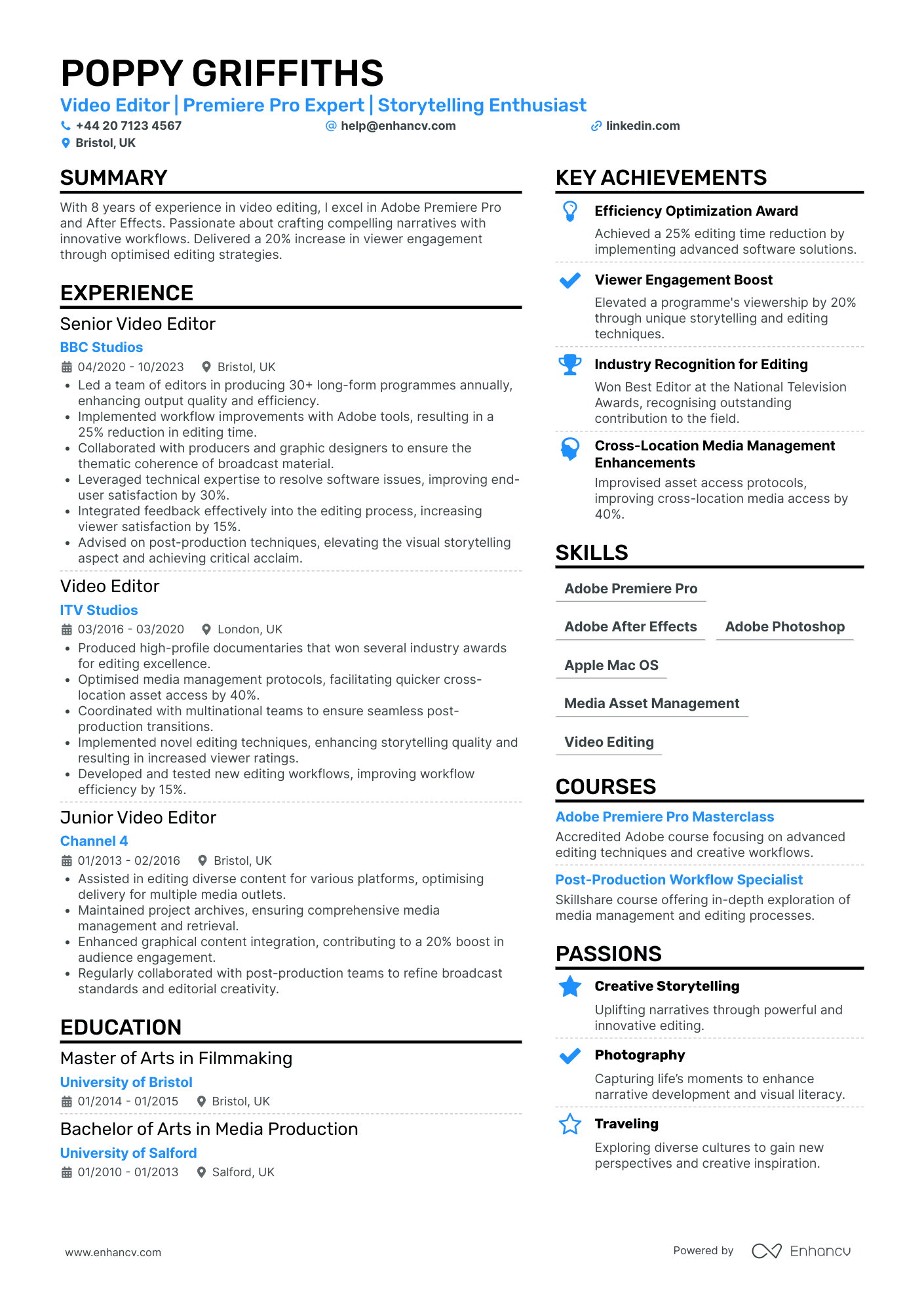
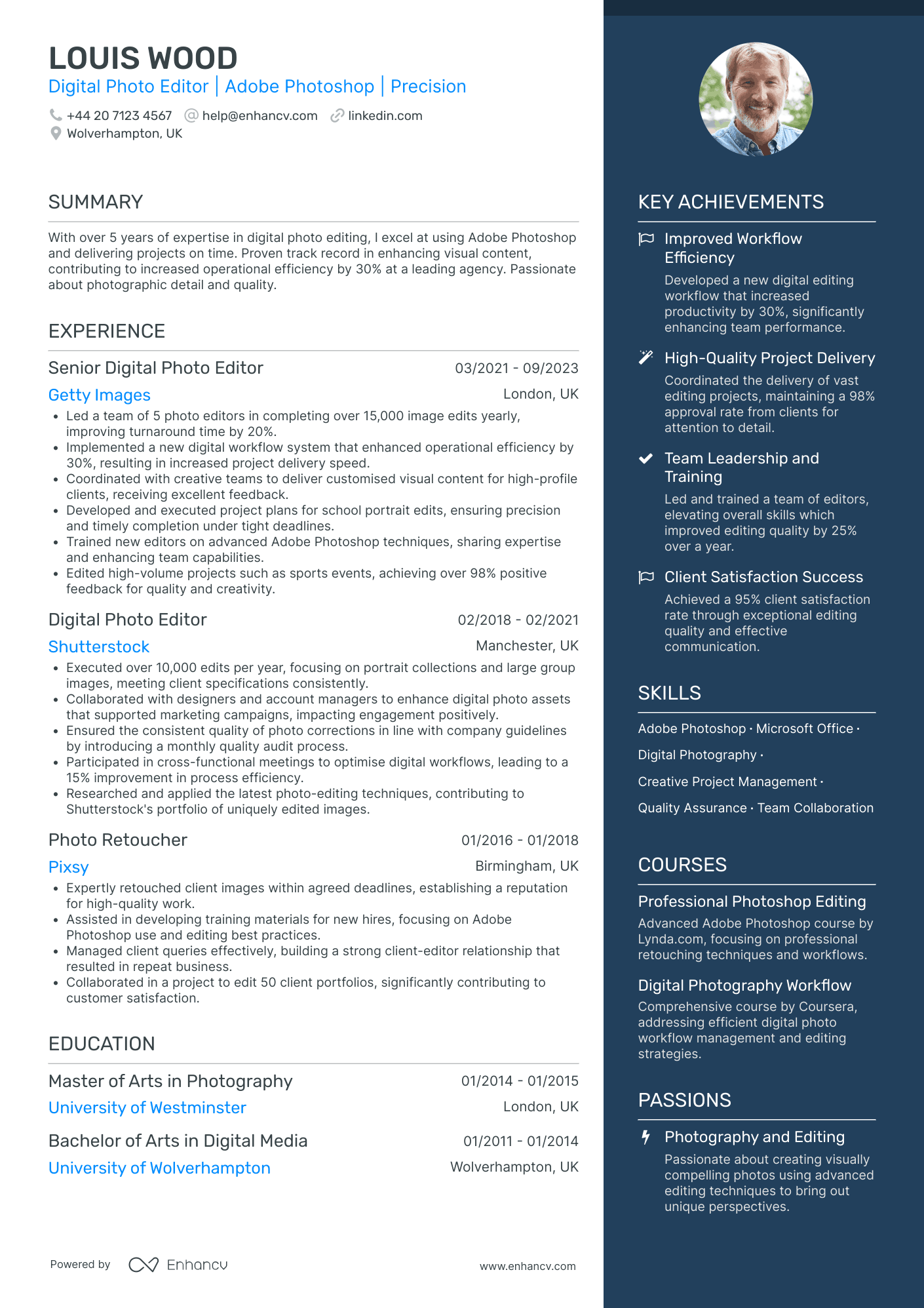
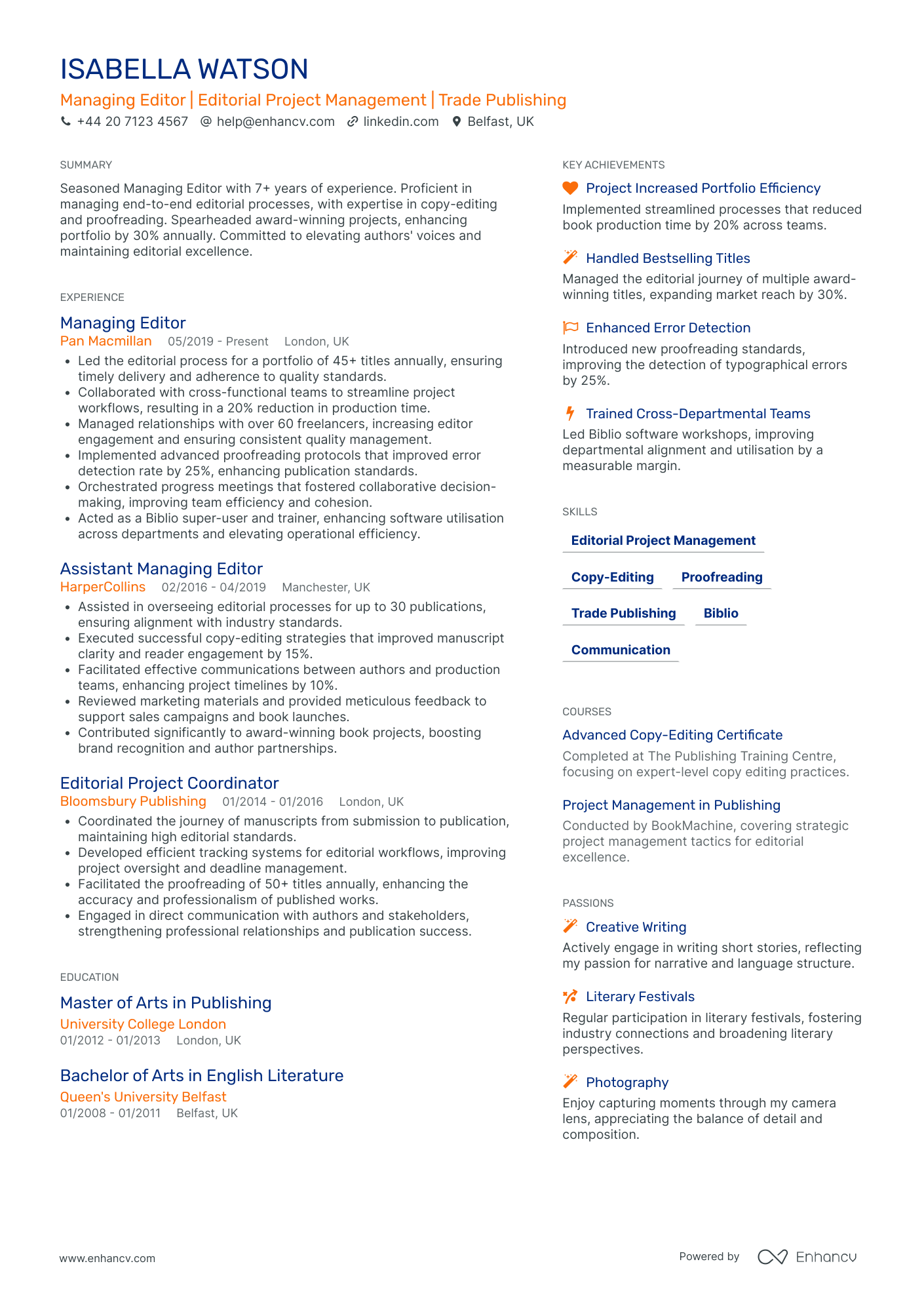
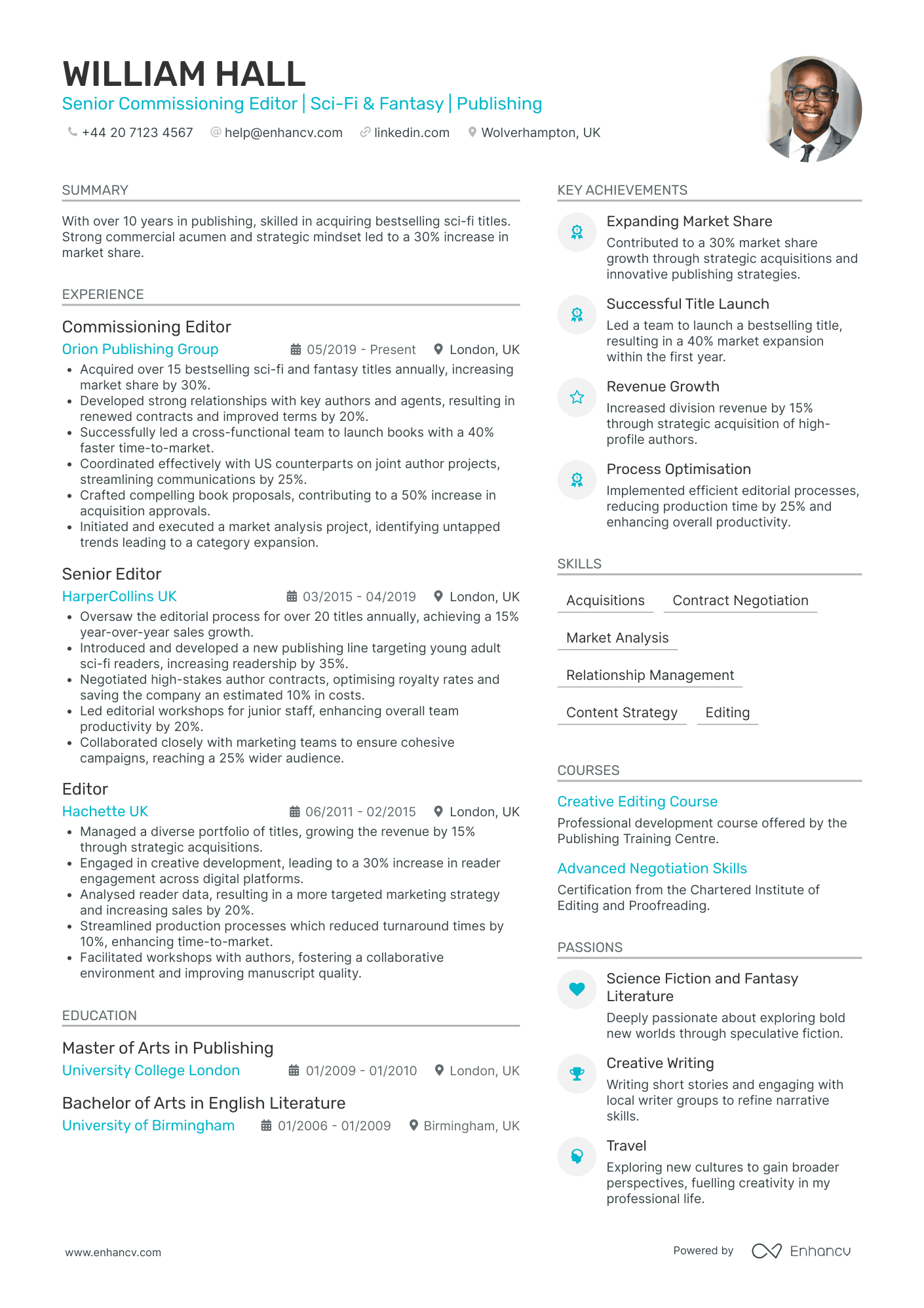
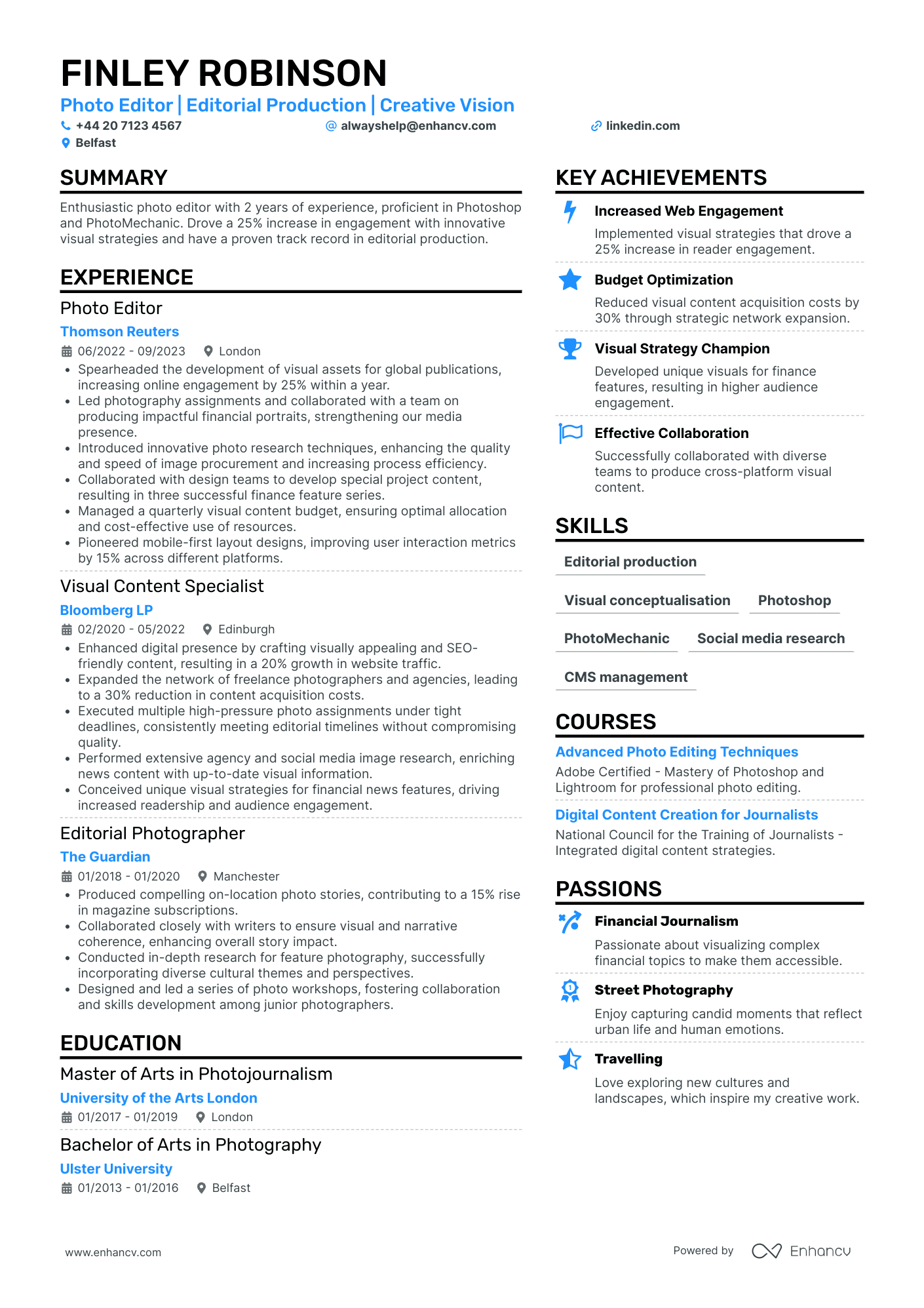
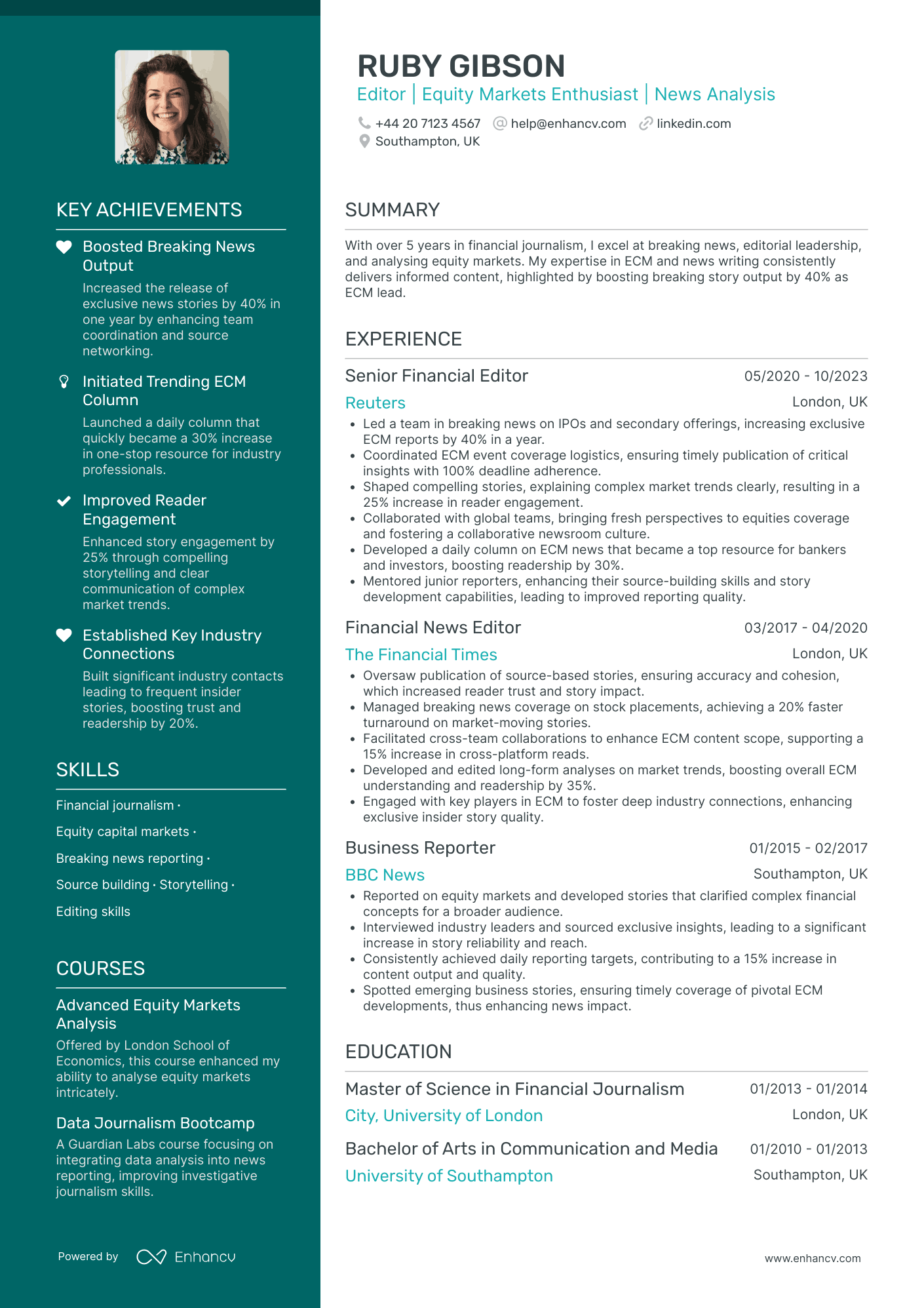
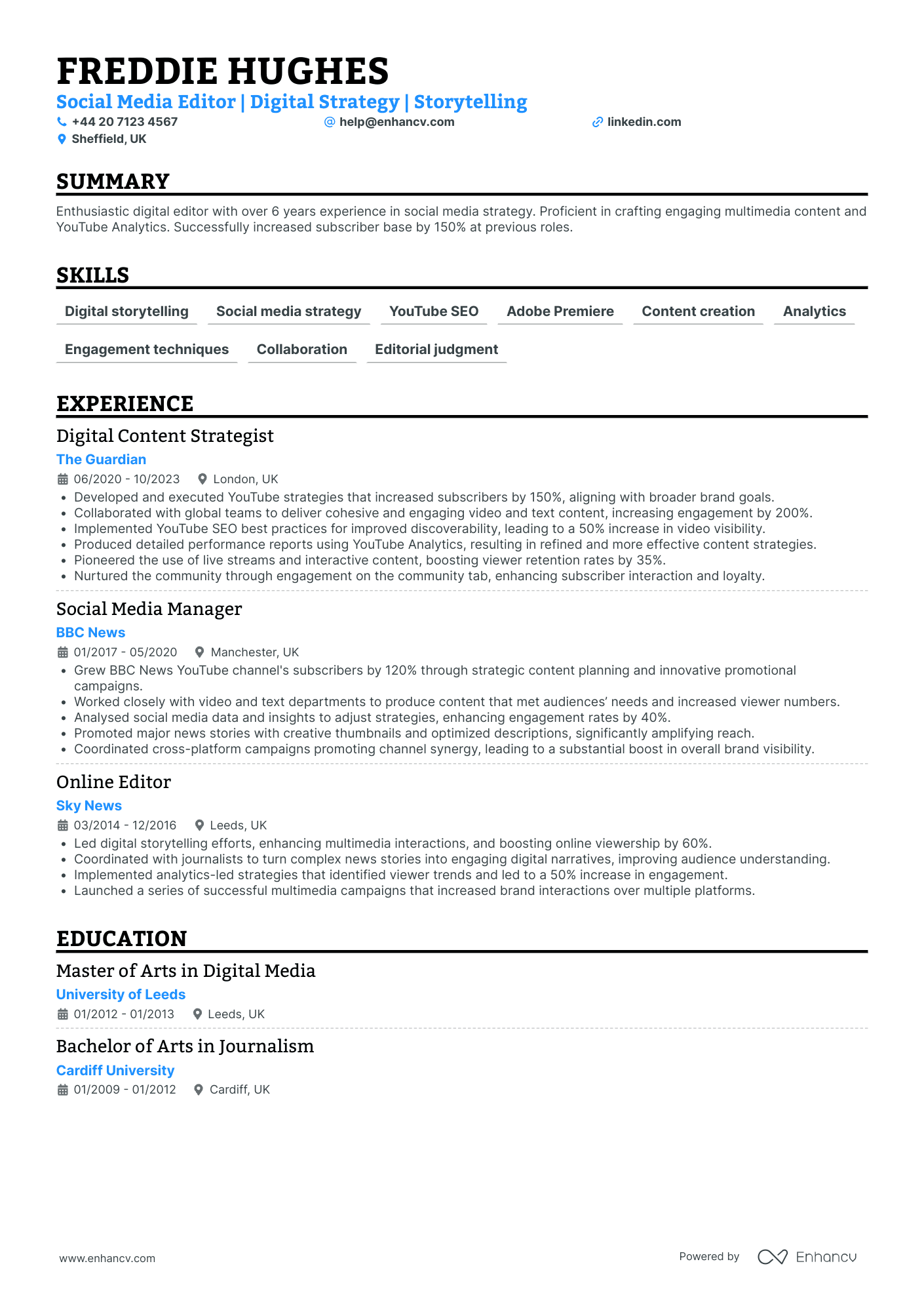
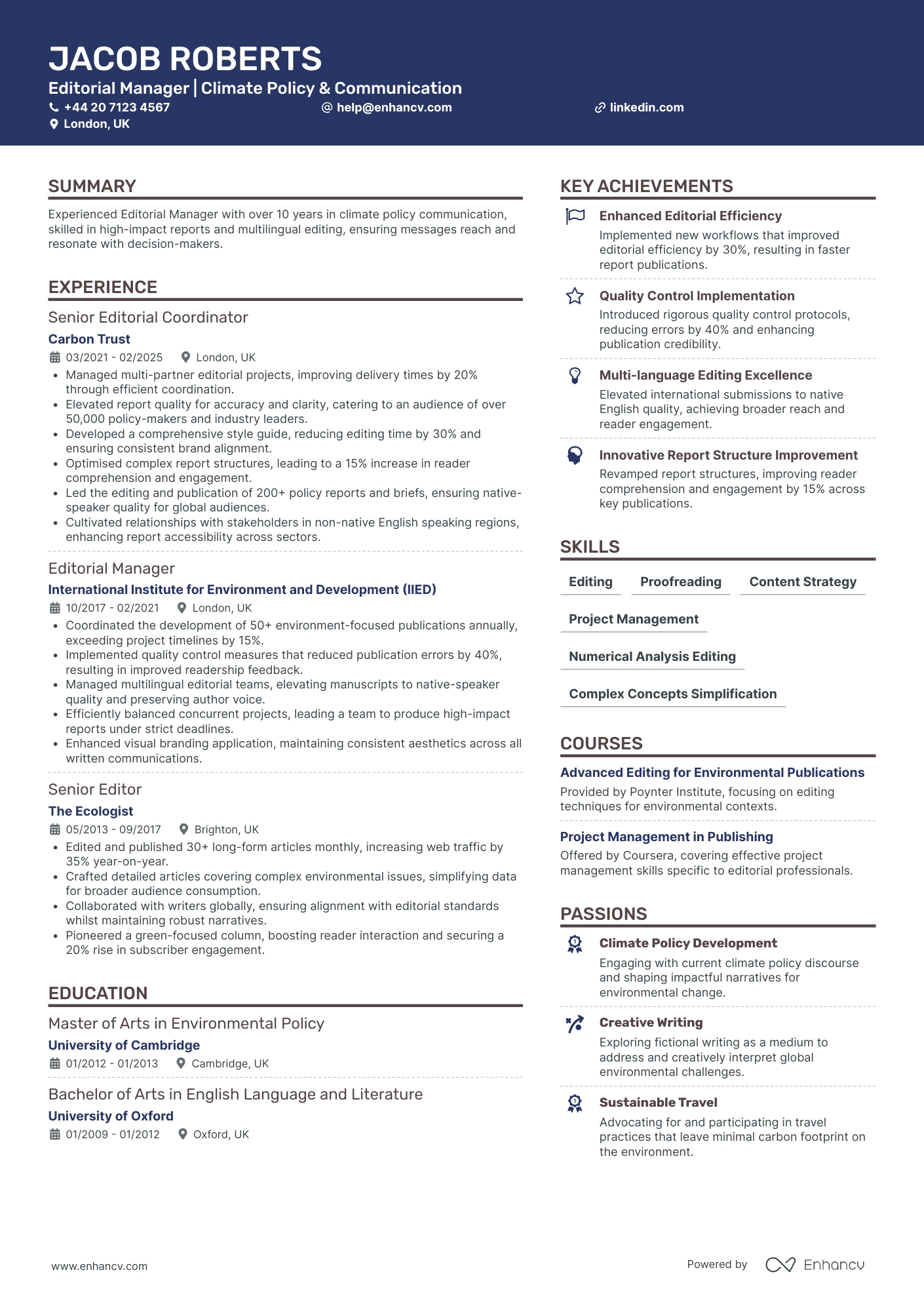
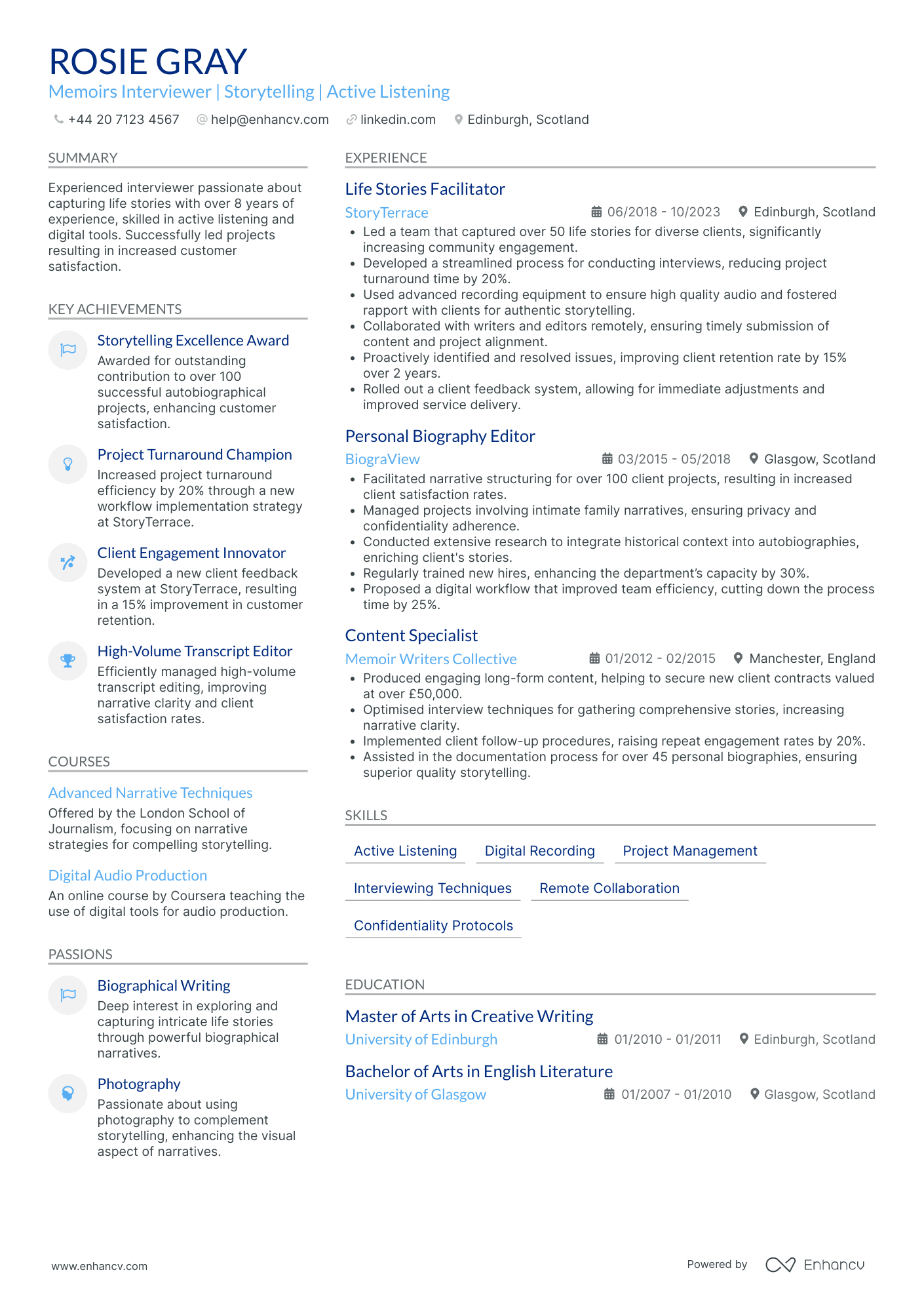
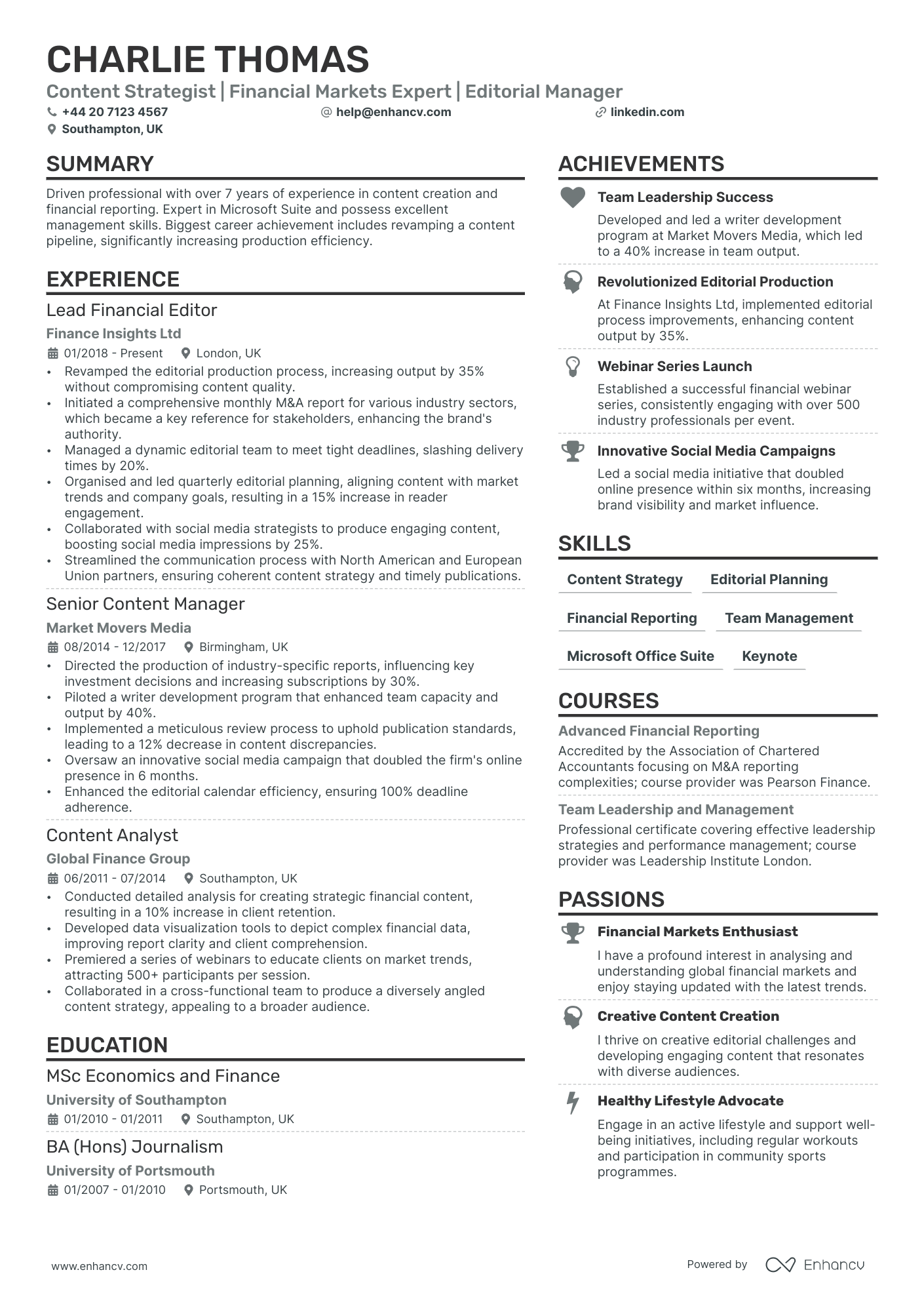
"Editor" is one job title stretched across half a dozen crafts. A video editor, a photo editor, and a content editor share the word and almost nothing else on the page.
The CVs that get shortlisted name the specialism in the first line and back it with work a recruiter can watch or read. The ones that stall hide behind "creative professional" and leave the reader guessing. Decide which editor you are first, then write the CV around it.

Key takeaways
- Lead with your specialism. Video editor, photo editor, or content editor belongs in your CV headline, not buried in the profile.
- Put a working portfolio or showreel link in the header. For an editor, the work is the argument.
- UK editor roles split fairly evenly between hybrid and on-site, so state your location and whether you can travel.
- Mirror the tools and skills the advert names, from Premiere Pro and After Effects to content strategy and SEO.
- Quantify output. Videos shipped, turnaround time, views, and engagement are your achievements.
- Two pages, reverse chronological, sent as a PDF unless the advert asks for a Word file.
Tailoring your editor CV to your specialism
Start by naming the craft. A recruiter hiring a video editor is not the same person hiring a sub-editor for a magazine, and a CV that tries to serve both serves neither.
Put the specialism in your CV headline and echo it in the first line of your personal statement. "Video editor with six years in branded social content" tells the reader what they are looking at before they reach your experience.
The three tracks that dominate UK editor adverts each ask for a different core:
- Video editor. Premiere Pro and After Effects, pacing and sound design, and a showreel that proves you can cut to a brief. Motion graphics and colour grading are frequent extras.
- Photo editor. Retouching and colour work in Photoshop and Lightroom, plus the judgement to select and sequence images. Some roles lean editorial, others product or ecommerce.
- Content or copy editor. Editing for accuracy and house style, content strategy, and increasingly SEO. Here the portfolio is published pieces, not a reel.
Read the advert and mirror its language exactly. If it says "Premiere Pro", do not write "video editing software". If it says "sub-editing", do not write "proofreading". Those exact words are how both the reader and the applicant tracking software match you to the role.
The overlap is real, and it is a trap. A photo editor who also cuts video is genuinely useful, but a CV that lists everything reads as a generalist for hire. Lead with the one craft the advert wants, then let the rest sit lower as range.
Evidence beats adjectives at every level. A video editor proves pacing with a reel, a photo editor proves an eye with a sequenced set, and a content editor proves judgement with published, bylined work. Whatever you claim in the profile, the reader should be able to click through and see it inside two moves.
The specialism also decides the shape of your experience section. A video editor lists projects and formats, a photo editor lists shoots and titles, and a content editor lists publications and the metrics the pieces moved. Match the structure to the craft, and the CV stops reading like a template with your name dropped in.

PRO TIP
One CV cannot chase every editor role. Keep a master version, then cut a video-editor CV and a photo-editor CV from it, each leading with the tools and samples that suit the advert in front of you.
What the UK editor market looks like
Knowing where the roles sit and what they ask for shapes what you put near the top of the CV.
| What | UK editor roles |
|---|---|
| Where the work happens | Split fairly evenly between hybrid and on-site, with remote-only roles rare (across 99 UK editor postings in the last ~30 days, Enhancv's internal job feed) |
| Experience level asked for | Mostly mid-level, then lead and senior, with entry-level roles in the minority |
| Most-listed skills | Project management, SEO, and content strategy recur most often, with After Effects, storytelling, and Premiere Pro close behind |
Two of those signals should change your CV today.
Editor work is split fairly evenly between hybrid and on-site, and remote-only roles are scarce, so a recruiter needs to see you can reach the studio or newsroom. Put your town in the header and mention whether you can travel.
Most openings are pitched at mid-level, which rewards a CV that shows progression and range rather than a long list of tools. Lead with the projects that prove you can own an edit from brief to delivery.
The skills mix is worth reading closely too. Project management, SEO, and content strategy sitting at the top, alongside the craft tools, tells you employers want editors who can run a workflow and think about reach, not only sit at the timeline. A CV that shows you plan, deliver, and measure your work speaks directly to that.
Building your editor portfolio and showreel
For an editor, the portfolio is the CV's evidence. A recruiter will click before they read your bullet points, so the link has to work and land on your strongest three minutes.
Put one clean URL in the header, next to your email. A personal domain, or a Vimeo, Behance, or YouTube page, reads better than a raw file share. Test it on a phone before you send, because that is often where it gets opened.
Curate hard. A 90-second showreel of your sharpest cuts beats a folder of everything you have touched. For a photo editor, 10 to 15 finished images with a line on your role beats 60 unlabelled files.
Caption each piece with the brief, your specific contribution, and the tools. "Edited and graded a 30-second spot for a national retailer in Premiere Pro and DaVinci Resolve" tells the recruiter exactly what you delivered.
Order the reel by strength, not by date. The opening shots decide whether anyone watches the rest, so put your sharpest cut first and cut anything that makes you explain yourself. If a client asked you to keep work private, describe it in a caption rather than linking it, and never post anything under embargo.
Freelancers can carry this further. A tidy landing page with your specialism, three or four case studies, and a contact line often does more work than the CV itself, and it gives agencies something to forward internally. Keep the CV and the site telling the same story so nothing contradicts.
Formatting your editor CV
Use a reverse chronological layout once you have a few roles behind you, with the portfolio link and specialism up top. A skills-based CV only makes sense if you are switching into editing from a neighbouring craft.
Keep it to two pages, one column, standard headings, and a readable font. The showreel carries the visual flair, so the CV itself should be clean and fast to skim.
Send a PDF for direct applications so the layout holds, and keep a Word copy for agencies that reformat CVs into their own template. If the advert names a file type, follow it.
Editor applications often pass through tracking software, so keep the structure simple for an ATS-friendly CV and let the portfolio do the showing off. Build from a tested layout rather than a blank page, since Enhancv's CV templates export to a clean PDF.
Is your resume good enough?
Drop your CV here or choose a file. PDF & DOCX only. Max 2MB file size.
Writing your editor personal statement
Three or four sentences at the top: the editor you are, your strongest tools, the kind of work you cut or shape, and one result. See more personal statement examples if the opening line will not come.
Skip the adjective soup. "Creative, passionate, detail-oriented" is on every other CV and tells a recruiter nothing they can check.
Lead with evidence instead:
Editor CV personal statement example (video)
Video editor with five years cutting branded and social content for agencies and in-house teams. Fluent in Premiere Pro, After Effects, and DaVinci Resolve, with a reel spanning short-form ads, YouTube series, and event films. Cut more than 200 videos last year on tight turnarounds, and looking to bring that pace to a fast-moving content team in Manchester.
Editor CV personal statement example (photo)
Photo editor with four years in editorial and ecommerce retouching, working across fashion and product shoots. Confident in Photoshop and Lightroom, from high-volume clipping and colour correction to fine beauty retouching, with a portfolio covering two national magazine titles. Known for a fast, consistent turnaround on large sets, and looking to bring that eye to a busy studio in London.
Editor CV personal statement to avoid
Passionate and creative editor with a keen eye for detail and a love of storytelling. Seeking a challenging role in a dynamic company where I can grow my skills and contribute to exciting projects.
The first names the tools, the volume, and the location. The second could belong to any applicant in any field, which is exactly why a recruiter skims past it.
When I read an editor's CV, I skim the words and click the reel. If the link is dead or buried, the application is already losing. Put one working portfolio URL in the header, lead with the specialism, and let the first thirty seconds of your best work make the case the bullet points cannot. Tools and turnaround times matter, but the edit itself is the interview.
Writing your editor experience section
Lead each bullet with a verb and end it with a result. "Edited", "graded", "sub-edited", and "sequenced" beat "responsible for". For the mechanics, see work experience on a CV.
Editing is measurable even when it feels purely creative. Videos shipped, turnaround time, publish cadence, views, watch-through, and engagement are your achievements, so pull the numbers from your analytics.
Mirror the advert's duties where they are true of you, and name the tools inside the bullet where you used them rather than only in a separate skills list.
Show ownership, not just tasks. "Edited" is a task, but "owned the edit from rushes to final delivery" tells a hiring manager you can be handed a project and trusted with it. For mid-level roles, which is where most UK editor adverts sit, that sense of ownership is often what separates two similar CVs.
- Cut and delivered more than 200 short-form videos a year for retail and tech clients, holding a 48-hour turnaround across the team
- Built a library of After Effects motion templates that reduced average edit time per video by a third
- Graded and finished a national campaign spot in DaVinci Resolve that reached 1.2 million views in its first month
- Mentored two junior editors and set the studio's export and file-naming standards
PRO TIP
Recruiters scan for the tools they named in the advert. If you have edited in Premiere Pro, After Effects, Lightroom, or DaVinci Resolve, write them exactly as the advert does, inside the bullet where you used them, not only in a separate skills box.
Skills to put on an editor CV
Across UK editor adverts, the same demands repeat, and they mix craft with strategy. Project management, SEO, and content strategy come up most often, with After Effects, storytelling, Premiere Pro, and social media close behind.
List the hard skills in the words the adverts use, and only the ones you can stand behind in an interview. A tool on your CV is an invitation to be tested on it.
The soft skills that matter here are the ones a busy team feels every week: meeting deadlines, taking feedback without ego, and communicating clearly across a project. Prove each in a bullet rather than just claiming it.
Group the list so it reads at a glance. Keep software in one cluster, craft skills such as colour grading and motion graphics in another, and workflow skills like project management and content strategy in a third. A recruiter scanning for a specific tool should find it in seconds.
Top skills for your editor CV:
Premiere Pro
After Effects
DaVinci Resolve
Photoshop
Lightroom
Colour grading
Motion graphics
Content strategy
SEO
Project management
Social media
Storytelling
Attention to detail
Deadline management
Collaboration
Taking feedback
Education, certifications, and the freelance route
Editing is a portfolio-first field, so a degree is useful but rarely the deciding factor. If you hold one in film, journalism, media, or design, list it briefly in your education section and move on.
Short, named training carries weight when it maps to the tools. Adobe Certified Professional credentials, a colour-grading course, or a recognised sub-editing qualification are worth a line under certifications. Put them where the reader can see they are current.
Many UK editor roles are freelance or contract, and a freelance CV reads a little differently. Group your work under one "Freelance Editor" heading with the standout clients and projects as bullets, rather than a scattered entry for every gig. If you are early on with no paid credits yet, treat student films, volunteer edits, and spec work as real entries with dates, tools, and outcomes.
Conclusion
Name your specialism, lead with a portfolio a recruiter can watch or read, and quantify what your edits achieved.
Keep the CV clean and let the work carry the flair, and you give a busy hiring team every reason to press play. Pair it with a short cover letter that says why this role, and the application is complete.

Author's take - The Enhancv team
When I read an editor's CV, I skim the words and click the reel. If the link is dead or buried, the application is already losing. Put one working portfolio URL in the header, lead with the specialism, and let the first thirty seconds of your best work make the case the bullet points cannot. Tools and turnaround times matter, but the edit itself is the interview.