
Looking to land your first civilian job after leaving the Army? Competition is tough. Political uncertainty, economic instability, and rising living costs have made employers more cautious about hiring. This means a well-crafted military-to-civilian CV is essential if you want to stand out.
Fortunately, you’re in the right place. In this guide, we’ll walk you through how to create an Army leaver CV that wins over even the most discerning hiring managers. You’ll also find British Army CV examples, including one for candidates who are applying to join the Forces.

Key takeaways
- There are two types of British Army CVs: military-to-civilian CVs and CVs to apply to the Army.
- For your ex-militaryCV, translate all ranks, acronyms, and jargon into plain language, so hiring managers from all industries can understand you.
- Choose a CV format based on your career path: reverse-chronological for consistent service, skills-based for varied experience.
- Lead with civilian job title equivalents and put military rank in brackets for reference checks.
- When building a CV to join the Army, focus on fitness achievements, teamwork examples, discipline, and reliability. These are the core values the Army assesses.
- Never share sensitive military information, but do provide enough specific detail to prove your claims.
- Use Enhancv’s tried and tested CV templates to create an ATS-ready application that improves your odds of landing an interview.
If you already have a CV, find out how it measures up. Upload it to Enhancv’s CV Checker below:
Is your CV good enough?
Drop your CV here or choose a file. PDF & DOCX only. Max 2MB file size.
First up, let’s talk about exactly what we mean when we talk about a British Army CV.
What is a British Army CV?
The term “British Army CV” can be used in two cases: either when you’re leaving the Army and looking for a job, or when you’re looking to join the British Armed Forces. In this guide, we’re going to be taking a look at both.
Look at how to approach each.
- If you’re leaving the Army and looking for a new career, you’ll need to write a military-to-civilian CV. This document should cover the transferable skills you honed during your years of service and clearly outline how your experience aligns with a civilian role.
- On the other hand, if you’re looking to join the army, you need a CV that showcases your suitability for the Forces. Note that you don’t need a CV for all positions in the Forces. However, if you want to serve as a Professionally Qualified Officer, you may do.
In both cases, you need to tailor your CV to meet the hiring demands and understand how to best position yourself.
First up, let’s deal with writing a military-to-civilian CV. These applications often fall short of the mark, but there are simple tweaks you can make to change that.
Why most Army CVs fall short
When writing a British Army CV, positioning is everything. Many military leavers struggle to describe their experience in clear, civilian-friendly language.
First up, you need to make sure you avoid these pitfalls.

Pitfalls when writing your Army-leaver CV
- Too much military jargon: Whether you’re applying to a civilian role or the Forces, ditch the jargon. You can’t be sure that the person reading your CV will be familiar with terms and acronyms. Instead, write in plain, approachable English.
- Underselling leadership and responsibility: If you’ve held positions of leadership, that is immensely valuable to the hiring manager. Avoid underselling these roles and be clear about the impact you had. Wherever possible, add metrics and evidence to support the statements you make.
- Failing to translate into civilian job language: When you’re applying for a traditional role after leaving the Army, it’s essential to phrase your duties in a way recruiters immediately understand.
- Layouts not suited for ATS scans: Applicant tracking systems (ATS) are a type of software that sorts and sometimes ranks incoming CVs. Many modern employers use this system, so it’s smart to optimise your application accordingly. Using a clear layout with headings is a great place to start.
Now that you’ve seen how not to write your CV, let’s focus on how to write a British Army CV that attracts recruiters.
How to write a British Army CV when leaving the Forces
Switching careers from a military role to a civilian job is not without its challenges, but that doesn’t mean it’s impossible. The workplace skills and experiences you gained during your service are invaluable. But you need to translate that to a whole new audience.
Follow the steps below to get started on your military to civilian CV:
Step 1: Understand how civilian employers read military experience
Let’s kick things off by getting into the mindset of typical hiring managers. Unless they’ve worked in the Forces (which is unlikely), they won’t understand rank structures, unit names, or acronyms. That means that simply listing these details won’t do much for your chances.
However, what hiring managers do care about is outcomes, leadership, teamwork, logistics, and safety. Highlighting them on your CV is a quick way to instantly boost your odds.

Use bullet points that are easy to understand
Rather than writing “Responsible for 30 pax across multiple exercises and ops,” make things clearer for the reader.
A better option would be to write “Trained and managed 30 soldiers over three years.”
Next up, let’s talk about how you can switch up your language for the average reader.
Step 2: Adapt your language to civilian recruiters’ expectations
Should you use military acronyms on your civilian CV? The short answer is no. Packing your application full of jargon is the fastest way to alienate the reader.
Luckily, you can get around this problem by rewording certain terms.
Turn your military rank into civilian equivalents. If you don’t know where to start, check out the below:
Military ranks and their civilian translation
| Army title | Civilian title |
|---|---|
| Trooper | Vehicle operator or plant operative |
| Private | Operative or security officer |
| Gunner | Technical operator |
| Signaller | Network engineer |
| Kingsman | Security officer |
| Rifleman | Operative |
| Sapper | Construction worker, electrician, or plumber |
| Lance corporal | Lead operative |
| Signals | Communication or IT support |
| Corporal | Team leader |
| Section Commander | Supervisor |
| Sergeant | Senior supervisor |
| Colour Sergeant | Operations manager |
| Corps Sergeant Major | Senior operations manager |
| Academy Sergeant Major | Chief training officer |
Now, check out how you can use those translations in your CV.
In your personal statement section, you can simply write the civilian term. You may also add details about what the role entailed here. For example, write something like:
"Senior Operations Manager responsible for standards, discipline, and welfare across a 120-person organisation. Broad experience in inventory control, warehouse operations, team leadership, and health and safety compliance. Holds a current counterbalance license, HGV class 2 license, and SC clearance. Track record of running high-pressure logistics environments and leading large-scale teams.”
When listing your job title in your work experience section, lead with the civilian translation and add your military rank in brackets afterward. For example, you can write “Senior Operations Manager (Corps Sergeant Major)” as a full title.
The civilian translation immediately tells the hiring manager what you did. They’ll be familiar with the role of a Senior Operations Manager. And the military rank in brackets matches any background checks or references you give as part of the application process.
While you’re familiar with phrases like “conducting recces” and “MATT training,” the hiring manager won’t be. Put these tasks and skills into plain English so they understand them.
Here’s how:
Military terms vs their civilian translation
| Term | Civilian translation |
|---|---|
| Training recruits | Training new employees |
| Mentoring JNCOs | People development |
| Conducting MATT training | Delivering mandatory compliance training |
| Running cadres | Running certification courses |
| Writing TACOMs | Developing training policies |
| Conducting recces | Site surveys |
| Writing OPORDERs / FRAGOs | Writing operational briefs |
| Maintaining situational awareness | Monitoring operations |
| Conducting SJARs | Performance reviews |
| Handling AGAI 67 | Overseeing disciplinary procedures |
| Managing TRIM | Wellbeing management |
| Sending SITREPs | Status reports |
| Writing MILOBs | Formal correspondence |
Using these common industry terms will make your CV more ATS-friendly since most CVs are filtered based on keywords— ie, your skills, degrees, and certifications. Once you clear that first automated check, your CV lands in front of a hiring manager—and clear, traditional terminology improves your chances of getting noticed.
Below is a good example of how this can work in your experience section bullet points.
The above is written in plain English, which means that any hiring manager would understand it. Remove any jargon and replace it with simplified terms.
PRO TIP
If in doubt ask a friend or family member to review your British Army CV. They’ll be able to help you see the application through a civilian’s eyes. Have them highlight anything that doesn’t make sense to them. Simply any terms that are confusing to the average reader.
Now that you know what language civilian employers expect, here’s how to weave it naturally into your CV.
Step 3: Pick the right format for your ex-military CV
Choosing the right CV format is key when moving from military to civilian employment. The three formats used in the UK are reverse-chronological, skills-based, and combination (hybrid).
For most Army leavers, the reverse-chronological CV is the best option. It highlights your recent experience first, shows progression through your roles, and gives civilian employers a clear, easy-to-follow timeline of what you’ve done.
Why this format works best
- Civilian employers understand it immediately—no need to interpret Army structures.
- Shows progression clearly, which helps translate promotions and increased responsibility.
- Strong for ATS because it places job titles, dates, and achievements exactly where software expects them.
In some cases, a skills-based (functional) CV can work well too. It isn’t the most common format in the UK, but it places your transferable skills at the top and reduces the focus on job titles or dates. It’s particularly useful if you’re making a big career shift (say, infantry to marketing) or if your military experience doesn’t map neatly onto civilian roles.
As a rule of thumb: use a skills-based format when your skills tell a stronger story than your job titles.
Finally, the combination format well if you want to emphasise your skill set while still using a familiar, easy-to-scan structure. The key is making sure your strengths are written in a way any civilian employer can understand.
Step 4: Translate military skills into civilian language
The technical skills you developed in the Army are a huge asset, but only if you present them in language civilian employers recognise. These are your hard skills, and they belong in a dedicated skills section on your CV.
The key is to translate each one so it aligns with the terminology used in the jobs you’re targeting. Avoid military acronyms and rewrite every term using plain, industry-standard wording.
Look at some examples:
Common hard skills for Army CVs (with civilian translations)
- SAA qualified → Firearms handling and safety certification
- Force protection duties → Physical security and access control
- CBRN instructor → Hazardous materials awareness and safety training
- Cat C+E (military) → HGV Class 1 licence (Cat C+E) – full civilian conversion
- Signals operator → Radio communications and IT network support
- Combat medic → Emergency first aid, trauma response, and patient care support
- Stores accounting → Inventory management and stock control
- Vehicle mechanic (REME) → Automotive maintenance and repair technician
- Armourer → Mechanical engineering and equipment safety inspection
- Movements controller → Logistics coordination and transport planning
- Range conducting officer → Risk assessment and safety supervision
- Classified material handling → Secure document and data management
- Driver specialist → Advanced vehicle operation and route safety compliance
- Infantry section commander → Team leadership, training delivery, and operational planning
Taking the time to rewrite your skills is laborious, but it’s worth it. When a hiring manager glances at your skills section, they can quickly see how your talents match the role.
While these will make up the bulk of your skills section, there are two other types to be aware of:
Transferable skills
Transferable skills are abilities you can carry from one role or industry to another. Examples include soft skills like communication, time management, and organisation. During your time in the Forces, you’ll have picked up a selection of notable soft skills.
However, you don’t want to cram all of the above into your skills section. Only include these talents if they are specifically mentioned in the job advert or they are exceptional (for example, presenting to 500+ new recruits). Otherwise, you can weave them throughout the rest of your CV, making subtle references to them.
Role-specific skills
Including role-specific skills is vital to your success. Do this by reviewing the job advert and picking out keywords that are related to the job itself. Should you already have these in your roster, you’ll want to prioritise them within your skills section.
Avoid using too many synonyms. If the job advert says “Managing large teams” and you put “Overseeing recruits,” you could lose out. Match your language to that of the recruiter. This will help you get noticed while also upping your chances of ranking well in the ATS.
Let’s take a look at an example for a logistics team leader that includes the above:
If ATS results are a concern, Enhancv’s AI CV Builder can guide you through the process. The One-Click Job Tailoring feature helps you match your CV to the employer’s requirements with minimal effort.
Step 5: Include your top Army achievements
Chances are, you’ve racked up some impressive CV achievements in the Force. Conveying these to the reader is your next priority. You can include your standout moments in your work experience section. However, once again, make sure you rewrite any jargon in plain, everyday language.
Let’s take a look at some translated examples you can use for inspiration:
Military achievements vs their civilian translation
| Term | Civilian translation |
|---|---|
| Led 12 soldiers | Supervised a team of 12, ensuring 100% compliance with safety procedures. |
| Served as Pl Sgt responsible for 30 pax | Supervised 30 staff across three teams, managing performance and daily task allocation. |
| Conducted multiple patrols | Planned and led team operations in challenging environments, conducting risk assessments, and briefing staff. |
| Built FOB infrastructure on tour | Led construction projects in remote locations, managing teams of 15 and delivering structures within tight deadlines. |
| Conducted recces for bridge build | Completed site surveys and feasibility assessments, producing reports with recommendations on resource requirements. |
| Managed G4 at company level | Controlled supply chain operations for 120-person organisations and overseeing distribution of materials valued at £2 million annually. |
| Drove HGV on logistics convoys | Operated heavy goods vehicles (Cat C+E) on long-distance distribution routes, maintaining delivery schedules. |
| Installed CIS for battlegroup HQ | Deployed and configured IT networks for 200+ users across multiple sites, ensuring secure connectivity and 99% uptime. |
| Set up satellite communications | Installed and configured satellite communication systems in remote locations, providing voice, data, and video connectivity. |
| Worked as CMT on tour | Provided emergency medical care in high-pressure environments and coordinated evacuation to higher-level care facilities. |
| Supported welfare cases in units | Provided initial mental health support to staff in distress, signposting to specialist services, and monitoring wellbeing over time. |
If you want to craft equally strong CV bullet points, try Enhancv’s Bullet Point Generator. It helps you tailor each line to a specific job advert. All you need to do is add your own metrics.
Step 6: Craft a strong personal statement
Personal statements sit at the top of CVs, and are often the first thing the hiring manager reads. However, they should be the last thing you write on your Army CV. Once the rest of your CV is finished, look back over it and pull out the strongest, most relevant points.
The best personal statements do four things:
- Summarise your experience (in civilian terms)
- Highlight your core competencies
- Show your alignment with the role
- Demonstrate your value with results
If you can do all of that in just a few lines, you’re ahead of the competition.
To help you get started, we’ve created a quick checklist:
Personal statement must-haves
- Your professional identity: That is who you are and your rank in civilian terminology. Start with the translated job role and your years of experience.
- Relevant skills and strengths: Any key skills that are essential to the job you’re going for—once again, translated into plain English.
- Key achievements: Your biggest wins over the years with numbers, where possible. The more detail you give, the more eye-catching your statement will be.
- The value you offer: What value are you bringing to the table? Be clear about what your Unique Selling Proposition (USP) is and why it matters to the reader.
- Why you’re changing careers (optional): If you want, you can add a quick reason about why you’re leaving the Army and looking for a civilian role. Should you do this, make sure your explanation is professional and positions you in a positive light.
Ideally, your personal statement should be no longer than three to four sentences. Lead with your most notable value, i.e. the thing that the hiring manager will care about the most.
Use the implied first person—which means that you write sentences relating to yourself but ditch the “I” at the start. For example, “I’m an operations manager” becomes “Operations manager”.
Here’s an example for a British Army CV:
This example works as it immediately establishes the candidate’s professional identity and adds in the years of experience. It then continues to highlight key experiences and achievements that make them an excellent leader. Each statement is backed up with metrics, providing tangible evidence.
With the steps for writing an ex-military CV covered, let’s look at some strong CV examples.
British Army CV examples for civilian job applications
Ready to create your CV? In the following section, we have a range of well-positioned CV examples you can use as inspiration when working on yours.
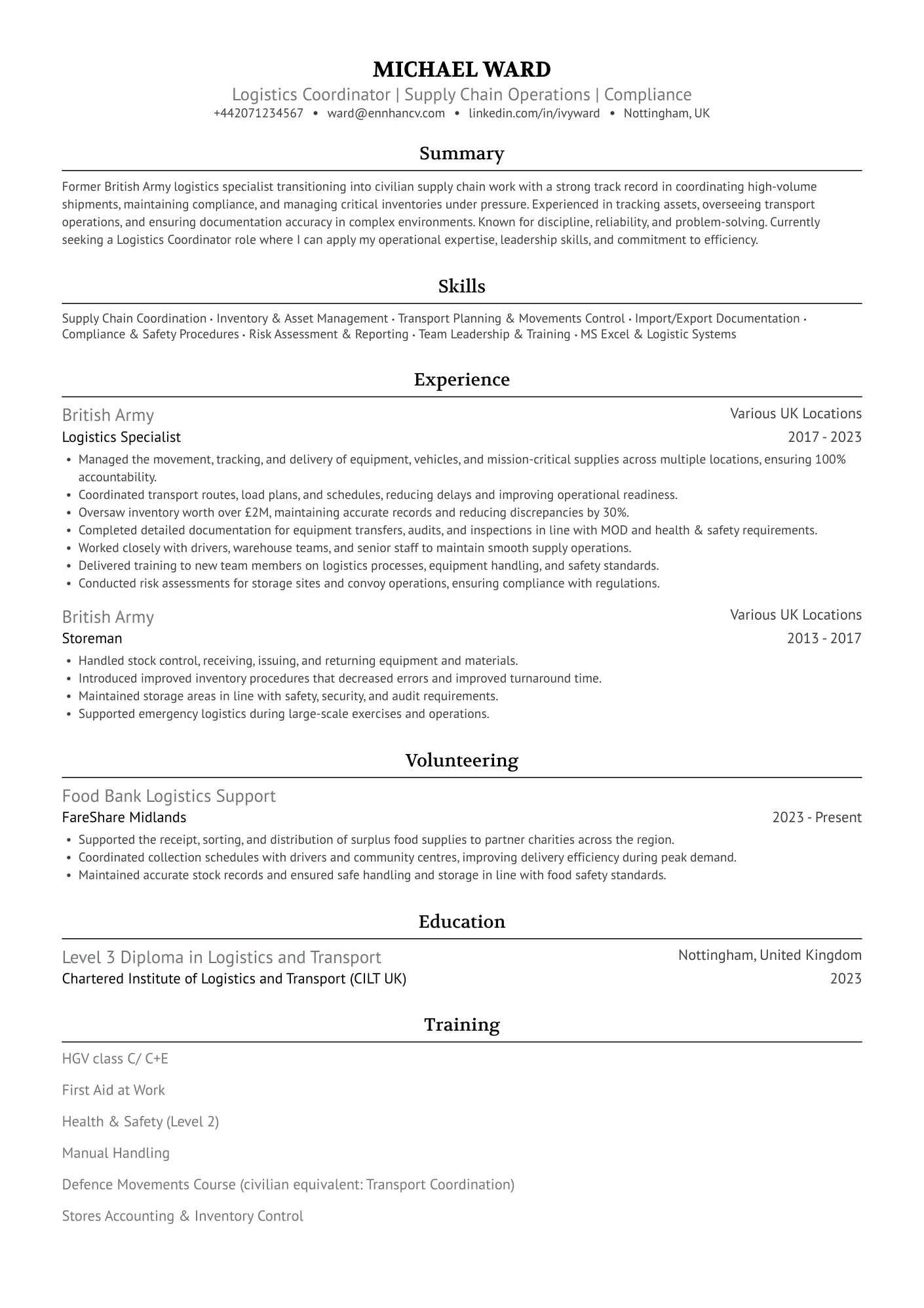
Logistics coordinator CV example
If your role in the Forces included streamlining operations and maintaining supply chain efficiency, you could be a shoe-in for a logistics role.
Check out our example below:
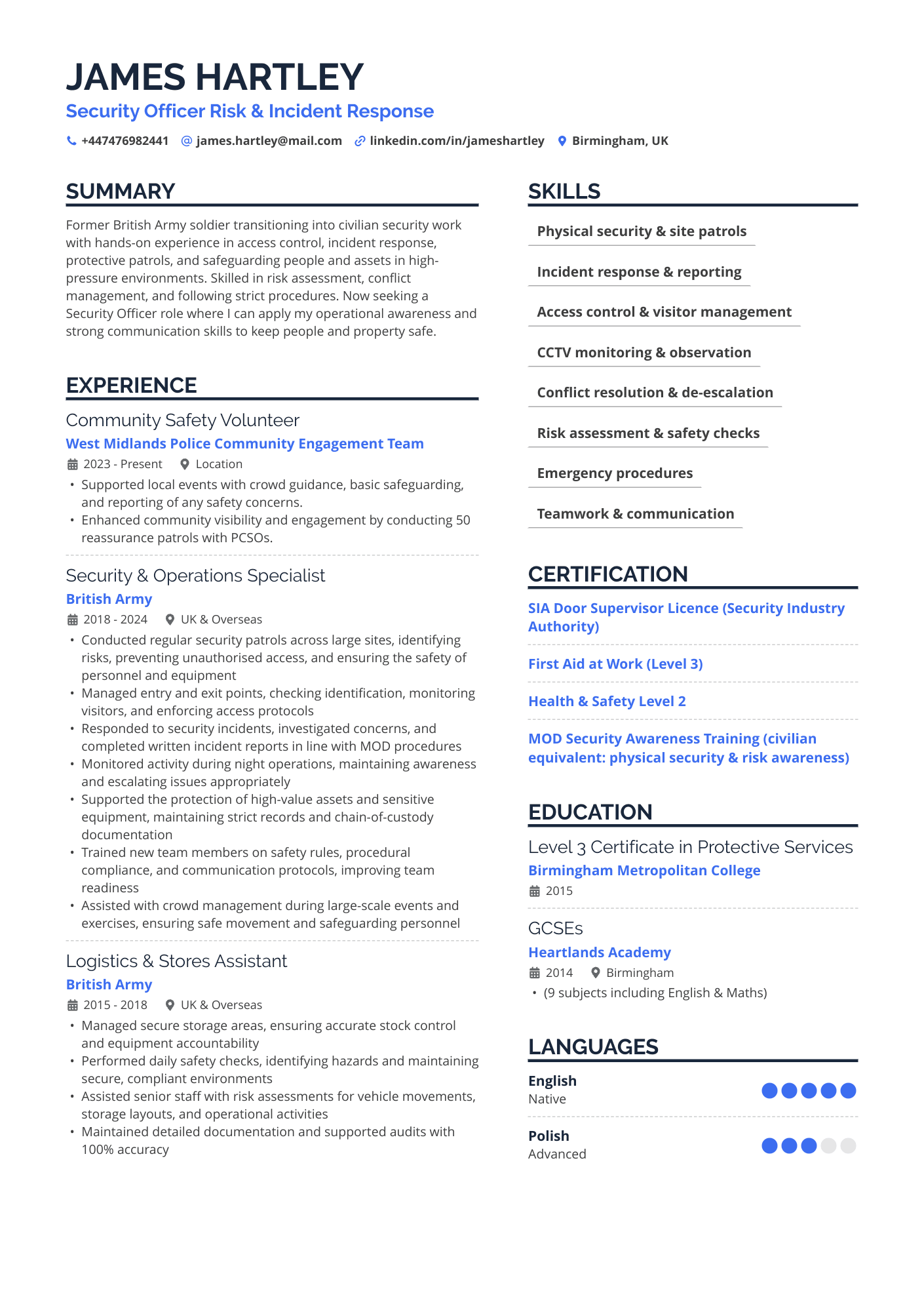
Security officer CV example
You already know how to stay cool under pressure and what protocol to follow. Going for a security officer role is a smart move, especially if your technical skills overlap.
Here’s a CV example for inspiration:
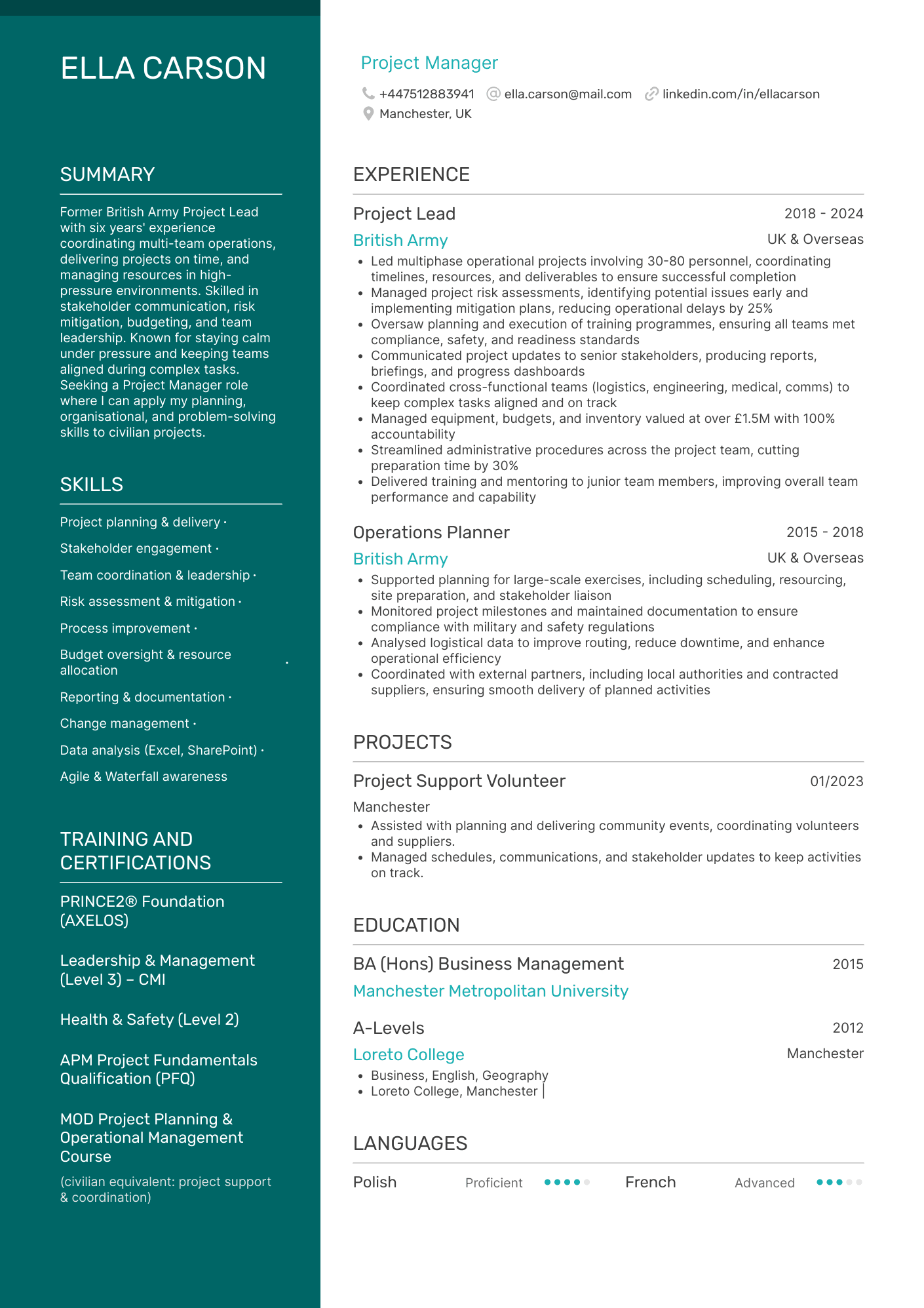
Project manager CV example
If organisational skills and a clear vision of success is part of your MO, you may thrive as a project manager. Be sure to mention any technical knowledge you have under your belt.
Let’s take a look at a project manager CV example here:
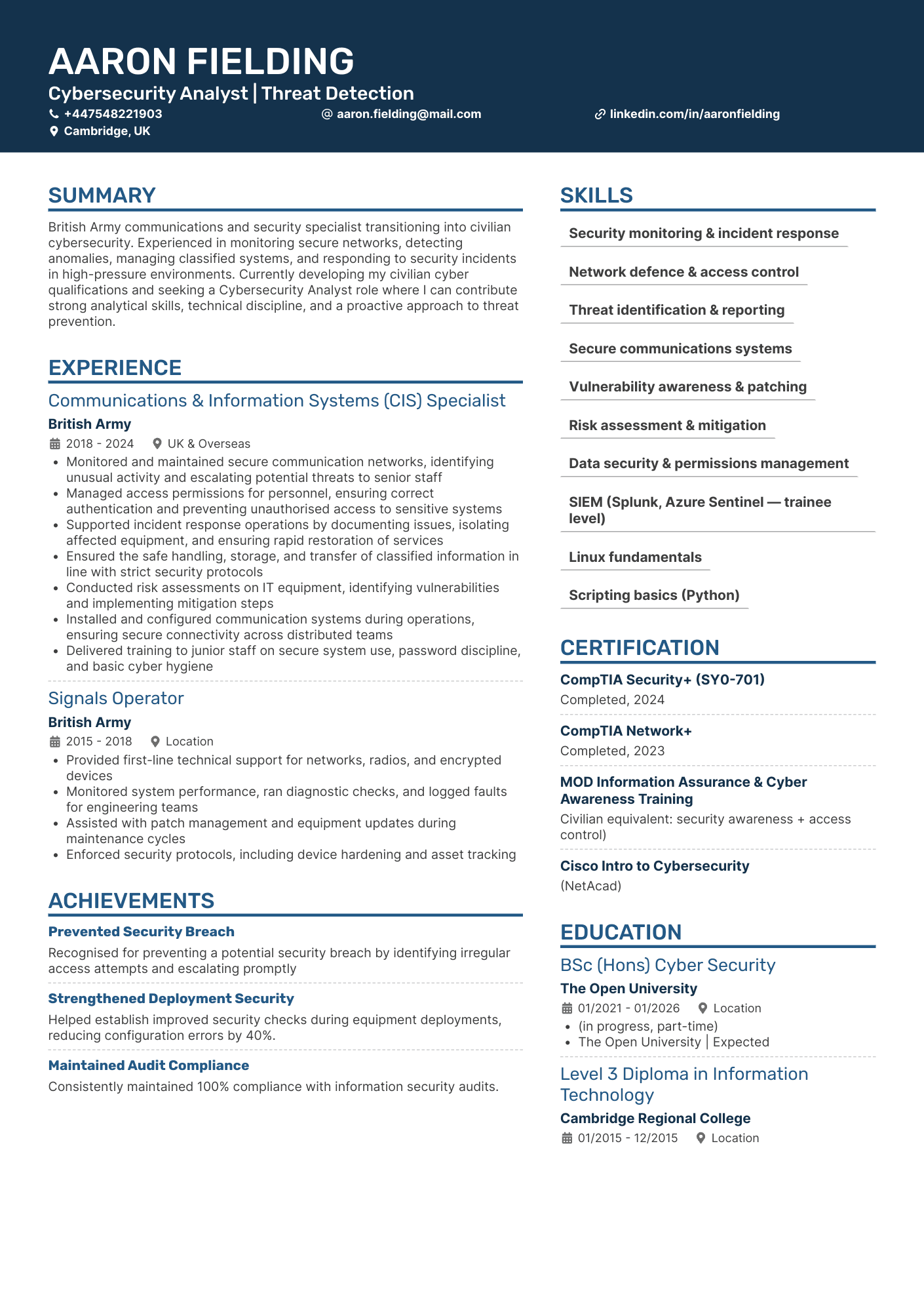
Cybersecurity specialist CV example
Cybersecurity is a growing field, with more than 2,600 new jobs appearing in the UK every month. If your service gave you a working knowledge of this industry, it’s time to capitalise on that fact. Share tangible metrics that prove you have what it takes to succeed.
Use the following CV example to help you get started:
IT Support CV example
Should you have gained technical expertise while in the Army, that is likely to be invaluable to future employers. Translate your technical skills into approachable language here.
Here’s an IT CV example for you to review:

Your experience in the Forces makes you extremely hireable. You’ve learned a wealth of high-value skills and proven you have what it takes to thrive under extreme pressure. Use this education to your advantage when writing your military to civilian CV.
Get extra career support
Military leavers have access to the Career Transition Partnership (CTP) offered by the government. The service aims to support you in “successfully making the transition to civilian life through new employment”.
If you meet the criteria, you’ll have access to career workshops, training courses, resettlement advice, events, and a dedicated jobs portal. If you’re ready to take the next steps and find your civilian job, this service is a great place to start.
We’ve covered all you need to know about writing a British Army CV if you’re applying to a civilian role. But what if you’re looking to enter the Forces?
Should you want to land a position in the Army, you’ll need an altogether different tack. In the next section, we’ll share how you can write a CV to land your dream role in the Forces.
How to write a CV to join the British Army (for new applicants)
Most applications to the British Army are based on internal tests and application forms. In some cases, you may want to create a CV voluntarily to send alongside your other documents. This is completely optional.
However, there are some high-level Forces roles that require both a professional CV and a cover letter. These tend to be the “professionally qualified” positions in the Forces, such as the jobs in the Army Legal Services or the Army Reserve.
As part of the internal testing, the Army is looking for key factors that make you the right fit. Before you apply for any position, it’s worth making sure you have the basic requirements.
What the Army is looking for
- Fitness. Before you can join, you need to pass a fitness test. At minimum, this includes the ability to run 2km in under 11 minutes and 15 seconds, throw a 4kg ball 2.9 metres, and have a mid-thigh pull force of 46kg.
- Discipline. You will also need to be disciplined and prove that during the internal testing. This is one of the core values and standards of the Forces.
- Teamwork. To succeed in the Forces, teamwork skills are essential. You will need to show that you’re a teamplayer who can collaborate well.
- Reliability. Reliability is non-negotiable when you’re in the Army. You need to be consistent in your dedication and show up for the rest of your platoon.
Learn more about how to get ready for your internal tests by visiting the British Army website.
What to put on a CV for joining the Army
Planning to create a CV for joining the Army?
Here are some of the elements you can include:
- Short objective or personal statement: First up, you should write a short objective or personal statement. Include why you want to join the Forces, the exceptional talents you have, and any experience that makes you well-positioned for this intense role.
- Education: You can apply for many Army roles with no qualifications at all. (However, there are legal requirements in the UK that mean you may have to complete your education.) Whatever certificates or education you have, include them clearly on your CV.
- Experience: If you’re a school leaver, you may not have any formal work experience. If you have any voluntary experience or even a part-time job, you can list it here. Of course, if you’re a career changer, you can detail your past roles.
- Army-aligned hobbies: Should you need to bolster your British Army CV, adding hobbies and interests can help. Make sure these are army-aligned. For example, any sport teams, the Duke of Edinburgh award, or being in the scouts.
- Physical achievements. Since the Forces value physical fitness, any achievements in this area are bound to be valuable. You get extra points if you have certificates that prove your prowess, such as Jujitsu belts or personal training qualifications.
Here’s a simple CV structure template you can use:
Example CV for joining the Army
Want to know how a British Army CV might look? Check out our example below:
THOMAS RICHARDS
Army Applicant | Leadership Potential | Physical Readiness
+44 7729 843 112 | thomas.richards@enhancv.com | linkedin.com Sheffield, UK
Summary
Motivated and disciplined applicant seeking to join the British Army. I bring strong teamwork skills, physical fitness, reliability, and a willingness to learn. Experienced in challenging environments where resilience, communication, and problem-solving are essential. Committed to the Army’s values and prepared to contribute positively to the team, complete training to a high standard, and grow into a role with long-term responsibility.
Experience
Assistant Coach (Voluntary)
Sheffield Falcons Youth Rugby | 2022 – Present
- Support coaching sessions for young players, helping with drills, warm-ups, and safety checks.
- Encourage teamwork and discipline among players, promoting a positive training environment.
Assist with organising match days, coordinating equipment, and ensuring readiness for training sessions.
Warehouse Operative (Part-Time)
DHL Supply Chain, Sheffield | 2021 – Present
- Helped maintain an organised and safe warehouse environment by following strict procedures and safety rules.
- Worked efficiently as part of a team to process deliveries, manage stock, and complete tasks to daily targets.
- Undertook manual handling tasks and operated basic equipment safely and responsibly.
Duke of Edinburgh (Gold Award Expedition)
2020 – 2021
- Completed multi-day expedition requiring physical endurance, teamwork, navigation, and resilience.
- Contributed to group planning and demonstrated commitment to completing tasks to high standards.
Education
- A-Levels: Physical Education, Geography, Psychology
King Ecgbert School, Sheffield | 2021 - GCSEs (9 subjects including English, Maths, and Science)
King Ecgbert School, Sheffield | 2019
Certifications
- First Aid (St John Ambulance – Basic)
- Safeguarding Awareness (NSPCC)
- Basic Health & Safety Level 1
- Manual Handling Awareness
- UK Clean Driving Licence (full)
Skills
- Teamwork & communication
- Physical fitness & endurance
- Discipline & time management
- Problem-solving under pressure
- Situational awareness
- Responsibility & reliability
- Quick learning & adaptability
- Basic mechanical/technical aptitude
- First Aid awareness
Volunteering
Community Support Volunteer
South Yorkshire Community Trust | 2021 – Present
- Assist with neighbourhood clean-up days and charity fundraising events.
- Provide support and guidance to younger participants and community organisers.
- Demonstrate commitment, punctuality, and teamwork in every activity.
Interests
- Fitness training (running, strength training)
- Team sports (rugby, football)
- Outdoor activities (hiking, camping, orienteering)
- Volunteering & youth mentoring
As you can see, the CV example is easy to read and focuses on the candidate’s value.
Next up, let’s talk about how you can avoid some common problems with your CV for the Forces.
Common problems on British Army CVs (and how to fix them)
- Overusing acronyms: From 1SL to MOS, the Forces have plenty of acronyms that could be confusing to civilians. Avoid getting overlooked by translating them into common language for the hiring manager.
- Oversharing sensitive info: When you’re in the Army, there’s certain sensitive information that you should never share. Be aware of this when you’re writing your CV. You should omit any information that is considered private or sensitive.
- No metrics or evidence: That isn’t to say that your CV should lack evidence. When you’re making big statements, back them up with numbers and statistics.
- An overlong CV: You might have a lot to say about your experience in the Forces. However, hiring managers have a matter of seconds to review CVs. Stick to either one or two pages.
- Not tailoring your CV: Make sure you read the core criteria of the vacancy and align your application with it. This is one thing that many candidates fail to do, and it can make all the difference.
By this point, you may be ready to get to work on your British Army CV. Fortunately, you don’t have to be a design whiz to get it right.
How to design your British Army CV
Looks matter, especially when you’re trying to hook a hiring manager’s attention.
Let’s take a look at some of the basic style rules you should follow when crafting your CV.
- Style: The style of your British Army CV should be classic and simple. Avoid any garish or overly colourful styles. You want to convey that you’re a professional. If in doubt, use one of Enhancv’s simple templates. They’re created with both ATS filters and UK hiring managers’ requirements in mind.
- Fonts: Readability should be your number one priority when creating your CV. Choose a legible font, such as Times New Roman, Arial, Calibri, Rubik, or Volkhov. Your body content should be between 10 and 12pt, while your headings can be larger at 14pt.
- Colours: Don’t go wild when it comes to colours. Too many tones can look unprofessional and insinuate that you don’t understand modern hiring practices. Pick a template that has just a couple of colours, rather than a multicoloured design.
- Margins: The standard size for margins is 2.5 cm (25 mm) all around. This approach helps with the readability of your document—avoiding the crammed-in look. If you’re not sure how to adjust the margins yourself, don’t worry. Enhancv’s app uses preset margins that automatically keep your spacing and sections consistent, even if you adjust the margin width.
- Photos: As a general rule, you should not include photos on your CV. This is against British hiring standards and can make you stand out for all the wrong reasons. The only exceptions are roles in which your looks are essential, such as modelling and acting.
- File format: Ready to save your Army CV? Downloading it as a PDF is the best option. This format doesn’t shift around when it’s opened on different devices. However, there are exceptions. If the job advert asks for a Word document, follow that advice instead.
Enhancv has a massive range of tried-and-tested CV templates you can use. Simply select a design that works for you and customise it to create a great CV in a matter of minutes. The builder tool is quick and easy to use—no matter your skill level.
How to ensure your CV is ATS-ready with Enhancv
- ATS-optimised formats: Help your British Army CV rank well in the ATS system. Our CV templates have been designed with the software in mind. You can tweak and edit the template to suit your needs. Using an optimised layout means you don’t have to worry about formatting issues causing your CV to be filtered out.
- Translate your CV with ease: Struggling to translate your British Army CV into civilian language? Enhancv’s AI assistant makes the whole thing easy. Simply click a section to get AI-supported suggestions that will help you speak the hiring manager’s language.
- Bespoke tailoring suggestions: Aligning your CV with the role is the only way to get ahead. When you use Enhancv’s Builder, you get clever tailoring suggestions while you create your CV. We’ve packed real intelligence into the tool, meaning you can effortlessly write a CV that will win over the reader.
Takeaway
Whether you’re a military leaver looking for a new role or want to enter the Forces, writing a well-positioned CV could be the first step.
In this guide, we’ve covered both bases, offering actionable tips and examples you can use to craft your next application. It’s all about highlighting your value to employers and translating your experience into plain English. Getting started couldn’t be easier. Simply use the Enhancv CV Buildernow.
