



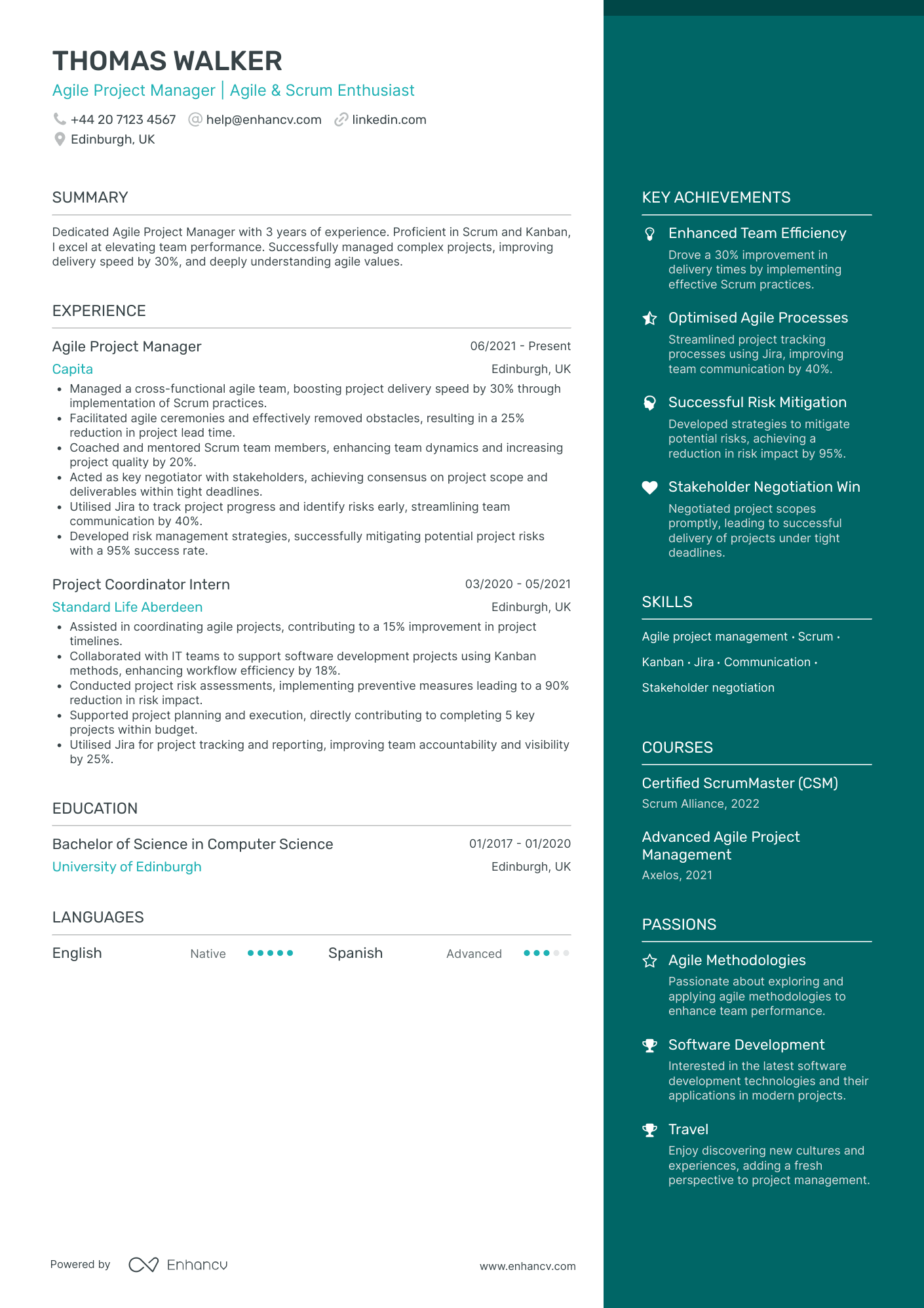
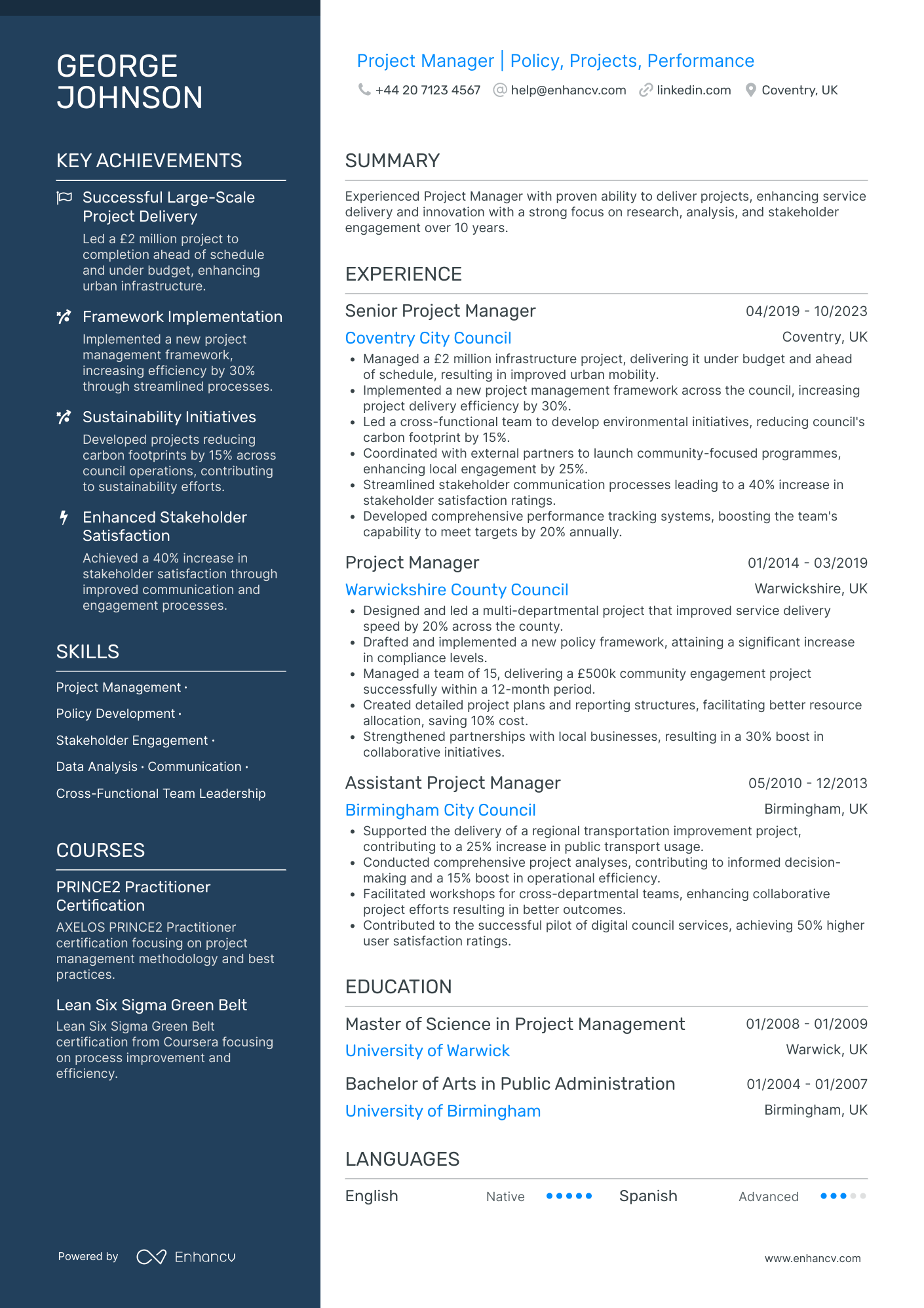
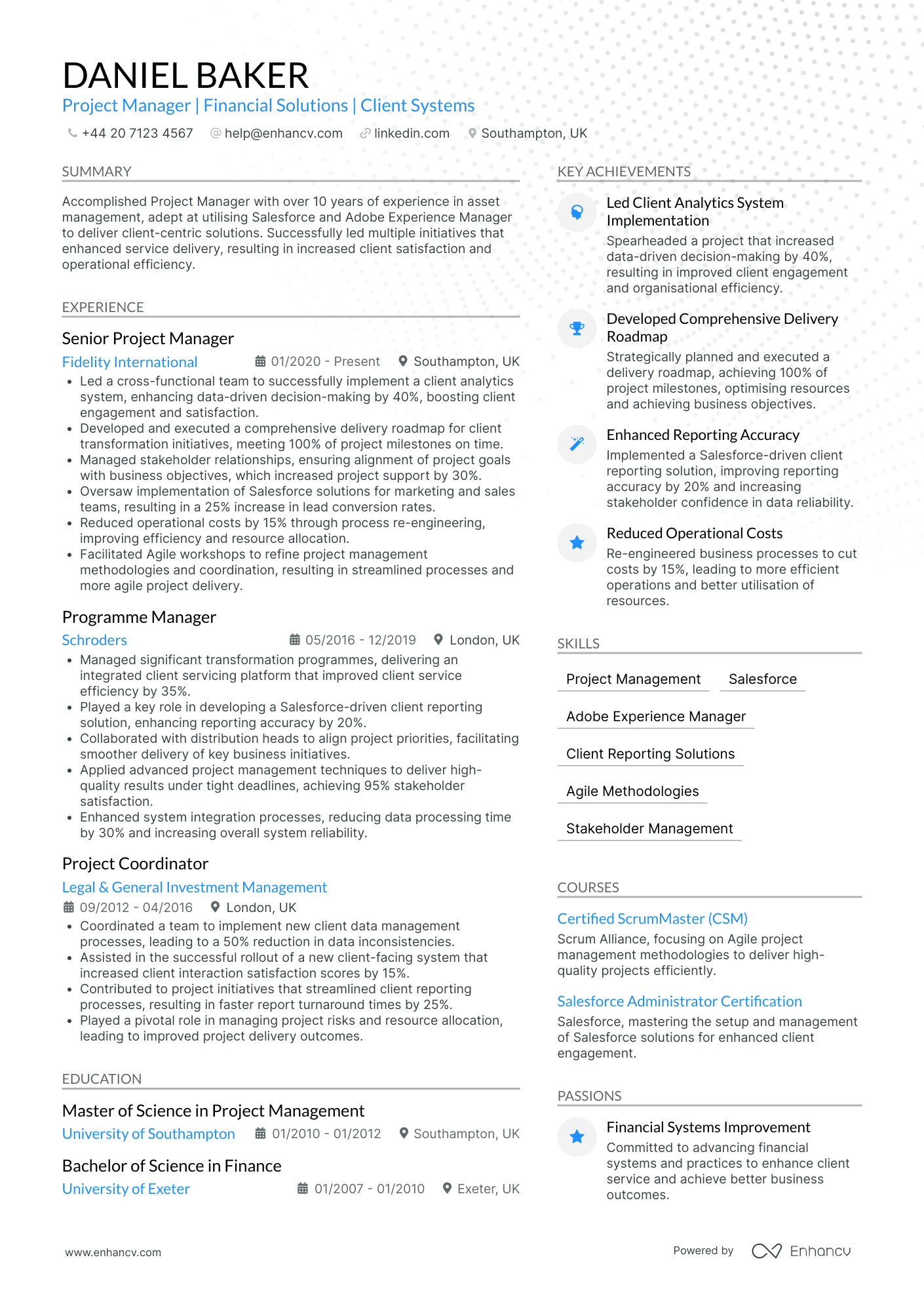
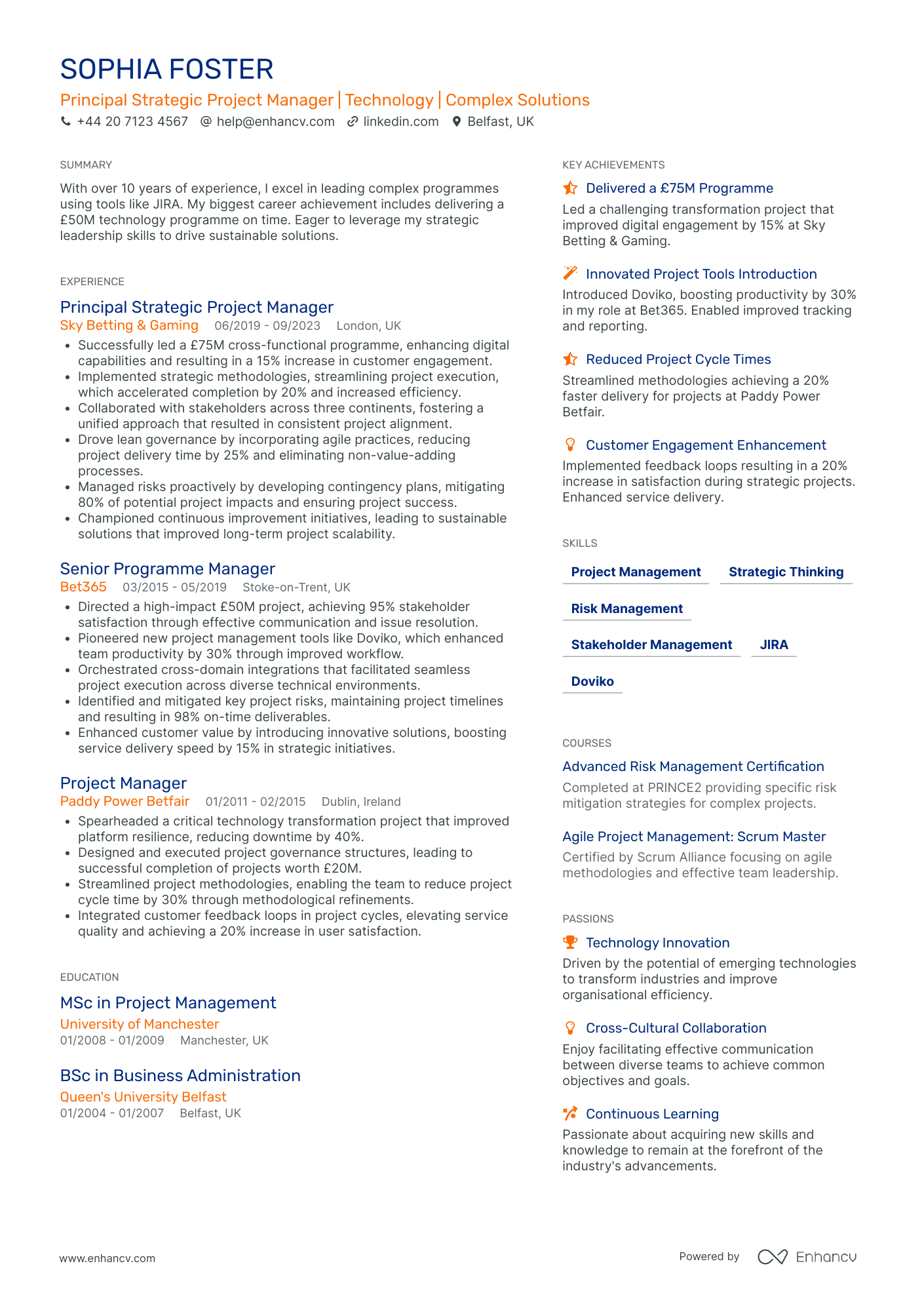
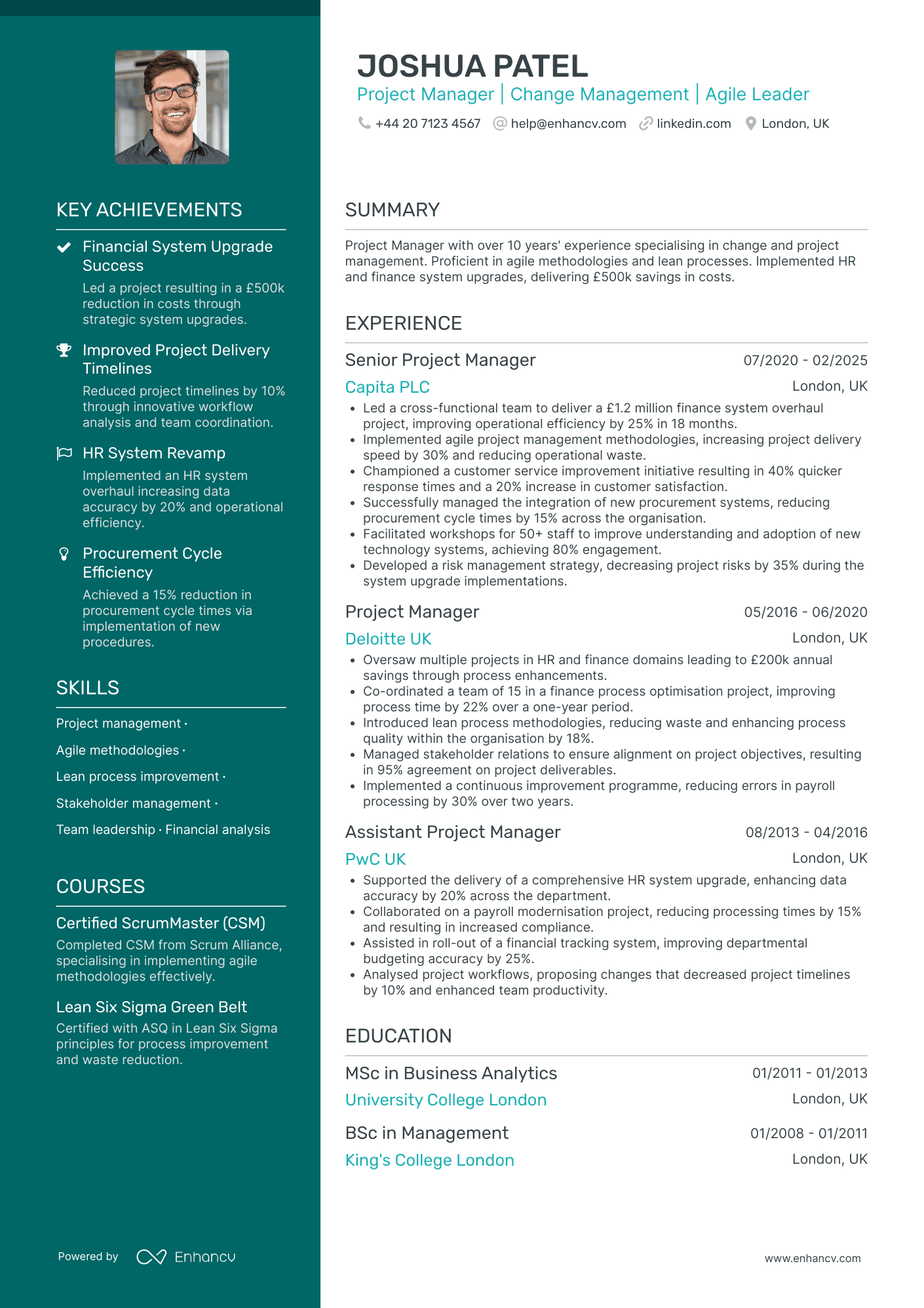
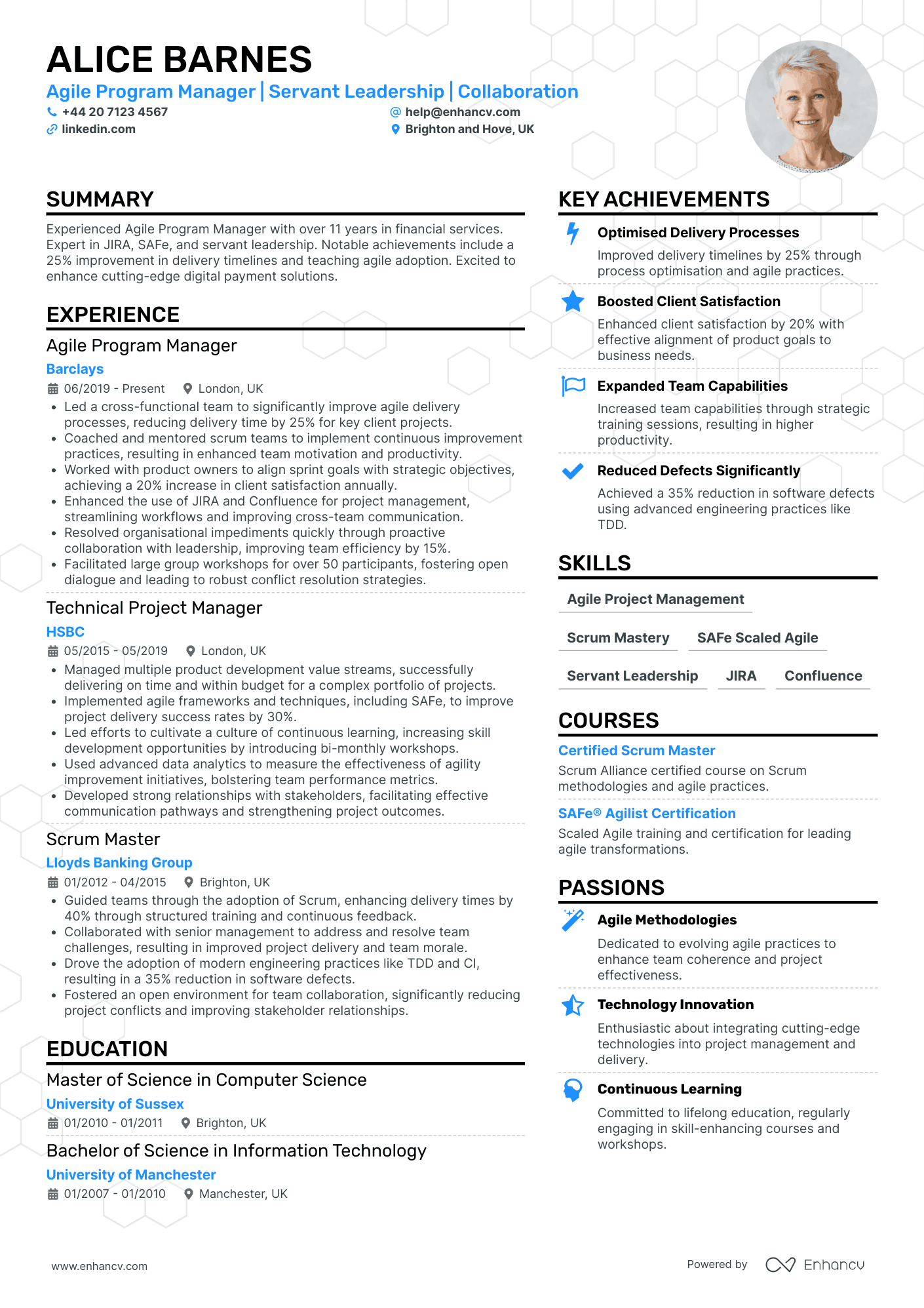
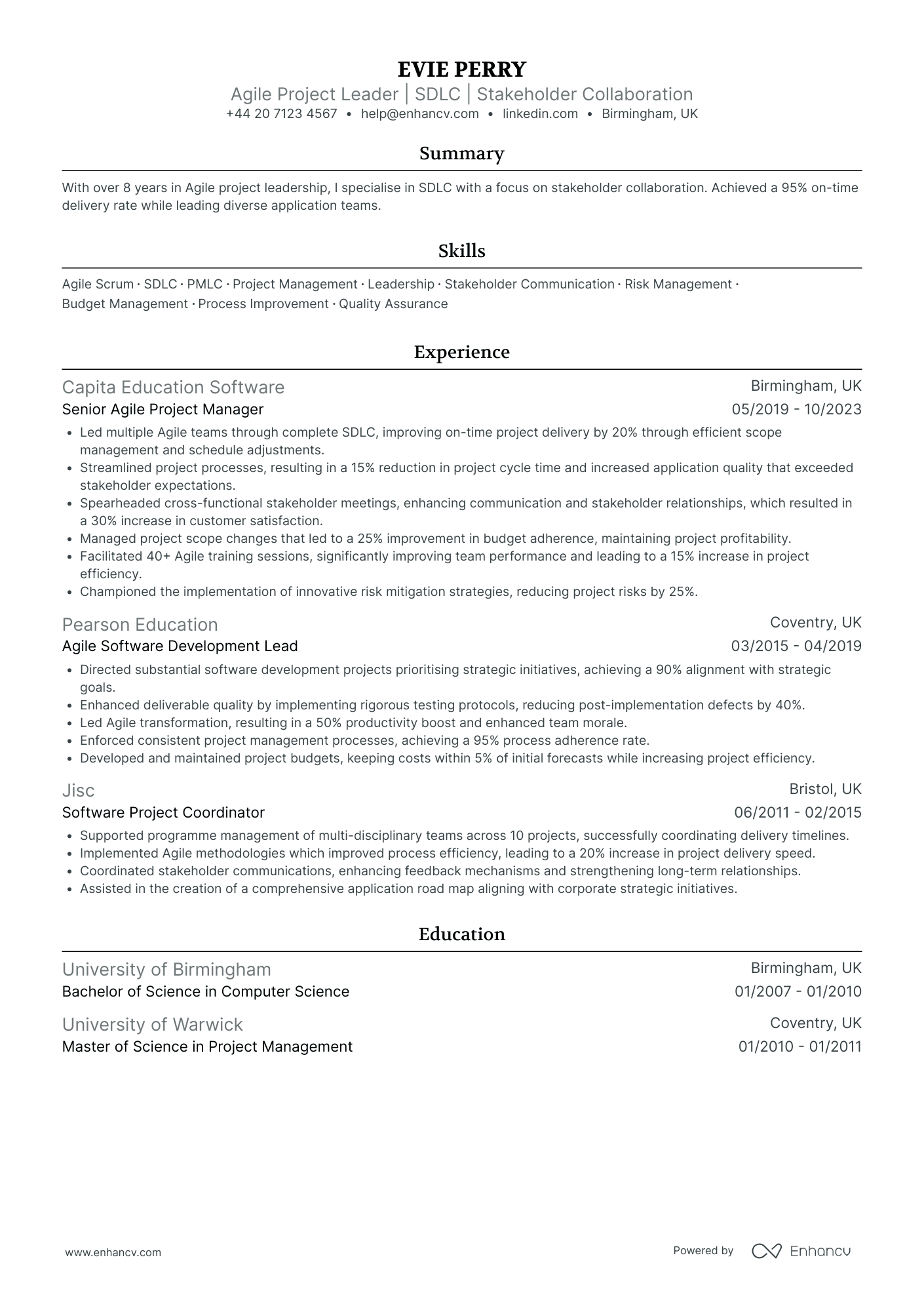
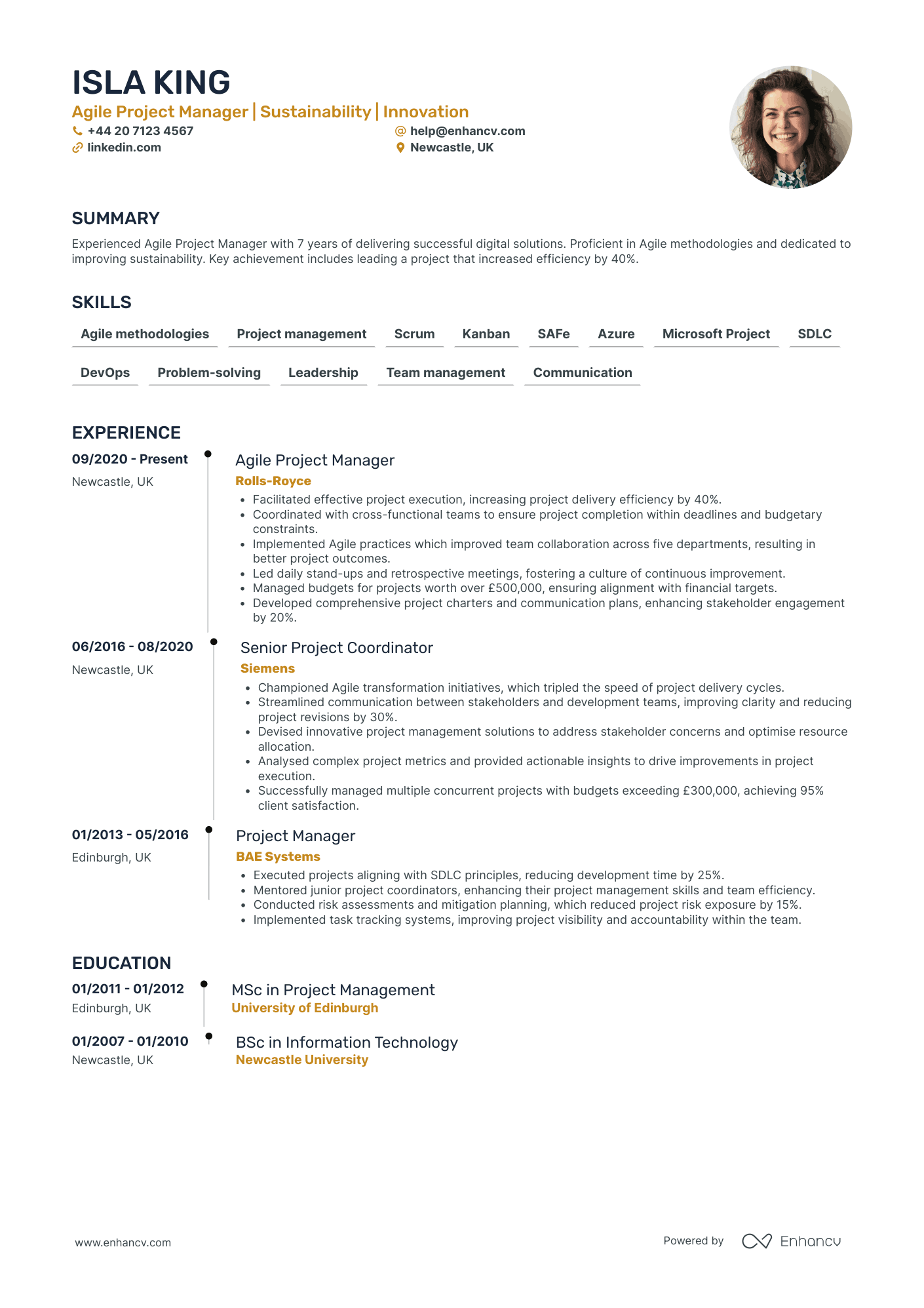
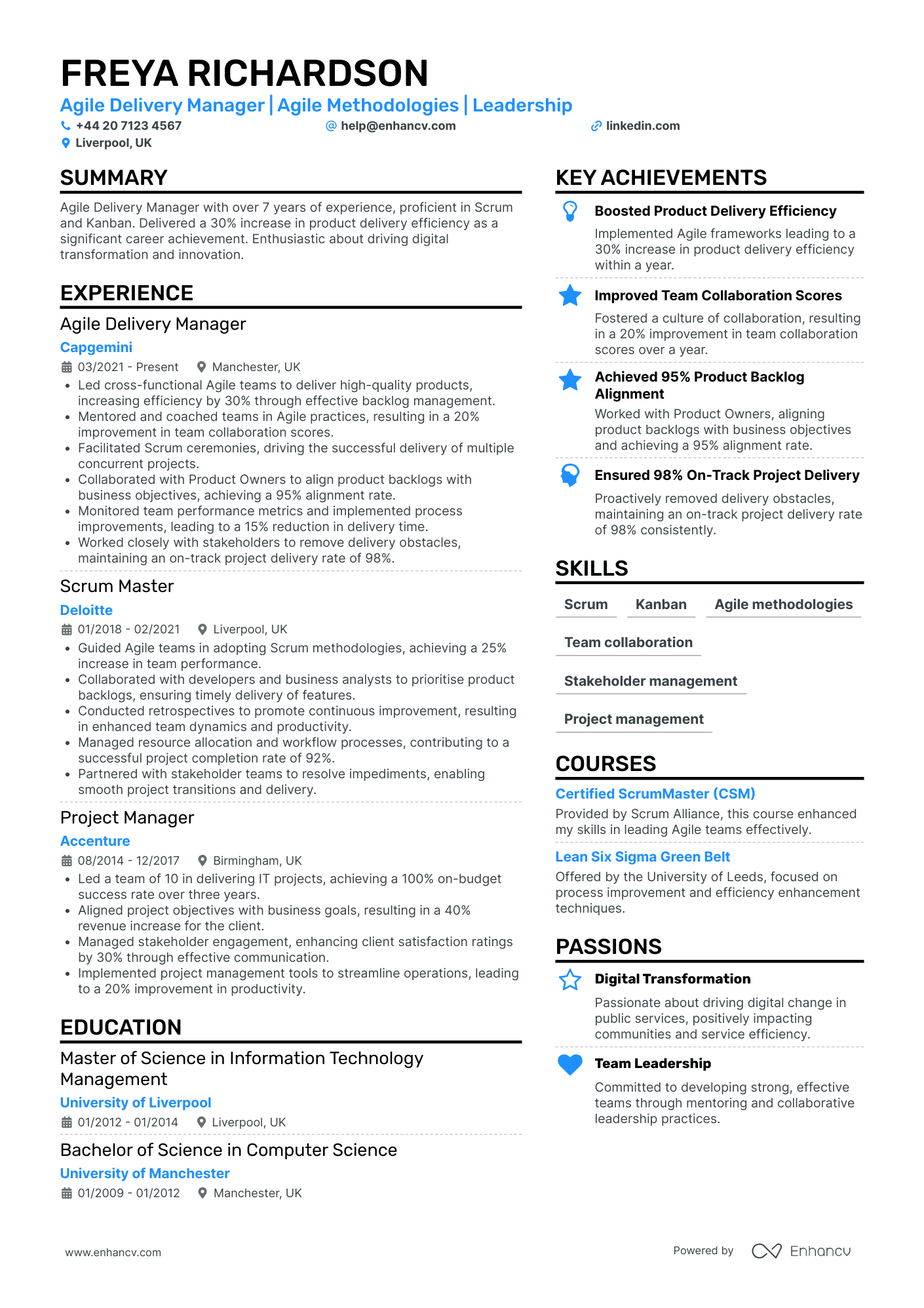
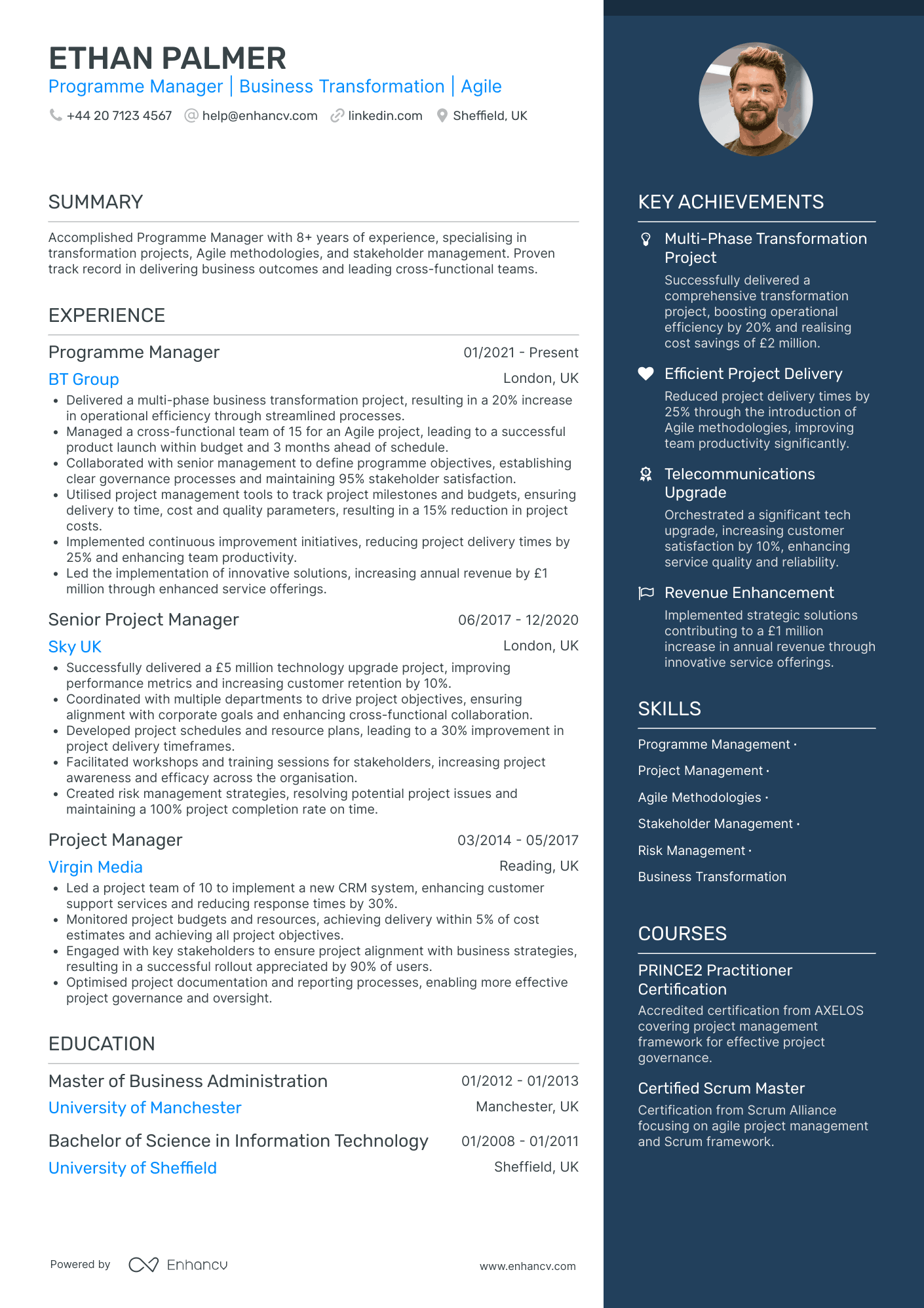
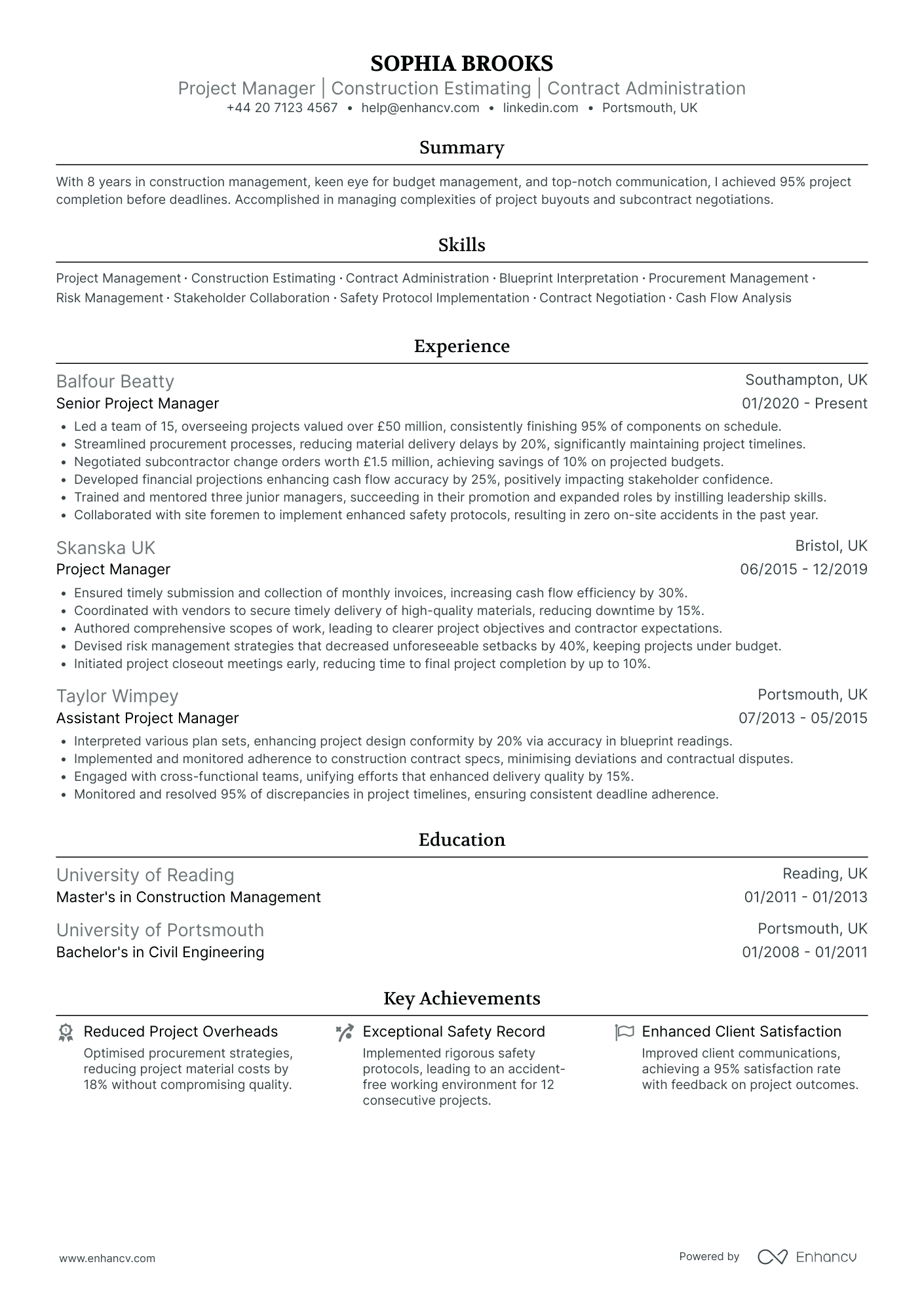
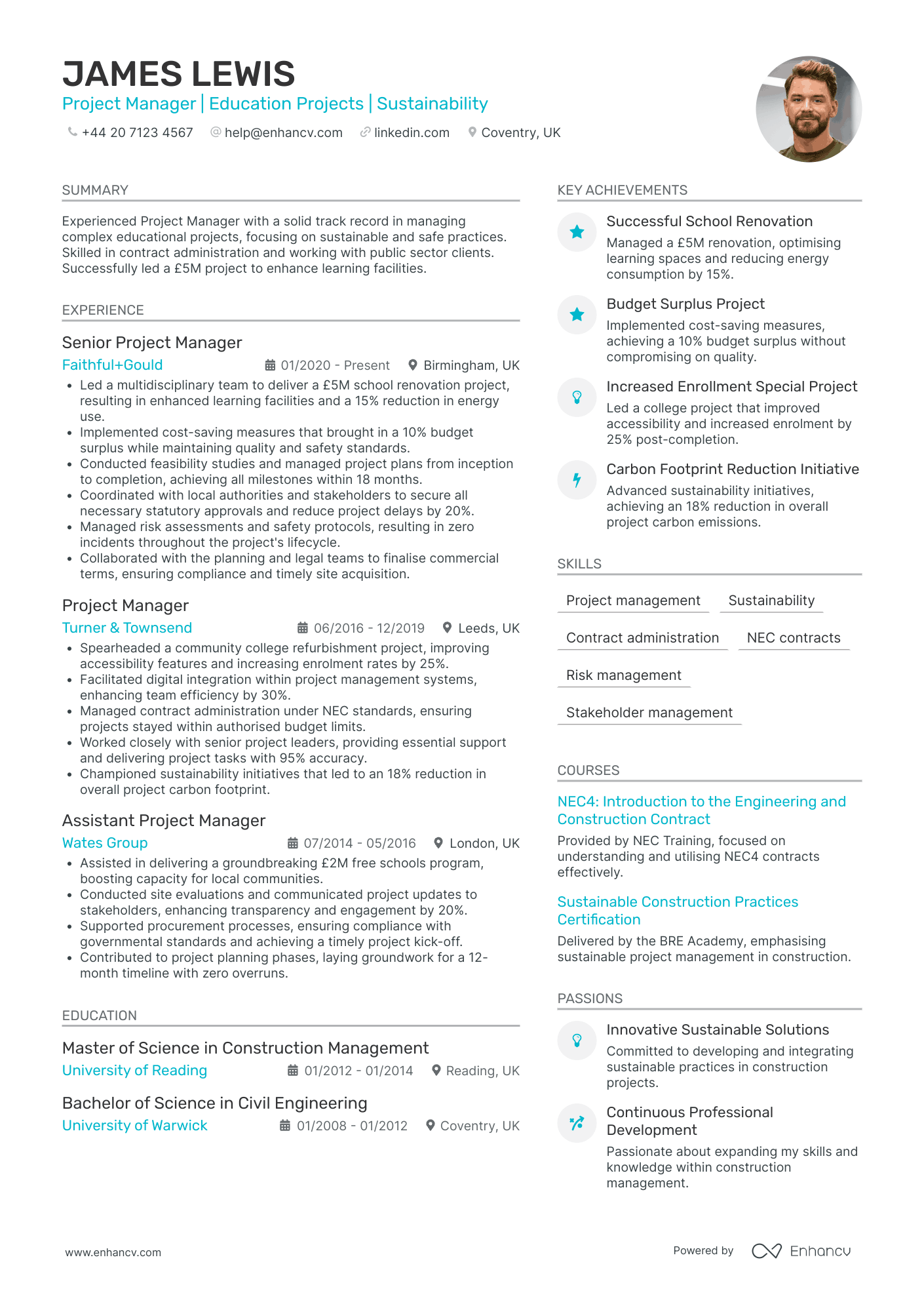
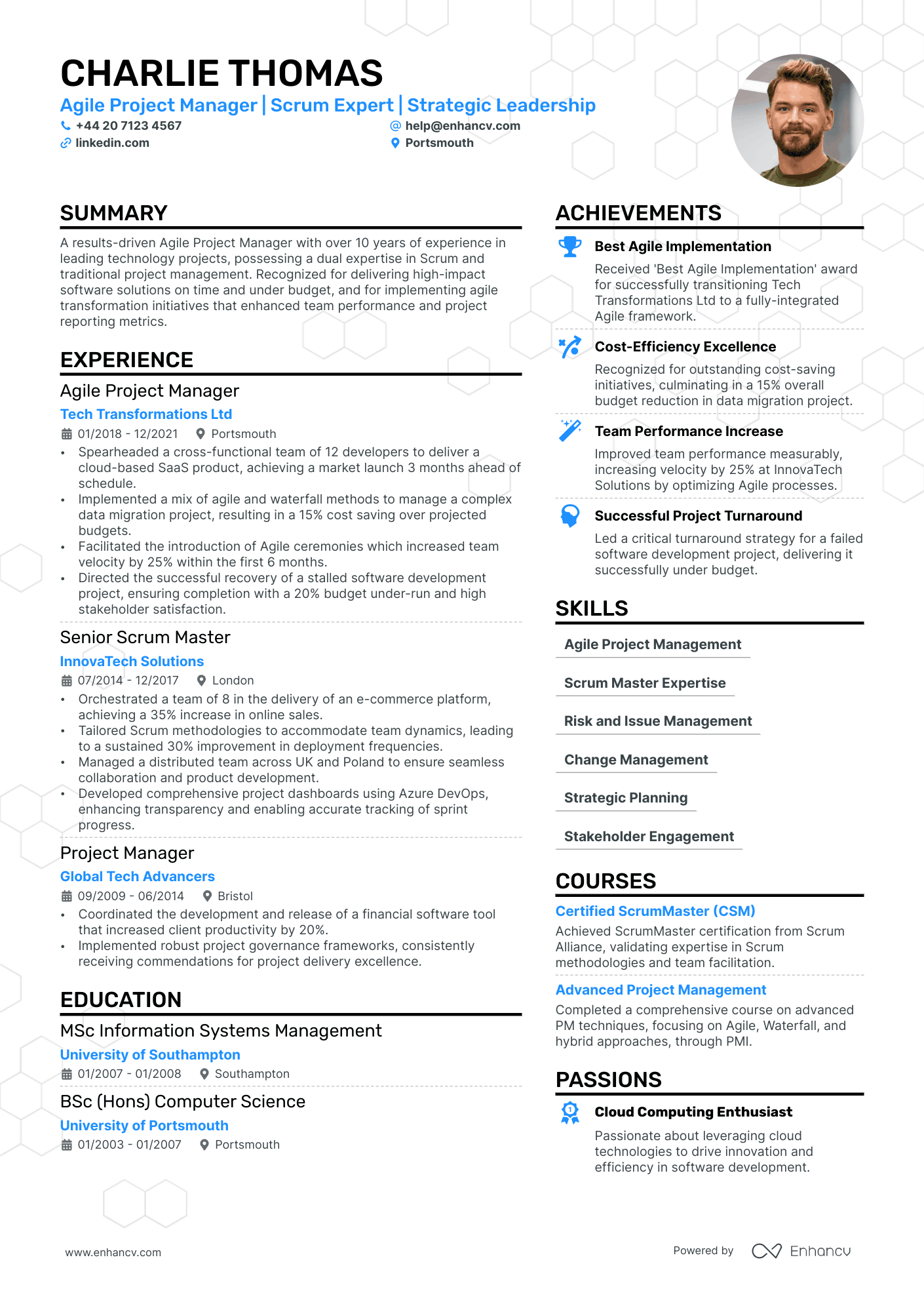
Most agile project manager CVs read like a Scrum textbook stapled to a job description. Ceremonies listed, frameworks named, and not one line that shows a release actually shipped.
The CVs that get interviews do the opposite. They lead with how you run delivery, the cadence you set, and the outcomes your teams reached, then let the framework names sit quietly in a skills line where they belong.

Key takeaways
- Lead with agile delivery, not job titles. Show the cadence you set, the impediments you cleared, and what the team shipped.
- Name your frameworks precisely: Scrum, Kanban, SAFe, and the tools you run them in, like Jira or Azure DevOps.
- Quantify flow as well as output: velocity trend, cycle time, release frequency, and defect escape rate.
- Open with a short personal statement built on one delivery outcome, not a list of adjectives.
- Two pages, reverse chronological, sent as a PDF unless the advert asks for a Word file.
- List the certifications employers scan for, like PSM, PMI-ACP, or PRINCE2 Agile, even if one is in progress.
How to show agile delivery on your CV
Agile is a way of working, and a recruiter can tell in seconds whether you have run it or only read about it.
Naming ceremonies proves nothing. Every applicant lists stand-ups and retrospectives, so the words carry no signal on their own. What separates a real practitioner is the delivery around them: the cadence you set, the blockers you cleared, and the metrics that moved because of it.
Describe agile experience as evidence, not vocabulary. Instead of "facilitated daily stand-ups", write what the facilitation changed, like "cut sprint carry-over from nine points to two by reworking how the team sized stories".
Be specific about the flavour of agile you have actually run. Scrum with two-week sprints reads differently from a Kanban board with work-in-progress limits, and scaling delivery with SAFe across five teams is a different job again. Name the one you led, not the whole glossary.
Spell out what you owned day to day, because "agile project manager" means different things in different companies. In some you hold the budget, scope, and sponsor relationships while a Scrum Master facilitates. In others you carry both. Say which, so a hiring manager knows what they are getting.
Show the numbers agile leaders live by: velocity trend, sprint predictability, cycle time, release frequency, and defect escape rate. One credible flow metric beats a paragraph of framework theory.
Avoid vanity numbers, though. "Ran 300 stand-ups" measures attendance, not delivery. Tie every figure to an outcome a business cares about, like a release that stopped slipping or a backlog that stopped growing.
Give impediment removal its own evidence, because it is the part of the job that is hardest to see and easiest to prove. A dependency you unblocked between two teams, a vendor delay you routed around, a decision you forced when a sprint was stalling, each of those is a bullet, and each shows judgement a framework list never will.
Frame yourself as a servant leader, because that is what the role rewards. You clear the path for the team, protect the sprint from mid-cycle scope changes, and keep stakeholders aligned, rather than assigning tasks from the top.
If you have worked at scale, show it plainly. Coordinating a single team is a different job from running a programme increment across five squads, aligning a release train, and managing dependencies between them. Put the number of teams and the size of the programme on the page, because that is the first thing a scaled agile employer looks for.
And handle the Scrum Master question directly. Many agile PM adverts blur the two roles, so state where the line fell in your work. If you facilitated the ceremonies yourself, say so. If a dedicated Scrum Master ran the team while you held delivery and budget, say that instead. Ambiguity here costs you interviews with employers who care about the distinction.

PRO TIP
If an advert names its framework, mirror it exactly. A team running the 3-5-3 of Scrum, which is three roles, five events, and three artefacts, wants to see Sprint Planning, backlog refinement, and a Product Owner relationship on your CV, not generic 'project coordination'.

Weak line versus strong line
Weak: 'Responsible for facilitating agile ceremonies and managing the product backlog.' Strong: 'Ran two-week Scrum sprints for a team of nine, lifting sprint predictability from 64% to 92% and clearing a six-month backlog of stalled work.' The strong line names the cadence, the team size, and two outcomes a sponsor can feel.
Skills to put on an agile project manager CV
The strongest agile PM skills lists read like a delivery toolkit, not a glossary. Split them into the methods and tools you run and the leadership skills that make them work.
Your hard skills are the frameworks, tools, and delivery techniques you can be questioned on: Scrum, Kanban, SAFe, backlog management, release planning, and the tools you track them in. List them in the words the adverts use.
The soft skills that matter are the ones a team feels, like servant leadership, stakeholder management, facilitation, and coaching. Prove each in a bullet rather than claiming it.
Keep the list honest. A recruiter will ask about anything you name, so list only the frameworks and tools you can be interviewed on. If you have run Scrum but only read about SAFe, put Scrum in your skills and keep SAFe for a line about what you are learning. A tight, defensible list beats a long one every time.
Top skills for your agile project manager CV:
Scrum
Kanban
SAFe
Backlog management
Sprint planning
Release management
Risk management
Jira and Azure DevOps
Servant leadership
Stakeholder management
Facilitation
Coaching
Communication
What UK employers want from an agile project manager
Before you write a line, read a batch of live agile PM adverts. A handful of demands repeat, and the strongest CVs answer them head-on in the language the advert uses.
| What employers emphasise | How to evidence it on your CV |
|---|---|
| Agile delivery | Name the framework you ran (Scrum, Kanban, or SAFe) next to an outcome, like a release shipped on cadence or carry-over reduced. |
| Delivery tooling | List the tools you drive delivery in, such as Jira, Azure DevOps, or ServiceNow, and what you tracked in them. |
| Stakeholder management | Show how you kept product owners, sponsors, and engineers aligned, not just that you 'liaised' with them. |
| Metrics and flow | Quantify velocity trend, cycle time, or release frequency rather than listing responsibilities. |
| Certifications | PSM, PMI-ACP, or PRINCE2 Agile signal you were trained in the method, not just exposed to it. |
Two of those rows do the heavy lifting on a CV: the delivery outcomes and the certifications. The rest support them, so spend your best lines proving the first two and let the others sit in a skills or tools row.
Whatever an advert asks for, answer it in its own words. If it says 'scaled agile' or 'continuous delivery', those phrases should appear on your CV where they are true of you, sitting next to the evidence that backs them.
Formatting your agile project manager CV
Use a reverse chronological structure. You have a delivery track record, so lead with it and let each role show the scale of team and product you ran.
Keep it to two pages, one column, standard headings. A hiring manager working through a stack of project managers wants to find your frameworks and outcomes fast.
Send a PDF for direct applications so the layout holds, and keep a Word copy for agencies that reformat CVs into their own template. If the advert names a file type, follow it.
Agile PM applications almost always pass through tracking software, so keep the layout clean and the headings standard for an ATS-friendly CV. Build it from a tested layout rather than a blank page: Enhancv's CV templates export to a clean PDF.
One page is only right very early in a career. An agile project manager with several delivery roles behind them needs the second page to show the range of teams, sectors, and frameworks they have run. Trim the oldest roles to a line each rather than dropping the page.
Writing your agile project manager personal statement
Three or four sentences at the top: who you are, the delivery you have led, the frameworks you run, and the kind of team you want next. Keep every clause concrete. See more personal statement examples if the opening line is stuck.
Skip the adjective pile-up. "Dynamic, results-driven agile leader" tells a recruiter nothing they can check.
Lead with a delivery outcome instead:
Agile project manager personal statement example
Certified Scrum Master with eight years leading delivery across fintech and public-sector programmes. Ran four Scrum teams on a two-week cadence, lifted sprint predictability from 60% to 90%, and shipped a payments system migration on schedule. PMI-ACP certified, fluent in Jira and Azure DevOps, and looking to lead a scaled agile programme in a product-led business.
What to avoid in an agile project manager personal statement
Dynamic and passionate agile project manager with a proven track record of delivering results in fast-paced environments. Skilled in Scrum, Kanban, and stakeholder management, with excellent communication and leadership skills. Seeking a challenging role to leverage my expertise and drive success.
The weak version names the same frameworks and still says nothing. No cadence, no team size, no number a recruiter can picture. Every clause could belong to any of the other applicants on the pile.
When I read an agile project manager CV, I skip past the framework list and look for one thing: proof you have owned a cadence. Anyone can write "facilitated ceremonies". The candidates I remember write what changed because they did, a release that stopped slipping, a team whose velocity finally became predictable, a stakeholder who stopped escalating. Name the method once, then spend your lines on the delivery it produced.
The Enhancv team
Writing your experience section
Write each role as a dated heading, then bullets that pair an action with a delivery outcome. Lead every bullet with an action verb, and put a number on it wherever you can.
Agile work is more measurable than most PMs admit: velocity, cycle time, release frequency, escaped defects, budget held, teams scaled. Those are your CV achievements.
Give each bullet a shape a reader can follow: the situation, what you did, and the result. "Inherited a team missing every sprint goal, reset the cadence and story sizing, and reached 90% sprint completion within two quarters" carries more than three vague duties ever will.
Tailor each application to the advert, mirroring the framework and tools it names where they are true of you. Enhancv's CV tailoring feature reads the job ad and suggests the matching edits, which saves rewriting from scratch each time.
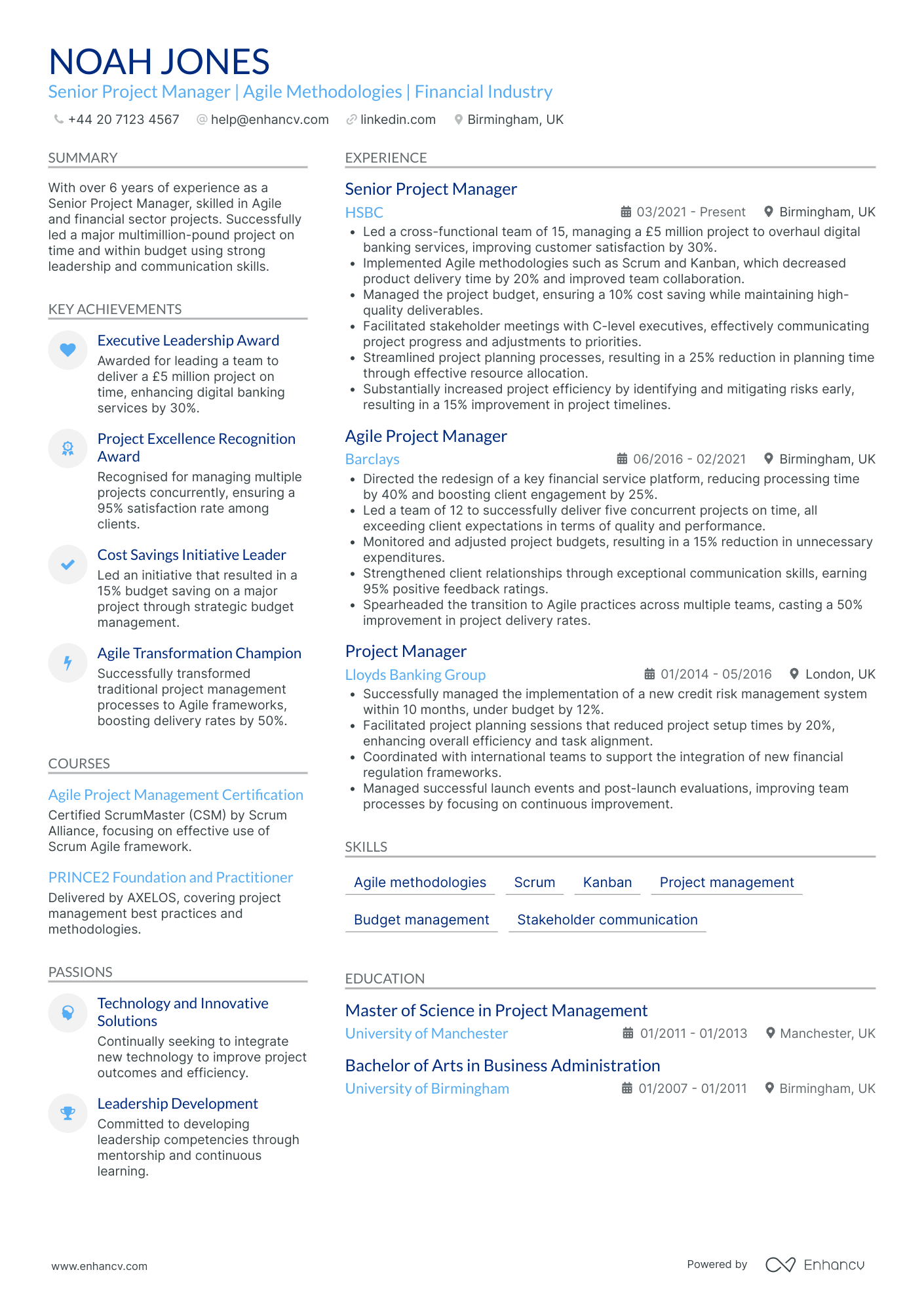
- Lead four Scrum teams delivering a payments product, running sprint planning, reviews, and retrospectives on a two-week cadence
- Raised sprint predictability from 62% to 91% over three quarters by refining story sizing and enforcing work-in-progress limits
- Cut average cycle time from 14 days to 6 by unblocking dependencies across engineering, QA, and product
- Coached two teams through a Scrum-to-Kanban transition, holding release frequency steady while reducing carry-over
- Reported delivery metrics to sponsors fortnightly, replacing status meetings with a live Jira dashboard
PRO TIP
Pull the exact skills and framework language from the advert and mirror it where it is true of you. If the ad asks for 'PI Planning' or 'PMI-ACP', use those words, not a paraphrase, so both the ATS and the hiring manager see the match. Read more on CV keywords before you tailor.
Certifications for an agile project manager CV
Certifications carry real weight here, because they tell an employer you were trained in the method rather than just exposed to it.
List the ones recruiters scan for: Professional Scrum Master (PSM), Certified ScrumMaster (CSM), PMI Agile Certified Practitioner (PMI-ACP), and PRINCE2 Agile for public-sector and enterprise roles. Put your current certificates in a dedicated block near the top.
Name anything in progress too. "PMI-ACP, expected March 2026" still signals you are on the path. Pair each qualification with where you applied it in your education section, so it reads as practice rather than a badge.
Choose which certificate leads by the role you are chasing. PSM and CSM speak to Scrum-heavy delivery roles, PMI-ACP reads as broader agile and appeals to enterprise programmes, and PRINCE2 Agile is worth foregrounding for public-sector and government-adjacent work where it is often named in the advert.
Your degree matters less than your delivery record here, so keep it to a line unless you are early in your career. A relevant qualification, whether in business, computing, or engineering, is worth naming, but it never earns more space than the outcomes above it.
Conclusion
Lead with delivery, name your frameworks once, and let flow metrics carry the weight that adjectives cannot.
Pair the CV with a short cover letter that names the programme you want to run next, and you turn a framework list into a delivery story a hiring manager can trust.
Author's take - The Enhancv team
When I read an agile project manager CV, I skip past the framework list and look for one thing: proof you have owned a cadence. Anyone can write "facilitated ceremonies". The candidates I remember write what changed because they did, a release that stopped slipping, a team whose velocity finally became predictable, a stakeholder who stopped escalating. Name the method once, then spend your lines on the delivery it produced.