



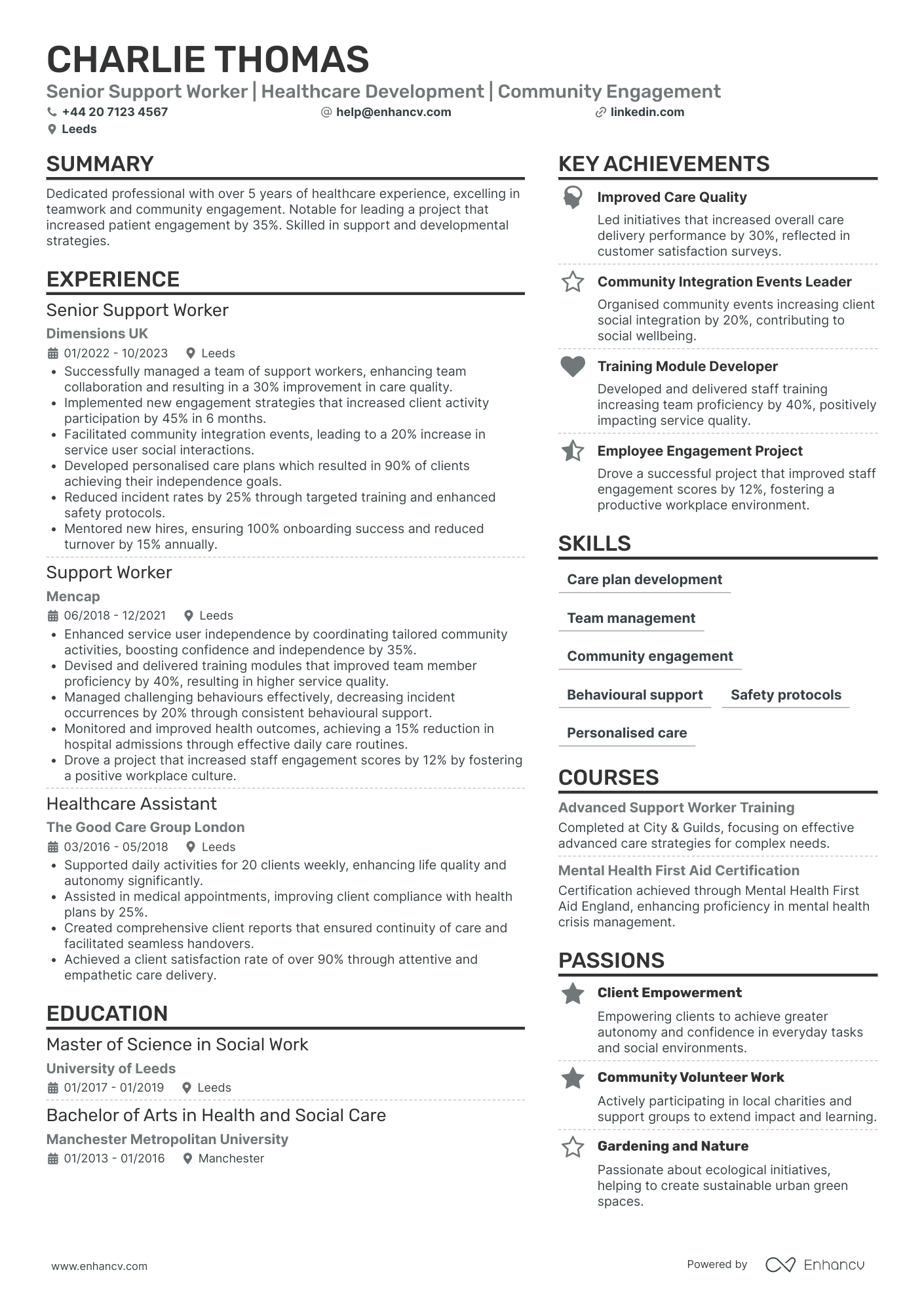
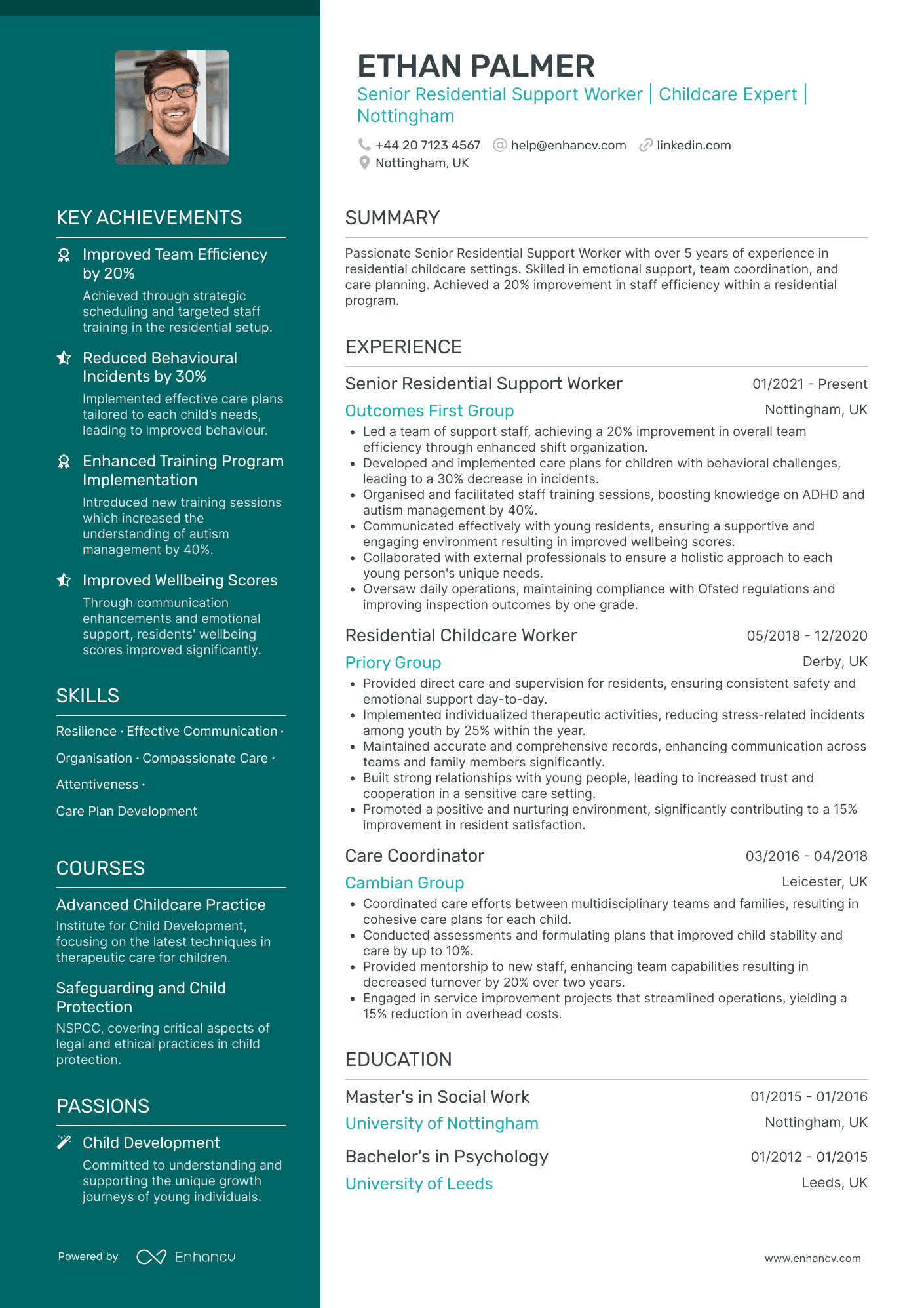
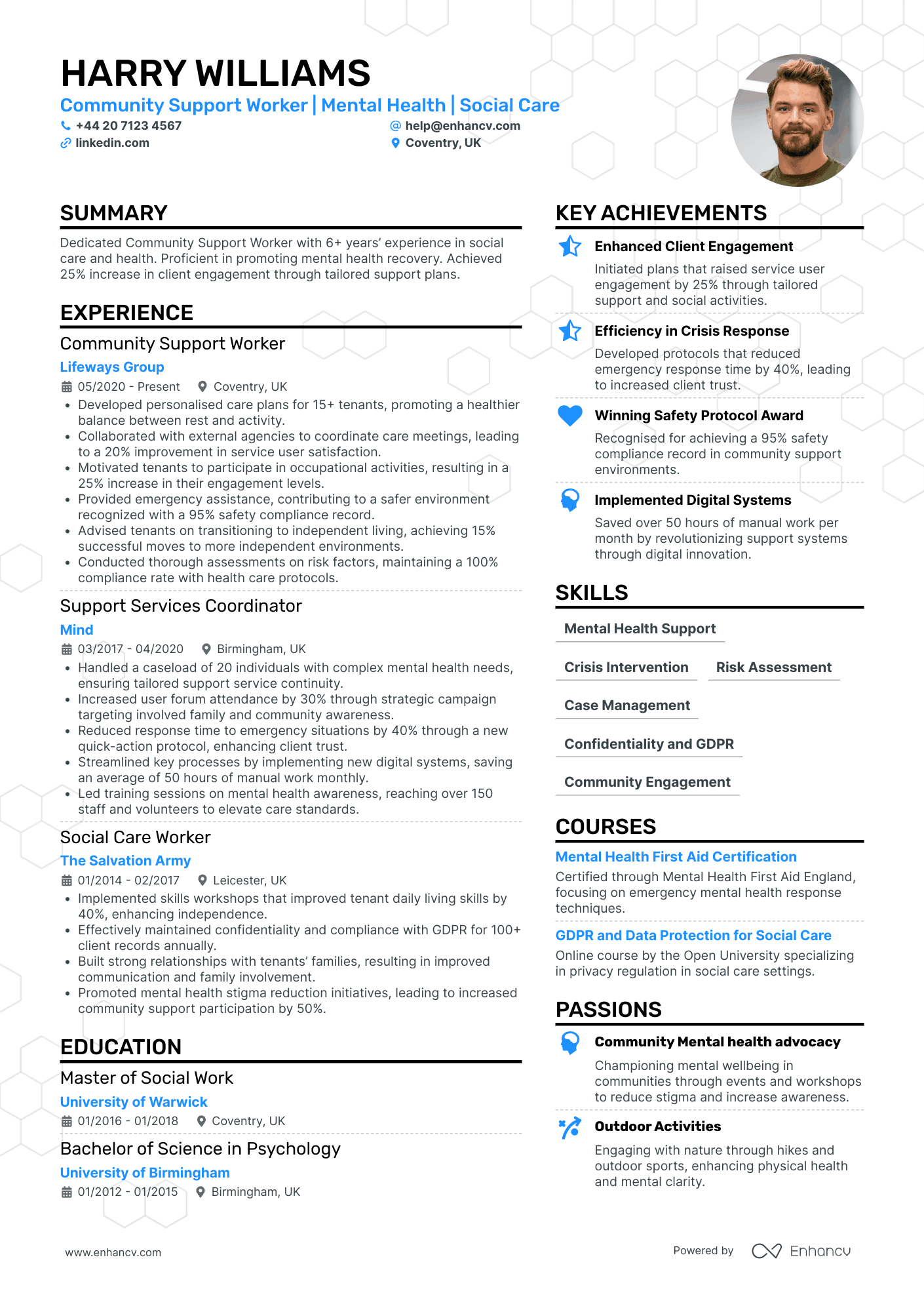
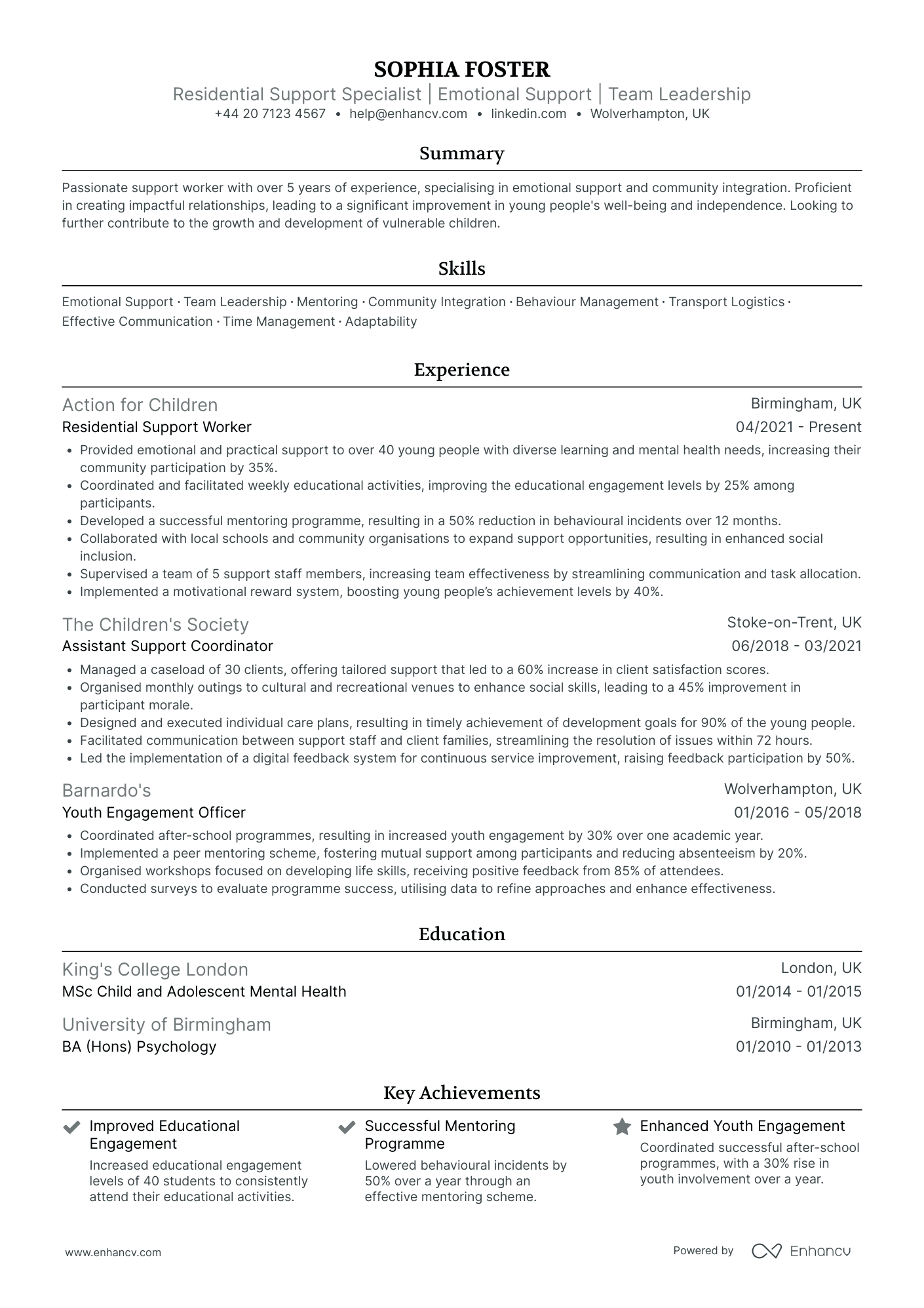
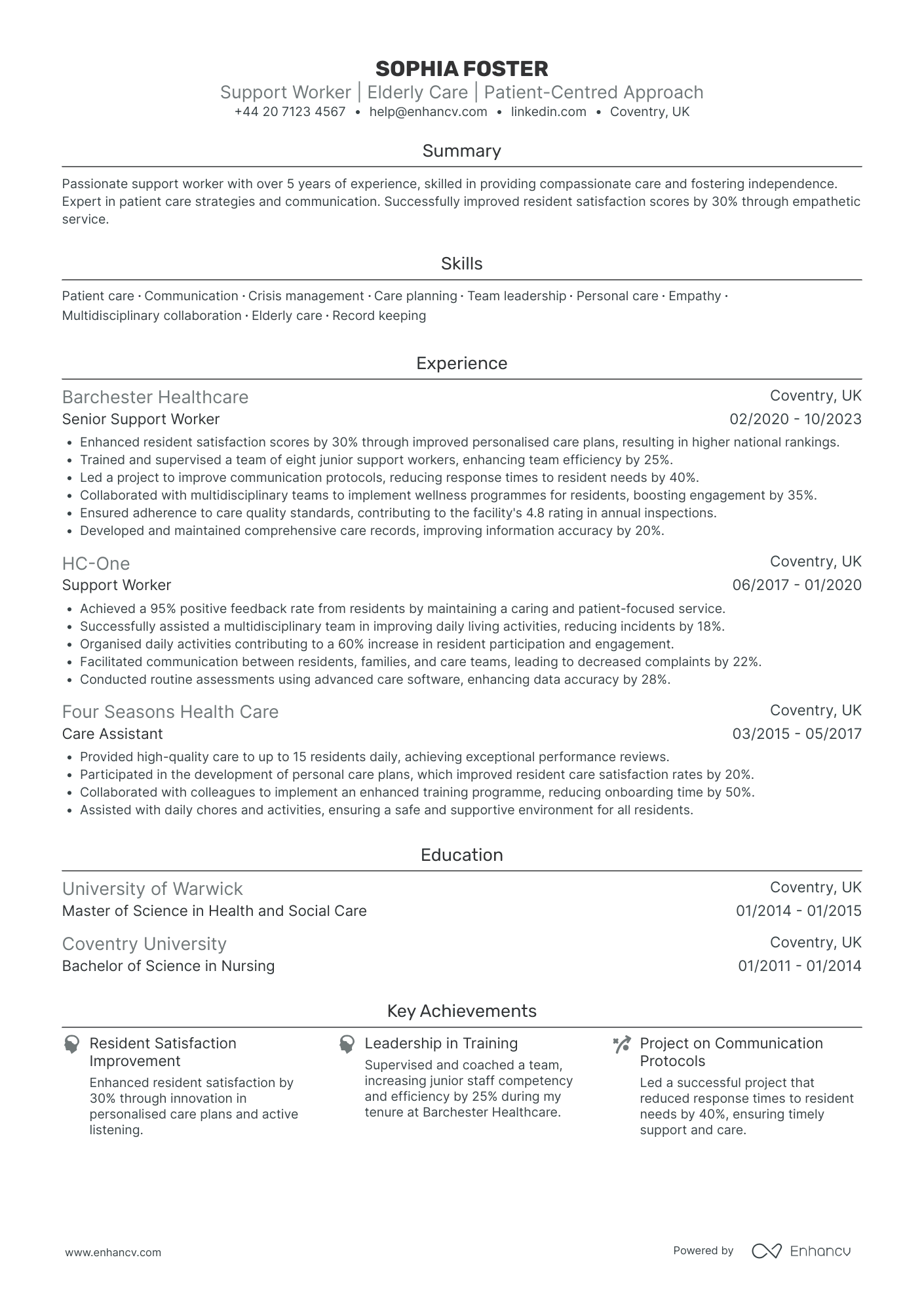
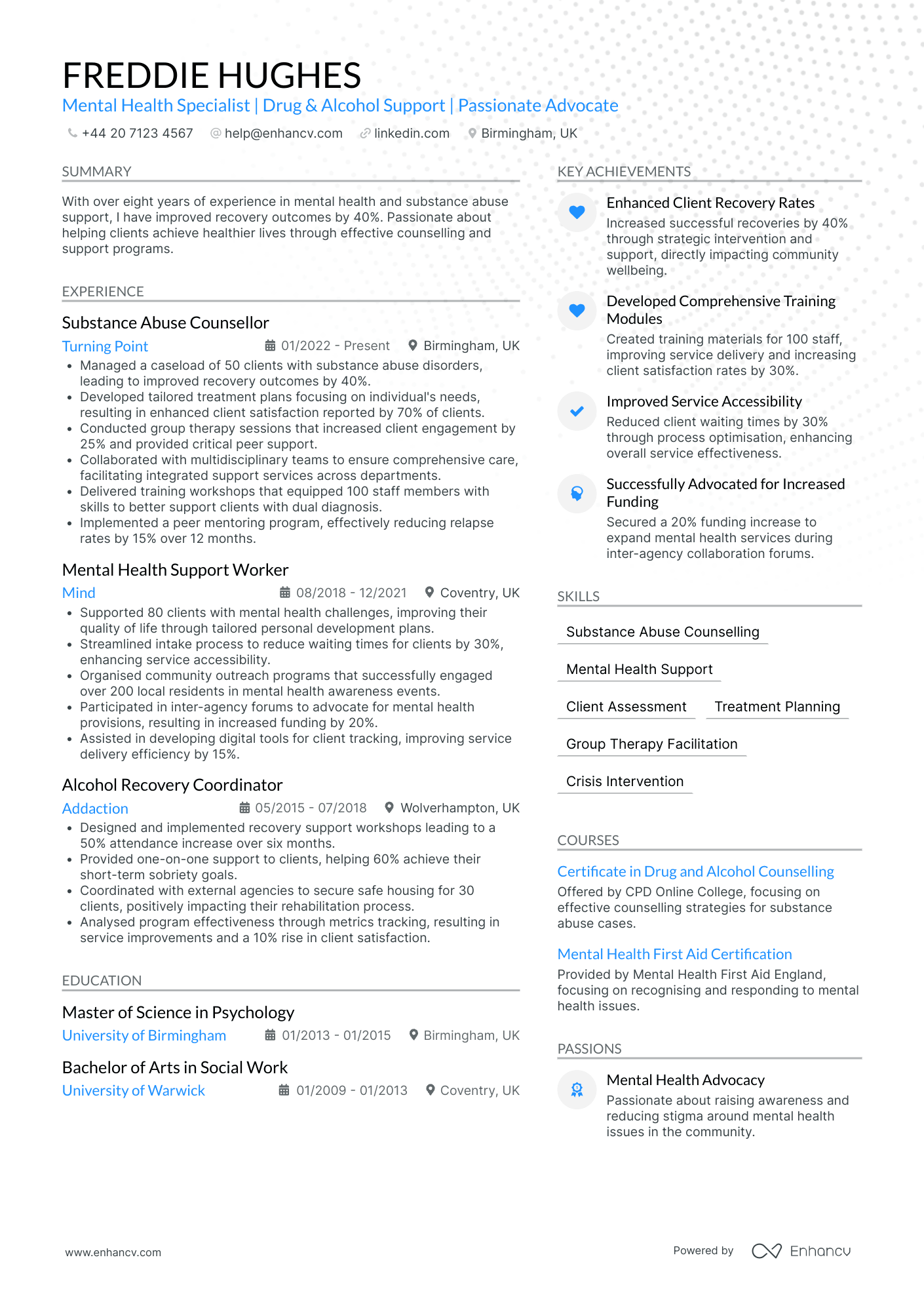
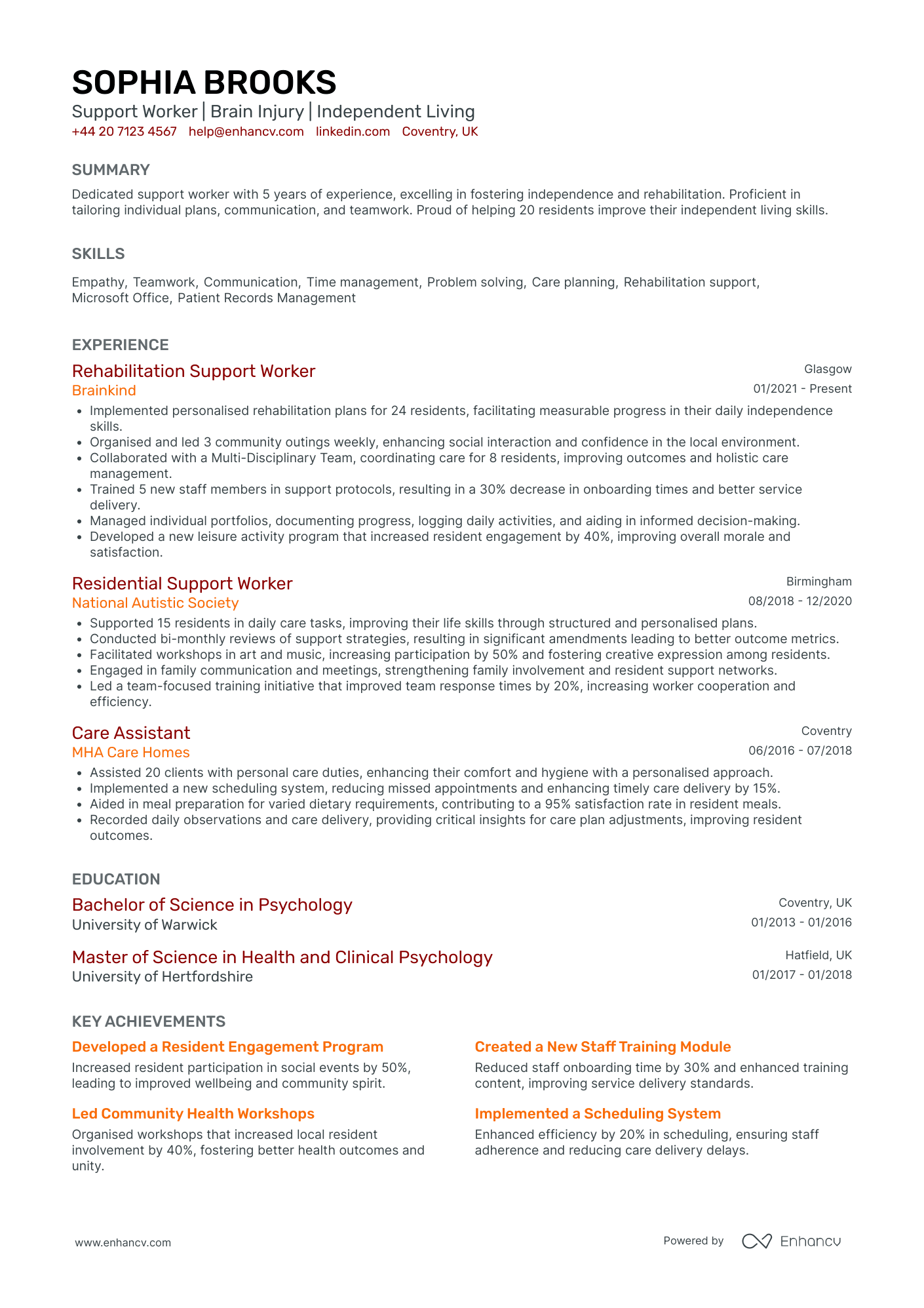
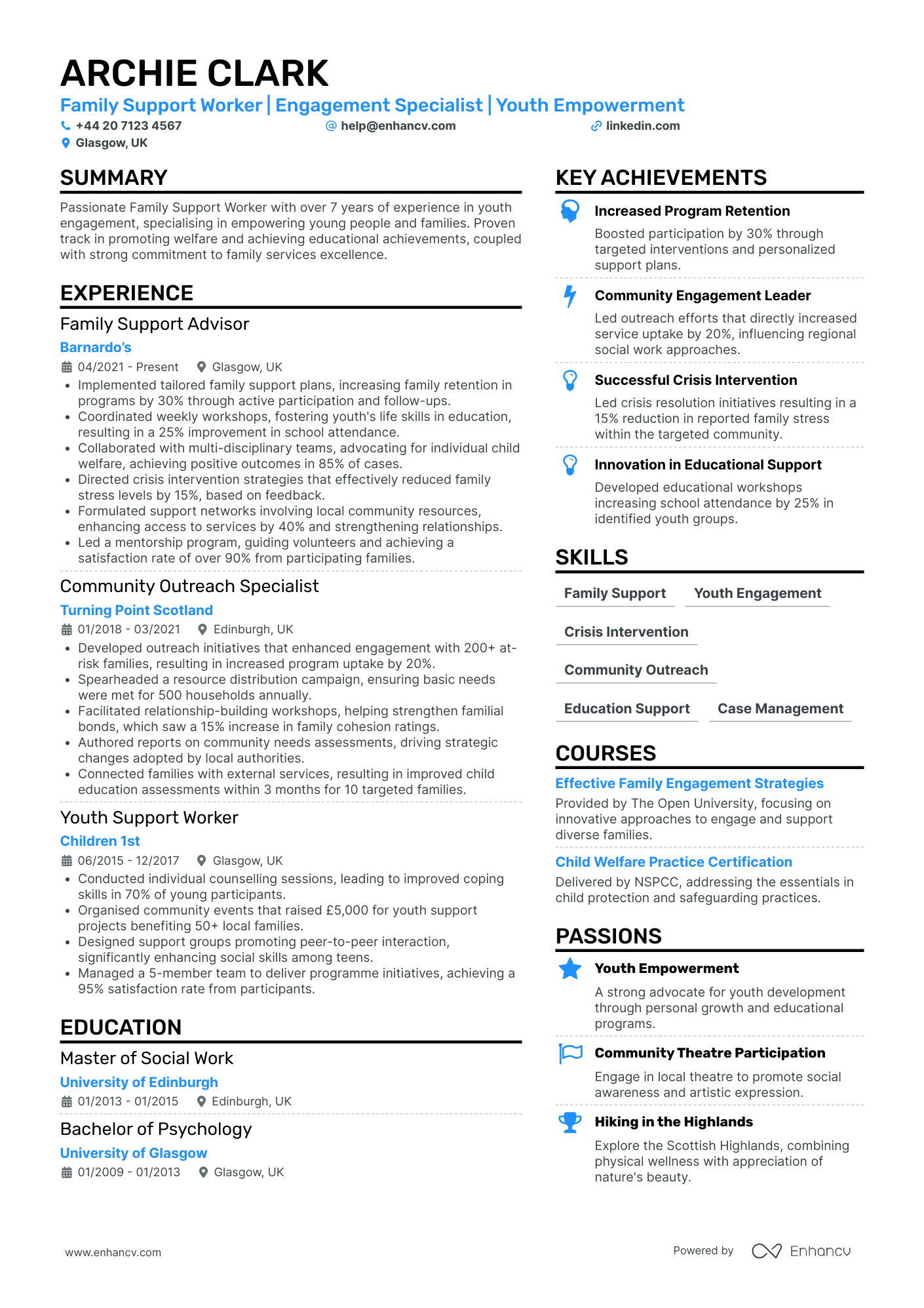
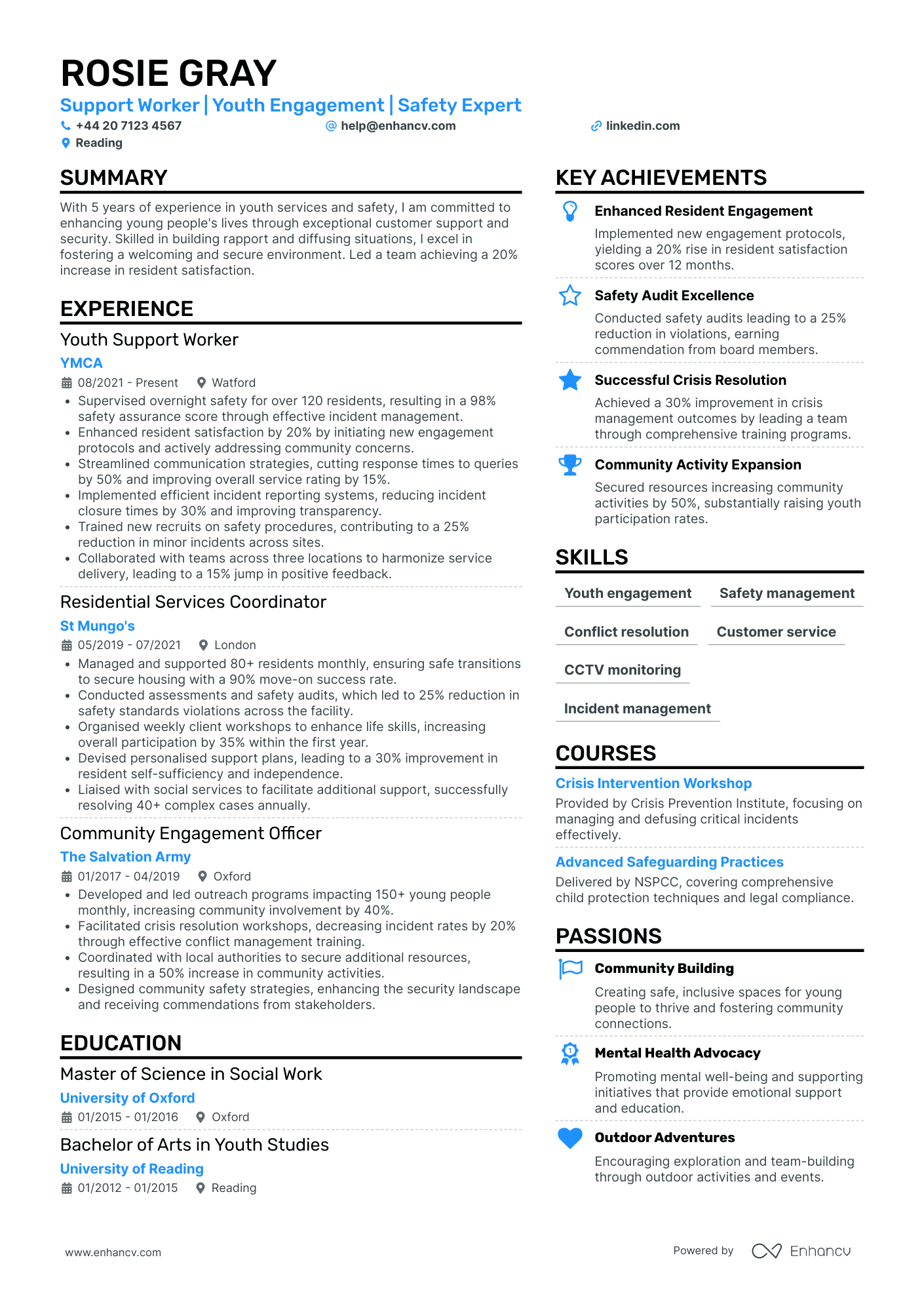
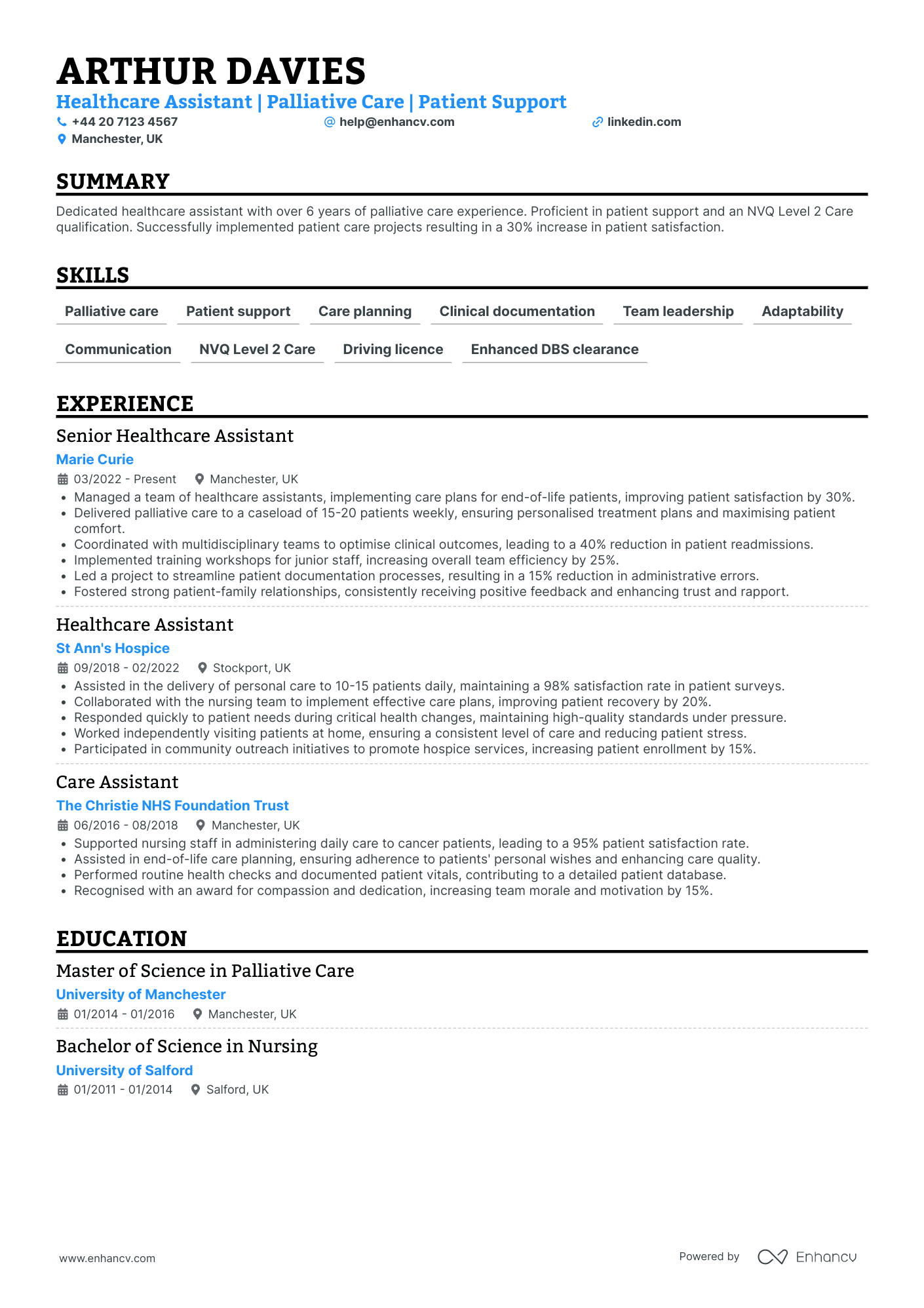
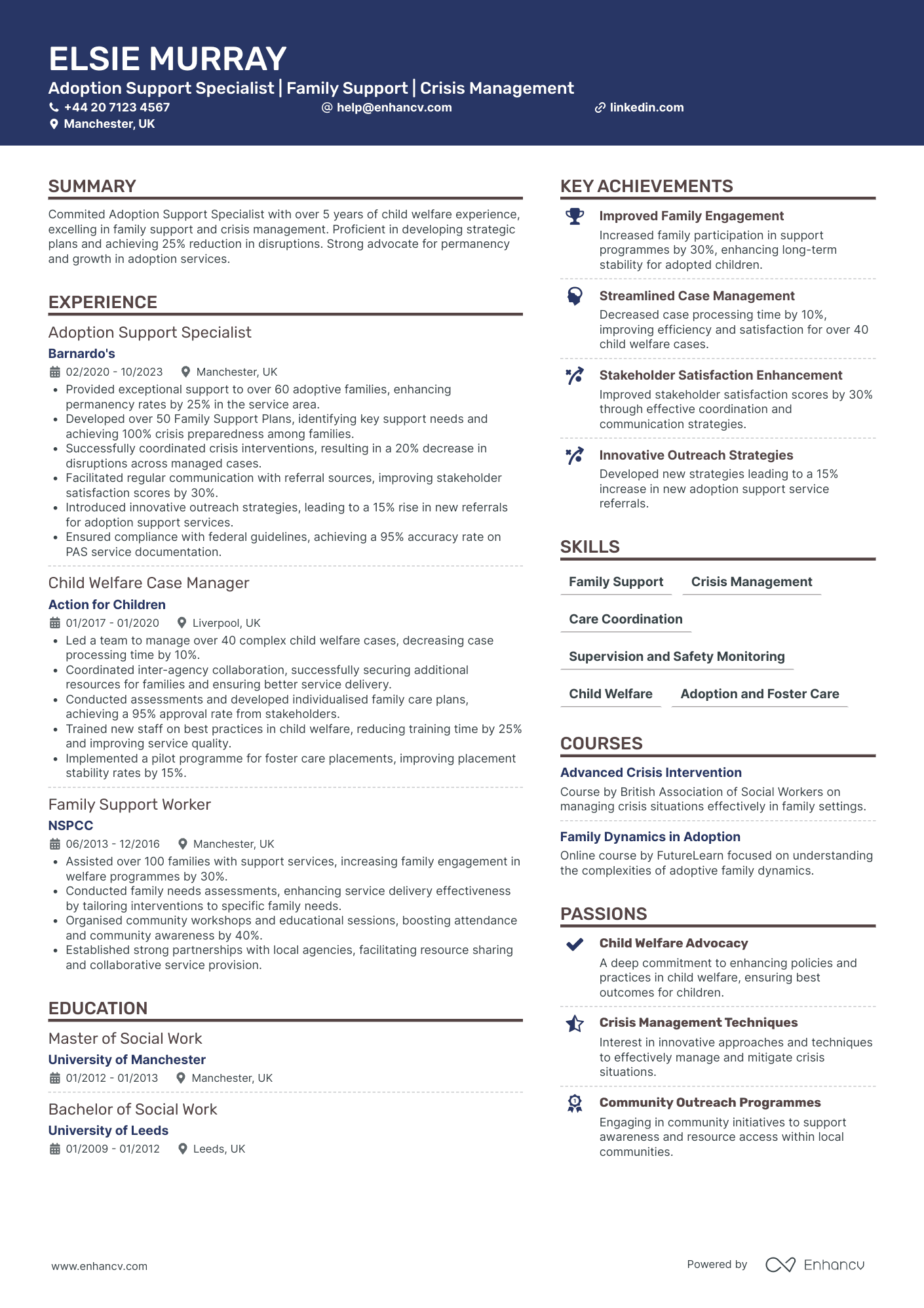
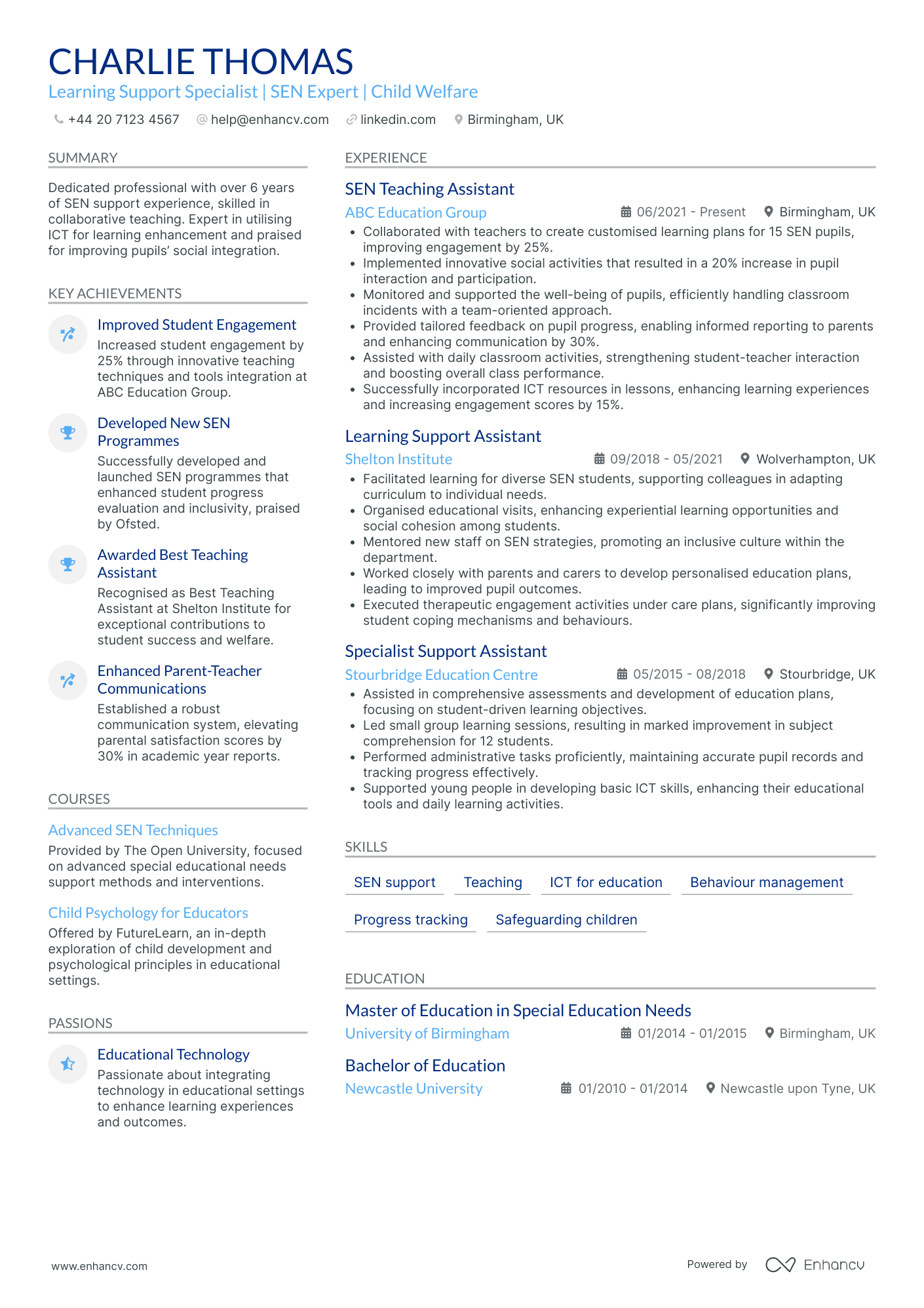
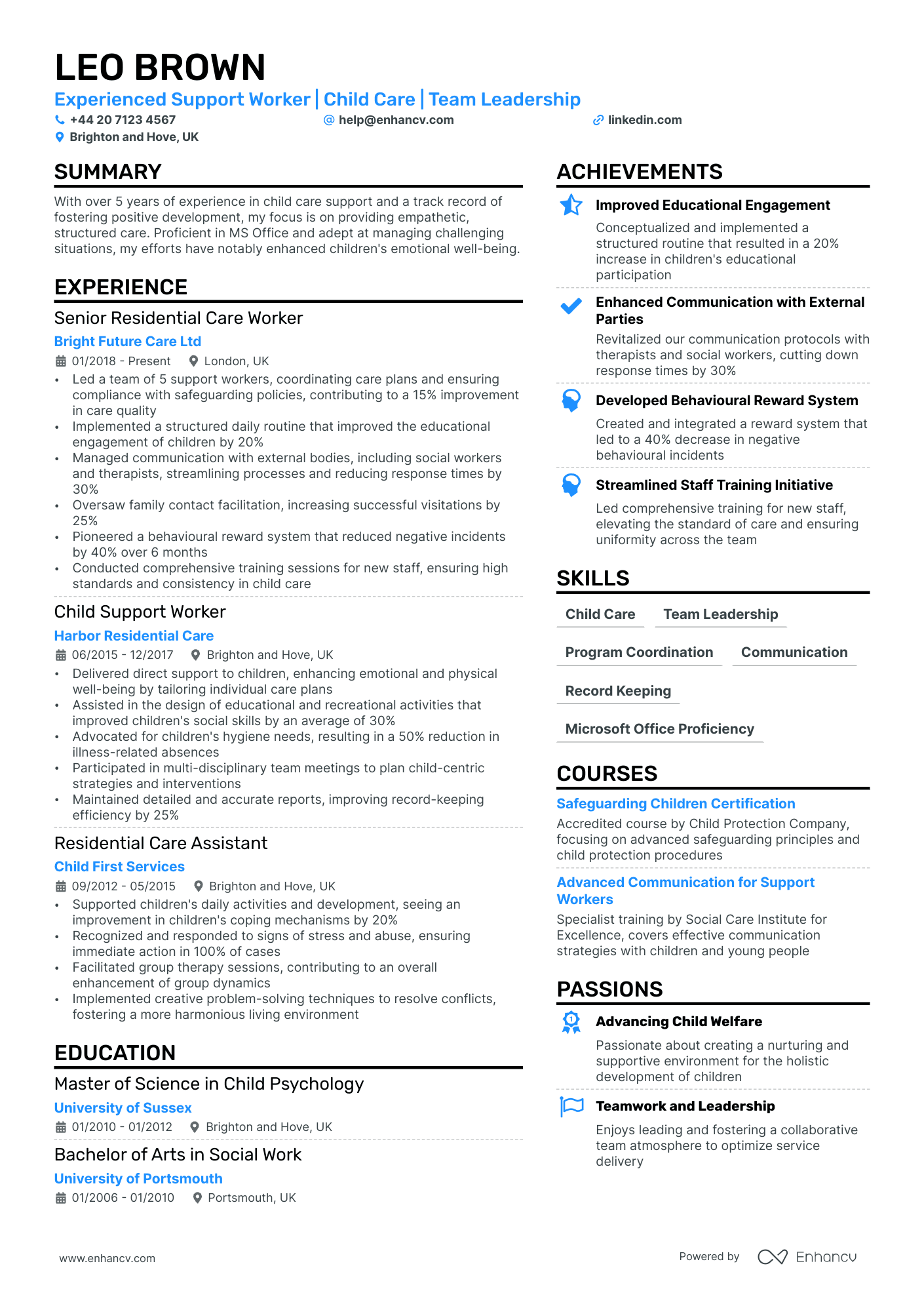
Most support worker CVs list the same soft skills every applicant claims, then bury the one thing a manager actually screens for: whether you can be trusted with vulnerable people and know the specifics of the role.
The strong ones lead with concrete skills and duties, named in the language the adverts use, and back each one with a real example. Get the fundamentals right first with a quick read on how to write a CV, then tailor everything below to the setting you are applying to.

Key takeaways
- Lead with the skills and duties support work is built on: personal care, medication administration, safeguarding, and positive behaviour support.
- Support work is almost always on-site, so put your location and travel radius near the top.
- Name the qualities a manager can check, and prove each one in a bullet rather than claiming it.
- Open with a short personal statement built on values, any care exposure, and one concrete example.
- List an enhanced DBS check and any mandatory training, even in progress. Employers screen for them.
- Two pages, reverse chronological once you have experience, sent as a PDF unless the advert asks for Word.
Top skills for your support worker CV
Read a dozen live support worker adverts and the same demands repeat. Reflective practice, personal care, and medication administration are the skills that recur most often across UK postings, according to Enhancv's internal job feed over the last ~30 days.
Safeguarding, positive behaviour support, and autism support show up almost as often. Those are your hard skills, and you should list them in the exact words the adverts use. A manager scanning for "positive behaviour support plans" wants to see that phrase, not "helping people manage their behaviour".
The five that carry the most weight on a support worker CV are personal care, medication administration, safeguarding, positive behaviour support, and reflective practice. If you can only evidence a few, lead with those.
Top skills for your support worker CV:
Personal care
Medication administration (MAR charts)
Safeguarding
Positive behaviour support (PBS)
Autism and learning-disability support
Reflective practice
Care planning and record keeping
Moving and handling
Communication
Patience
Empathy
Teamwork
Reliability
The soft skills here are real and checkable, not filler. Communication, patience, empathy, teamwork, and reliability decide whether a shift runs well. Prove each one in a bullet instead of listing it: "de-escalated a resident in crisis using their PBS plan" shows more than the word "patient" ever will.
Support work splits into specialisms, and adverts reward the right vocabulary. Learning-disability and autism roles look for positive behaviour support, sensory support, and communication tools like Makaton or PECS. Mental health roles look for recovery-focused support, risk management, and crisis de-escalation. List the ones you have genuinely worked with.
Personal qualities matter as much as competencies in this role. Managers hire for values and train for tasks, so a CV that shows dignity, discretion, and a calm head under pressure reads stronger than one that only claims them. Match your skills section to the advert and keep it to what you can stand behind.
Where do these sit? On a first support worker CV, a short, tight skills list belongs near the top so values and training land before a thin work history. Once you have roles to show, move it below your experience and let the bullets carry the proof.

PRO TIP
Do not list a skill twice. Name it once in your skills section, then evidence it once in a bullet where you used it. A skill that appears only in the list, with no example anywhere in your experience, reads as a claim rather than a competency.
The key duties to put on your support worker CV
Every hiring manager has one question in mind: what does this person actually do on shift? Answer it directly by naming the duties, not by describing yourself as "hard-working".
Five duties sit at the core of most support worker roles:
- Personal care: washing, dressing, toileting, and mealtime support delivered with dignity.
- Medication administration: prompting, recording, and administering under the MAR chart.
- Safeguarding: spotting and reporting concerns, and following local procedures.
- Positive behaviour support: following each person's plan to prevent and de-escalate crises.
- Daily living and community support: budgeting, appointments, activities, and building independence.
Pull the duties from the advert and mirror the ones that are true of you. A job description on a CV should read like the advert's own list, reordered around your strongest evidence.
Settings differ, so read the advert for the type of support. Residential and supported living lean on personal care and positive behaviour support, domiciliary roles add lone working and travel between clients, and mental health roles weight recovery-focused support and risk awareness. Name the version that matches the job in front of you.
What the UK support worker market looks like
Knowing the market shapes the CV. Here is where the work happens and what employers ask for most.
| What | UK support worker roles |
|---|---|
| Where the work happens | On-site, 96% of postings (1,357 of 1,407 UK postings in the last ~30 days, Enhancv's internal job feed) |
| Experience level asked for | Mostly entry level (1,195 of 1,407 postings). A first CV with little paid experience is viable. |
| Skills that recur most | Reflective practice, personal care, medication administration, safeguarding, positive behaviour support, autism support |
| Verified salary | No reliable figure available. Pay varies by setting and shift pattern, so check the advert. |
Support work is almost entirely on-site, so a recruiter needs to see you can reliably get there. Put your town and a travel radius in the personal details at the top, and mention a driving licence and access to a car if you have them, since many community roles require it.
Most postings are pitched at entry level, which is why a first support worker CV with little paid experience is realistic rather than wishful. The sector hires for values and trains for tasks.
No reliable salary figure sits behind these postings, so treat any single number with caution and check the advert. Pay varies widely by setting, shift pattern, and whether sleep-ins or waking nights are involved.
The picture also tells you where to aim. A large entry-level base sits below senior support worker, team leader, and coordinator roles, so a CV that shows training completed and responsibility taken on positions you for the next step, not only the first one.
Formatting your support worker CV
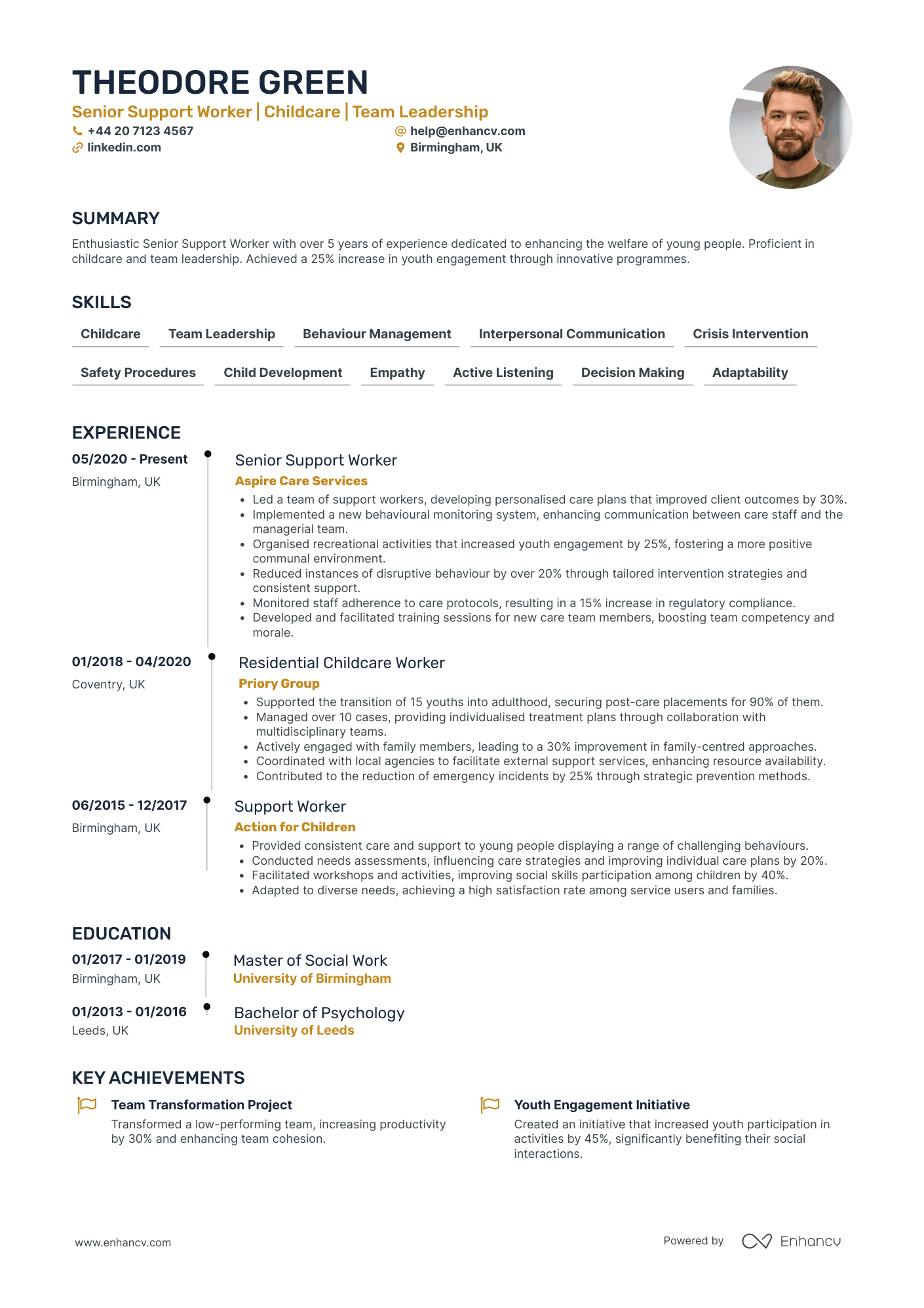
Once you have support roles behind you, use a reverse chronological structure. For a first CV, lead with a skills-led structure so values and training come before a thin work history.
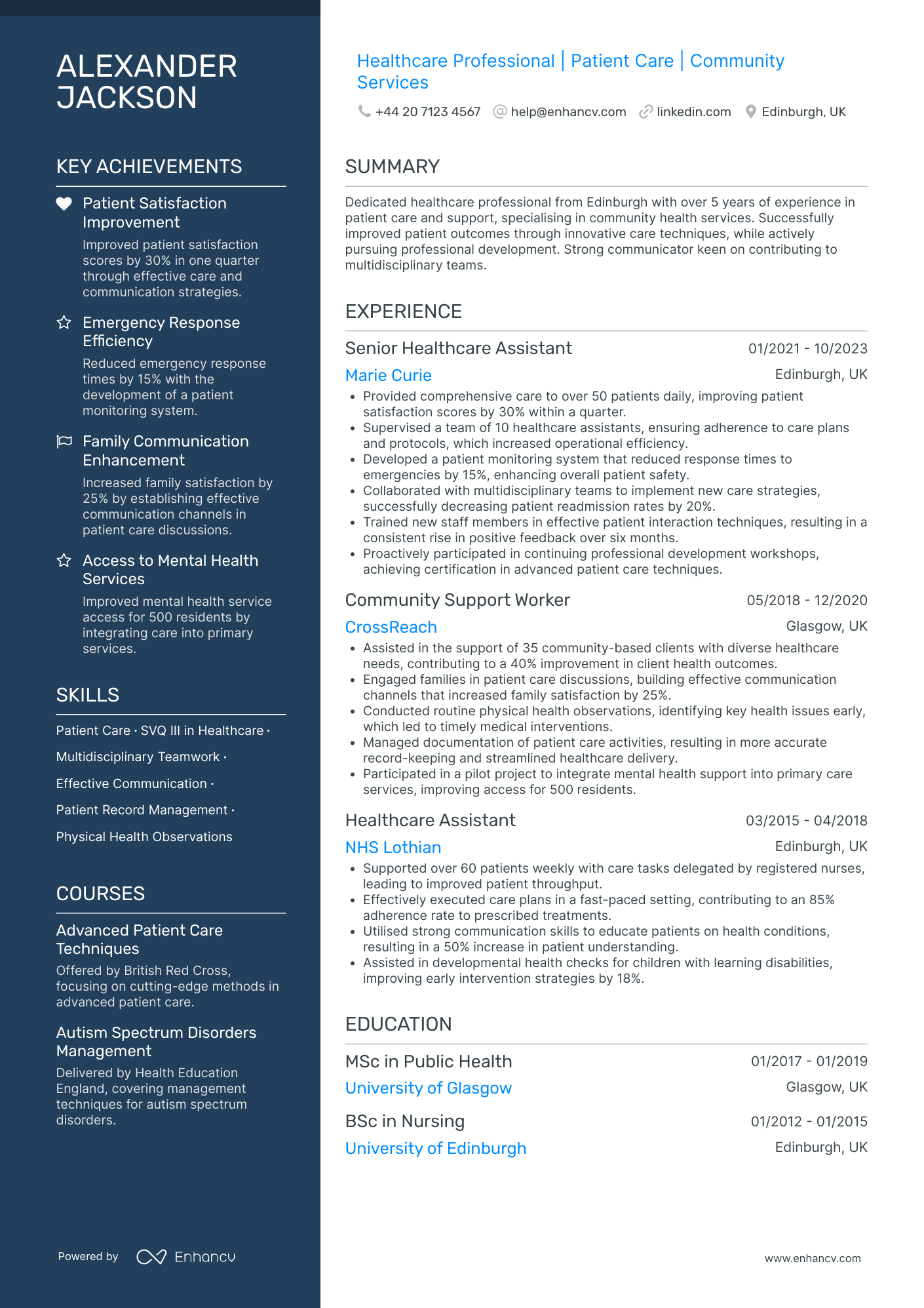
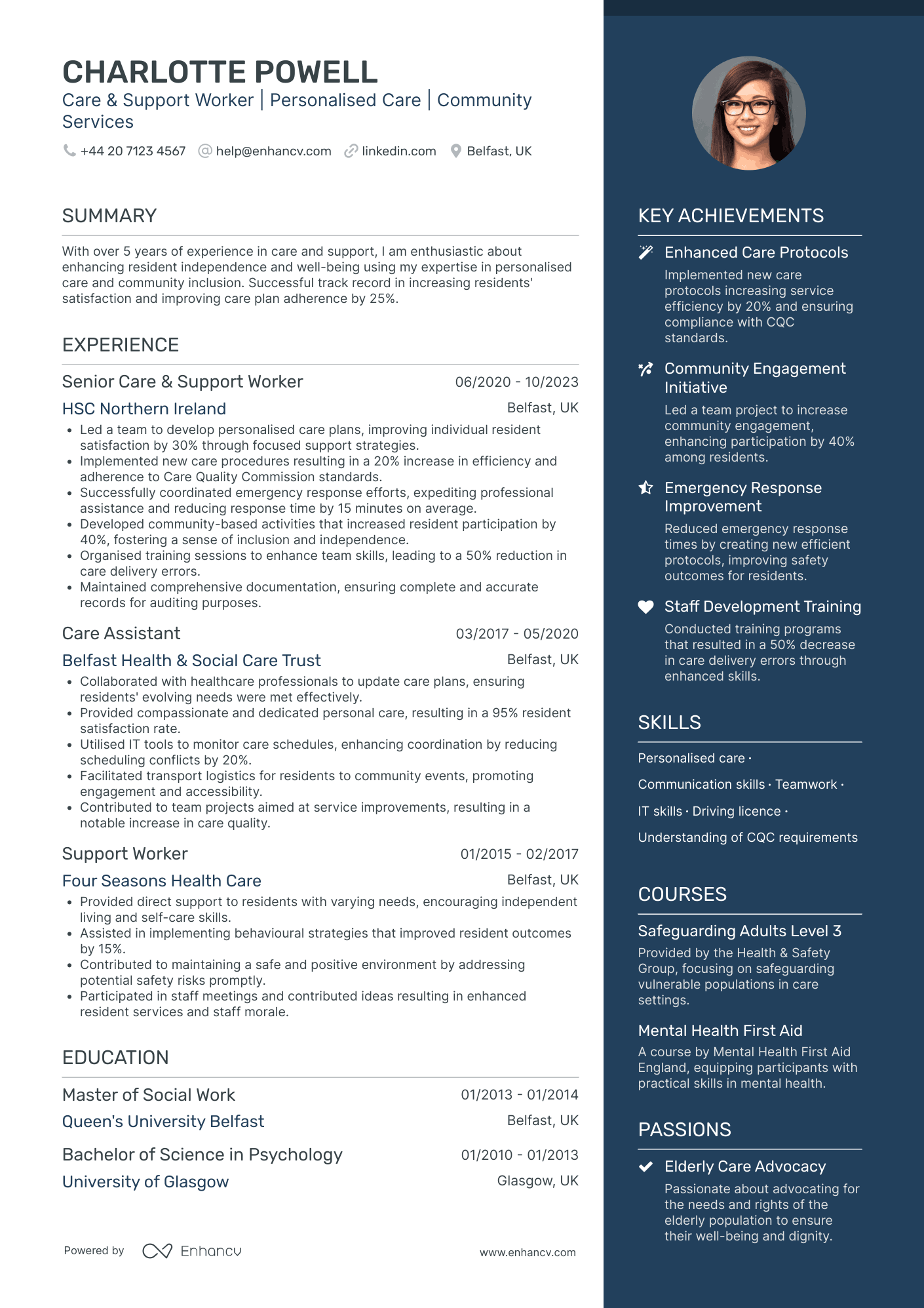
Keep it to two pages, one column, standard headings, and a readable font. Managers skim between shifts, so a clean layout beats a decorative one.
Your header needs your name, phone number, email, and location. Skip a photo, a date of birth, and your full street address, since UK employers do not expect them and they can invite bias.
Send a PDF for direct applications so the layout holds. Keep a Word copy for agencies, which place a large share of support roles and reformat CVs into their own template. If the advert names a file type, follow it.
Applications often pass through tracking software, so keep the headings standard and the wording aligned to the advert for an ATS-friendly CV. Build it from a tested layout rather than a blank page: Enhancv's CV templates export to a clean PDF.
Writing your support worker personal statement
Three or four sentences at the top: who you are, the values you bring, any exposure to care or support, and why this employer. Keep it concrete. See more personal statement examples if the opening line is stalling you.
Avoid the adjective soup every other CV uses. "Caring, passionate, and hard-working" tells a manager nothing they can verify.
Lead with evidence instead:
Support worker CV personal statement example
Reliable and patient support worker with three years supporting adults with learning disabilities and autism in supported living. Experienced in personal care, medication administration under MAR charts, and following positive behaviour support plans. Level 3 Diploma in Adult Care and an enhanced DBS on the update service. Looking to bring a calm, person-centred approach to a supported living role near Bristol.
Compare that with the version a manager skims straight past, one that could belong to any applicant for any job:
Support worker personal statement to avoid
Hard-working and passionate individual seeking a support worker role. I am caring, a good team player, and always willing to go the extra mile. I work well under pressure and am looking for a new challenge where I can really make a difference.
Nothing in it can be checked. Swap every claim for a specific: a setting, a task, and how long you did it.
When we read a support worker CV, we look for one thing first: evidence you understand the day-to-day reality of the role. A line like "followed a resident's PBS plan to de-escalate a crisis without restraint" tells us more than any list of adjectives. Name the setting, the people you supported, and what you actually did. Pair that with your training and a current DBS check, and a manager can picture you on shift before the interview.
The Enhancv team
Writing your support worker experience section
Whether it is paid, agency, or voluntary, write each entry the same way: a dated heading, then bullets that show what you did and the outcome. Lead each bullet with a verb. For the mechanics, see work experience on a CV.
Support work is measurable even when it does not feel like it: people supported, incidents de-escalated, care records kept clean, independence goals met. Those details are your CV achievements.
You will not have sales figures, but you have numbers. A medication audit passed, a caseload size, shifts covered at short notice, an incident rate brought down. One real number anchors a bullet better than three adjectives.
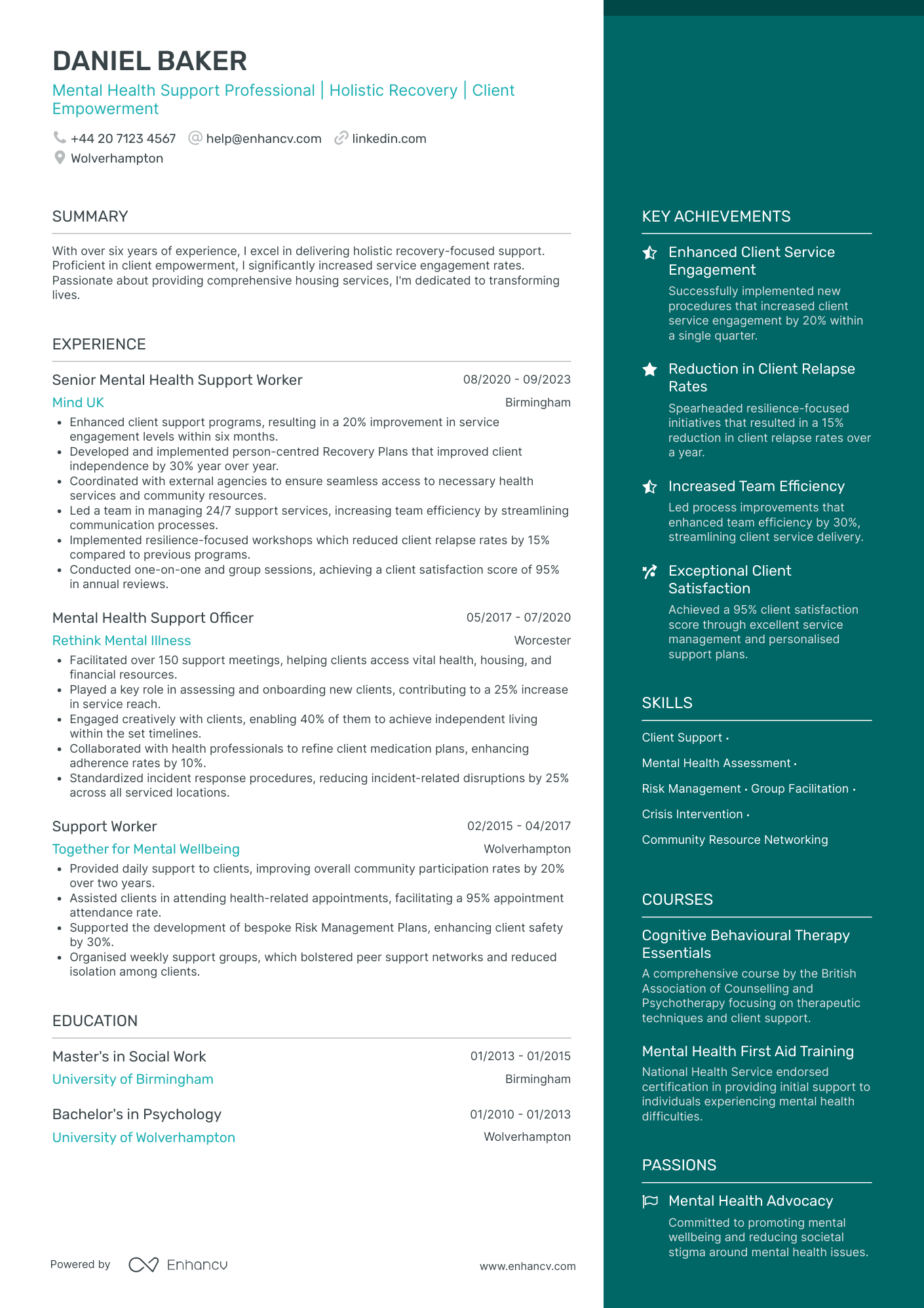
- Support six adults with learning disabilities and autism across waking days and sleep-ins, following each person's care and positive behaviour support plan
- Administer and record medication under MAR charts with a zero-error audit over 18 months
- De-escalated behaviours of concern using positive behaviour support, reducing recorded incidents on my caseload by a third
- Completed safeguarding, moving-and-handling, and epilepsy-awareness training, and mentor two new starters through their induction
- Covered day, night, and sleep-in shifts across residential and supported-living settings at short notice
- Delivered personal care and medication support to adults with physical and learning disabilities
- Kept accurate daily notes and handovers so the next shift picked up without gaps
Tailor every application. Pull the duties and specialist terms from the advert and mirror them where they are true of you. Enhancv's CV tailoring feature reads the ad and suggests the matching edits, which saves rewriting from scratch each time.
PRO TIP
Support adverts name specifics, not soft-skill clouds. Mirror the ones you can back: "medication administration", "PEG feeding", "PBS plans", "safeguarding", "moving and handling". If you have been trained in it, name it exactly as the advert does.
Qualifications, training, and checks employers expect
You rarely need a degree to start, which is why the entry-level route works. What employers do check is a willingness to complete mandatory training and a clean background check.
List these where you have them, even "in progress": the Care Certificate, an NVQ or Diploma Level 2 or 3 in Adult Care, and core training in safeguarding, medication, moving and handling, and positive behaviour support. Put them in your education section or a dedicated training block.
Specialist training is worth naming separately, since each item maps straight to an advert: positive behaviour support, autism awareness, Makaton, epilepsy and buccal midazolam, PEG feeding, and first aid. Every one you list is a task the employer does not have to train from scratch.
An enhanced DBS check belongs on the CV, ideally noted as being on the update service. It is a baseline expectation for the role, and listing the certificates you hold saves the employer a question.
Writing a support worker CV with no experience
Support work is one of the most entry-friendly fields in the UK. Employers hire on values and trainability, and most provide the specialist training once you start.
Mine your life for real evidence. It is almost always there:
- Caring for a family member: personal care, medication reminders, appointments, and managing a routine.
- Volunteering in a care home, hospice, charity, or community group.
- Retail or hospitality: patience under pressure and a duty of care to the public.
- Any role with vulnerable people: SEN support, childcare, first aid, or youth work.
Write those in support language. "Supported a relative with daily personal care and medication for two years" is a support worker bullet that happened at home, and volunteering on a CV counts as experience, not filler.
Give volunteering a dated entry like a job, with duties and hours. One line moves a first CV up the pile: "Care Certificate in progress" or "enrolled on NVQ Level 2 Adult Care". It signals you are already on the path.
Conclusion
Lead with the skills and duties support work is built on, prove your values with real examples, and name the training and checks employers screen for.
Pair the CV with a short cover letter that says why you want to support people, and you turn a plain application into a credible one.
Tailor it to each advert, keep every claim honest, and the CV does the one job it is built for: getting you in front of a manager for an interview.

Author's take - The Enhancv team
When we read a support worker CV, we look for one thing first: evidence you understand the day-to-day reality of the role. A line like "followed a resident's PBS plan to de-escalate a crisis without restraint" tells us more than any list of adjectives. Name the setting, the people you supported, and what you actually did. Pair that with your training and a current DBS check, and a manager can picture you on shift before the interview.