



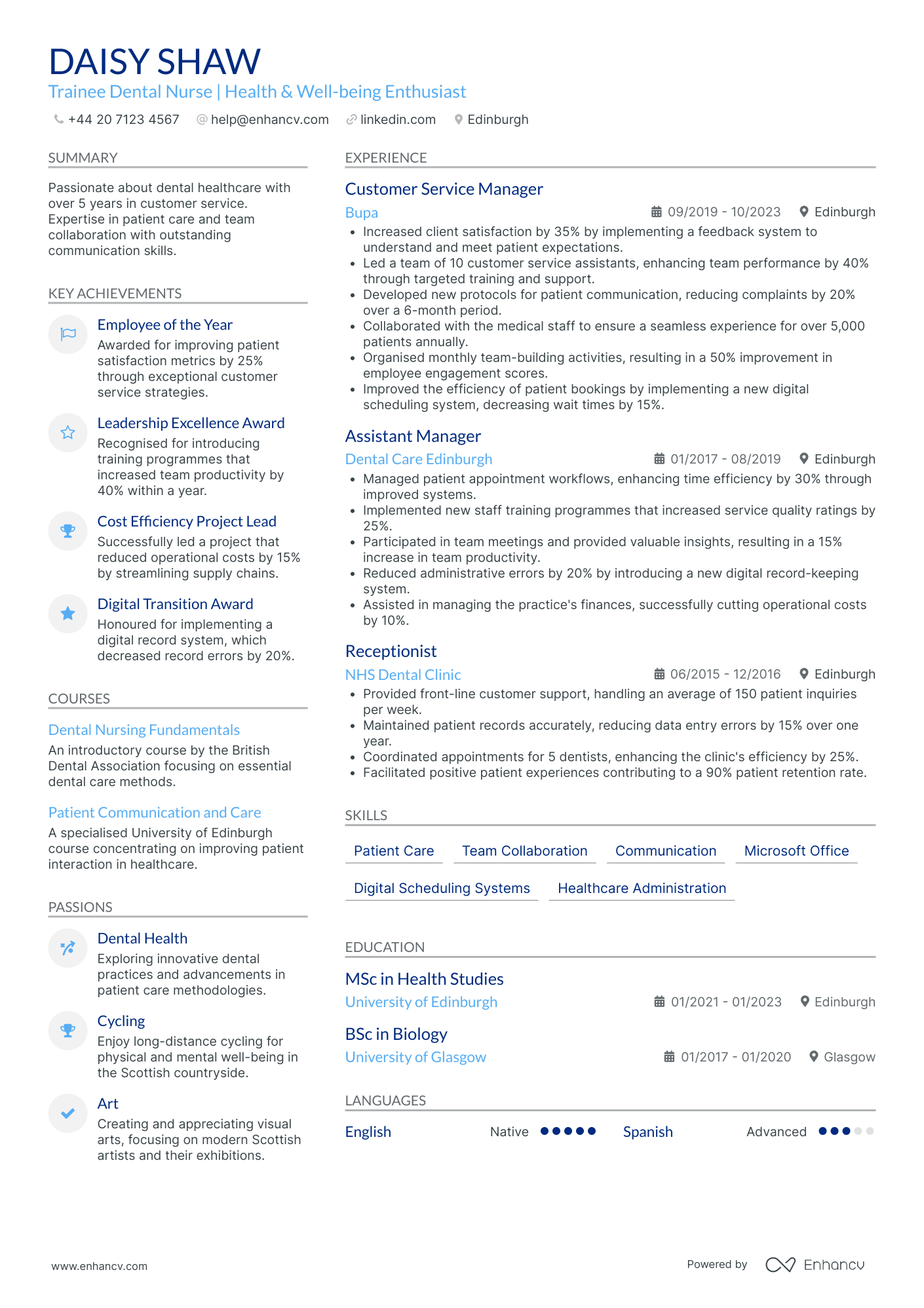
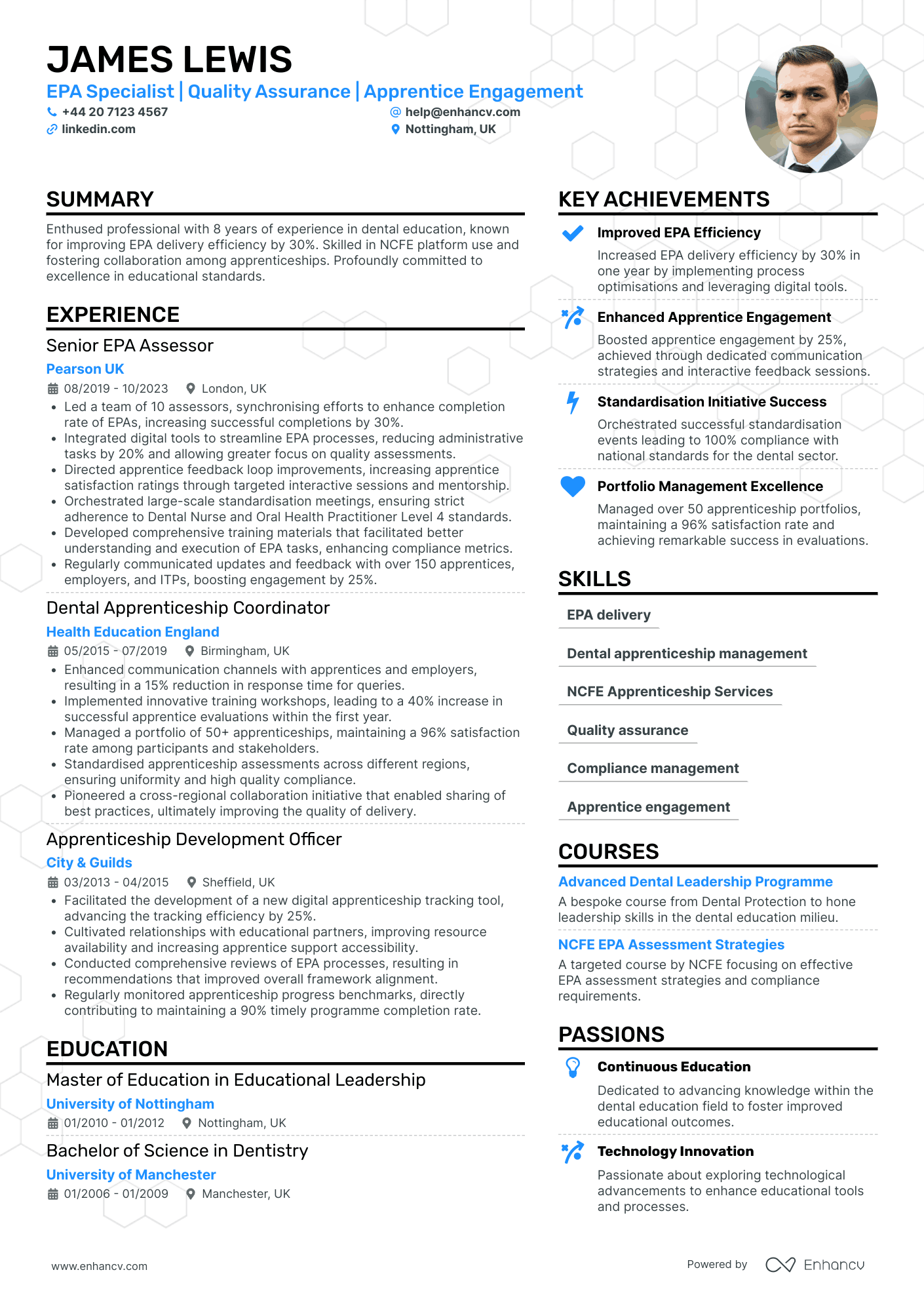
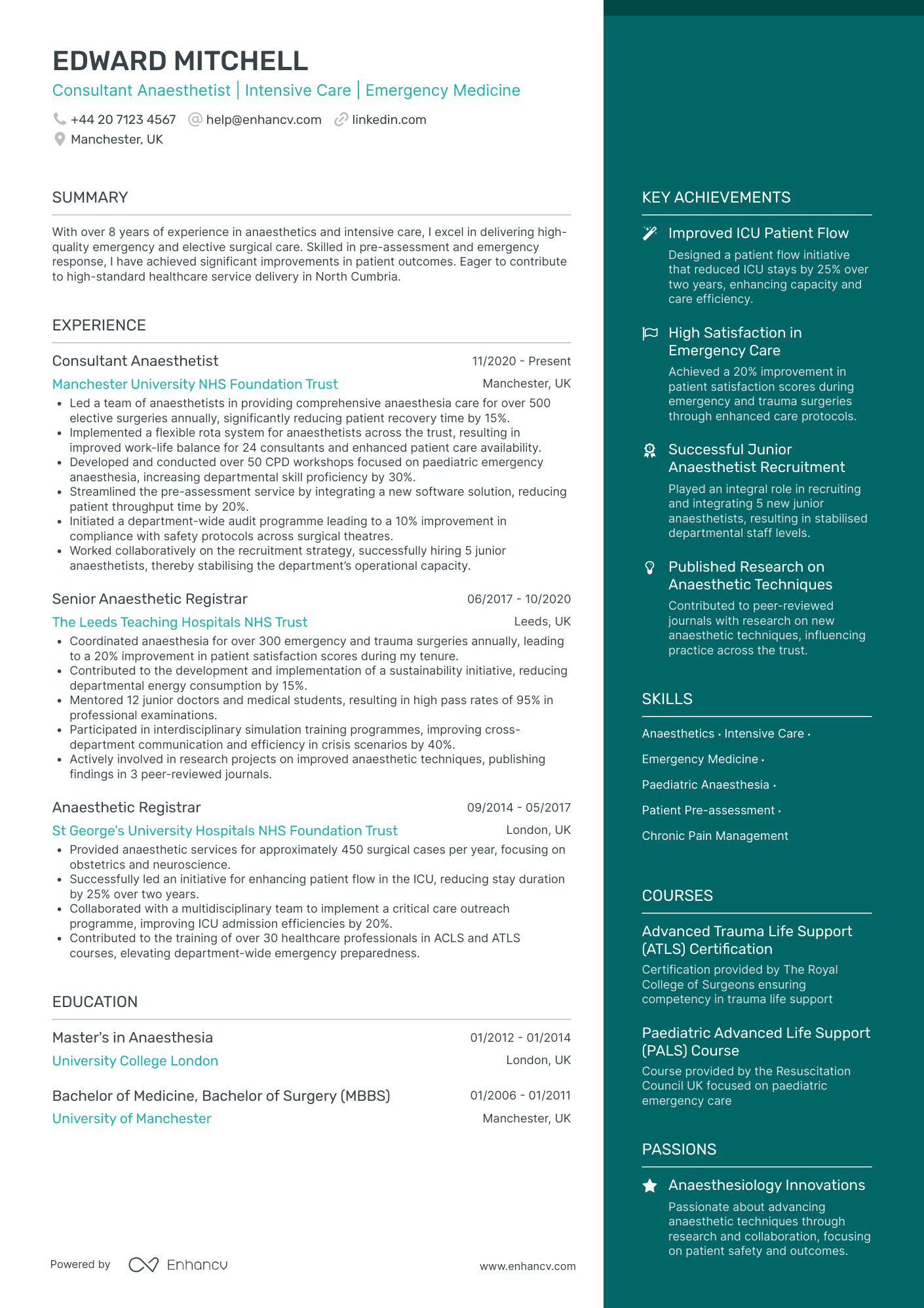
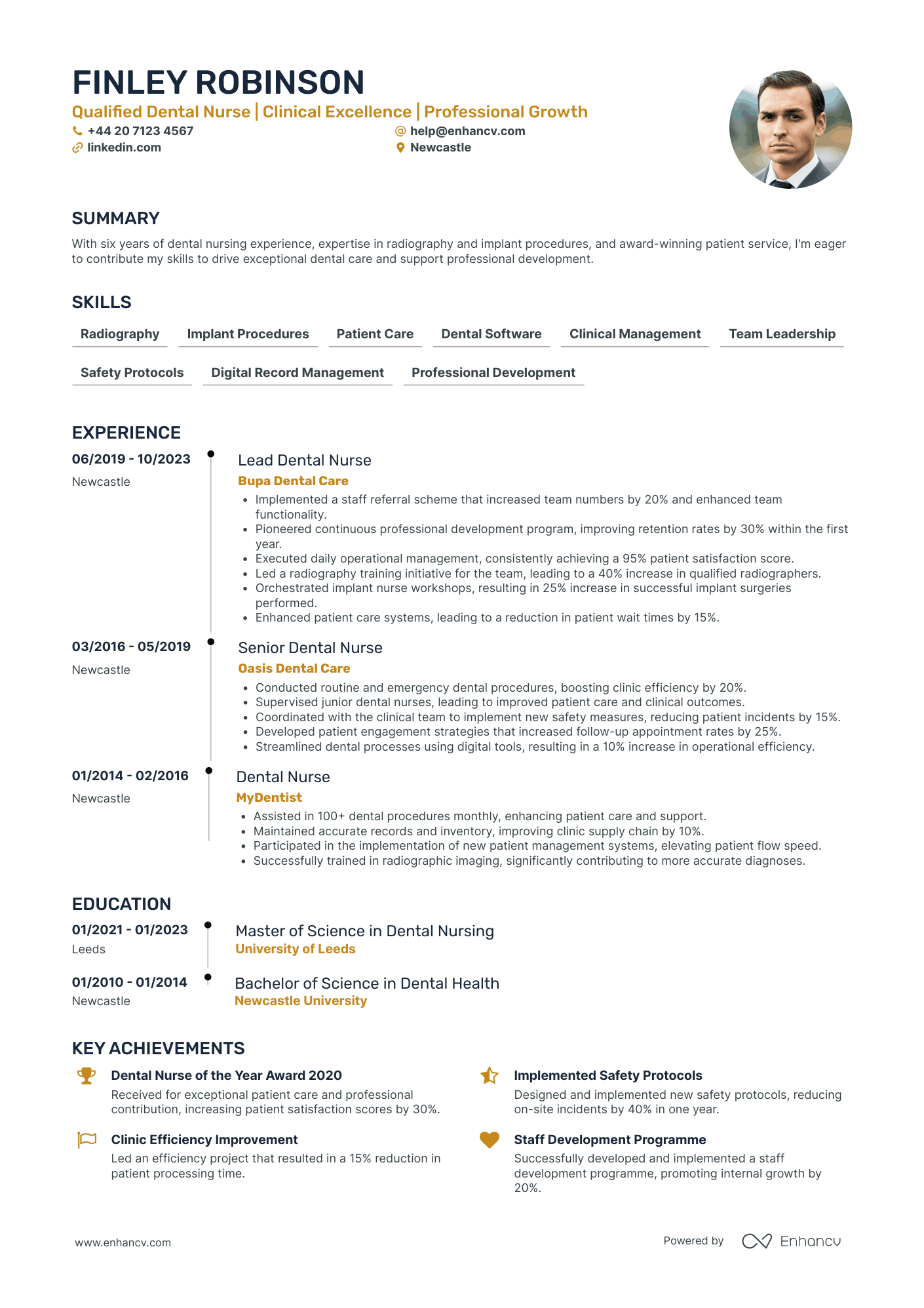
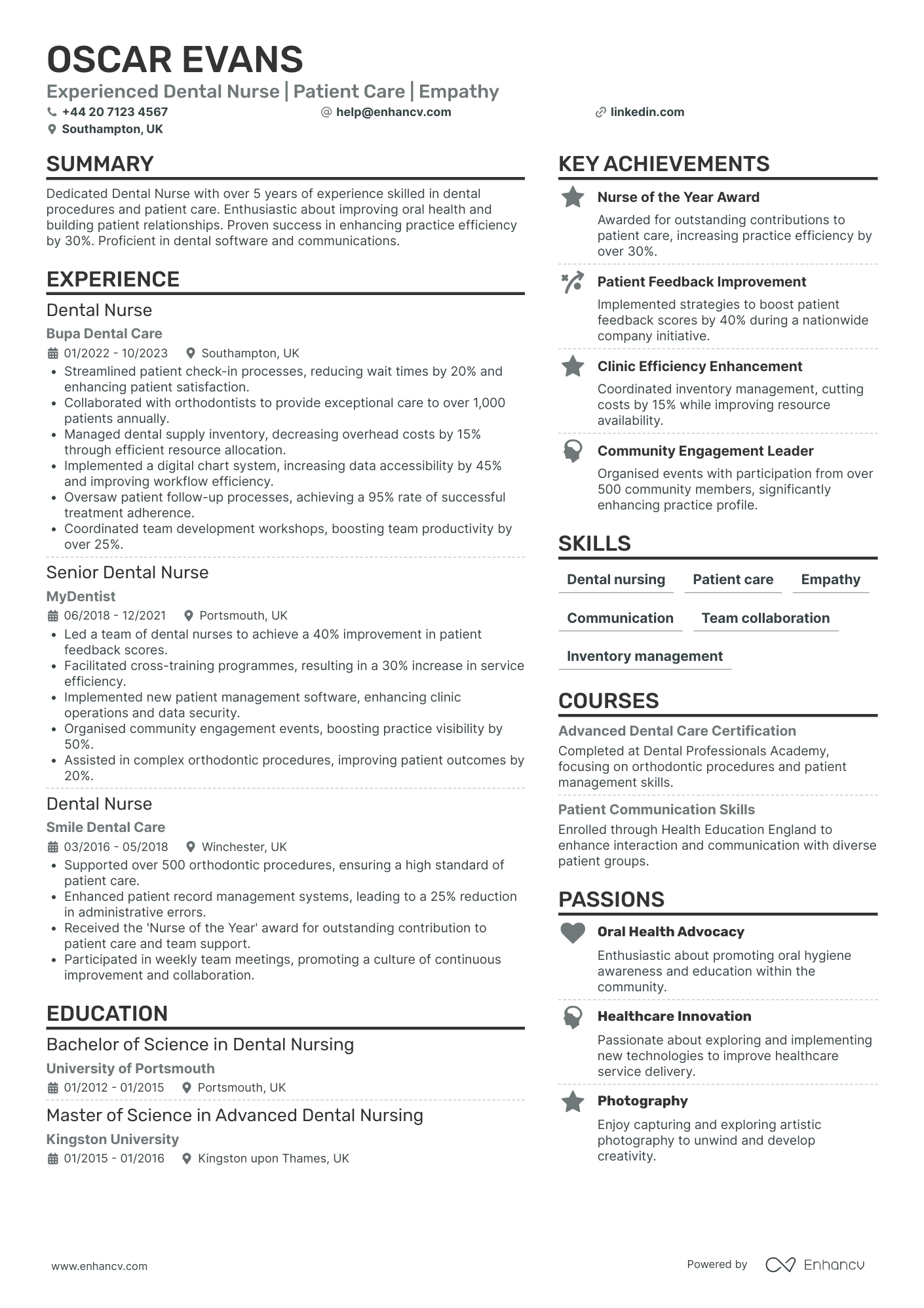
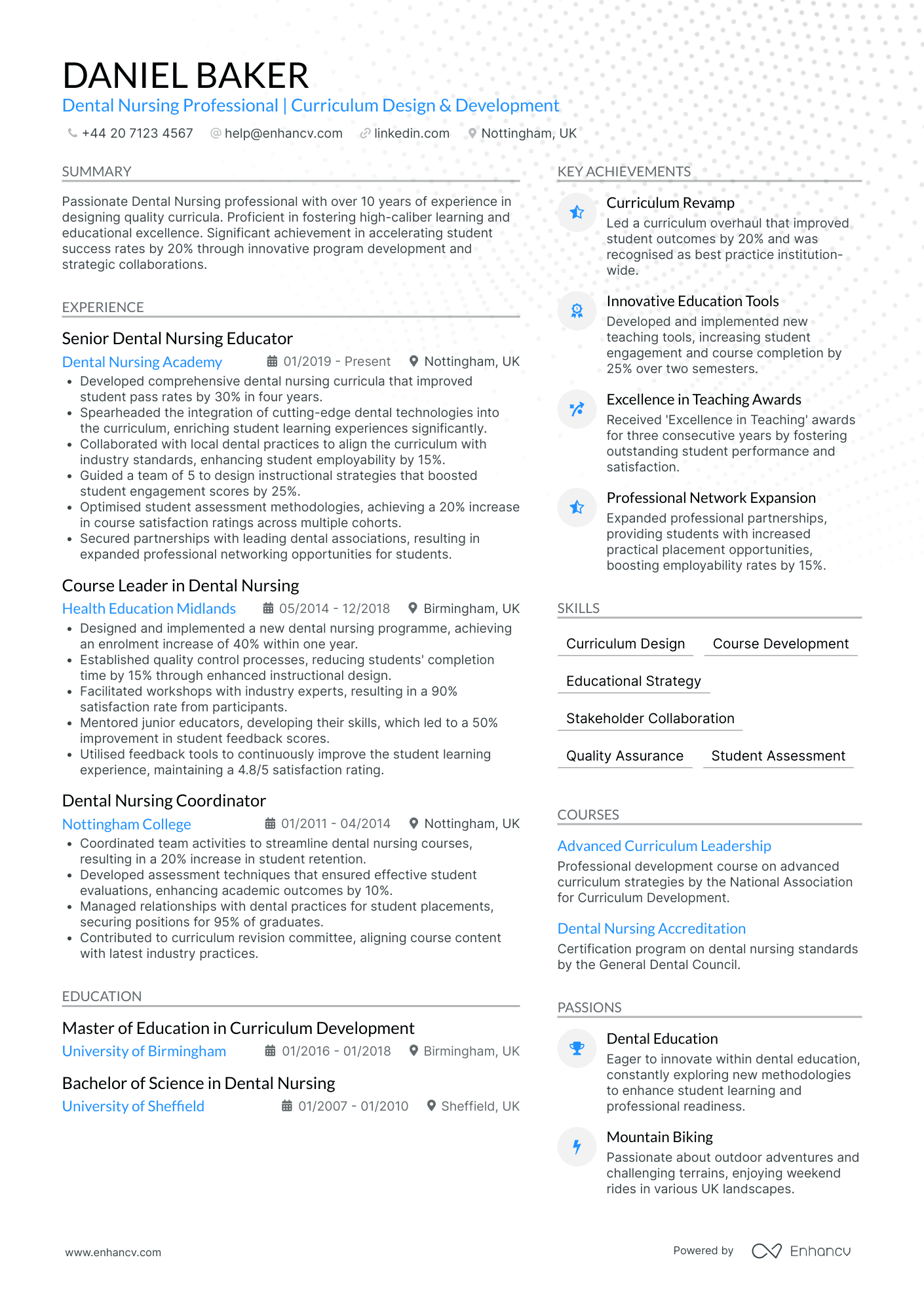
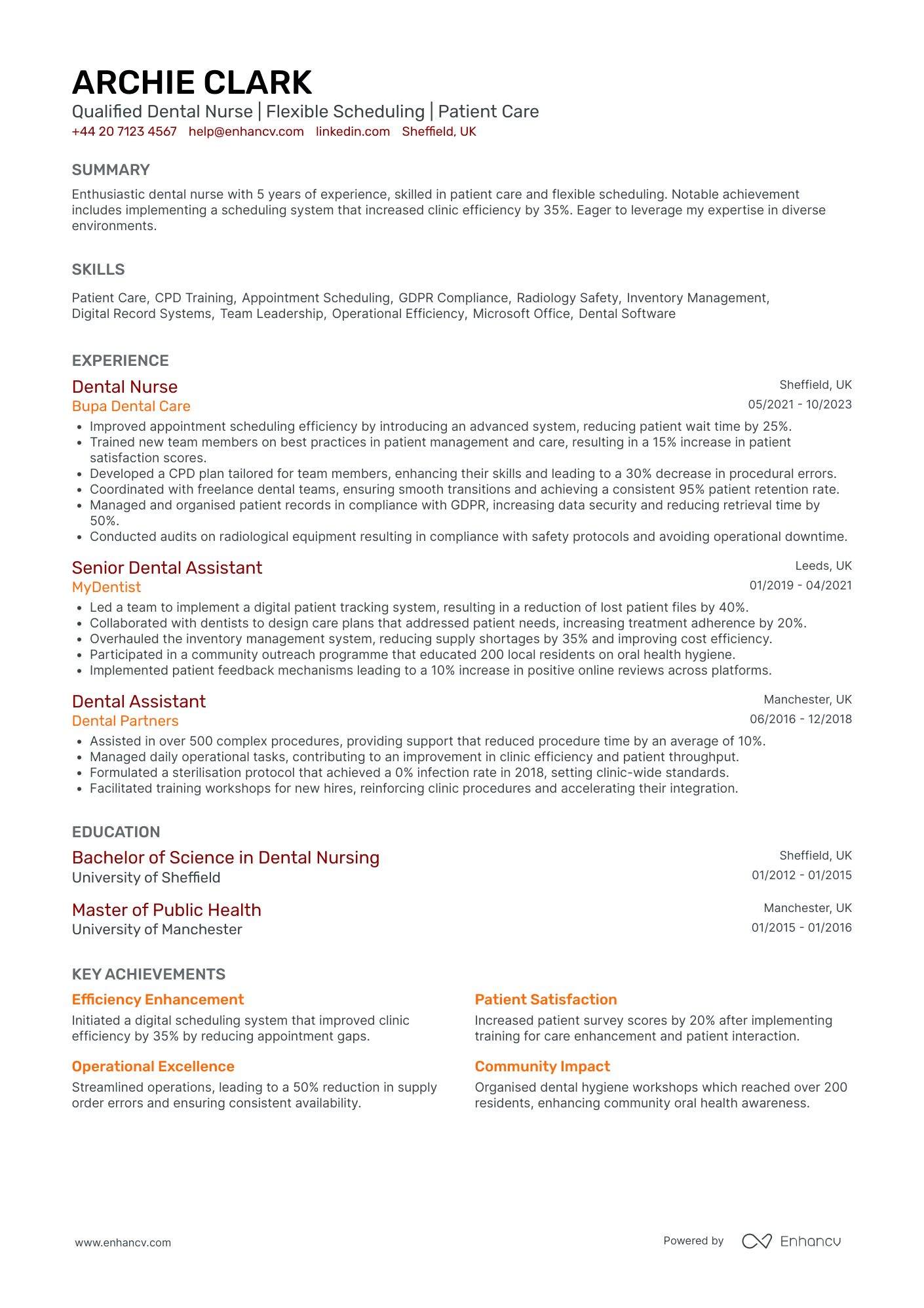
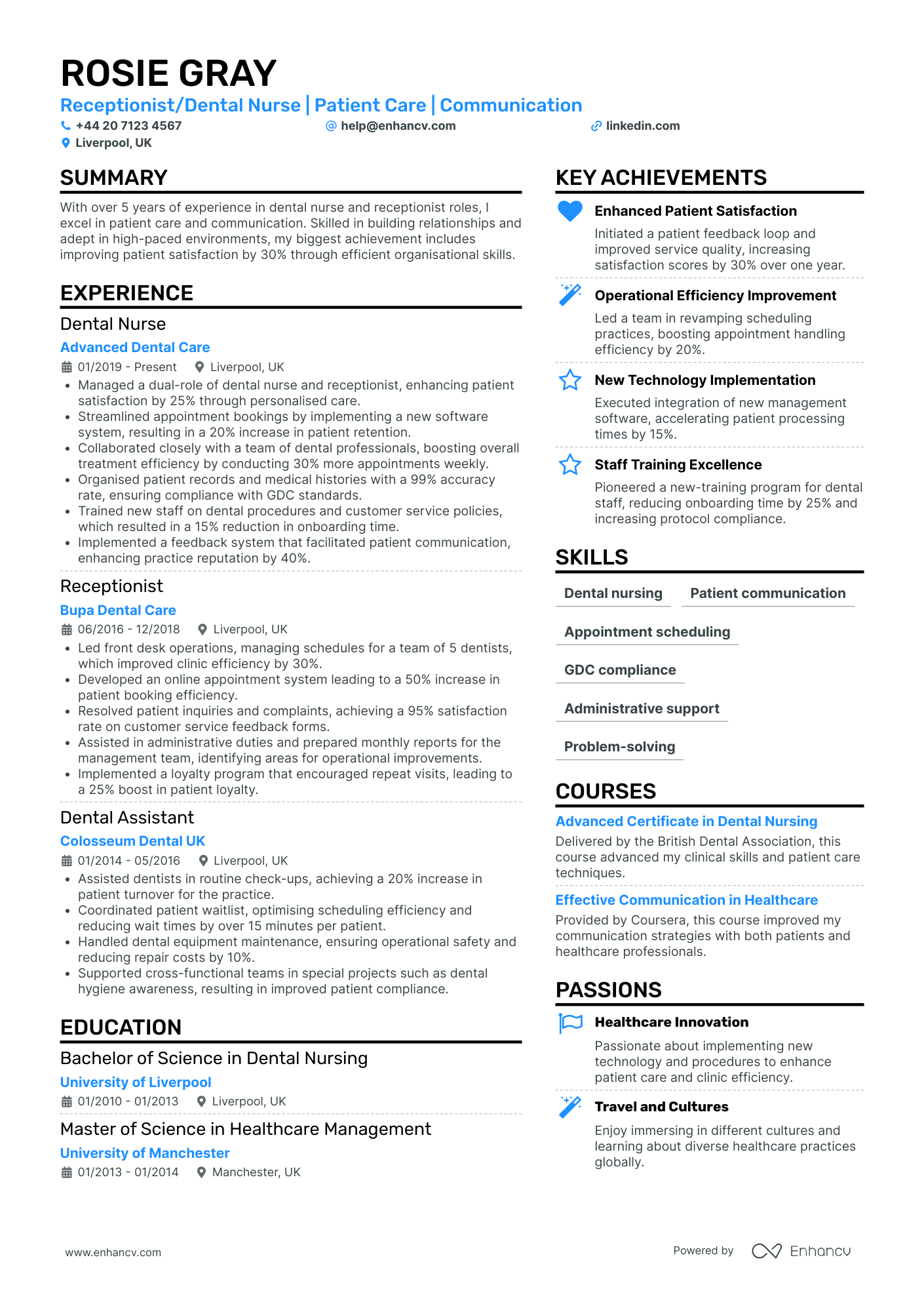
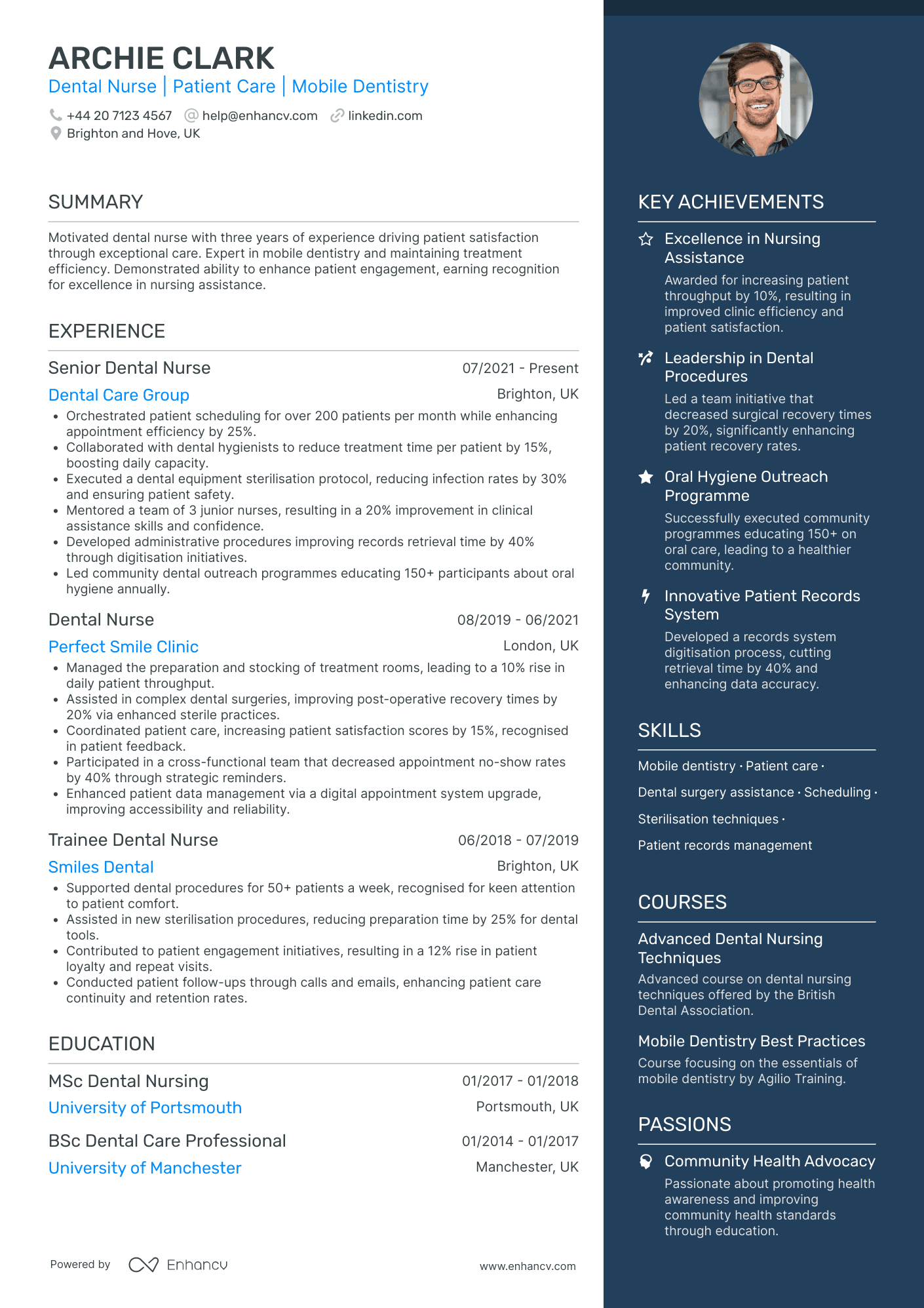
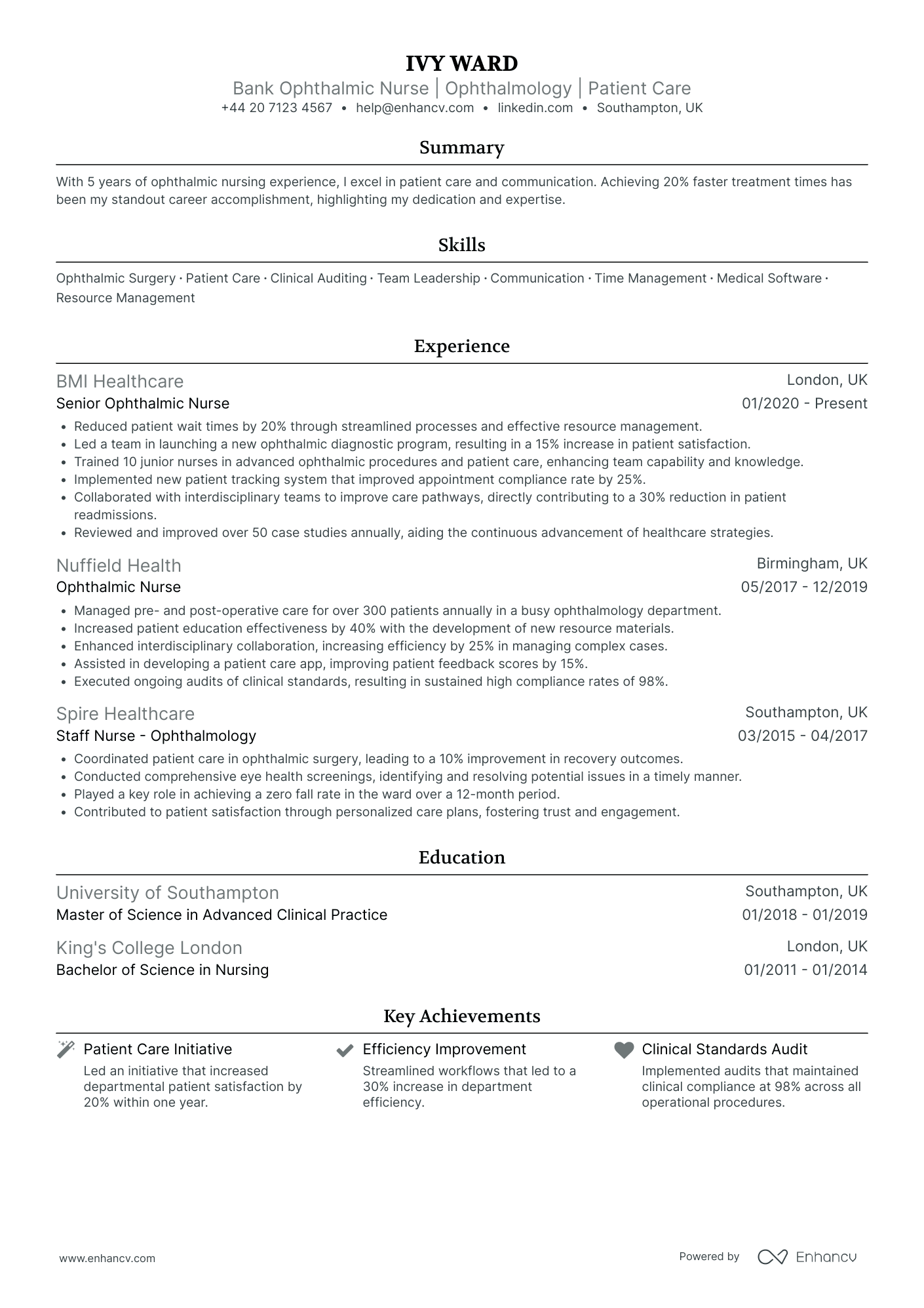
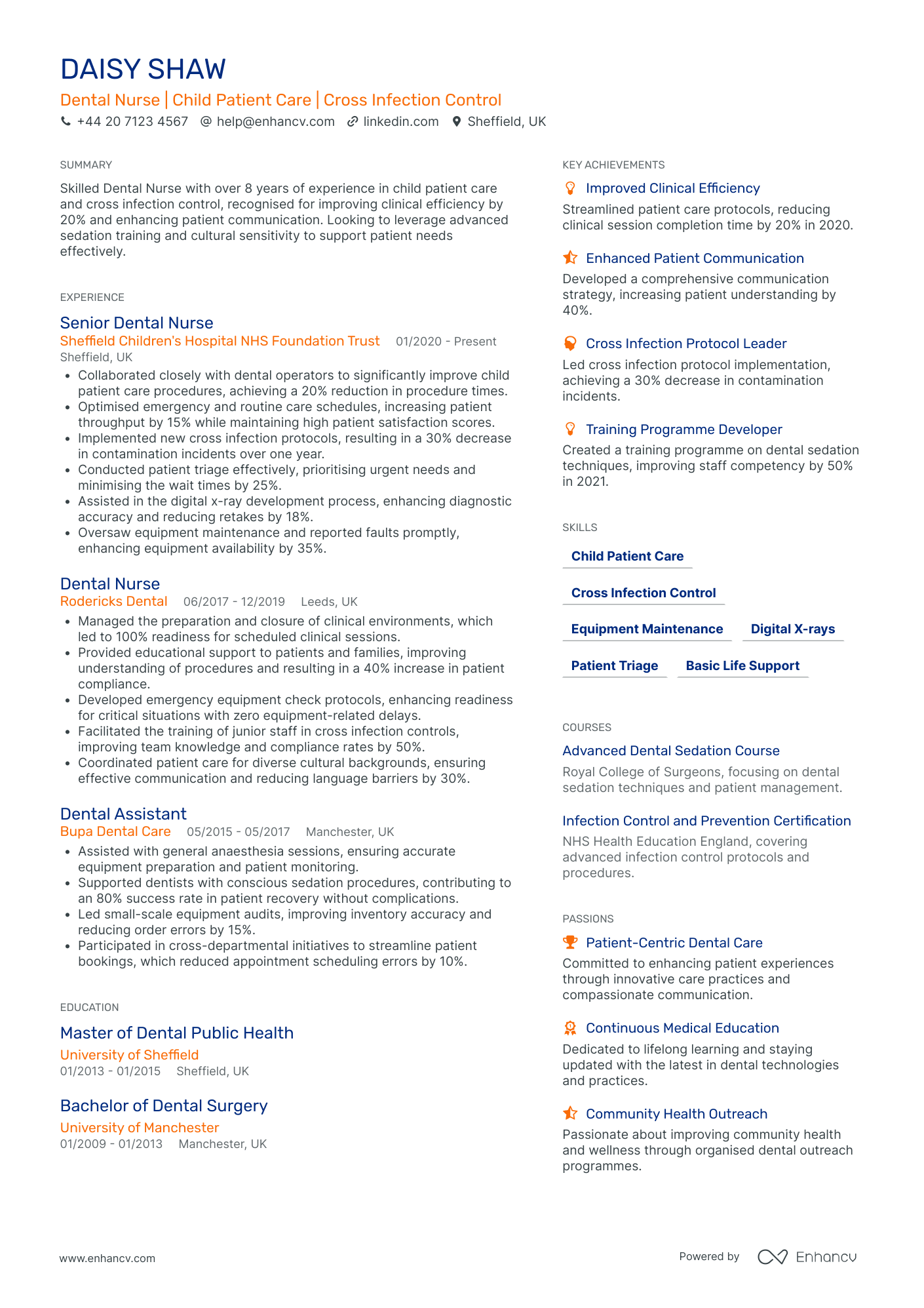
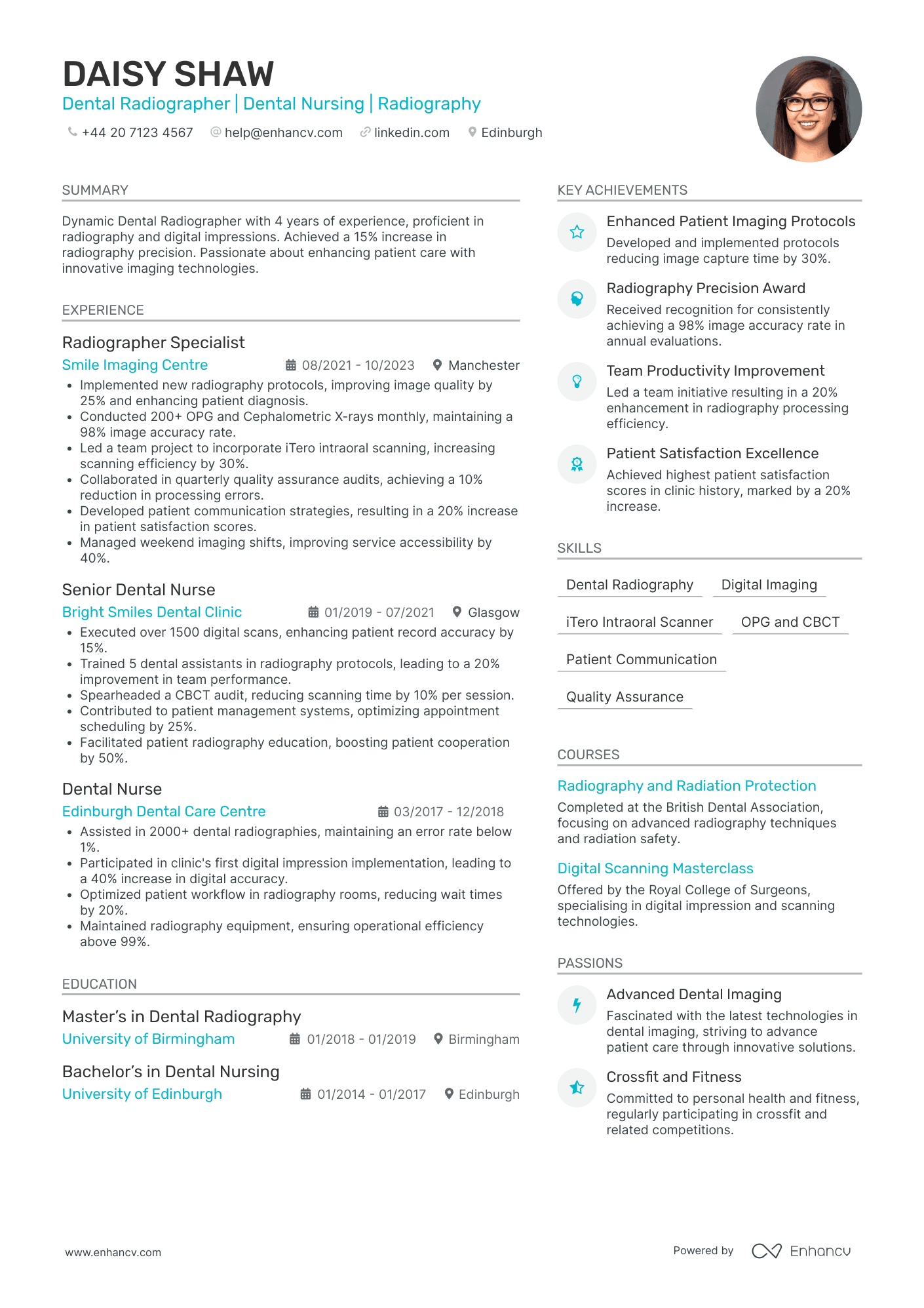
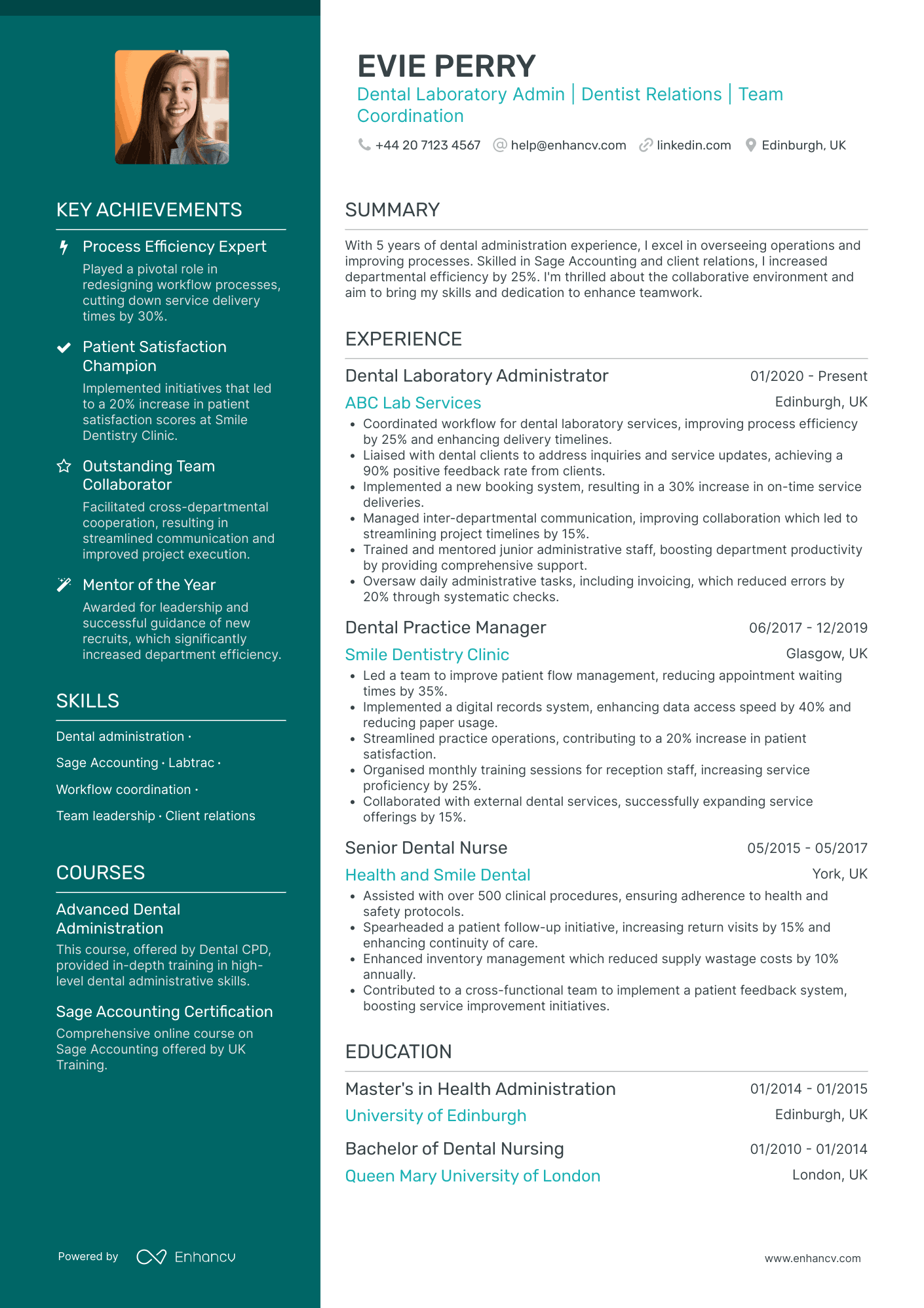
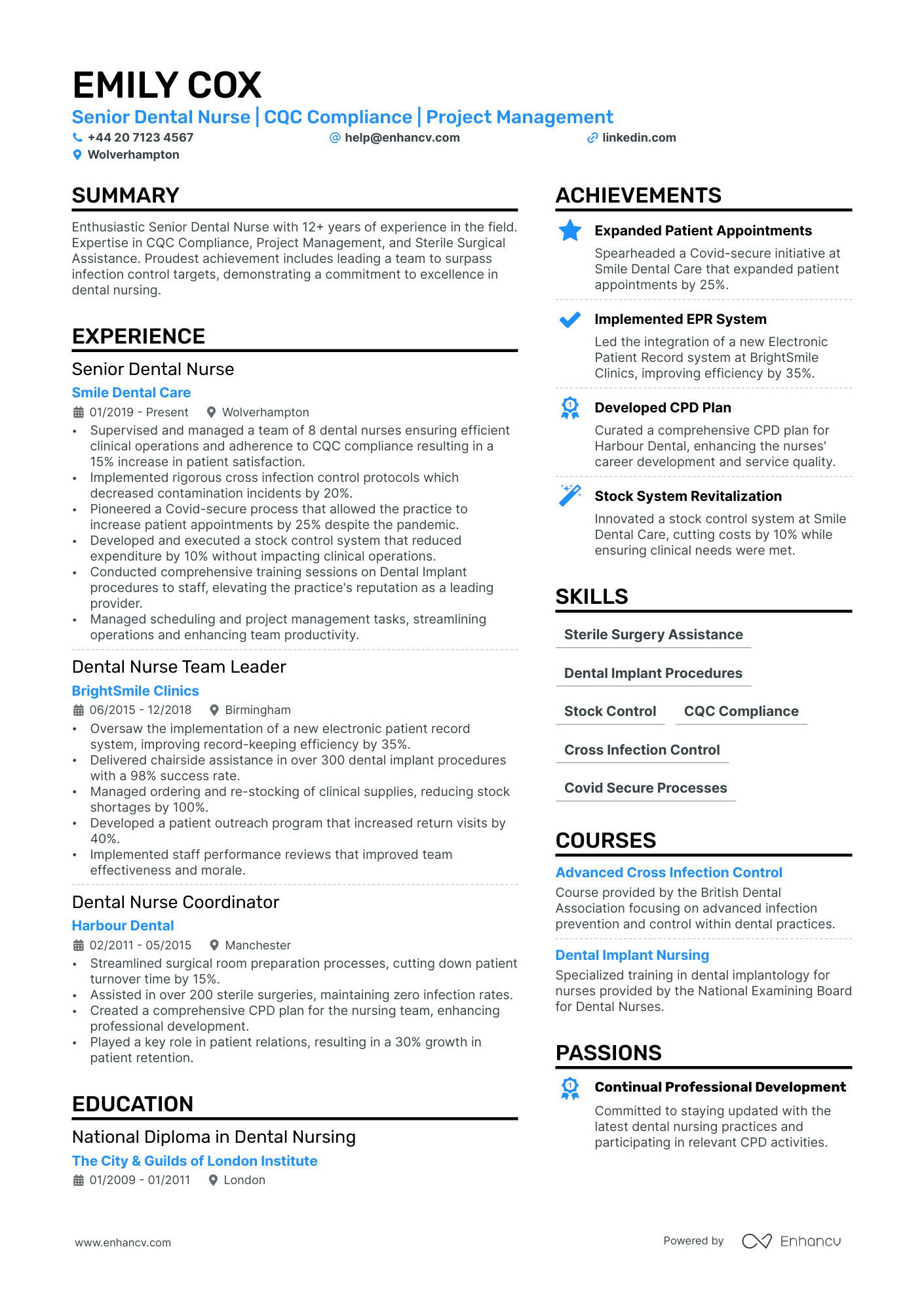
Most dental nurse CVs list the duties every nurse in the practice already does, then stop. The ones that earn an interview prove three things fast: General Dental Council (GDC) registration, infection control, and confident chairside support.
A practice manager reads your CV between patients, so the regulated essentials cannot be buried. Put your registration status, your qualification, and your right-to-practise details where the eye lands first, then back them with real chairside detail.

Key takeaways
- GDC registration is the first thing a practice checks. If you are registered, put your number near the top. If you are training, name your enrolment.
- Lead with the regulated essentials: infection control, decontamination, radiography where you hold it, and chairside assisting.
- Keep it to two pages, reverse chronological once you have clinical roles behind you, in one clean column.
- Send a PDF so the layout holds, and keep a Word copy for any practice or agency that asks.
- Write a four-line personal statement built on your qualification, your registration, and one concrete strength.
- Mirror the real duties from the advert that you can back, not a generic soft-skill cloud.
Formatting your dental nurse CV
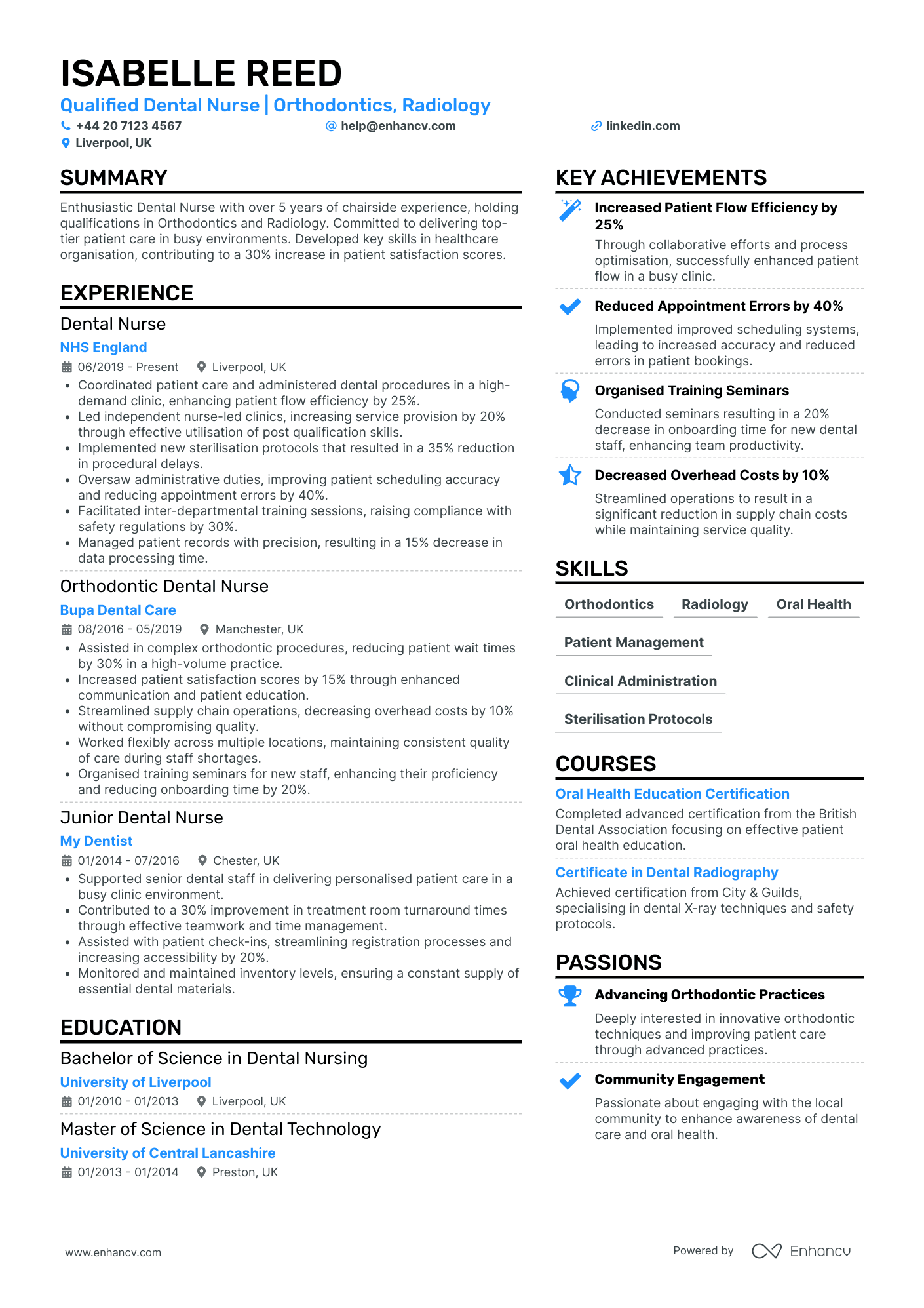
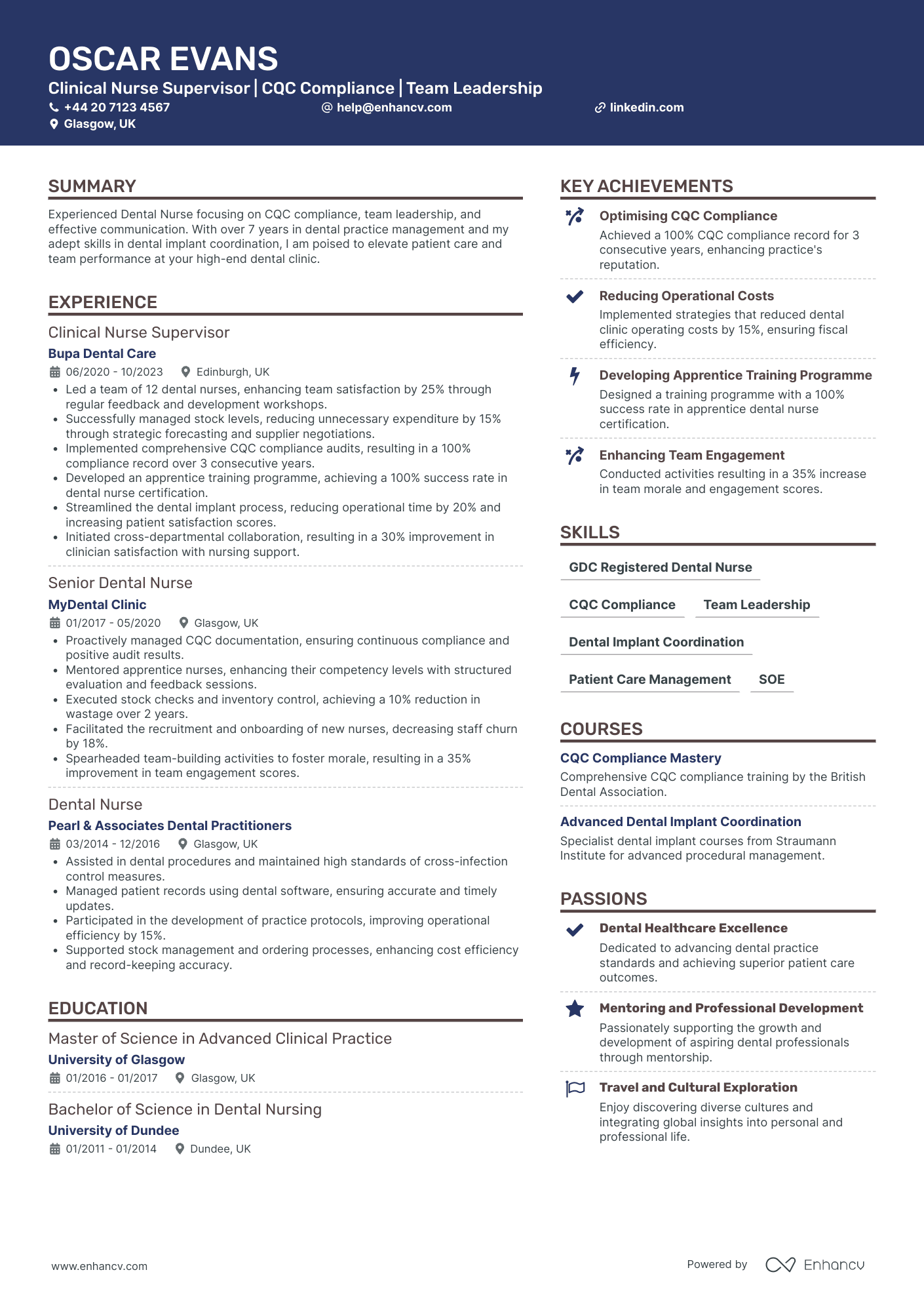
Structure comes first, because a dental nurse CV lives or dies on how fast a busy practice can scan it. The reader is usually the principal dentist or a practice manager, and they are deciding in seconds whether you can register, decontaminate, and stand chairside safely.
Use a reverse chronological layout once you have clinical roles behind you, so your most recent practice sits at the top. Reach for a skills-based CV only while you are still training, when your qualification and transferable skills carry more weight than a short work history.
Order the sections the way a practice reads them: header, personal statement, GDC registration and qualifications, skills, then experience. Front-loading registration is the single biggest formatting decision on a dental nurse CV, because it is the box the reader is looking to tick first.
Keep it to two pages. One page reads thin for a registered nurse, and a third page rarely gets read in a practice squeezing recruitment between appointments.
One column beats two, because tracking software reads a single column cleanly and a human eye does not have to zigzag. Use standard headings, a readable font at 10 to 12 point, and generous white space so the page never feels cramped.
Put your name, location, phone, email, and GDC registration number in the header so the essentials clear before the reader scrolls. Skip a photo, your date of birth, and your full home address. UK practices do not expect them, and they only take up space the regulated details should own.
Send a PDF for direct applications so your layout holds on any screen. Keep a Word copy for recruitment agencies and any practice that asks for one, and if the advert names a file type, follow it exactly.
Dental group and NHS applications often pass through tracking software first, so keep the layout clean and the headings standard for an ATS-friendly CV. Build it from a tested layout rather than a blank page: Enhancv's CV templates export to a clean PDF that keeps its shape once it lands in an inbox.
Is your resume good enough?
Drop your CV here or choose a file. PDF & DOCX only. Max 2MB file size.
What UK dental practices look for
Dental nursing is a regulated, chairside role, and that shapes every hiring decision. A practice needs to see at a glance that you can register, decontaminate, and support the clinician safely from day one.
The setting changes the emphasis, not the essentials. An NHS practice cares about throughput and record keeping, a private or specialist clinic leans on your patient manner and any extended duties, and a hospital department wants to see you cope with complex cases. Read the advert for which of those it prizes, then lead with the matching evidence.
| What | UK dental nurse roles |
|---|---|
| Registration | GDC registration is mandatory to practise. Trainees must enrol and register within the GDC's timescales. |
| Where the work happens | On-site and chairside, in an NHS or private practice, a clinic, or a hospital dental department. |
| Usual entry route | The NEBDN National Diploma in Dental Nursing or a Level 3 dental nurse apprenticeship, both of which lead to GDC registration. |
| Skills adverts ask for | Infection control and decontamination, chairside assisting, dental radiography, patient care, and accurate record keeping. |
None of that is optional, which is why your CV should mirror the advert's wording. If a practice lists dental radiography or decontamination to HTM 01-05, and you hold it, name it the same way they do.
Registration and safe practice are the gate. Get those on the page early, and the rest of your CV gets a fair read.
Two details reassure a reader more than any adjective. A GDC number they can look up, and current indemnity, tell a practice you are ready to work rather than a project to onboard. Put both where they are easy to find.
Writing your dental nurse personal statement
Four sentences at the top: who you are, your qualification and registration, the clinical strengths you bring, and the kind of practice you want to join. Keep it concrete. See more personal statement examples if you are stuck on the opening line.
Skip the adjective soup. "Hard-working, caring and passionate" tells a practice manager nothing they can check, and it opens roughly every other CV in the pile.
Name the specifics instead. How long you have nursed, the lists you have covered, the extended duties you are certified for, and the setting you thrive in. A recruiter should be able to picture your working day from the first four lines.
Lead with evidence:
Dental nurse CV personal statement example (registered)
GDC-registered dental nurse with three years of chairside experience across NHS and private practice. Confident in four-handed dentistry, decontamination to HTM 01-05, and dental radiography, with a post-registration certificate in oral health education. Looking to bring calm, organised chairside support to a busy mixed practice in Manchester.
Weak personal statement to avoid
Hard-working and passionate dental nurse who is a great team player and always puts patients first. Looking for a new challenge in a friendly practice where I can grow and develop my skills.
When I read a dental nurse CV, I look for the regulated essentials before anything else. Tell me you are GDC registered, tell me you decontaminate to standard, and tell me you can assist chairside without being prompted. A line like "three years of four-handed dentistry, radiography, and decontamination to HTM 01-05" says more than a paragraph of adjectives. Prove the essentials first, then let your personality show.
Skills to put on a dental nurse CV
Read a dozen live dental nurse adverts and the same demands repeat, and they are clinical, not generic. Infection control and decontamination, chairside assisting, dental radiography, patient care, and accurate record keeping come up again and again. Those are your hard skills, listed in the words the adverts use.
Do not stop at the label, though. A skills list that reads "decontamination, radiography, charting" is a start, but the version that lands the interview shows each one working somewhere on the page. Put the term in your skills box, then evidence it in a bullet under a real role.
The soft skills that matter are the ones a clinician relies on chairside: communication, empathy, teamwork, and staying calm when a patient is anxious. Prove each in a bullet rather than claiming it. "Reassured nervous children through their first checkups" beats "good with people" every time.
List only what you can stand behind. If you have been trained and signed off on radiography, name it. If you have not, keep it under training in progress rather than skills. A practice will test the claim on day one, and an overstated CV costs you the trust you spent the interview building.
Top skills for your dental nurse CV:
Infection control and decontamination
Chairside (four-handed) assisting
Dental radiography
Instrument sterilisation (HTM 01-05)
Patient care and comfort
Dental charting and record keeping
Stock and equipment maintenance
Health and safety compliance
Communication
Empathy
Teamwork
Attention to detail
Calm under pressure
Writing your dental nurse experience section
Write each role the same way: a dated heading, then bullets that show what you did and the result. Lead every bullet with an action verb. For the mechanics, see work experience on a CV.
Dental nursing is more measurable than it feels. Patients supported per list, decontamination cycles logged, audits passed with no actions, waiting times cut, stock kept in date. Those specifics are your CV achievements.
Name the setting and the type of dentistry in the heading, not just the job title. "Dental Nurse, mixed NHS and private practice" or "Orthodontic Dental Nurse" tells a reader in one line whether your experience matches their list.
Tailor every application. Pull the clinical terms from the advert and mirror them where they are true of you. Enhancv's CV tailoring feature reads the advert and suggests the matching edits, which saves rewriting from scratch each time.
- Provide four-handed chairside support across NHS and private lists, assisting on up to 25 patients a day
- Run decontamination to HTM 01-05 and maintain the practice's compliance logs, passing the last two CQC infection-control audits with no actions
- Take and process dental radiographs under IRMER protocols, holding a post-registration certificate in dental radiography
- Mentor two trainee dental nurses through their NEBDN portfolios and manage clinical stock, cutting expired items to near zero

Turn a duty into an achievement
Weak: "Responsible for decontamination and stock ordering." Strong: "Ran decontamination to HTM 01-05 and kept the practice audit-ready, passing two CQC infection-control checks with no actions." Same task, but the second version names the standard, the outcome, and the proof a practice can trust.

PRO TIP
Dental adverts name clinical specifics, not soft-skill clouds. Mirror the ones you can back: "four-handed dentistry", "decontamination", "HTM 01-05", "dental radiography", "IRMER", "CQC audit". If you have been trained in it, name it exactly as the advert does.
Qualifications and GDC registration for a dental nurse CV
This is the section a practice checks first, so make it unmissable. Lead with your GDC registration and number, then your qualifying diploma, then any post-registration certificates. Treat it as the anchor of your education section.
The recognised routes are the NEBDN National Diploma in Dental Nursing and a Level 3 dental nurse apprenticeship, both of which lead to GDC registration. List whichever you hold, with the awarding body and the year, alongside your other qualifications.
Post-registration skills earn their own lines: dental radiography, oral health education, sedation nursing, impression taking, and fluoride application. These extended duties are what move you up the pay scale, so name each certificate and the year you gained it.
Add your continuing professional development if you have recent hours logged, since the GDC requires it to stay registered. A short line naming your most relevant recent training, for example cross-infection control or medical emergencies and CPR, tells a practice you keep your mandatory hours current.
Include your indemnity and a current enhanced DBS check. Both are baseline expectations for the role, and naming any certificates you hold saves the practice a question. If a certificate is in progress, say so with an expected date rather than leaving it off.
Dental nurse CV with no experience or an apprenticeship
If you are applying for a trainee post or an apprenticeship, you are not expected to arrive registered. You are expected to show you understand what chairside work involves and that you can be trusted around anxious patients.
Use a skills-based CV: personal statement, then transferable skills and any clinical exposure, then education, with work history lower down. It carries the weight a thin work history cannot.
Mine your background for real evidence. Customer-facing work shows communication under pressure. Any care or first-aid role shows a duty of care. A placement or a week's work experience in a practice is worth a dated entry, and so is your first job anywhere it built a transferable skill.
Write that evidence in dental language. "Handled cash and confidential records in a busy pharmacy" reads as attention to detail and discretion. "Reassured anxious customers and kept a calm front desk" reads as chairside temperament. The skill is the same, the framing does the work.
One line lifts a trainee CV to the top of the pile: "enrolled on the NEBDN National Diploma" or "applying for a dental nurse apprenticeship". It signals you are already on the path to registration.
Give volunteering and placements dated entries with duties and hours. Volunteering on a CV counts as experience for this role, not filler. A day spent shadowing at a local practice, framed with what you observed and did, shows initiative a generic CV never can.
Conclusion
Lead with the regulated essentials, prove your chairside competence with real detail, and keep the format clean and easy to scan.
Everything else on the page is supporting evidence for one question a practice is asking: can this person register, decontaminate, and stand chairside safely from day one. Answer it in the first third of the CV and the rest reads as confirmation.
Pair the CV with a short cover letter that says why this practice, and you give a practice manager every reason to book the interview.
Author's take - The Enhancv team
When I read a dental nurse CV, I look for the regulated essentials before anything else. Tell me you are GDC registered, tell me you decontaminate to standard, and tell me you can assist chairside without being prompted. A line like "three years of four-handed dentistry, radiography, and decontamination to HTM 01-05" says more than a paragraph of adjectives. Prove the essentials first, then let your personality show.