



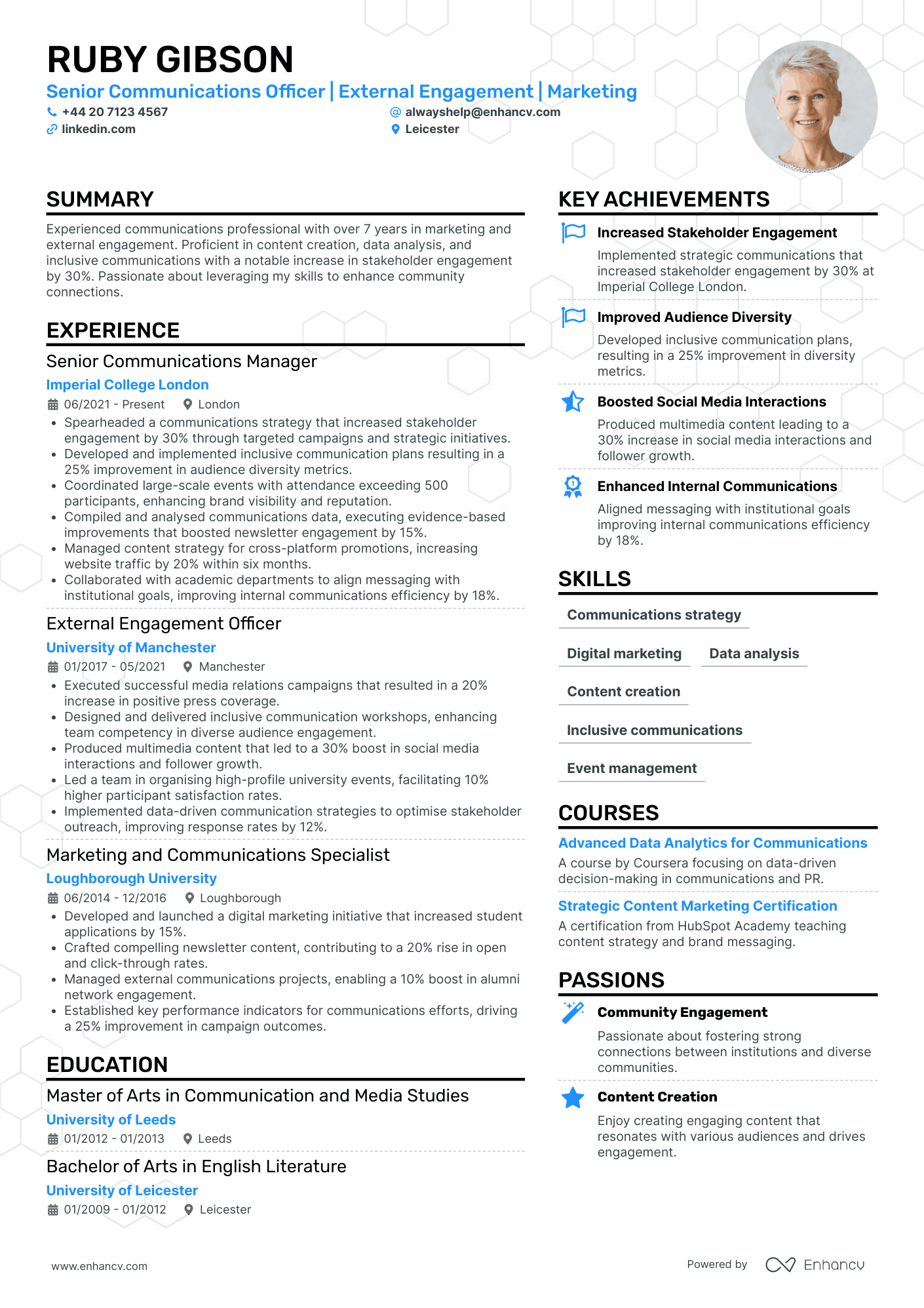
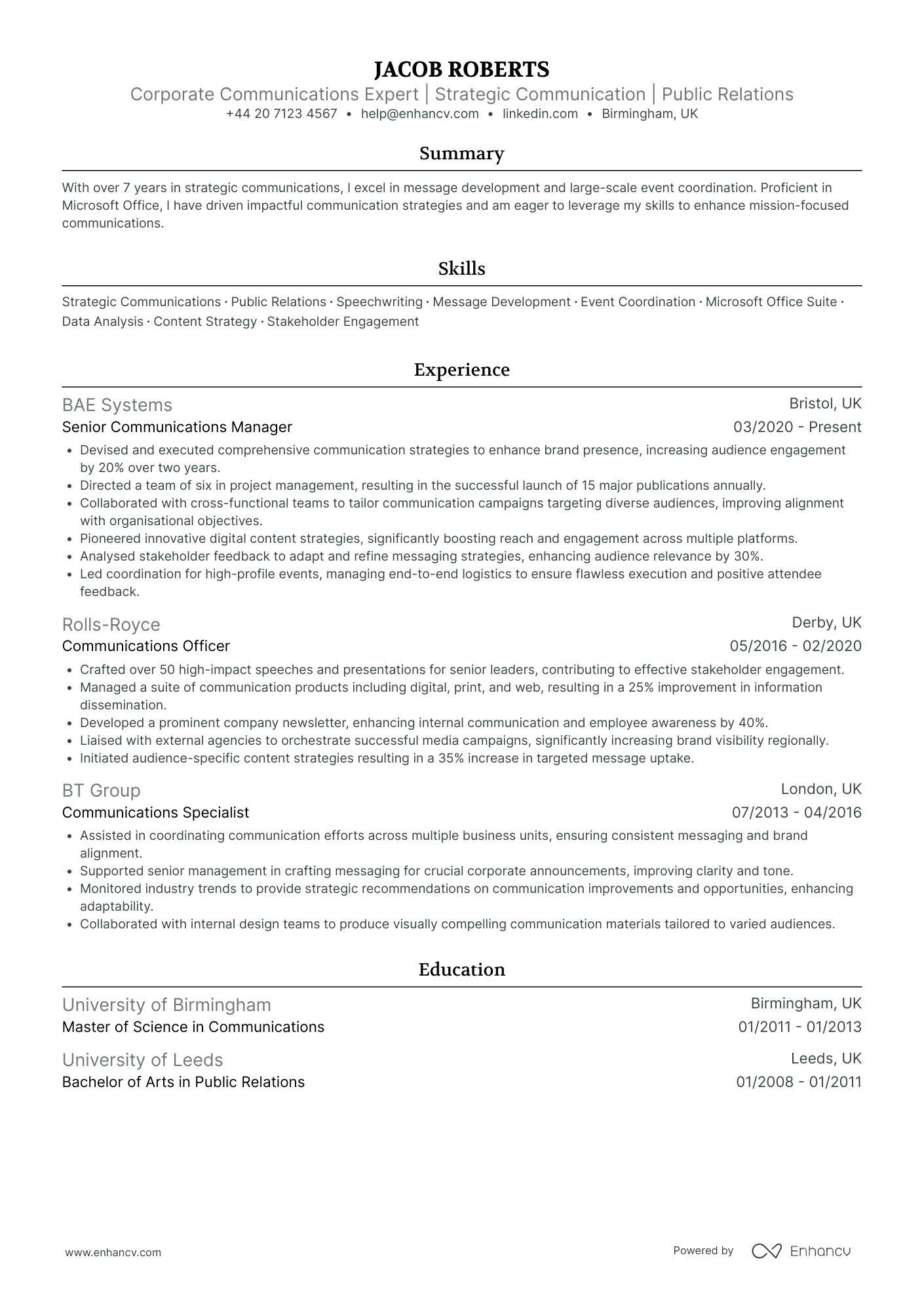
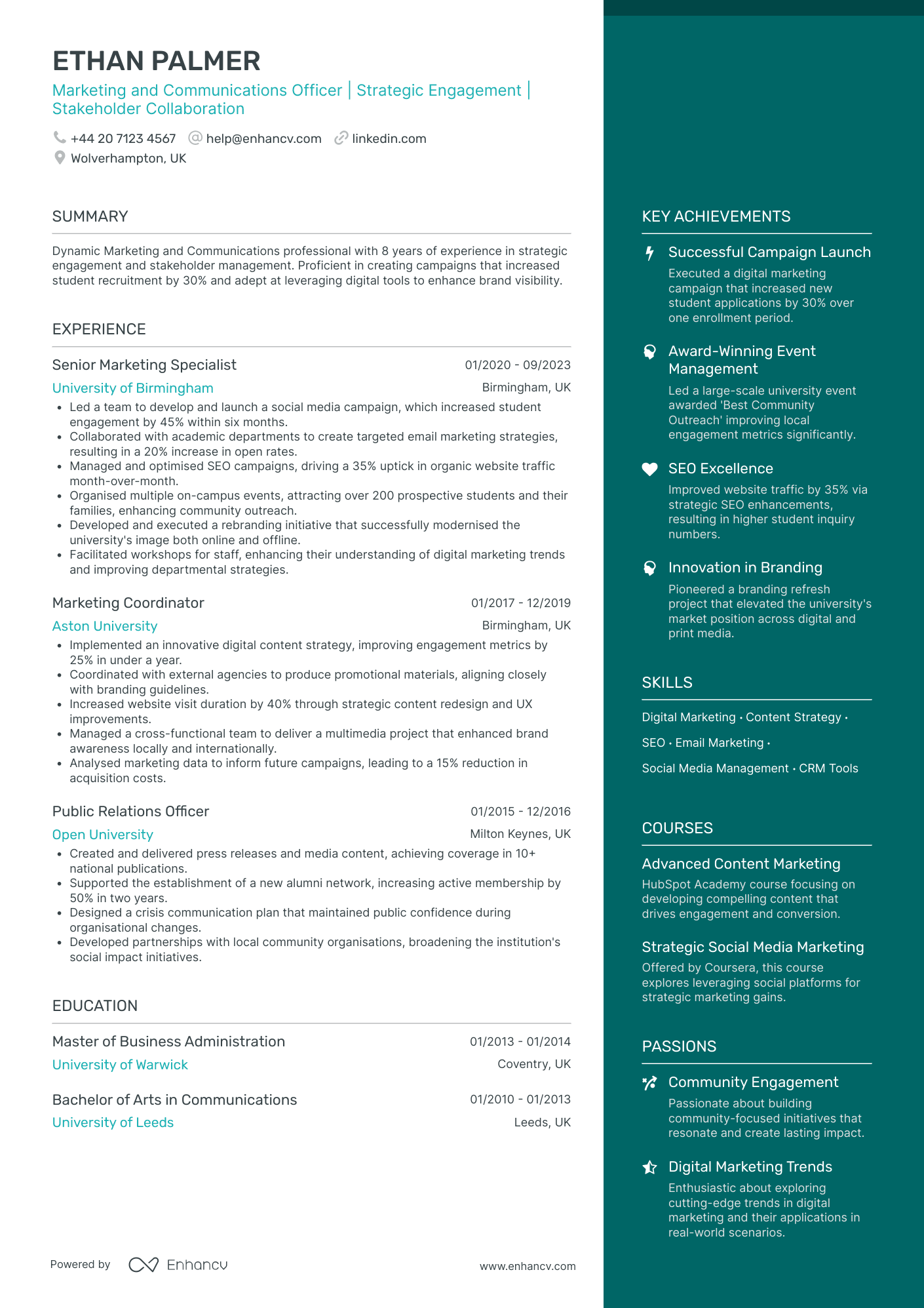
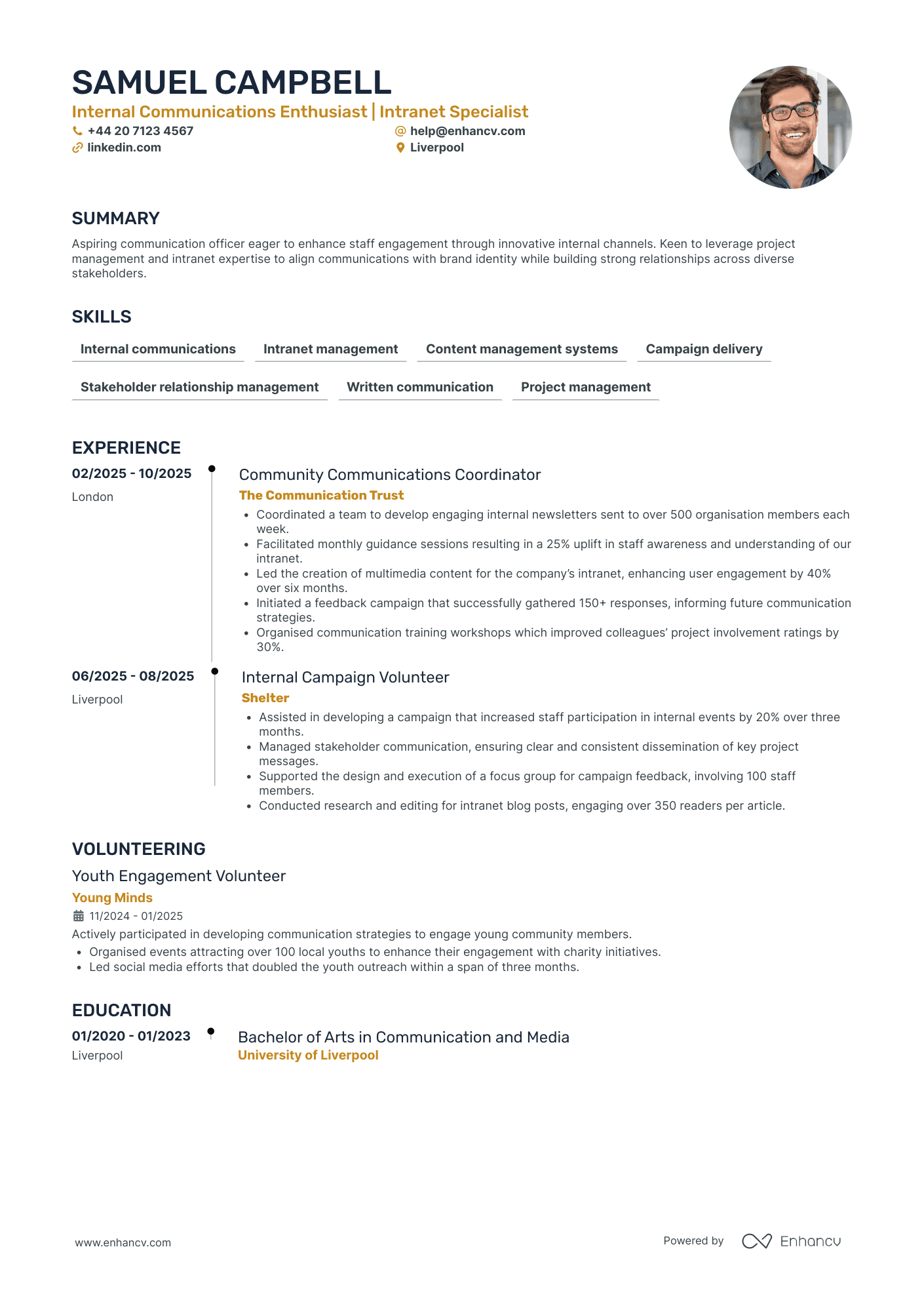
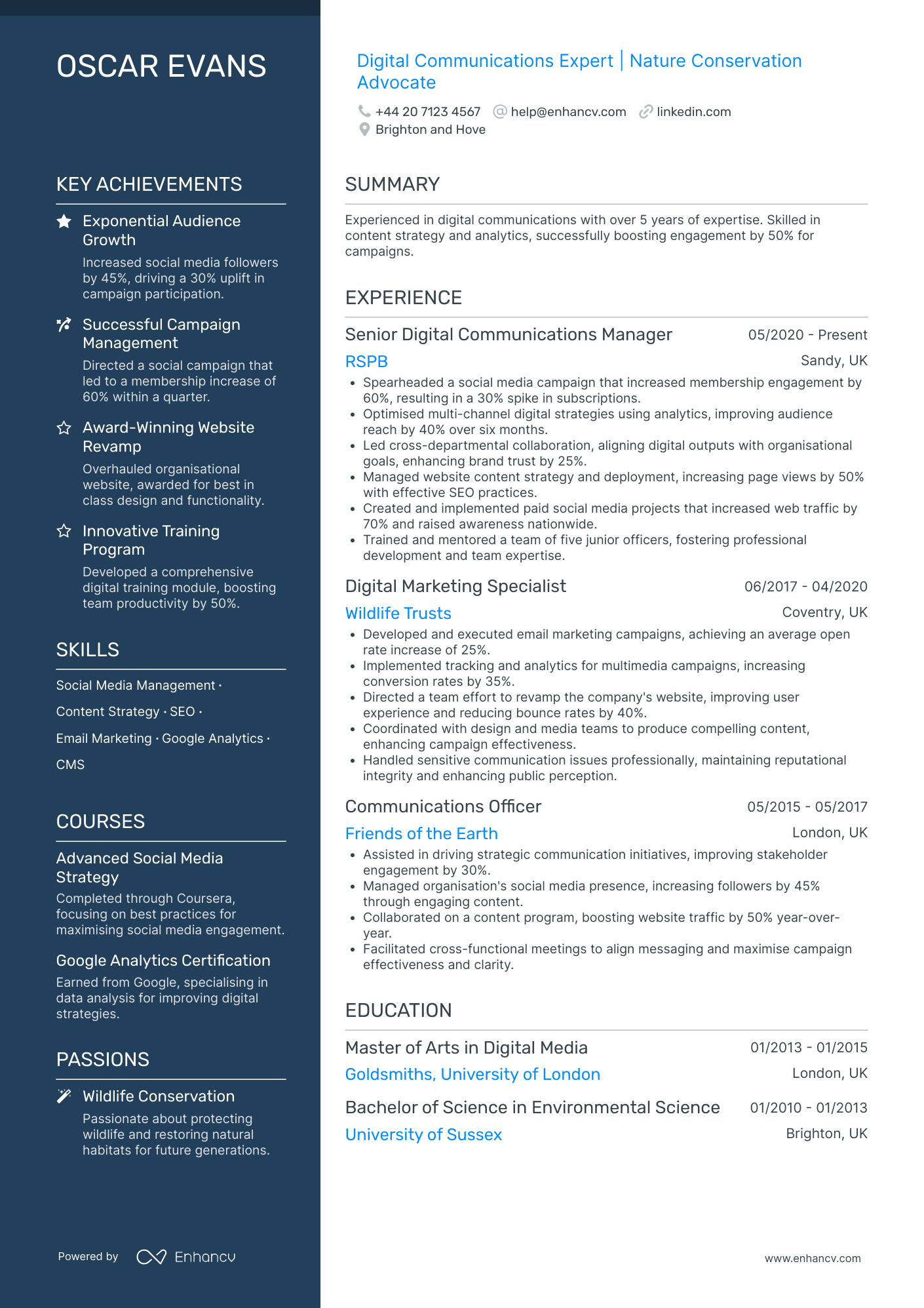
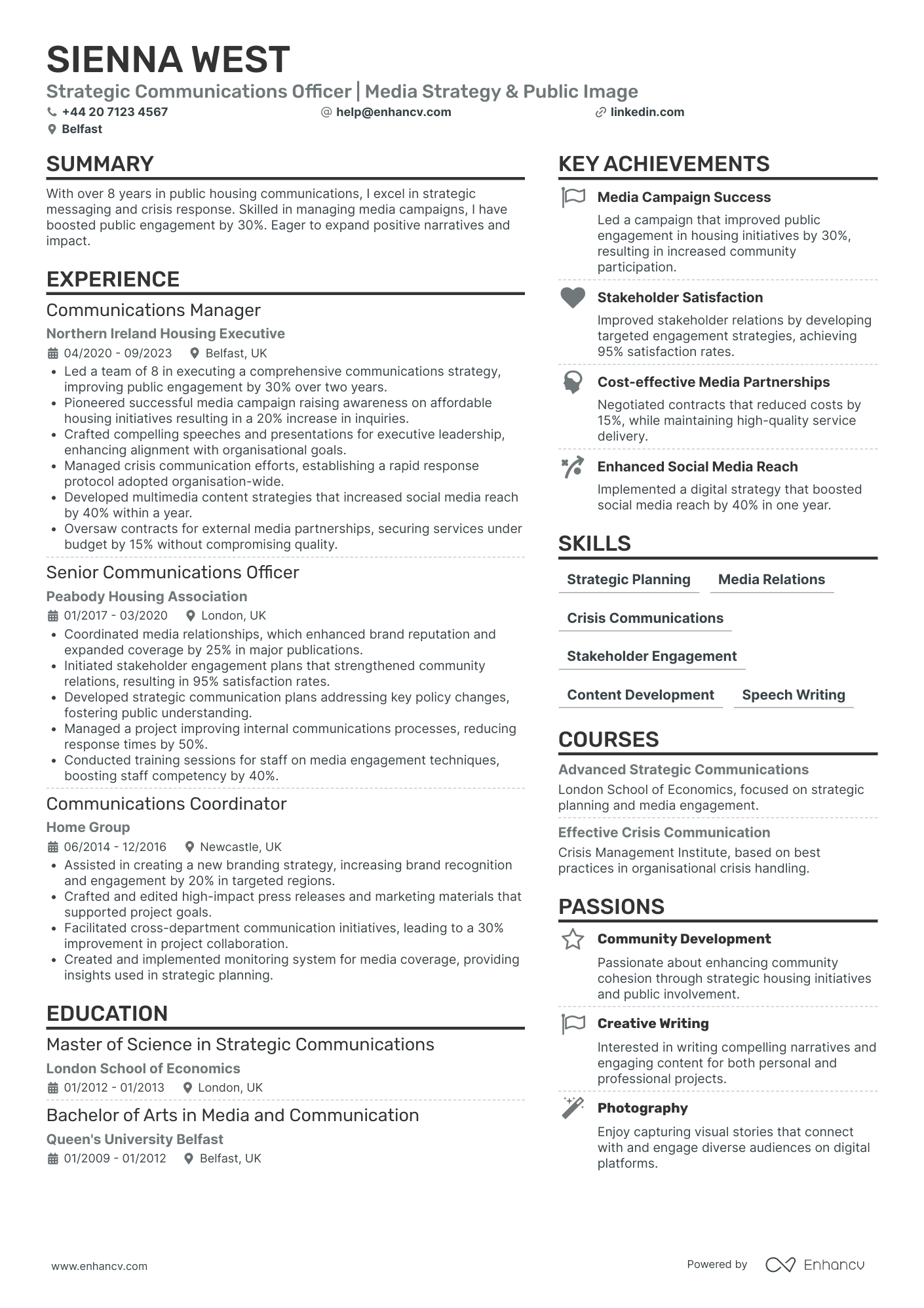
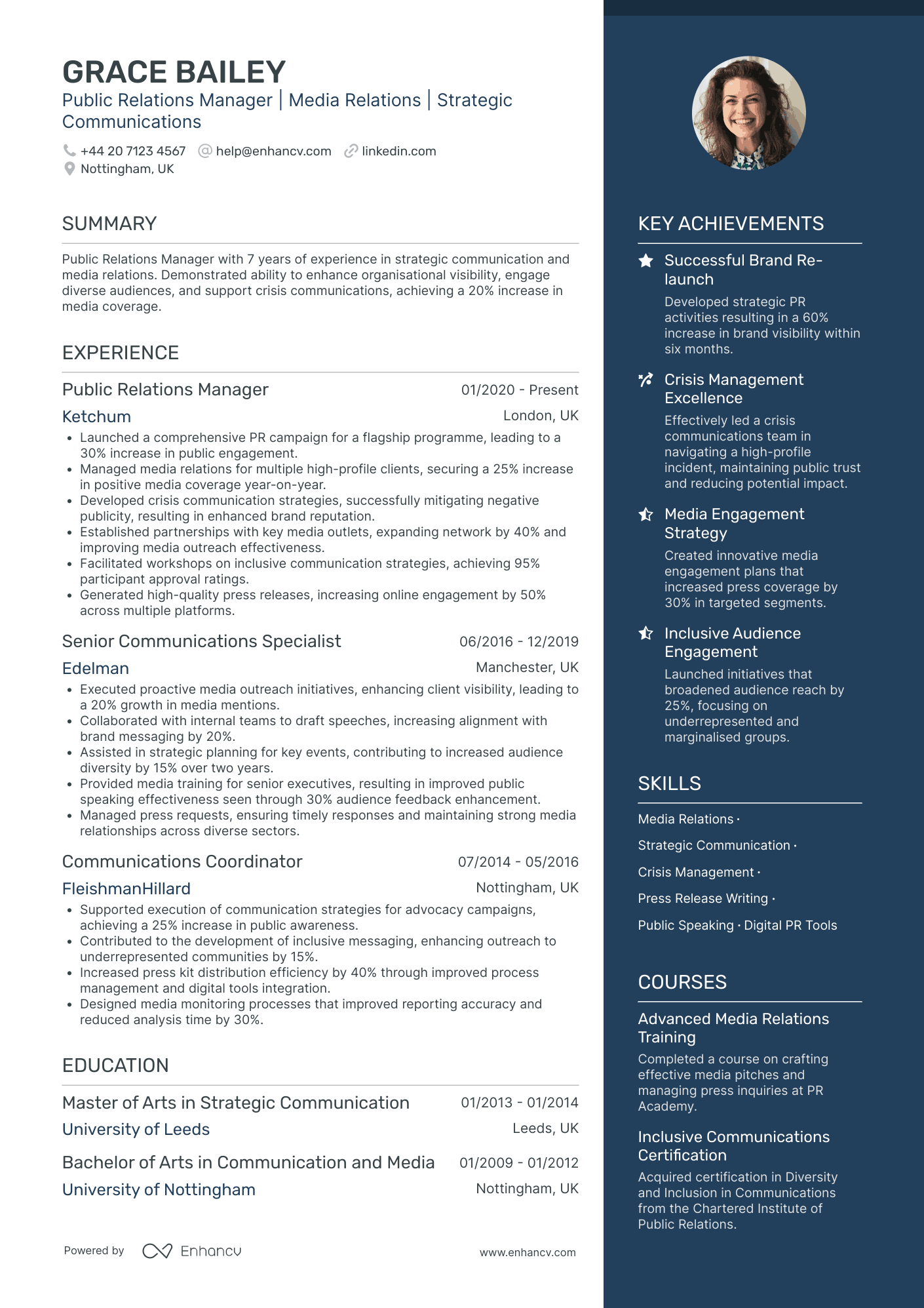
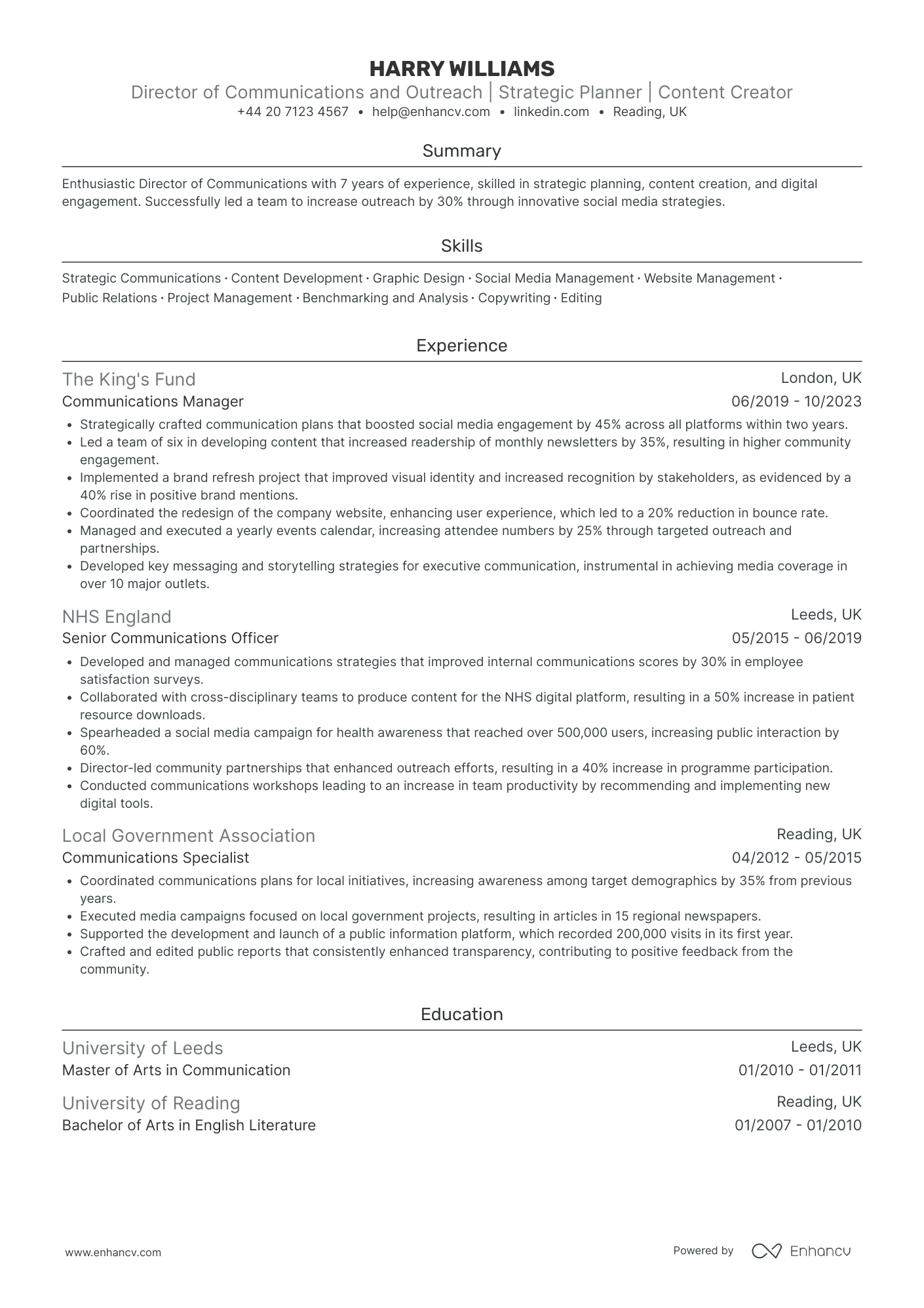
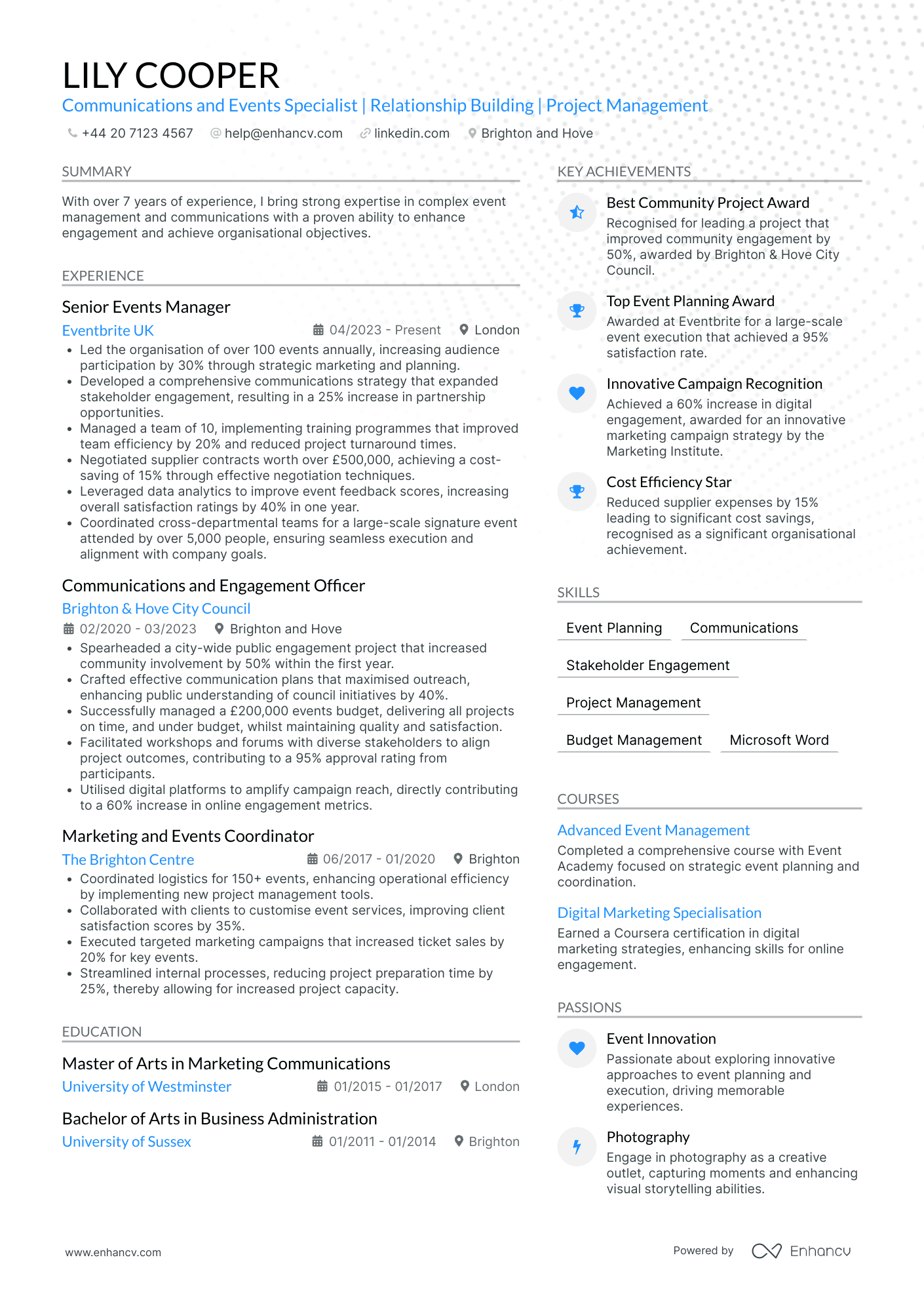
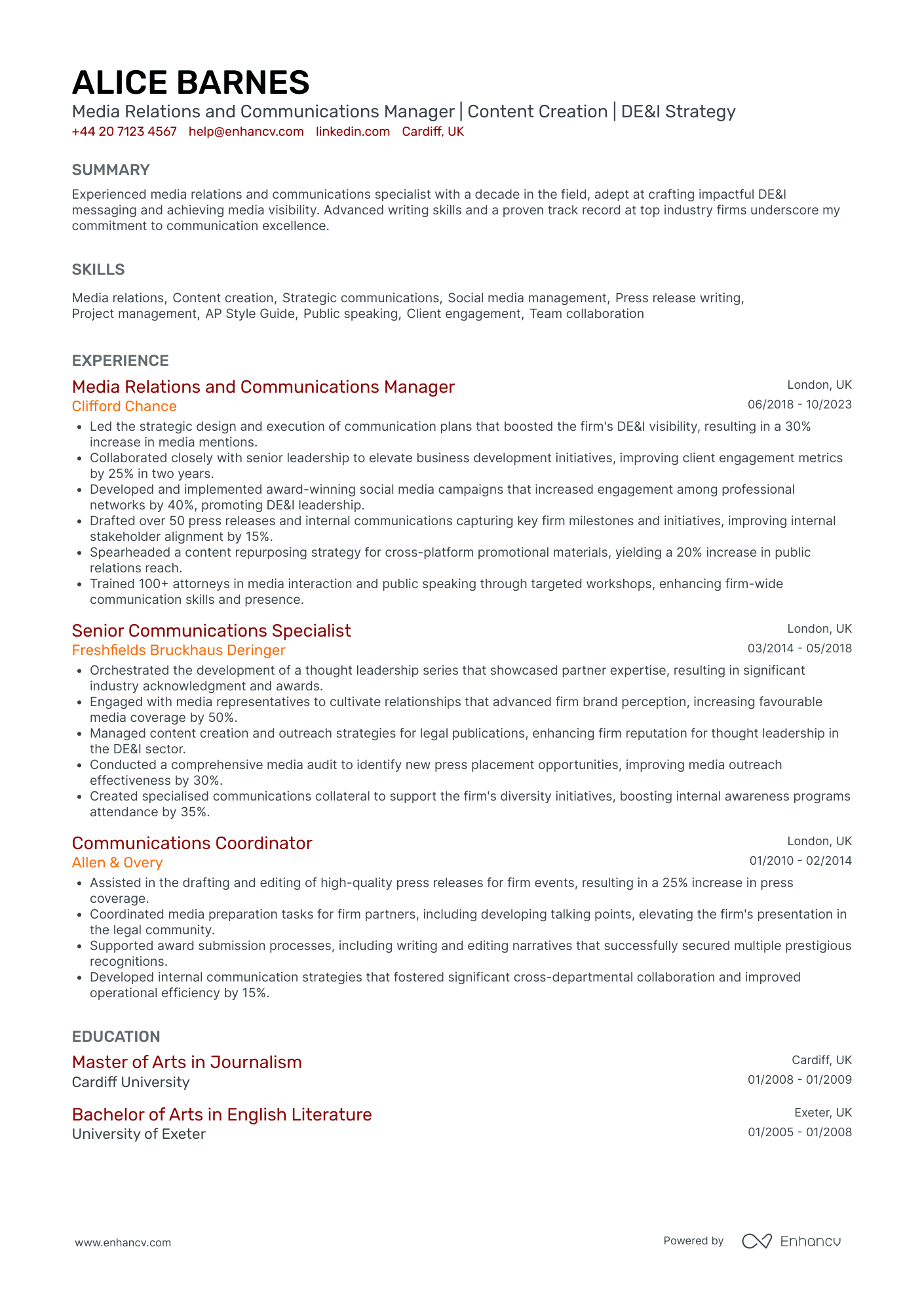
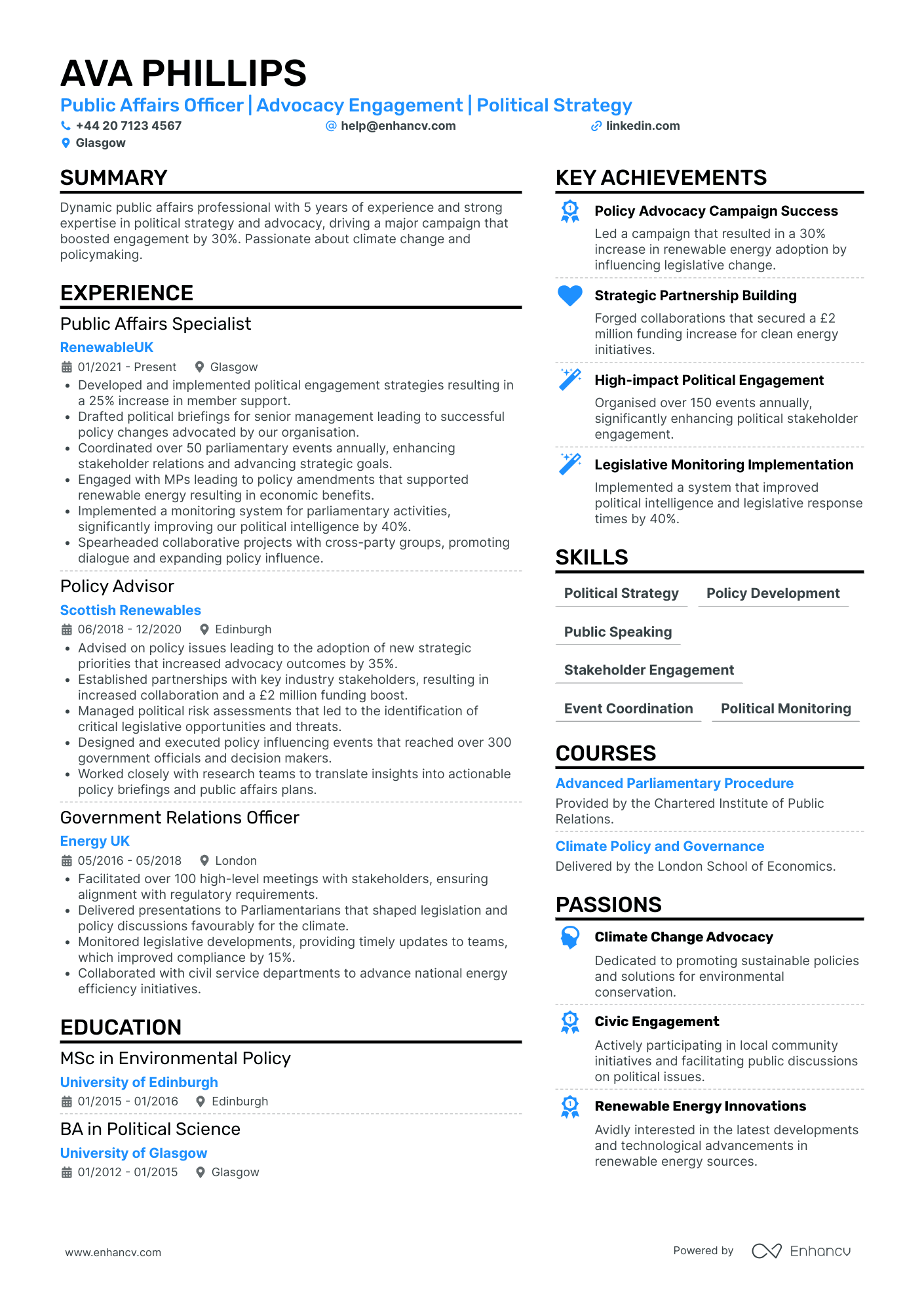
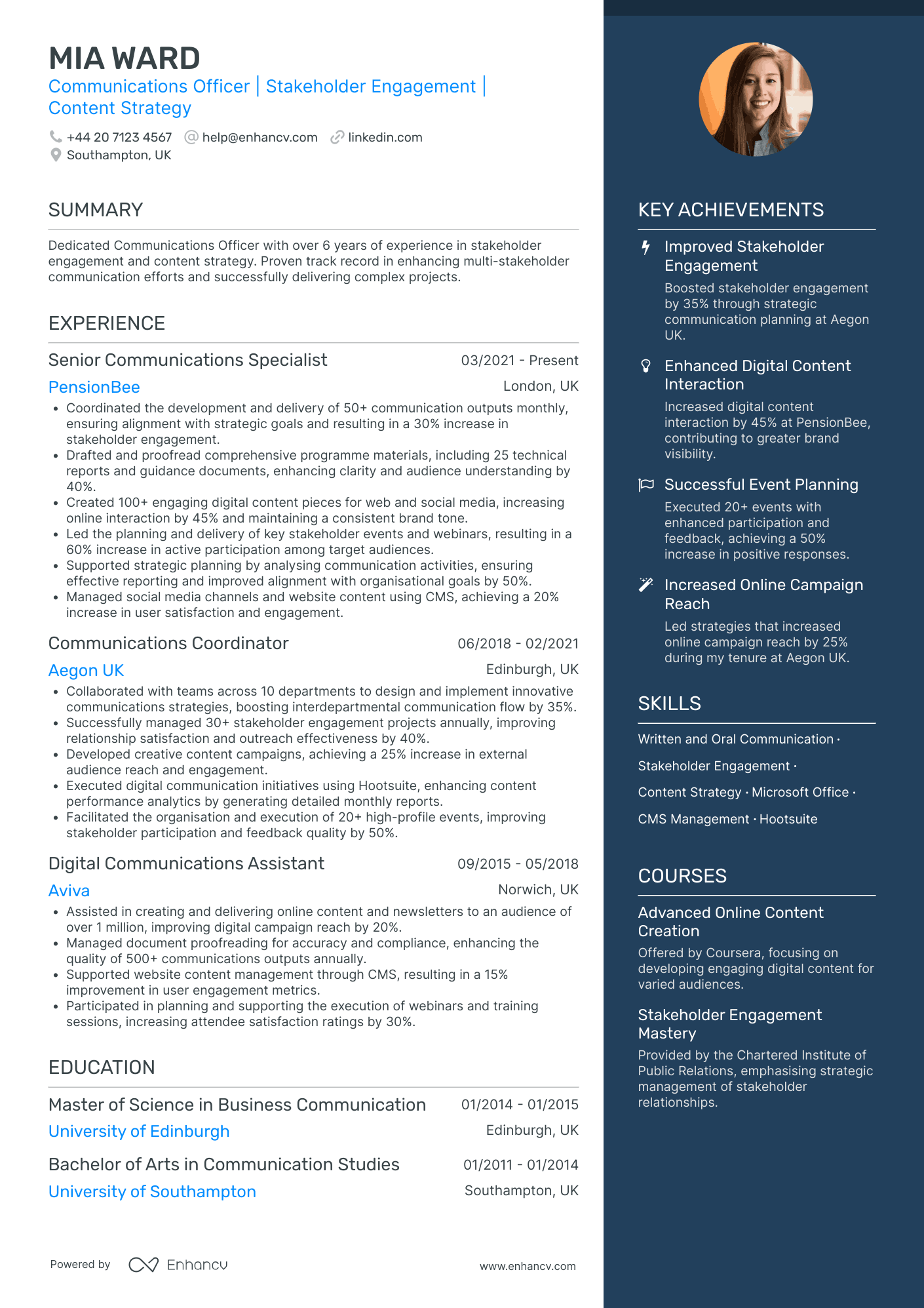
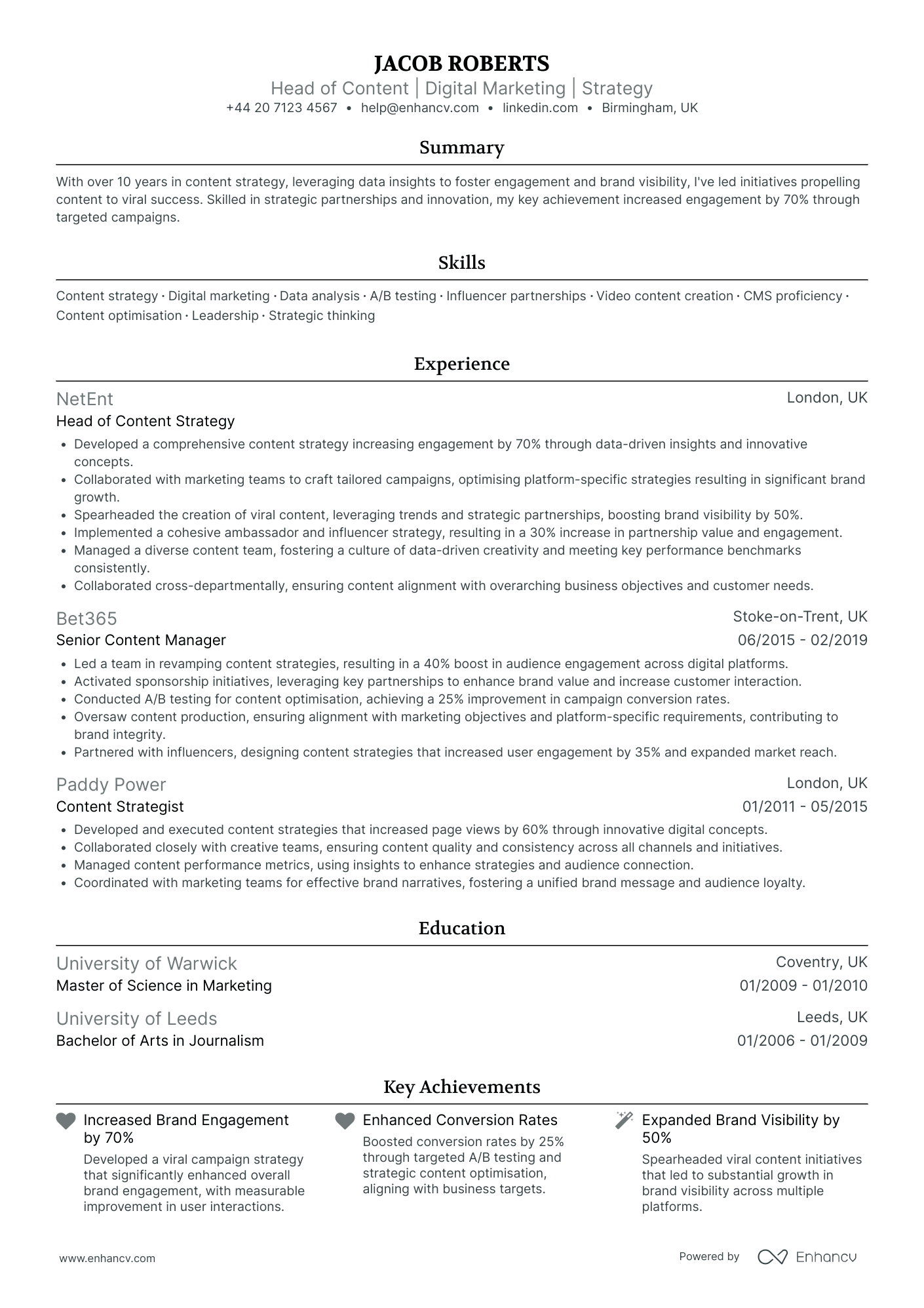
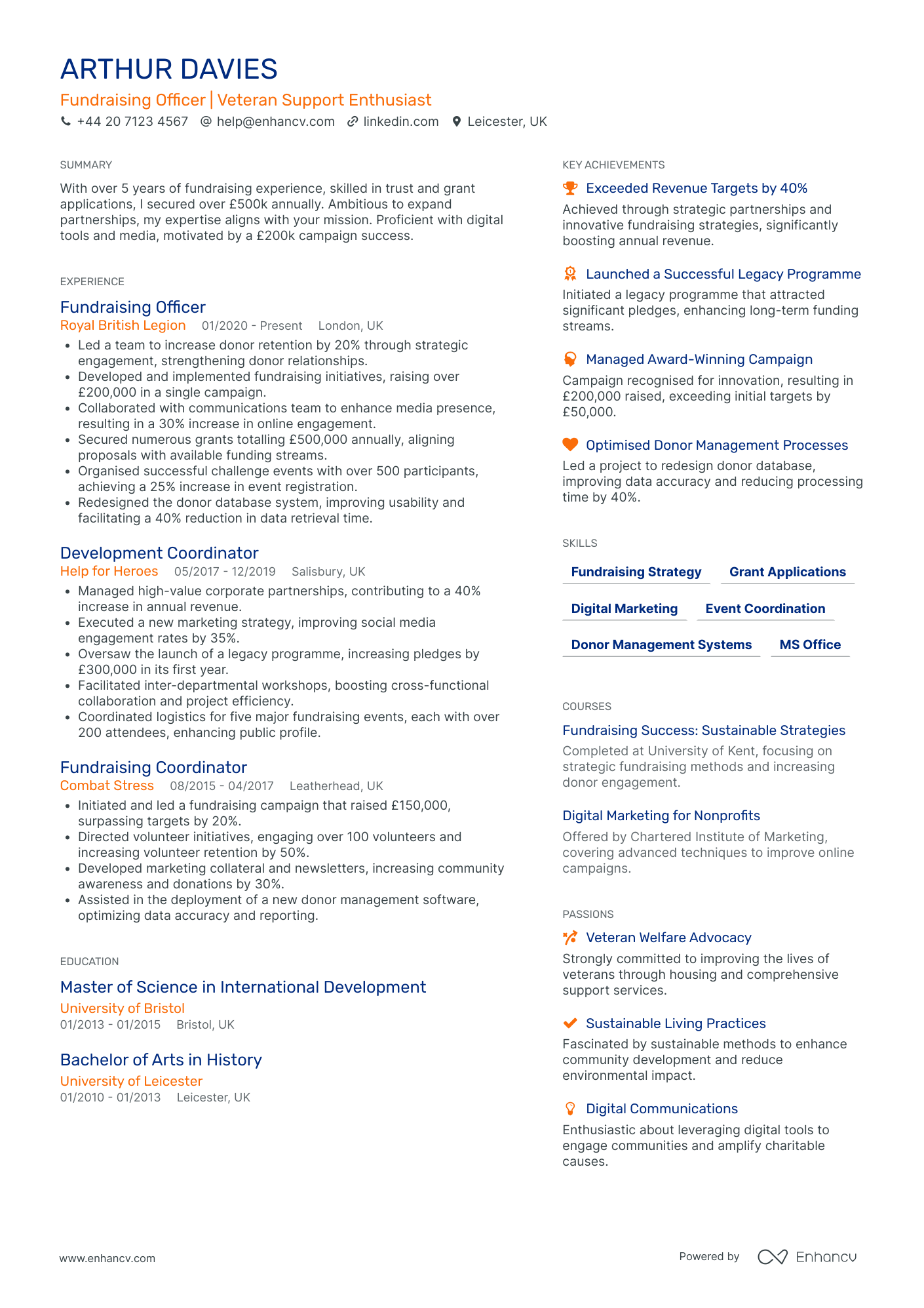
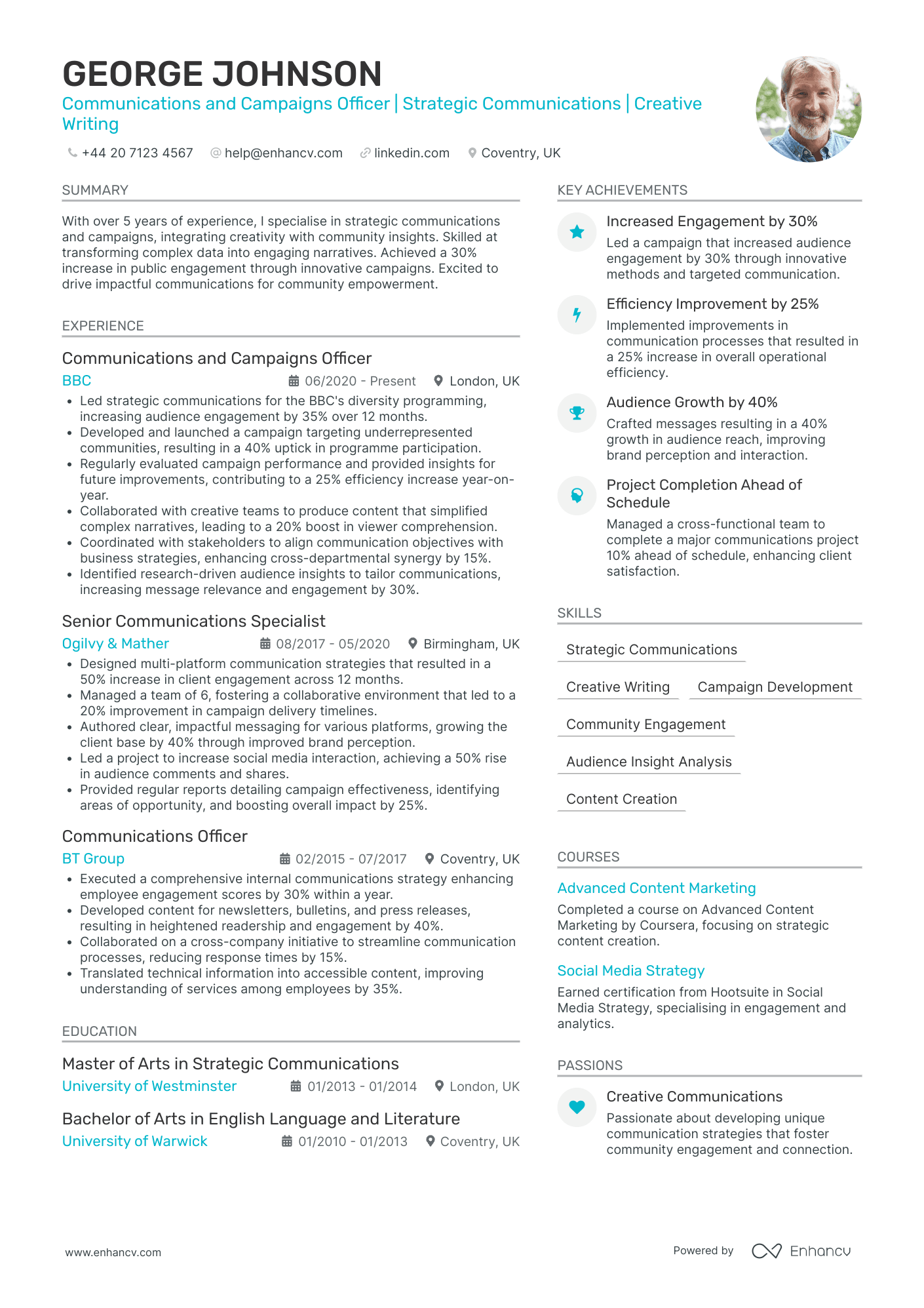
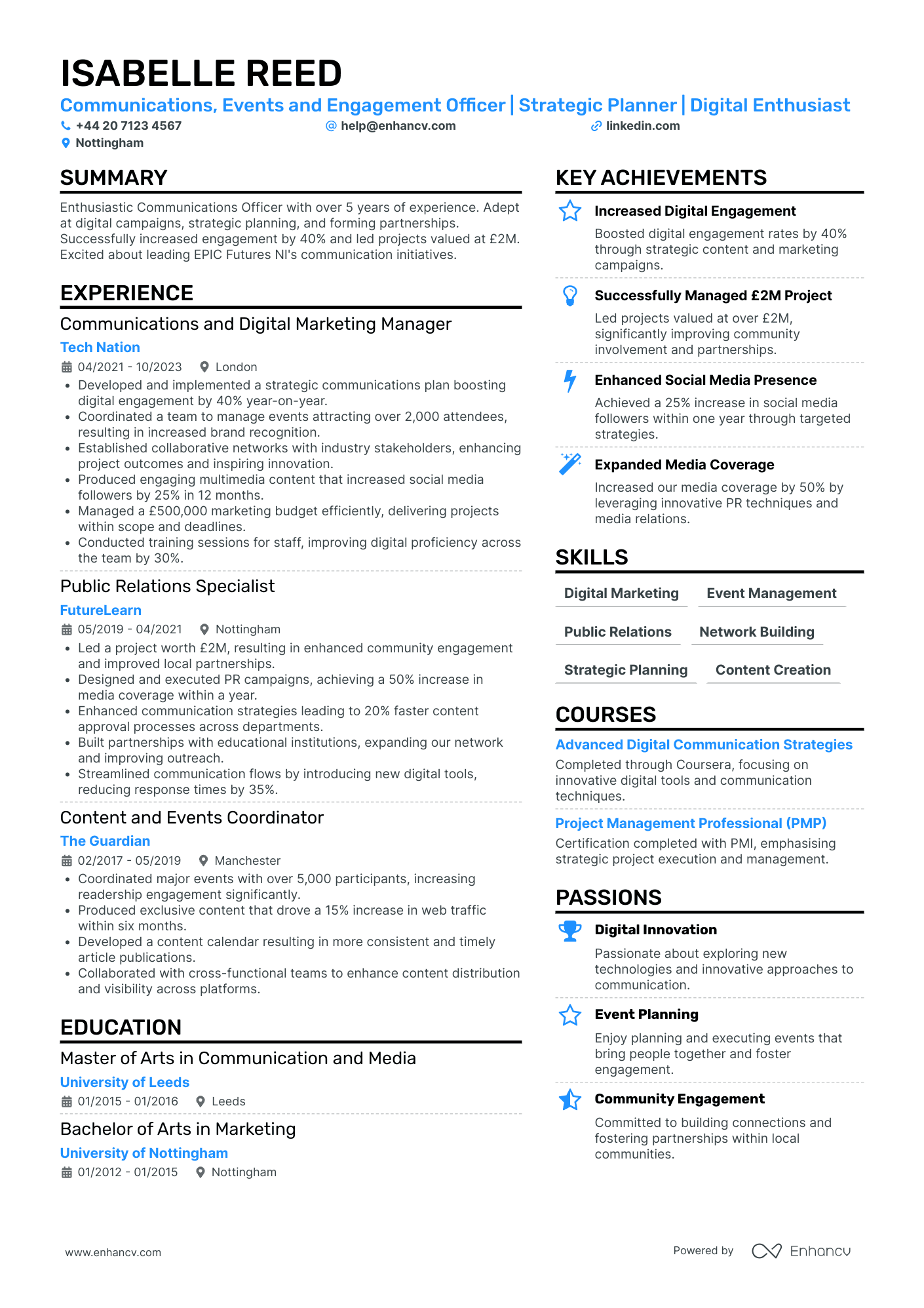
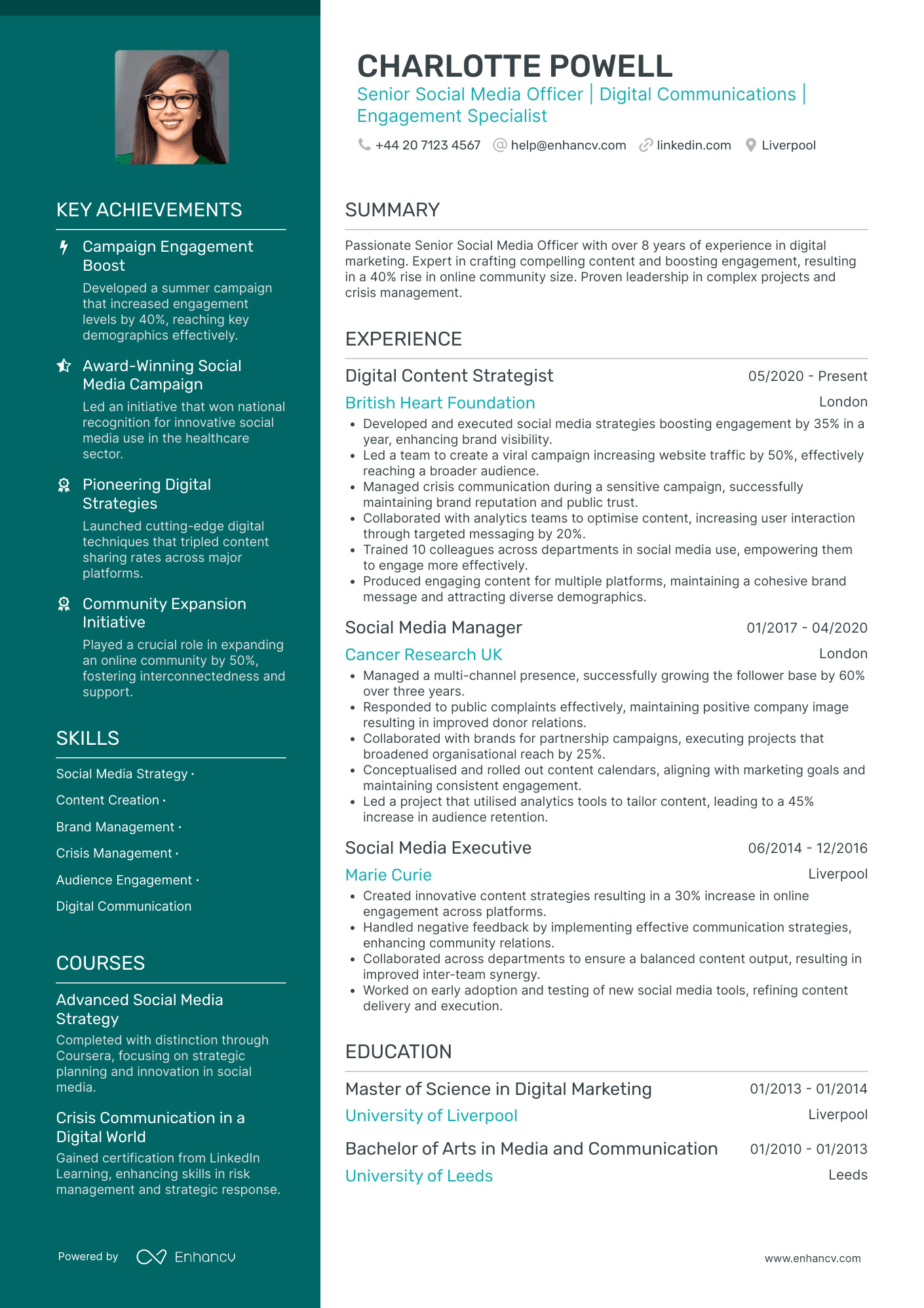
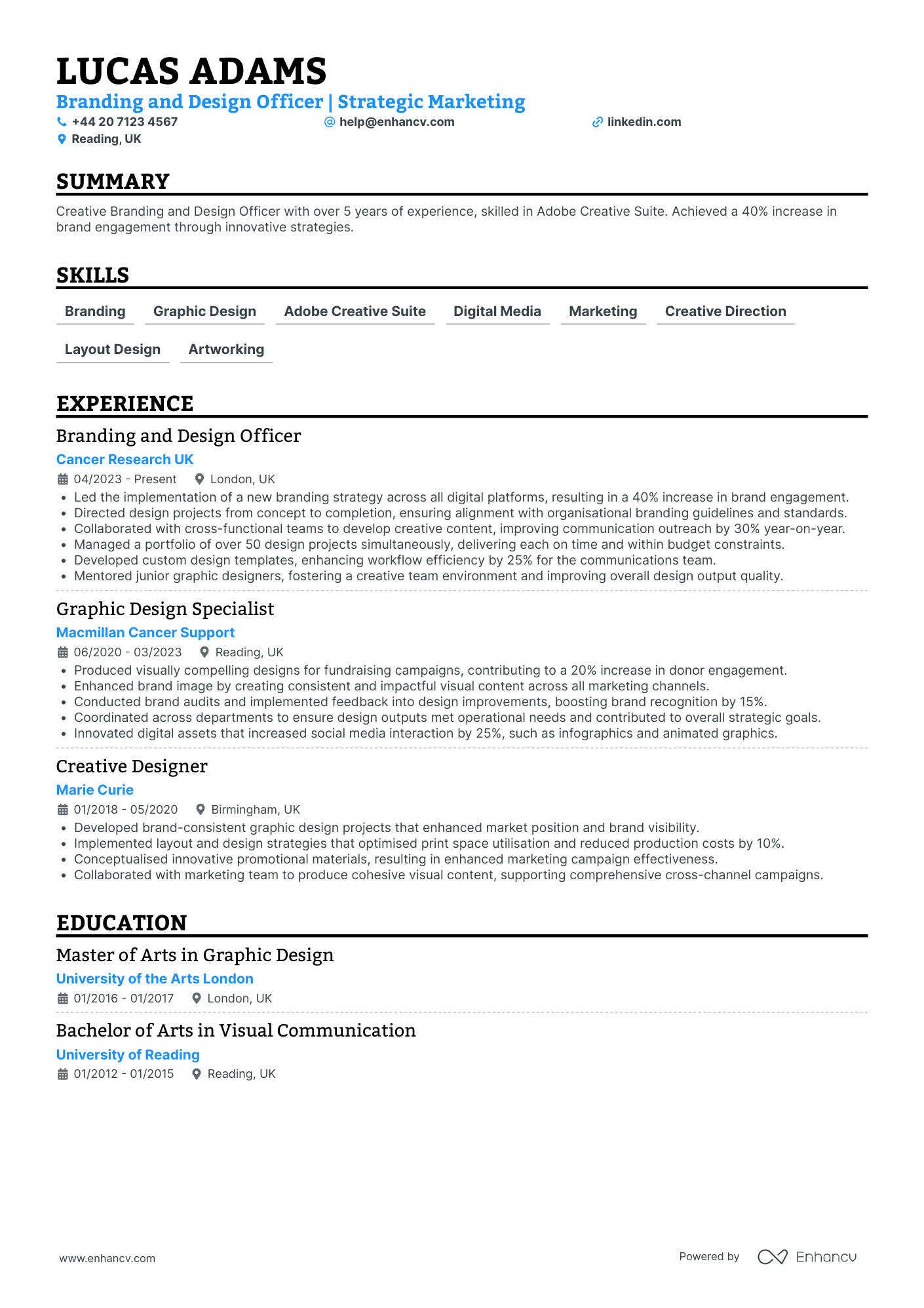
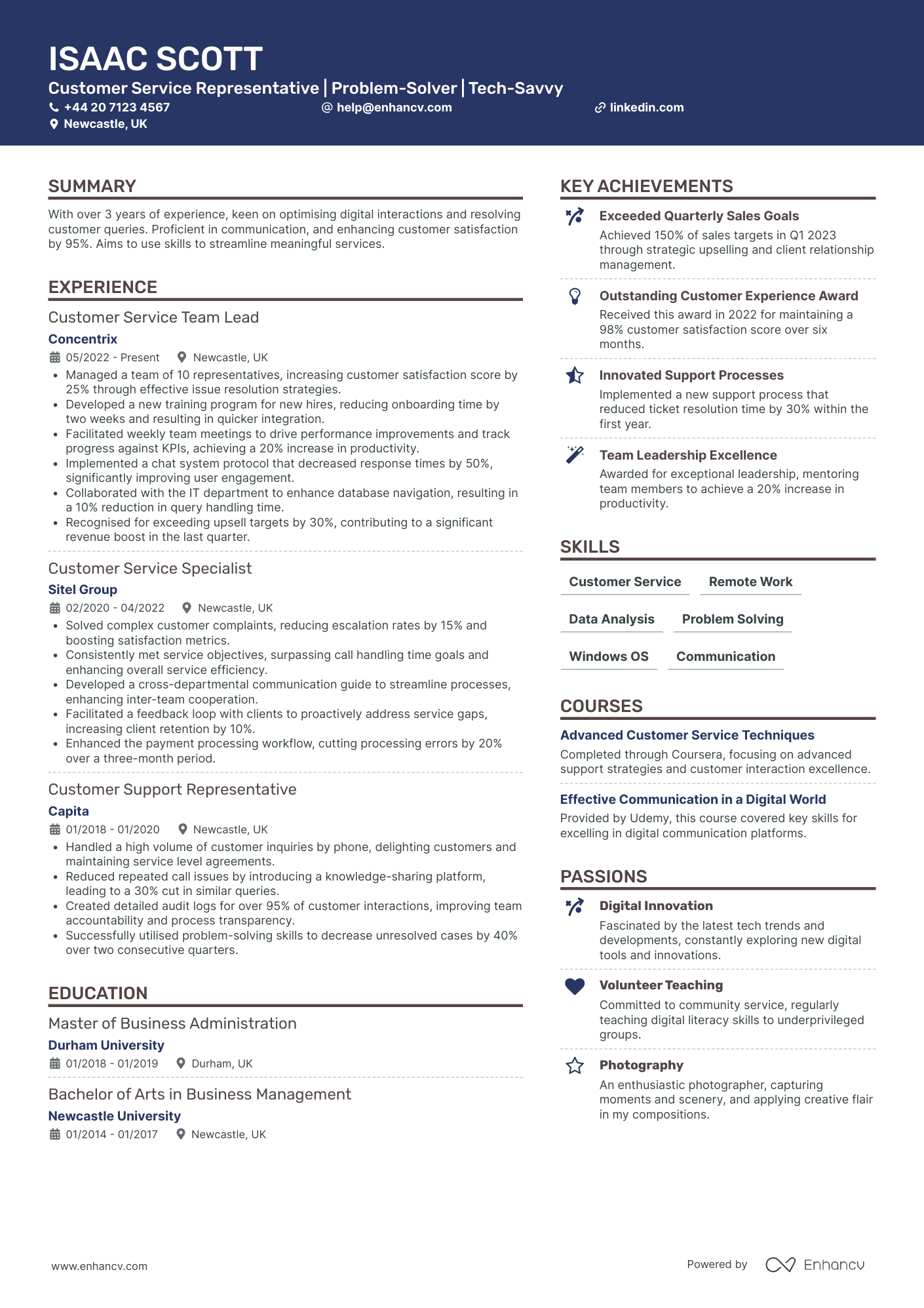
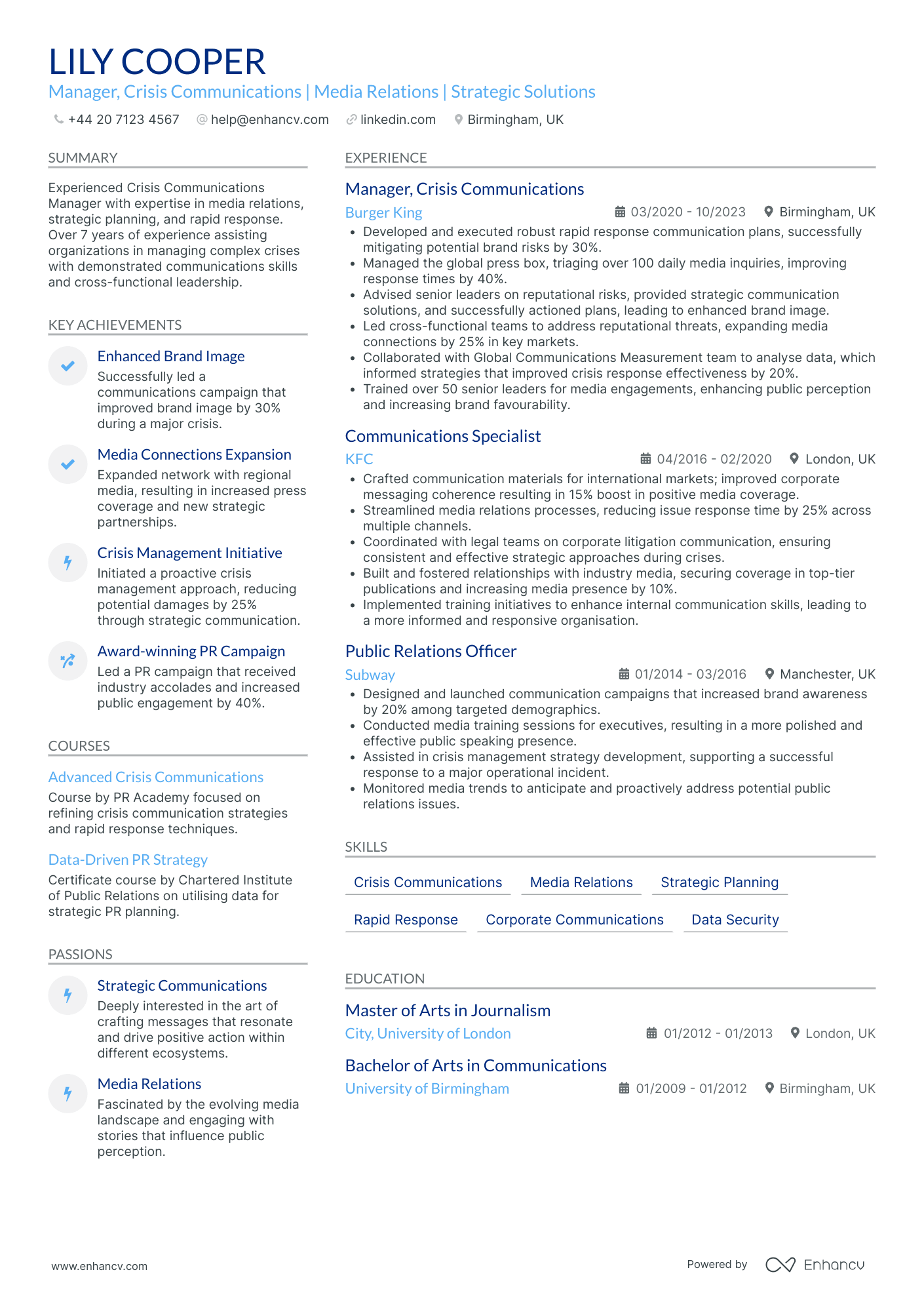
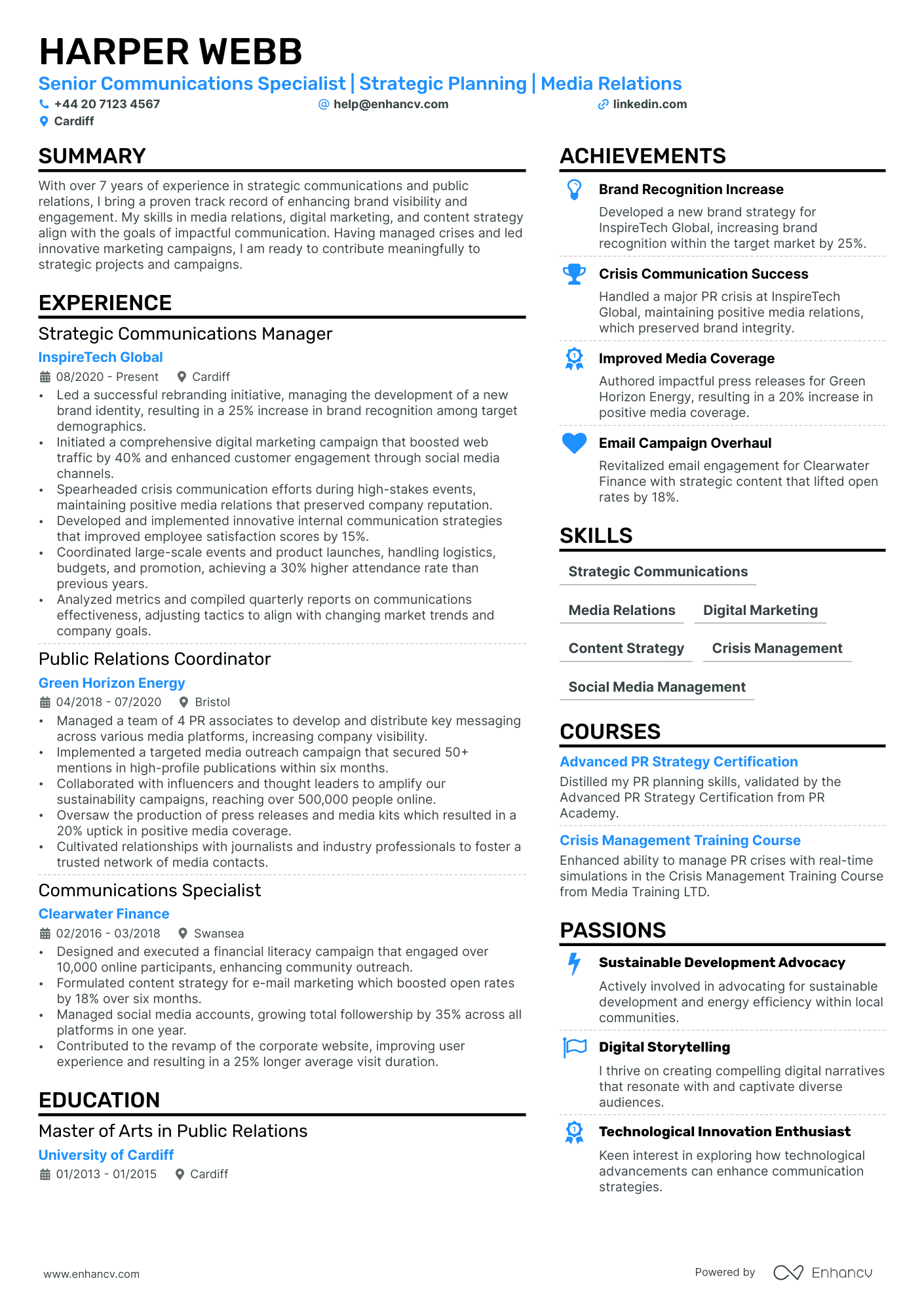
Your communications officer CV is a writing sample before it is anything else. If it cannot land your own story in a recruiter's six-second scan, they quietly doubt you can land a message for their organisation.
Most comms CVs read like a press release about the applicant, dense with "strategic", "dynamic", and "passionate", and thin on the campaigns, channels, and numbers that prove the point. The strong ones lead with evidence a hiring manager can check, and they lead with the right skills.

Key takeaways
- Lead with skills. A communications officer is hired on channels and output, so put social media, content creation, and internal communications where a recruiter sees them first.
- Prove communication, do not claim it. Swap "excellent communicator" for a campaign, a reach figure, or a stakeholder you kept aligned.
- Most UK roles are hybrid, so name your location and treat reliable hybrid working as a given near the top.
- Open with a short personal statement built on one campaign, one channel, and one result.
- Quantify everything you can: reach, engagement, open rates, media pickups, and turnaround times.
- Two pages, reverse chronological, sent as a PDF unless the advert asks for a Word file, with a link to a portfolio of published work.
Top skills for your communications officer CV
This is the section that gets you shortlisted, so it leads. A communications officer is judged on the channels they can run and the output they can produce, not on a paragraph of adjectives.
Across 24 UK communications officer postings in the last ~30 days on Enhancv's internal job feed, three skills recur more than any others: social media, content creation, and internal communications. Media relations and public relations follow close behind. Put the ones you can back at the top of your skills section, worded the way the adverts word them.
Hard skills are the tools and channels. List them plainly and only where you can evidence them:
- Social media management: name the platforms and the tools (Meta Business Suite, Hootsuite, Later), and pair them with a reach or engagement figure.
- Content creation: blogs, newsletters, press releases, and video scripts. Say how much you produce and how often.
- Internal communications: intranet updates, all-staff emails, leadership messaging, and employee campaigns.
- Media relations: press releases issued, journalist relationships, coverage secured, and spokespeople briefed.
- Campaign management: planning, delivery, and reporting against objectives.
- Editing and copywriting: house style, proofreading, and turning jargon into plain English.
Media relations and public relations read as the same thing to an outsider, so keep them distinct on the page. Media relations is the working relationship with journalists and the coverage it earns. Public relations is the wider reputation work: stakeholder messaging, crisis lines, and the story an organisation tells about itself. Naming both, with an example under each, signals you know the difference.
Round out the list with the quieter tools that adverts increasingly ask for. A content management system such as WordPress, analytics such as GA4, and basic design in Canva or the Adobe suite all belong here when you use them. They are the difference between a writer and a comms officer who can publish, measure, and report without waiting on another team.
Soft skills matter here more than in most roles, because communication is the job. The trap is claiming them. "Excellent communication skills" is the most ignored line on a comms CV because every applicant writes it and none of them prove it. Turn each one into evidence instead, and see our guide to soft skills on a CV for the wording.
Stakeholder management is the one worth spelling out. Comms officers sit between leadership, service teams, and the public, and the job is often keeping all three aligned on one message. "Briefed and aligned three directorates on a single crisis line within an hour" says more about your judgement than any adjective.
Top skills for your communications officer CV:
Social media management
Content creation
Internal communications
Media relations
Public relations
Campaign management
Copywriting and editing
CMS (WordPress)
Analytics (GA4)
Writing
Stakeholder management
Attention to detail
Adaptability
Collaboration

PRO TIP
"Good communication skills" tells a recruiter nothing. Replace it with what you communicated, to whom, and what changed: "Wrote and issued 45 press releases a year, securing regular regional and national coverage", or "Rewrote the all-staff newsletter and lifted open rates from 22% to 41%". Show the skill in action and let the reader conclude you have it.
What the UK communications officer market looks like
Knowing what employers ask for shapes what you put first. Here is what the current crop of UK adverts looks like.
| What | UK communications officer roles |
|---|---|
| Sample | 24 UK communications officer postings in the last ~30 days (Enhancv's internal job feed) |
| Where the work happens | Split between hybrid and onsite, with hybrid slightly ahead |
| Experience level asked for | Mostly mid-level, with senior and lead roles above it |
| Most-listed skills | Social media, content creation, and internal communications, then media relations and public relations |
Two things here should shape your CV.
Most of these roles are hybrid rather than fully onsite, so a recruiter wants to see you can work across a split week. Put your location in the header and treat reliable hybrid working as a given rather than an open question.
The demand clusters around mid-level officers, with senior and lead roles above them, so pitch your CV at the level the advert names. Pay is not quoted here because it swings widely by sector, from charity and public sector through to agency and corporate, so read each advert and the salary band it gives.
Formatting your communications officer CV
Use a reverse chronological structure once you have comms roles behind you, with a skills-led block near the top so your channels are visible on page one.
Keep it to two pages, one column, standard headings, and a clean, readable font. A communications hire is partly a judgement about taste, so a tidy layout does quiet work for you.
Send a PDF for direct applications so the formatting holds, and keep a Word copy for recruitment agencies that reformat into their own template. If the advert names a file type, follow it.
Link to a portfolio. Comms work is public by nature, so add a line in your header pointing to published articles, campaign write-ups, or press coverage. A clean URL beats a paragraph describing the work. If you cannot share client work, a simple page with two or three anonymised case studies does the same job.
Get the header right while you are there. Name, one contact line, location, and a LinkedIn or portfolio link is enough. Skip the date of birth, the marital status, and the full postal address, none of which a UK employer needs and all of which cost you space that a result could fill.
Comms applications often pass through tracking software, so keep the headings standard and the layout simple for an ATS-friendly CV. Build it from a tested layout rather than a blank page: Enhancv's CV templates export to a clean PDF.
Is your resume good enough?
Drop your CV here or choose a file. PDF & DOCX only. Max 2MB file size.
Writing your communications officer personal statement
Three or four sentences at the top: who you are, the channels you own, one result, and the kind of organisation you want to do it for. This is your best-written paragraph on the page, so treat it like copy you would publish. There are more personal statement examples if the opening line is fighting you.
Write it last, once the rest of the CV exists, and pull the strongest number straight into the second line. A recruiter reading dozens of comms CVs in a sitting decides in that second line whether to keep going, so the specific beats the sweeping every time.
Tailor it to the sector, too. A charity wants to hear about mission and reach on a small budget, a corporate team wants reputation and stakeholder management, and a public body wants clarity under scrutiny. One rewritten opening line per application is worth more than a generic paragraph sent to all three.
Lead with evidence, not adjectives. Here is the difference.
Communications officer personal statement example
Communications officer with six years across public sector and charity comms, covering social media, media relations, and internal campaigns. Grew a council's combined social following from 8,000 to 34,000 in two years and secured regular regional press coverage for public health campaigns. Looking to bring hands-on channel experience and a plain-English writing style to a mission-led organisation in the North West.
What to avoid
A passionate and dynamic communications professional with excellent communication skills and a proven track record of delivering strategic messaging to a wide range of stakeholders. A creative team player who thinks outside the box and is truly passionate about storytelling.
When we read a communications officer CV, the personal statement is the audition. If it is full of "strategic", "dynamic", and "passionate", we assume the applicant reaches for filler when a real sentence is hard, which is the opposite of what the job needs. Name one campaign, one channel, and one number in those first three lines. A comms officer who can write a sharp paragraph about their own work can write one about anything.
Writing your communications officer experience section
Each role gets a dated heading, then bullets that open with a verb and close with a result. For the mechanics, see work experience on a CV.
Comms work is more measurable than people assume: reach, engagement rate, open rate, media pickups, event attendance, turnaround time, and budget managed. Those numbers are your achievements, so pull them into the bullets.
Where a number is genuinely out of reach, describe the scale or the stakes instead. "Sole comms contact during a service outage that reached 40,000 residents" carries weight without a percentage. Lead every bullet with a verb, drop the ones that only describe duties, and keep the three or four that show a result.
Tailor each application to the advert, mirroring its channels and priorities where they are genuinely yours. Enhancv's CV tailoring feature reads the job ad and suggests the matching edits, which saves rewriting from scratch each time.
- Run all corporate social media across four channels, growing the combined following from 8,000 to 34,000 and lifting average engagement by 60% in two years
- Write and issue 45 press releases a year, securing regular coverage in regional titles and three national pickups for public health campaigns
- Rewrote the all-staff newsletter and raised open rates from 22% to 41% across 1,200 employees
- Managed a £15,000 campaign budget for a winter services push, delivered it under budget, and reported results to the senior leadership team
PRO TIP
Comms adverts name specific channels and tools. Mirror the ones you can back, worded as they are: "internal communications", "media relations", "CMS (WordPress)", "Meta Business Suite", "GA4". If you have run it, name it exactly as the advert does, and keep the ones you cannot yet back off the CV.
Education and qualifications for a communications officer CV
Employers care more about output than about a specific degree, so keep this section short and let your channels do the talking. List your degree and its classification in a brief education section, and drop the modules once you have real experience.
Where they add weight, name relevant qualifications: a CIPR or PRCA course, a CIM marketing qualification, or short courses in specific tools such as Google Analytics or a CMS. Put anything in progress on the CV too, marked as such.
A degree in communications, journalism, PR, marketing, or English is common, but plenty of strong comms officers come from unrelated subjects. If that is you, the skills and experience sections carry the CV, not this one.
Writing a communications officer CV with no experience
Comms is a field you can enter without a comms job title, because the evidence is often sitting in things you already do. Lead with a skills-led structure: personal statement, then skills and projects, then education, with any work history lower down.
Mine your life for real communications output:
- Running social media for a society, a charity, a small business, or a side project.
- Editing a student newspaper, a blog, or a community newsletter.
- Writing, designing, or sending email campaigns for a volunteer group.
- Any role where you briefed, presented to, or wrote for an audience.
Write those in comms language and attach numbers wherever they exist: followers grown, articles published, an event promoted. Volunteering on a CV counts as experience here, so give it a dated entry with output and hours.
Projects earn their own section when you have no paid roles to show. Give each one a title, a date, your role, and the result, exactly as you would a job. "Grew a university society's Instagram from 200 to 2,100 followers over one term" is a comms achievement, whether or not anyone paid you for it.
One portfolio link does a lot of work on a first comms CV. A handful of published pieces or a campaign you ran end to end proves more than a line claiming you are a strong writer. If the work lives across different places, gather it onto one simple page so a recruiter follows a single link, not five.
Conclusion
Lead with the channels you can run, prove your communication skills with numbers instead of adjectives, and treat every line as a sample of your writing.
Pair the CV with a short cover letter that shows the same plain-English style, and you give a comms team every reason to shortlist you.

Author's take - The Enhancv team
When we read a communications officer CV, the personal statement is the audition. If it is full of "strategic", "dynamic", and "passionate", we assume the applicant reaches for filler when a real sentence is hard, which is the opposite of what the job needs. Name one campaign, one channel, and one number in those first three lines. A comms officer who can write a sharp paragraph about their own work can write one about anything.