



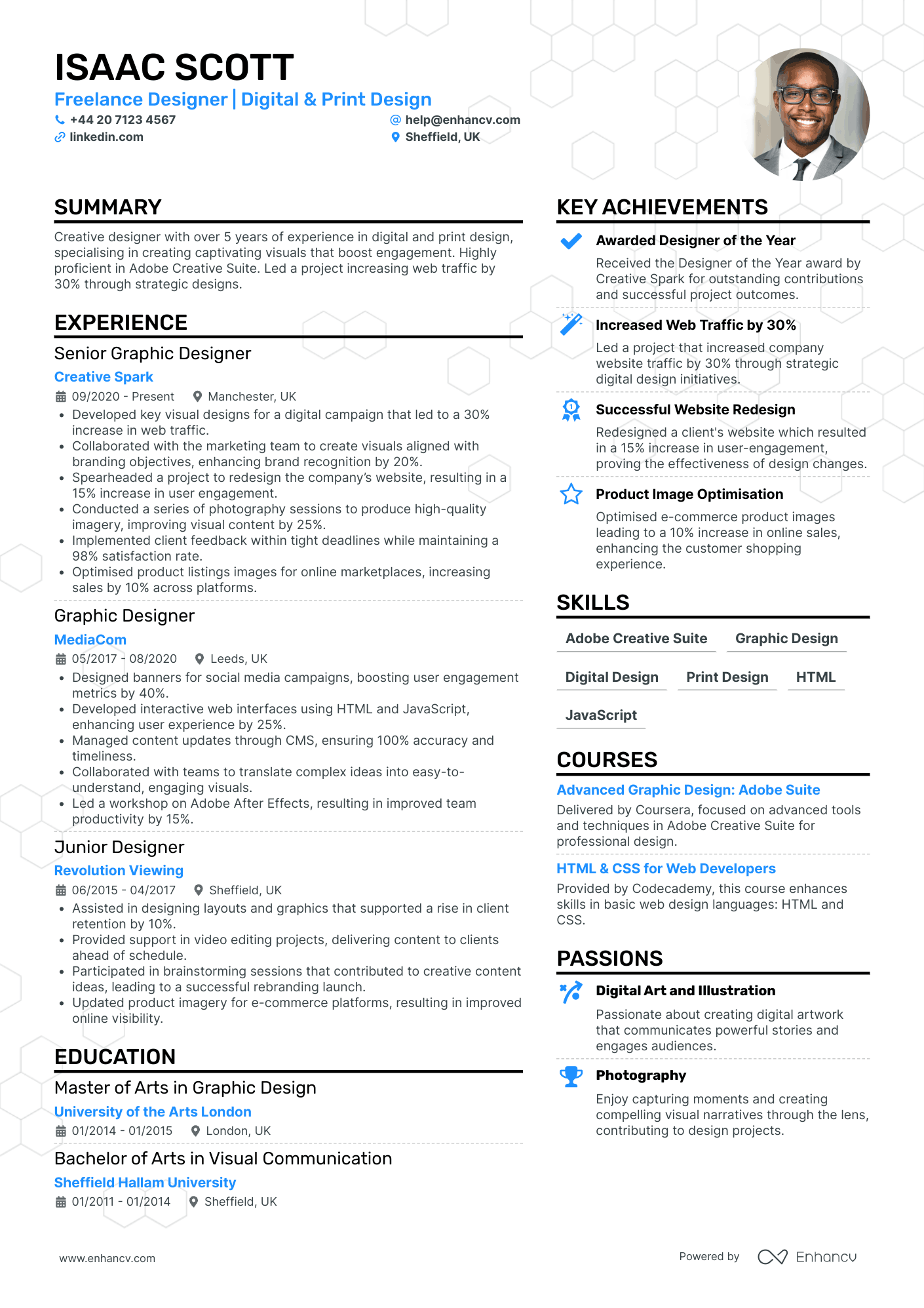
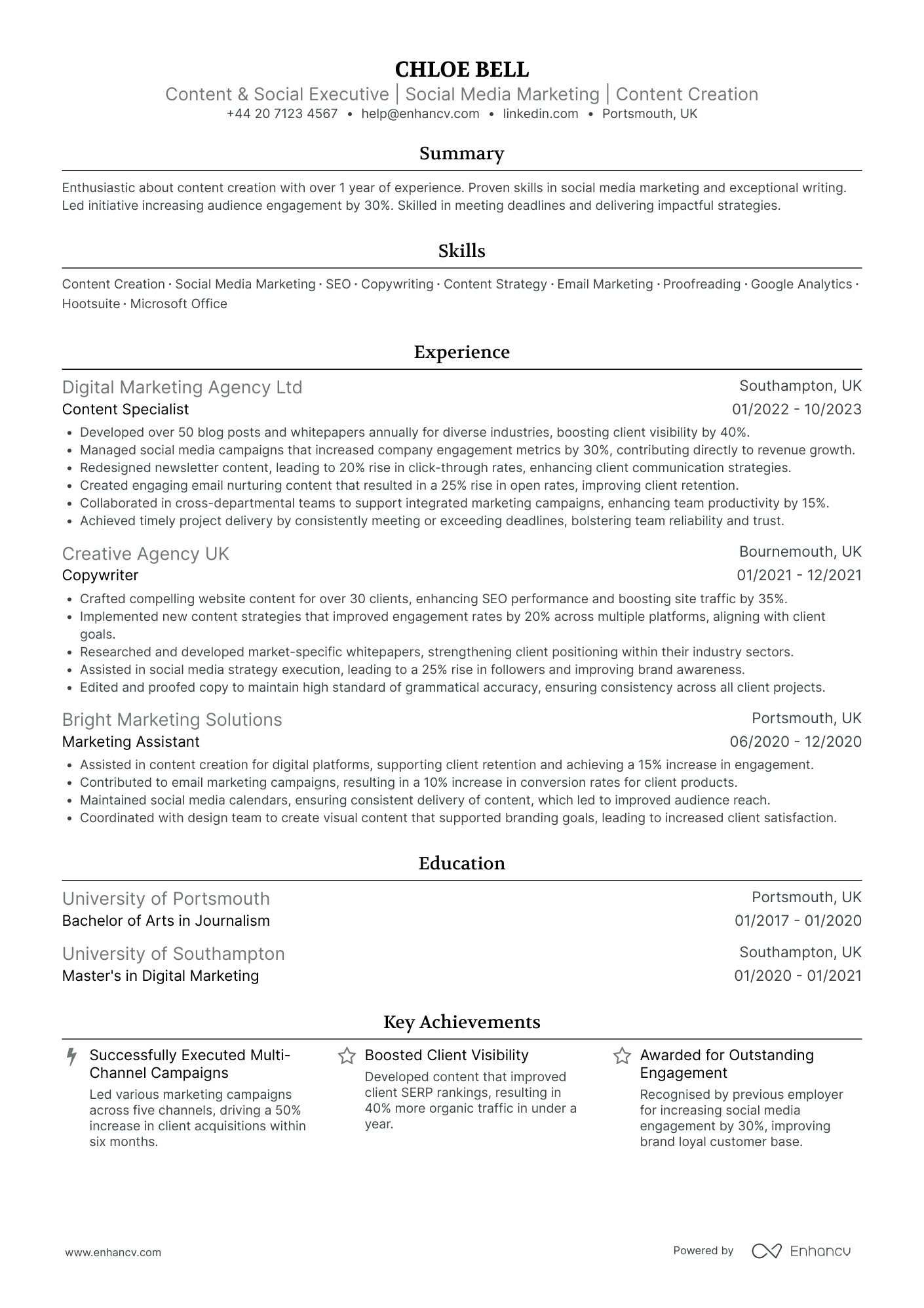
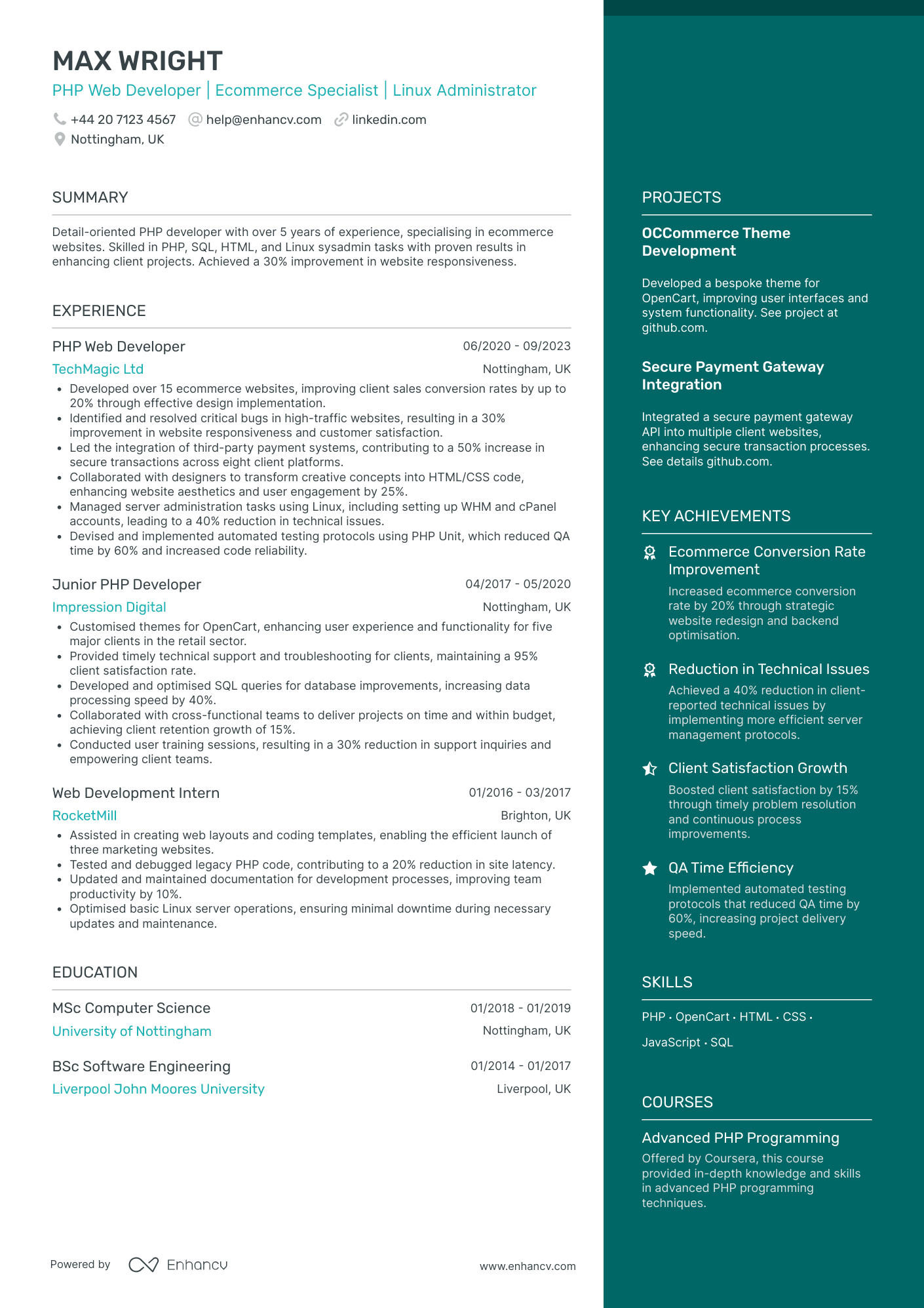
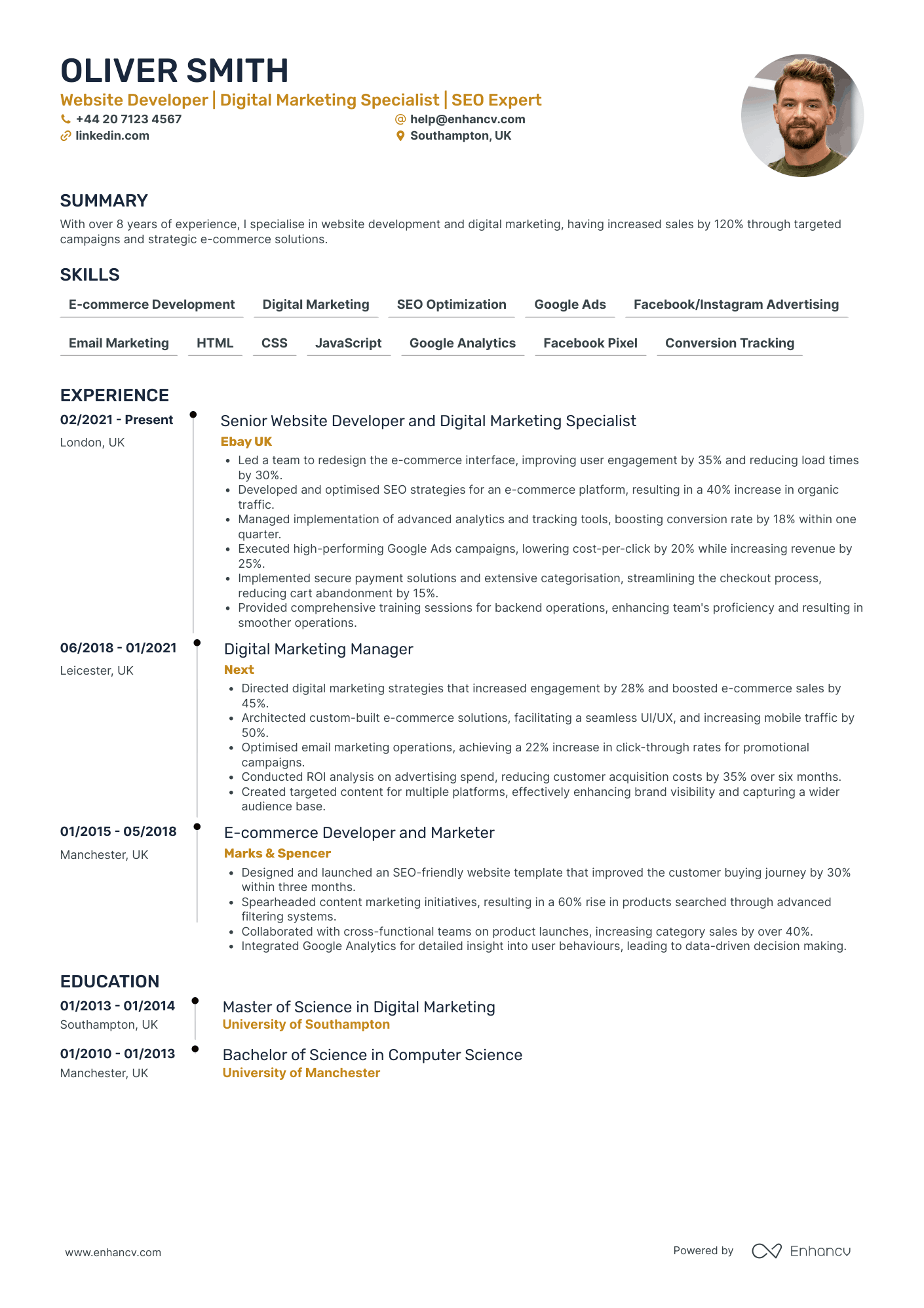
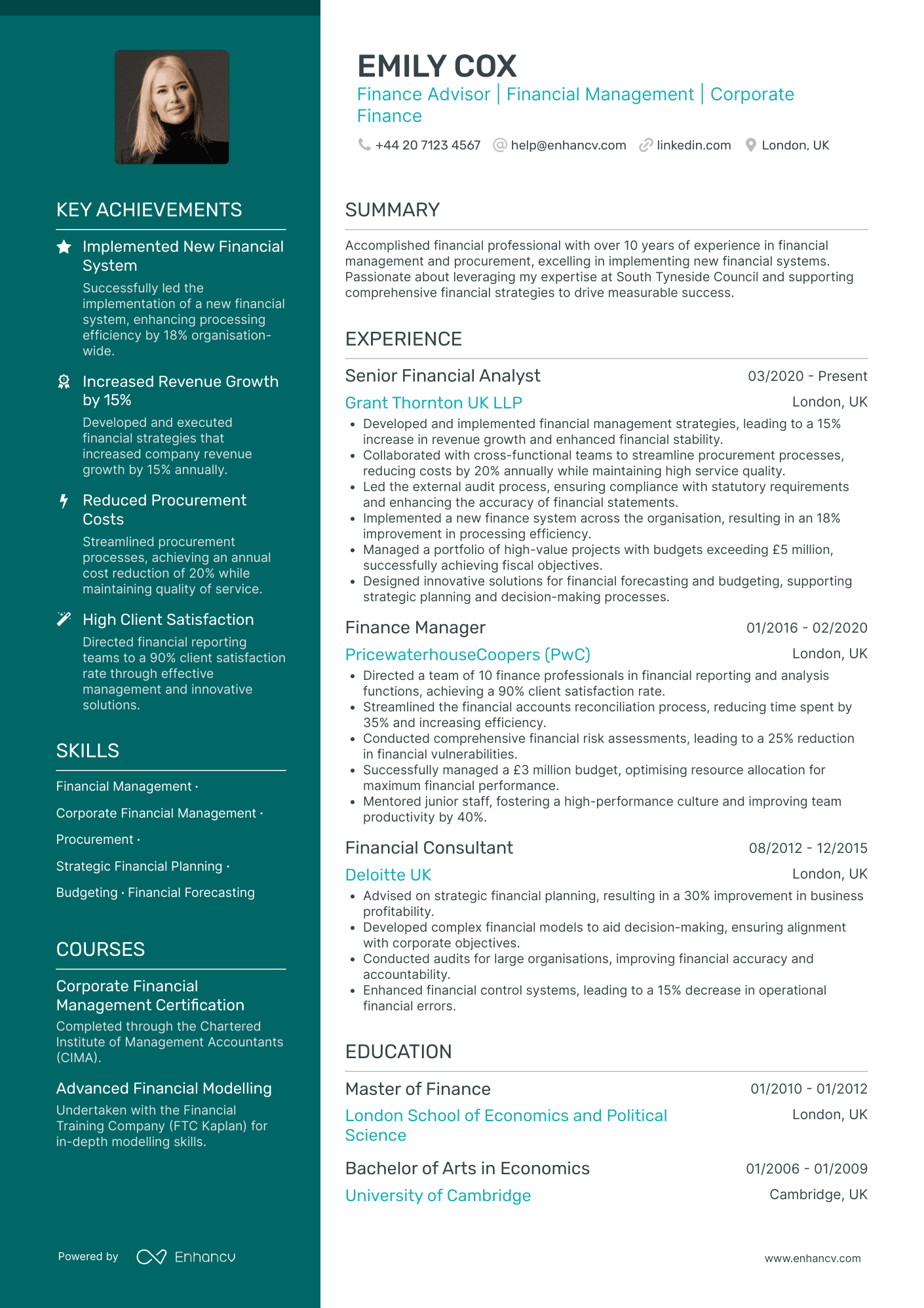
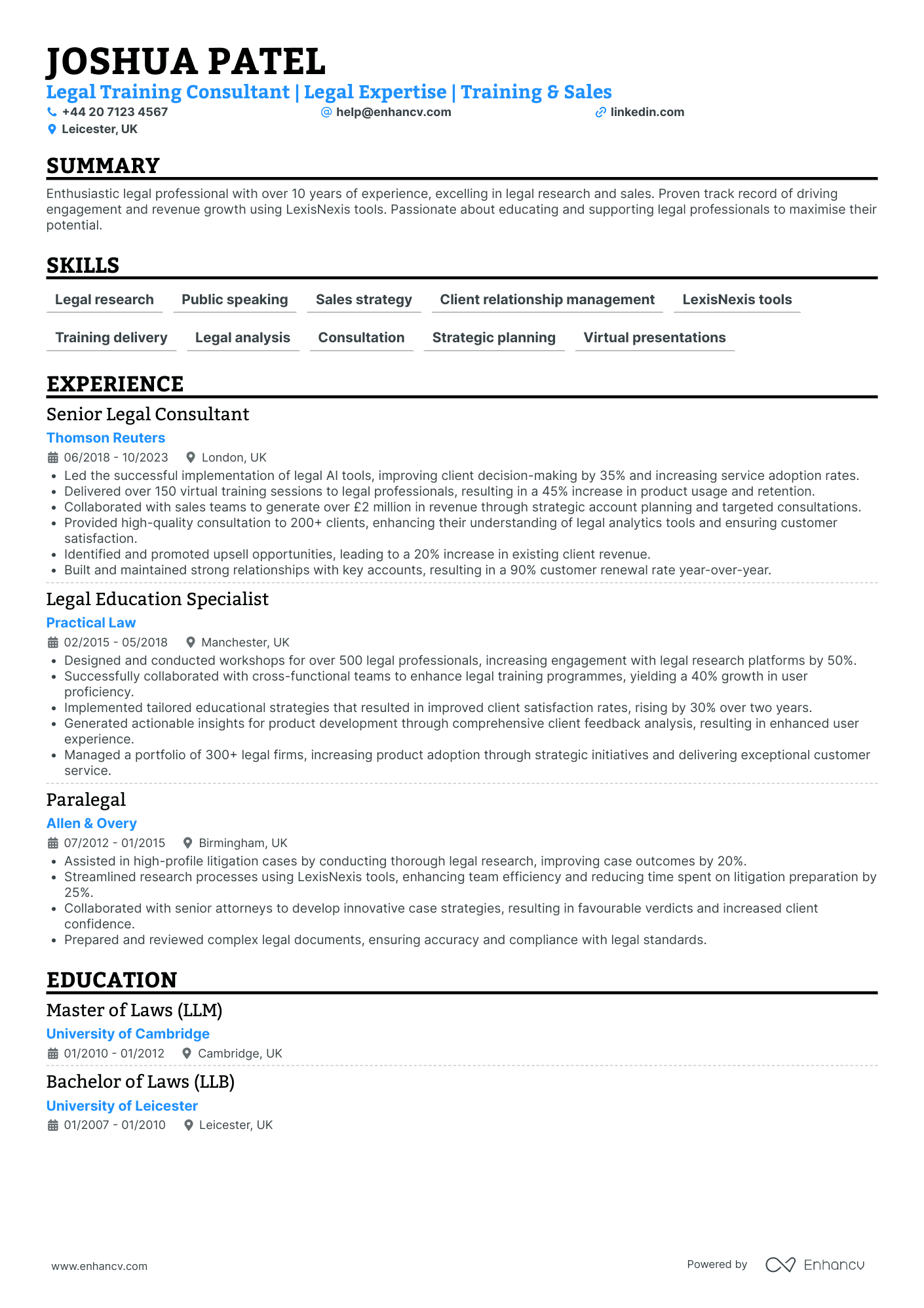
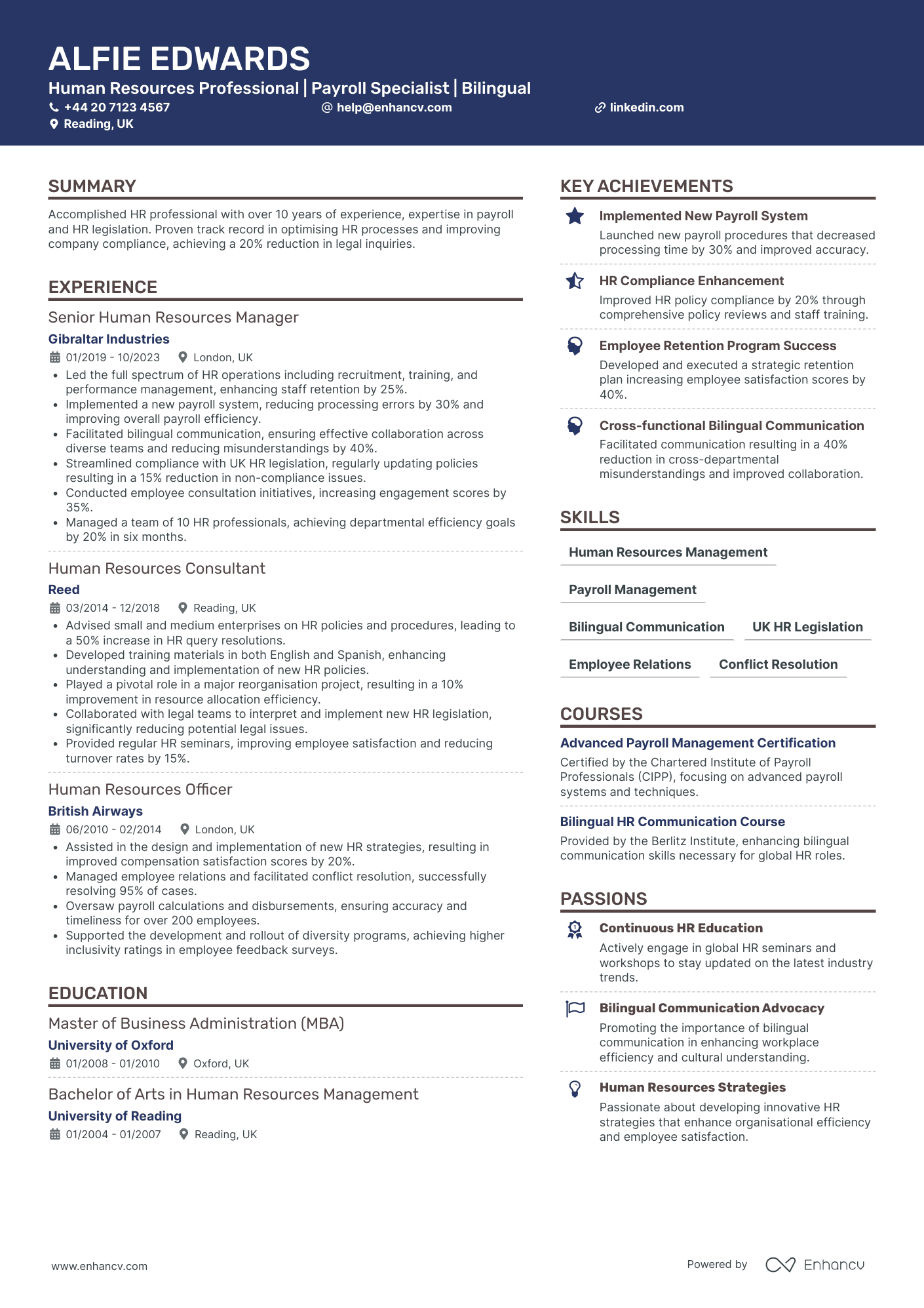
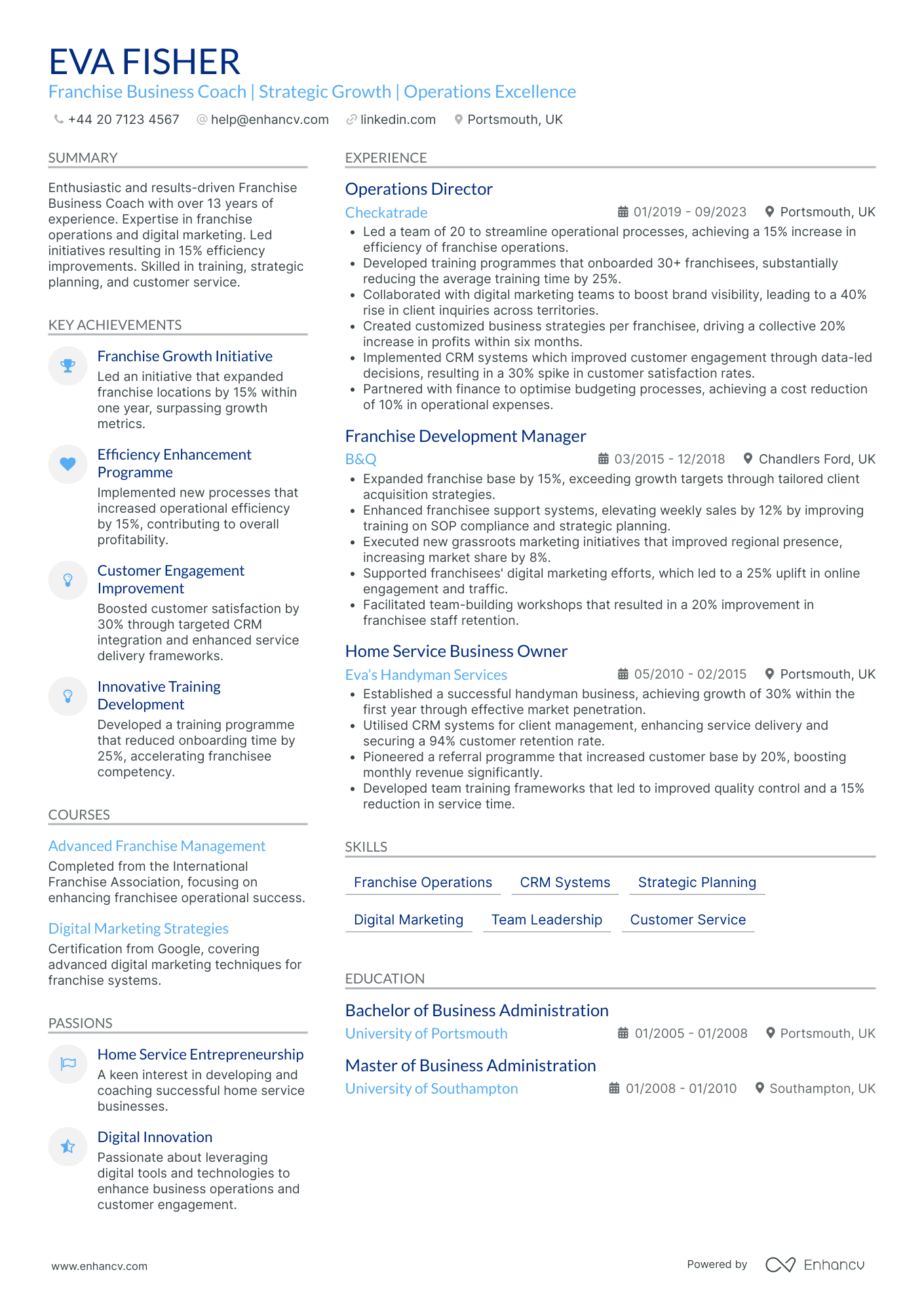
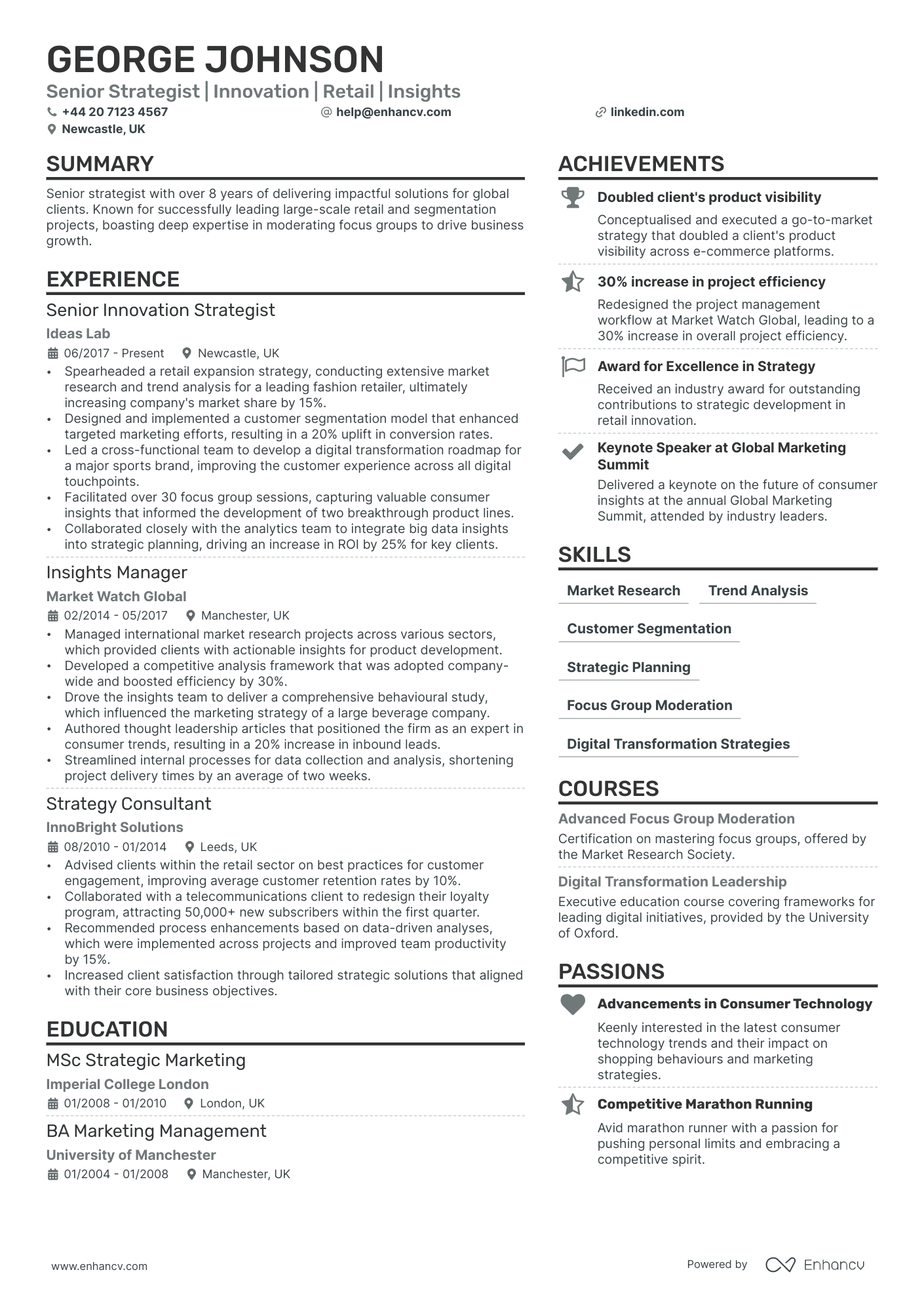
Most freelance CVs read like a scrapbook of unrelated gigs with no through-line. A client skims it, cannot work out what you actually do, and moves on to the next candidate.
The freelance CVs that win work do one thing differently. They read like a business with a single clear specialism, proof of delivery, and a portfolio a client can open in one click. Get the fundamentals right with how to write a CV, then layer on the freelance-specific moves below.

Key takeaways
- Lead with one clear specialism, not a list of unrelated gigs.
- Present your freelance work as a single business, with clients or sectors as sub-entries.
- Put your portfolio or website link in the header, where a client sees it first.
- Two pages, one column, sent as a PDF unless the client asks for a Word file.
- Quantify delivery: clients retained, projects shipped, revenue or time saved.
- No paid work yet? Build the CV around a portfolio of self-initiated and volunteer projects.
Formatting your freelance CV
Freelancers face a formatting problem employees do not have. You have run many short engagements, and a plain reverse-chronological list of every one of them looks chaotic on the page.
Fix it with structure. Use a clean, single-column CV layout with standard headings so both a busy client and any ATS-friendly CV screener can follow it top to bottom.
Keep it to two pages once you have a track record, one page while you are still building one. A readable font and sensible margins matter more here than any flourish, so pick a CV font that holds up at 11 point.
Your header does more work on a freelance CV than on any other. Alongside your name, location, and email, add a one-word availability line if it helps, such as "Available for project and retainer work", and your portfolio or website link. If you trade under a business name, put it next to your own name so a client can match the invoice to the person.
Send a PDF for direct approaches so your layout survives the trip. Keep a Word copy for recruitment agencies and talent marketplaces, which often reformat CVs into their own template. If the client names a file type, follow it.
Two-column designs and heavy graphics are tempting for creative freelancers, and they still trip up a fair number of tracking systems. A single readable column with the odd accent colour reads cleanly for a human and parses reliably for a machine, which matters when you apply through an agency portal.
On structure, a strict reverse chronological CV works once you have a few anchor clients. Early on, a skills-based CV or a combination CV lets your services lead while your gig history sits lower down.
Build from a tested layout rather than a blank page. Enhancv's CV templates export to a clean PDF that keeps your portfolio link live.

PRO TIP
Put your portfolio or website URL in the header, next to your email, not buried at the foot of page two. A client who cannot find your work in five seconds assumes there is none to find.
What to put in a freelance CV template
A freelance CV template uses the same building blocks as any other CV. It just reorders the CV sections so your services and proof come before a long gig history.
Here is the running order that works for most freelancers:
| Section | What goes in it |
|---|---|
| Header | Name, a plain job title such as "Freelance copywriter", location, email, and your portfolio or website link |
| Personal statement | Two to four lines naming your specialism, the clients you serve, and one concrete result |
| Skills and services | The services you sell, plus the tools you deliver them with |
| Freelance experience | One business entry, with named clients or sectors as bullets |
| Selected clients or projects | A short, curated list tailored to the brief in front of you |
| Education and certifications | Relevant qualifications and training, kept brief |
The single biggest decision is how to handle clients. Do not give every three-week project its own dated heading, or page one drowns.
Run one umbrella entry, "Freelance [your role]", with your strongest clients or sectors as bullets underneath. Give two or three anchor clients their own dated sub-entries when the relationship ran long or the name carries weight.
A "Selected clients" line under the header earns its place too. A single row of recognisable names or sectors tells a client you belong in their world before they read a word of detail.
Keep the education and certification block short. For most freelancers it confirms the basics and then gets out of the way, because the work in your portfolio is doing the persuading.

What a client checks in the first ten seconds
Can I tell what this person specialises in? Is there a portfolio link, and does it work? Is there one result I can believe? If all three are a yes near the top of page one, your CV has already done its job.
Writing your freelance personal statement
Four lines at the top: your specialism, the clients you serve, one concrete proof point, and the kind of work you want next. See more CV personal statement openers if the first line will not come.
Skip the adjective soup. "Versatile, creative freelancer passionate about great work" tells a client nothing they can check or price.
Lead with evidence instead, and sell yourself on your CV with specifics a client can picture:
Freelance CV personal statement example
Freelance B2B copywriter with six years turning technical products into plain-English campaigns for SaaS and fintech clients. Regular writer for three retained accounts, including a fintech scale-up whose email open rates rose from 18% to 31% after a rewrite. Looking for project and retainer work with product-led teams that value clear, converting copy.
The weak version of that same statement reads "Experienced freelancer offering a wide range of services to help businesses grow." It names no specialism, no client, and no result, so a client cannot tell whether you are right for the brief.
Rewrite the statement for each niche you pitch into. A B2B client and a charity client are reading for different proof, so lead the fintech pitch with the fintech result and the charity pitch with the charity one. The rest of the CV can stay the same.
The freelance CVs that get a reply almost always answer three questions in the first four lines: what do you do, who have you done it for, and what happened as a result. A client is hiring a risk, and every named client and every real number lowers that risk. Vague, versatile openers do the opposite, because they read like someone who will take any work going.
Writing your freelance experience section
Write your freelance work as a business, not a run of odd jobs. One entry, one job title, and bullets that show what you delivered. For the mechanics that apply to any role, see work experience on a CV.
Lead every bullet with an action verb and land it on a result. Freelance work is highly measurable once you look: clients retained, projects shipped on deadline, revenue generated, hours saved. Those are your CV achievements.
Here is how one umbrella entry looks in practice:
- Write and edit campaigns for a rolling roster of 8 to 12 SaaS and fintech clients, including three retained accounts billed monthly
- Lifted email open rates from 18% to 31% for a fintech scale-up across a six-week rewrite of its onboarding sequence
- Delivered 40 landing pages and case studies to deadline, with a 90% client repeat or referral rate over four years
- Scope, quote, and invoice every project directly, running a five-figure annual freelance income single-handed
Frame the scope in each bullet so a client understands the size of what you handled. "Sole writer across a 12-week product launch" says more than "wrote copy", because it shows you carried the work without hand-holding.
Retainers and repeat business are your strongest signal, so surface them. A line like "three retained clients billed monthly for two years running" tells a client that other clients trust you enough to keep paying, which is the reassurance every brief is really testing for.
Gaps between contracts are normal in freelance work and rarely need explaining. A single continuous "Freelance" entry with a start date and "Present" smooths over the quiet months without hiding anything.
Tailor the entry to each brief by mirroring the language the client uses in their advert or scope, a move worth making on every pitch. Here is how to tailor your CV without starting over each time.
Enhancv's CV tailoring feature reads the brief and suggests the matching edits, which saves rewriting from a blank page for every client.
PRO TIP
Anchor clients are worth naming. If you have delivered for a brand a client will recognise, put that name in the bullet, not just the sector. Recognition does quiet, powerful work on a freelance CV.
Top skills for your freelance CV
A freelance CV carries two layers of skill. There is the craft a client is buying, and there is the business of running yourself as a supplier, and a strong CV shows both.
List the craft as your hard skills in the words clients use in their briefs. Put the running-a-business skills nearby, because they are what separate a reliable freelancer from a risky one.
The soft skills that matter most to a client are the ones that predict a smooth project: clear communication, time management, and reliability under a deadline. Prove each in a bullet rather than just claiming it, and keep your skills section honest.
The business skills are the ones inexperienced freelancers forget, and they are exactly what reassures a client who has been let down before. Show them in your bullets, not just your skills box. "Scoped, quoted, and delivered every project to a fixed fee" proves budgeting and reliability in a single line.
Top skills for your freelance CV:
Client and account management
Project scoping and quoting
Proposal and pitch writing
Invoicing and budgeting
Contract and rate negotiation
Personal branding and self-marketing
Your core craft (name it: writing, design, development)
Self-discipline
Time management
Communication
Adaptability
Reliability
Building and linking your portfolio
For most freelancers the portfolio does more selling than the CV. The CV's job is to get the client to click through to it.
Host your work somewhere with a clean, memorable URL, and put that link in your CV header beside your contact details. A portfolio a client cannot reach is the same as no portfolio.
Curate, do not dump. Show three to six pieces that match the client in front of you, each with a line on the brief, your role, and the outcome. Swap the selection per pitch the way you would tailor the CV itself.
Write each piece as a short case study rather than a gallery image. The client, the problem, what you did, and the result, in four lines, turns a nice-looking sample into evidence a client can act on. That structure also gives you ready-made bullets for the CV.
Any hosting that gives you a clean link works, from a dedicated site to a well-organised profile on a portfolio site. What matters is that it loads fast, looks current, and is easy to skim on a phone, because that is where a client will first open it.
If a contract or an NDA stops you sharing the work itself, describe the problem and the result without the client's name or assets. A client reading redacted-but-specific work trusts it more than a wall of logos with no detail.
Writing a freelance CV with no experience
Every first freelance CV has the same gap: no paying clients yet. You close it with proof you created rather than proof you were paid for.
Build a portfolio of self-initiated and spec projects that look like real briefs. Redesign a badly built local website, write sample campaigns for brands you admire, or ship a small app, then treat each one as a portfolio piece with a stated goal and a result.
Mine any employed or student work for freelance-shaped evidence. A side project you ran end to end, a society newsletter you designed, or a stall you marketed all show you can scope and deliver without a manager standing over you, which is the exact quality a first client is nervous about.
Volunteering for a charity or a community group is the fastest route to real, referenceable work, and it counts as experience for this purpose, not filler. One part-time or one-off paid gig, however small, moves you from "no clients" to "freelancer".
Price your first jobs to build proof, not a fortune. A couple of small, well-delivered projects at a modest rate give you the results, the testimonials, and the confidence to charge properly on the next brief.
Frame the whole thing with a skills-led structure and lean on the fundamentals in these first-job CV examples. Then ask your first one or two clients for a short testimonial you can quote on both the CV and the portfolio.
Conclusion
Lead with one clear specialism, present your freelance work as a business, link a live portfolio, and keep the format clean enough to skim in seconds.
Pair the CV with a short cover letter that names the client's problem and how you would solve it, and you turn a pile of gigs into a credible pitch.
Author's take - the Enhancv team
The freelance CVs that get a reply almost always answer three questions in the first four lines: what do you do, who have you done it for, and what happened as a result. A client is hiring a risk, and every named client and every real number lowers that risk. Vague, versatile openers do the opposite, because they read like someone who will take any work going.