



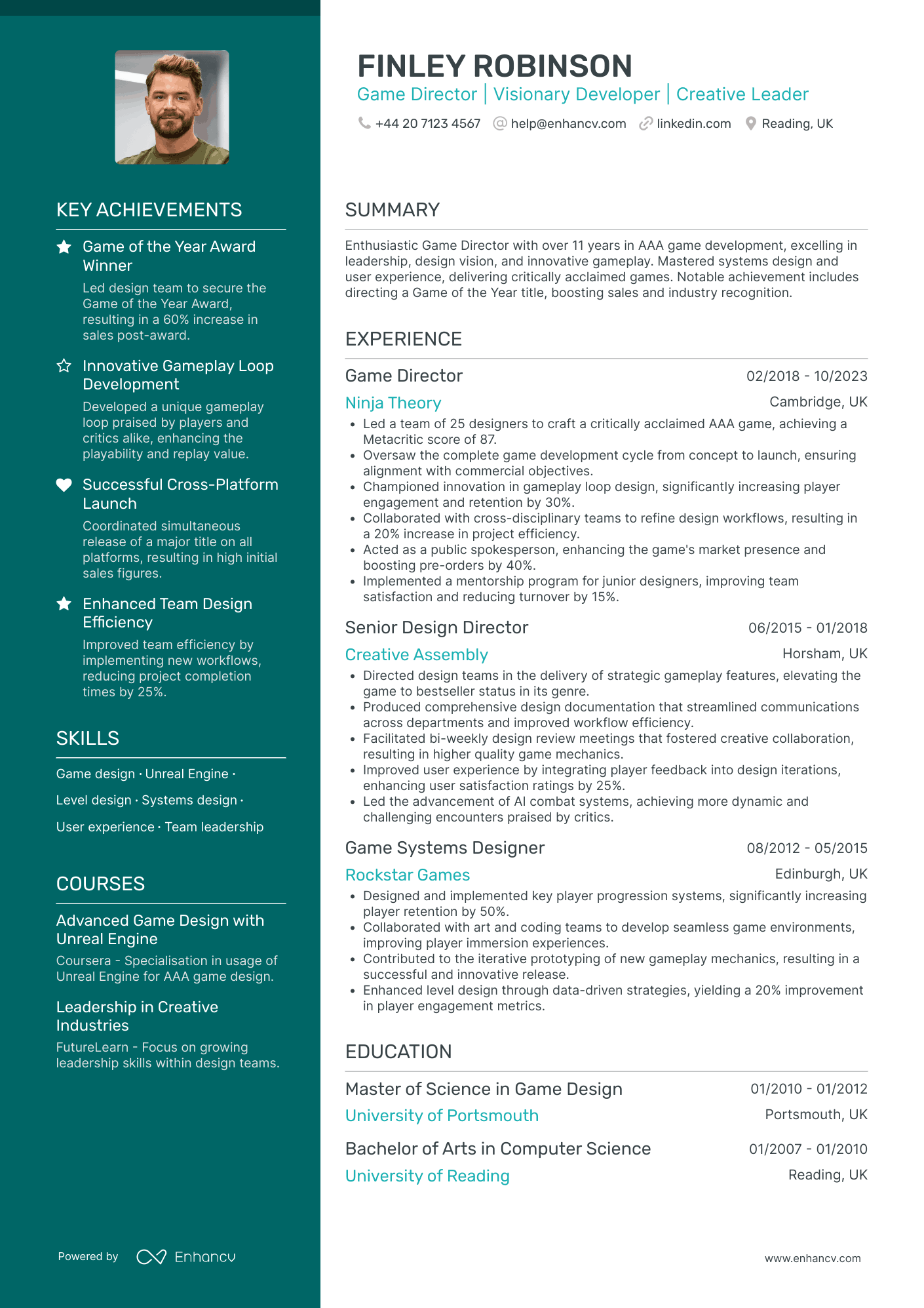
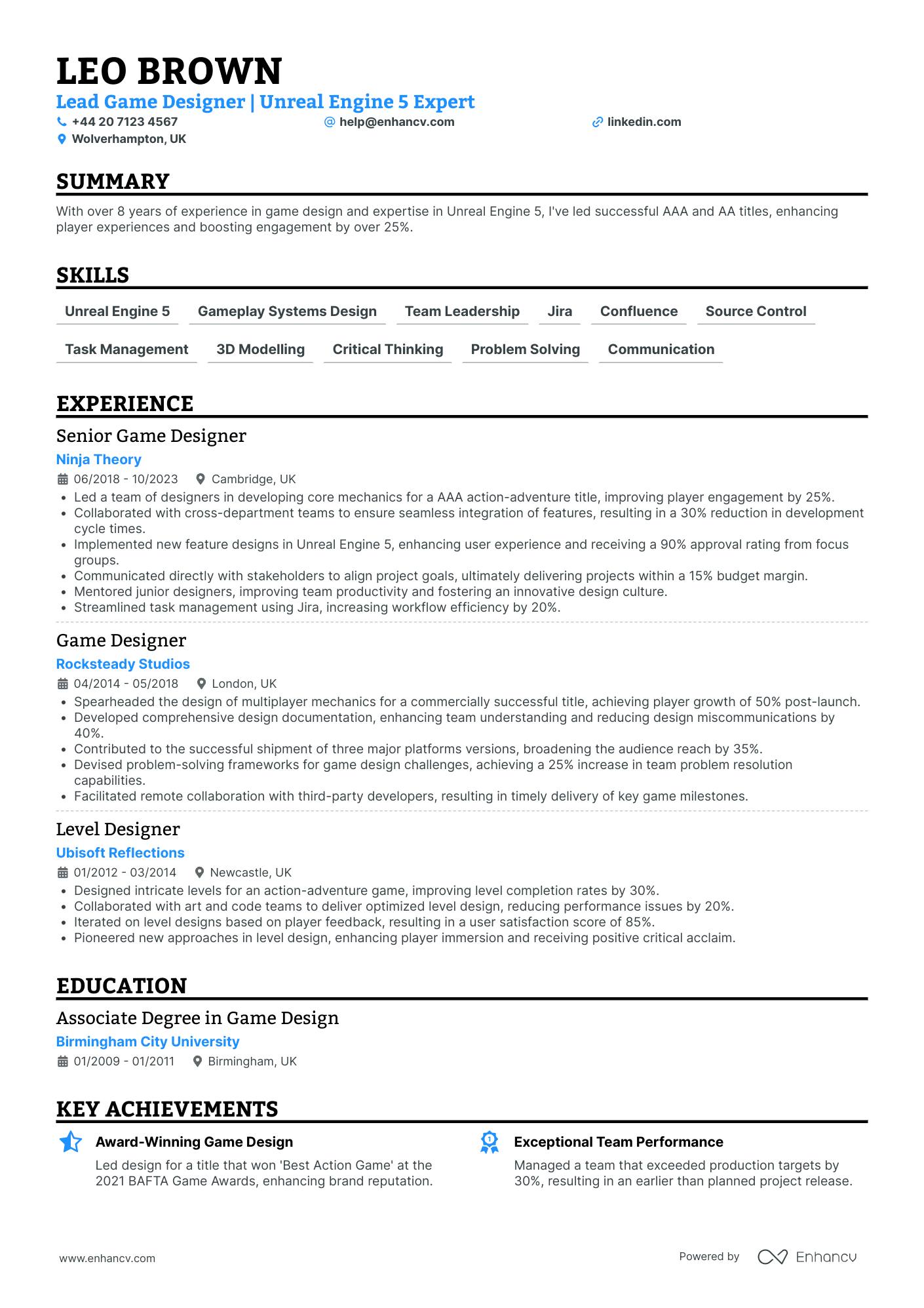
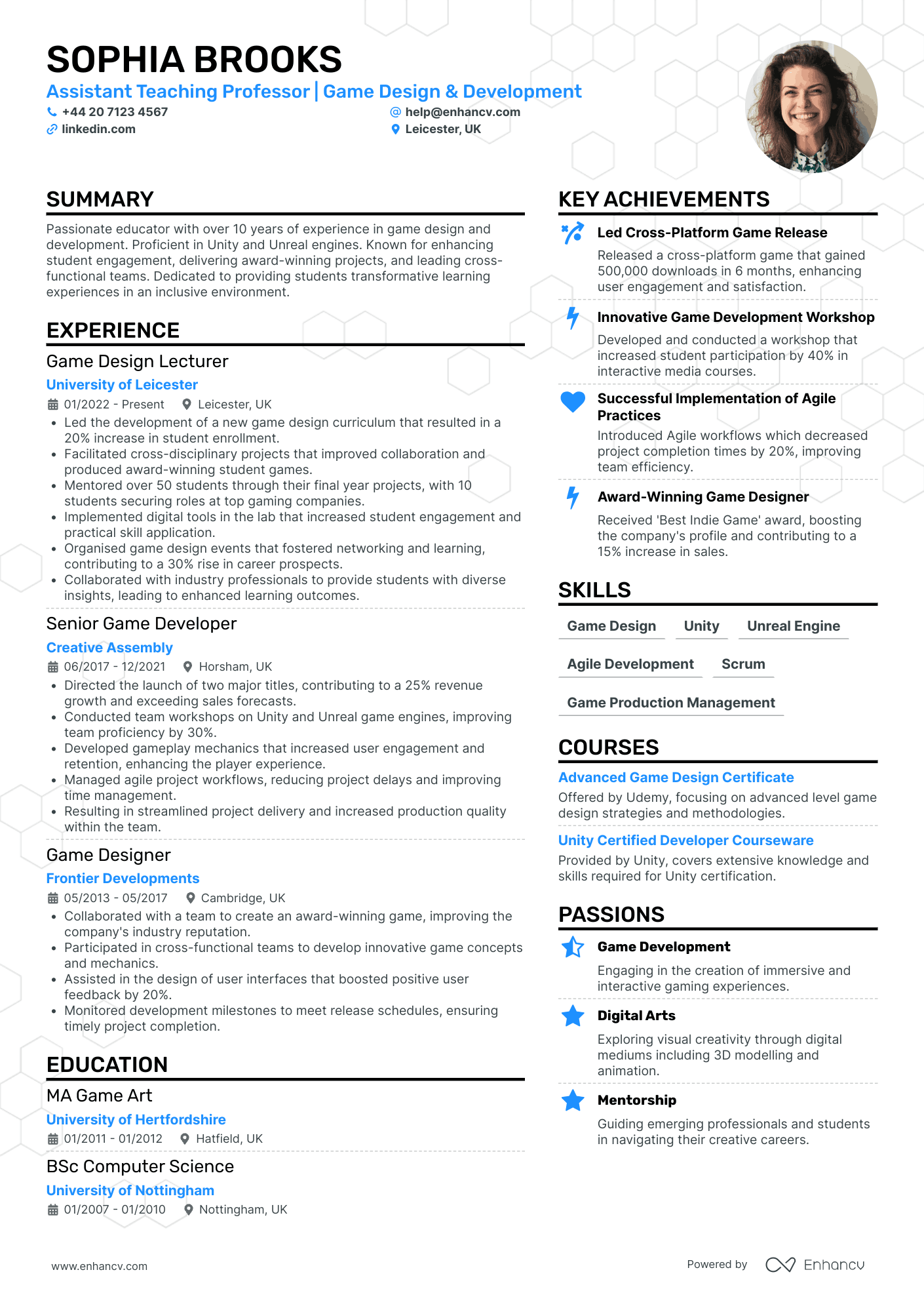
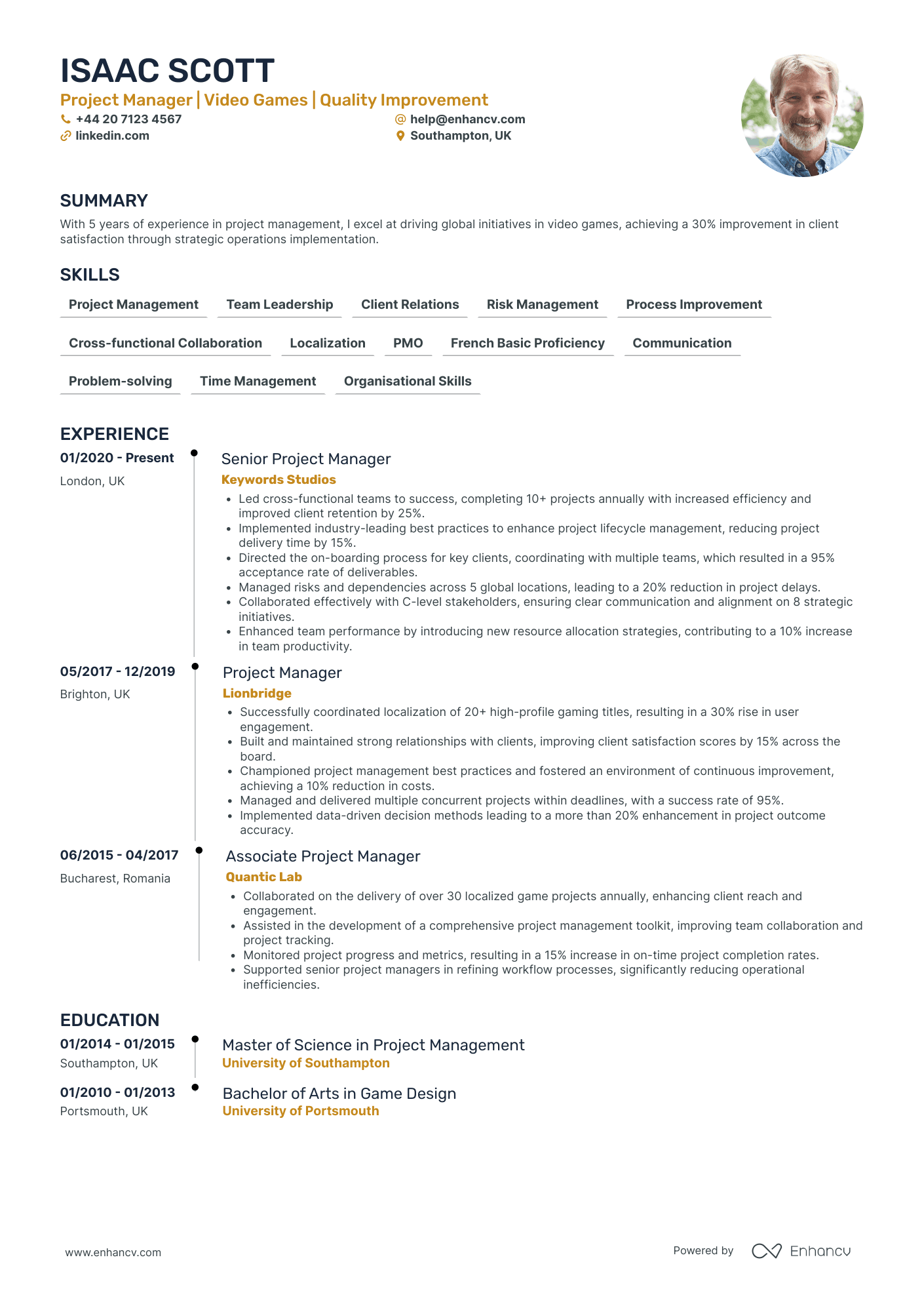
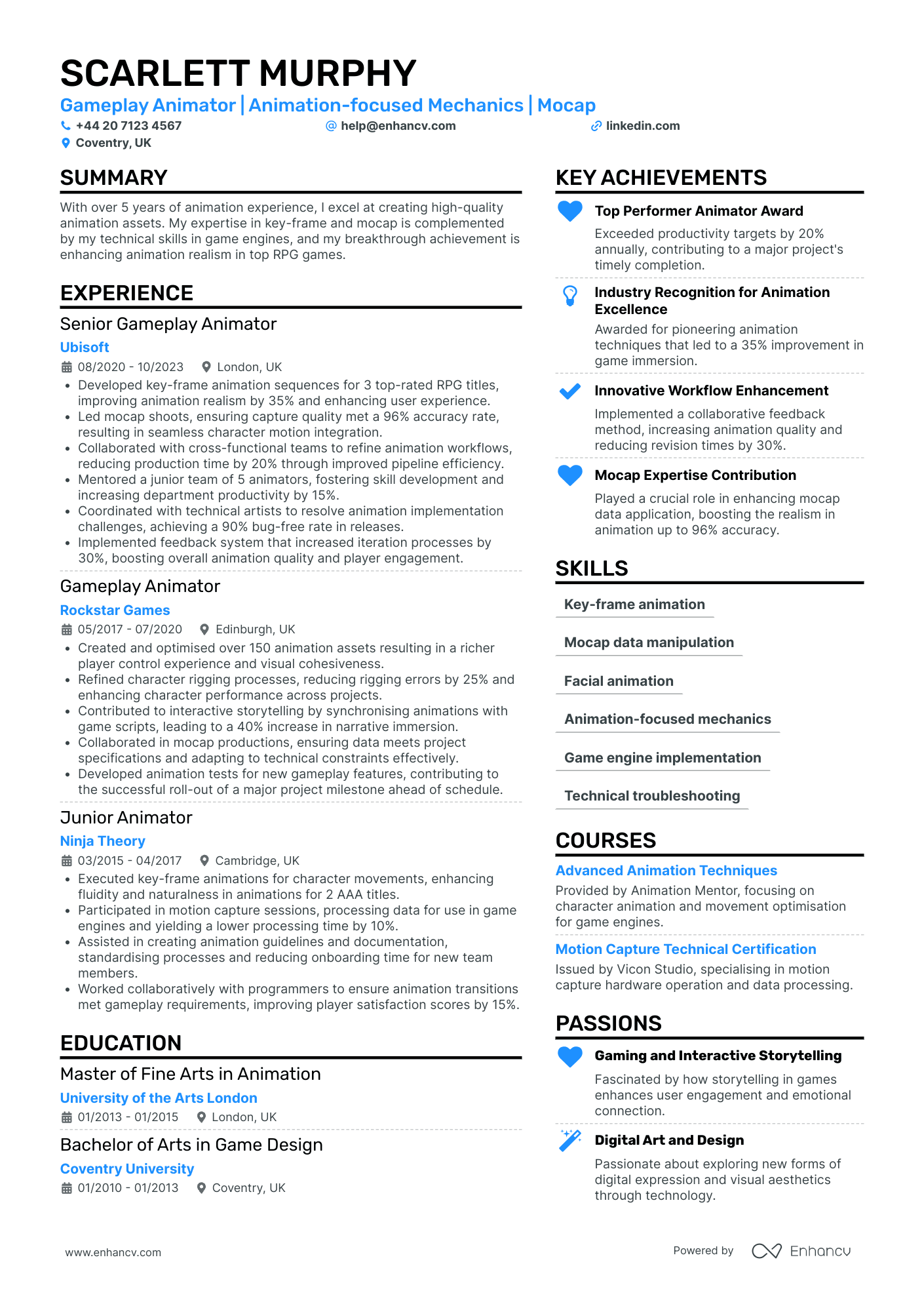
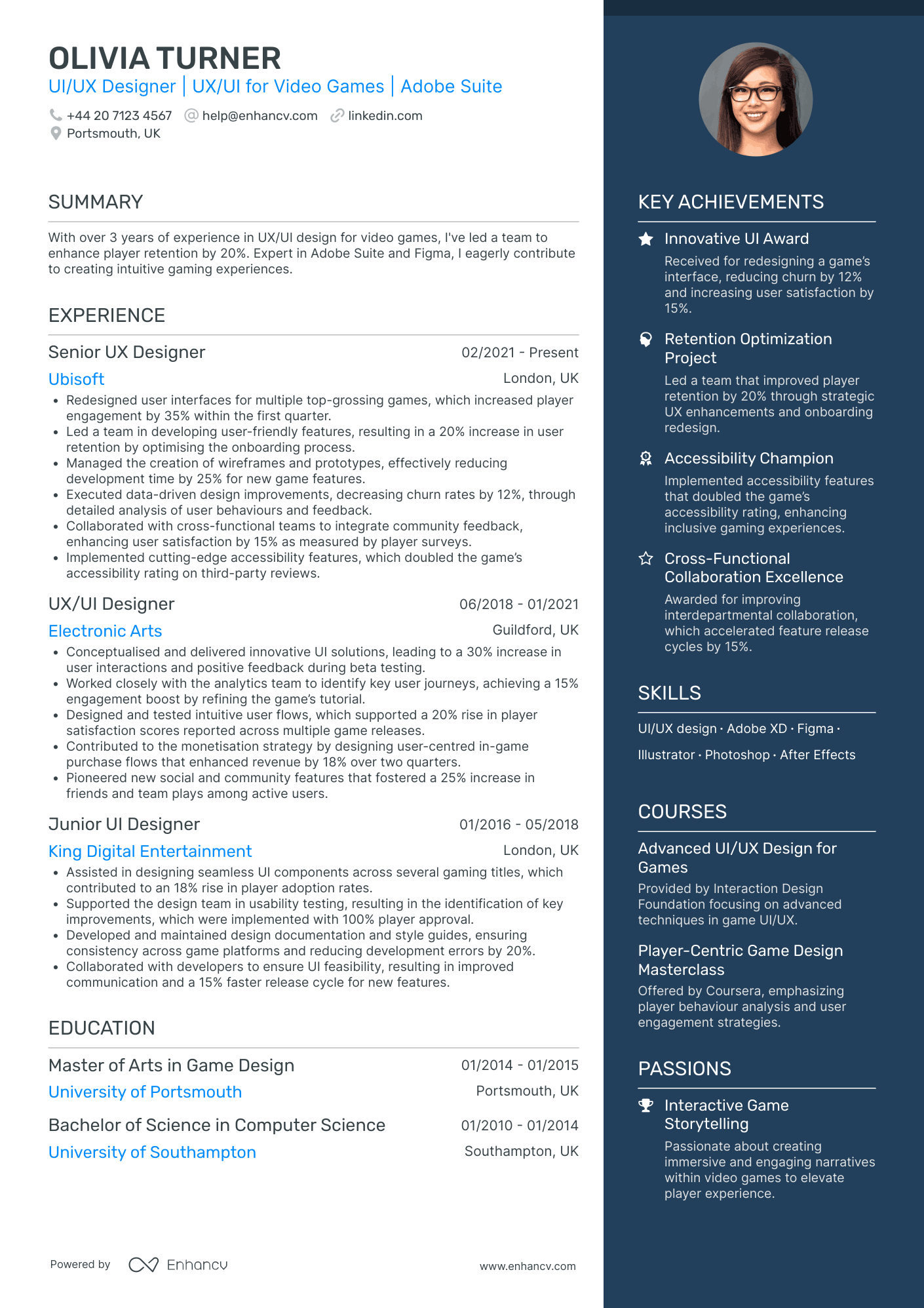
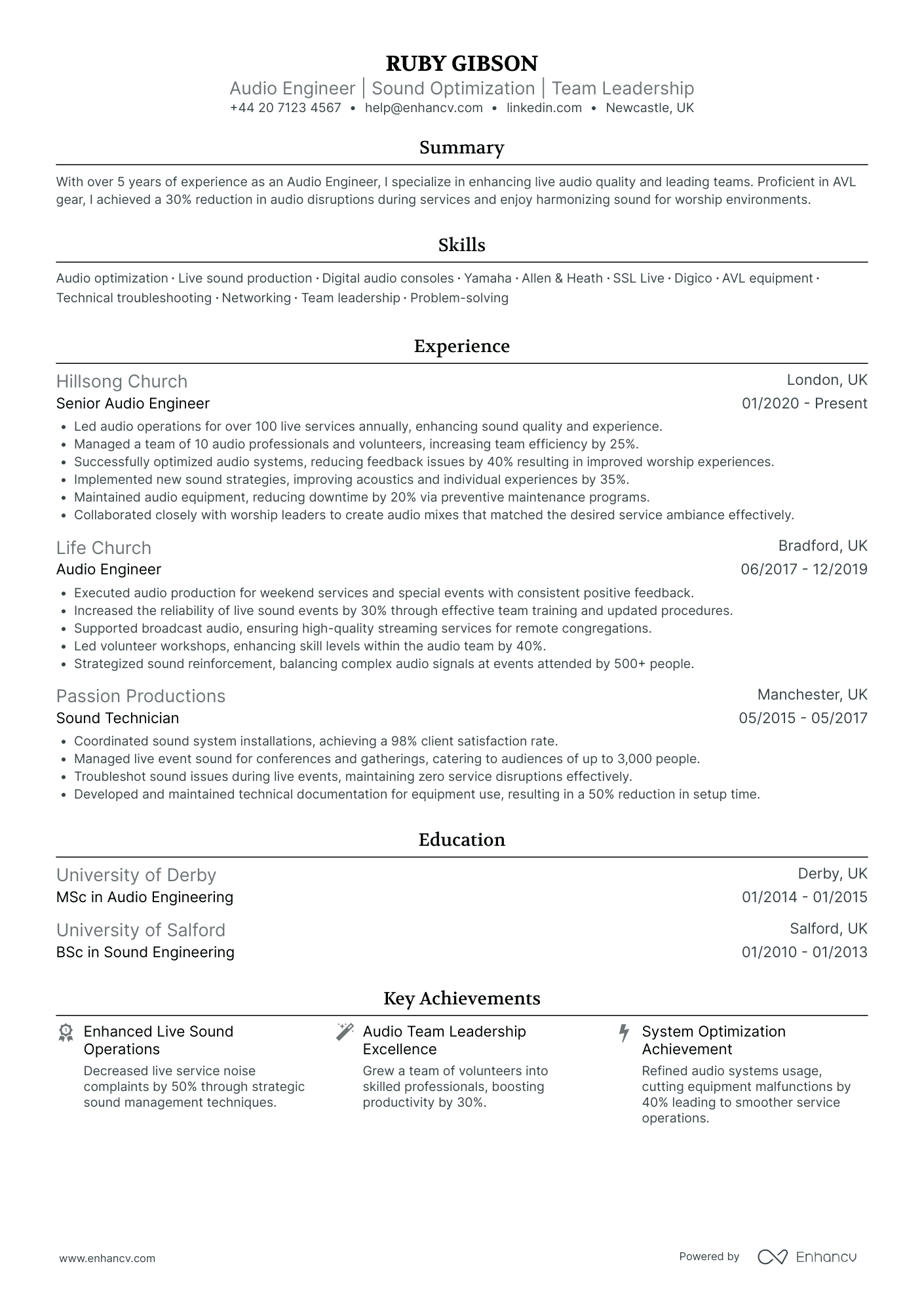
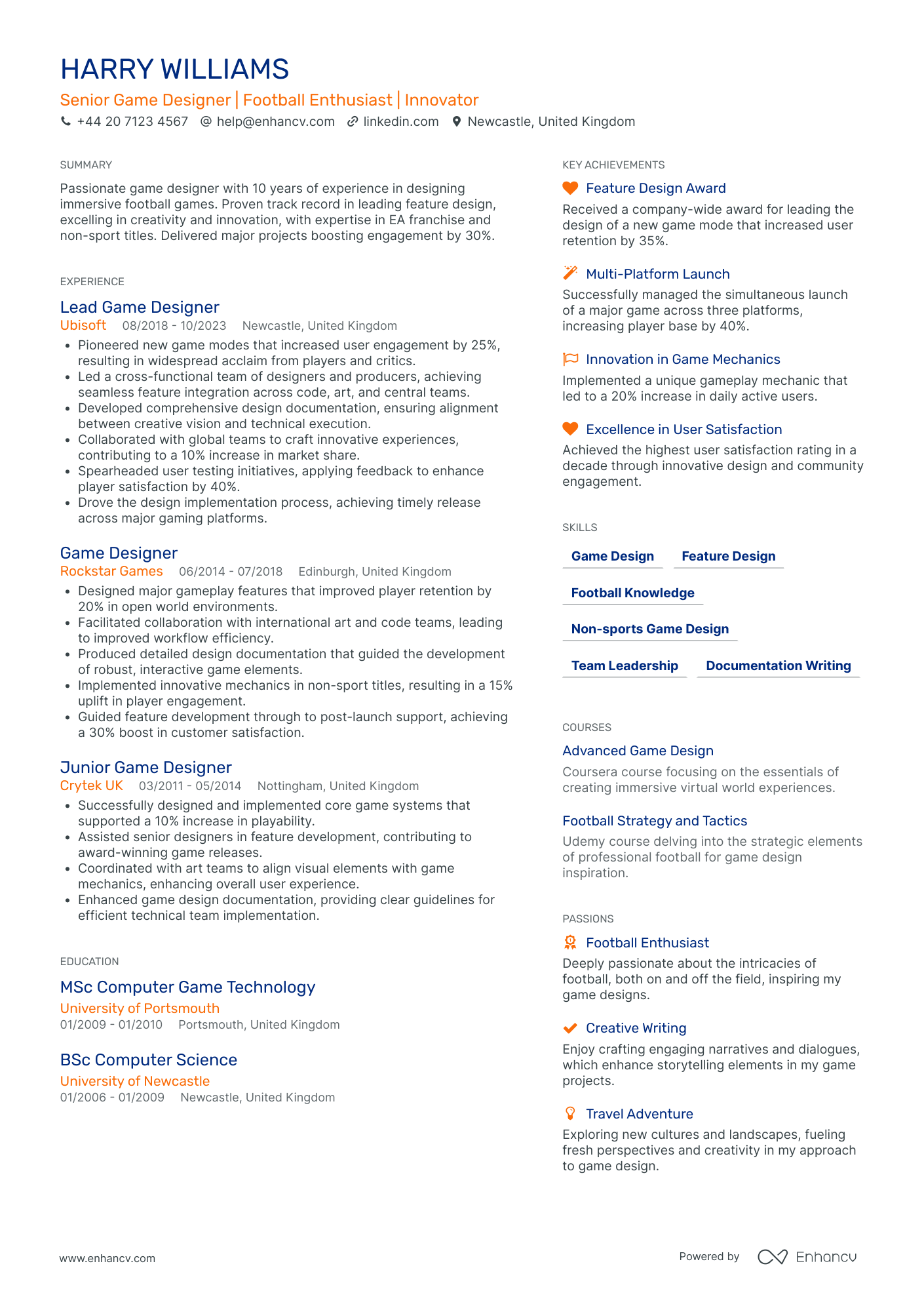
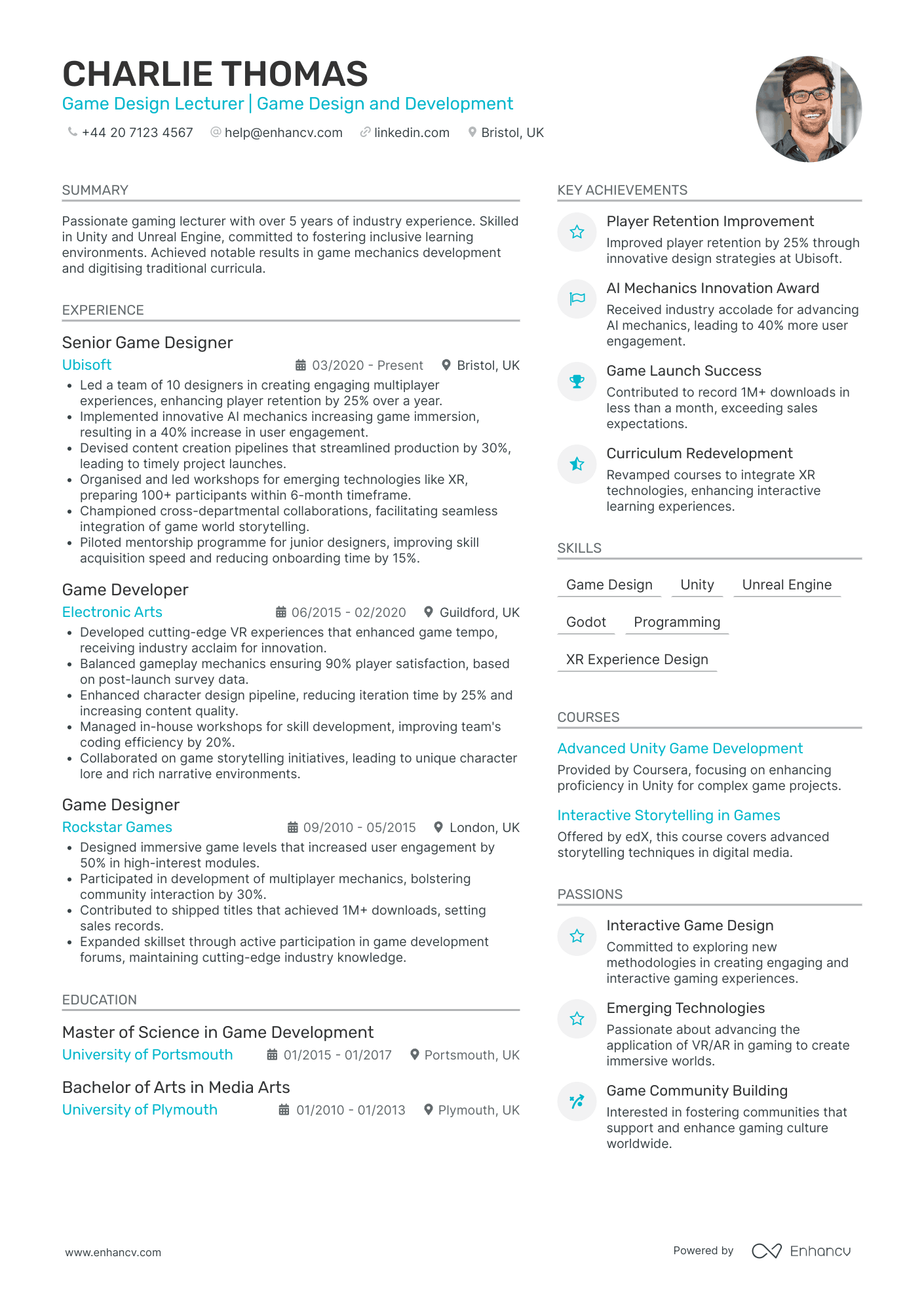
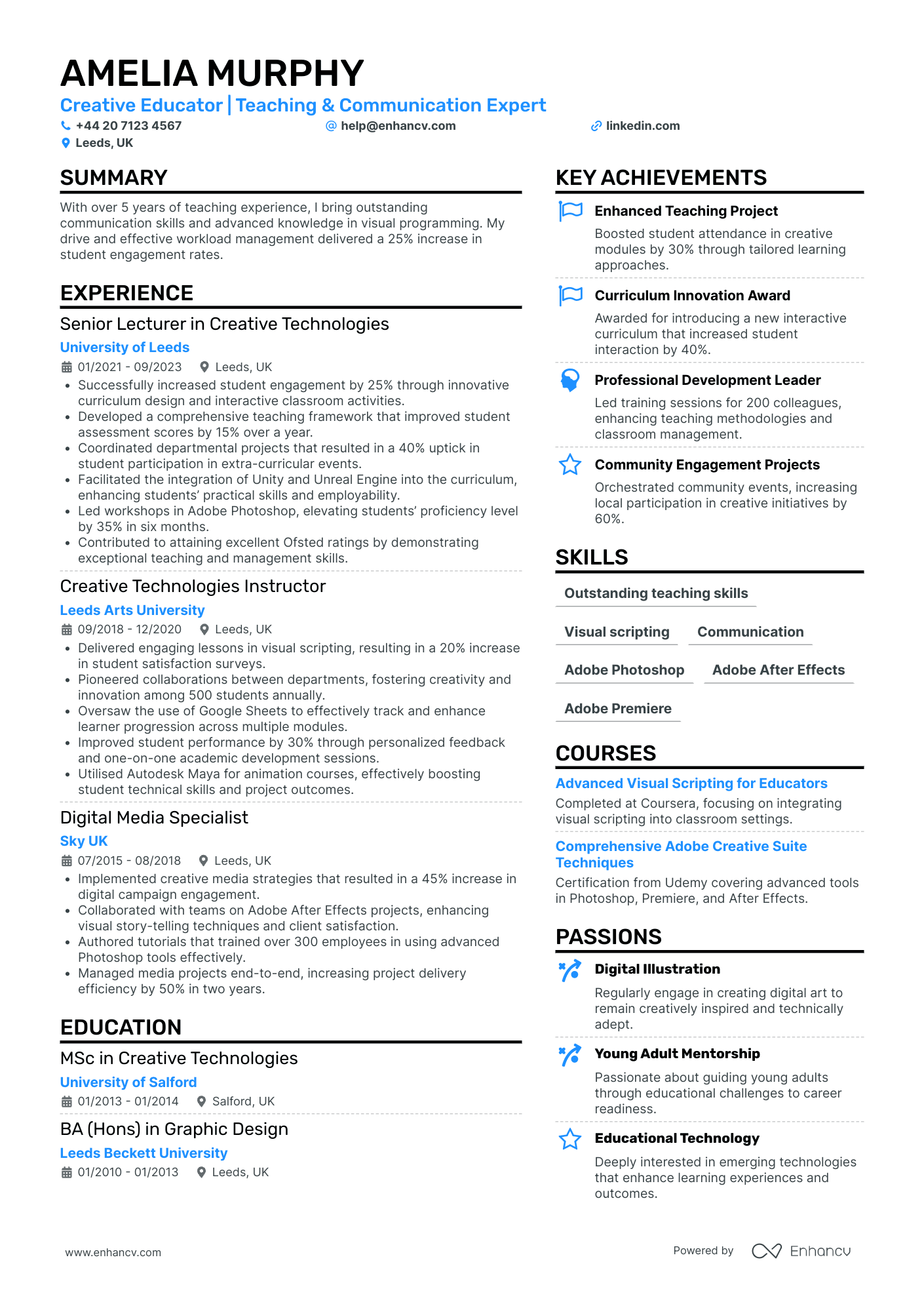
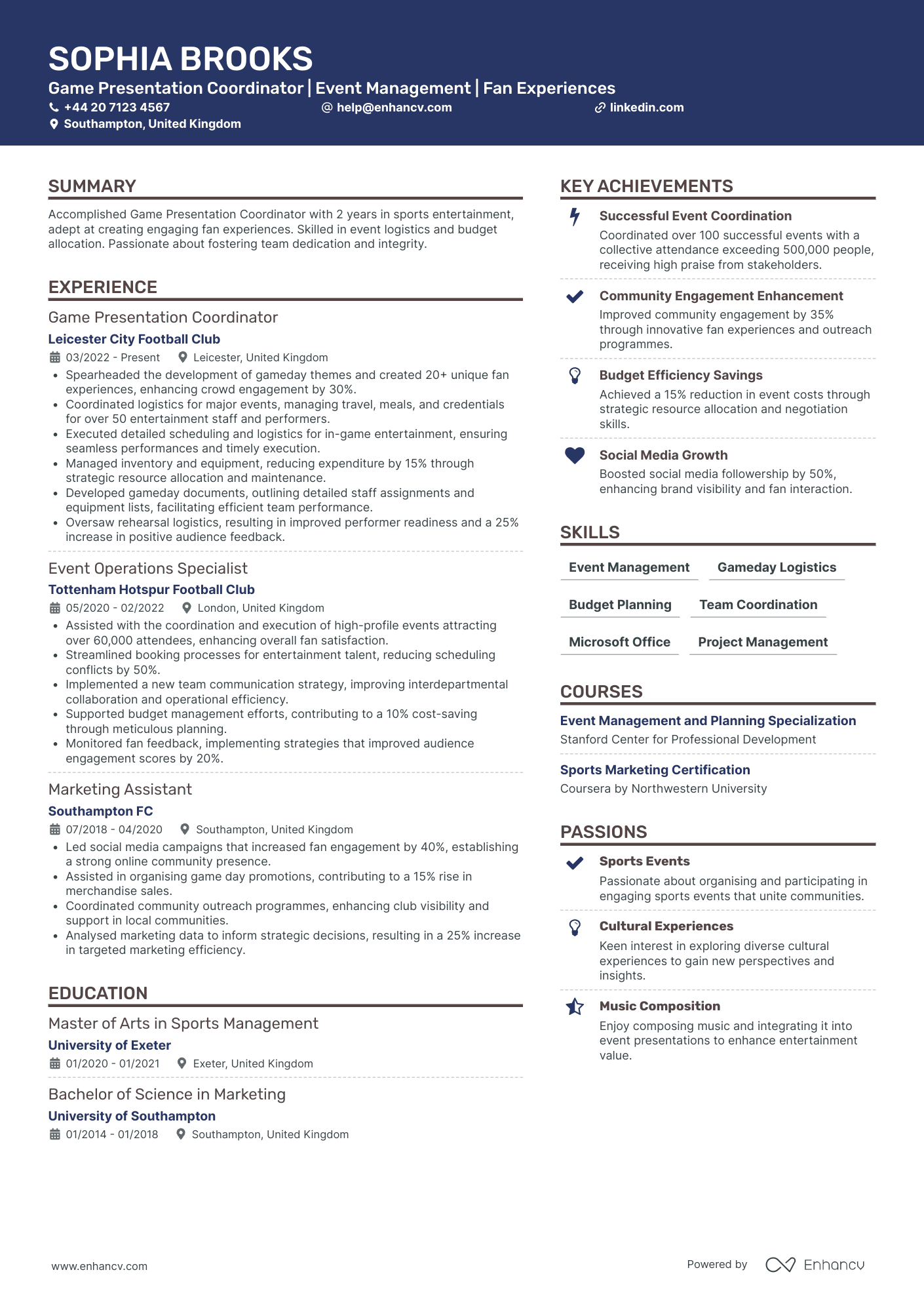
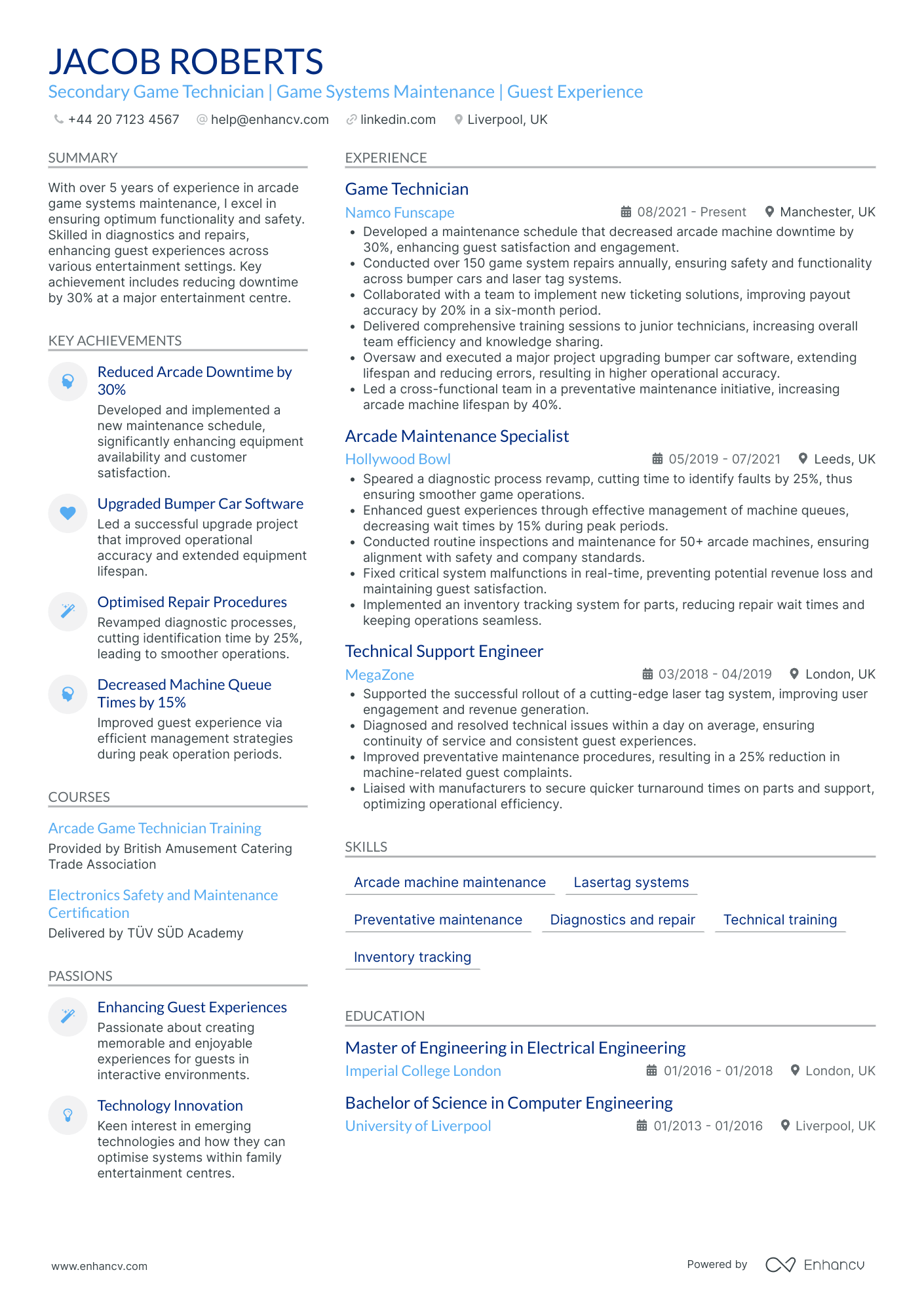
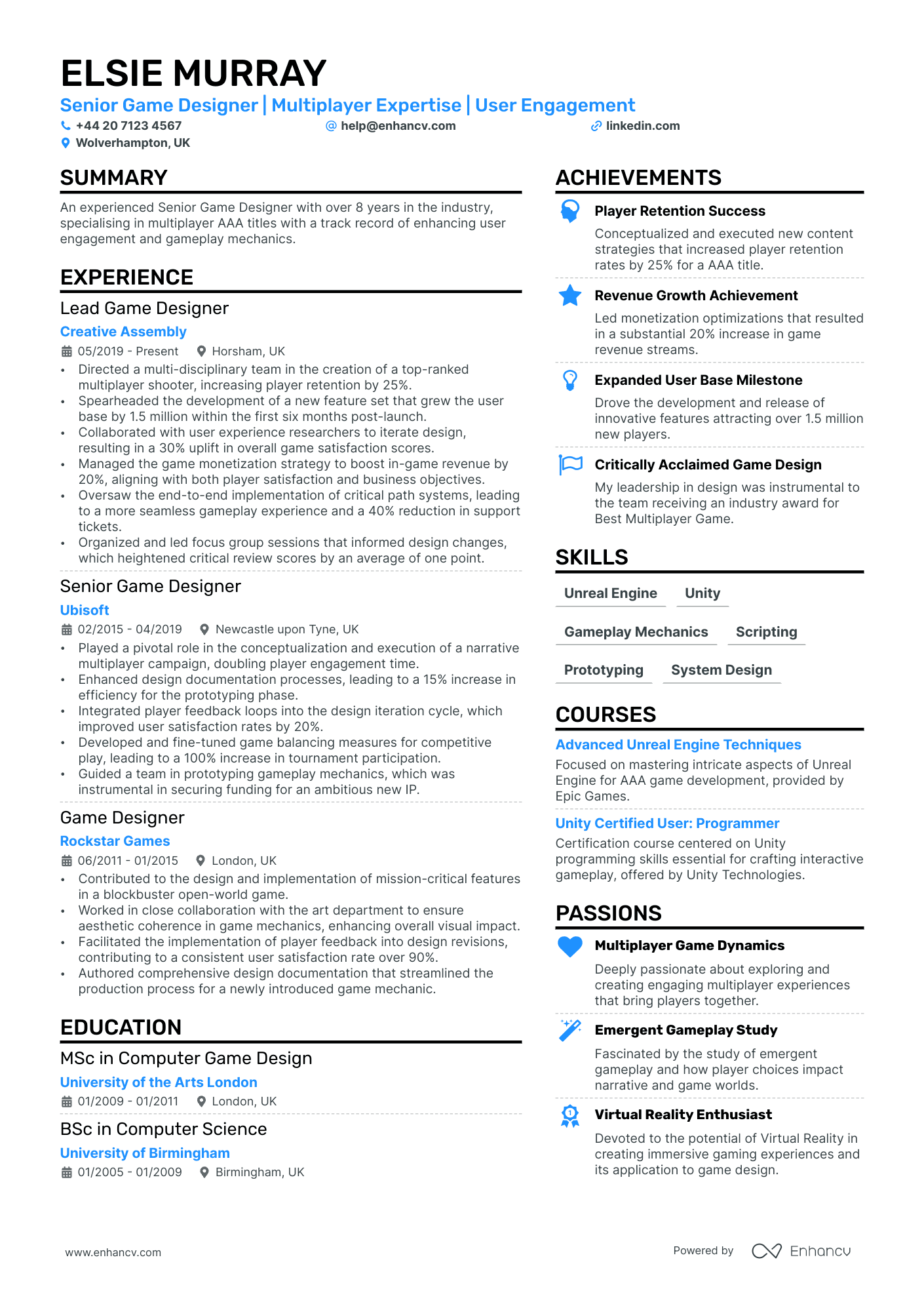
Most game design CVs read like a wishlist of favourite games and a stack of engines someone half-learned at university. A design lead skims that in seconds and moves on.
The CVs that earn a callback do two things. They point straight to playable work, and they are formatted so a busy studio can read them on one screen. Get the structure right before anything else, because a strong portfolio behind a messy CV rarely gets opened. If you want the fundamentals first, start with how to write a CV.

Key takeaways
- Lead with format. One column, standard headings, and a portfolio link a recruiter can open in one tap.
- Put your portfolio URL in the header next to your name, not buried on page two.
- Send a PDF for direct applications so the layout holds. Keep a Word copy for agencies.
- Two pages for experienced designers, one page while you are still building a track record.
- Name your discipline: level design, systems design, narrative, or economy design, rather than "game designer" in the abstract.
- Show finished work, including student projects and game jams. Playable beats described.
Formatting your game design CV
Game design sits between the creative and the technical, so your CV has to satisfy two readers. A design lead wants taste and judgement, and an ATS or HR filter wants clean, parsable text. Build for both.
Use a skills-led or combination structure when your strongest asset is a portfolio and a short work history. Switch to reverse chronological once you have two or three studio roles behind you.
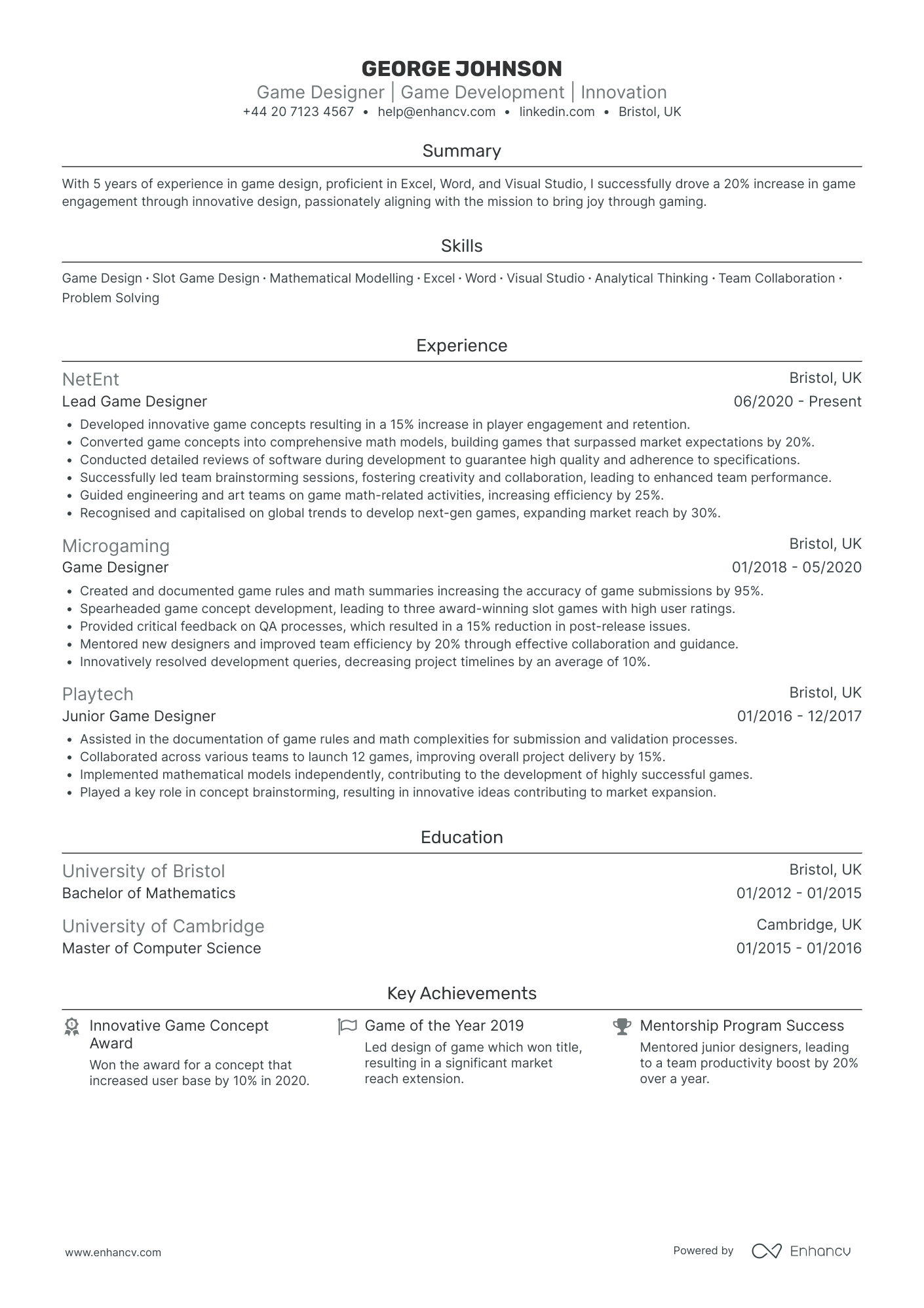
Keep it to two pages, one column, standard headings, and a readable font. Design leads skim between meetings, so make the hierarchy obvious.
Order the sections for how a lead actually reads. Header with your portfolio link, then a short personal statement, then skills, experience, and education. A junior CV moves projects up near the top, above any unrelated work history.
Put the portfolio link in the header, right next to your name. It is the first thing a studio wants and the easiest thing to lose at the foot of page two.
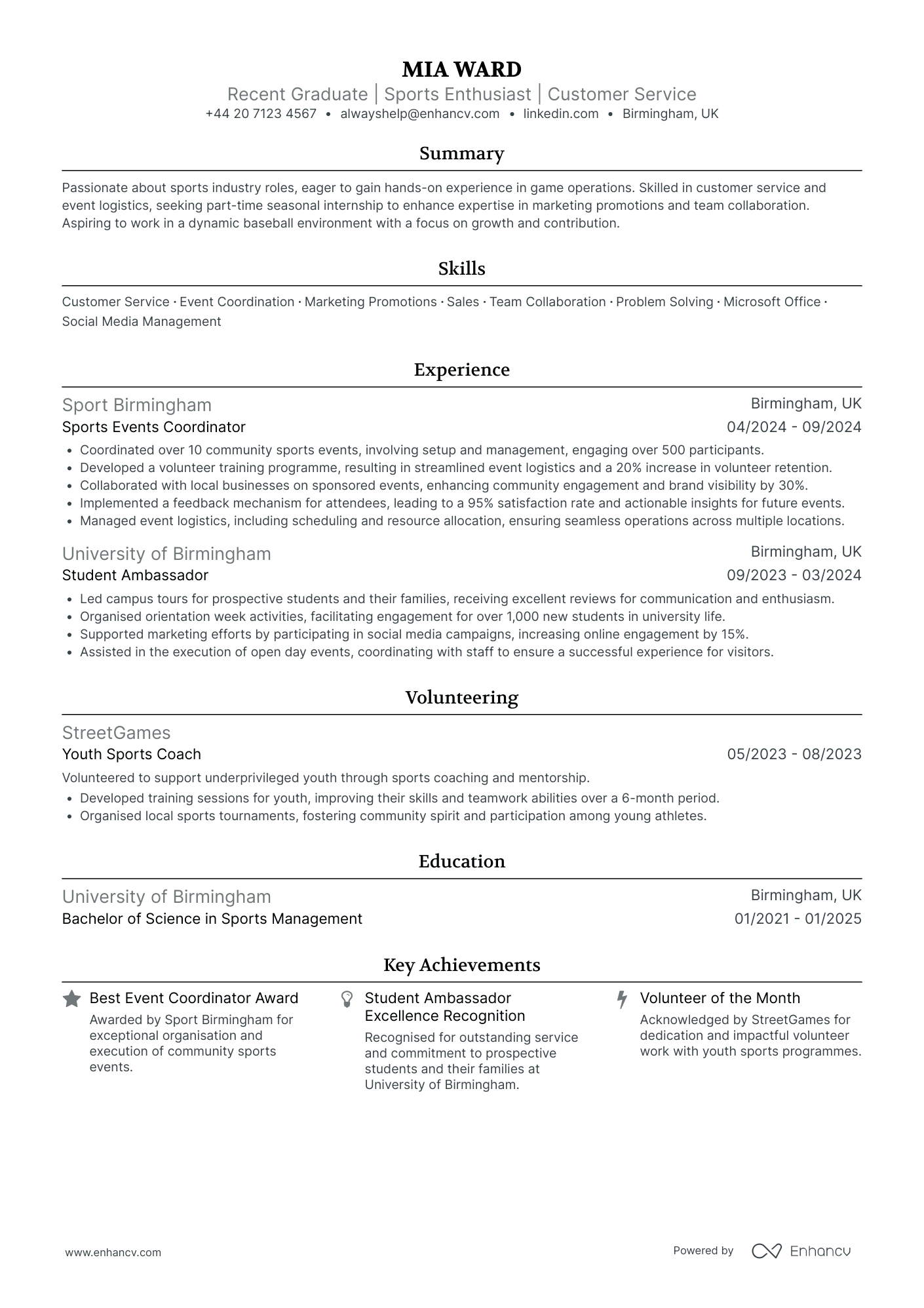
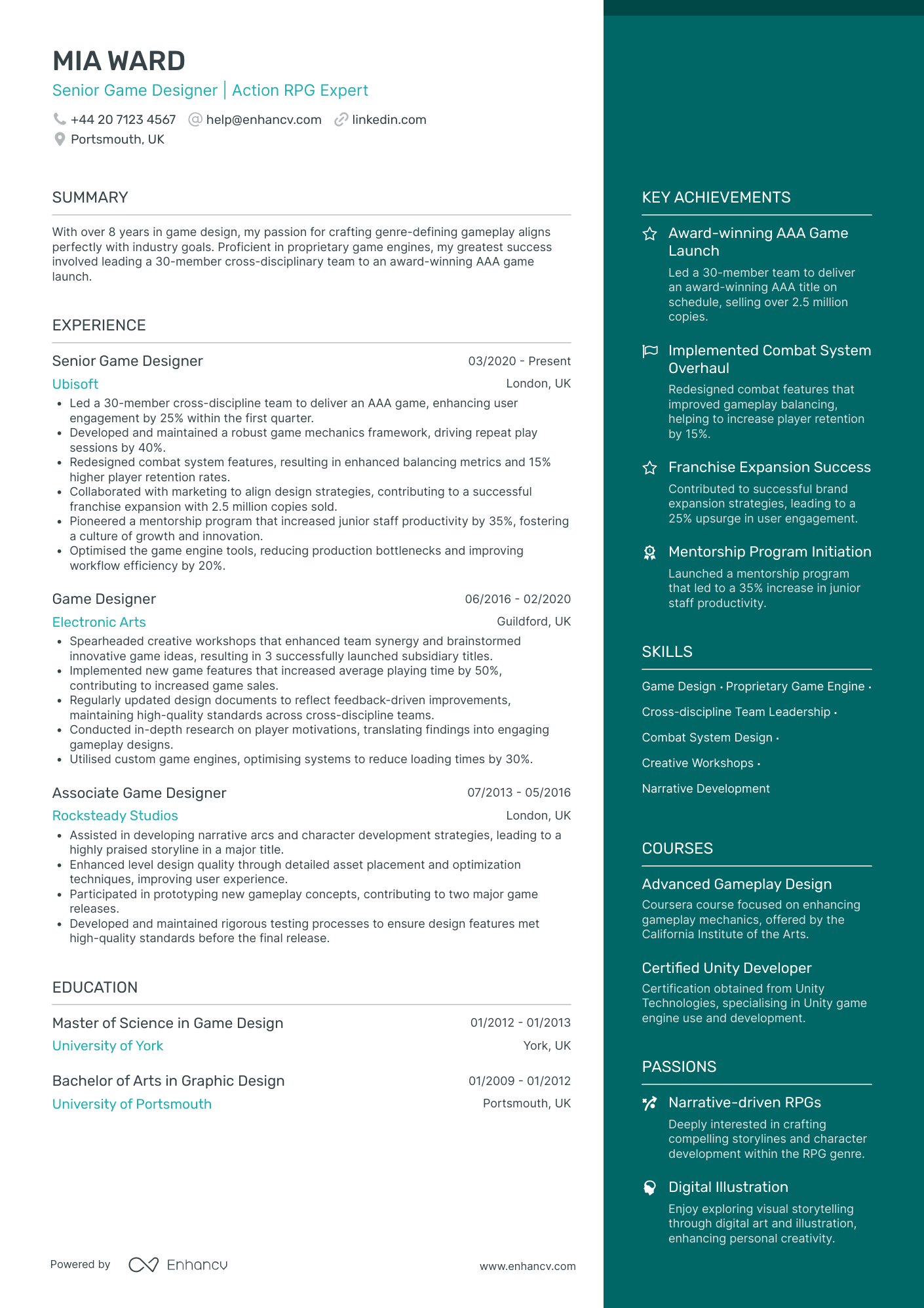
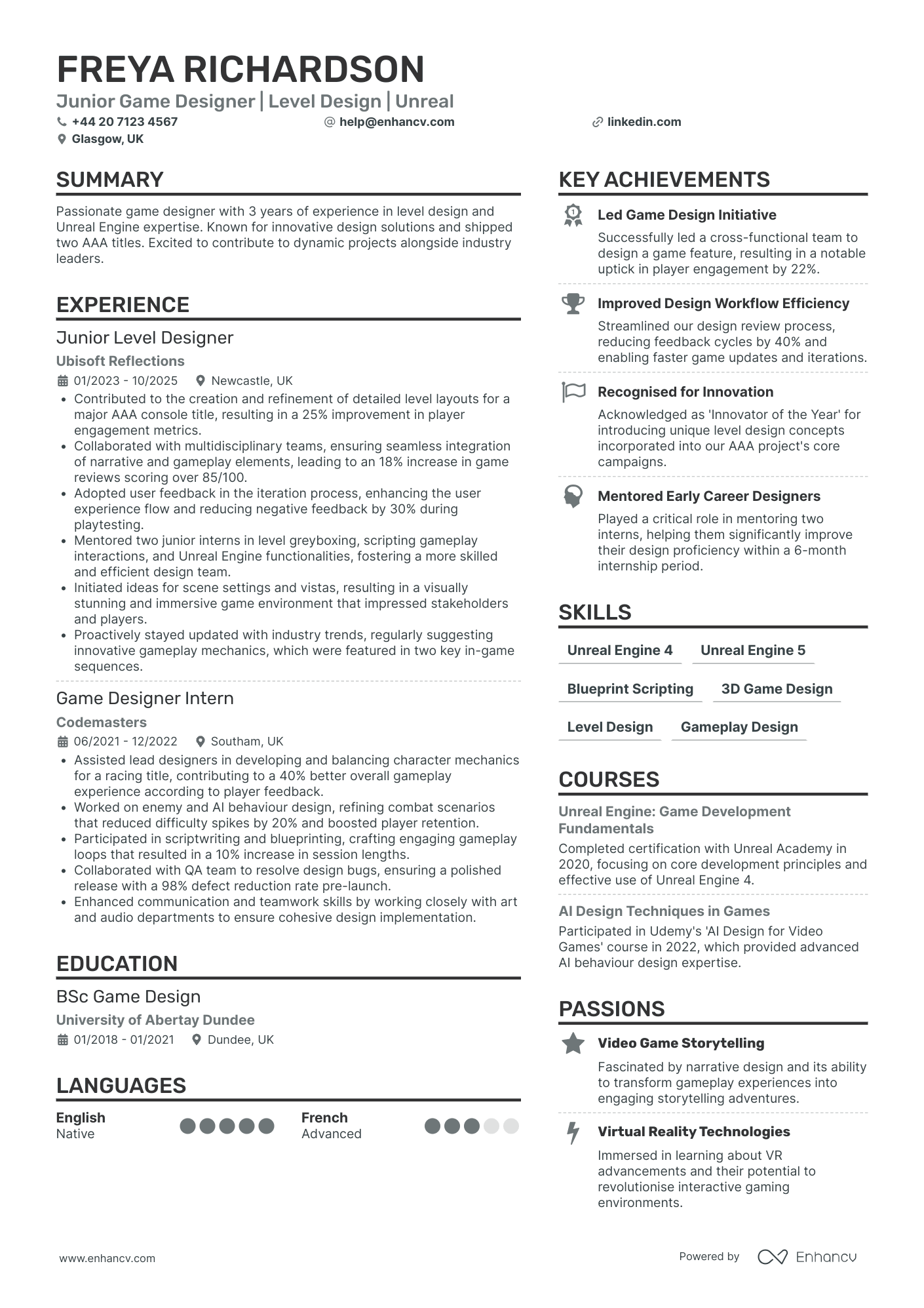
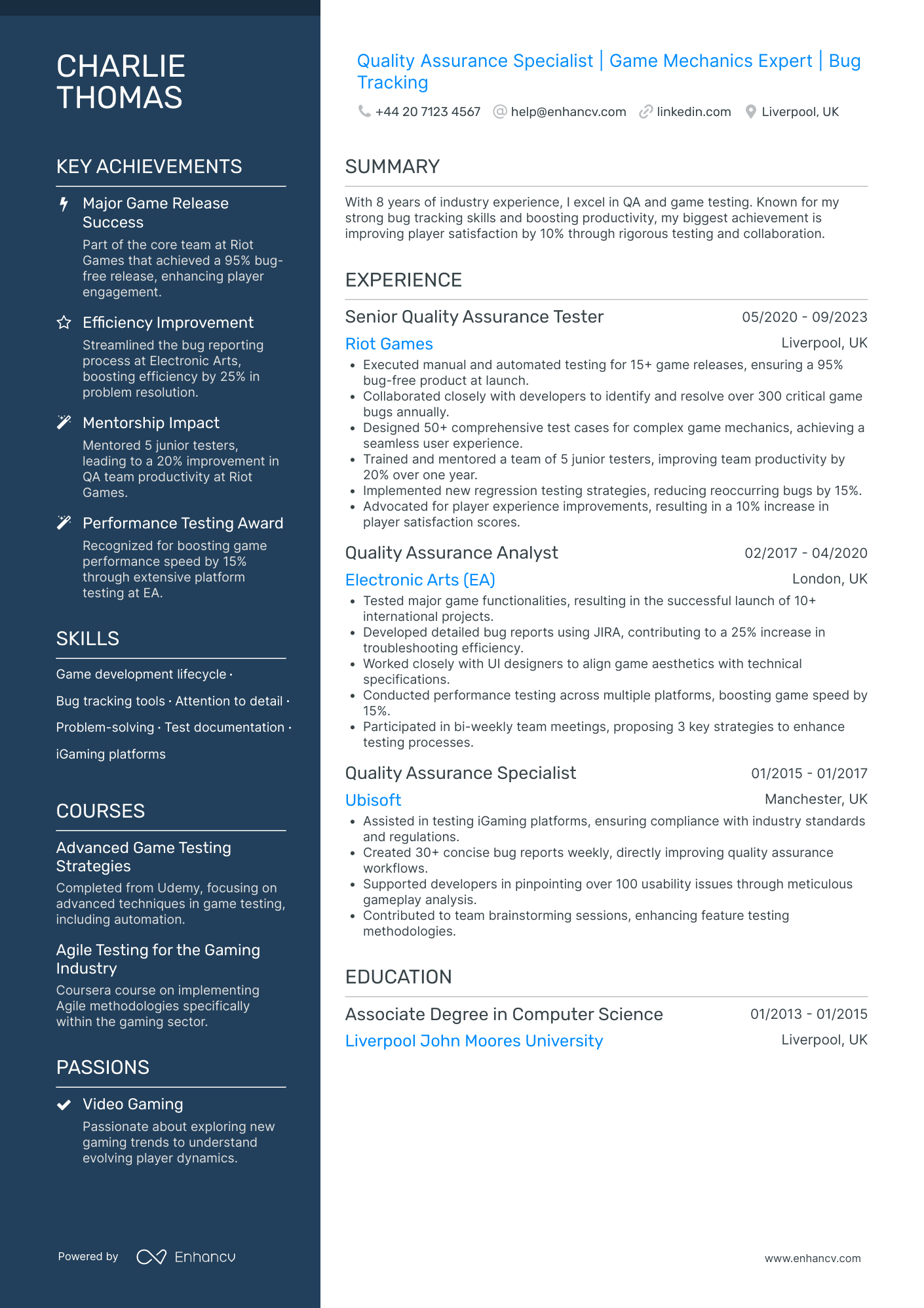
A word on the template itself, since it is usually the first thing people search for. Pick one that reads cleanly in greyscale and keeps your text out of narrow sidebars. The best game design CV template is the one a recruiter can scan in a glance and an ATS can parse without choking, not the one with the most colour or the boldest grid.
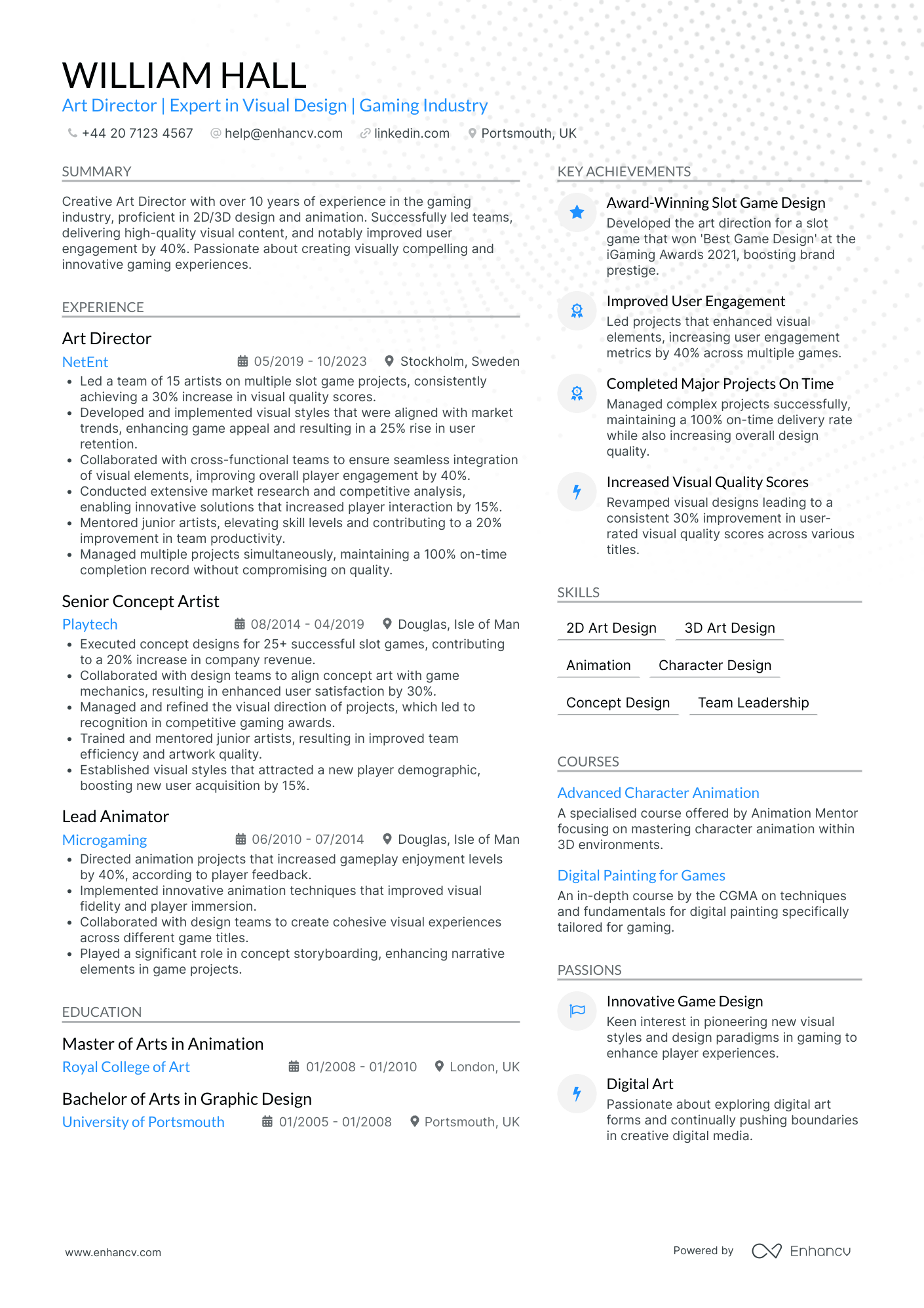
Ironically, a heavily designed CV works against a designer. It signals that you reach for decoration before clarity, which is the opposite of what a systems or level lead wants to see. Let the portfolio carry the visual weight and keep the CV quiet and legible.
Send a PDF for direct applications so your spacing and type choices survive. Keep a Word copy for recruitment agencies, which reformat CVs into their own template. If the advert names a file type, follow it.
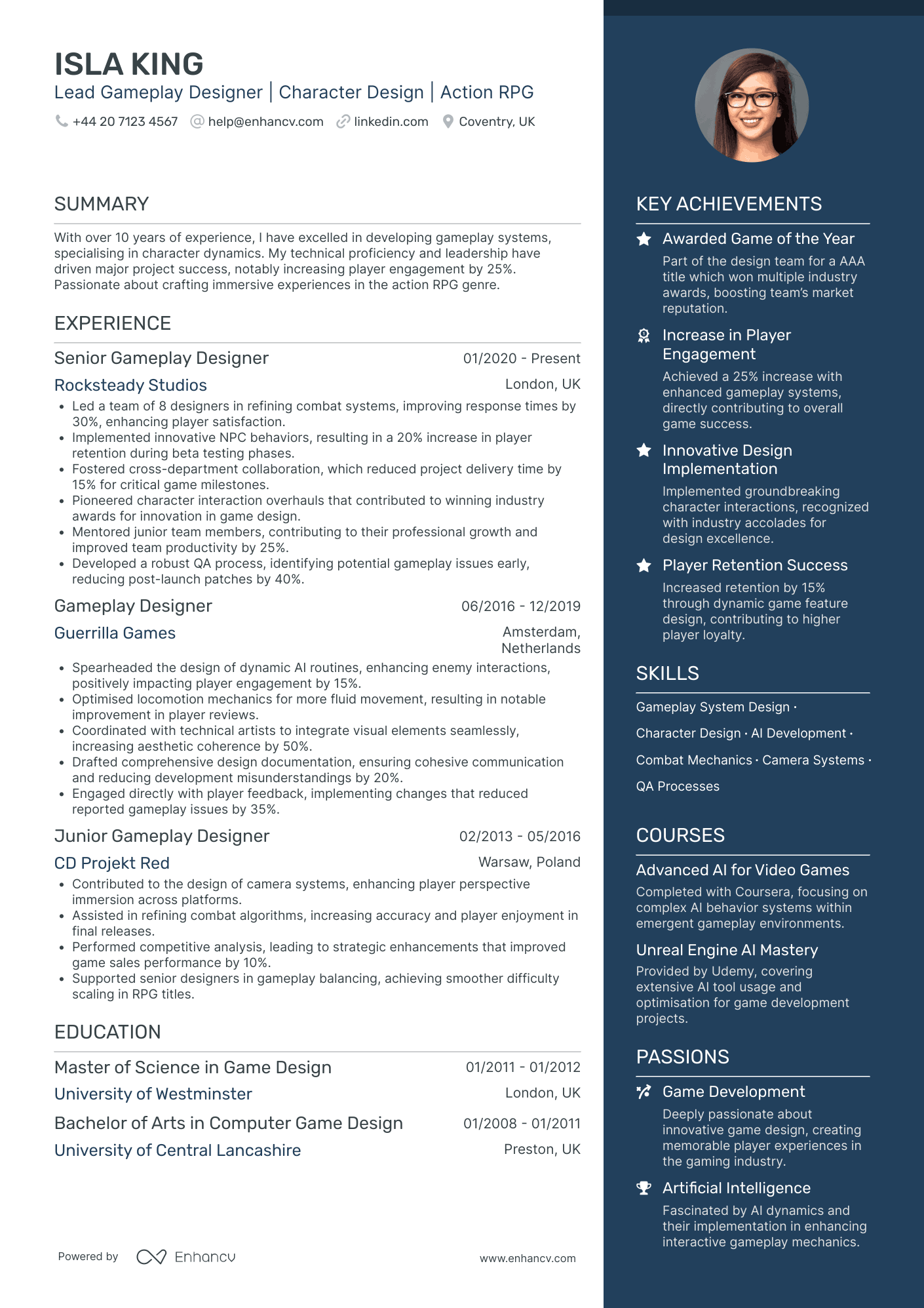
Studios and their HR teams often screen through tracking software, so keep the layout clean and the headings standard for an ATS-friendly CV. A two-column design stuffed with icons and text boxes can scramble in parsing, and a scrambled CV never reaches the design lead at all.
Build it from a tested layout rather than a blank page. Enhancv's CV templates export to a clean PDF and keep your links live.

PRO TIP
A template earns its place only if it survives a PDF export and an ATS parse. Before you send, save as PDF, reopen it, then copy the text into a plain document. If your job titles or portfolio link come out garbled, the layout is fighting you rather than helping you.
Is your resume good enough?
Drop your CV here or choose a file. PDF & DOCX only. Max 2MB file size.
Building and linking your game design portfolio
For a game designer, the portfolio is the CV and everything else is context for it. So the link has to work, load fast, and open on the pieces you most want judged.
Curate hard. Three or four polished pieces beat a dump of everything you have ever touched. Lead with the work closest to the role: level design for a level design job, systems and economy work for a systems role.
For each piece, write two lines a lead can read without playing it: your role, the team size, the tools, and the problem you solved. "Designed and balanced the crafting economy for a 12-person student project, cutting average grind time by a third in playtests."
Match the pieces to the discipline. A level designer leads with annotated layouts, blockouts, and a note on pacing and player flow. A systems designer leads with spreadsheets, economy models, and the reasoning behind a balance change. A narrative designer leads with a short, self-contained sample rather than a lore bible nobody has time to read.
Host it where it stays live, such as a personal site, itch.io, or a well-organised PDF portfolio. Put the single best link in your CV header and, where space allows, a plain URL next to the experience it backs up.
The quickest way to lose a portfolio review is a link that opens on a wall of thumbnails with no order. Point the reader straight at the work you want judged, and put the strongest piece first. A lead who has to hunt for your best project usually stops before they find it.
If your work sits under an NDA, describe the problem and your contribution in general terms and offer a full walkthrough at interview.
Top skills for your game design CV
Studios hire for judgement, not for a list of tools, but the tools still have to be on the page for the filter. Split them the way a CV should: the concrete craft first, then the working style that makes you easy to build alongside.
Name your discipline precisely. "Systems design" or "level design" tells a lead exactly where you fit, while "game designer" on its own makes them guess. List these as your hard skills in the words the adverts use.
The soft skills that matter here are checkable ones like collaboration and clear communication across art and code. Prove each in a bullet rather than claiming it. For the section itself, see how to build the skills section of a CV.
Evidence beats a keyword. "Game balancing" on its own is a claim, while "retuned enemy difficulty across 20 levels after playtest feedback, cutting rage-quits in the first hour" is proof. Pull the tool into a real result and it stops reading like a checkbox.
List only what you can defend in an interview. If a lead asks you to open Unreal and walk through a Blueprint, the honest skills stay on the CV and the padding gets you caught. When you are still learning a tool, say so plainly under a short "learning" line rather than claiming fluency.
Top skills for your game design CV:
Level design
Systems and economy design
Design documentation
Prototyping (Unity, Unreal)
Scripting (C#, Blueprints)
Game balancing
Content pipelines
Playtesting and iteration
Collaboration
Communication
Problem-solving
Giving and taking feedback
Adaptability
What UK studios look for in 2026
Reliable public pay data for UK game design specifically is patchy, so treat any single salary figure you find online with caution and research the studio, the city, and the discipline directly. What is consistent is what studios ask a CV to prove. Answer these points and you clear the first read.
The UK scene runs well beyond London and Guildford now, with studios clustered around Dundee, Leamington Spa, Brighton, and Manchester. Tailor the discipline and tools on your CV to the studios you are actually applying to, because a mobile live-ops studio and a premium single-player studio want to see very different evidence.
| What studios ask for | What to put on your CV |
|---|---|
| A named discipline | State it in your headline: level, systems, narrative, or economy design. |
| Finished, playable work | A portfolio link with shipped titles, student projects, or game jams, each with your role and the outcome. |
| Engine and scripting familiarity | Unity or Unreal, plus the scripting you actually use, such as C# or Blueprints. |
| Collaboration across teams | Bullets that show you working with artists, engineers, and producers, not designing in isolation. |
| Playtesting and iteration | One real playtest result: what you changed and what improved. |
Writing your game design personal statement
Three or four sentences at the top: your discipline, your strongest shipped work, the tools you build with, and the kind of studio you want to join. Keep it concrete, and see more personal statement examples if the opening line will not come.
Kill the adjective soup that opens most games CVs. "Passionate gamer seeking a creative role" tells a lead nothing they can check.
Lead with evidence instead.
Game design personal statement example
Systems designer with three years across two shipped mobile titles, focused on progression and in-game economies. Built and balanced the crafting loop for a live game with 40,000 daily players and cut early-game drop-off by 18% over two playtest rounds. Comfortable in Unity and C#, and happiest working close to economy and analytics. Looking to bring live-ops experience to a mid-core studio.
Weak opening to avoid
Passionate about games since I was six and always dreamed of making them. Hard-working team player with excellent communication skills, looking for an exciting opportunity in the games industry to learn and grow.
When we read a game design CV, we click the portfolio link before we read a single bullet. If it is broken, buried, or opens on a coursework slide deck, the CV has already lost us. Put the link in the header, lead with your two best pieces, and make each one say what you designed and what changed because of it. A CV that reaches playable work in one click beats a beautifully worded profile every time.
Writing your game design experience section
Lead each bullet with a verb and finish it with an outcome. Design work is measurable more often than designers admit: retention, session length, playtest scores, bugs cut, and content shipped. Treat those as your CV achievements, and see the mechanics of work experience on a CV.
Mirror the advert's language wherever it is genuinely true of you, so both the filter and the lead see the match. Enhancv's CV tailoring feature reads the advert and suggests the matching edits, which saves rewriting from scratch for every studio.
Write each bullet as a decision and its effect, not a duty. "Responsible for level design" tells a lead nothing, while "reworked the tutorial's first five minutes and lifted completion from 60% to 78%" tells them how you think. One strong, quantified bullet is worth three vague ones.
Cut the responsibility dump. A studio assumes a game designer writes documentation, runs playtests, and works in an engine, so spend the space on what you changed rather than what your job title implies. Keep three to five bullets per role and lead with the biggest result.
Write student and contract work the same way as staff roles: a dated heading, then bullets that show the decision and the result. For the full method, see how to tailor your CV.
- Designed and balanced the progression system for a live mobile RPG, lifting day-30 retention from 4% to 6% in an A/B test
- Owned the design documentation for two content updates, keeping a nine-person team aligned across art, engineering, and QA
- Prototyped a new crafting loop in Unity and C#, then iterated over four playtest rounds to cut average grind time by 30%
- Ran weekly playtests with 15 external players and turned the findings into a prioritised backlog the team shipped from
PRO TIP
Numbers make design legible to people who do not design. If you cannot share live metrics, use playtest data: "cut tutorial drop-off from 40% to 25% across three test rounds" still proves you measure and iterate.
Education and credentials for a game design CV
You do not need a games degree to work in games, and plenty of designers arrive from computing, art, or something unrelated. Studios care far more about what you have made, so keep the education section short once you have shipped work.
List a relevant degree if you have one, such as games design, computer science, or a creative subject, then move quickly to the projects. A recent graduate can give education a little more room and lead with a strong final-year project.
Self-directed learning counts when it produces output. A completed Unreal or Unity course with a project attached says more than a certificate on its own.
Writing a game design CV with no experience
Breaking in is a portfolio problem before it is a CV problem. Your first task is to have finished work to point at, so a lead can judge your design rather than your intentions.
Ship small and finish: game jams, mods, a level built inside someone else's game, or a fully documented systems design for a game that does not exist yet. Finished beats ambitious every time.
Structure it so your projects and skills sit above a thin work history, and write each project like a job. Give it a date, your role, the team size, the tools, and what you changed or learned. If it is your first application, these first job CV examples show the shape.
Mine your other experience for transferable proof. Running a Discord community, moderating a game's forums, organising a jam team, or leading a tabletop group all show the coordination and communication studios hire for. Write them in design language rather than leaving them as hobbies.
One line lifts a junior CV above the pile: a game jam placement, a mod with real downloads, or a project that got played by strangers and improved because of their feedback.
Conclusion
Format for two readers, lead with playable work, and make your portfolio link impossible to miss.
Pair the CV with a short cover letter that says why this studio and why this discipline, and a pile of projects becomes a clear, hireable story.

Author's take - the Enhancv team
When we read a game design CV, we click the portfolio link before we read a single bullet. If it is broken, buried, or opens on a coursework slide deck, the CV has already lost us. Put the link in the header, lead with your two best pieces, and make each one say what you designed and what changed because of it. A CV that reaches playable work in one click beats a beautifully worded profile every time.