



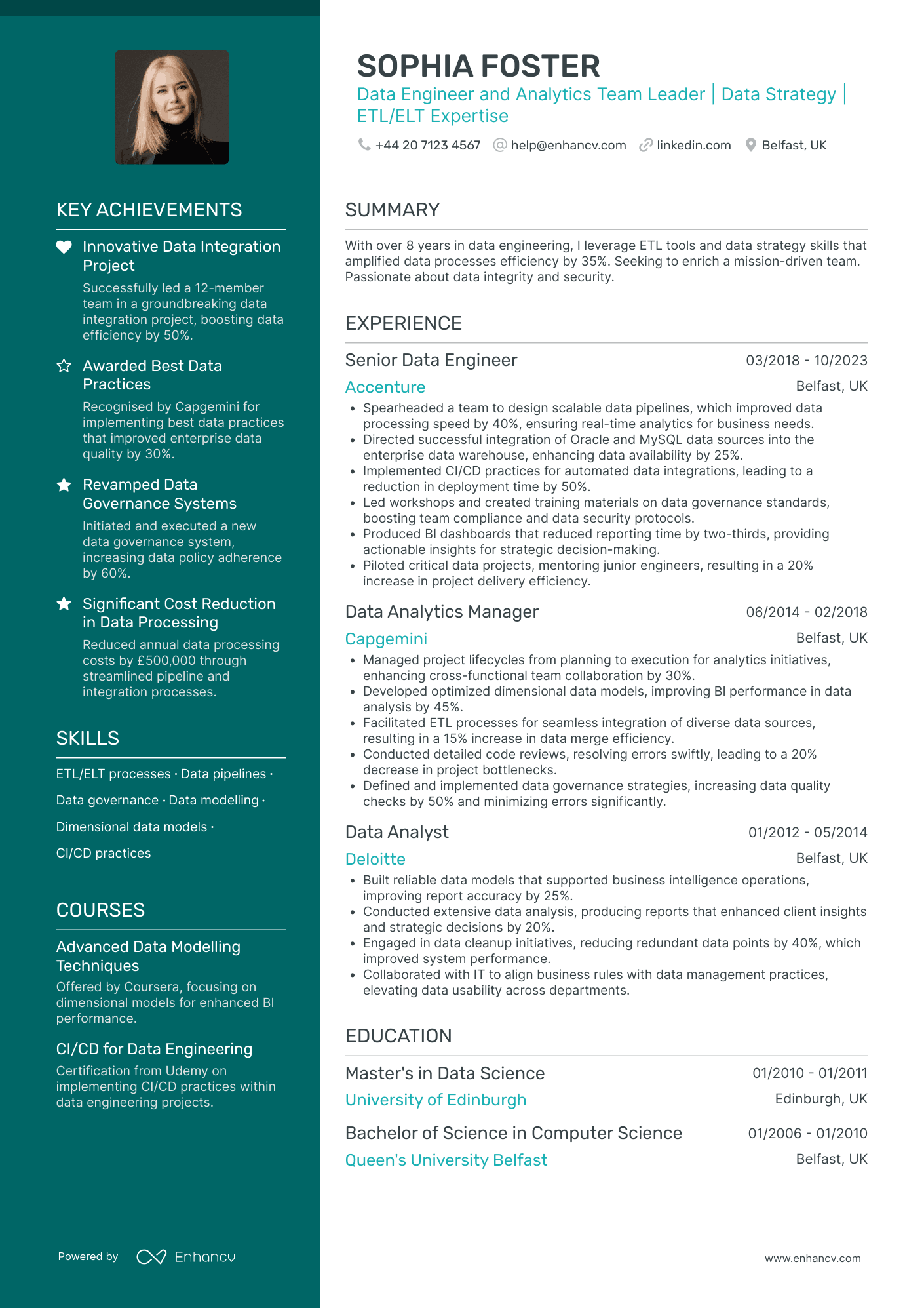
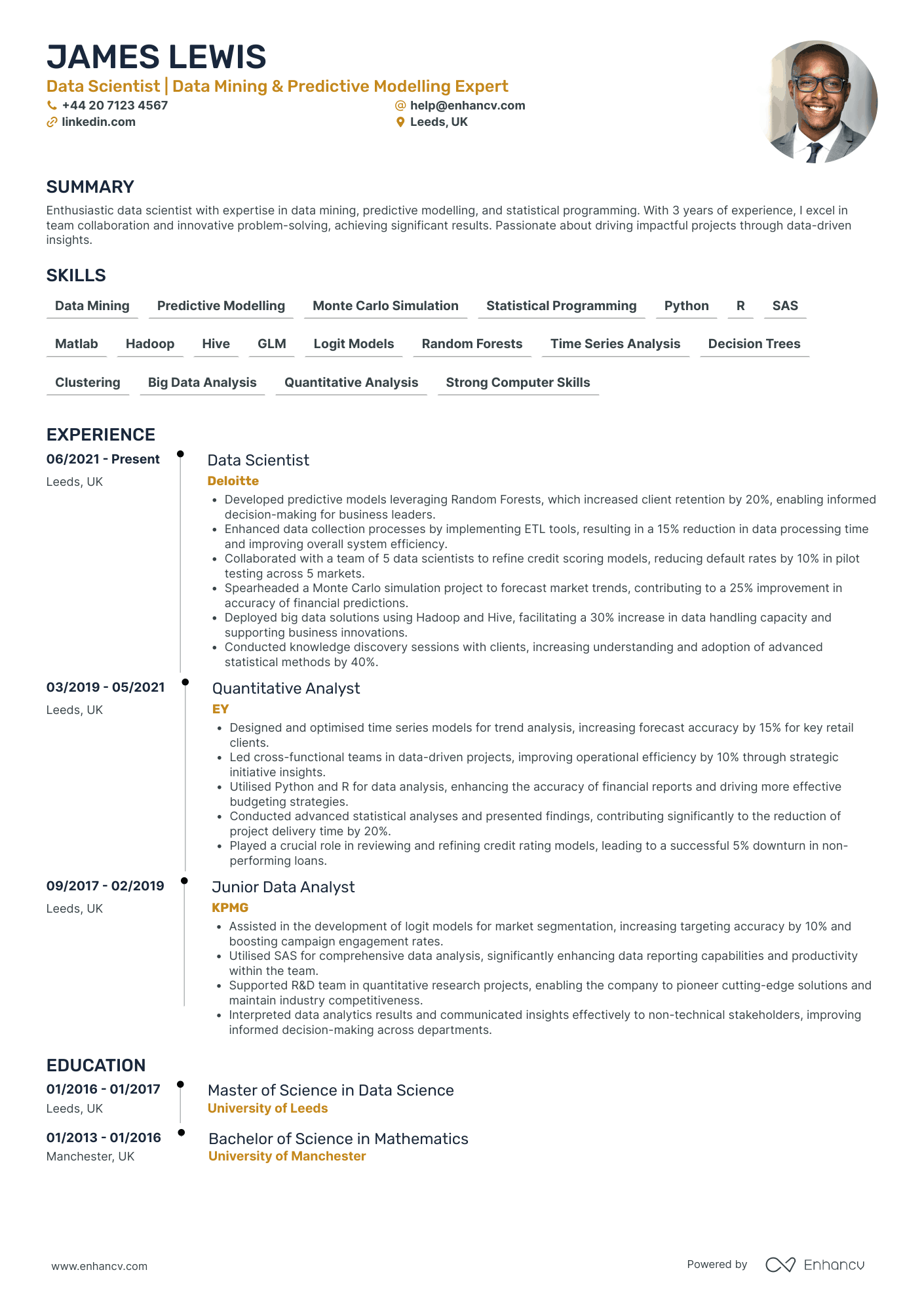
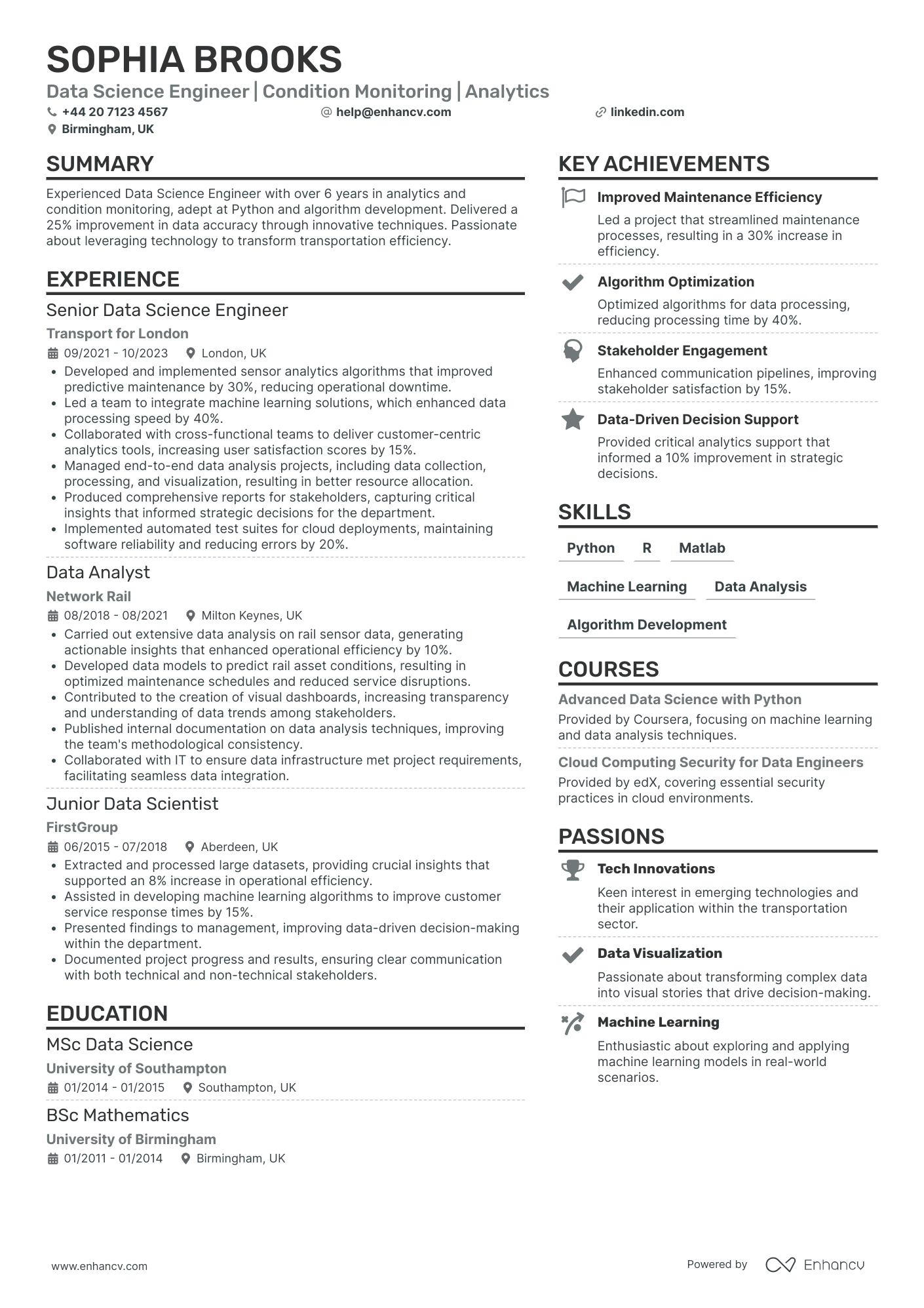
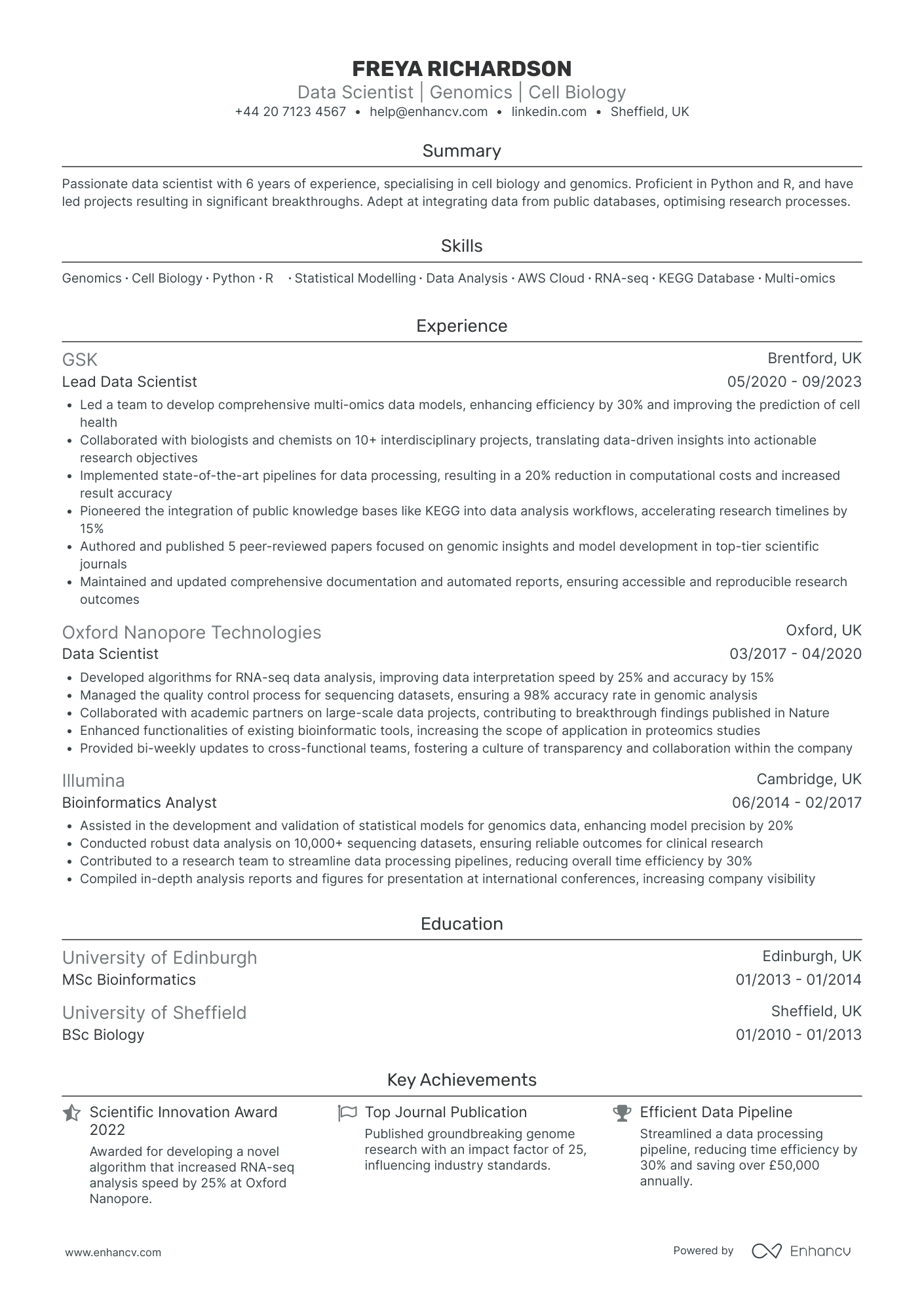
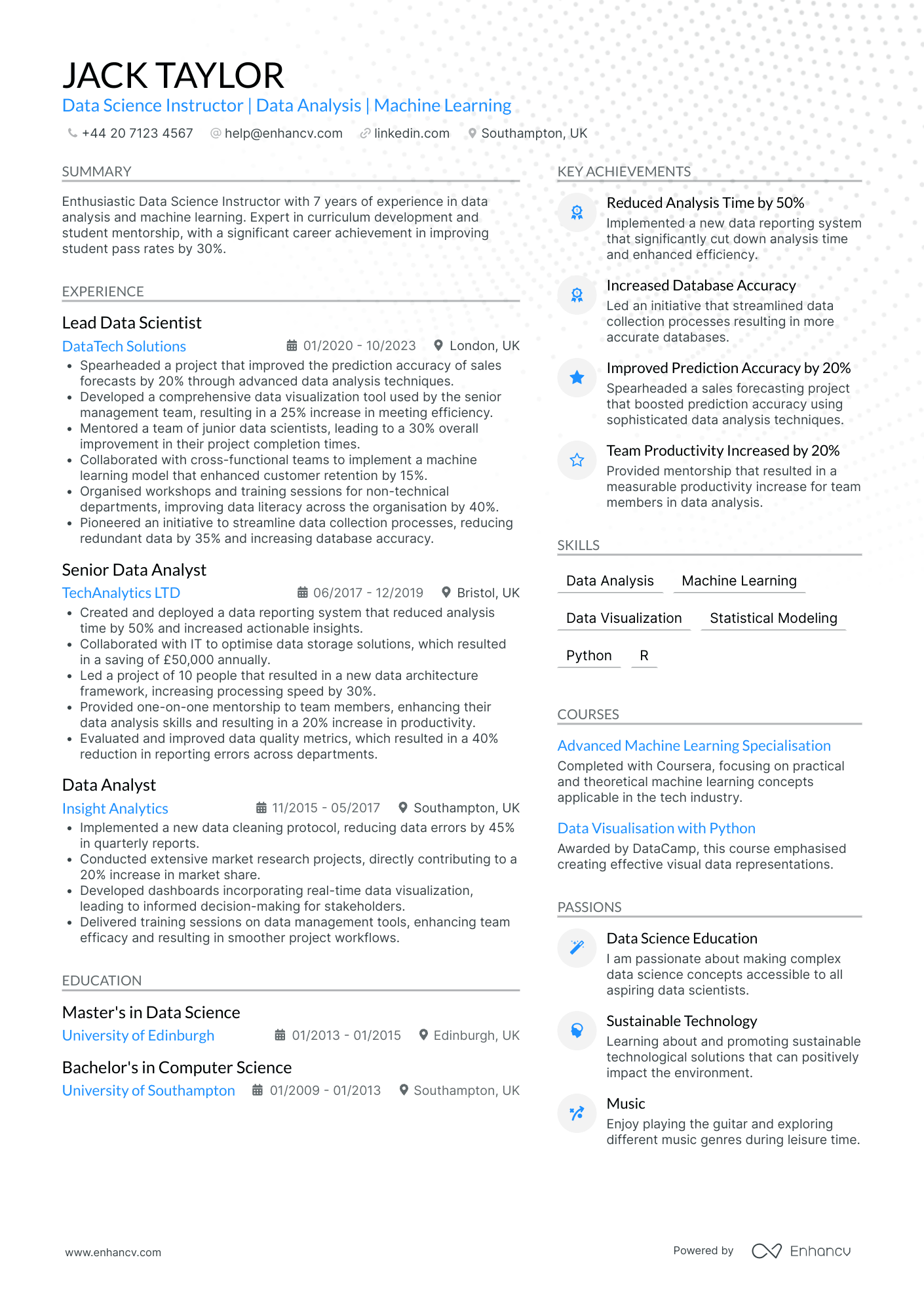
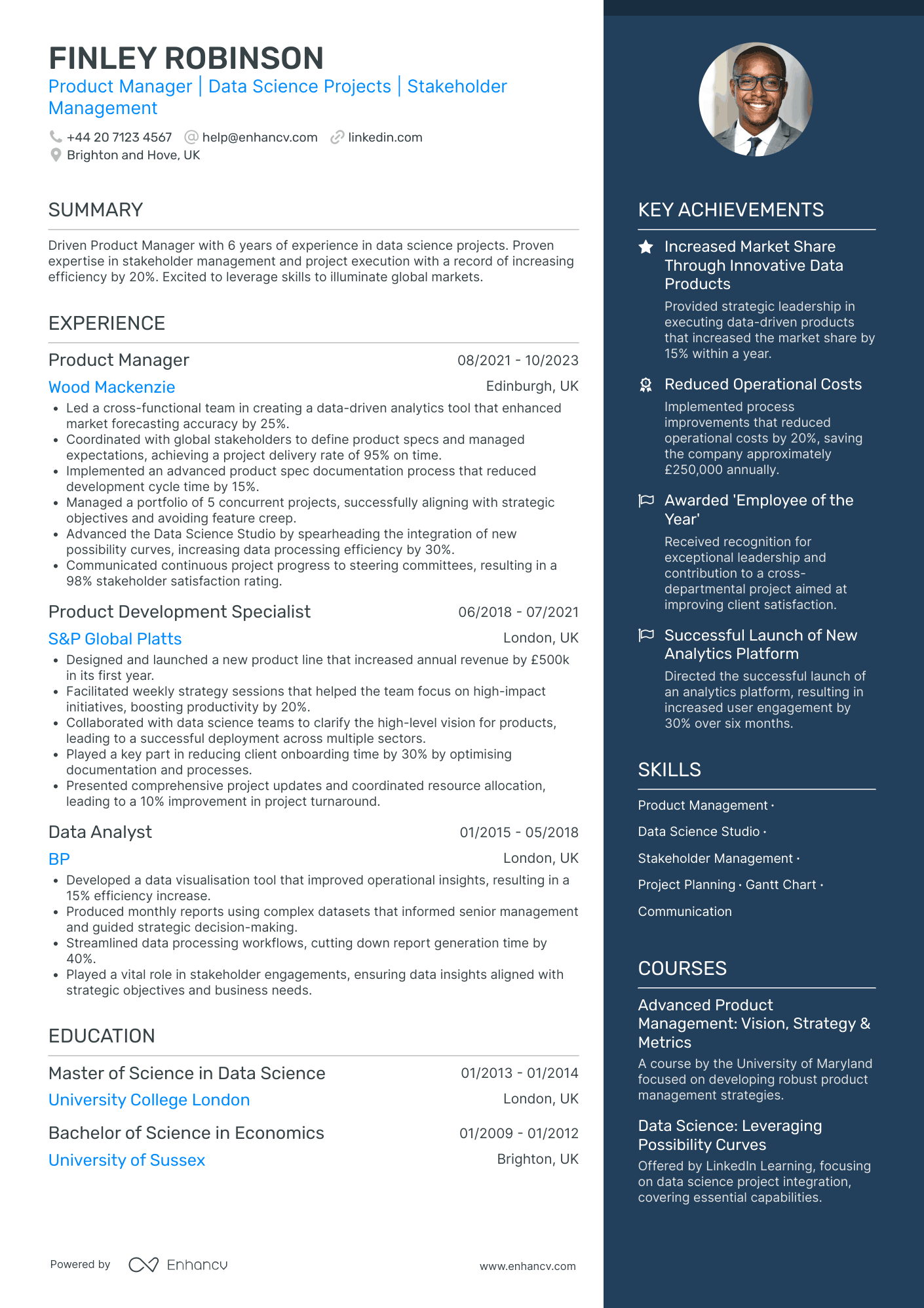
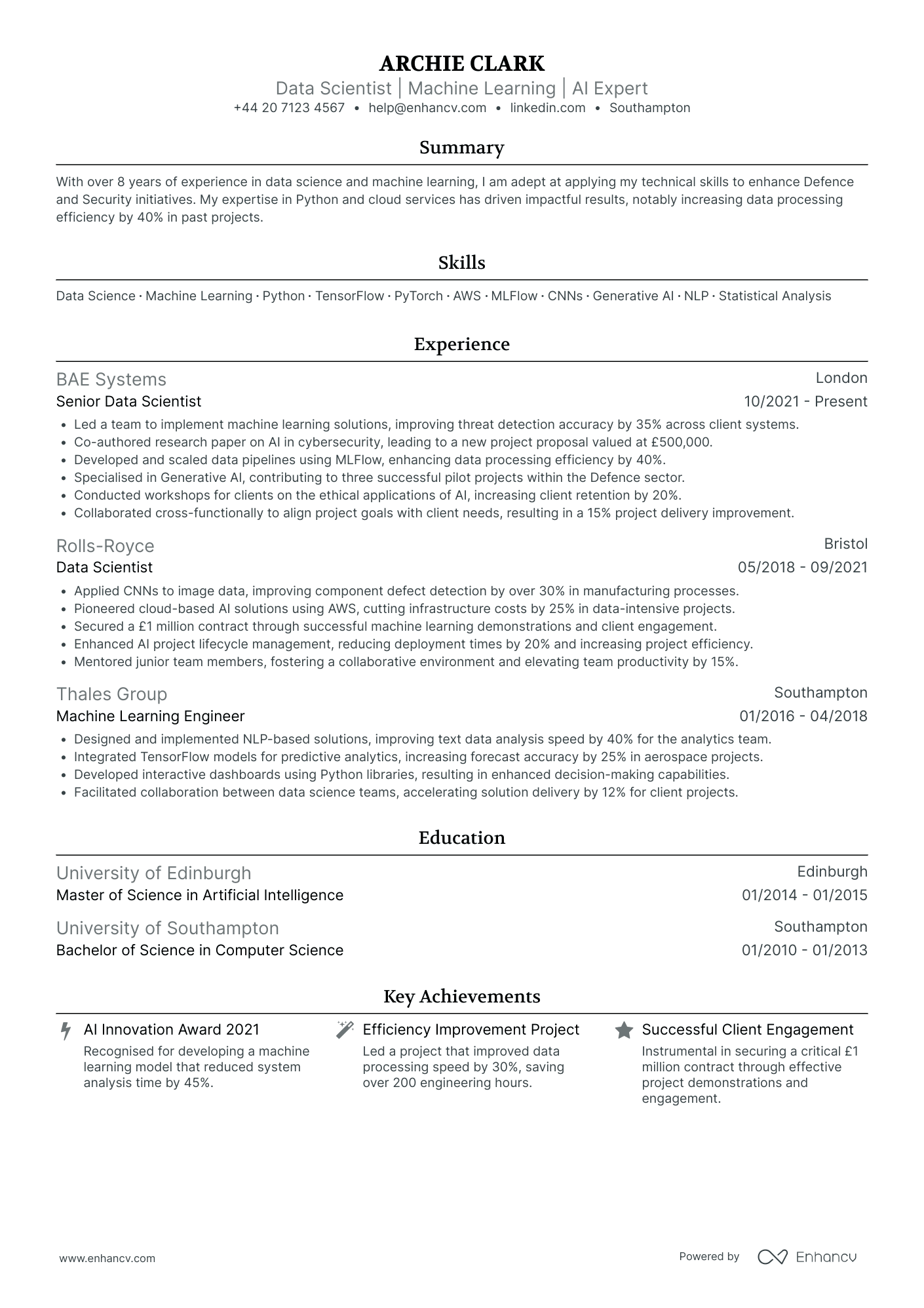
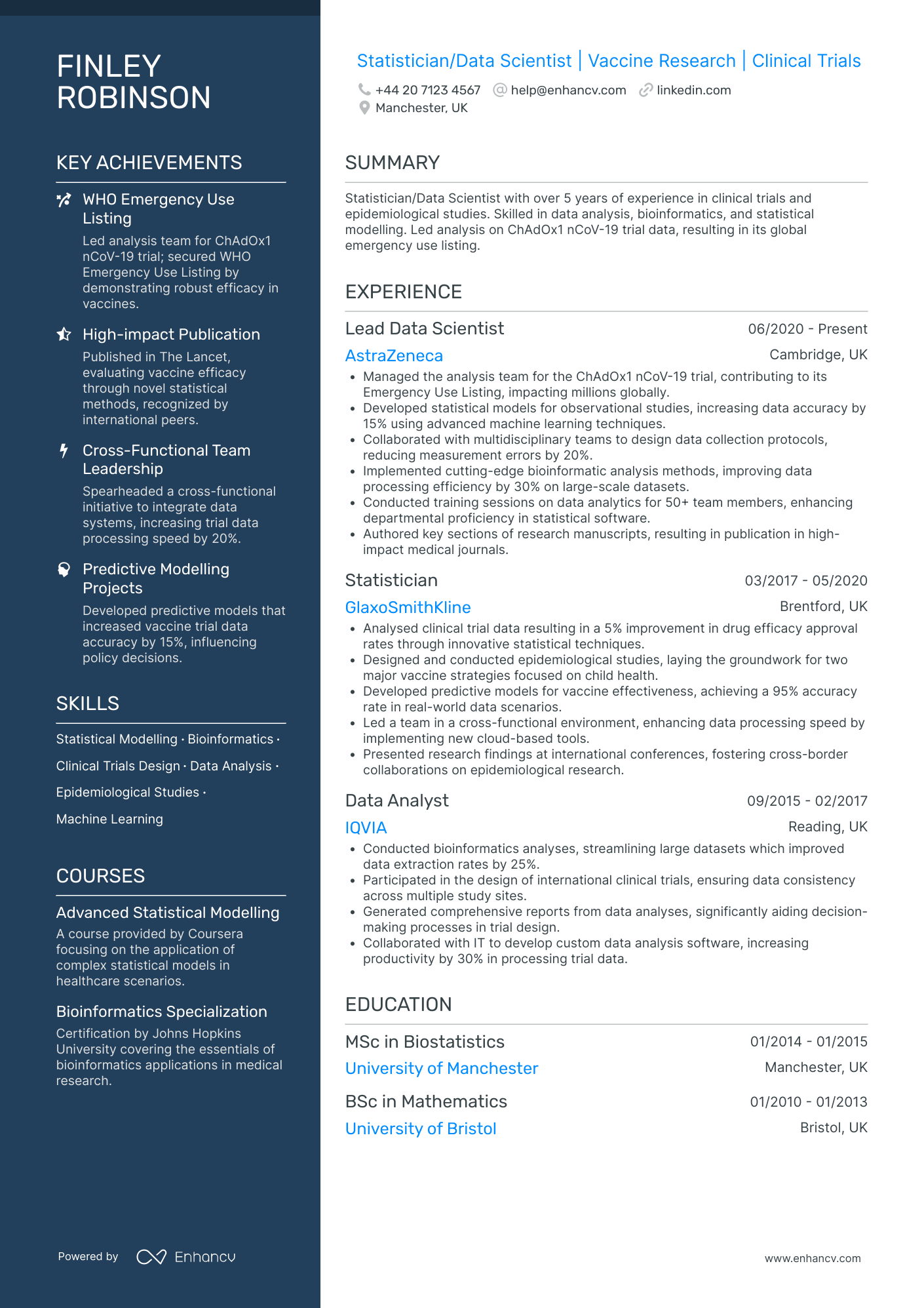
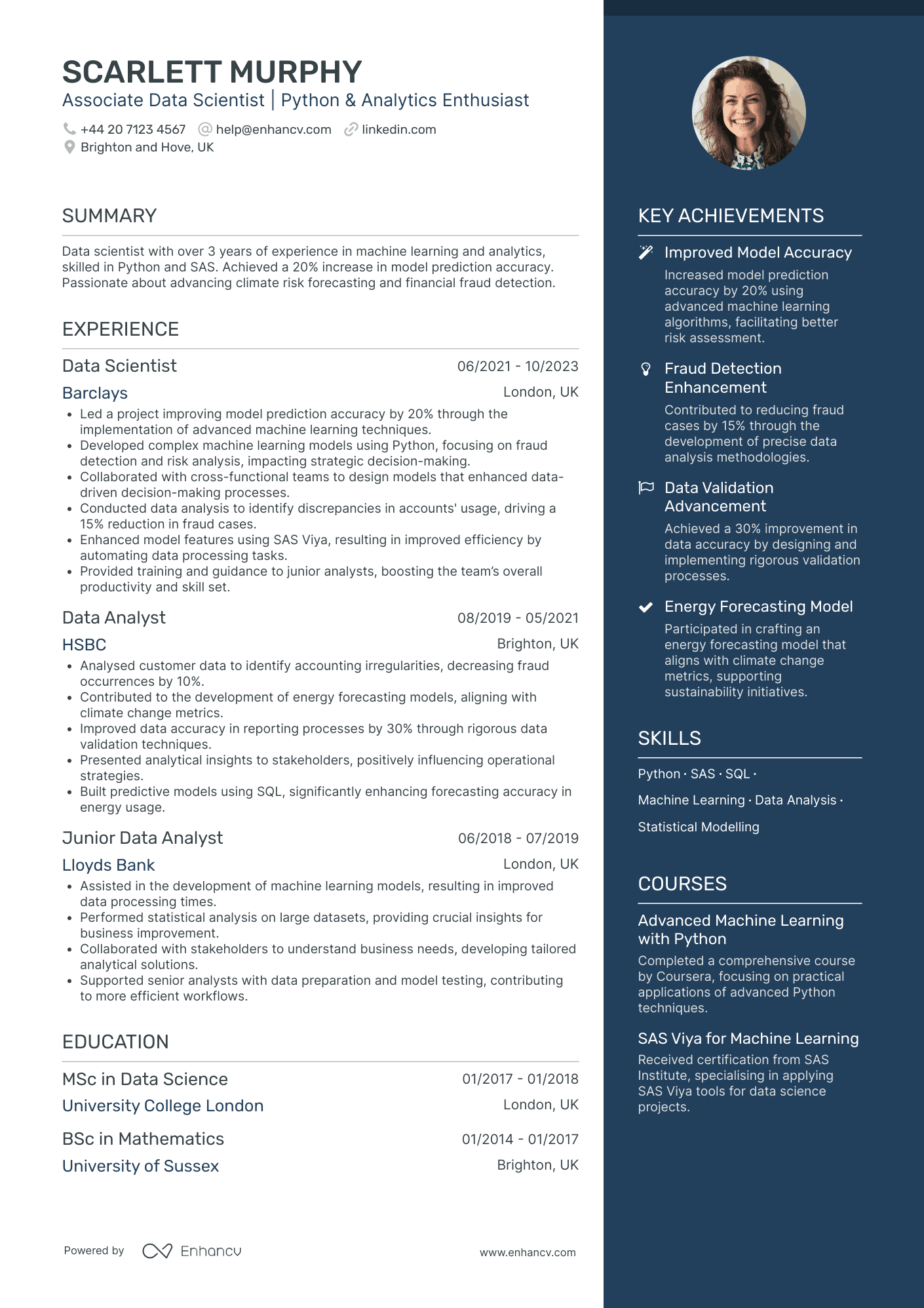
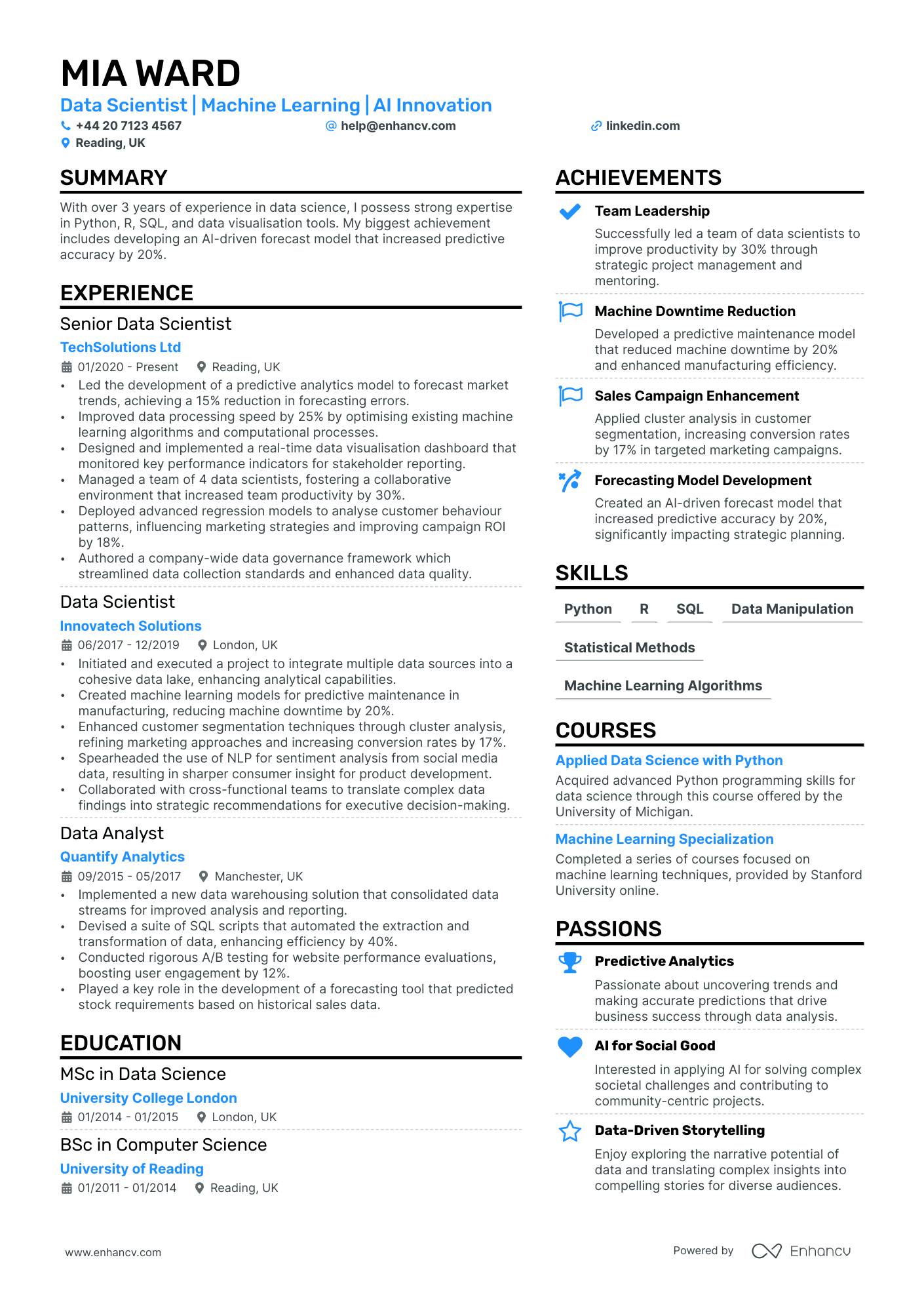
Most data scientist CVs read like a tools list with a person buried somewhere underneath. Python, SQL, a couple of framework logos, a cloud badge, and not one line about what any of it changed.
Recruiters for this role are not counting your libraries. They want the model you shipped, the decision it moved, and the number attached to it. That is what the CV has to prove, and prove fast.

Key takeaways
- Lead with skills. Python, machine learning, and SQL recur most often in UK postings, so name them near the top in the words the adverts use.
- Quantify every project. A model is only as strong as the decision or the metric it moved.
- Link a GitHub, Kaggle, or portfolio in the header. For a technical role, working code beats another adjective.
- Most UK roles are hybrid or on-site and pitched at mid to senior level, so put your location and level of experience up top.
- Two pages, reverse chronological, sent as a PDF unless the advert asks for something else.
- Show you can communicate. The strongest CVs prove a non-technical manager understood the result.
Top skills for your data scientist CV
Ask what the four core skills of a data scientist are and the honest answer sits on almost every UK advert: programming, statistics and machine learning, data handling, and the communication to make any of it land. Everything else is a specialism layered on top.
Skills lead this CV for a reason. A hiring manager scanning a stack of applications is filtering on a shortlist of tools before they read a single bullet, so the ones they need have to surface in the first third of the page.
The job feed backs the shortlist up. Across 210 UK data scientist postings in the last ~30 days on Enhancv's internal job feed, Python appears in 94% of them, machine learning in 77%, and SQL in 66%. Those three are not optional. If they are true of you, they belong near the top in the exact words the adverts use.
Listing a skill is the easy part. Evidencing it is what earns the interview. Put the tool in your skills section, then back it with a line in your experience where that skill produced a result.
Split them the way a reader expects. Your hard skills are the stack: languages, libraries, cloud, the modelling methods you have actually used. Name them precisely, because this is where the ATS and the hiring manager both scan first.
Your soft skills are the ones that decide whether the modelling matters: framing an ambiguous problem, managing stakeholders, and explaining a result to people who do not write code. Prove each in a bullet rather than asserting it.
List only what you can defend in an interview. If you have shipped it, name it. If you are still learning it, keep it honest and put it under tools you are developing rather than core skills.
Top skills for your data scientist CV:
Python
Machine learning
SQL
Statistics and probability
Data visualisation
R
Cloud platforms (AWS, Azure)
A/B testing and experimentation
Communication
Stakeholder management
Problem framing
Business acumen
Collaboration

The four core skills, and how to prove each
- Programming. Python and SQL do most of the daily work. Show a repository or a bullet where your code shipped. A language sitting on a list proves nothing on its own.
- Statistics and machine learning. Name the methods you have actually used, from regression to gradient boosting, and tie at least one to a result. An interviewer can tell trained from buzzword in about two questions.
- Data handling. The unglamorous majority of the job. A line about cleaning, joining, or engineering features from a real, messy dataset reads as genuine experience.
- Communication. The skill that decides whether the rest matters. Give one concrete example of a model or an analysis that a non-technical team acted on.
What the UK data scientist market looks like
Knowing the market shapes the CV. Here is what the role pays and what UK employers are actually asking for.
| What | UK data scientist roles |
|---|---|
| Typical pay | £32,000 to £83,000 a year (National Careers Service, gov.uk) |
| Where the work happens | Hybrid 59%, on-site 38%, remote 3% (123, 80, and 7 of 210 UK postings in the last ~30 days, Enhancv's internal job feed) |
| Experience level asked for | Senior 37% · mid 31% · lead 28% · entry 3% |
| Most-listed skills | Python 94%, machine learning 77%, SQL 66% |
Two numbers should shape how you write.
Only 3% of postings were pitched at entry level. The rest wanted mid, senior, or lead data scientists who own a problem end to end, which is why quantified, decision-led projects matter more here than a long tools list.
And almost all the work is hybrid or on-site, so a recruiter needs to place you. Put your town and whether you can commute in the header, especially for London and the other clusters where these roles concentrate.
The pay range is wide because the title stretches from a first analyst-adjacent role to a lead defining strategy. Pitch your CV at the band your experience supports, and let the projects justify it.
The hybrid and on-site split also tells you something about the work itself. These teams sit close to the business, in stand-ups and stakeholder reviews, which is why the communication skills above are weighted so heavily by the people doing the hiring.
Formatting your data scientist CV
Use a skills-led layout so your stack and your strongest projects appear before a long history, then keep the roles in reverse chronological order underneath.
Keep it to two pages, one column, standard headings, and a readable font. Hiring managers for this role skim for evidence, and design flourishes only slow that down.
Put the reader's shortlist where their eyes land first: a compact skills block and a linked project or two on page one, with the full work history flowing underneath. A technical reviewer decides whether to keep reading in the top third of the page.
Send a PDF for direct applications so tables and monospaced snippets hold their shape. Keep a Word copy for agencies that reformat into their own template. If the advert names a file type, follow it.
Data science applications often pass through tracking software first, so keep the layout clean and the headings standard for an ATS-friendly CV. Build it from a tested structure rather than a blank page, and Enhancv's CV templates export to a clean PDF that parses.
Is your resume good enough?
Drop your CV here or choose a file. PDF & DOCX only. Max 2MB file size.
Writing your data scientist personal statement
Three or four sentences at the top: what you build, the tools you build it with, one result you are known for, and the kind of team you want next. See more personal statement examples if the opening line is not coming.
Skip the phrase every other CV uses. "Passionate, data-driven problem solver" tells a recruiter nothing they can check, and they have read it forty times this week.
Lead with a project and a number instead. Anchor the opening on one result you are known for, then let the rest of the statement earn its place around it:
Data scientist CV personal statement example
Data scientist with five years turning messy product data into decisions, mostly in Python and SQL. Built a churn model that cut monthly churn by 18% and an experimentation framework now used across three teams. Comfortable owning a problem from the stakeholder question to a deployed model, and explaining the result to people who do not write code. Looking to bring that mix of rigour and clarity to a senior data science role in a product-led business.
The data scientist CVs that get interviews are not the ones with the longest tools list. They are the ones where every project ends in a number a manager cared about. When we review these CVs, we look straight past the stack to the outcome: what decision did the model change, and by how much. Name the business metric, put the figure next to it, and keep one line that proves you can explain it to someone who does not code. That combination separates a data scientist from a very expensive report generator.
Writing your data scientist experience section
Write each role as a dated heading followed by bullets that name the problem, the method, and the result. Lead every bullet with a verb, and end as many as you can with a number. For the mechanics, see work experience on a CV.
The trap in data science is describing the model and forgetting the point of it. "Built a random forest classifier" is a task. "Built a classifier that cut manual review by 30%" is a CV achievement. Reach for the second every time.
Tailor each application: pull the tools and methods from the advert and mirror the ones that are genuinely true of you. Enhancv's CV tailoring feature reads the job ad and suggests the matching edits, which saves rewriting from scratch for every posting.
- Built a churn prediction model in Python and scikit-learn that flagged at-risk accounts three weeks earlier, cutting monthly churn by 18% and protecting roughly £1.2M in annual recurring revenue
- Rebuilt the marketing attribution pipeline in SQL and dbt, replacing a two-day manual report with a self-serve dashboard used weekly by 40 stakeholders
- Ran 12 A/B tests on the onboarding flow, and the winning variant lifted activation by nine percentage points
- Presented model results to non-technical directors each quarter, translating precision and recall into revenue at risk so the board could act on them
- Automated weekly sales reporting in Python and SQL, freeing roughly six analyst-hours a week for higher-value analysis
- Built demand-forecasting models that cut overstock on seasonal lines by 12% across three regions
- Turned ad hoc questions from the commercial team into a shared Tableau dashboard, so buyers self-served the numbers they had been emailing for

PRO TIP
Data science adverts name specific tools and methods, not vague competencies. Mirror the ones you can back with a project: "PyTorch", "A/B testing", "dbt", "AWS SageMaker", "time-series forecasting". If it is on your CV, be ready to walk through the code behind it in the interview.
Projects and a portfolio on a data scientist CV
A data scientist CV carries a claim most CVs cannot: you can build things. Prove it with a link.
Put a GitHub, a Kaggle profile, or a portfolio site in your header, next to your email and location. For a technical role, code a hiring manager can open outperforms another line of description.
Curate it hard. Two or three clean, documented projects, each with a readme that states the problem, the data, and the result, read far better than 40 half-finished forks. Pin the ones that match the job you are applying for.
Make the code runnable. A notebook that executes top to bottom, a readme with a one-line setup, and a chart that states what it shows will do more for you than a paragraph of description ever could.
If your best work is behind an NDA, rebuild the idea on public data and say so. A recruiter cannot open a private repo, but they can see that you rebuilt a recommender on an open dataset over a weekend.
Education and certifications for a data scientist CV
Most UK data scientist roles expect a numerate degree, and many postings name a masters or PhD in a quantitative field. List yours with the classification, and move it below your experience once you have a few years behind you. See how to structure education on a CV if you are unsure where it belongs.
Certifications carry weight when they map to the stack employers list. A cloud certification in AWS, Azure, or GCP, or a recognised machine-learning course, signals you can work in the environments teams actually use.
You do not need every course you have ever touched. Two or three that match the role read as focus, and a wall of badges reads as padding.
Name the certificates you hold and any in progress. In a field that moves this quickly, recent and dated learning tells a recruiter you have kept current.
Will AI replace data scientists?
The honest answer, and the one worth writing towards: not soon, but the job is changing.
Large language models now draft SQL, write boilerplate, and speed up exploratory analysis. What they do not do is frame an ambiguous business problem, choose the right metric, judge whether a result is trustworthy, or defend a modelling decision to a sceptical director.
That is where the demand sits. Across the UK postings in the feed, only 3% were pitched at entry level, and the rest wanted mid, senior, and lead data scientists who own problems end to end.
So write the CV that shows judgement over raw output. The projects where you decided what to build, and why, are the ones AI cannot claim for you. Lead with those.
It also changes how you should describe your tools. Saying you use an AI assistant to move faster is fine. Saying it produced a result you understood, checked, and stand behind is what a hiring manager is actually buying.
Conclusion
Lead with the skills employers search for, then prove each one with a project that ends in a number a manager cared about.
Link your code, keep the format clean and ATS-ready, and make sure one line shows you can explain a model to someone who does not write code. That is the data scientist CV that gets interviews in 2026.
Author's take - the Enhancv team
The data scientist CVs that get interviews are not the ones with the longest tools list. They are the ones where every project ends in a number a manager cared about. When we review these CVs, we look straight past the stack to the outcome: what decision did the model change, and by how much. Name the business metric, put the figure next to it, and keep one line that proves you can explain it to someone who does not code. That combination separates a data scientist from a very expensive report generator.