



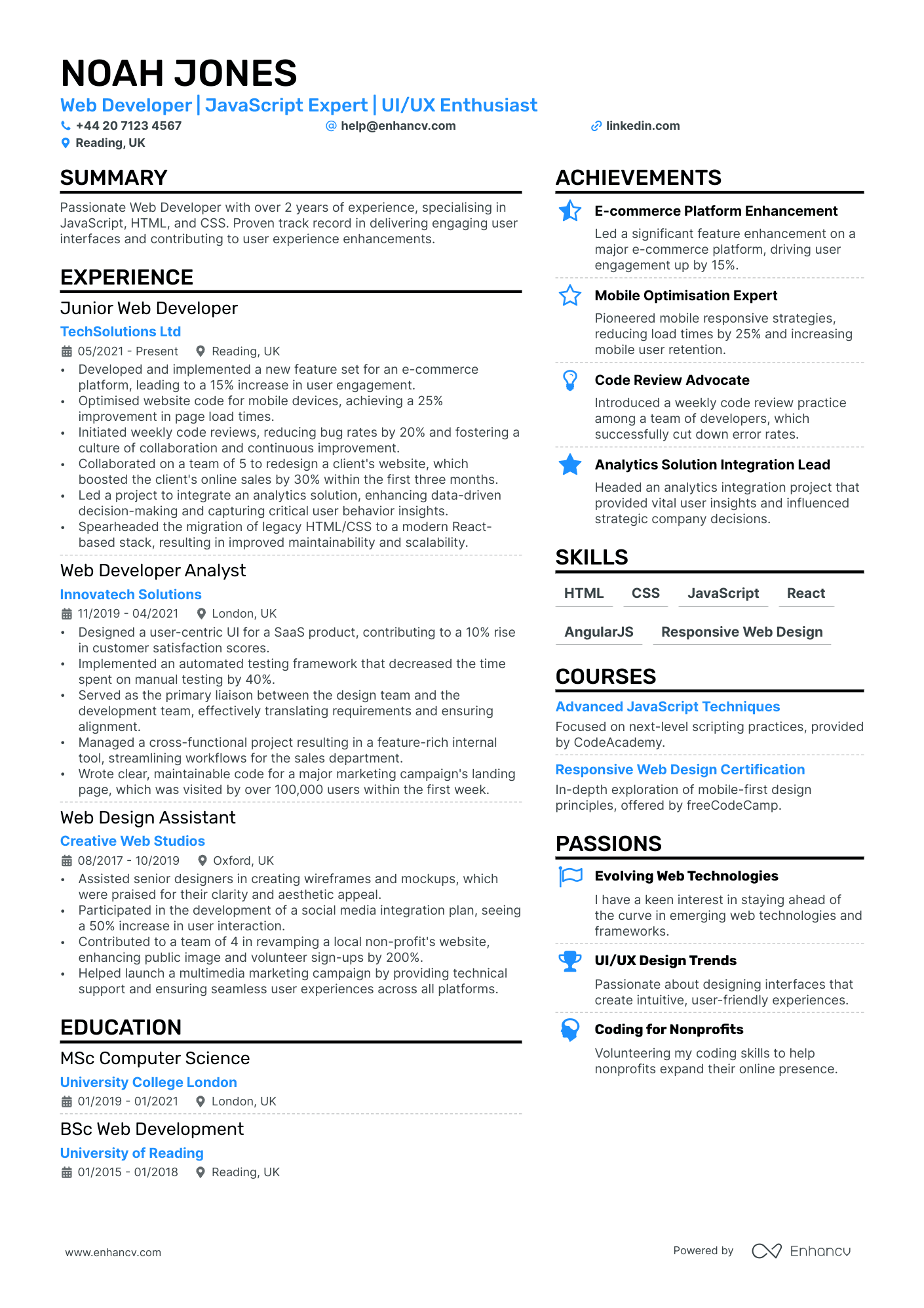
Most front end developer CVs make one of two mistakes. They over-design the page to prove they can, or they bury the tech stack three scrolls down where a hiring manager will not find it.
The version that gets the interview does the unglamorous thing well. It loads the stack near the top, points to work that runs in a browser, and formats clean enough to survive a first-round scan. Get the structure right and every other section has somewhere solid to stand. For the fundamentals underneath all of this, see how to write a CV.

Key takeaways
- Lead with your stack. Put JavaScript, your main framework, and your tooling near the top where a recruiter scans first.
- Link a live portfolio and a GitHub profile in the header. For a front end role, working code beats a described project.
- Keep the format clean and single-column so an applicant tracking system can read it. Save the visual flair for the portfolio itself.
- Two pages, reverse chronological, exported as a PDF unless the advert asks for a Word file.
- Quantify what your code did: load times cut, bundle size reduced, users served, test coverage raised.
- No commercial experience yet? Lead with projects, open-source contributions, and the stack, not an empty work history.
Formatting your front end developer CV
Your CV is a front end artefact, so recruiters read the formatting as a sample of your work. A cluttered, inconsistent layout quietly undercuts every claim about clean code.
This is why format leads for a front end CV. The same instincts that make a good interface, hierarchy, whitespace, and restraint, are the ones a hiring manager wants to see applied to your own page.
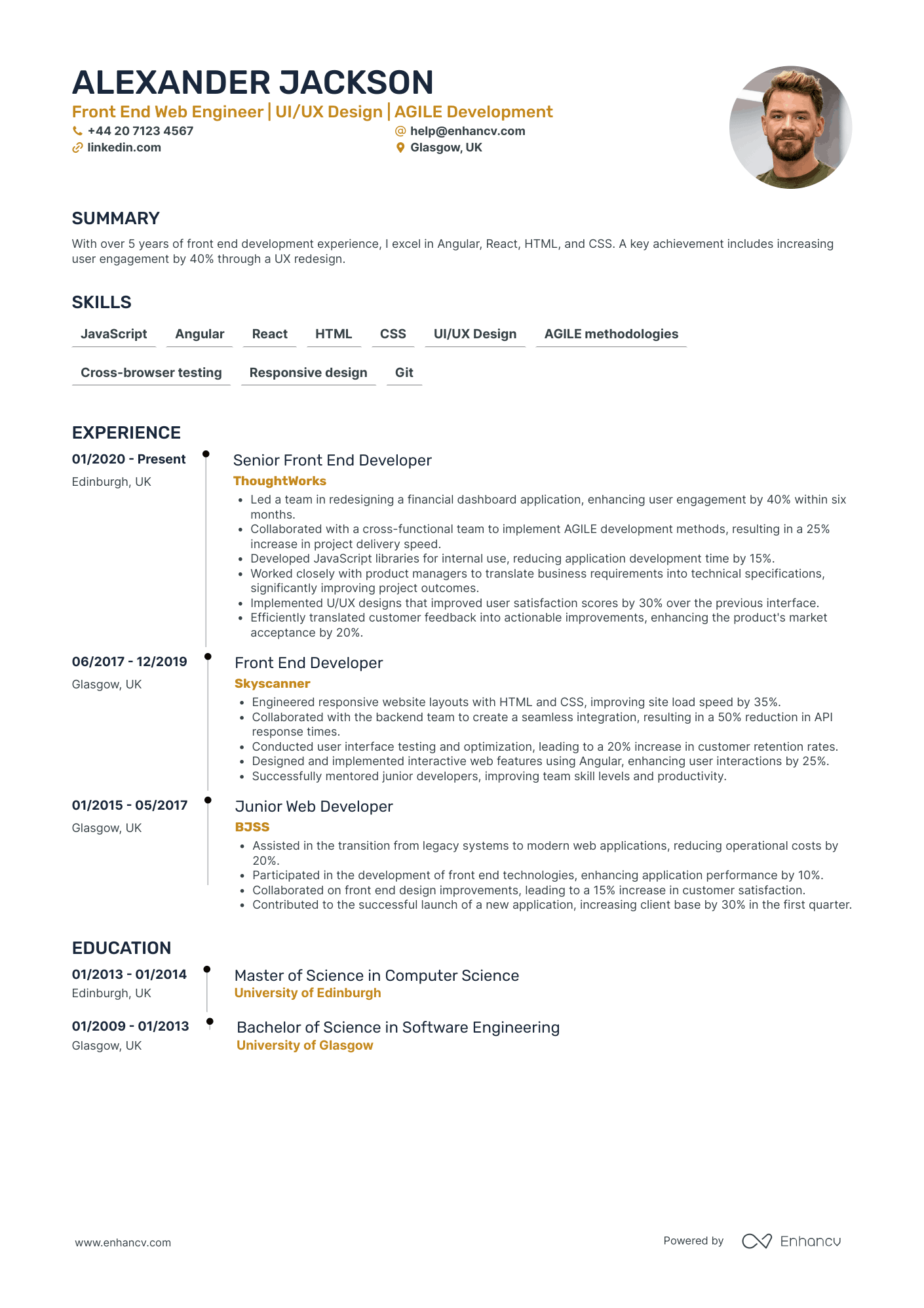
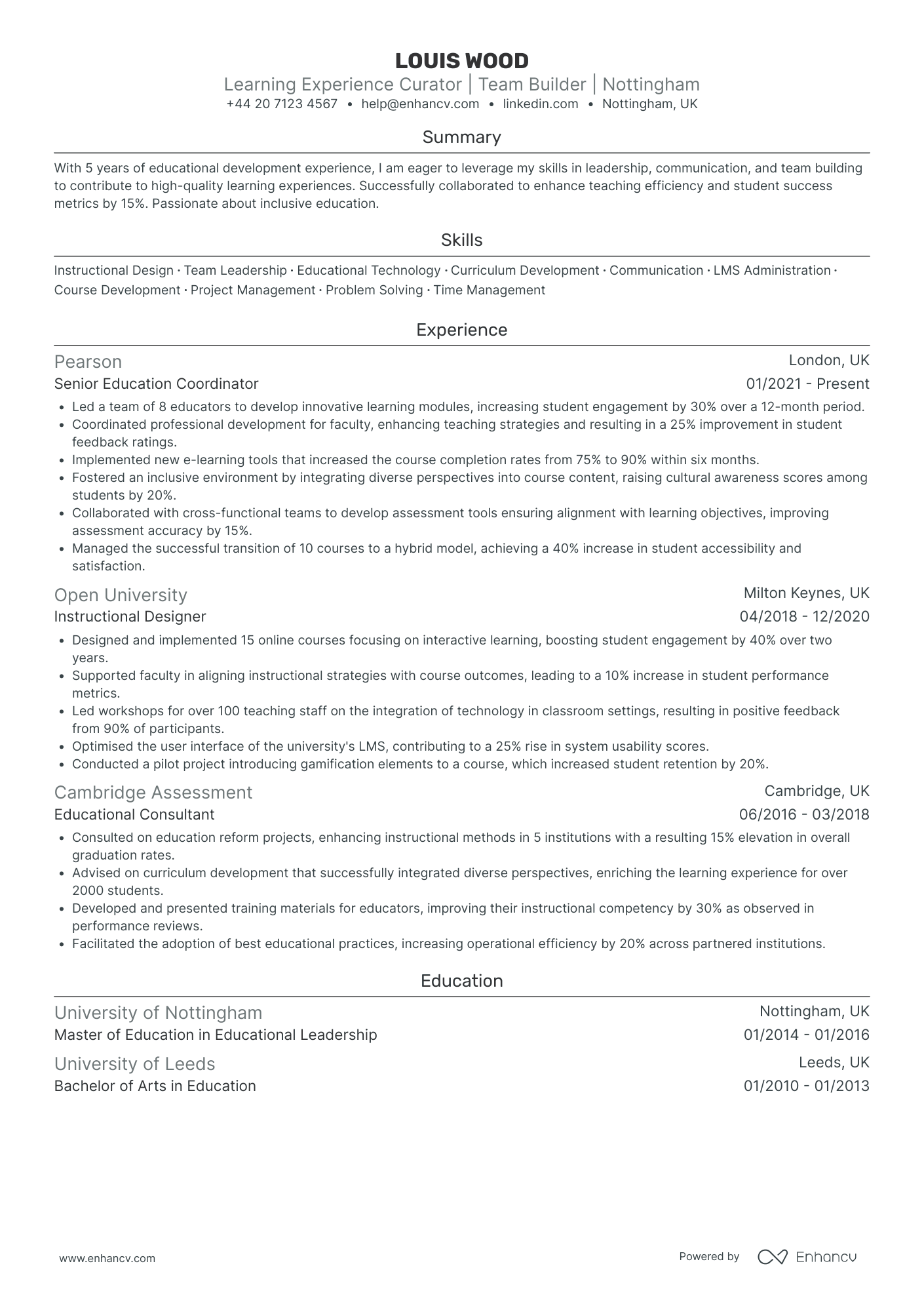
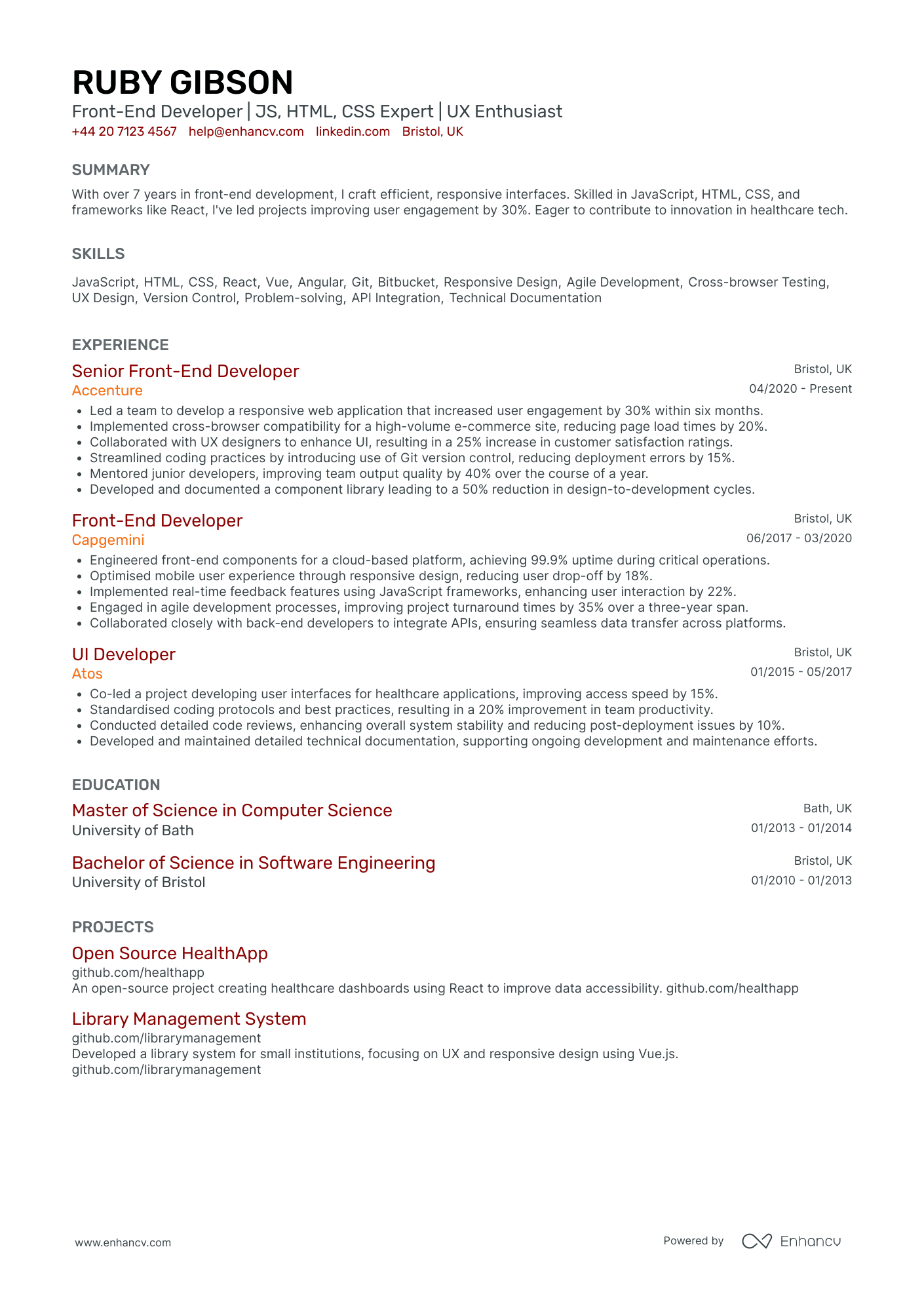
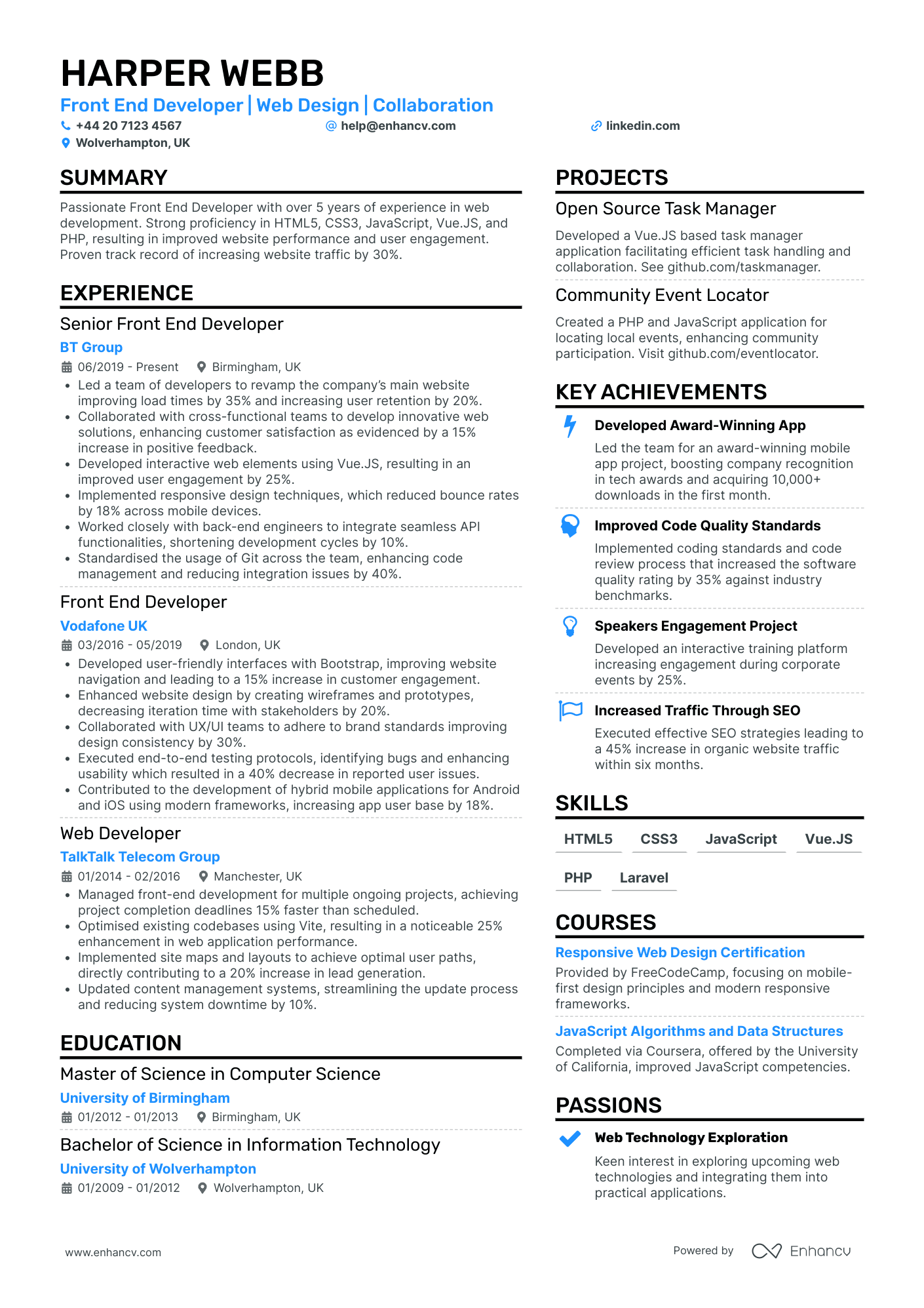
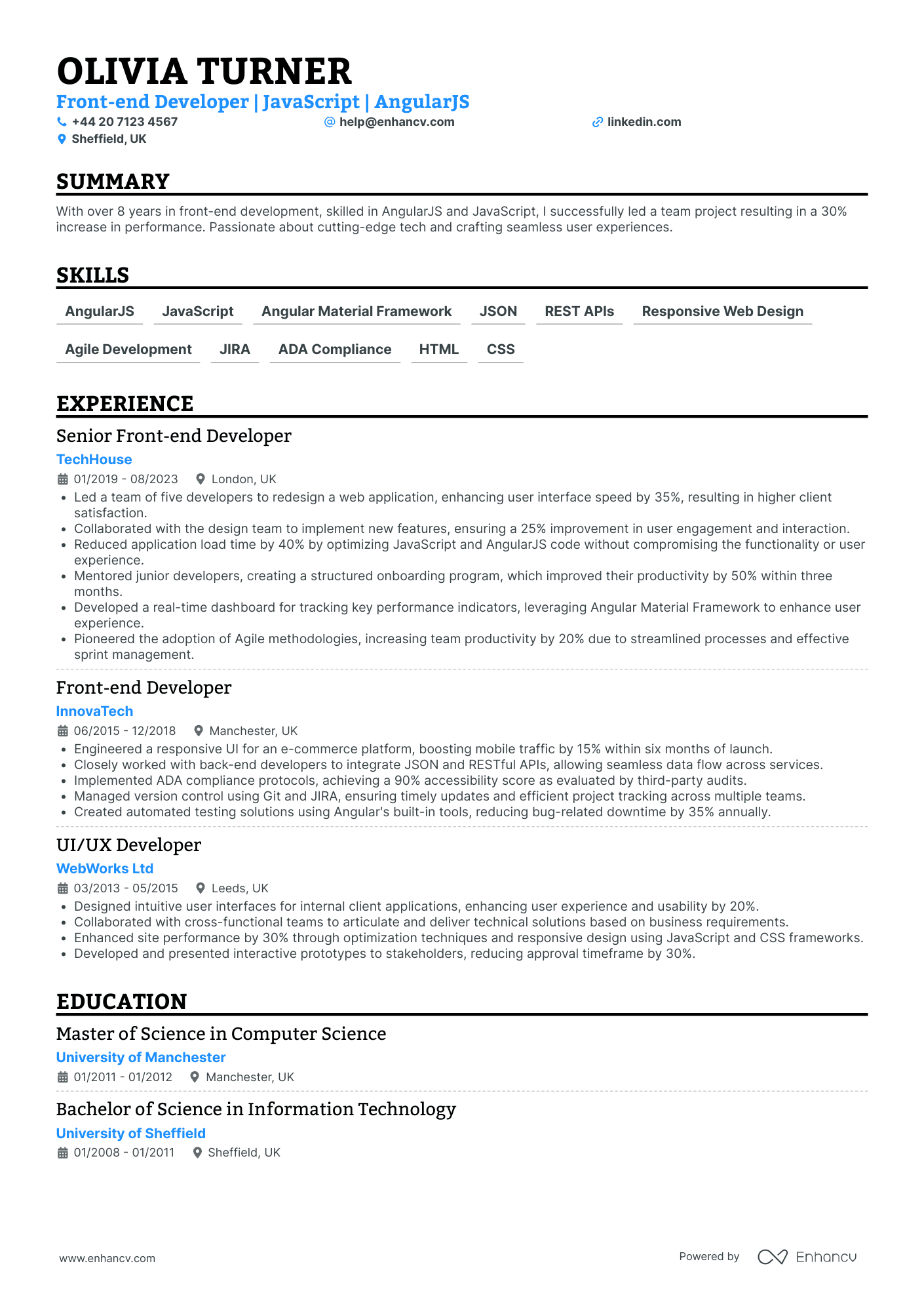
Use a reverse chronological structure once you have commercial roles behind you, most recent first. It is what UK hiring managers expect and what an applicant tracking system parses most reliably.
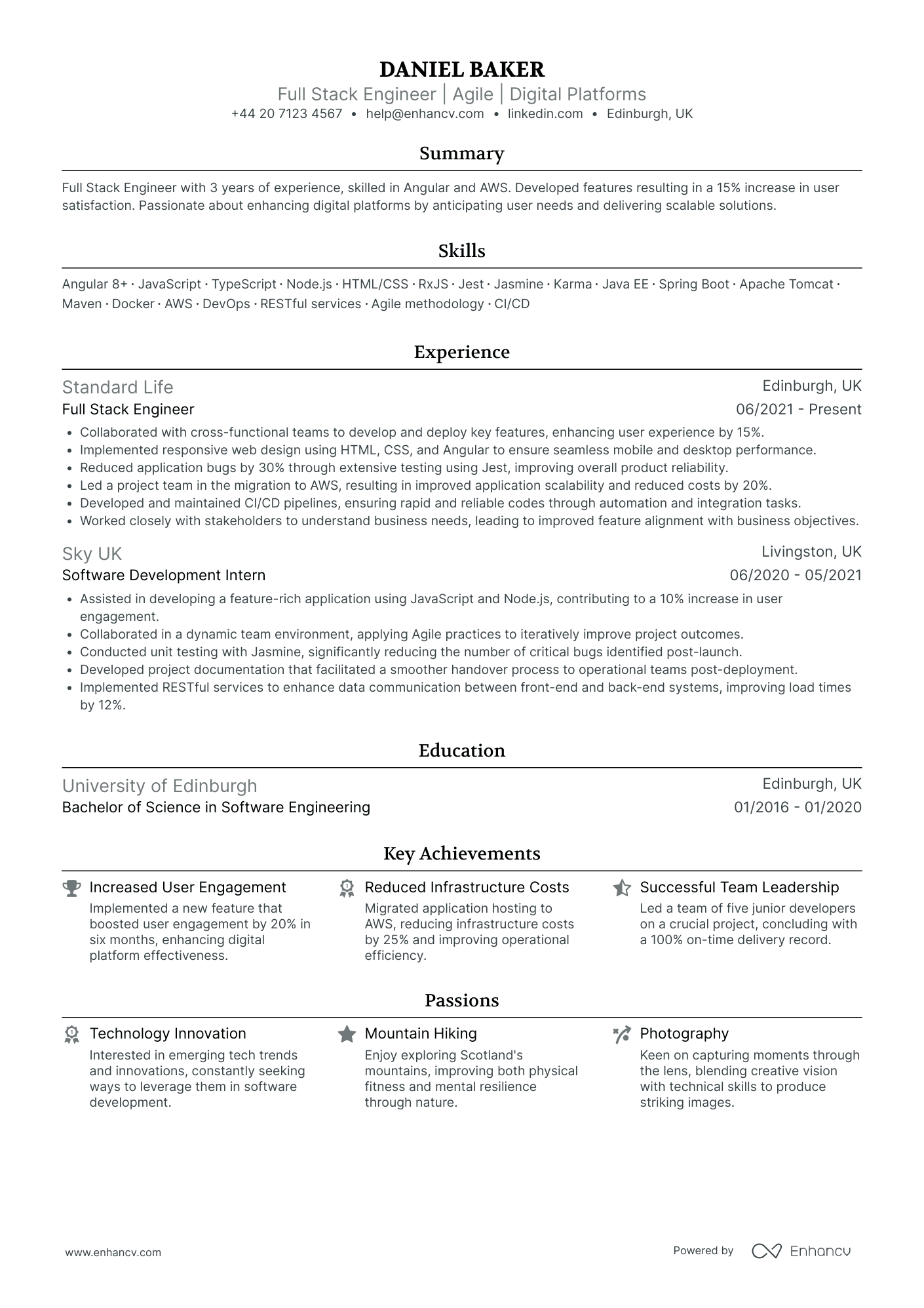
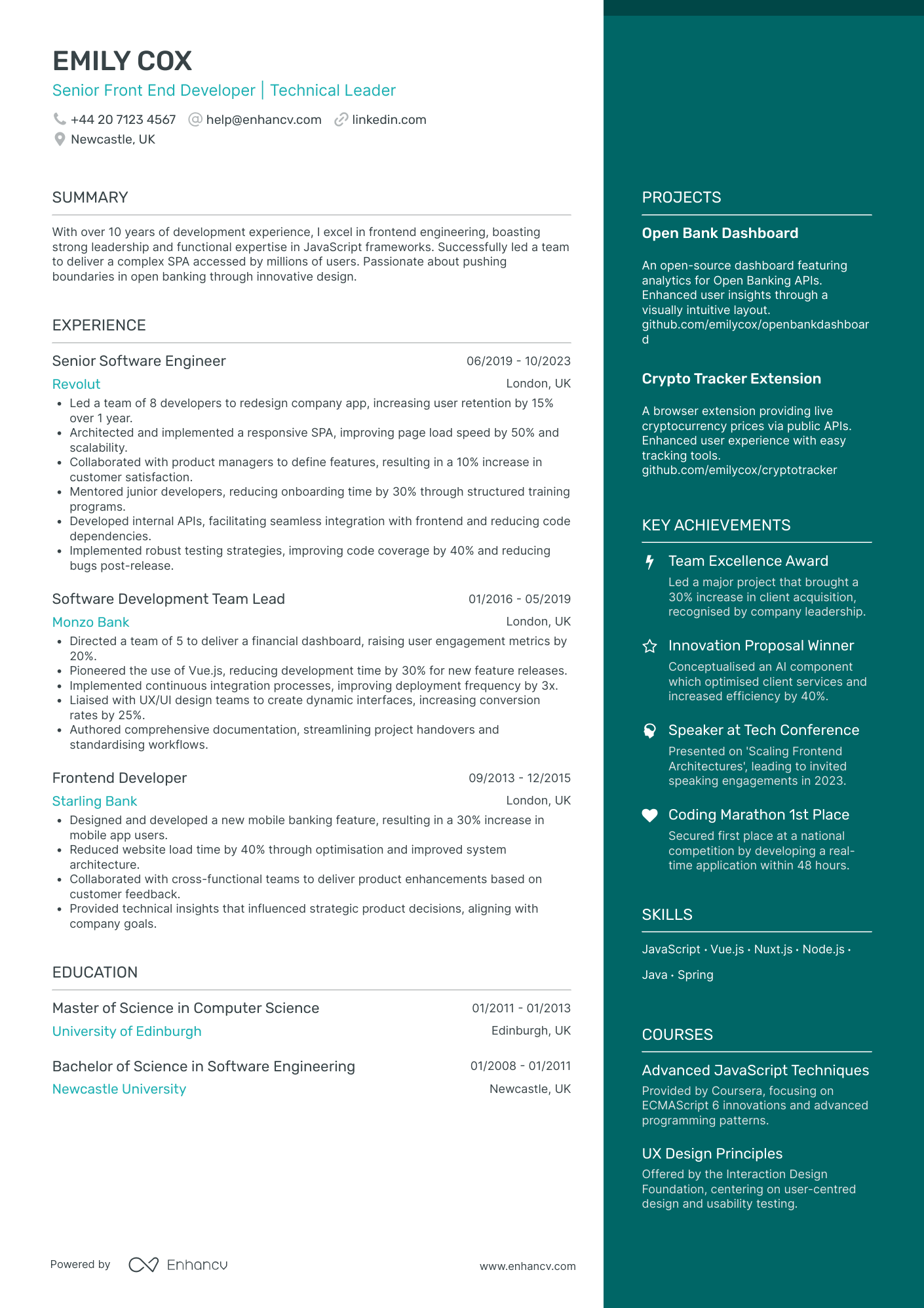
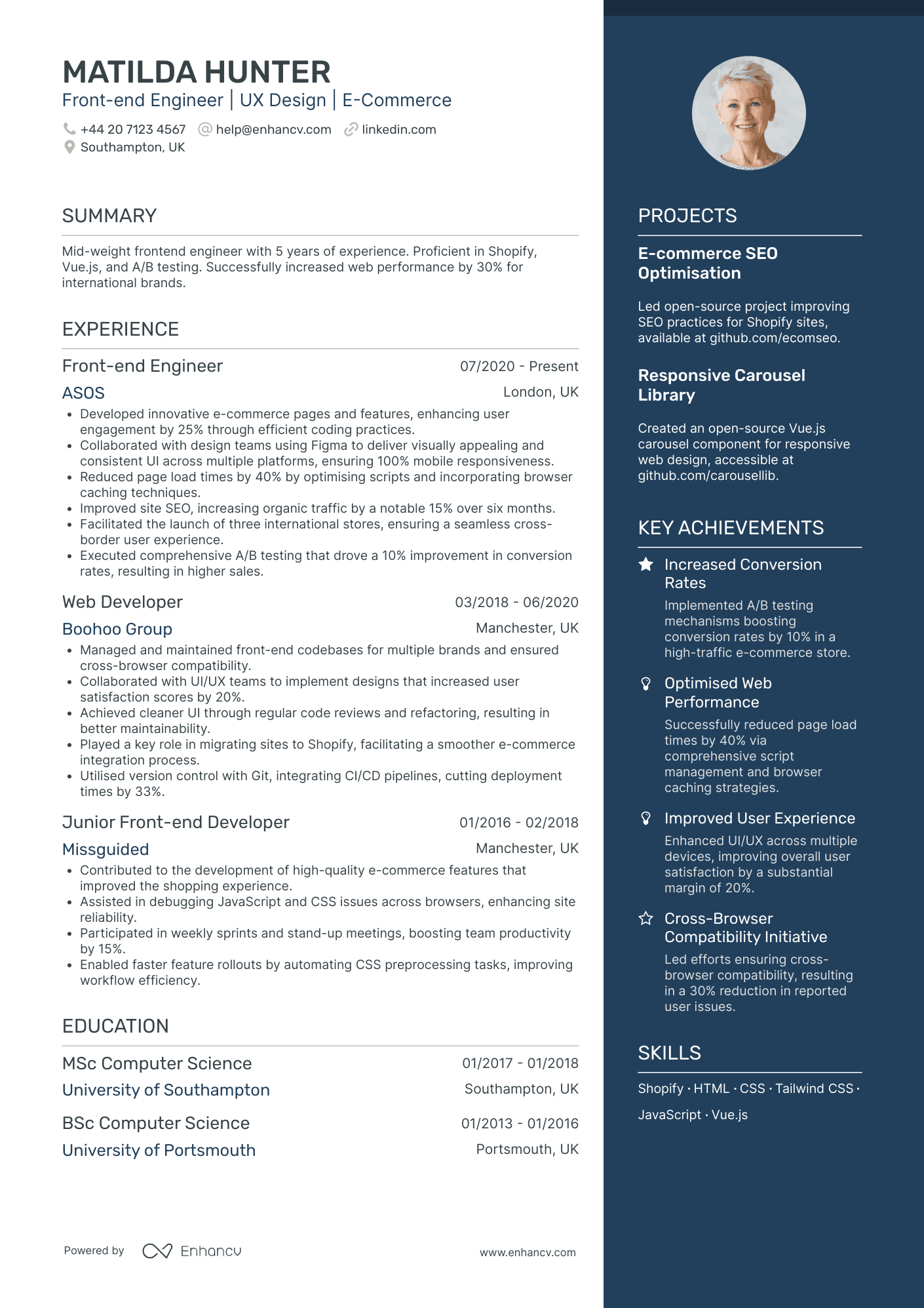
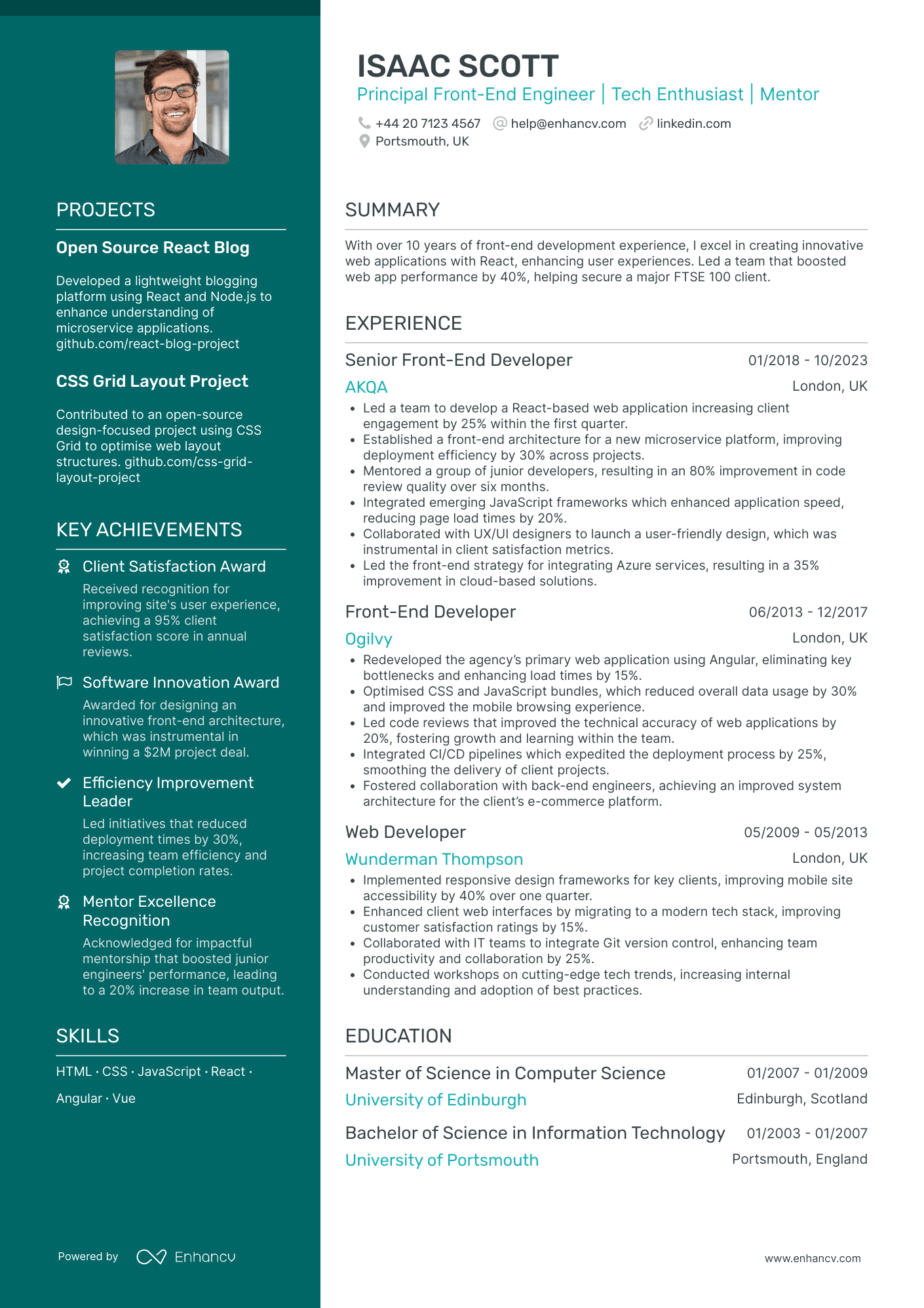
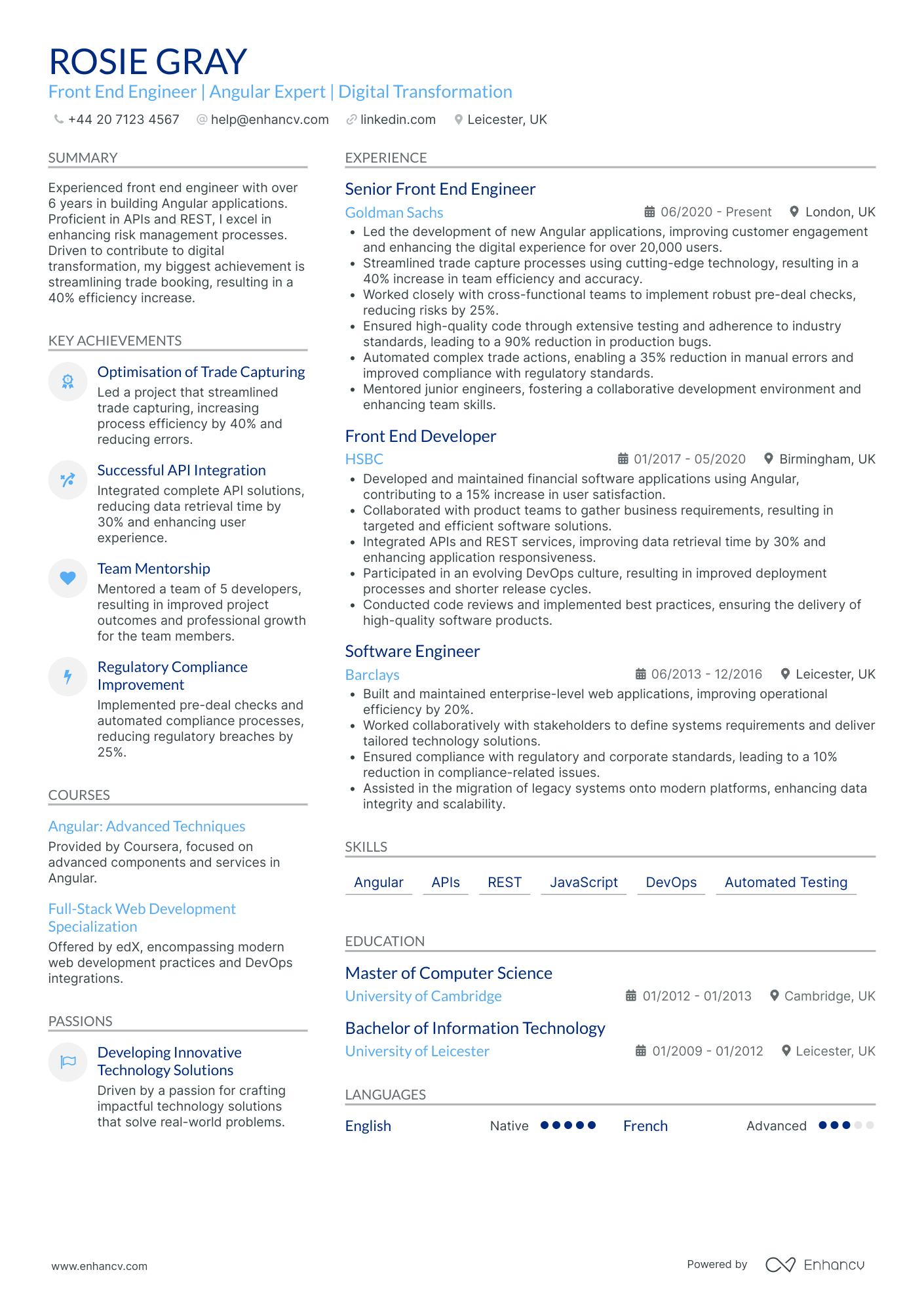
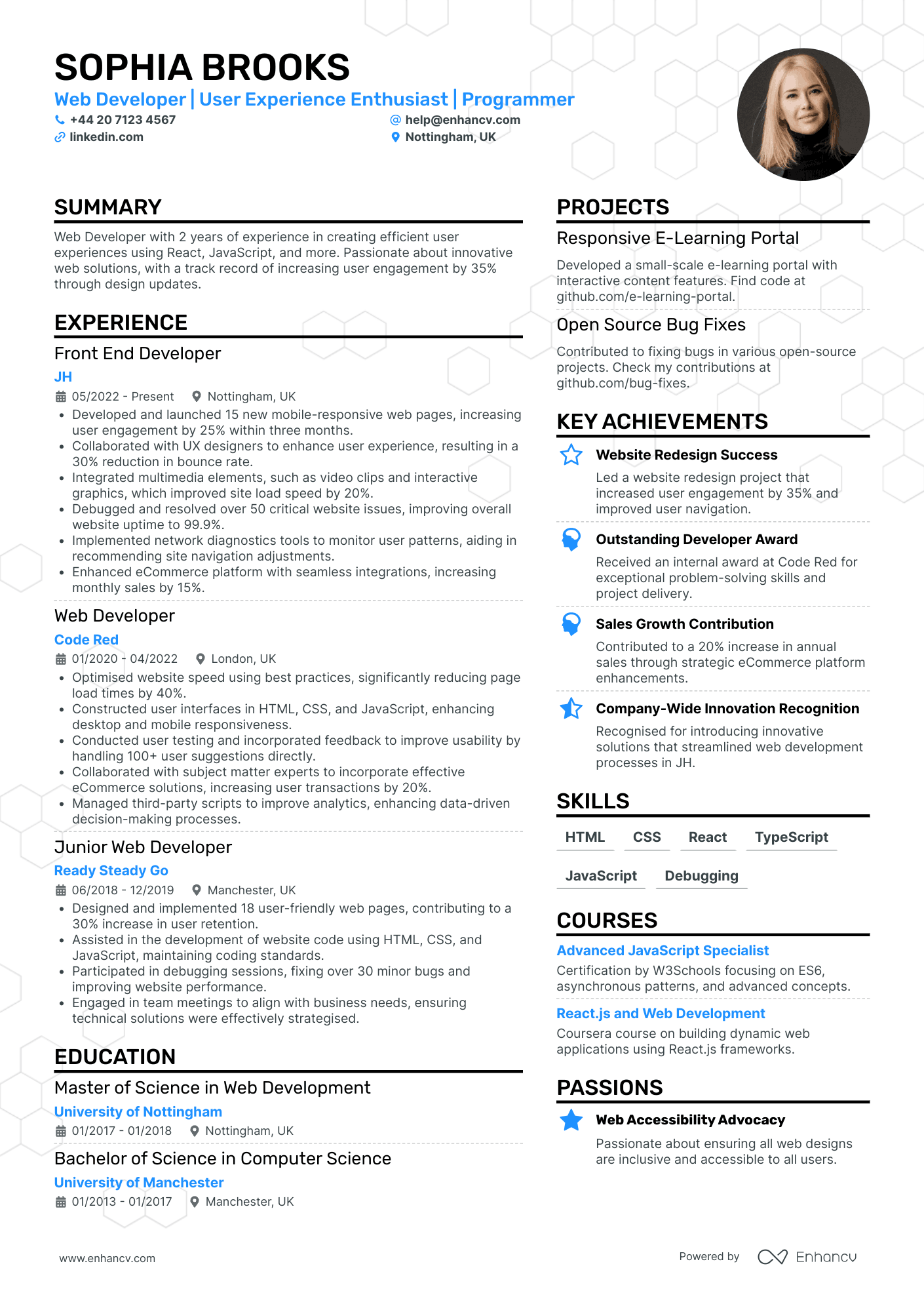
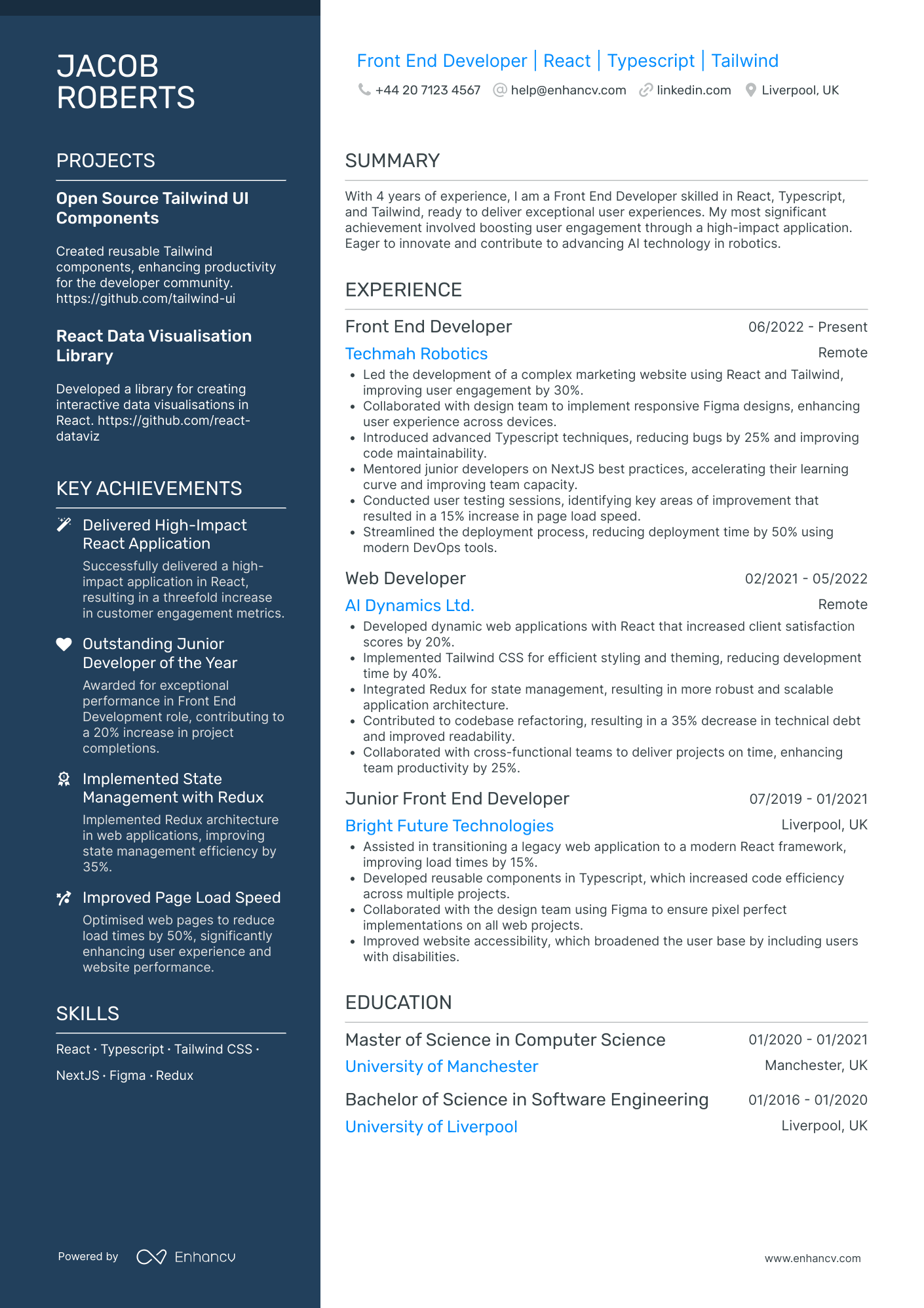
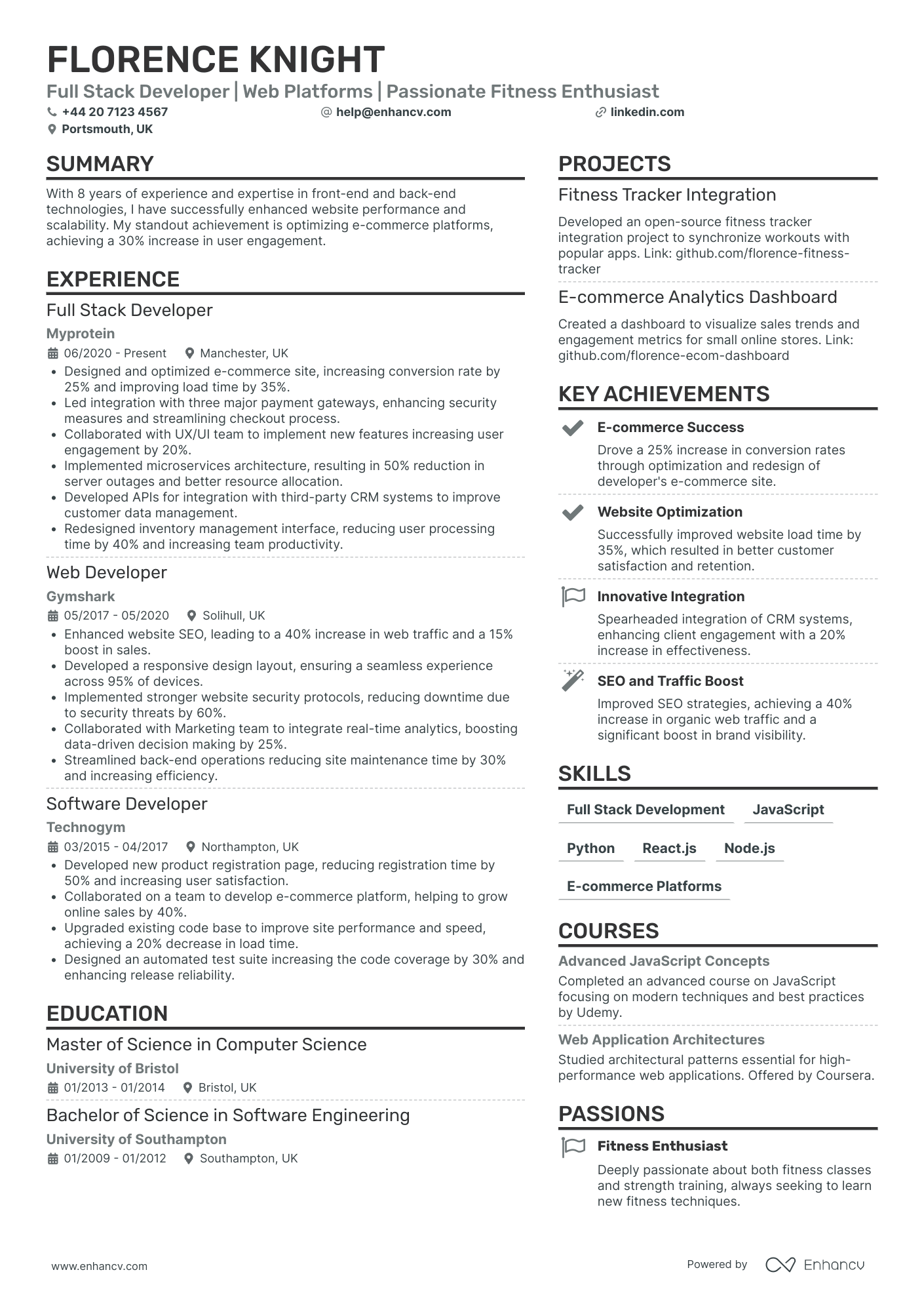
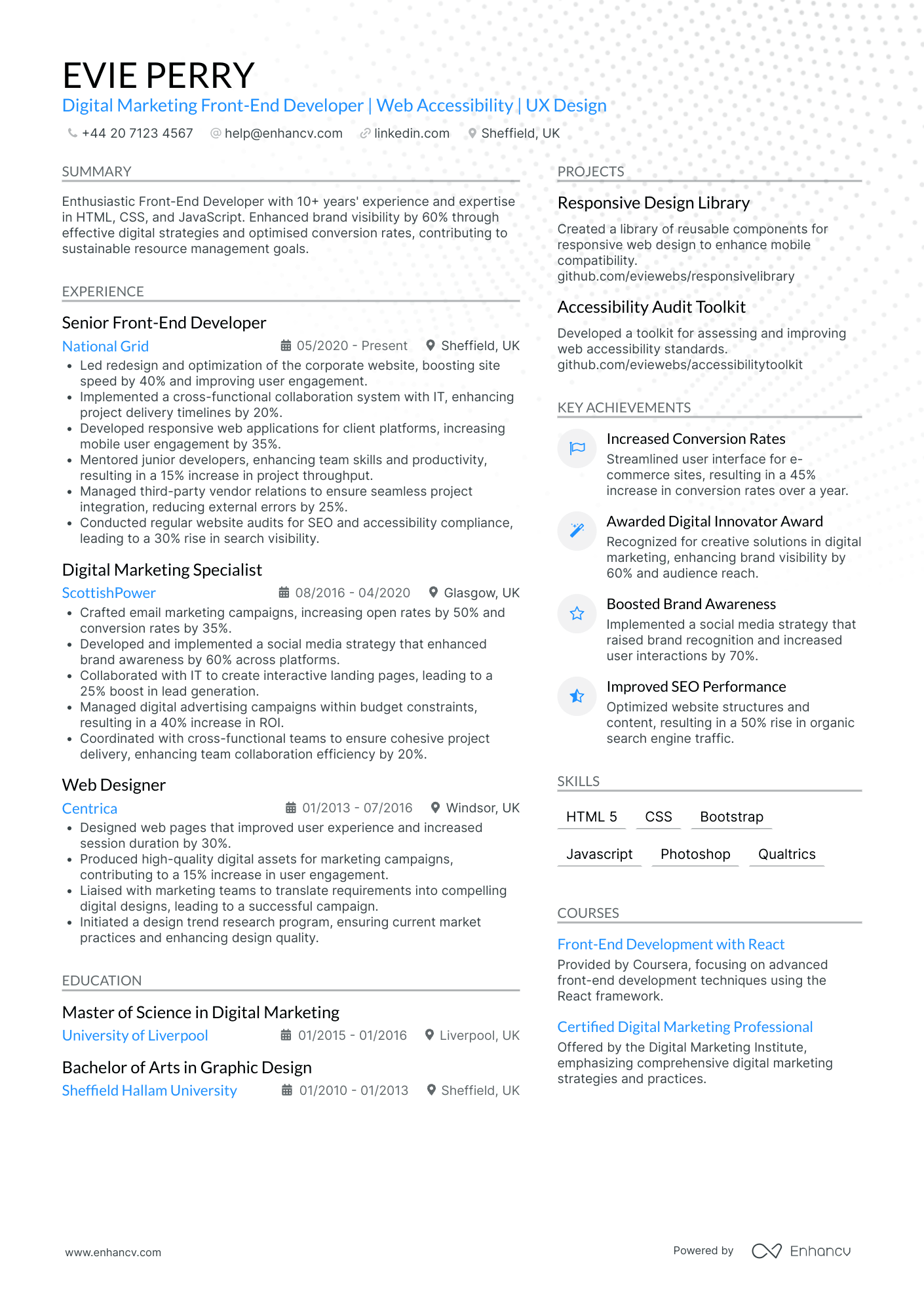
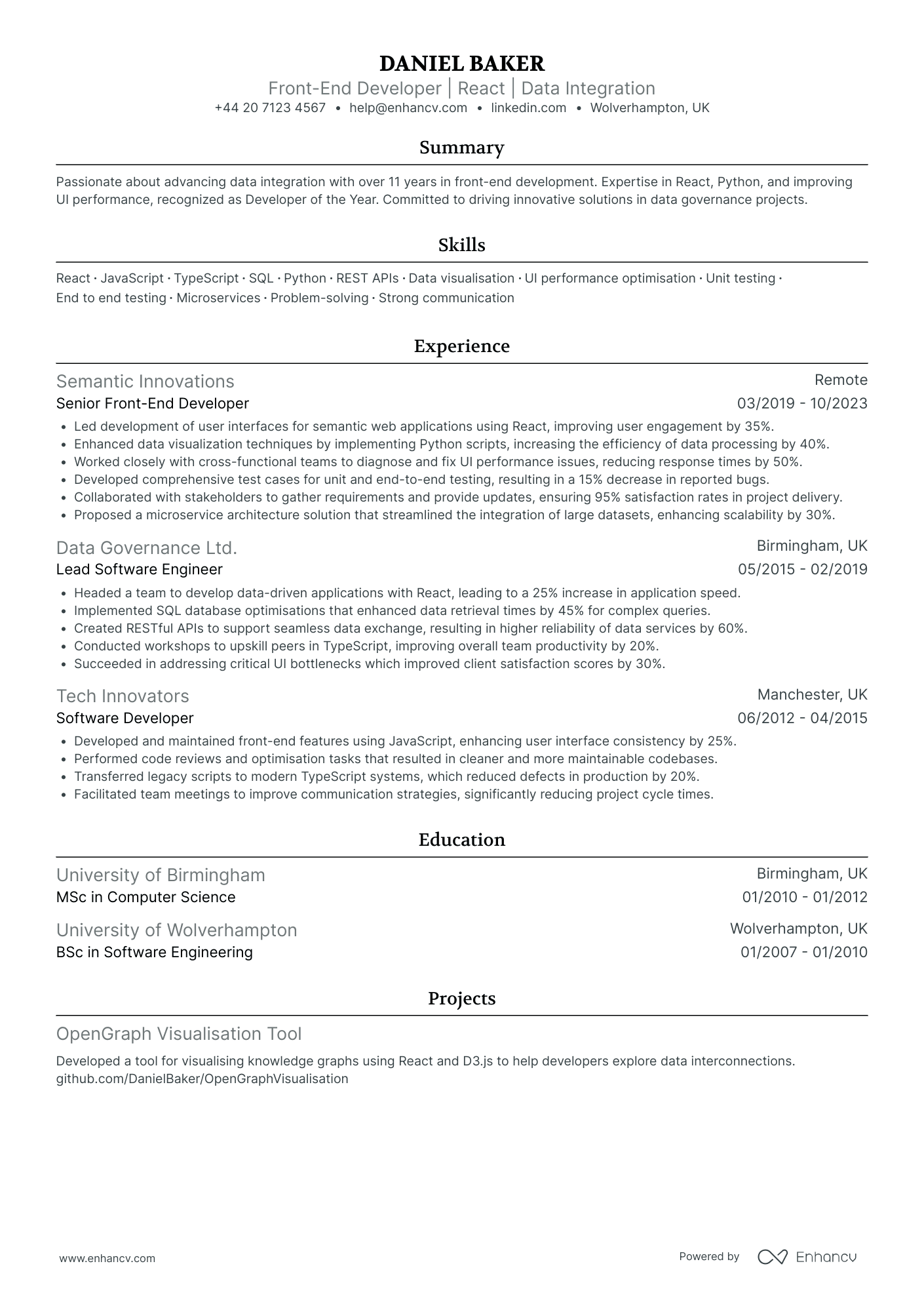
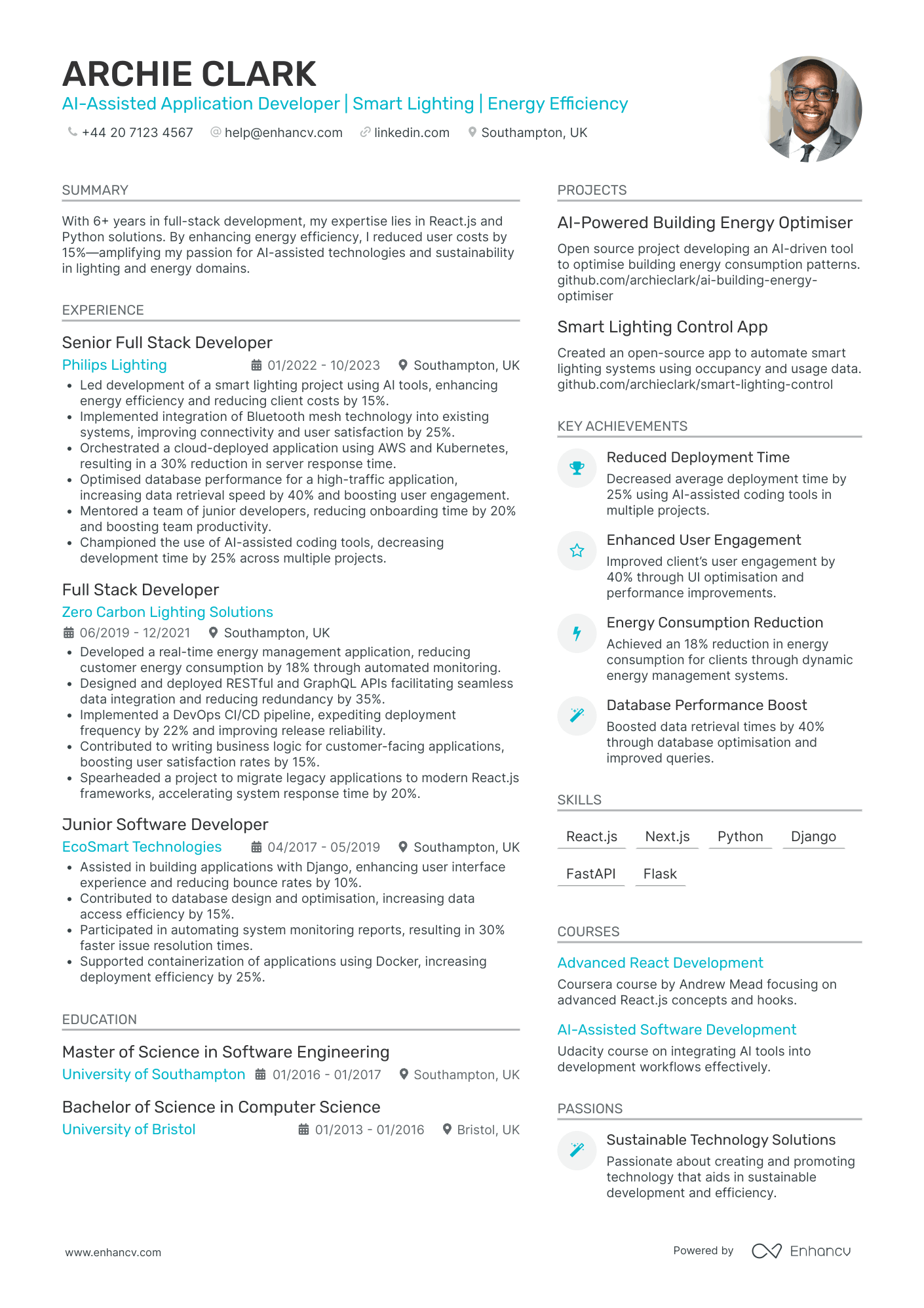
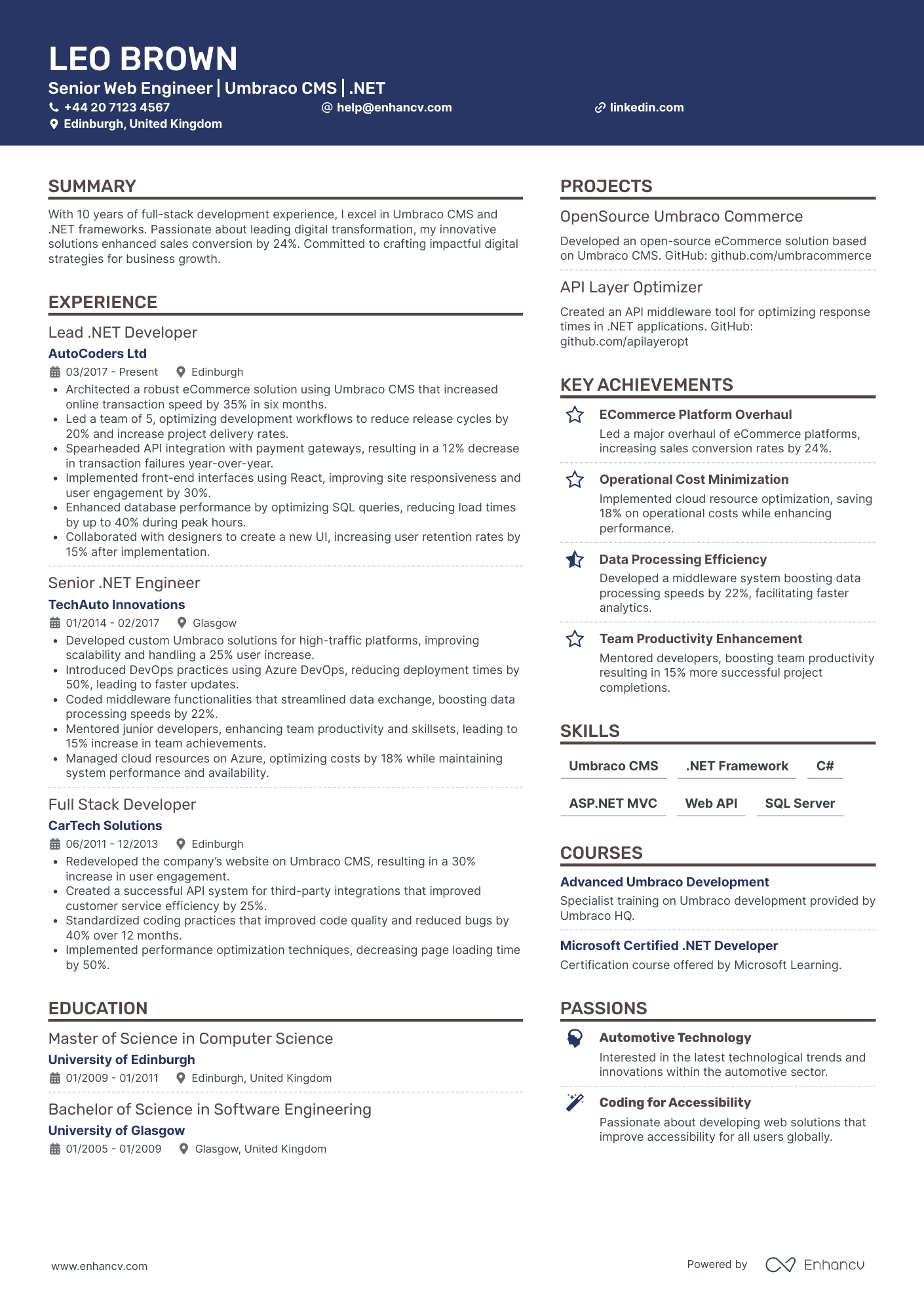
Keep it to a single column with standard headings and a readable font. The CV layout tricks that look clever, such as skills sidebars, rating dots, and multi-column grids, are the same ones that confuse a parser and drop half your stack from the recruiter's keyword search.
Order the sections for a technical reader: header with links, a short personal statement, key skills or tech stack, experience, then education. A front end recruiter wants the stack and the work before the schooling.
Two pages is the UK norm for anyone past their first role. One page is fine for a junior. A third page on a front end CV usually means you are listing tools rather than achievements, so see how long a CV should be if you are trimming.
Choose a font a screen renders cleanly, such as Inter, Arial, or Calibri, and hold to one size for body text and one for headings. Consistency in spacing and alignment reads as care, and a front end recruiter notices the difference.
Send a PDF for direct applications so the layout holds on any machine. Keep a Word copy for recruitment agencies, which often reformat CVs into their own template before passing them on. If the advert names a file type, follow it.
Most applications pass through a parser before a person sees them. Write the real skills in plain text, keep them out of images and header graphics, and the tool reads exactly what is on the page. Name the file with your name and the role, not "cv_final_v3", so it is easy to find again in a crowded inbox.
Preview the PDF before you send it. Fonts substitute, links break, and a second page can spill onto a third on a different machine. What you export is what the recruiter judges, so open the file the way they will.
On the template question that brings most front end developers here, pick a plain, tested one and put your energy into the content. Enhancv's CV templates export to a clean, single-column PDF that a parser can read, which saves you fighting the formatting in a blank document.

PRO TIP
Recruiters search a CV database for the exact stack. If the advert says React, write React, not "modern JavaScript frameworks". Name the framework, the version where it matters, and the tooling in the words the advert uses, so both the ATS and the human find them.
Writing your front end developer personal statement
Three or four sentences at the top: who you are, your core stack, one shipped result, and the kind of team you want to join. See more personal statement examples if the opening line is fighting you.
Skip the adjective soup. "Passionate, detail-oriented developer" tells a hiring manager nothing they can verify, and every other CV in the pile opens the same way.
Lead with the stack and a number instead:
Front end developer CV personal statement example
Front end developer with five years building responsive React and TypeScript interfaces for high-traffic retail sites. Cut the checkout bundle by 40% and lifted Lighthouse performance from 62 to 94, which reduced drop-off on mobile. Looking to bring a strong eye for accessibility and component design to a product team shipping to millions of users.
Compare that to "passionate front end developer seeking a challenging role to grow my skills and contribute to a dynamic team". It names no stack, no result, and no direction. A recruiter cannot tell it apart from the fifty CVs underneath it.
Point the statement at the role in front of you. One written for a design-led product team should sound different from one aimed at a data-heavy internal dashboard, even when the underlying stack overlaps.
When we read a front end CV, the first thing we look for is the stack, fast. If we have to hunt for whether you use React or Vue, TypeScript or plain JavaScript, tested code or none, the CV has already lost us. Put the tools you work in near the top, then prove them lower down with one project where your code changed a number, a load time, a conversion rate, an error count. A live link that runs in the browser beats three paragraphs describing what you built.
the Enhancv team
Writing your front end developer experience section
Each role gets a dated heading, then bullets that lead with a strong action verb and end in a result. For the mechanics, see work experience on a CV.
Front end work is measurable, so treat a vague duty line as a missed chance. Load times, bundle size, conversion, accessibility scores, test coverage, and components shipped are all CV achievements waiting to be quantified.
Name the stack inside the bullet, not only in a skills list. "Rebuilt the basket in React and TypeScript" tells a reader far more than "responsible for front end development".
Give each bullet enough scope to matter. "Fixed CSS bugs" is a task. "Owned the migration of a 200-component design system to CSS modules" is a story a hiring manager remembers into the interview.
Show progression where you have it. Moving from fixing tickets, to owning a feature, to leading a rebuild tells a stronger story than three roles that all read the same.
- Rebuilt the checkout flow in React and TypeScript, cutting the main bundle by 38% and reducing mobile drop-off by 12%
- Raised Lighthouse performance from 64 to 92 across the top five landing pages by lazy-loading images and code-splitting routes
- Introduced a shared component library in Storybook, cutting new-page build time by roughly a third for a team of six developers
- Added end-to-end tests in Cypress that lifted coverage on the checkout path from 40% to 85% and cut regressions reaching production
Tailor every application. Pull the framework, tooling, and responsibilities from the advert and mirror the ones that are true of you. Enhancv's CV tailoring feature reads the job ad and suggests the matching edits, which beats rewriting the CV from scratch for each role.
PRO TIP
Open every bullet with a verb and close it with a number. Built, shipped, optimised, migrated, reduced. A stray "responsible for" is the fastest way to make real engineering sound passive, and it wastes the one line a recruiter actually reads.
Top skills for your front end developer CV
Front end hiring runs on a shared core. JavaScript, a component framework such as React or Vue, Git, and modern CSS turn up on nearly every advert, so those are the hard skills to list in the words employers use.
Depth beats a long list. Ten frameworks at a surface level reads worse than three you can talk through in a technical interview. List what you would be comfortable being questioned on and put your strongest tools first.
The soft skills that matter here are the ones that keep a codebase shippable: clear communication with designers and back end, code review, and the patience to debug. Prove each in an experience bullet rather than asserting it in a list.
Group the stack so it scans in seconds. Languages and frameworks together, tooling and testing together, then the supporting skills. A recruiter skimming for React should land on it without reading a wall of comma-separated words.
Evidence each headline skill somewhere lower down. A framework named in the skills list and then shown working in an experience bullet reads as real. A framework that appears only in the list reads as aspirational, and a technical interviewer will probe the gap.
Keep the skills section honest. If you have touched a tool once, it belongs under "familiar with", not next to the framework you ship in daily.
Top skills for your front end developer CV:
JavaScript
TypeScript
React
Vue.js
HTML5 and CSS3
Git
Responsive and cross-browser design
Web accessibility (WCAG)
End-to-end testing (Cypress, Playwright)
CI/CD
REST and GraphQL APIs
Performance optimisation
Communication
Collaboration with designers
Code review
Problem-solving
Attention to detail
Linking your portfolio, GitHub, and live work
For a front end role, a live link is the strongest thing on the CV. Working code a hiring manager can open is the best way to sell yourself on a CV.
Put three links in your header next to your email: a portfolio site, your GitHub, and one flagship project that runs in a browser. Make them real hyperlinks, not bare URLs, and check every one before you export the file.
Curate hard. A recruiter clicks one or two things, so lead with your best work rather than everything you have ever pushed. Pin your strongest repositories on GitHub and write a proper README for each, because the README is often read before the code.
Where a project is live, say what it does and what you built. "Built the front end in Next.js, deployed on Vercel, serving 10k monthly users" turns a link into evidence.
Keep the portfolio itself fast and accessible. A hiring manager who watches your own site load slowly or break on a phone has learned something about your work before reading a single word of the CV.
Education and certifications for a front end developer CV
Front end hiring leans on proof of work over credentials, so keep this section short once you have experience. A computer science degree is worth a line, and so is a well-known bootcamp, but neither carries the CV on its own.
List your education with the classification if it helps you, a First or a 2:1, and drop the module lists once you are a year or two into working. If you are self-taught, a completed bootcamp or course belongs here in its place.
Certificates count for less in front end than in some fields, but a relevant one is worth naming. A certificate in accessibility, a cloud fundamentals badge, or a recognised JavaScript course signals current, deliberate learning. Add one only if you finished it and can speak to what you built.
Writing a front end developer CV with no experience
Front end is one of the more portfolio-friendly routes into tech, so a thin work history is not the barrier it feels like. What you have shipped can carry a first CV further than a job title would.
Use a skills-led order: personal statement, stack, then a projects section before any unrelated work history. Treat each project like a job entry, with a dated heading, the stack, and what you built.
Build things worth linking. A weather app that calls a real API, a site you use rebuilt in React, or a genuine open-source contribution all count as evidence a hiring manager can open.
Contributing to open source does double duty here. A merged pull request on a project other people use proves you can read an unfamiliar codebase, follow a review process, and ship to someone else's standard, which is most of the junior job.
Keep any part-time or unrelated work lower down, framed for the transferable parts, reliability, teamwork, and communication with customers. One paragraph is enough. The projects are what a front end employer reads first.
Conclusion
Lead with the stack, prove it with quantified projects, and link work that runs in a browser. Then format the whole thing clean enough to read on any screen and pass a parser.
Pair the CV with a short cover letter that names the role and one thing you have shipped, and you turn a strong CV into an interview.

Author's take - the Enhancv team
When we read a front end CV, the first thing we look for is the stack, fast. If we have to hunt for whether you use React or Vue, TypeScript or plain JavaScript, tested code or none, the CV has already lost us. Put the tools you work in near the top, then prove them lower down with one project where your code changed a number, a load time, a conversion rate, an error count. A live link that runs in the browser beats three paragraphs describing what you built.