



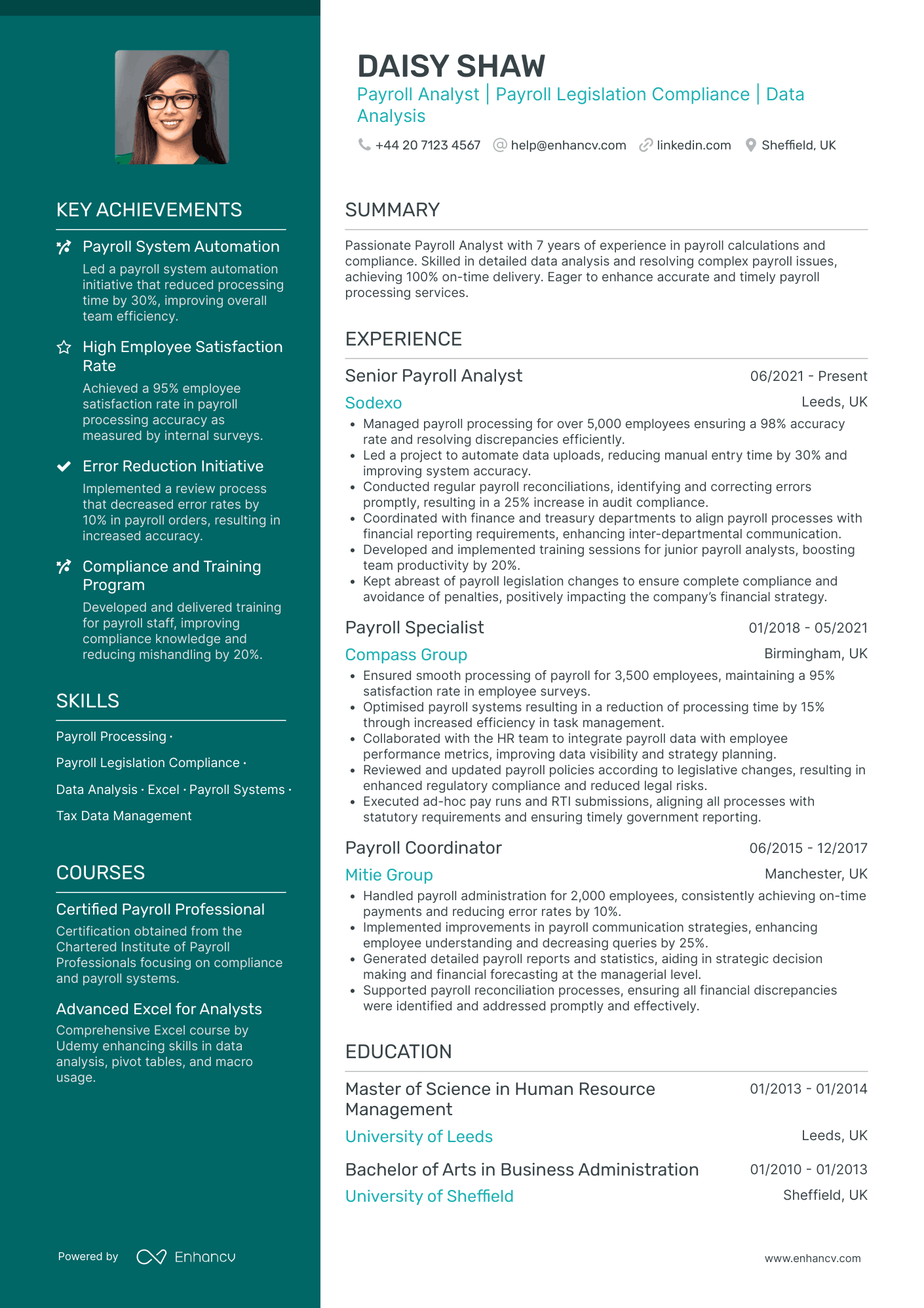
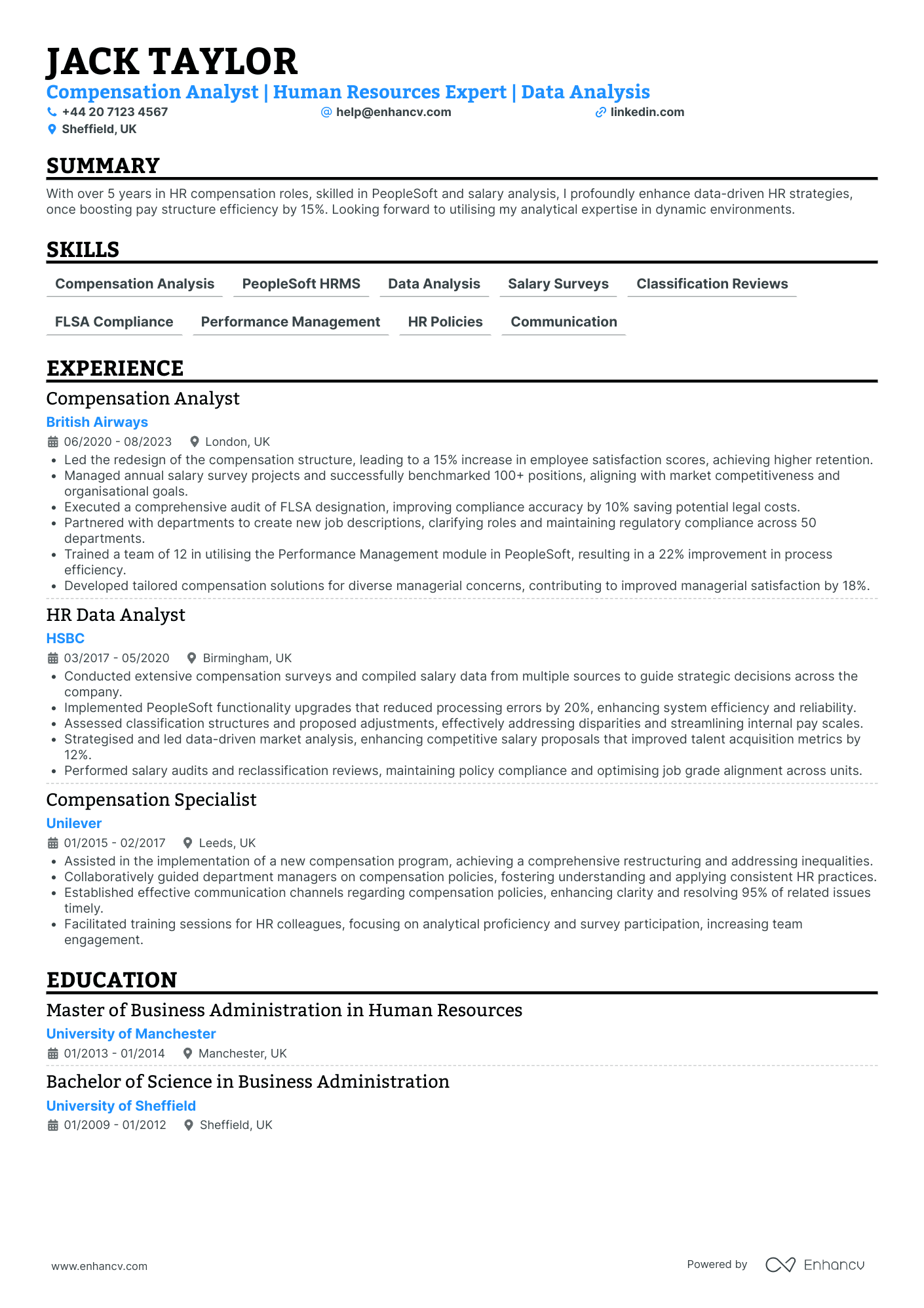
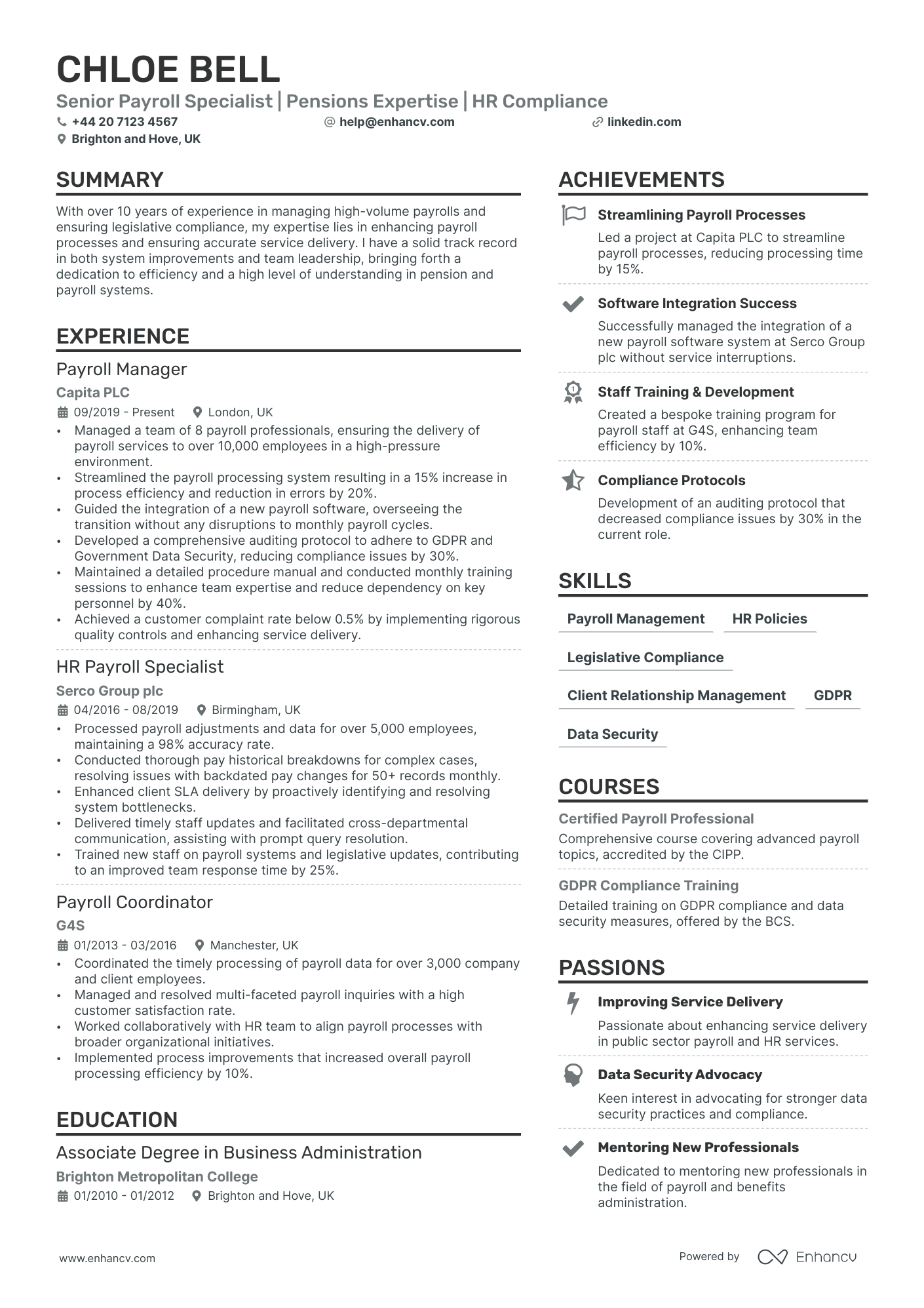
Most payroll CVs read like a duties list copied out of the job advert: processed payroll, ran reports, resolved queries. Three lines every other applicant also wrote.
The CVs that get shortlisted prove accuracy and volume with numbers, name the systems and legislation the employer runs on, and show the payroll stayed clean under a deadline. If you want the fundamentals first, see how to write a CV.

Key takeaways
- Lead with the systems and legislation the advert names: Sage, Workday, PAYE, RTI, and auto-enrolment. Payroll employers screen for the exact terms.
- Quantify everything. Headcount, entities, error rate, and deadlines hit say more than any adjective.
- Payroll is mostly hybrid or on-site, so put your location in the header.
- Most postings sit at mid-level or above, so prove hands-on, end-to-end processing rather than support tasks.
- Keep it to two pages, reverse chronological, and send a PDF unless the advert asks otherwise.
- List a CIPP qualification, even one in progress. It signals you know UK payroll rules, not just the software.
Top skills for your payroll CV
Read a run of live UK payroll adverts and the same demands repeat. Across 250 UK payroll postings in the last ~30 days on Enhancv's internal job feed, Excel, payroll processing, and stakeholder management were the skills that recurred most often. Payroll systems and Workday followed close behind.
Your hard skills are the mechanics and the legislation, listed in the words the adverts use: end-to-end payroll processing, PAYE, real-time information (RTI) submissions, auto-enrolment pensions, statutory pay, and the systems you have run. Name the software exactly. "Sage 50 Payroll" and "Workday" beat "payroll software".
Legislation is where a payroll CV separates itself from a data-entry one. Naming PAYE, RTI, auto-enrolment, statutory sick and maternity pay, attachment of earnings orders, and year-end tells an employer you understand the rules behind the numbers, not just the buttons in the software. Put the ones you have worked with in your skills section and again inside your bullets.
Excel is not a throwaway line here. Payroll teams live in spreadsheets for reconciliations and imports, so specify the functions you actually use, like pivot tables, VLOOKUP or XLOOKUP, and SUMIFS. Vague computer skills read as a gap.
Systems are a screening filter, so list the ones you know by name and version. Sage 50, Workday, iTrent, ADP, and BrightPay are the systems UK employers ask for most, and a recruiter often searches for the exact one their business runs. If you have migrated between two systems or led an implementation, that is a strong line on its own.
The soft skills that matter in payroll are checkable, not decorative. Stakeholder management when a manager queries a figure, discretion with sensitive pay data, and the analytical eye to catch a wrong number before it is paid. Prove each in a bullet rather than listing it.
Volume and accuracy are the two figures that turn a skill into proof. Anyone can list "payroll processing", but "payroll for 950 staff across four entities at 99.8% accuracy" shows the scale and the standard in one line. Keep those numbers close to the skill they support.
List only what you can stand behind in an interview. If you have run year-end and P11Ds, say so. If you have only assisted, say assisted. Payroll interviews test the detail fast, and an overstated skill unravels in the first ten minutes.
Top skills for your payroll CV:
End-to-end payroll processing
Excel (pivot tables, VLOOKUP, SUMIFS)
Payroll systems (Sage, Workday, iTrent)
PAYE, RTI, and HMRC submissions
Auto-enrolment pensions
Statutory pay (SSP, SMP, SPP)
Reconciliations and control accounts
Year-end processing (P60, P11D)
Attention to detail
Stakeholder management
Analytical skills
Problem-solving
Communication
Discretion

What a payroll employer checks first
Before the prose, a payroll manager scans for three things: the systems you have run, the headcount and number of entities you have processed, and whether you name the UK legislation. Put all three in your top third, in the header and the personal statement, so the CV answers those questions before the reader reaches your bullets.
What the UK payroll market looks like
Knowing the market shapes the CV. Here is where the work happens and what employers ask for most.
| What | UK payroll roles |
|---|---|
| Where the work happens | Hybrid 58%, on-site 40%, remote 2% (145, 99, and 6 of 250 UK payroll postings in the last ~30 days, Enhancv's internal job feed) |
| Experience level asked for | Mid 51% · lead 26% · senior 13% · entry 10% |
| Most-listed skills | Excel, payroll processing, stakeholder management, payroll systems, Workday |
Two of those numbers should shape your CV.
Payroll is a hybrid or on-site job. Only 2% of these postings were fully remote, so put your location in the header and lead with the controls and systems you can run inside a team.
And more than three-quarters of postings sit at mid-level or above, with just 10% pitched at entry level. That is why a first payroll CV has to work harder to prove hands-on, end-to-end processing rather than support tasks.
The skills column tells you what to foreground. Excel and named payroll systems appear again and again, so they belong in your top third, not buried in a list on page two.
Formatting your payroll CV
Use a reverse chronological layout. Payroll is a field where recent, hands-on processing matters most, and employers want to see it first.
Keep it to two pages, one column, standard headings, and a readable font. A payroll manager skim-reads for systems and headcount before anything else.
Your header does more work here than on most CVs. Alongside your name and contact details, add your location and the systems you know best, so a recruiter searching for Sage or Workday finds them in the first few seconds.
Send a PDF so the layout and your numbers hold their place. Keep a Word copy for agencies, which place a large share of payroll roles and reformat CVs into their own template. If the advert names a file type, follow it.
Payroll applications often pass through tracking software, so keep the layout clean and the headings standard for an ATS-friendly CV. Build it from a tested layout rather than a blank page: Enhancv's CV templates export to a clean PDF.
Is your resume good enough?
Drop your CV here or choose a file. PDF & DOCX only. Max 2MB file size.
Writing your payroll personal statement
Three or four sentences at the top: who you are, the scale you have run, the systems and legislation you know, and what you want next. Keep it concrete. See more personal statement examples if the opening line is hard.
Skip the adjective soup. "Detail-oriented, hard-working payroll professional with excellent communication skills" tells a recruiter nothing they can check, and it opens roughly half the payroll CVs in any pile.
Lead with numbers and specifics instead. Headcount, the number of entities, the systems, and one accuracy or deadline figure do more work in one line than a paragraph of qualities:
Payroll CV personal statement example
Payroll specialist with six years running end-to-end monthly payroll for 1,200 employees across three UK entities. Cut payroll errors to under 0.2% and hit every RTI deadline for 48 consecutive months. Fluent in Sage 50 and Workday, and fully conversant with PAYE, auto-enrolment, statutory pay, and year-end. Looking to bring tight controls and clean reconciliations to a payroll manager role in a multi-site business.
Compare that with the version a recruiter skims past. It could describe anyone in any job:
Payroll CV personal statement to avoid
A hard-working and detail-oriented payroll professional with excellent communication skills and a passion for accuracy. A committed team player who thrives under pressure and is keen to develop within a forward-thinking company.
On a payroll CV, one number settles it. Tell me you run monthly payroll for 1,200 people across three entities at 99.8% accuracy and I know the scale, the complexity, and that you count what you do. "Responsible for payroll" tells me none of that. Name the headcount, the systems, and the deadlines you hit, then let the rest of the CV back it up.
Writing your payroll experience section
Write each role as a dated heading, then bullets that lead with a verb and end with a result. For the mechanics, see work experience on a CV.
Payroll is one of the easiest jobs to quantify, so use that. Headcount, entities, pay runs, error rates, query volumes, and deadlines are all CV achievements. Open each bullet with a strong action verb like processed, reconciled, or resolved.
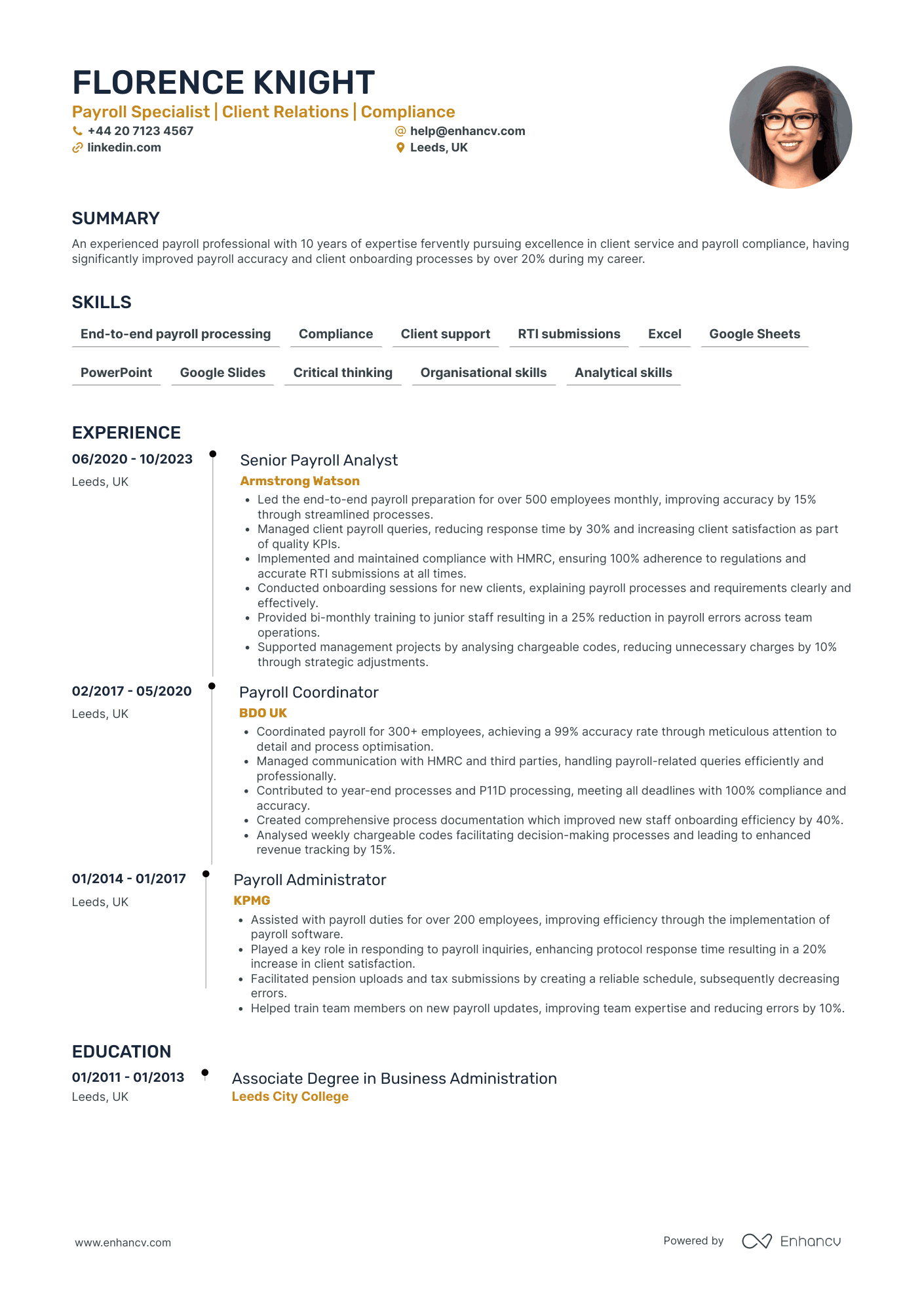
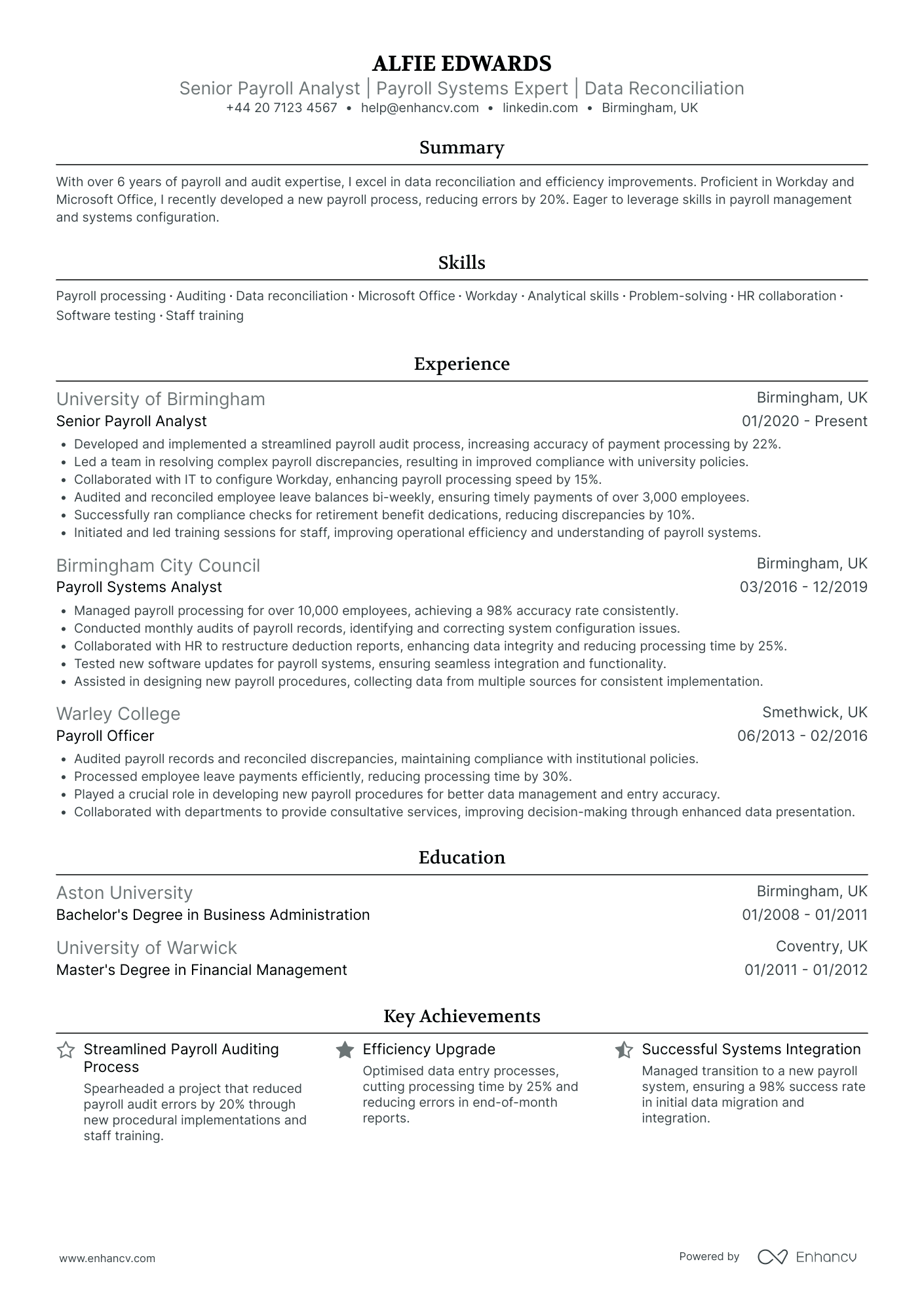
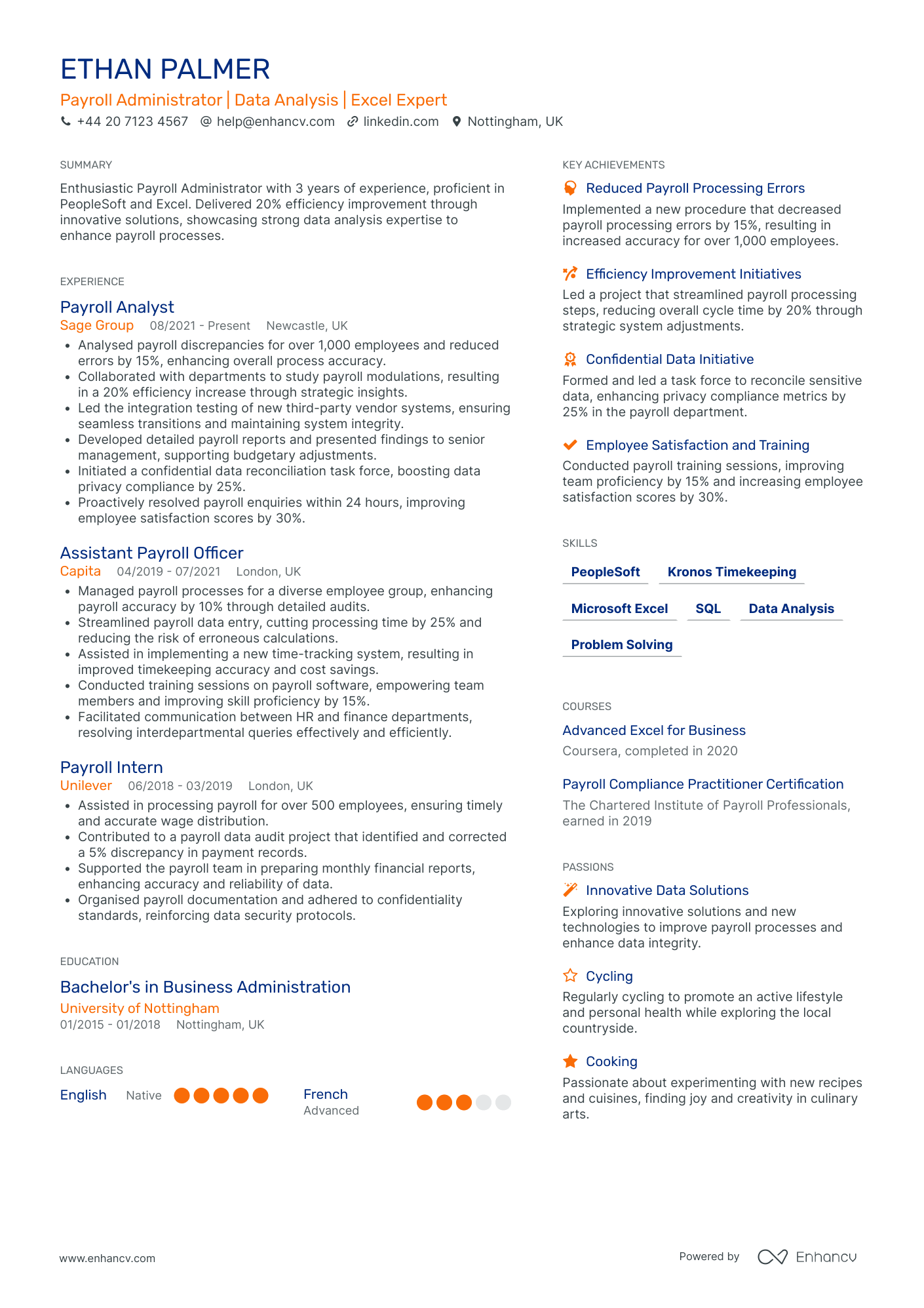
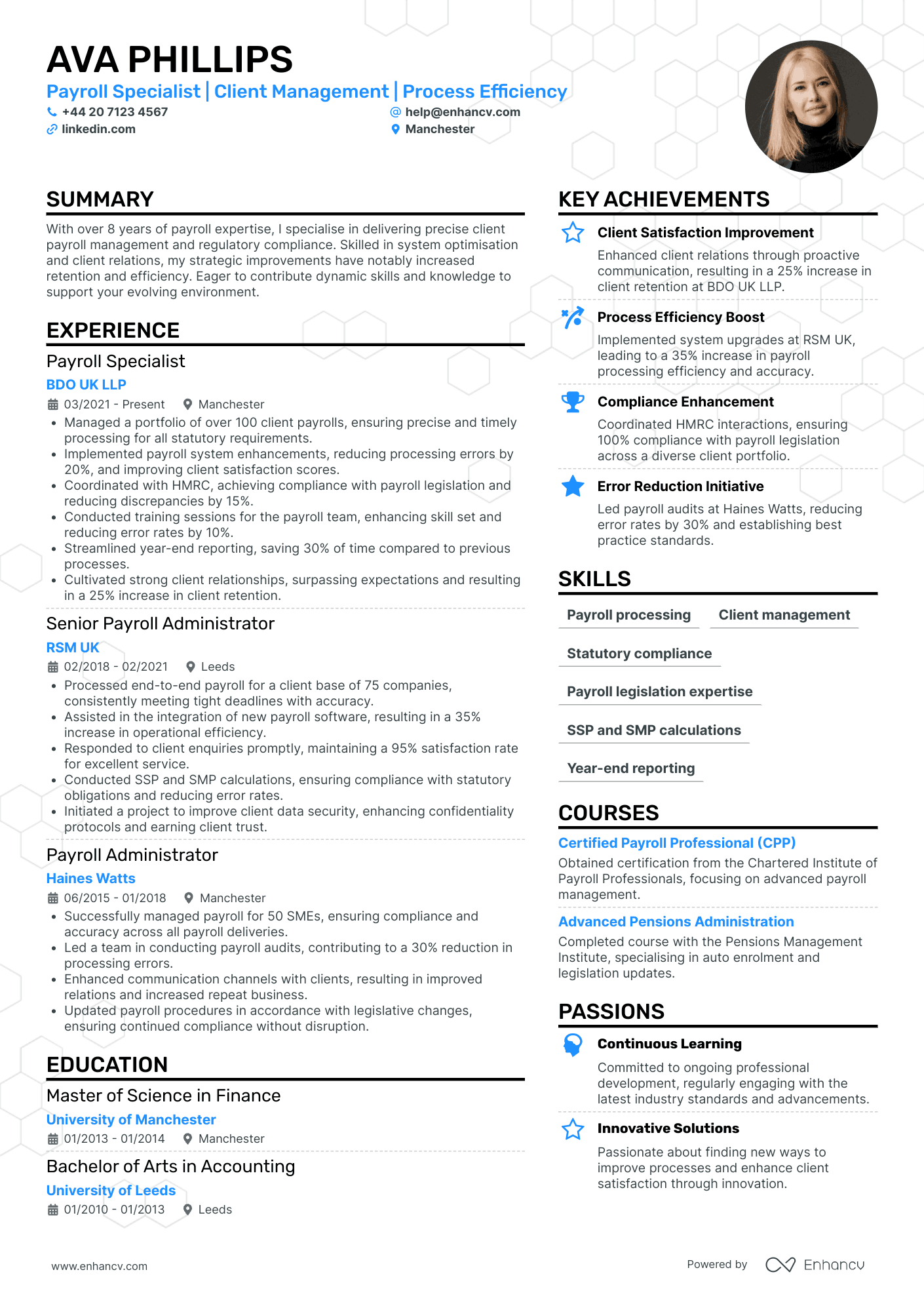
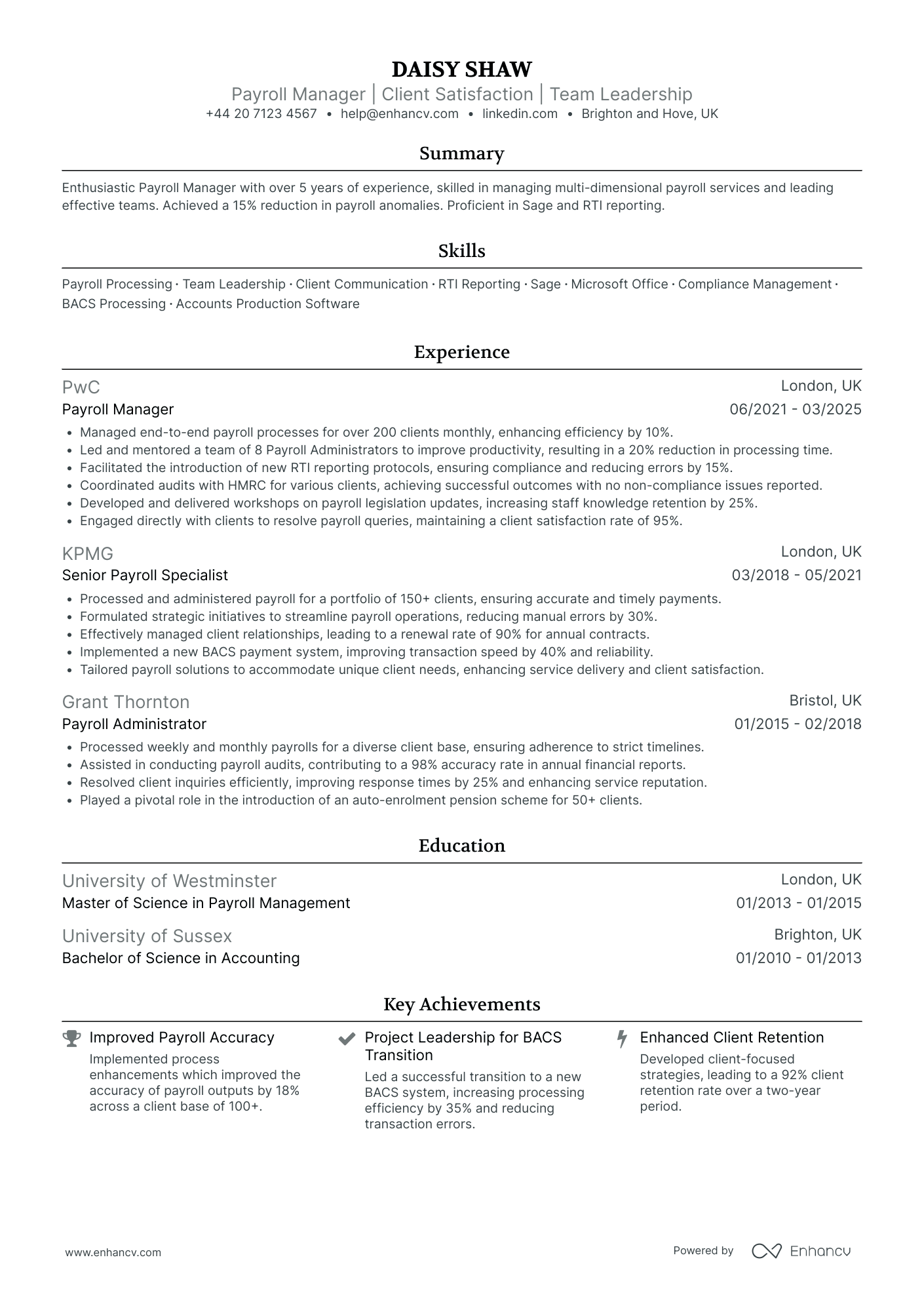
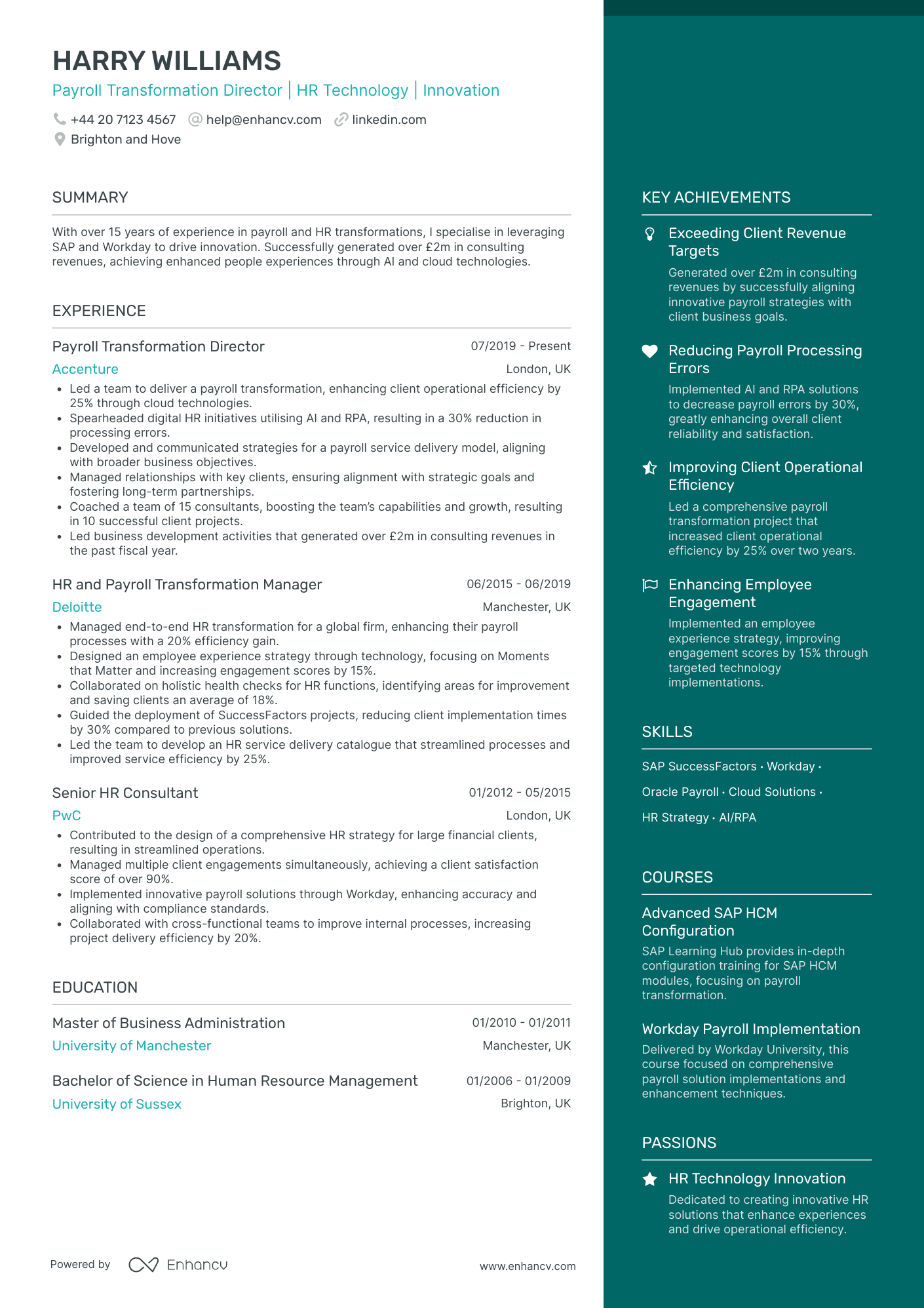
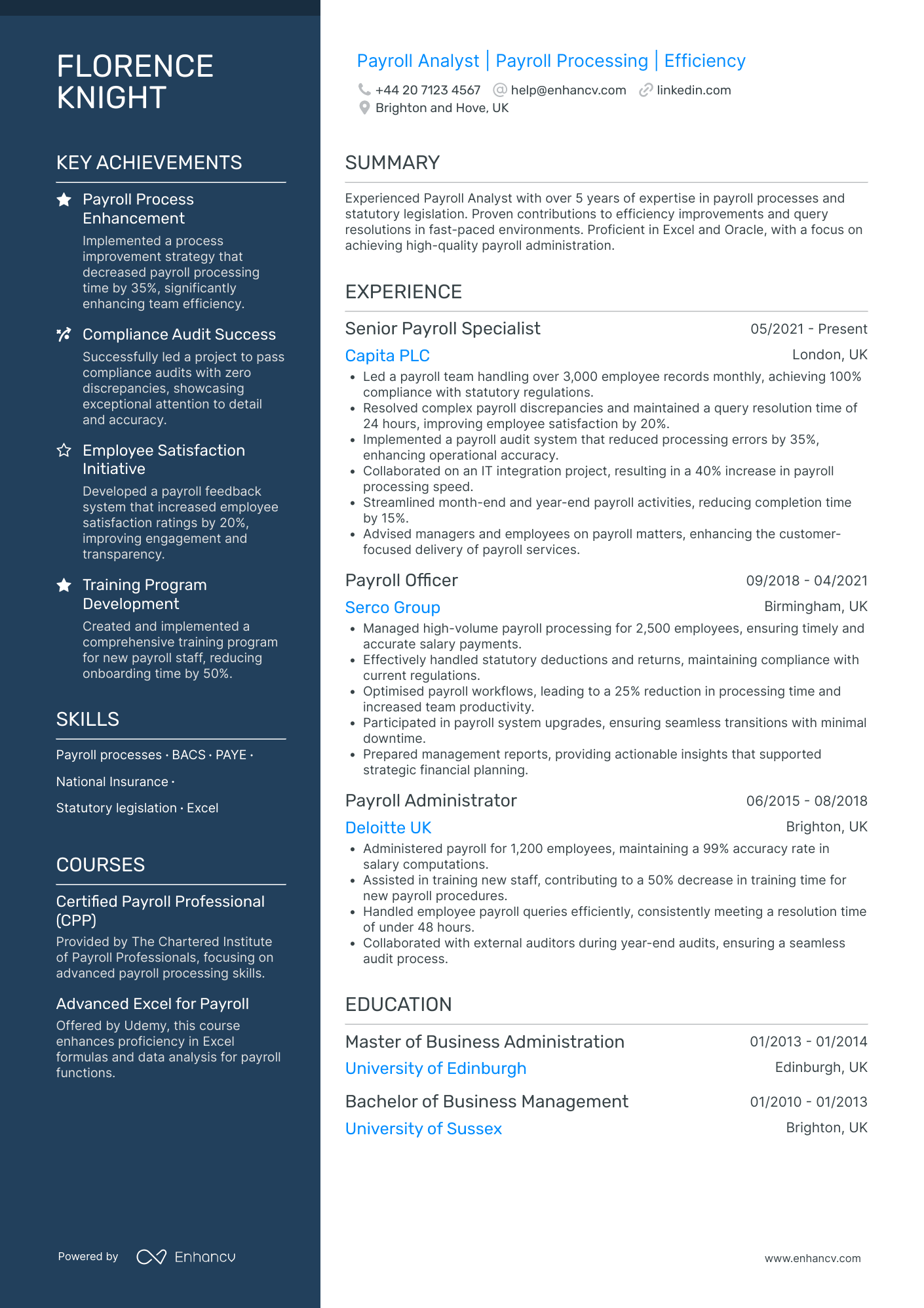
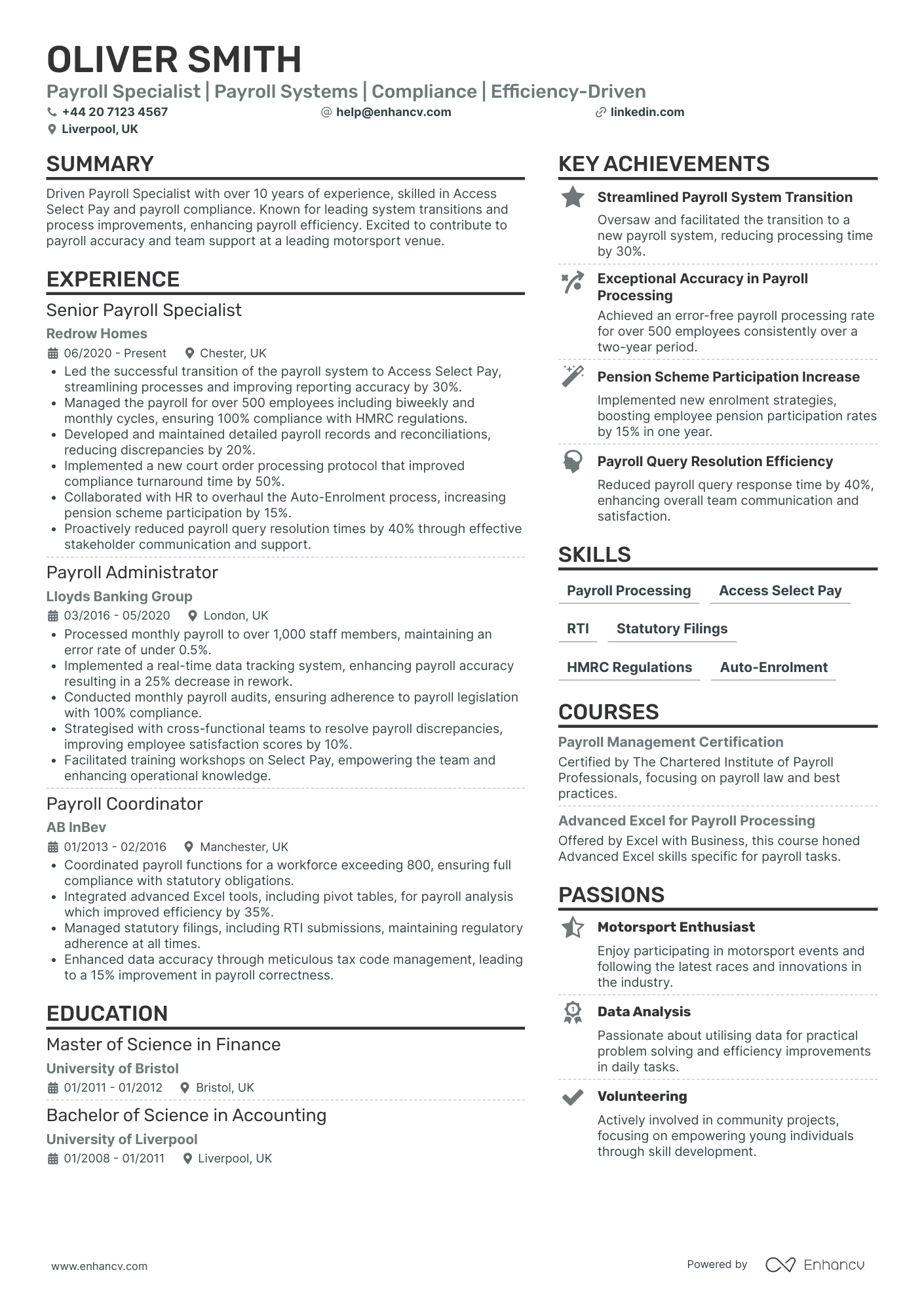
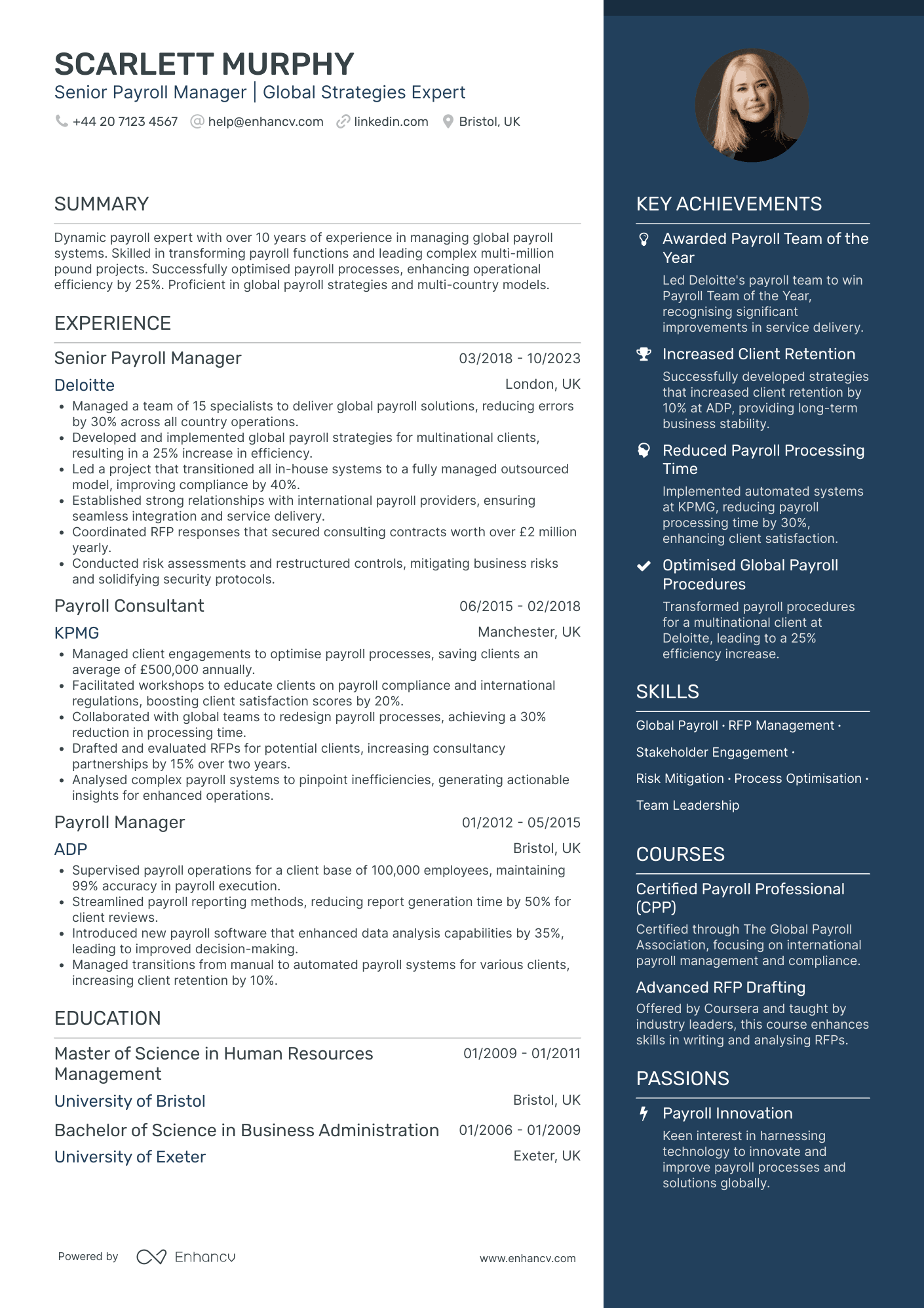
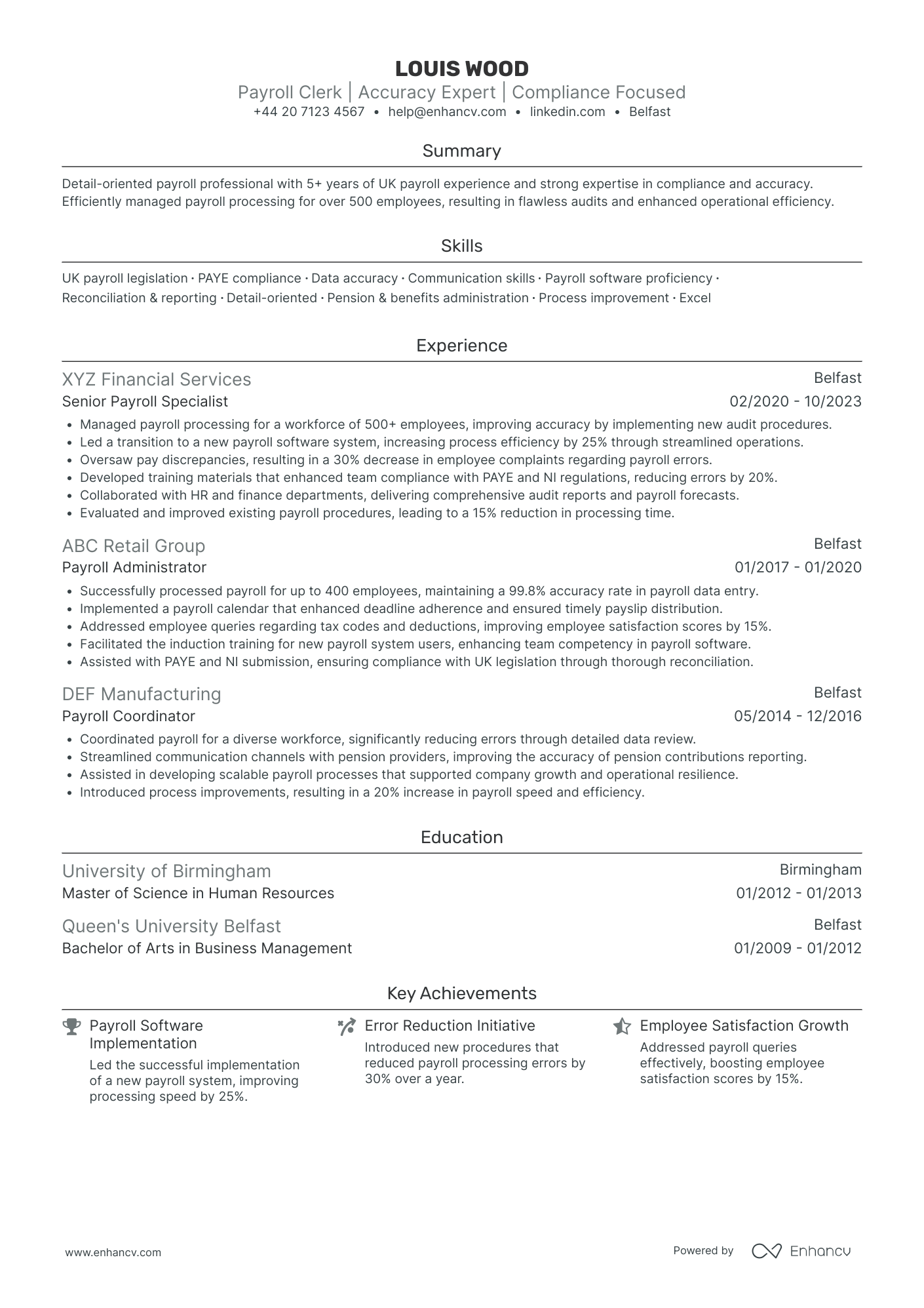
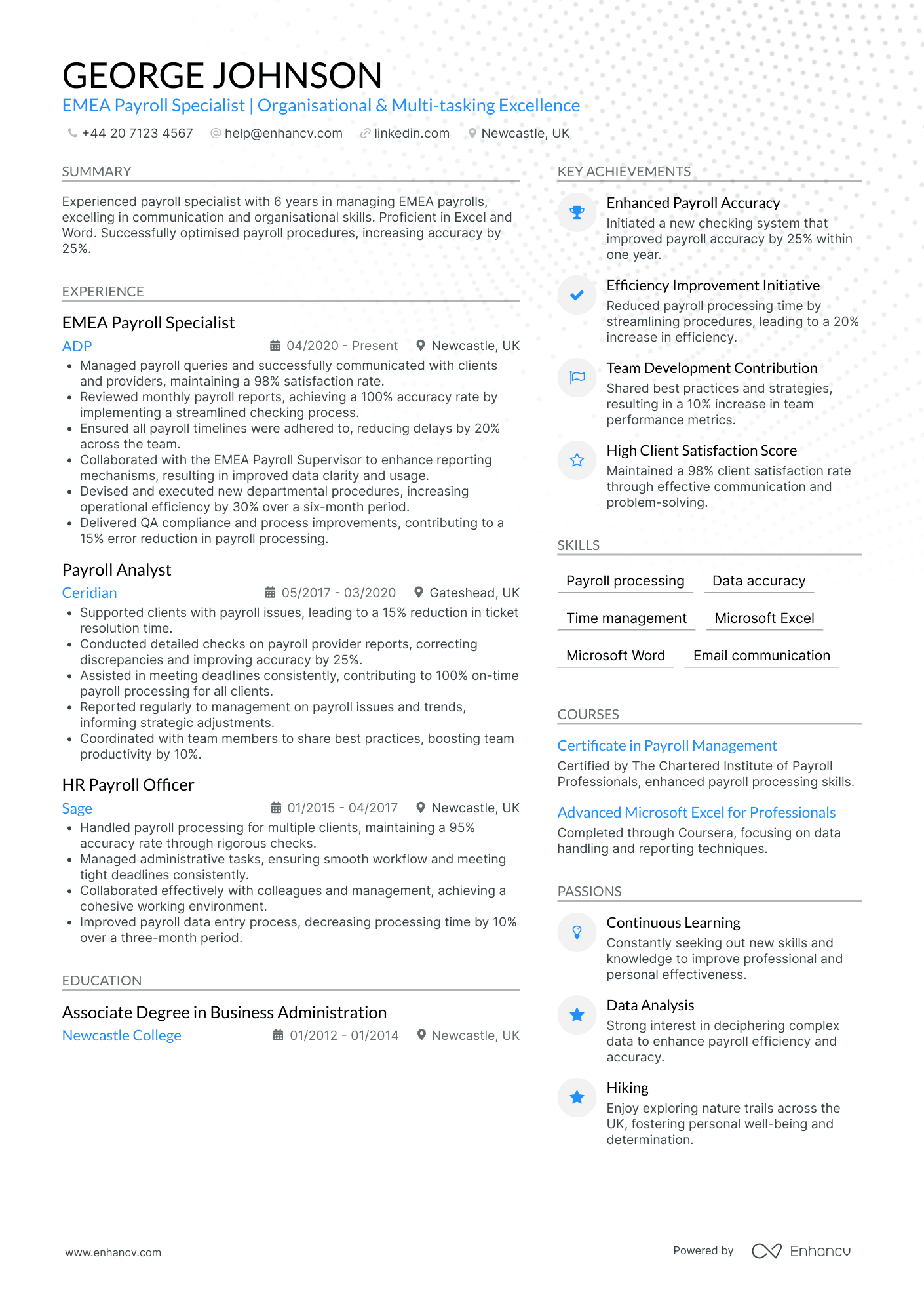
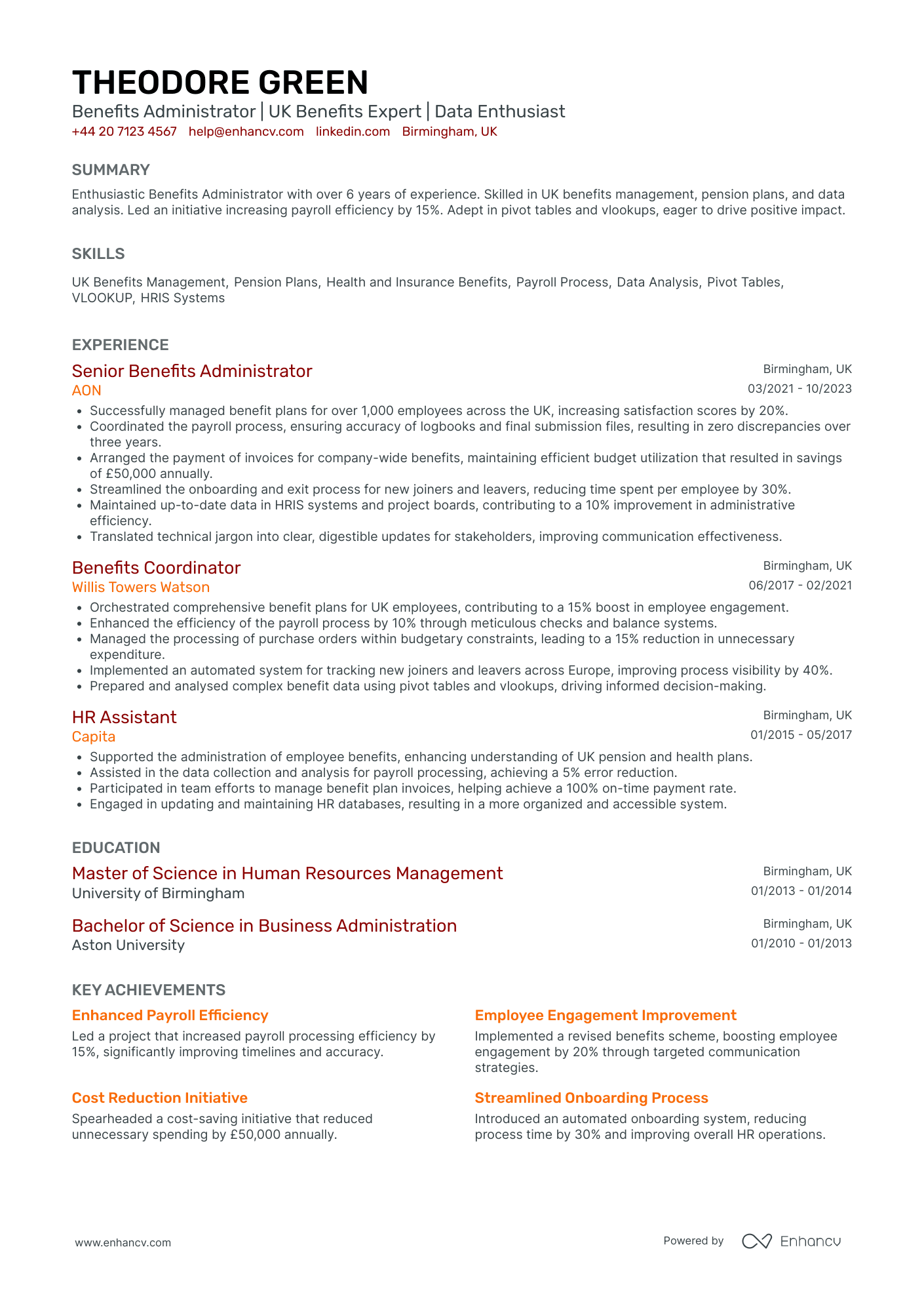
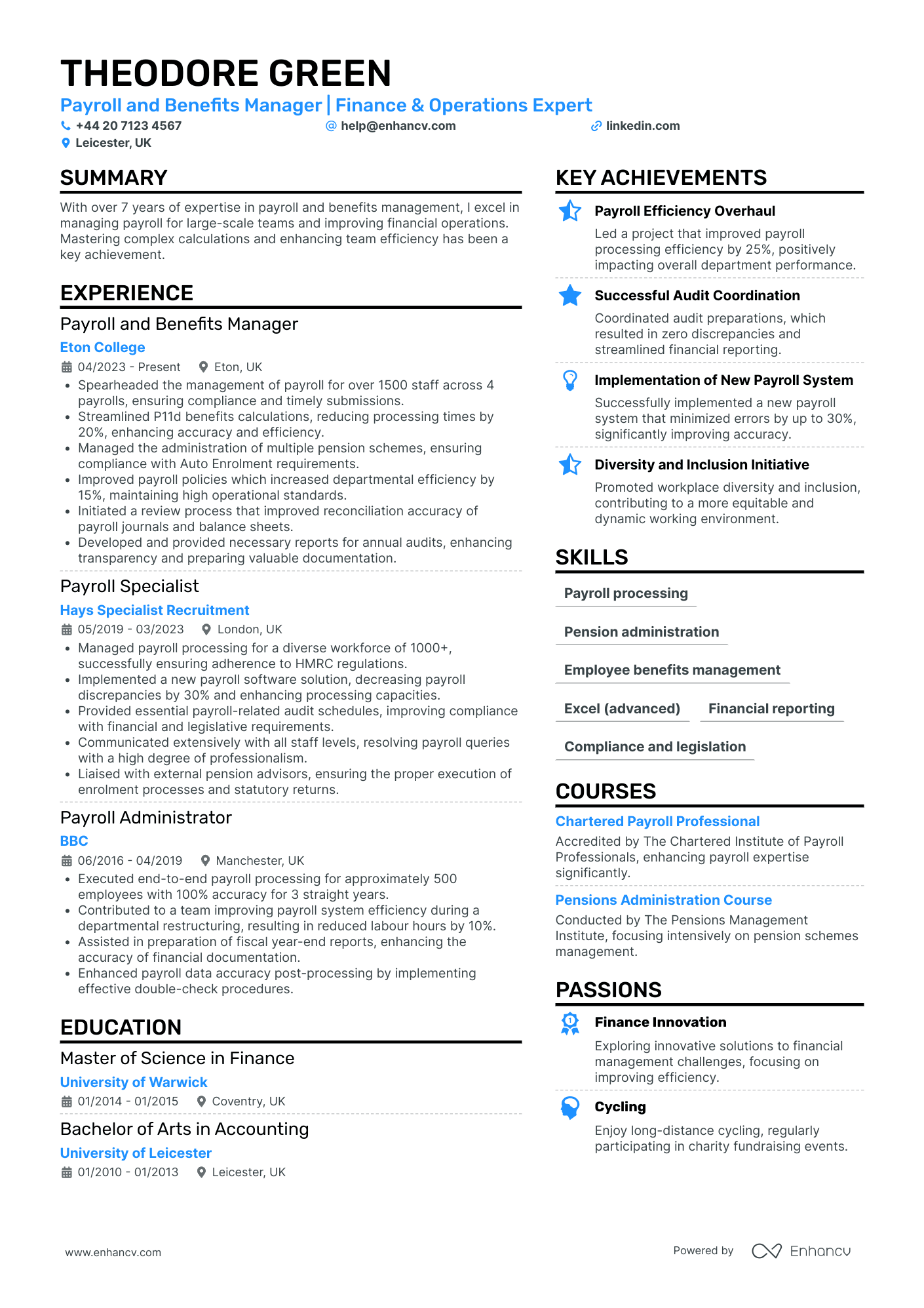
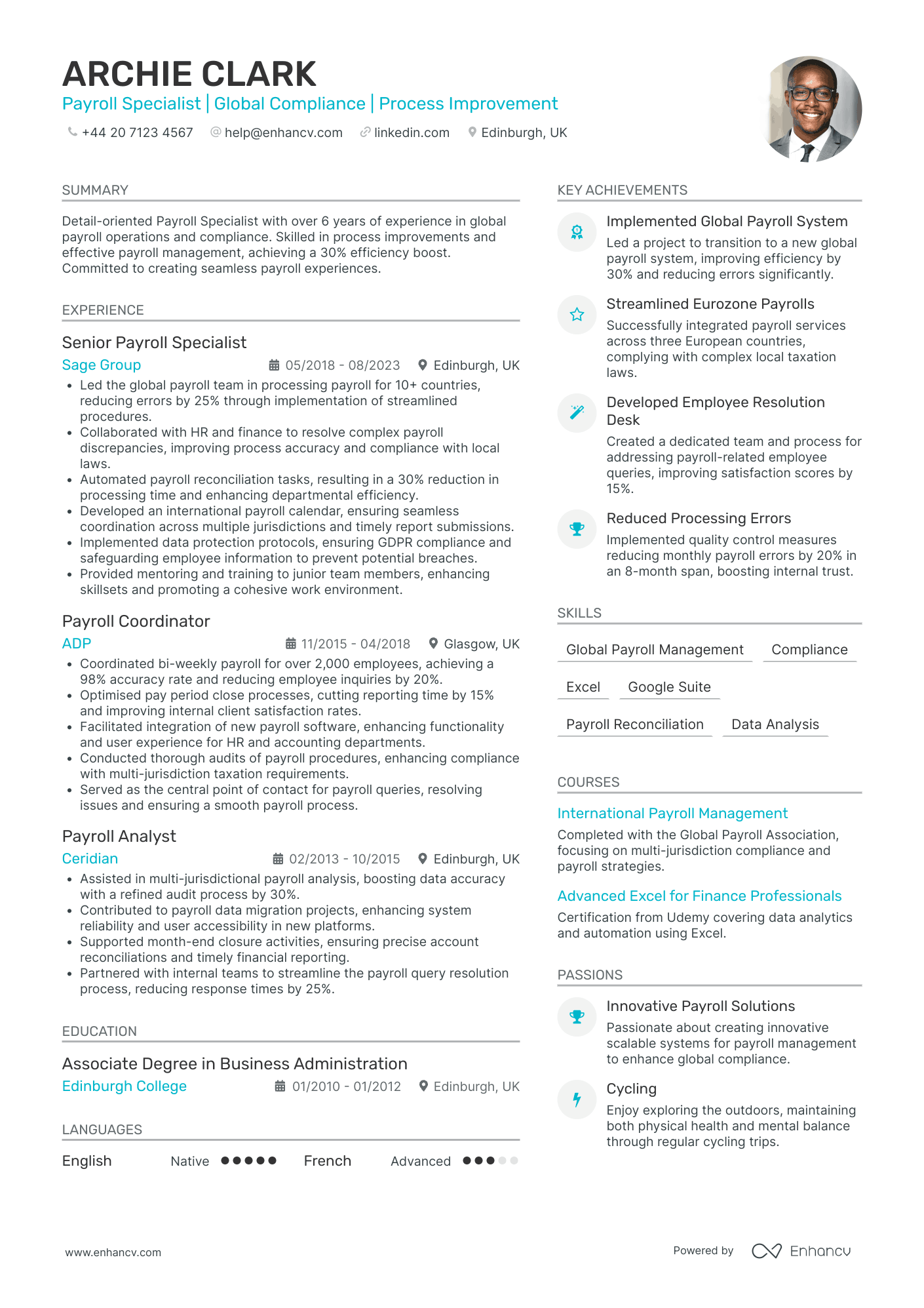
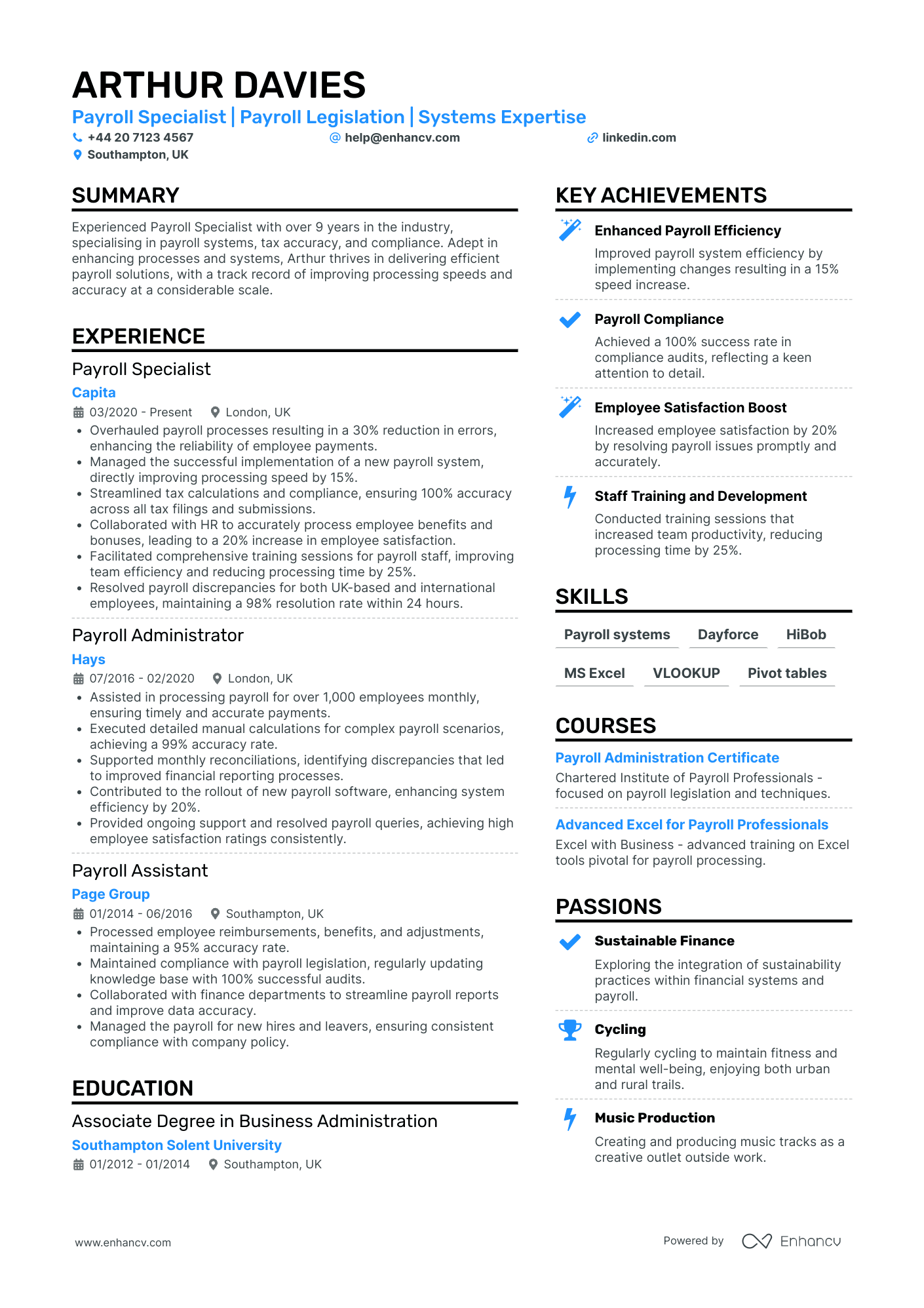
Give your current role four or five bullets and older roles two or three. Weight the space towards the payroll you run today, and let earlier entries show progression from administrator to officer to manager. The two examples below show the same career at two stages.
- Run end-to-end monthly payroll for 950 employees across four legal entities, holding a 99.8% accuracy rate over three years
- Submit RTI to HMRC and process auto-enrolment, SSP, SMP, and attachment of earnings orders inside statutory deadlines every period
- Reconcile payroll control accounts each cycle and cut month-end close from five days to three by standardising the import process
- Cleared a backlog of 300 historic pay queries and introduced a tracker that reduced repeat queries by 40%
- Led the migration from Sage 50 to Workday for 950 records with zero missed pay dates
- Processed weekly and monthly payroll for 400 hourly and salaried staff, including overtime, shift premiums, and holiday pay
- Actioned starters, leavers, and P45s, and answered around 60 employee pay queries a week within a one-day turnaround
- Reconciled timesheets against the rota system and flagged discrepancies before each pay run, cutting overpayments by a third
Describing payroll duties on your CV
"Processed payroll" is a task, not an achievement. To describe payroll duties well, pair each duty with its scale and its outcome.
Mirror the advert's language. If the job description covers RTI, auto-enrolment, and attachment of earnings, use those exact terms where they are true of you. Employers and the tracking software both search for them, so natural keywords matter.
Turn each duty into evidence by adding the scale and the result behind it:
- "Ran monthly payroll" becomes "Ran monthly payroll for 950 staff across four entities at 99.8% accuracy".
- "Handled queries" becomes "Resolved around 60 pay queries a week within one working day".
- "Did year-end" becomes "Delivered year-end for 950 employees, filing P60s and P11Ds ahead of the HMRC deadline".
- "Used Sage" becomes "Administered Sage 50 Payroll and led the migration to Workday with no missed pay dates".
Keep the tense consistent, present for your current role and past for everything else, and lead every line with the action rather than "responsible for". A recruiter reading twenty payroll CVs notices the ones written as results, not job descriptions.
Same duties, far more signal. Enhancv's CV tailoring feature reads the advert and suggests the terms to mirror, which saves rewriting from scratch for each application.

PRO TIP
Payroll adverts name specific systems and rules, not generic skills. Mirror the ones you can back: "Sage 50", "Workday", "PAYE", "RTI", "auto-enrolment", "attachment of earnings", "P11D". Write each one exactly as the advert does.
Education and certifications for a payroll CV
Payroll is a competence-led field, so a professional qualification often carries more weight than a degree. The Chartered Institute of Payroll Professionals (CIPP) is the UK benchmark.
List these where you have them, even "in progress": the CIPP Payroll Technician Certificate, the Foundation Degree in Payroll Management, or AAT bookkeeping and accounting qualifications. Put them in your education section or a dedicated certifications block.
Match the qualification to your stage. The Payroll Technician Certificate suits someone moving into payroll or in their first year, while the Foundation Degree and the CIPP diploma signal you are ready for officer and manager roles. If you are aiming at a management post, a completed CIPP qualification is often the line that gets you past the first sift.
Payroll rules change most years, so a short line on recent training shows you keep current. A course on the latest tax-year changes, a new pension update, or a system you have just been certified on all tell an employer you will not need retraining on the basics.
If you hold a degree, a single line is enough. A relevant qualification in progress still counts, so name it and give the expected date rather than leaving it off.
Writing a payroll CV with no experience
Most payroll postings ask for experience, and only around one in ten sits at entry level, so a first payroll CV has to borrow proof from adjacent work.
Mine your history for real payroll-adjacent evidence. It is usually there in a role you did not think of as payroll:
- Bookkeeping, accounts payable, or accounts receivable work.
- Handling sensitive or confidential data to a deadline.
- High-volume, accuracy-critical data entry or reconciliations.
- Any role where a wrong number had a real consequence, such as retail cash handling or invoicing.
Write those in payroll language and lead with a skills-based structure so your skills and training come before a thin work history.
One line lifts a no-experience CV: "CIPP Payroll Technician Certificate in progress". It signals you know UK payroll rules, not just spreadsheets. Pair it with strong Excel and a first placement or temp assignment, and see CV examples for a first job for the structure.
Temporary and agency work is a realistic way in. A three-month payroll assignment gives you a dated, real entry to write up, and many payroll teams recruit from the temps who already know their systems. Treat the first assignment as the experience that makes the next CV easy to write.
Conclusion
Lead with the systems and legislation employers screen for, quantify the scale and accuracy of the payroll you have run, and keep the format clean and ATS-ready.
Pair the CV with a short cover letter that says why this employer, and you turn a duties list into a shortlist-worthy application.
Author's take - the Enhancv team
On a payroll CV, one number settles it. Tell me you run monthly payroll for 1,200 people across three entities at 99.8% accuracy and I know the scale, the complexity, and that you count what you do. "Responsible for payroll" tells me none of that. Name the headcount, the systems, and the deadlines you hit, then let the rest of the CV back it up.