



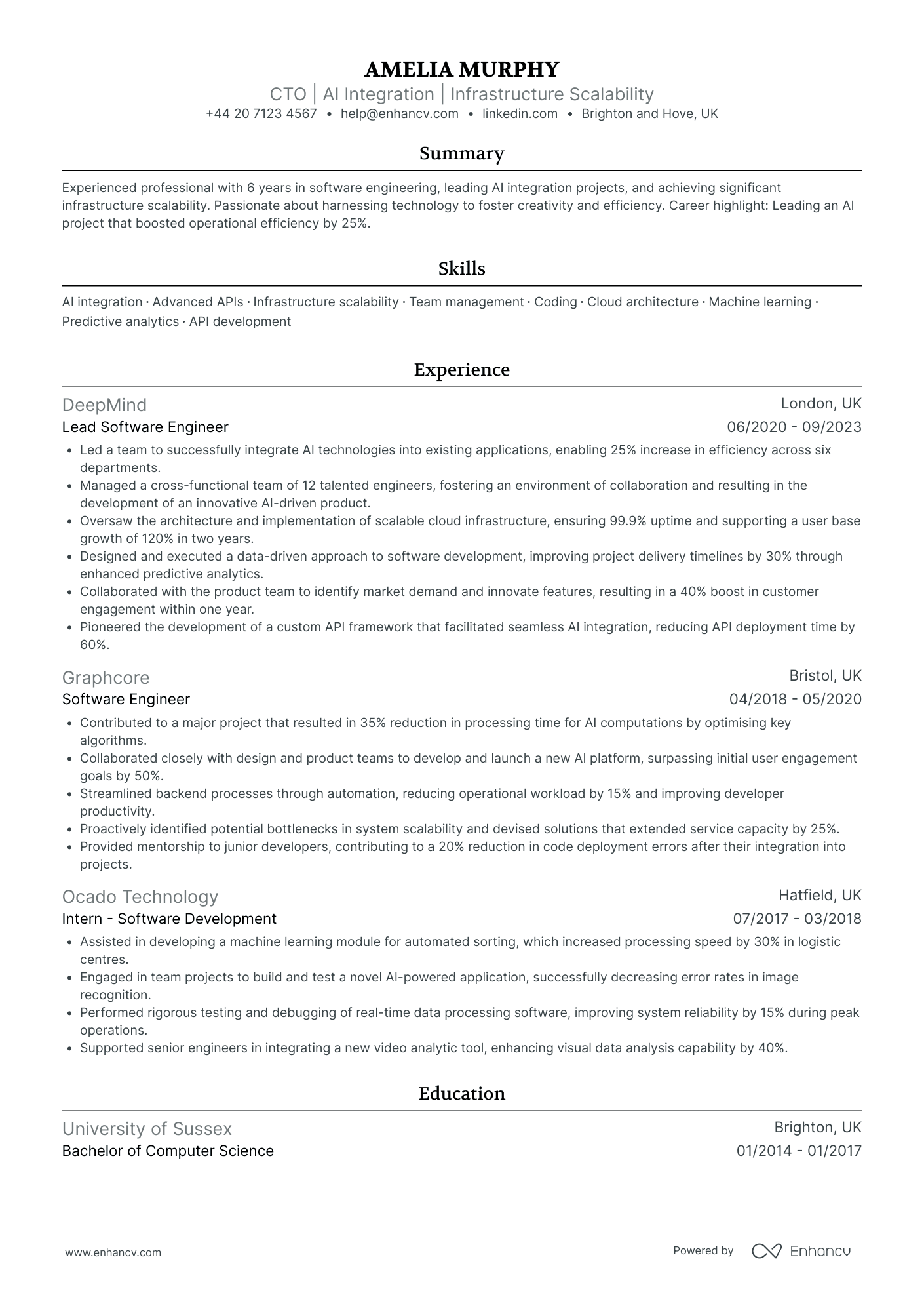
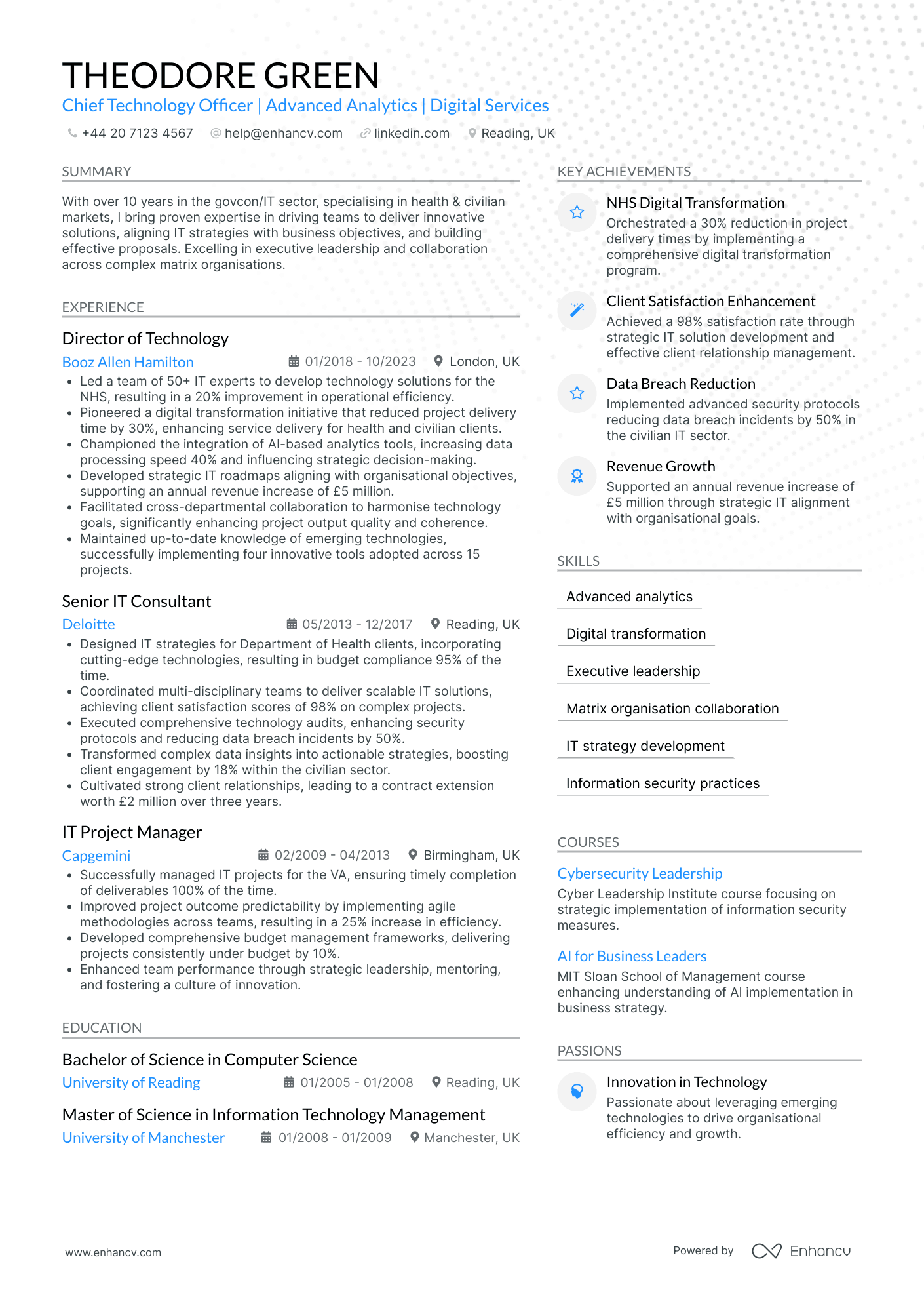
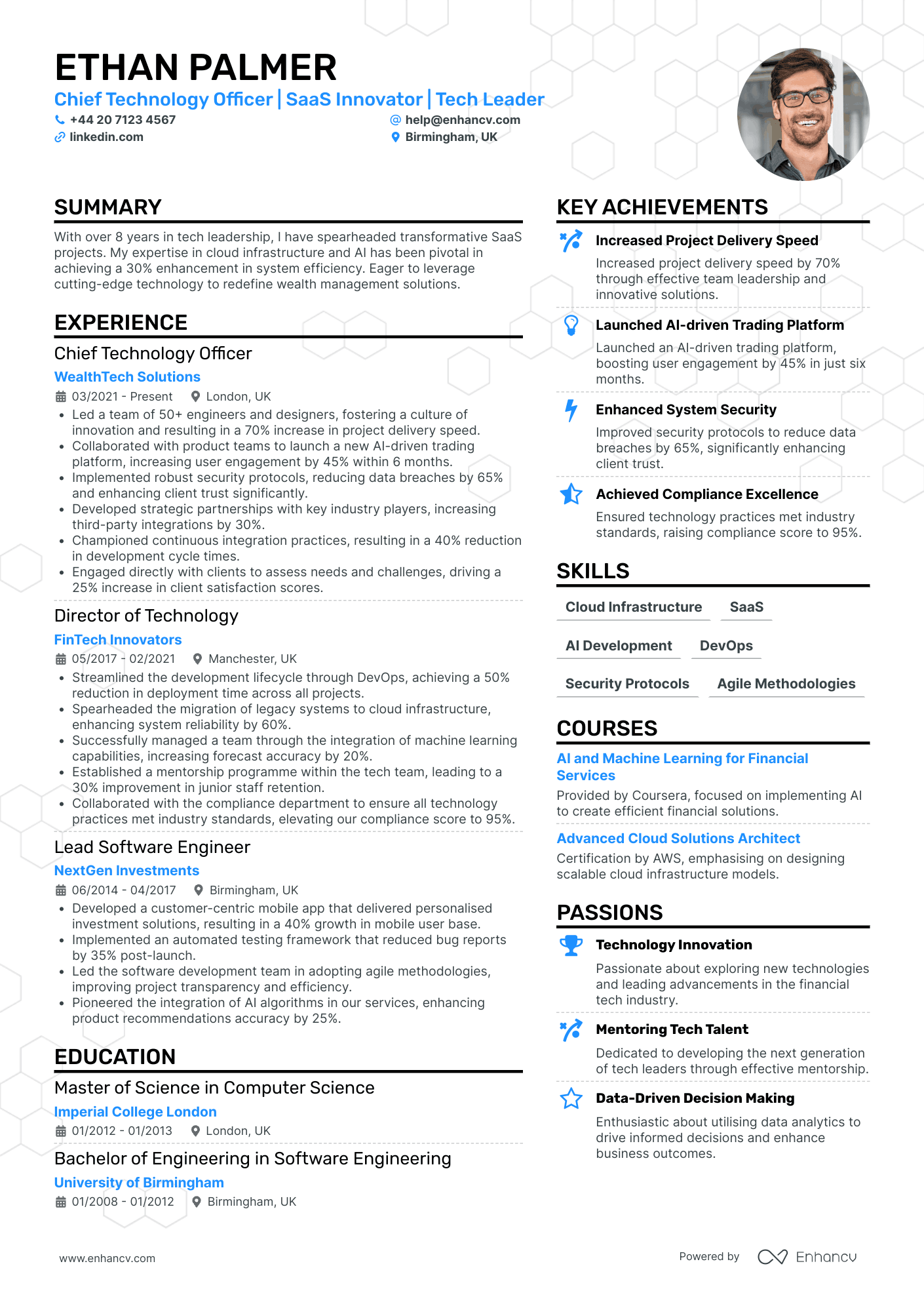
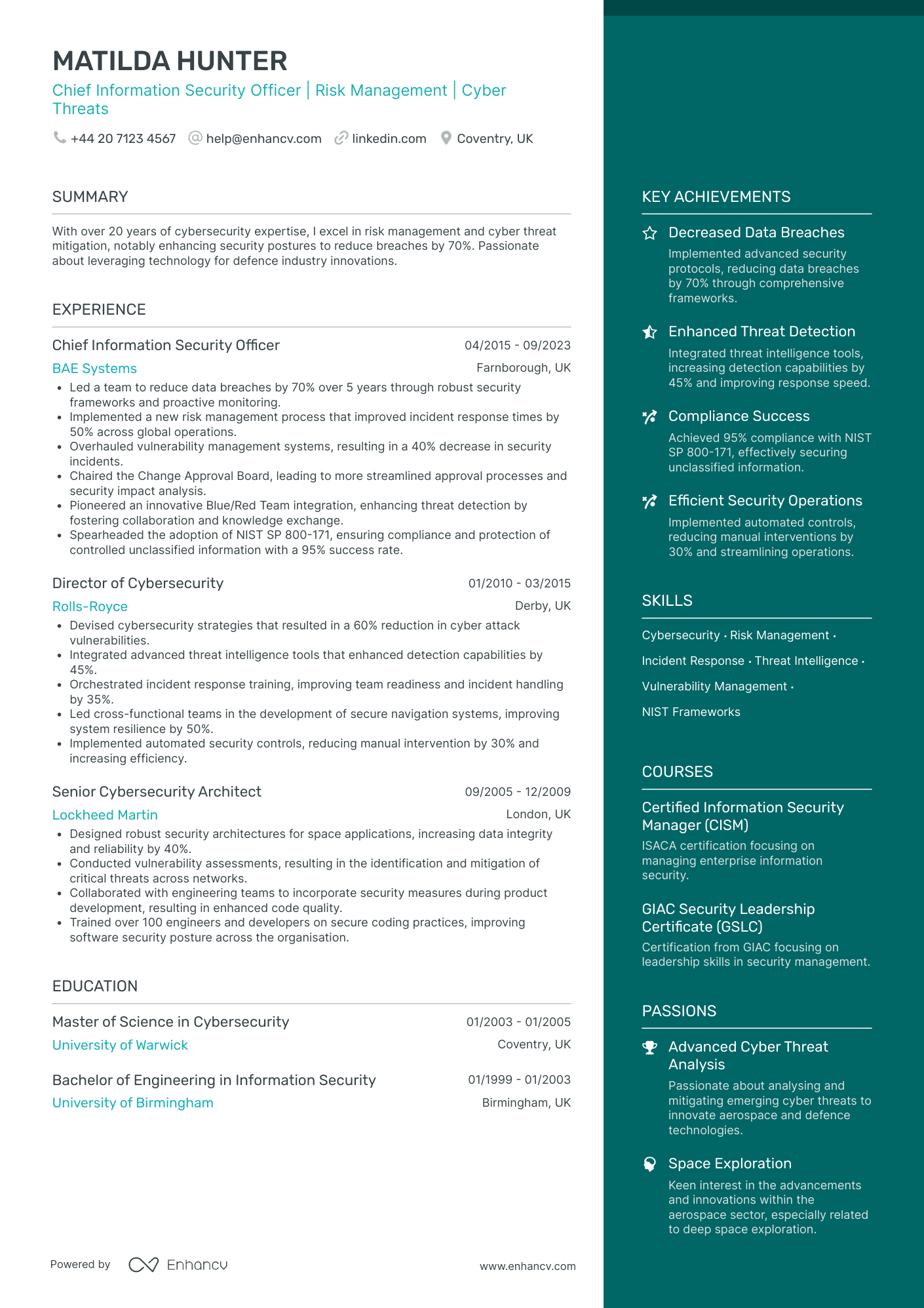
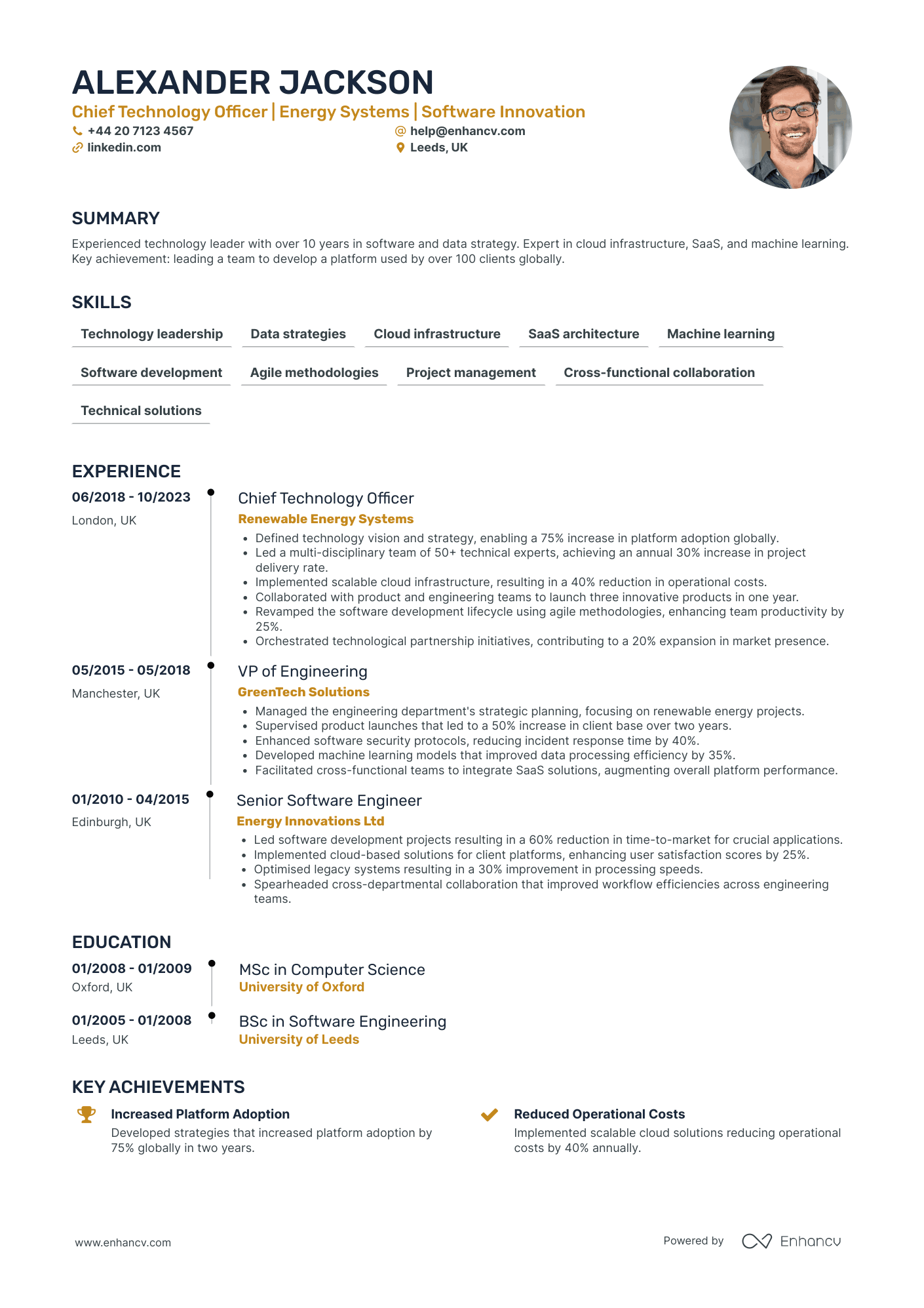
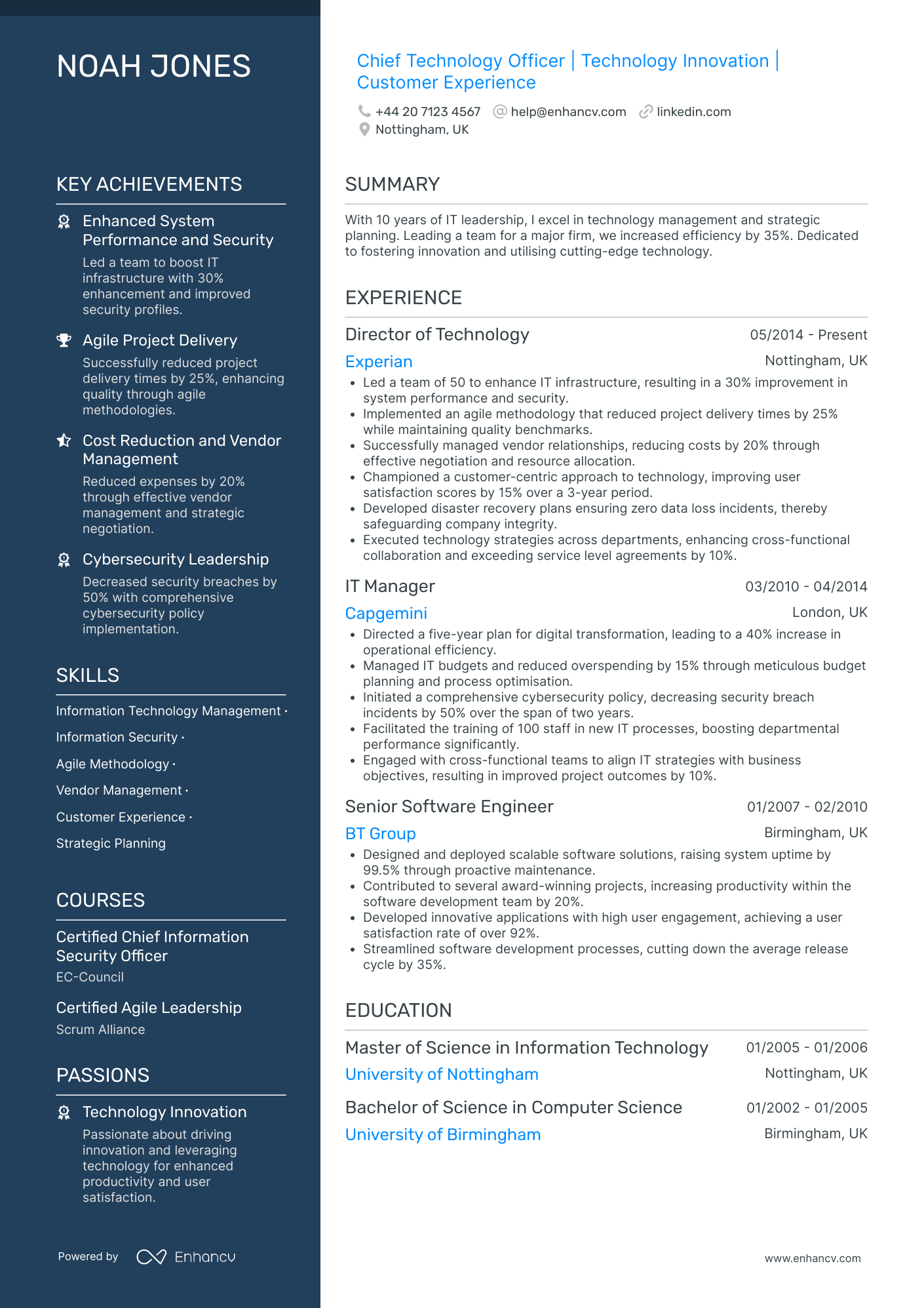
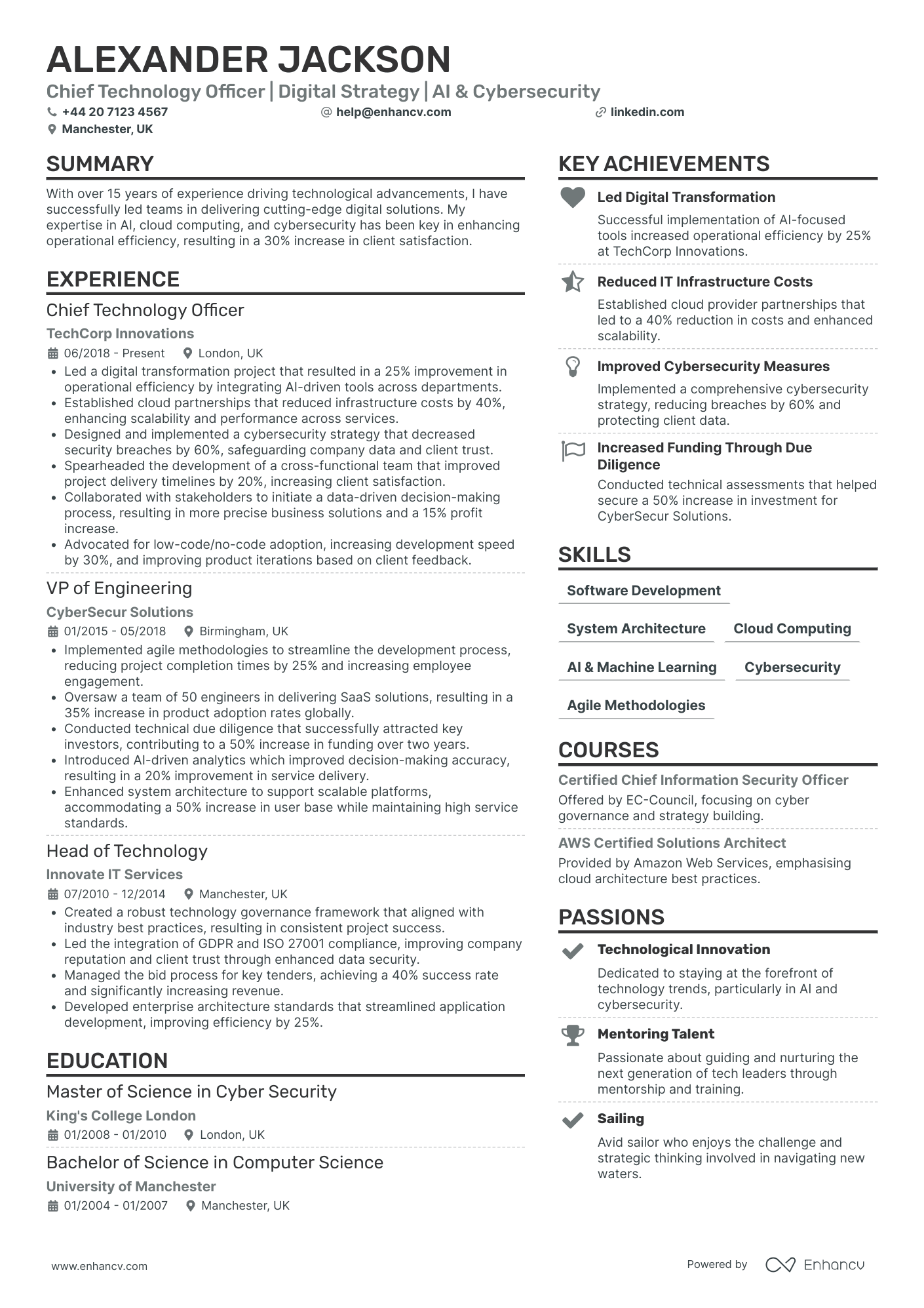
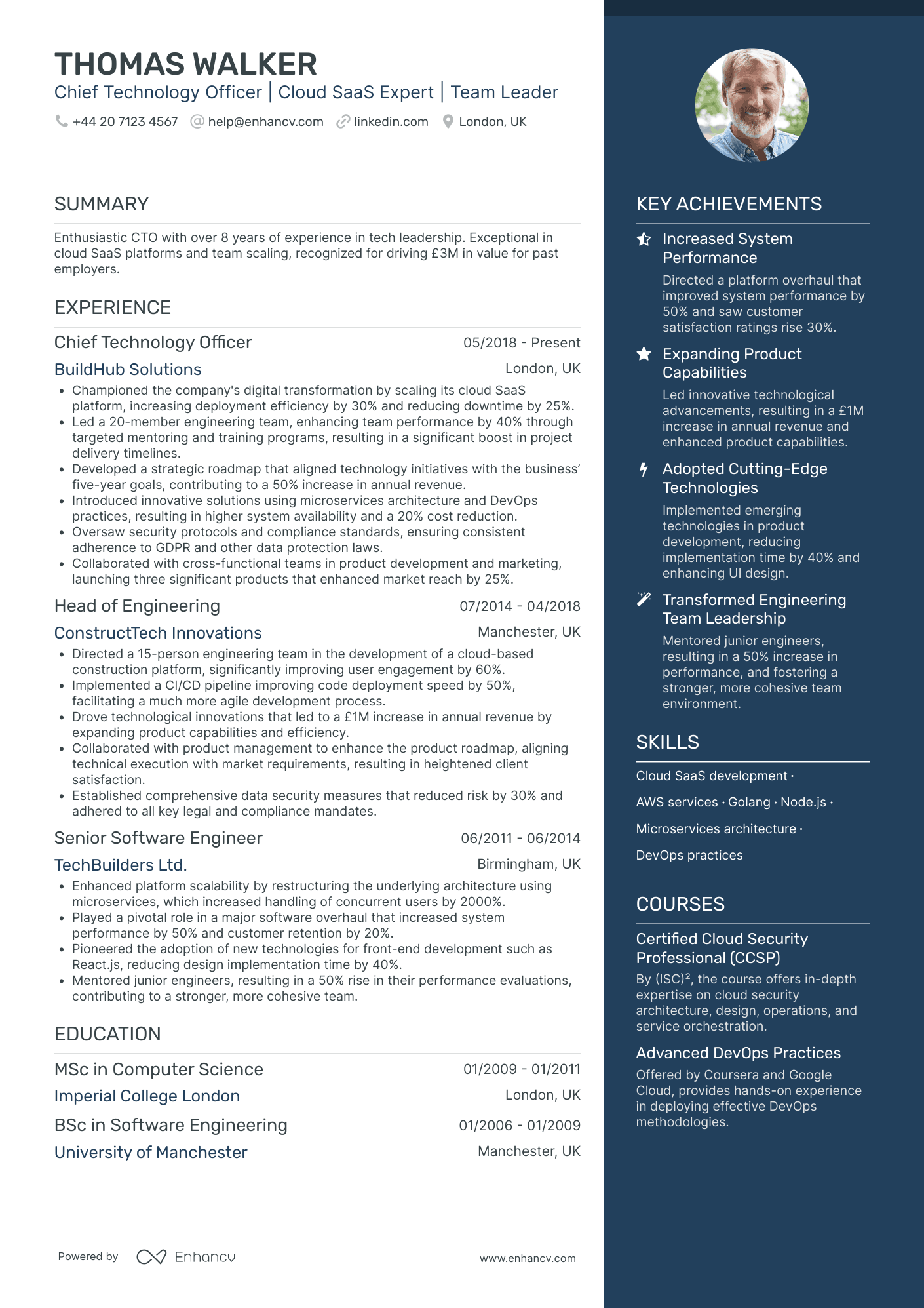
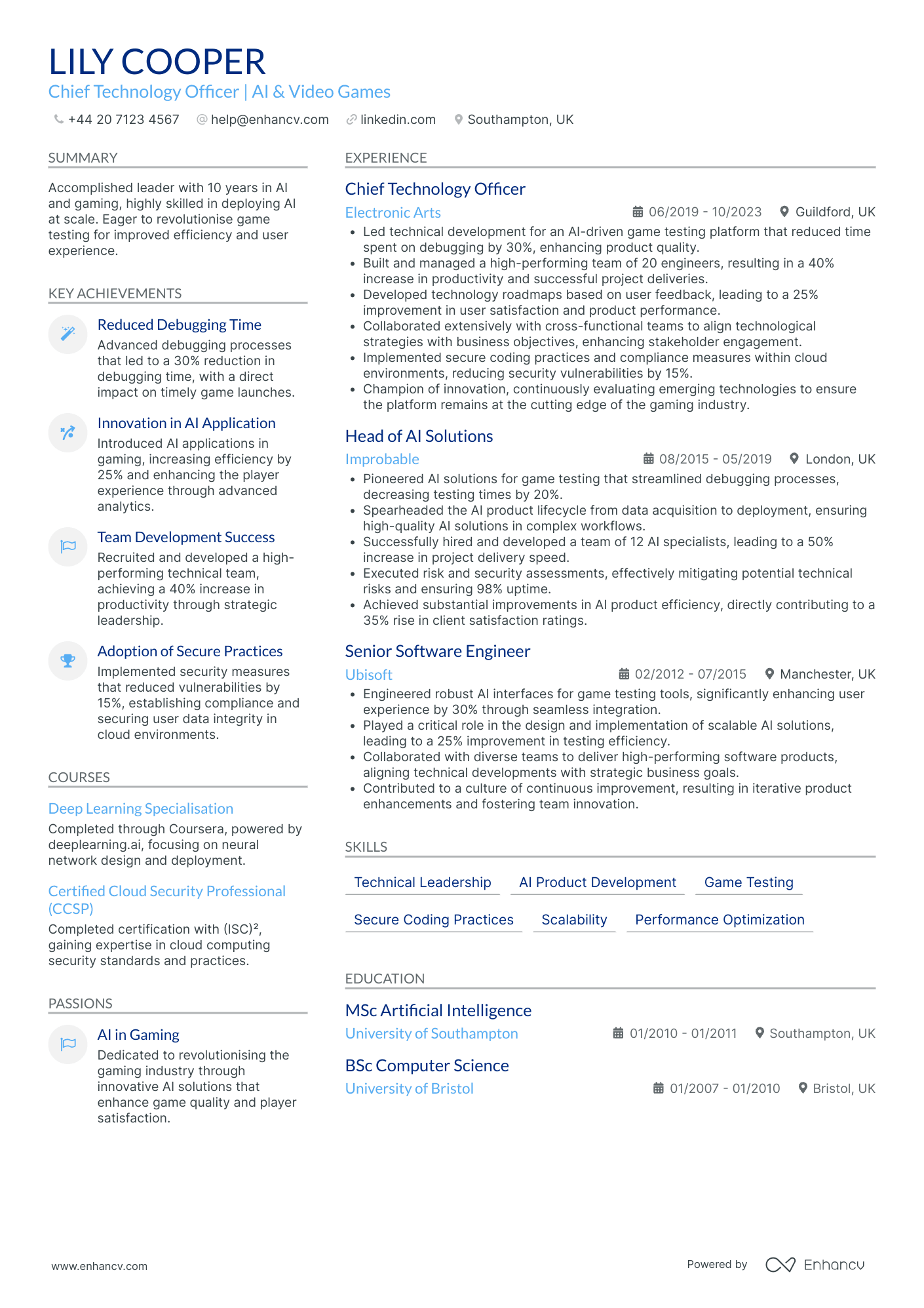
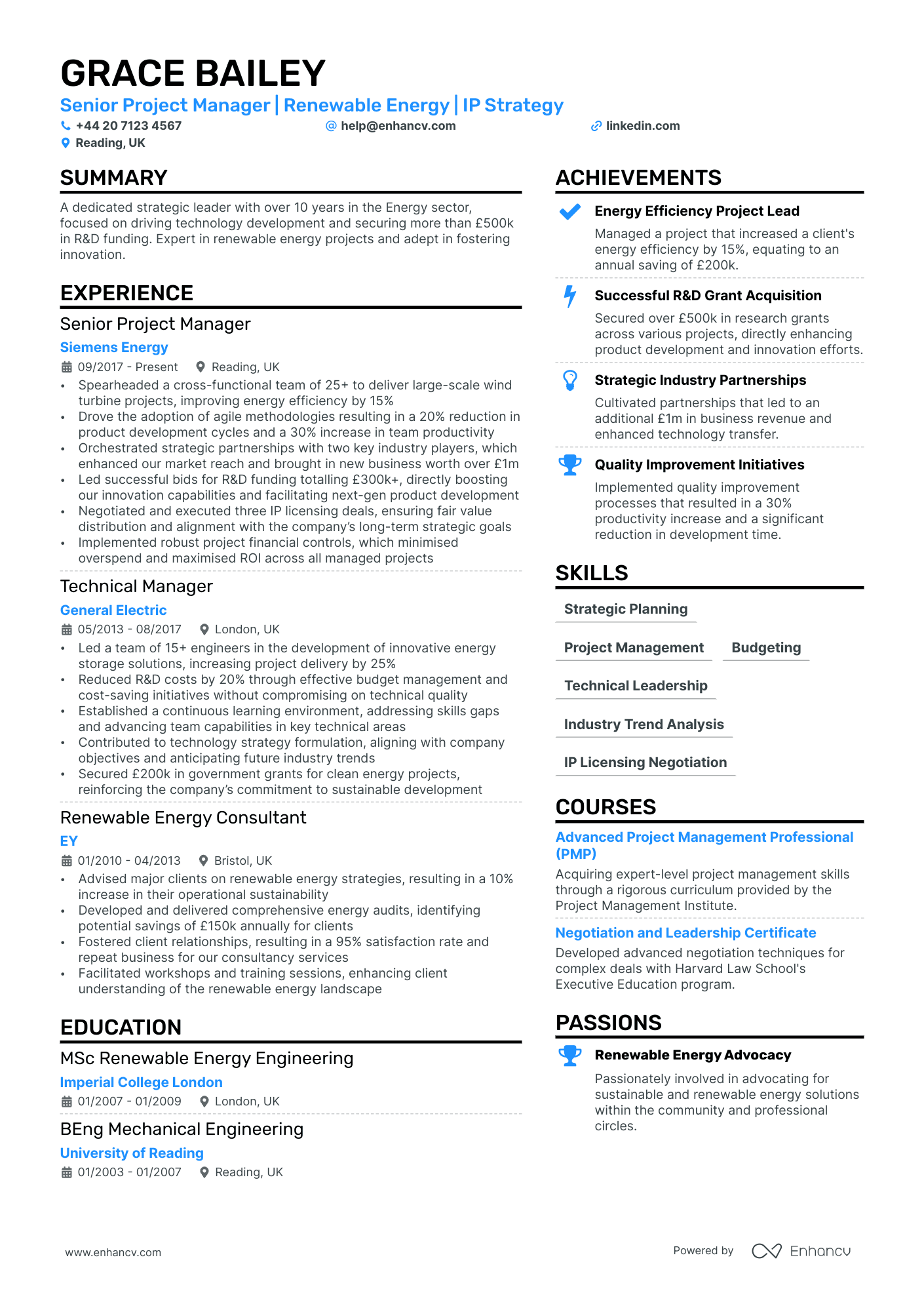
The fastest way to lose a CTO shortlist is to hand the board a CV that reads like a CIO's. A CIO runs the technology a business depends on to operate. A CTO builds the technology a business sells, or leads the transformation that turns a traditional company into a technical one.
That single distinction shapes everything underneath it: the outcomes you lead with, the skills you name, and the numbers a board actually reads. Get the positioning right and the rest falls into place. If you want the structural mechanics first, start with how to write a CV, then come back for the moves that are specific to this role.

Key takeaways
- Lead with the CTO-versus-CIO distinction. Your first two lines should make clear whether you build product technology or run internal IT.
- Boards read for outcomes, not scope. Quantify revenue enabled, systems scaled, teams built, and risk removed.
- Name the skills UK CTO adverts repeat most: project management, stakeholder management, and risk management.
- Most UK CTO roles are on-site or hybrid, so put your location and working pattern near the top.
- Two pages, reverse chronological, sent as a PDF unless the advert asks for a Word file.
- Open with a five-line personal statement that states your scale, your domain, and one board-level result.
CTO or CIO: position your CV for the right seat
Is a CTO bigger than a CIO? It depends entirely on the company, and your CV has to answer the question before a recruiter asks it.
In a software business, the CTO usually owns the product that generates revenue and sits at the centre of strategy. In a bank, retailer, or manufacturer, the CIO often holds the larger budget because internal systems are the bigger spend. Neither title wins by default, so stop competing on seniority and compete on the outcome you own.
The pivot most in demand right now is the transformation CTO: the leader brought in to modernise a legacy estate, build an engineering culture, and turn a company that buys technology into one that builds it. If that is the move you are making from a CIO or IT director seat, your CV has to show the shift from running systems to shipping product.
The way you evidence that shift is with a before-and-after. Name the estate you inherited, the state it was in, and the technical organisation you left behind. A board hiring a transformation CTO is buying a track record of change, so the achievements that carry the most weight are the ones where you moved a business from one technical era to the next.
The four shapes of the CTO role
Recruiters loosely sort CTOs into four shapes, and naming yours tells the reader which job you are applying for:
- The infrastructure and operations CTO, who owns reliability, security, and internal platforms. This is the shape closest to a CIO.
- The strategy and vision CTO, who sets the technical roadmap and defends a competitive position.
- The customer-facing CTO, who is the external technical voice to clients, partners, and the market.
- The transformation CTO, who rebuilds a legacy business and its engineering culture from the ground up.
Pick the shape that matches the roles you want, then make your personal statement, skills, and top three achievements all point at it. A CV that tries to be all four reads as none of them. For the wider principle, see how to sell yourself on a CV without inflating the claims.
What the UK CTO market looks like
Knowing what UK employers actually advertise for tells you which numbers to put first. Here is what the current postings show.
| What | UK CTO roles |
|---|---|
| Where the work happens | Onsite 51%, hybrid 48%, remote 2% (across 4,141 UK CTO postings in the last ~30 days, Enhancv's internal job feed) |
| How adverts pitch seniority | Lead 64%, executive 14%, mid 12%, entry 7%, senior 3% (same sample) |
| Skills that recur most | Project management, stakeholder management, and risk management, followed by Agile, data analysis, and AI |
Two lines in that table should shape your CV.
On-site and hybrid roles account for almost every posting, so a board needs to see where you are based and how often you can be in the room. Put your location and working pattern in the header rather than burying them on page two.
Project management, stakeholder management, and risk management are the skills that recur most often in UK CTO postings, so mirror the ones you can genuinely evidence. That is board language, not engineering language, and it signals you can operate above the code.
Notice too that most adverts are pitched at lead or executive level rather than mid or entry. That tells you the reader expects a track record of owning outcomes, not a list of technologies you have touched, so weight the CV towards decisions and results from the top of the page.
There is no single reliable salary benchmark for the role. CTO pay swings too widely between an early-stage startup and a listed company for one figure to mean much, so anchor your CV in the outcomes you have delivered rather than a target number.
The skills a CTO CV has to prove
A CTO CV has to carry two skill layers: the technical depth that earns respect from engineers, and the commercial fluency that earns trust from the board. List both, and prove each one in a bullet rather than a keyword.
State your hard skills in the language adverts use, covering technology strategy, architecture, cloud, cybersecurity, and increasingly data and AI. The soft skills that matter at this level are real and checkable, led by stakeholder management, board communication, and building teams that stay. Treat your skills section as evidence, not a word cloud.
Leadership is the skill a board scrutinises hardest, so show it with scale and retention figures rather than the word itself. Strong leadership skills on a CTO CV look like team growth, attrition held low, and successors promoted from within.
Top skills for your CTO CV:
Technology strategy and roadmapping
Software architecture and platform scaling
Cloud infrastructure (AWS, Azure, GCP)
Cybersecurity and risk management
Data and AI strategy
Agile delivery at scale
Technology budgeting and P&L
Project and programme management
Stakeholder management
Board-level communication
Team building and retention
Commercial judgement
Change leadership
Formatting your CTO CV
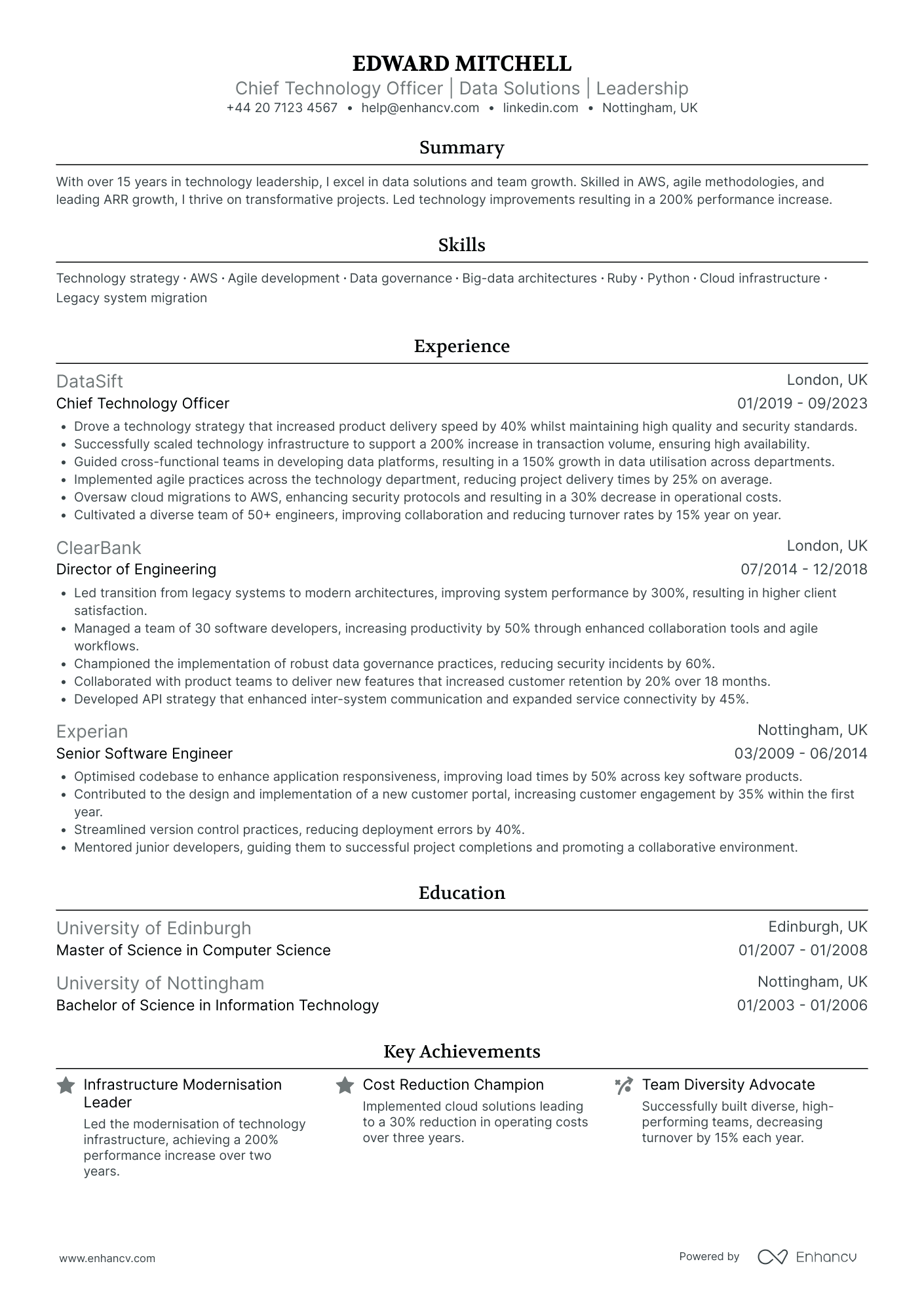
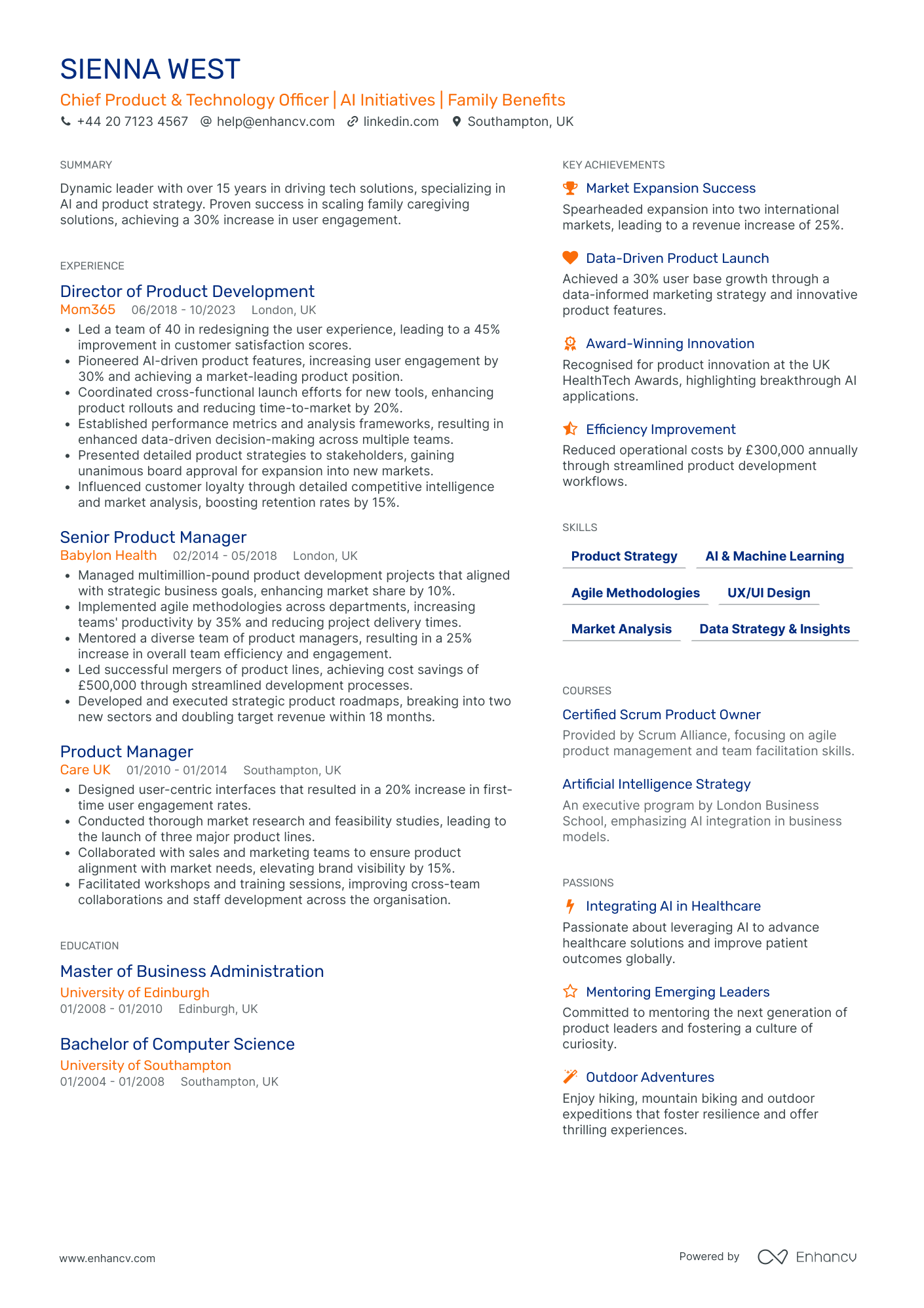
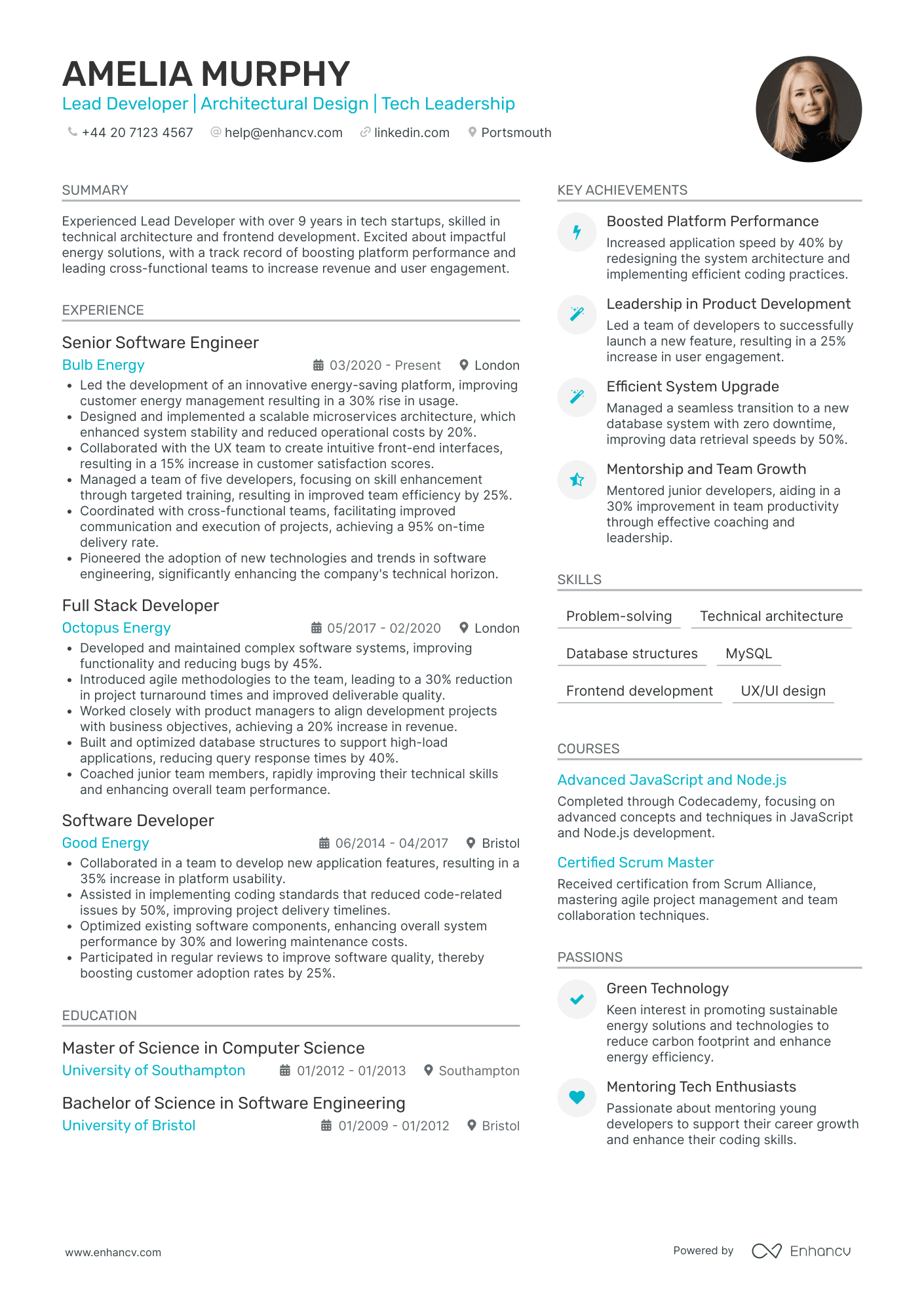
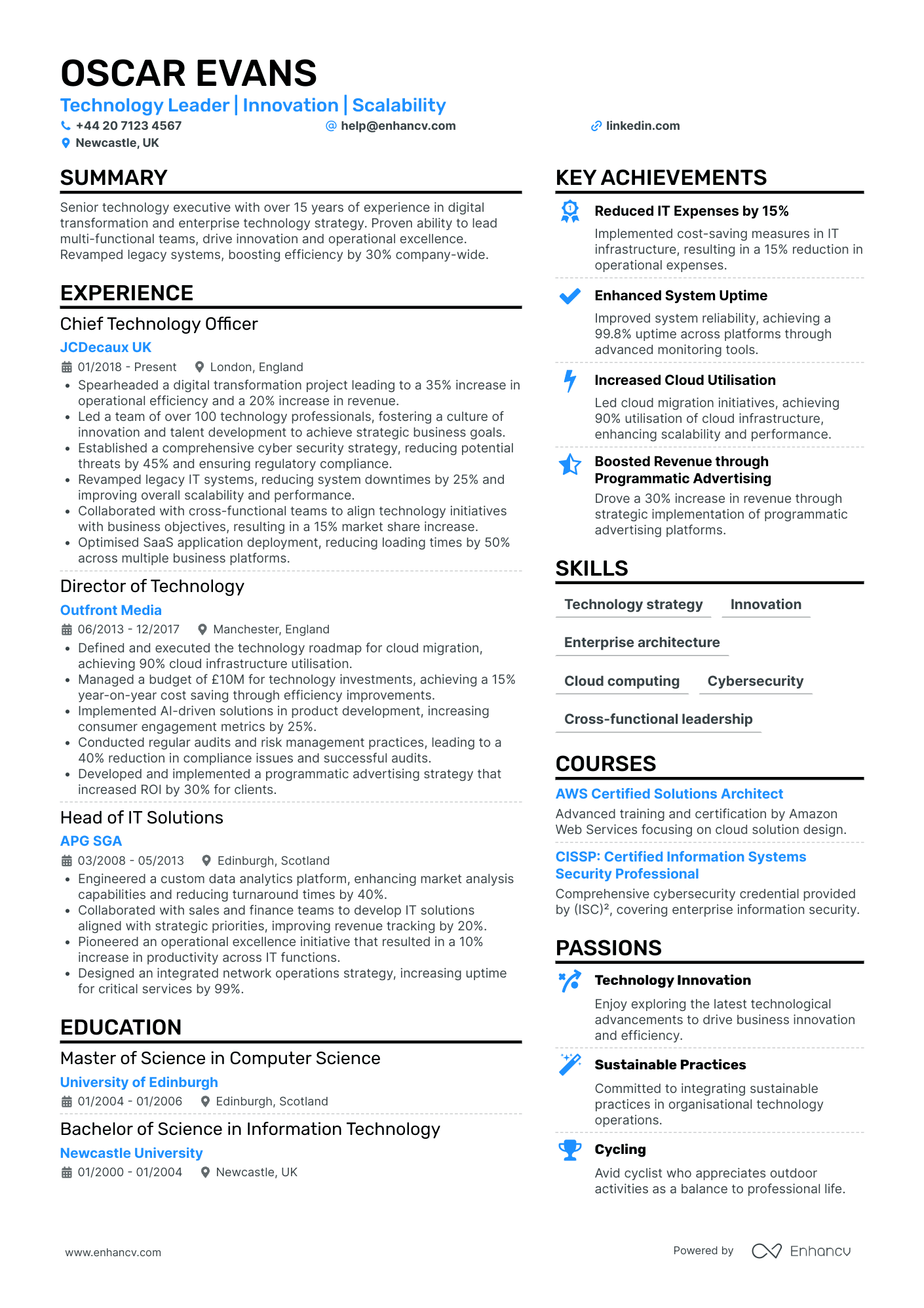
Use a reverse chronological structure so your most senior role leads, and keep it to two pages. A board member reading a dozen CVs before a meeting will not reach page three.
Keep the layout clean, one column, standard headings, and a readable font. The seniority of the role comes through in the results, not in a decorative template.
Send a PDF for direct applications so the formatting holds, and keep a Word copy for executive search firms that reformat into their own template. If the advert names a file type, follow it.
Applications still pass through tracking software at executive level, so keep the headings standard and the layout parseable for an ATS-friendly CV. Build it from a tested layout rather than a blank page, since Enhancv's CV templates export to a clean, single-column PDF.
Writing your CTO personal statement
Four or five sentences at the top: your scale, your domain, one board-level result, and the seat you want next. See more personal statement examples if the opening line is not landing.
Skip the adjective soup that every other executive CV opens with. "Visionary, results-driven technology leader" tells a board nothing it can verify.
Keep it to five lines at most. Anything longer and a board reader skims past it to the experience section, which is where the real proof lives anyway. The job of the statement is to earn those next twenty seconds, so front-load the biggest number you have.
Lead with evidence instead:
CTO personal statement example (transformation focus)
Transformation-focused CTO with 14 years scaling engineering organisations from 8 to 140 people across fintech and SaaS. Rebuilt a legacy monolith into a cloud-native platform, cutting infrastructure spend by 32% and moving releases from monthly to daily. Owned a £6m technology budget and reported to the board on delivery, security, and technical risk. Now looking to lead product and platform strategy for a scale-up preparing for Series C.
What to avoid
Visionary and results-driven technology leader with a passion for innovation and a proven track record of delivering cutting-edge solutions. A strong communicator and strategic thinker who thrives in fast-paced environments and consistently goes the extra mile to drive business success.
When I read a CTO CV, I skip the adjectives and hunt for two things: the scale you operated at and a decision that changed a number. Tell me the size of the team and budget you owned, the state of the technology when you arrived, and the one metric that moved because you were there. "Visionary leader" is what people write when they cannot point to a result. A single line like "took platform uptime from 96% to 99.9% while halving cloud spend" outranks a paragraph of traits.
Writing your CTO experience section
Write each role as a dated heading followed by bullets that lead with a verb and end in an outcome. For the mechanics, see work experience on a CV, and lean on strong action verbs to open each line.
At this level, the outcome has to be in board currency: revenue enabled, cost removed, risk closed, teams scaled, and time to market cut. Those are your CV achievements, and one quantified line is worth five that only describe responsibilities.
Tailor every application to the shape of CTO the advert wants, and mirror its language where it is genuinely true of you. Enhancv's CV tailoring feature reads the advert and suggests the matching edits, which saves rebuilding the CV from scratch for each board.
- Scaled the engineering organisation from 22 to 130 people across four countries while holding voluntary attrition below 8%
- Led the migration from an on-premise monolith to a cloud-native architecture, cutting infrastructure costs by 34% and shortening release cycles from six weeks to daily
- Owned a £9m annual technology budget and presented delivery, security, and risk to the board every quarter
- Introduced an AI-assisted fraud model that reduced chargebacks by 27% and protected an estimated £4m in annual revenue
- Reached ISO 27001 and SOC 2 Type II certification within 11 months, unlocking enterprise contracts previously out of reach

PRO TIP
Translate every technical win into board language. "Migrated to Kubernetes" means little to a non-technical director. "Cut infrastructure spend by 34% and released daily instead of monthly" means everything. Put the outcome first and the technology second.
Education, certifications, and board credibility
Most CTOs hold a technical degree, and where you do, list it plainly in your education section with the classification and institution. If your route in was non-traditional, let the outcomes on page one carry the weight, because at this level a proven track record outranks a degree.
Certifications still earn their place when they map to the role. Cloud credentials from AWS or Azure, a security qualification such as CISSP, and increasingly formal AI governance training all signal current depth. List the certificates a board would recognise and drop the rest.
Board credibility is its own section once you have it. Non-executive directorships, advisory roles, and committee memberships tell a hiring board you already operate at their level, so give them a short, dated block of their own.
Conclusion
Decide which seat you are aiming for, name the shape of CTO you are, and prove it with board-level numbers rather than adjectives.
Keep the format to two clean pages, mirror the skills UK adverts actually repeat, and pair the CV with a short cover letter that says why this company and why now.

Author's take - the Enhancv team
When I read a CTO CV, I skip the adjectives and hunt for two things: the scale you operated at and a decision that changed a number. Tell me the size of the team and budget you owned, the state of the technology when you arrived, and the one metric that moved because you were there. "Visionary leader" is what people write when they cannot point to a result. A single line like "took platform uptime from 96% to 99.9% while halving cloud spend" outranks a paragraph of traits.