



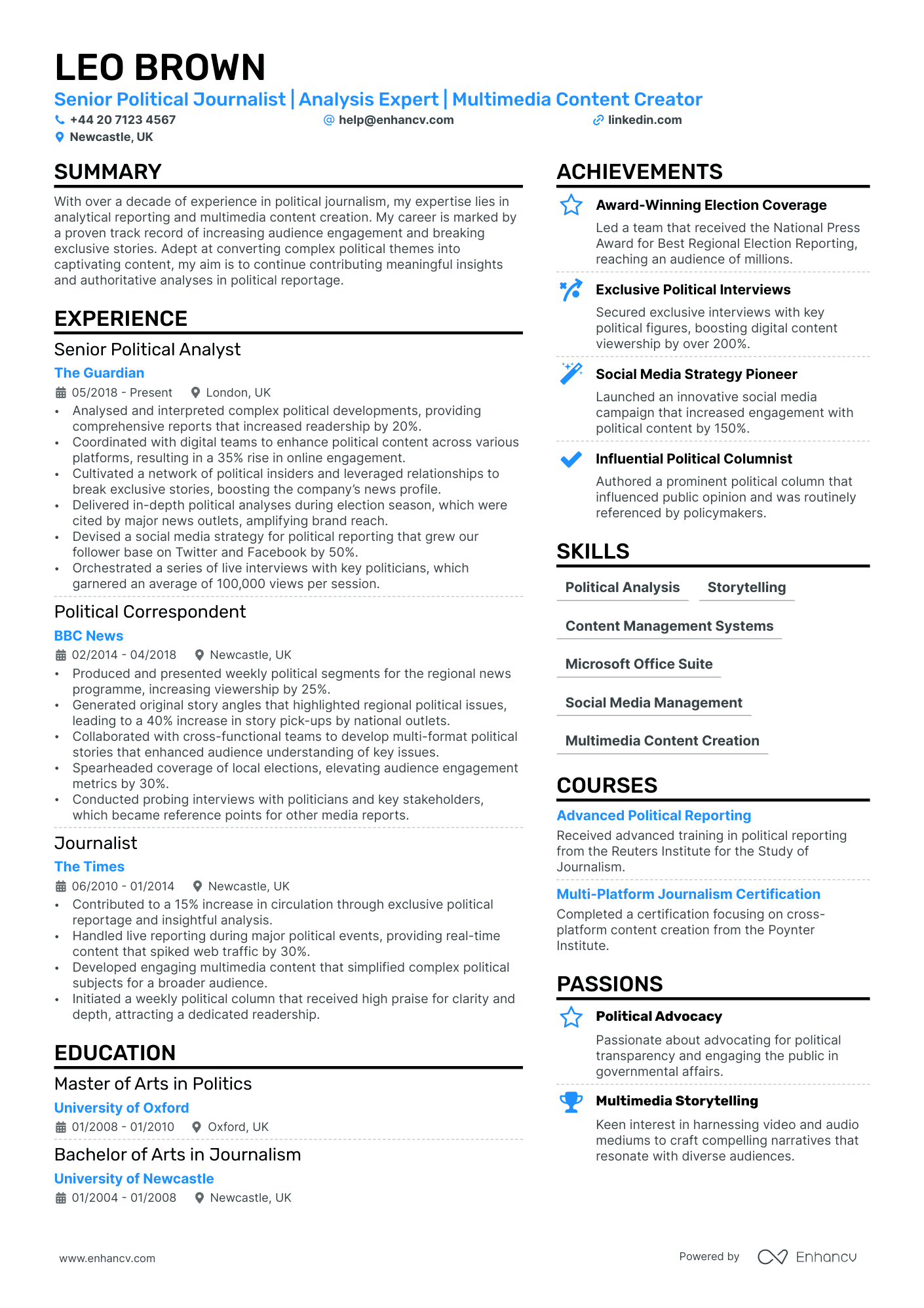
Most journalist CVs read like a cuttings file with the actual cuttings removed. An editor gets a job title, a masthead, and a list of duties, but none of the reporting that would make them pick up the phone.
What lands an interview is a CV built to be skimmed in the ten seconds an editor gives it: a clean layout, a link to your best clips near the top, and copy as tight as your best story. Get the format right first, then fill it. If you want the fundamentals before the specifics, see how to write a CV.

Key takeaways
- Lead with format: a clean two-page CV, sent as a PDF, with a live link to your clips near the top.
- UK journalist roles skew on-site or hybrid, so put your location and your patch in the header.
- Name the skills editors list: social media, storytelling, live reporting, and media law.
- Open with a short personal statement built on your beat, one known byline, and a number.
- Quantify your reporting: stories filed, readers reached, exclusives landed, and turnaround under pressure.
- Link a curated portfolio of your best clips, not a folder of PDFs.
Formatting your journalist CV
Lead with format, because an editor screens dozens of these between deadlines. The layout decides whether your clips ever get read.
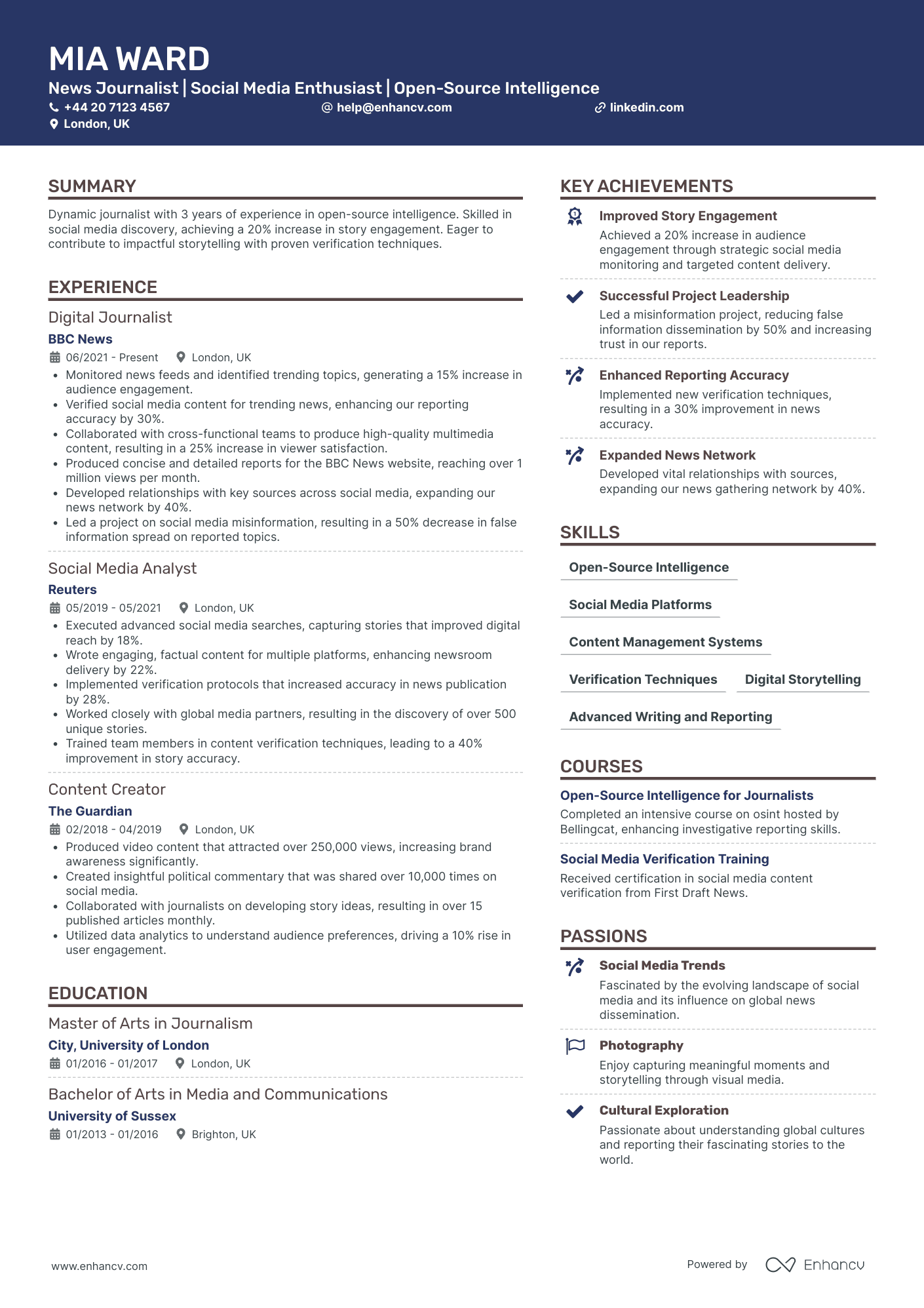
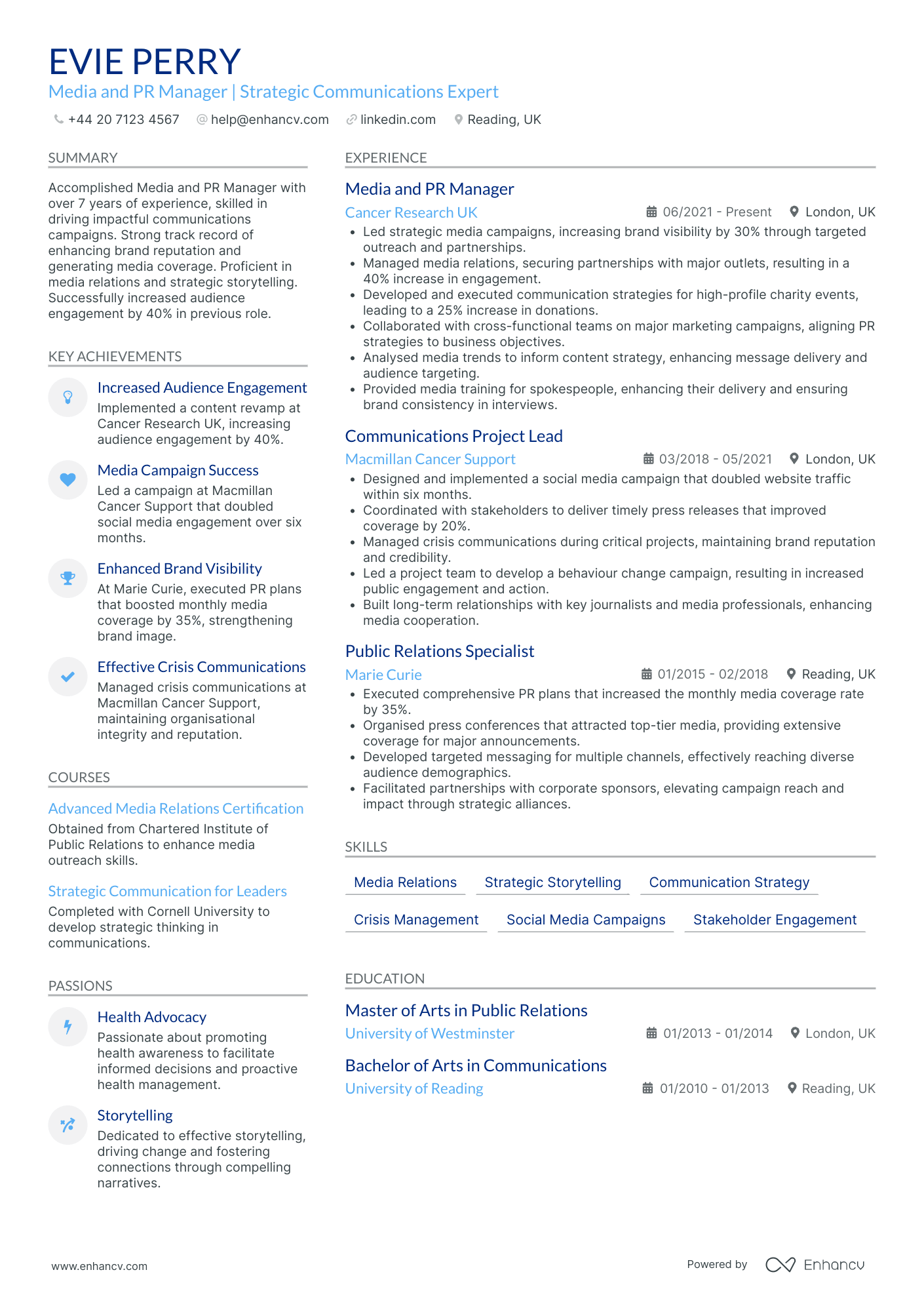
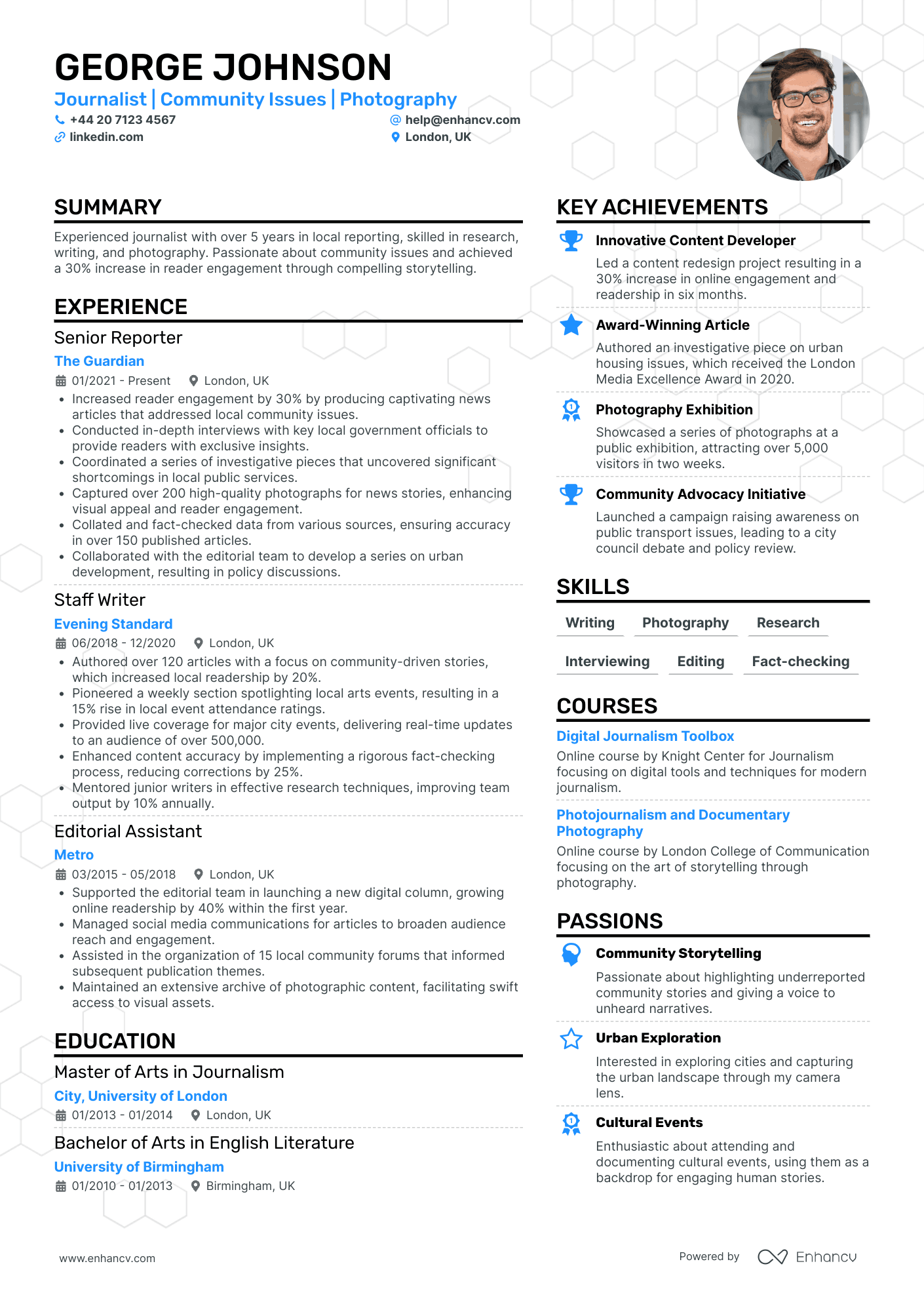
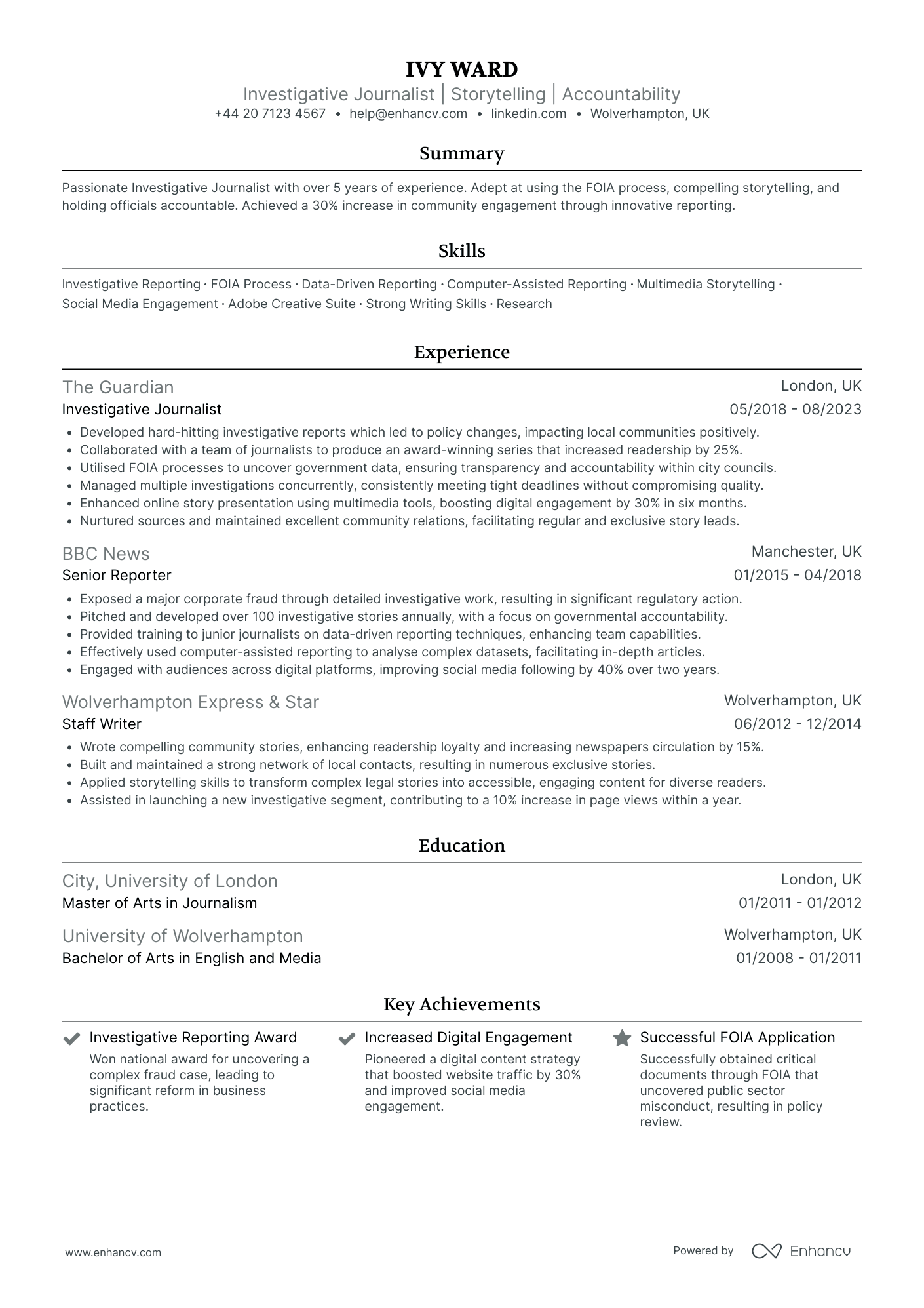
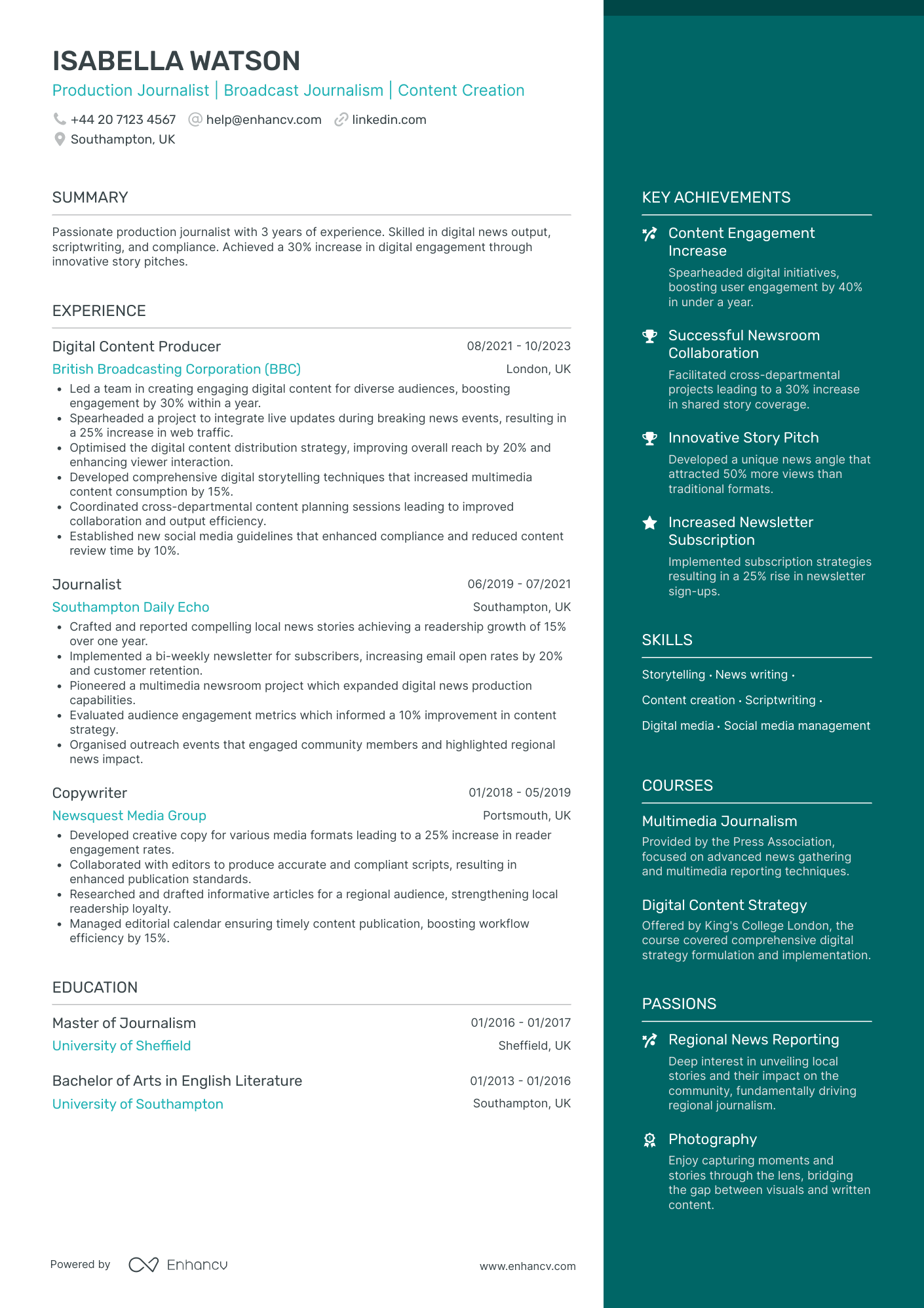
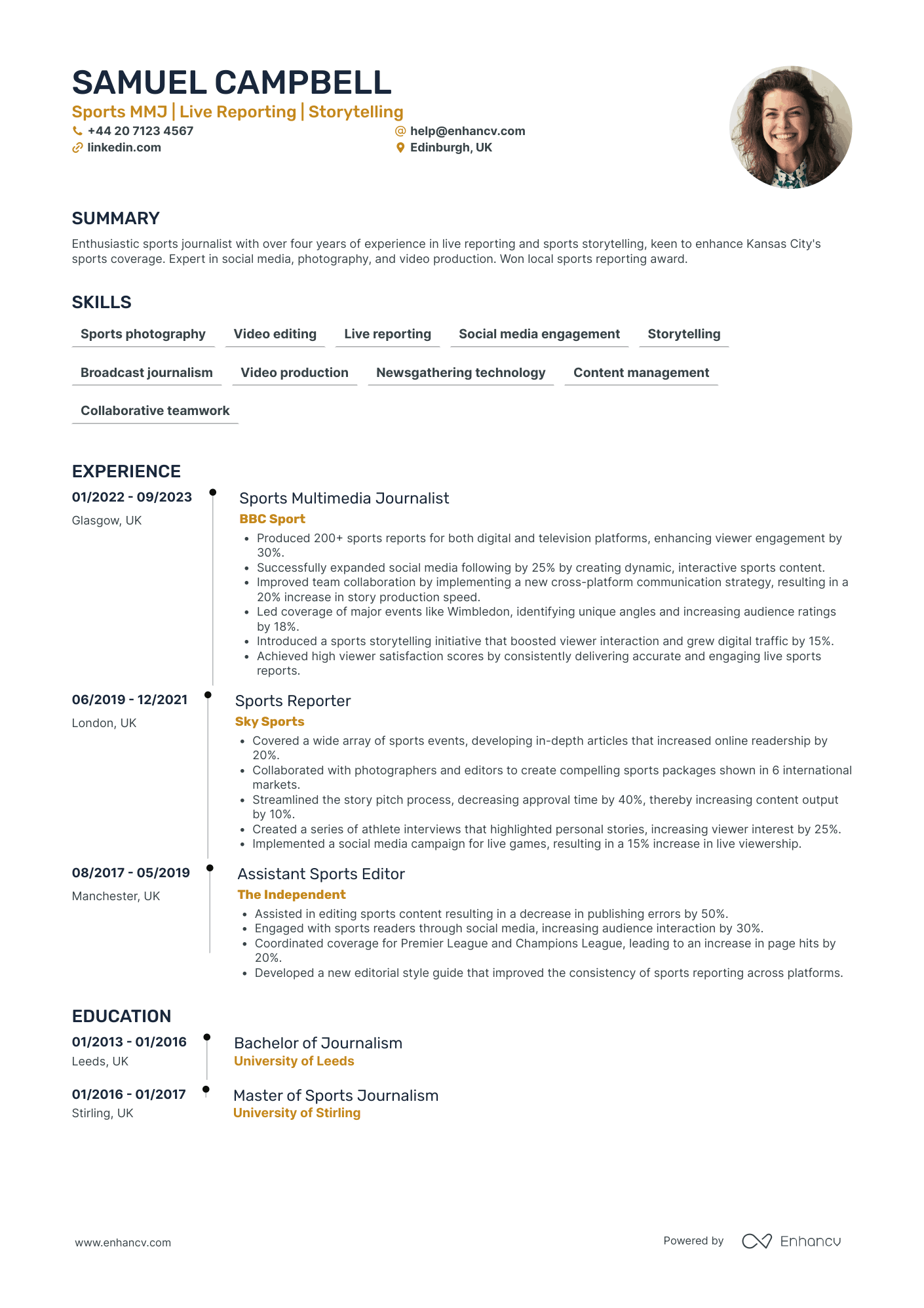
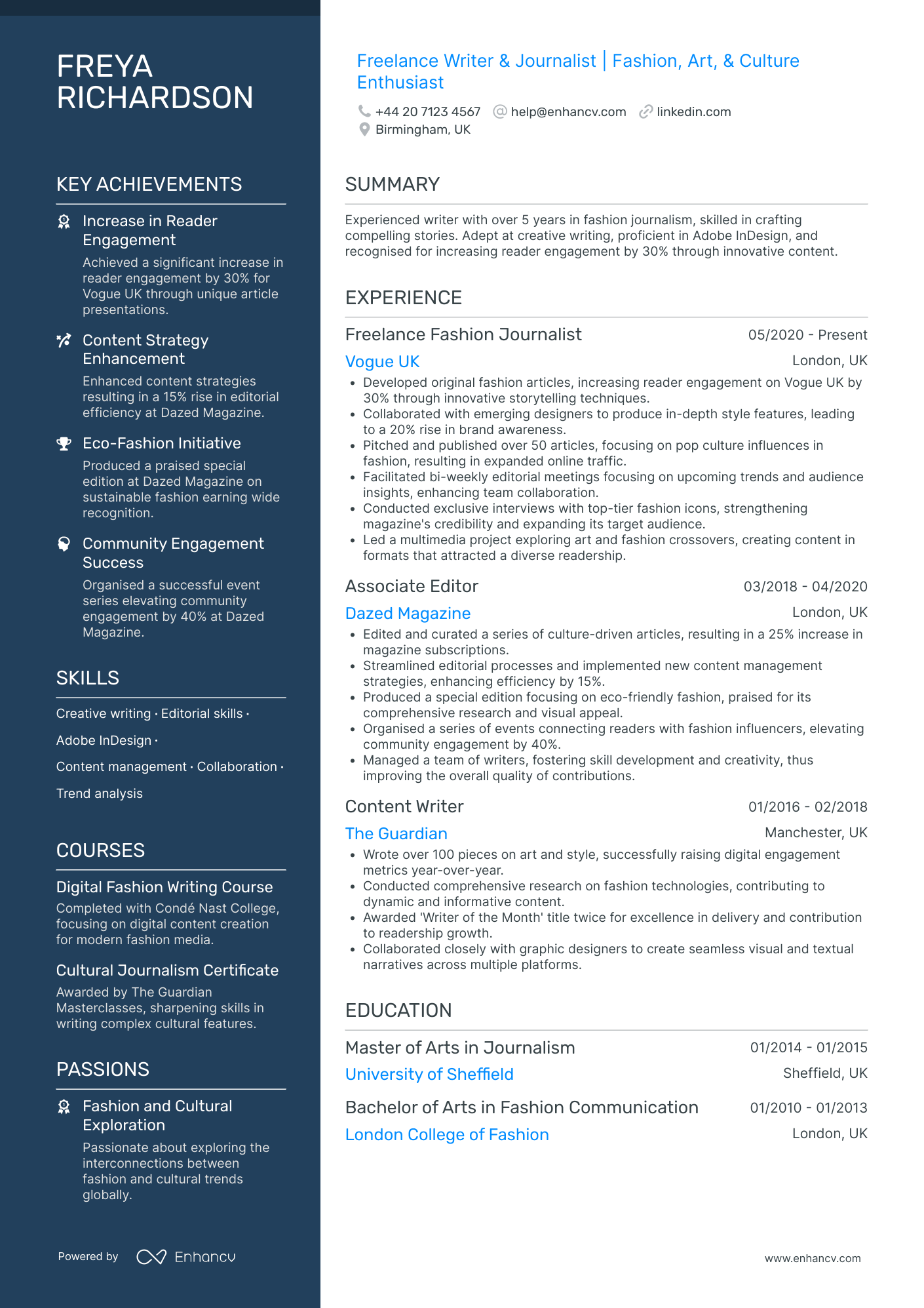
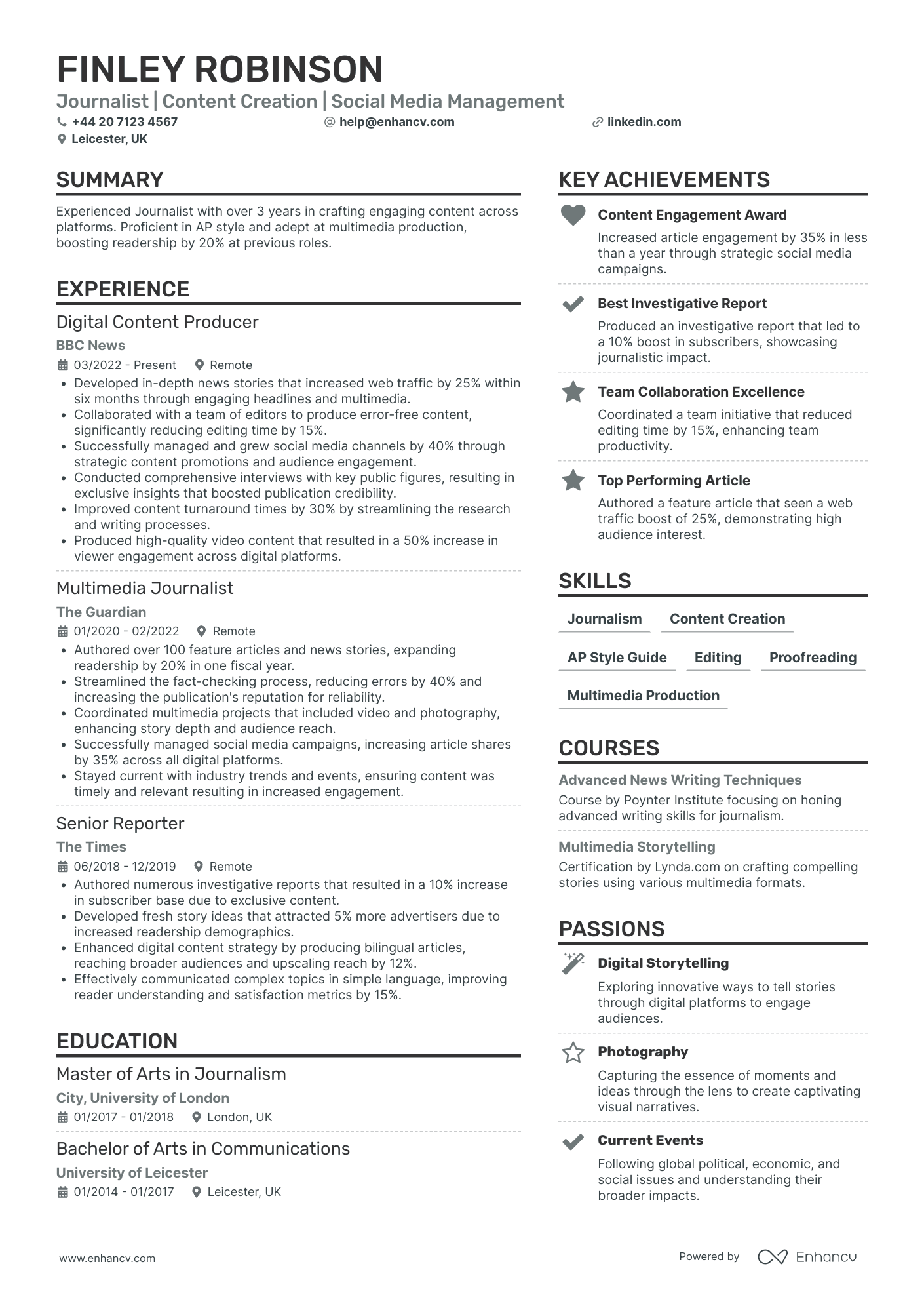
Keep it to two pages, reverse chronological, one column, with standard headings. Save the flourishes for your writing, not your margins.
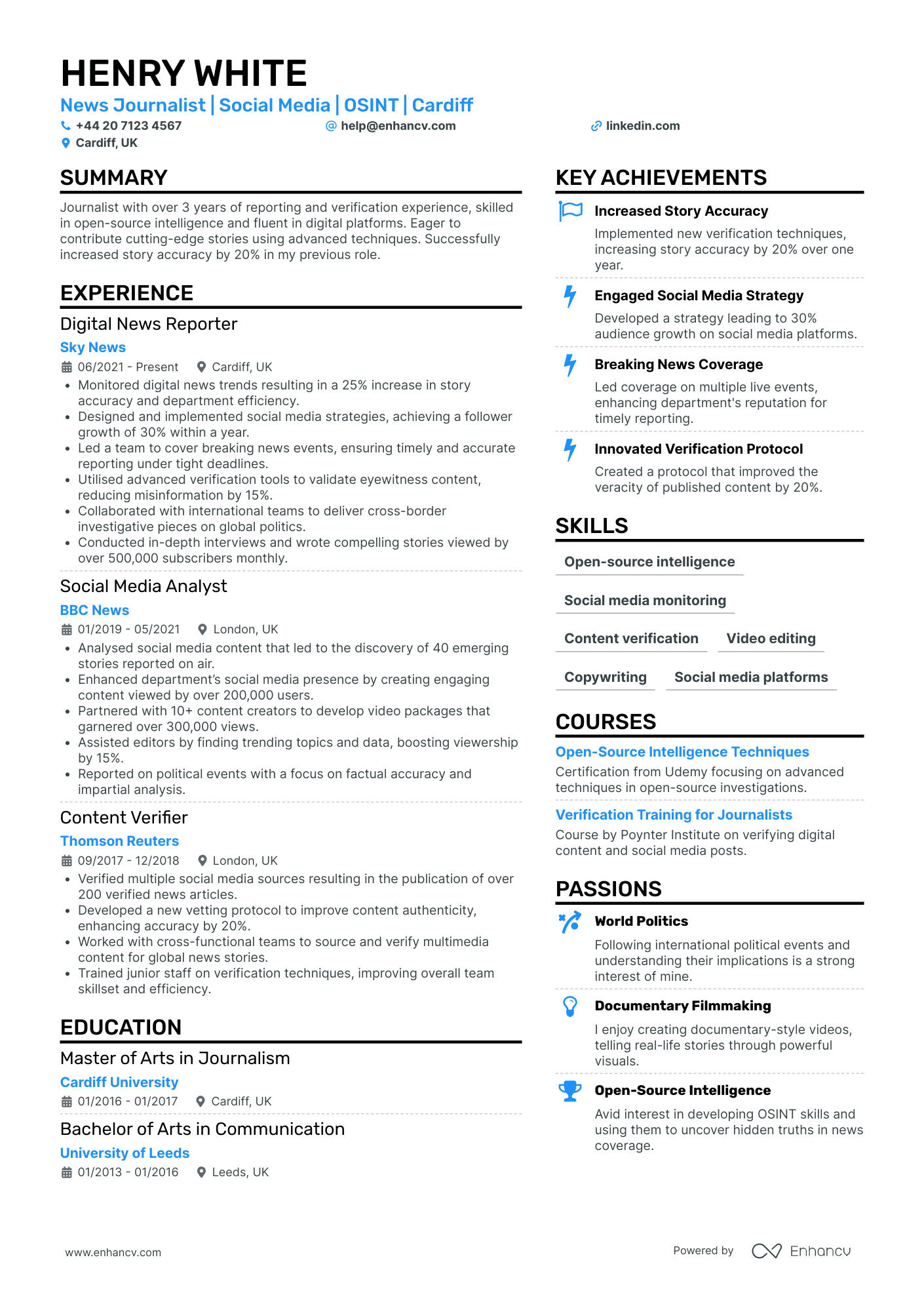
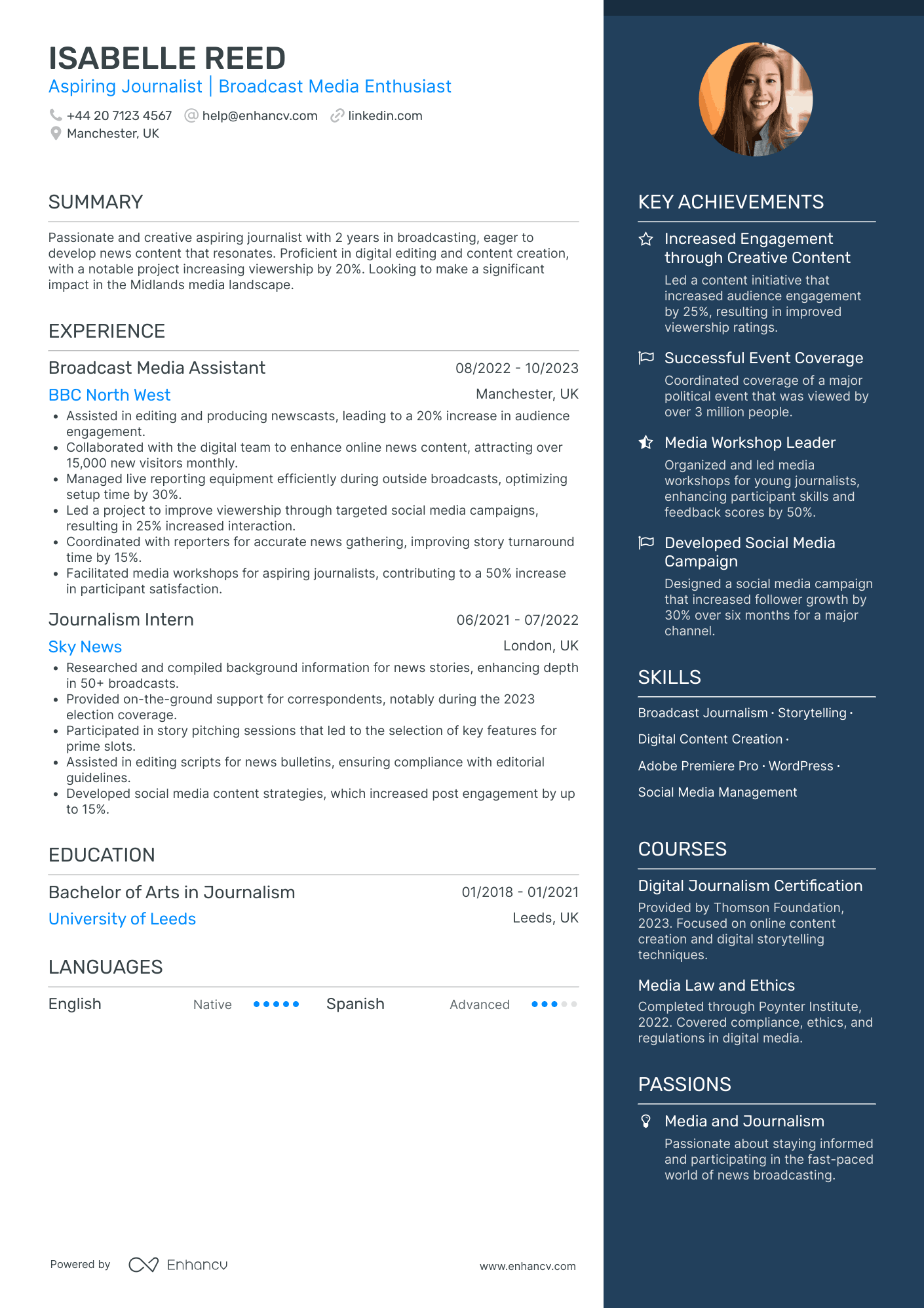
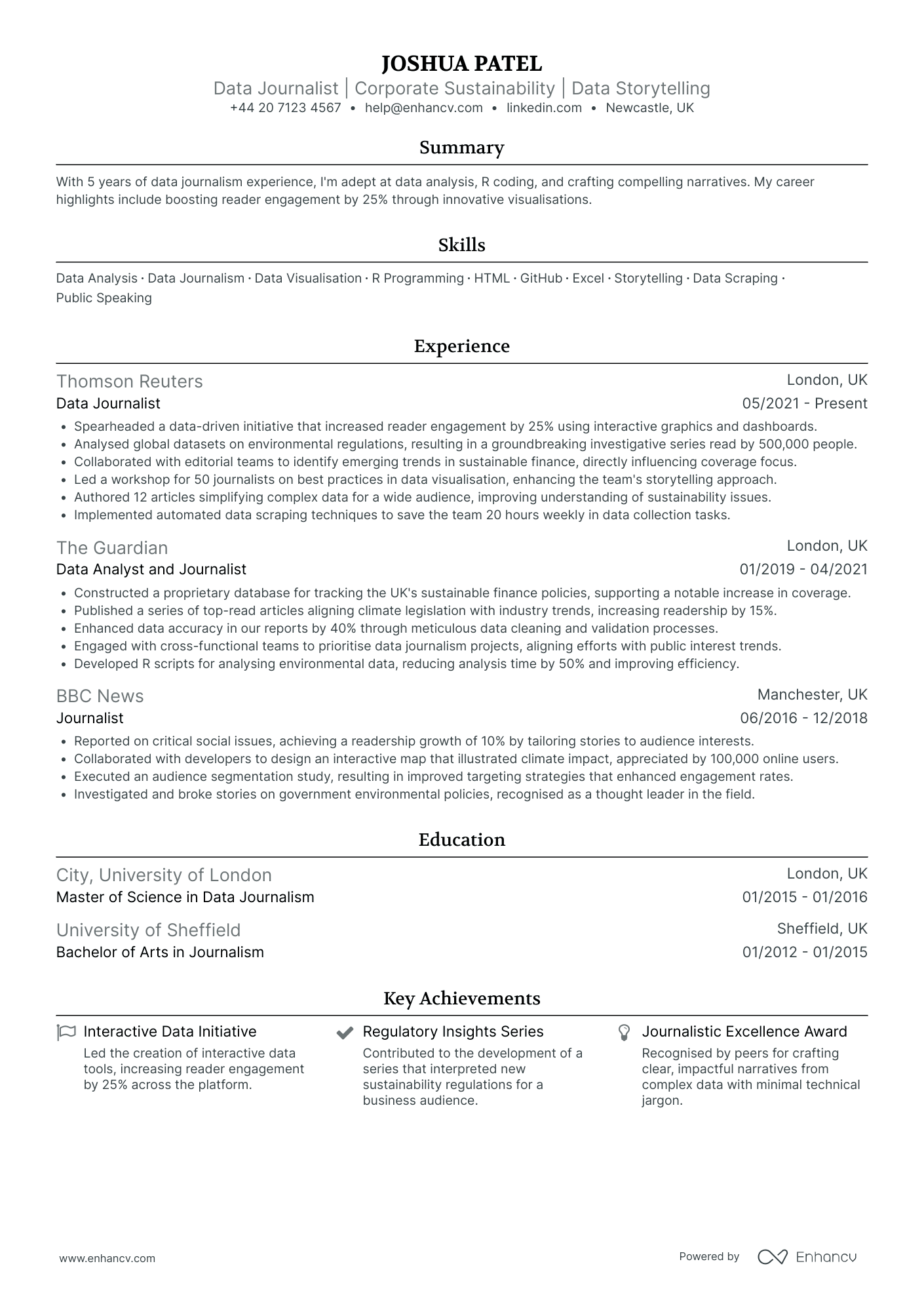
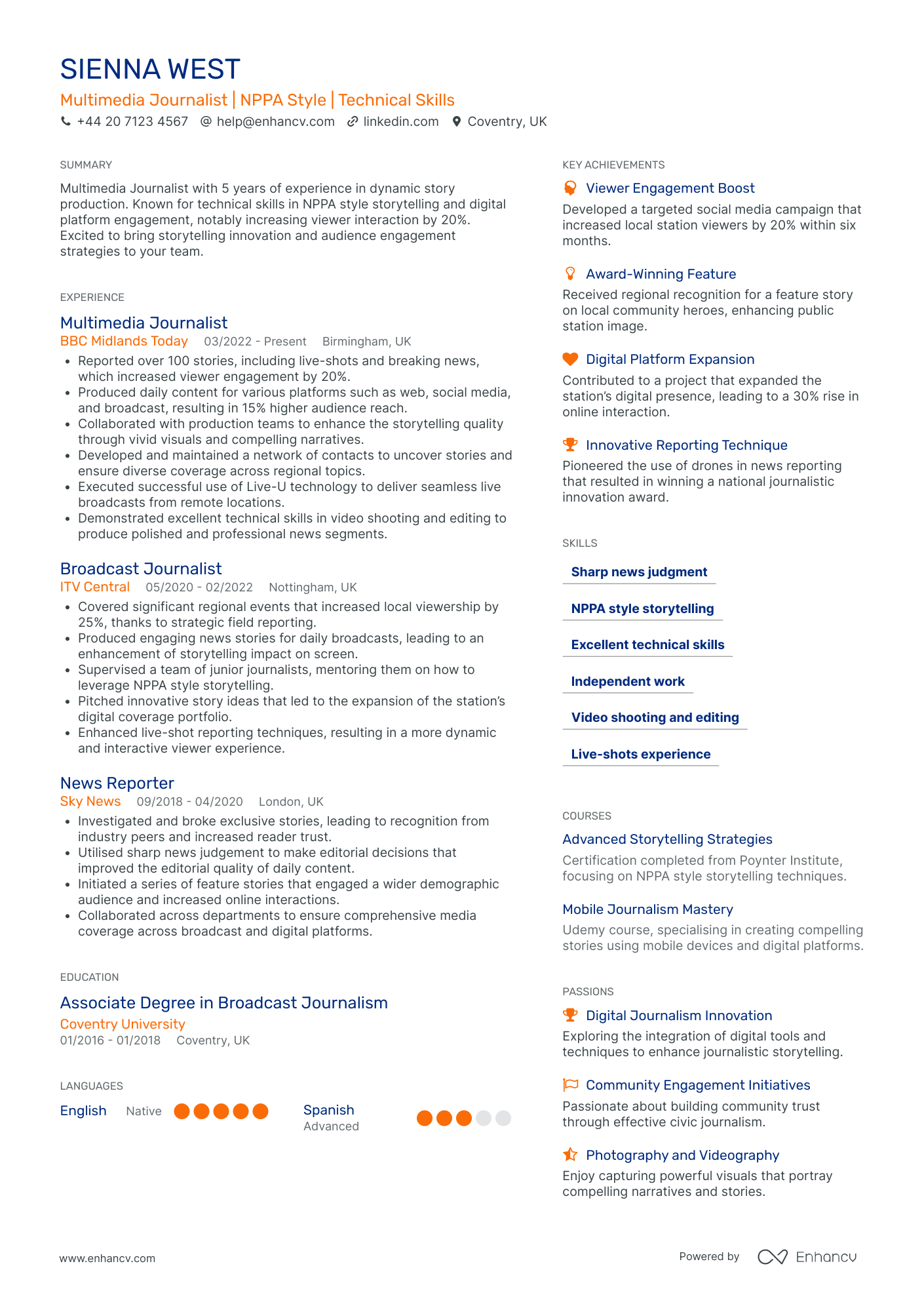
Order the sections for a journalist: header with your clip link, a short personal statement, key skills, experience, then education and training. A reporter's CV earns its keep in the top third, so the strongest evidence goes there.
Keep the header tight: name, the beat or title you are pitching for, location, one phone number, a professional email, and the clip link. A relevant social handle helps if your reporting lives there, but leave off anything you would not want an editor to read.
Send a PDF for direct applications so the layout holds when it lands in an editor's inbox. Keep a Word copy for recruitment agencies, which reformat CVs into their own template. If the advert names a file type, follow it.
Choose a readable font and keep the design plain. Newsrooms run applications through tracking software, so clean headings and a single column keep an ATS-friendly CV parsable.
Leave off the extras UK employers do not want. No photo, no date of birth, no full home address. A town and the beat you cover are enough, and every line you save buys room for another clip or metric.
Make the clip link impossible to miss. Put it beside your name in the header, not buried in a hobbies line at the foot of page two. If the role is digital, a link to your author page on a live site does more work than a paragraph describing your output.
How long should a journalism CV be? Two pages for an established reporter, one page if you are early in your career. A third page of old bylines works against you, so see CV length if you are trimming.
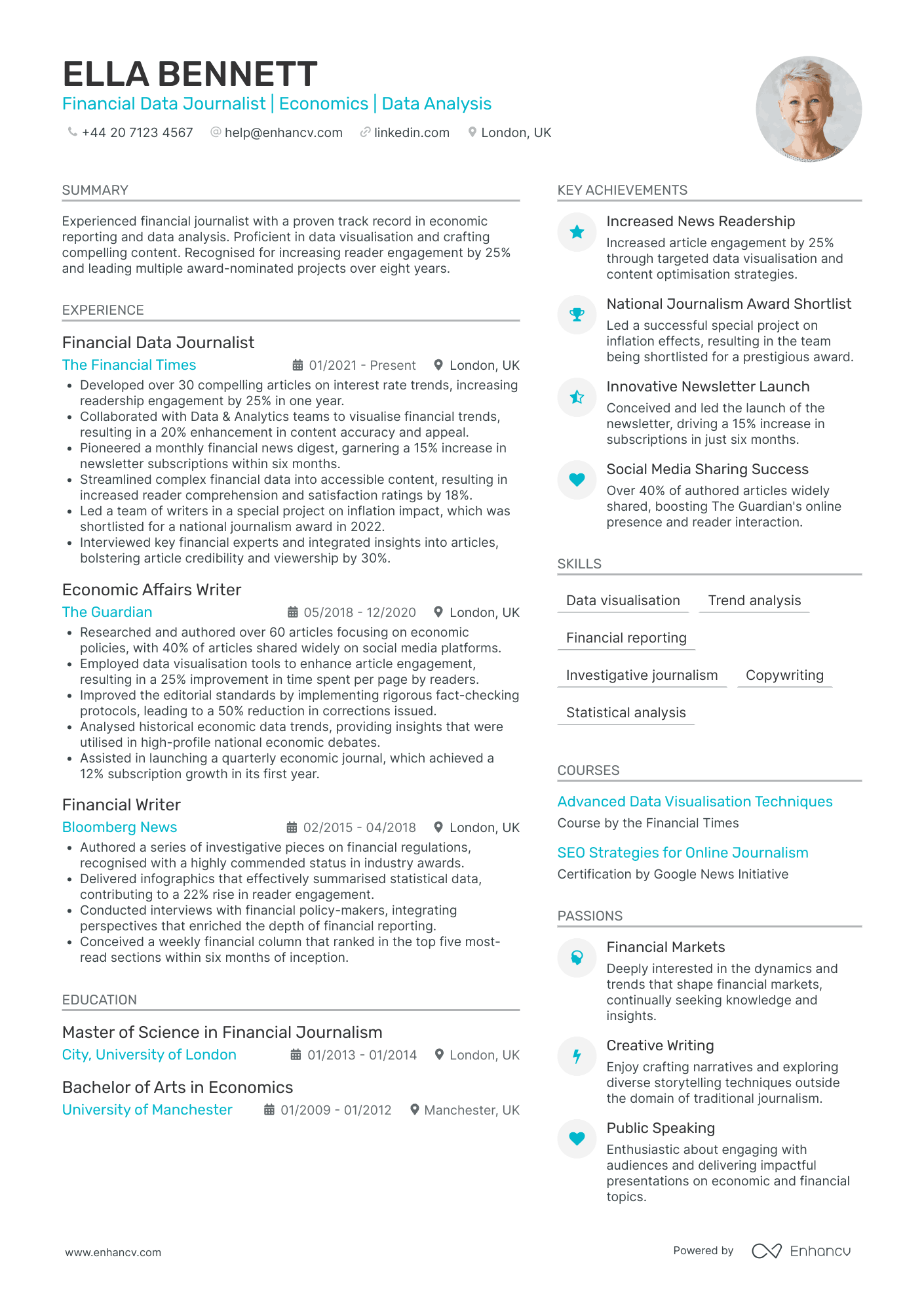
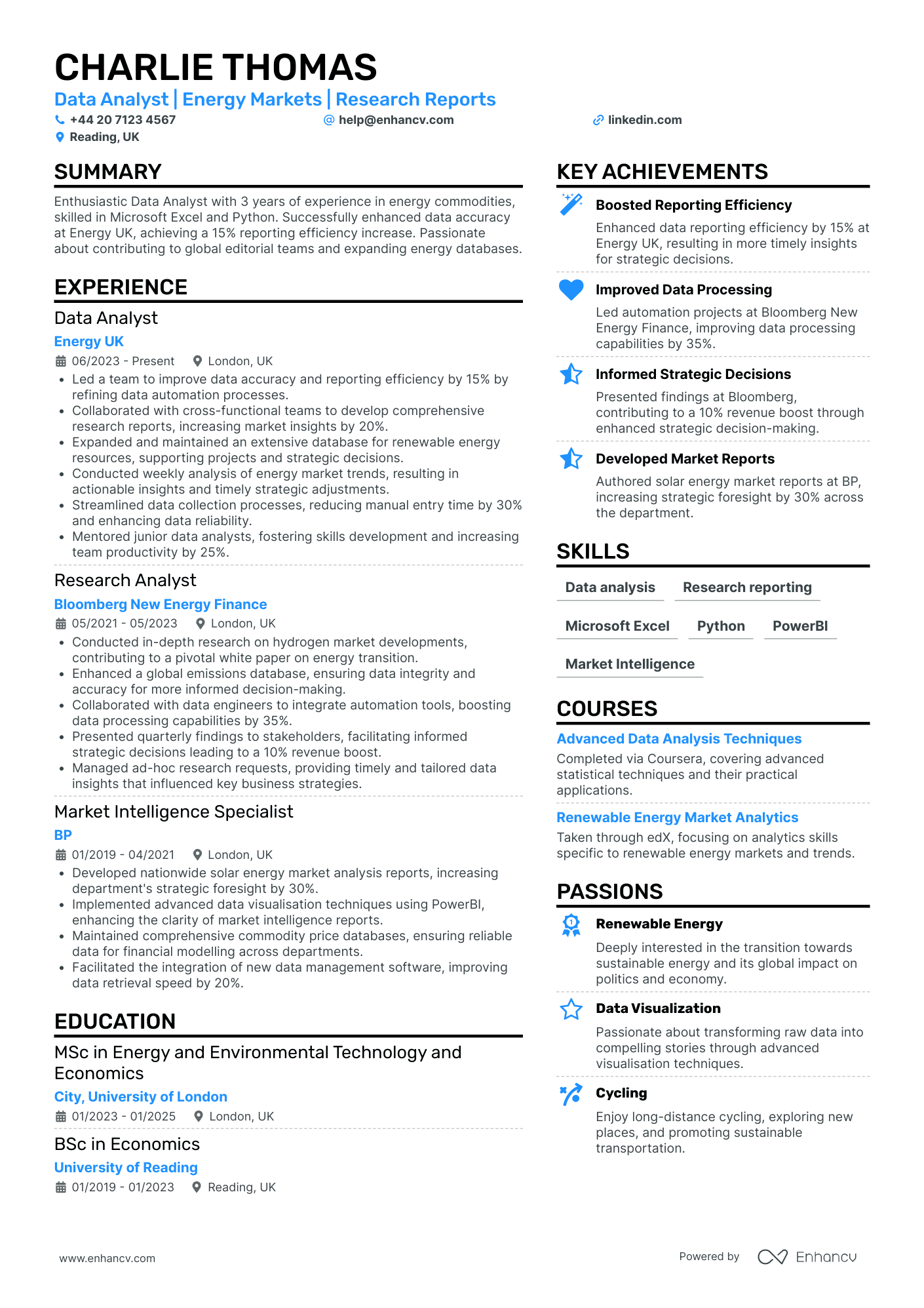
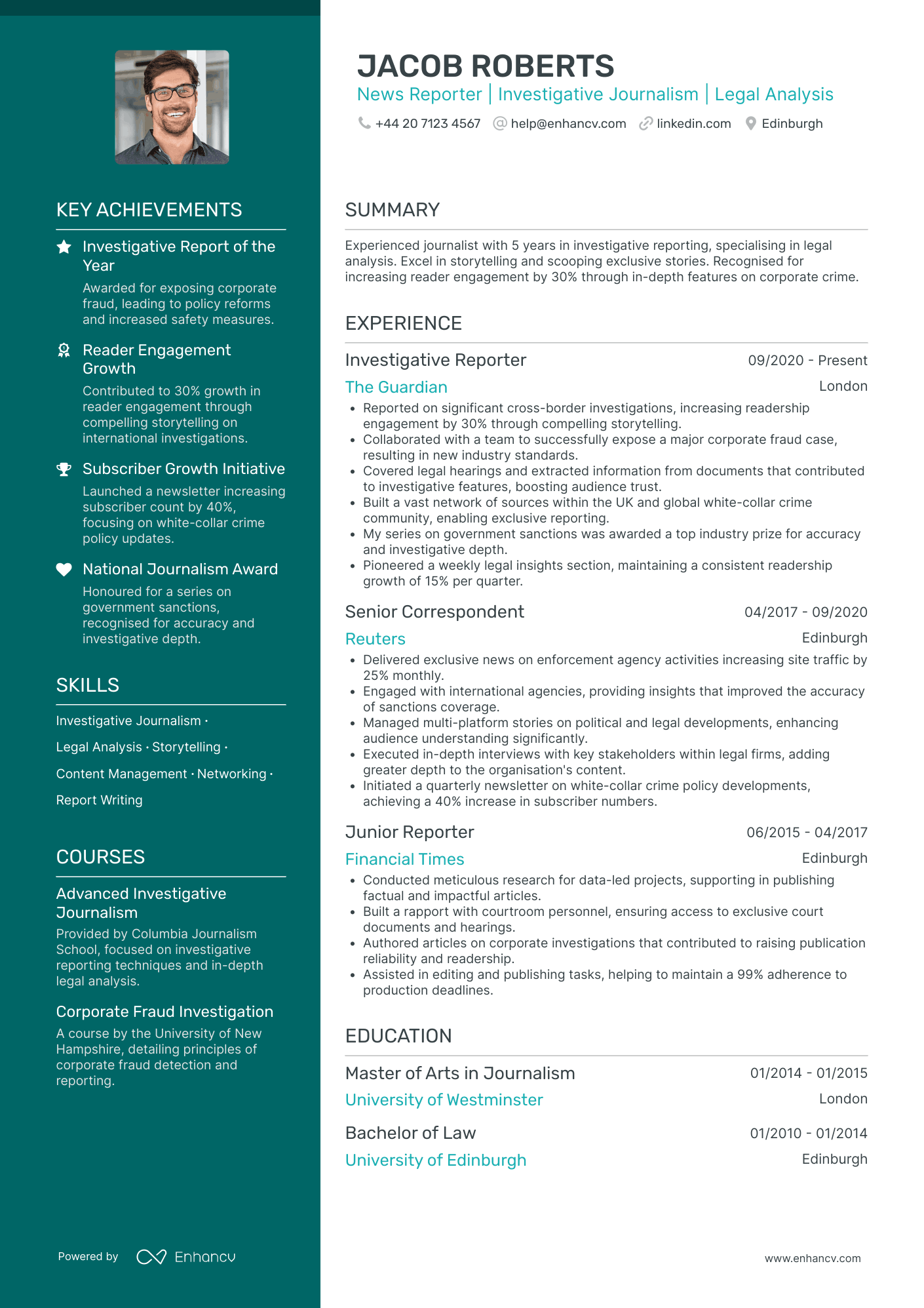
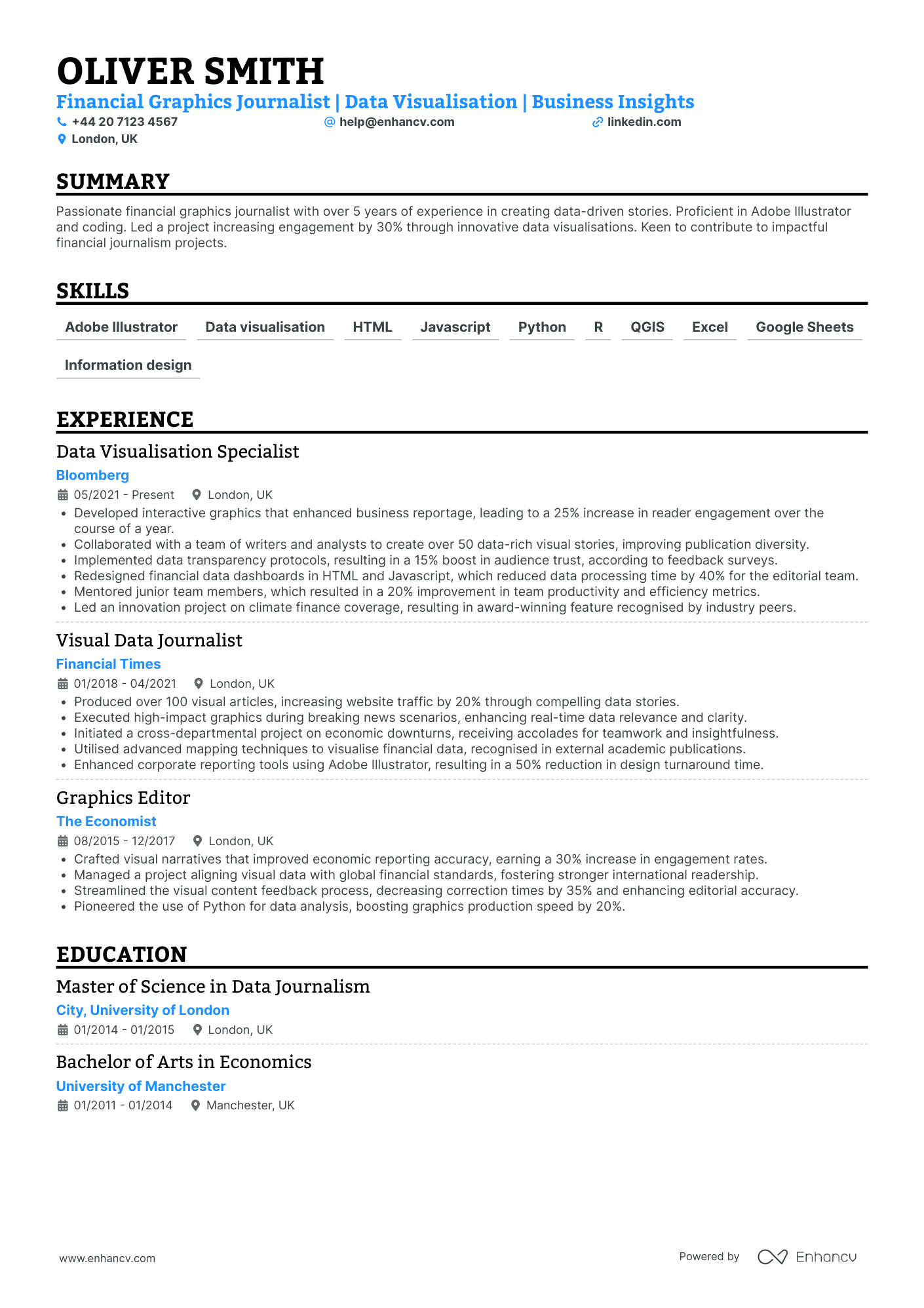
Build it from a tested layout rather than a blank page. Enhancv's CV templates export to a clean PDF that keeps your clip links clickable.
Is your resume good enough?
Drop your CV here or choose a file. PDF & DOCX only. Max 2MB file size.
What the UK journalist market looks like
Knowing what editors ask for shapes what belongs at the top of the CV. Here is what UK journalist postings show right now.
| What | UK journalist roles |
|---|---|
| Where the work happens | Mostly on-site or hybrid, with only one fully remote (across 25 UK journalist postings in the last ~30 days on Enhancv's internal job feed) |
| Experience level asked for | Mostly mid-level, with only a handful of entry, senior, and lead roles |
| Skills that recur most | Social media, storytelling, and live reporting, followed by media law, scriptwriting, and video editing |
Two things there should change your CV.
UK journalist postings are split between onsite and hybrid work, so a newsroom needs to see you can reach the patch. Put your town and the area you cover in the header, and mention a driving licence if the beat needs one.
And social media, storytelling, and live reporting are the skills that recur most often in UK journalist postings, so name the ones you can back with a clip or a metric rather than listing all eight.
Most of those roles are pitched at mid-level rather than entry, so a first CV has to work harder to show published output. Lean on the portfolio and the personal statement to close that gap.
Hybrid does not mean the newsroom stops caring where you are. A patch reporter still has to reach the courts, the council, and the doorstep, so a local phone number and named coverage area reassure an editor more than a promise to be flexible.
Writing your journalist personal statement
Three or four sentences at the top: your beat, your experience, one story you are known for, and what you want next. Keep it concrete, and see more personal statement examples if the opening line will not come.
Skip the adjective soup. "Passionate, driven storyteller with a nose for news" tells an editor nothing they can check.
Rewrite the statement for each application. A national newsdesk wants to see the size of the stories you have handled, while a specialist title wants the beat and the contacts. Two versions of the same career, aimed at two different editors.
Lead with evidence instead:
Journalist personal statement example
NCTJ-qualified reporter with four years covering courts and local government for a regional daily. Filed more than 300 stories last year, broke two front-page investigations into council spending, and grew the paper's crime and courts newsletter to 8,000 subscribers. Looking to bring hard news reporting to a national newsroom.
Journalist personal statement to avoid
A passionate and hardworking journalist with excellent writing skills and a genuine love of storytelling, seeking a challenging role at a forward-thinking publication where I can grow and make a real difference.
The first names a qualification, a beat, and three numbers an editor can picture. The second could describe anyone who has ever kept a diary.
When I read a journalist's CV, I skip straight to the clips and the numbers. A line like "broke the story that forced a council resignation" or "grew a newsletter to 8,000 readers" tells me more than a paragraph about a love of the truth. Name the beat, link the work, and let one or two real results carry the pitch. Editors hire reporters who can prove they file, not applicants who can describe themselves.
Writing your journalist experience section
Each role gets a dated heading, then bullets that show what you covered and what it did. Lead every bullet with a strong action verb, and see work experience on a CV for the mechanics.
Reporting is more measurable than most journalists admit. Stories filed, readers reached, exclusives landed, and turnaround under pressure all count as CV achievements.
Show range without diluting the pitch. Two or three bullets on your core beat, then one on the skill the advert flags, whether that is data, video, or running a live blog. An editor should finish a role entry knowing exactly what you would own on their desk.
Pick metrics an editor trusts. Readership, subscriber growth, stories filed per week, and pickups by other outlets are concrete. Vague claims like "increased engagement" without a number get skipped.
Freelance and shift work belong here too. List a freelance spell as one dated entry, name the mastheads you filed for, and lead with the pieces that ran. Casual shifts on a national are worth more than a staff title nobody has heard of, so say where you have covered.
- Filed six to eight news stories a week on the courts and local government beat, consistently hitting a same-day deadline
- Broke a front-page investigation into misspent council funds that was picked up by two national outlets
- Grew the crime and courts newsletter from 2,000 to 8,000 subscribers in twelve months
- Produced video and social packages for major stories, adding around 40,000 monthly views to the website
- Covered council meetings, inquests, and community news, filing three to four stories a week
- Completed the NCTJ Diploma in Journalism alongside the role, passing shorthand at 100 words per minute
- Built and ran the paper's social media presence, growing followers from 1,200 to 6,000
Tailor every application to the masthead. Pull the beat, the tools, and the skills from the advert and mirror the ones that are true of you. Enhancv's CV tailoring feature reads the ad and suggests the matching edits, which saves rewriting from scratch for every desk. For the manual version, see how to tailor your CV.

PRO TIP
Editors hire for a beat. If the advert wants courts, health, or sport, lead your bullets with the stories you have filed on that beat and push the rest down. A CV aimed at every desk reads like it is aimed at none.
Skills to put on a journalist CV
Read a run of live journalist adverts and the same demands repeat. Social media, storytelling, live reporting, media law, scriptwriting, and video editing come up again and again. Those are your hard skills, listed in the words editors use.
The soft skills that matter are the ones you can prove in a bullet: interviewing, news judgement, working to deadline, and accuracy.
Group the hard skills by what the desk needs. A digital newsroom wants social media, video, and audio editing near the front, while a court reporter leads with media law and shorthand.
The 5 Ws and the inverted pyramid are assumed, not listed. Show them in your clips rather than your skills box. And list media law only if you can stand behind it, because it reassures an editor you will not land them in front of a lawyer.

The craft editors assume you have
The 5 Ws, the inverted pyramid, tight subbing, and clean shorthand are the baseline, not a selling point. No editor is impressed to read them in a skills box. Prove them in your clips and your filing rate, and spend the space on the specialist skills that separate you: a beat, a language, media law, or a data toolset the newsroom actually needs.
Top skills for your journalist CV:
Social media
Storytelling
Live reporting
Media law
Scriptwriting
Video editing
Writing and subediting
Audio editing
Interviewing
News judgement
Working to deadline
Accuracy
Adaptability
Building and linking your journalist portfolio
Your clips are the strongest thing on the CV, so make them one click away. A byline page, a personal site, or a clean PDF of your best five stories all work.
Link to the live work rather than attachments. An editor reads a URL in the header far more often than a folder of files.
Curate hard. Five sharp clips that match the beat beat a dozen chosen to show range. Lead with the exclusive, the investigation, or the piece that travelled.
Label each clip with the outlet, the date, and one line on why it mattered. "Investigation, regional daily, 2024, prompted a council audit" gives an editor the context a bare headline does not.
If you work in broadcast or video, link a short showreel and label its length. Nobody watches an unlabelled ten-minute reel on deadline.
Keep it current. A portfolio that stops two years ago reads as a career that stopped too. Swap in your latest strong piece before every application, and cut anything you would be reluctant to defend in an interview.
No published clips yet? Build a portfolio from student journalism, a hyperlocal blog, community radio, or freelance pieces. A body of self-started work reads as initiative, which is the trait every newsroom hires for. If this is your first application, our first-job CV examples show how to structure a light history.
Education and training for a journalist CV
UK newsrooms look for one qualification above the rest: the NCTJ Diploma in Journalism. If you hold it, put it near the top of your education section with your shorthand speed.
A degree helps but rarely decides it. Editors care more about published work and the NCTJ than the subject of your degree, so keep any qualifications brief unless they are directly relevant.
If you took a journalism degree or a postgraduate diploma, name the institution and the modules that map to the beat. For any other degree, one line is enough, and your published work does the rest.
A degree is not the only way in. If you came through a journalism apprenticeship or an NCTJ fast-track course, list it plainly with the mastheads you trained at. Editors read the qualification and the newsroom, not the route you took to reach it.
List media law and public affairs modules by name, and add a shorthand speed of 100 words per minute if you have it. Those are the specifics that court and council reporting demand, and naming any certificates you hold saves the editor a question.
Conclusion
Get the format right first: two clean pages, a PDF, and a link to your clips where an editor cannot miss it. Then let your beat and your best numbers do the arguing.
Pair the CV with a short cover letter that pitches one story only you could have written, and you turn a stack of bylines into an interview.
Author's take - the Enhancv team
When I read a journalist's CV, I skip straight to the clips and the numbers. A line like "broke the story that forced a council resignation" or "grew a newsletter to 8,000 readers" tells me more than a paragraph about a love of the truth. Name the beat, link the work, and let one or two real results carry the pitch. Editors hire reporters who can prove they file, not applicants who can describe themselves.