



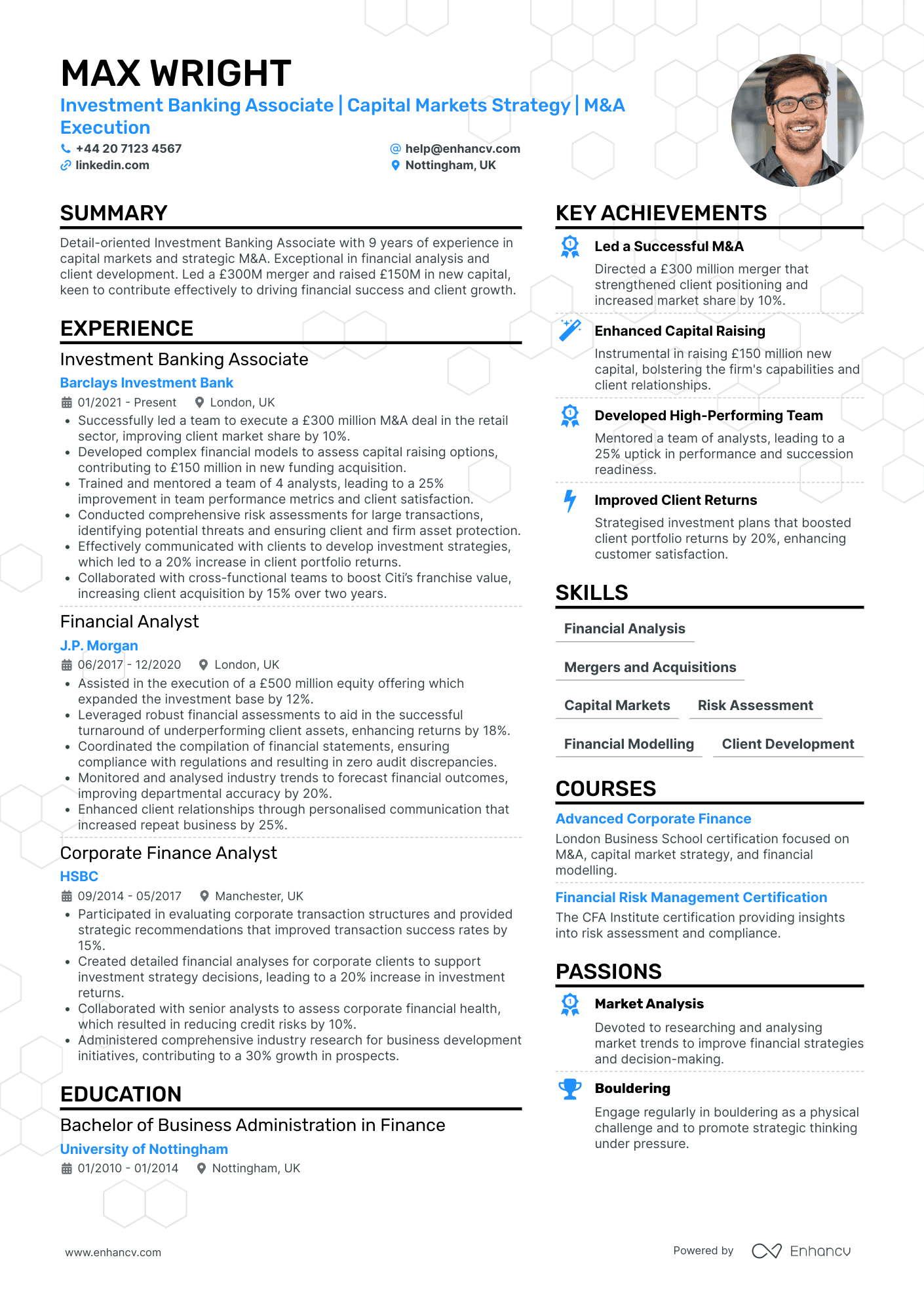
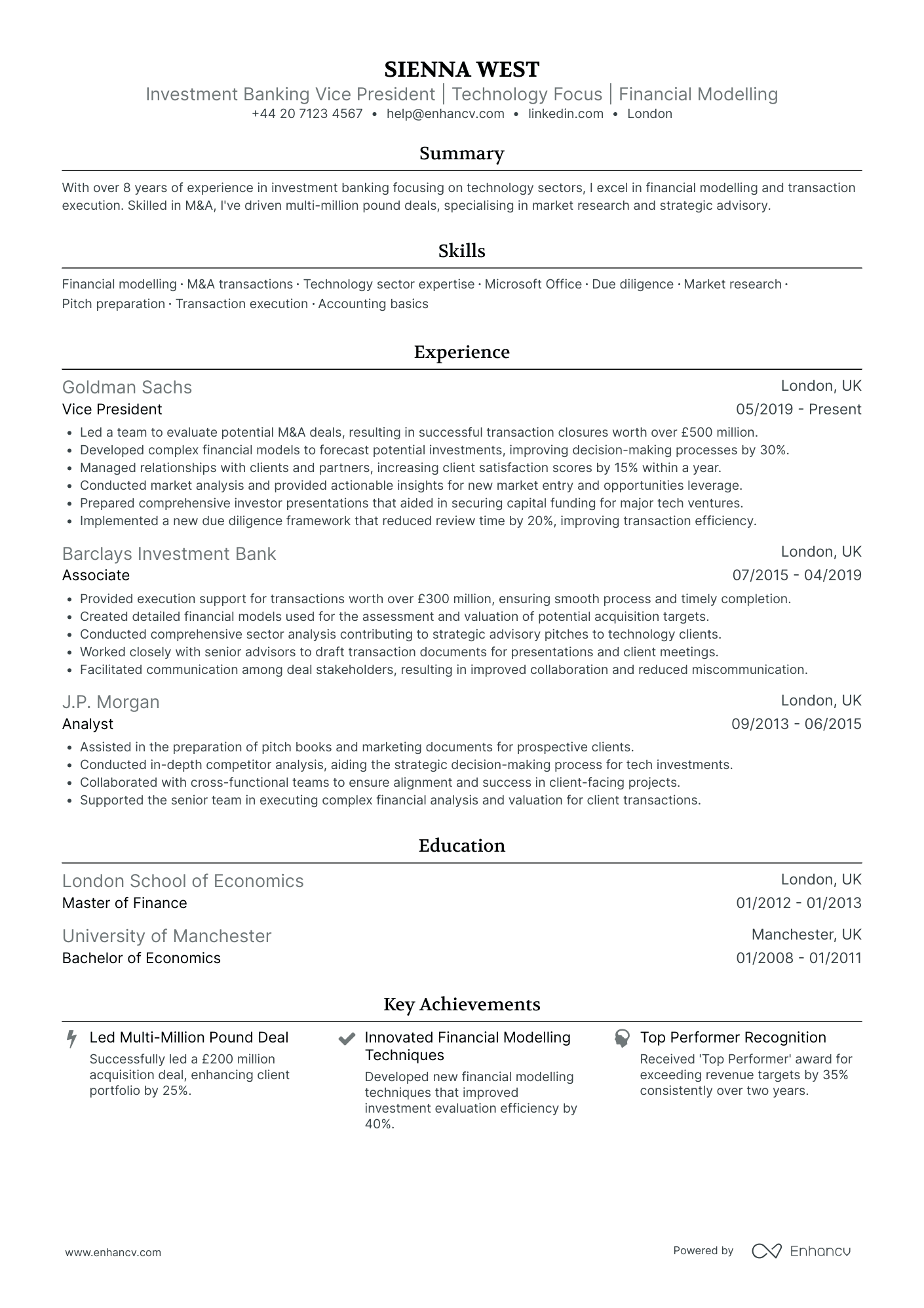
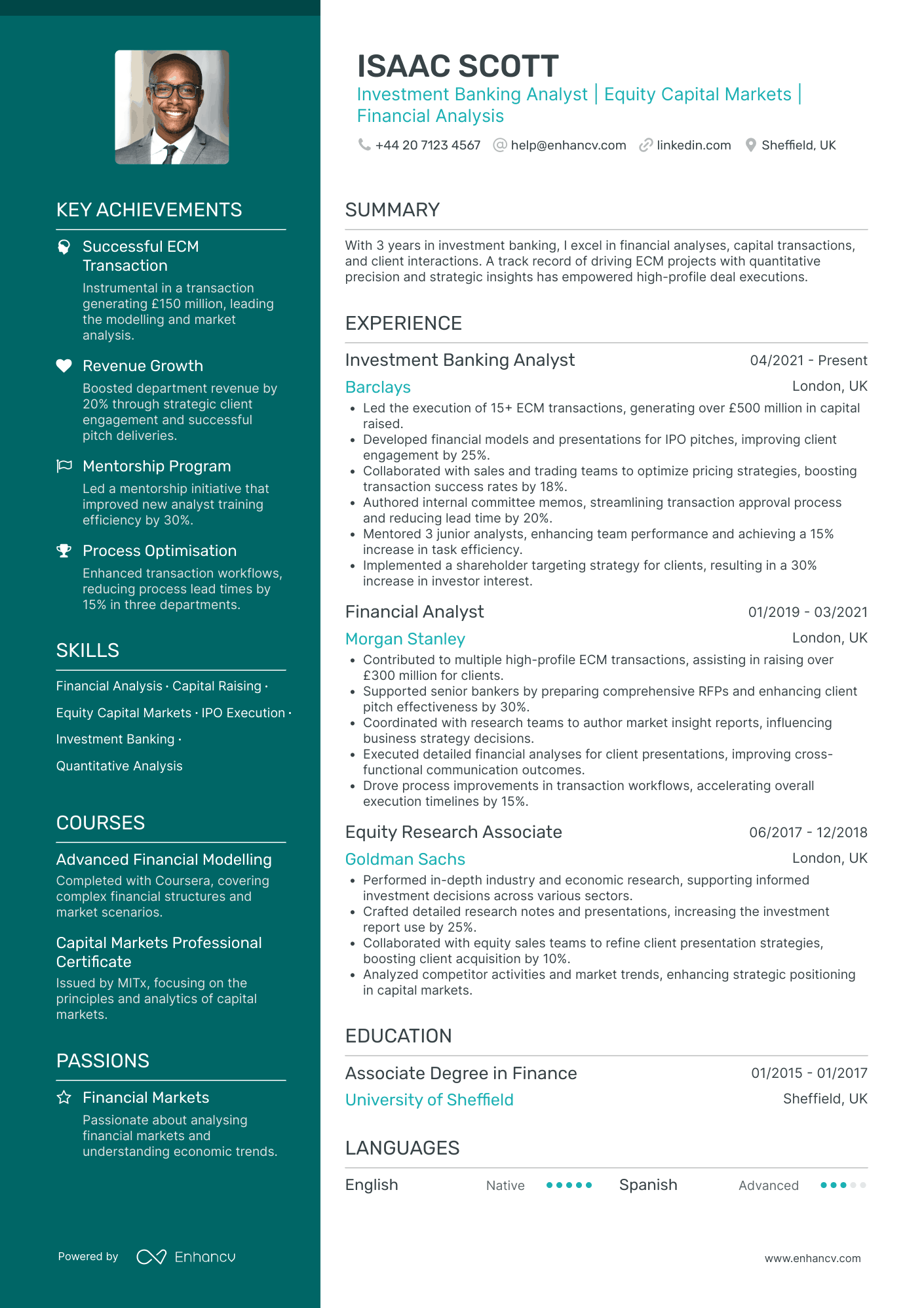
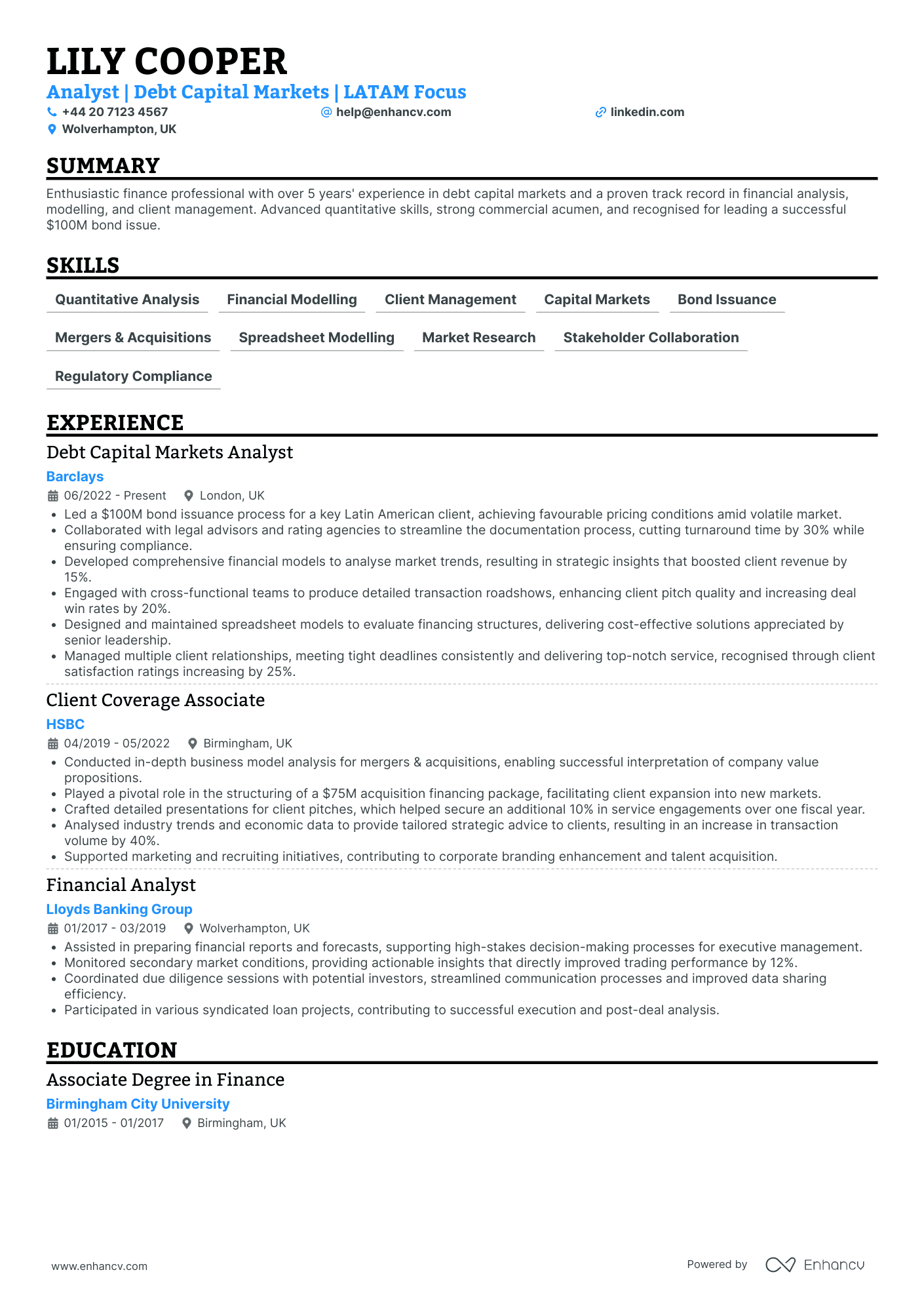
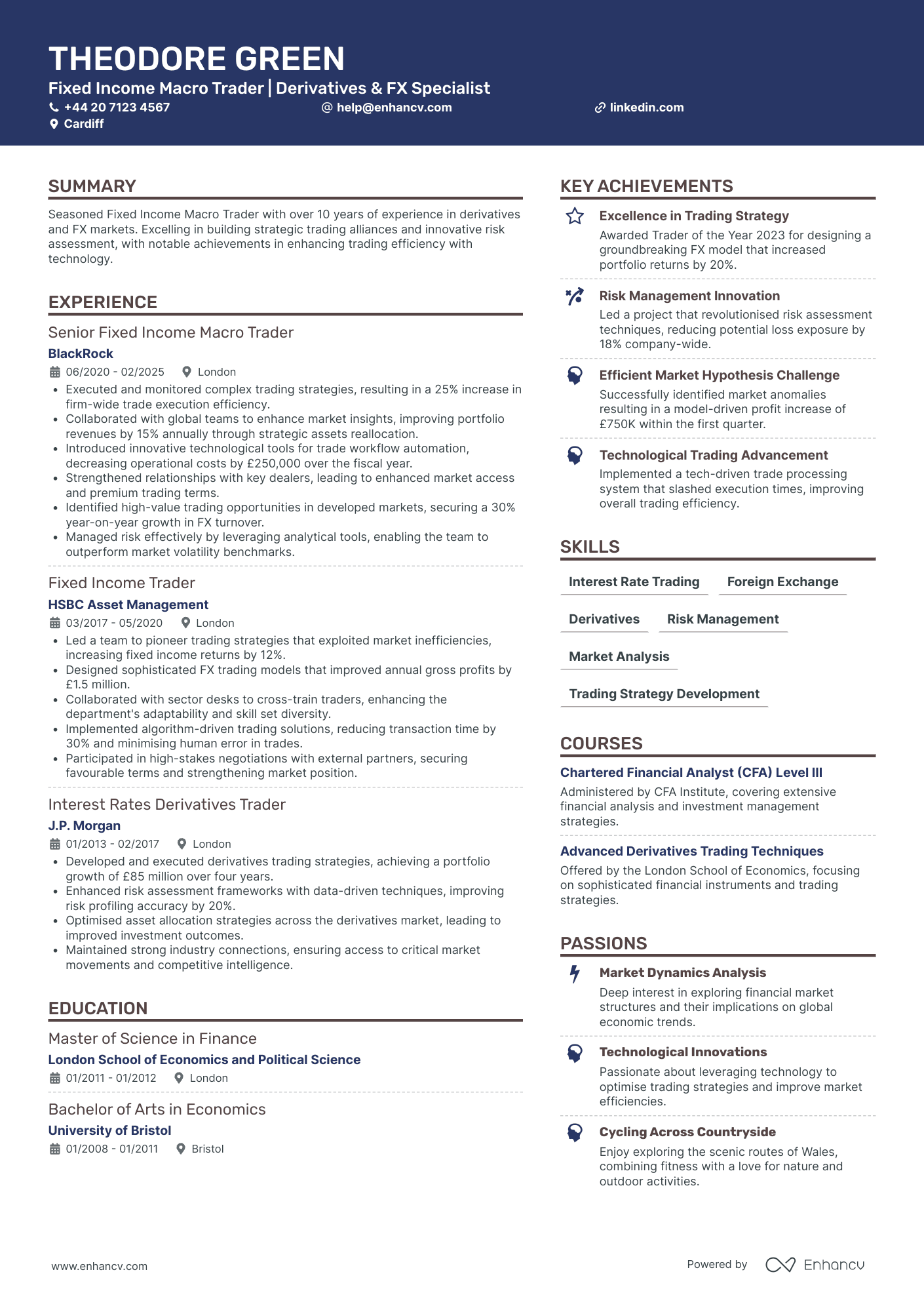
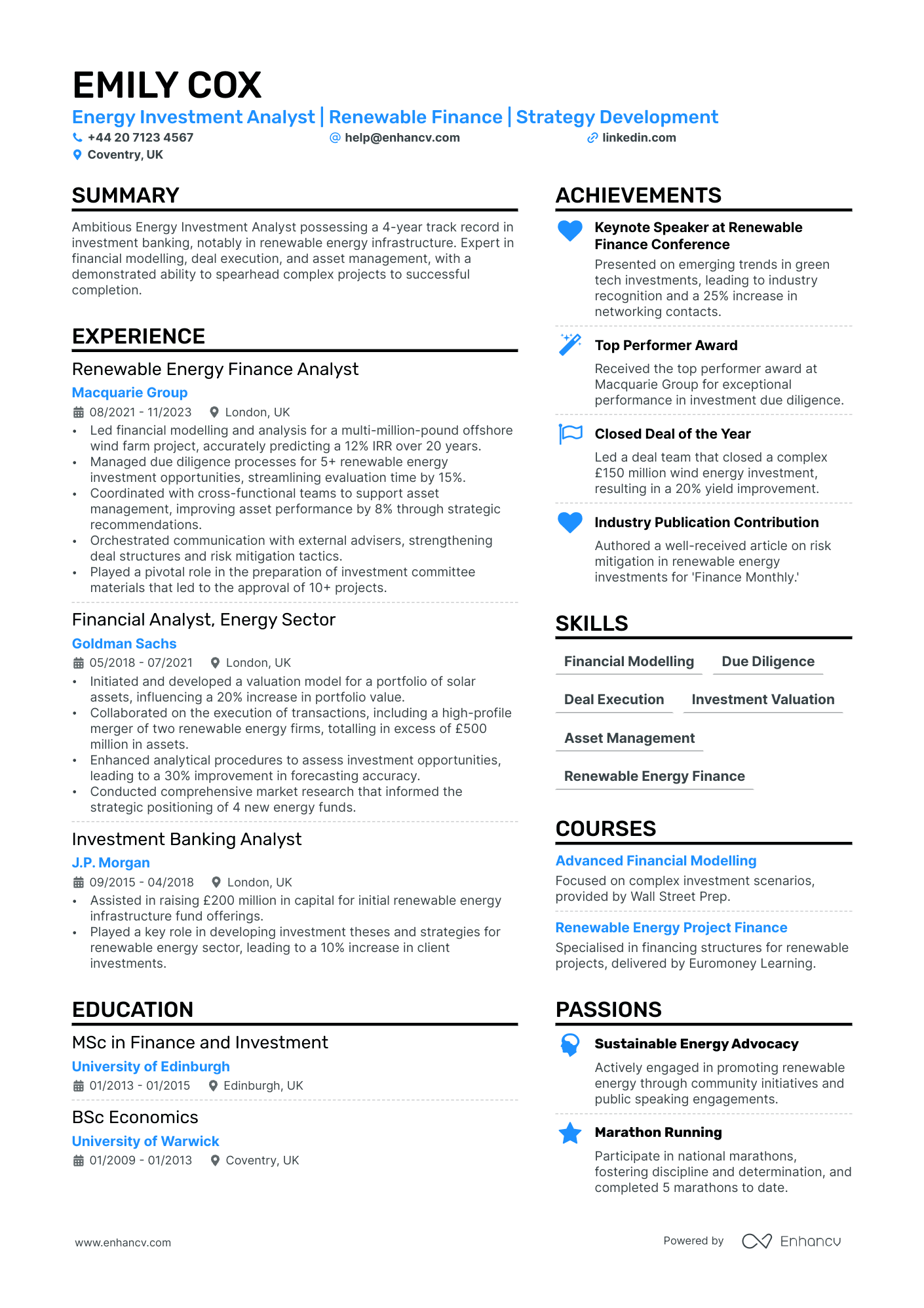
Most investment banking CVs read like a tombstone with the numbers blacked out, all deal names and no evidence of what you actually did on them. The ones that win interviews do the opposite.
Recruiting for the City and Canary Wharf runs on fast pattern recognition. The analyst screening a stack of applications wants deal exposure, a strong academic record, and a layout that respects the one-page convention, so a CV that misses any of those is filed before the detail gets read. If you want the fundamentals first, see how to write a CV.

Key takeaways
- One page is the norm in investment banking, not two. Analysts and associates fit everything onto a single dense page.
- Lead with deal experience: the transaction type, your specific role, the deal size, and the outcome.
- Your academic record stays on the CV. Show your degree classification, university, and A-level or GCSE grades so a junior CV can be checked fast.
- The work is on-site in London, so put your location in the header.
- Name the technical skills banks screen for: Excel, financial modelling, valuation, and M&A.
- Send a PDF so the layout holds, and keep a Word copy for recruitment agencies.
Formatting your investment banking CV
Investment banking breaks the usual UK two-page rule. For analyst and associate applications, one page is the standard, and running over it reads as a lack of discipline before a word is read. See how long a CV should be if you are coming from a field where two pages is the default.
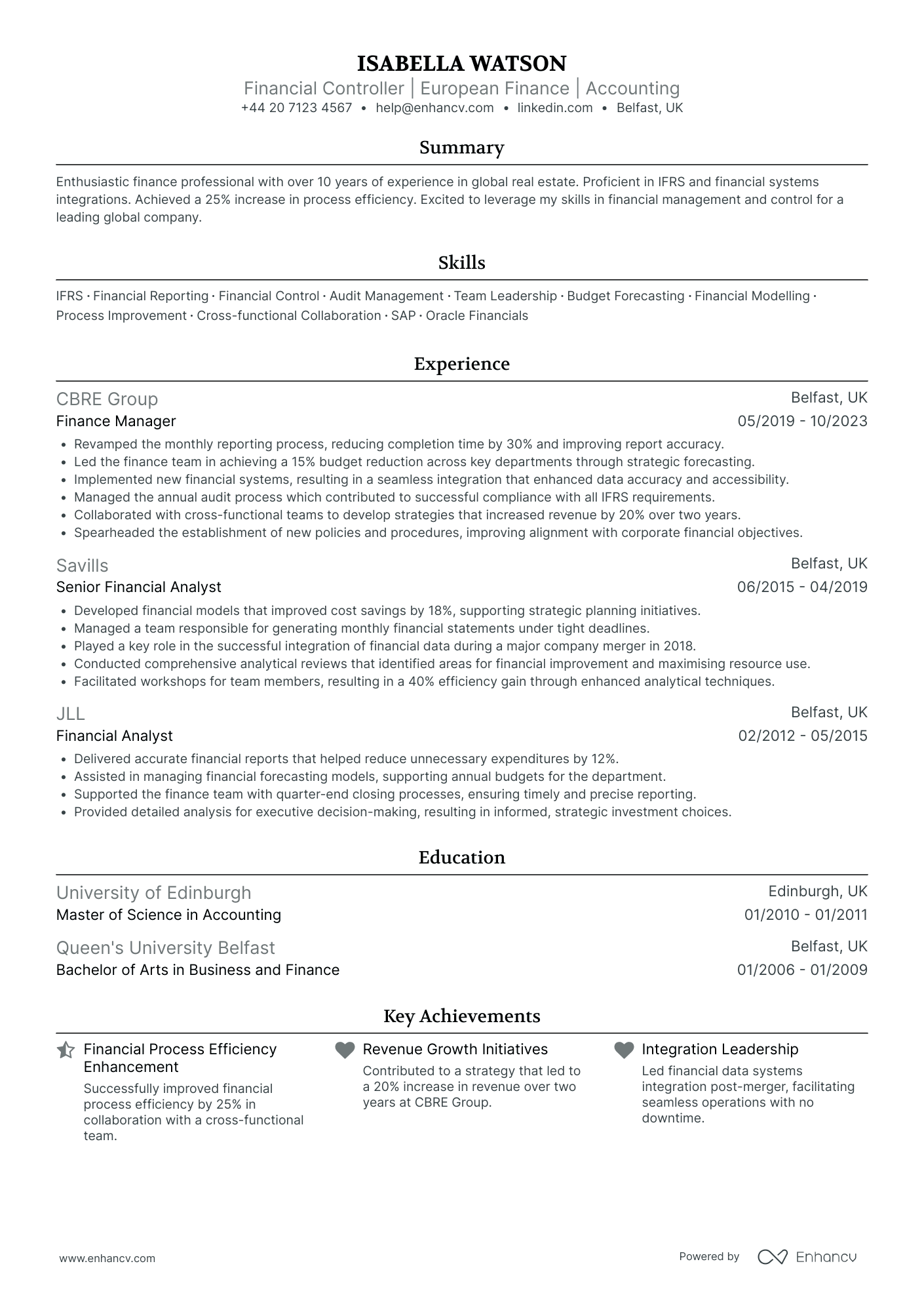
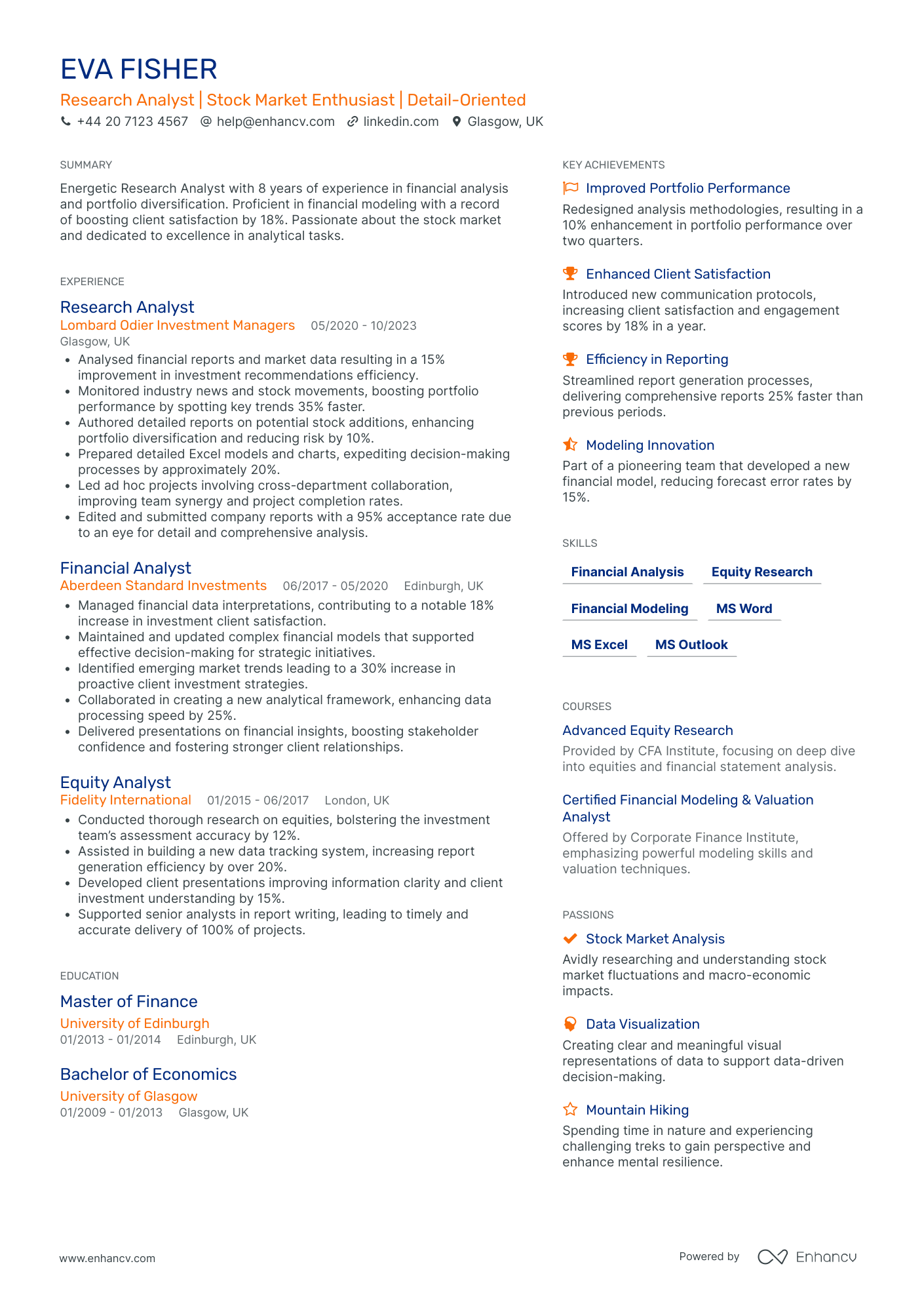
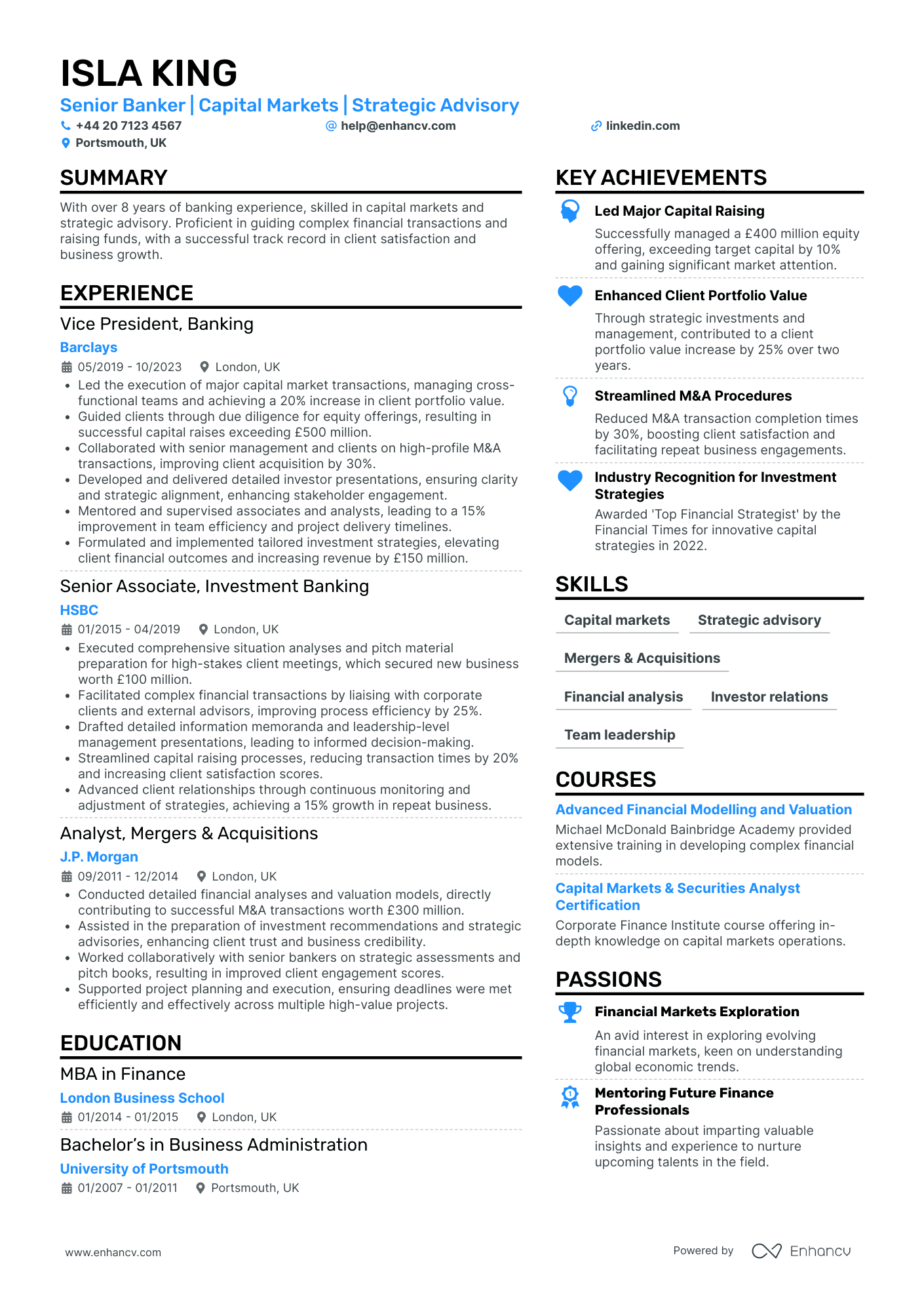
Use a reverse chronological structure, a single column, and standard headings. A recruiter should find your degree, your latest role, and your deal experience without scrolling or hunting through a clever layout that hides the basics.
For juniors, education sits above work experience, because the target university and classification are doing a lot of the screening. Once you have real deal roles behind you, flip that and lead with experience.
Experienced hires add a short "Selected transactions" block near the top, one line per deal with the type, the size, and your role. Analysts and interns fold that same detail into their internship bullets instead, because a standalone deal list would look thin.
Consistency is what makes a banking CV read as polished. Keep dates aligned down the right edge, use one font throughout, and make every bullet start with a verb and end with a full stop. A recruiter who spots ragged formatting assumes the same carelessness will show up in a model.

A one-page investment banking CV, top to bottom
- Header: name, London location, phone, email, and a LinkedIn URL.
- Education: university, degree and classification, key quantitative modules, then A-levels and GCSEs.
- Work experience: internships, spring weeks, and any deal or transaction exposure, most recent first.
- Skills: technical tools and modelling, kept to one tight line.
- Additional: languages, positions of responsibility, and a single line of genuine interests.
Give it a plain, professional font and generous margins so a dense single page still breathes. A conservative font in a readable size beats anything decorative, because banking values substance over design.
Send a PDF for direct applications so the spacing and alignment hold on any screen. Keep a Word copy for recruitment agencies, which often reformat CVs into their own template before sending them on.
Applications routed through a bank's portal are usually parsed by software first, so keep the headings standard and the layout clean for an ATS-friendly CV. Build it from a tested one-page layout rather than fighting a blank document: Enhancv's CV templates export to a clean PDF.

PRO TIP
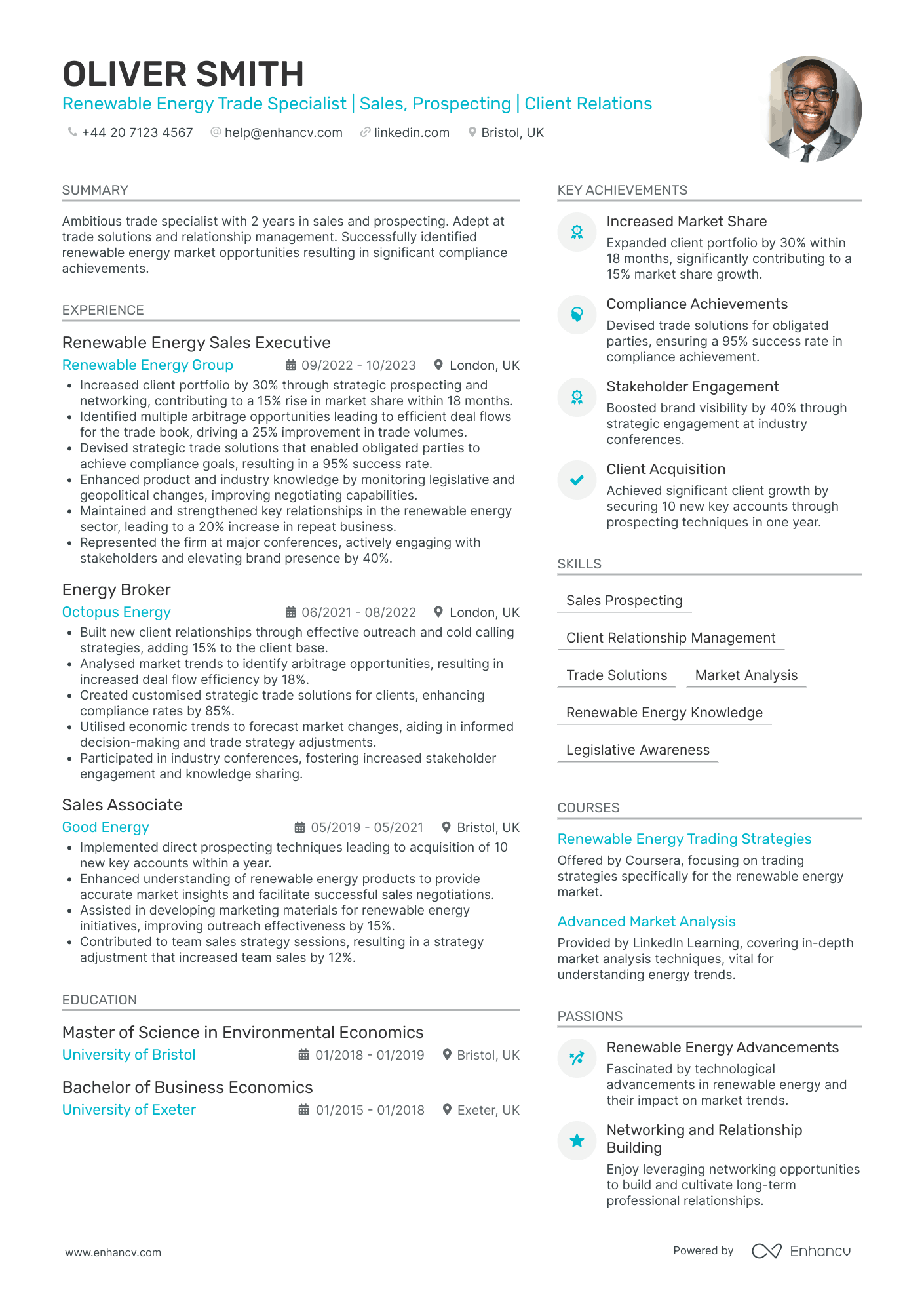
Keep the format ruthless. No photo, no age, no full street address, and no personal statement longer than three lines. Every millimetre of that single page should be showing deal exposure and academic strength, not decoration.
What the UK investment banking market looks like
Knowing what the roles actually ask for shapes what you put first. Here is what the current UK postings show.
| What | UK investment banking roles |
|---|---|
| Where the work happens | Almost entirely on-site (52 of 60 UK postings in the last ~30 days, Enhancv's internal job feed) |
| Experience level asked for | Mostly mid-level, with a sizeable entry-level intake (33 mid and 16 entry of 60 postings) |
| Most-listed skills | Excel, financial modelling, M&A, valuation, and PowerPoint |
| What it pays | No single verified UK figure was available for this search, so anchor your level on deal size and responsibility rather than a headline number |
Two things in that table should shape the CV.
The work is on-site and concentrated in London, so a recruiter needs to see at a glance that you are based there or moving there. Put your London location in the header rather than burying it.
And the mid-level demand sitting alongside a real entry-level intake tells you the analyst pipeline is genuine, so a well-built junior CV is worth the effort rather than a long shot.
The recurring skills point the same way. Excel and financial modelling show up more than anything else, so those belong high on the page and backed by a bullet, not buried in a list at the bottom.
Top skills for your investment banking CV
Read a run of live banking adverts and the same technical demands repeat. Excel, financial modelling, valuation, and M&A come up again and again, and they are your hard skills, listed in the words the adverts use.
The soft skills that matter here are the ones the job actually tests: attention to detail, working under pressure, and clear communication with a deal team. Prove each one in a bullet rather than just claiming it.
List only what you can defend in a technical interview. If you have built a DCF or an LBO, say so. If you have only read about them, keep them off the skills section until they are real.
Top skills for your investment banking CV:
Financial modelling
Excel
Valuation (DCF, comps, precedent transactions)
M&A execution
Three-statement modelling
LBO modelling
Financial analysis
PowerPoint
Attention to detail
Working under pressure
Communication
Commercial awareness
Teamwork
Writing your investment banking personal statement
Three lines at the top: who you are academically, the deal or internship exposure you bring, and the team you are targeting. Keep it concrete and keep it short. See more personal statement examples if the opening line is holding you up.
Name the specifics. The bank or type of firm, the coverage group or product area you want, and the language or region you can cover all tell a recruiter you have thought about where you fit rather than blasting the same paragraph everywhere.
Avoid the adjective soup that fills most banking applications. "Highly motivated and passionate" tells a recruiter nothing they can check, and they have read it a thousand times.
Lead with evidence instead:
Investment banking CV personal statement example
Penultimate-year Economics student at a Russell Group university (predicted 2:1) with a spring week at a bulge-bracket bank and a summer internship in the M&A team of a boutique advisory. Built three-statement and DCF models on two live sell-side mandates, including a £180m carve-out. Fluent in French and targeting a full-time analyst role in London coverage or advisory.
What to avoid
Highly motivated and passionate finance graduate seeking a challenging investment banking role in a dynamic, fast-paced environment where I can utilise my strong analytical skills, leverage my passion for the markets, and add value to a leading firm.
When we read an investment banking CV, we are scanning for three things in the first few seconds: a strong degree, real deal exposure, and numbers that prove you did the work rather than watched it. A line like "built the operating model for a £180m carve-out" beats a paragraph of adjectives every time. Name the transaction, your specific contribution, and the size. That is the difference between a CV that earns a phone screen and one that gets filed.
Writing your investment banking experience section
Whether it is a summer internship, a spring week, or an off-cycle placement, write each entry the same way: a dated heading, then bullets that lead with what you built or ran and end with the deal and the number. For the mechanics, see work experience on a CV.
Banking work is measurable even as a junior: models built, mandates supported, deal size, pages of a pitch owned. Those specifics are your CV achievements, and they beat any list of responsibilities. Open each line with a strong action verb.
Give each role three or four bullets, no more. A single page cannot carry ten lines per job, and a recruiter reads the first two anyway, so put your strongest deal work at the top of each entry and cut the routine admin.
Non-banking work still counts if you frame it in the language of the desk. Retail, tutoring, or a summer job shows reliability under pressure and client contact, so write it as evidence of those, not as filler you are apologising for.
Respect confidentiality on live deals. Use a rounded deal size and a generic descriptor like "a mid-market industrials carve-out" rather than naming a client you signed an NDA with. Recruiters read discretion as a sign you can be trusted on a real mandate.
Tailor every application to the team you are applying to, mirroring the coverage area and the tools named in the advert where they are true of you. Enhancv's CV tailoring feature reads the advert and suggests the matching edits, which saves rewriting from a blank page each time.
- Built and maintained three-statement, DCF, and LBO models across two live sell-side mandates worth a combined £250m
- Prepared pitch materials and management presentations for a £180m carve-out, working directly with the deal lead
- Ran comparable company and precedent transaction analysis for a healthcare coverage team, feeding into three client pitches
- Coordinated the diligence data room and tracked buyer queries across a two-month process, reporting to associates daily
PRO TIP
Lead every bullet with what you built or ran, then the deal and the size. "Built the LBO model for a £180m buyout" says far more than "assisted the deal team with financial analysis". Bankers hire people who can point to specific work on specific transactions.
Education and qualifications for an investment banking CV
Investment banking is one of the few fields where your degree, and even your A-levels, stay on the CV well into your early career. Give your education section the space it deserves near the top.
Lead with your university, degree, and classification. A 2:1 is the usual floor, and a first is a genuine advantage. List your strongest quantitative modules, your A-level grades, and solid GCSEs, especially maths.
Relevant certifications carry weight. The CFA, in progress or passed at Level I, signals commitment to the technical side, and an ACA or ACCA matters more for roles that touch accounting and valuation. Do not pad this block with short online courses, because one or two genuine qualifications say more than a long list.
If you attended a target or semi-target university, the name carries weight and belongs in full. If you did not, let a strong classification and clear quantitative results do the work, and lean harder on internships and modelling to prove the same ability.
Breaking into investment banking with no experience
Almost nobody walks into banking with full-time deal experience. The route in runs through spring weeks, insight programmes, and summer internships, so a first CV has to make the most of those and of everything adjacent to them. If this is your first serious application, start from CV examples for a first job.
No internship yet? Build the CV around evidence of the same skills. An investment or finance society, a stock-pitch competition, a self-taught modelling course, or a company you have valued on your own all show genuine interest and applied technical work.
Use a skills-led structure while your experience is thin, then switch to a deal-led one once you have internships behind you.
Timing matters as much as content. Spring weeks open in the autumn of your first year and summer internships close early, often more than a year before the role starts, so a CV that is ready in September gives you the widest run at the deadlines.
Networking does the rest. A sharp, targeted CV plus a coffee chat that turns into a referral beats a cold application to the portal.
Conclusion
Fit it on one page, lead with quantified deal work, and keep the academic record visible. That is what a City recruiter screens for.
Pair the CV with a short cover letter that names the bank, the team, and why you, and you turn a strong CV into an interview.
Author's take - the Enhancv team
When we read an investment banking CV, we are scanning for three things in the first few seconds: a strong degree, real deal exposure, and numbers that prove you did the work rather than watched it. A line like "built the operating model for a £180m carve-out" beats a paragraph of adjectives every time. Name the transaction, your specific contribution, and the size. That is the difference between a CV that earns a phone screen and one that gets filed.