



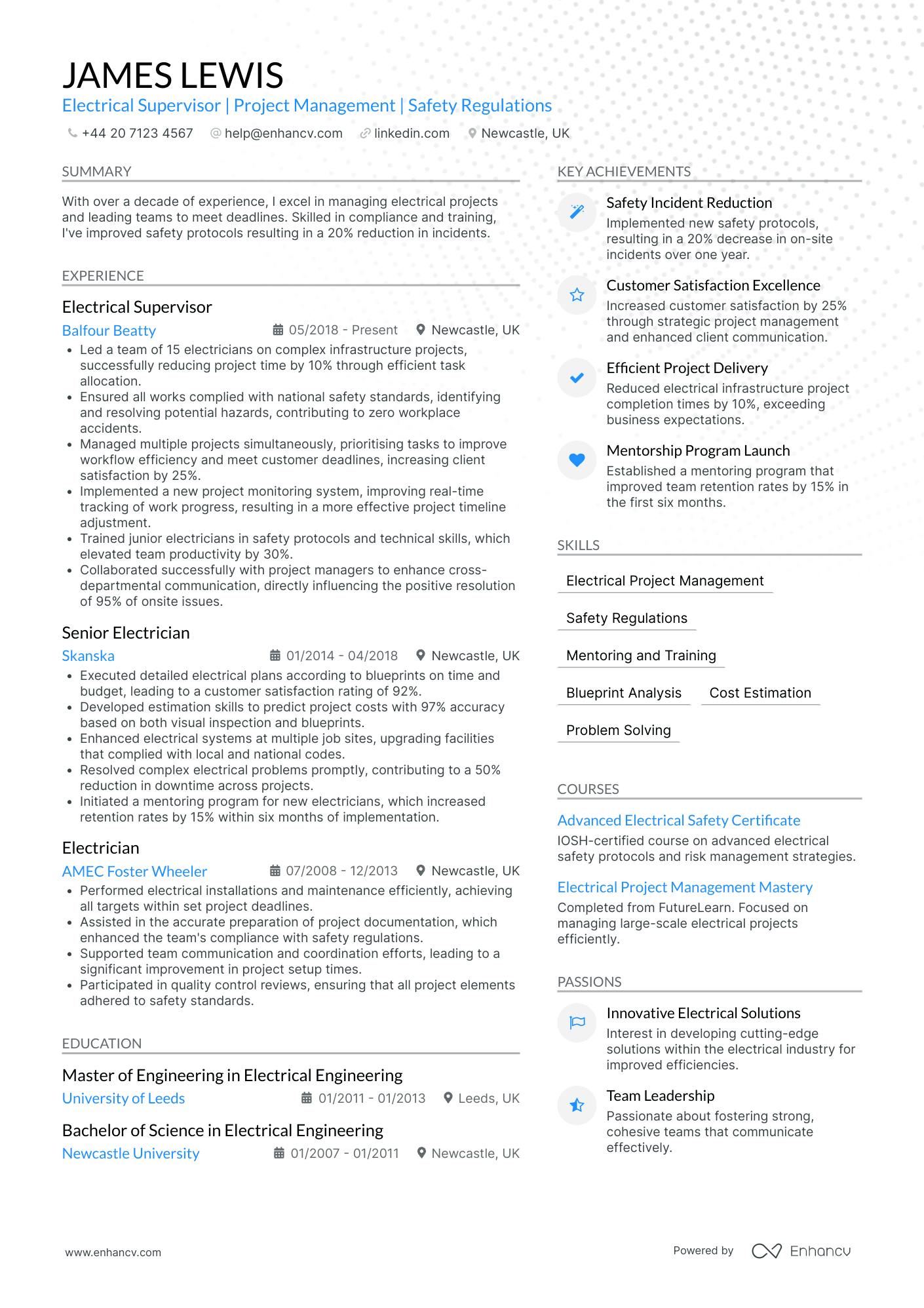
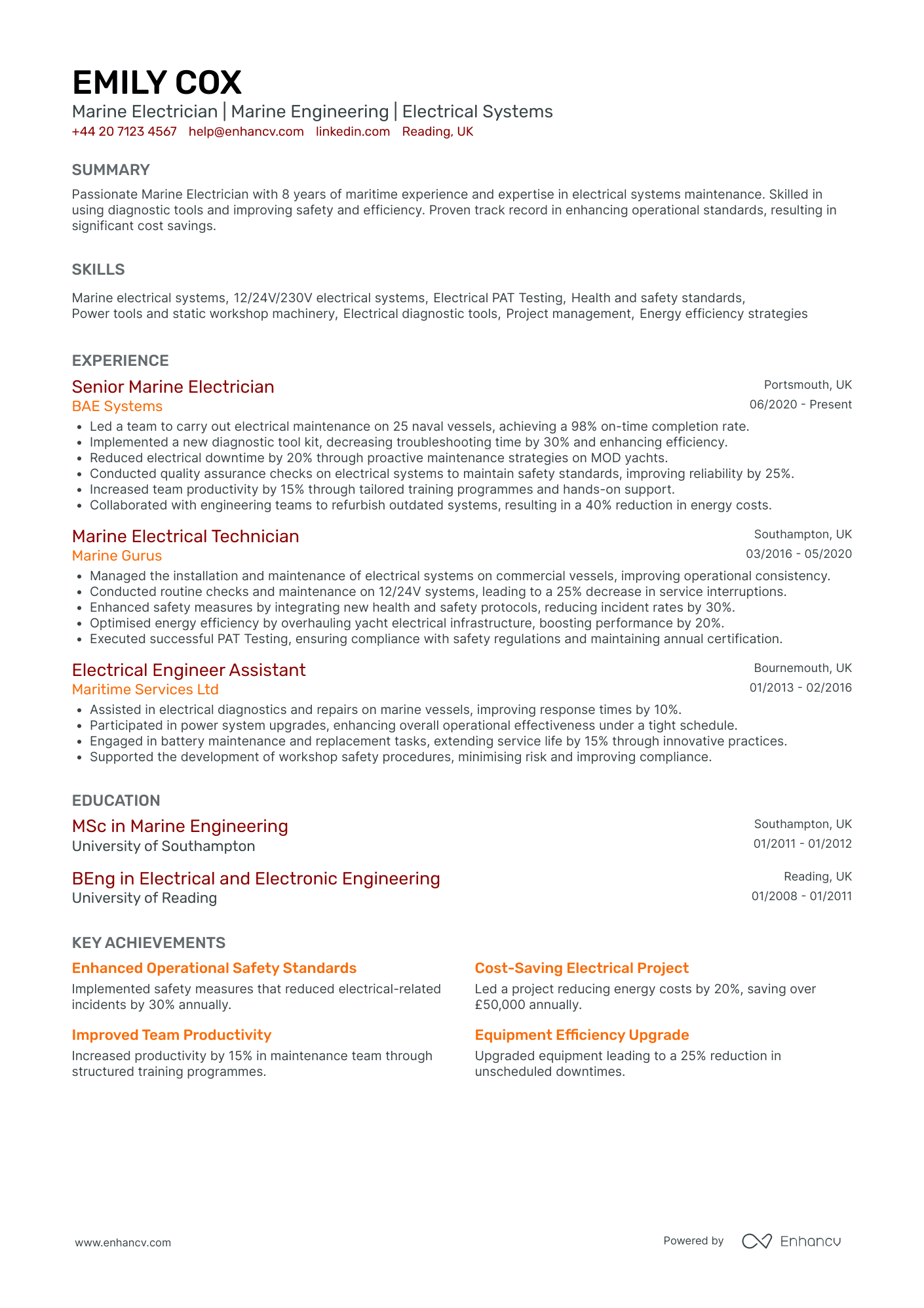
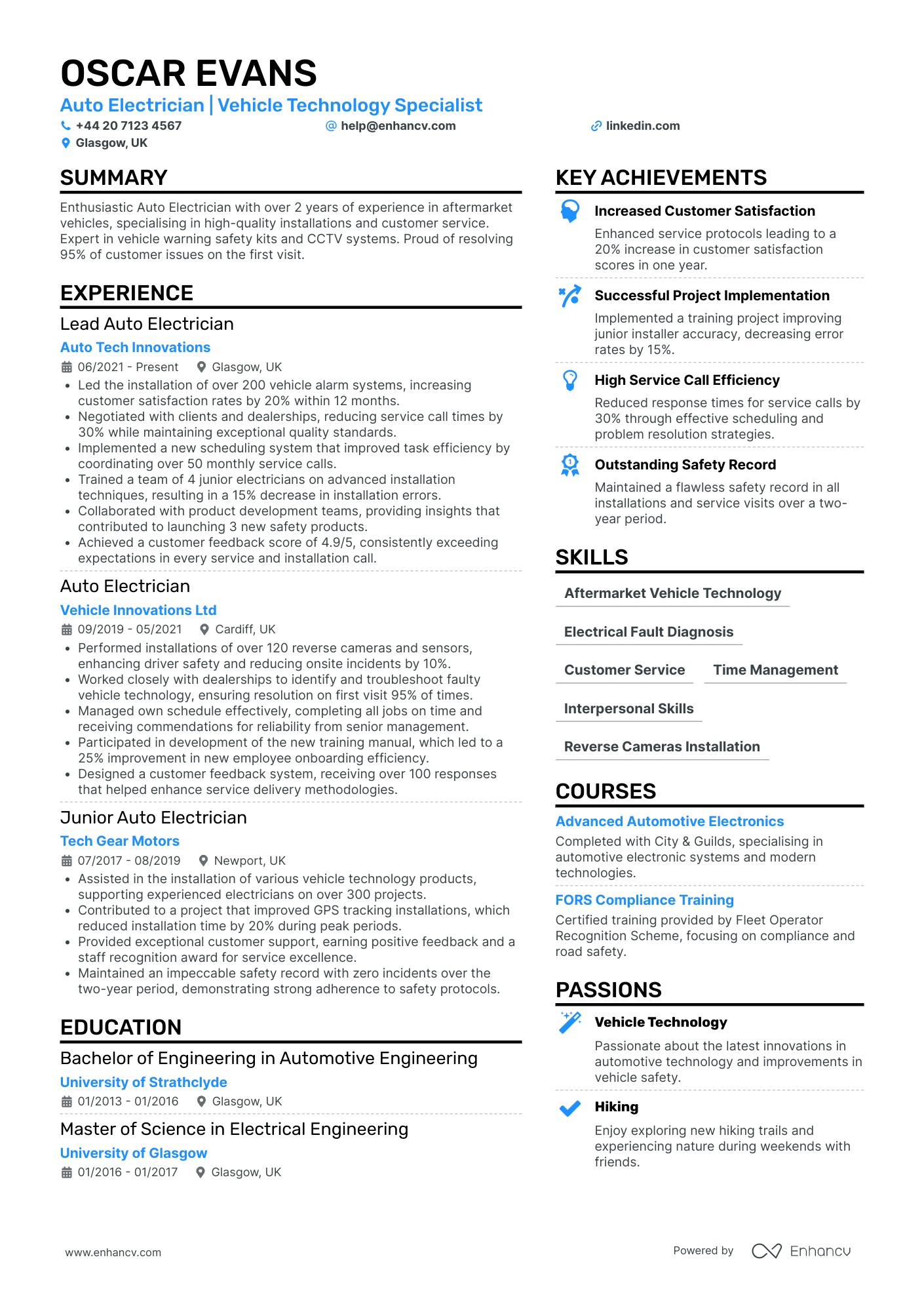
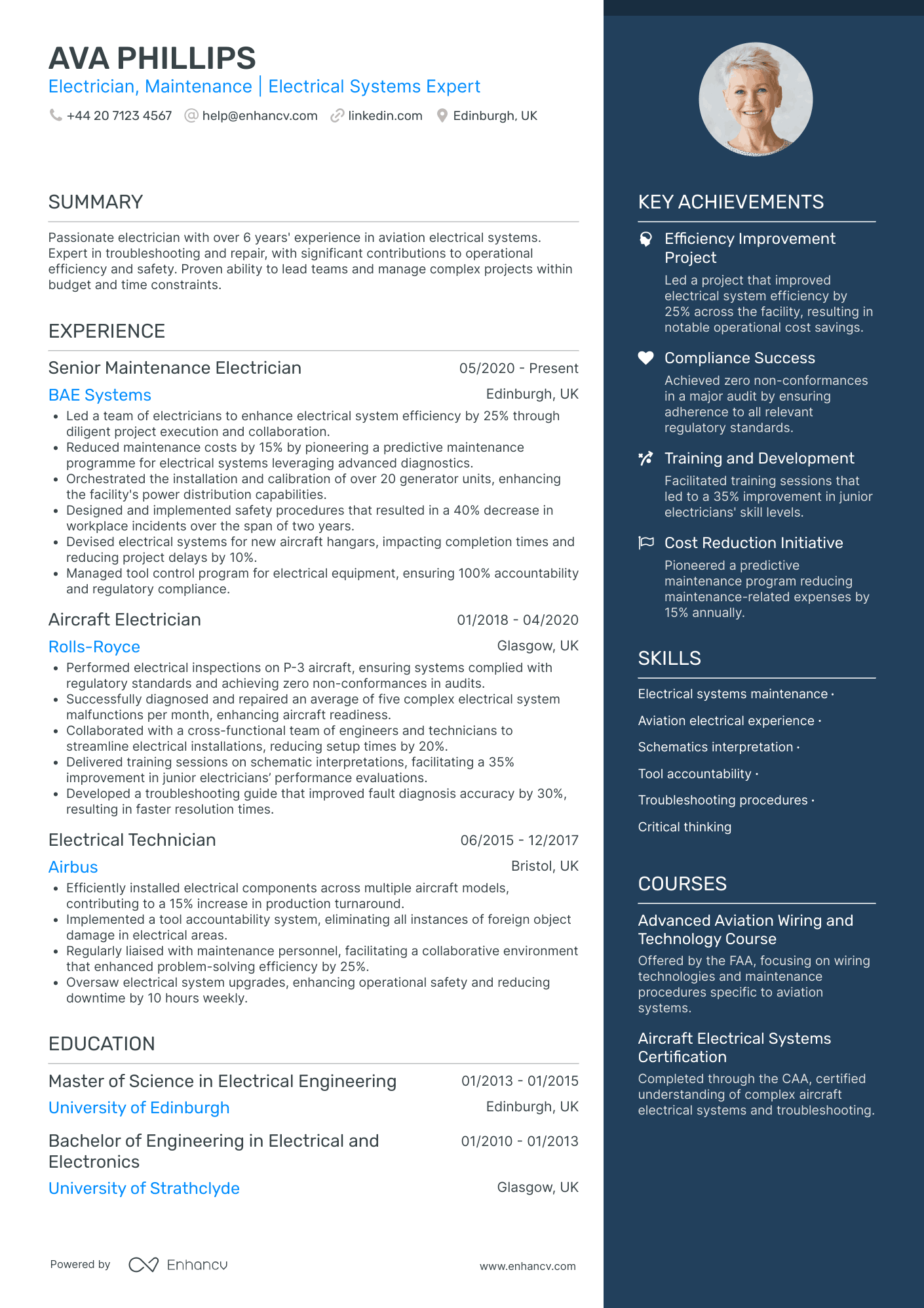
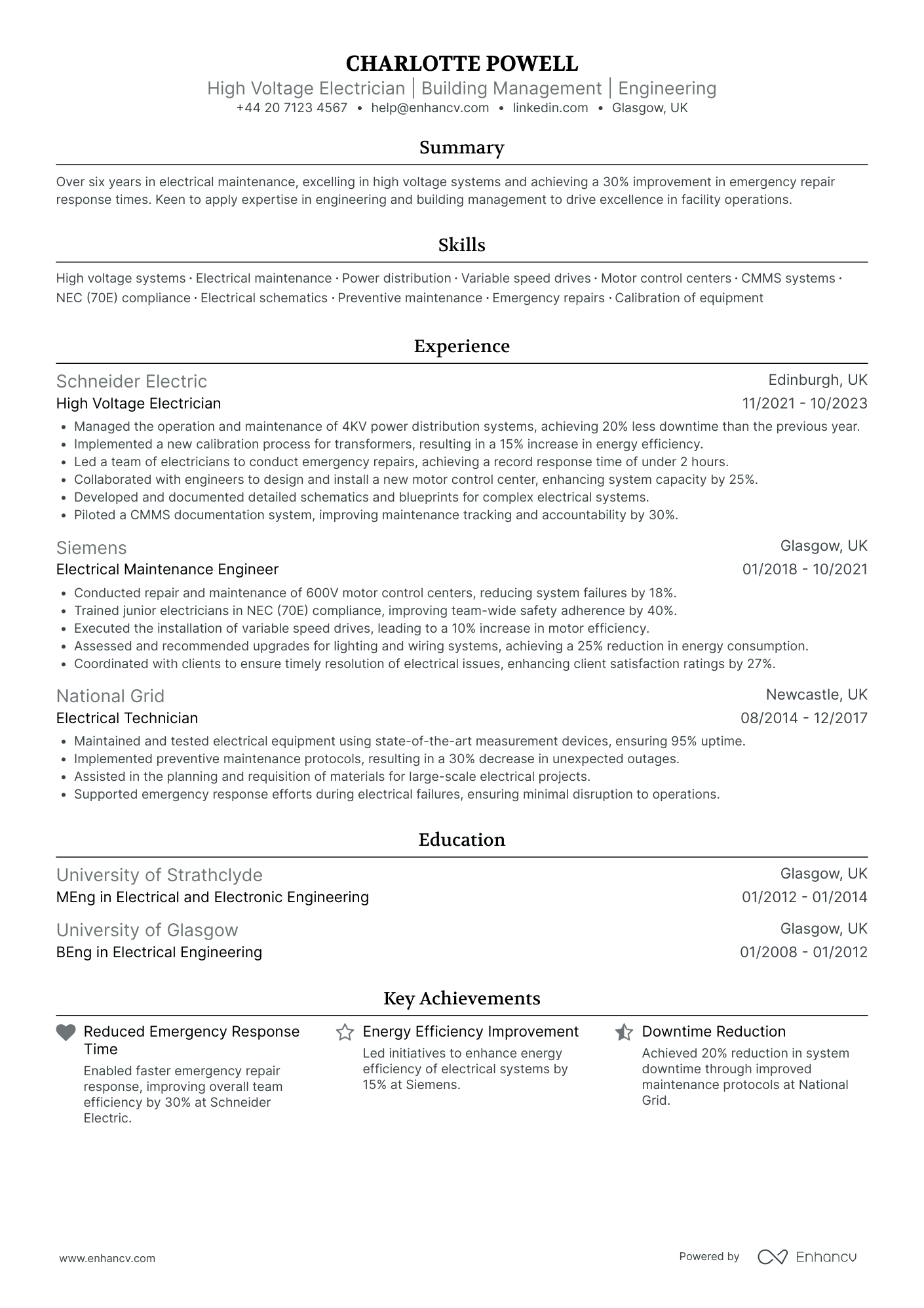
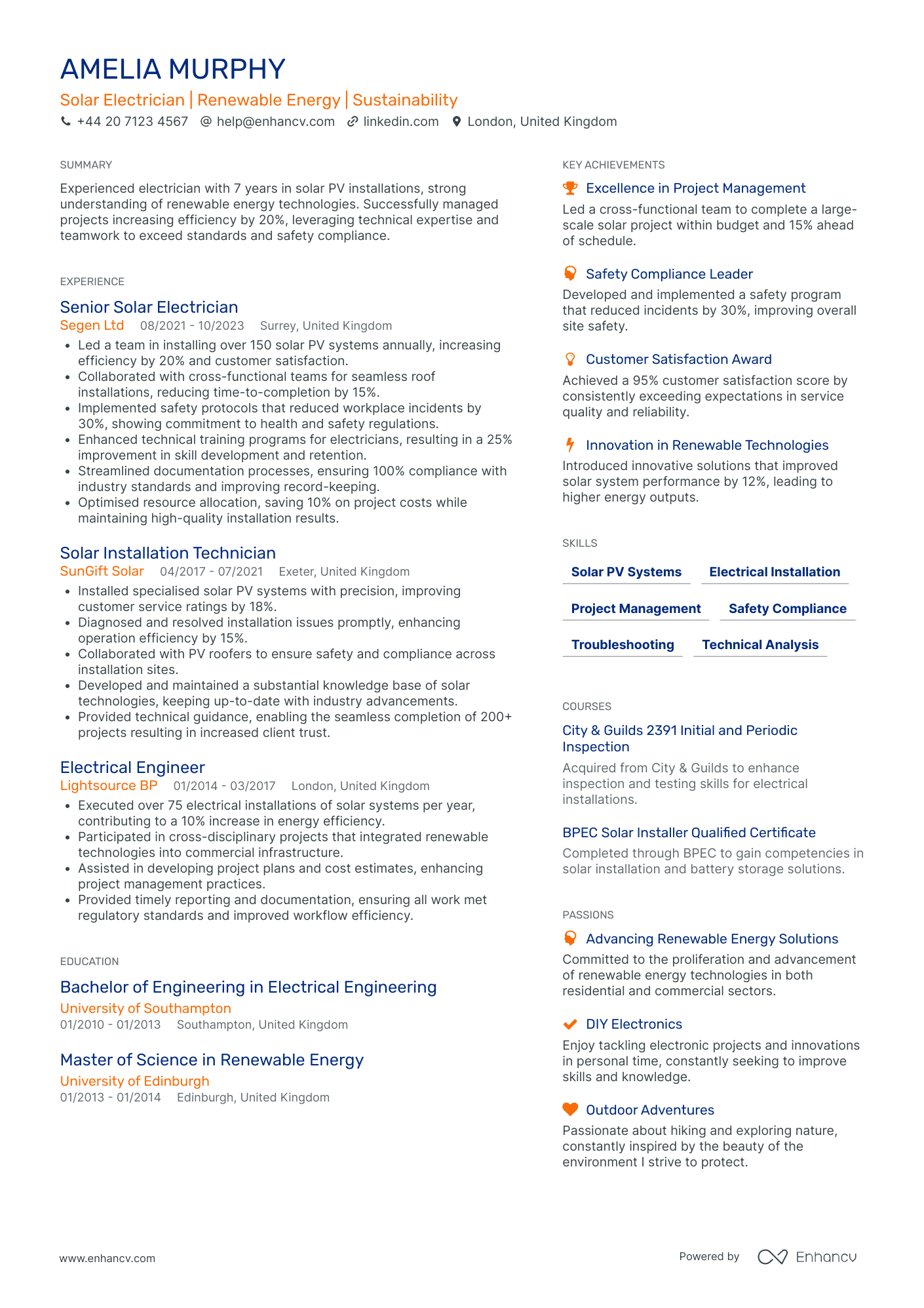
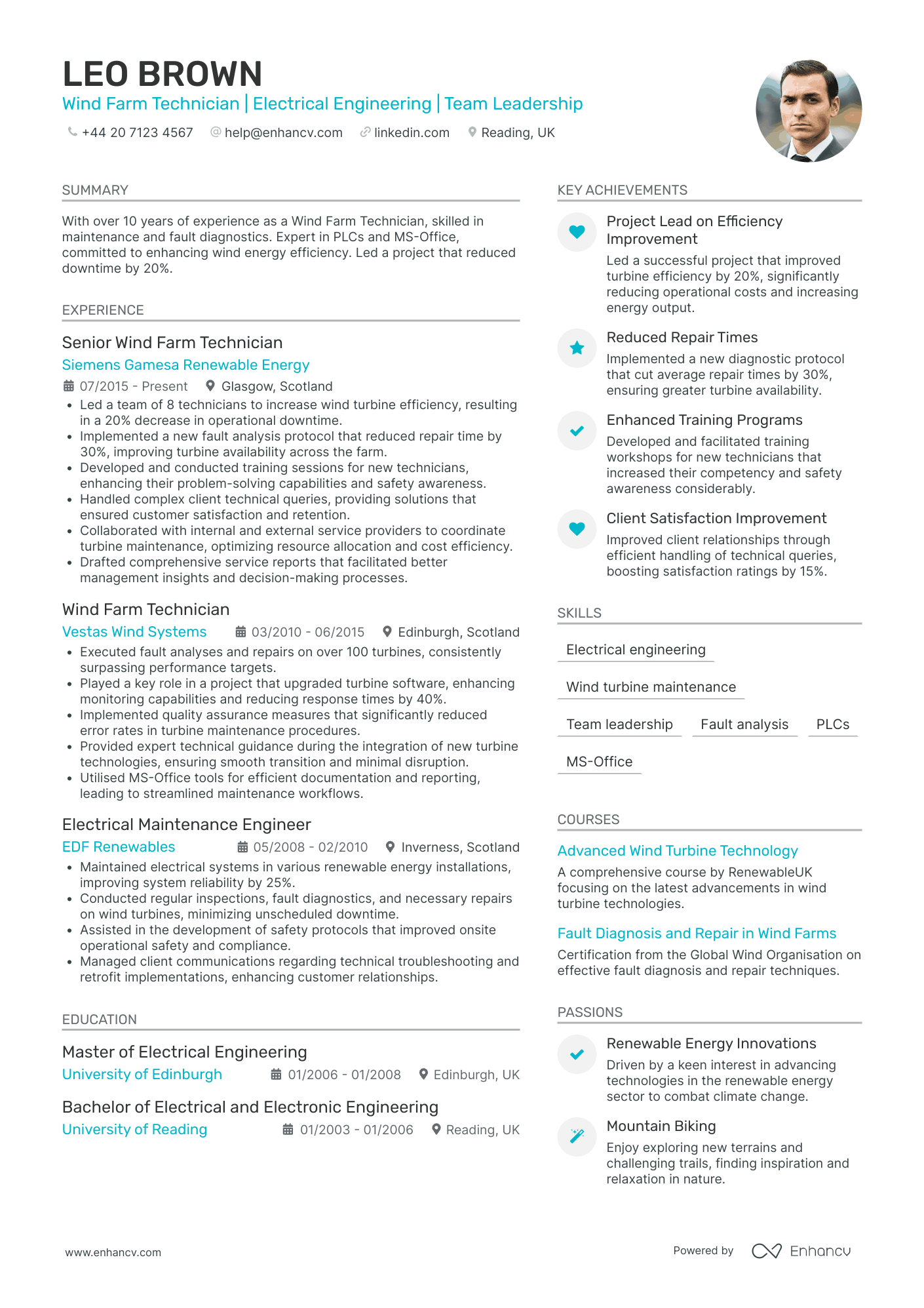
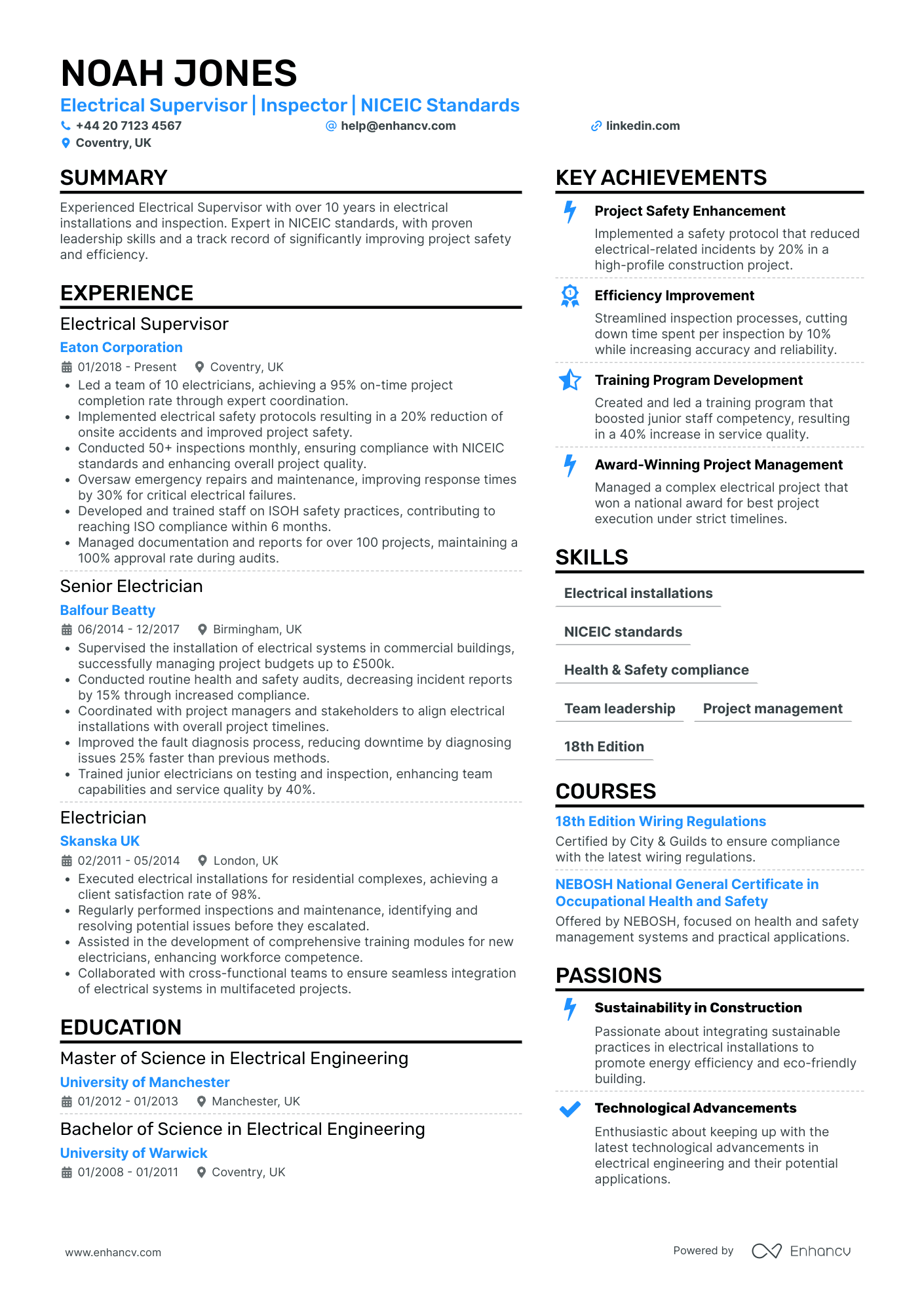
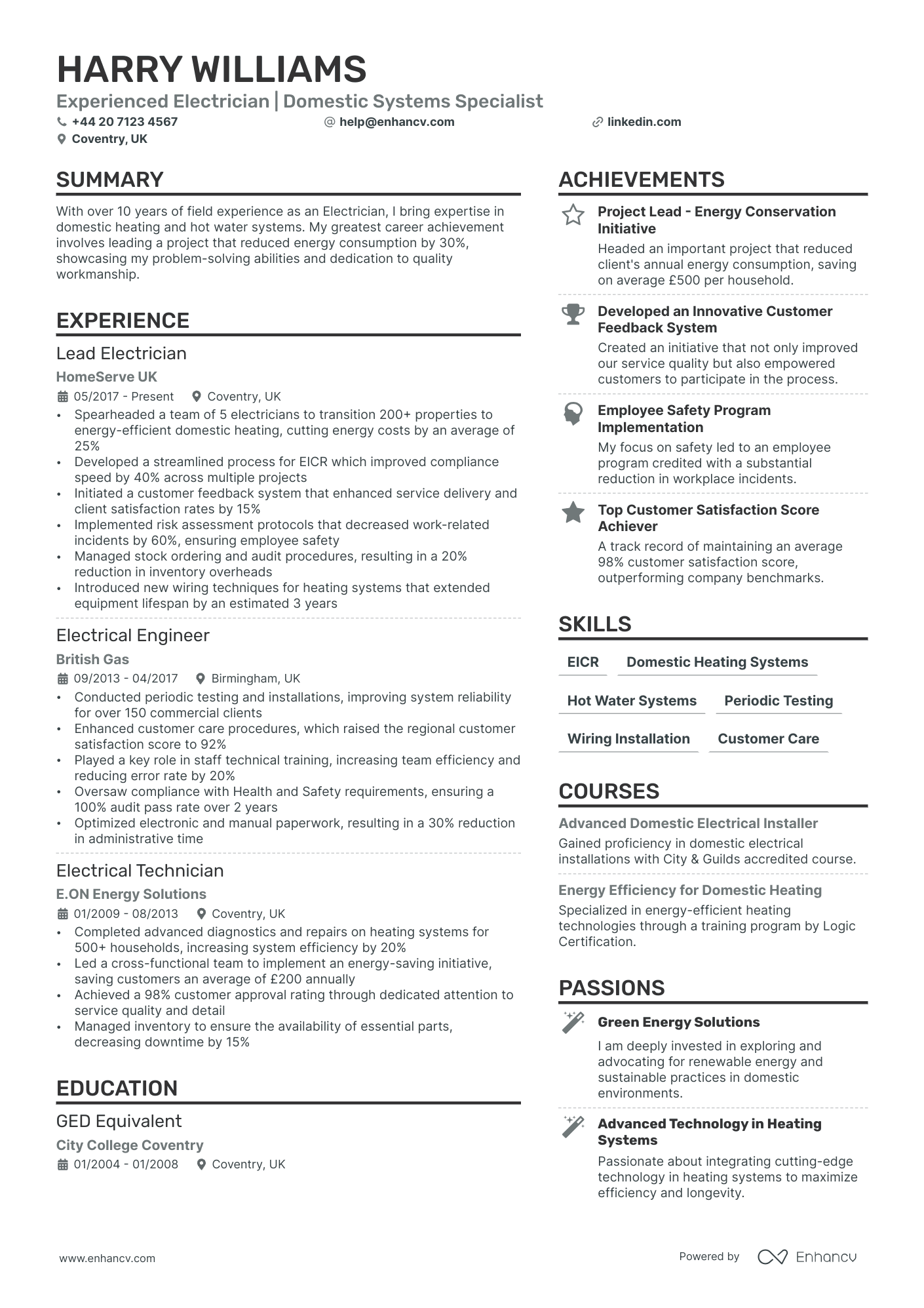
A recruiter fills an electrician vacancy on two questions: are you qualified and card-carrying, and can you be trusted on a live site without close supervision. Most CVs make them dig for the answers.
The fix is not a flashier template. It is a clean, standard layout that puts your ECS card, your 18th Edition, and your best-quantified jobs where a busy hiring manager reads them in the first ten seconds.

Key takeaways
- Lead with your ECS card status and the 18th Edition (BS 7671). Employers screen for both before anything else.
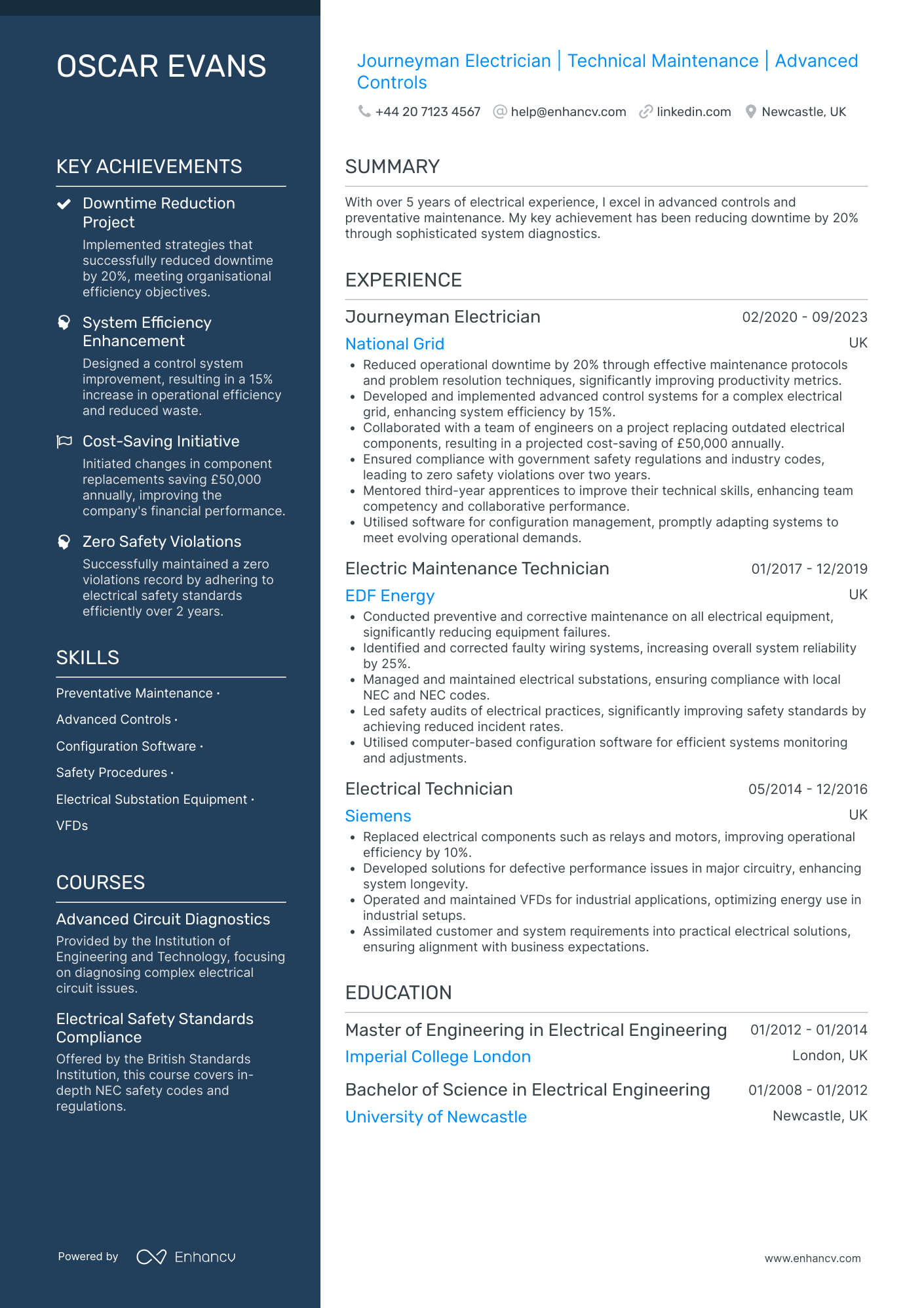
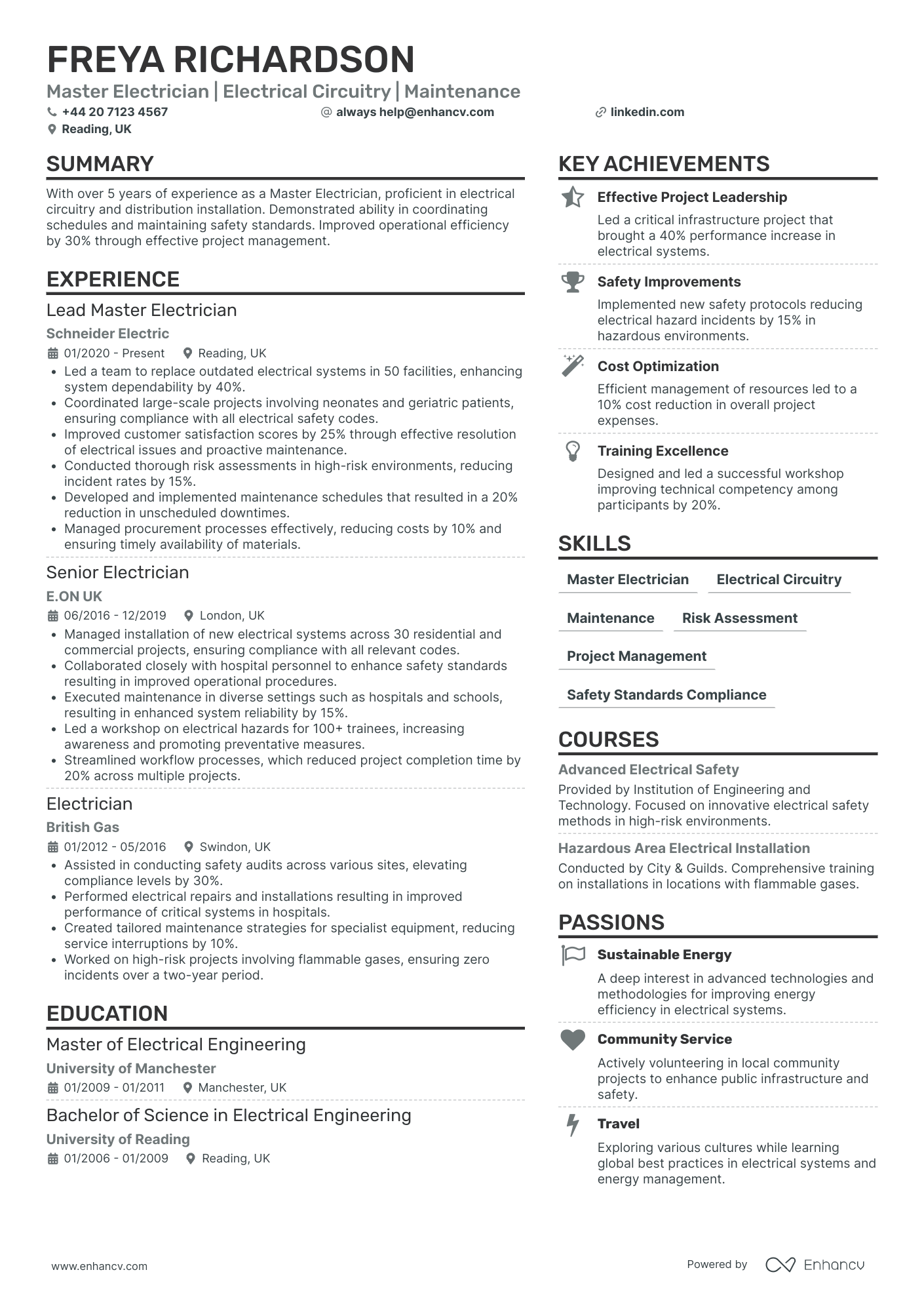
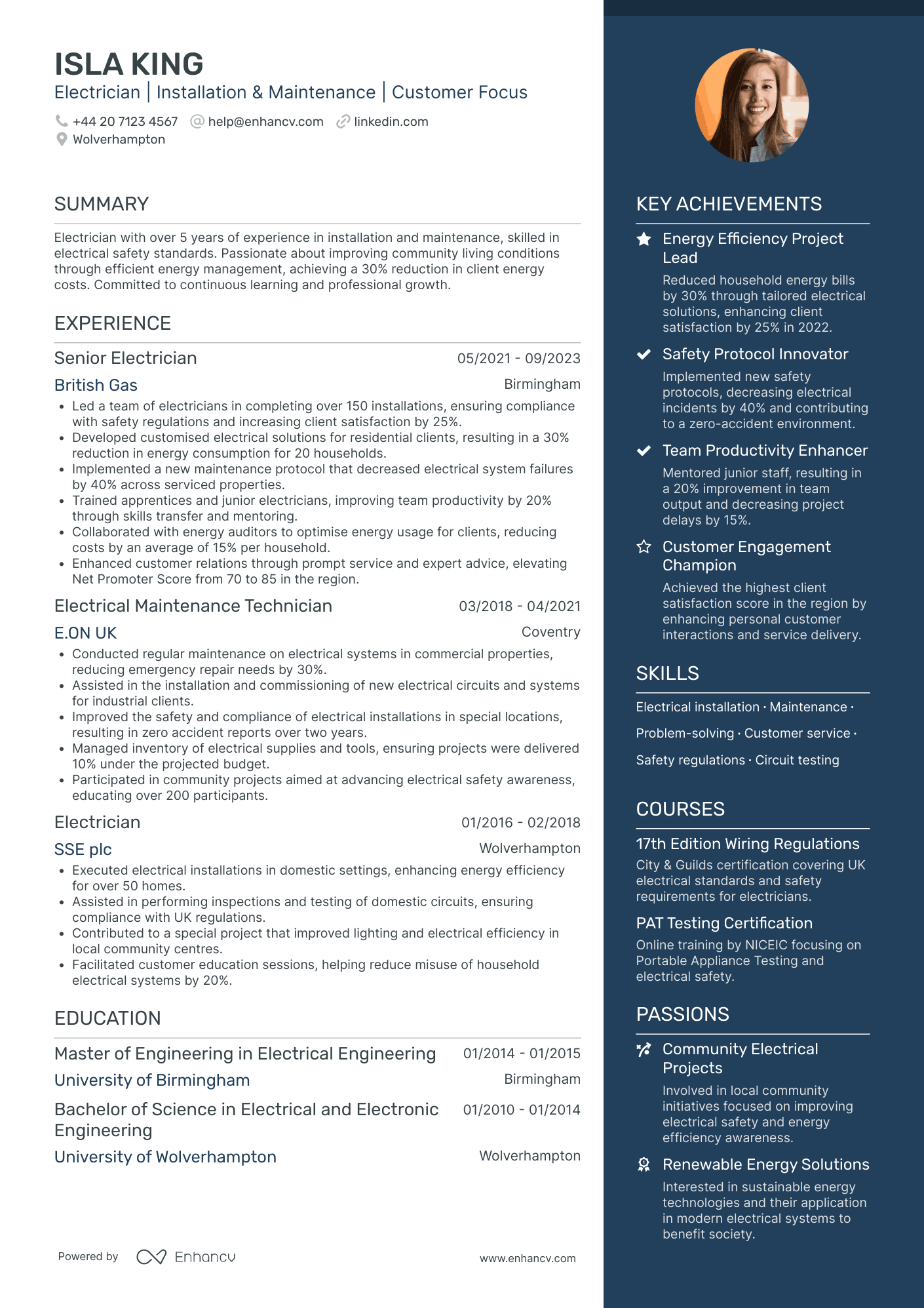
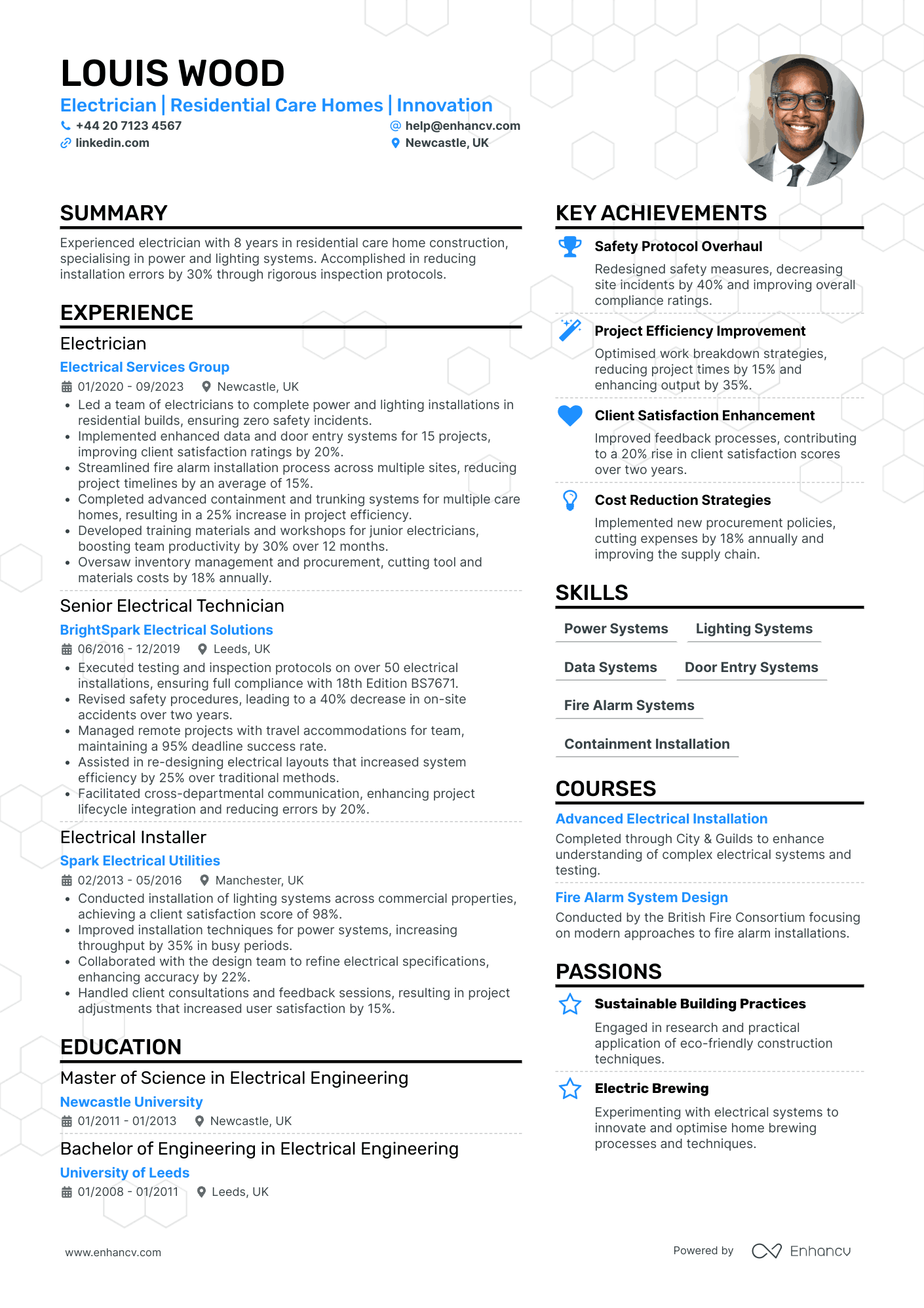
- Use a clean, single-column template in reverse chronological order. A decorative layout works against you in this trade.
- Two pages, sent as a PDF unless the advert asks for Word. Keep a Word copy for agencies.
- Electrician work is almost entirely on-site, so put your location, travel radius, and driving licence near the top.
- Quantify the jobs: properties tested, boards changed, faults cleared, downtime cut. One real number beats a line of adjectives.
- Mirror the advert's exact wording for regs and tests, such as EICR, testing and inspection, and fault finding.
Formatting your electrician CV
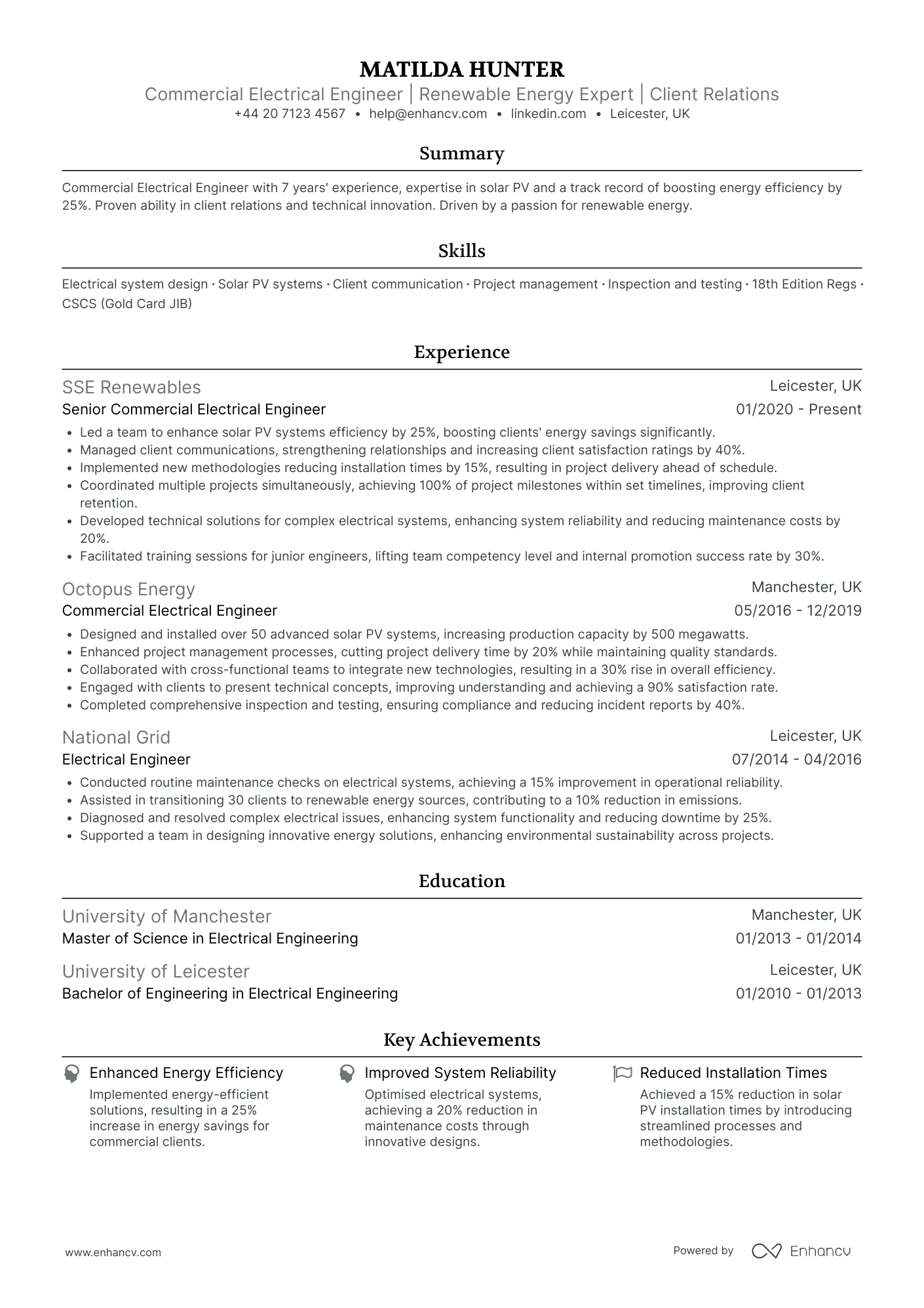
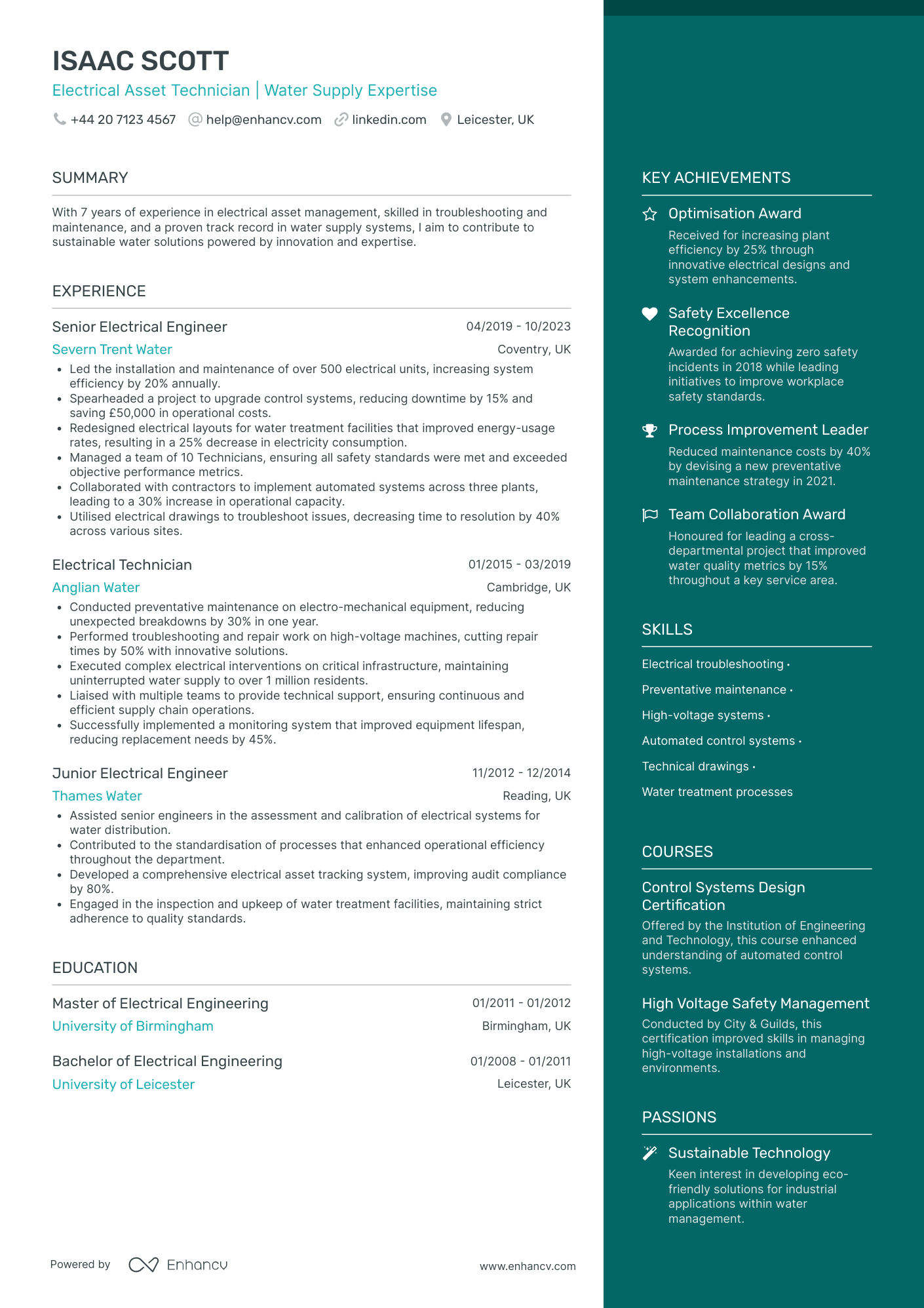
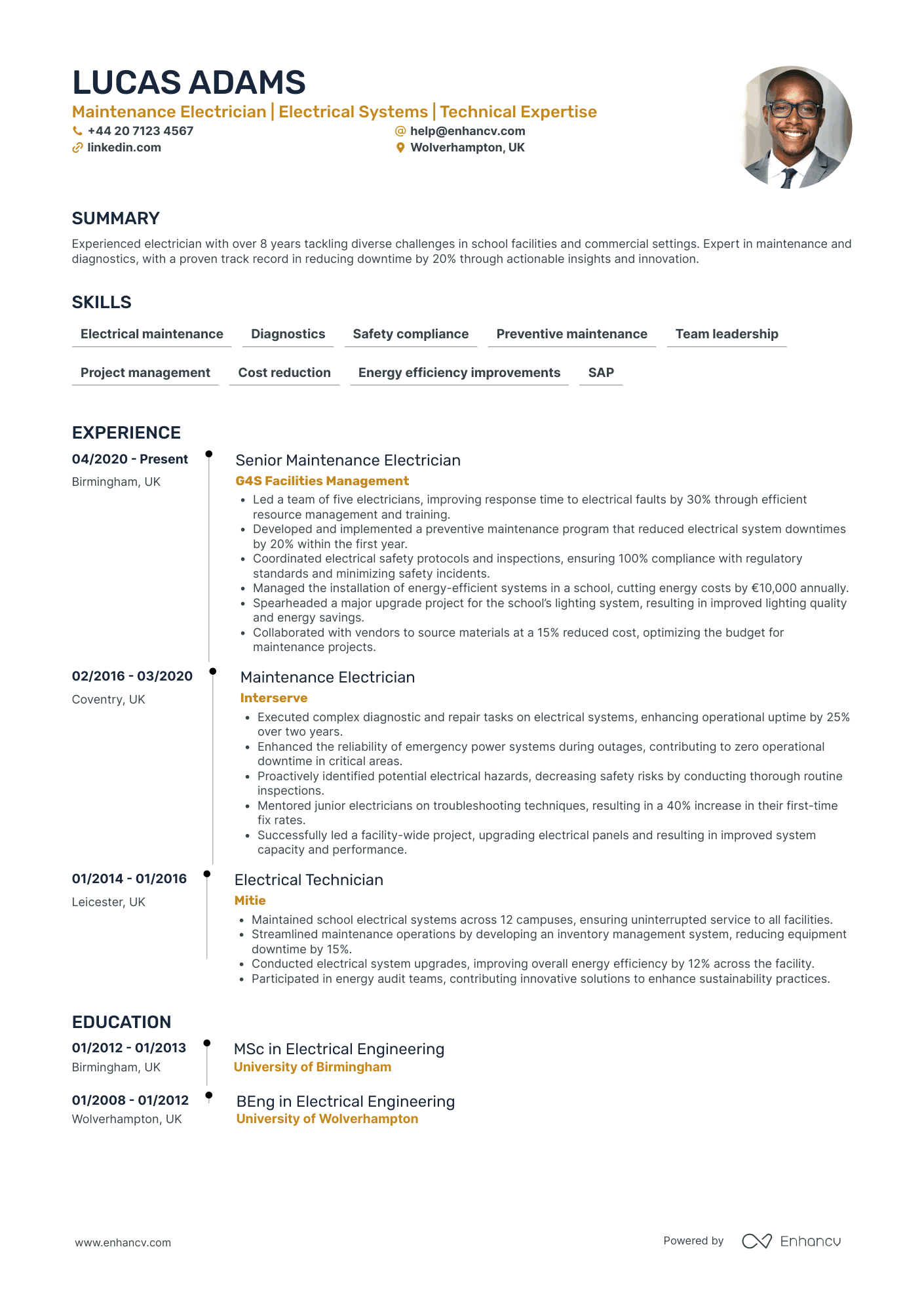
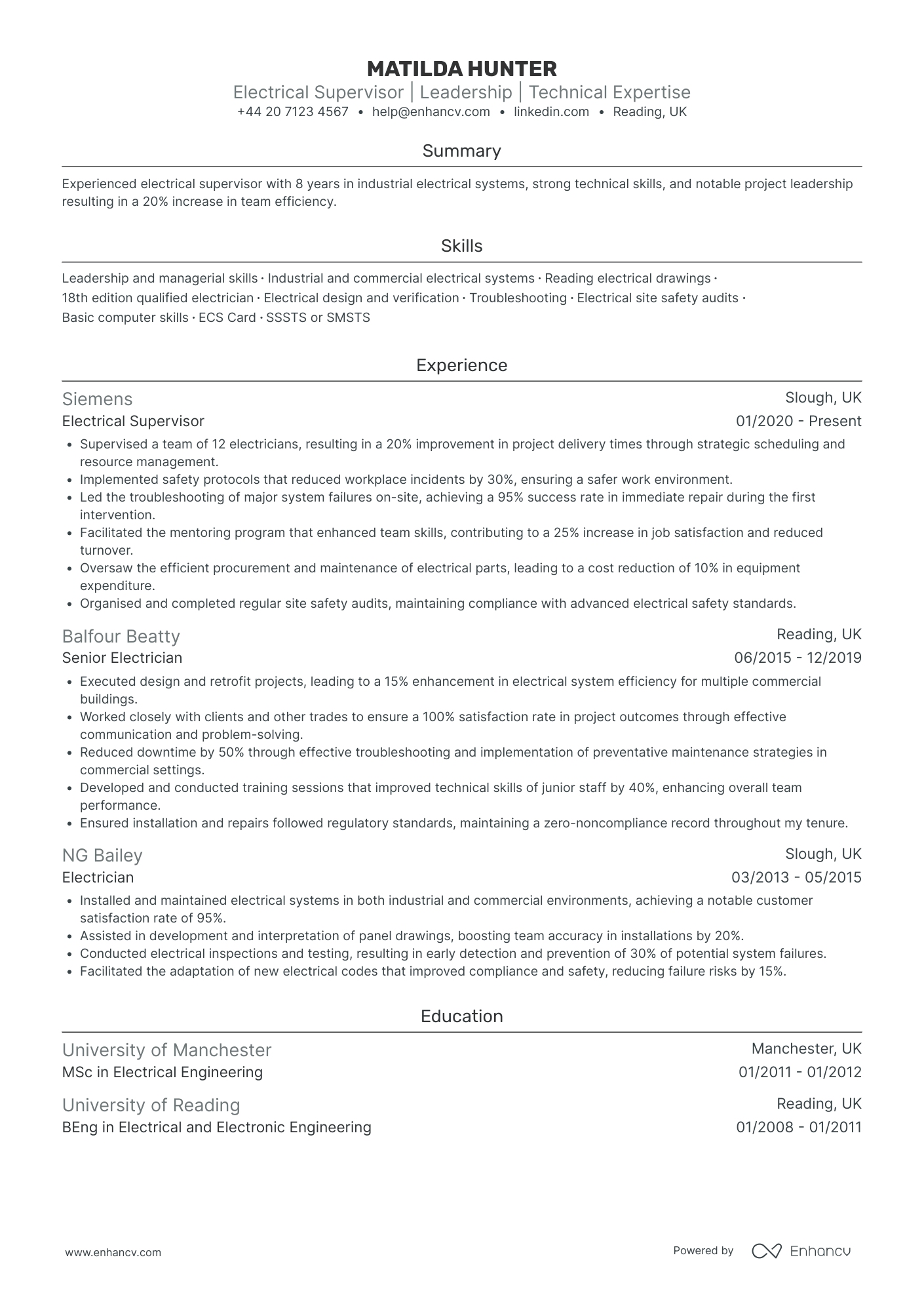
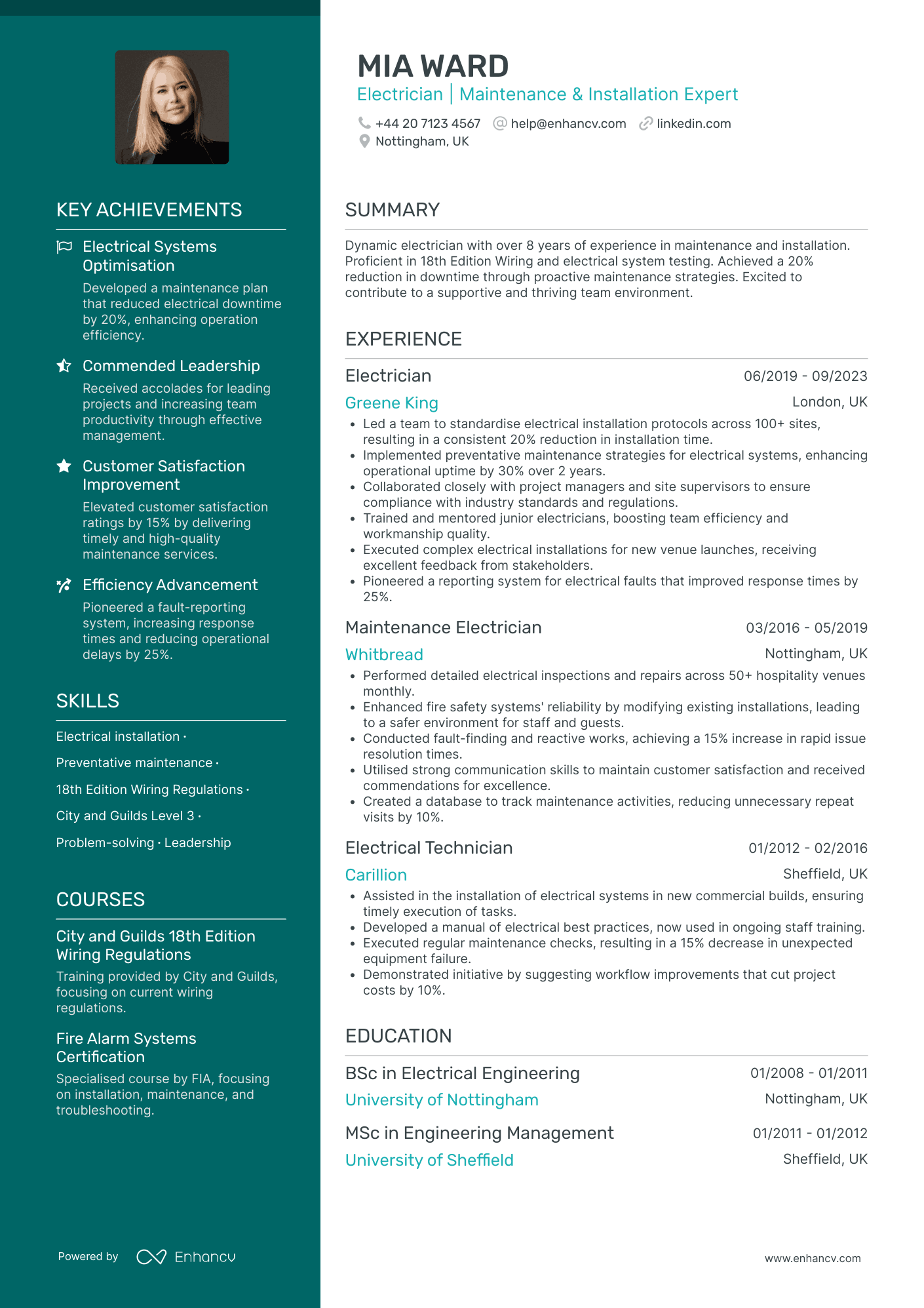
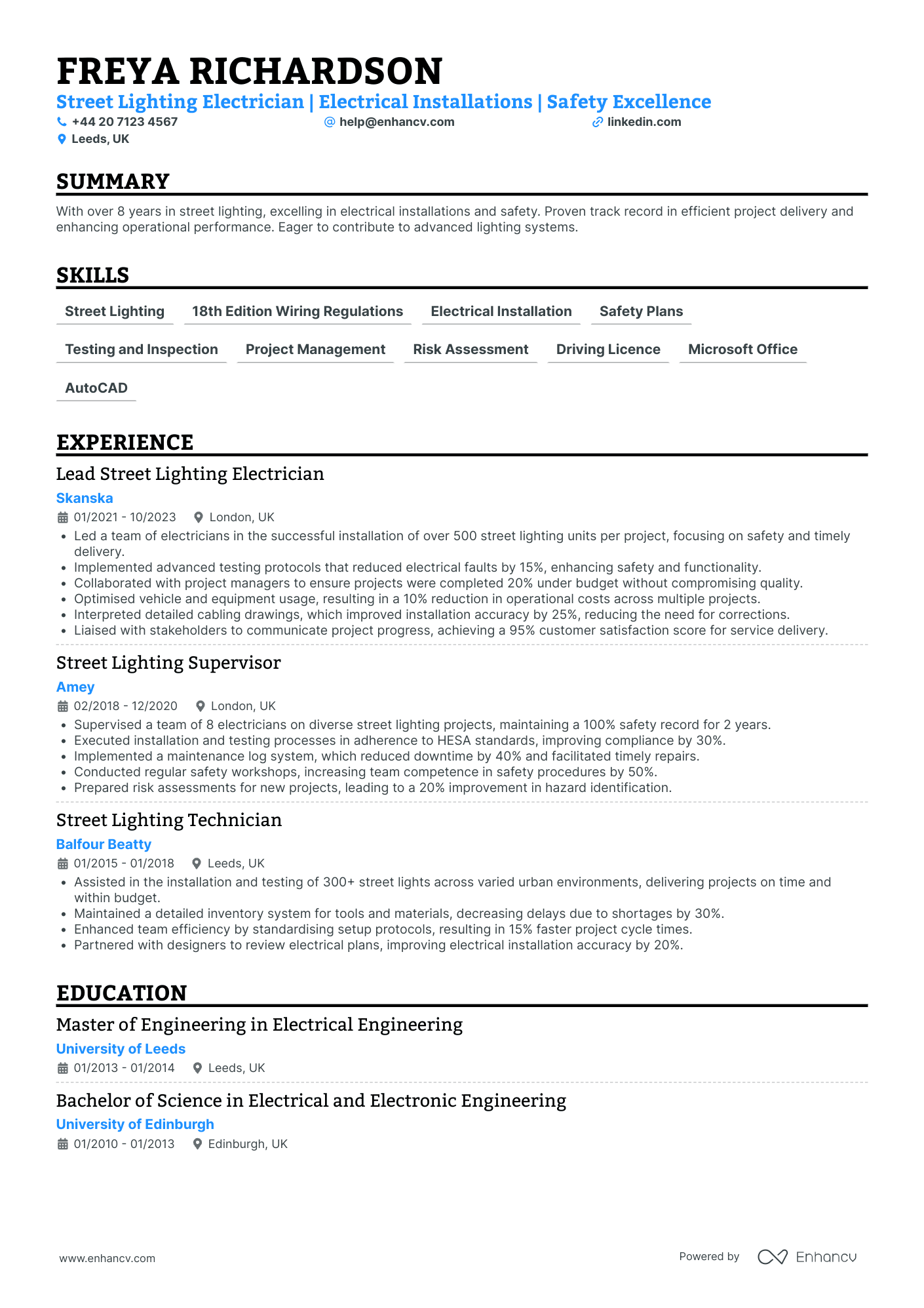
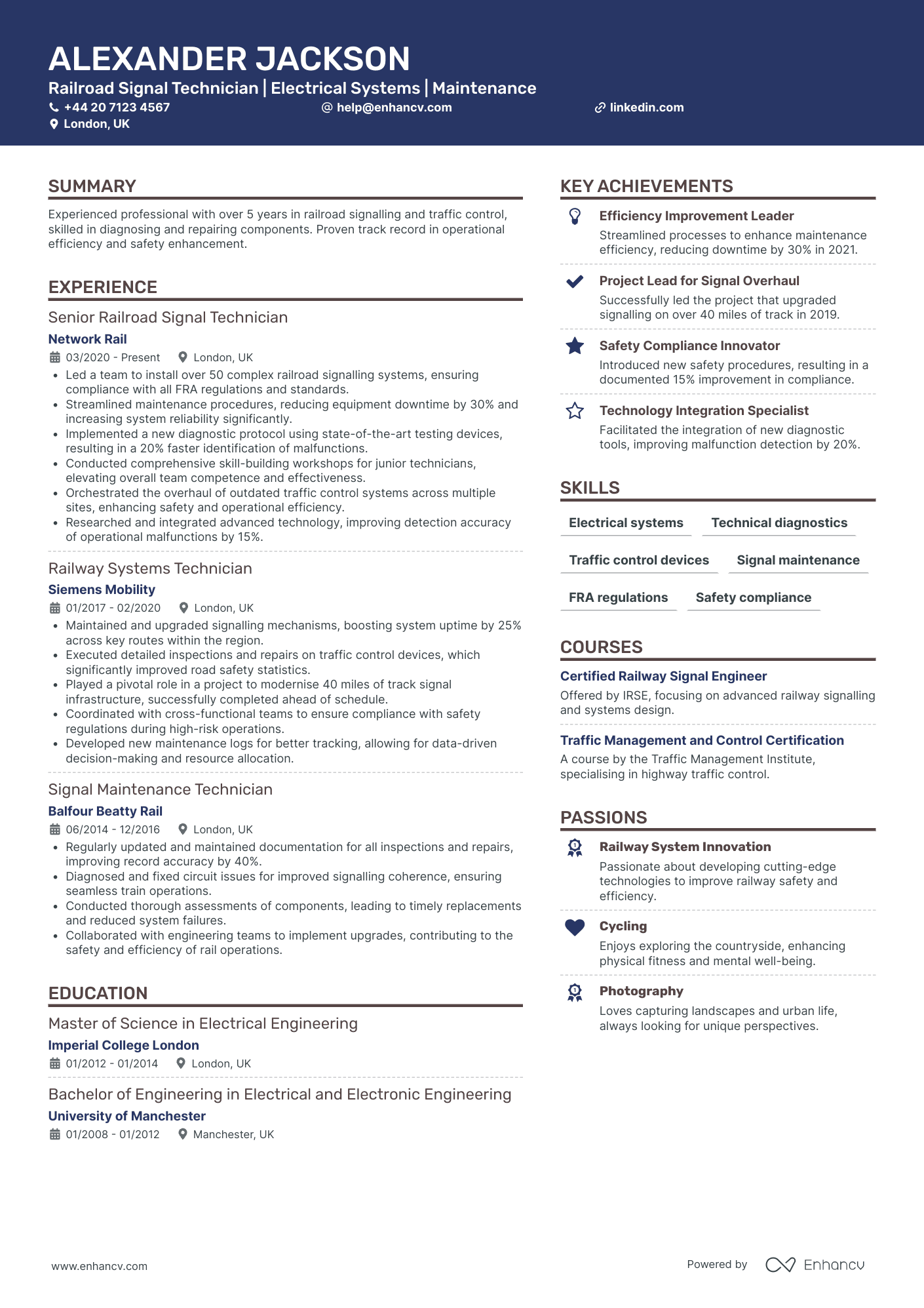
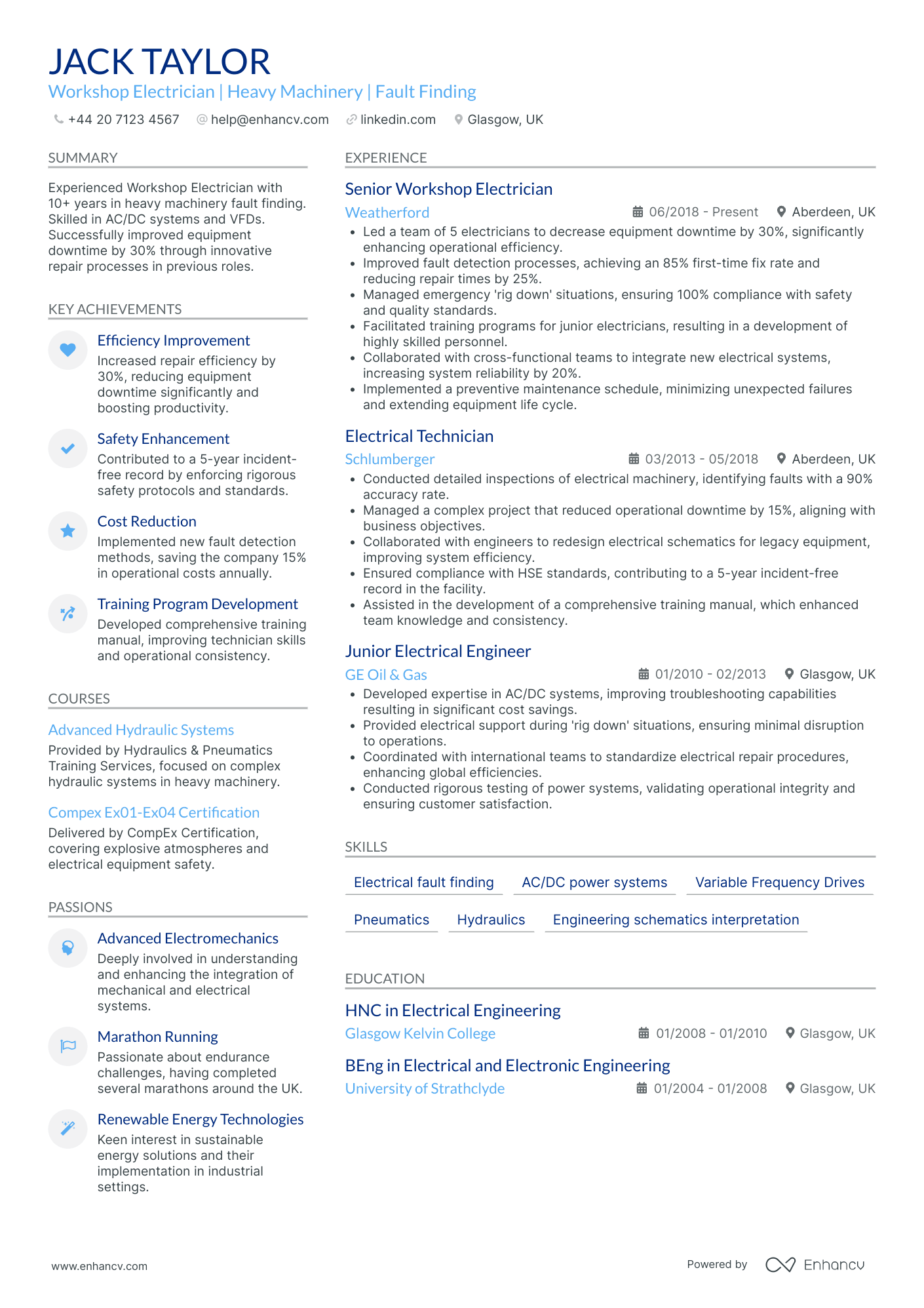
Download a template rather than starting from a blank page, but pick a plain one. This is a trade where a clean, single-column CV layout beats anything decorative, and a designer-style CV reads as a red flag.
Use reverse chronological order, with your current or most recent role first and the rest working back. It suits a mid-level trade where recent site work is what a hiring manager wants to see, and 85% of the 150 postings we logged were pitched at mid-level.
Keep it to two pages. One page is fine for an apprentice or newly qualified sparky, but an experienced electrician has enough jobs, cards, and tickets to justify two. A third page gets skimmed, not read.
Send a PDF for direct applications so the layout, spacing, and any icons hold on every screen. Keep a Word copy for recruitment agencies, which place a large share of trades roles and drop your details into their own template. If the advert names a file type, follow it.
Because the work is on-site, your CV header has to earn its place. Name your town, a realistic travel radius, and a full driving licence, plus your own transport and tools if you have them. Skip the CV photo and date of birth, which UK employers do not need and which only crowd out the detail that matters.
Set the whole thing in a readable font at 10 to 12 point, with clear headings and enough white space to skim. A site manager reads CVs between jobs, not at a desk.
Many contractors and agencies screen applications through tracking software, so keep headings standard and the structure clean for an ATS-friendly CV. Fancy columns, tables, and text boxes are exactly what gets scrambled before a human ever sees the page.
Keep one editable master copy and tailor a fresh version for each advert, then export that to PDF. Overwriting a single file every time is how the wrong company name or the wrong site type ends up on the CV you send.
Build it from a tested layout rather than fighting margins in a word processor. Enhancv's CV templates export to a clean, ATS-friendly PDF you can reuse for every application.

The section order that works for an electrician CV
Header with location, travel radius, and driving licence. Personal statement of three or four lines. Key skills and cards, led by your ECS card and 18th Edition. Experience in reverse chronological order with quantified bullets. Qualifications and tickets in a dated block. Keep any references, hobbies, or courses to the very end, and only if they add something.
Is your resume good enough?
Drop your CV here or choose a file. PDF & DOCX only. Max 2MB file size.
What the UK electrician market looks like
Knowing what employers ask for and what the role pays should shape what you put at the top of the CV. Here is the picture from the current market.
| What | UK electrician roles |
|---|---|
| Typical pay | £26,000 to £45,000 a year (National Careers Service) |
| Where the work happens | On-site (94% of 150 UK postings in the last ~30 days, Enhancv's internal job feed) |
| Experience level asked for | Mid 85% · entry 11% · senior and lead 3% |
| Most-listed skills | Electrical maintenance, 18th Edition Wiring Regulations, electrical installation, electrical testing, fault finding |
Two figures should change how you write. First, the work is almost entirely on-site, so a hiring manager needs to see you can reliably reach the site. Put your location, travel radius, and driving licence in the header.
Second, the same technical skills repeat across advert after advert. Electrical maintenance, the 18th Edition Wiring Regulations, and electrical installation are the phrases that recur most often on Enhancv's internal job feed, so mirror the ones you can genuinely back.
The pay band reflects a trade that rewards cards and proven site work. A newly qualified electrician sits near the lower end, while an approved electrician with testing and inspection tickets and a specialism pushes towards the top.
Specialisms are where the ceiling moves. EV charging, solar and battery storage, fire and security systems, and high-voltage or industrial work all command more than general installation, so if you hold the tickets, name the specialism in your header and your personal statement rather than leaving it in a list.
Writing your electrician personal statement
Three or four sentences at the top: who you are, your cards and core competence, the work you have done, and what you are after. Keep it concrete. See more personal statement examples if the opening line will not come.
Skip the adjective soup. "Hard-working, reliable and passionate electrician" tells a hiring manager nothing they can check.
A weak opener stops at "Qualified electrician looking for a new challenge with a reputable company." It could belong to anyone. Lead with the specifics they screen for instead: your card, your regs, the type of work, and a number.
Tune the emphasis to the employer. A domestic firm cares about EICRs, consumer unit upgrades, and customer manner, while a commercial or industrial contractor wants three-phase, containment, and work to programme. Rewrite the first line for each so it mirrors their sites, not a generic ideal.
Electrician CV personal statement example
Gold Card electrician with over eight years across domestic, commercial, and light industrial installations. City and Guilds Level 3 qualified, 18th Edition (BS 7671), and 2391 testing and inspection certified. Completed more than 400 EICRs and consumer unit upgrades to a first-time-pass standard, with a clean safety record across every site. Looking to bring reliable, right-first-time work to a commercial installation team around Manchester.
What to avoid
Hard-working and passionate electrician with a good attitude and strong work ethic. A team player who is reliable, motivated, and always willing to learn. Seeking a challenging role with a forward-thinking company where I can develop my skills.
The weak version names no card, no regs, no setting, and no number. Every line could sit on a CV for any job in any trade, which is exactly why a hiring manager skips past it.
When a CV crosses my desk for an electrician role, I am scanning for three things in the first few seconds: the card, the regs, and one real job with a number attached. "Rewired 30 flats to BS 7671 with zero call-backs" tells me more than a paragraph of adjectives ever will. Put the qualification you hold and the work you have actually signed off up top, and let the detail carry the rest.
Writing your electrician experience section
Write every role the same way: a dated heading with the job title and contractor, then bullets that show the work and the result. Lead each bullet with an action verb. For the mechanics, see work experience on a CV.
Electrician work is measurable, so use numbers. Properties rewired, boards changed, EICRs completed, faults diagnosed, downtime cut, jobs passed first time. One quantified line is worth five that only list duties, and those figures are your CV achievements.
Name the setting and the standard. "Commercial", "domestic", "industrial", "new-build", and "BS 7671" tell a hiring manager whether your experience matches their sites.
Group short agency placements under one heading so a run of temporary contracts does not read as job-hopping. If there are gaps in employment, a one-line note about training, travel, or a period between contracts is better than an unexplained jump in the dates.
- Complete domestic and commercial installations to BS 7671 across 60-plus sites a year, from first fix through testing, certification, and hand-over
- Carry out EICRs and fault finding on live systems, clearing an average of 12 reactive callouts a week at a first-time-fix rate above 90%
- Upgraded 45 consumer units and rewired 18 rental properties to current regs, all passing landlord inspection first time
- Mentor two apprentices on safe isolation, testing procedure, and on-site conduct, both progressing to NVQ Level 3
Tailor each application by pulling the exact skills and tickets from the advert and mirroring the ones that are true of you. Enhancv's CV tailoring feature reads the advert and suggests the matching edits, which saves rewriting from scratch each time.

PRO TIP
Adverts name specific tickets and regs, not vague skills. Mirror the exact wording you can back: "18th Edition (BS 7671)", "2391 testing and inspection", "EICR", "safe isolation", "three-phase". If you hold it, write it the way the advert does so both the software and the hiring manager catch it.
Skills to put on an electrician CV
Read a dozen live electrician adverts and the same technical demands repeat. Electrical maintenance, the 18th Edition Wiring Regulations, electrical installation, testing, and fault finding come up again and again. Those are your hard skills, written in the words the adverts use.
The soft skills that matter on site are the checkable ones: attention to detail, problem solving, clear communication with clients and other trades, and safety awareness. Prove each in a bullet rather than just claiming it.
List only what you can stand behind. If you hold a ticket, name it. If you are working towards it, put it under training in progress rather than in your skills list.
Match the wording to the advert. Tracking software looks for the exact phrase, so "18th Edition Wiring Regulations" and "testing and inspection" beat a vague "fully qualified". Weaving those CV keywords into your skills list and your bullets is how you clear the first automated filter.
Top skills for your electrician CV:
Electrical maintenance
18th Edition Wiring Regulations (BS 7671)
Electrical installation
Testing and inspection (EICR)
Fault finding and diagnostics
Electrical systems
Electrical repairs
Containment and cable installation
Attention to detail
Problem solving
Communication
Time management
Safety awareness
Qualifications and certifications UK employers check
For a trade, this section can matter more than the personal statement. It is the first thing a hiring manager or agency checks, so give it its own clearly labelled block.
List the core credentials where you hold them, and mark anything in progress rather than leaving it off: an ECS or JIB Gold Card, City and Guilds or NVQ Level 3 in Electrotechnical or Electrical Installation, the 18th Edition (City and Guilds 2382, BS 7671), and 2391 or 2392 testing and inspection.
Add the tickets that widen the jobs you can take: 2919 for EV charging, solar or battery storage, IPAF or PASMA for access, CSCS for site work, and first aid. Put dates on them so an employer can see they are current.
If you are on a recognised route to Gold Card status, such as an NVQ or the Experienced Worker Assessment, say so and give the expected completion date. A hiring manager would rather see a clear path than a gap where the card should be.
See certificates on a CV and how to present qualifications on a CV if you are unsure where each one belongs.
Writing an electrician CV with limited experience
Apprentices and newly qualified electricians carry this section differently. You lead with the qualification and the training, not a long job history.
Use a skills-led structure: personal statement, then cards and skills, then your apprenticeship and any college work, with paid roles below. One page is enough at this stage.
Your apprenticeship is experience, so write it like a job. Name the contractor, the length, the type of installations you worked on, and what you were signed off to do unsupervised.
List every ticket you already hold and every one in progress. "18th Edition (BS 7671), AM2 passed, working towards 2391" signals you are on the path, and for the entry-level share of the market that is exactly what a hiring manager wants to see.
Pull evidence from wherever you have it. A college installation project, a work placement, a labouring stint on site, or a mate's rewire you assisted on all show hand skills, safe working, and site awareness. Write each with a date and a line on what you actually did, the same way you would a paid role.
Conclusion
Lead with your cards and regs, keep the layout clean and single-column, and quantify the jobs you have signed off. That is what moves an electrician CV to the top of the pile.
Pair it with a short cover letter that says why this employer, and you turn a qualified CV into interviews.
Author's take - The Enhancv team
When a CV crosses my desk for an electrician role, I am scanning for three things in the first few seconds: the card, the regs, and one real job with a number attached. "Rewired 30 flats to BS 7671 with zero call-backs" tells me more than a paragraph of adjectives ever will. Put the qualification you hold and the work you have actually signed off up top, and let the detail carry the rest.