



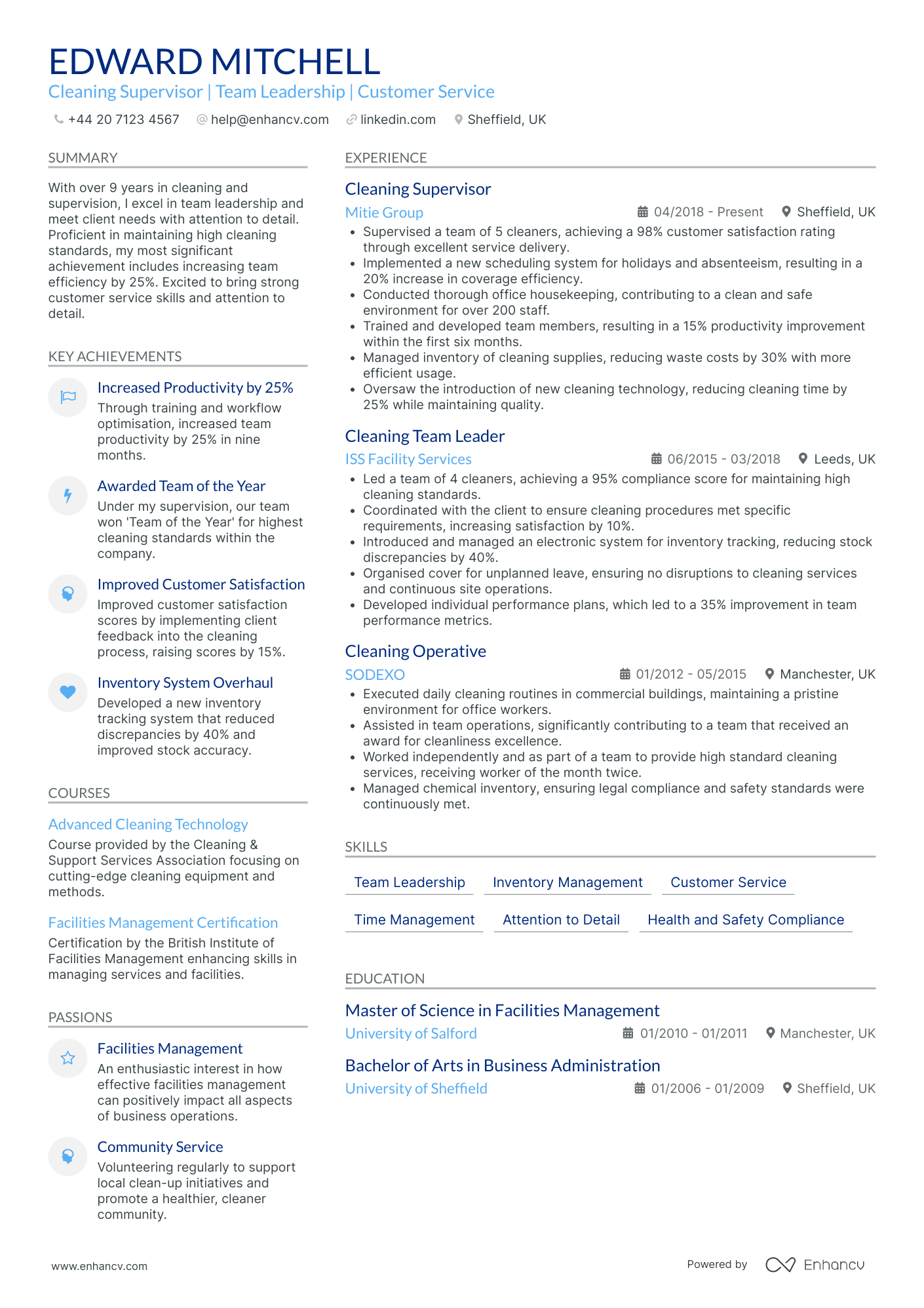
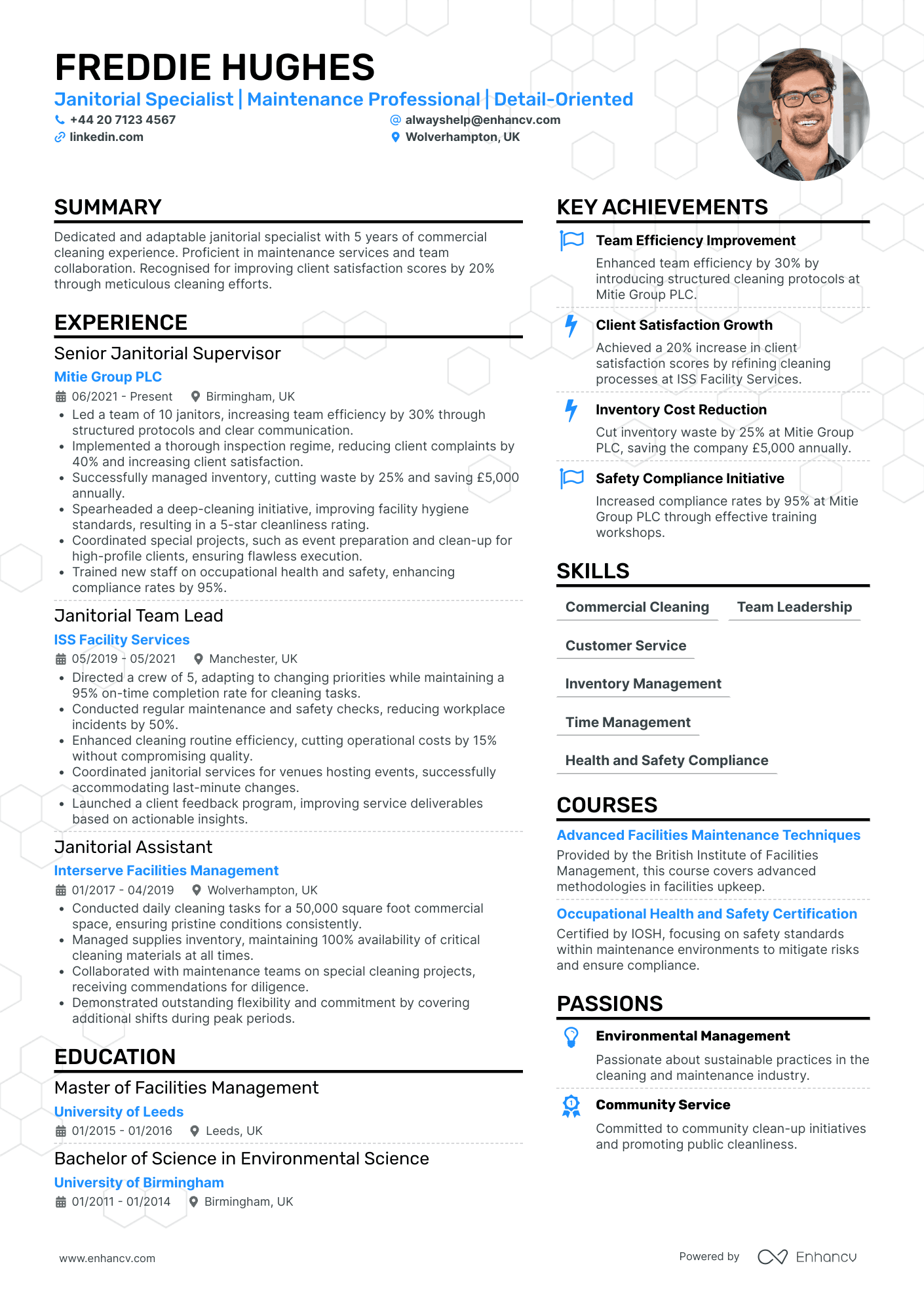
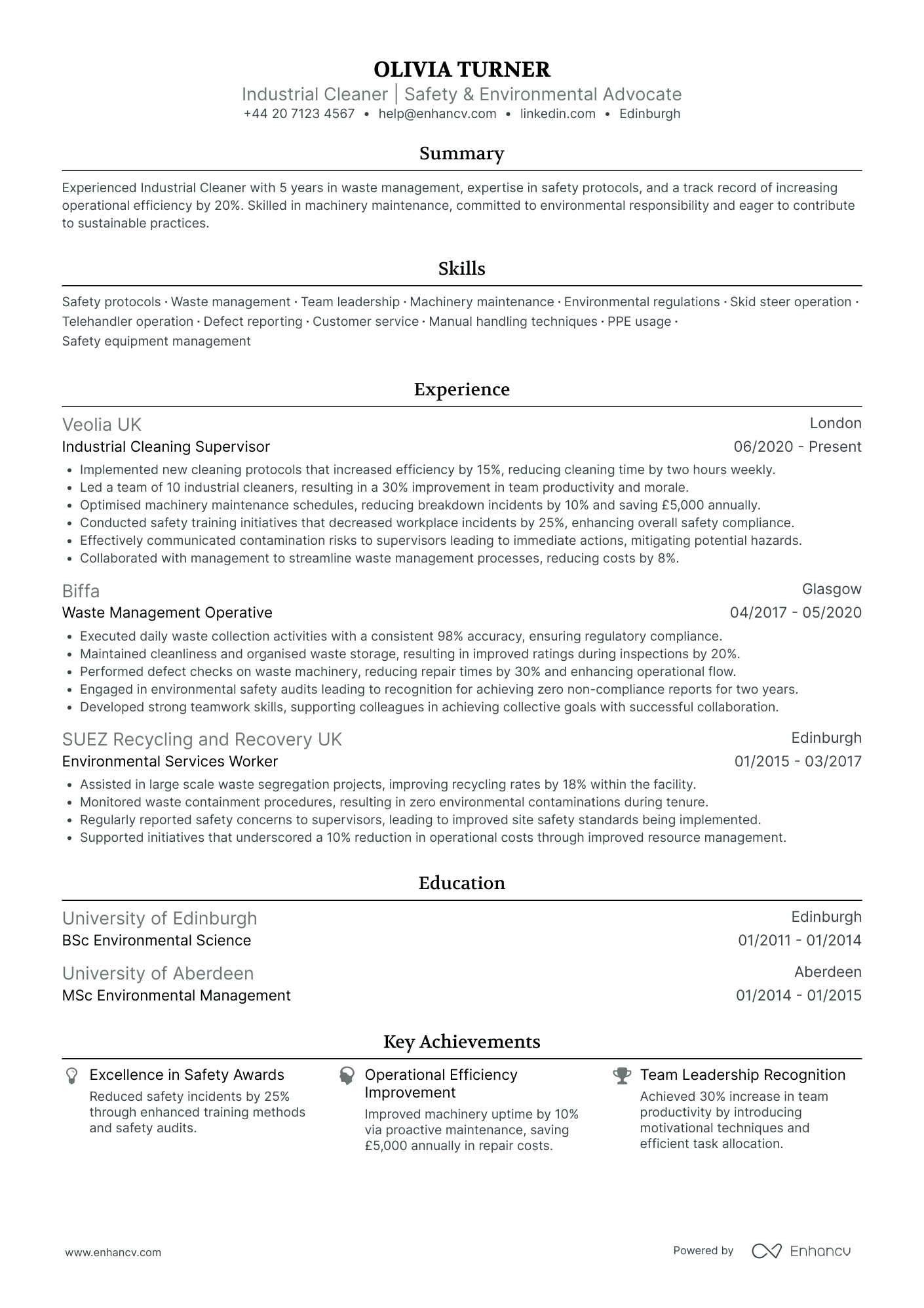
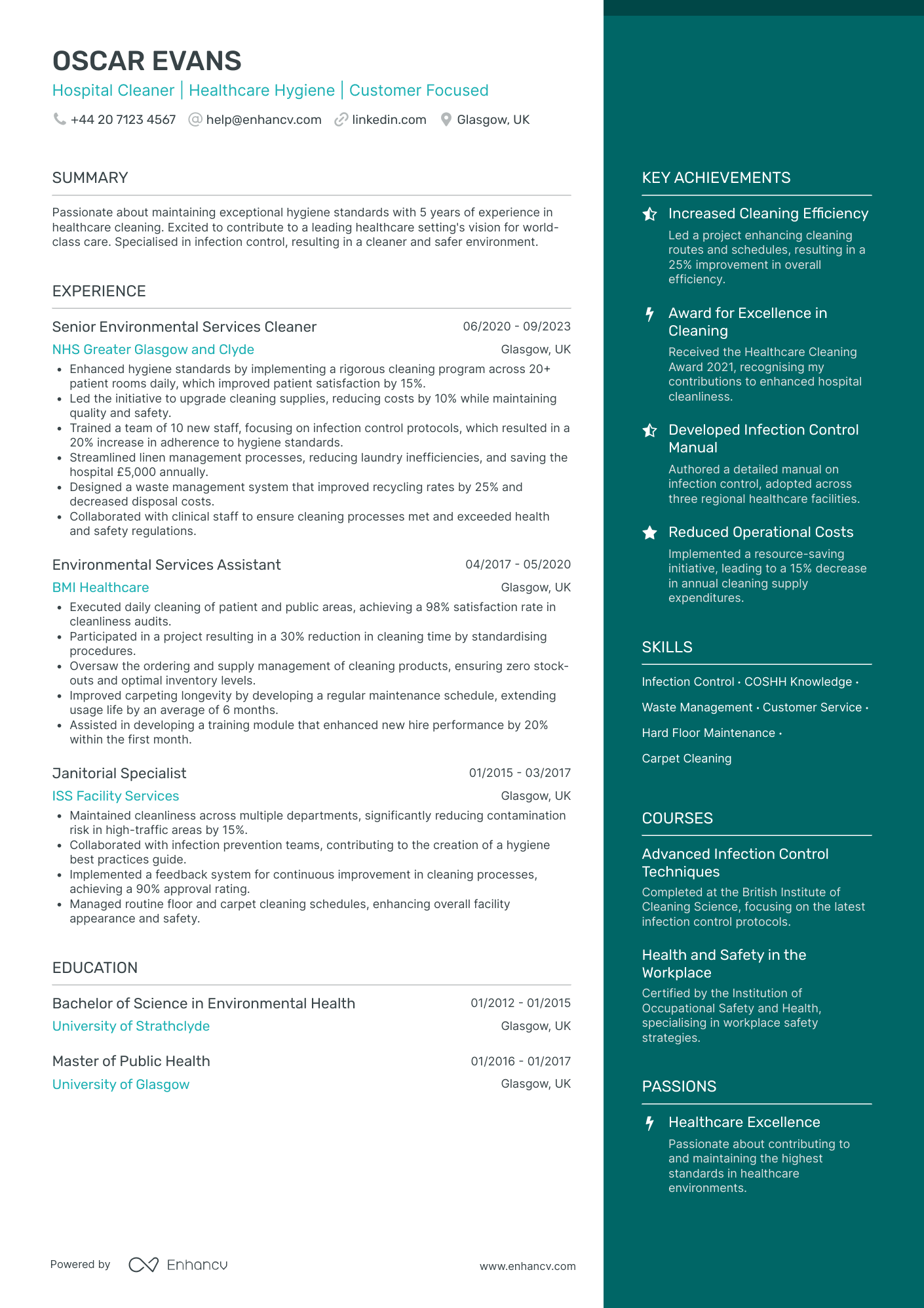
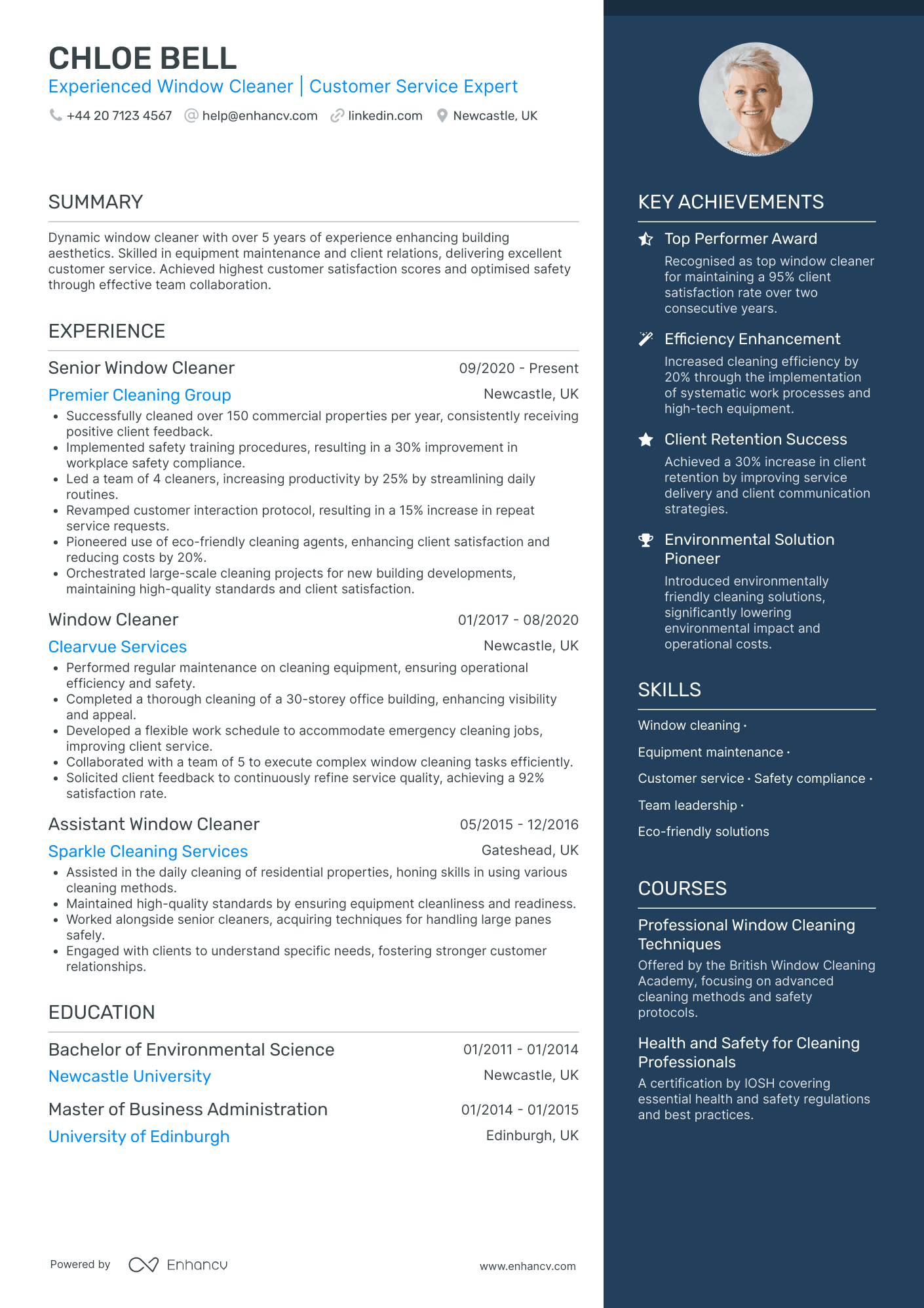
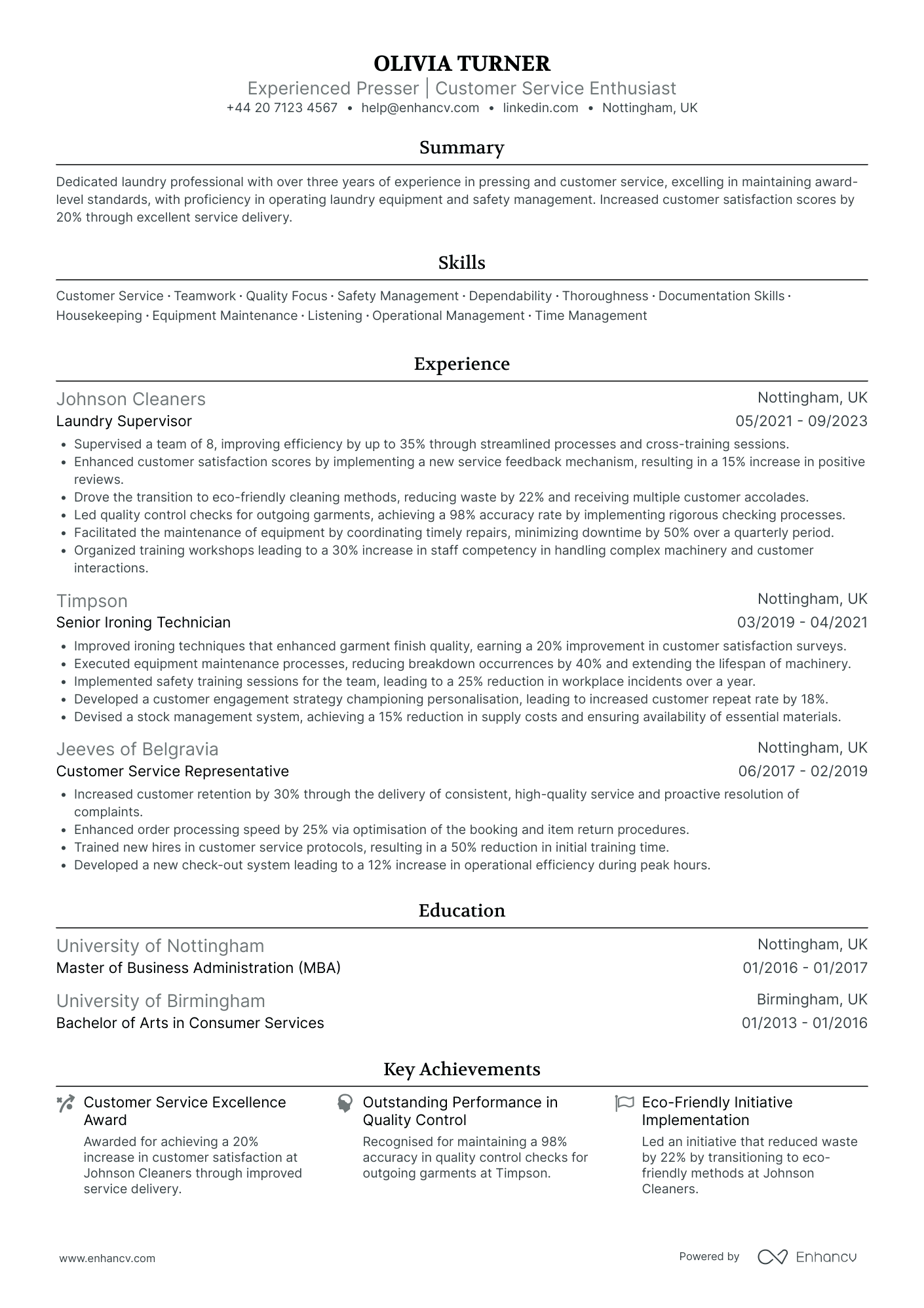
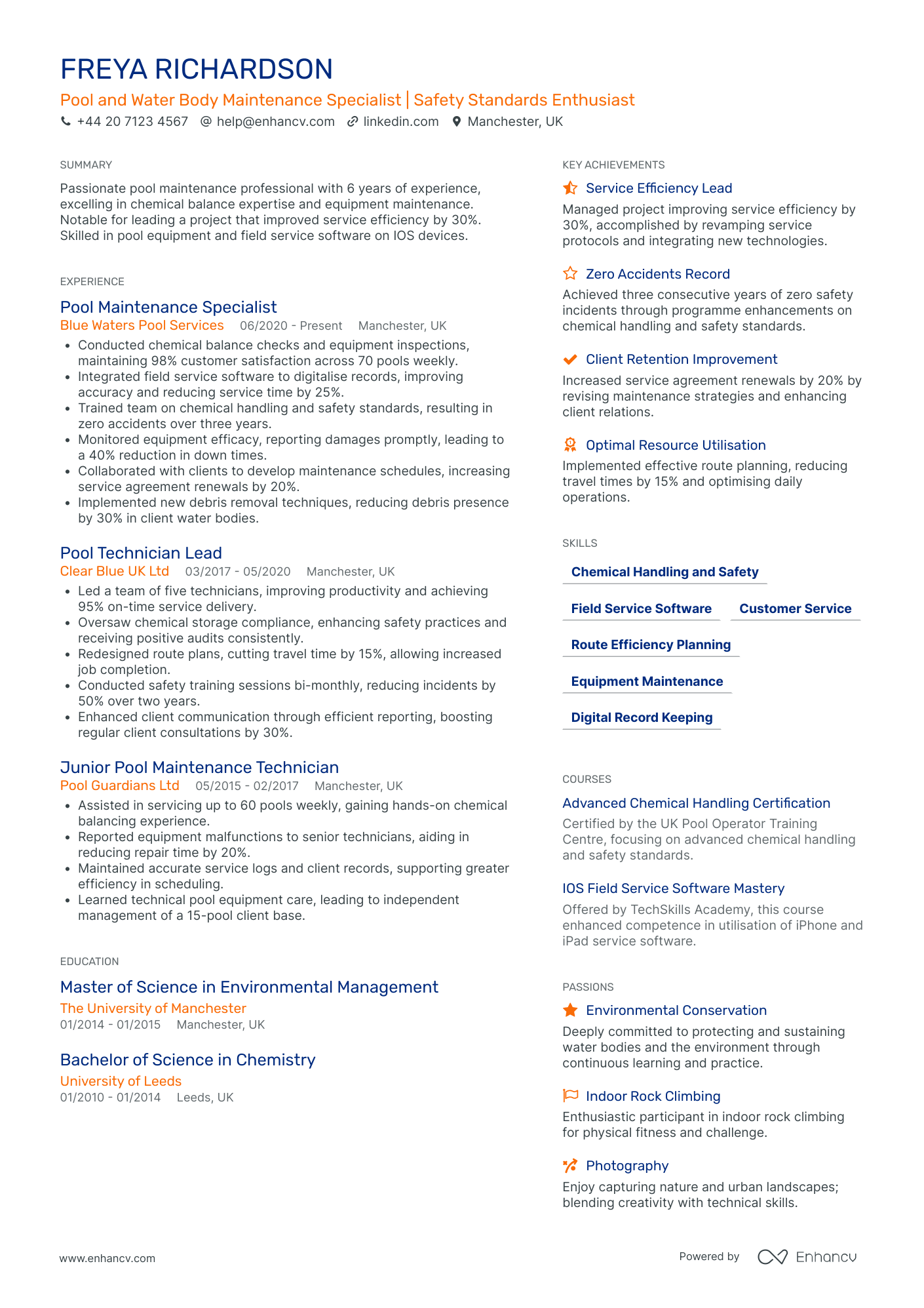
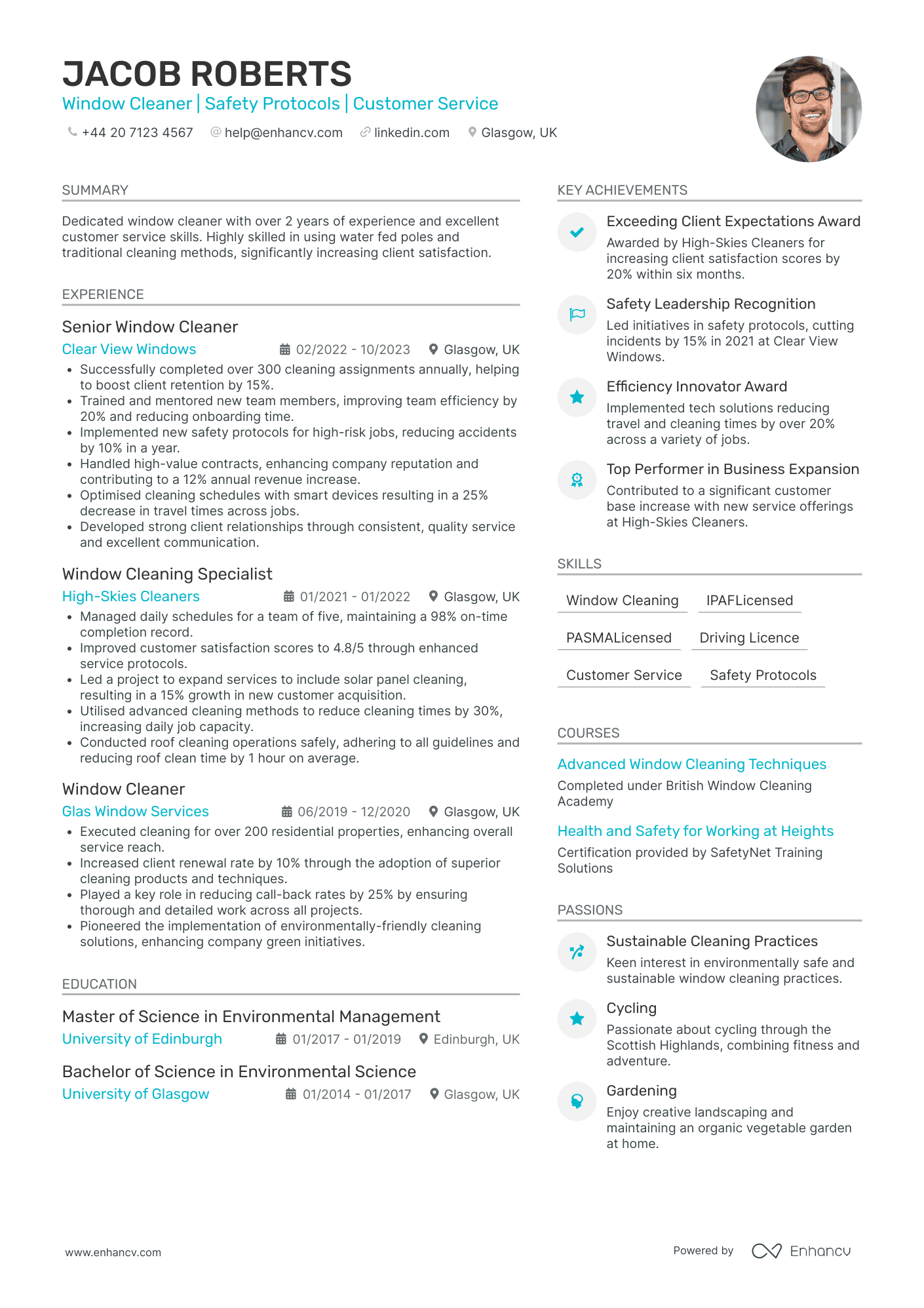
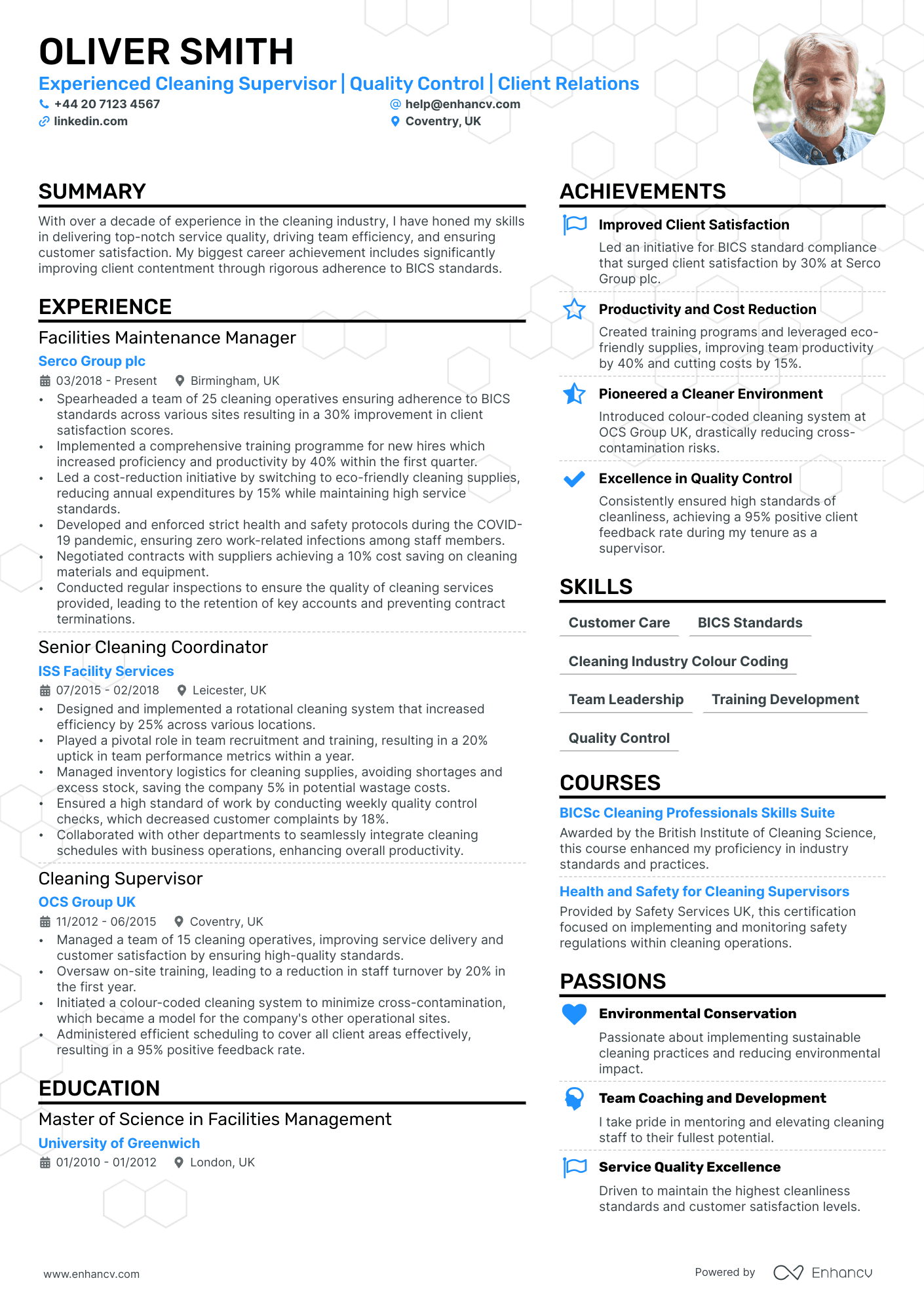
Most cleaner CVs try too hard. Two pages, a coloured header, and a paragraph about being a hard-working team player, all for a job that is won on reliability and a clean record.
The CVs that get called back do the opposite. One tidy page, the right training named at the top, and clear proof that you turn up and can be trusted with someone's keys.

Key takeaways
- One clean page is usually enough. A cleaner CV is judged on reliability and relevant training, not length.
- Name the training employers screen for at the top: COSHH, health and safety, and manual handling.
- Cleaning work is on-site, so put your location, travel details, and any driving licence near the top.
- Prove reliability with specifics: sites covered, years with one employer, keyholder trust, and a spotless attendance record.
- Send a PDF unless the advert asks for Word, and keep the layout plain so every line stays readable.
- No experience yet? Lead with a short personal statement, transferable reliability, and any training in progress.
Formatting your cleaner CV
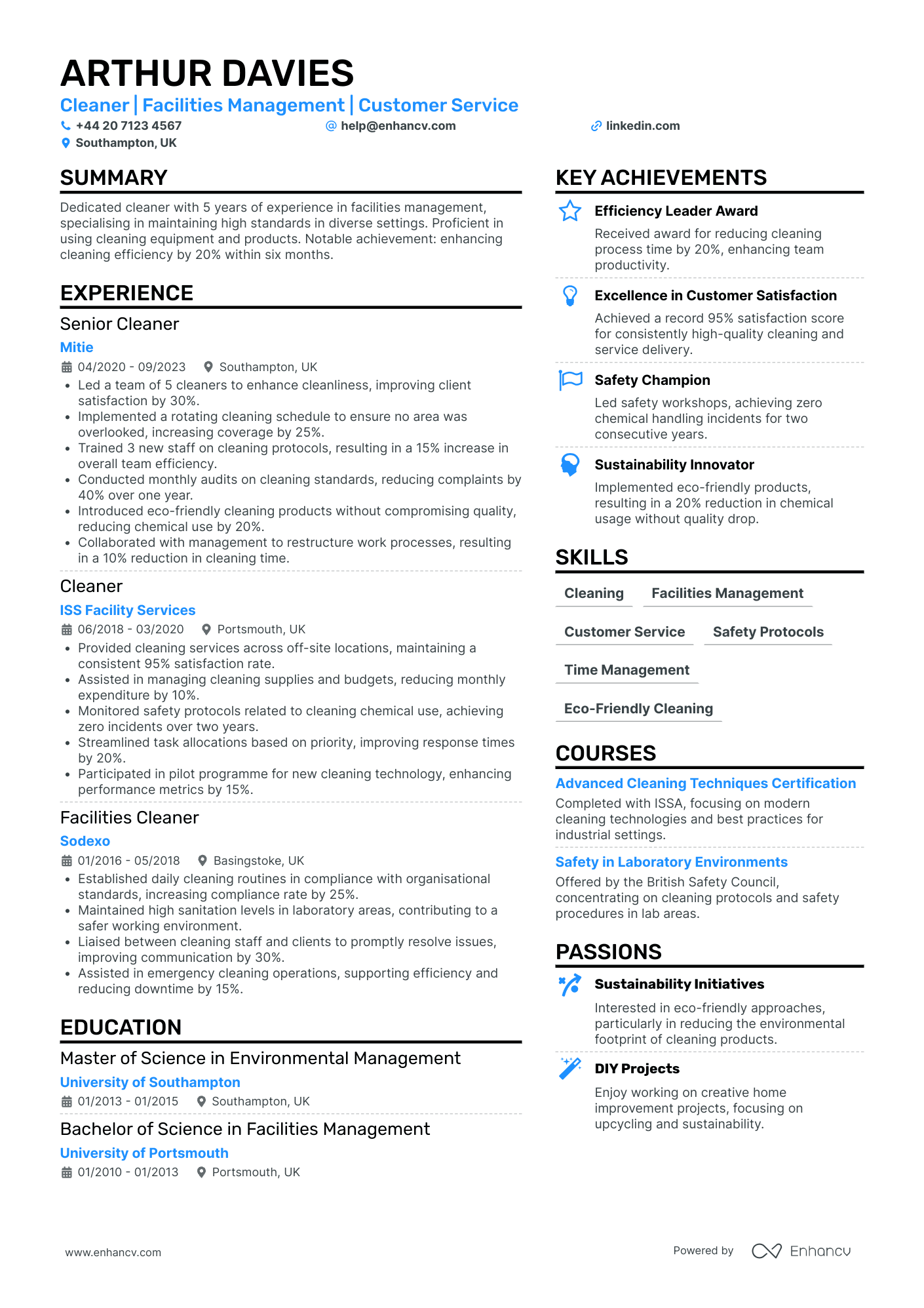
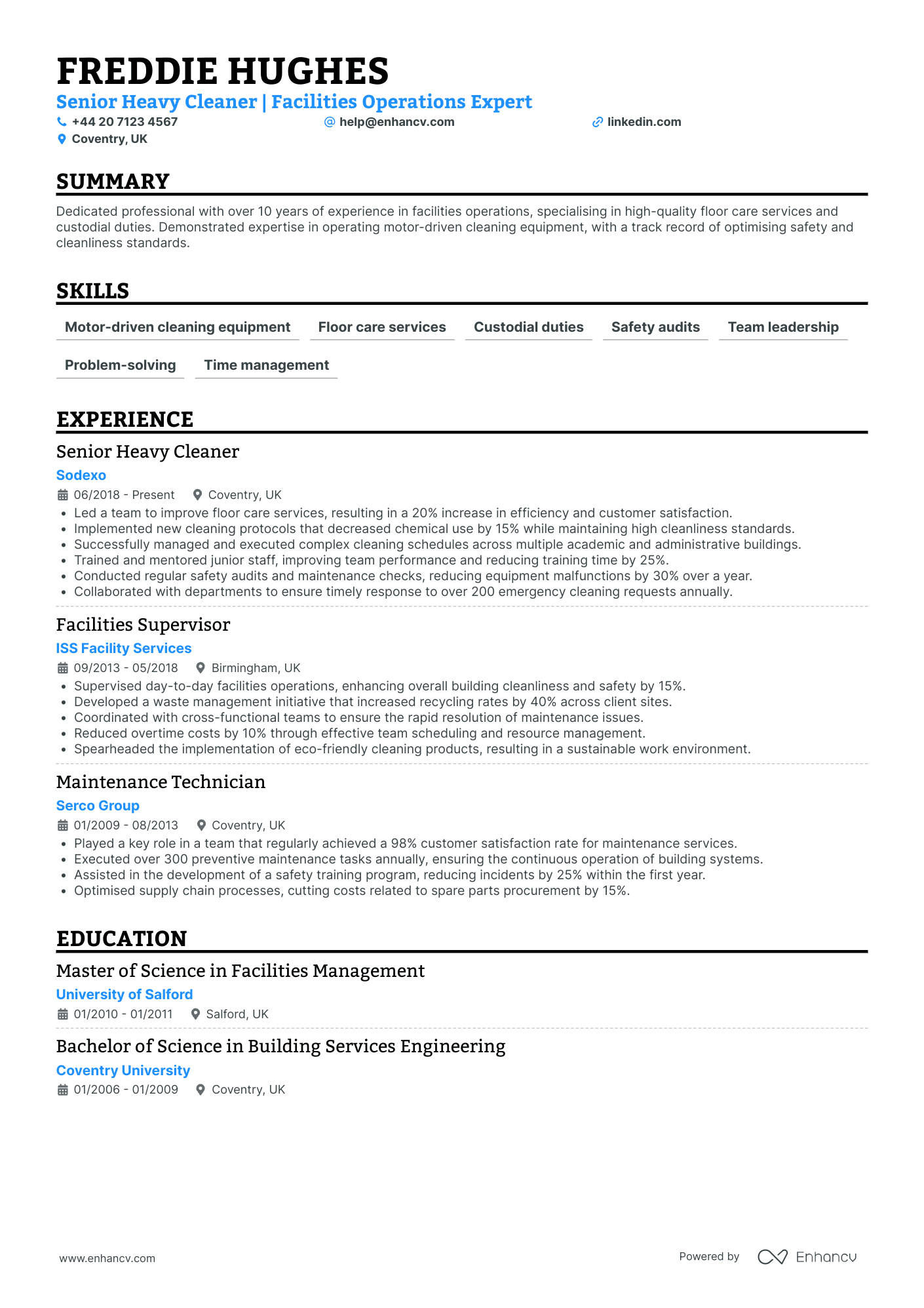
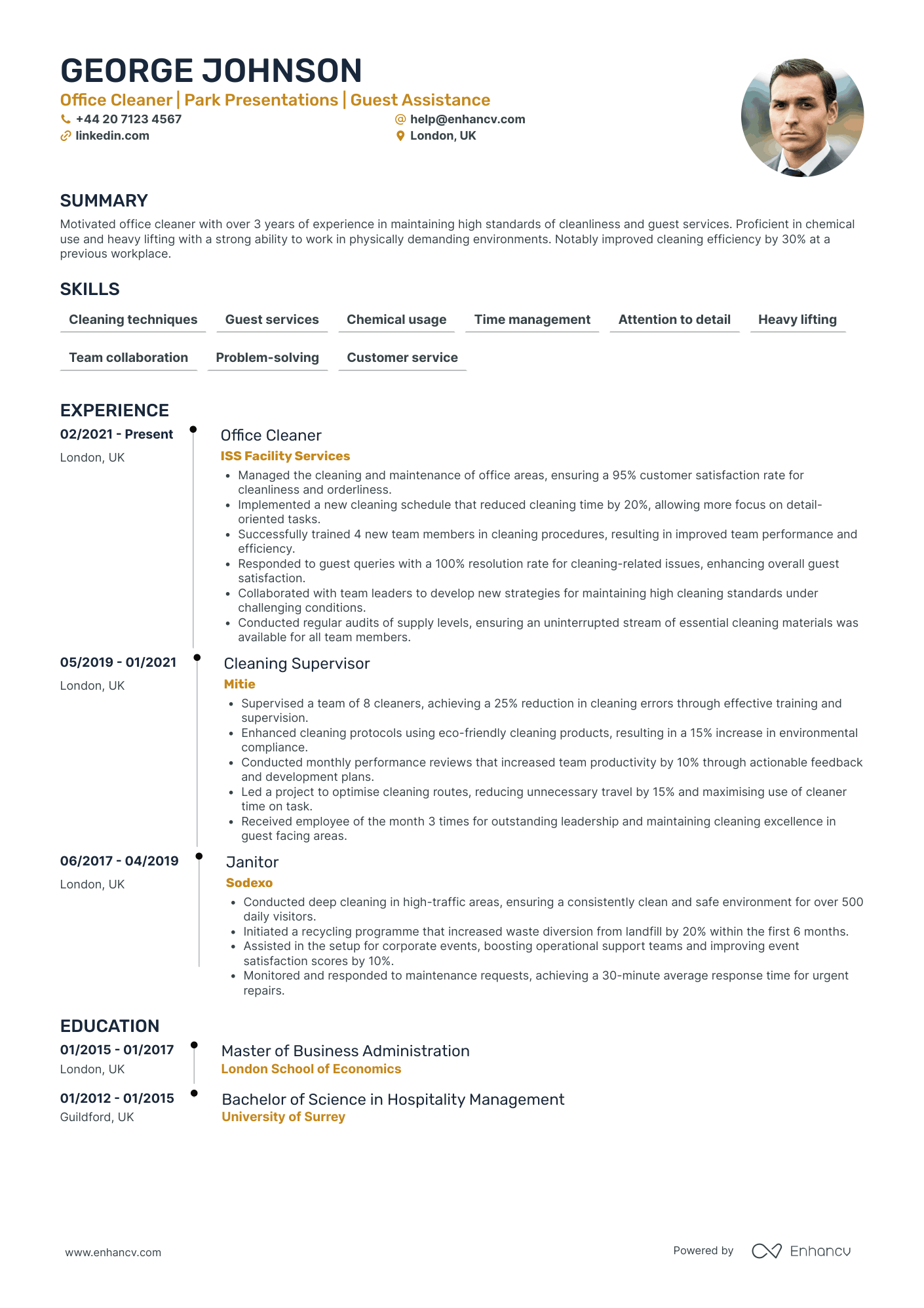
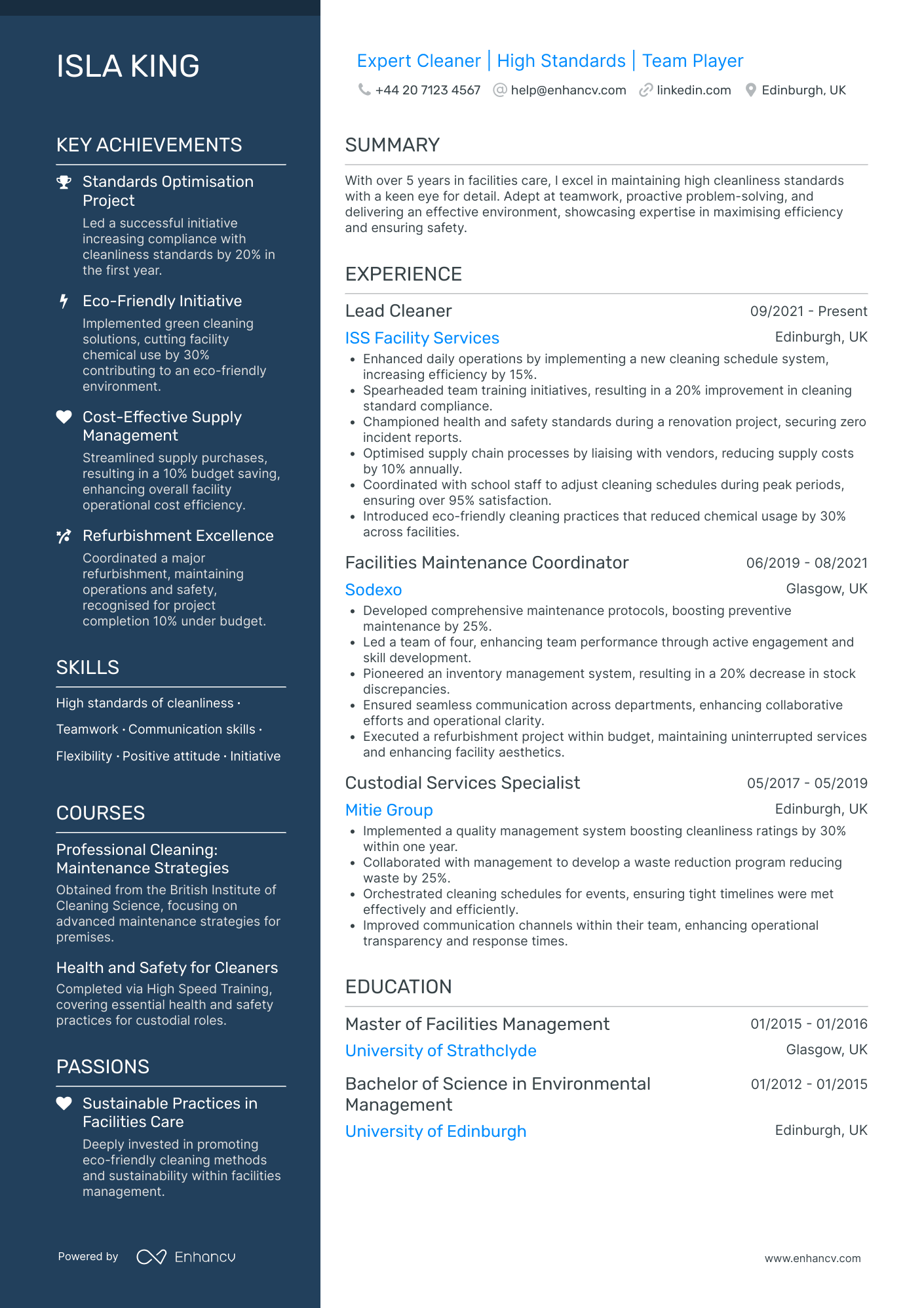
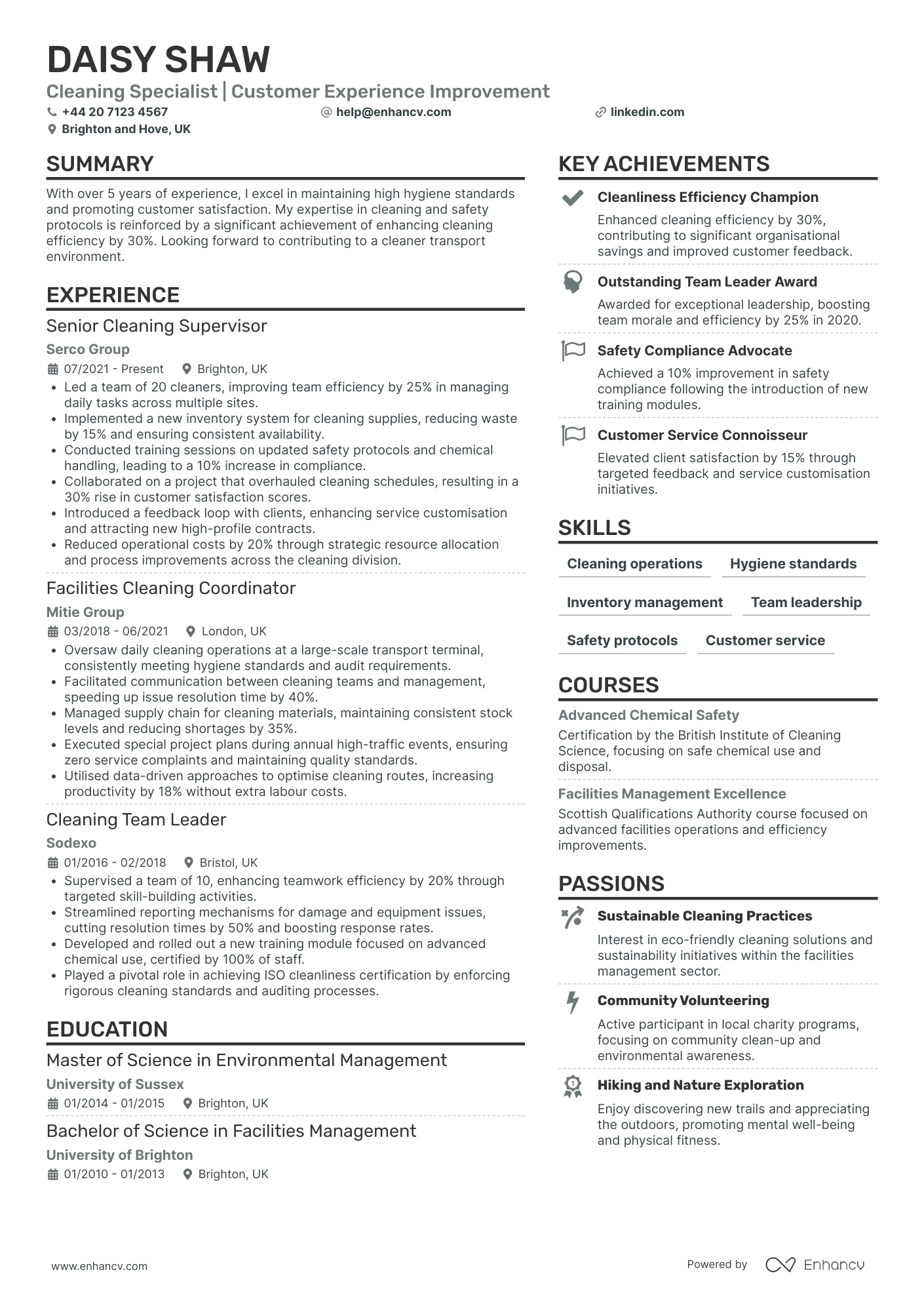
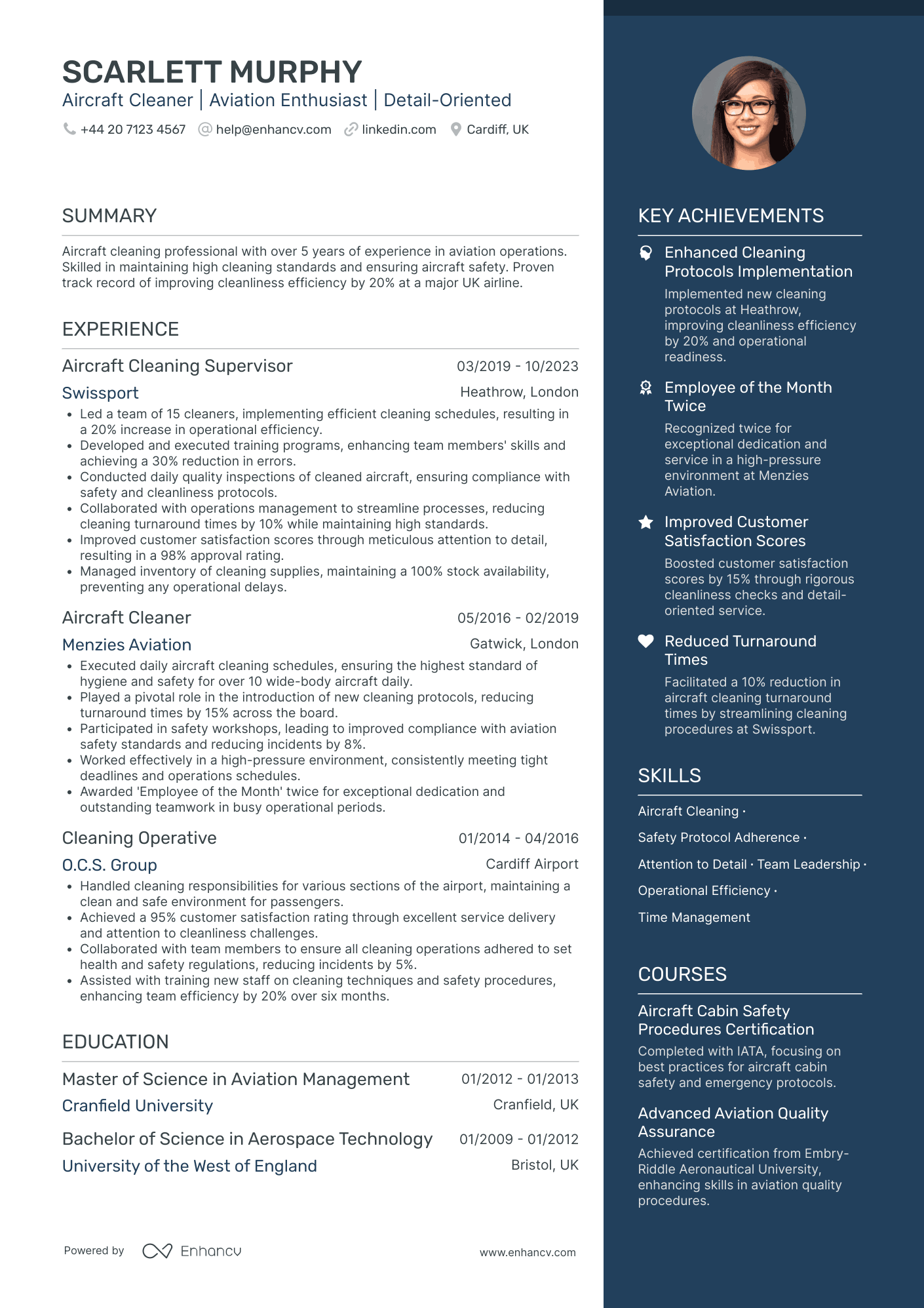
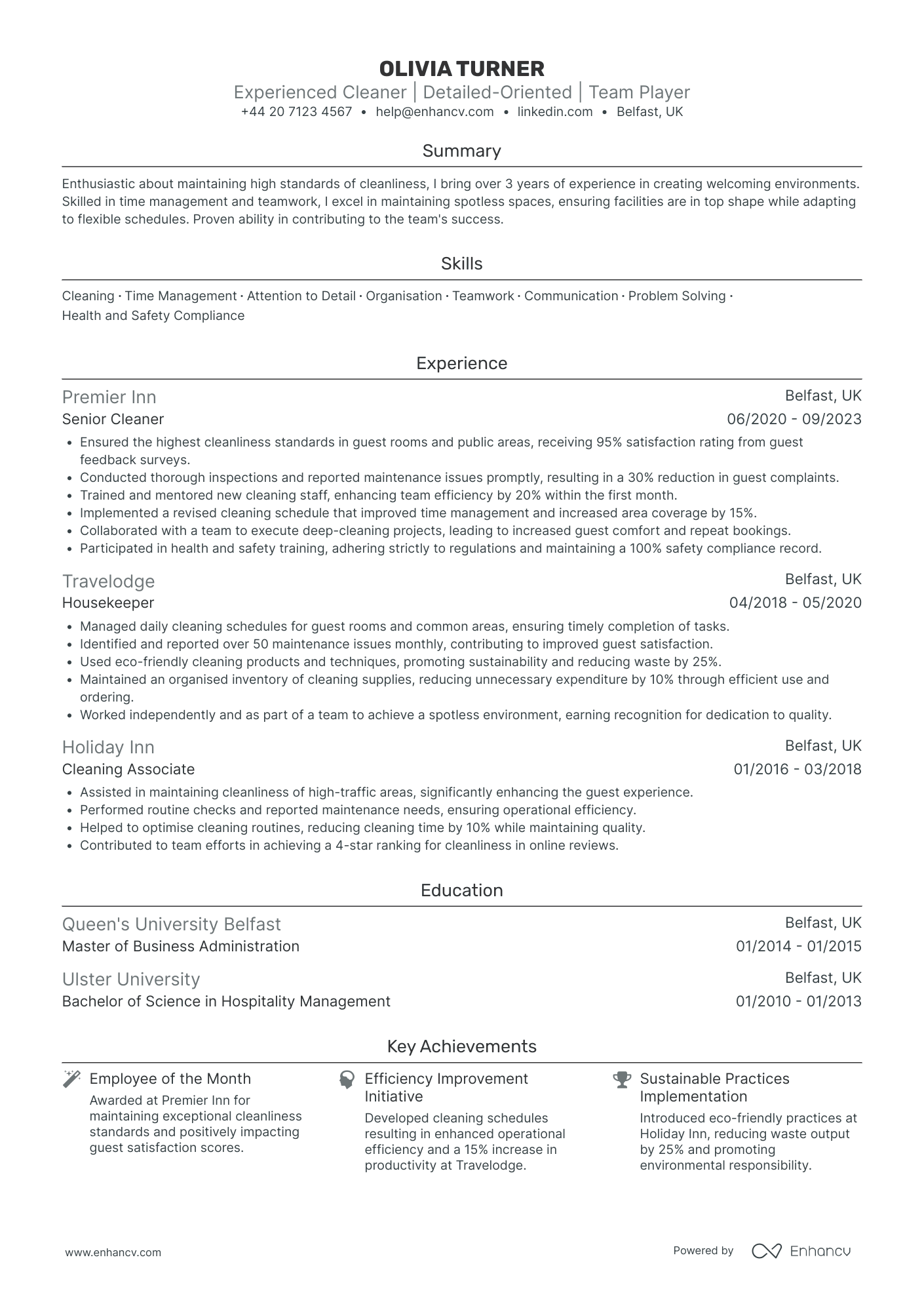
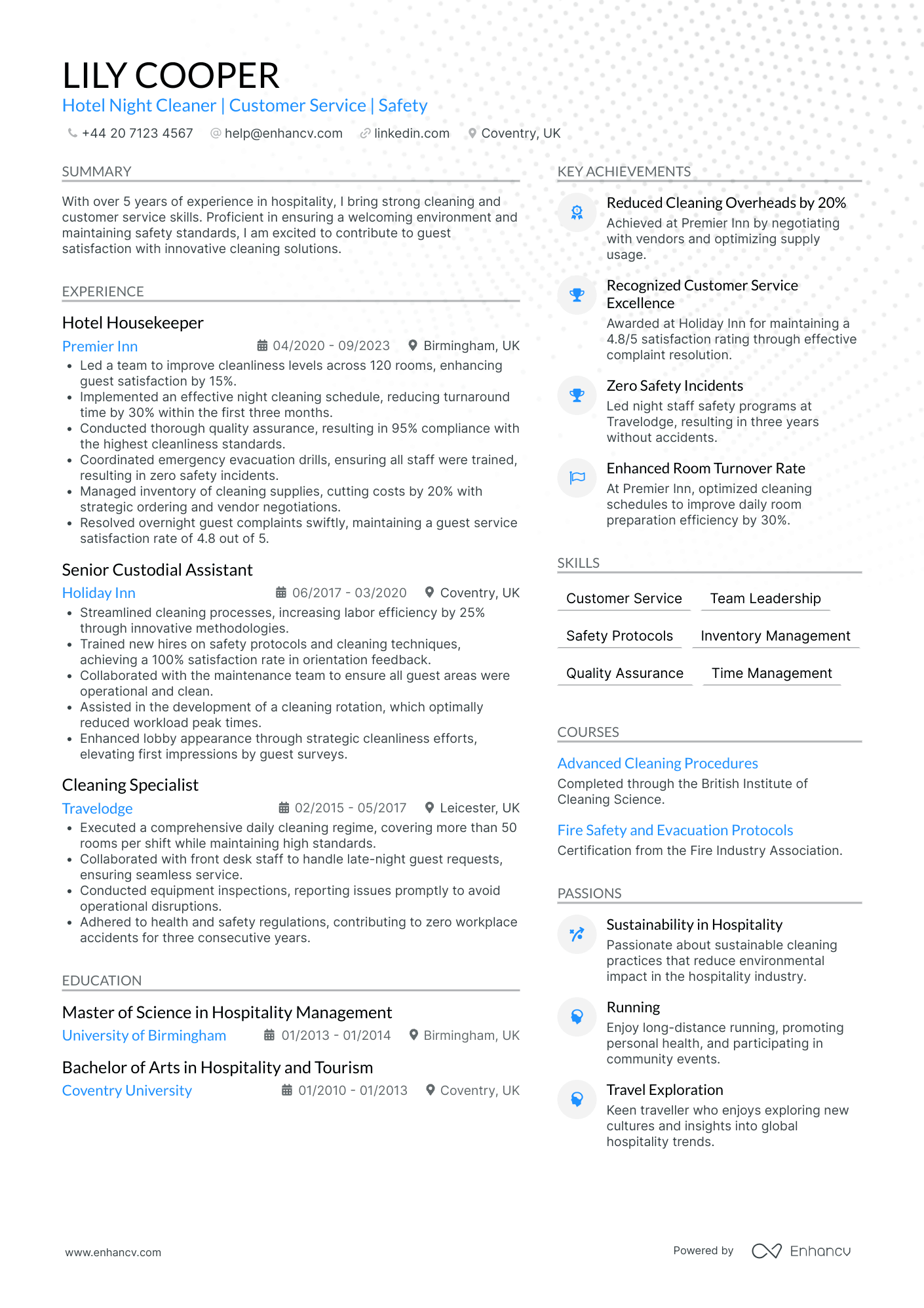
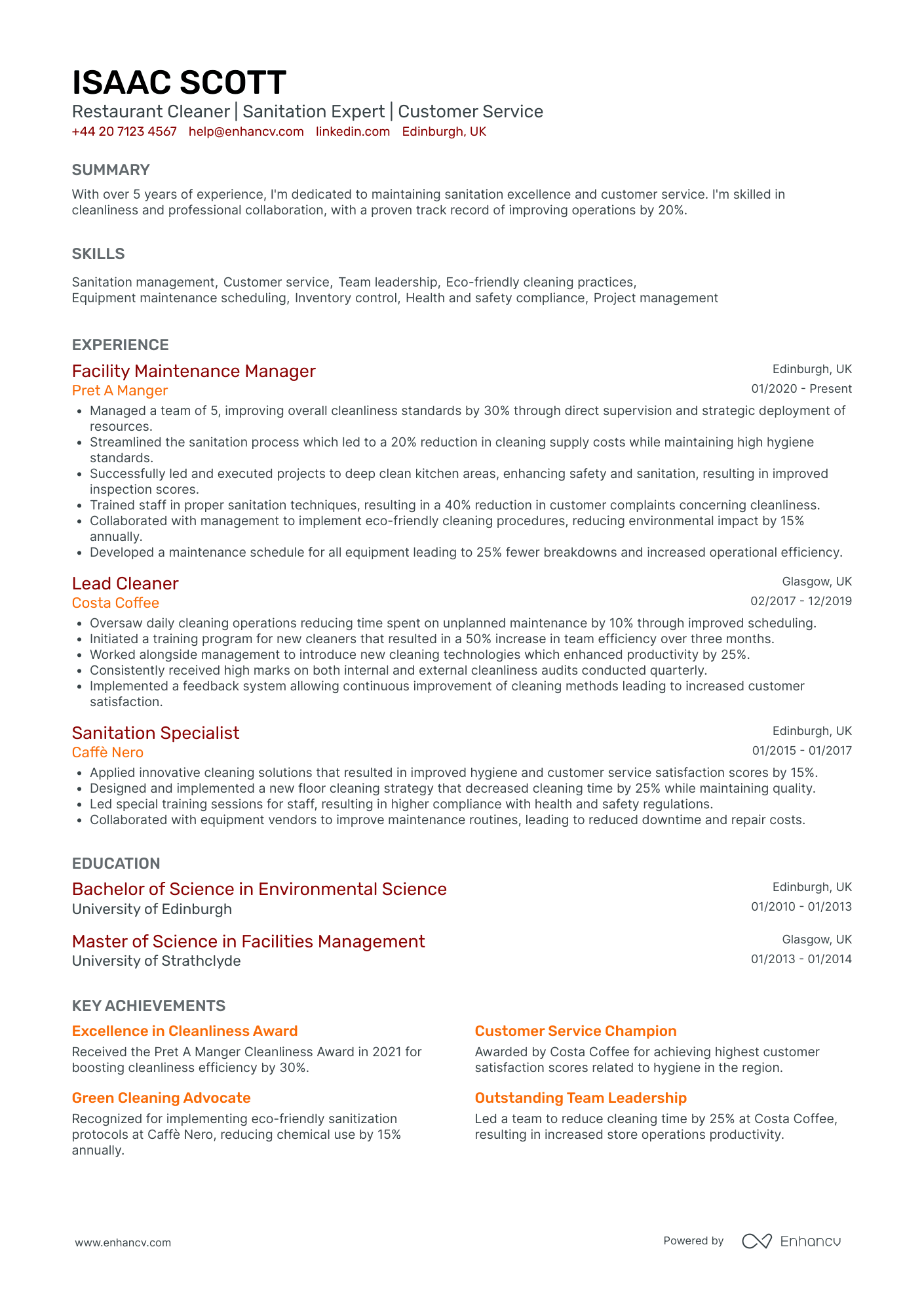
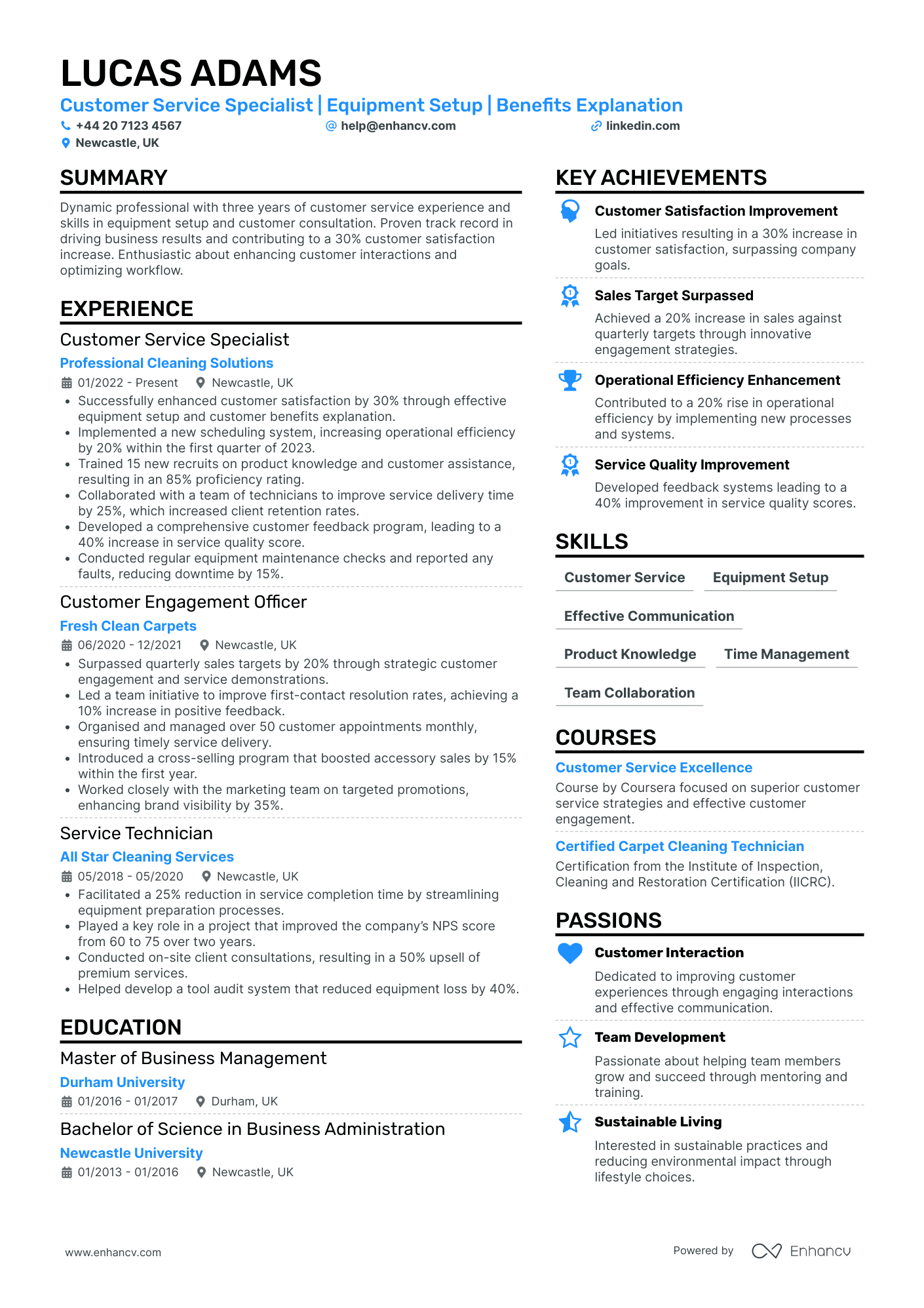
A cleaner CV should look like the work: clean, in both senses. One column, plain headings, and nothing a busy manager has to decode to find your phone number.
Keep it to one page. Most cleaning roles are straightforward and entry friendly, so a manager wants the facts fast, not a two-page story. Save a second page for a long career or a supervisory record.
If you have a steady work history, use a reverse chronological CV, latest job first. If you are starting out or coming from another line of work, a skills-based CV lets your training and reliability lead instead of a thin job list.
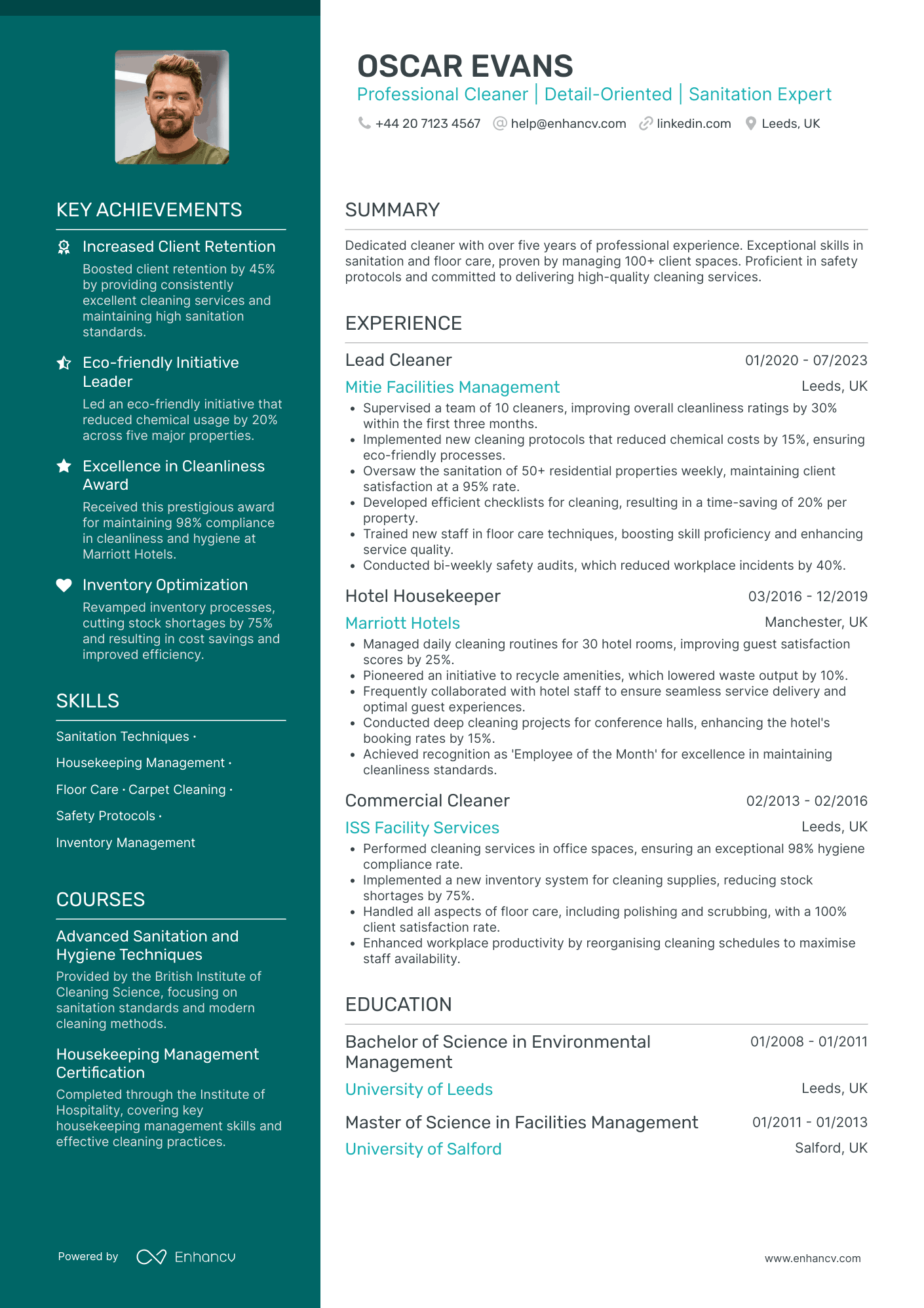
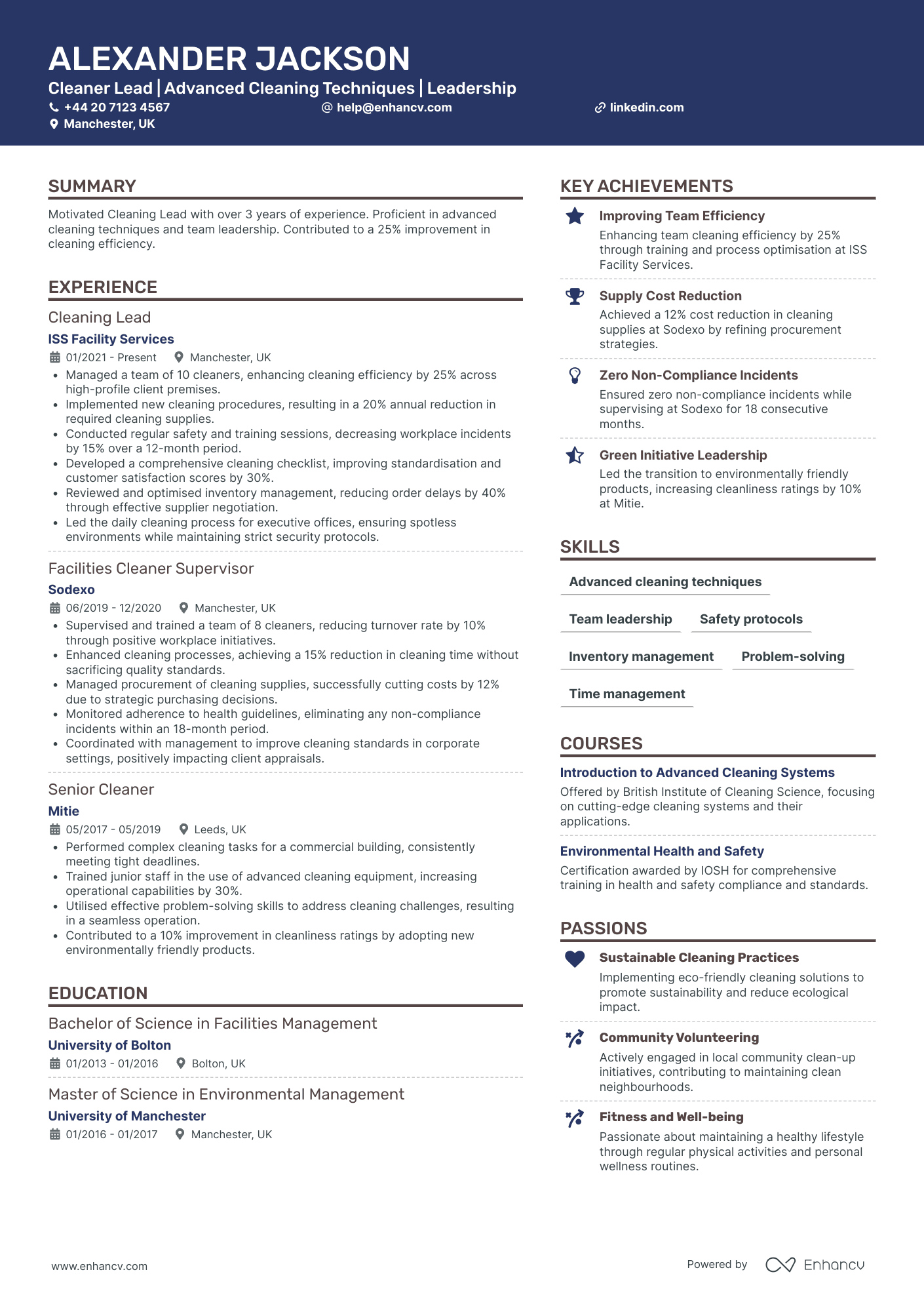
Order the page so the reader never hunts: contact details and location at the top, a short personal statement, your key skills and training, then work experience and education. Add 'references available on request' at the foot only if you need the space back.
You do not need a photo, a skills bar, or colour. A readable font at a sensible size does more for you than any graphic, and it keeps the layout clean and easy to skim.
Send a PDF for direct applications so the layout holds on any device. Cleaning agencies place a large share of these roles and often reformat CVs into their own template, so keep a Word copy ready for them. If the advert names a file type, follow it.
Agency and in-house applications often pass through tracking software, so keep the headings standard and the text live, not trapped inside an image, for an ATS-friendly CV. That is all a clean CV really means to a parser: plain structure it can read top to bottom.
Build it from a tested layout rather than a blank page. Enhancv's CV templates export to a clean PDF and keep the structure simple, so you can fill in the content and trust the format to hold.
Is your resume good enough?
Drop your CV here or choose a file. PDF & DOCX only. Max 2MB file size.

PRO TIP
Cleaning adverts usually name a site type: offices, schools, hospitals, or domestic homes. Match your CV to it. A hospital contract wants infection control and COSHH front and centre, while a domestic role leans on trust, discretion, and keyholding.
What the UK cleaner market looks like
Knowing what UK cleaning employers ask for tells you what belongs at the top of the page.
| What | UK cleaner roles |
|---|---|
| What the role pays | £19,000 to £25,000 a year (National Careers Service) |
| Where the work happens | On-site, 100% of postings (1,842 of 1,842 UK cleaner postings in the last ~30 days, Enhancv's internal job feed) |
| Experience level asked for | Entry level about 97% (1,784 of 1,842), with a small mid and senior band |
| Skills that recur most | COSHH, health and safety records, and cleaning equipment |
Two of those numbers should shape your CV.
Cleaning work is entirely on-site, 100% of the postings in the feed over the last ~30 days, so a manager needs to see you can reliably get there. Put your town, your travel radius, and a driving licence in the header if you have one.
And about 97% of postings are pitched at entry level, which is why the no-experience route below is realistic rather than wishful. The sector hires for reliability and trains for the rest.
COSHH, health and safety records, and cleaning equipment are the skills that recur most often across those adverts, so name the ones you hold in the exact words the advert uses.
Writing your cleaner personal statement
Three or four sentences at the top: who you are, the training you hold, one concrete proof of reliability, and the kind of cleaning role you want. Keep it factual. See more personal statement examples if the opening line is not coming.
Skip the adjective soup every other CV opens with. 'Hard-working, reliable, and passionate' tells a manager nothing they can check.
Lead with evidence instead:
Cleaner personal statement example (experienced)
Reliable commercial cleaner with six years across office and school contracts in Leeds, trusted with keyholder access on more than 20 sites and a spotless attendance record. COSHH trained and confident with colour-coded systems, floor machines, and the safe dilution of industrial chemicals. Full clean driving licence and my own transport. Looking for a full-time cleaning role with a company that values long-term, dependable staff.
What to avoid
A hard-working and reliable person who is passionate about cleaning and always gives 110%. A friendly team player with an eye for detail, looking for a new challenge in a company where I can grow and use my skills.
The second version names no training, no site type, and nothing a manager can verify. It could describe any applicant for any job, which is exactly why it gets skimmed past.
Give the reader one checkable fact instead: the years, the sites, the COSHH card, the clean record. One concrete detail beats a line of adjectives.
Writing your cleaner CV experience section
List each role with a dated heading, then bullets that open with a verb and close with a result. This is where 'I clean things' becomes proof you are worth hiring.
A bullet like 'responsible for general cleaning duties' is a shrug in writing. The same job written like it mattered names the site, the scale, and the standard: 'Cleaned a 40-room office floor to a nightly checklist, passing every monthly inspection for two years.'
Cleaning is more measurable than it feels. Sites covered, rooms per shift, inspection scores, years with one employer, complaints avoided, and keyholder trust are all achievements that belong in the bullet.
Open each line with a strong action verb: cleaned, sanitised, maintained, operated, restocked. Then attach the detail and the result. For the mechanics, see work experience on a CV.
Tailor each application to the advert, mirroring the site type and the training it names where they are true of you. Enhancv's CV tailoring feature reads the advert and suggests the matching edits, which saves rewriting from scratch each time.
- Cover nightly cleaning across a three-floor office site of 40-plus rooms, working to a fixed checklist with unsupervised keyholder access
- Passed every monthly client inspection for two years, with zero contract complaints logged against my shifts
- Operate floor scrubbers, buffers, and carpet extractors, and manage COSHH-compliant dilution and a colour-coded cloth system
- Trained four new starters on site procedures, health and safety, and safe chemical handling
- Cleaned classrooms, corridors, and washrooms for a 300-pupil primary school to term-time deadlines
- Followed infection-control routines through flu season, keeping shared surfaces sanitised to the school's standard
- Restocked consumables and reported maintenance faults early, cutting reactive callouts across the site
PRO TIP
No numbers to hand? Scale is evidence too. Name the size of the site, the number of rooms, the length of the contract, or the years you stayed. 'Sole cleaner for a 12,000 square foot warehouse' says more than 'hard-working cleaner' ever will.
Skills to put on a cleaner CV
Read a dozen live cleaning adverts and the same demands repeat. COSHH, health and safety, cleaning equipment, and safe chemical handling come up again and again, and they are the hard skills that matter here. List them in the words the adverts use.
COSHH is worth spelling out, since it is the one thing cleaning employers screen for by name. It stands for Control of Substances Hazardous to Health, and it covers the safe storage, dilution, and use of cleaning chemicals.
The soft skills that count are the checkable kind: reliability, trustworthiness, attention to detail, and good time management across a fixed round. Prove each one in an experience bullet rather than just claiming it.
Keep the skills section honest. If you have used a floor machine once, it is not a skill yet. List what you can defend on a trial shift.
Top skills for your cleaner CV:
COSHH
Health and safety
Manual handling
Cleaning equipment operation
Chemical dilution and colour-coding
Infection control
Waste disposal and recycling
Floor and carpet care
Stock and consumables control
Maintenance reporting
Reliability
Trustworthiness
Attention to detail
Time management
Working independently
Communication
Writing a cleaner CV with no experience
Cleaning is one of the most entry-friendly fields in the UK, with about 97% of postings pitched at entry level, so a thin work history is not the barrier it feels like. Employers hire on reliability and train for the rest.
Lead with a skills-based layout: a short personal statement, then your reliability and any training, with work history lower down.
Mine your life for real evidence. It is almost always there. Keeping a family home or a shared flat to a routine, tidying up in a retail or hospitality job, cleaning for a neighbour, or volunteering at a community centre all show you can work to a standard.
Write those in cleaning language. 'Kept a busy 20-cover cafe spotless through service, including deep cleans and waste rotation' is a cleaning bullet that happened in a hospitality job.
One line lifts a no-experience CV: 'COSHH training booked' or 'enrolled on a Level 2 cleaning principles course'. It signals you are already on the path. See more CV examples for a first job if you are staring at a blank page.
Training and certifications UK cleaning employers value
You rarely need formal qualifications to start cleaning, which is why the no-experience route works. What employers do value is proof you can work safely.
List these where you hold them, even 'in progress': COSHH, health and safety, and manual handling training, plus any BICSc (British Institute of Cleaning Science) award or a Level 2 Diploma in Cleaning and Support Services. Put them in your education or a short training section.
A current DBS check is worth naming if you have one, since cleaning roles in schools, hospitals, and care homes require it. Listing any certificates you hold saves the employer a question.
If you drive, say so. A full clean licence widens the sites you can cover, especially for mobile and multi-site rounds, and it often appears in the advert as a requirement.
Conclusion
Keep it to one clean page, name the training employers screen for, and prove your reliability with specifics rather than adjectives.
Get the basics right the way any strong CV starts, by following how to write a CV, then add a short cover letter that says why this employer. Do that and a simple cleaning CV turns into interviews.

Author's take - The Enhancv team
The cleaner CVs that stall are the ones trying to sound impressive. I do not need to read that someone is passionate about cleaning. I need to know they turn up, they can be trusted alone in a building, and they know how to handle the chemicals without an incident. Give me the years, the site types, and the COSHH card, on one page I can read in thirty seconds. Reliability you can prove beats enthusiasm you only claim.