



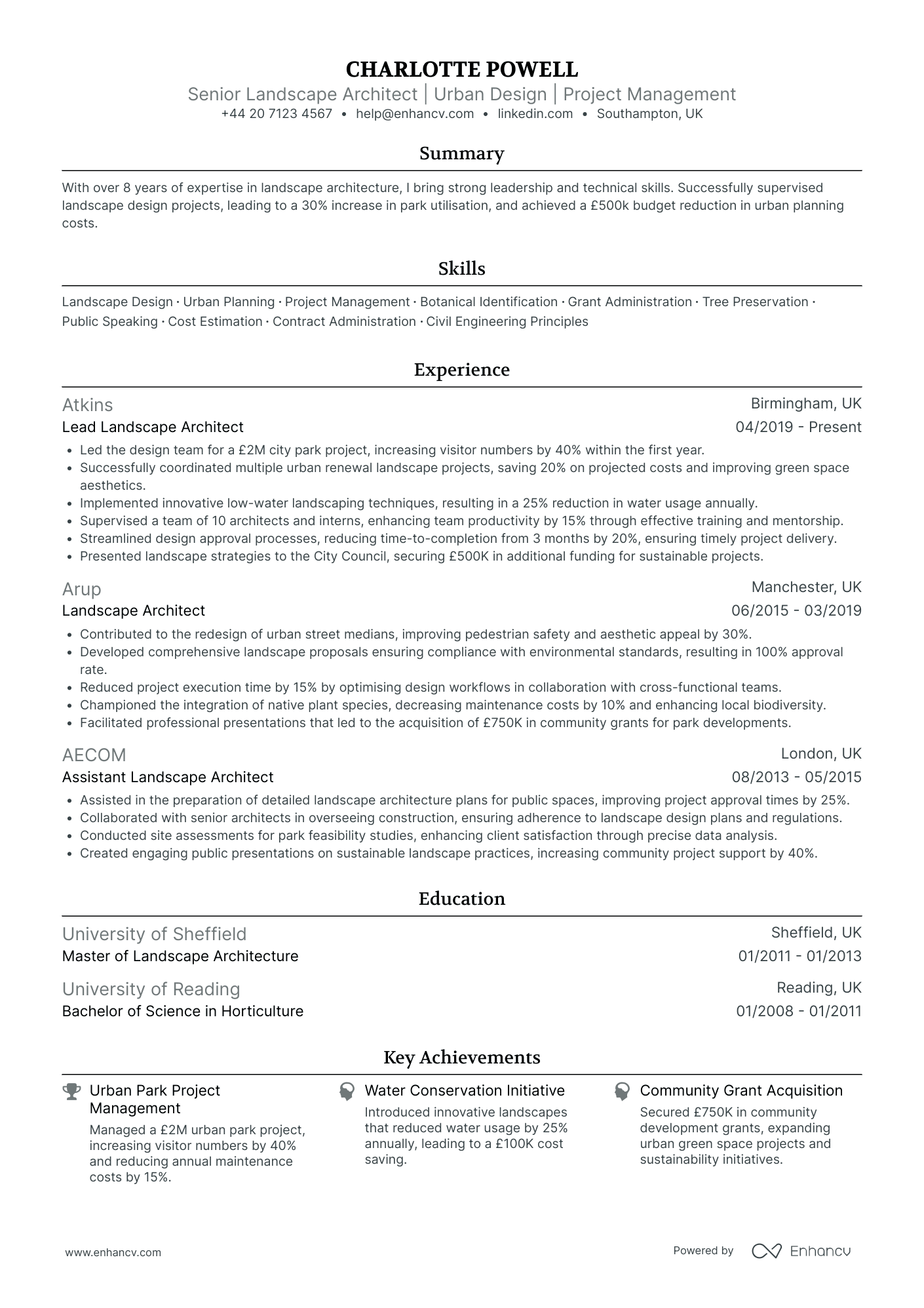
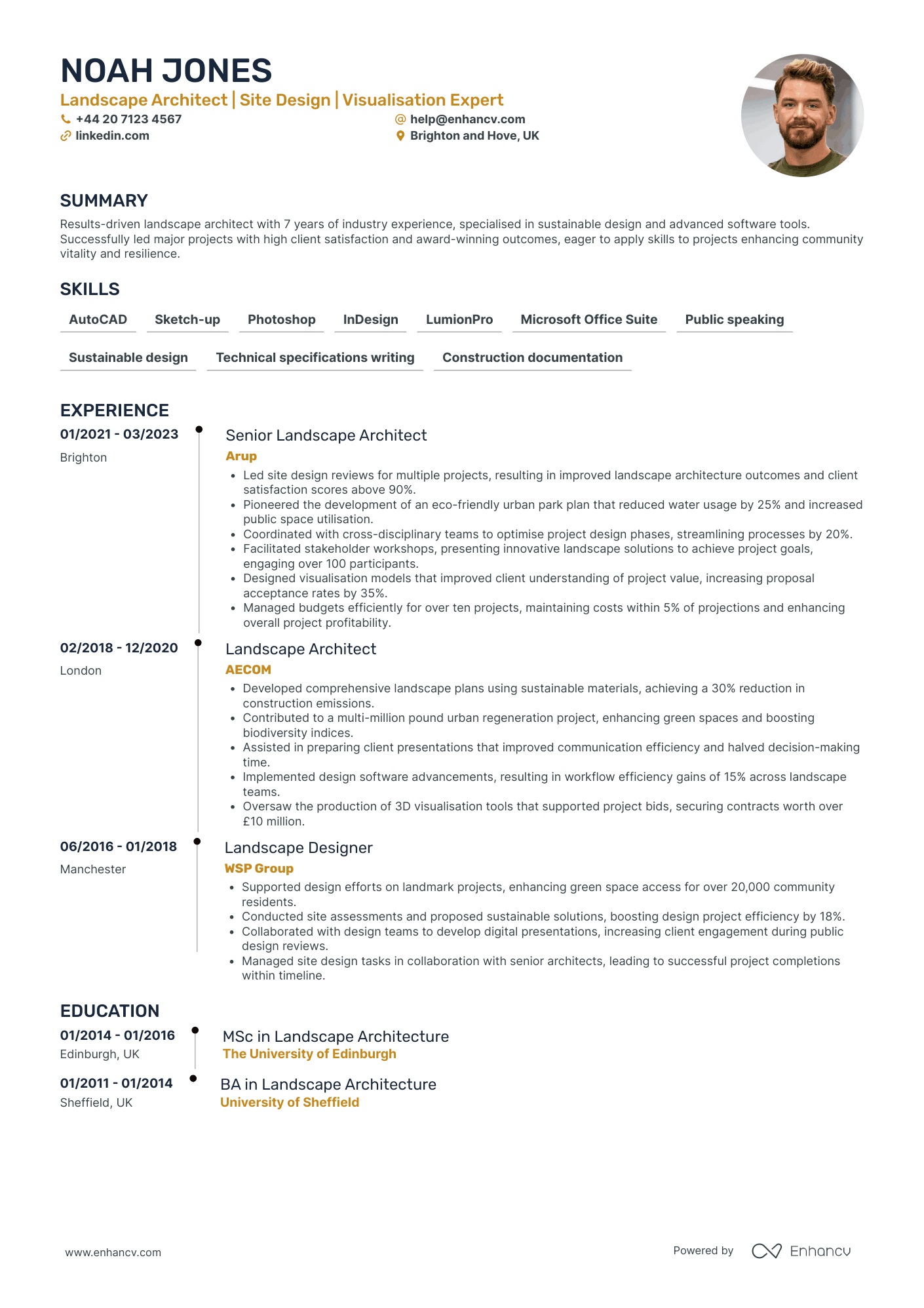
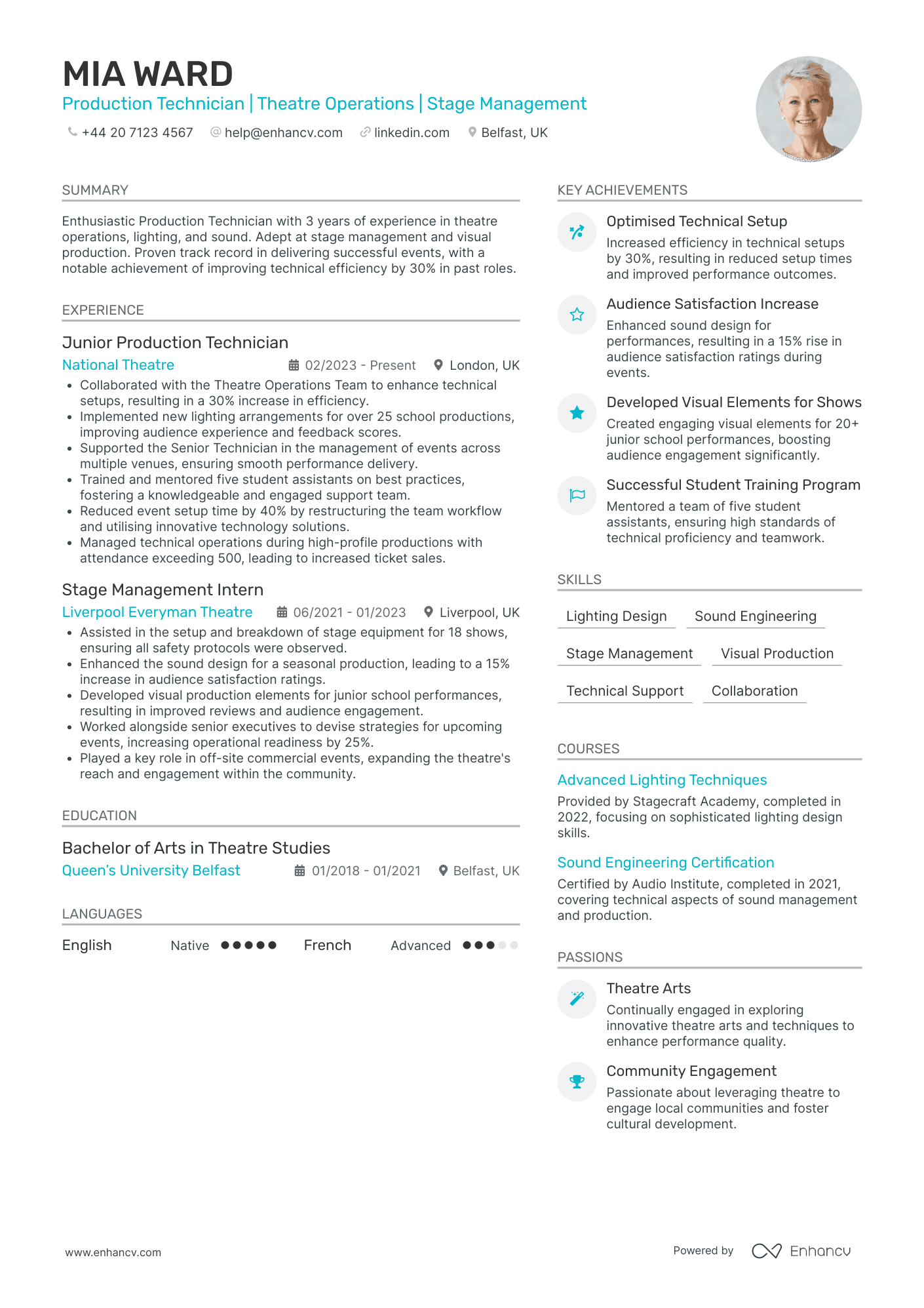
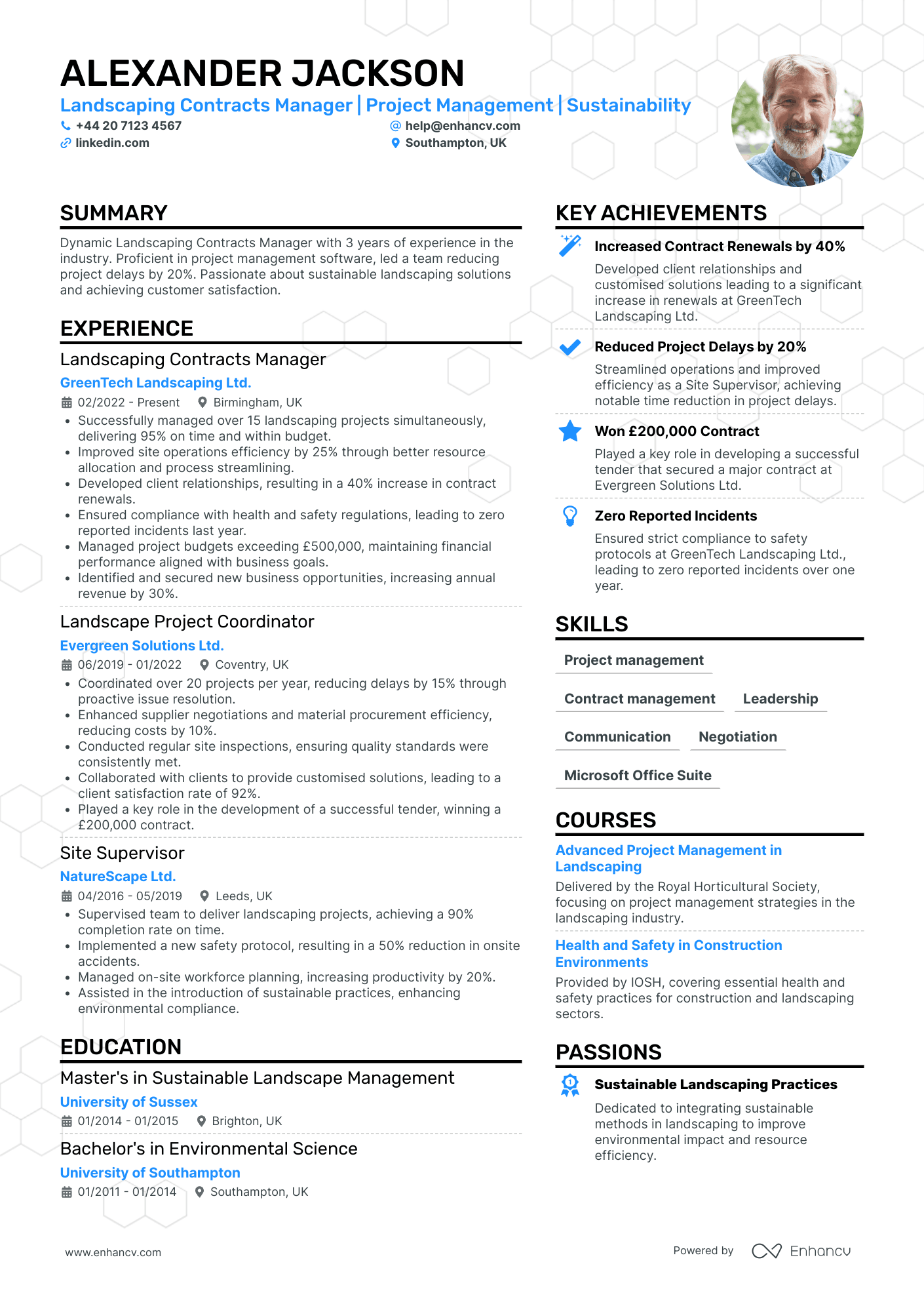
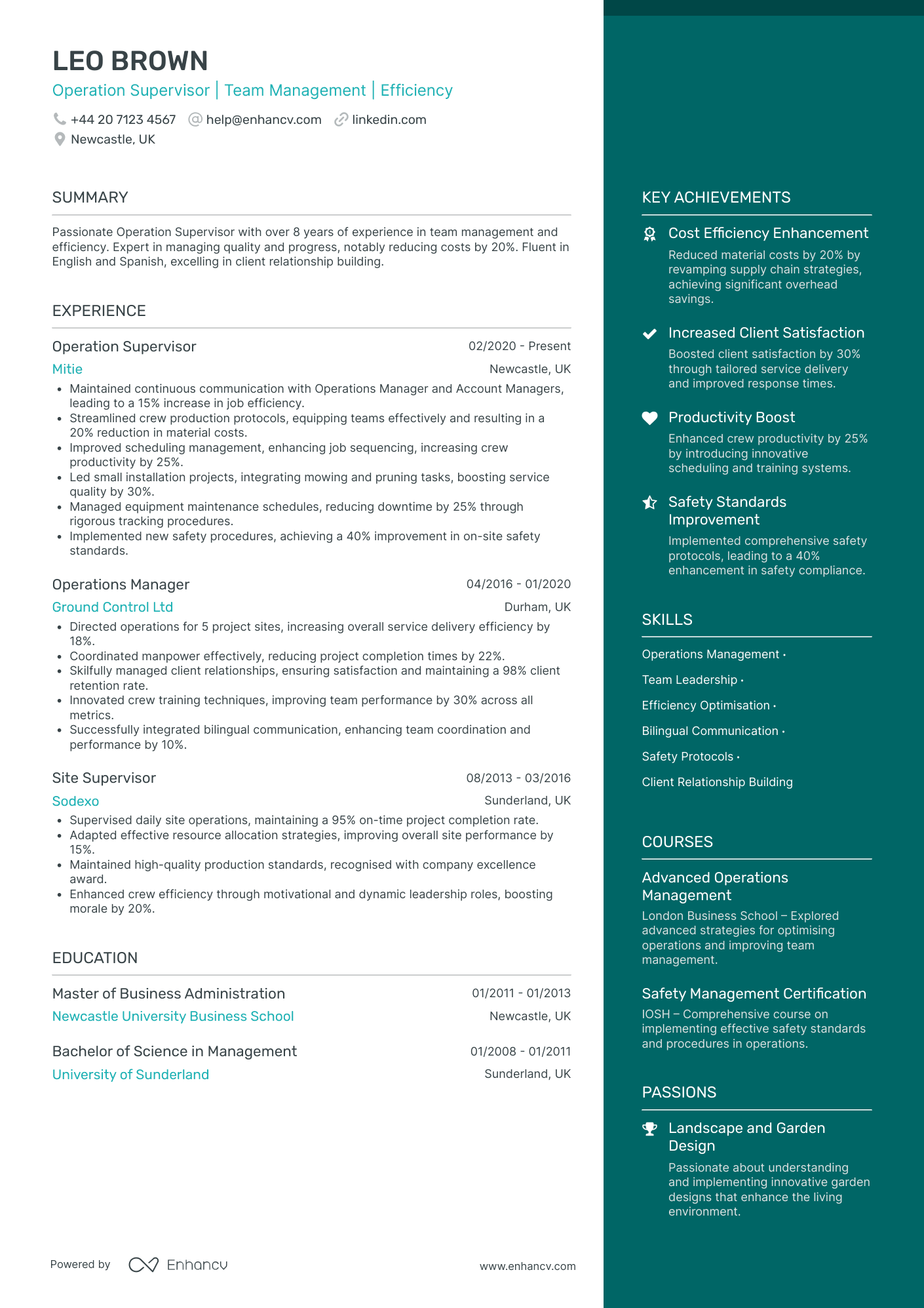
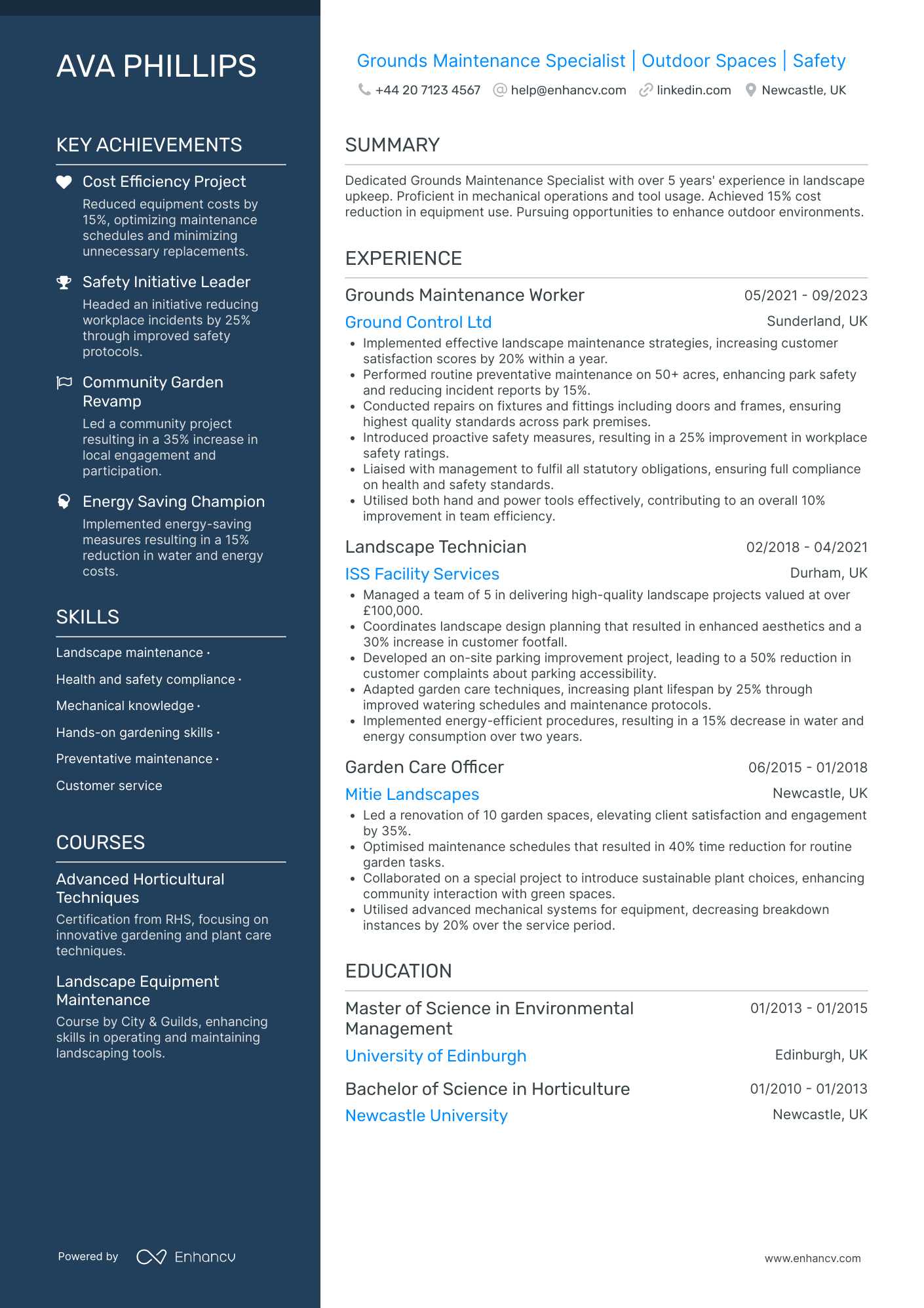
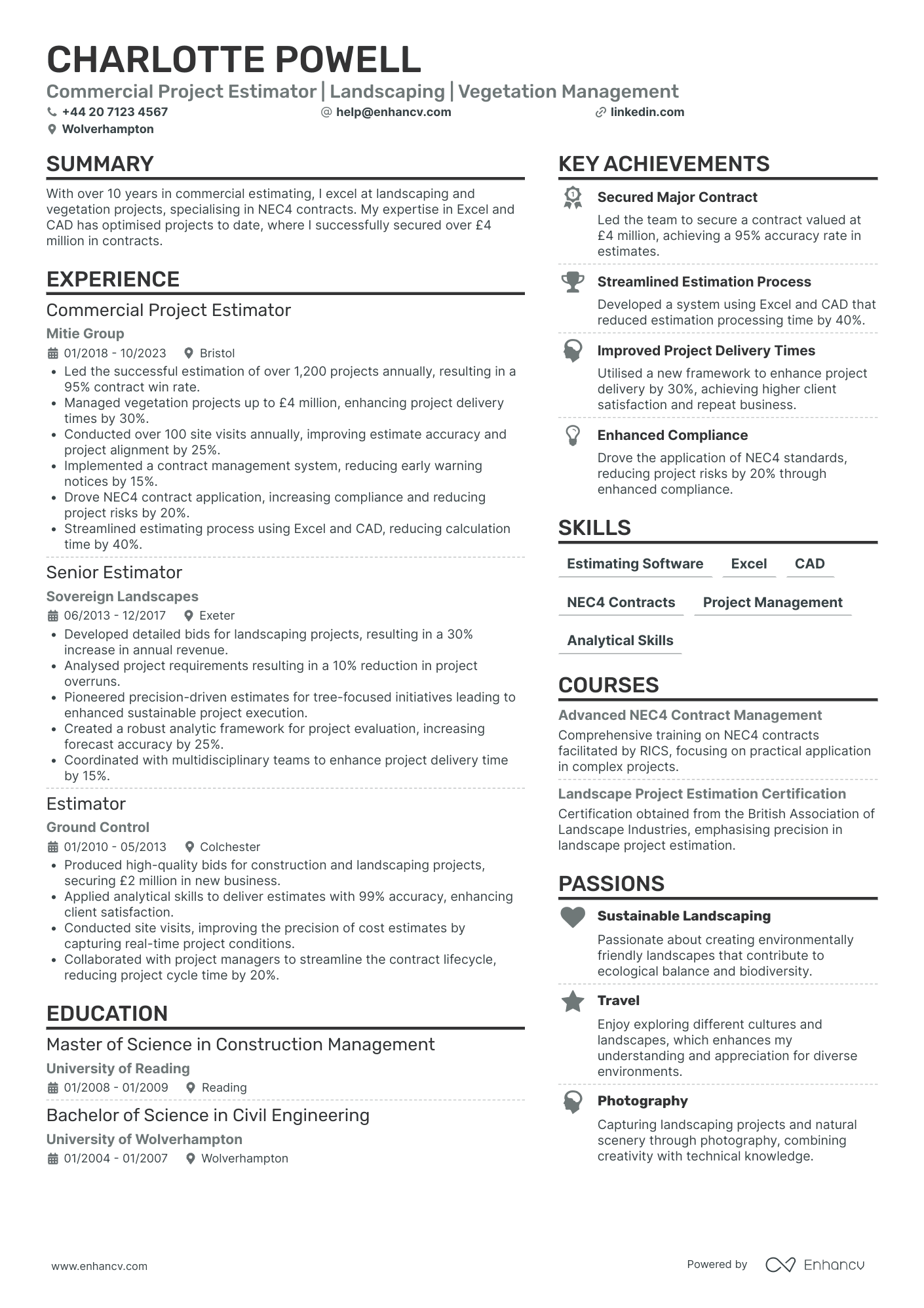
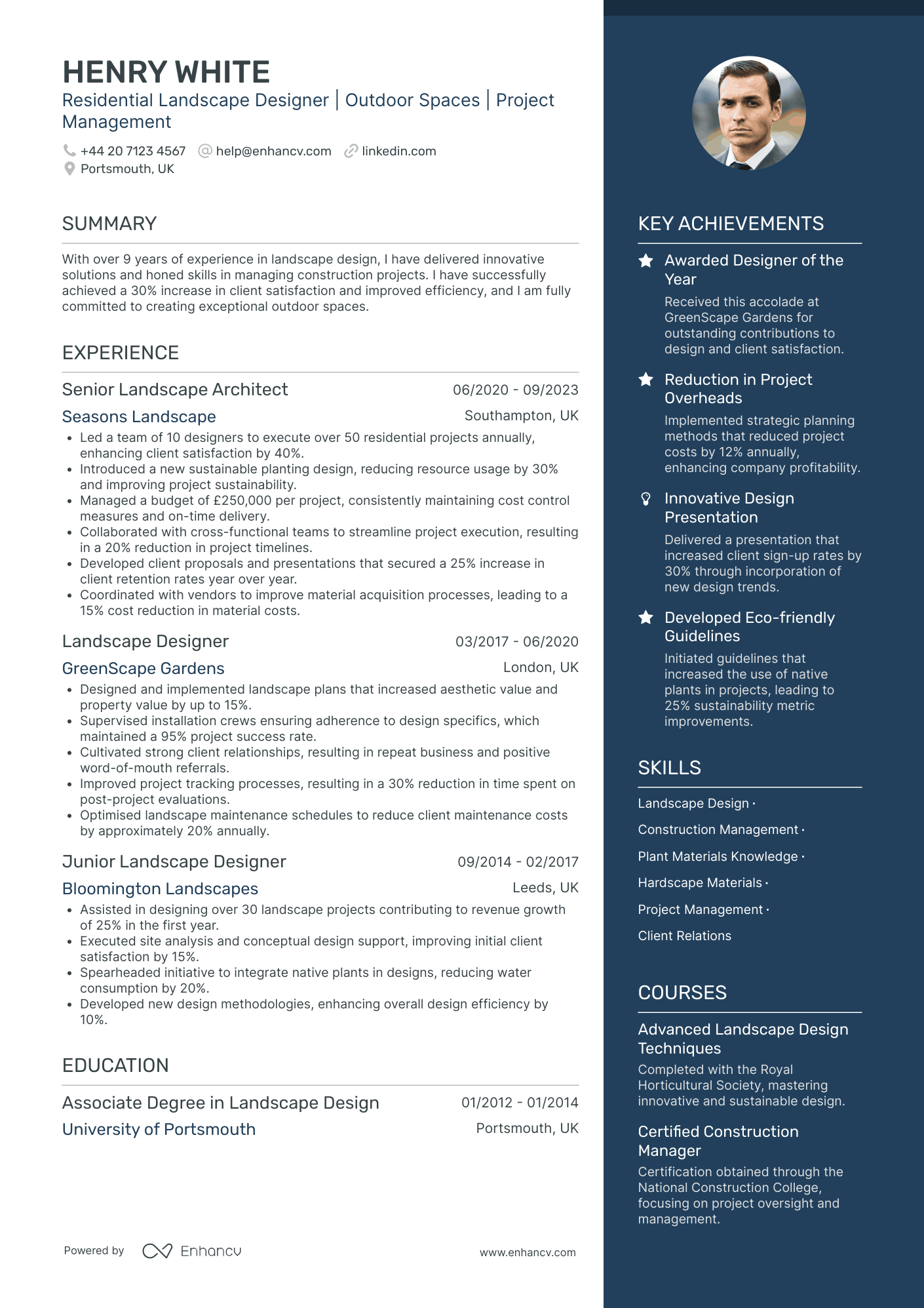
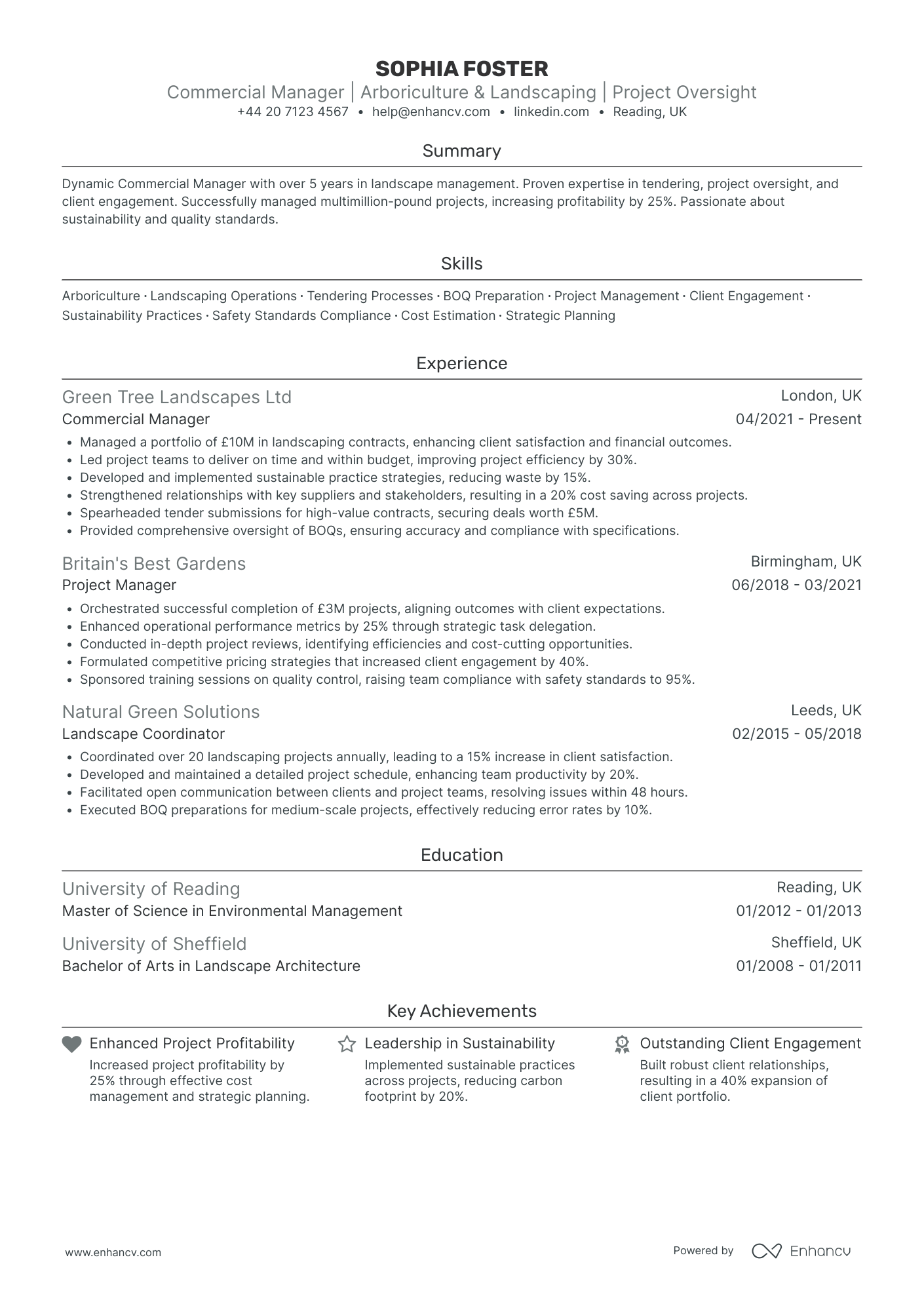
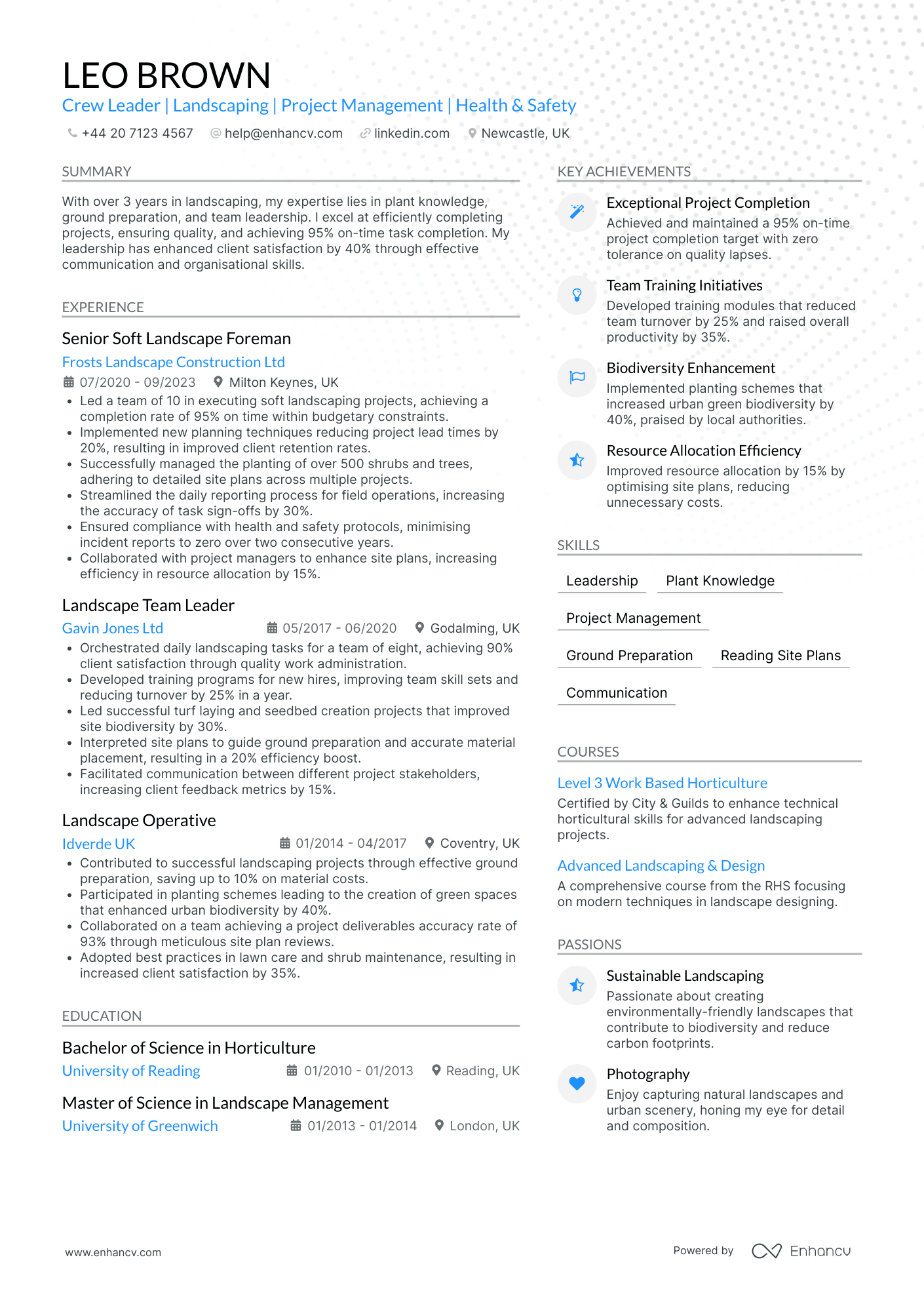
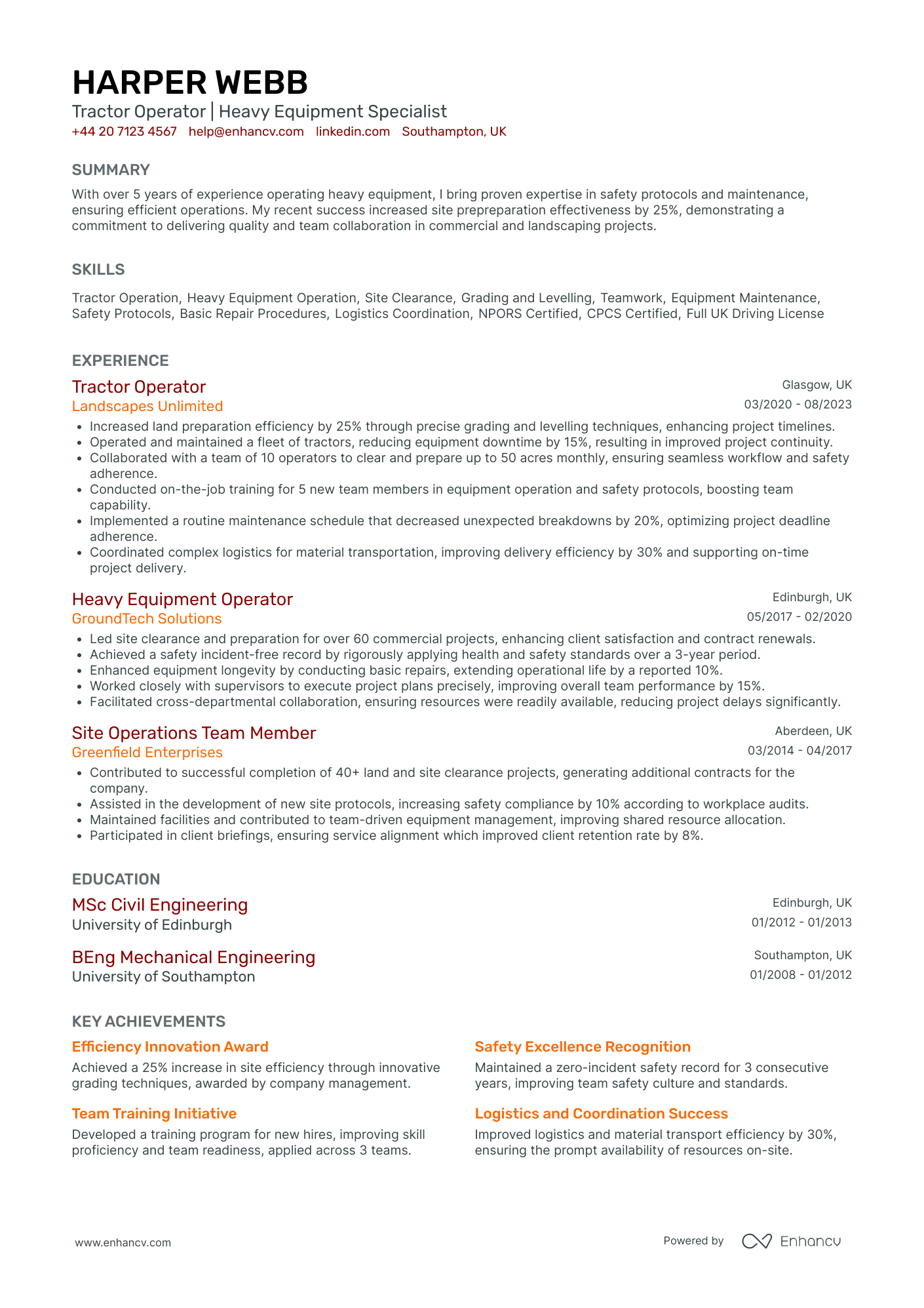
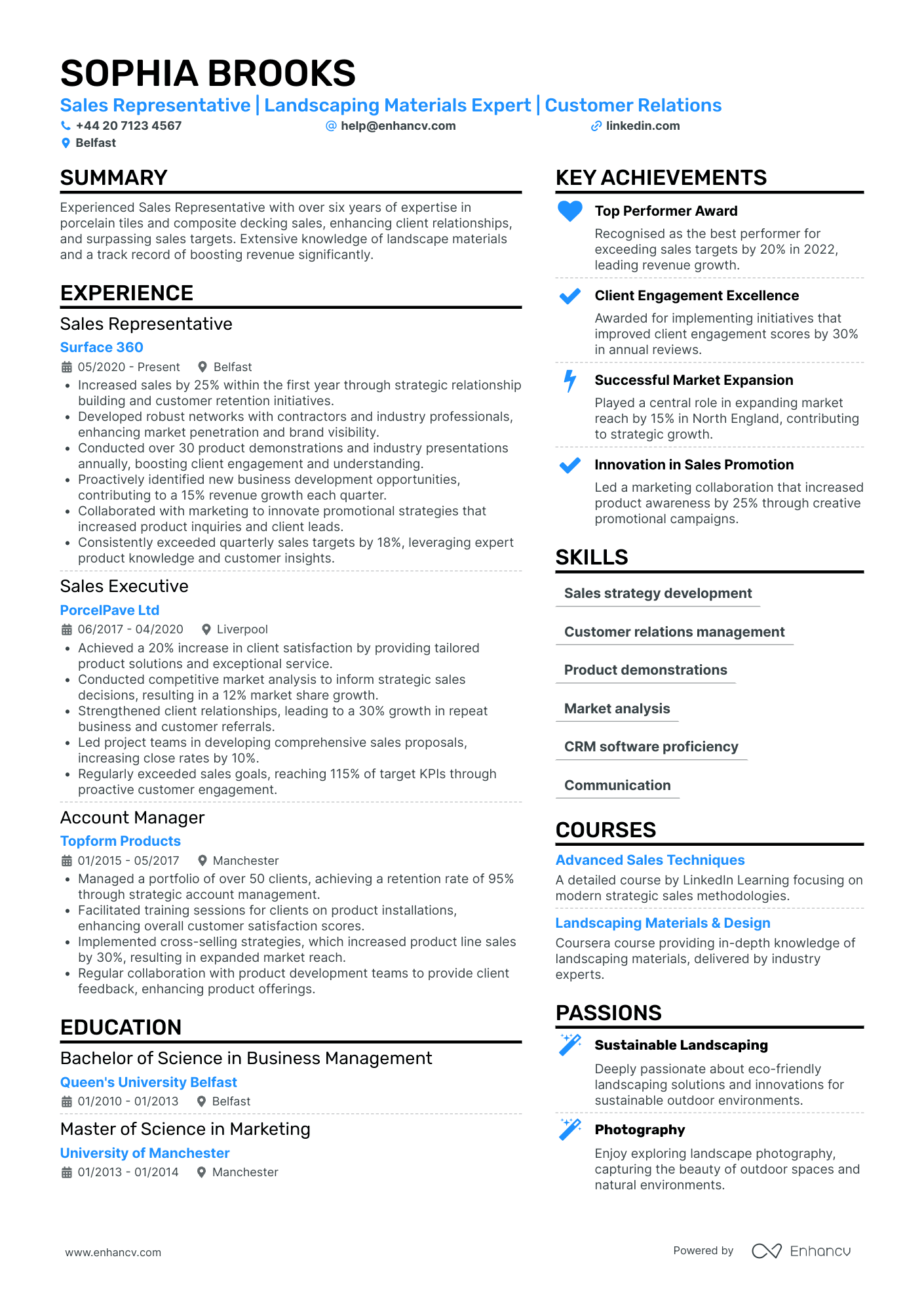
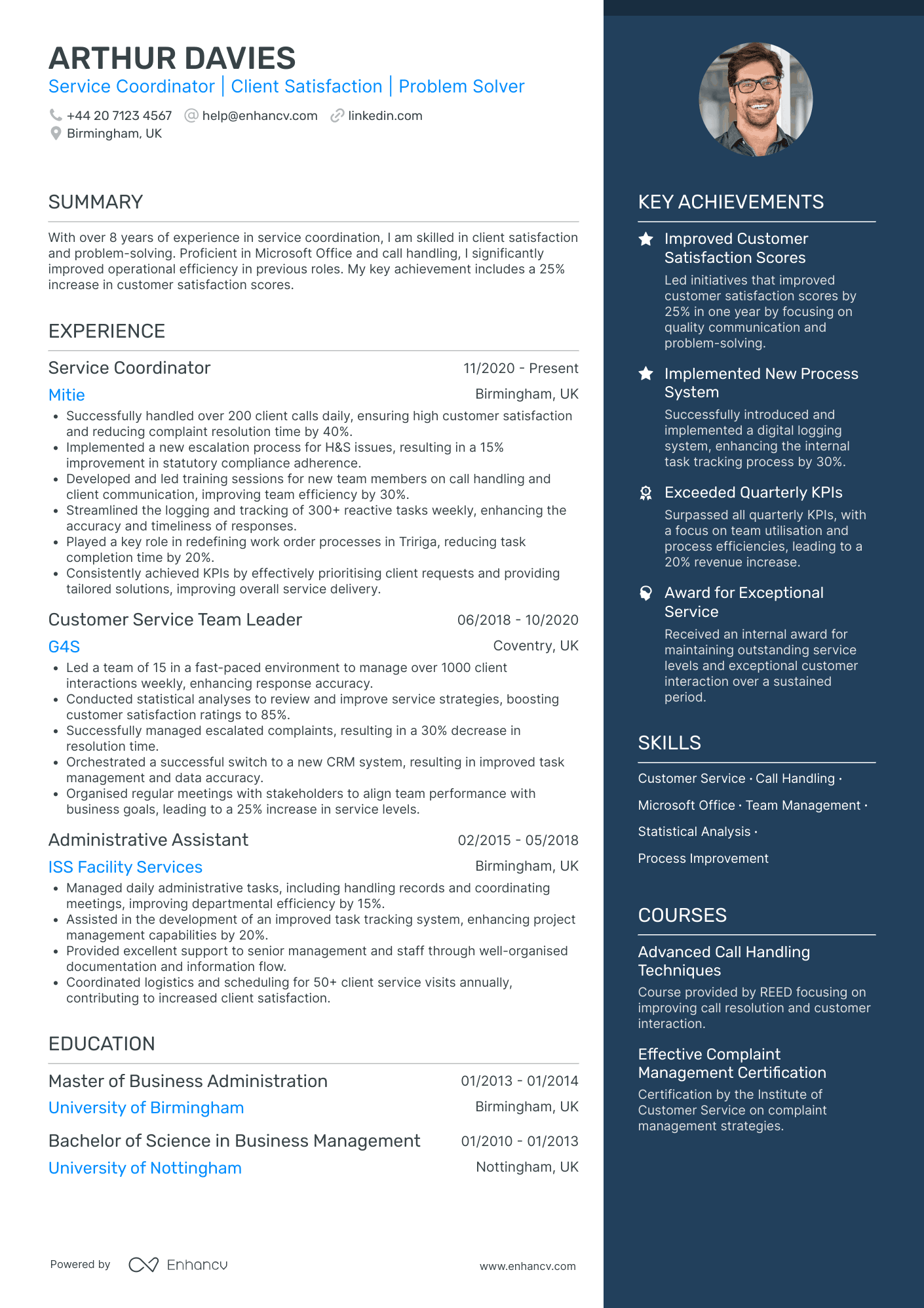
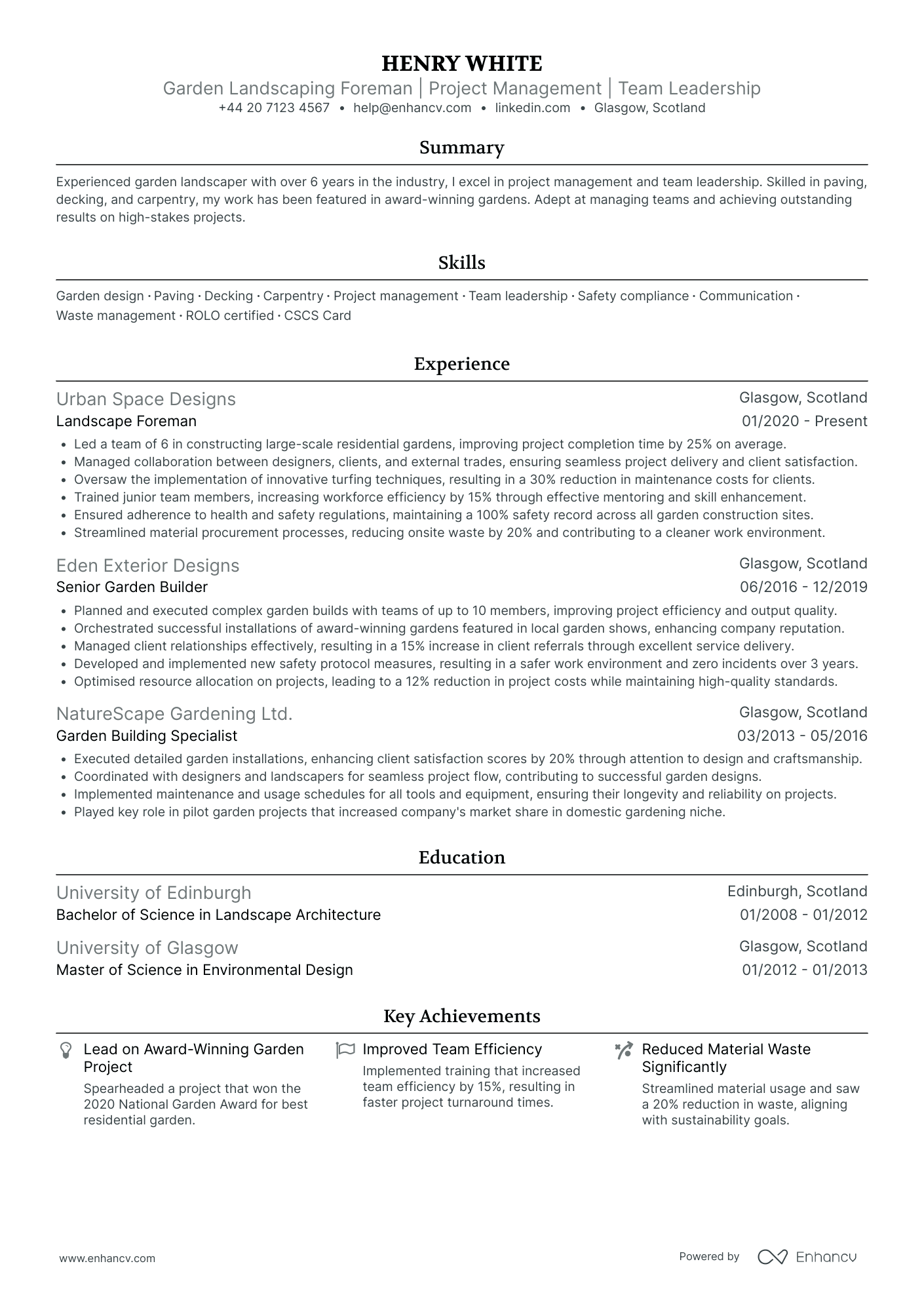
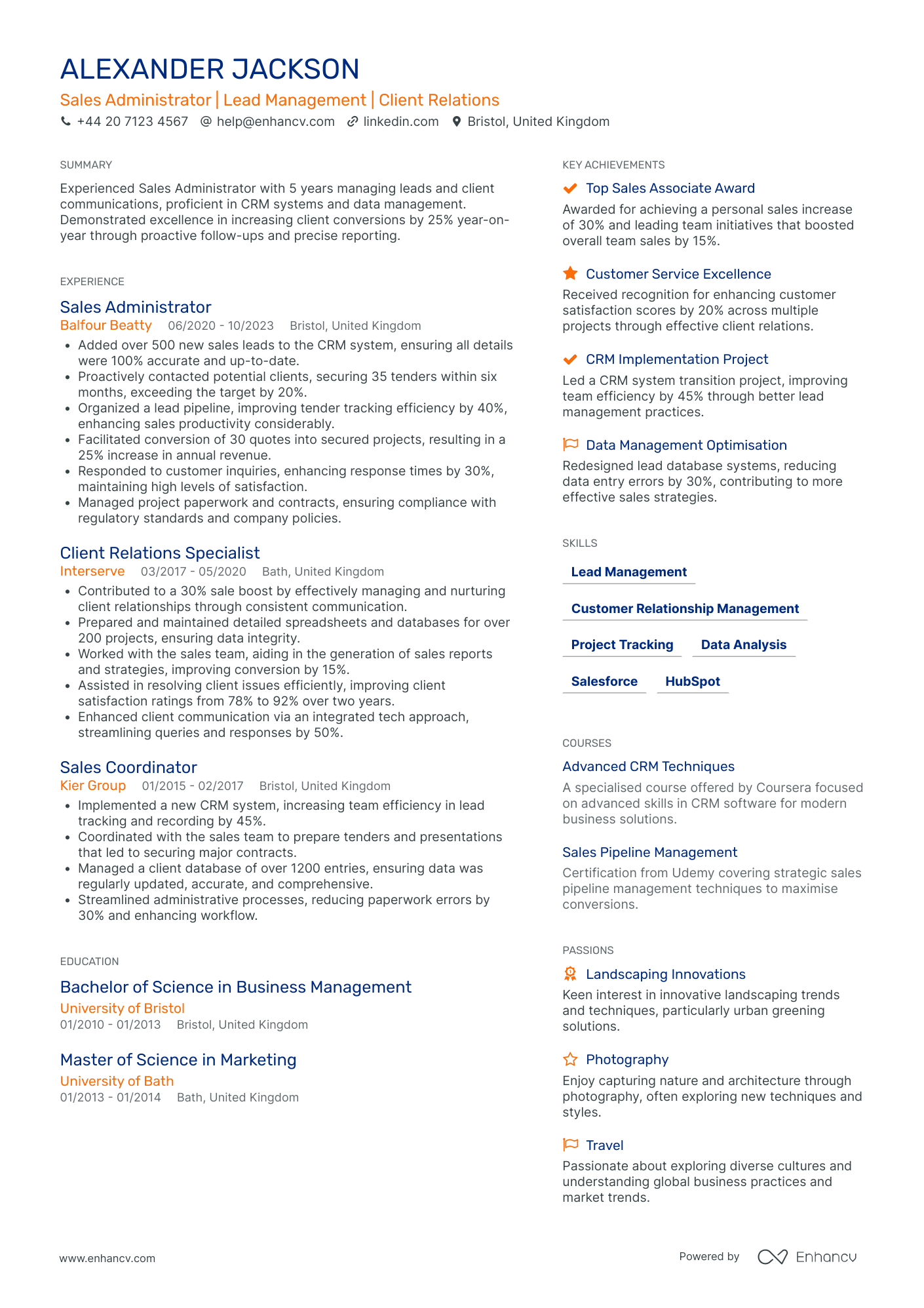
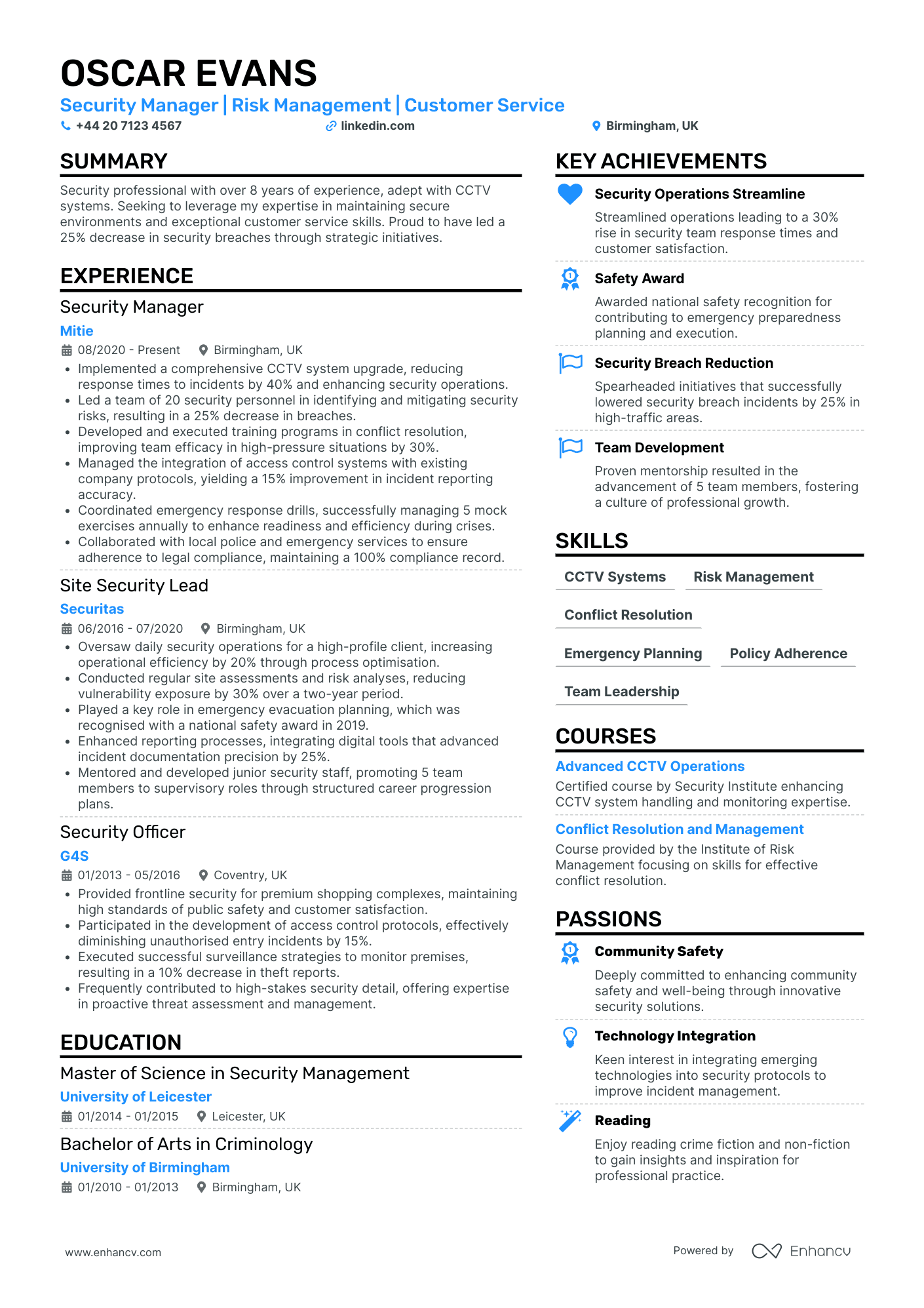
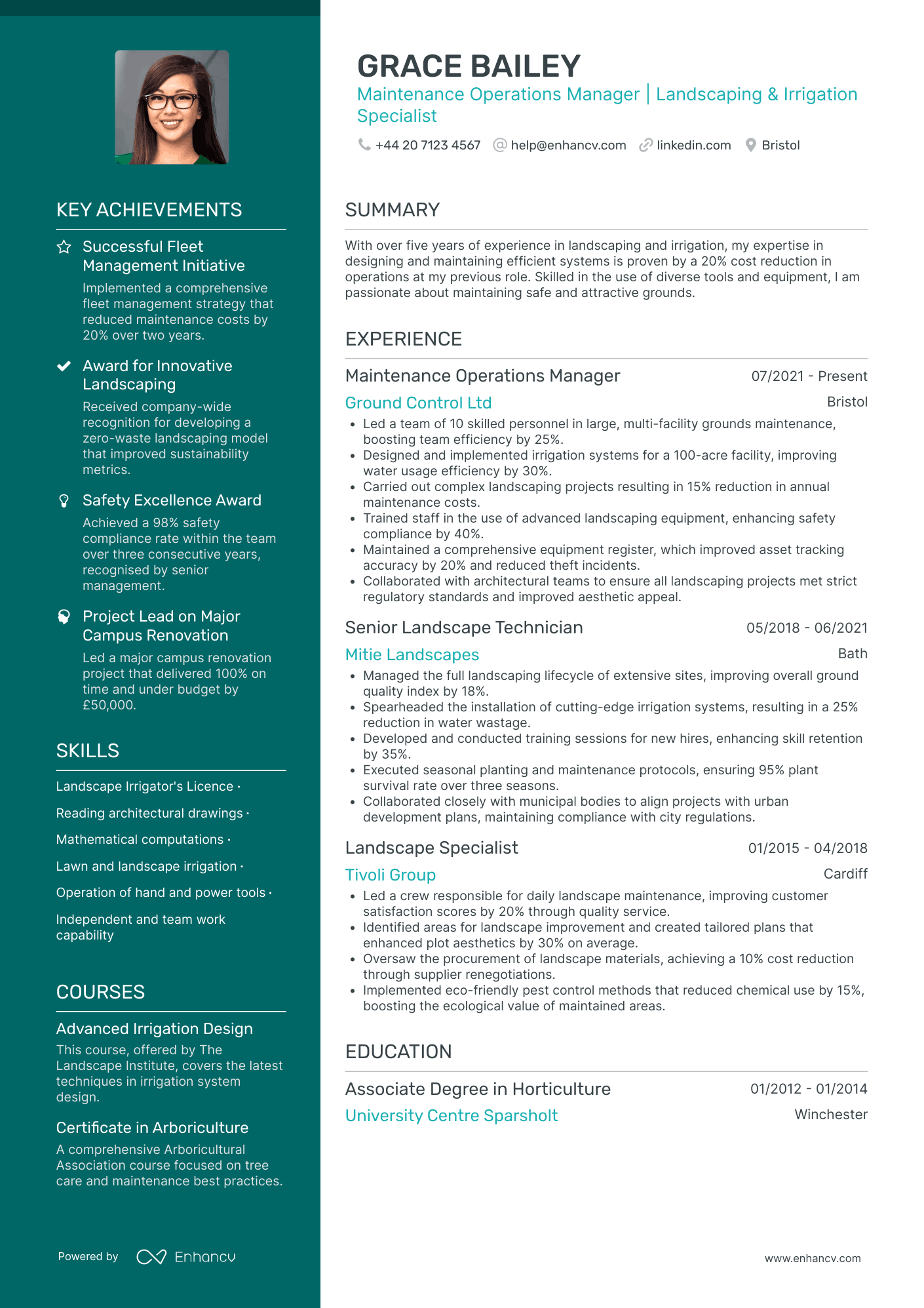
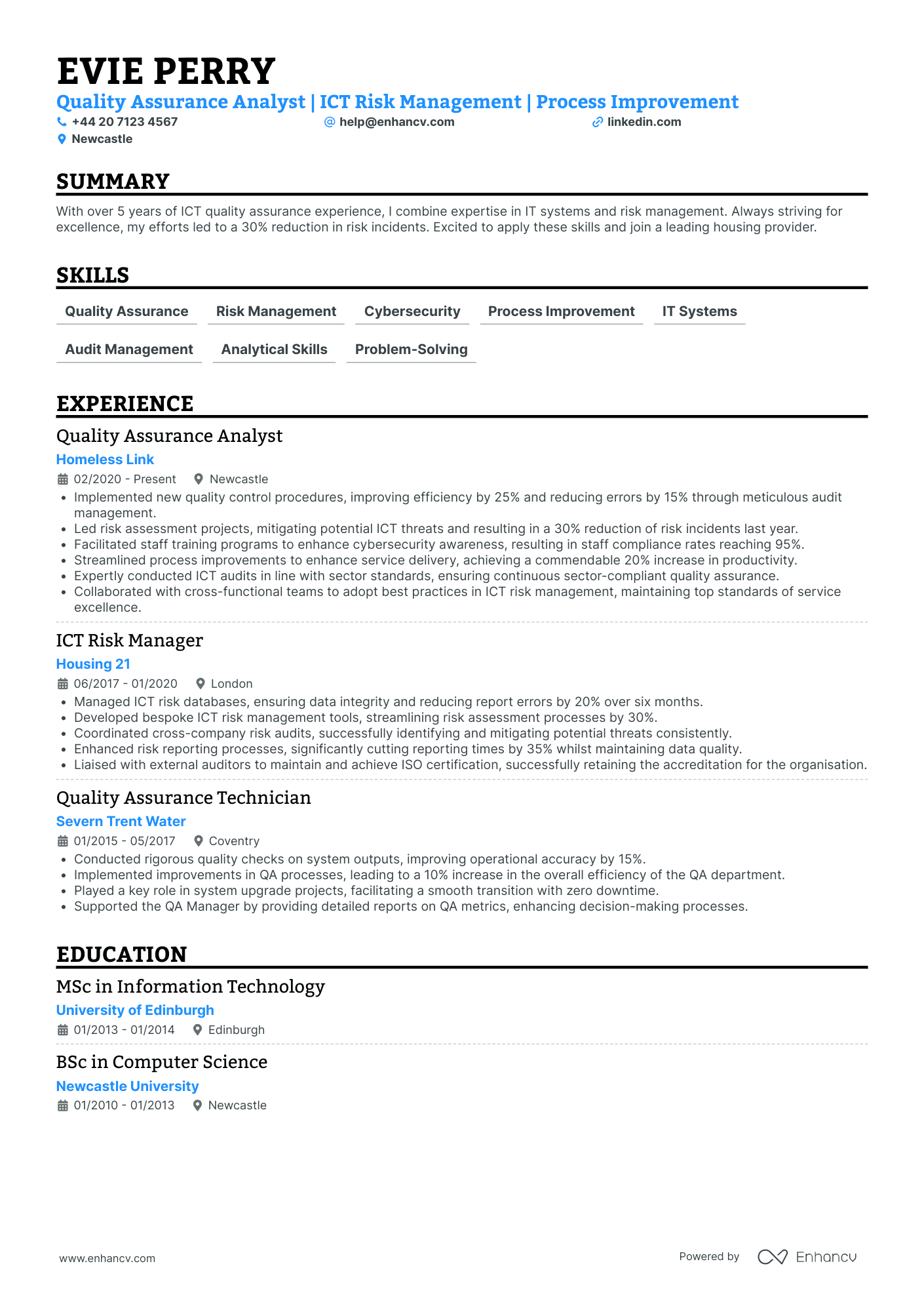
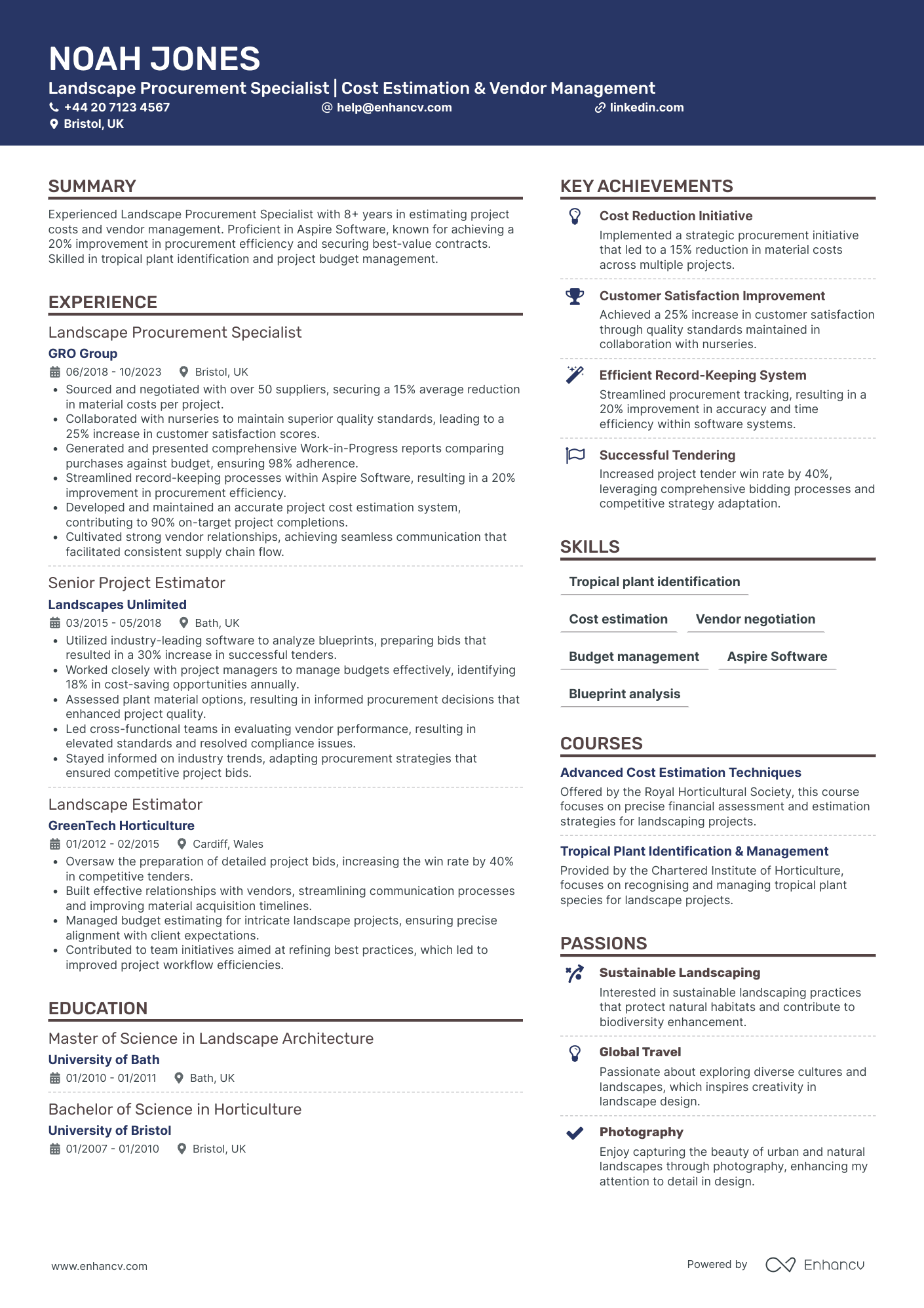
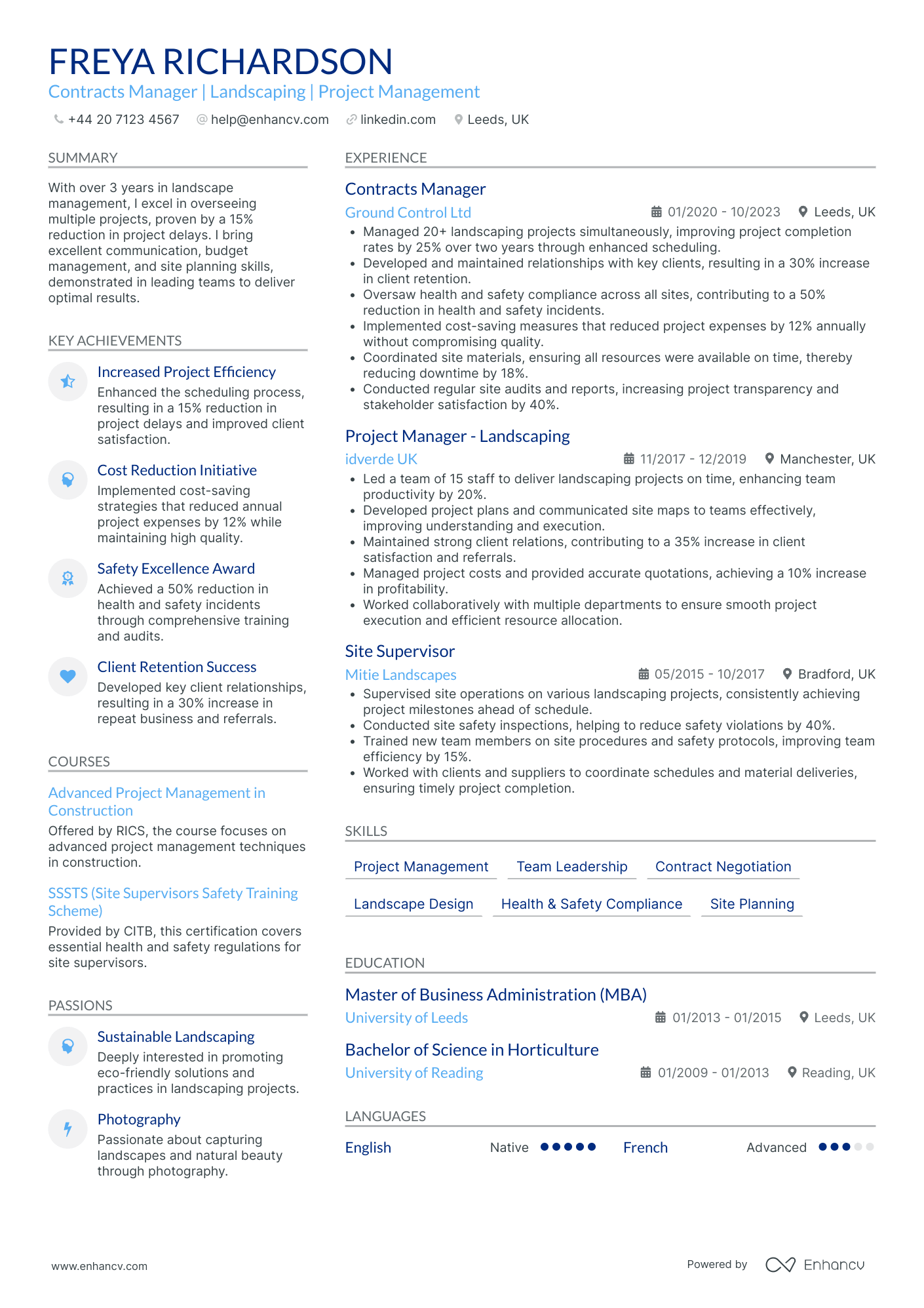
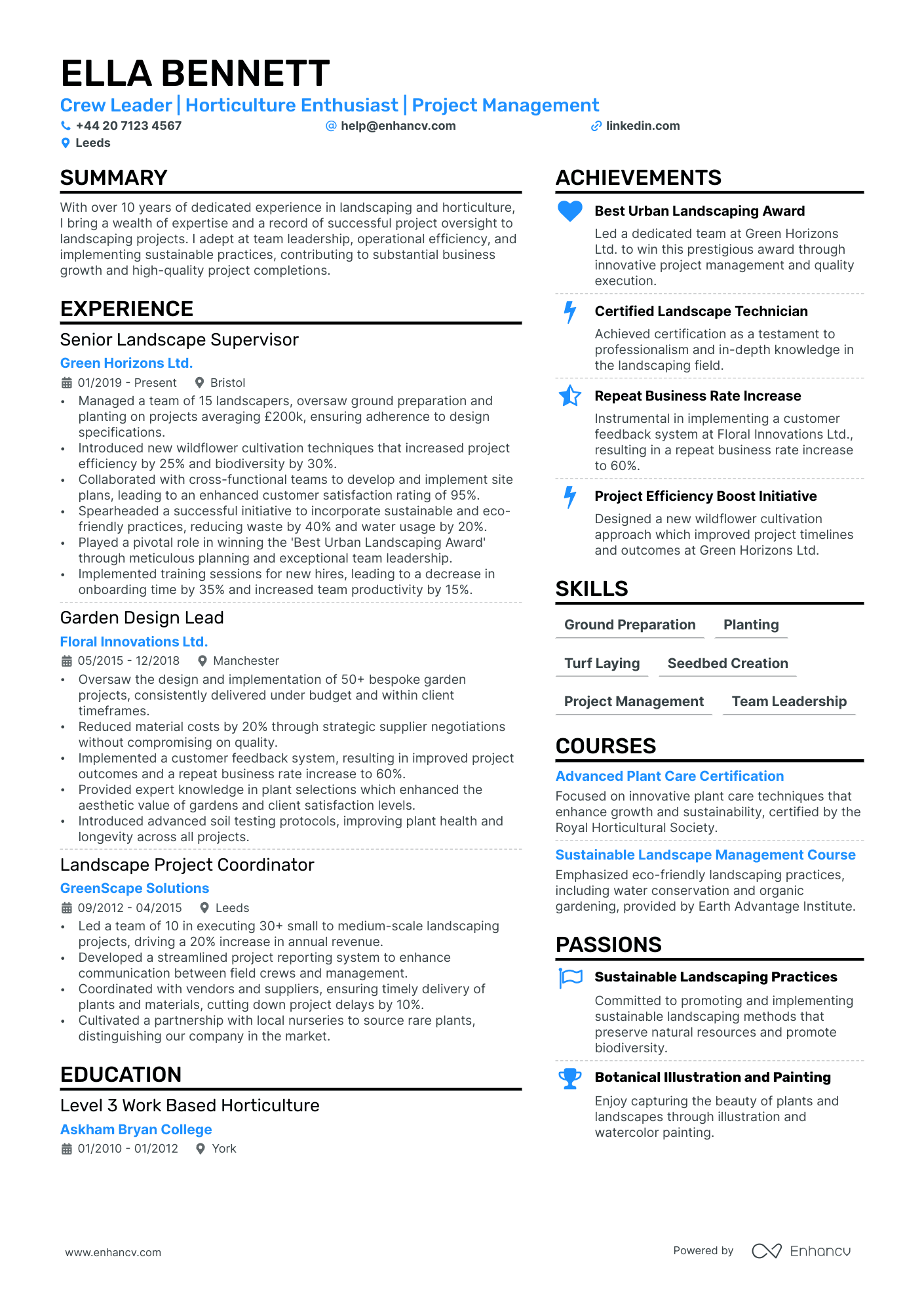
The strongest landscaping CVs I see get read in under a minute, on a phone, by a foreman standing on a half-finished patio. The format has to do the heavy lifting before a single word is read.
Most landscaping CVs lose it right there. They land as a Word file that reflows on someone else's screen, run to three cramped pages, and bury the tickets and machinery a firm actually hires for. Get the format right and the same experience reads like a safe pair of hands.

Key takeaways
- Lead with format. One or two pages, single column, sent as a PDF. A landscaping CV gets skimmed fast, often on a phone.
- Put tickets, licences, and machinery near the top: a CSCS card, PA1 and PA6 spraying certificates, chainsaw tickets, and a full driving licence.
- Portrait, not landscape. "Landscape" is the trade here, not the page orientation.
- Open with a short personal statement built on hard landscaping, planting, and one concrete job you finished.
- Quantify the outdoor work: square metres laid, plants installed, deadlines beaten, machinery operated.
- Send a PDF so the layout holds, and keep a Word copy for agencies that ask for one.
Formatting your landscaping CV
Start with the structure. If you already have trade history, use a reverse chronological layout so your most recent sites sit at the top. If you are new to the tools, a skills-based CV puts your tickets and hands-on ability ahead of a thin work history. For the underlying mechanics, see how to write a CV.
Order the sections for a trade, not an office. A landscaping CV reads best as header, then a short personal statement, then tickets and licences, then skills, then work history, then education. The header carries your name, phone number, town, and travel radius. A foreman needs to know you can get to site before anything else on the page matters.
Keep it to one page early on, two pages once you have years behind you. UK employers expect two pages at most, and a landscaping firm will not read a third. If you are spilling onto a third page, it is usually old roles and full sentences that need cutting, not smaller margins.
Use a single column, standard headings, and a plain, readable font. Leave room near the top for your licences and machinery, because that is the first thing a hiring foreman scans for. A cluttered layout hides exactly the details that get you the call.
The searches for a landscaping template in Word and PDF are worth a word of caution. A Word template is easy to edit, but it reflows the moment it opens on a different machine, and your tidy two columns can land as a mess on the hiring manager's screen. Draft in Word if that is what you have, then export the final version to PDF so what you see is what they see.
Send a PDF for direct applications so the layout holds on any screen. Keep a Word copy for recruitment agencies, which place a good share of landscaping and grounds roles and reformat CVs into their own template. If the advert names a file type, follow it.
Some larger firms and agencies run applications through tracking software, so keep the headings standard and the layout clean for an ATS-friendly CV. Skip photos, tables inside the experience section, and text boxes, which tracking systems tend to scramble. Build it from a tested layout rather than a blank page. Enhancv's CV templates export to a clean PDF that keeps its shape wherever it lands.
One more format question comes up for this trade more than any other. No, your CV should not be in landscape orientation. "Landscape" is the work, but the page stays portrait, the way every recruiter and tracking system expects to read it.

PRO TIP
List your tickets exactly as the advert writes them. If a firm asks for "PA6" or "CSCS", put "PA6" and "CSCS" on the CV in those words. A tracking system and a busy foreman both scan for the exact term, not a paraphrase.
What UK landscaping employers look for
Landscaping is a hands-on trade, and the CV that wins reflects that. Rather than a job title and a list of duties, employers want proof you can turn up, operate the kit, and finish the work safely.
Here is what to put in front of them, and where it belongs on the page.
| What | On your landscaping CV |
|---|---|
| Where the work happens | On-site and outdoors, usually across several client gardens or sites in a week. Put your base location and how far you can travel in the header, and name a full driving licence. |
| How firms hire | On tickets and hands-on evidence more than formal qualifications. Lead with the machinery you can operate and the certificates you hold. |
| Format they expect | One to two pages, portrait, sent as a PDF. Reverse chronological once you have trade history, skills-led before that. |
| What to lead with | Hard landscaping, planting and grounds skills, plus a CSCS card and any spraying or chainsaw tickets. |
Pay for landscaping work tracks the tickets and machinery you can bring to a site. That is the practical reason to list every certificate you hold. Each one is evidence and leverage at the same time.
The work also splits into two markets that read differently on a CV. Domestic work, patios, driveways, and private gardens, rewards finish quality and dealing well with homeowners. Commercial and grounds work, for councils, contractors, and facilities firms, rewards site tickets, machinery hours, and a clean safety record. Aim your CV at whichever the advert is describing, and lead with the evidence that market cares about.
Tickets, licences, and training that strengthen a landscaping CV
This is the section that separates two landscapers with the same years on site. List what you hold, and add "in progress" or "booked" for anything you are working towards.
The ones UK landscaping and grounds employers look for most:
- A CSCS card for construction and commercial site access.
- PA1 and PA6 pesticide application certificates for spraying.
- Chainsaw and related tickets, such as City and Guilds NPTC units CS30 and CS31.
- Plant and machinery tickets: mini excavator, dumper, telehandler, ride-on mower.
- A full UK driving licence, and category B and E if you tow a trailer or plant.
- Horticulture qualifications, such as an RHS or City and Guilds Level 2 or 3.
Put these in a dedicated tickets or education block, and name any certificates in full. A current first aid or manual handling qualification belongs there too. It saves the employer a question and signals you take site safety seriously.
A ticket often beats a year of vague experience. Two candidates each claim three years of hard landscaping, but one holds a PA6 and a dumper ticket and the other lists neither. The first can be put on a job on Monday with no supervision and no hire cost. That is the difference the certificates section is really communicating, so give it room and keep it current.
Add the awarding body and the year where you can. "NPTC CS30, 2023" reads as a real, checkable ticket. "Chainsaw trained" reads as something you might have picked up on a weekend. The more precise you are, the less a hiring manager has to take on trust.
Writing your landscaping personal statement
Three or four sentences at the top: who you are, the landscaping skills you bring, the tickets you hold, and one job you actually finished. Keep it concrete. See more personal statement examples if the opening line will not come.
Skip the adjective soup every other CV opens with. "Hard-working, reliable, and passionate about the outdoors" tells a foreman nothing he can check.
Lead with evidence instead.
Landscaping CV personal statement example
Reliable hard landscaper with four years building patios, driveways, and garden walls across domestic and commercial sites around Greater Manchester. CSCS card holder, PA1 and PA6 certified, and confident on a mini digger, dumper, and plate compactor. Recently laid a 120 square metre porcelain patio with a retaining wall two days ahead of schedule. Full UK driving licence and happy to travel across the North West.
Compare that with the version that says plenty and proves nothing.
Weak landscaping personal statement to avoid
Hard-working and passionate team player looking for a new challenge in the landscaping industry. Good with my hands, reliable, and always willing to learn. A real people person who takes pride in every job and gives 110 percent.
When I read a landscaping personal statement, I am looking for two things in the first three lines: the tickets you hold and one job you finished, with a number attached. "Laid a 120 square metre patio two days early" tells me more than a paragraph of adjectives ever could. Name the machinery, name the certificates, and name one real result. That is what gets a landscaper to the top of the pile.
The Enhancv team
Writing your landscaping experience section
Write every entry the same way: a dated heading with the firm and your role, then bullets that show what you did and how it turned out. Lead each bullet with a verb. For the mechanics, see work experience on a CV.
Landscaping is more measurable than it feels. Square metres laid, plants installed, sites finished in a week, machines operated, deadlines beaten. Those numbers are your achievements, and they read far louder than "responsible for garden maintenance".
Start each bullet with a strong action verb: laid, built, operated, planted, dug, graded, maintained.
Write safety and quality into the bullets rather than claiming them in a skills list. "Zero reportable incidents in two years" and "passed client sign-off first time" are the phrases that tell a firm you are low-risk to take on. Where you supervised, trained, or ran a small crew, say so. Landscaping firms are short of people who can be left to run a job.
- Laid over 600 square metres of block paving, porcelain patios, and natural stone across 25 domestic sites, passing client sign-off first time on all but two
- Operated a 1.5 tonne excavator, dumper, and plate compactor daily, with zero reportable incidents in two years
- Built retaining walls, timber fencing, and raised beds to landscape drawings, setting levels and falls for drainage
- Trained two new labourers on safe machine use and site set-up, cutting first-month rework on their jobs
- Maintained 30 commercial sites on a weekly round, mowing, strimming, hedge-cutting, and clearing to a fixed schedule
- Held PA1 and PA6 and applied weed control across car parks and pathways in line with COSHH and site risk assessments
- Planted and established 400 shrubs and hedging on a new-build estate, with over 95 percent surviving the first season
- Kept machinery serviced and logged, reducing downtime and hire costs across the team's kit
Tailor each application. Pull the duties and tickets straight from the advert and mirror the ones that are true of you. Enhancv's CV tailoring feature reads the ad and flags the matching edits, so each application builds on your last one instead of a blank page.
PRO TIP
No exact numbers to hand? Estimate honestly. "Around 500 square metres of block paving across the season" is fine, and far stronger than a bullet with no scale at all.
Skills for a landscaping CV
Read a run of landscaping adverts and the same demands repeat. Hard landscaping, planting, groundworks, fencing, and machinery operation come up again and again, so list them in the words the adverts use. Those are your hard skills.
The soft skills that matter on a site are real and checkable: reliability, teamwork, communication, and time management. Prove each one in a bullet rather than just claiming it.
List only what you can stand behind. If you hold a ticket for a machine, name it. If you are still training on it, put it under training in progress rather than skills.
Split the list so a scanner can read it. Keep the trade skills and the machinery together, and keep the soft skills short and honest. A landscaping CV that claims fifteen skills and evidences none reads worse than one that claims six and backs each with a bullet in the experience section.
Where a skill maps to a ticket, pair them. "Pesticide application (PA1, PA6)" is stronger than "weed control", because it tells the reader you are legal to do the work, not just familiar with it. The same goes for chainsaw work, plant operation, and anything a firm would otherwise have to hire in or supervise.
Top skills for your landscaping CV:
Hard landscaping
Planting and soft landscaping
Groundworks and drainage
Fencing
Brick and block work
Machinery operation (excavator, dumper, mower)
Grounds maintenance
Pesticide application (PA1, PA6)
Reliability
Teamwork
Communication
Time management
Attention to detail
Physical stamina
Landscaping CV with no experience
Landscaping is one of the more open trades in the UK. Firms hire for fitness, reliability, and a willingness to earn tickets, and most will train you on the tools once you are on site.
So your first CV carries its weight differently. Lead with a skills-based structure: a short personal statement, then skills and any hands-on work, with paid history lower down.
Mine your life for real evidence. It is usually there:
- Labouring, groundwork, or any building-site work.
- Farm, agricultural, or forestry work, and anything outdoors and physical.
- Gardening, allotment, or grounds work, paid or not.
- Driving, towing, or operating machinery in another job.
Write it in trade language. "Cleared and re-turfed a 200 square metre garden for a neighbour over two weekends" is a landscaping bullet that happened at home.
If you have helped at a community garden or allotment, give it a dated entry like a job. Volunteering counts as experience for this trade, not filler.
One line lifts a no-experience CV up the pile: "CSCS card booked" or "enrolled on a Level 2 in Horticulture". It shows you are already on the path. For more on structuring a first CV, start there.
Show you understand the day. Landscaping is early starts, physical work in all weather, and long stretches on your feet. A short line that says you know that and want it settles the one worry every foreman has about a first-timer, which is whether you will still be there in week three.
Apprenticeships and labouring roles are the usual way in, and neither needs a polished CV. A clean one page, a couple of tickets booked, transport sorted, and a genuine willingness to start at the bottom will get you a trial. Once you have a season on site, you rewrite the CV around what you actually did.
Conclusion
Lead with the format, put your tickets and machinery near the top, and quantify the outdoor work in square metres, plants, and deadlines beaten.
Pair the CV with a short cover letter that says why this firm, and a clean, one-or-two-page PDF turns your time on site into interviews.

Author's take - The Enhancv team
When I read a landscaping personal statement, I am looking for two things in the first three lines: the tickets you hold and one job you finished, with a number attached. "Laid a 120 square metre patio two days early" tells me more than a paragraph of adjectives ever could. Name the machinery, name the certificates, and name one real result. That is what gets a landscaper to the top of the pile.