



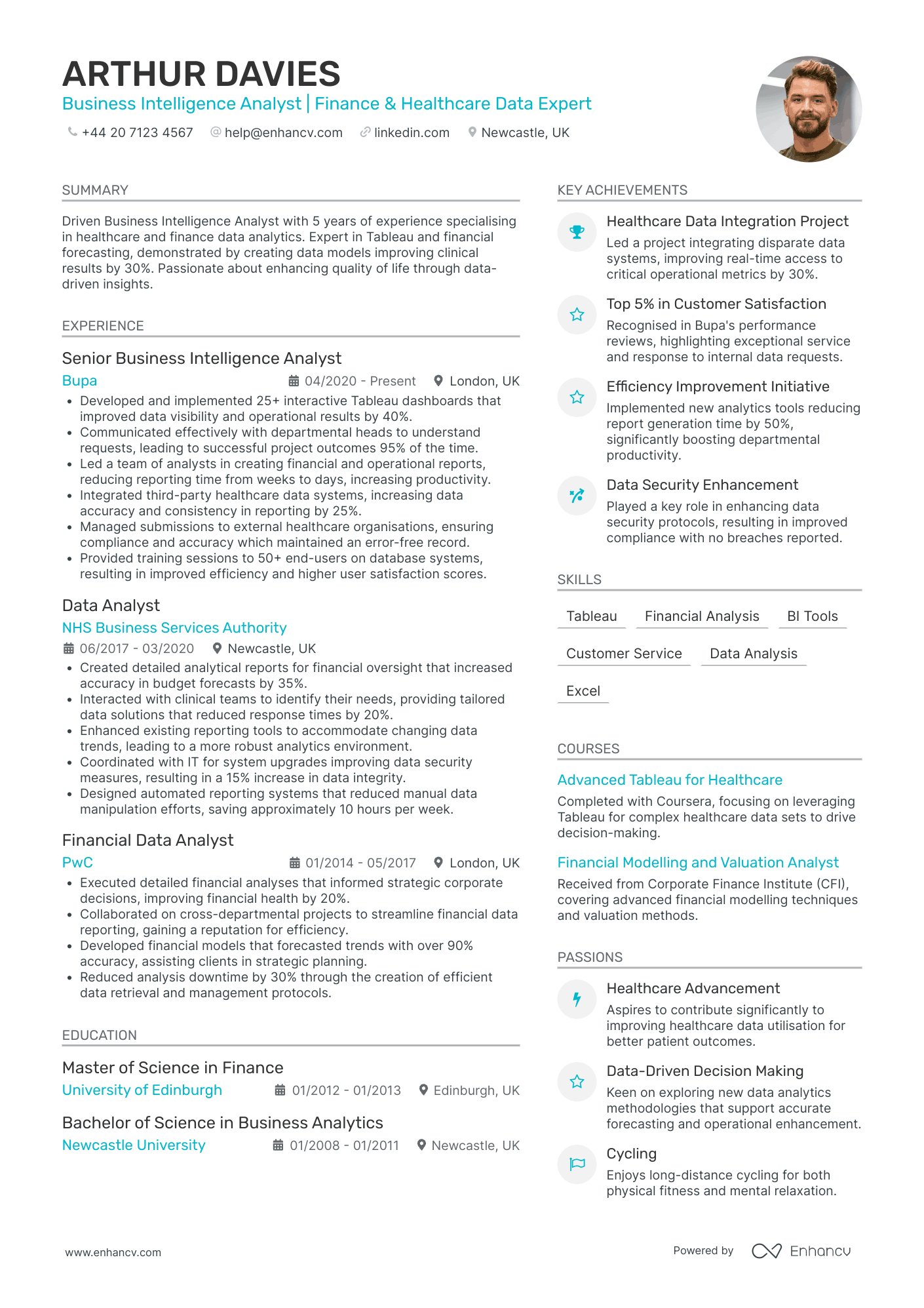
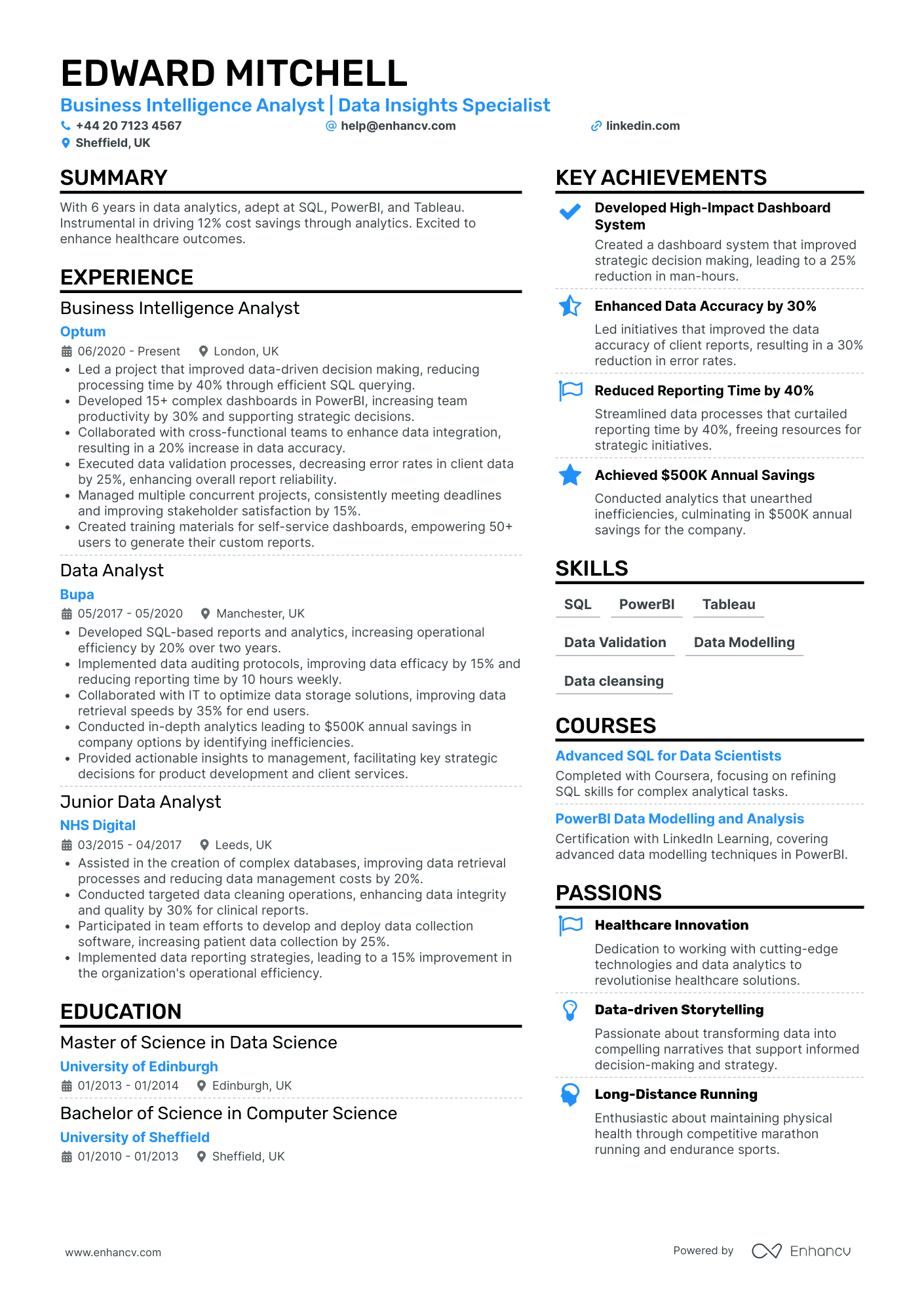
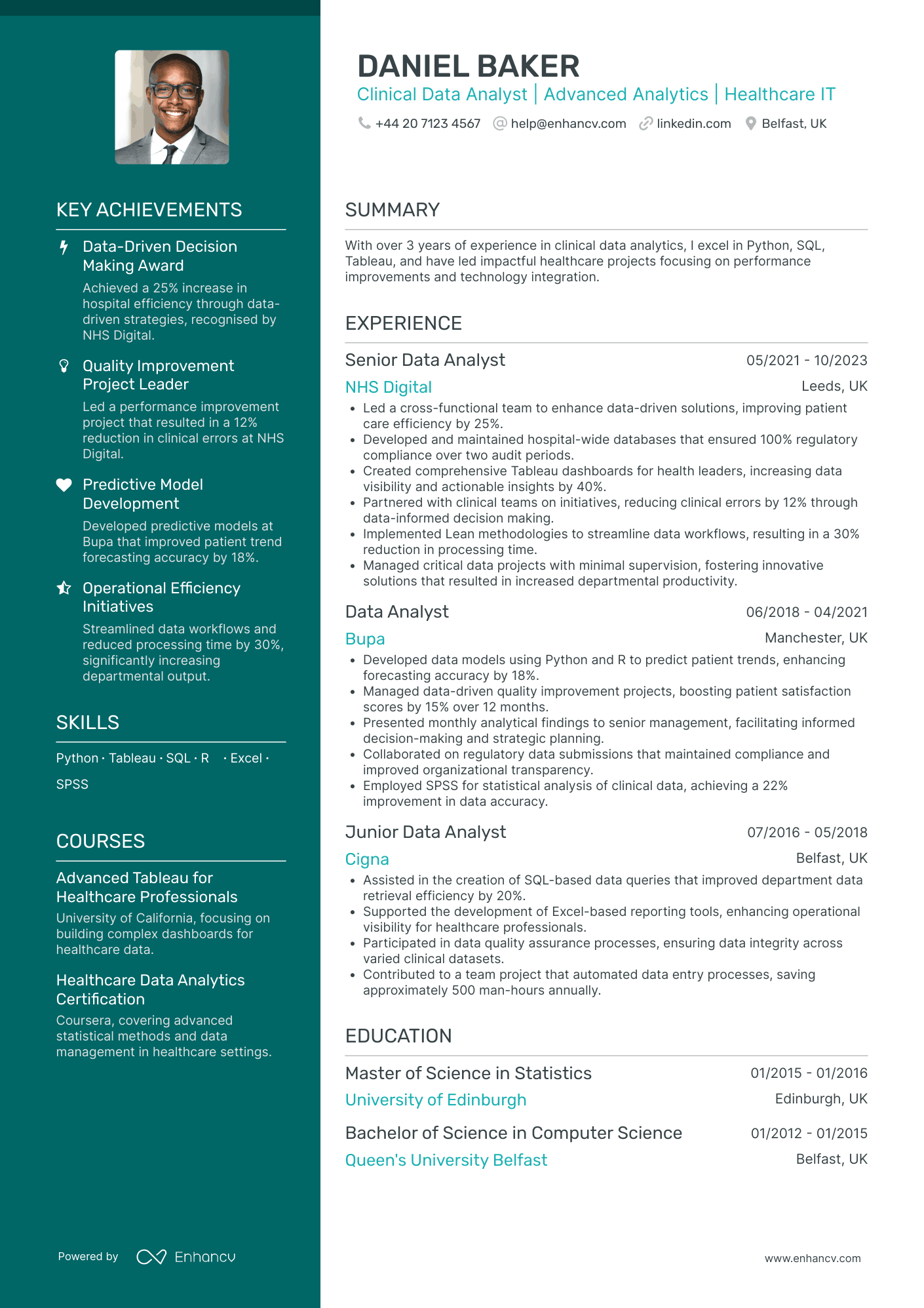
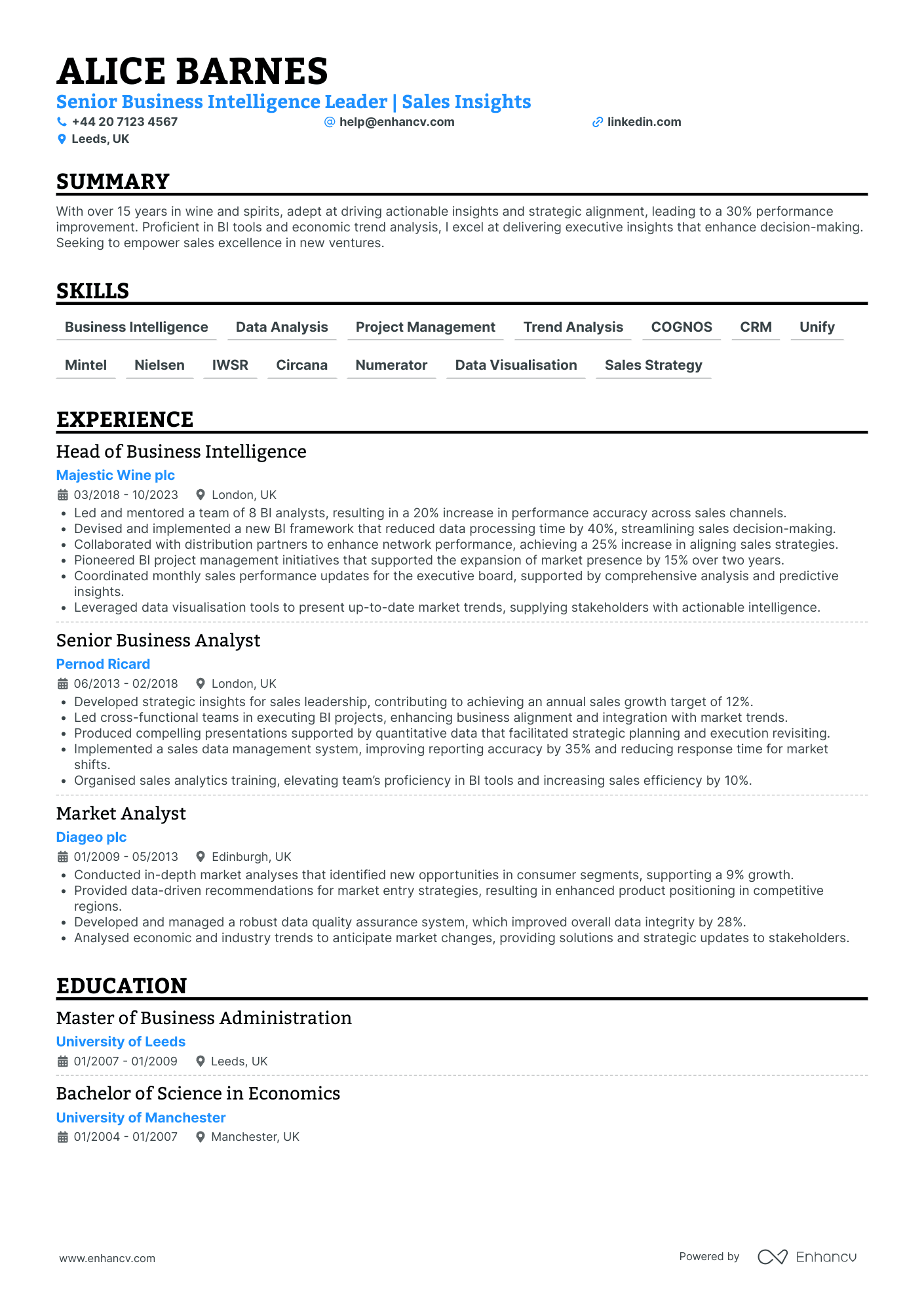
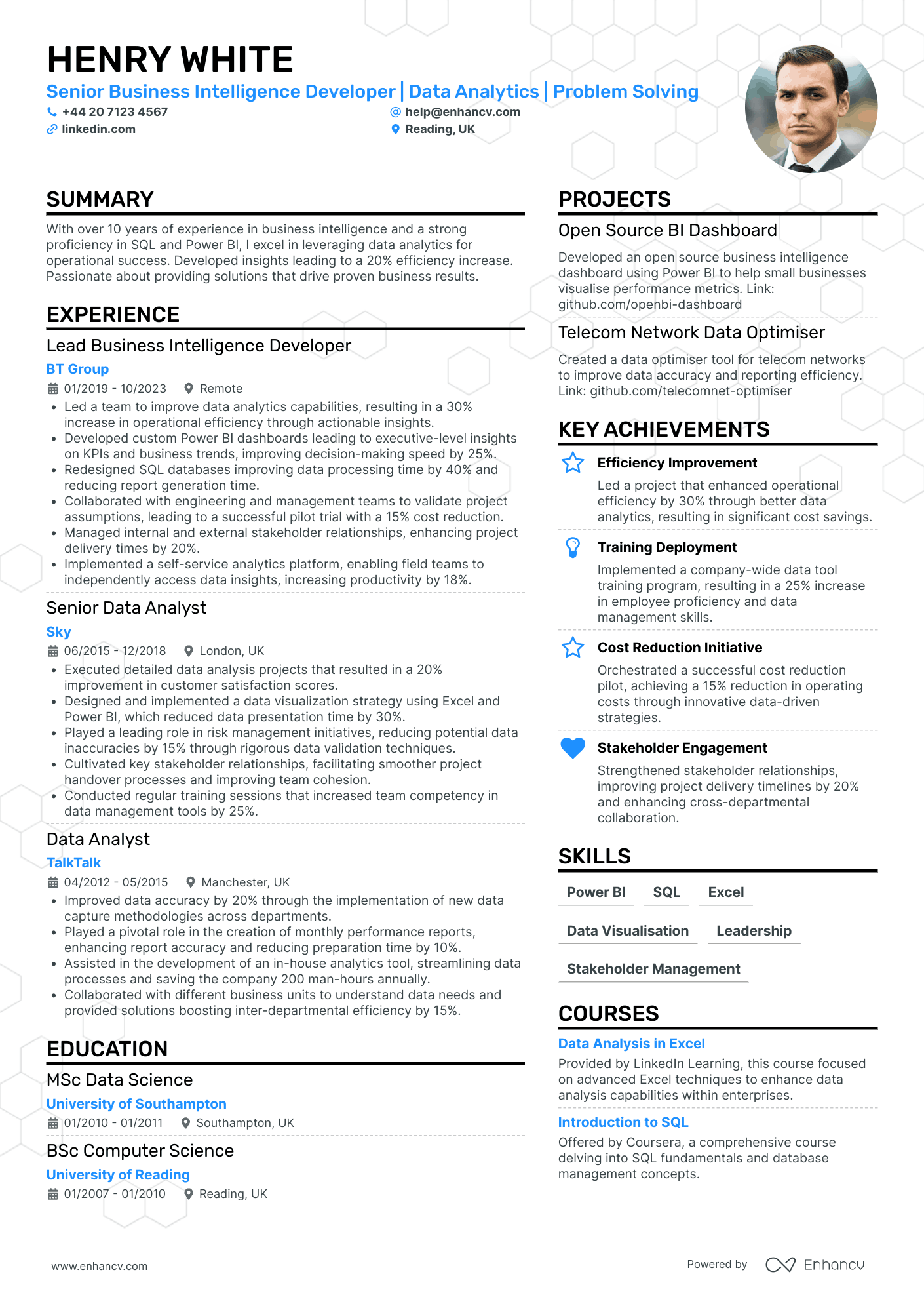
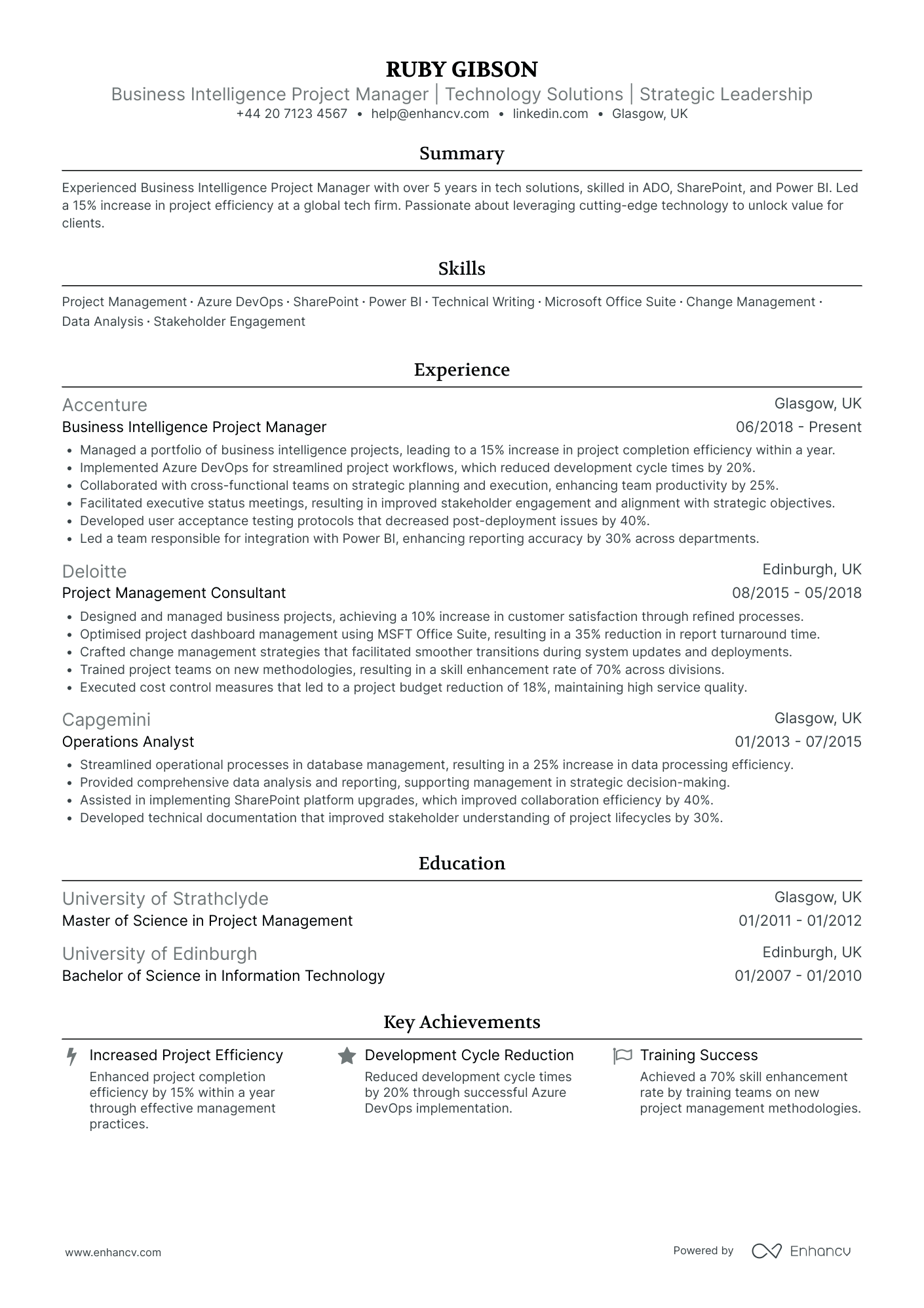
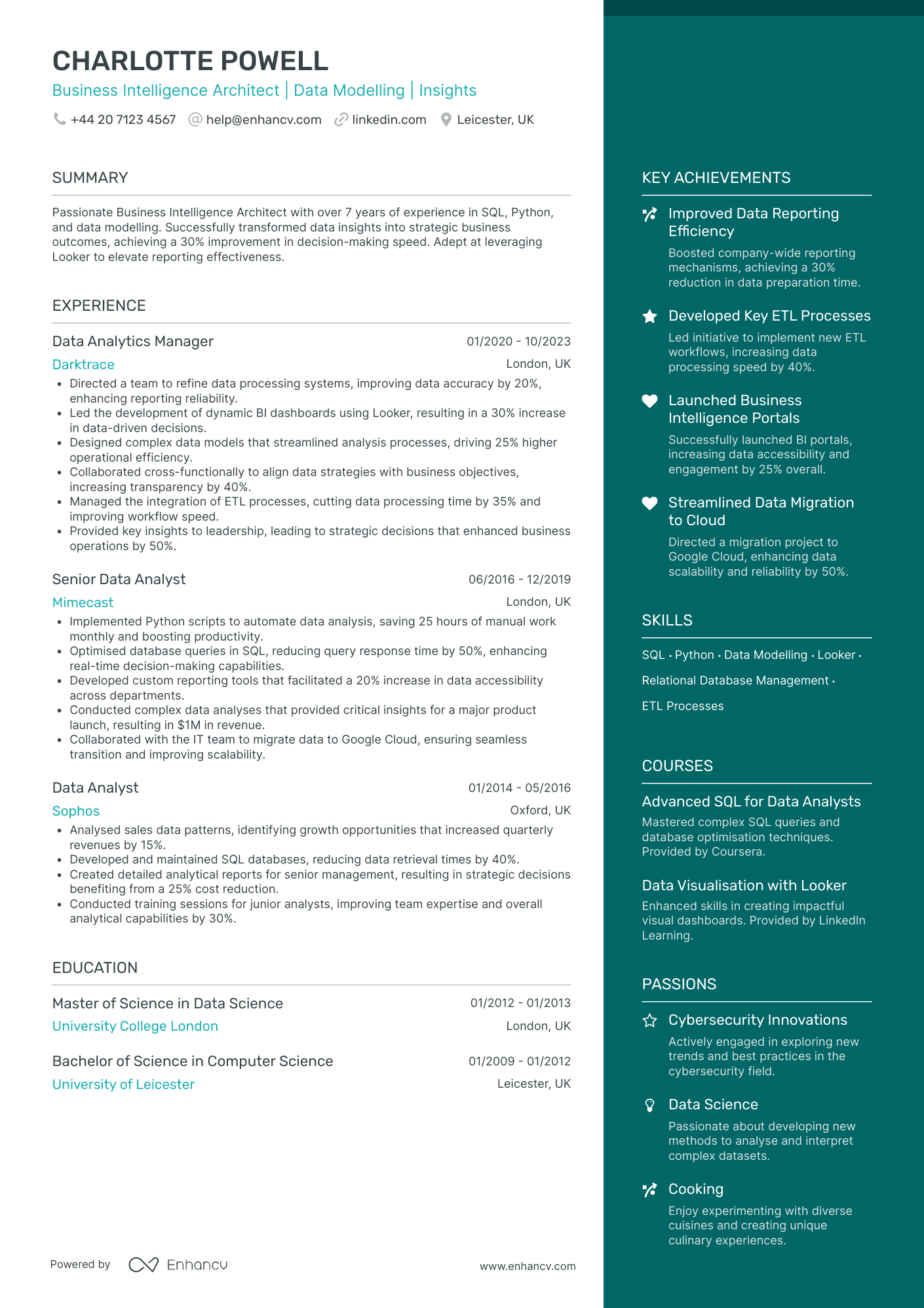
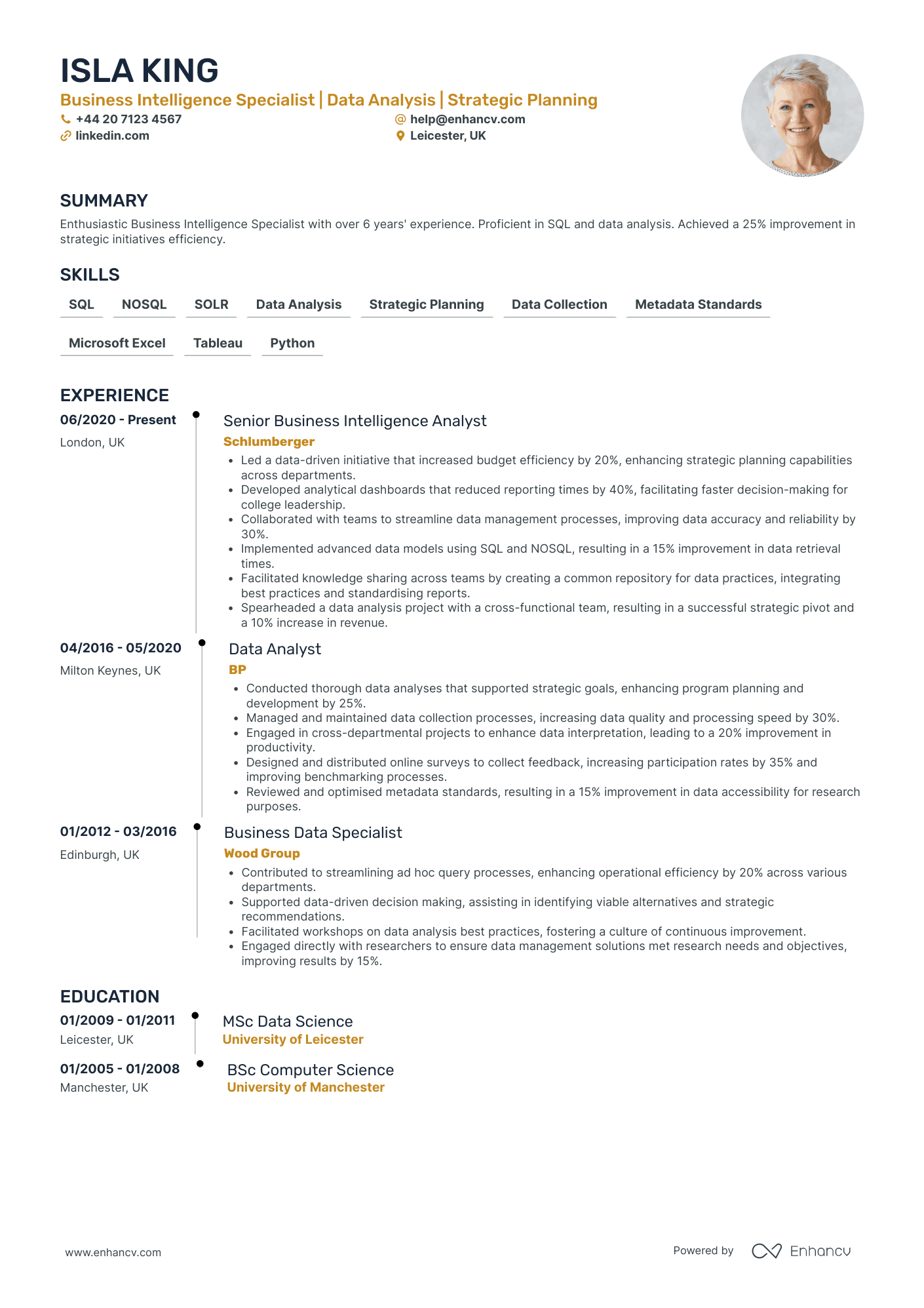
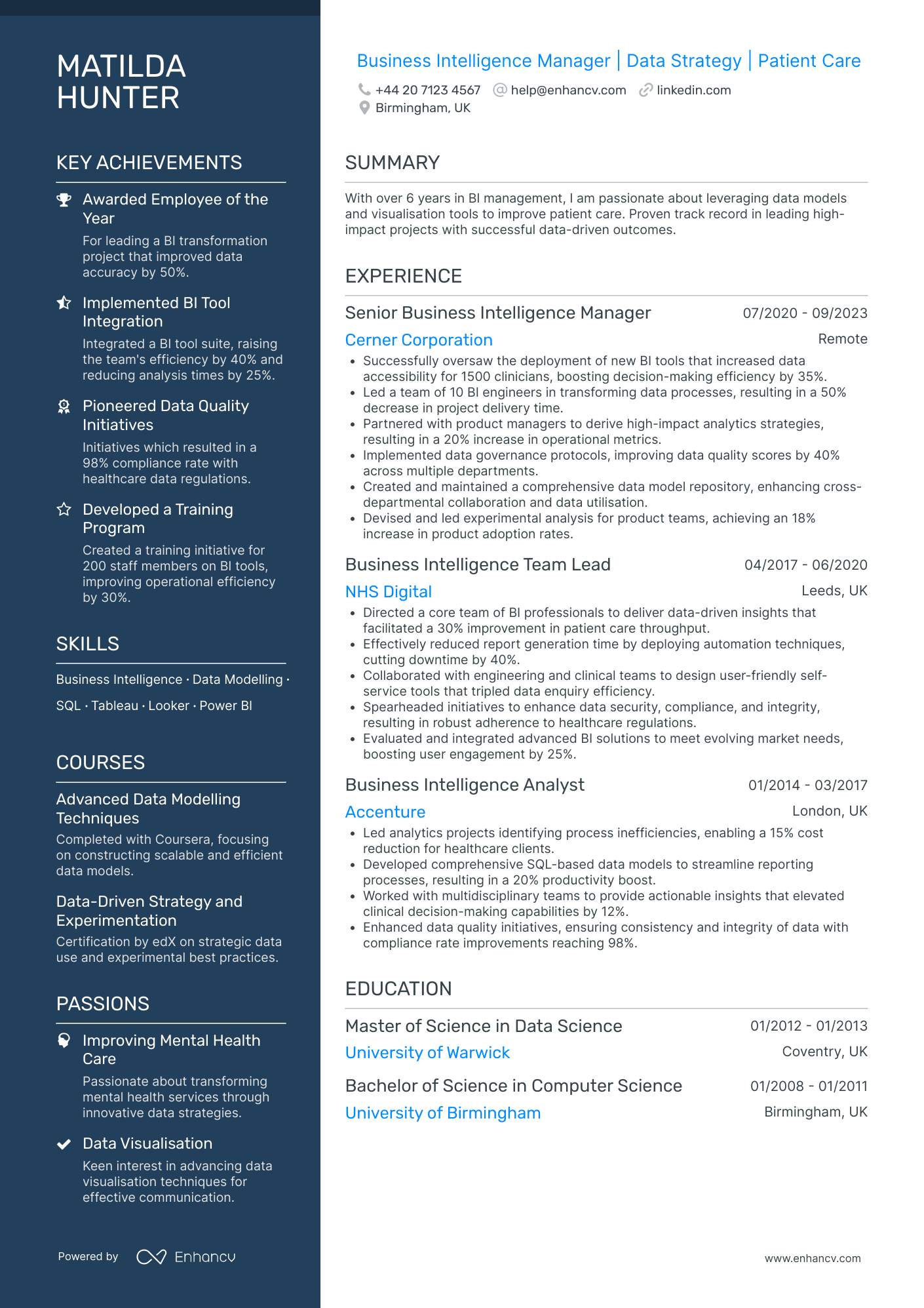
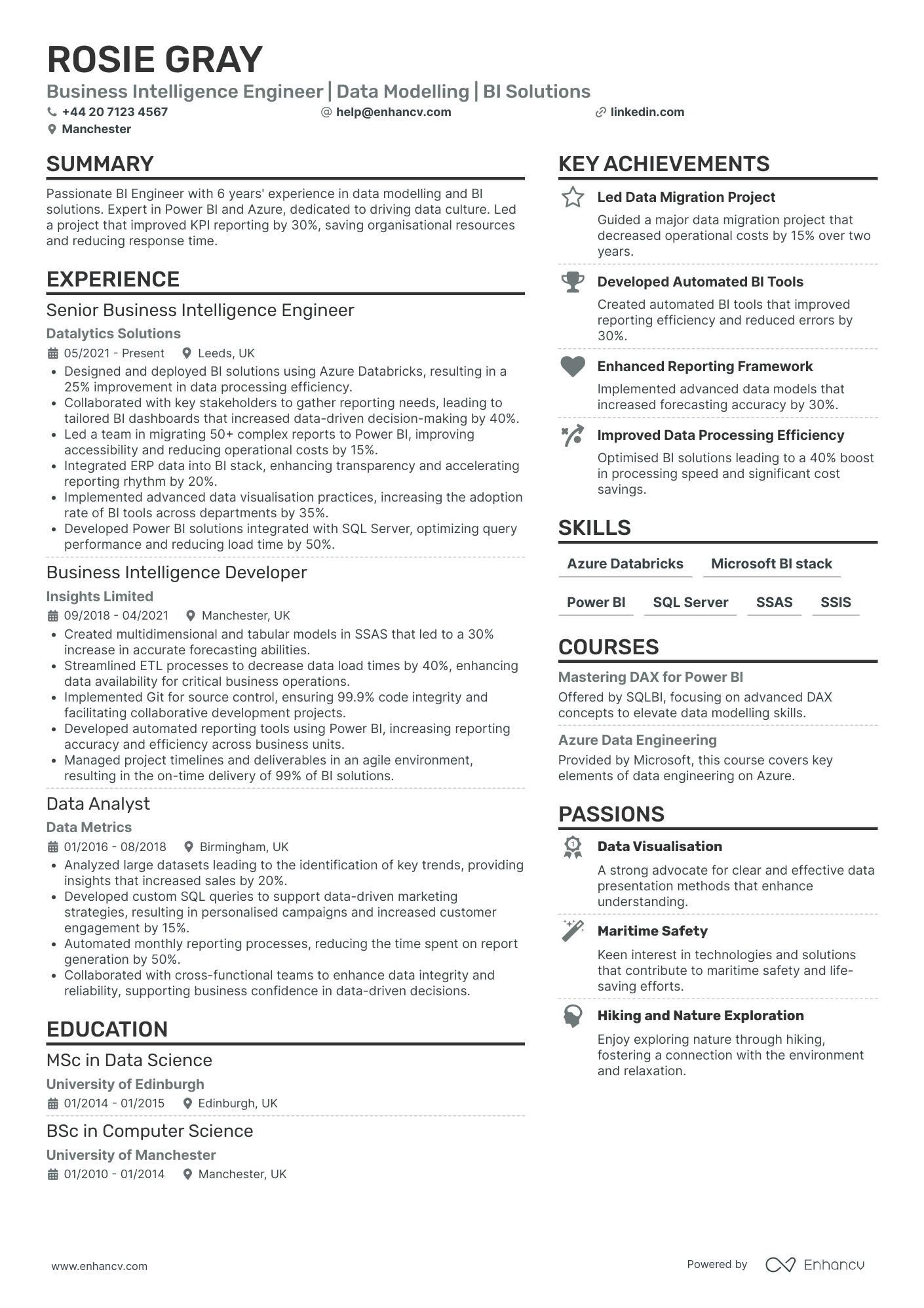
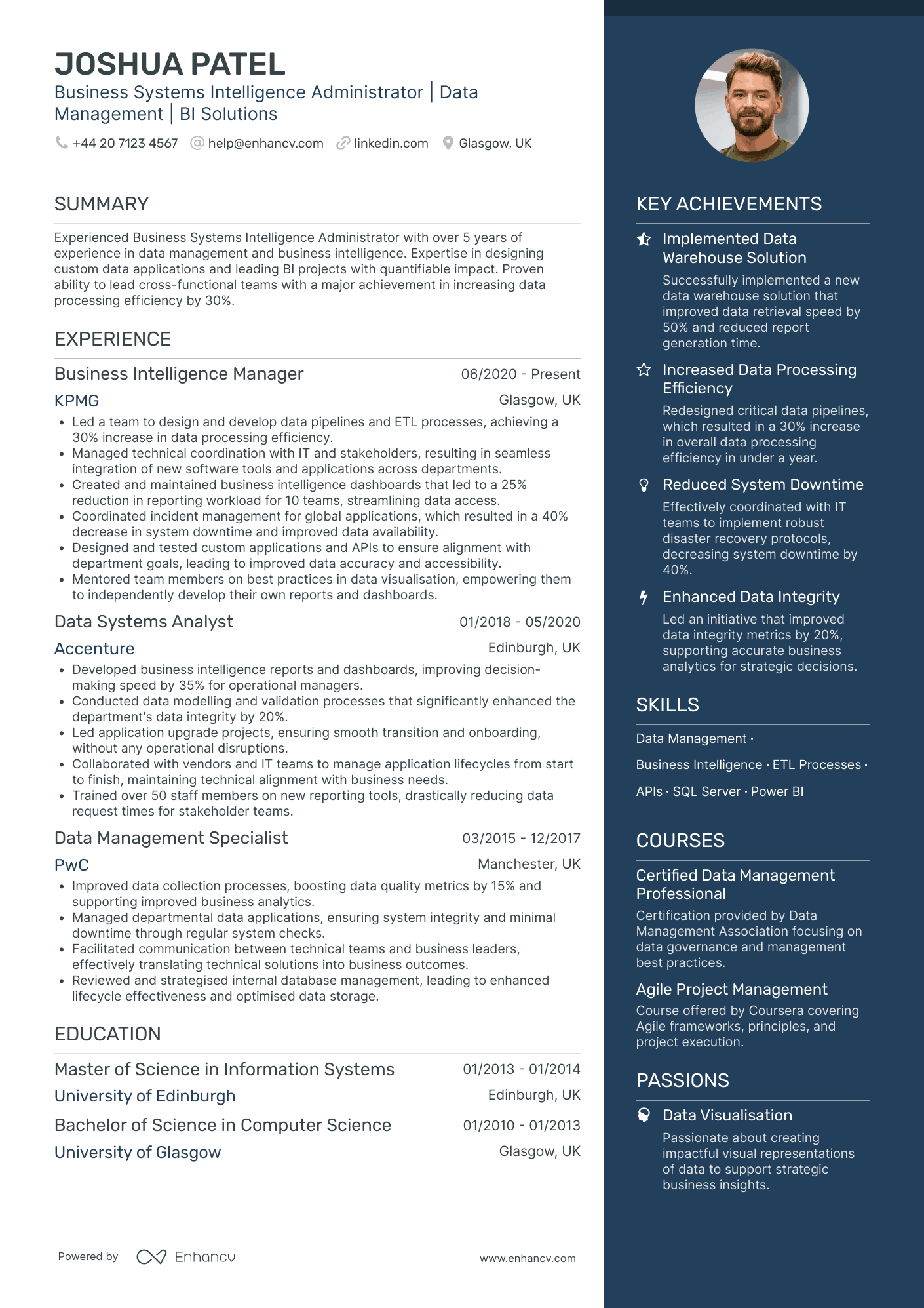
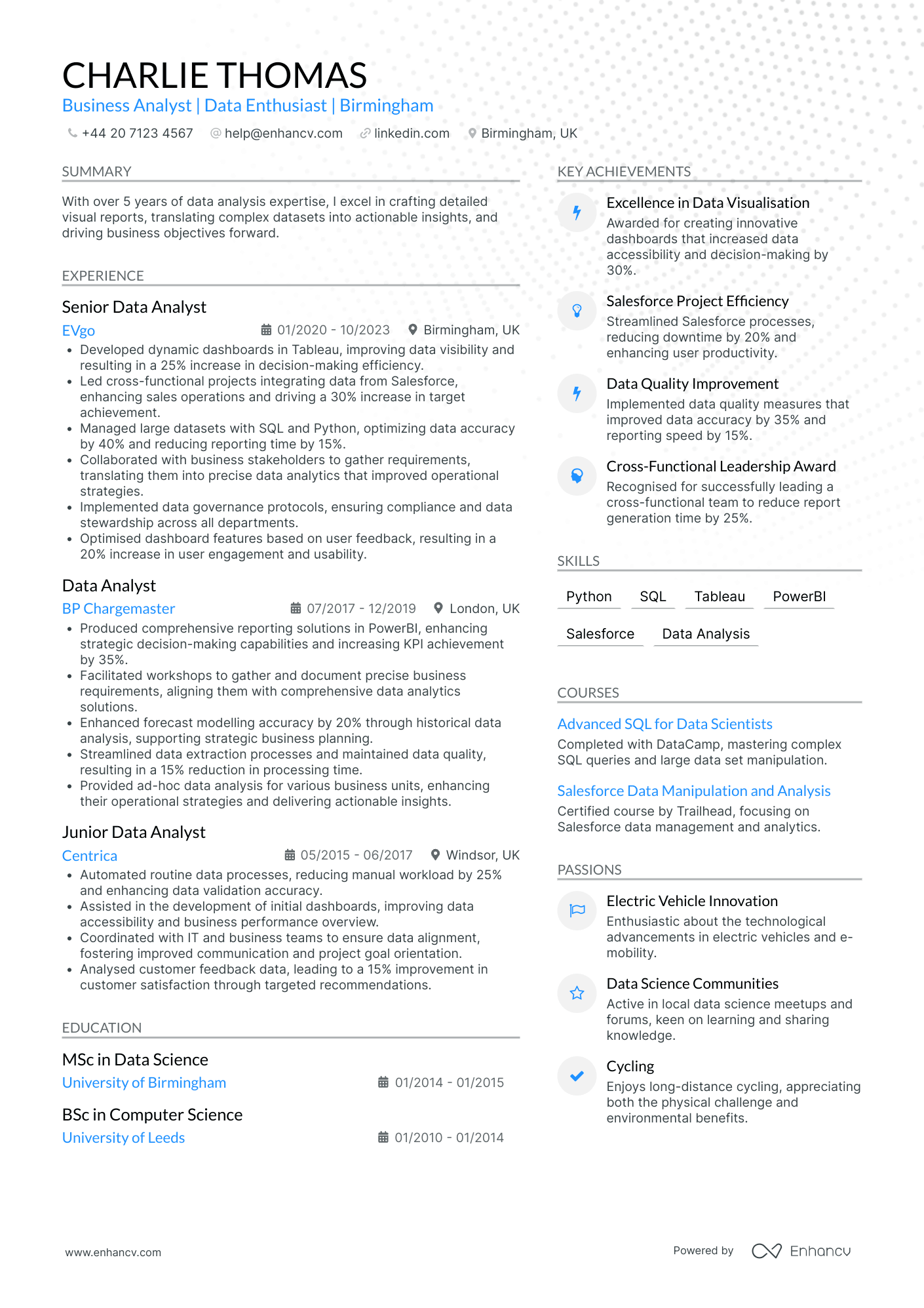
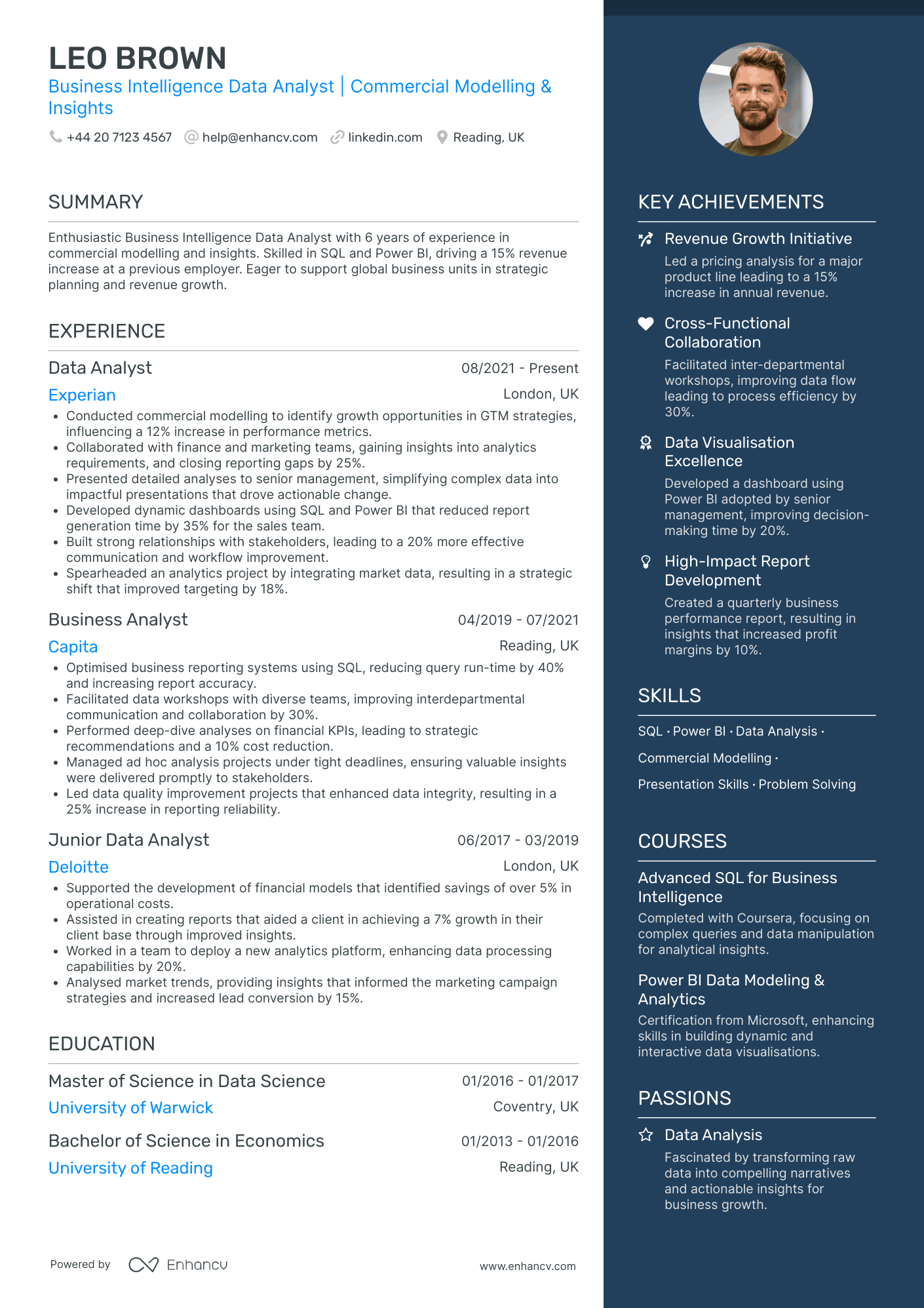
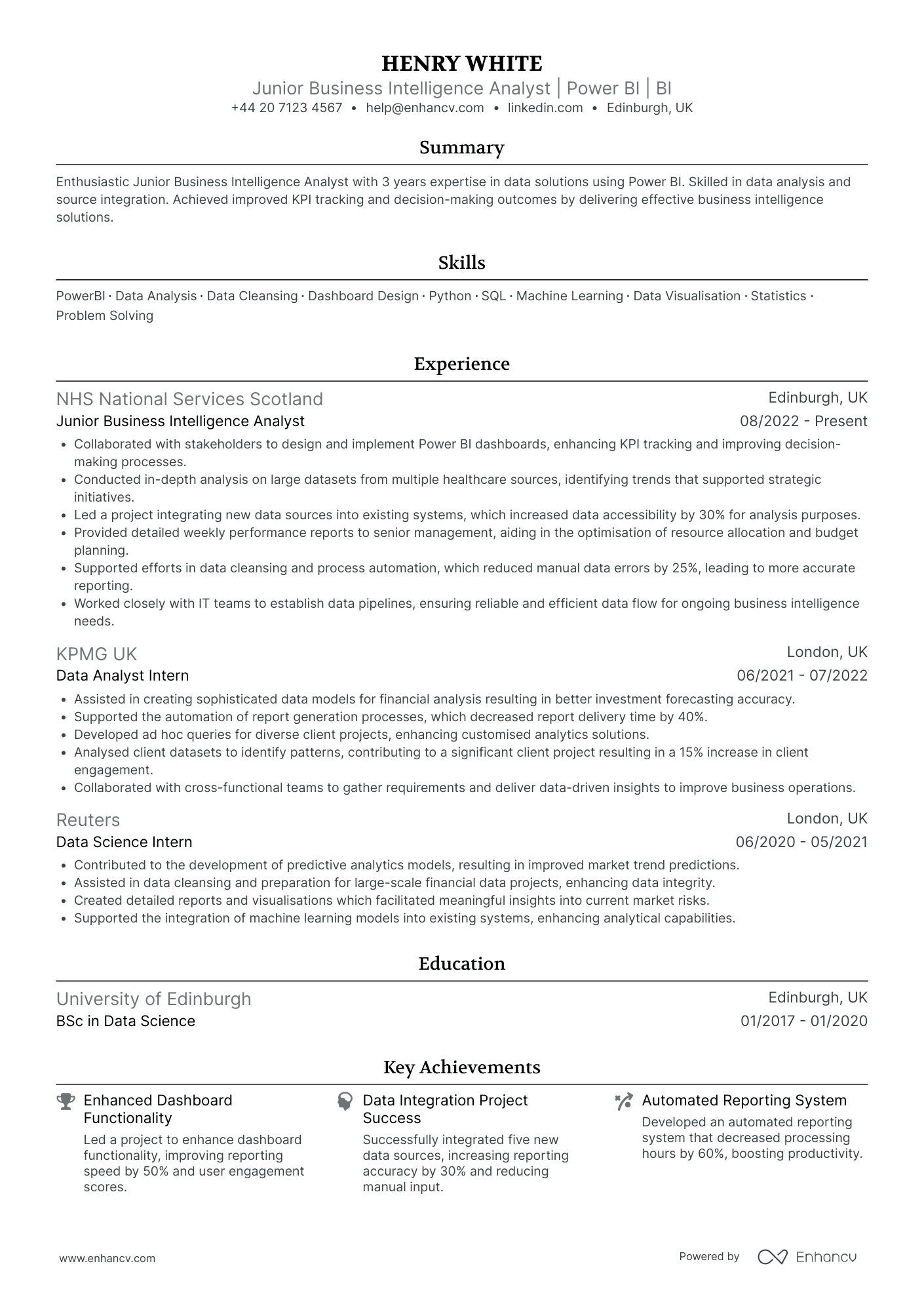
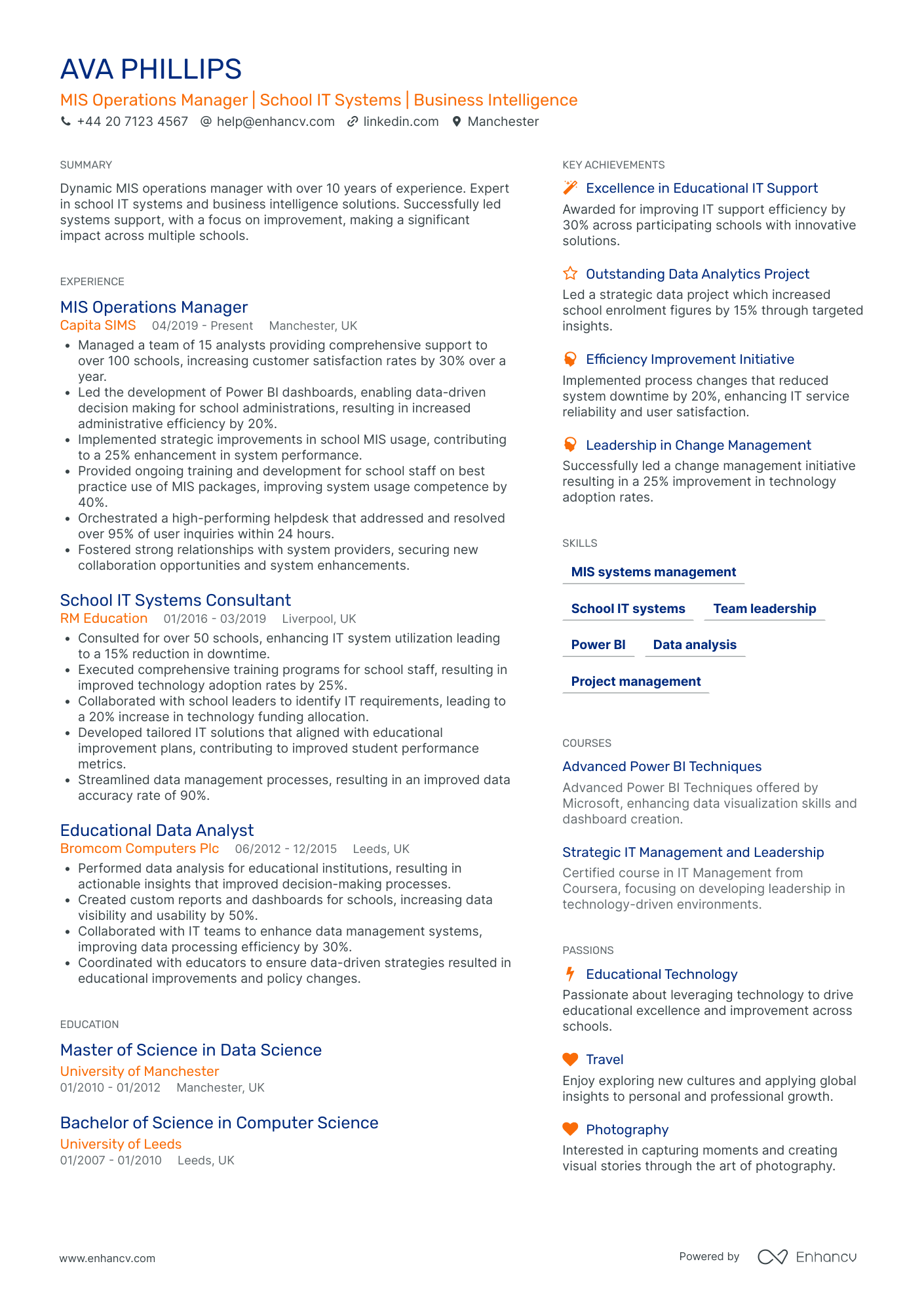
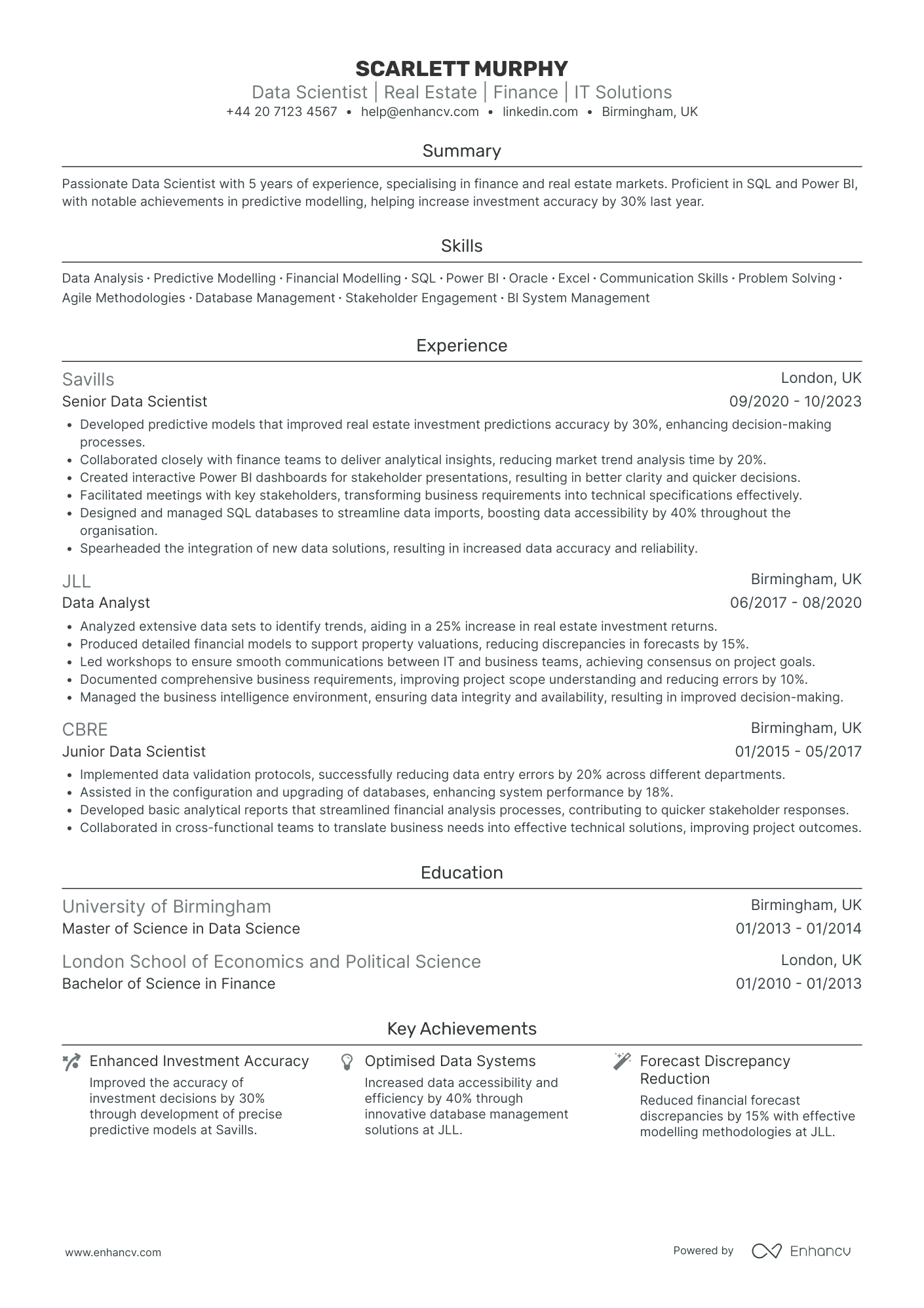
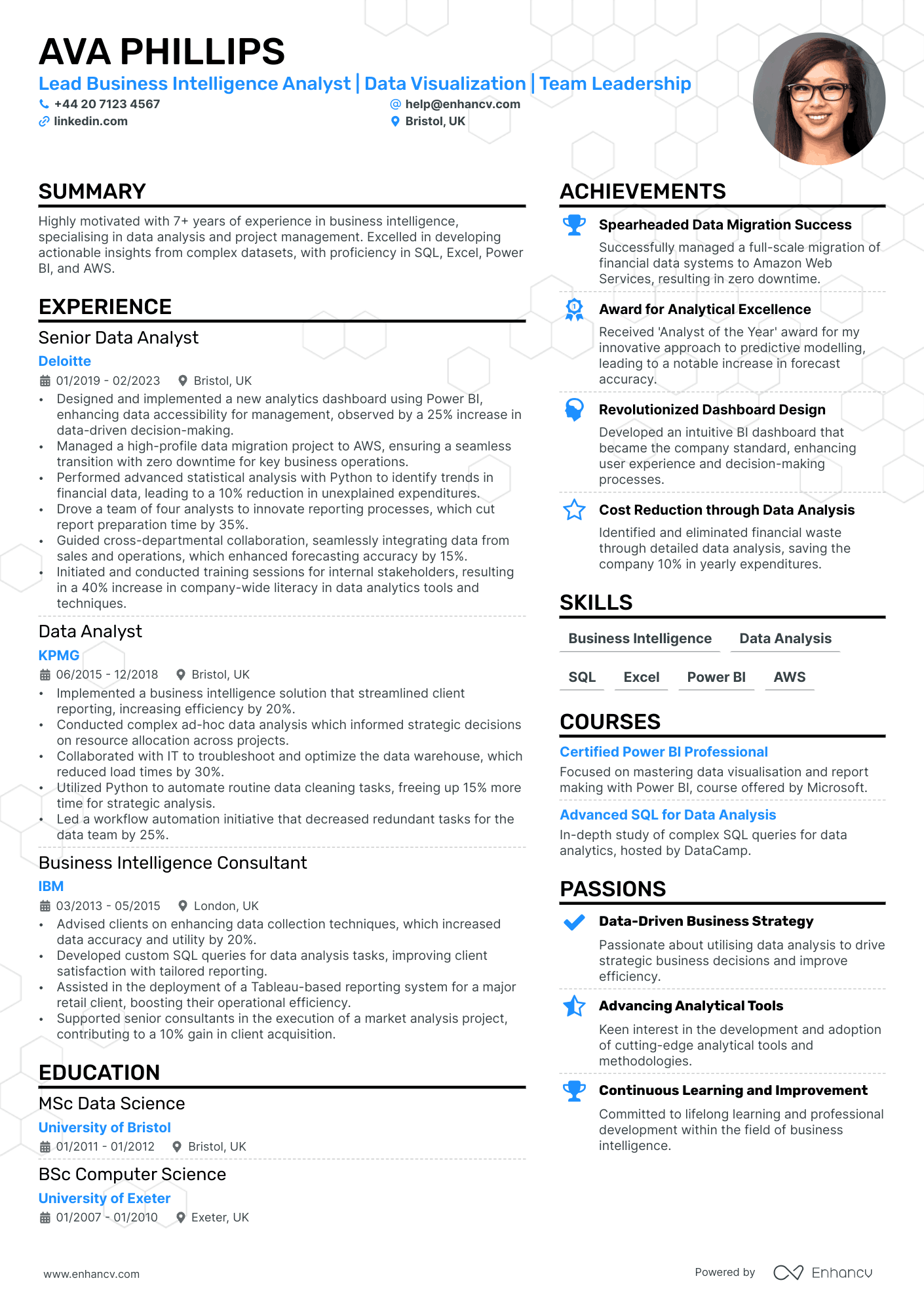
Most business intelligence CVs try to be an analyst and a developer at once, and end up reading as neither.
A manager hiring a Power BI analyst does not want to wade through pipeline internals, and a team hiring a BI developer will not shortlist a dashboard tour with no SQL behind it. Decide which job you are applying for before you write a line, and if you want the fundamentals first, see how to write a CV.

Key takeaways
- Pick a lane. A CV that chases analyst and developer roles at the same time reads as unfocused to both.
- Lead with the stack the advert names: SQL almost always, then Power BI or Tableau, then the language or modelling the role actually needs.
- Prove impact with numbers, not tool lists. A dashboard that cut reporting time or a model that caught a revenue leak beats a skills wall.
- UK BI work is split between hybrid and on-site, so put your location and what you can commit to near the top.
- Most postings sit at mid to lead level, so evidence of ownership matters more than breadth.
- Two pages, reverse chronological, sent as a PDF unless the advert asks for Word.
Analyst or developer? Decide what your BI CV is selling
Business intelligence is two jobs wearing one title. The CV that gets shortlisted knows which one it is applying for.
A BI analyst sits close to the business. The work is turning messy data into a decision someone can act on: dashboards, reporting, stakeholder questions, and the SQL to answer them. The evidence here is a metric that moved because of your analysis.
A BI developer sits closer to engineering. The work is building and maintaining the machinery the analysts rely on: data models, pipelines, warehouse tables, and the tuning that keeps them fast. The evidence here is a system you built or made more reliable.
Both use SQL. Both may touch Power BI. But the proof each role screens for is different, so one CV cannot serve both without diluting each.
If you are aiming at analyst roles, foreground:
- Dashboards and reports you own, and the decisions they drove.
- Data visualisation and storytelling for non-technical stakeholders.
- SQL for analysis, plus Power BI or Tableau depending on the advert.
If you are aiming at developer roles, foreground:
- Data modelling, ETL, and the warehouse or lakehouse you worked in.
- SQL performance and reliability, not just query writing.
- Python or other scripting where you automated or productionised something.
Some roles genuinely blend the two, especially in smaller teams where one person owns the whole stack. If that is the job, say so plainly and show one strong example from each side rather than a vague both. What loses people is not breadth, it is a CV that never commits.
Your career stage decides how hard you commit. Early on, a broad CV that shows you can analyse and build is reasonable, because you are still finding your lane. By mid to lead level, the market expects a clear specialism, so a scattered CV reads as someone who has not yet decided what they are good at.
Read the advert and mirror its centre of gravity. Your hard skills section should reorder itself around whichever role you are chasing.

PRO TIP
Job titles lie. A role advertised as 'BI analyst' that lists ETL, data modelling, and Python is a developer job in disguise, and one advertised as 'BI developer' that leans on stakeholder reporting is really an analyst role. Match the skills in the advert, not the title on it.
Top skills for your business intelligence CV
Read a stack of live UK business intelligence adverts and the same tools repeat. SQL, data visualisation, and Power BI recur most often, followed by Tableau, data analysis, data modelling, and Python (Enhancv's internal job feed, last ~30 days).
List them in the words the adverts use, and only what you can stand behind. A tool on your skills line with no matching bullet in your experience reads as filler.
Group them so a recruiter sees your lane in one glance: the query and modelling layer, the visualisation layer, and the analysis or scripting that ties them together. For the mechanics, see the skills section of a CV, and keep your soft skills separate rather than blended into the tool list.
Evidence beats inventory. Next to SQL, show the kind of query work you did, window functions for cohort analysis, or rewriting a slow report that ran every morning. Next to Power BI or Tableau, name what the dashboard was for and who used it. Next to Python, say what you automated. A recruiter can tell the difference between a tool you have touched once and one you have shipped with.
The soft skills that matter in BI are the ones that turn a query into a decision: explaining a finding to someone who will not read the SQL, and knowing which question is worth answering. Prove each in a bullet rather than claiming it.
Top skills for your business intelligence CV:
SQL
Power BI
Tableau
Data visualisation
Data modelling
Data analysis
ETL and data pipelines
Python
Stakeholder communication
Storytelling with data
Problem solving
Attention to detail
Commercial awareness
What the UK business intelligence market looks like
Knowing the shape of the market tells you what to put near the top of the CV. Here is what UK postings are actually asking for.
| What | UK business intelligence roles |
|---|---|
| Where the work happens | Split between hybrid and on-site, with remote rare (19 hybrid, 19 on-site, and 3 remote of 41 UK postings in the last ~30 days, Enhancv's internal job feed) |
| Experience level asked for | Mostly mid to lead level (17 lead, 16 mid, 6 senior, and 2 entry across the same 41 postings), entry-level roles are rare |
| Skills that recur most | SQL, data visualisation, and Power BI, followed by Tableau, data analysis, data modelling, and Python |
Two things here should shape your CV.
The work is split fairly evenly between hybrid and on-site, and fully remote roles are rare, so state your location and what you can commit to near the top rather than leaving a recruiter to guess.
And the roles skew towards mid and lead level, with entry-level openings uncommon. That means evidence of ownership, a system you ran or a decision you influenced, carries more weight than a long list of tools.
Practically, that shifts what leads your CV. At this level a recruiter assumes you can write SQL, so the differentiator is scope: how many people used your work, what you were trusted to own, and what changed as a result. If you are early in your career and chasing one of the rarer entry roles, lean the other way and make the stack and any projects visible, because you cannot yet lead on scope.
Formatting your business intelligence CV
Use a reverse chronological structure once you have BI roles behind you, so your most recent and most senior work leads. Keep it to two pages.
One column, standard headings, a readable font. A hiring manager gives the first pass about thirty seconds, so the tools and the numbers need to be visible without hunting.
Order the sections for your lane. A BI CV usually runs personal statement, key skills, then experience, because the stack is the first thing a technical screener checks. If your best proof is a specific project rather than a job, a short projects block just under your skills can carry more weight than another dated role.
Send a PDF for direct applications so the layout holds, and keep a Word copy for agencies that reformat into their own template. If the advert names a file type, follow it.
BI applications often pass through tracking software, so keep the layout clean and the headings standard for an ATS-friendly CV. Build from a tested layout rather than a blank page: Enhancv's CV templates export to a clean PDF.

Where your dashboards and code go
If you have public work, a Tableau Public profile, a GitHub repo, or an anonymised dashboard screenshot, add one link in the header. One clean, working link beats three that need explaining. Never link to anything covered by an employer's data or an NDA.
Writing your business intelligence personal statement
Three or four sentences at the top: which BI role you are, the stack you work in, and one result a manager can picture. See more personal statement examples if the opening line is fighting you.
Skip the adjective soup. "Detail-oriented, data-driven professional passionate about insights" tells a recruiter nothing they can check.
Lead with the stack and one number instead:
Business intelligence analyst personal statement example
Business intelligence analyst with five years building Power BI and SQL reporting for retail operations teams. Rebuilt a weekly sales dashboard that cut manual reporting by two days a month and surfaced a stock issue worth £120,000 a year. Strong on stakeholder communication and turning ambiguous questions into metrics people act on. Looking to bring that to a hybrid BI analyst role in Manchester.
Business intelligence developer personal statement example
BI developer with six years designing and maintaining the data layer behind analytics teams. Built the star schema and nightly ETL for a 40-table sales warehouse, cutting average dashboard load from twelve seconds to under two. Fluent in SQL performance tuning, dbt, and Python for pipeline automation. Looking for a developer role where reliability and clean data models matter as much as the final chart.
The version to avoid
Hard-working and passionate data professional with experience in various BI tools and a proven track record of delivering insights. A team player with excellent communication skills, seeking a challenging role to leverage my skill set and grow within a forward-thinking company.
When a business intelligence CV lands on my desk, the first thing I look for is whether the person knows which job they are applying for. The strong ones tell me in the first two lines: here is my stack, here is a number I moved, here is the kind of BI work I do. The weak ones list every tool they have ever opened and leave me to guess. Pick your lane, lead with one real result, and you are already ahead of most of the pile.
the Enhancv team
Writing your business intelligence experience section
Each entry: a dated heading, then bullets that show what you built or analysed and what changed because of it. Lead every bullet with a strong action verb. For the mechanics, see work experience on a CV.
BI work is measurable by definition, so use the numbers you already produce: time saved, revenue found, errors cut, adoption of a dashboard. Those are your CV achievements, and one real figure beats a paragraph of responsibilities.
Mirror the advert. Pull the tools and terms it lists and match them where they are genuinely true of you. Enhancv's CV tailoring feature reads the advert and suggests the matching edits, which saves rewriting from scratch for every application.
- Built and own 14 Power BI dashboards used daily by operations and finance, cutting weekly manual reporting by around two days a month
- Wrote the SQL models behind demand forecasting, which flagged a stock issue worth roughly £120,000 a year in lost margin
- Partnered with category managers to turn vague requests into defined metrics, reducing back-and-forth on report specs
- Introduced a shared data dictionary that cut duplicate 'which number is right' queries across three teams
PRO TIP
Recruiters filter BI CVs on tools first and impact second. Put the stack (SQL, Power BI, Tableau, Python) inside the bullets where you used it, not only in a skills box, so it survives both the ATS keyword match and the human read.
Targeting developer roles instead? Same section, different proof. Show the machinery rather than the dashboard:
- Rebuilt the nightly ETL job so it ran in 40 minutes instead of three hours, removing the morning data delay for 30 report users.
- Modelled a star schema for the sales warehouse that cut average dashboard load time from twelve seconds to under two.
- Added automated data-quality checks in Python that caught broken feeds before the business ever saw a wrong number.
Whichever lane you are in, the pattern holds: name the thing you did, then the number that proves it landed.
Education and certifications for a business intelligence CV
A degree helps but rarely decides a BI hire. A numerate subject such as computer science, maths, economics, or statistics is a plus, and by mid-level your recent work matters more than your education section.
Certifications carry real weight in BI because they map to the tools adverts name. List certifications such as the Microsoft Power BI Data Analyst Associate, the Tableau Desktop Specialist, or a cloud data qualification where you hold them, even "in progress".
Short, dated, and specific beats a long training list. Put any relevant courses in a compact block rather than padding the page.
If a certification is the strongest thing on your CV, for example you are moving into BI from a numerate role, lift it near the top under your skills rather than burying it at the bottom. Recruiters use these as a quick shorthand for whether you can use the tool the advert names.
Red flags that sink a business intelligence CV
A few patterns get a BI CV binned fast. Most are fixable in an afternoon.
- A skills wall with no evidence: twenty tools listed and not one bullet showing you used them in anger.
- No numbers. BI is a measurable field, so a CV with zero quantified outcomes reads as someone who watched the work rather than did it.
- Analyst and developer blur. Claiming both at once loses the reader who is screening for one.
- Obvious generic AI text, all "leveraging synergies" and no specifics, which recruiters spot instantly.
On that last point, a model can speed up a first draft, but it cannot know your numbers, and overclaiming a tool you cannot discuss in an interview is worse than a modest, true CV. Feed it your real figures and real stack, then edit hard, or the result reads like every other generic CV in the pile.
The words that actually impress a BI hiring manager are not adjectives. They are verbs tied to outcomes: built, modelled, automated, forecast, migrated, each followed by what it changed. "Passionate", "detail-oriented", and "results-driven" are invisible because everyone uses them. Replace every one of them with a thing you did.
Conclusion
Decide whether you are the analyst or the developer, then build every section around that answer: the stack up top, the impact in numbers, the format clean.
Pair the CV with a short cover letter that names the team's tools and one problem you could solve, and you turn a tool list into a shortlist.
Author's take - the Enhancv team
When a business intelligence CV lands on my desk, the first thing I look for is whether the person knows which job they are applying for. The strong ones tell me in the first two lines: here is my stack, here is a number I moved, here is the kind of BI work I do. The weak ones list every tool they have ever opened and leave me to guess. Pick your lane, lead with one real result, and you are already ahead of most of the pile.