



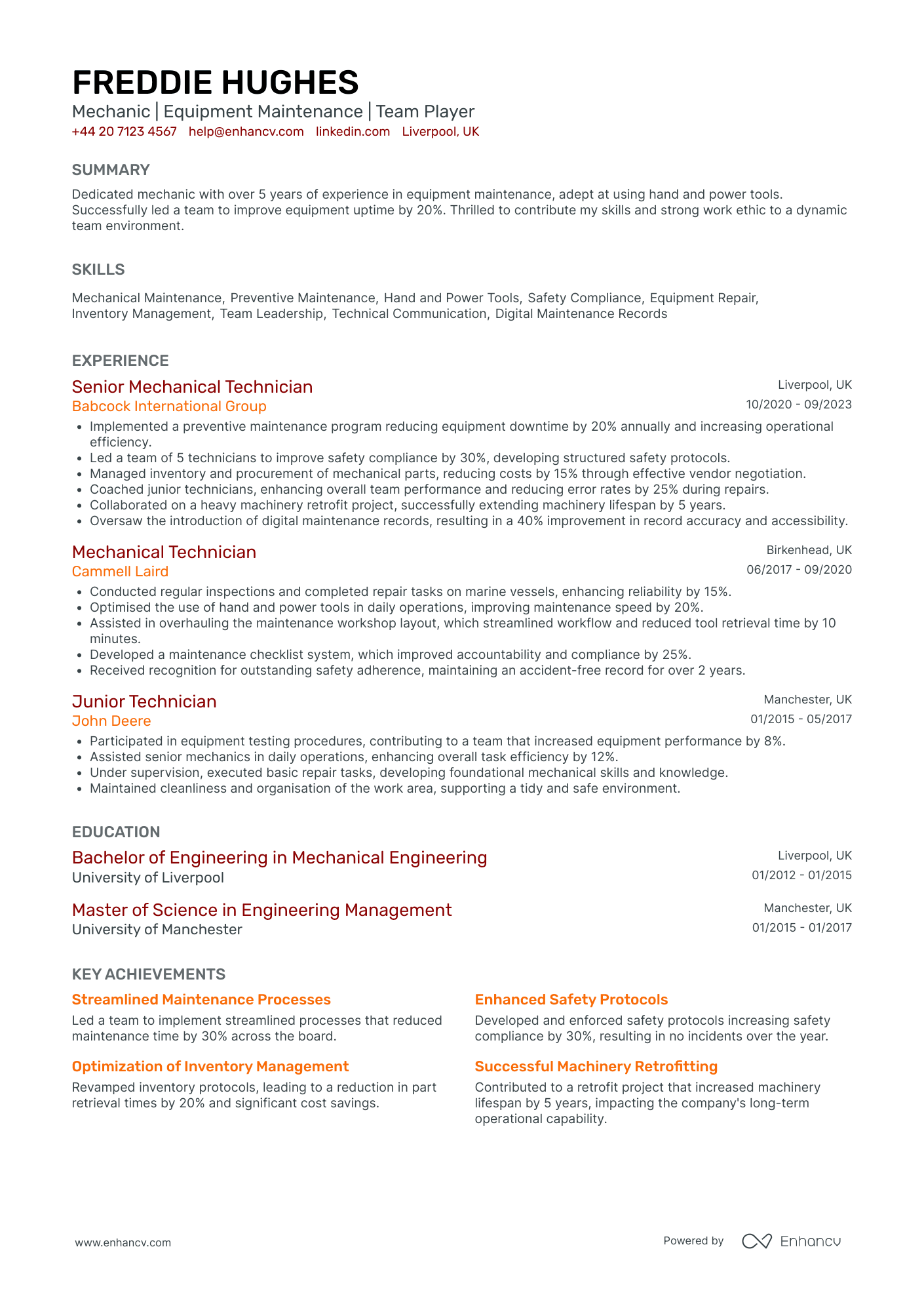
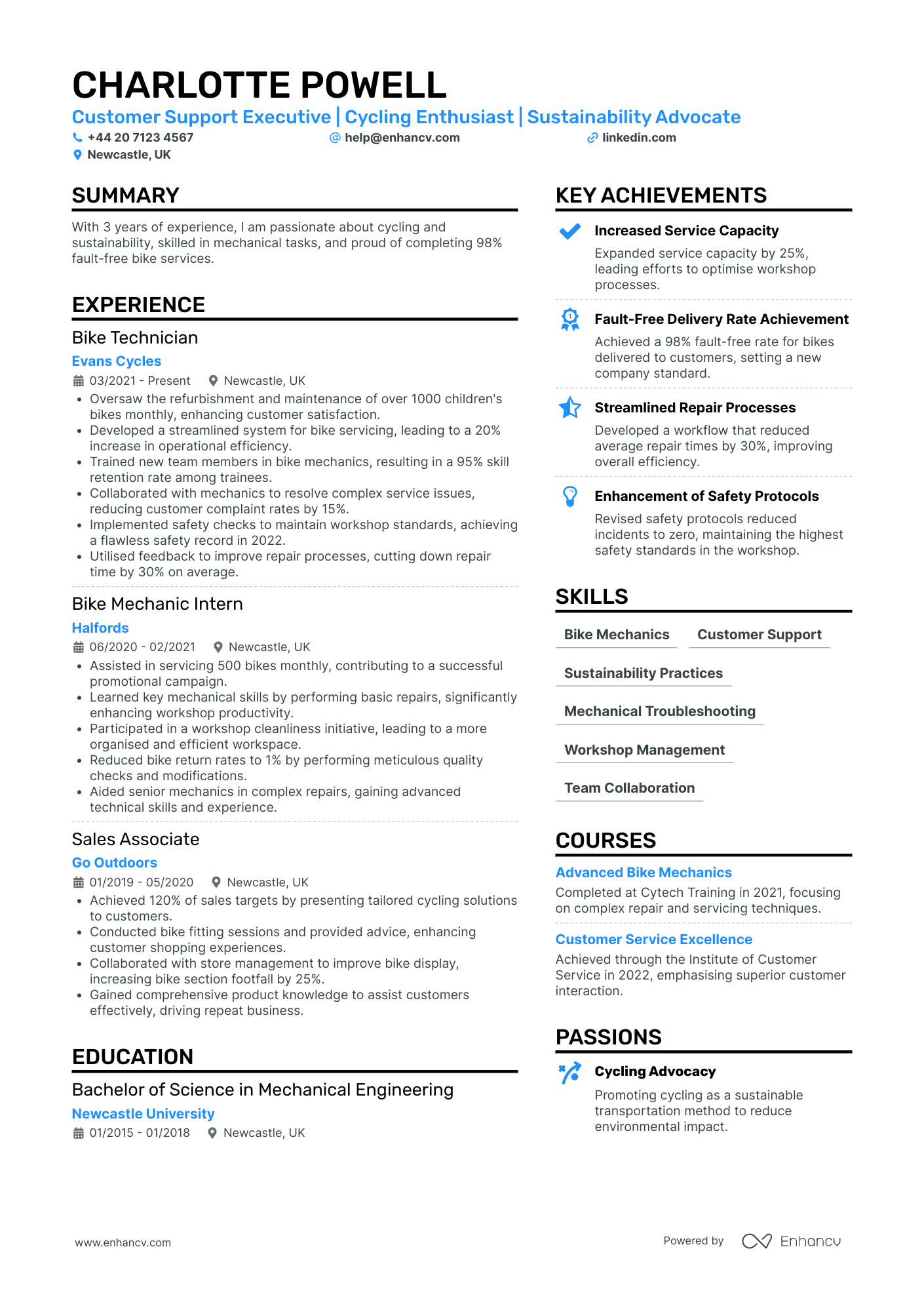
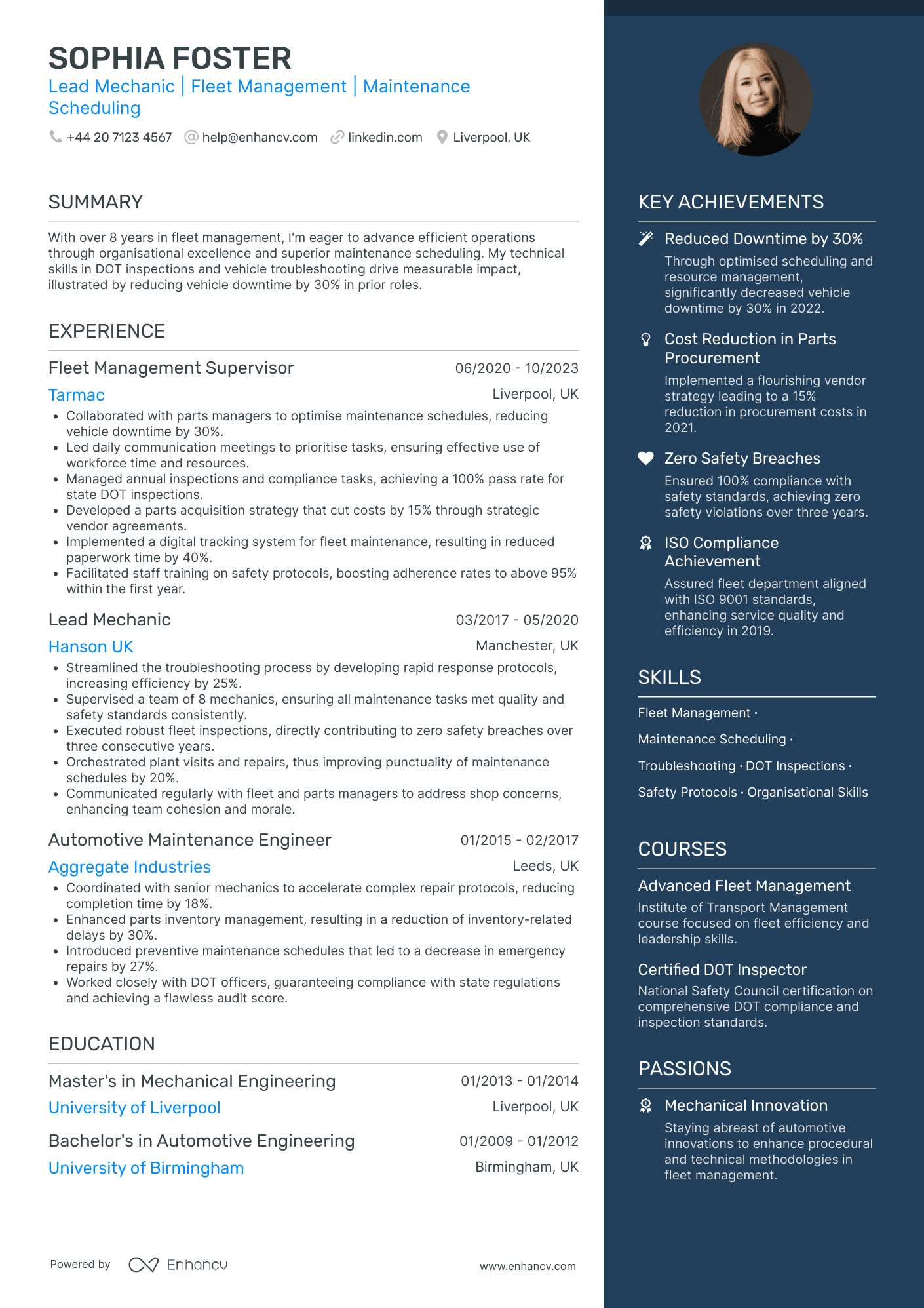
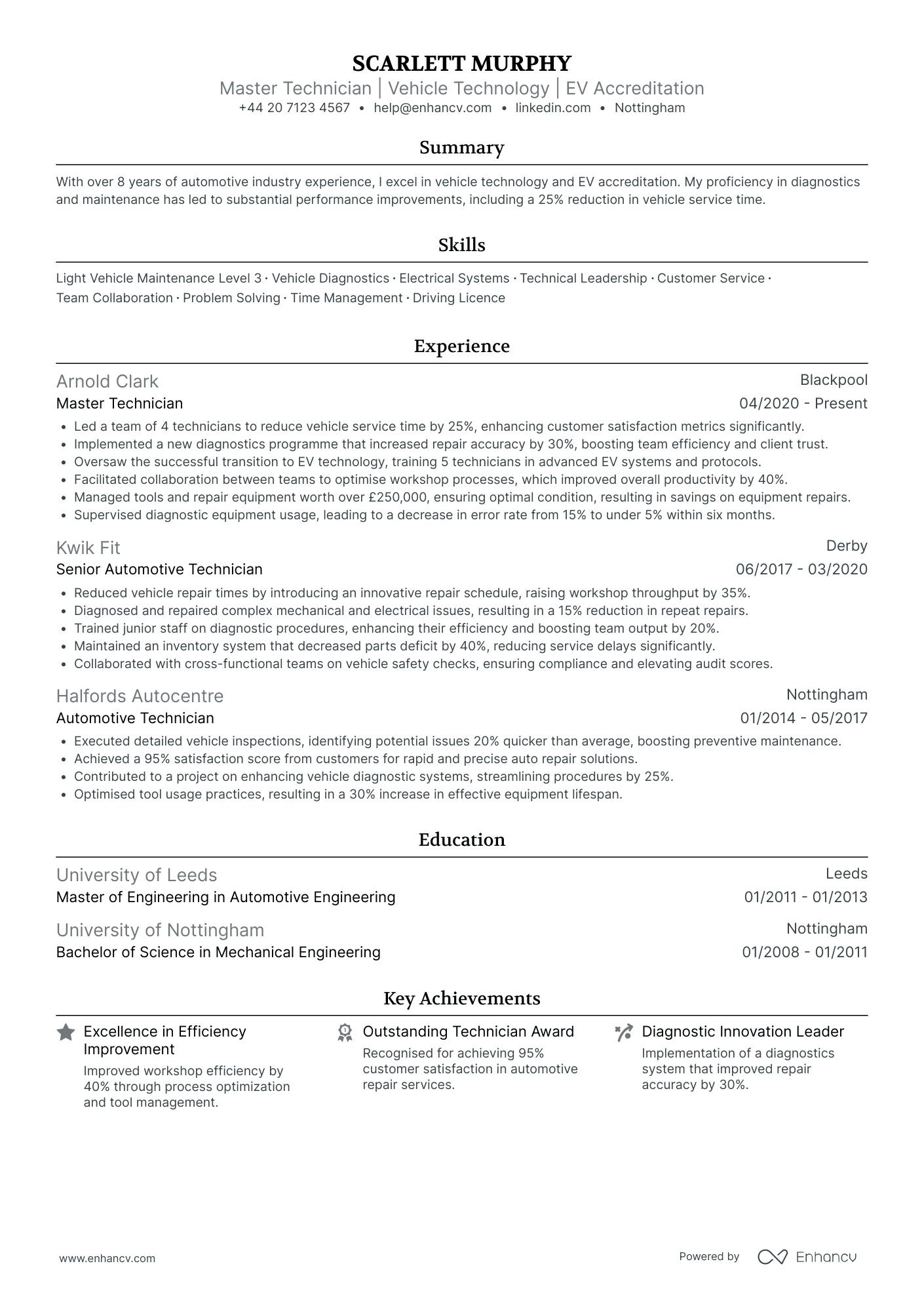
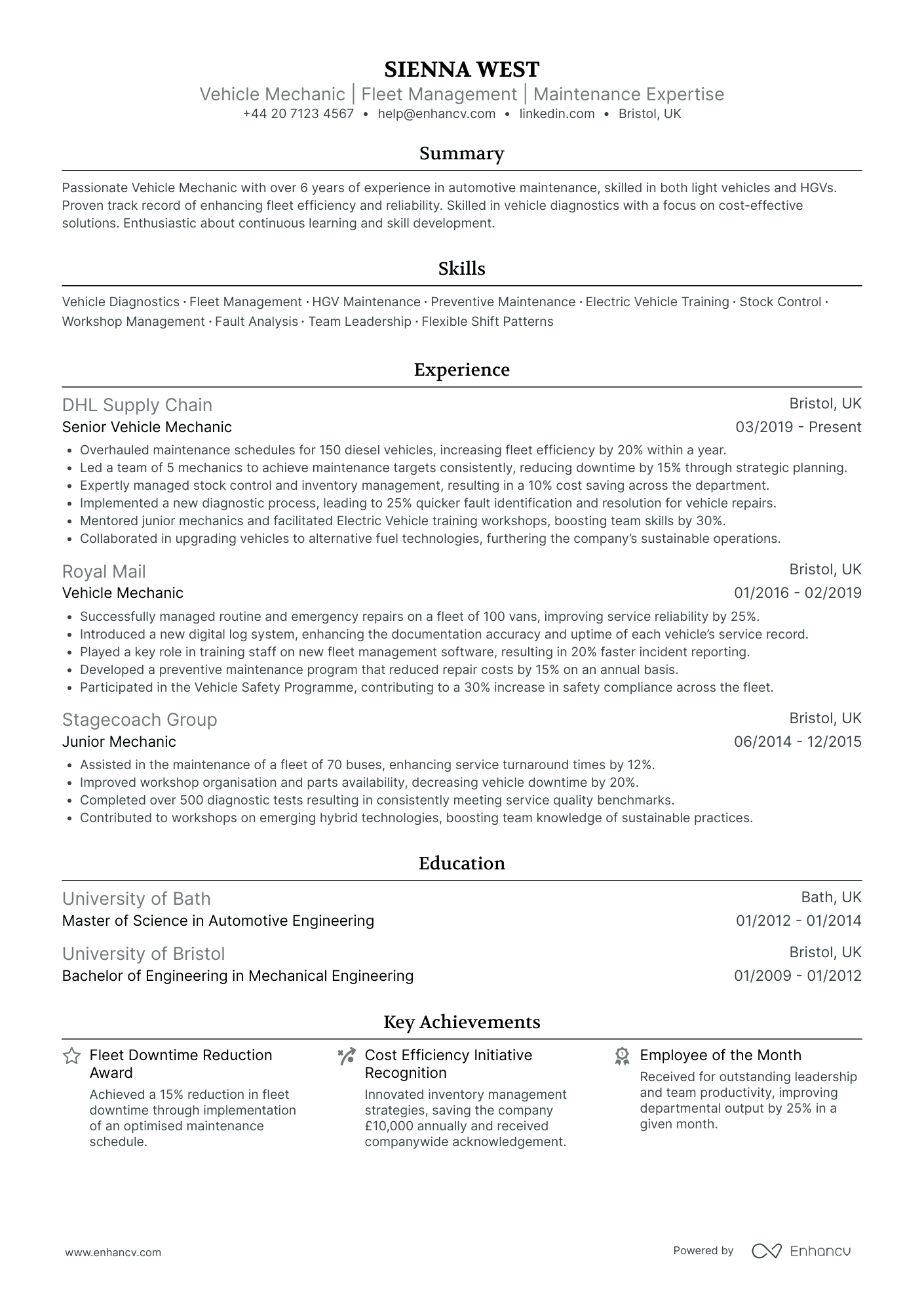
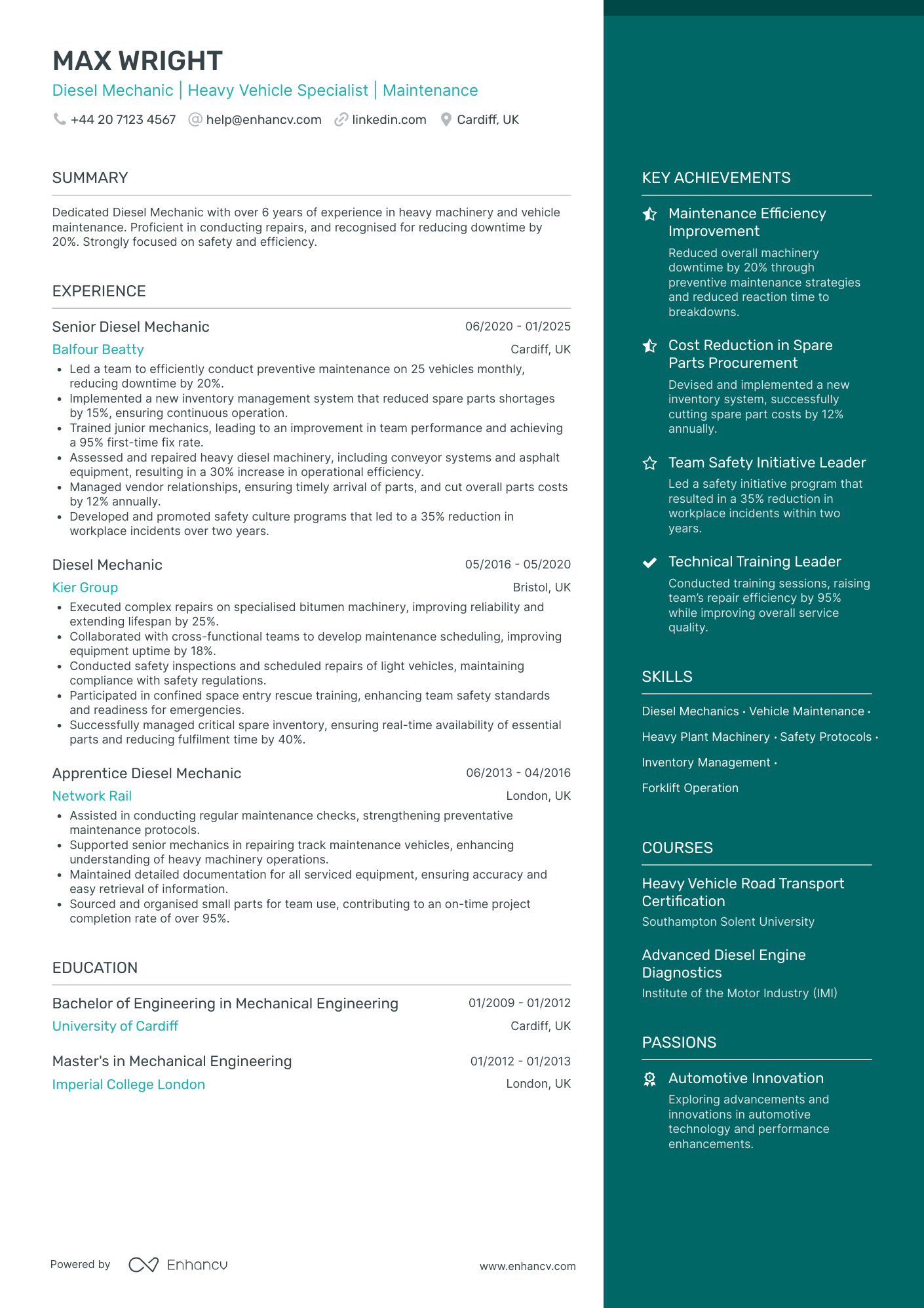
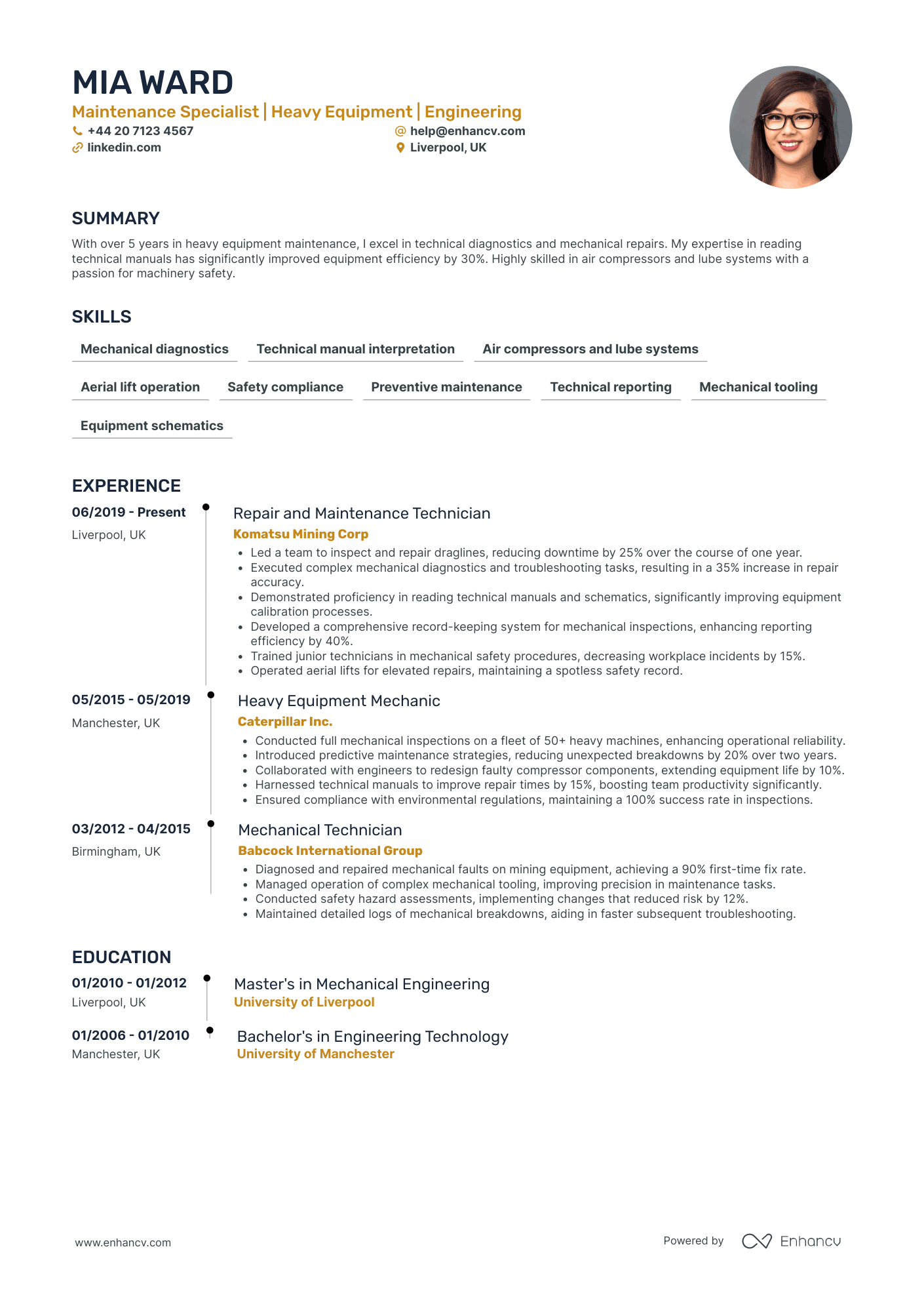
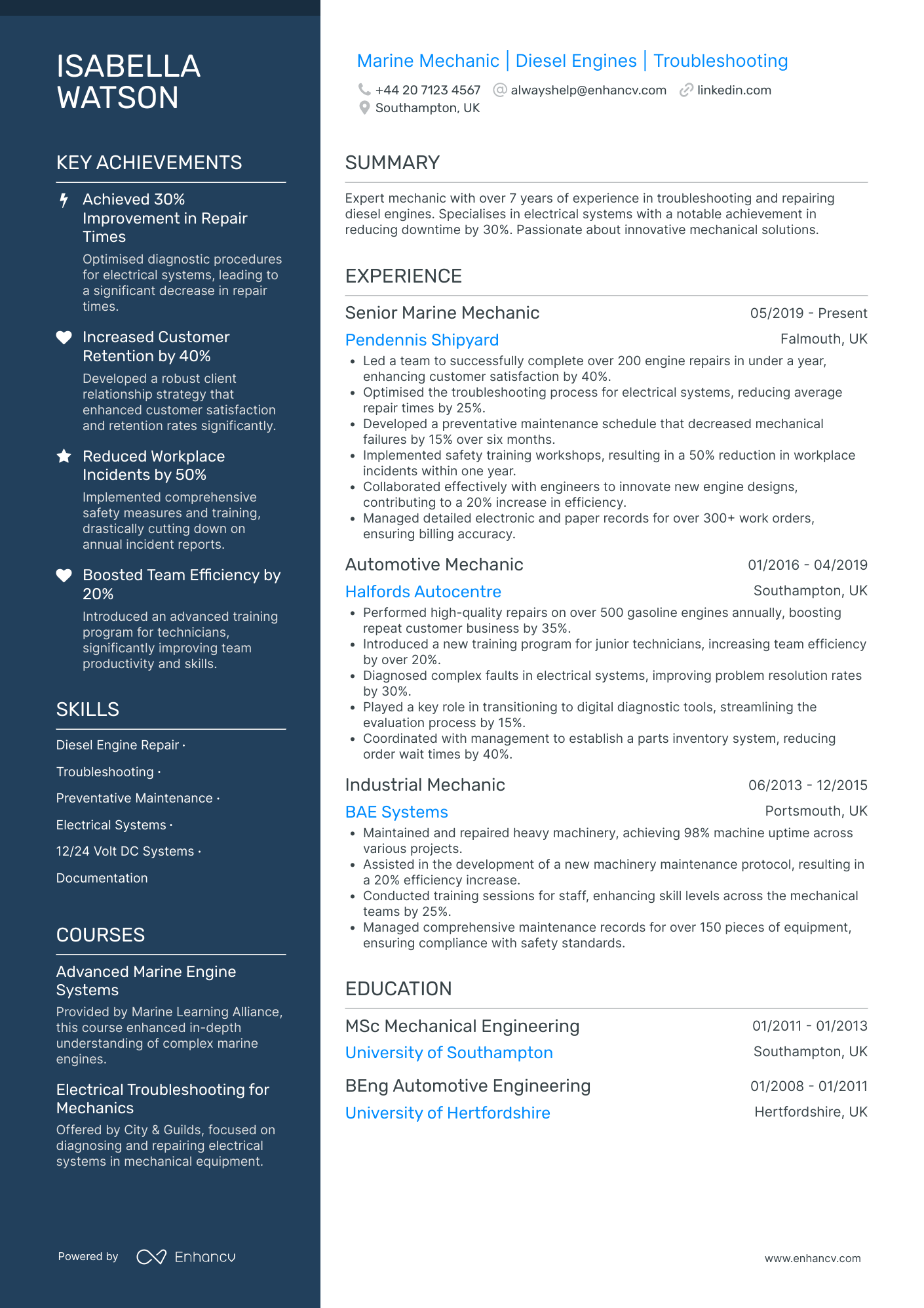
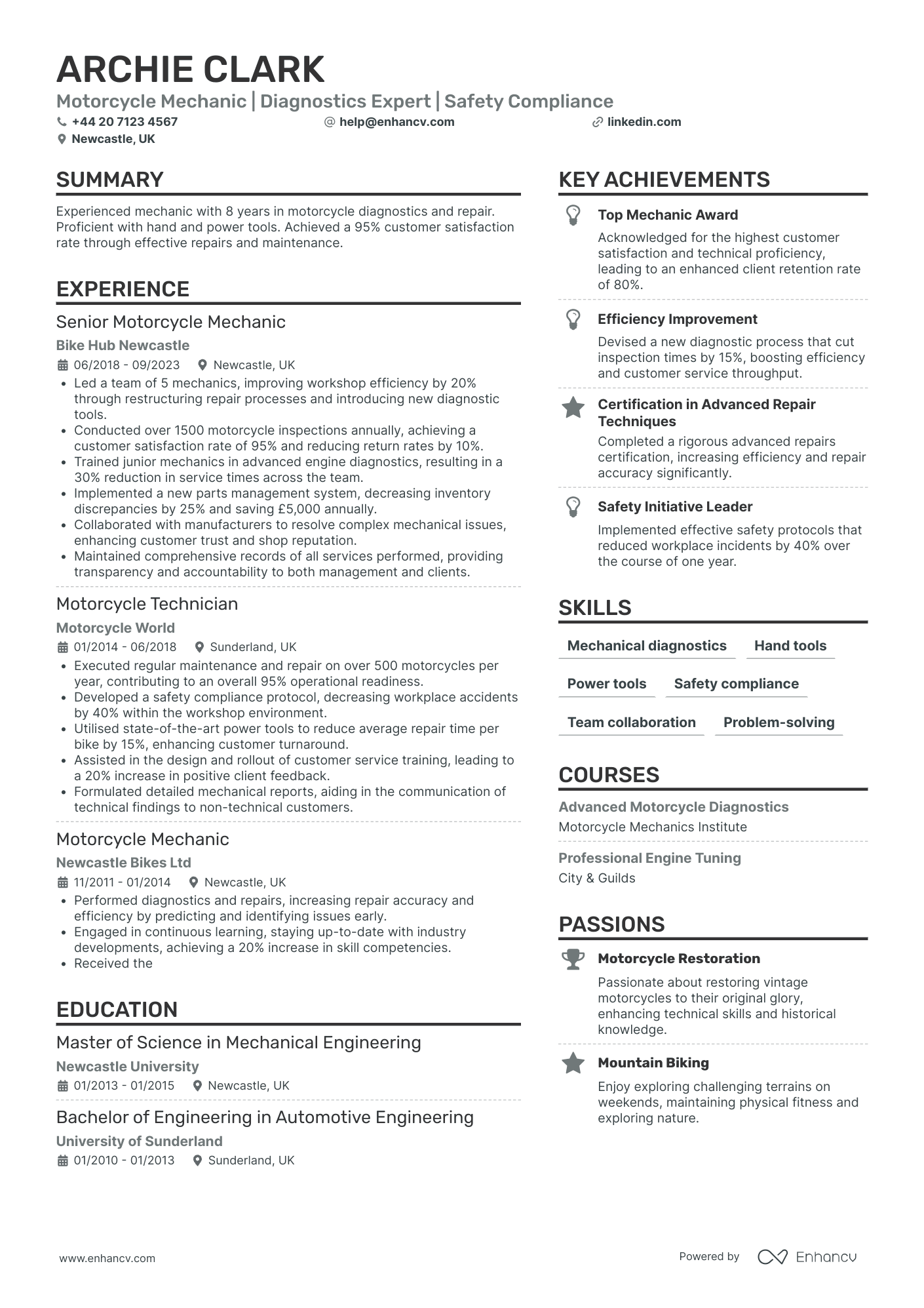
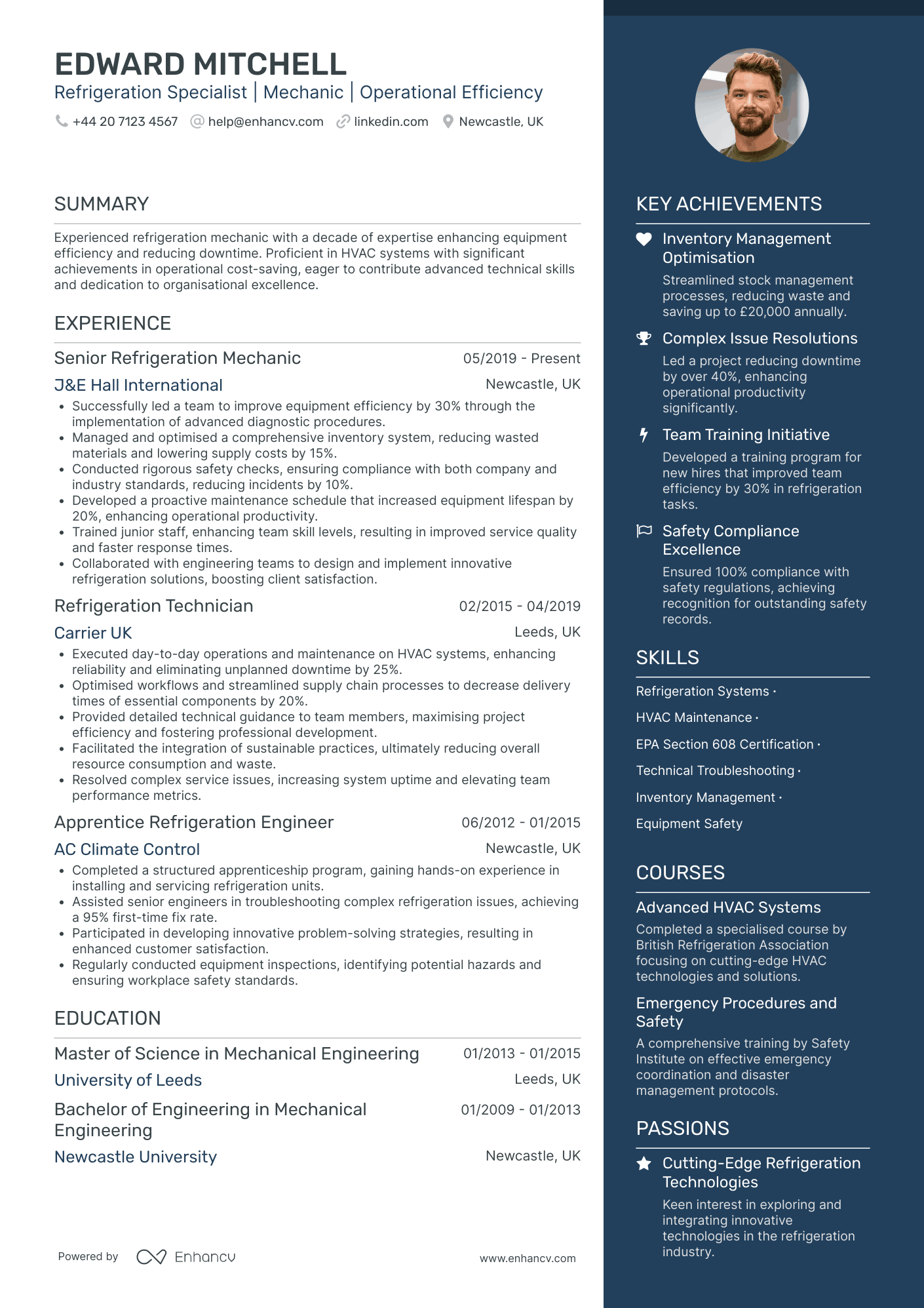
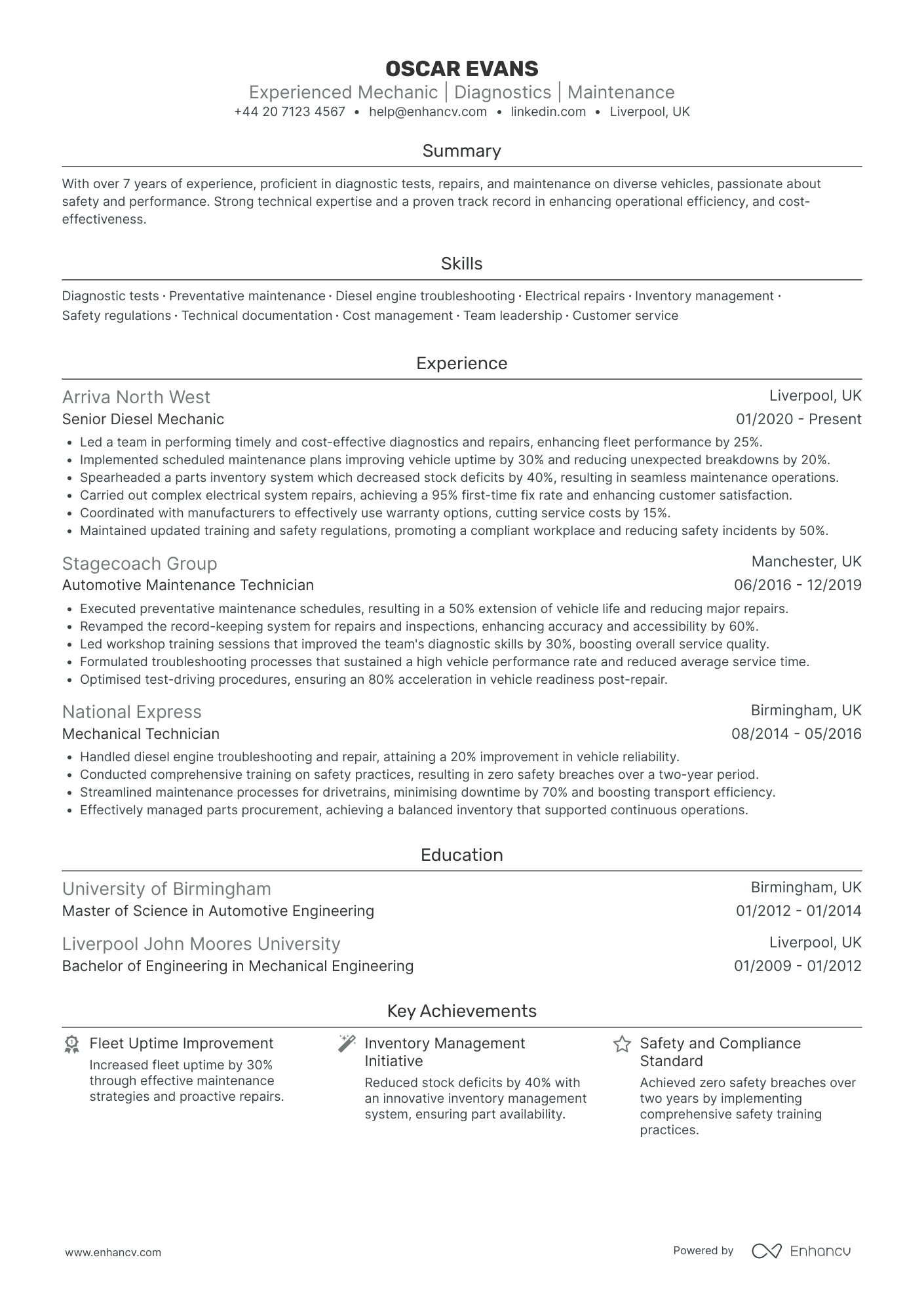
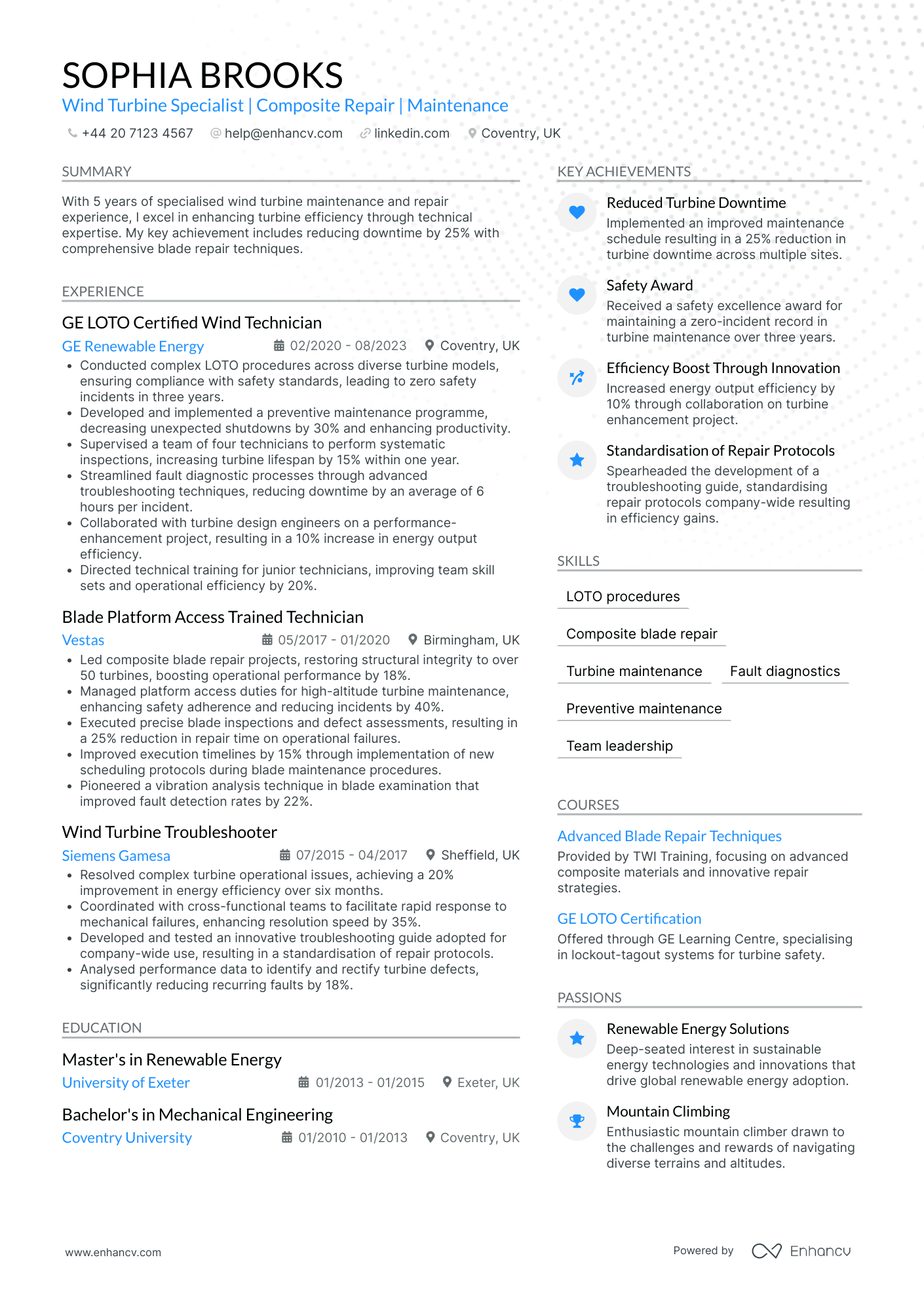
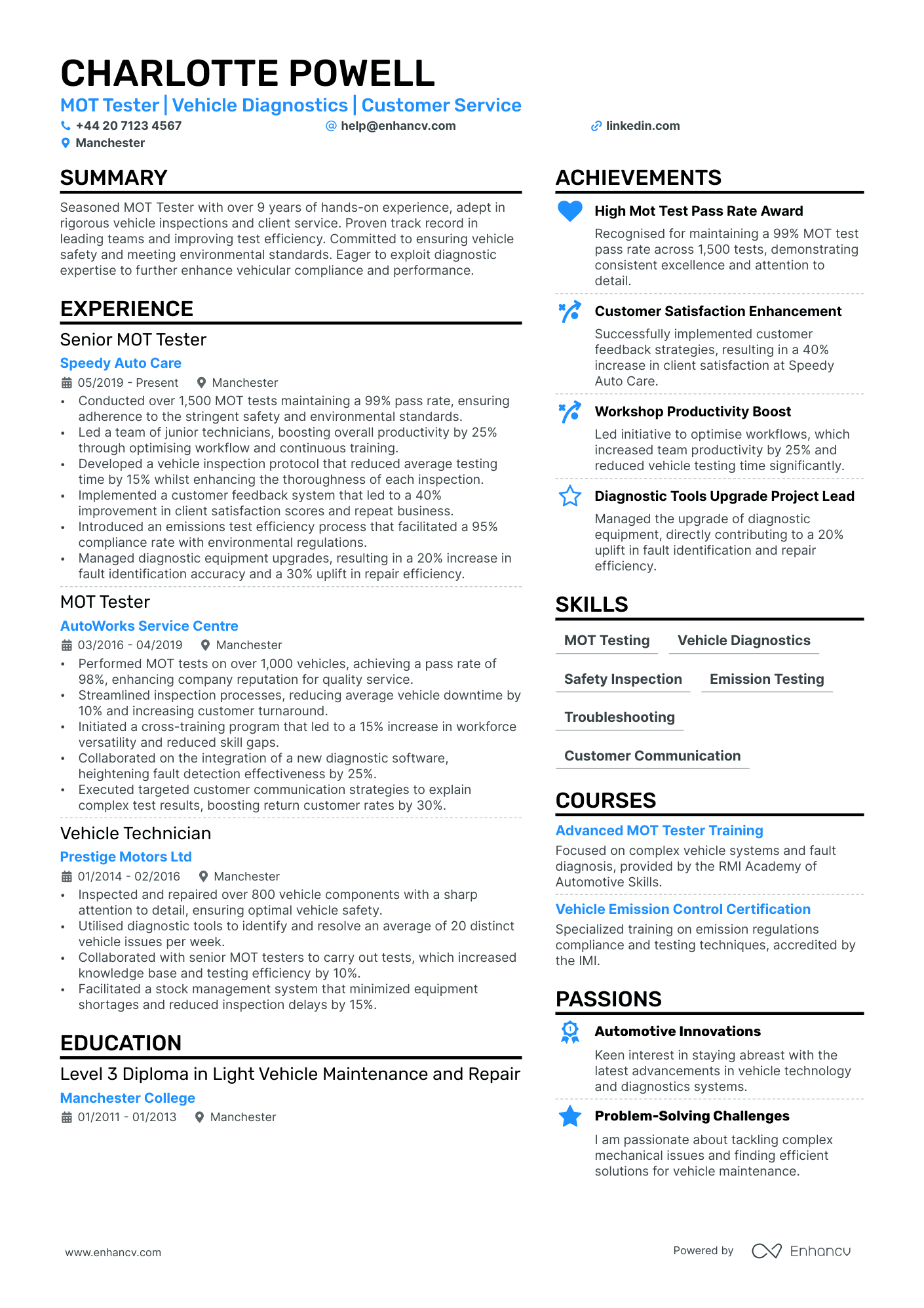
Most mechanic CVs read like a job sheet. A list of tasks, no proof any of them went well, and nothing that tells a workshop manager this person can be trusted with a bay of their own.
The CVs that get called in do the opposite. They lead with the faults you can diagnose, the systems and vehicles you have worked on, and the jobs you turned around, then put a number on each one. If you want the fundamentals first, see how to write a CV.

Key takeaways
- Lead with the faults you can fix and the systems you know, not a list of duties every mechanic shares.
- Name the exact vehicles, scan tools, and tickets you have used. Employers and their software search for them.
- Mechanic work is on-site, so put your town and a full driving licence near the top.
- Quantify what you can: jobs a day, first-time fix rate, MOT throughput, comeback rate, fleet downtime cut.
- List qualifications plainly: your NVQ, City and Guilds or IMI level, MOT tester class, and F-Gas.
- Two pages, reverse chronological, sent as a PDF unless the advert asks for a Word file.
Top skills for your mechanic CV
A workshop manager scans a mechanic CV for one thing first: can this person fix what rolls into the bay without supervision. So the skills section has to be specific, not a wall of adjectives.
Split it in two. The hard skills you apply with your hands and the systems you know, then the working habits that keep a busy workshop moving. List the hard skills in the words the adverts use: diagnostics and fault-finding, engine and transmission repair, braking and suspension, auto-electrics, air conditioning, and servicing to schedule.
Name your kit and your tickets. "Diagnostics" lands harder when you add the scan tools you have used, whether that is a manufacturer system or a generic OBD reader. "MOT testing" lands harder with the class and your tester status. Vague skills are easy to claim, so they carry no weight.
Evidence each one the way a manager would check it. For diagnostics, name a fault you traced and fixed that others had missed. For repair, name the components and the vehicle types. For servicing, name the schedules and the throughput you held. A skill with a job attached to it reads as real.
Electric and hybrid work is the fastest-moving line on a modern mechanic CV. If you have high-voltage awareness or HEVRA training, put it near the top, because fewer applicants can claim it and more workshops now need it.
Order the list by what the advert asks for, not by what you enjoy most. If the role is diagnostic-led, the scan tools and fault-finding go first. If it is a fast-fit or servicing bay, tyres, brakes, and servicing throughput lead. The same skills, reordered per application, read as a tailored CV rather than a template.
The soft skills that matter here are checkable: problem solving, attention to detail, clear communication with customers and service advisers, and time management under a full booking sheet. Prove each one in a bullet rather than listing it in your skills section.
List only what you can stand behind. If you hold a ticket, name it. If you are still training towards it, put it under training in progress rather than skills.
Top skills for your mechanic CV:
Vehicle diagnostics and fault-finding
Engine and transmission repair
Braking and suspension systems
Auto-electrical and electronic systems
MOT testing (Class 4 and 7)
Servicing and scheduled maintenance
Air conditioning (F-Gas)
Electric and hybrid systems (HEVRA)
Welding and fabrication
Reading wiring and technical diagrams
Problem solving
Attention to detail
Communication
Time management
Teamwork
What the UK mechanic market looks like
Knowing the market shapes the CV. Three things from the adverts should change how you write yours.
| What | UK mechanic roles |
|---|---|
| Where the work happens | On-site: 74% of 780 UK mechanic postings in the last ~30 days (Enhancv's internal job feed) |
| Experience level asked for | Mid-level 54%, lead 17%, entry 15%, senior 14% |
| Skills that recur most | Mechanical engineering, project management, and mechanical design |
Mechanic work is almost entirely on-site, which sounds obvious until you remember the recruiter cannot see it on a CV. Put your town and a full driving licence in the header so they know you can reach the workshop reliably.
Most of the demand sits at mid-level, so pitch yourself as a competent technician who works independently rather than a beginner who needs watching. The entry share is real too, which is why the apprenticeship route below is realistic rather than wishful.
The skills line looks surprising for a hands-on trade, and that is the real lesson. Mechanic is a broad label in UK adverts, stretching from vehicle technicians to maintenance mechanics and mechanical engineers, so the terms that recur most lean towards the engineering end. Read your target advert and tailor your CV to its exact wording rather than to this blended picture.
Formatting your mechanic CV
Reverse chronological is right for most mechanics: your current workshop first, then the one before. If you are fresh out of an apprenticeship with little history, a skills-based CV lets your training and tickets lead instead.
Keep it to two pages, one column, standard headings, and a font a manager can read at a glance between jobs. A tidy CV signals a tidy technician.
Your header does real work for a mechanic. Name your town and travel radius, a full driving licence, and a direct phone number, because workshops often ring the shortlist rather than email it.
Leave off the things that eat space and prove nothing: a photo, your full home address, a personal-interests paragraph, and a school-by-school history from a decade ago. The room they free up goes to your systems, tickets, and numbers.
Send a PDF for direct applications so the layout holds on any screen. Keep a Word copy for agencies, which place a large share of workshop and fleet roles and reformat CVs into their own template. If the advert names a file type, follow it.
Dealership groups and larger workshops often screen applications through tracking software, so keep the layout clean and the headings standard for an ATS-friendly CV. Build it from a tested layout rather than a blank page: Enhancv's CV templates export to a clean PDF.
Is your CV good enough?
Drop your CV here or choose a file. PDF & DOCX only. Max 2MB file size.
Writing your mechanic personal statement
Three or four sentences at the top: what you fix, how long you have done it, the kit and vehicles you know, and what you are after. Keep it concrete. See more personal statement examples if the opening line will not come.
Skip the adjective soup. "Hardworking, reliable, and passionate about cars" tells a manager nothing they can check, and it opens half the CVs in the pile.
Write it to the specific workshop. A main dealer wants to see manufacturer systems and warranty-standard work, while a fast-fit or independent garage wants speed, breadth, and a first-time fix rate. The same career, framed for the reader in front of you.
Lead with evidence instead:
Mechanic CV personal statement example
Time-served vehicle technician with eight years across main-dealer and independent workshops, servicing and repairing petrol, diesel, and hybrid vehicles. Level 3 in Light Vehicle Maintenance and Repair, MOT tester for Class 4 and 7, and confident on manufacturer diagnostic systems. First-time fix rate above 90% across roughly 40 jobs a week. Looking to bring that throughput to a busy independent garage near Bristol.
Personal statement to avoid
Hardworking and reliable mechanic with a real passion for cars and a strong work ethic. A great team player who always goes the extra mile and is looking for a new and exciting challenge in the motor trade.
The second could describe anyone in the trade. The first names the vehicles, the tickets, and a number, which is exactly what earns a call.
When I read a mechanic CV, I skip the adjectives and look for two things: the systems you can diagnose without hand-holding, and a number that proves throughput. "First-time fix rate above 90% across 40 jobs a week" tells me more than a paragraph about being hardworking. Name the vehicles, the diagnostic kit, and the tickets you hold, then let one real figure do the talking. That is the CV that gets a bay.
the Enhancv team
Writing your mechanic experience section
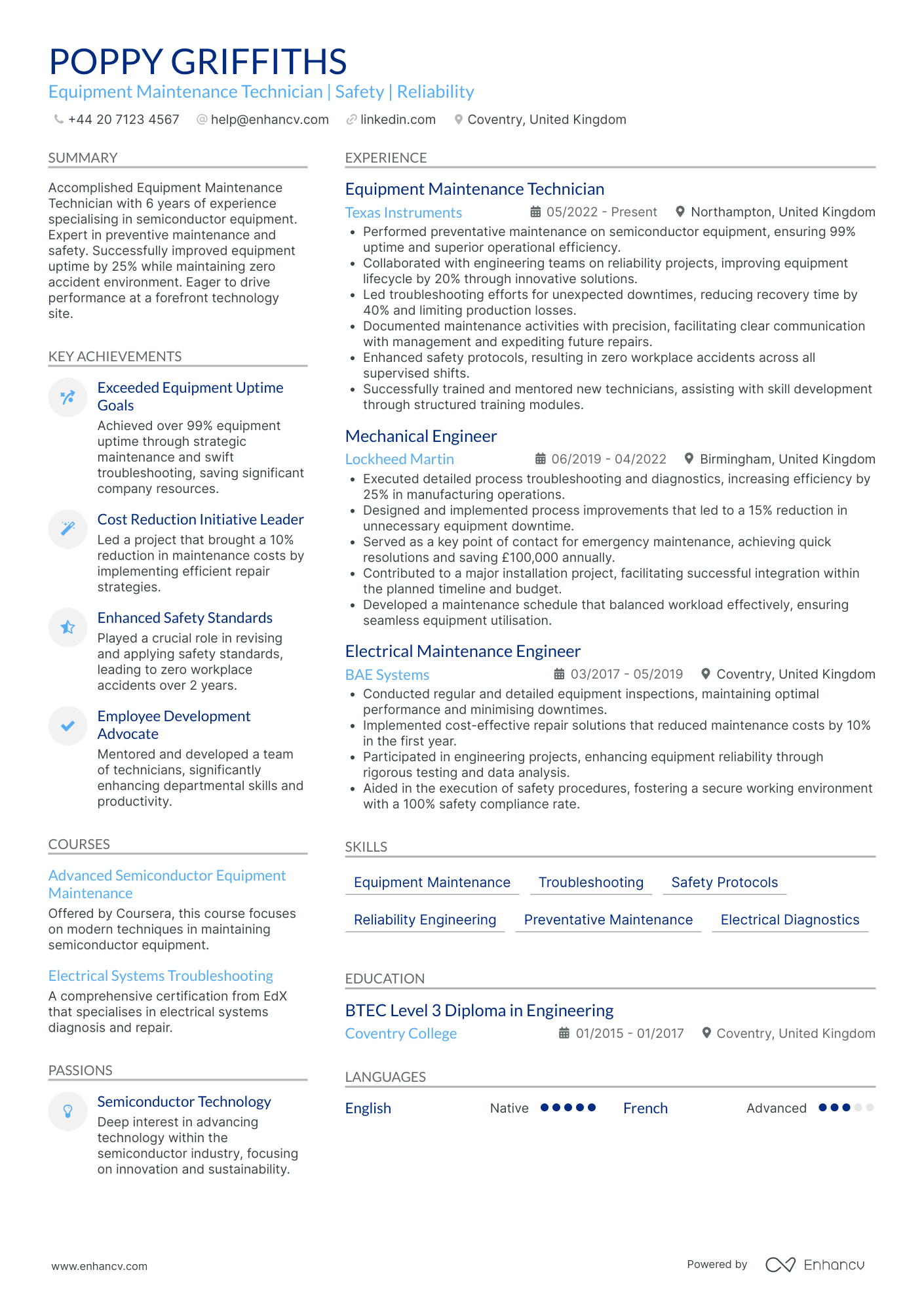
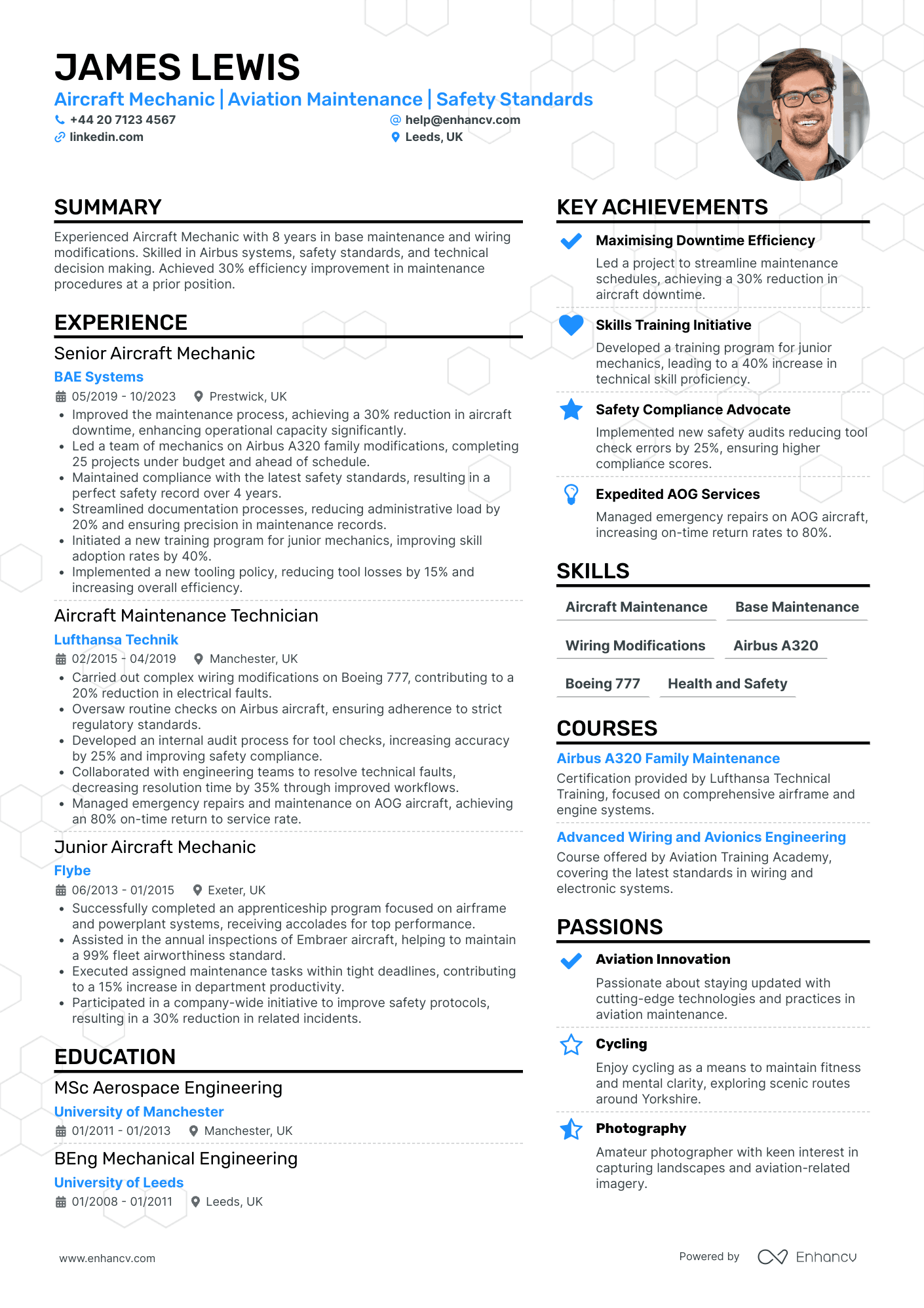
Each role gets a dated heading, then bullets that show what you worked on and how it turned out. Lead every bullet with a verb, and put a number on it wherever you honestly can. For the mechanics of it, see work experience on a CV and these action verbs.
Mechanic work is more measurable than most trades: jobs completed a day, first-time fix rate, MOT throughput, comeback rate, warranty claims avoided, fleet downtime cut. Those are your achievements, and they beat "responsible for repairs" every time.
Show range as well as volume. One bullet on a tricky intermittent fault you tracked down proves you can think, while a throughput number proves you can produce. A manager wants both, so give each its own line rather than burying them in a paragraph.
No numbers to hand? Estimate honestly from your booking sheet. "Around 35 to 40 jobs a week" is defensible and still far stronger than a bare duty. What you must not do is round a good week up into a claim you cannot back in an interview.
Tailor each application: pull the systems, vehicle classes, and tickets from the advert and mirror the ones that are true of you. Enhancv's CV tailoring feature reads the advert and suggests the matching edits, which saves rewriting from scratch each time.
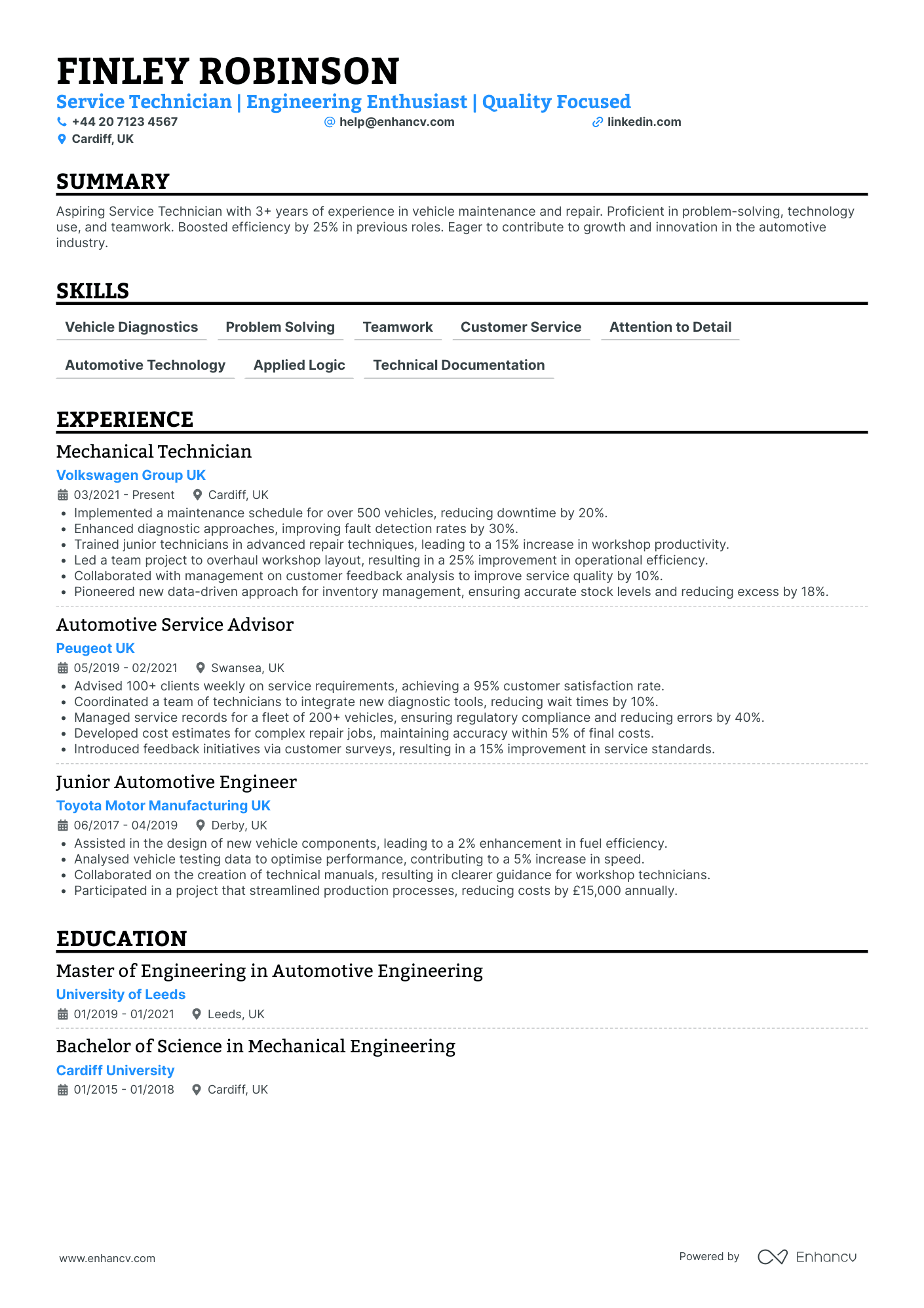
- Diagnose and repair petrol, diesel, and hybrid faults across roughly 40 jobs a week, holding a first-time fix rate above 90%
- Carry out MOT testing on Class 4 and 7 vehicles, averaging 12 tests a day with no re-test disputes in the last year
- Cut average diagnostic time by 20% by standardising the workshop's fault-finding checklist for recurring electrical issues
- Reduced comebacks on brake and clutch jobs to under 2% by introducing a second-tech sign-off on safety-critical work
- Mentor two apprentices through their Level 2, signing off logbook tasks alongside the workshop supervisor
- Serviced and repaired a mixed van and light-commercial fleet of about 120 vehicles, keeping them on the road to a rolling maintenance schedule
- Cut average vehicle downtime by a day per repair by pre-ordering common parts against the fleet's fault history
- Passed the annual MOT tester assessment first time each year and kept a clean testing record
- Kept accurate digital job cards for every repair, which the fleet manager used for warranty and cost reporting

PRO TIP
Adverts name specific systems and vehicle classes, not soft-skill clouds. Mirror the ones you can back: "Class 4 and 7 MOT", "F-Gas certified", "HEVRA-trained on hybrids", "manufacturer diagnostics". If you hold the ticket, name it exactly as the advert does.
Qualifications and training for a mechanic CV
List these plainly, most relevant first. UK employers scan for the level and the licences before they read anything else.
Your core qualification is usually an NVQ or City and Guilds, or an IMI Level 2 or 3 in Vehicle Maintenance and Repair. Name the level, not just the subject, in your education section.
Then the tickets that let you bill work: MOT tester status and class, F-Gas for air conditioning, and any manufacturer or HEVRA training for electric and hybrid vehicles. A full driving licence belongs here or in the header. Listing the certificates you hold saves the employer a question.
Keep the tickets current and say so. An MOT tester who has passed the annual assessment, or a technician up to date on the latest manufacturer software, is worth more than one whose training has lapsed. A short "last renewed" note beside a licence answers the question before it is asked.
If you trained through an apprenticeship, say so and date it. It tells an employer exactly how you learned the trade, and it reads as credibility rather than a gap.
Writing a mechanic CV with no experience
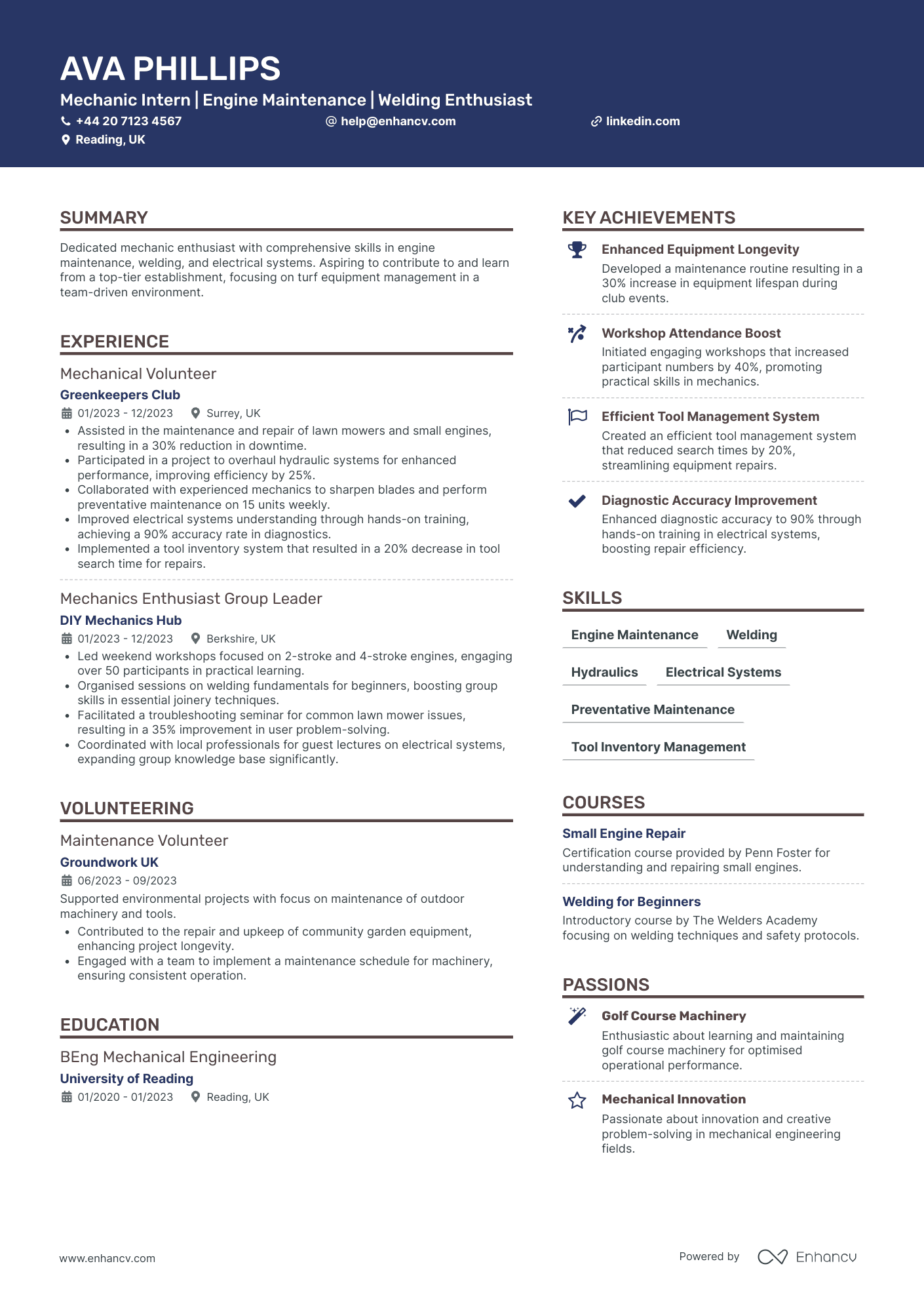
If you are just out of college or partway through an apprenticeship, lead with a skills-based structure so your training and hands-on coursework come before a thin work history.
Mine everything that shows mechanical aptitude: college workshop projects, a work placement, servicing friends' and family cars, rebuilding a bike or an engine at home, or any job that proves you turn up and work to procedure.
Give a placement a dated entry like a job, with the tasks you did and the tools you used. Volunteering on a CV and any part-time job both count as evidence here, not filler. If this is your first application, these first-job CV examples show the shape.
Write your coursework in workshop language, not classroom language. "Stripped and rebuilt a four-cylinder engine as a college project, diagnosing a timing fault along the way" is a repair, and it happened to be graded. That reads as a mechanic, not a student.
One line lifts an entry-level CV: "Level 2 Light Vehicle Maintenance in progress" or "apprenticeship, year two of three". It shows you are already on the path.
Entry-level mechanic personal statement example
Motivated apprentice vehicle technician in the second year of a Level 3 apprenticeship, servicing and repairing petrol and diesel cars under supervision at a busy independent garage. Confident with routine servicing, brake and clutch replacement, and basic diagnostics on the workshop scan tool. Trained in health and safety and COSHH, with a full UK driving licence. Keen to finish the qualification and take on more complex diagnostic work.
Conclusion
Lead with the faults you can fix and the systems you know, put a number on your bench work, and name your tickets in plain terms.
Pair the CV with a short cover letter that says why this workshop, and you turn a list of tasks into an application a manager wants to call in.

Author's take - the Enhancv team
When I read a mechanic CV, I skip the adjectives and look for two things: the systems you can diagnose without hand-holding, and a number that proves throughput. "First-time fix rate above 90% across 40 jobs a week" tells me more than a paragraph about being hardworking. Name the vehicles, the diagnostic kit, and the tickets you hold, then let one real figure do the talking. That is the CV that gets a bay.