



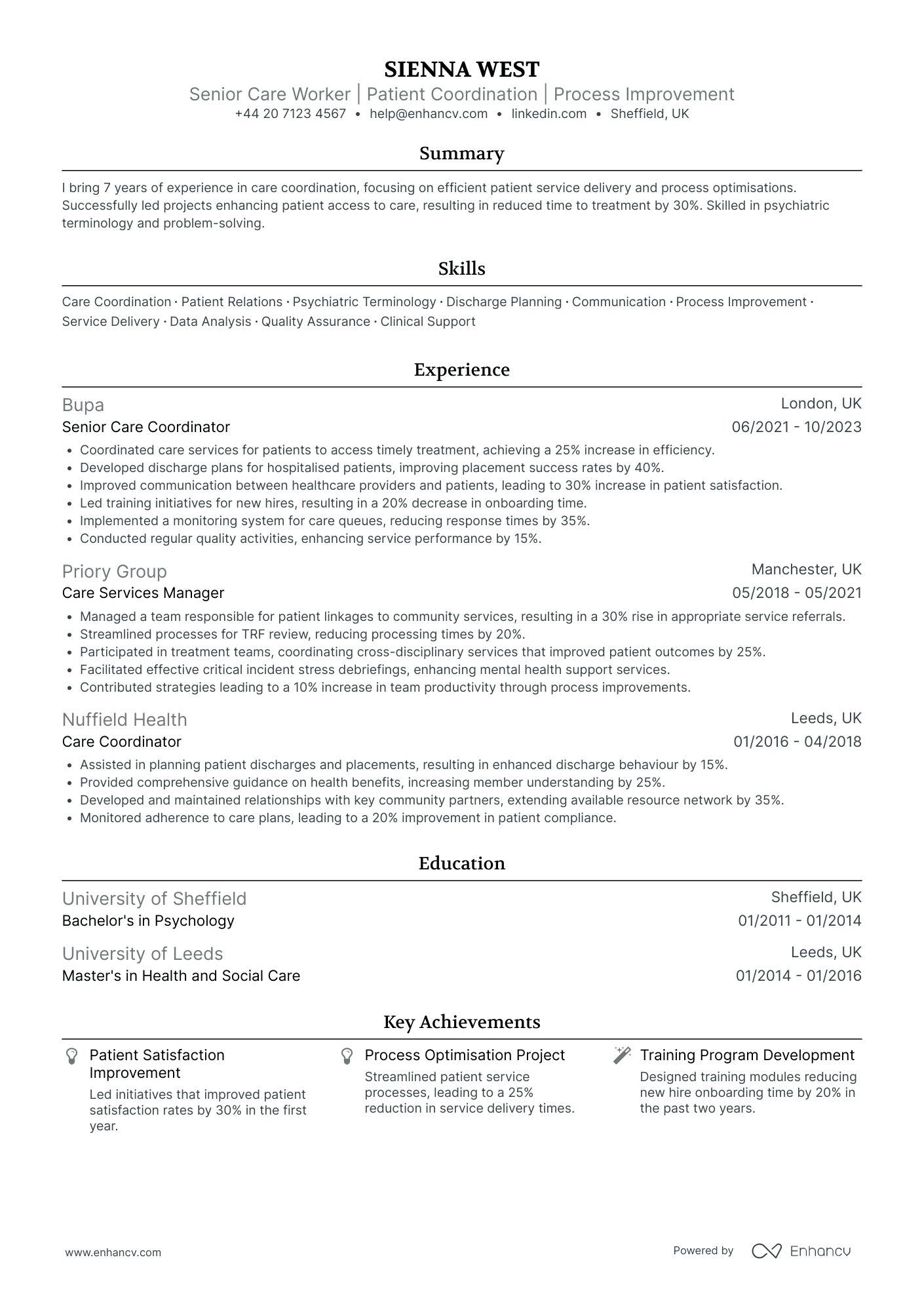
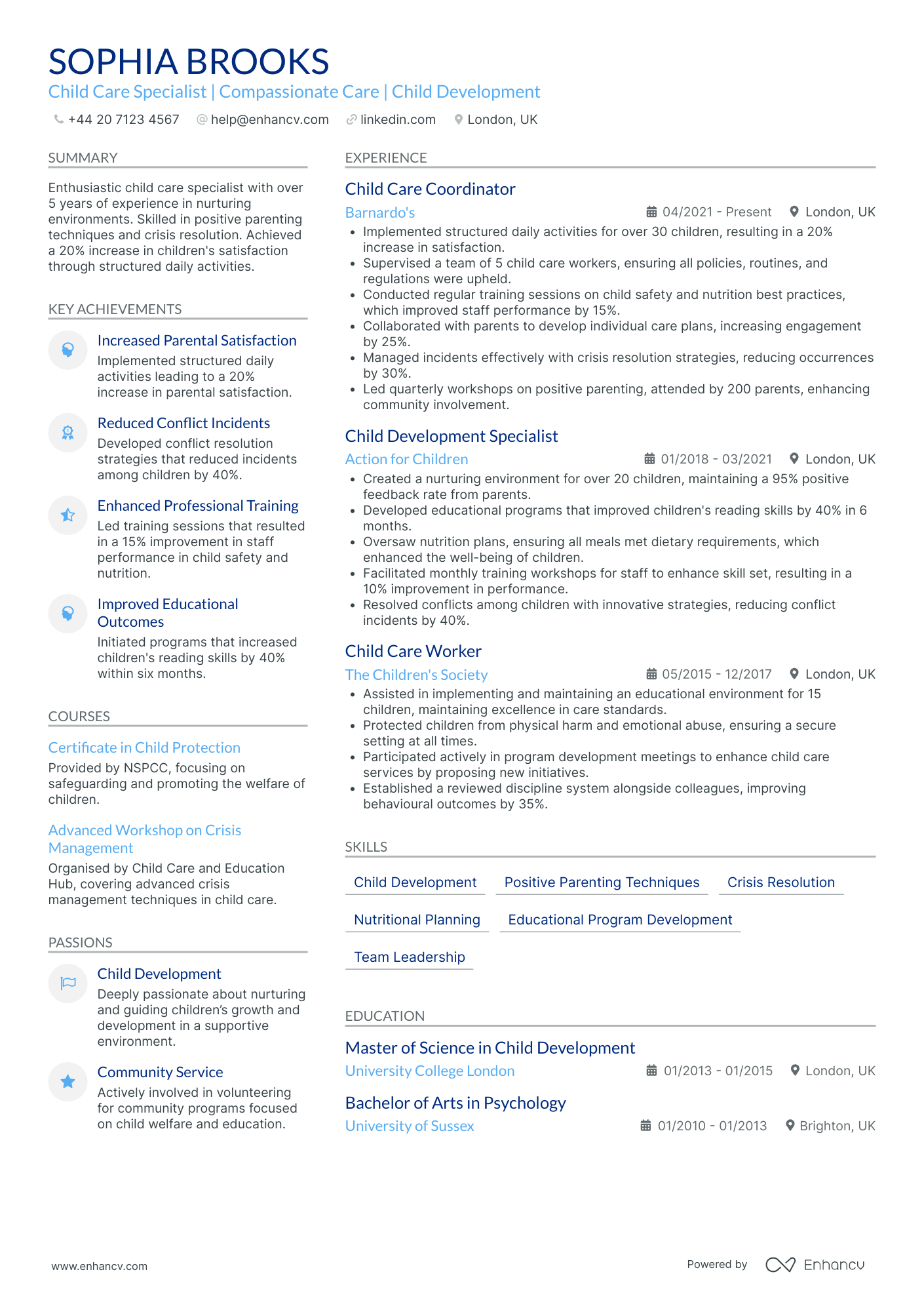
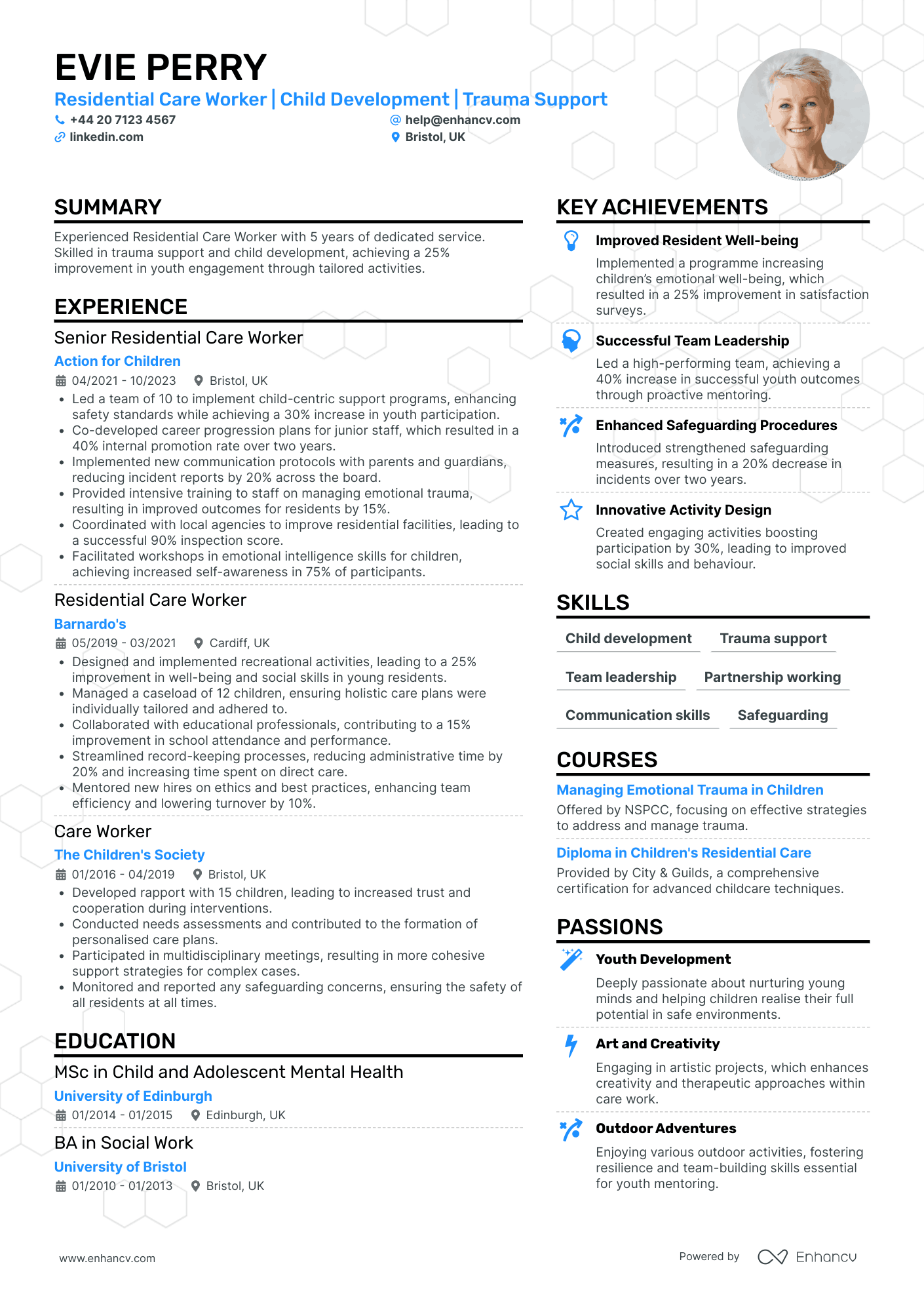
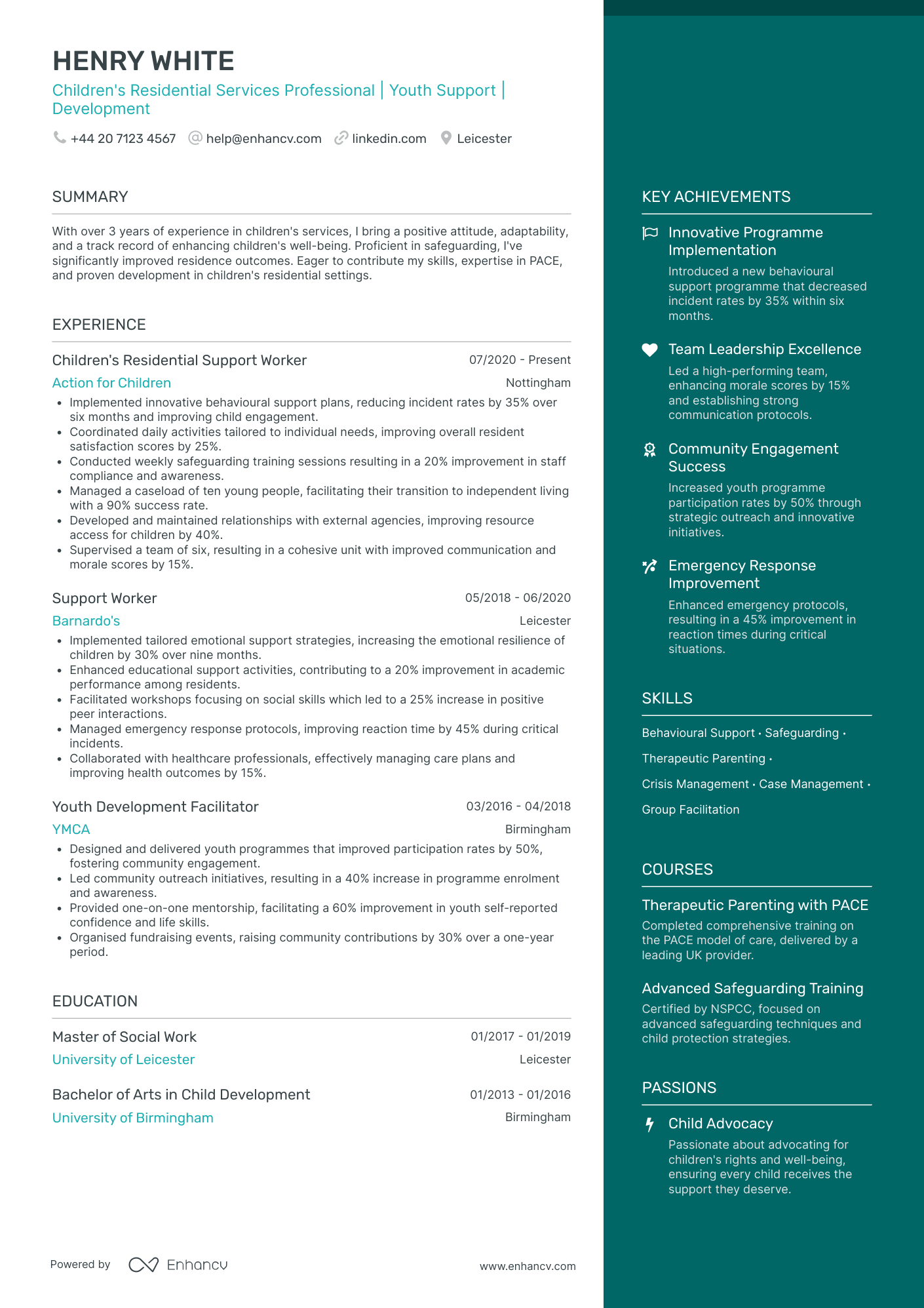
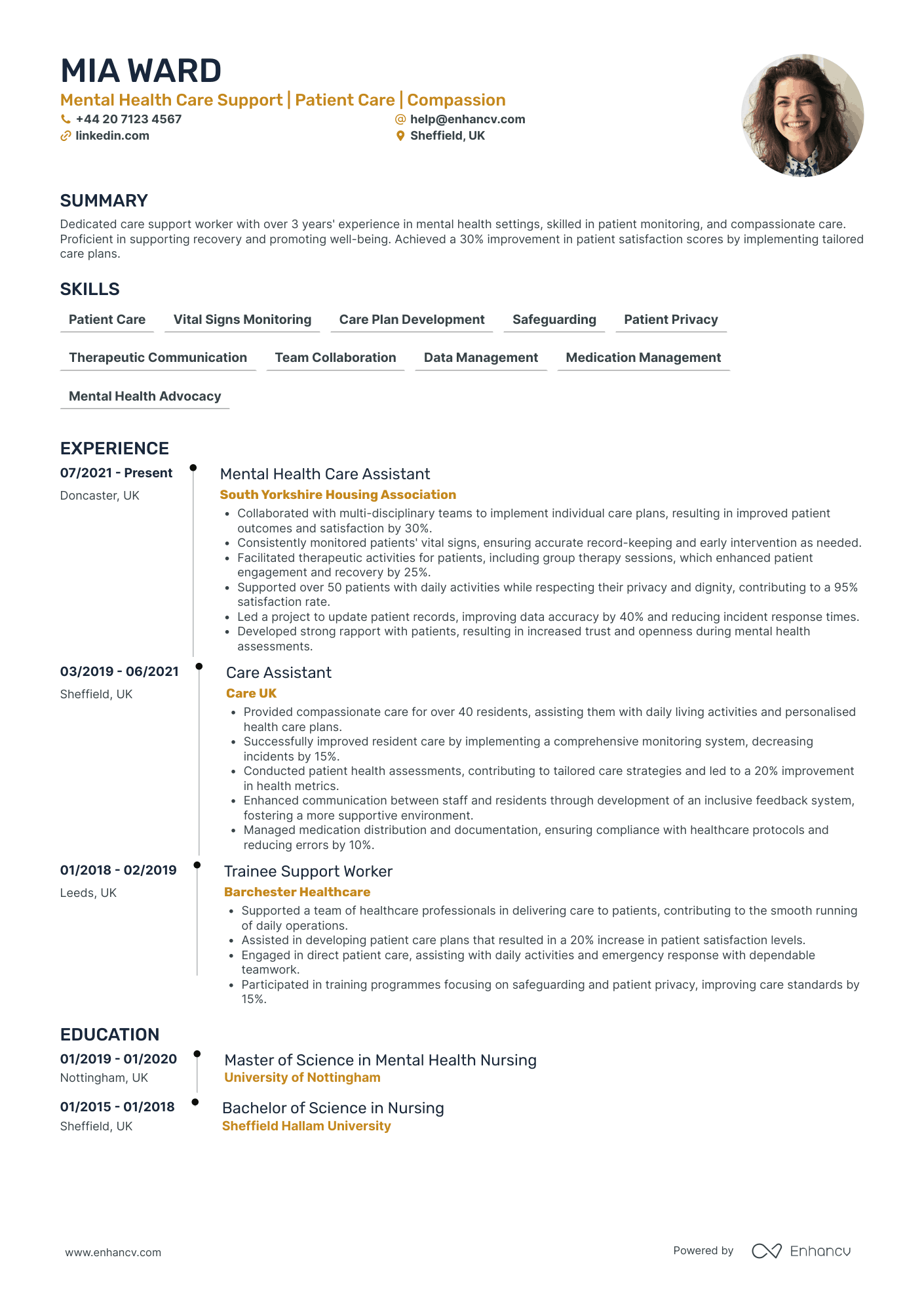
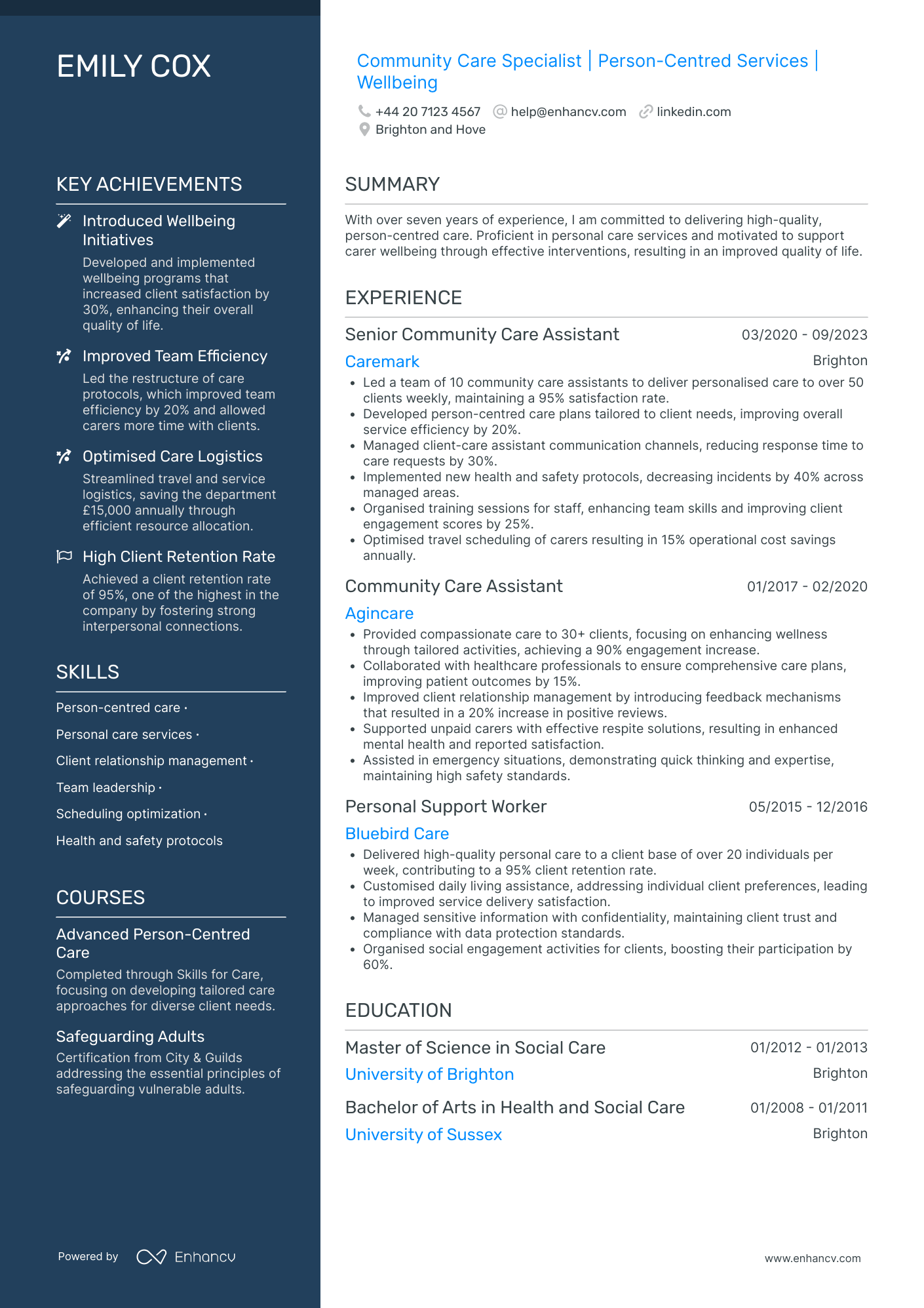
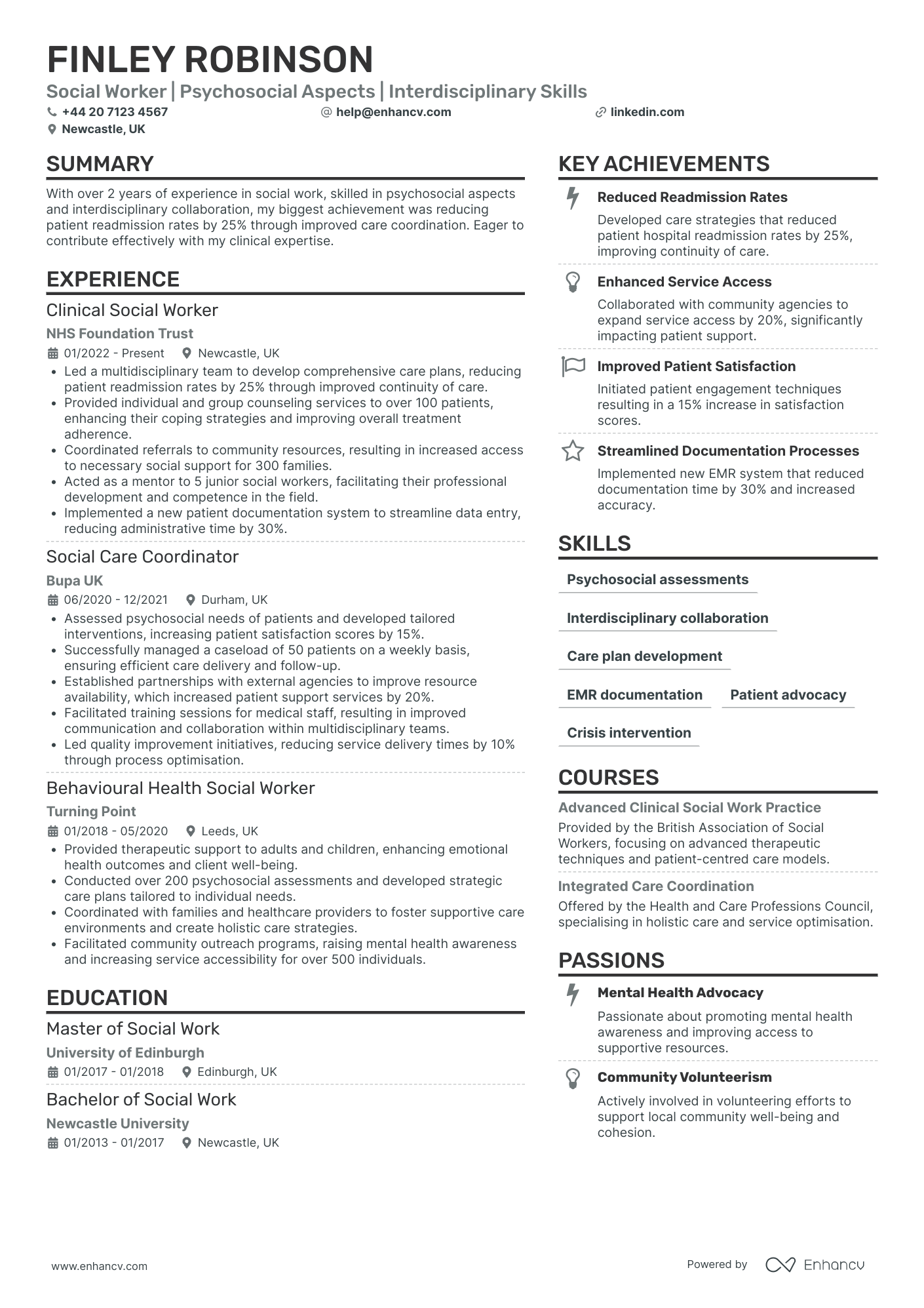
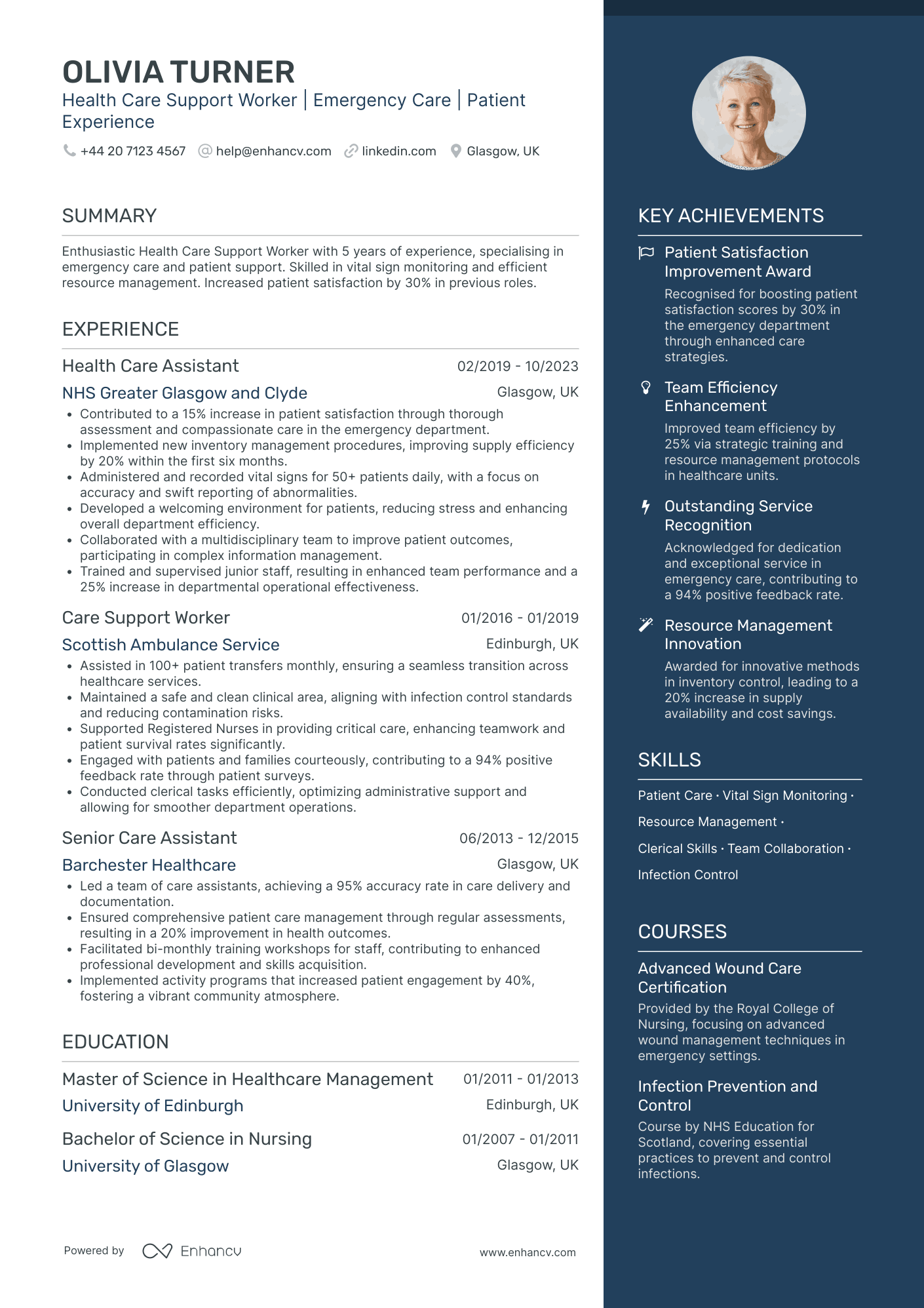
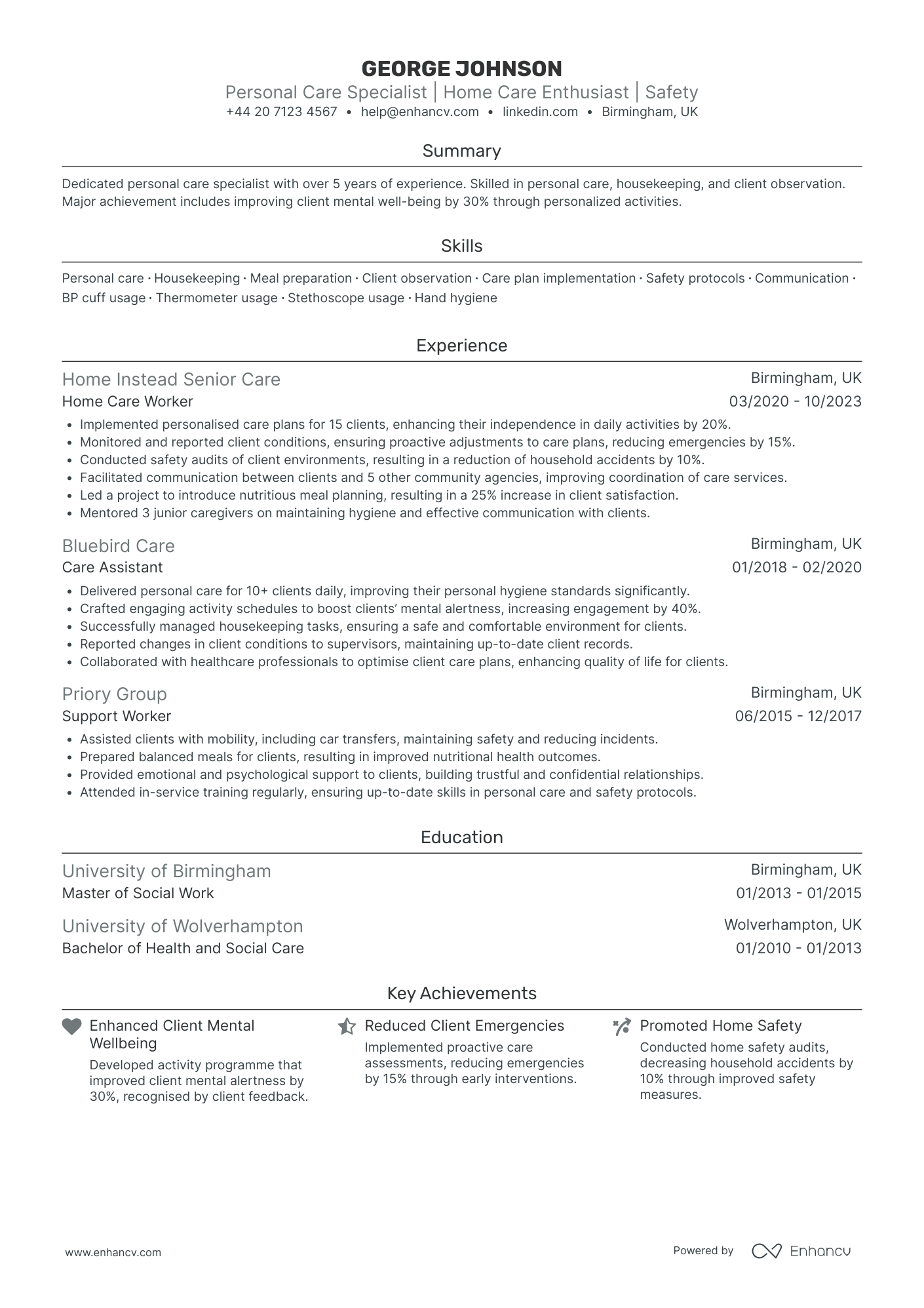
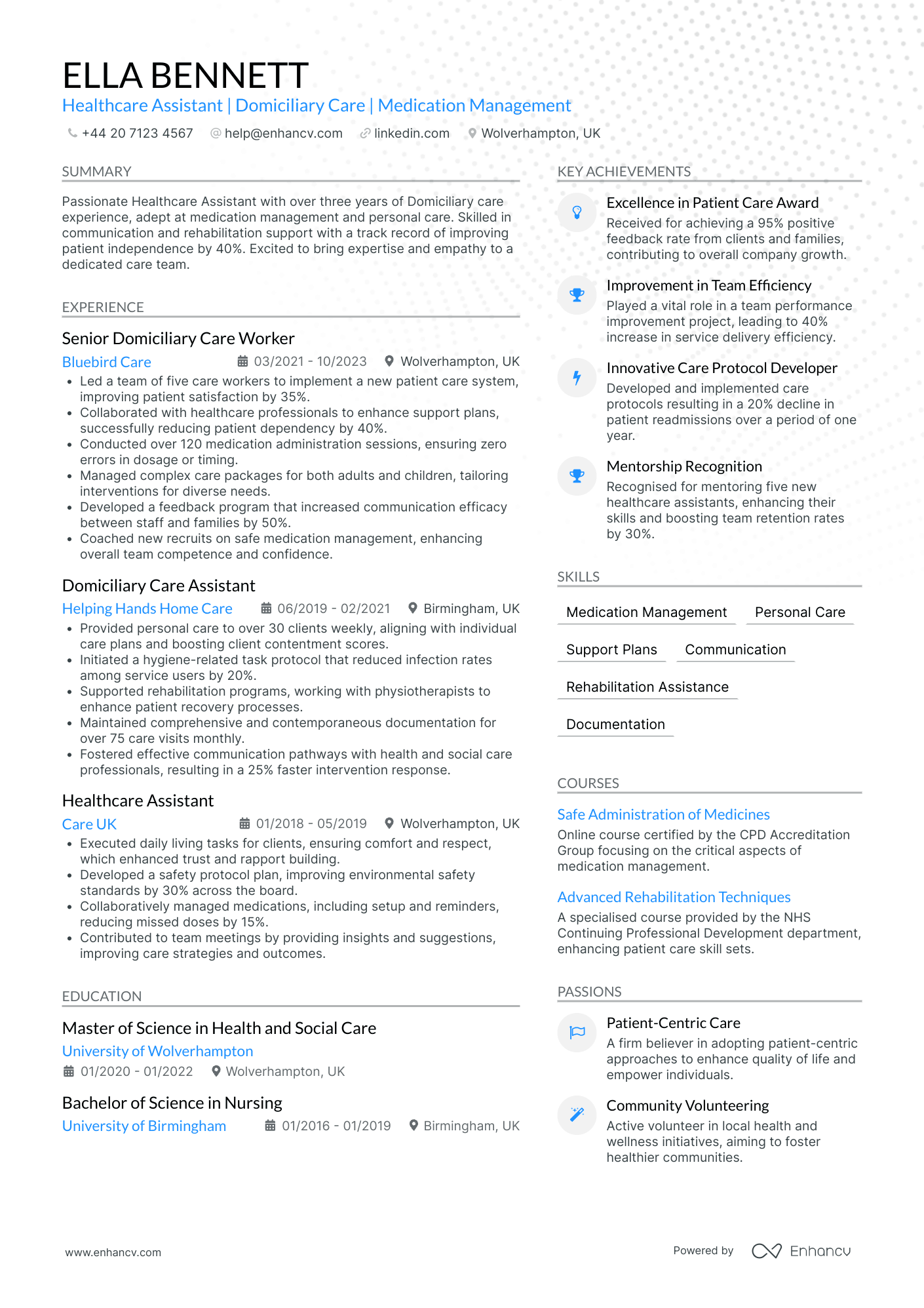
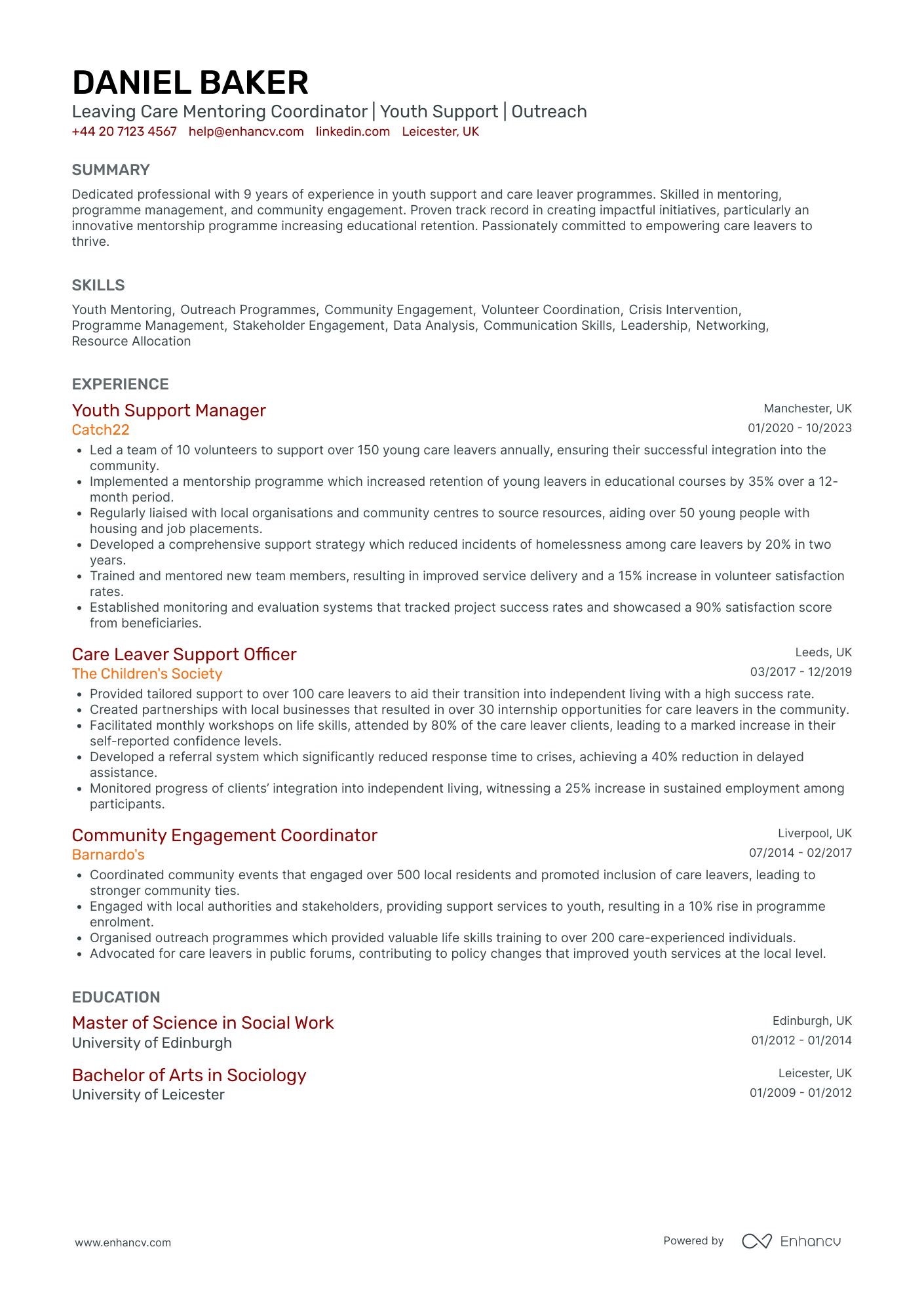
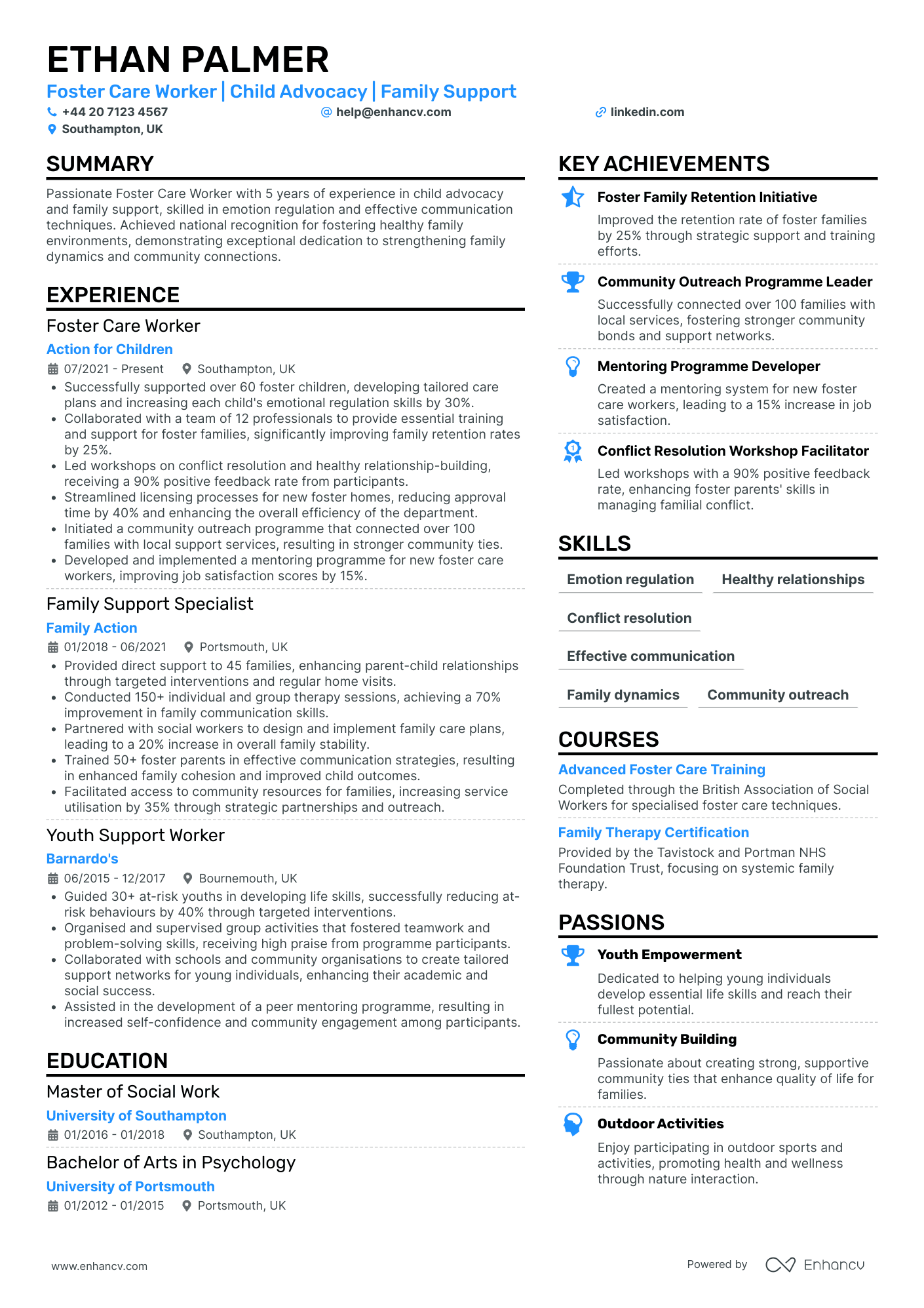
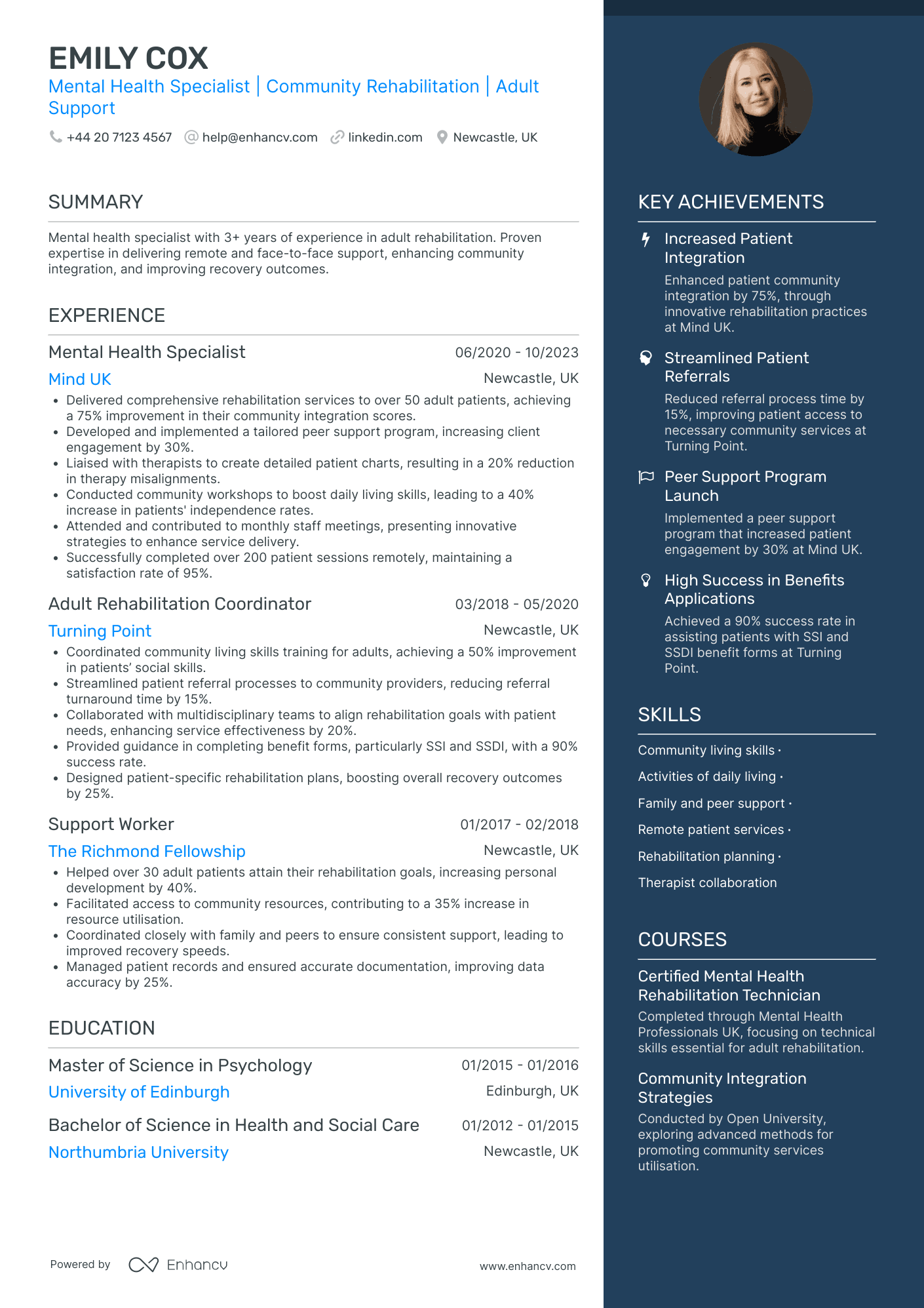
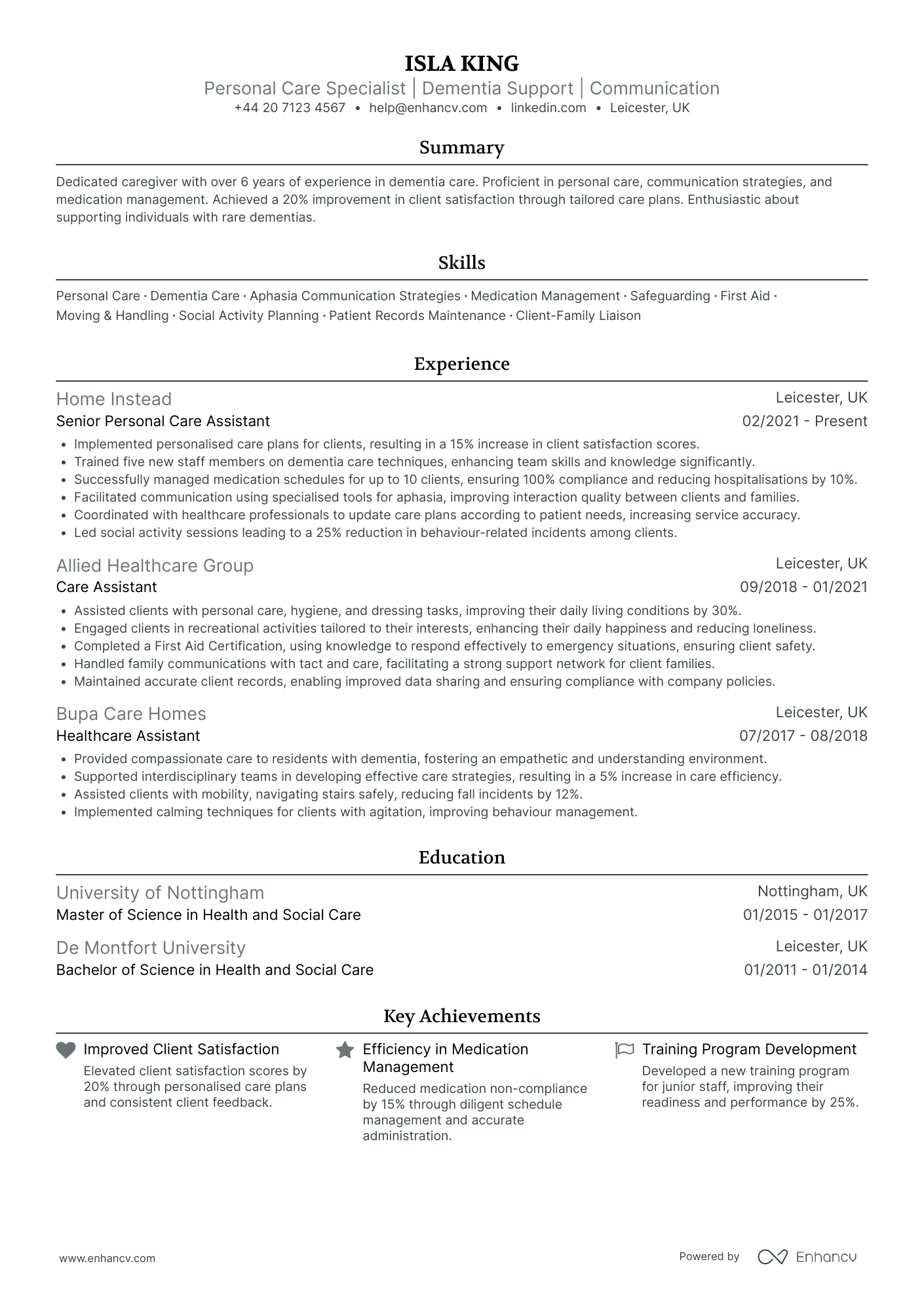
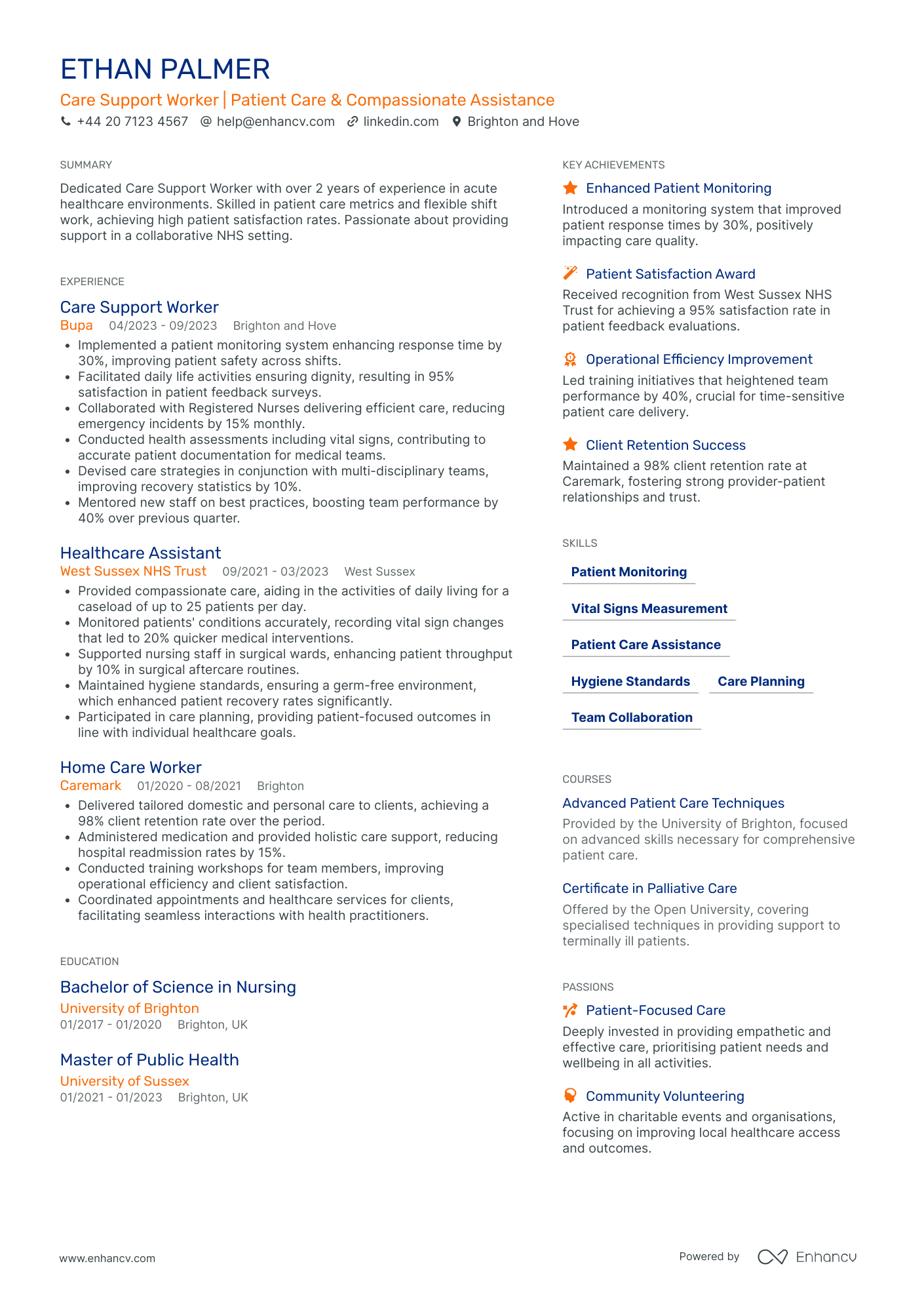
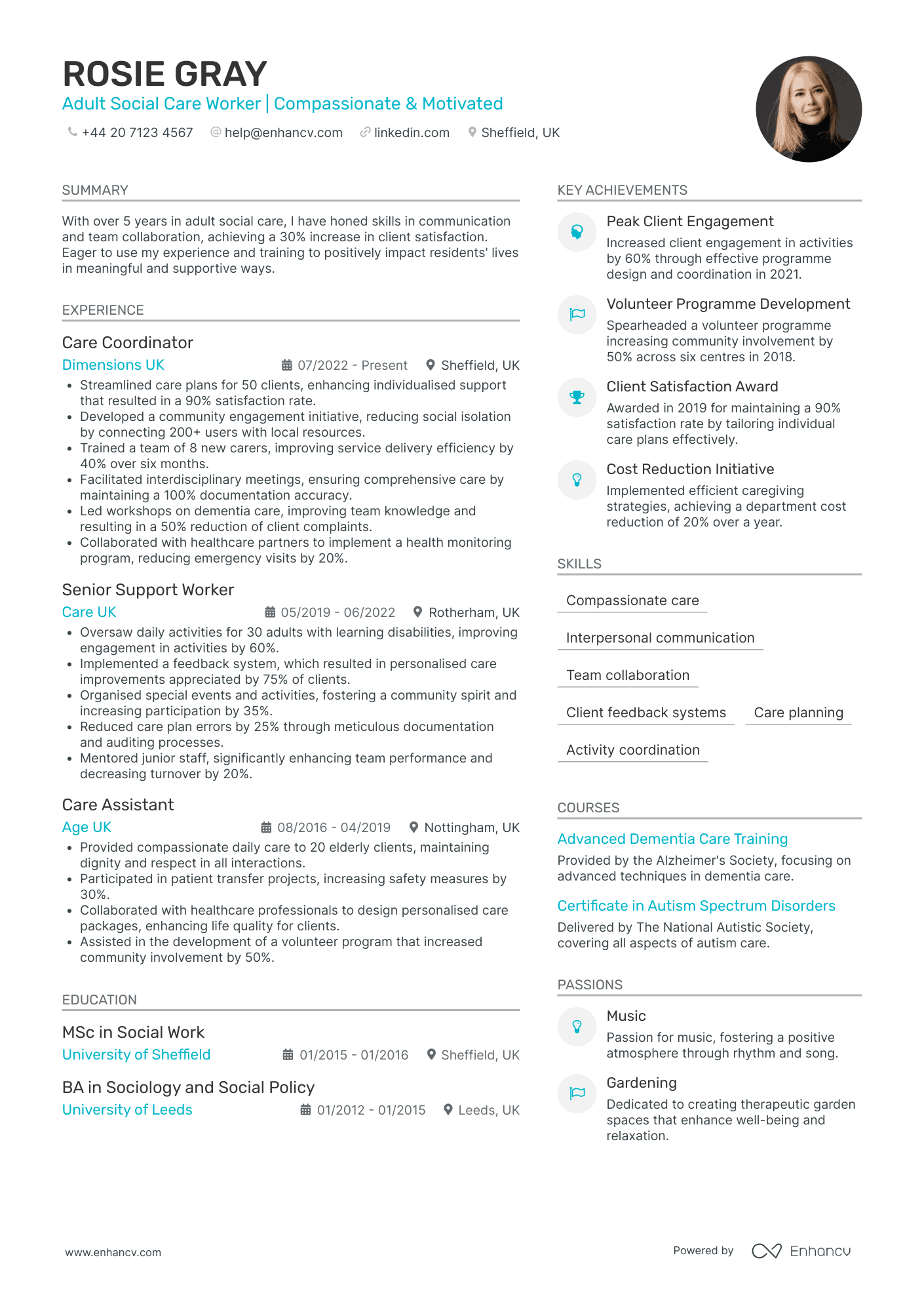
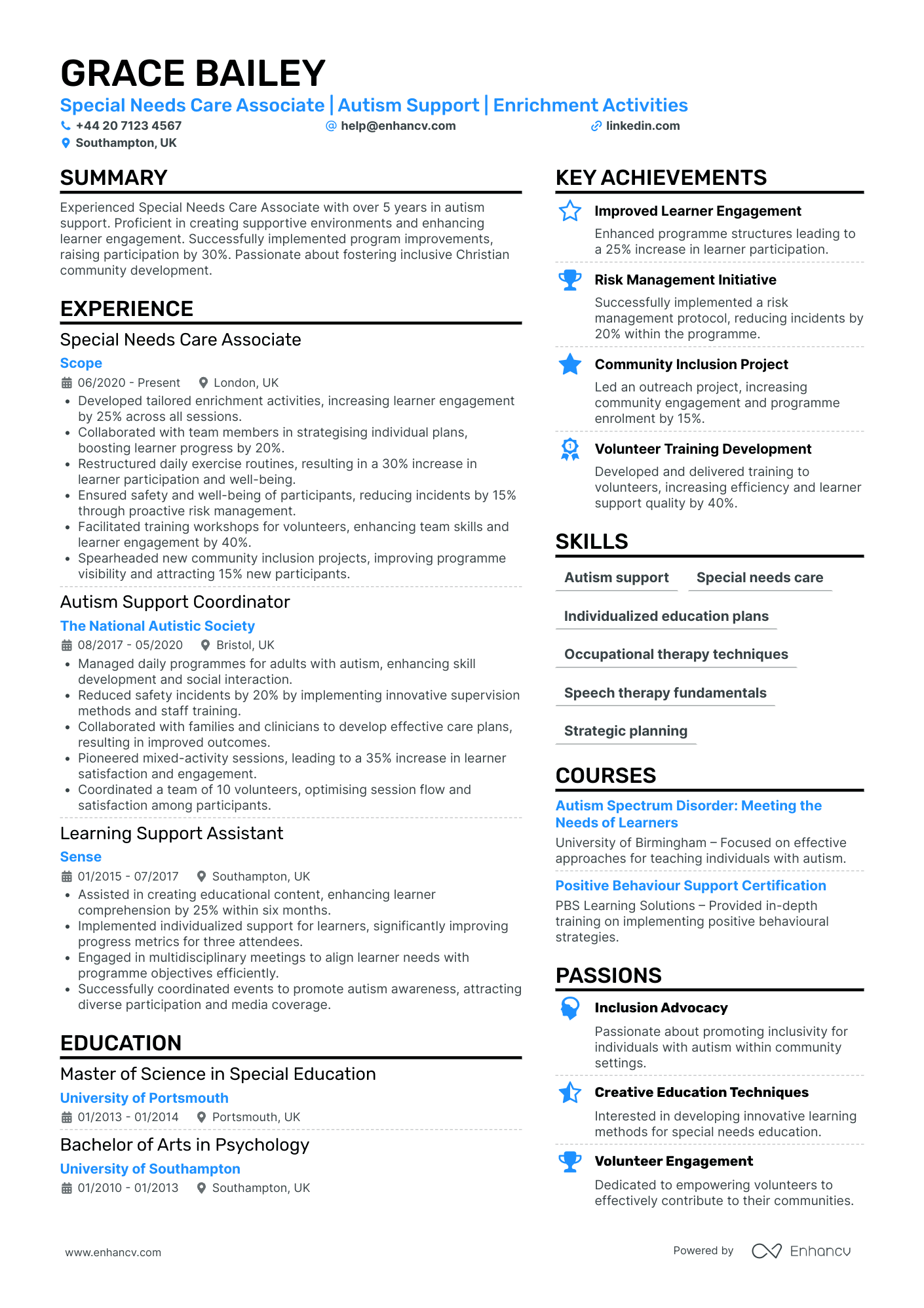
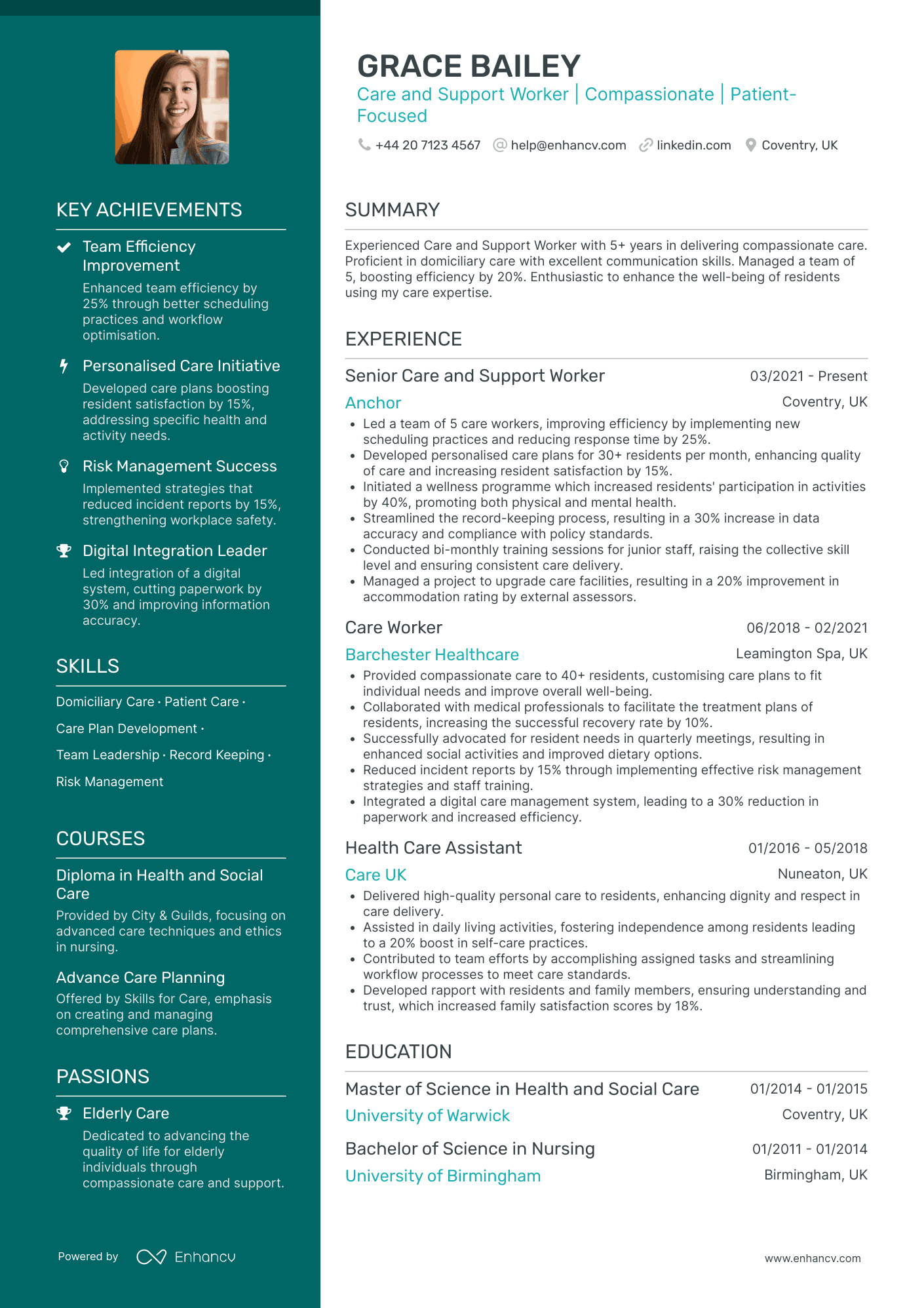
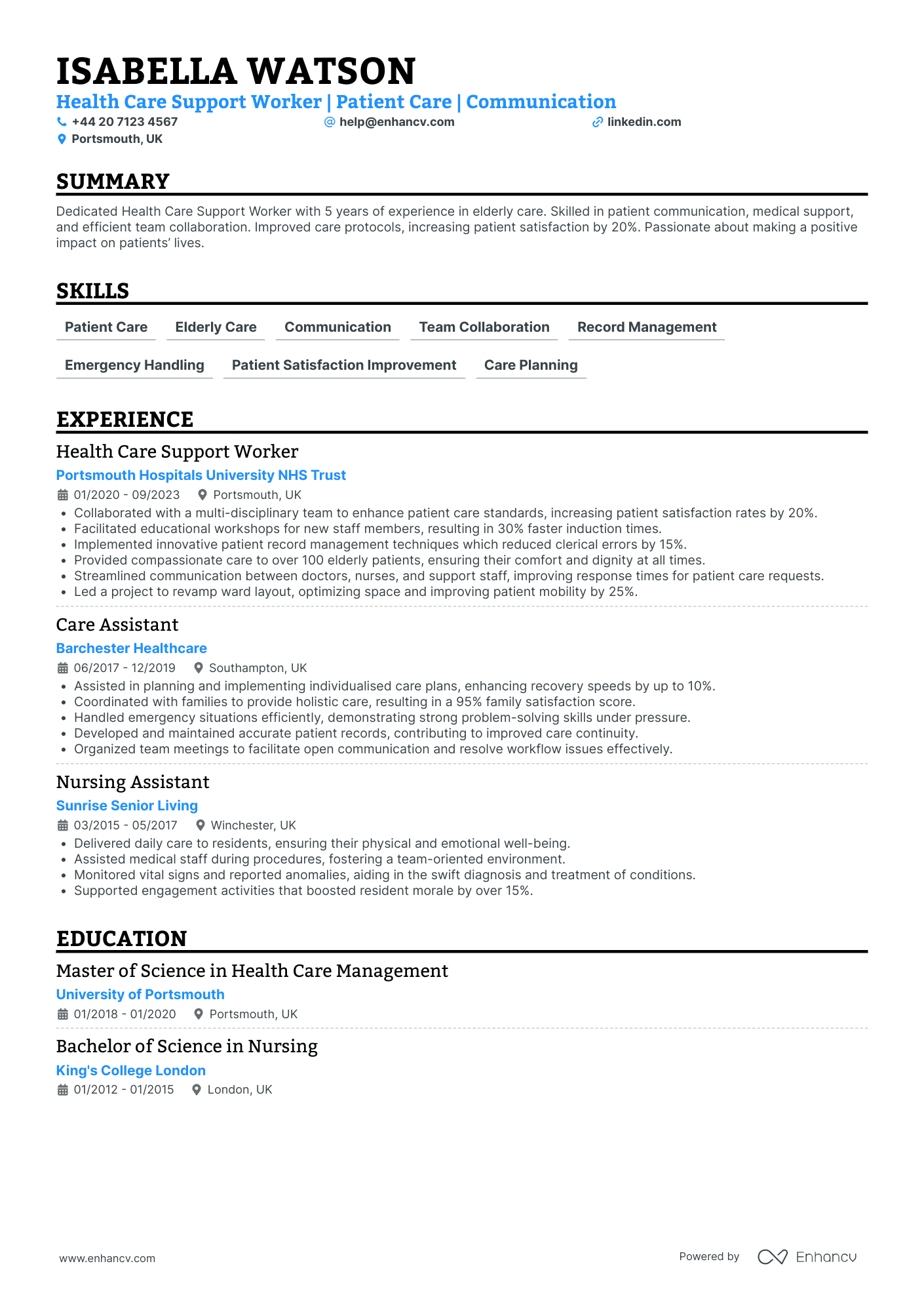
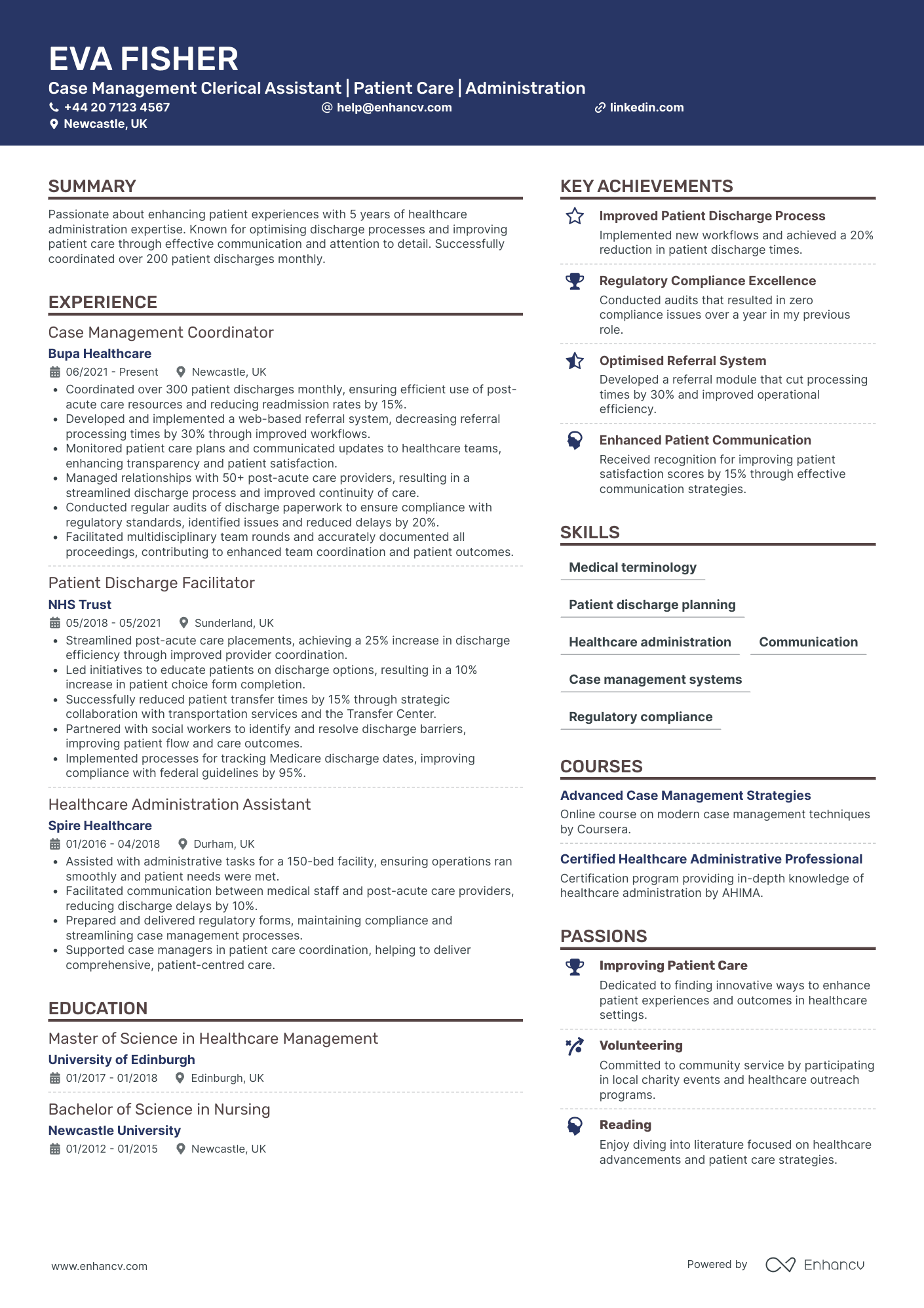
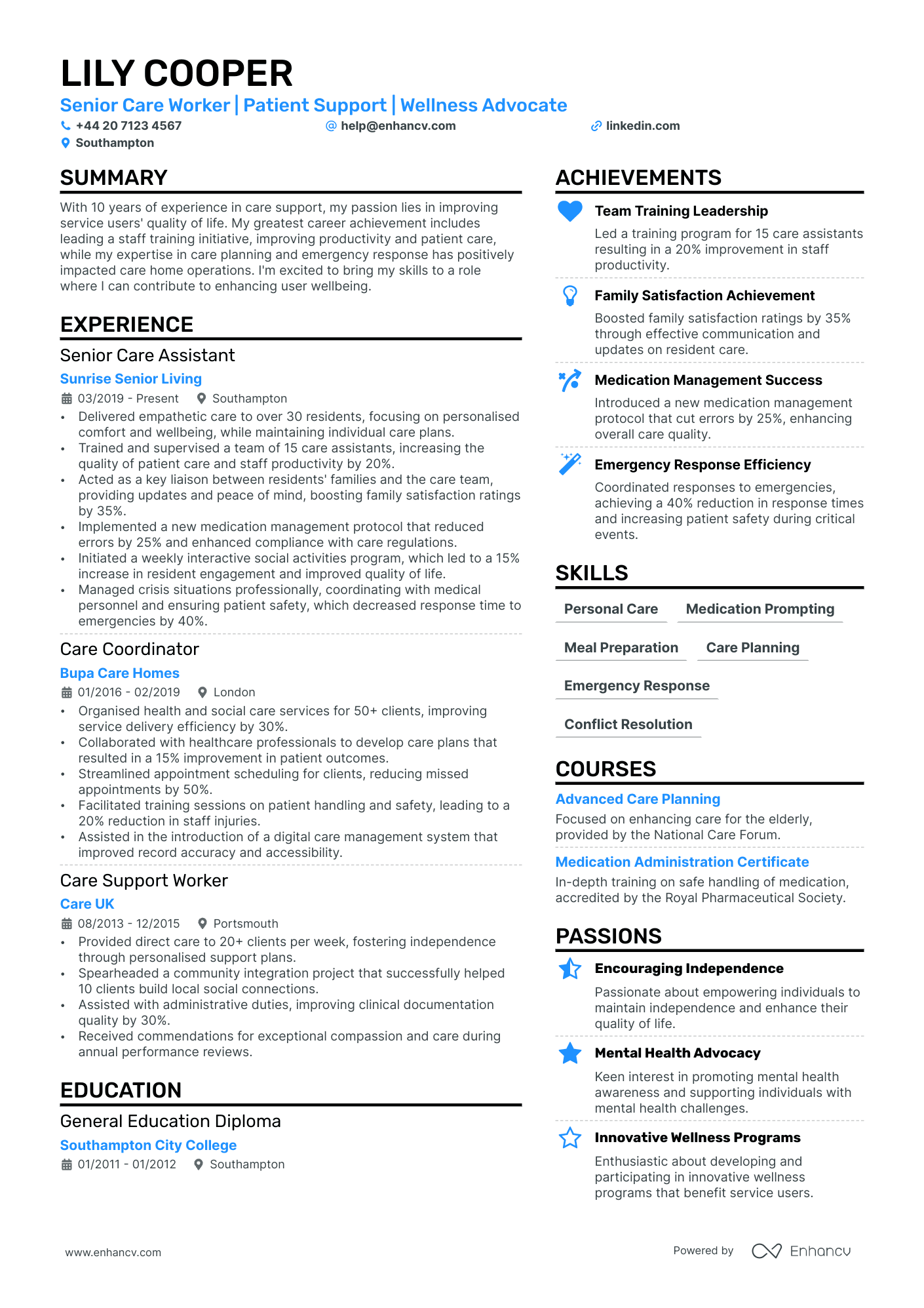
Care employers do not hire on warm words. They hire on evidence that you can keep a vulnerable person safe, clean, and well cared for from your very first shift.
Most care worker CVs bury that evidence under a generic profile and a duties list copied straight from the advert. The ones that get called back lead with the specific skills, and the specific training, that care managers actually screen for.

Key takeaways
- Lead with the skills care managers screen for: care planning, safeguarding, personal care, moving and handling, and medication support.
- Care work is almost entirely on-site, so put your town and travel radius near the top of the CV.
- Name the checks employers expect: an enhanced DBS, and in Scotland PVG scheme membership and SSSC registration.
- Prove every soft skill in a bullet. "Patient" on its own tells a recruiter nothing.
- Two pages, reverse chronological once you have care roles, sent as a PDF unless the advert asks for Word.
- Open with a short personal statement built on care values and one concrete example.
Top skills for your care worker CV
Ask what carer skills belong on a CV and the honest answer is short: the ones a care manager can check. Not adjectives, but the tasks and the training that keep people safe.
Read a run of live UK care adverts and the same demands repeat. Care planning, social care support, safeguarding, personal care, moving and handling, and medication support come up again and again. Those are your hard skills, written in the words the adverts use.
Across 110 UK care worker postings in the last ~30 days on Enhancv's internal job feed, care planning and social care support are the skills that recur most often, and in Scotland many roles also require PVG scheme membership and SSSC registration.
If you need a top five to anchor the skills section of a CV, use care planning, safeguarding, personal care, moving and handling, and communication. Add medication administration once you are trained to give it.
Evidence beats a list. Under personal care, name the settings you have worked in, whether that is residential, domiciliary, or supported living, and the client groups, from older adults and dementia to learning disabilities and end-of-life care. A recruiter reads a named specialism as competence.
Digital care planning is now a skill in its own right. If you have used a system like Nourish, PASS, or Person Centred Software, say so, because homes moving off paper want people who will not slow the handover down.
Record keeping earns its place as a hard skill too. Accurate daily notes, incident reports, fluid and food charts, and body-map records are the paper trail a regulator checks, and a care manager trusts the applicant who treats them as part of the job rather than an afterthought.
The soft skills that matter here are real and checkable: communication, compassion, patience, and teamwork. Prove each one in a bullet rather than claiming it. "Calmed an agitated resident at mealtimes and kept the routine on track" beats "excellent communicator".
List only what you can stand behind. If you have trained in a clinical task, name it exactly as the advert does. If you have not yet, put it under training in progress rather than skills.
Top skills for your care worker CV:
Care planning (incl. digital care systems)
Personal care
Medication administration
Safeguarding
Moving and handling
Infection control
Social care support
Record keeping
Communication
Compassion
Patience
Empathy
Teamwork
Reliability

PRO TIP
Put your background checks where a recruiter sees them fast. An enhanced DBS on the update service, and in Scotland current PVG scheme membership and SSSC registration, are the details that let a manager shortlist you without a follow-up email.
What the UK care worker market looks like
Knowing the market shapes the CV. Here is what the role pays and what employers actually ask for.
| What | UK care worker roles |
|---|---|
| Typical pay | £20,000 to £25,000 a year (National Careers Service, gov.uk) |
| Where the work happens | On-site (103 of 110 UK postings in the last ~30 days, Enhancv's internal job feed) |
| Experience level asked for | Entry 64%, mid 23%, senior 11% (of 110 postings) |
| Most-listed skills | Care planning, social care, PVG scheme membership, SSSC registration, support planning |
Two of those numbers should shape your CV.
Care work is almost entirely on-site, so a recruiter needs to see you can reliably get there. Put your town and a travel radius in the header, and mention a driving licence if you have one, because domiciliary rounds and split shifts depend on it.
Roughly two-thirds of postings are pitched at entry level, which is why a first care CV is a realistic application rather than a long shot. The pay reflects a sector that hires for attitude and trains for skill.
The duties care employers expect you to evidence
Adverts describe duties. A CV proves you can do them. The space between the two is where most care worker CVs lose the interview.
Five duties anchor almost every UK care role:
- Personal care: washing, dressing, toileting, and mobility support, always with dignity.
- Medication support: prompting, administering, and recording under the home's policy.
- Care planning: following and updating each person's plan, often in a digital care system.
- Health monitoring: spotting changes, logging observations, and escalating concerns.
- Companionship and safeguarding: keeping people socially engaged and free from harm.
The five duties above are the spine of the role, but the emphasis shifts with the setting. Domiciliary care leans on lone working and time management between visits, residential care on teamwork and clean handovers, and supported living on promoting independence rather than doing everything for the person.
Do not just list them. Turn each into a line that shows scale or outcome, like the number of people you supported, a shift pattern you held, or an incident you prevented. Then match the wording to each advert when you tailor your CV, pulling the duties straight from the job description on a CV wherever they are true of you.
Writing your care worker personal statement
Three or four sentences at the top: who you are, the care values you bring, the settings you have worked in, and what you want next. Keep it concrete. For more openings, see these CV personal statement examples.
Skip the adjective soup every other CV opens with. "Caring, compassionate and hard-working" tells a recruiter nothing they can check.
Here is the version that gets skimmed past: "Hard-working and caring individual seeking a rewarding role where I can make a difference." It could describe anyone applying for anything. Swap every adjective for a fact.
Lead with evidence instead:
Care worker CV personal statement example
Reliable care worker with four years supporting older adults in a residential home, including personal care, medication administration, and dementia support for up to 14 residents a shift. Trained in safeguarding and moving and handling, with an enhanced DBS on the update service. Looking to bring calm, person-centred care to a supported-living role near Manchester.
When I read a care worker CV, I look for one thing in the opening lines: evidence the person understands what the work actually involves. "Supported 14 residents through personal care and medication each shift" tells me more than a paragraph of adjectives. Name the setting, the tasks, and the scale, then add the training and the DBS. Specifics a manager can picture will always beat a polished statement with nothing behind it.
Writing your care worker experience section
Write every entry the same way, whether the role was paid, agency, or voluntary: a dated heading, then bullets that show what you did and what changed. Lead each bullet with a verb, and keep a list of action verbs for CV writing handy if you keep reaching for "helped" and "assisted". For the mechanics, see work experience on a CV.
Care work is measurable even when it does not feel like it. People supported, shifts covered, a complaint avoided, a care plan kept current, a medication record with no errors. Those details are your CV achievements.
You do not need a corporate metric to quantify care. "Cut a resident's falls by moving to hourly checks", "kept a full medication round on time across a 12-hour shift", or "trained two new starters on the digital care system" all read as outcomes a manager can weigh. One concrete number does more than a line of adjectives.
Tailor each application to the advert in front of you. Enhancv's CV tailoring feature reads the ad and suggests the matching edits, which saves rewriting from scratch each time.
- Support up to 14 residents each shift with personal care, mealtimes, and mobility, following each person's care plan
- Administer and record medication for 20+ residents under the home's policy, with no recorded errors in two years
- Log daily observations in the digital care system and escalate health changes to the senior on duty
- Praised by the care manager for calm, patient handling of residents living with dementia and their families
Agency and zero-hours work still counts. Group short assignments under one heading, name the sectors and settings, and total the hours so the pattern reads as steady rather than scattered.
If there are gaps, a line is enough. Care managers understand caring responsibilities and health breaks better than most, so a short, honest note beats an unexplained hole.
PRO TIP
Care adverts list clinical specifics, not soft-skill clouds. Mirror the ones you can back: "medication administration", "safeguarding", "personal care", "moving and handling", "catheter care". If you have been trained in it, name it exactly as the advert does.
Formatting your care worker CV
Once you have care roles behind you, use a reverse chronological CV so your most recent experience leads. Starting out, a skills-based CV puts values and training before a thin work history.
Keep it to two pages, one column, standard headings, and a readable font. Care managers skim fast between shifts.
Your header does the first job. Name, phone, email, town, and a travel radius or driving licence. Leave off your date of birth, a photo, and your full street address, because none of them help a UK care application and a photo can trip an ATS.
Send a PDF for direct applications so the layout holds. Keep a Word copy for agencies, which place a large share of care roles and reformat CVs into their own template. If the advert names a file type, follow it.
Care applications often pass through tracking software, so keep the layout clean and the headings standard for an ATS-friendly CV. Build it from a tested layout rather than a blank page. Enhancv's CV templates export to a clean PDF.
Writing a care worker CV with no experience
Care is one of the most entry-friendly fields in the UK, and roughly two-thirds of postings are pitched at entry level. Employers hire on values and trainability, then provide the clinical training once you start.
So your first CV carries its weight differently. Structure it so your strengths lead: personal statement, then a skills section and any care exposure, then education and training, with paid work history lower down.
Mine your life for real care evidence, because it is almost always there:
- Caring for a family member: personal care, medication reminders, appointments, and a daily routine.
- Volunteering in a care home, hospice, charity shop, or community group.
- Retail or hospitality: patience under pressure and a duty of care to vulnerable customers.
- Any role with vulnerable people: SEN support, childcare, first aid, or lifeguarding.
Write those in care language. "Supported my grandmother with daily personal care and medication for two years" is a care worker bullet that happened at home. If you have volunteered, give it a dated entry like a job, because volunteering on a CV counts as experience for this role.
One line moves a no-experience CV up the pile: "Care Certificate in progress" or "enrolled on an NVQ Level 2 in Health and Social Care". It signals you are already on the path.
Qualifications and training UK care employers check
You rarely need formal qualifications to start, which is why the no-experience route works. What employers do check is your willingness to complete mandatory training.
List these where you have them, even in progress: the Care Certificate (15 standards), an NVQ or Diploma Level 2 or 3 in Health and Social Care, and core training in safeguarding, moving and handling, medication, and basic life support. Put your qualifications on CV in the education section or a dedicated training block.
Do not wait for a course to finish before you claim it. "Care Certificate, 9 of 15 standards complete" is a stronger line than silence, and it tells a manager exactly where you are.
The background checks belong on the CV too. An enhanced DBS is a baseline expectation, and in Scotland PVG scheme membership and SSSC registration are often required before you start. Naming the certificates on a CV you already hold saves the employer a question.
Conclusion
Lead with the skills care managers screen for, prove each one in a bullet, and name the training and checks the role expects.
Keep the format clean and on-site-friendly, and pair the CV with a short cover letter that says why care. That is how you turn a care worker CV into interviews.

Author's take - the Enhancv team
When I read a care worker CV, I look for one thing in the opening lines: evidence the person understands what the work actually involves. "Supported 14 residents through personal care and medication each shift" tells me more than a paragraph of adjectives. Name the setting, the tasks, and the scale, then add the training and the DBS. Specifics a manager can picture will always beat a polished statement with nothing behind it.