



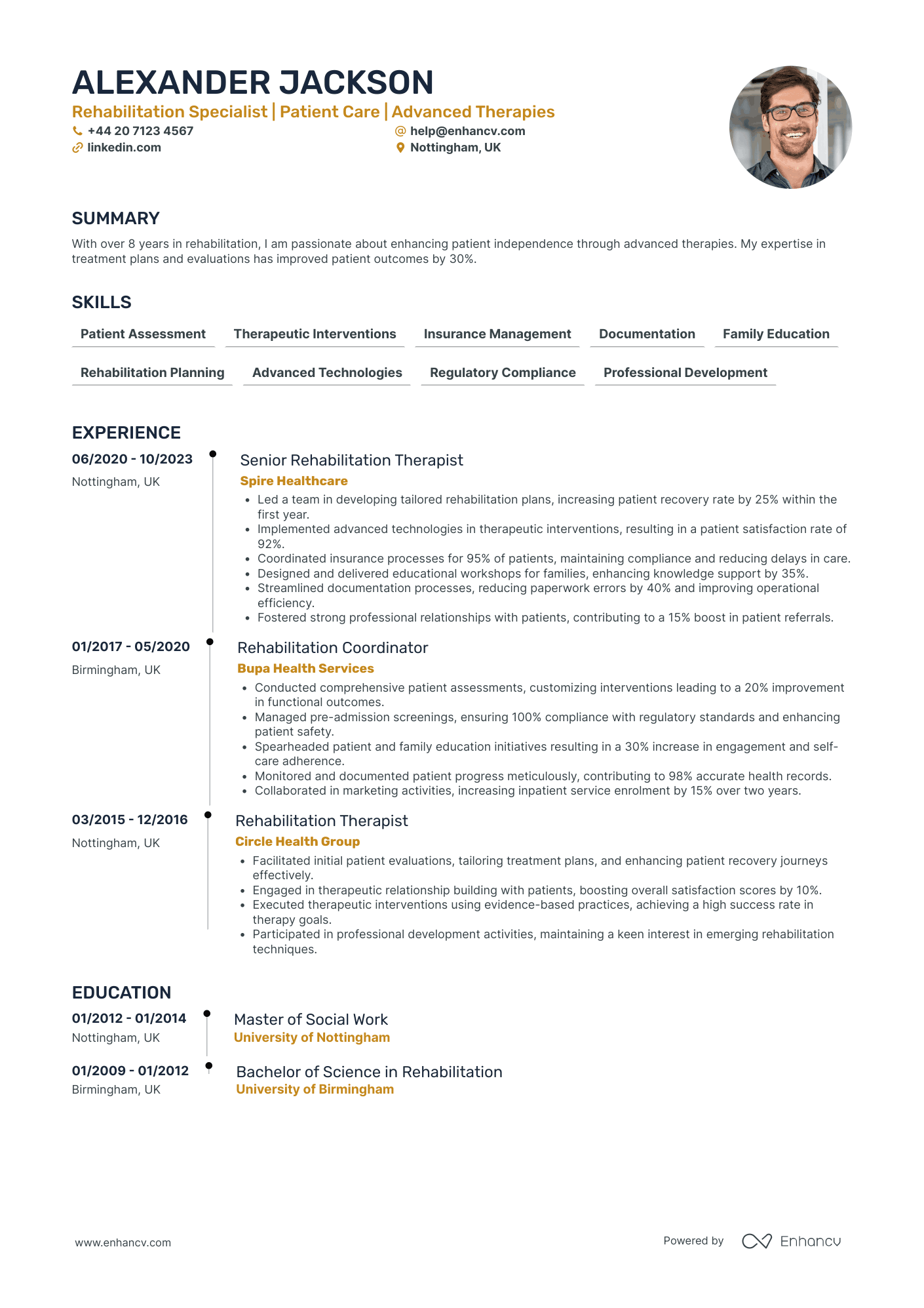
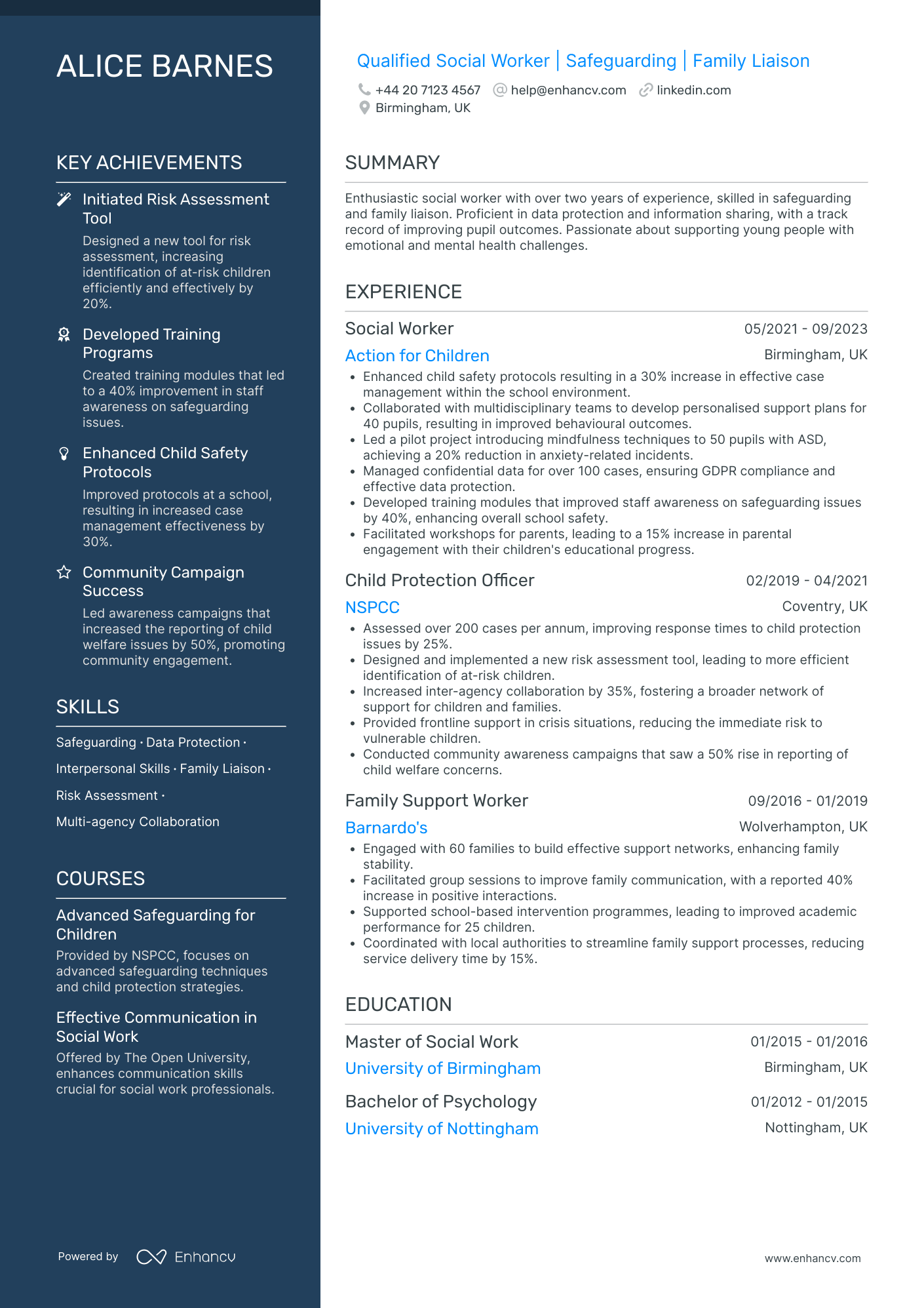
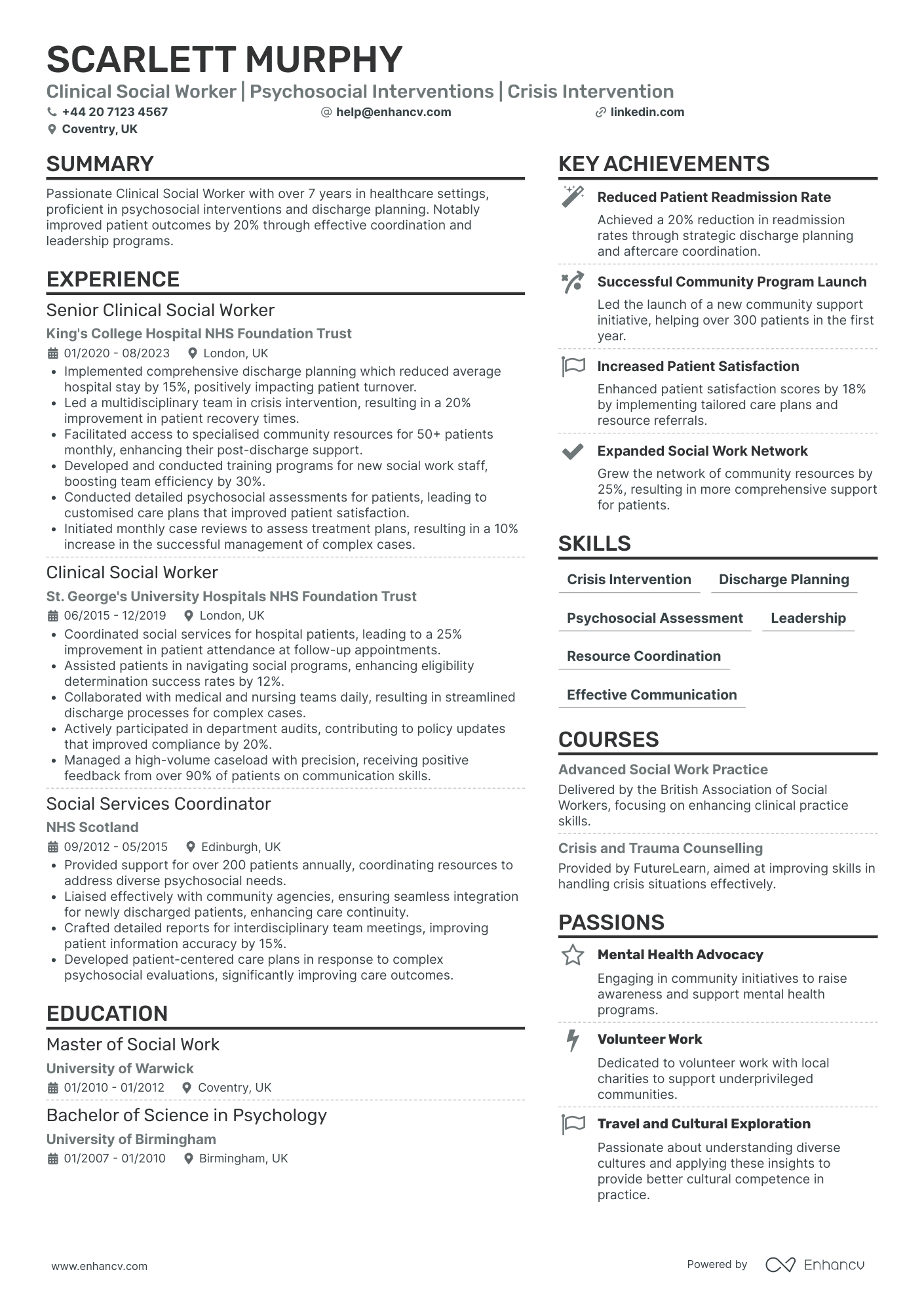
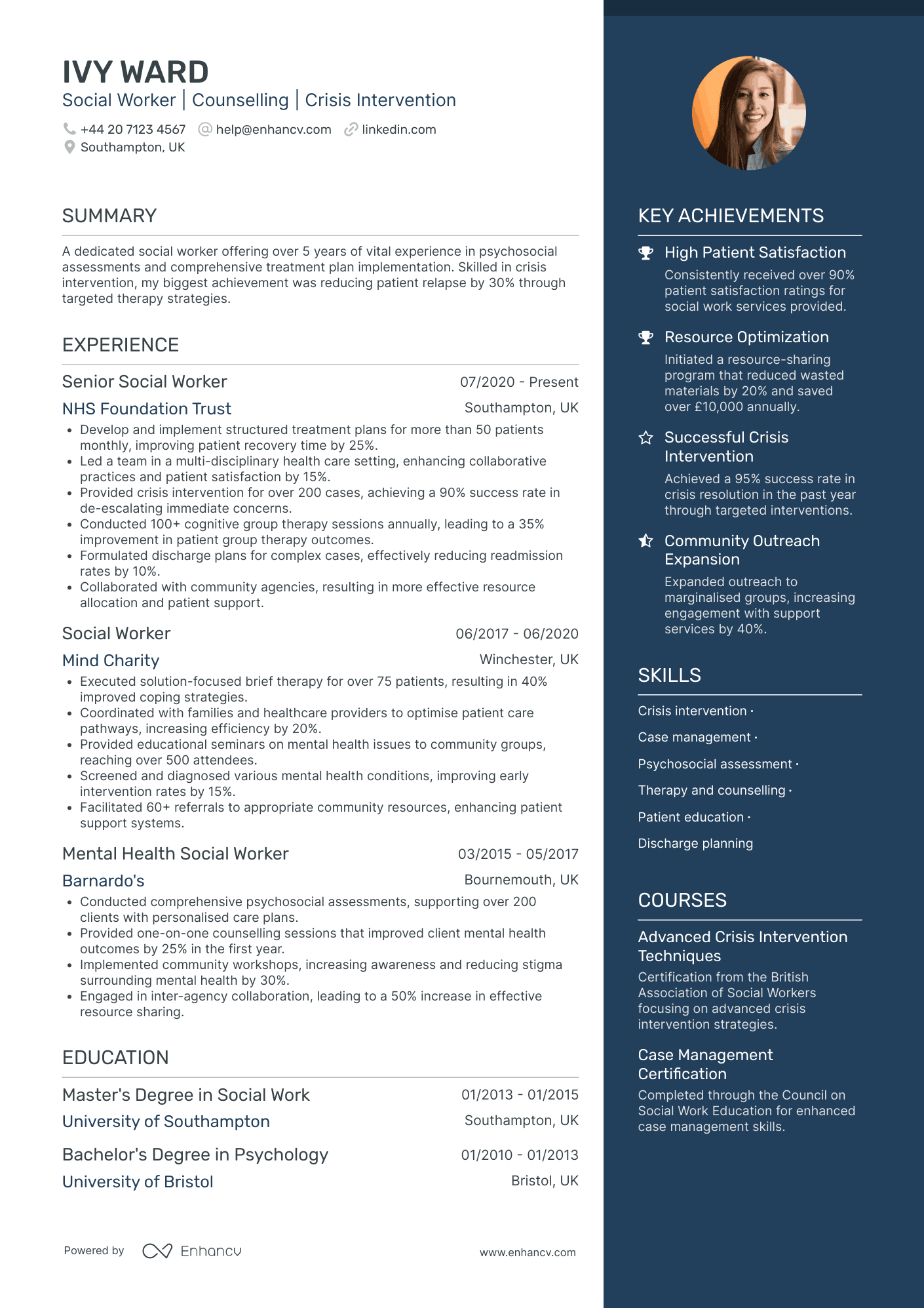
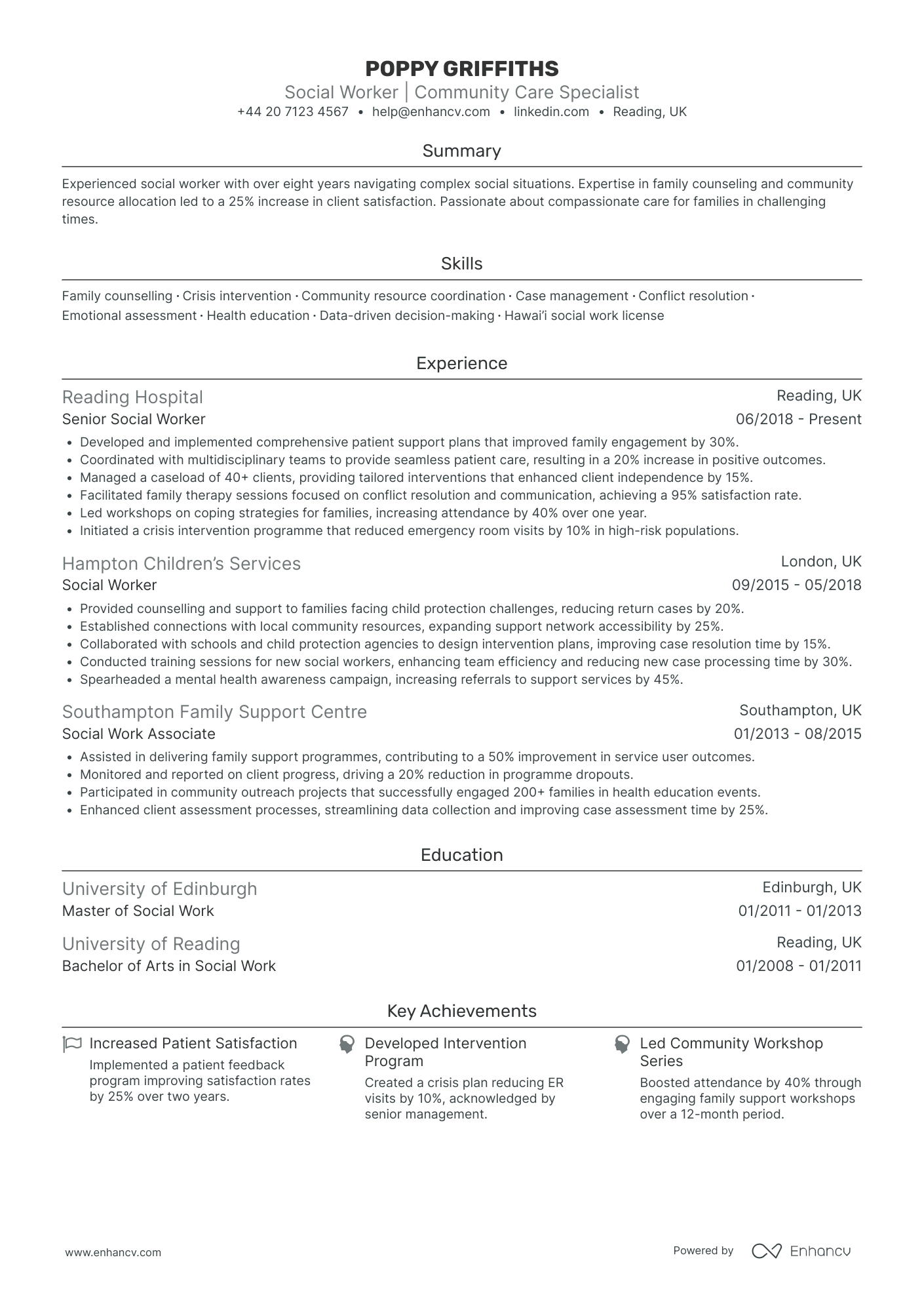
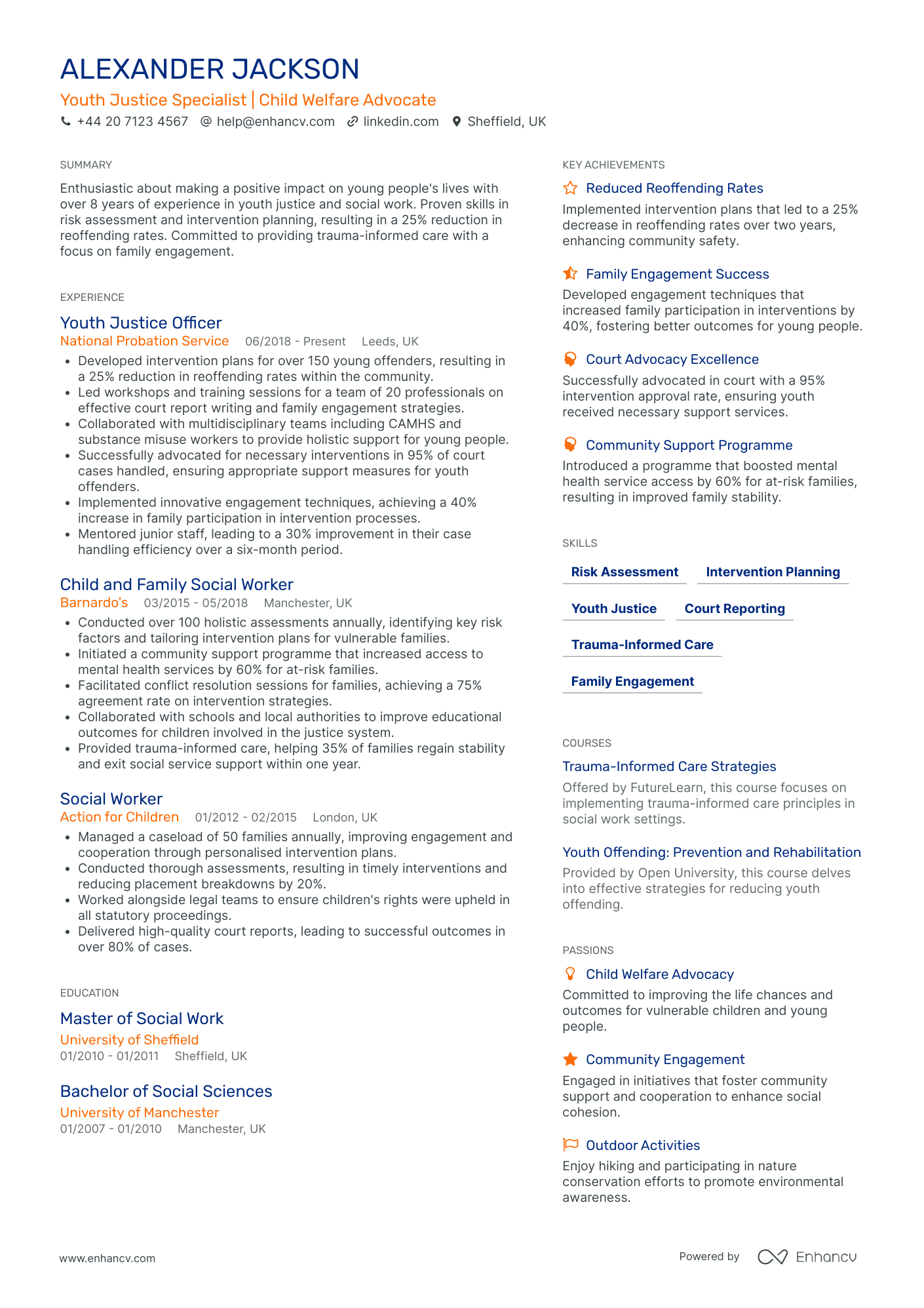
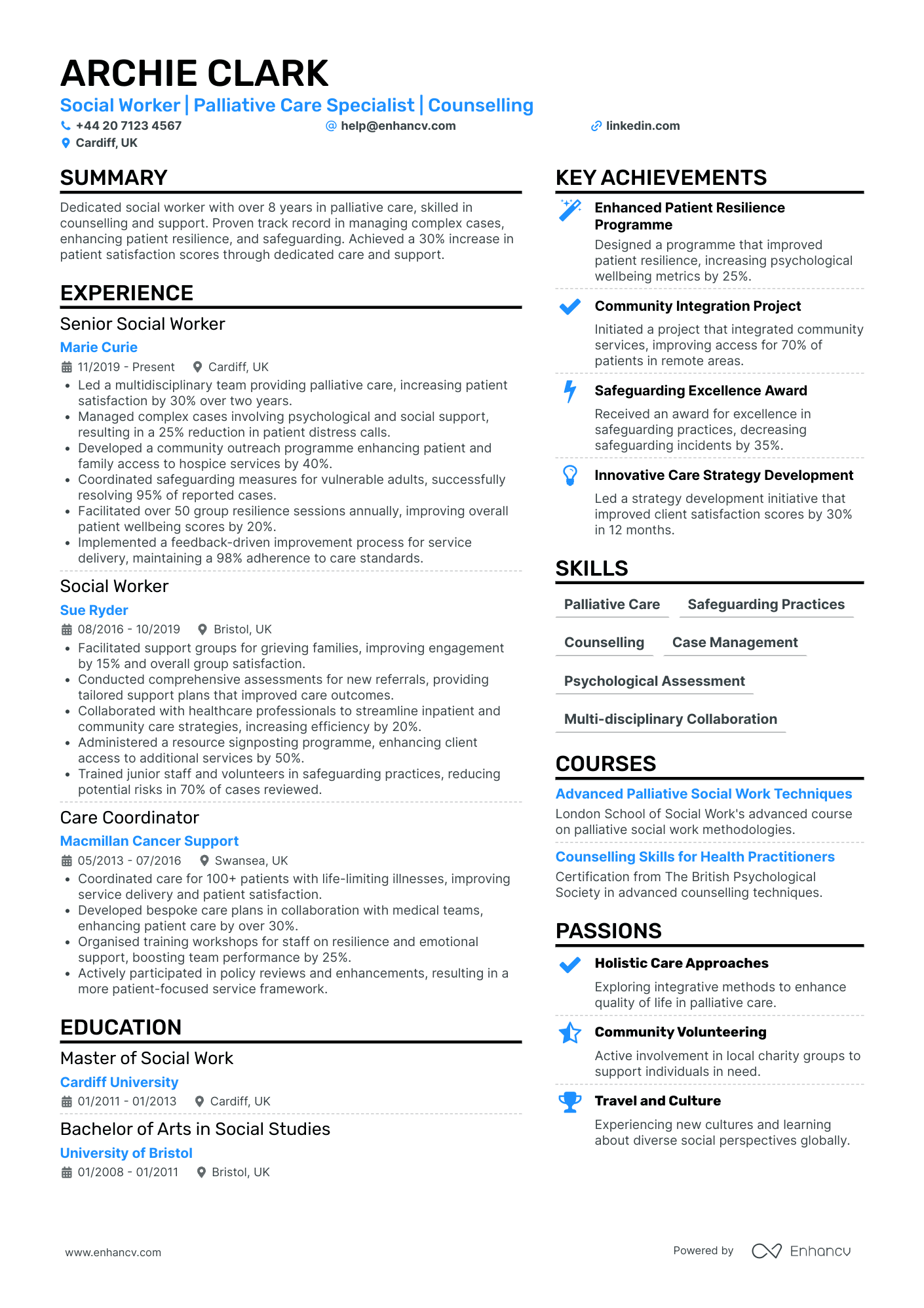
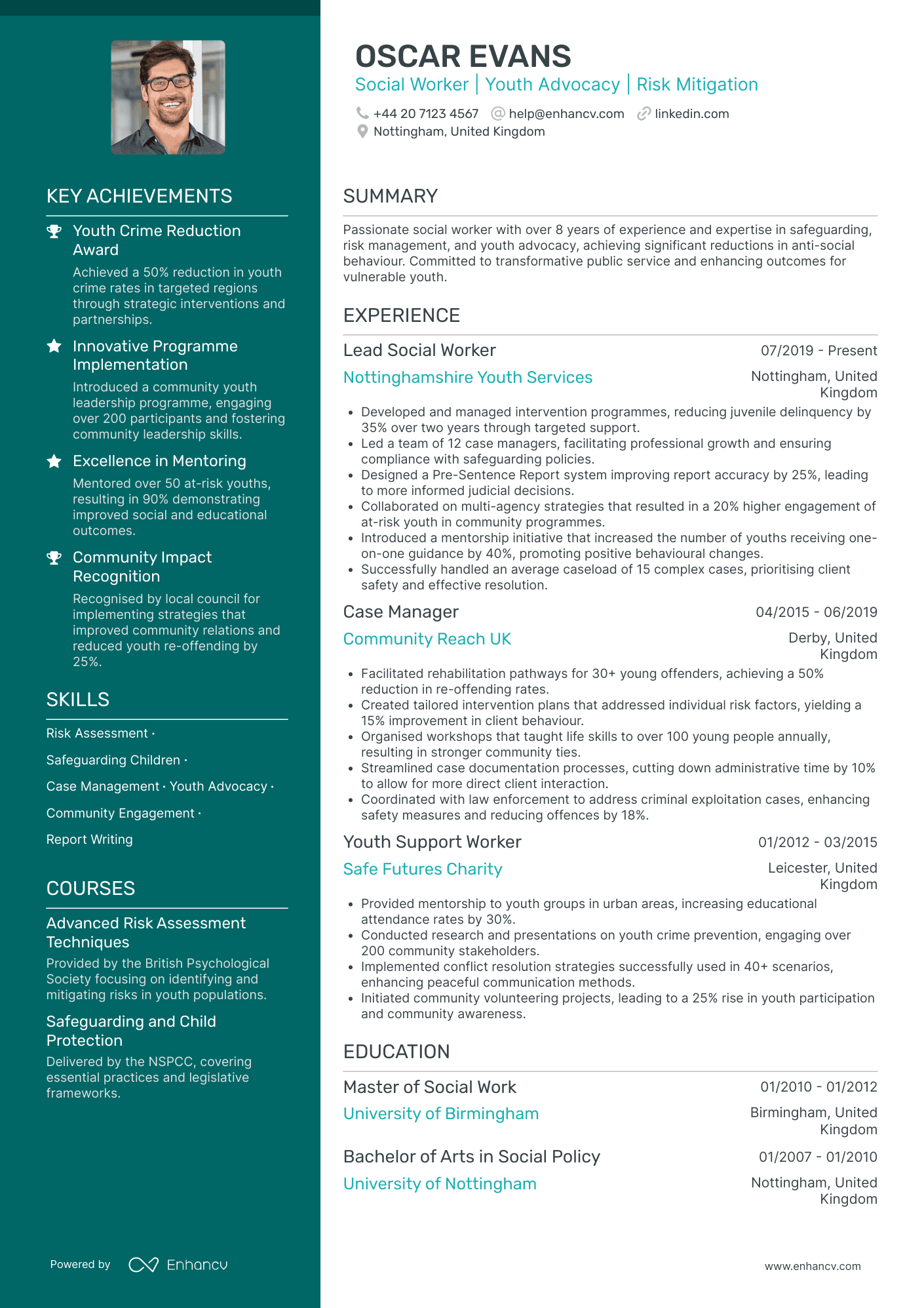
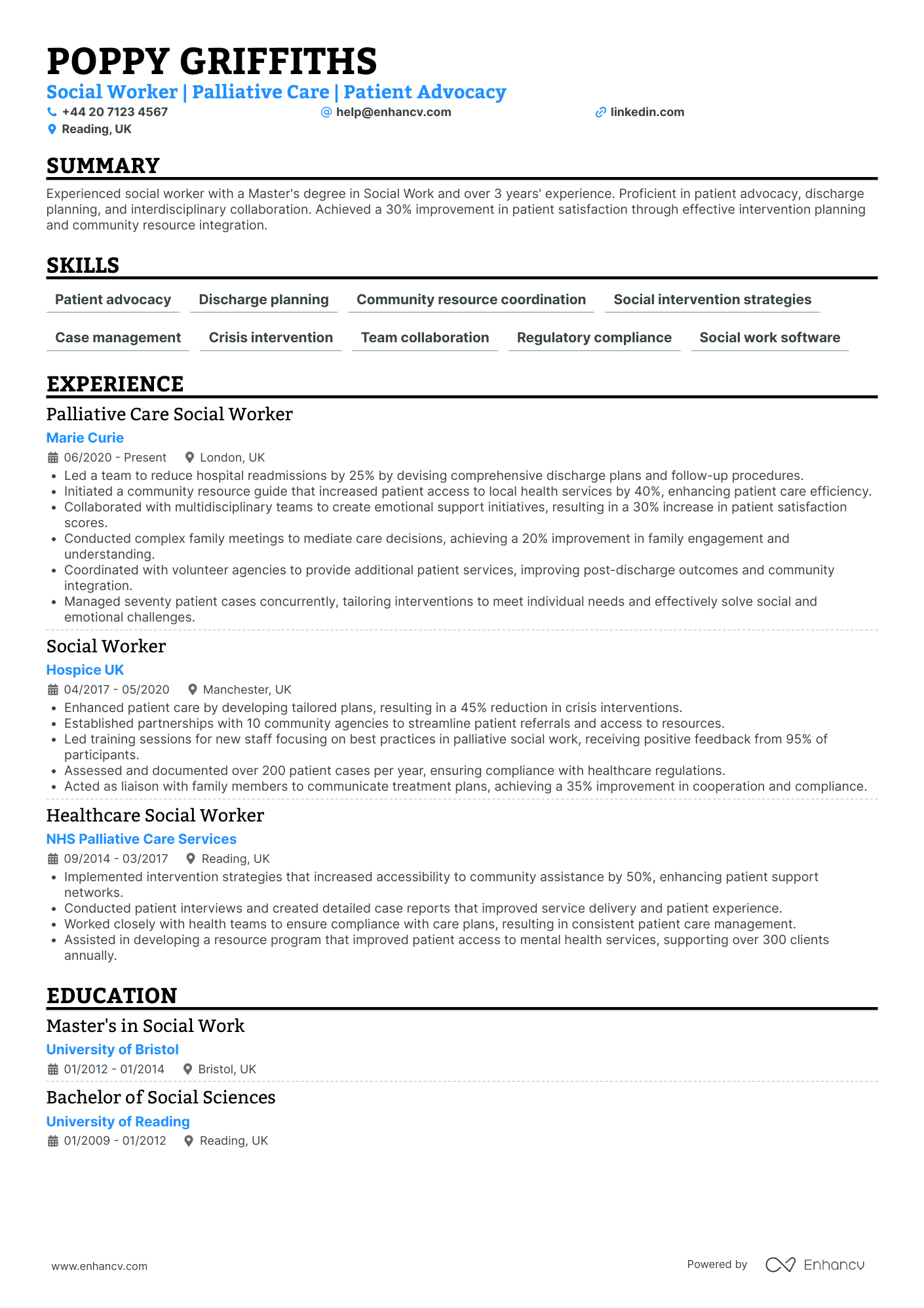
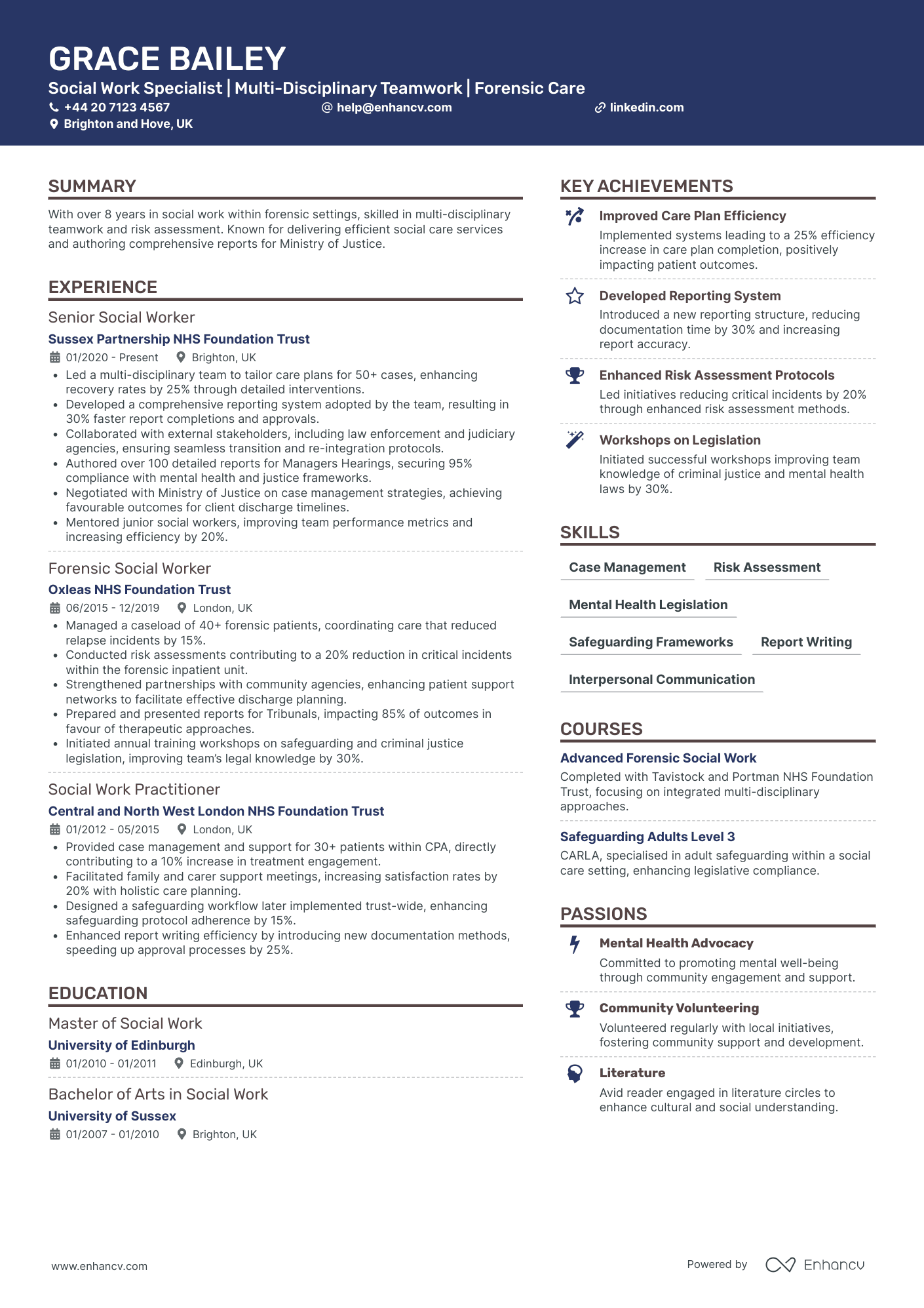
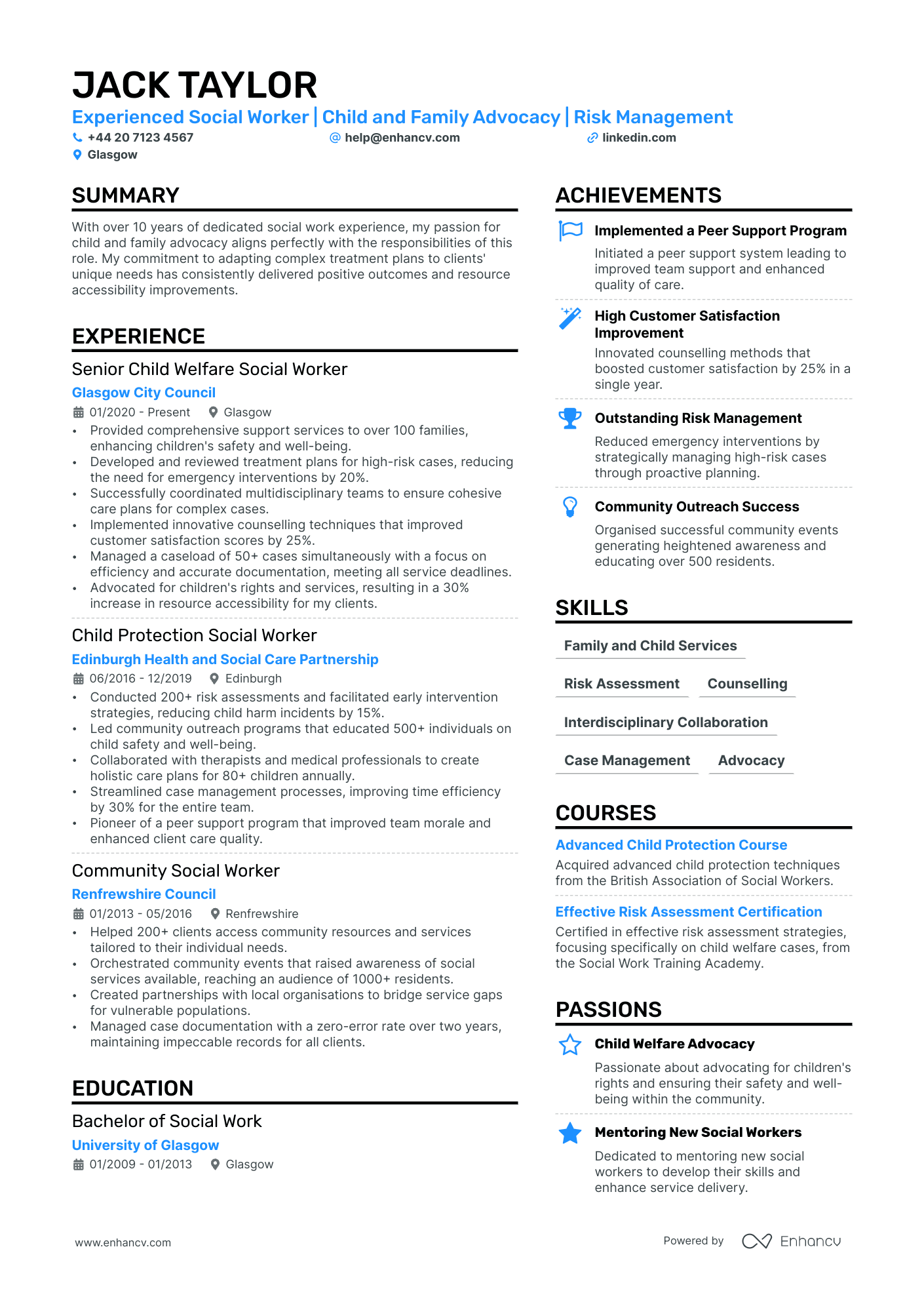
Most social work CVs read like a case file with the feeling taken out: a job title, a caseload number, and a list of duties the panel could have written itself.
The ones that get shortlisted mirror something specific back to the manager, the exact kind of social work they are hiring for. A children's safeguarding CV and an adult social care CV are not the same document, and the strongest applicants stop treating them as if they were.

Key takeaways
- Decide first whether you are writing a children's or an adult social work CV, then tailor every section to that specialism.
- Name your regulator and registration number near the top. Social Work England is the first thing a manager checks.
- Open with a personal statement built on a real case type, the statutory framework you work under, and one outcome.
- Mirror the words the adverts use: safeguarding, case management, risk assessment, child protection, and multi-agency working.
- Quantify caseloads, timescales, and outcomes. "Held a caseload of 20" beats "managed a busy caseload".
- Most social work roles are on-site or hybrid, so put your location and a driving licence near the top.
Children's versus adult social work: which CV are you writing?
This is the first decision, and it shapes everything below it. Managers recruit for a specialism, not for "a social worker", and your CV has to name yours in the first ten seconds.
Children's services work sits on the Children Act 1989 and 2004, Section 47 enquiries, child protection conferences, looked-after children, and the Public Law Outline. If that is your world, your CV should read in that language.
Adult social work sits on the Care Act 2014, the Mental Capacity Act 2005, Deprivation of Liberty Safeguards, and Section 42 safeguarding enquiries. An Approved Mental Health Professional adds the Mental Health Act 1983 on top.
The mistake is writing one neutral CV and sending it to both. A children's safeguarding team and an older people's hospital discharge team want different case types, different statutory knowledge, and different risks handled well.
Signal your track three ways: the job titles in your history, the frameworks you name, and the case examples you choose. "Chaired core groups for a child protection caseload of 18" places you instantly. So does "Completed Care Act assessments and led Section 42 enquiries in a hospital discharge team".
The two managers screen for different things. A children's team lead wants to see that you can hold risk on a live caseload, meet visit timescales, and stand up in court. An adult services manager wants capacity assessments done well, hospital discharges that do not break down, and safeguarding under the Care Act.
If you have worked across both, pick the one that matches the advert and lead with it, keeping the other as a shorter block lower down. A CV that tries to be equally strong in both usually reads as neither.
Moving between the two is common, and the trick is to reframe rather than relist. A children's worker applying to adults should translate risk assessment, safeguarding, and multi-agency working into the Care Act and Mental Capacity Act, and say plainly why the move makes sense. When in doubt, let how to tailor your CV guide the edits for each application.

PRO TIP
Name the statutory framework you actually work under, not just the client group. "Section 47 enquiries", "Care Act assessments", "Mental Capacity Act", "PLO", and "AMHP" tell a manager exactly what you can carry from day one. Vague phrasing like "supported vulnerable people" could mean almost anything.
What the UK social work market looks like
A few numbers should shape the CV before you write a word. Here is what UK social work postings ask for right now.
| What | UK social worker roles |
|---|---|
| Typical pay | £32,000 to £48,000 a year (National Careers Service, gov.uk) |
| Where the work happens | On-site 53% and hybrid 47% (197 and 176 of 375 UK postings in the last ~30 days, Enhancv's internal job feed) |
| Experience level asked for | Mid 71%, senior 14%, lead 9%, entry 6% |
| Most-listed skills | Social work, safeguarding, case management, risk assessment, child protection |
Two of those rows should shape your CV directly.
Social work is still done where the people are. Across 375 UK social worker postings in the last ~30 days on Enhancv's internal job feed, 53% were on-site and 47% hybrid, with remote roles almost non-existent. Put your town and a driving licence near the top so a manager knows you can reach the patch.
Most of those postings, 71%, were pitched at mid-level rather than entry. That rewards a CV showing a real caseload and statutory experience, and it is why newly qualified applicants need the dedicated approach further down.
Social work, safeguarding, and case management are the three demands that recur most often across those adverts, with risk assessment and child protection close behind. Mirror the ones that are true of you, in the words the adverts use.
Mid-level dominance also tells you what to leave off. A recruiter reading for a caseload-ready practitioner does not need three lines on your dissertation or a hobbies section. Give the space to statutory experience instead.
Formatting your social worker CV
Use a reverse chronological CV once you have social work roles behind you, so your most recent statutory experience sits at the top. Newly qualified applicants can lead with a skills-based CV instead.
Keep it to two pages, one column, standard headings, and a readable font. Shortlisting panels skim fast, often scoring each CV against a person specification.
Put your Social Work England registration number in the header or near the top. It is the first thing a manager checks, and leaving it off raises a question you do not want raised.
A PDF CV holds its layout for direct applications. Keep a Word copy for agencies, which place a large share of locum and interim social work roles and reformat CVs into their own template. If the advert names a file type, follow it.
Applications often pass through tracking software, so keep the layout clean and the headings standard for an ATS-friendly CV. Build it from a tested layout rather than a blank page: Enhancv's CV templates export to a clean PDF.
Is your resume good enough?
Drop your CV here or choose a file. PDF & DOCX only. Max 2MB file size.
Writing your social work personal statement
Four sentences at the top: who you are, your registration, the case types you carry, and the outcome you are known for. Keep it concrete and specialism-specific.
Avoid the adjective soup that opens most social work CVs. "Passionate, dedicated, hard-working social worker" tells a panel nothing it can score.
Lead with evidence instead:
Social worker CV personal statement example (children's services)
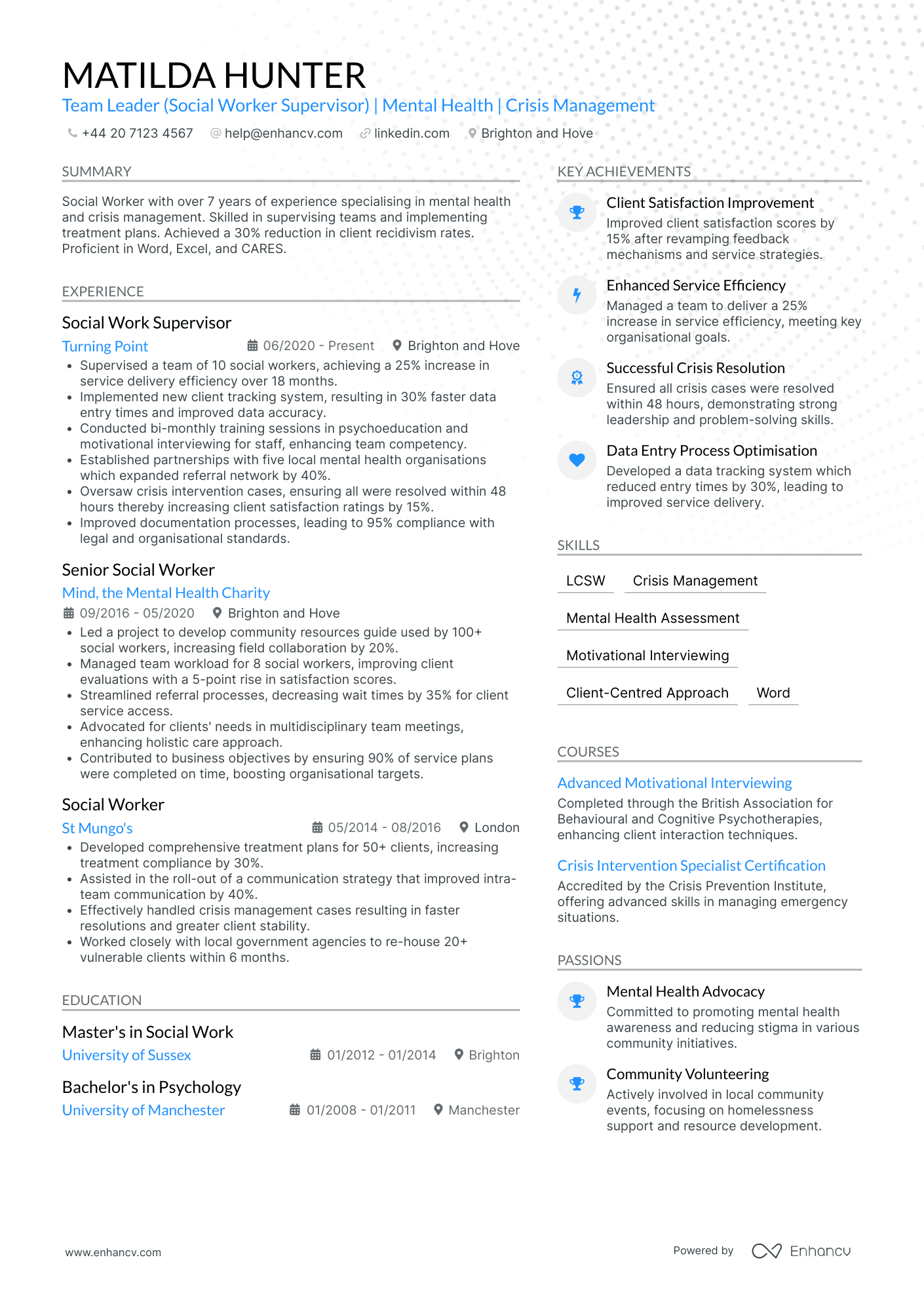
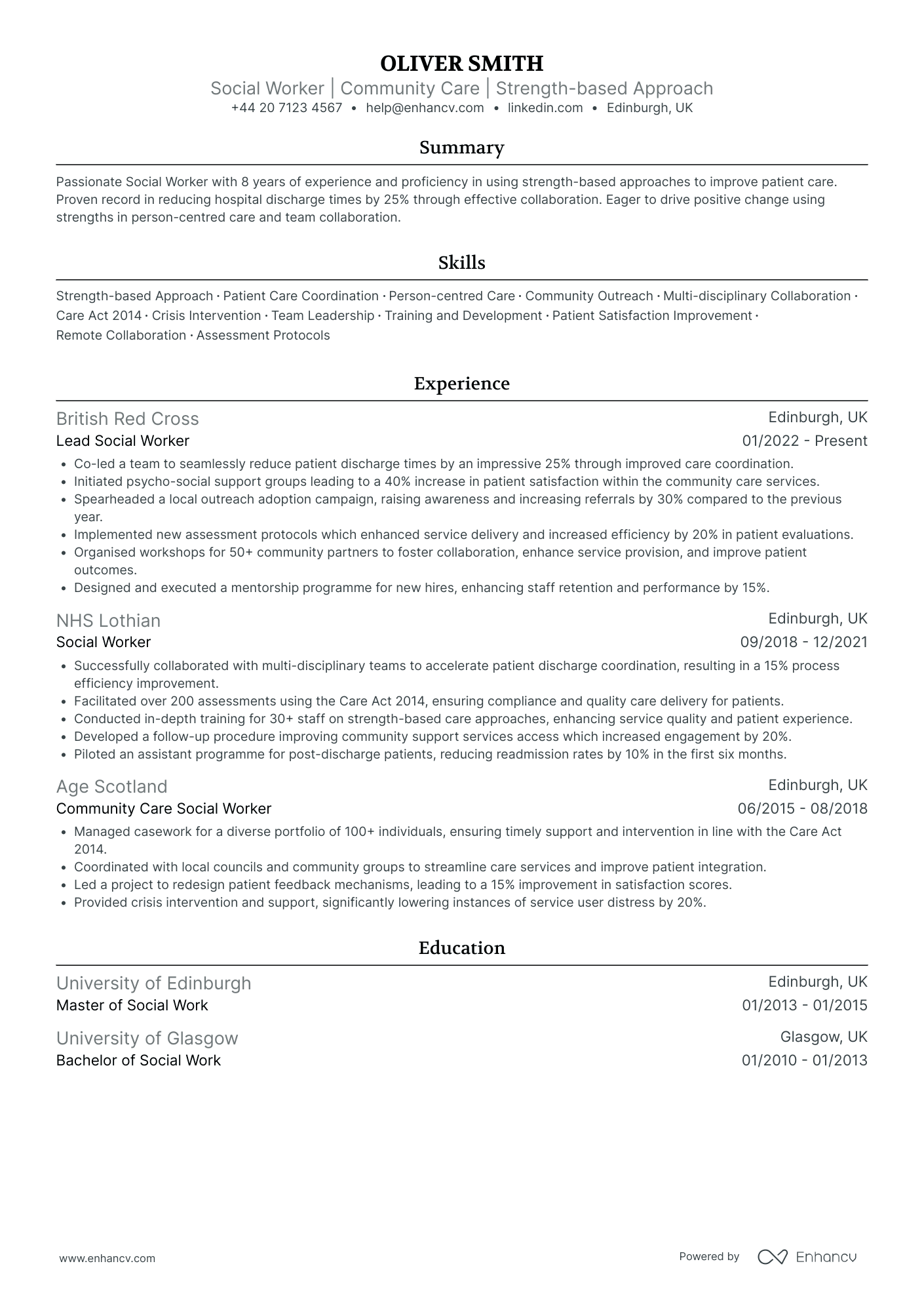
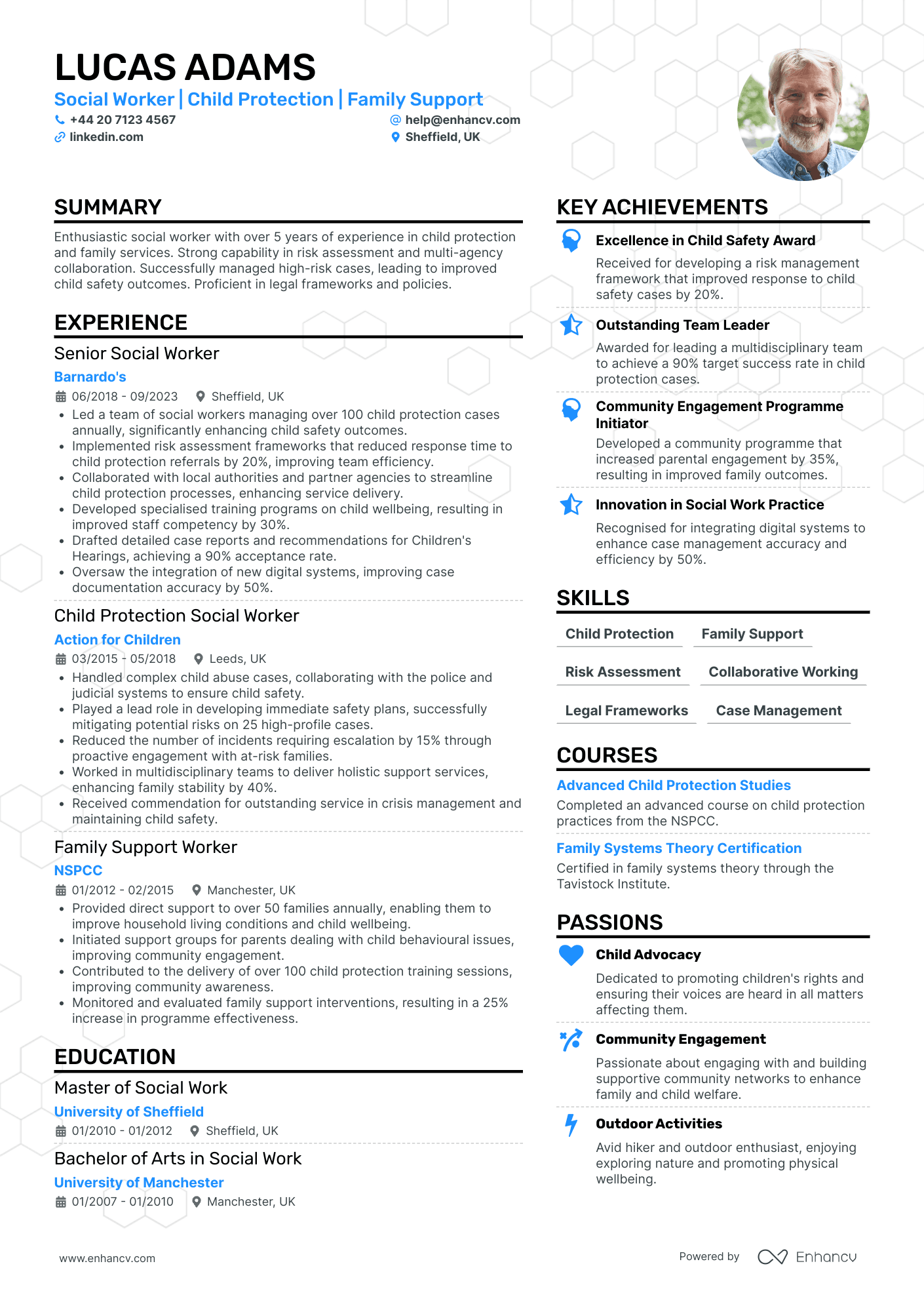
Social Work England registered social worker with four years in a children's safeguarding team, holding a caseload of up to 20 children on child protection and child in need plans. Experienced in Section 47 enquiries, chairing core groups, and writing court reports within PLO timescales. Looking to bring calm, evidence-led practice to a frontline safeguarding role across Greater Manchester.
Social worker CV personal statement example (adult services)
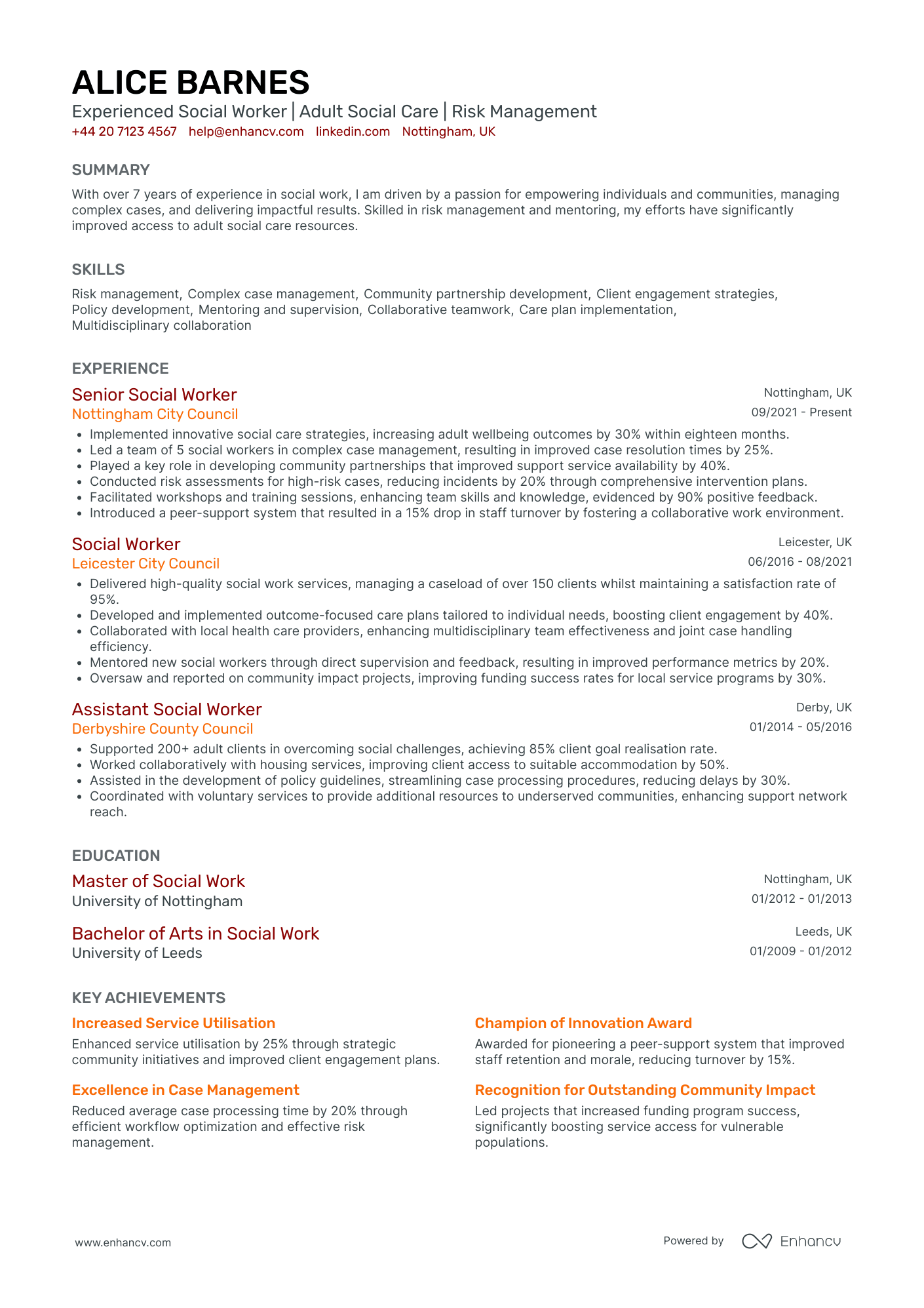
Social Work England registered social worker with six years in adult services, specialising in hospital discharge and mental health. Completes Care Act 2014 assessments and Section 42 safeguarding enquiries, and applies the Mental Capacity Act to complex discharge decisions. Looking to bring steady, person-centred practice to a community mental health team in Leeds.
Both open with the regulator, name the specialism, and put a real statutory task in the second line. That is what makes a manager read on.
Here is the version to avoid: "A caring and motivated social worker looking for a new challenge where I can make a difference and help vulnerable people." It could belong to anyone, in any team, in any decade.
See more CV personal statement examples if the opening line is where you stall.
When we read a social work personal statement, we are looking for one thing in the first two lines: the specialism and a real case type. "Held a child protection caseload of 18" or "led Care Act assessments on a hospital discharge team" tells a manager more than a paragraph of adjectives. Name the framework, name the caseload, name one outcome. That combination reads as someone who has done the job, not someone describing it.
Writing your social work experience section
Write each role the same way: a dated heading, then bullets that show the case, the action, and the outcome. Start each bullet with one of the CV action verbs managers scan for, and keep the statutory language visible. For the mechanics, see work experience on a CV.
Social work is more measurable than it feels. Caseload size, timescales met, panels chaired, assessments completed, and reviews held are all countable, and they are your CV achievements.
The strongest bullets pair a statutory action with a result. "Chaired child in need reviews for 15 families" is good. "Chaired child in need reviews for 15 families, cutting drift by closing plans on time" is better, because it shows judgement, not just activity.
Mirror the advert. Pull the frameworks and duties from the person specification and reflect the ones that are true of you. Enhancv's CV tailoring feature reads the advert and suggests the matching edits, which saves rewriting from scratch for every application.
- Hold a caseload of up to 20 children on child protection and child in need plans, meeting statutory visit timescales at over 95%
- Lead Section 47 enquiries and chair core groups, coordinating police, health, and education in multi-agency safeguarding
- Write court statements and PLO documentation, contributing to care proceedings for 12 children in the last year
- Cut a backlog of overdue assessments by 30% after redesigning the team's visit-tracking process
PRO TIP
Social work adverts list statutory specifics, not soft-skill clouds. Mirror the ones you can back: "Section 47", "Care Act assessments", "Mental Capacity Act", "court report writing", "multi-agency working". If you have done it, name it the way the person specification does.
Skills to put on a social worker CV
Read a dozen live social work adverts and the same demands repeat, and they are statutory, not generic. Safeguarding, case management, risk assessment, child protection, and multi-agency working come up again and again. Those are your hard skills, listed in the words the adverts use.
The soft skills that matter here are real and checkable: communication, professional judgement, resilience, and reflective practice. Prove each one in a bullet rather than just claiming it.
List only what you can stand behind under supervision or in a panel. If you have practised it, name it. If you have only observed it, keep it out of the skills block.
Top skills for your social worker CV:
Safeguarding
Risk assessment
Case management
Child protection
Care Act 2014 assessments
Section 47 enquiries
Multi-agency working
Court report writing
Communication
Professional judgement
Resilience
Reflective practice
Empathy
Registration, qualifications, and training for social workers
Registration is not optional, and it belongs on the CV. Social workers in England register with Social Work England, and the equivalent bodies are Social Care Wales, the Scottish Social Services Council, and the Northern Ireland Social Care Council.
List your qualifying degree, a BA or MA in Social Work or the social work apprenticeship route, with the classification and dates. Add your registration number so a manager can verify it in seconds, and record it alongside your education section on a CV.
Name the training that maps to the role: safeguarding levels, the Mental Capacity Act, court skills, Signs of Safety, or AMHP and Practice Educator status where you hold it. These are the certificates on a CV a panel actually looks for.
Keep your continuing professional development current, since Social Work England requires it for renewal, and a recent, relevant course signals you are still sharp.
If you hold a post-qualifying award, name it. A Practice Educator qualification, Best Interests Assessor training, or AMHP status tells a manager you can take on responsibility beyond a standard caseload, and each maps to a specific set of roles worth targeting.
Writing a newly qualified social worker CV
A newly qualified social worker CV carries its weight differently, because you are competing for the mid-level roles that make up most of the market with less time in post.
Lead with a skills-led structure: personal statement, then your specialism and practice placements, then your degree, with any earlier work history lower down.
Treat your final placement like a job. Give it a dated heading, the setting, your caseload under supervision, and the statutory work you were part of. A 70-day children's services placement with real case examples beats a vague line about "gaining experience".
Name your ASYE if you are on it or ready for it. The Assessed and Supported Year in Employment is what many newly qualified roles are built around, and saying you are prepared for it answers the manager's main question.
Keep the personal statement honest about where you are. "Newly qualified children's social worker, Social Work England registered, with a final placement in a busy safeguarding team" is stronger than borrowed confidence, because it matches what the references will say.
Draw on relevant experience from before you qualified too. Support work, youth work, and volunteering on a CV with vulnerable people all count as evidence, not filler. See CV examples for first job for the mechanics of a lighter history.
Conclusion
Decide which social work you are applying for, then make every section prove it: the specialism, the statutory frameworks, the caseload, and the outcomes.
Pair the CV with a short cover letter that says why this team and this local authority, and a strong practitioner becomes an obvious shortlist.

Author's take - The Enhancv team
When we read a social work personal statement, we are looking for one thing in the first two lines: the specialism and a real case type. "Held a child protection caseload of 18" or "led Care Act assessments on a hospital discharge team" tells a manager more than a paragraph of adjectives. Name the framework, name the caseload, name one outcome. That combination reads as someone who has done the job, not someone describing it.