



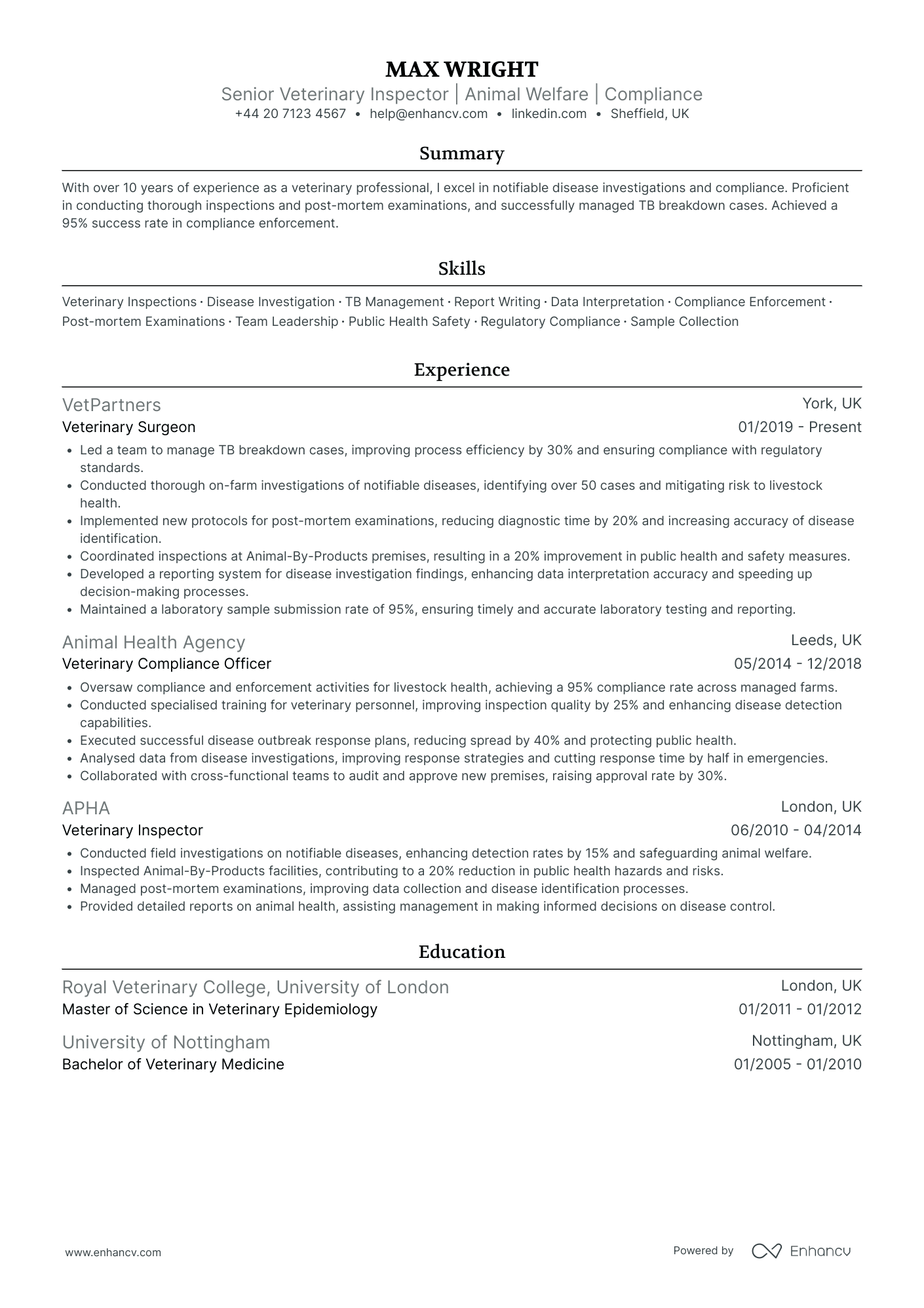
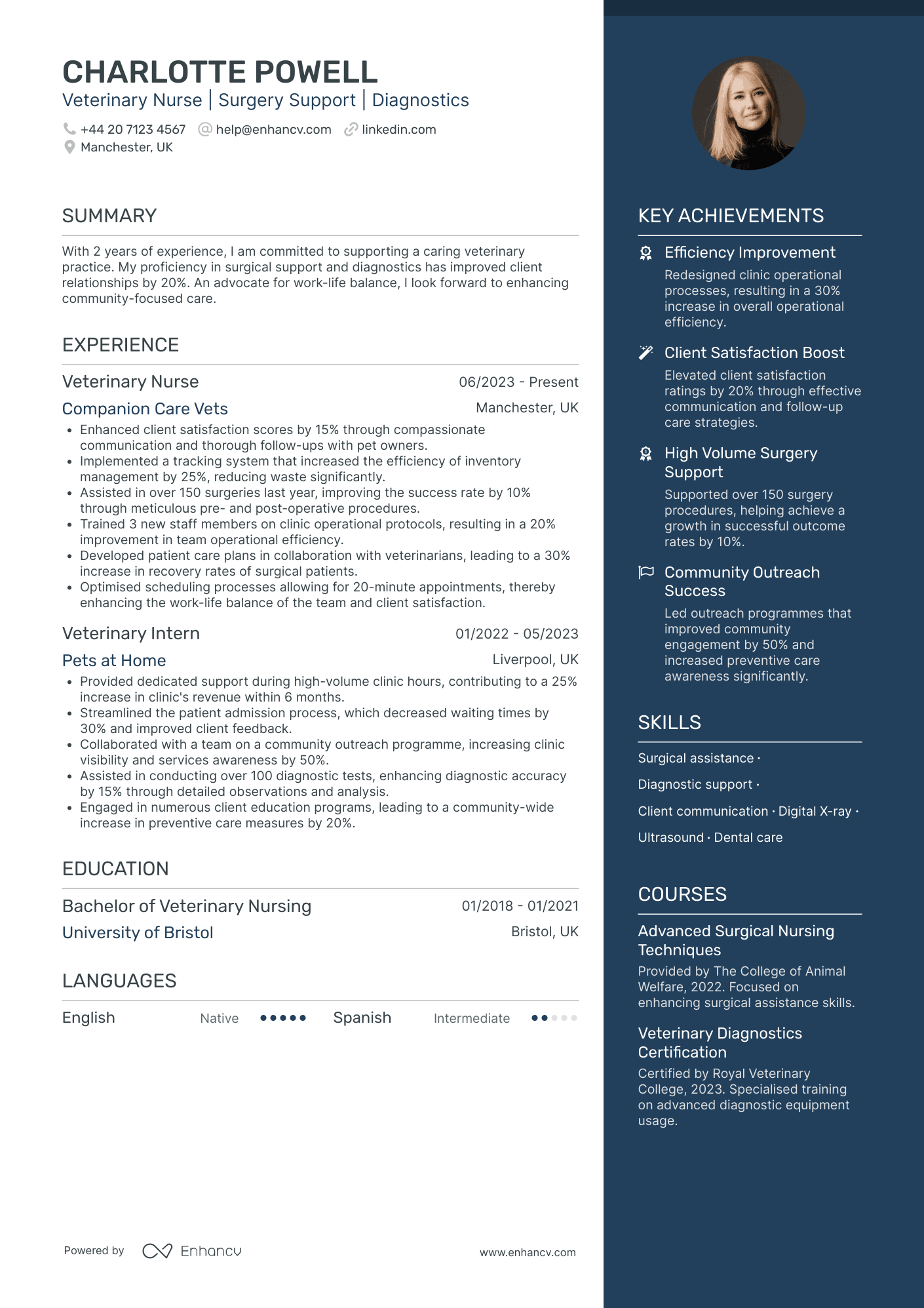
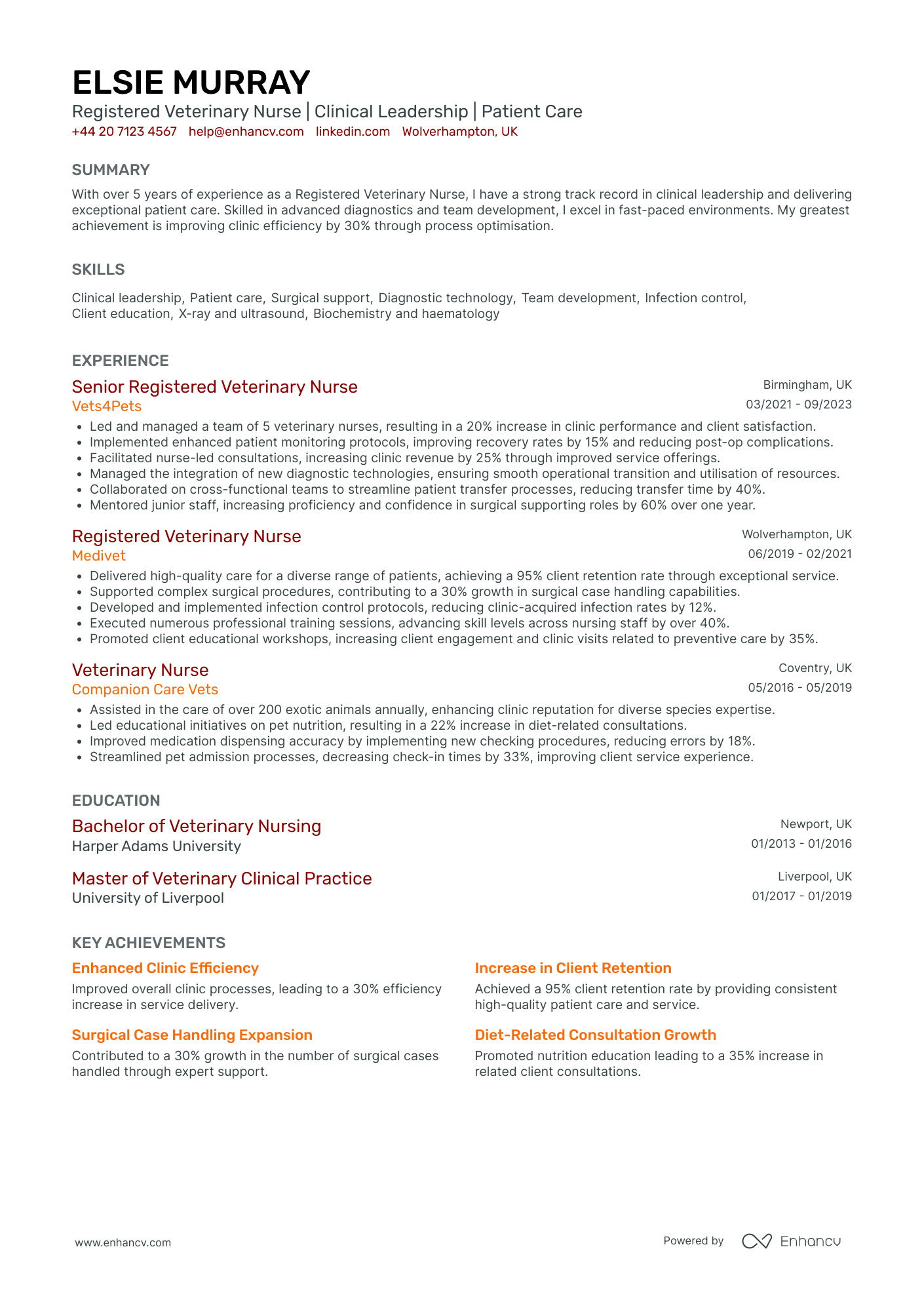
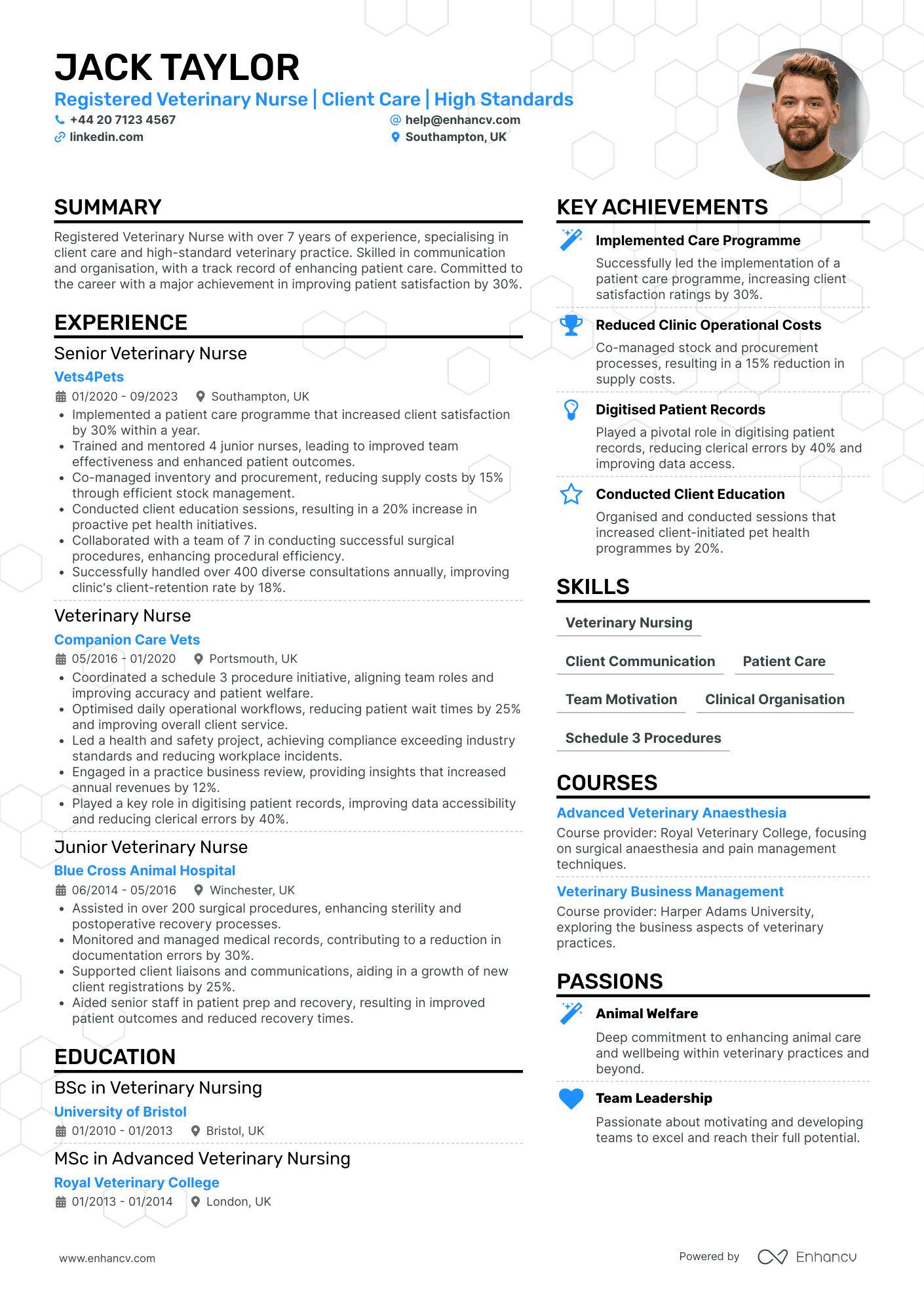
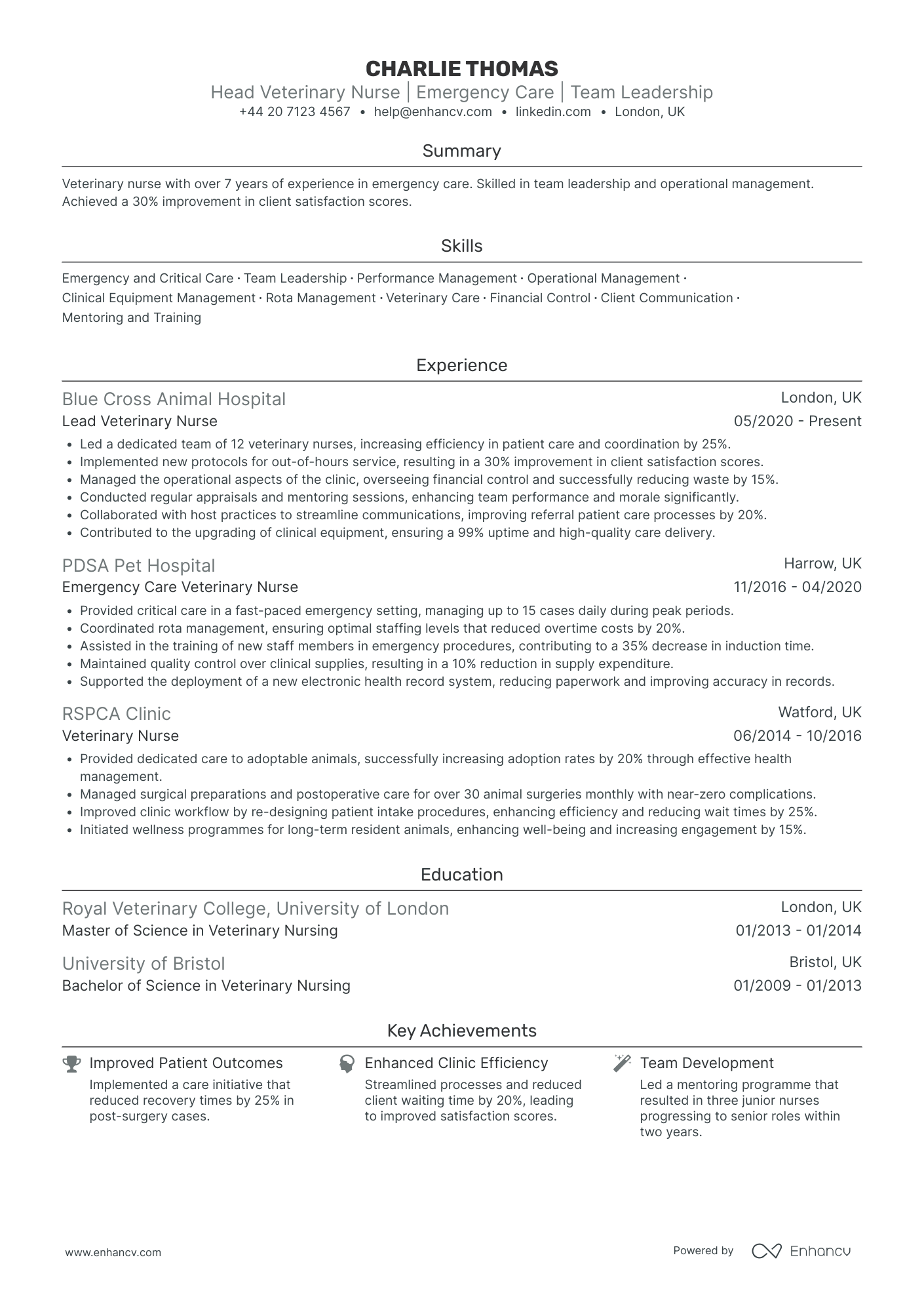
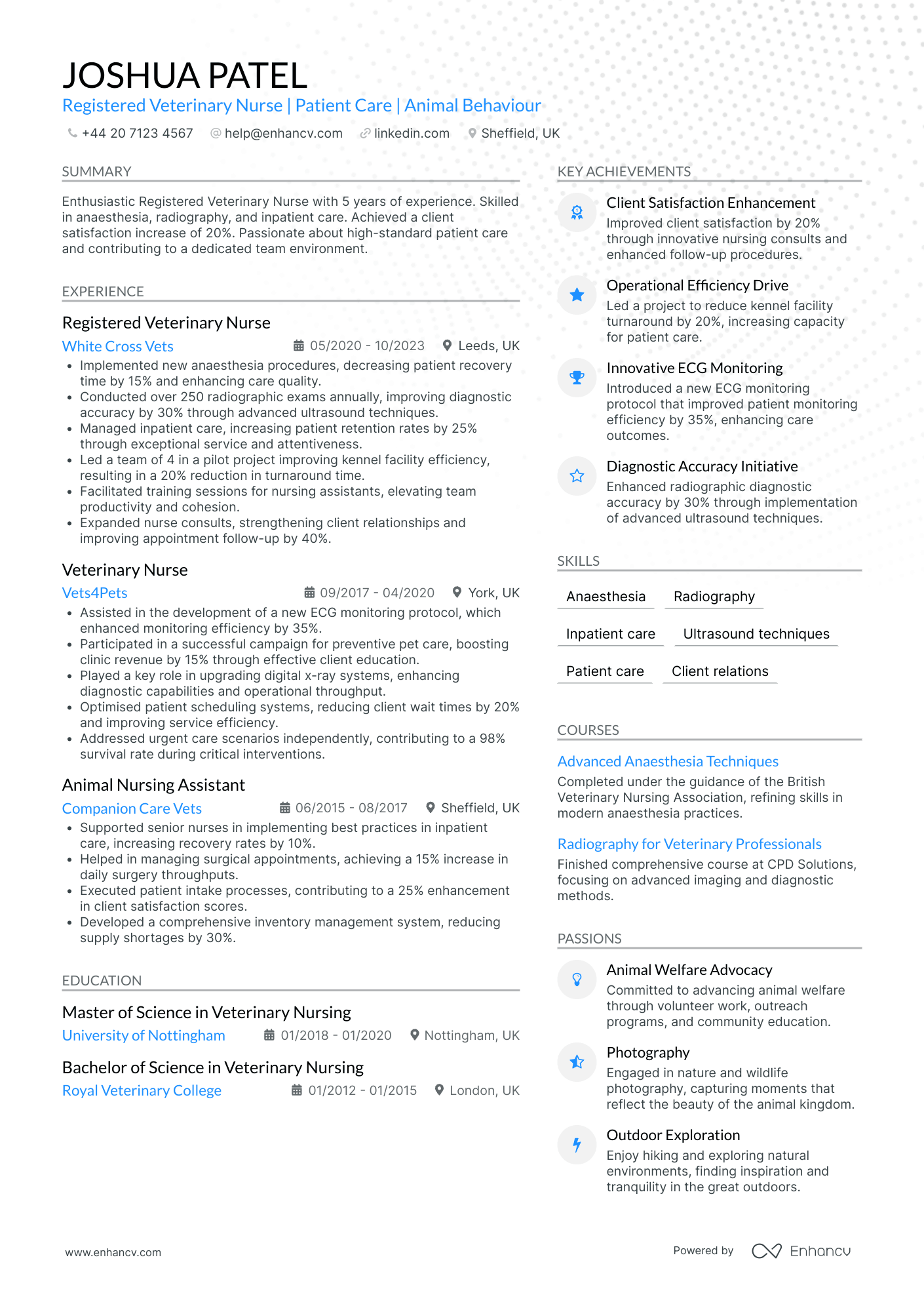
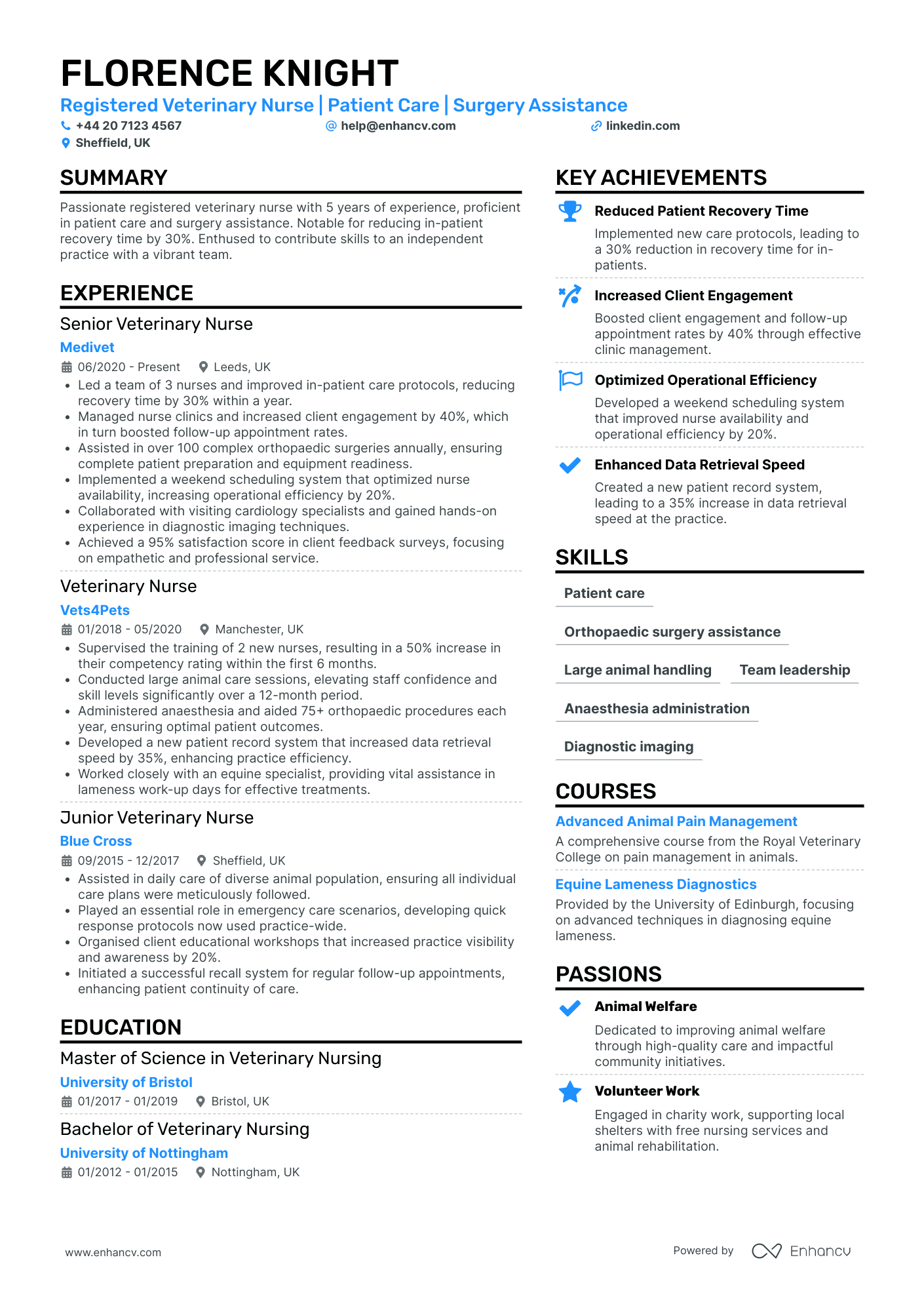
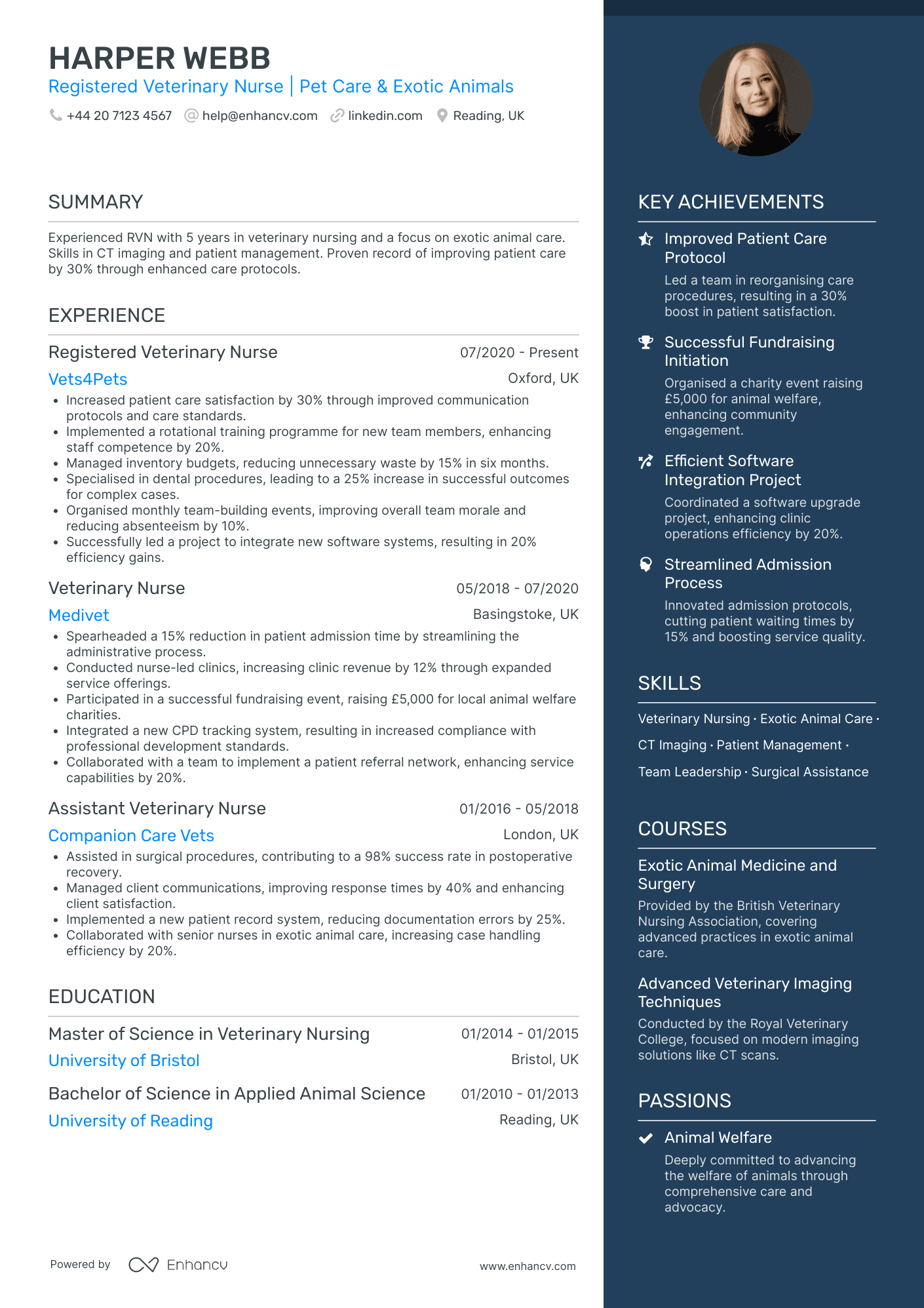
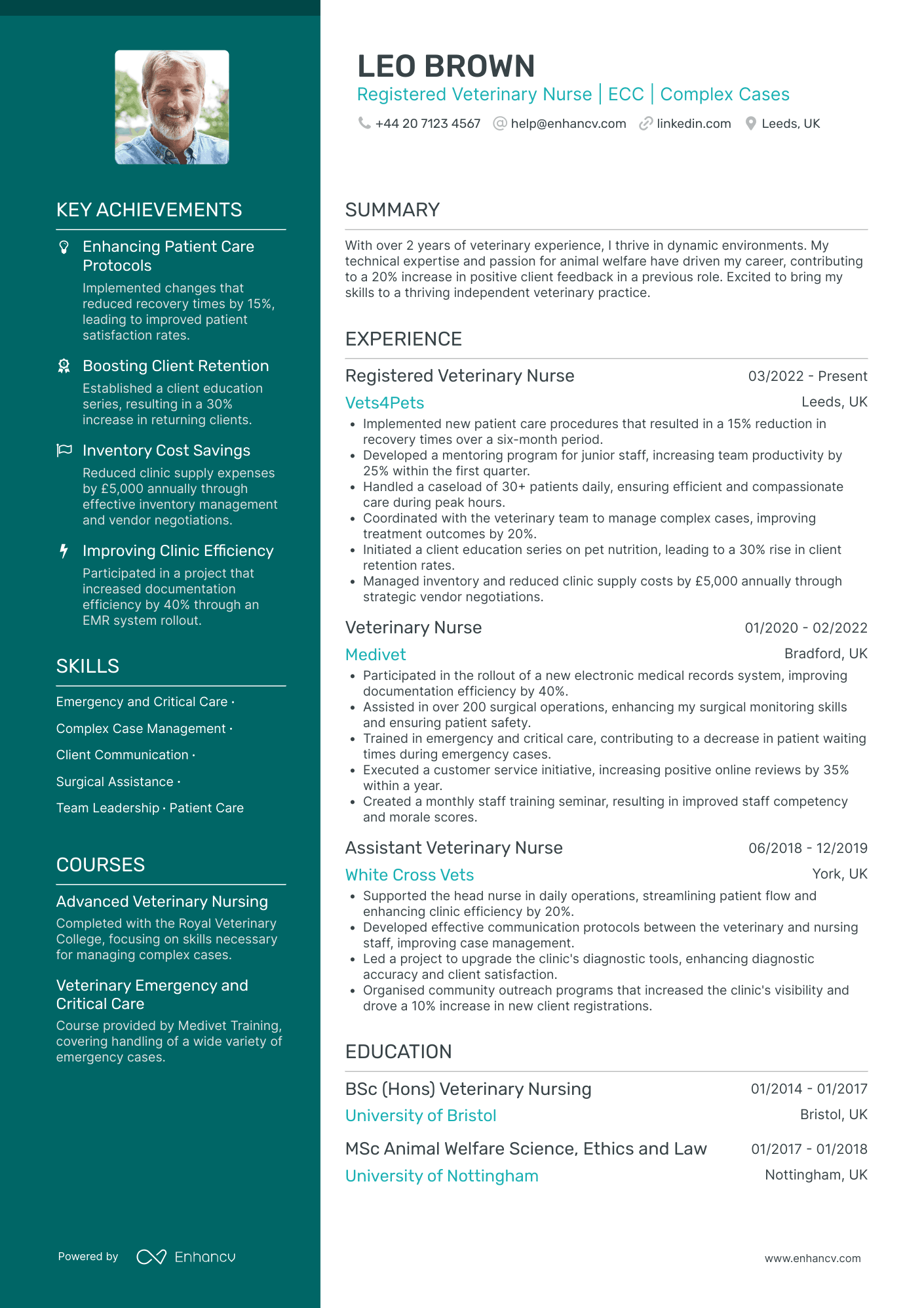
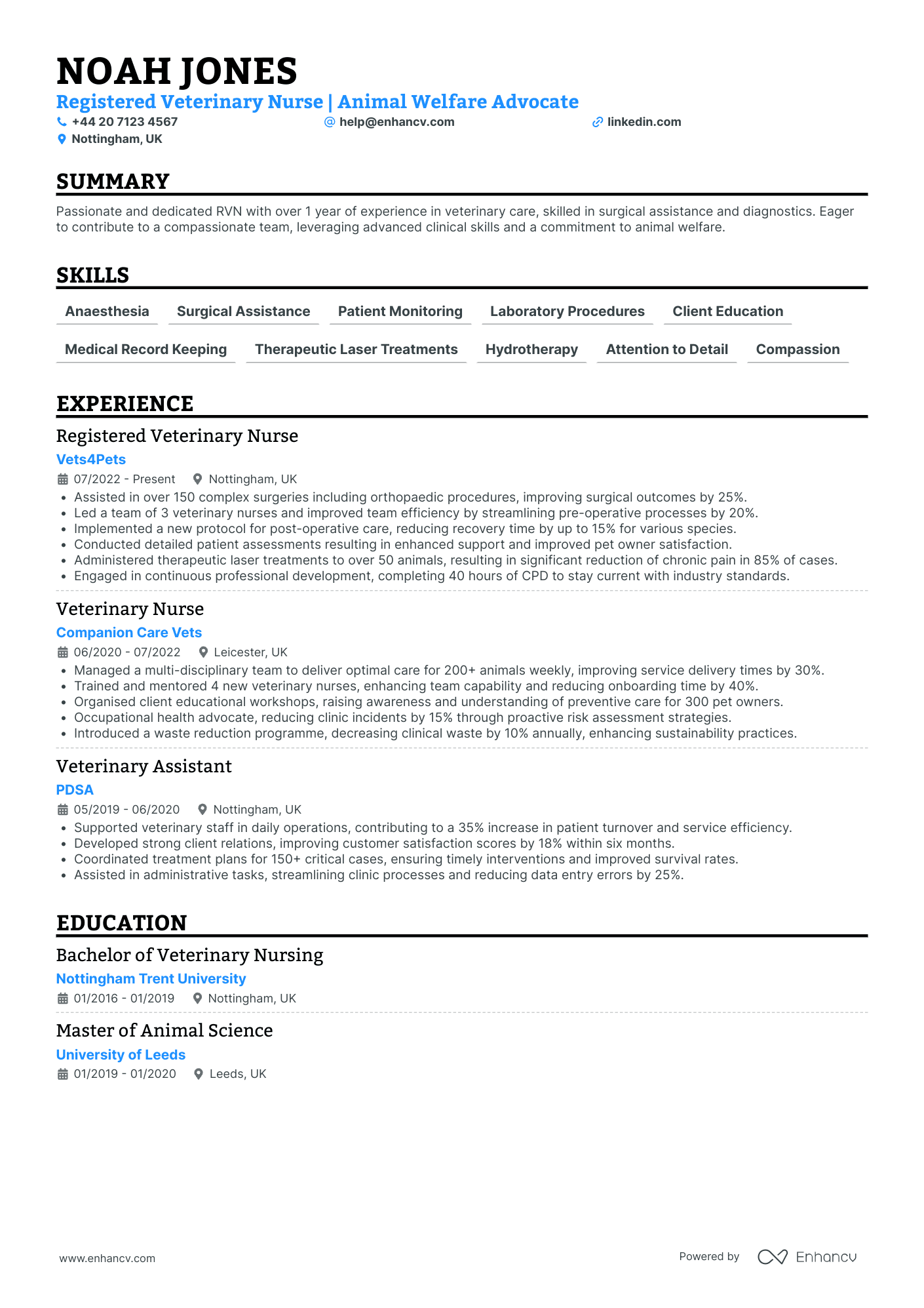
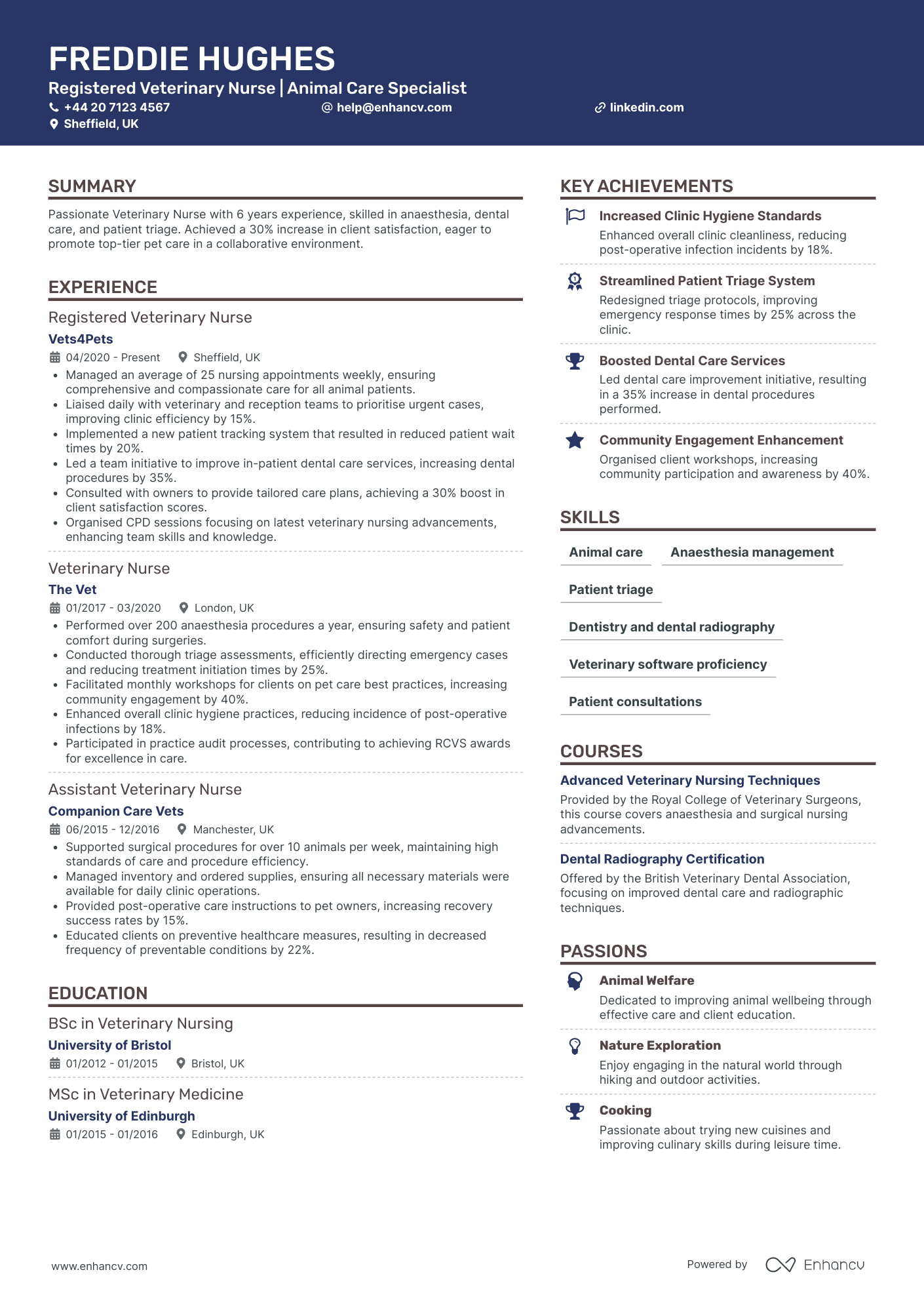
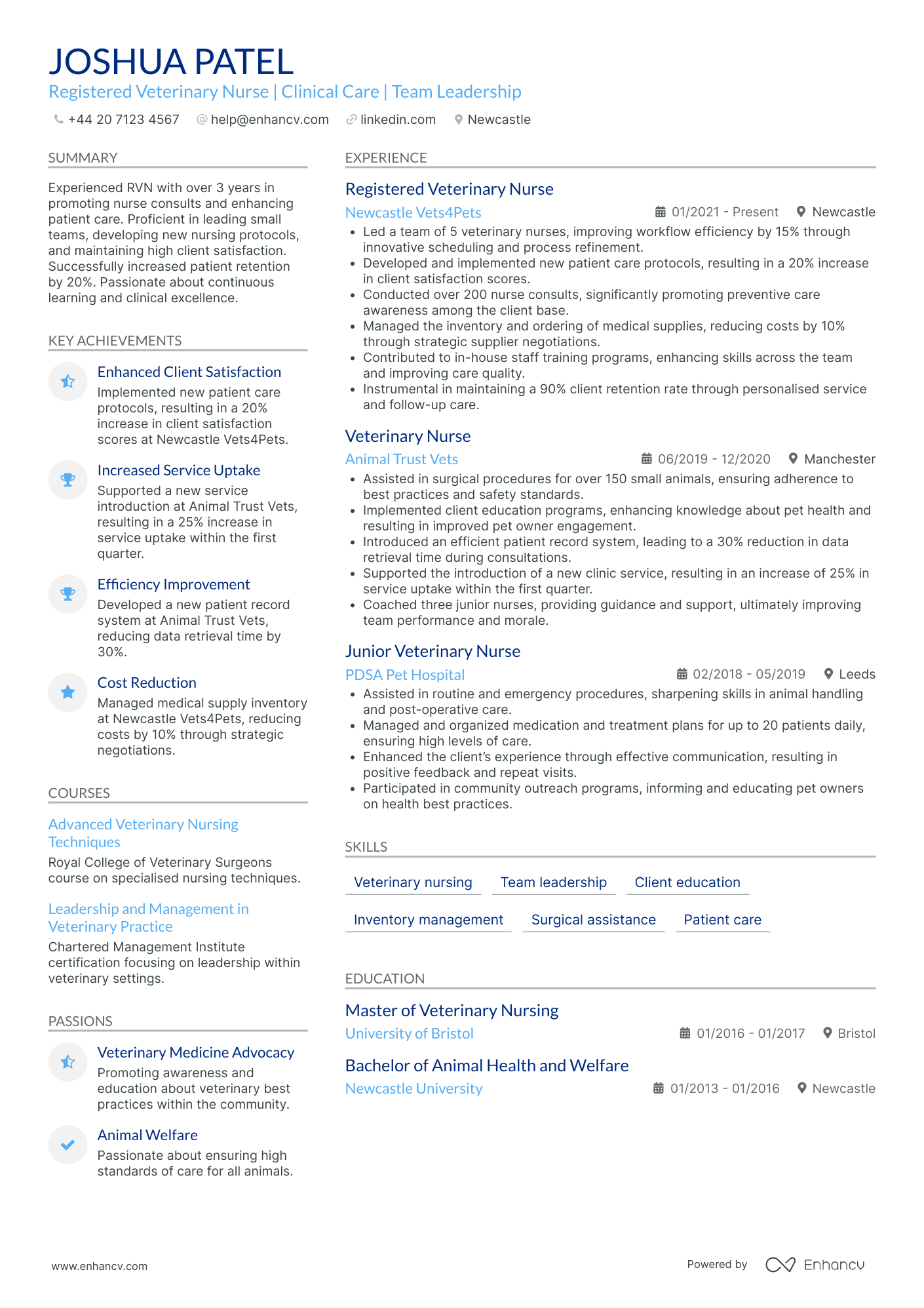
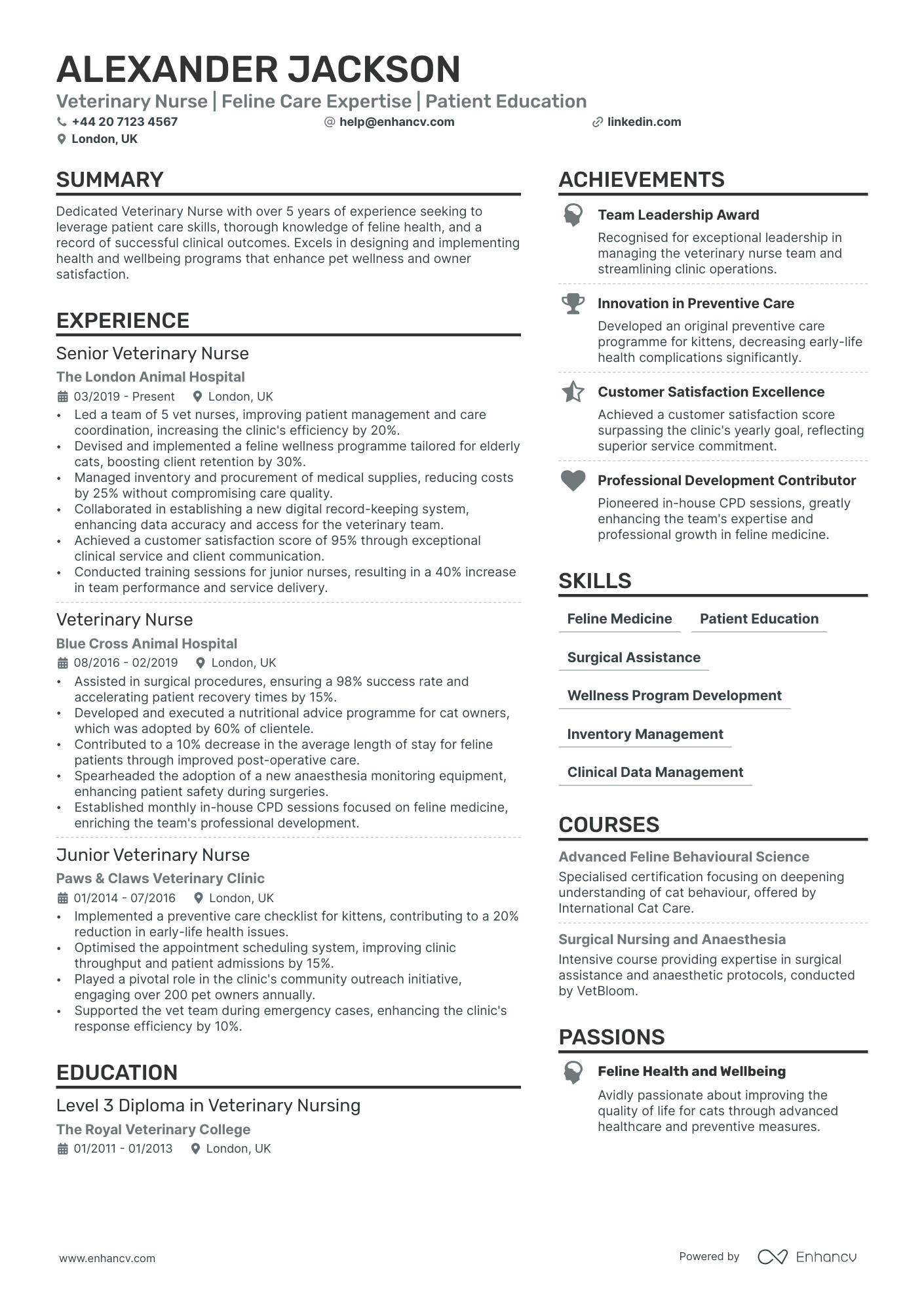
A veterinary nurse CV lives or dies on one line: your RCVS registration. Bury it on page two and a practice manager reading fast will assume you do not have it.
Across 103 UK veterinary nurse postings on Enhancv's internal job feed in the last ~30 days, RCVS registration is the credential that comes up more than any other. The CV that wins the interview states it near the top, then backs it with the clinical work behind it. If you want the fundamentals first, see how to write a CV.

Key takeaways
- Lead with your RCVS registration and RVN status. It is the first thing a practice checks, and 83% of UK postings ask for it.
- Veterinary nursing is on-site work, so put your location and whether you can drive near the top.
- Send a PDF so the layout holds, and keep a Word copy for practices and agencies that ask for one.
- Two pages, reverse chronological, with standard headings an ATS can read.
- Name the clinical specifics practices list: patient monitoring, admissions and discharges, anaesthesia, and inpatient care.
- Open with a short personal statement built on your registration, your clinical strengths, and one concrete result.
Formatting your veterinary nurse CV
Start with the format, because a veterinary nurse CV has to do two jobs at once: satisfy the practice manager who skims it in seconds and survive the tracking software many groups now use.
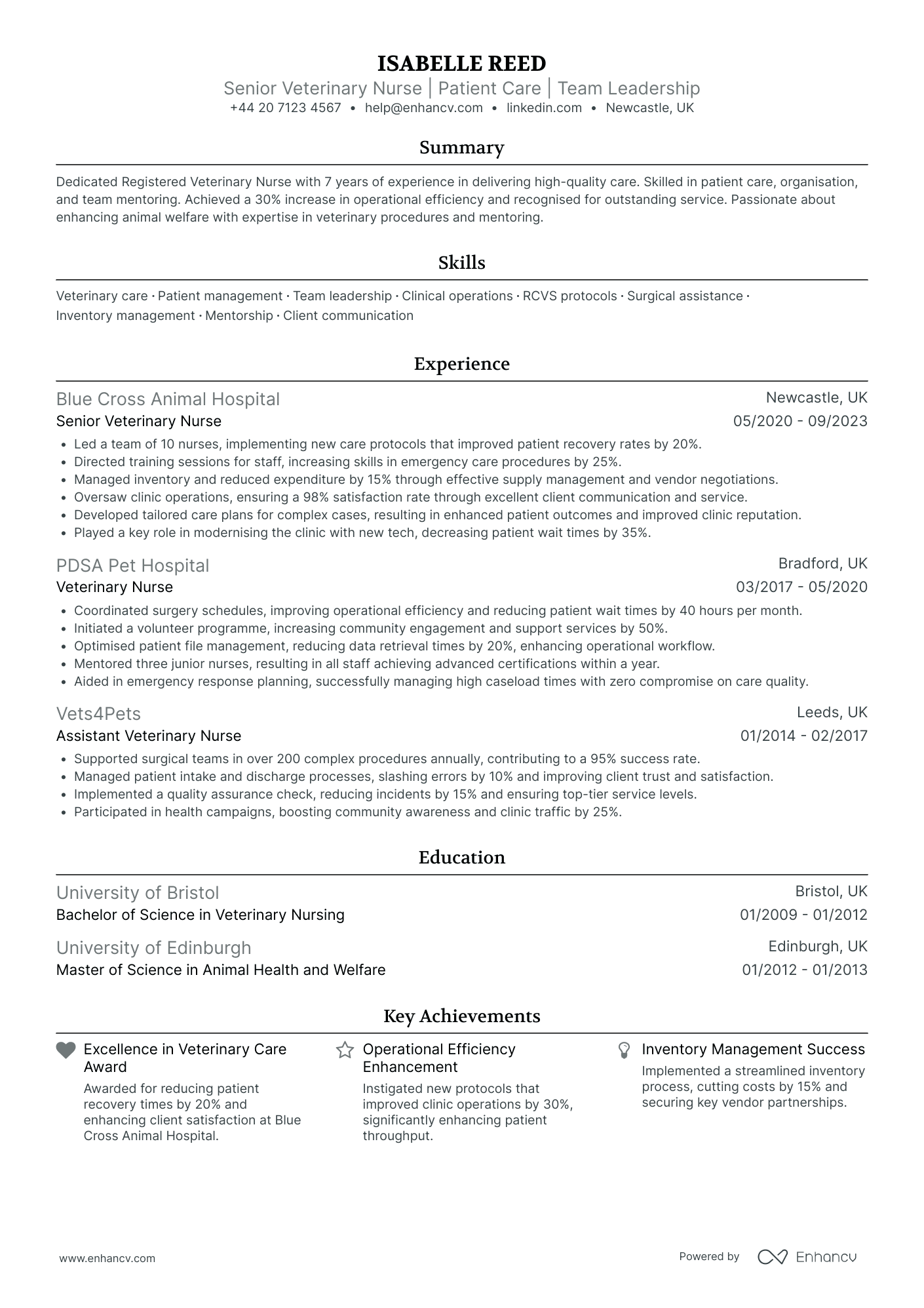
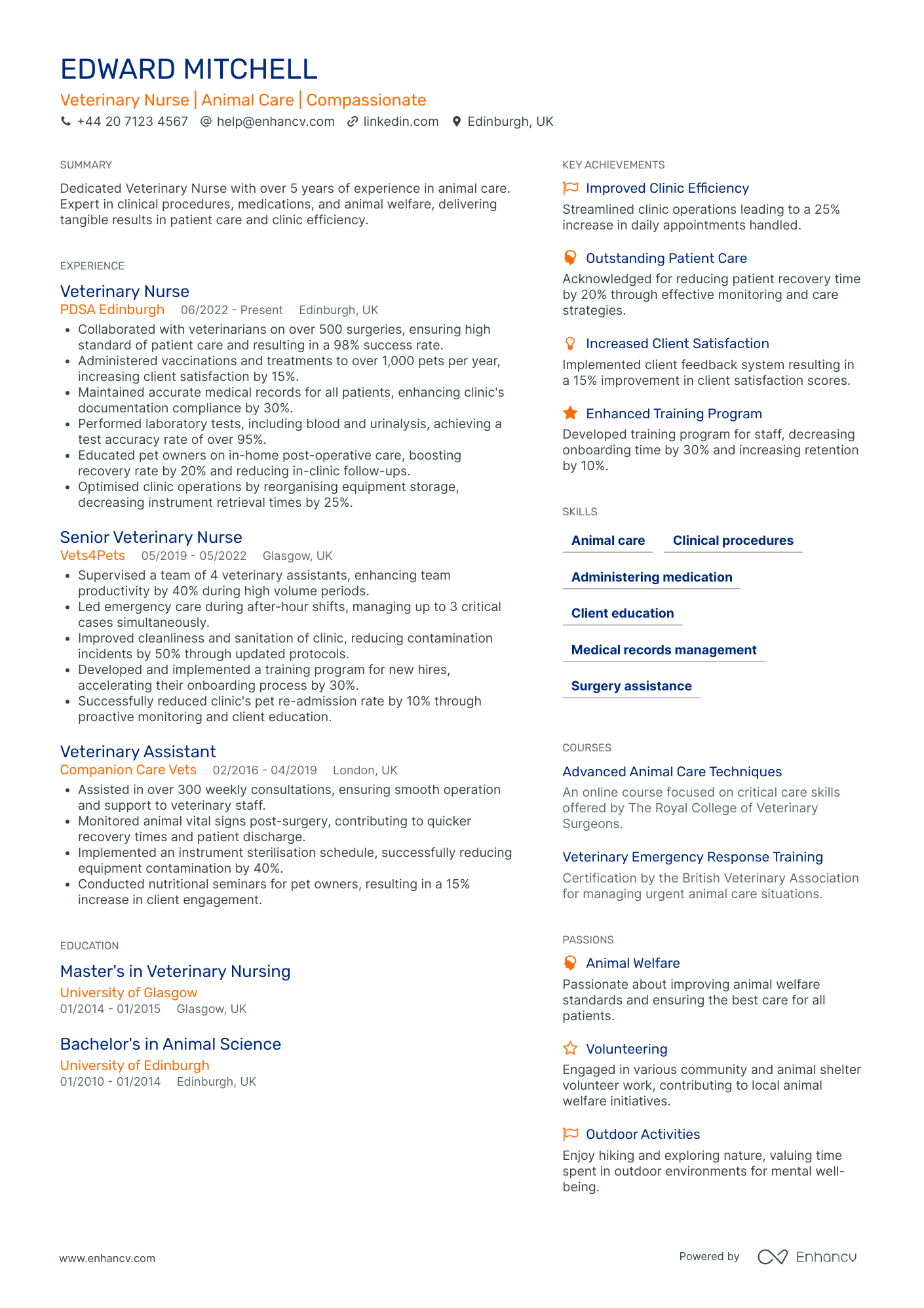
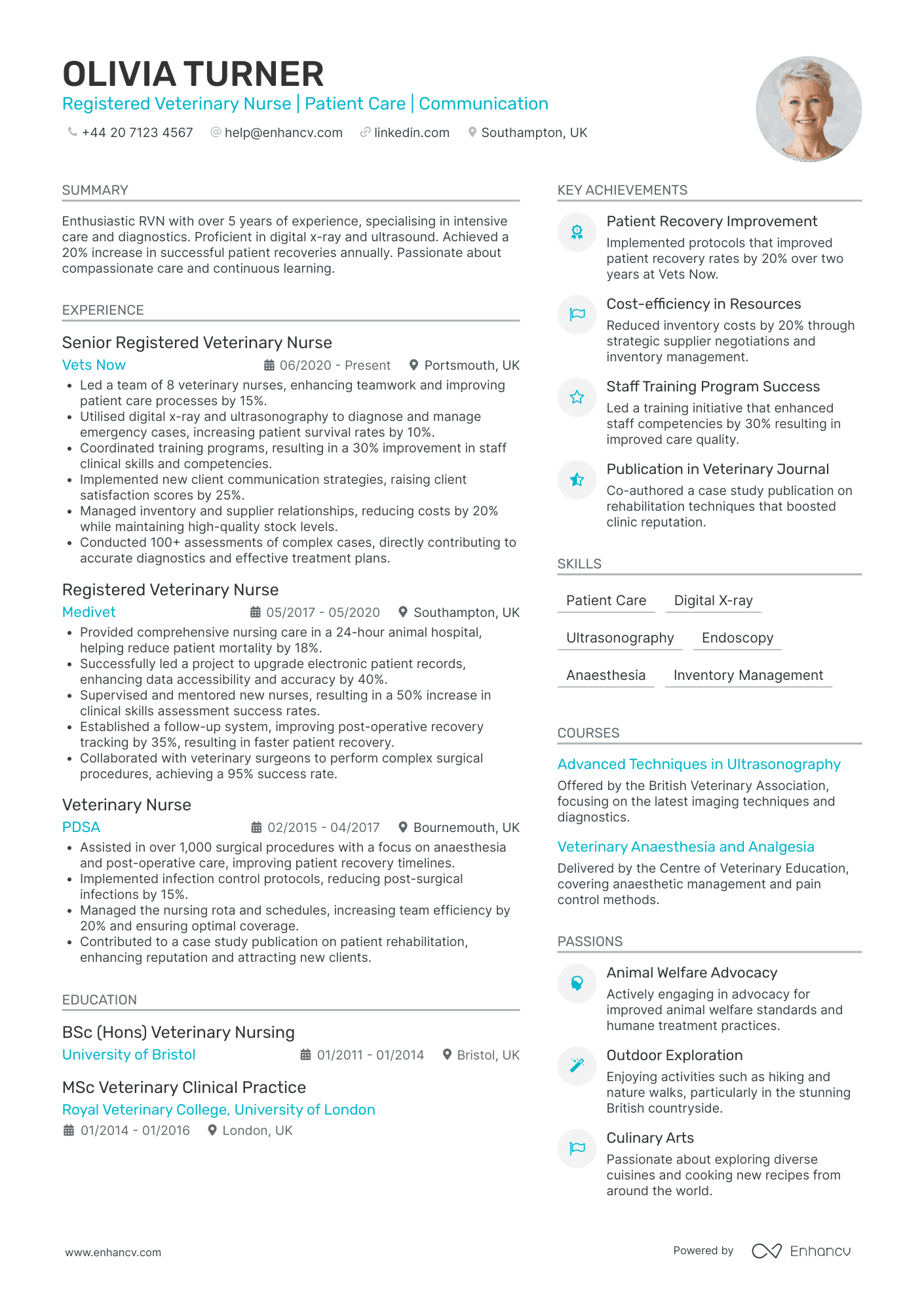
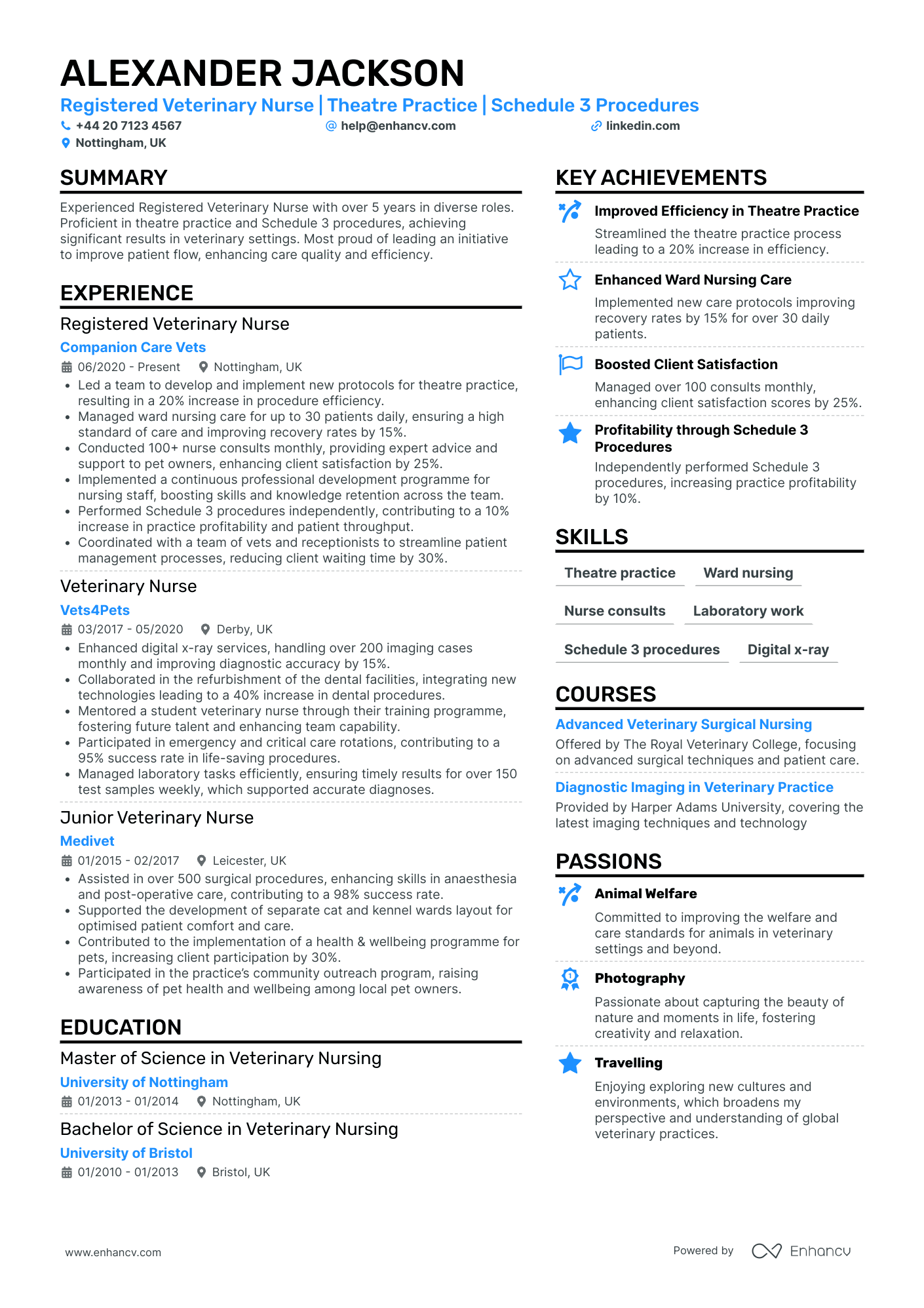
Use a reverse chronological CV. You are a registered professional with clinical roles to show, so your work history leads and your qualifications sit just under it.
Keep it to two pages. One page rarely holds a full nursing history, and a third page dilutes the strong material. UK practices expect two and will not reward a longer document.
Send a PDF for direct applications so your layout, spacing, and headings hold on any screen. Keep a Word copy for locum agencies and larger veterinary groups, which often reformat CVs into their own template. If the advert names a file type, follow it exactly.
Stick to one column, standard section headings, and a readable font. Veterinary CVs pass through tracking software as often as any other, so keep the layout clean and the titles obvious for an ATS-friendly CV. Skip the photo, the graphs, and the sidebars that scramble a parser.
Order the sections the way a practice reads them: header, personal statement, RCVS registration, work experience, skills, then education and CPD. A practice manager should not have to hunt for the parts that decide whether you get an interview.
Put your RCVS registration number in the header, next to your name and RVN title. It is the first detail a practice looks for, and hiding it in a qualifications list at the bottom costs you the quick yes.
Leave off the clutter that dates a CV: a full home address, your date of birth, a headshot, and a wall of hobbies. A line on your town, a contact number, an email, and your registration does more than any of them.
Build it from a tested layout rather than a blank page: Enhancv's CV templates export to a clean, ATS-parsable PDF that holds its shape whether a person or a parser opens it.

PRO TIP
Name the file so a busy practice can find it: Surname-Veterinary-Nurse-CV.pdf, not CV-final-v3.pdf. And check your RVN title reads exactly as it appears on the RCVS register, initials and all.
What the UK veterinary nurse market looks like
Knowing the market tells you what to put where. Here is what the role pays and what practices actually ask for.
| What | UK veterinary nurse roles |
|---|---|
| Typical pay | £24,000 to £32,000 a year (National Careers Service (gov.uk)) |
| Where the work happens | On-site (103 of 103 UK postings in the last ~30 days, Enhancv's internal job feed) |
| Experience level asked for | Mid 82% · lead 14% · entry 3% · senior 2% |
| Most-listed requirement | RCVS registration (83% of postings) |
| Most-listed skills | Patient monitoring, admissions and discharges, ultrasound, client communication, inpatient care |
Three of those numbers should shape your CV.
Every posting is on-site, so a recruiter needs to see you can get to the practice reliably. Put your location and a driving licence near the top of the header.
Most roles, 82% of them, are pitched at mid level, so lead with clinical competence rather than raw enthusiasm. Entry-level openings are rare at 3%, which makes your registration and your placement hours worth foregrounding if you have only just qualified.
And RCVS registration shows up in 83% of adverts, more often than any single clinical skill, which is exactly why it belongs in your header rather than buried below.
The pay band above is the national picture, and practices assume you know it. Do not put a salary expectation on the CV. Save that for the application form or the interview, where you can pitch it against the specific role, the rota, and the on-call demands.
RCVS registration and where it belongs on your CV
You cannot lawfully call yourself a veterinary nurse in the UK without being on the RCVS register. So this is not a nice-to-have on your CV, it is the entry ticket, and the reader wants to see it in seconds.
State your status plainly. Registered Veterinary Nurse (RVN) with your RCVS registration number, or Student Veterinary Nurse (SVN) with an expected qualification date. Put it in the header and again in your qualifications.
If you trained through a diploma or a degree, name the awarding body and the year. If you are mid-training, say exactly where you are, for example "SVN, RCVS-accredited Level 3 Diploma, qualifying summer 2026".
Keep your professional details current and honest. Listing the certificates you actually hold, and noting that your registration is in good standing, saves the practice a question and heads off any doubt.
Never inflate your status. Calling yourself an RVN before you are on the register, or leaving a lapsed registration to look current, is the fastest way to lose an offer once a practice checks the public register, which they always do. If your registration has gapped, say so plainly and give the date it resumes.

Where your RCVS details go
Header: name, RVN, RCVS registration number, location, phone, and email. Qualifications section: the accredited diploma or degree, the awarding body, and the year. One clear line in both places, no ambiguity about your status.
Writing your veterinary nurse personal statement
Four sentences at the top: your registration, your clinical strengths, the setting you work in, and one concrete result. Keep it specific. See more personal statement examples if the opening line is not coming.
Skip the adjective soup. "Caring, dedicated and hardworking" sits on half the CVs in the pile and tells a practice manager nothing they can check.
If you have just qualified, the shape is the same but the evidence shifts. Lead with your fresh RVN status, the number of clinical hours in your placement, and the procedures you are already confident running solo. A newly registered nurse who names real theatre and ward experience reads as ready, not raw.
Lead with evidence instead:
Veterinary nurse personal statement example (experienced)
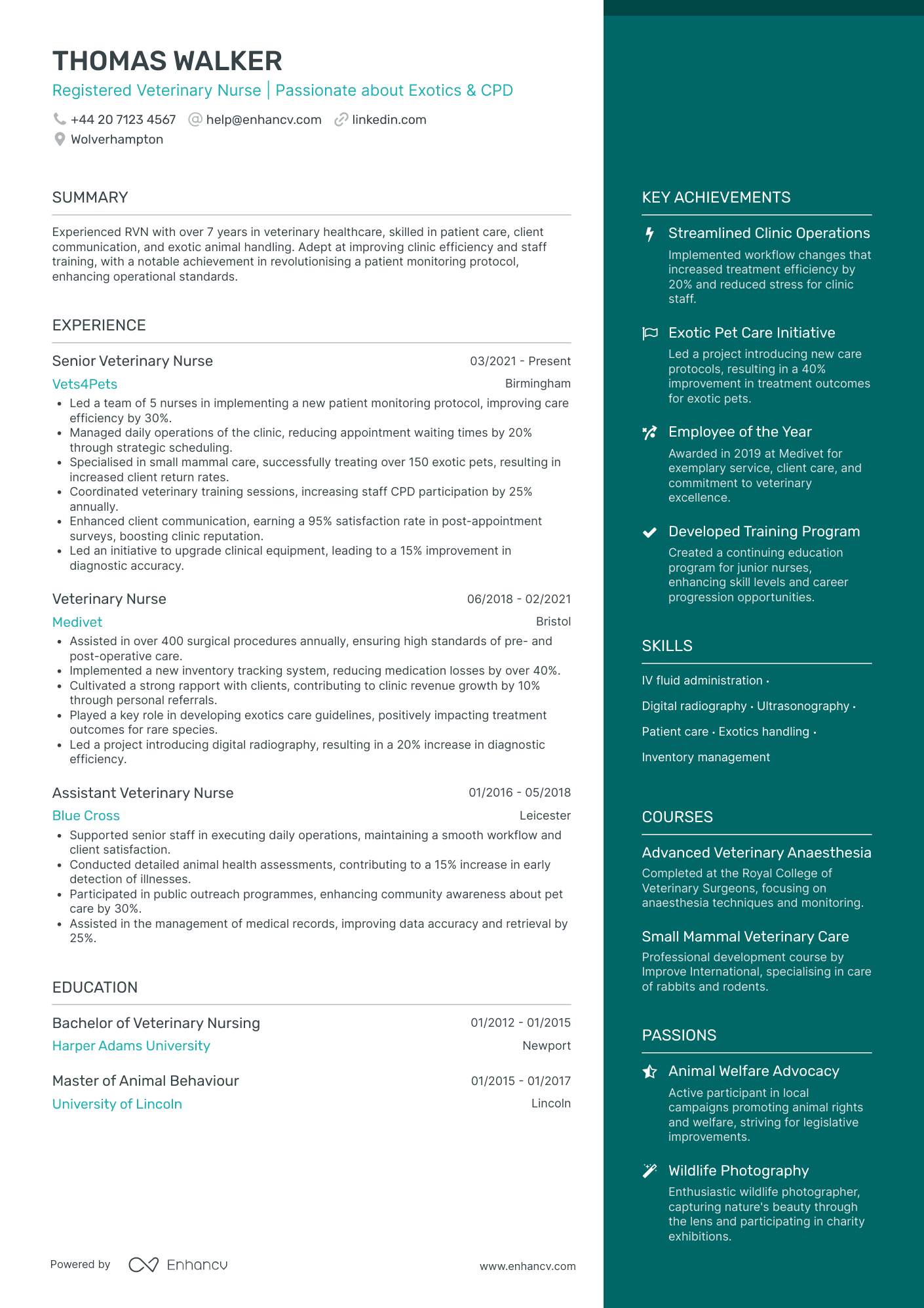
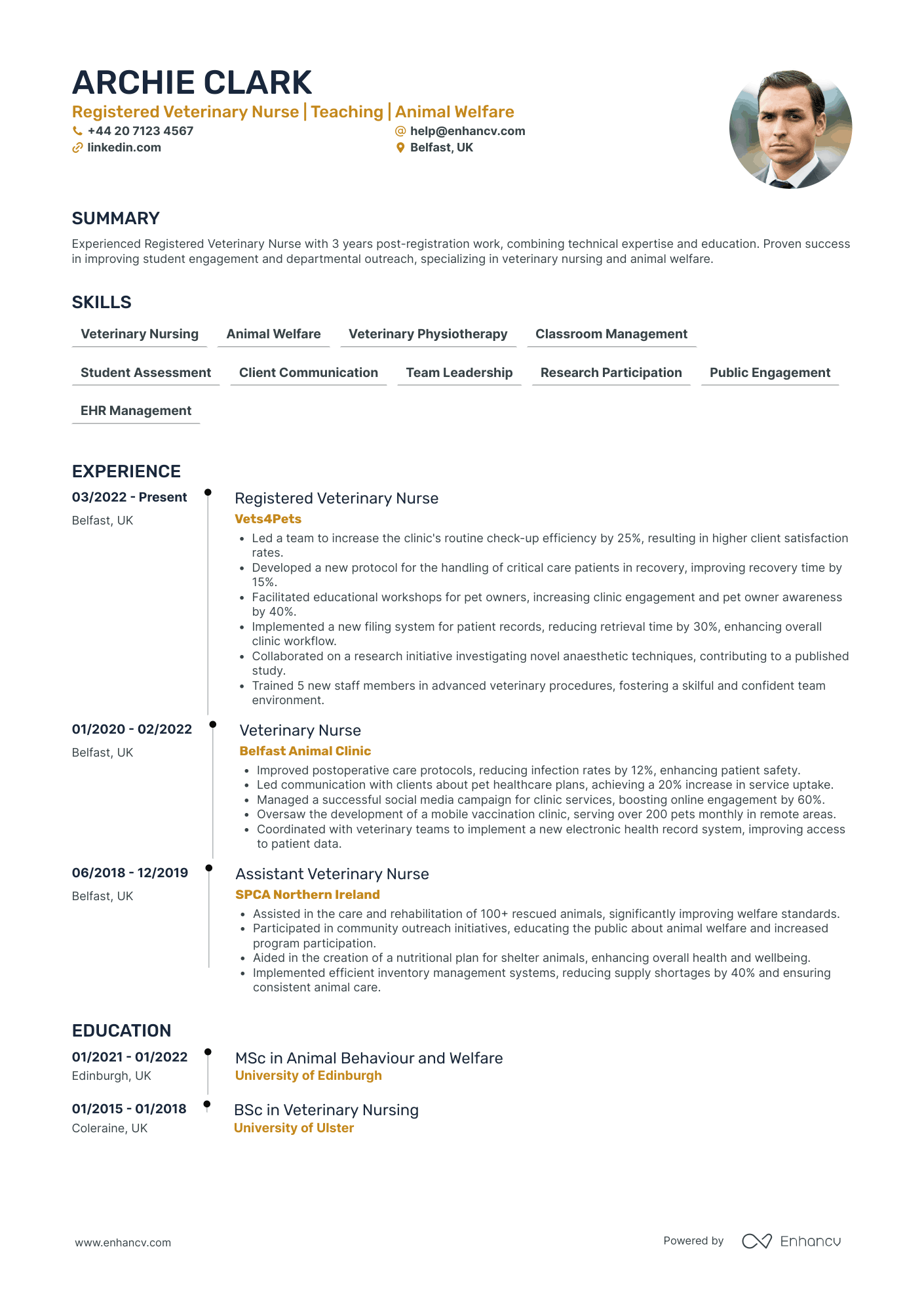
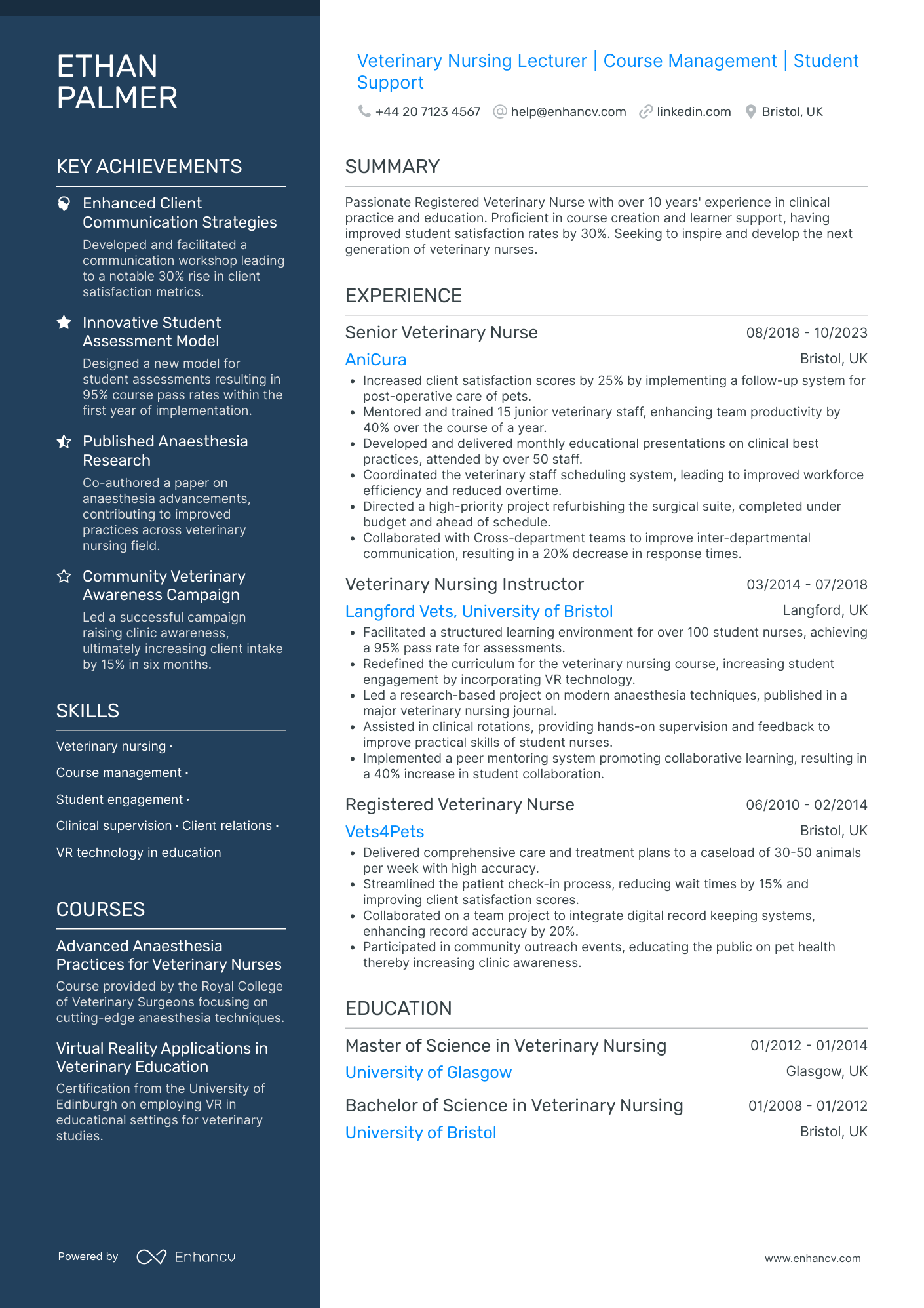
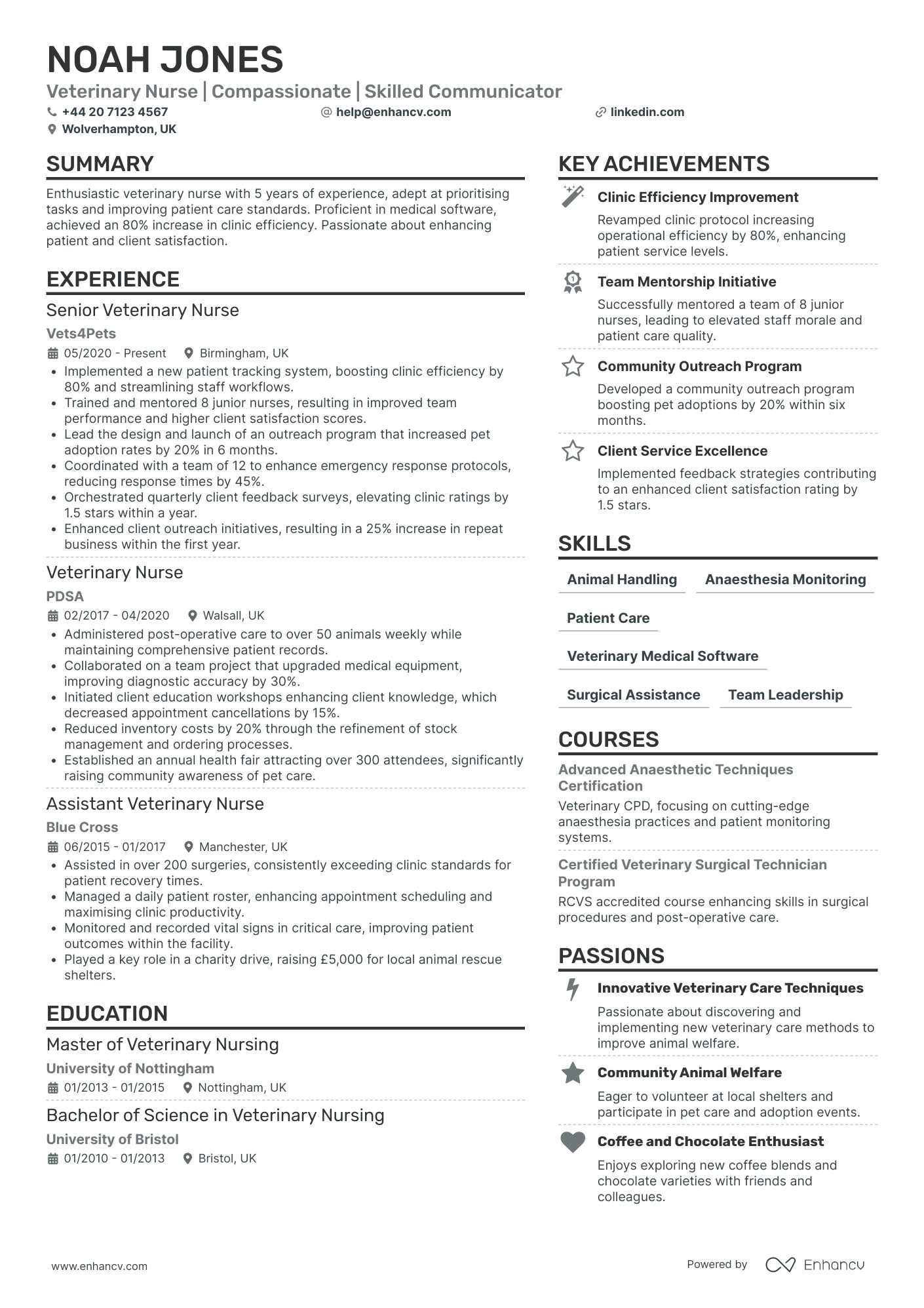
RVN registered with the RCVS since 2019, based in Bristol, with five years in a busy small animal practice. Confident lead nurse for anaesthesia and theatre, running inpatient care for up to 12 patients a shift and mentoring two student nurses. Known for calm client communication when owners are distressed. Looking to bring accurate, dependable clinical support to a referral hospital within reach of BS postcodes.
Here is the version to avoid, the one that could belong to almost anyone:
Personal statement to avoid
A caring and dedicated animal lover with a real passion for helping pets and their owners. Hardworking, reliable, and a good team player, looking for a rewarding role in a friendly practice where I can make a difference.
When a veterinary nurse CV crosses my desk, I look for the RCVS number before I read a single sentence. It tells me you can legally do the job. After that I want one real shift: how many patients you monitored, the anaesthetics you ran, the owner you talked down from panic. A registration line plus one concrete shift beats a paragraph of adjectives every time.
Writing your veterinary nurse experience section
Each role gets a dated heading, then bullets that show what you did and what changed because of it. Lead every bullet with one of the strong action verbs a clinical reader expects. For the mechanics, see work experience on a CV.
Nursing work is measurable even when it does not feel like it: patients monitored per shift, anaesthetics assisted, nurse clinics run, students mentored, drug errors caught before they reached the patient. Those are your CV achievements.
Mirror the advert. Pull the clinical terms a practice lists, patient monitoring, admissions and discharges, ultrasound, and match them where they are genuinely true of you. Enhancv's CV tailoring feature reads the advert and suggests the matching edits, which saves rewriting from scratch each time.
- Run anaesthesia and recovery for up to eight surgical patients a day, maintaining detailed monitoring charts and escalating concerns to the duty vet
- Lead inpatient care for a 12-bed ward, coordinating admissions, discharges, and client updates across two nursing shifts
- Set up and staff nurse-led clinics for weight management and post-operative checks, lifting repeat client bookings
- Mentor two student veterinary nurses through clinical placements, signing off practical skills against the RCVS framework
- Assisted on routine and emergency surgery, prepping theatre, monitoring anaesthesia, and placing IV catheters across a mixed small-animal caseload
- Handled admissions and discharges for the day ward, briefing owners on medication and aftercare so follow-up calls dropped
- Ran diagnostic imaging including radiography and assisted ultrasound, logging results to the practice management system
- Kept RCVS-standard clinical records and controlled-drug registers with zero audit discrepancies over two years
PRO TIP
Practices list clinical specifics, not soft-skill clouds. Mirror the ones you can back: "anaesthesia monitoring", "IV catheter placement", "radiography", "admissions and discharges", "RCVS-standard record keeping". Name each exactly as the advert does, and only if you have done it on a real shift.
Skills to put on a veterinary nurse CV
Read a dozen live veterinary nurse adverts and the same demands repeat, and most are clinical. Patient monitoring, admissions and discharges, ultrasound, inpatient care, and RCVS-standard record keeping come up again and again. Those are your hard skills, listed in the words the adverts use.
The soft skills that matter here are checkable, not decorative: client communication, teamwork under pressure, and calm handling of distressed animals and owners. Prove each one in a bullet rather than claiming it.
Group them into a clear skills section so a scanning reader finds them fast. List only what you can stand behind, and if you are still training on a task, put it under training rather than skills.
Evidence beats a list every time. "Ultrasound" on its own is a claim, while "assisted ultrasound-guided cystocentesis on the emergency rota" is proof. Where you have space, let the experience bullets carry the skill and keep the skills box for the terms a parser needs to match.
Top skills for your veterinary nurse CV:
RCVS registration (RVN)
Patient monitoring
Admissions and discharges
Anaesthesia and recovery
Ultrasound and imaging
Inpatient care
Patient care
Clinical record keeping
Client communication
Teamwork
Compassion
Calm under pressure
Attention to detail
Education and certifications for a veterinary nurse CV
Your route to registration is the anchor here: an RCVS-accredited Level 3 Diploma in Veterinary Nursing, a foundation degree, or a BSc in veterinary nursing. Name the qualification, the awarding body, and the year in your education section.
List your continuing professional development too. The RCVS expects registered nurses to log CPD each year, so a short line naming recent courses, radiography, emergency and critical care, or clinical coaching, signals that you keep current.
Add any extra certificates that map to the job, from Schedule 3 procedures to specific anaesthesia or dentistry training. Keep this section tight, since your registration and experience are doing the heavy lifting above.
If you have only just qualified, this section carries more weight, so give your placement its own dated entry with the practice, the hours, and the clinical skills you signed off. Treat that placement as real experience, because to a hiring practice it is. A newly registered nurse who documents a full placement reads as employable, not as a student still finding their feet.
Conclusion
Lead with your RCVS registration, prove the clinical work behind it, and keep the format clean, two pages, and easy for both a practice manager and an ATS to read.
Tailor it to each advert. A practice hiring for a busy theatre rota wants different evidence from a first-opinion clinic that leans on nurse-led clinics, so reshuffle the bullets that matter most to the top for each application.
Pair the CV with a short cover letter that says why this practice, and you turn a strong record into an interview.
Author's take - the Enhancv team
When a veterinary nurse CV crosses my desk, I look for the RCVS number before I read a single sentence. It tells me you can legally do the job. After that I want one real shift: how many patients you monitored, the anaesthetics you ran, the owner you talked down from panic. A registration line plus one concrete shift beats a paragraph of adjectives every time.