



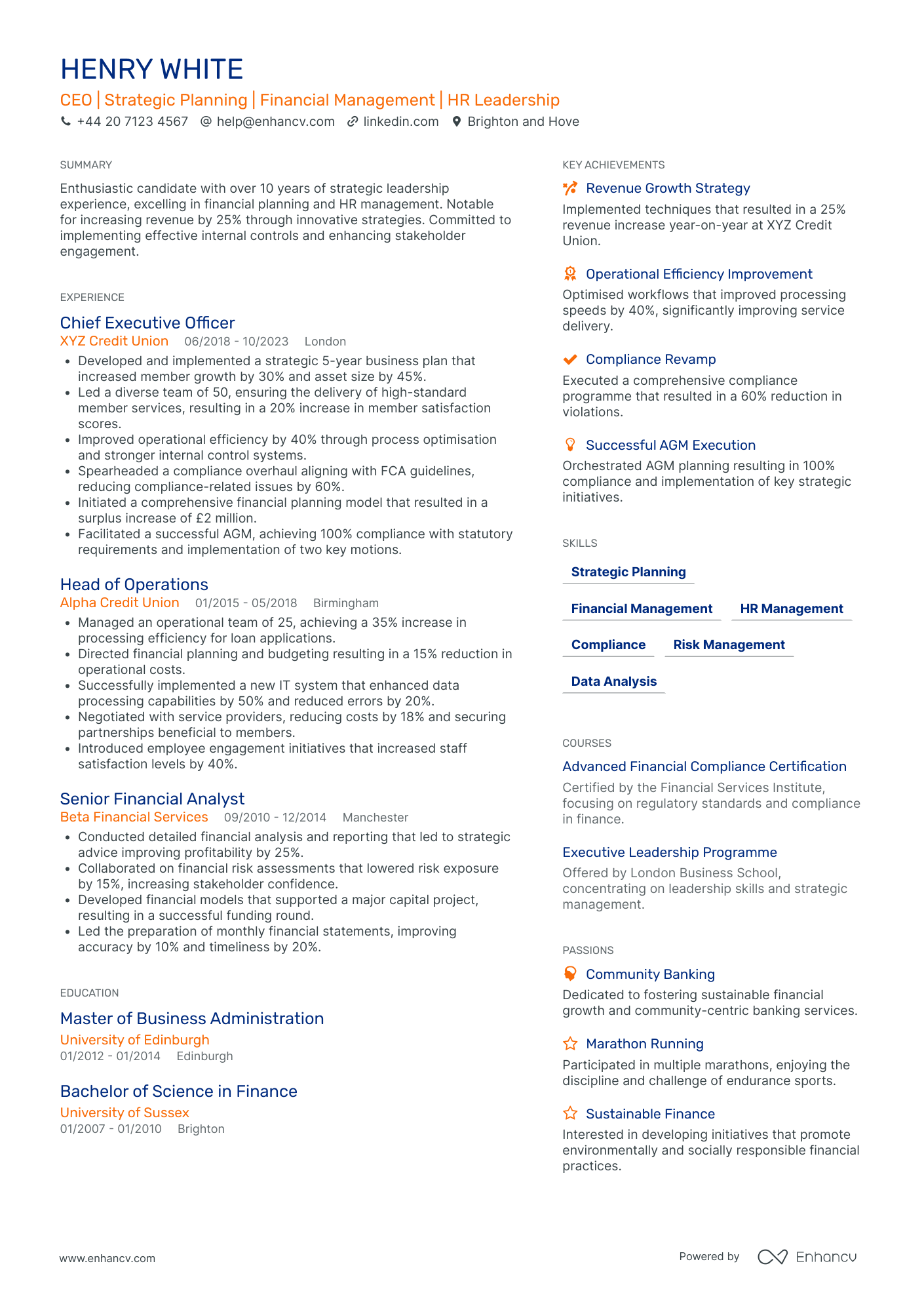
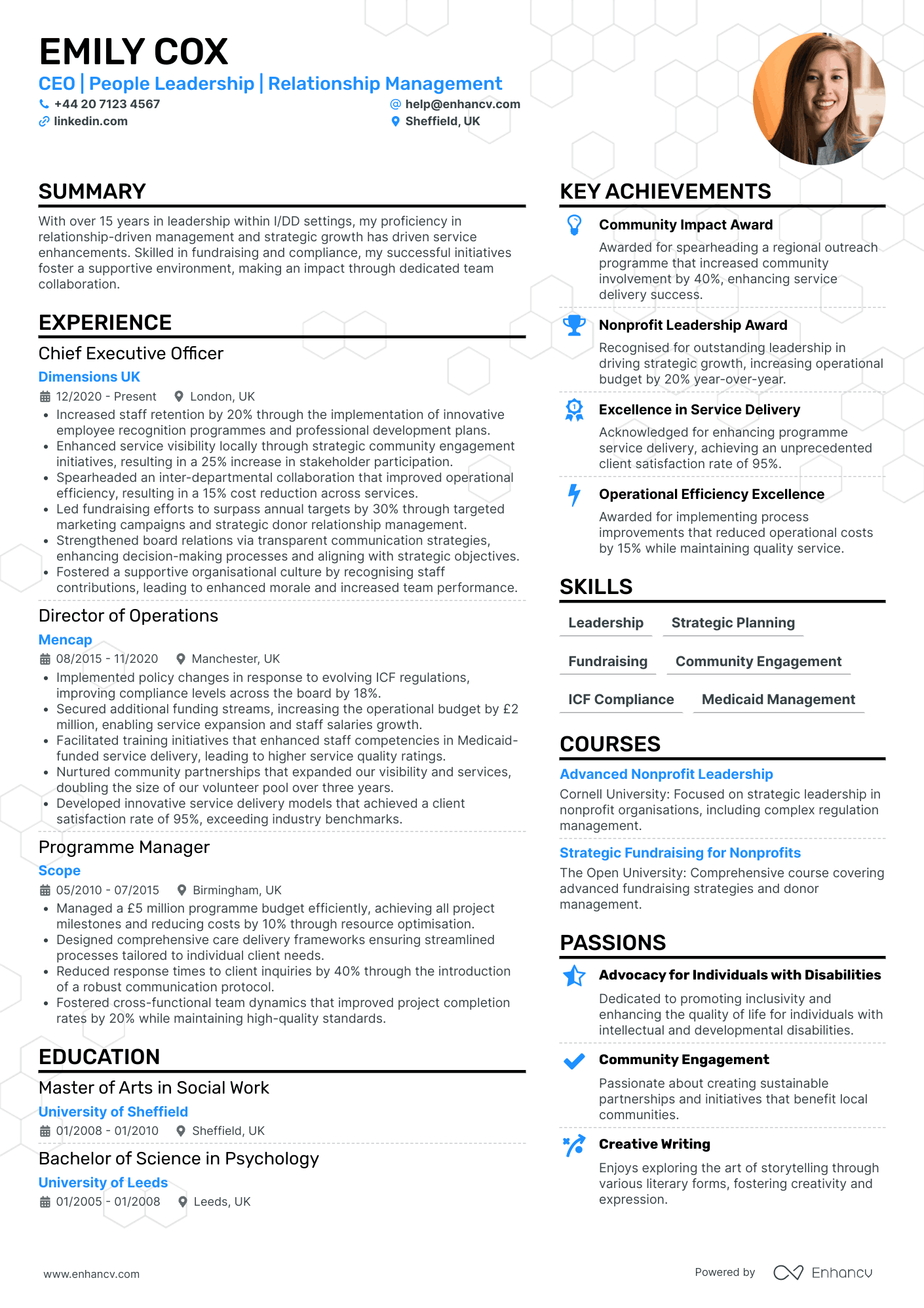
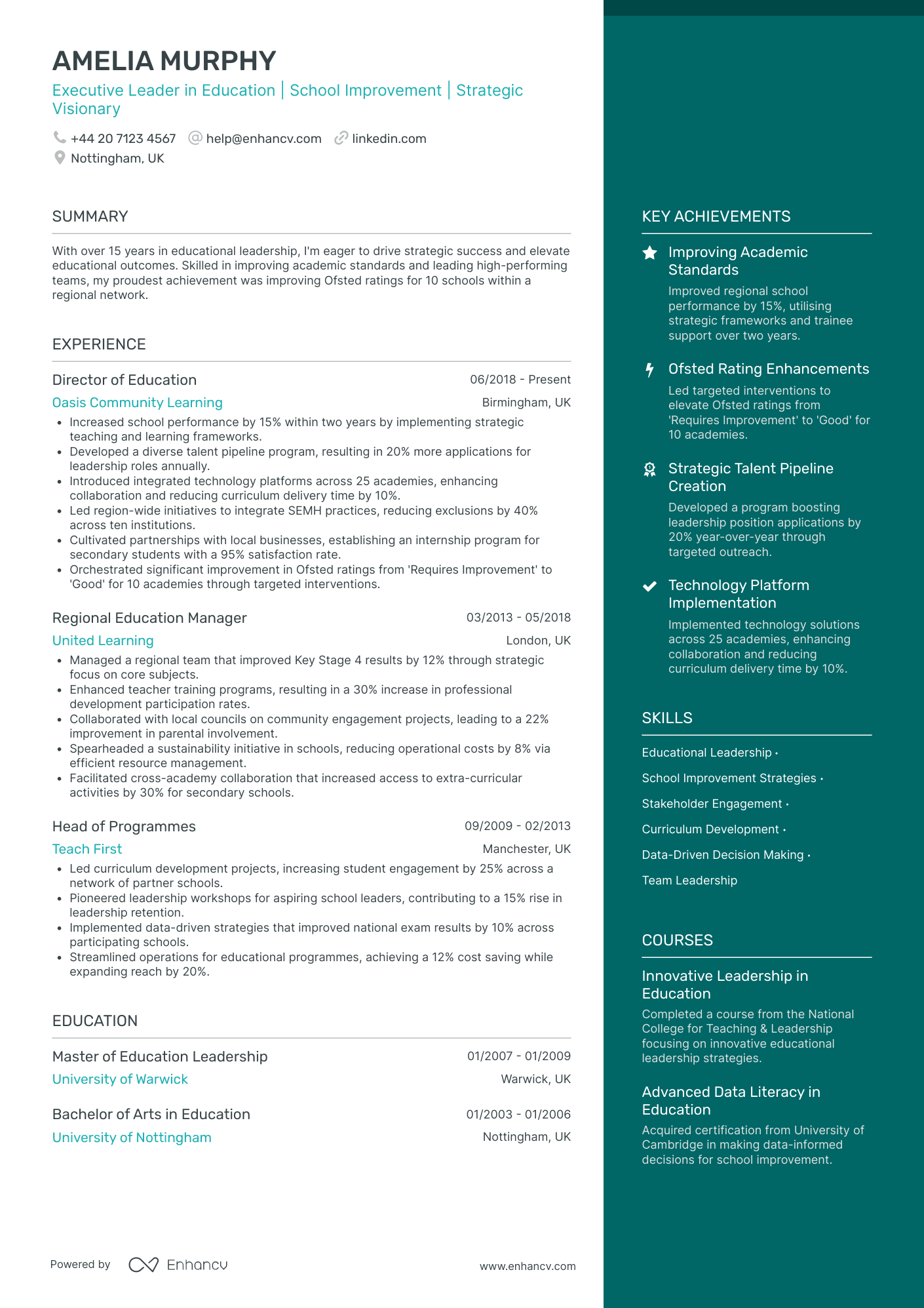
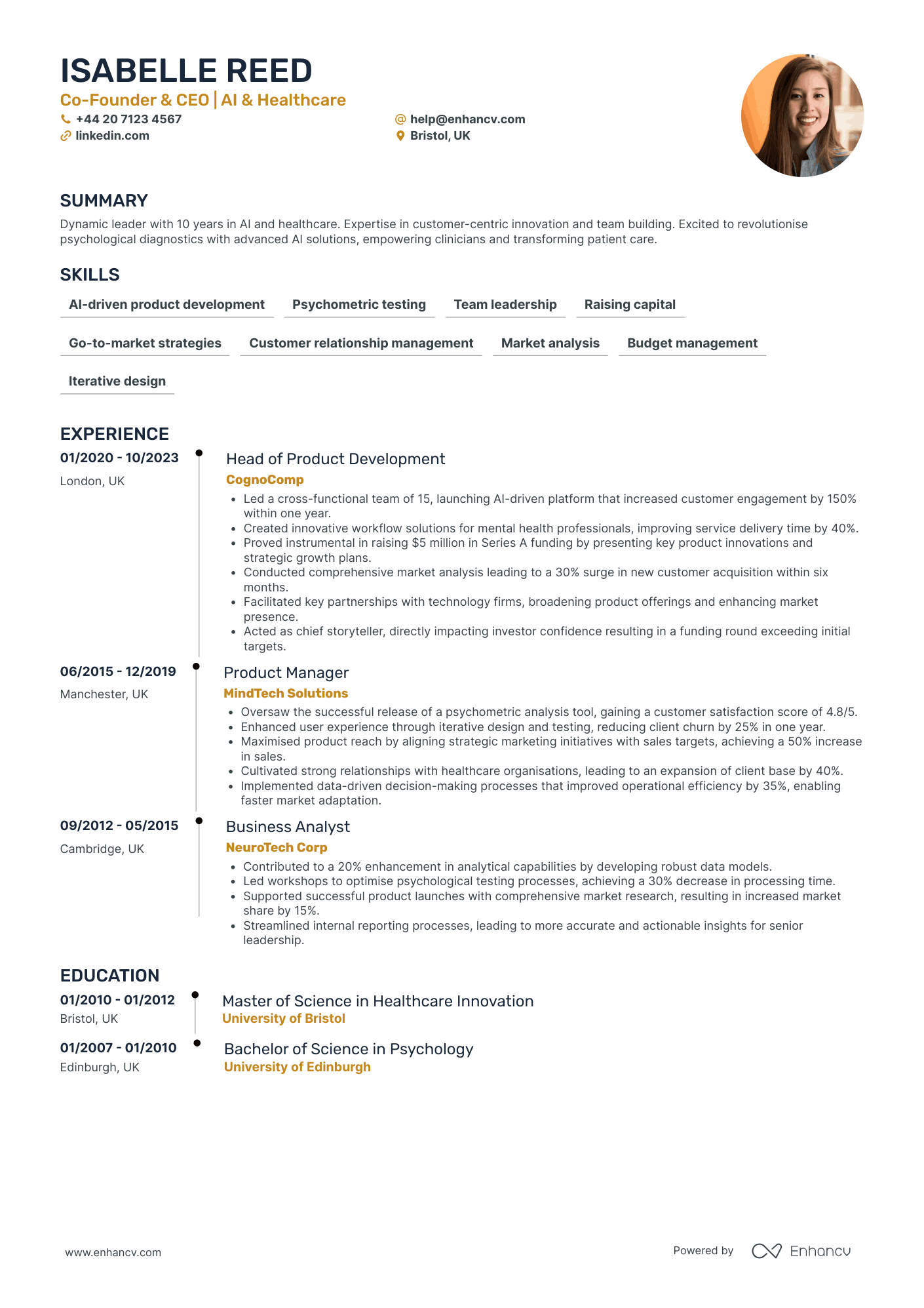
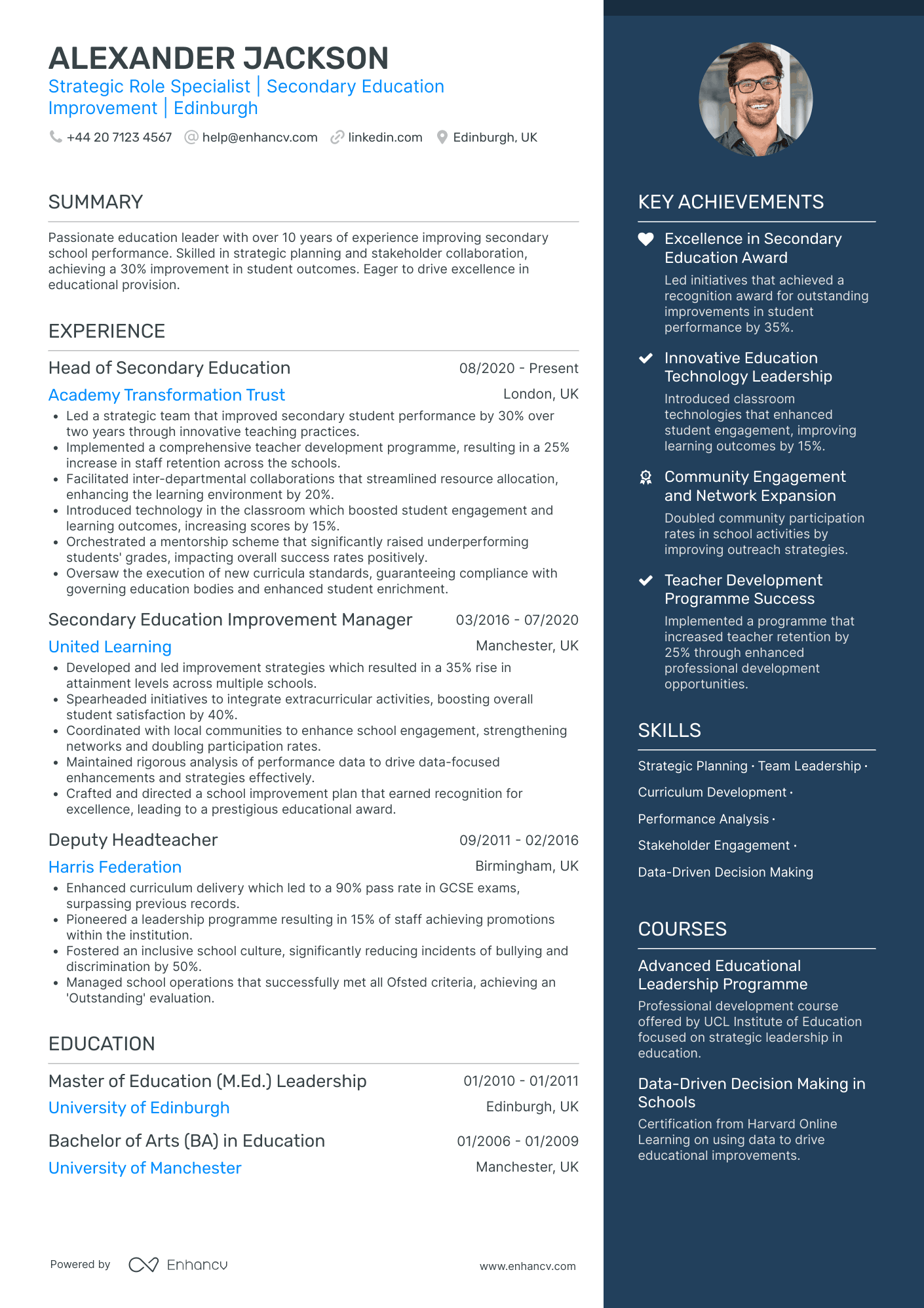
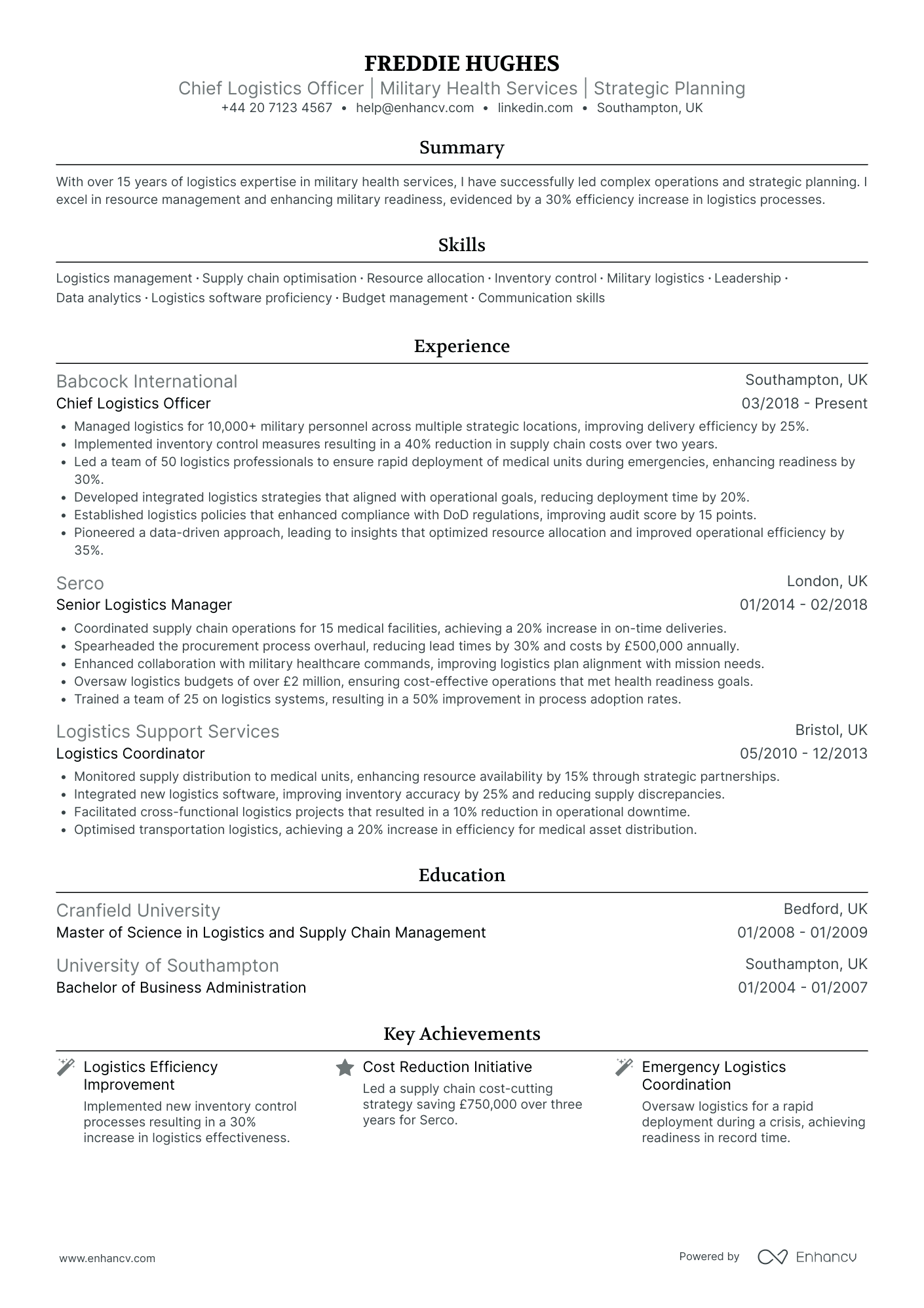
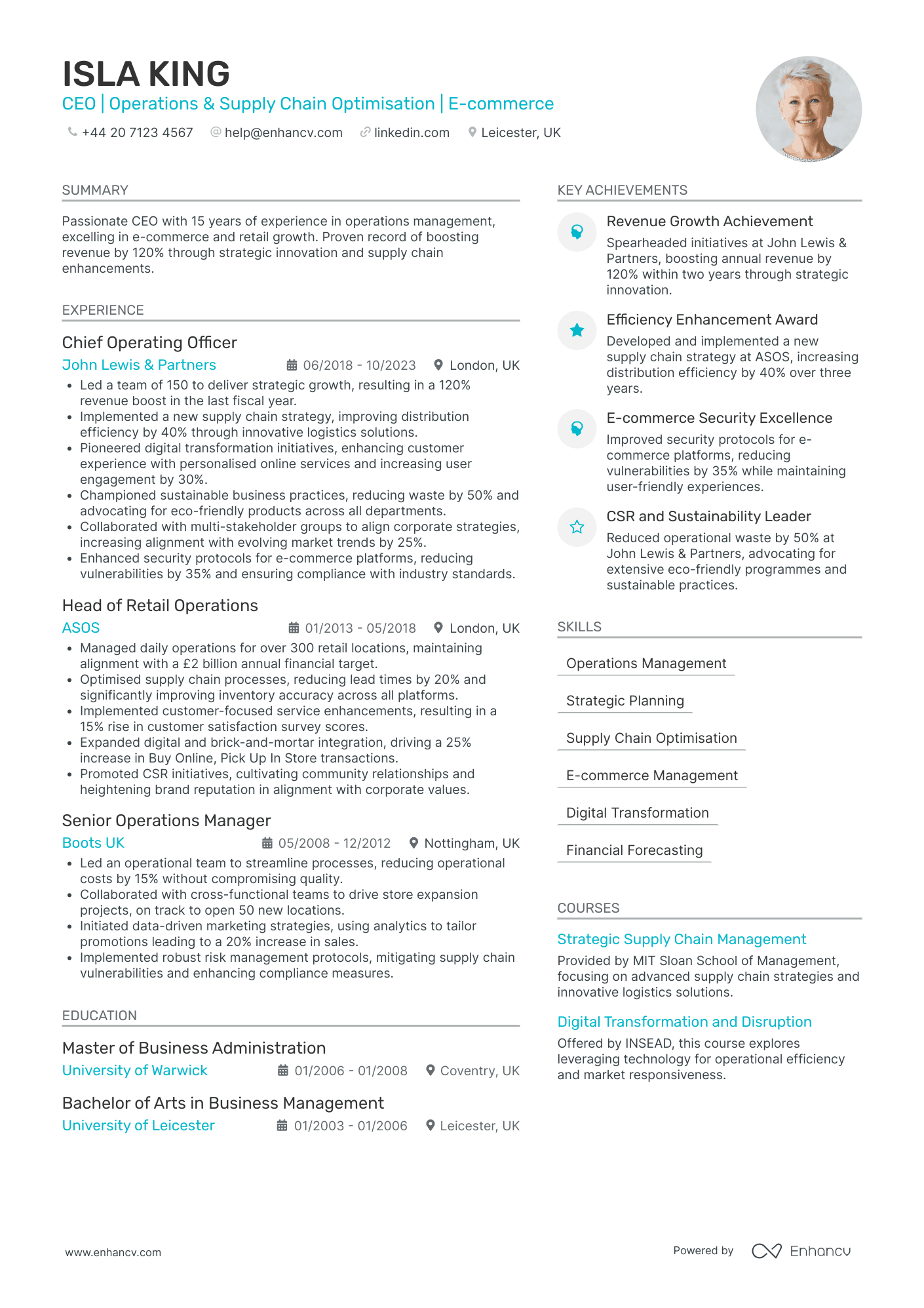
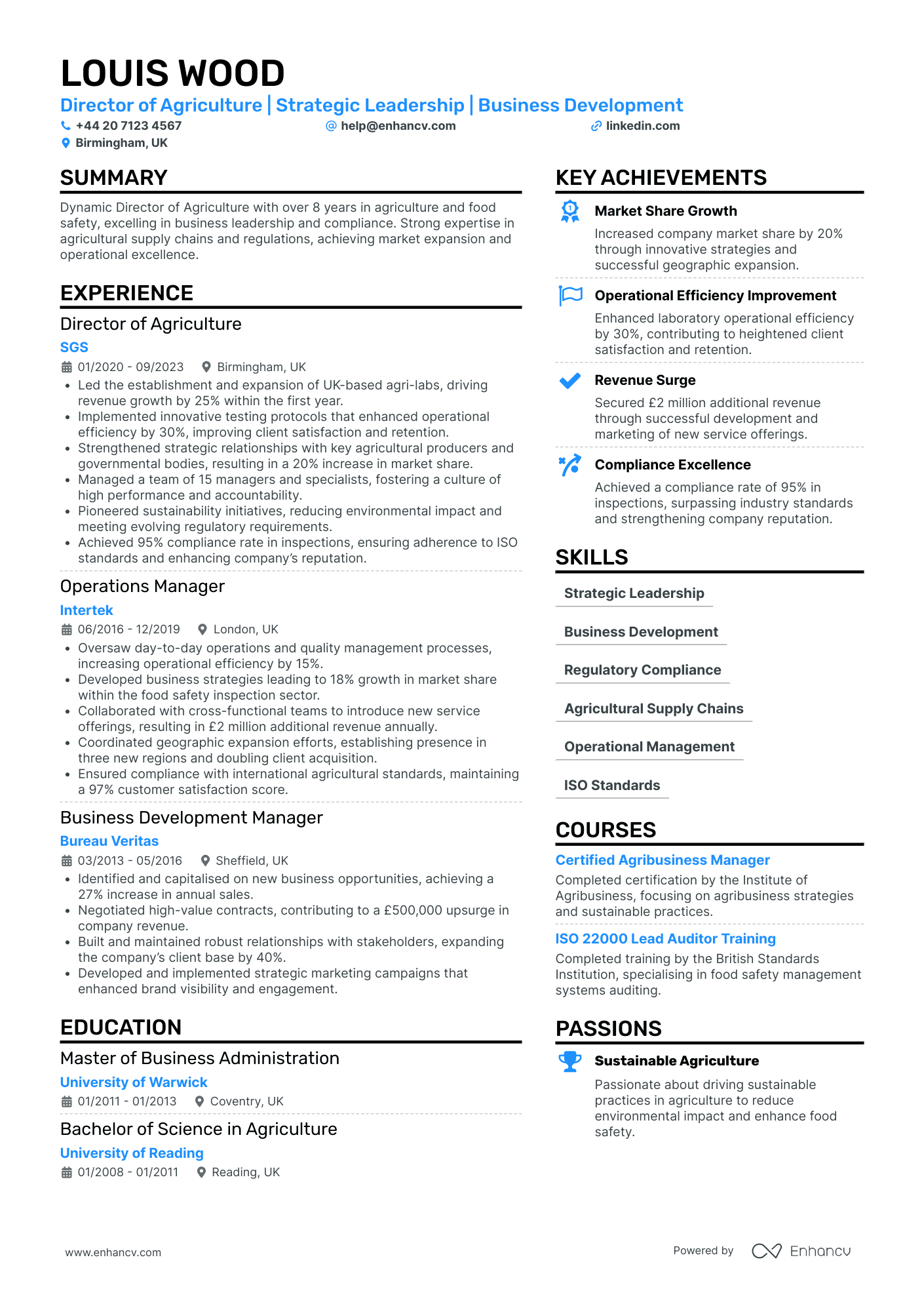
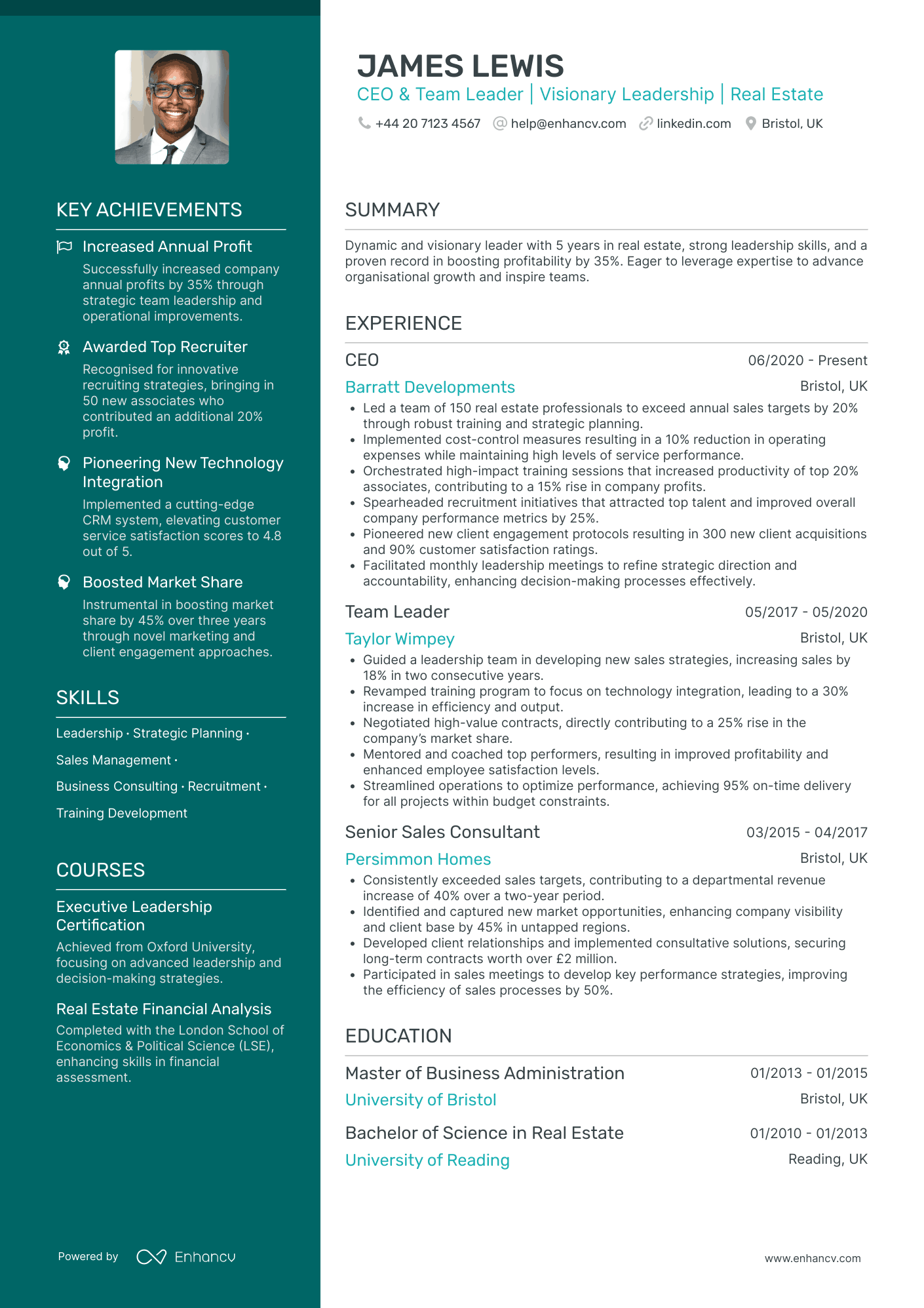
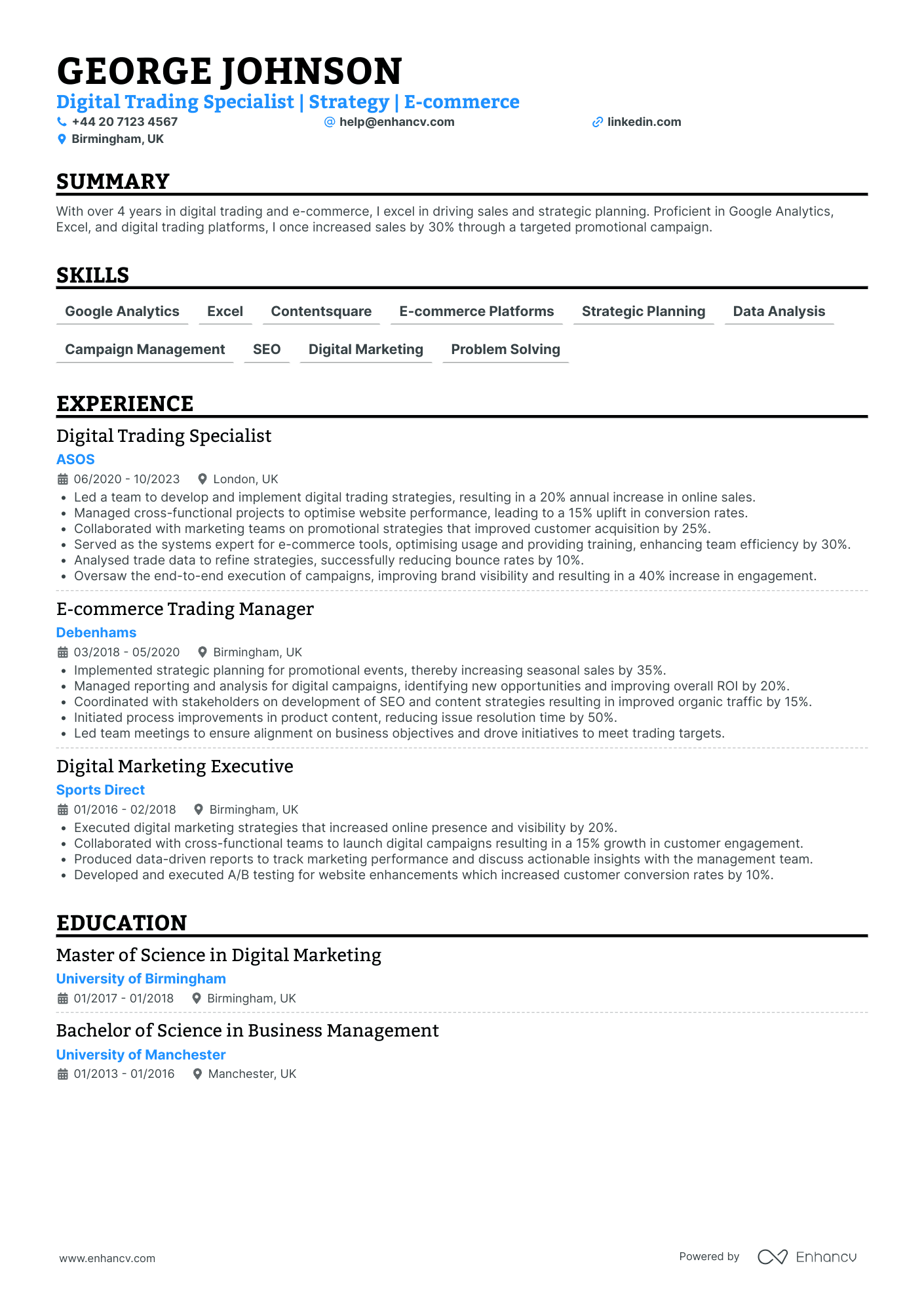
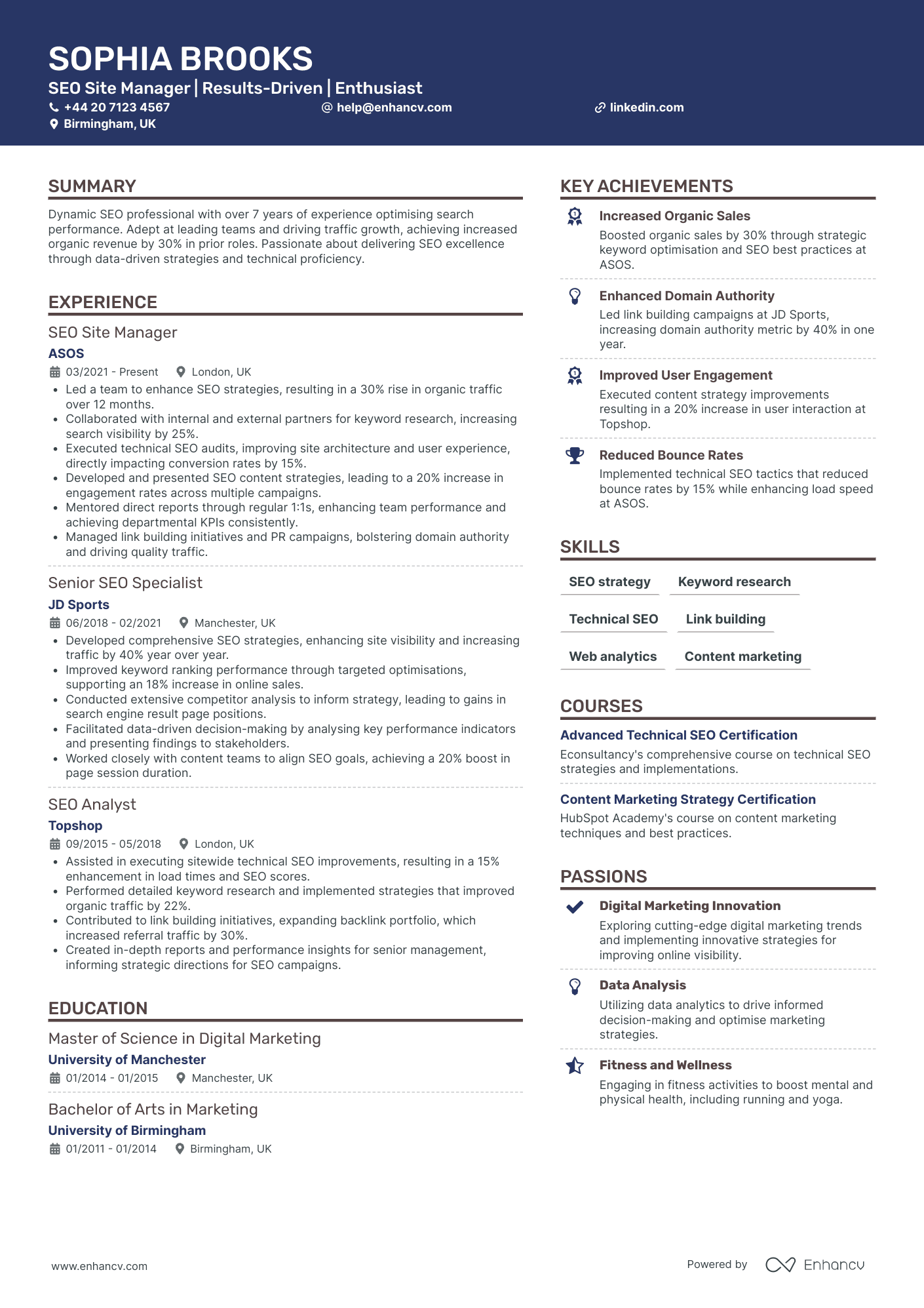
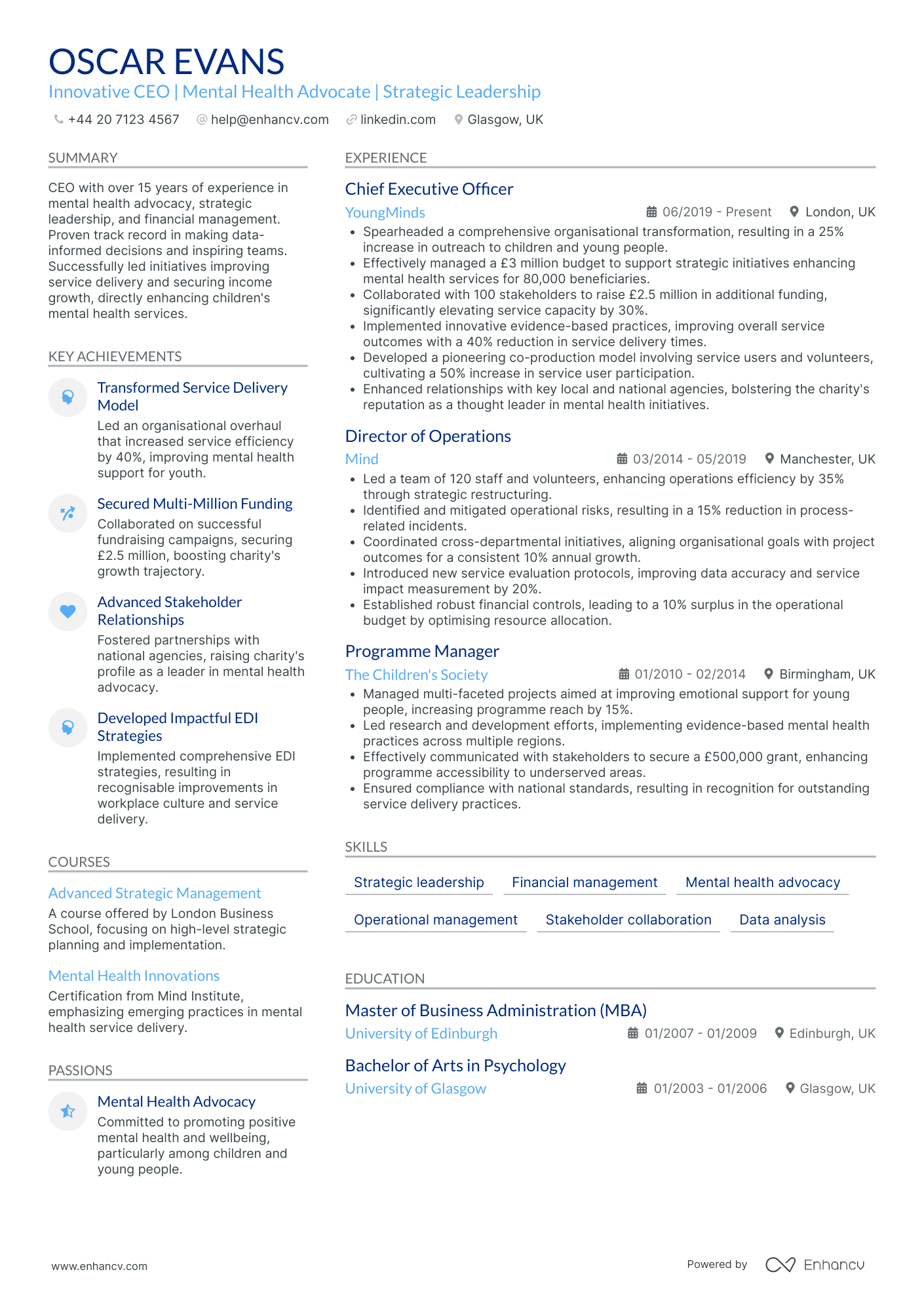
Most CEO CVs read like a job description with a grander title on top. Boards read straight past that. They are betting on a specific kind of leader for a specific moment in a company's life, and your CV either names that moment or it blends into the pile.
A first-time CEO, a serial chief executive, and a divisional managing director stepping up are three different candidates. The strongest CVs decide which one they are on the first line and prove it with results, not adjectives.

Key takeaways
- Decide which CEO you are, first-time, serial, or stepping up, and write the whole CV backwards from that.
- Two pages for most chief executives, three only when decades of board history genuinely need the room. Length reads as an inability to prioritise.
- Lead every role with a company descriptor: turnover, ownership, headcount, and stage.
- Quantify outcomes, not duties. Revenue, margin, valuation, and retention are the language boards read in.
- Open with a personal statement that names the value you create and the proof, never a wall of adjectives.
- Keep education short and give non-executive and board roles their own space.
Match your CV to the CEO role you're targeting
Start by naming the seat you want, because the evidence a board looks for shifts with it.
A first-time CEO is asking a board to take a bet. Lead with the profit and loss you already ran, the team you built, and the moment you made a call a chief executive would recognise as their own. Show you have operated one level below the top and reached for the decisions above your pay grade.
A serial or repeat CEO is selling a track record. Open with outcomes across full tenures: what the company looked like when you arrived, what it looked like when you left, and the number that proves the difference.
A step-up candidate, a COO, CFO, or divisional managing director moving into the top job, has one gap to close. Show enterprise-wide ownership, not functional excellence. A brilliant finance leader who never owned the whole result still reads as a brilliant finance leader.
A turnaround or scale-up CEO is a different animal again. Boards hiring for a crisis want evidence you have steadied a business under real pressure. Boards hiring for growth want a scaling story with revenue and headcount curves behind it.
The context matters as much as the stage. Running a listed PLC answerable to public markets is a different job from running a private equity portfolio company on a three-year value-creation plan, which is different again from a founder still holding the shares. Signal early which world you have operated in, and whether you are comfortable moving to another.
Whichever seat you are chasing, write the CV backwards from it. By the end of your personal statement the reader should know exactly which kind of chief executive they are looking at, and why you fit the brief in front of them.
How long should a CEO CV be?
Two pages for most chief executives. Three only when decades of board-level history genuinely need the room, and never as a licence to list everything you have ever done.
Seniority tempts people to sprawl. A longer career is the reason to cut harder, not softer. Your reader is a chair or a search partner who skims dozens of these a week, and every extra page reads as an inability to prioritise.
Give the last ten to fifteen years the space. Compress everything before that into a short early-career line. Nobody shortlisting a CEO needs four bullets about a graduate scheme from the 1990s.
Cut anything a chief executive is simply expected to have done. The reader assumes you can chair a meeting and read a balance sheet, so those lines waste space that a real result would earn. Keep what only you could claim.
A fuller board pack or a dossier for an executive search firm is a separate exercise. The CV that opens the conversation stays tight. See how long a CV should be for the general UK rule, then err shorter.
What boards and executive recruiters read for
A CEO CV rarely goes into an online form. It lands with a chair, a nominations committee, or an executive search partner, and each of them reads for something specific.
| Who reads it | What they are checking for |
|---|---|
| Chair or board | Fit with the company's next chapter, and whether you can carry the strategy they already have in mind |
| Nominations committee | Governance instinct, risk judgement, and how you behave when a decision is unpopular |
| Executive search partner | A clean, quantified track record they can put in front of a client without caveats |
| Investor or PE house | Value created, the multiple returned, and whether the pattern says you can do it again |
Two threads run through all of them. Results expressed as numbers, and judgement expressed as decisions you visibly owned. Everything else on the CV is scaffolding around those two.
It helps to picture the handover. A search partner reads your CV, then has to sell you to a client in a two-line summary. Write the CV so that summary almost drafts itself, with one headline achievement and one clear reason you fit the mandate. Make their job easy and you make the shortlist.
Formatting your CEO CV
Use a reverse chronological structure. At this level your progression is the argument, so let it run cleanly from top to bottom.
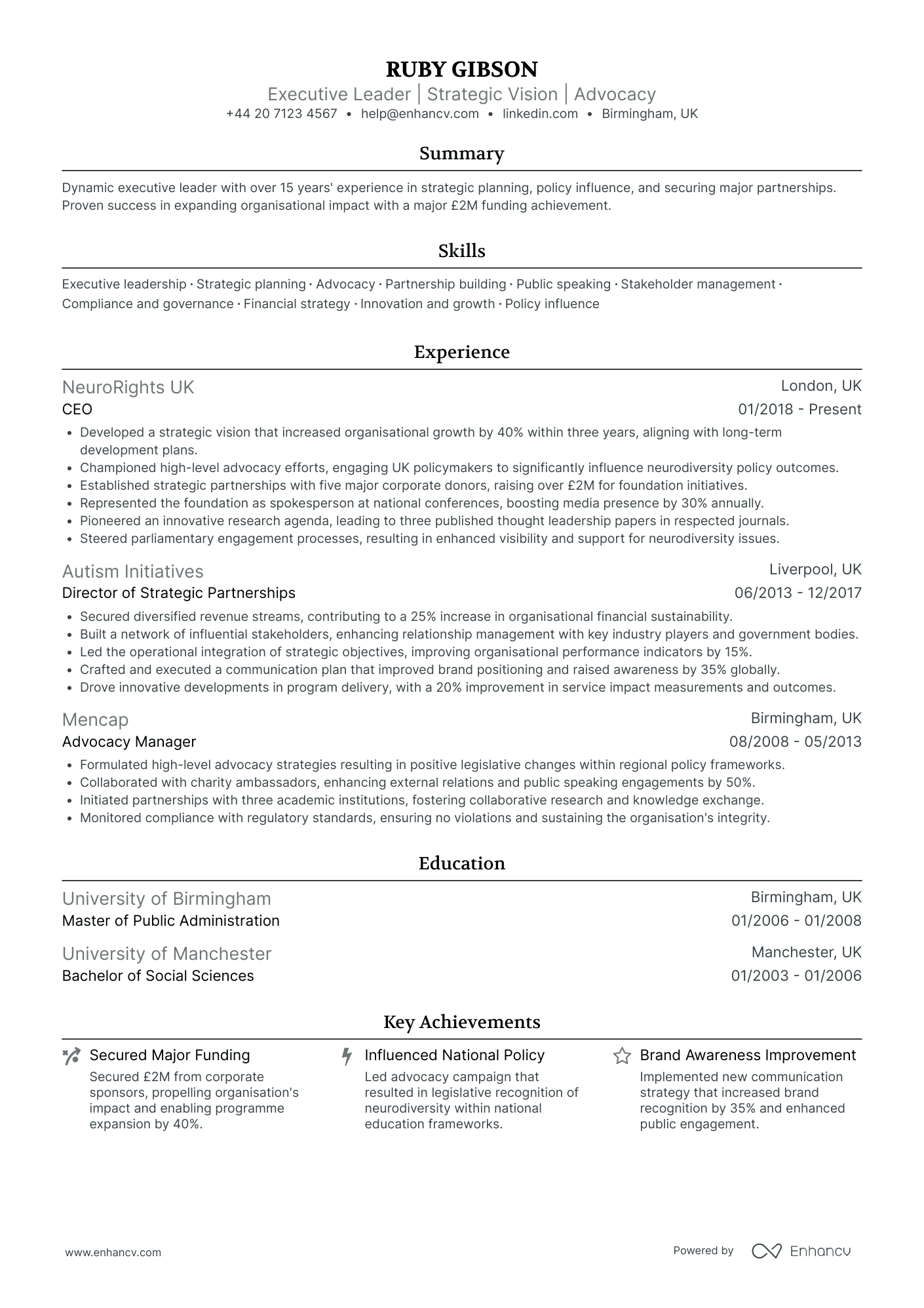
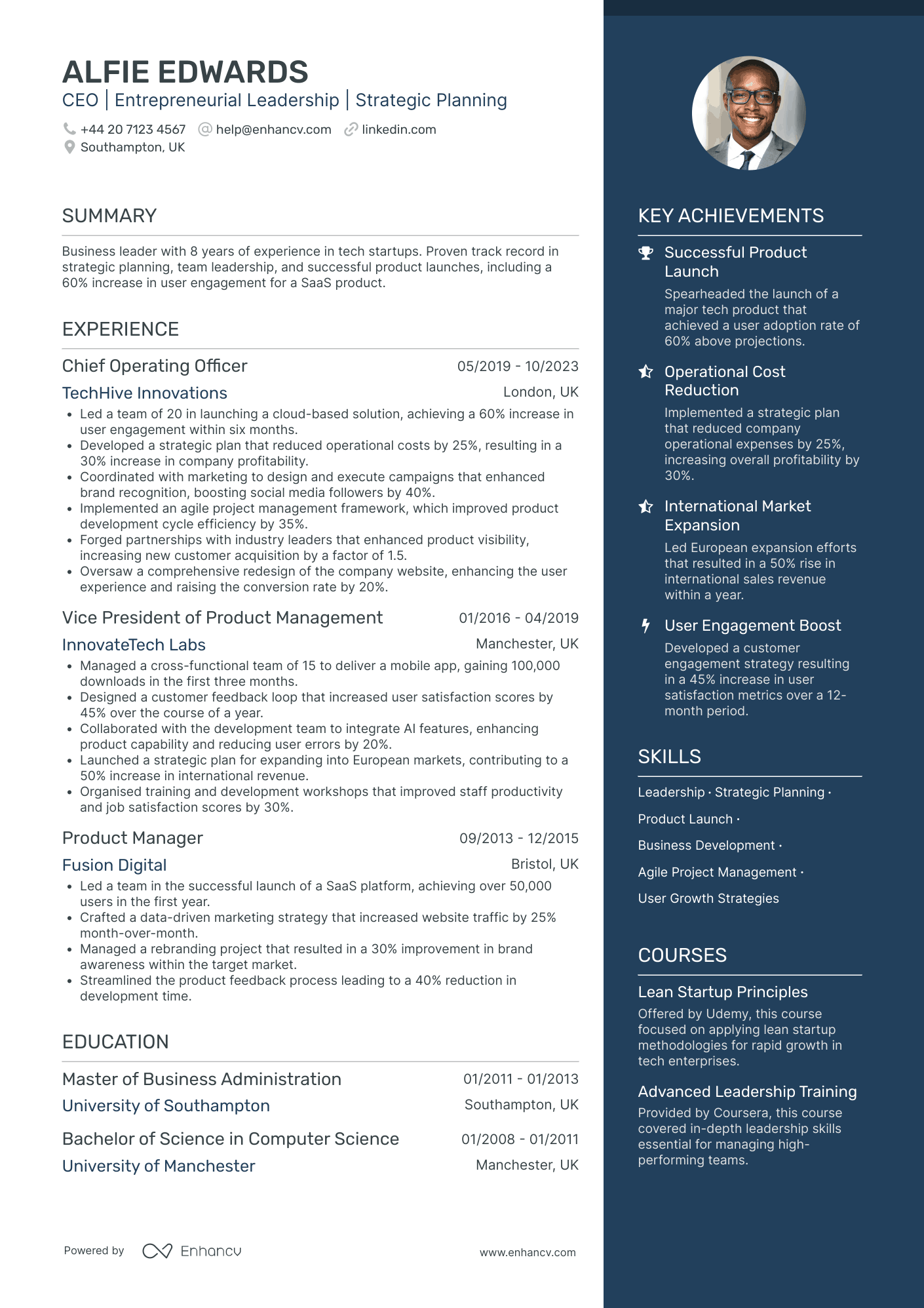
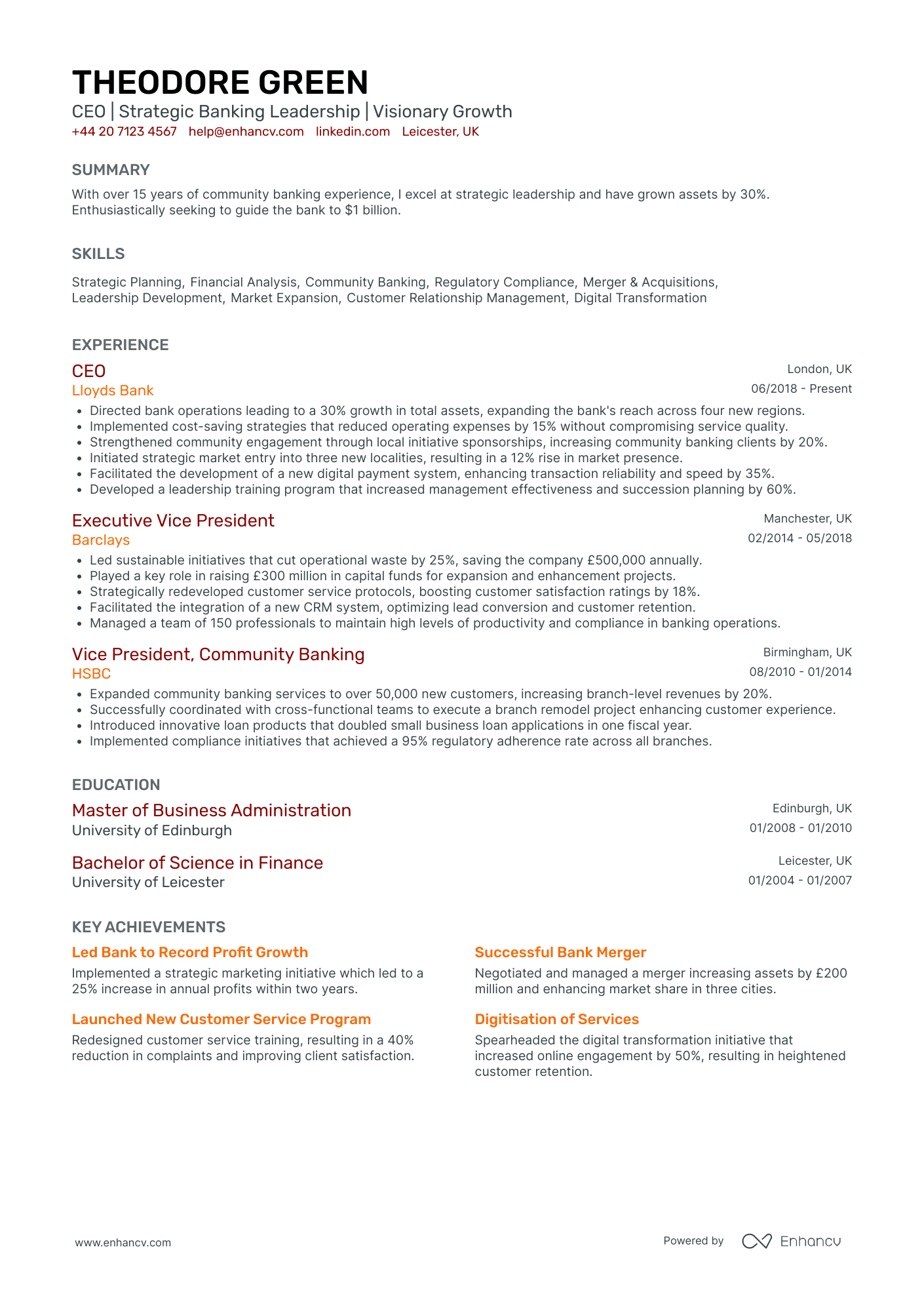
Keep it to one column, standard headings, and a serious, readable font. A CEO CV should look like a board paper, not a design portfolio. Restraint itself signals seniority.
Send it as a PDF so the layout holds on whatever screen the chair opens it on. Keep a Word copy for the search firm, which will often reformat it into a house template.
Executive applications still pass through recruiters and, increasingly, tracking software, so keep the layout clean and the headings standard for an ATS-friendly CV. Build it from a tested layout rather than a blank page. Enhancv's CV templates export to a clean PDF that reads well in print and on screen.
Writing your CEO personal statement
Four or five sentences at the top that answer one question: what kind of company do you make better, and what is the proof? This is your personal statement, sometimes called an executive summary.
Lead with the result, not the label. "Transformational leader with a passion for excellence" is the sentence a board has read four hundred times, and it gives them nothing to check.
Name the scale you operate at, the value you have created, and the situation you are built for. Then get out of the way.
Keep it in the first person by implication, dropped pronouns and all, the way board papers are written. Every clause should carry a fact a chair could quote back to the nominations committee.
CEO personal statement example (scale-up)
Chief executive who grew a UK SaaS business from £8m to £34m in annual recurring revenue over four years, scaling the team from 60 to 240 and closing a £25m Series C. Turned a founder-led business into a repeatable commercial engine, delivering two profitable years and a board that renewed my mandate twice. Now looking to lead a technology company through its next stage of growth, ideally towards an exit or IPO.
That works because it names a company a board can picture, backed by numbers it can trust. Now the version that fills most executive inboxes:
CEO personal statement to avoid
Visionary and results-driven senior executive with over 20 years of experience across multiple industries. A strategic thinker and inspirational leader passionate about driving growth, building high-performing teams, and delivering shareholder value. Seeking a challenging C-suite role in a forward-thinking organisation.
When we review a CEO CV, we skip the adjectives and hunt for one thing: a before and an after with a number in between. "Grew recurring revenue from £8m to £34m in four years" tells us more about your judgement than any paragraph about vision ever will. Boards buy the pattern in your results, not your personality, so make that pattern impossible to miss in the first six lines.
Writing your CEO experience section
Each role gets a dated heading, a one-line brief on the company's size and situation, then bullets that lead with a verb and land on a number. For the mechanics, see work experience on a CV.
The context line matters more at this level than anywhere else. "£40m turnover, private equity-backed, 300 staff" tells the reader the weight of every decision that follows.
Then quantify the result, not the activity. Boards read for achievements: revenue, margin, valuation, retention, and the size of what you were accountable for.
Separate what the company did from what you drove. "Revenue grew 40%" is a fact about the business, while "grew revenue 40% by moving the business upmarket and rebuilding the sales team" is a fact about you. The verb and the mechanism are where your judgement shows.
Tailor it to each mandate too. A search partner briefing for a turnaround wants your crisis record first, while a growth board wants the scaling story. Enhancv's CV tailoring feature reads the brief and flags which achievements to lead with, so you are not rewriting the whole CV for every approach.
- Grew annual recurring revenue from £8m to £34m in four years by rebuilding the commercial team and moving the business upmarket into enterprise accounts
- Led a £25m Series C round, winning over three institutional investors after an earlier process stalled
- Took EBITDA margin from minus 12% to plus 18% while scaling headcount from 60 to 240
- Restructured the executive team, hired a CFO and a CRO, and cut customer churn from 22% to 9% year on year
- Steered the business through the 2020 disruption with no compulsory redundancies and a return to growth within two quarters

PRO TIP
Put a one-line company descriptor next to every title: turnover, ownership, headcount, and stage. At CEO level the reader judges your results by the size and difficulty of the arena you played in, and a £2m family firm and a £200m PE-backed group are different sports.
Handling short tenures, gaps, and a non-linear path
Executive careers are rarely tidy, and boards know it. What they will not forgive is a short stint or a gap you try to hide.
Name a short tenure and own the reason in a single confident line: a private equity exit, a mandate delivered early, a strategy the board changed under you. A clean explanation reads as judgement, while silence reads as a problem.
The same goes for a spell of advisory or interim work. Give it a dated entry with the mandates you took and what each one achieved. See how to frame employment gaps on a CV without apologising for them.
A career that zigzags across sectors is a strength if you frame it as one. Draw the thread the board cares about, whether that is scaling businesses, fixing broken ones, or opening new markets, and let the industries fall in behind it. The pattern is the point, not the logos.
Top skills for your CEO CV
The honest answer to "what are the top five skills of a CEO" is that a board cares less about a list than about proof you have used them under pressure. Name them anyway, because search filters and quick scans still run on the words.
The leadership and strategic capabilities are the hard skills at this level: setting strategy, owning the profit and loss, allocating capital, and steering a board. List them in the language the mandate uses.
The softer qualities that decide CEO hires are real and checkable: judgement, resilience, and the ability to deliver a hard message cleanly. Prove each one in a result rather than claiming it as an adjective.
Do not bury these in a twenty-item cloud. Six to ten skills, each one you could defend in an interview, beats a wall of competencies that reads as filler. A board will test any skill you list, so only list what your record already earns.
Top skills for your CEO CV:
Strategic planning
P&L ownership
Capital allocation
Board and stakeholder management
Mergers and acquisitions
Operational scaling
Financial and commercial acumen
Corporate governance
Judgement under pressure
Decisiveness
Resilience
Influencing and communication
Leading through change
Education, credentials, and board roles
Keep education short and low on the page. At CEO level your degree is context, not a selling point, so a single line per qualification is plenty.
Non-executive directorships, board memberships, and advisory roles earn their own section, and they carry real weight. They signal that other boards already trust your judgement.
List the credentials that matter to your sector, such as chartered status, an MBA, or an INSEAD or IMD executive programme. Skip the certificates that will not move a board.
If you hold formal governance qualifications, a place on the Financial Times non-executive programme, or an Institute of Directors diploma, they belong here too. For a first-time CEO stepping onto a board, they show you understand the duties of the seat, not just the operational job beneath it.
Conclusion
Decide which kind of chief executive you are, then prove it with results a board can trust and decisions you visibly owned.
Keep the document tight, quantified, and tailored to the mandate in front of you. Pair it with a short cover letter that says why this company and this moment, and you turn a strong CV into a real conversation.

Author's take - the Enhancv team
When we review a CEO CV, we skip the adjectives and hunt for one thing: a before and an after with a number in between. "Grew recurring revenue from £8m to £34m in four years" tells us more about your judgement than any paragraph about vision ever will. Boards buy the pattern in your results, not your personality, so make that pattern impossible to miss in the first six lines.